See also
Sahara West to East
Fascinating interview with desert explorer and overlanding author, Tom Sheppard by Scott Brady from Overland Journal.
See also
Sahara West to East
Fascinating interview with desert explorer and overlanding author, Tom Sheppard by Scott Brady from Overland Journal.
See also:
Morocco Maps
Time for my Tablet: Samsung Tab + Gaia GPS vs Garmin Montana
How to trace a tracklog
Michelin 742 Morocco (2024) map review
Map review: Reise Know-How Morocco 1:1m (2023)
In a line
If you have the previous edition, save your money – this time round they’ve made more changes to the cover than the actual map itself.
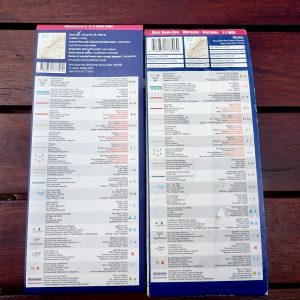
Note: in December 2022 a traveller had his RKH map confiscated at the Ceuta border because it showed ‘Western Sahara‘ – (like all other paper maps, afaik). Actually the back cover (see below right) always gave the impression it is all Moroccan territory, but inside they mark the ‘Moroccan Wall’ and the Polisario ‘Free Zone’, which is correct and more detail than most maps, but might also get up the Moroccans’ noses.
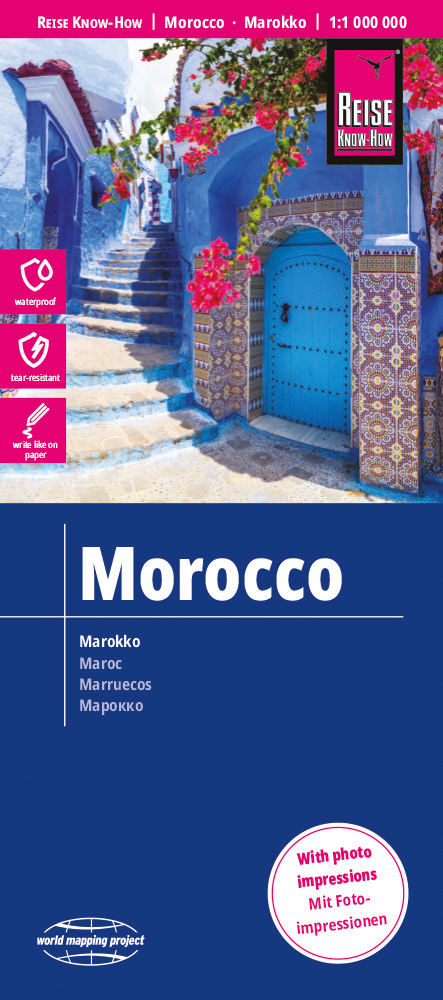
For the very latest mapping digital, OSM updated by users (used by Garmin and many others) is useful. But not everyone gets on with digital maps which are far from perfect of accurate, At the planning stage you can’t beat a paper map spread out before you. Out of habit I routinely carry a 2019 RKH out there, though almost never refer to it now as i know all the southern roads. I have much more success finding unknown pistes as well as verifying newly sealed roads from aerial imagery.
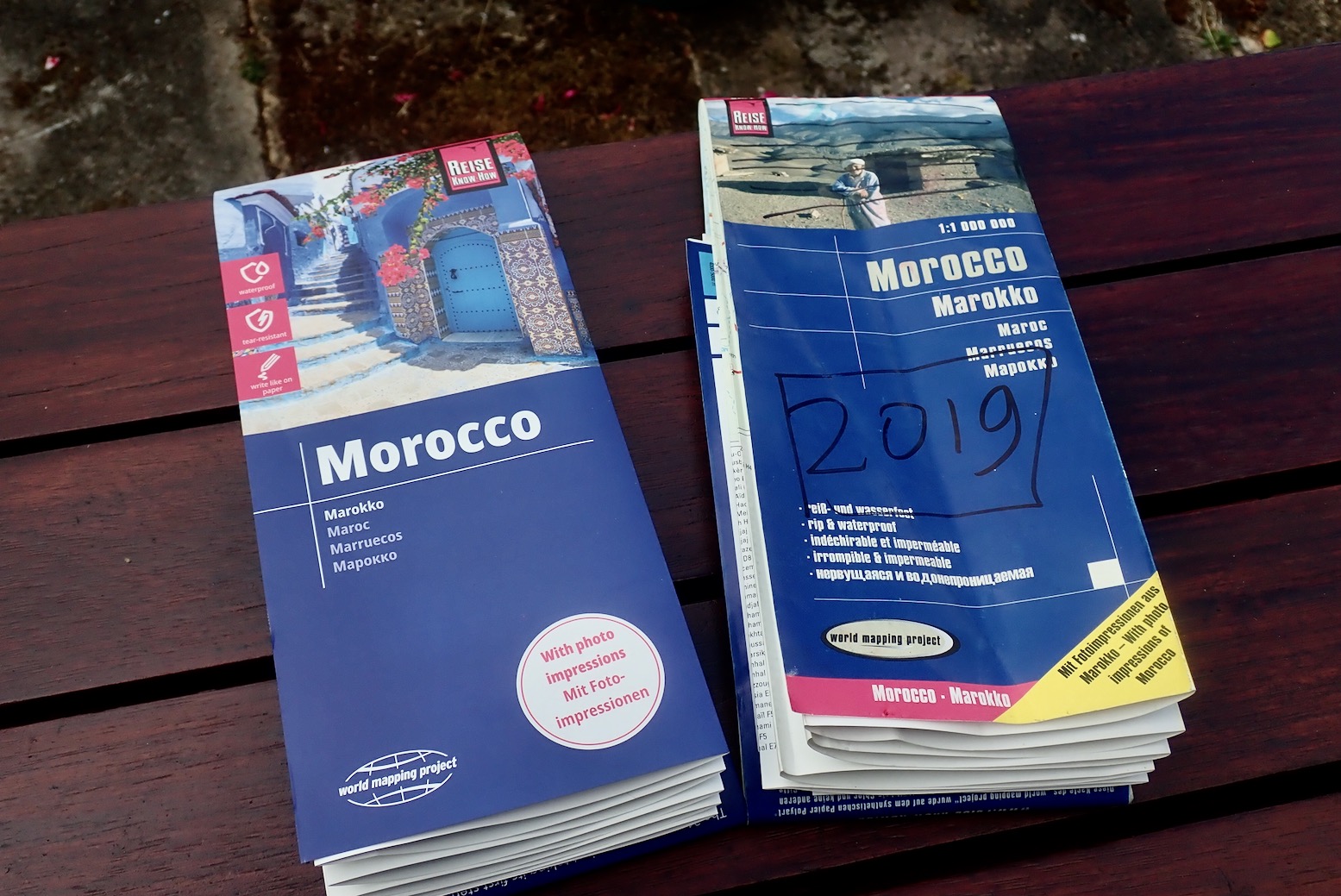
As you can read here, the German Morocco Reise Know-How (RK-H) is one of the least bad paper maps for Morocco. It’s double-sided, the plastic paper is tear-proof and compact at 70 x 100cm, and it has an intuitive 1:1m scale (1mm = 1km). They also show both old/new road numbers which changed in 2018, but unlike Europe, this information is of little use in Morocco (* see bottom of page).
In 2023 RK-H published the 13th edition of this map. The big question is, given the amount of road-building going on in Morocco, is it a properly updated edition like the previous one, or just a new cover with a few updates, as Michelin like to do? The answer is that in the south there appear to be virtually no changes to the actual mapping in the 2023 edition.
What they say
Reise Know-How maps are characterized by particularly stable plastic paper that can be written on like paper, even with a pencil. The cardboard cover is detachable so that the card can easily be slipped into any pocket. A protective cover is not required. The cartographic presentation focuses on the most important information for travelers and is particularly easy to read. Colored elevation layers are used instead of hillshading.
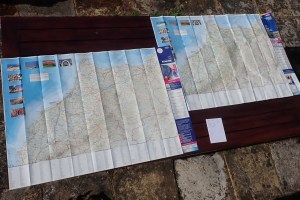
With the 2023 edition laid out alongside my crumpled 2019, what’s new? The cover; that’s about it, but it does include a redesign of the back cover too! Even the decorative pictures on the northern side of the map are unchanged. I may have missed some of course, but a few minutes scanning familiar roads and pistes in the south brought up precisely two changes, maybe three. Everything else appears identical.
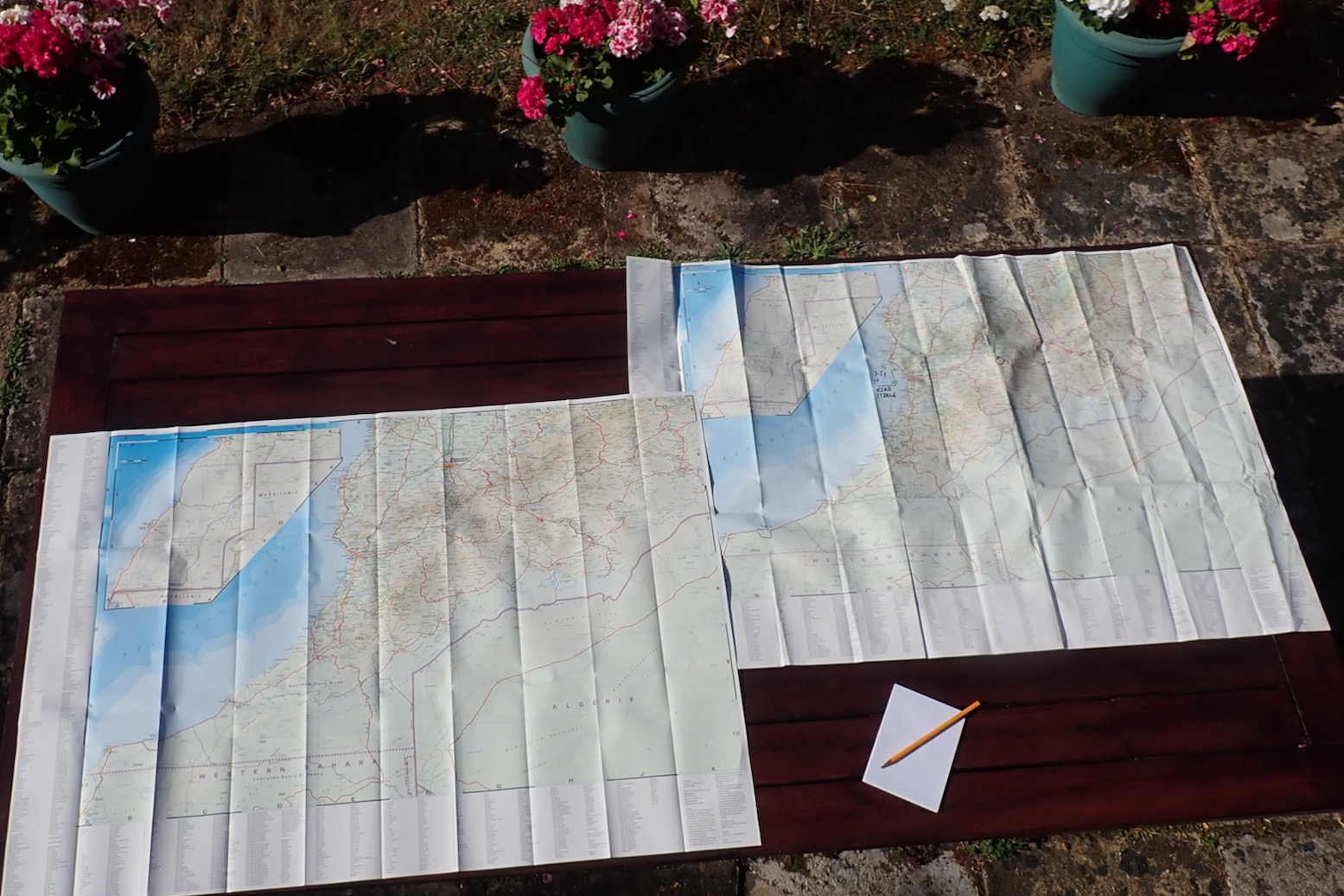
1. What was a yellow ‘Secondary Road’ for Route ME4 (Korima Pass in Morocco Overland 3) has now changed to ‘Track’ although it was actually a ‘Gravel Road’ imo. It suggests a user’s correction was actioned, but ironically it’s now sealed up to KM41 or beyond. I bet there are many more sealed roads let alone tracks on the nearby Rekkam plateau.
2. Another former road they’ve admitted was a piste all along is the R704 (Route MH1) High Atlas crossing from Dades Gorge to Agoudal. Again, the irony is that piste is about to be sealed too!
Thirdly, down in WS in the bottom left corner they switched ‘Laayoune’ with ‘El Aioun’ on the main panel in line with the inset; it was probably a typo.
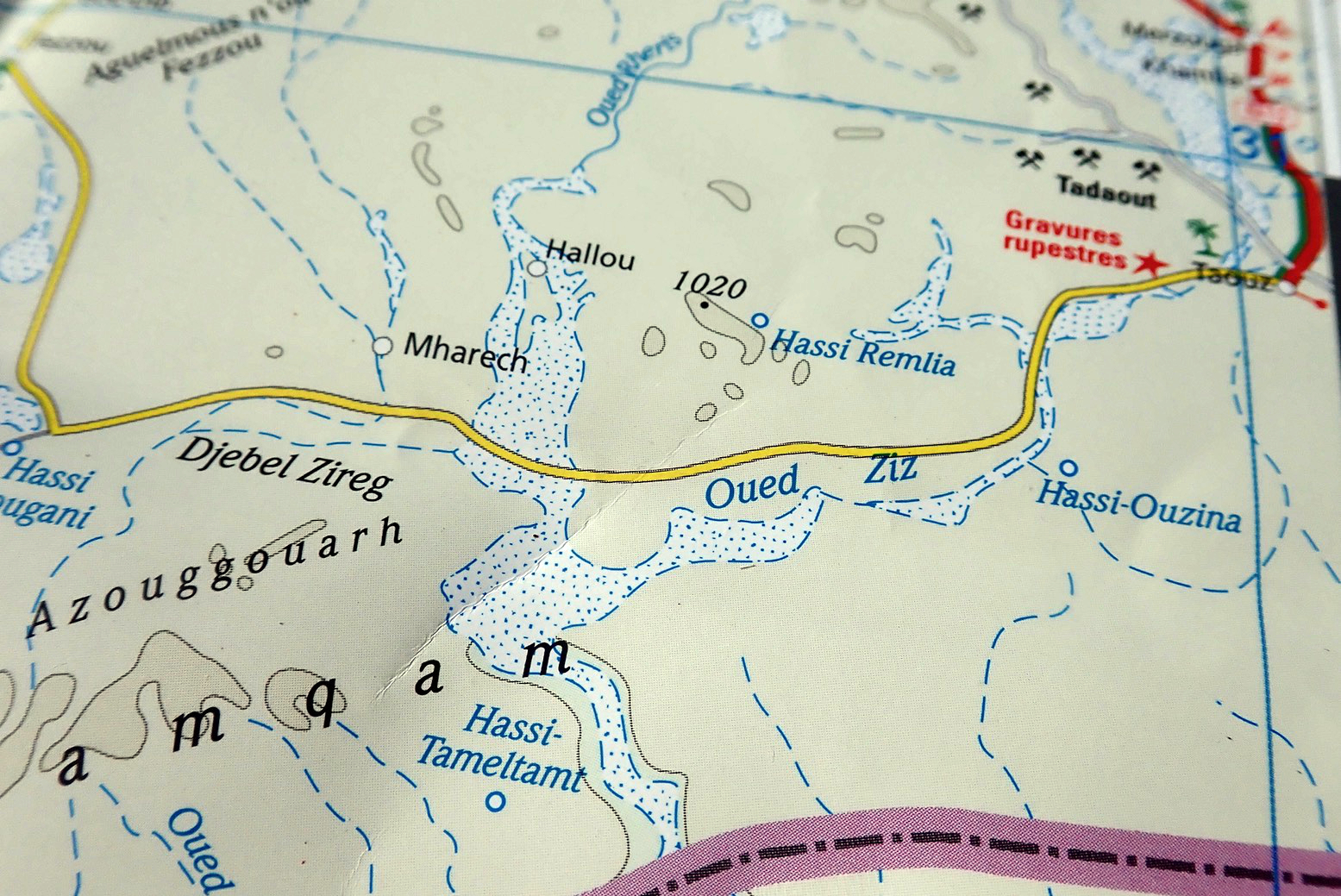
Elsewhere, right across the area I know well (not the north), pistes and even roads are still missing (Route MW6 to Labouriat) while many more pistes have become roads, in some cases over a decade ago, eg: Routes MW1/2/7 to Mseid; Route MH6 from Aguim as well as Routes MH7/8 south and west of Asakoun and Route MH4 Jebel Saro, etc, etc.
Old edition and new, Route MS6 (left) is shown as a secondary road all the way to the Sidi Ali Tafraoute (bafflingly shown as a well: ‘Hassi Fougani’ on the map). Imagine arriving at the notorious Rheris crossing in your campervan! But west of Sidi Ali they miss out the well-used track carrying on directly to Zagora just south of Oum Jrane. And I’ve just noticed in the WS panel on both editions they’ve shown the 1000-km Tindouf Route as sealed all the way (via the PFZ no less) to Zouerat, complete with bypass! No wonder Moroccan hats are confiscating this map at the border. You can understand them not keeping up with all the asphalting, but the practise of calling a piste a road is hard to fathom. Where do they get this information – QAnon?
These are just a few of the glaring errors that jumped out at me. There are loads more in the Anti Atlas, plus areas depicted as forest which are barren mountain hillsides and contour shading that jumps in 300- and then 600-metre stages. That means within one shade the elevation could change by nearly 2000 feet. Not a great map for push biking then.
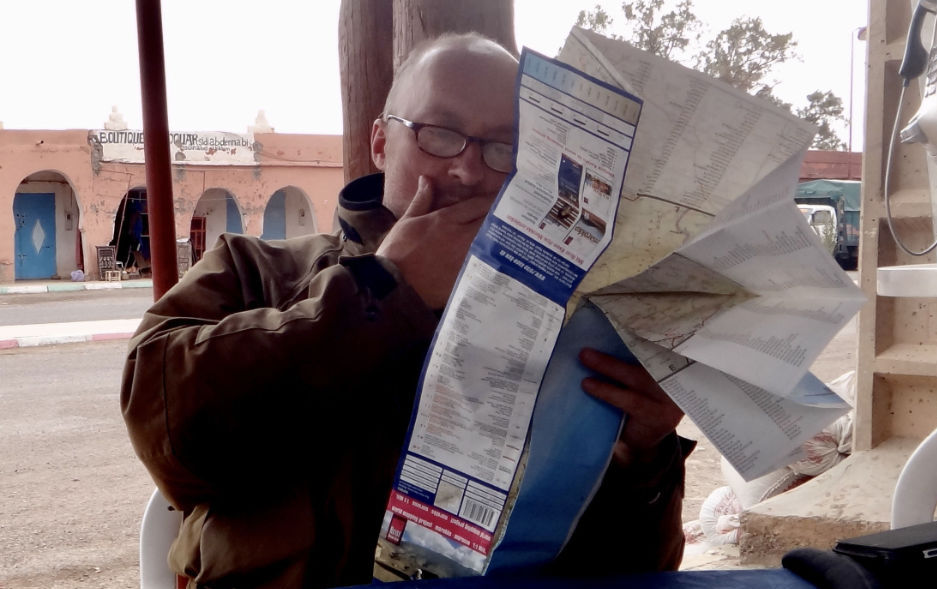
To be fair the previous edition did appear to be a genuine update with tangible changes but this edition is near identical to its predecessor. And I know the Michelin equivalent follows the same practise of ‘cover updates’ and can be just as flawed, last time I looked. All the others maps for Morocco are even worse. Sadly, this appears to be the state of paper mapping in the early 21st century – the money no longer exists to update maps properly, nor even action users suggestions. Good thing then there is Morocco Overland with Updates & Corrections as well as the Horizons forum taking up the slack for the adventurous traveller. I gave the 2023 map away.
* Are Moroccan road number even useful?
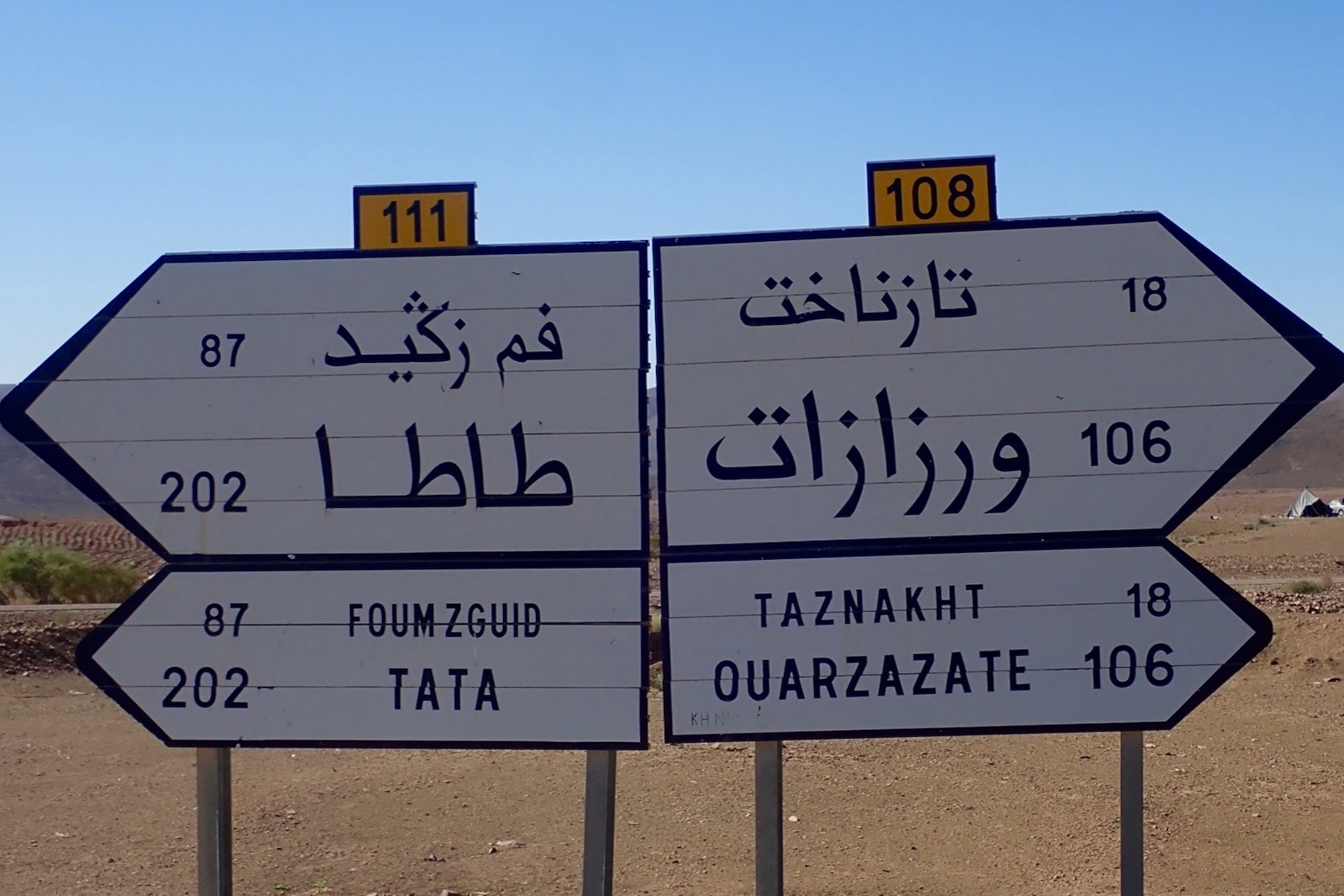
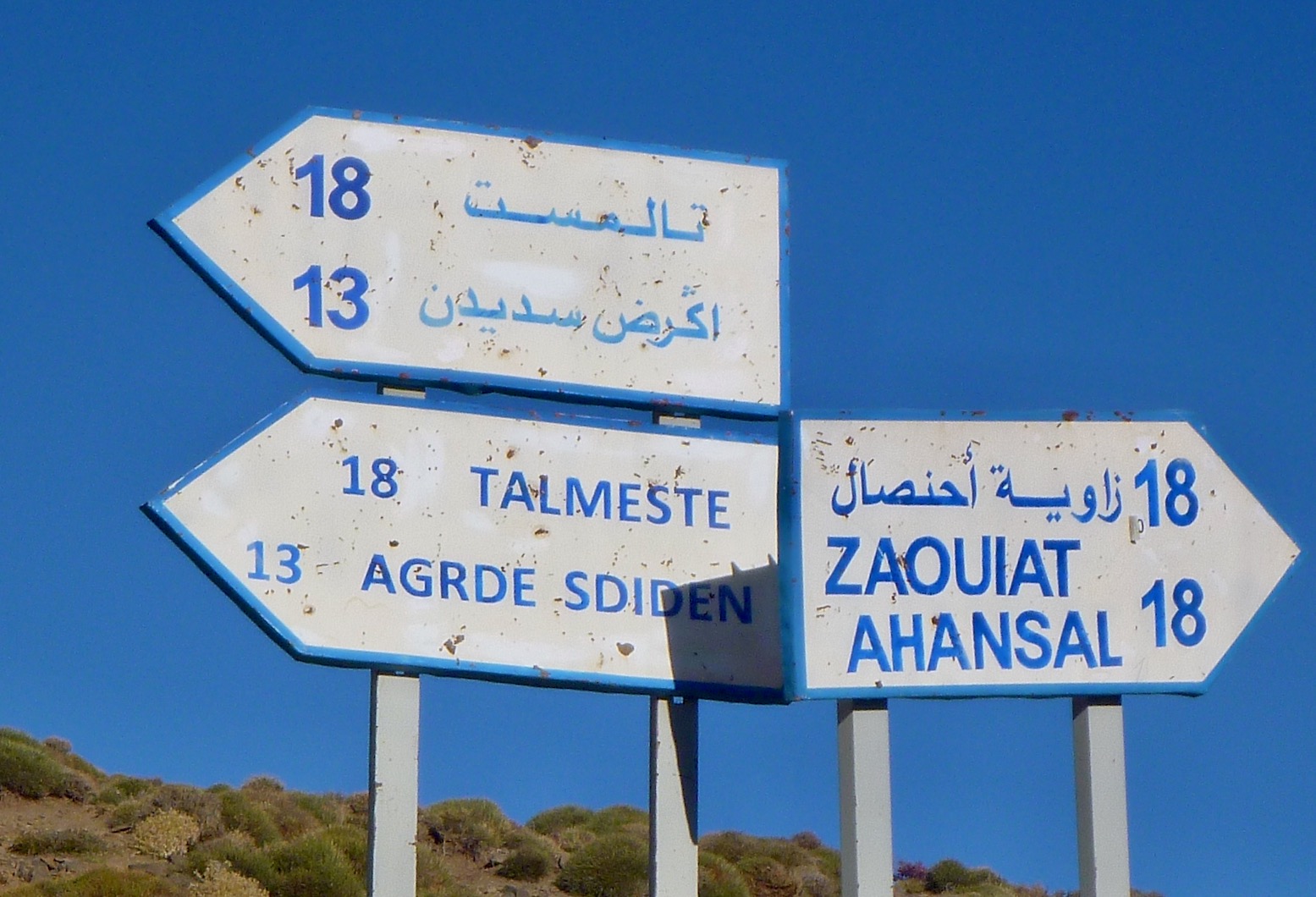
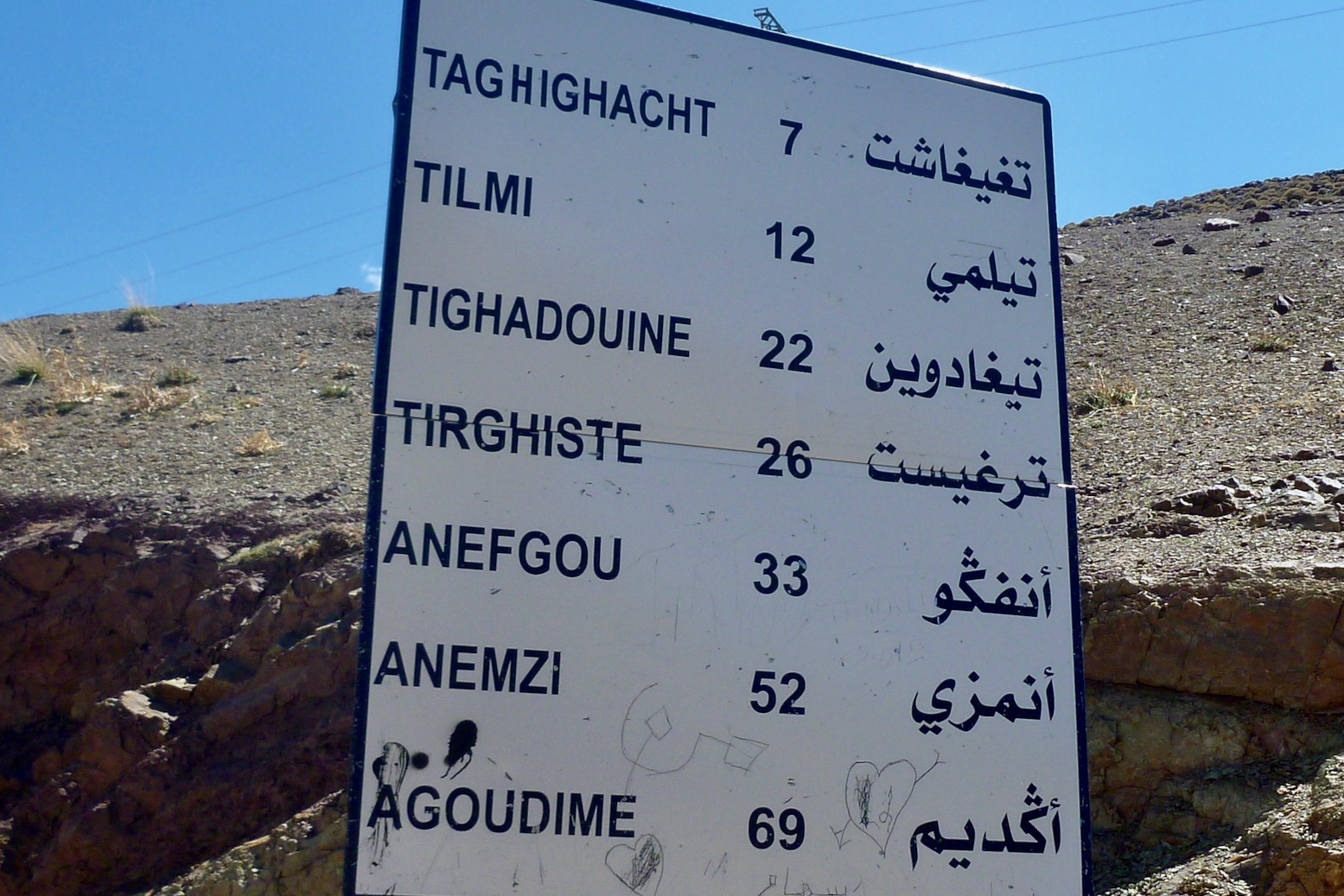
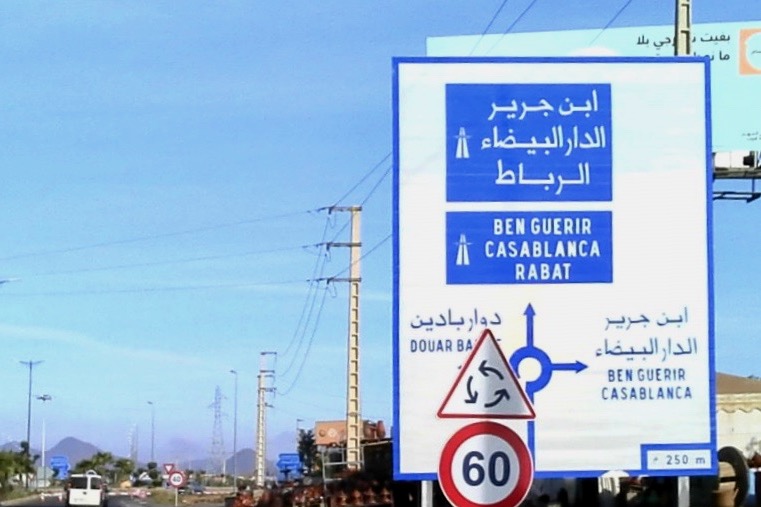
Unlike in the UK and Europe, in southern Morocco road numbers rarely appear on road signs, be they at junctions or showing distances. First photo is a positive example, below. So knowing – or wondering if – you’re on the R504 now called the RN4 will be near impossible to ascertain on the ground and therefor of little value. Of course a road sign saying ‘Foum Zguid 87 [km]’ will be what you want to know.
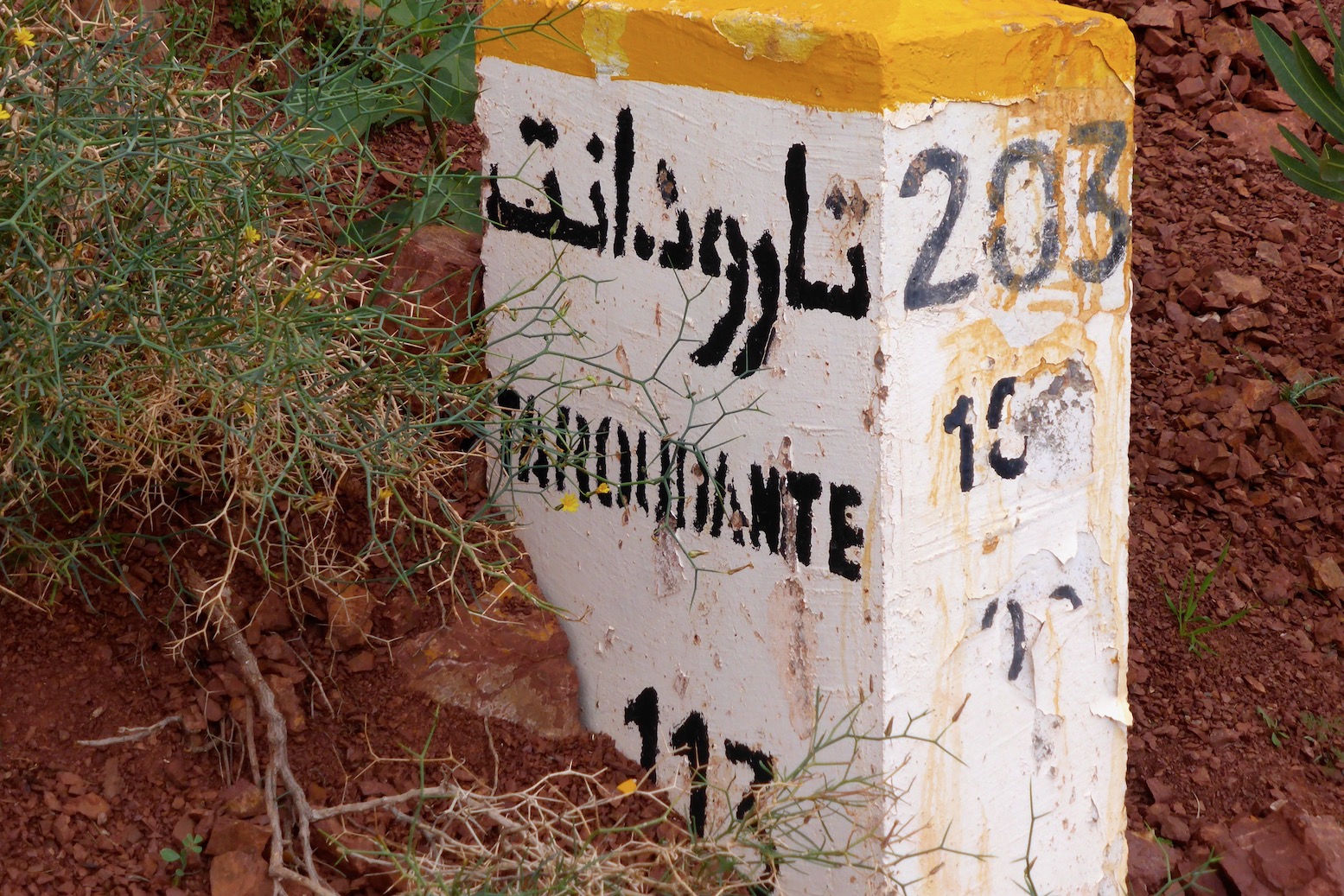
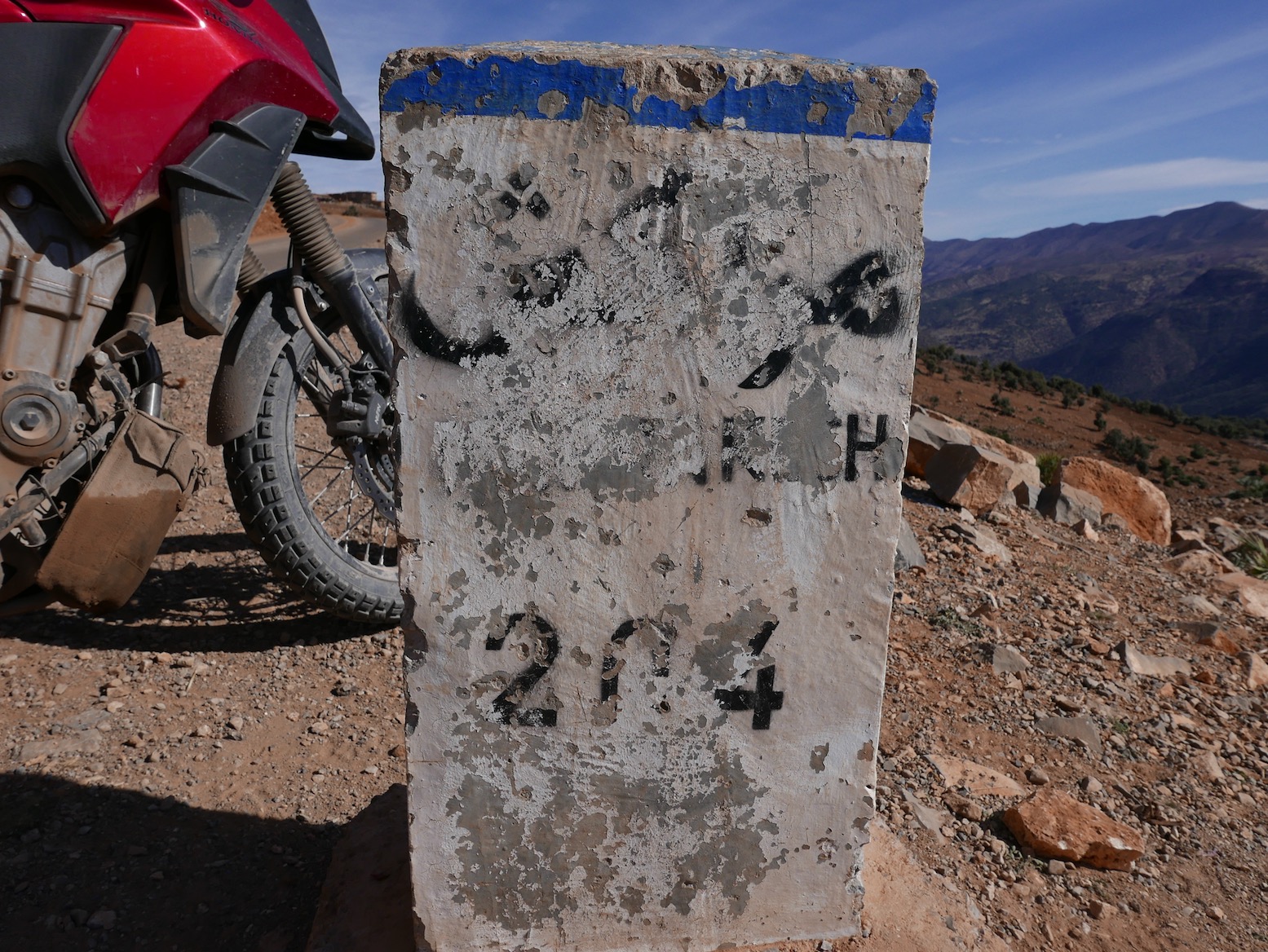
Infrequent and often weathered mileposts dating from the colonial era may show a road number. Example: the R203 Marrakech – Taroudant road via Tizi n Test, now called the RN7.
In most cases in the 2018 shake up, only the prefix changed so the ‘N10’ became the ‘RN10’ and so on, but elsewhere if there was a new number like the old N12 now called the RN17, I am fairly certain no one has since gone around Morocco updating mileposts and road signs.
See also: Empty Quarter 2006
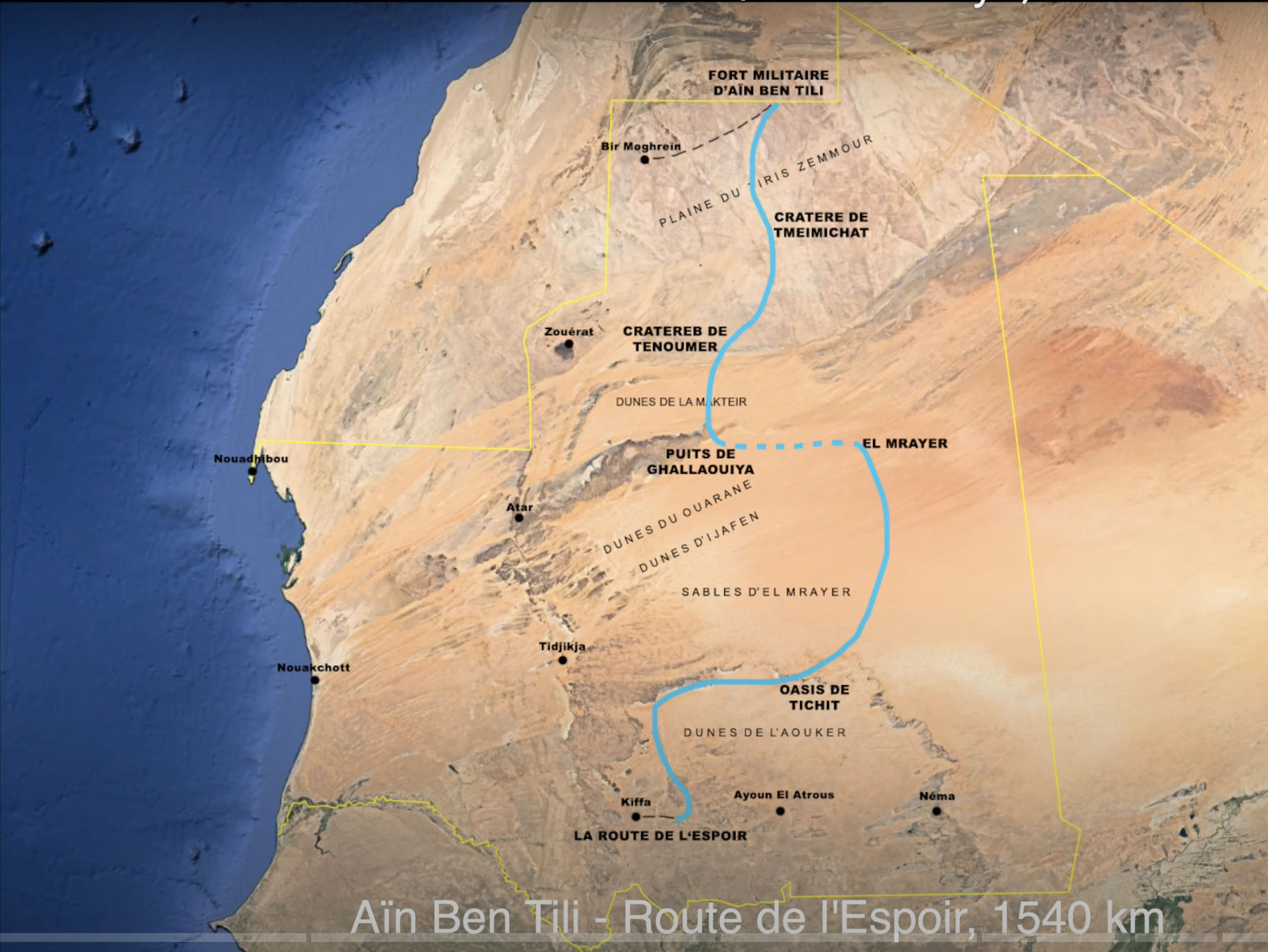
Mauritania and Citroen 2CV specialist, Cyril Ribas supports his son Evann as he cycles his Gorille e-MTB fatbike from Aïn Ben Tili on the PFZ frontier south for over 1500km to the Route d’Espoir highway paralleling the Senegalese border.
Cyril is recharging spare bike batteries as he tracks his son’s progress while keeping out of sight. Evann has to keep the e-bike in Eco power mode to extract up to 130km in a day.
The northern half of the route is relatively flat but from Ghallaouiya, east of Guelb er Richat they must cross the Mrayer Sand Sea before entering the tussocky region leading down to Tichit and the Aouker basin.
As you’d expect, there are some sublime drone images of the immense desert.
See also:
Toyota Prado TX rental
Duster 2 a few months later

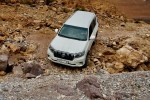
Drive around southern Morocco and you’ll see loads of Dacia Dusters. The Renault-owned Romanian brand has a factory in Tangier where Docker vans and Lodgy MPV taxis are also assembled. You’ll see those everywhere too.
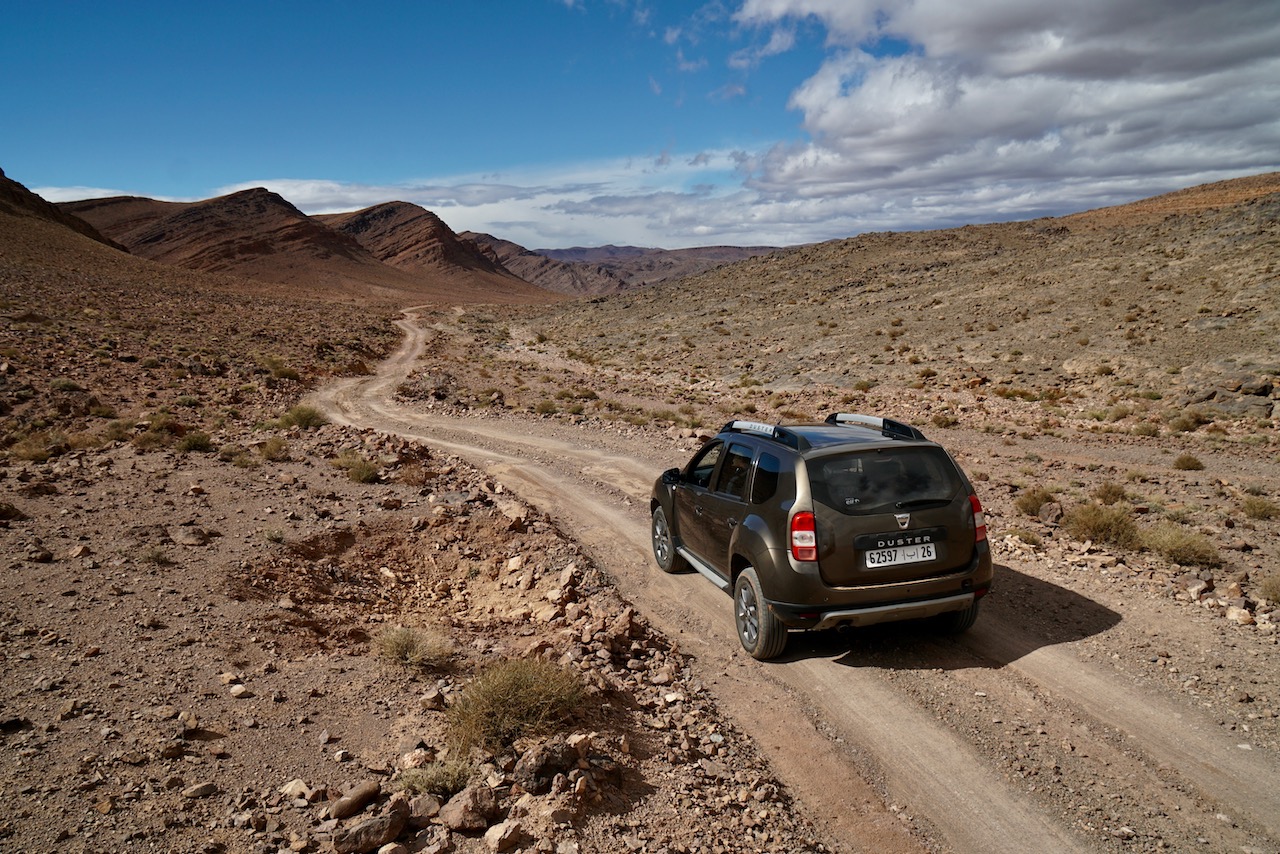
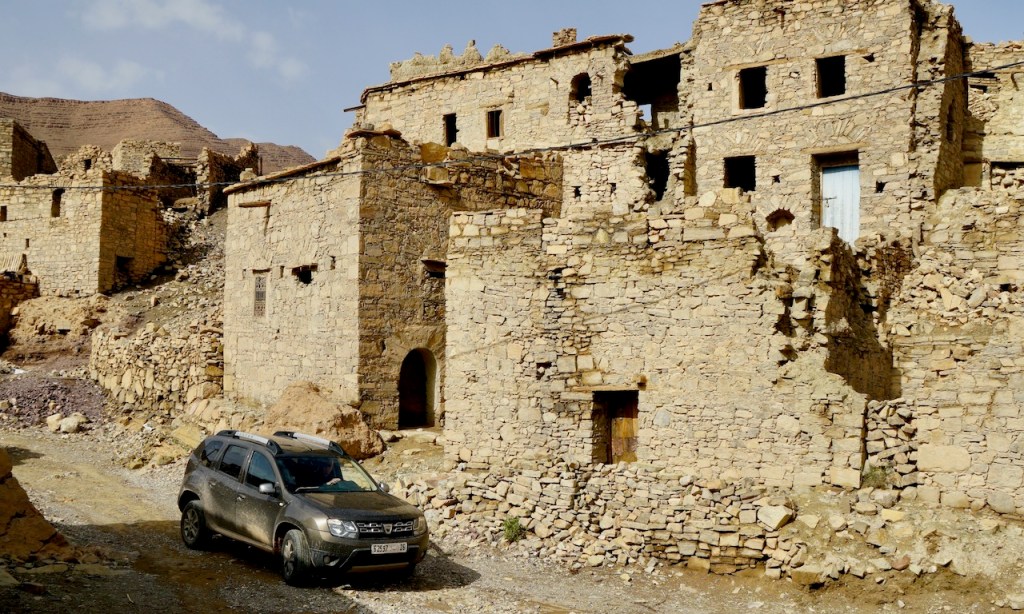
After spending a week in a Prado TX (right; more about that job here), I rented a Duster from Medloc to start work on Morocco Overland IV with a pal.
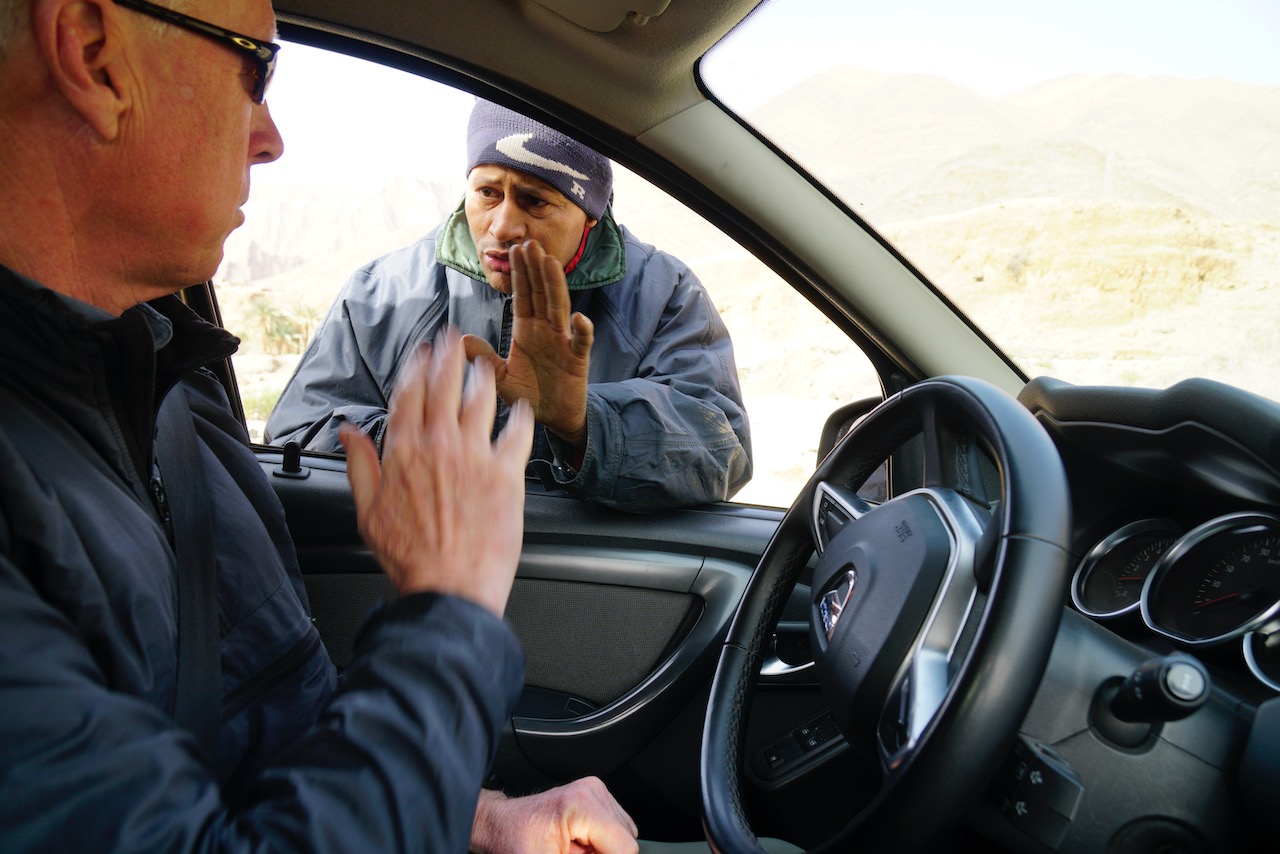
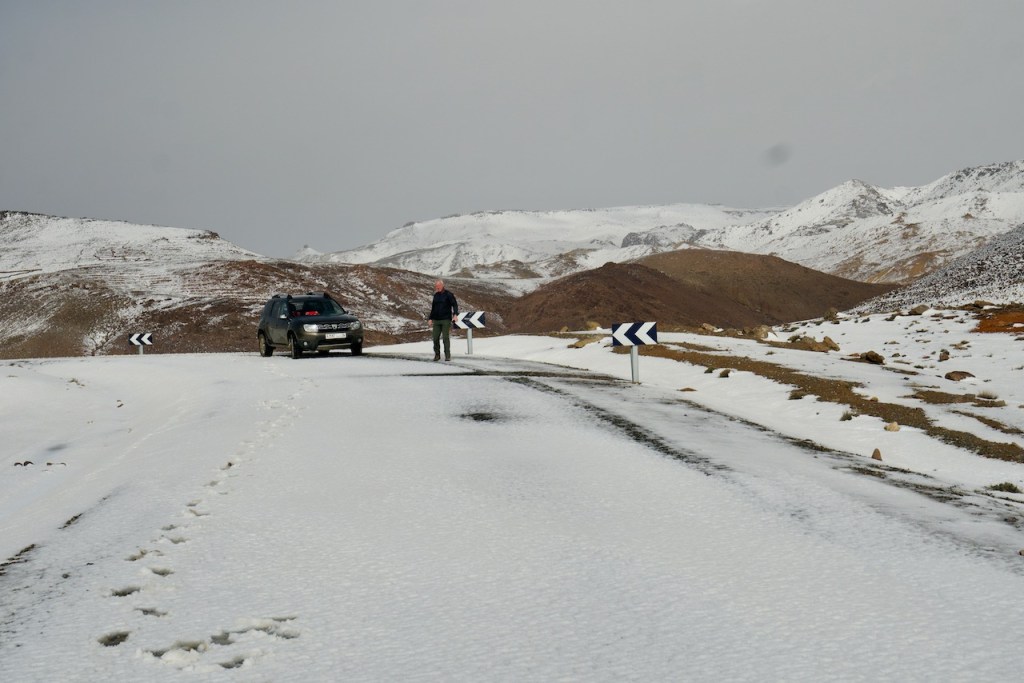
I’d spent the preceding weeks on Google Maps, Bing and BaseCamp, extracting a whole new tangle of routes right across southern Morocco, way more than I’d manage to cover in 12 days driving. Sadly my tally turned out to be even less than hoped when the weather turned during the Ineos job, ruining their route, snowing up passes down to 1800m and wreaking flood damage, landslides and transient floods across the land.
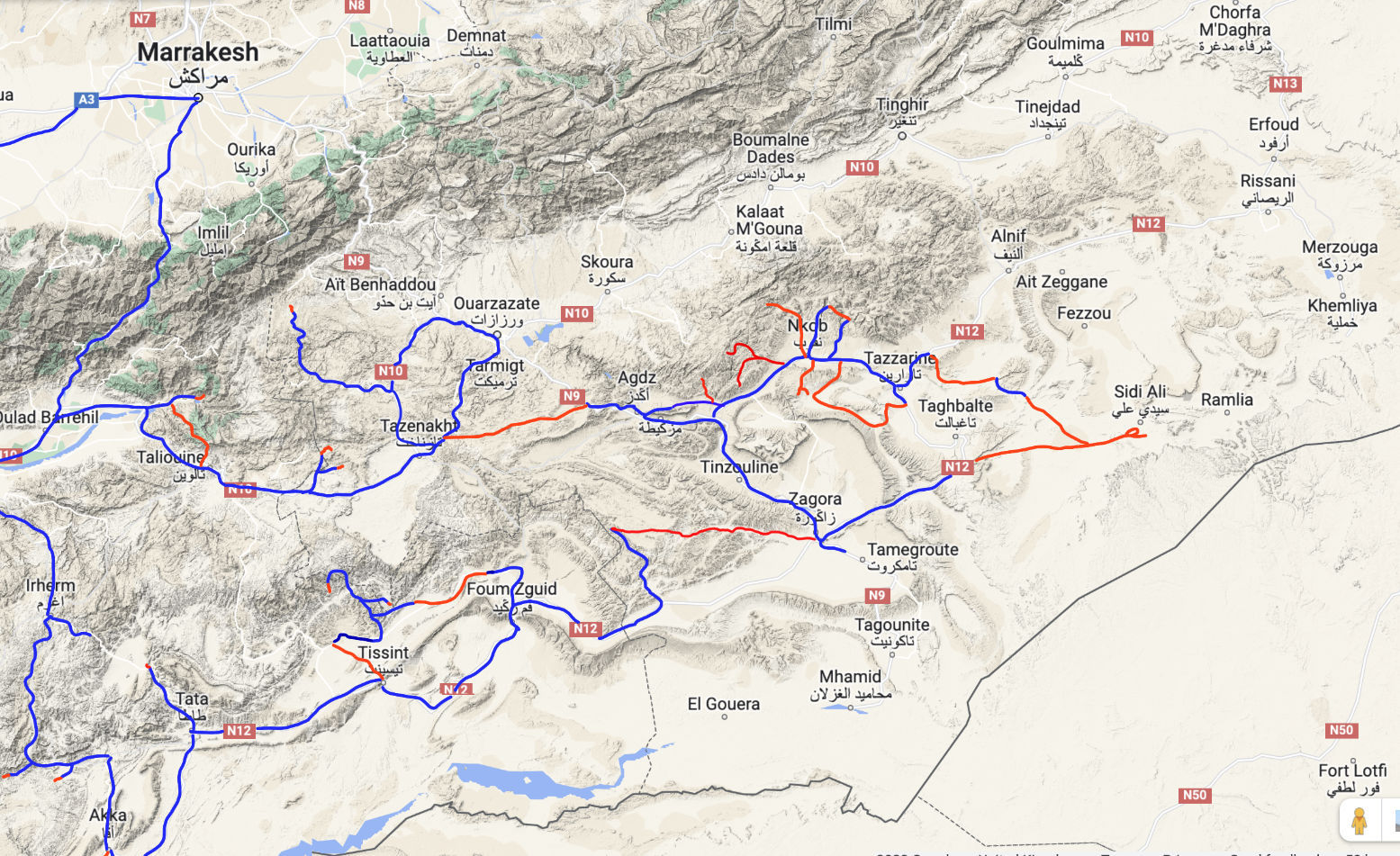
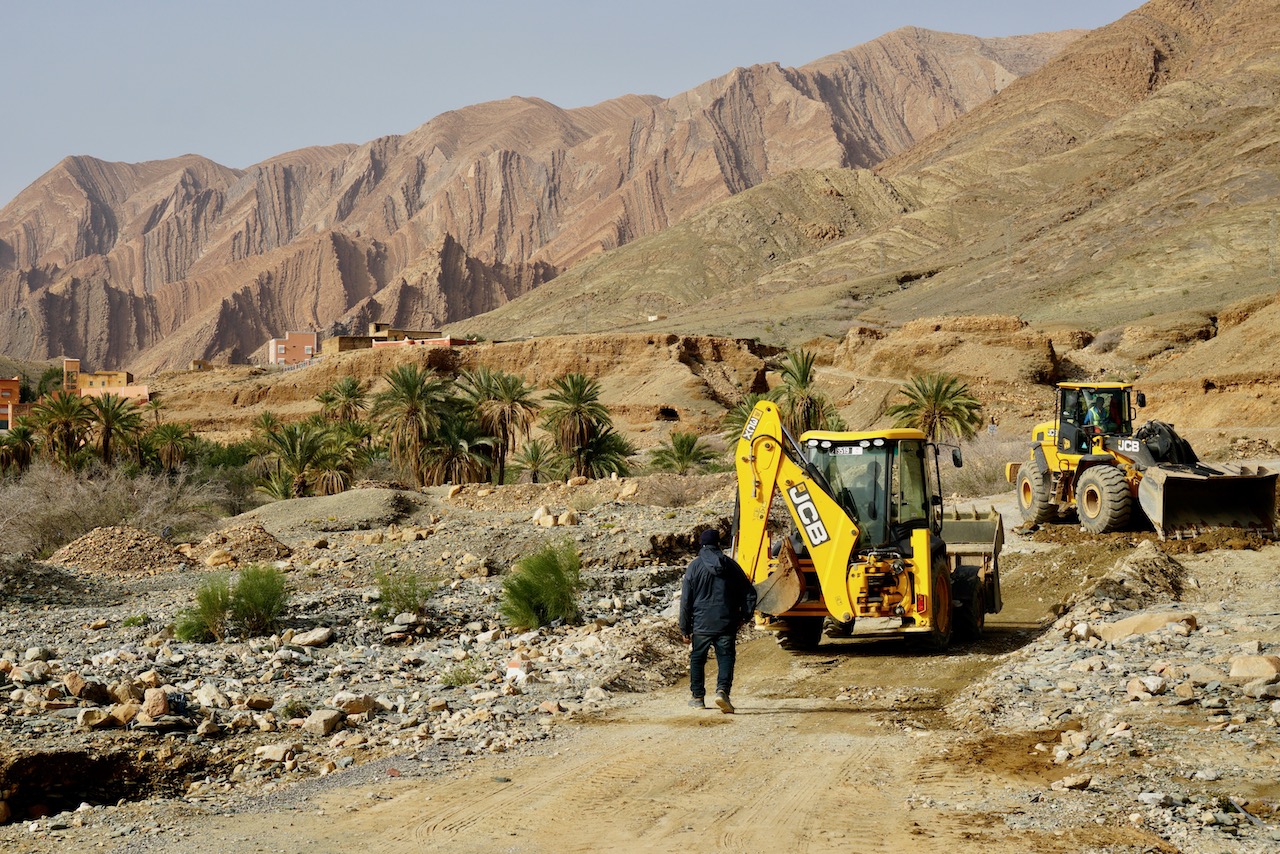
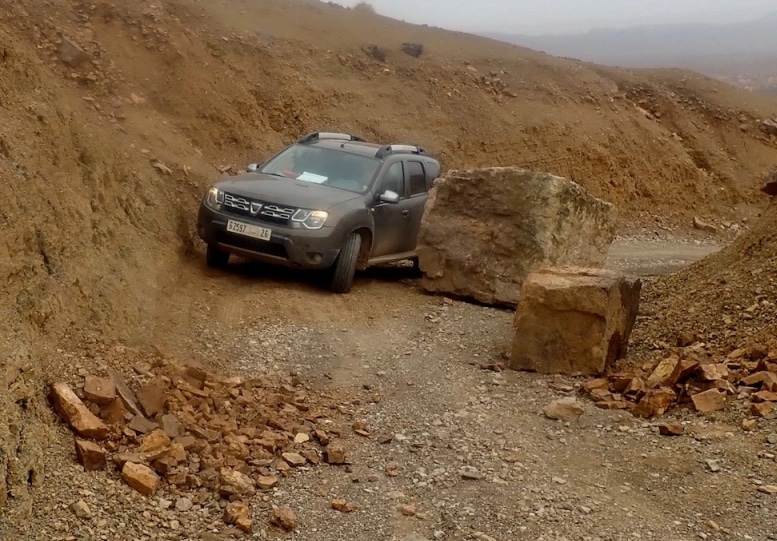
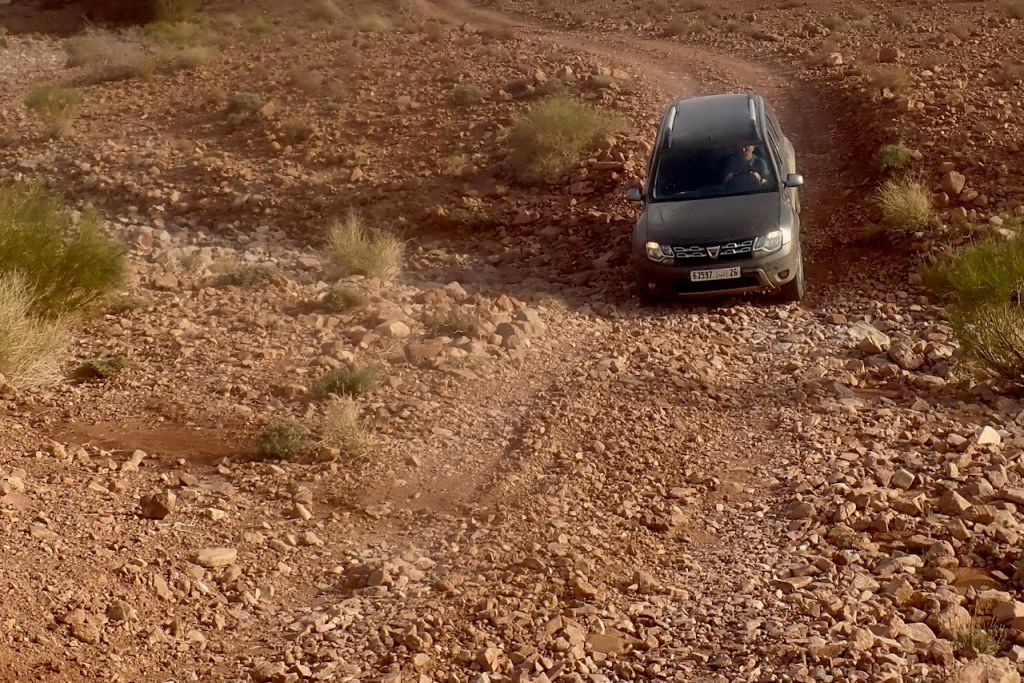
With many normally bone-dry rivers still flowing I knew we wouldn’t achieve much in the Dacia but we went ahead anyway; no recce is totally wasted. On the very first day we were snowed back then blocked by a churned up oued and rerouted by a closed mountain road. On the second day (left) we had to turn back three times before lunchtime! We settled into this pattern for the next week or so, probing, turning back and covering about 3500km (map above).
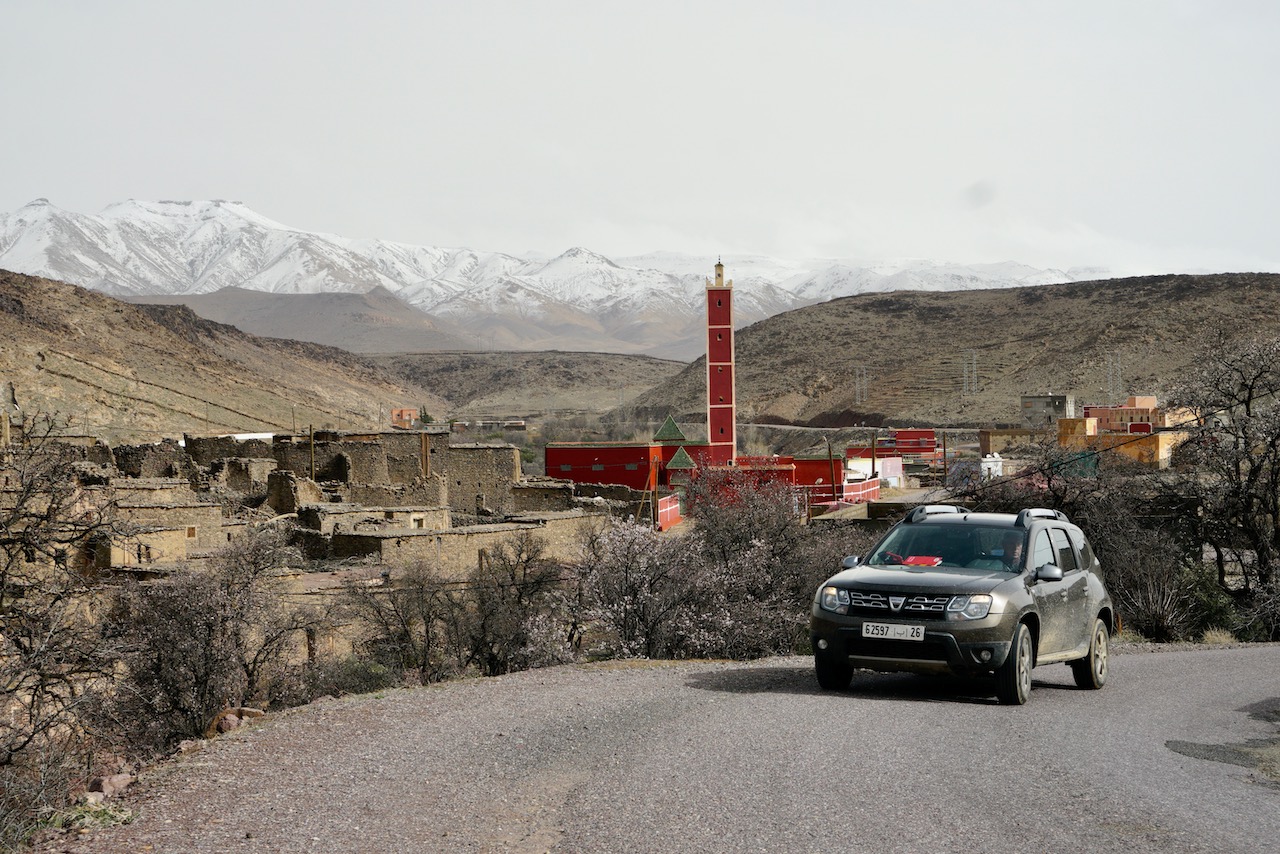
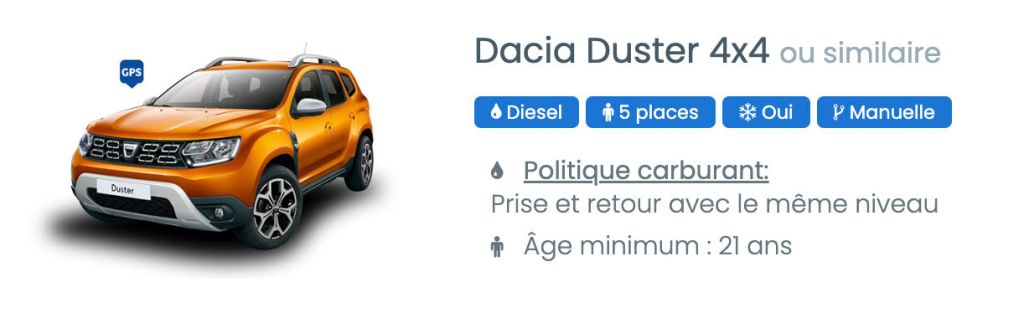
Renting a Duster in Marrakech Airport [RAK]
I’d rented from Medloc in Marrakech years ago but it can still feel a bit sketchy to a first-timer. Unlike Avis, Hertz, etc, Medloc and other Moroccan rental agencies don’t have a cabin office in the Menara airport car park, a 3-minute walk from the terminal. Nor might they meet you with a sign as you come out of Arrivals (not me at least, but I was there already). I had to call them and tell them where I was, using a car park place number.
Next: do not expect your freshly valeted car to be there waiting for you. Two guys rocked up after I called but it was about a hour before our actual car, booked for 11am, turned up. It’s not just me; the week before a ‘executive/prestige’ rental outfit dicked us about for even longer sourcing a second Prado which had been booked well in advance. And this was a multi-car job worth tens of thousands. Note that Dusters come as 2WDs too; make sure you book the right one!
Our car was a little dinged and repaired here and there but with seemingly good tyres (as requested), a similar spare and the all-important jack and wheel-changing tools (always check these; half the Prados’ jacks were missing). I’d make a show of checking the oil level while they watched too; it shows conscientiousness (ours looked like Brent crude).
I paid the rental fee on a portable card reader: €65/day plus a deposit of €1500, same as we do when renting bikes from Loc. Basic 3rd party insurance is included; no other damage waiver insurance was offered. I signed various forms, the pouch of documents went back in the glove box and we were asked to return the car with the same four bars on the fuel gauge.
On returning the car another call identified my location in the airport car park. People turned up fairly swiftly; checked around the car, asked about the bodged repair to the turbo hose (see below), made some calls and unexpectedly even refunded me the 200D I’d paid for the repair with no receipt then signed the car off. There was no cancellation of the €1500 deposit; he said he’d email me later with it (he didn’t). This was unnerving but checking my bank statement that evening, it seemed it had never been taken in the first place while the full rental fee had. This was similar to a moto I’d once rented off a trailer by the roadside in central Marrakech from M2R using a wifi card reader. It all felt sketchy as hell but panned out too. Even where possible I try to avoid using my card in Africa – cash for the rental and deposit is an option with Medloc.
Lessons learned: go ahead and use your 4×4 to its full ability on Moroccan tracks but make sure you have a number to call and try it before you get in trouble. Alone in a smoking Duster with over 100,000 rental kms, you may want to constrain your off-roading ambitions. Some places we drove would have been a near impossible recovery but don’t assume they’ll come down with a replacement if you car breaks down. They may suggest you try and get it fixed locally. I’d also bring a good tyre compressor. I’d also considered blagging a couple of planks somewhere for bridging as well as traction, although rearranging rocks, kicking away oued banks and on soft terrain stopping early and deflating did the trick.
I note that Hertz at RAK also rent Dusters. Renting with Hertz ought to feel more reassuring, but only if you get a proper 4×4 Duster (which don’t come as automatics in Morocco).
In a line
Prepare to be surprised with what you can manage in this light, all-terrain SUV.
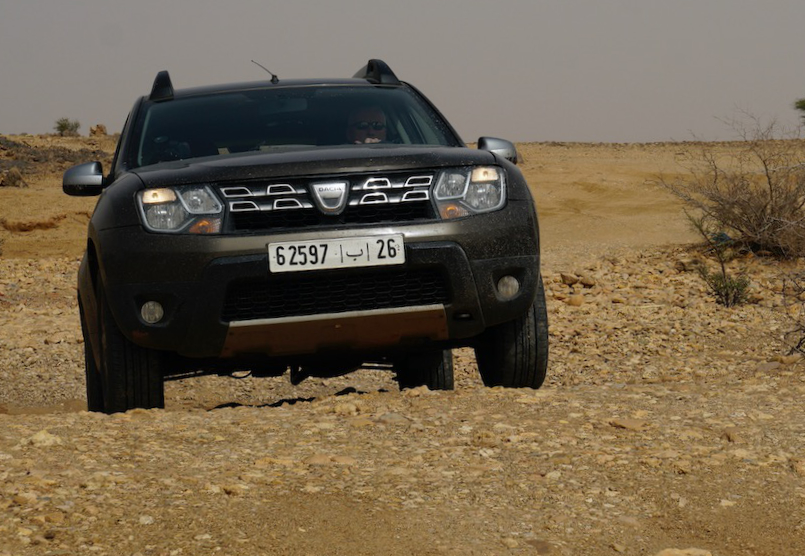
 • You can feel how lightness helps
• Great end clearances – never touched on some steep banks
• Recorded up 45mpg (16 kpl), that’s a 750-km range
• Nippy enough on southern Moroccan roads
• Suspension pretty good for what it is
• Had air-con and sat nav (but not the best)
• I didn’t miss Low Range much
• Road tyres worked fine up to a point when ATs wouldn’t have been much better. No punctures
• There is some underside protection
• There were fewer electrical faults (none, in fact) on our Duster than some of the Prados with similarly high rental mileages
 • Underbody clearance is lower than it looks over central track humps
• Lame air-con and hard to see sat-nav
• Clicking noises under power from the back diff on loose surfaces; an LSD working or transmission wear?
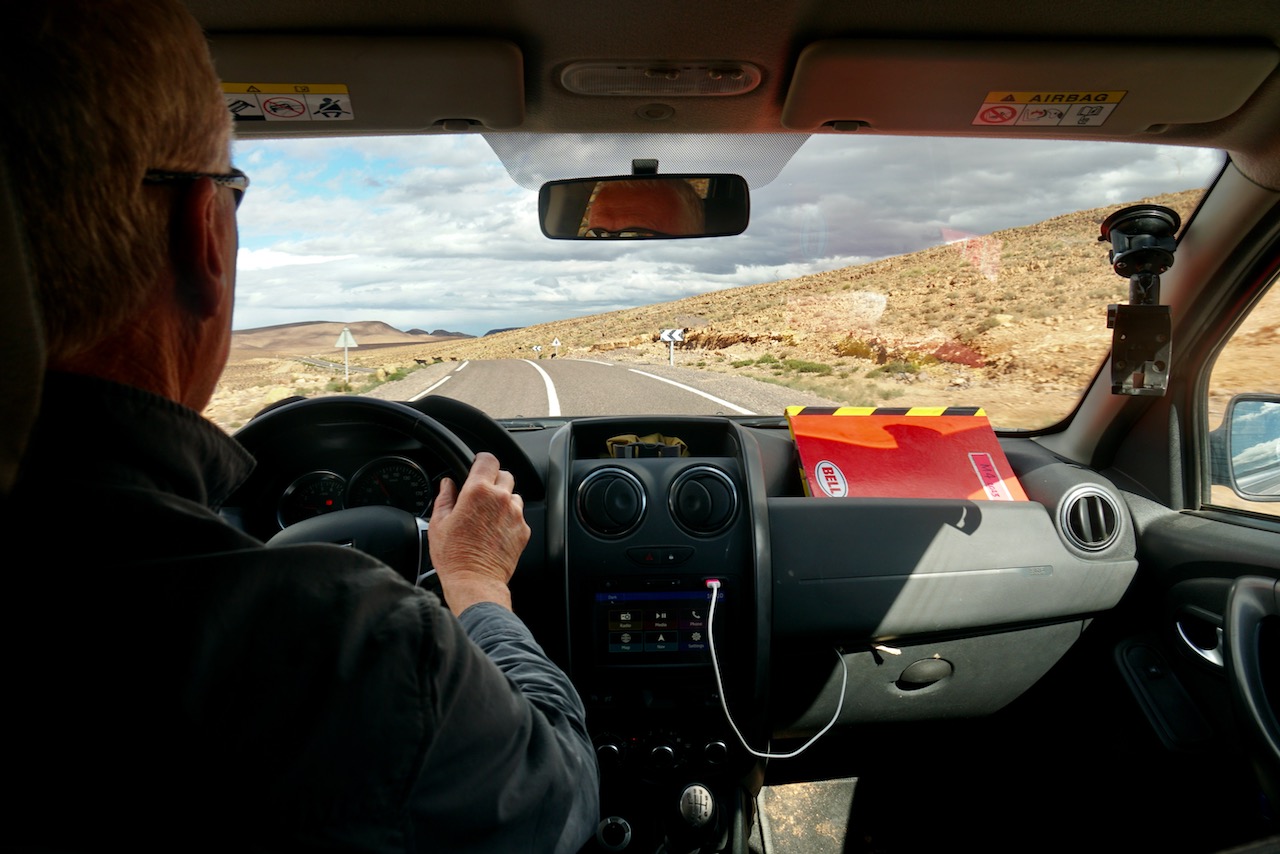
DACIA DUSTER
Le Doustaire is a budget SUV going from an amazing £15k new in the UK. I’ve long been impressed by its unusually functional angles and clearance – as good if not better than a stock Prado. In my experience, along with appropriate tyres, for off-roading good clearance is the first priority, followed by 4WD and good articulation (suspension range) or traction control, and finally low range. Plus a snorkel.
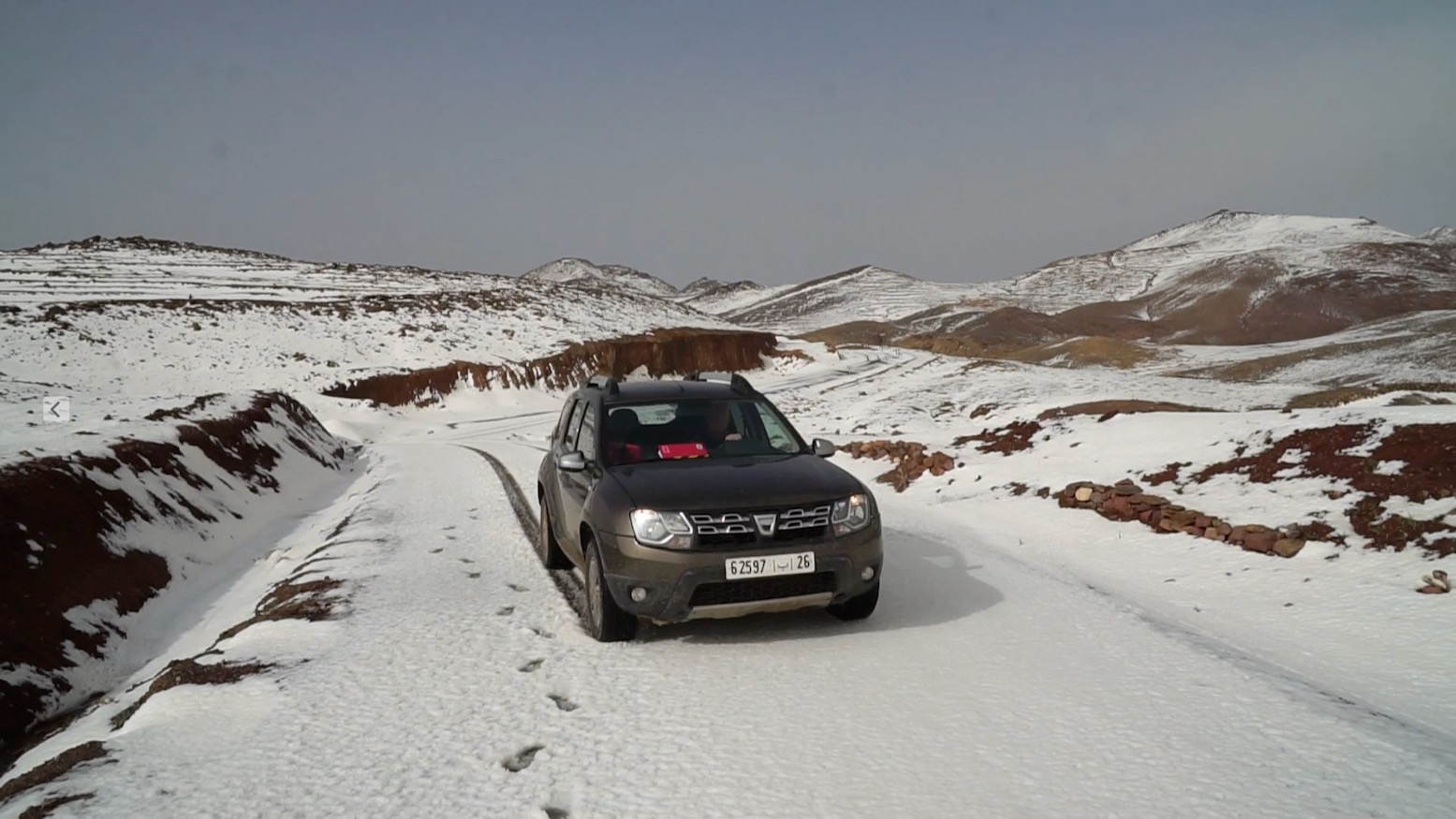
The 4WD Duster has six speeds but no low range, just a low first gear – though it doesn’t feel that low to me. I’d outlined my intended use to Medloc and asked for good tyres and that I didn’t mind a well-used example so long as it wasn’t black. At Menara we picked up a bronze 1st generation Duster a few years old with a Renault K9K 1.5dci, 85hp TD in 6-speed manual and 117,000km on the clock.
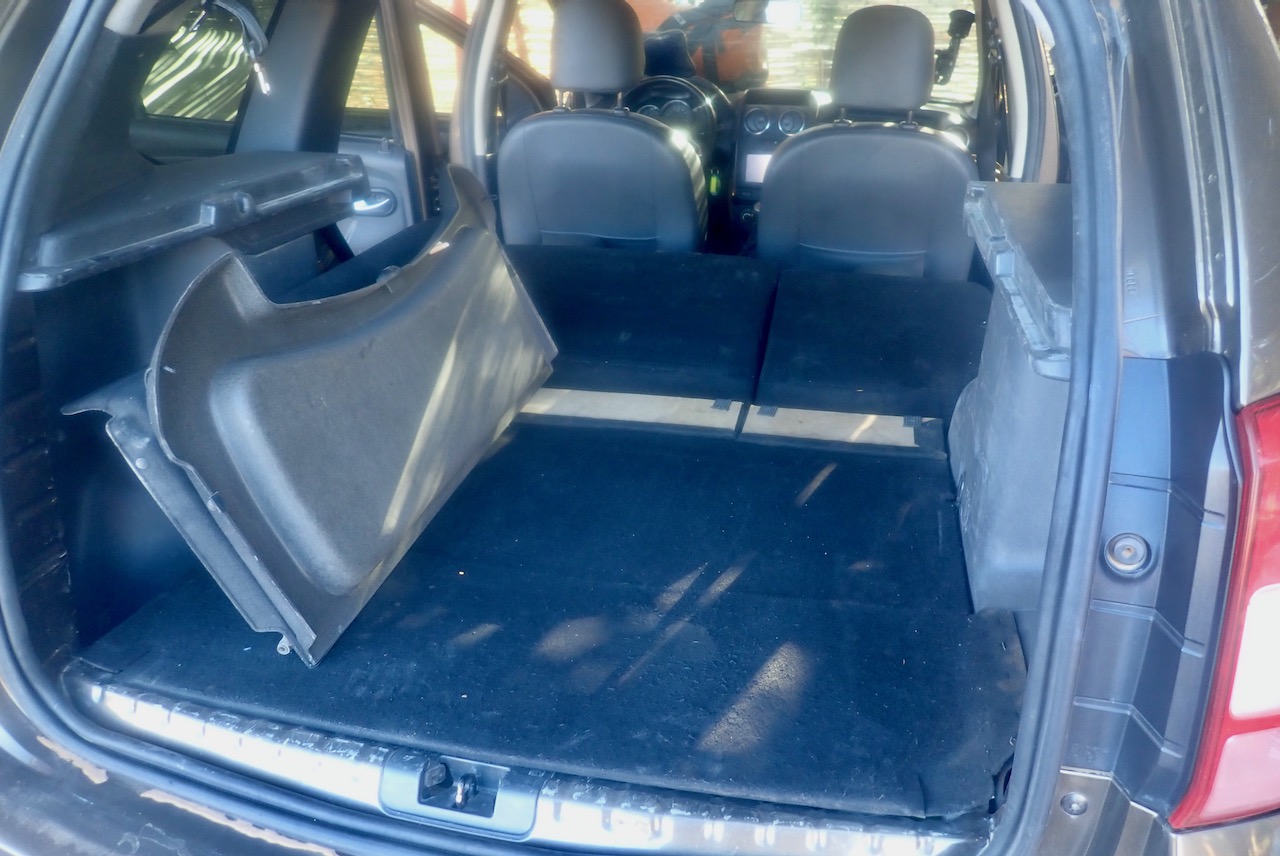
Our car had a sat nav which actually worked for routing once you’d got the better of the interface, but the matt LCD screen was hard to read and was set too low for the driver. There was also air-con but it was pretty poor at pumping cool air around. I don’t know if low pressure in the system does that.
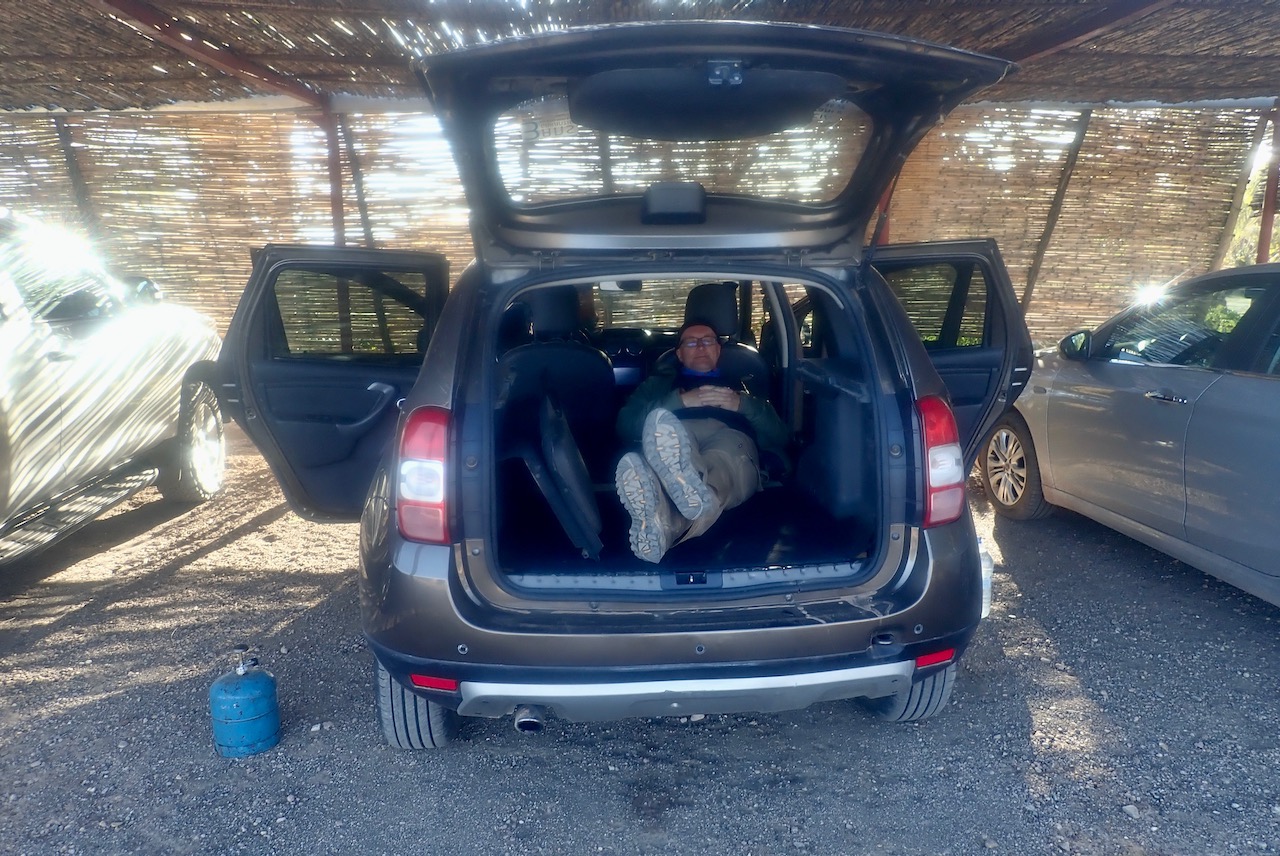
With the back seats down (left and below right) there’s almost enough room for two to sleep on the near-flat surface, if needed. The brakes were OK (non ABS) and so were the lights. I should get a job at Top Gear!
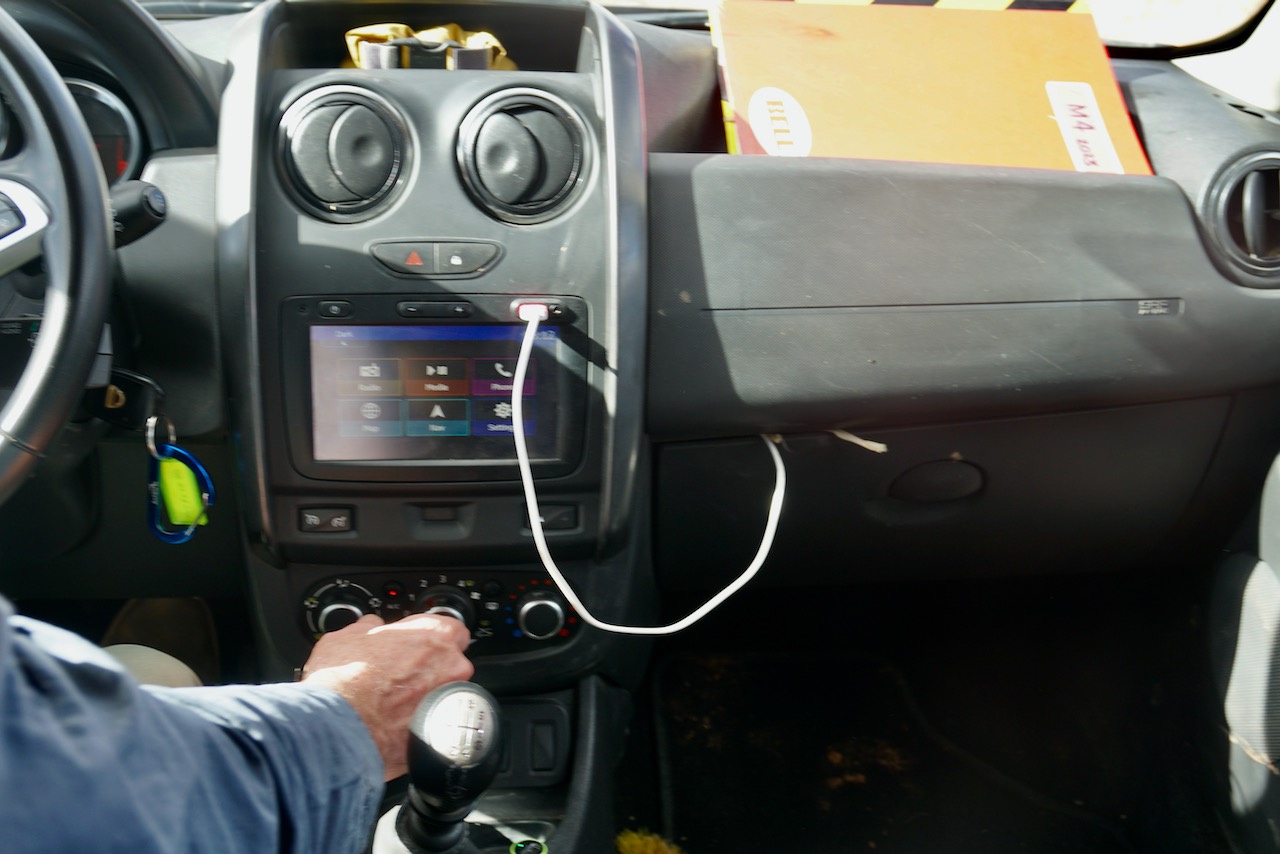
4WD system
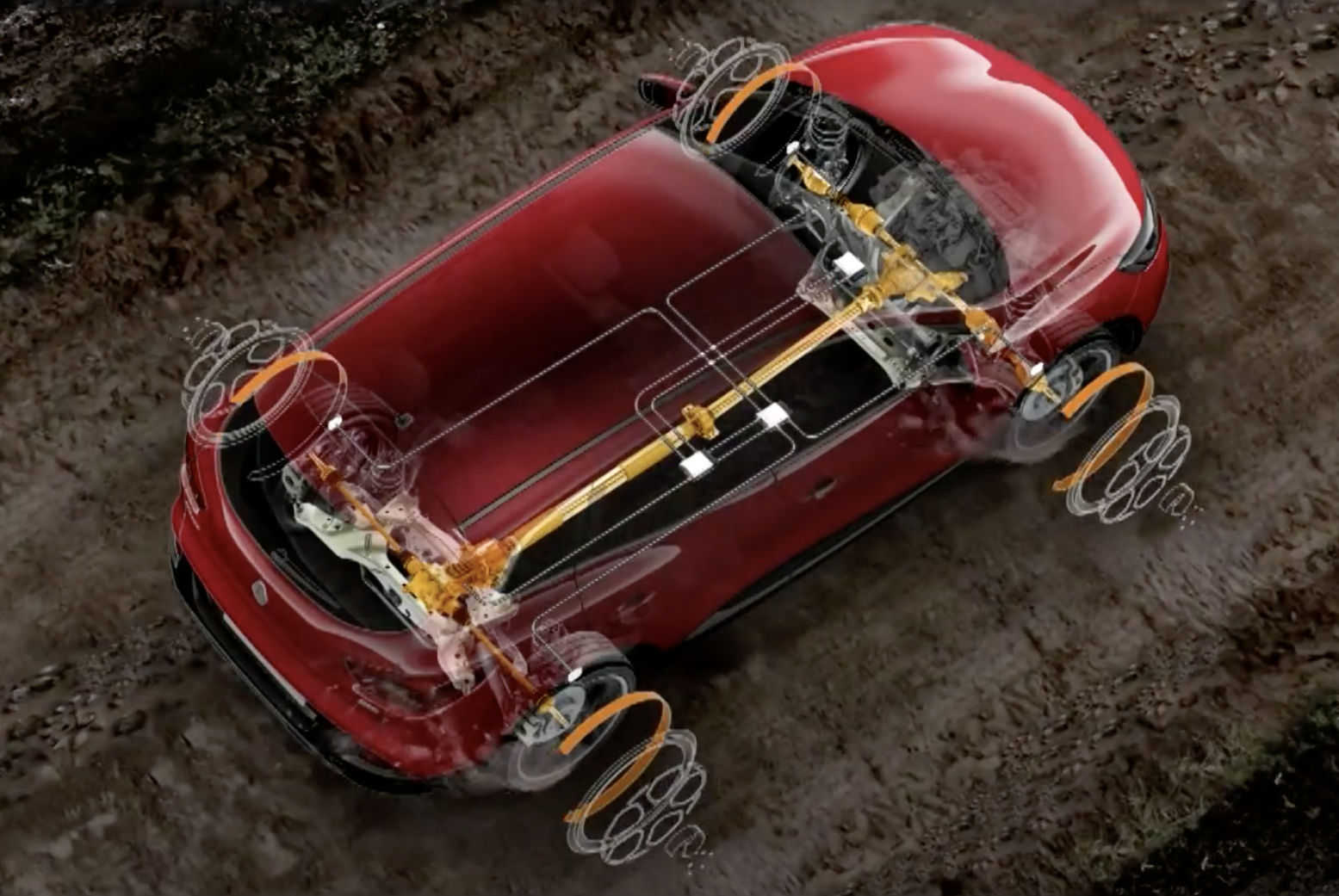
The Duster runs FWD until you turn a low-reach dial to ‘AUTO’ at which point the rear axle engages on demand, activated by front wheel slip. Another 90° turns the dial to ‘LOCK’ presumably engaging a central diff lock (up to 40- or 60kph) to split torque 50/50 for a bit more traction. I don’t think our car had ABS, nor did it have ‘ESP’ which includes traction control. Later models have more acronyms. This Renault video may help demystify things, or this page where there’s talk of the system overheating if used hard, so there must be something slipping somewhere.
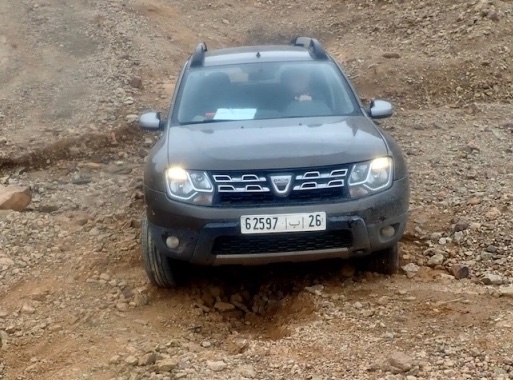
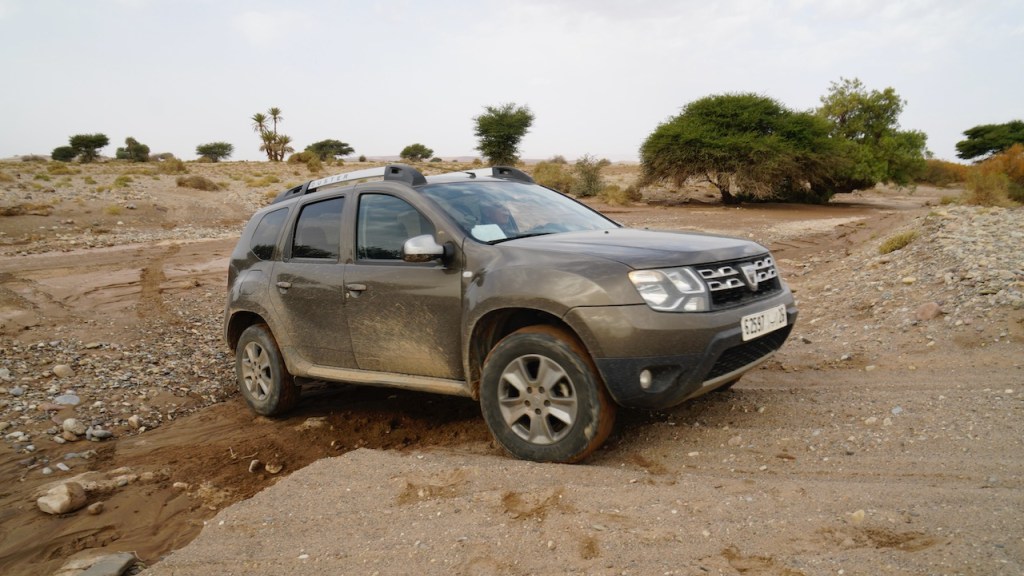
It all feels a bit opaque compared to the old-school mechanical lever and lock systems I’m used to, but we only struggled twice; once when the articulation and so the traction was on the limit crossing a wash-out (left). That ditch took a bit to rocking/momentum (not ideal and how lurching, non-low-range cars get damaged). The other time was wet sand under a crust between low dunes where I wasted no time in stopping early, clearing the wheels, lowering the tyres and foot recce’ing a way out.
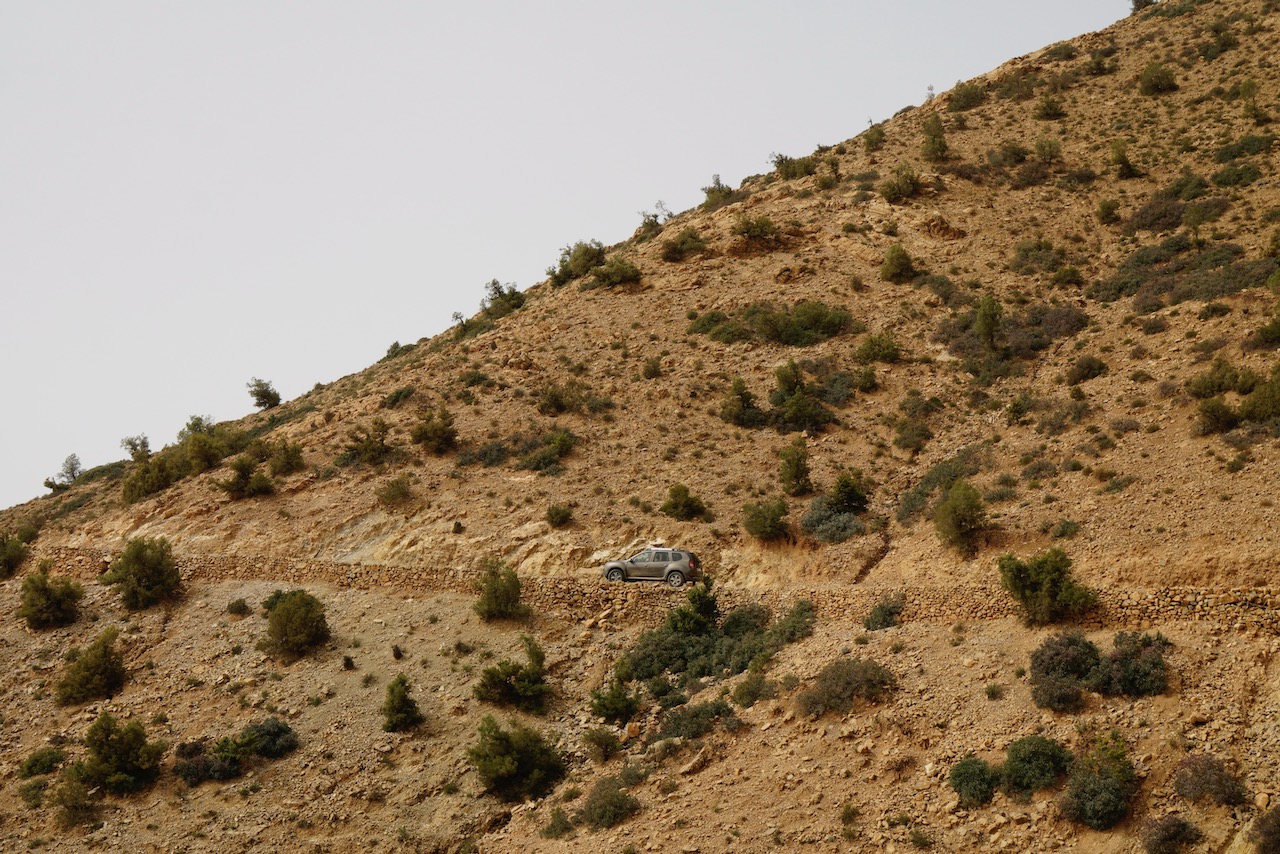
As I know well, on the piste you can manage with 2WD 97.3% of the time, but there’s no harm leaving it in AUTO which won’t wind up the transmission and ought only intervene when needed, though might create some drag and higher fuel consumption. It did feel like the steering stiffened reassuringly in LOCK so something was happening below, but a couple of times when turning on loose surfaces under power the back diff clicked as if there was a mechanical LSD in there, or something was slipping and would soon eventually strip splines or snap.
This is the risk in using lightly built ‘4WD’ SUVs on remote desert tracks where occasionally you might have to ask a lot of the transmission. There’s a reason why Land Cruisers and the like are relied on by aid agencies, despite their weight, cost and fuel. consumption. They are over-built to handle the task and last, but are of course still prone to failures.
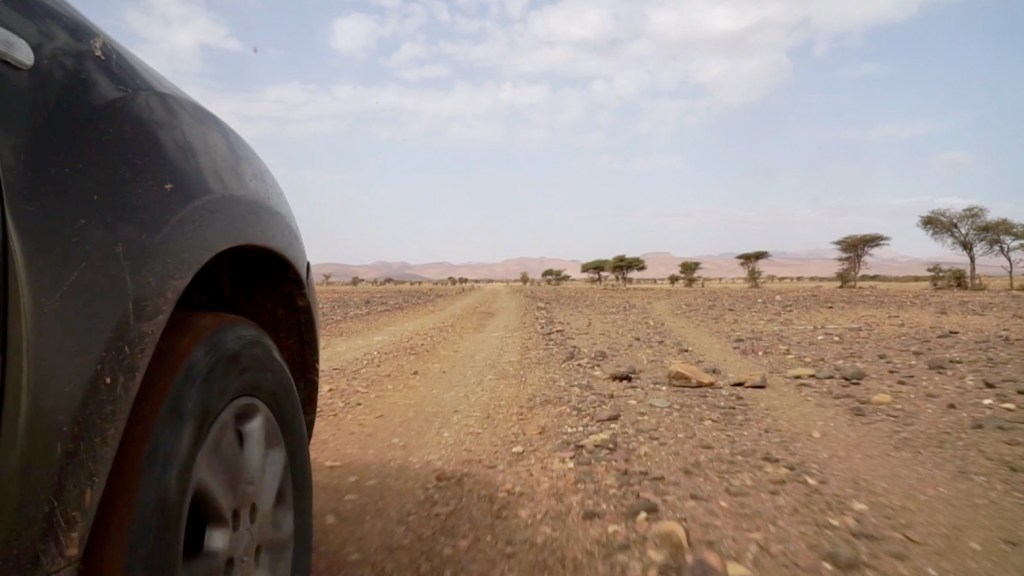
This was why, again and again in our aged Dacia we backed away from terrain which we might have tackled in a stouter Prado with Low Range or with another vehicle present. And it was why we didn’t cross something which we weren’t confident we could reverse, if needed. Nor on this occasion did we intend to venture into the remote desert south of Rissani. The nature of flood damaged tracks: wash-outs, landslides, fallen rocks, boulder-filled river beds or actual rivers and slimy claypans (we encountered all these), is that a track can be perfectly drivable for miles, then virtually impassable, then fine for miles again to become completely impassable. It takes some experience of desert off-roading and a vehicle’s abilities to know how far to push it while also knowing what you can tackle without risk.

Camping fuel with fly-in rentals
Flying in to rent a vehicle then camp, you’re limited with what stoves or fuel you can carry on a plane. For boiling water a harmless volcano kettle will work but current models can be slow and fiddly. I managed to transport solid fuel ethanol blocks in my hold bag (they can be classed as ‘disinfectant gel’) to use on a compact gimp stove, and also thoroughly aired off my reliably powerful old Coleman petrol stove but ran up against the weight limit so left it. At the last minute I bought a Trangia burner which, using the same stand as a gimp stove, will work with alcohol that you can buy readily from pharmacies in Morocco.
In fact, in any small town it’s easy to buy a 5kg bottle of butane for just 60D (£5), as well as a cheap burner head for around 40D in a hardware store. From previous experience in North Africa a bottle this size will last a month and is of course dead easy to use once out of the wind.
While faff-free, one thing we noticed is that Moroccan butane is of a lower quality than what you’d get in Europe. You won’t get a crisp blue flame but it got there in the end, probably no quicker than a v-kettle, Trangia or a gimp stove.
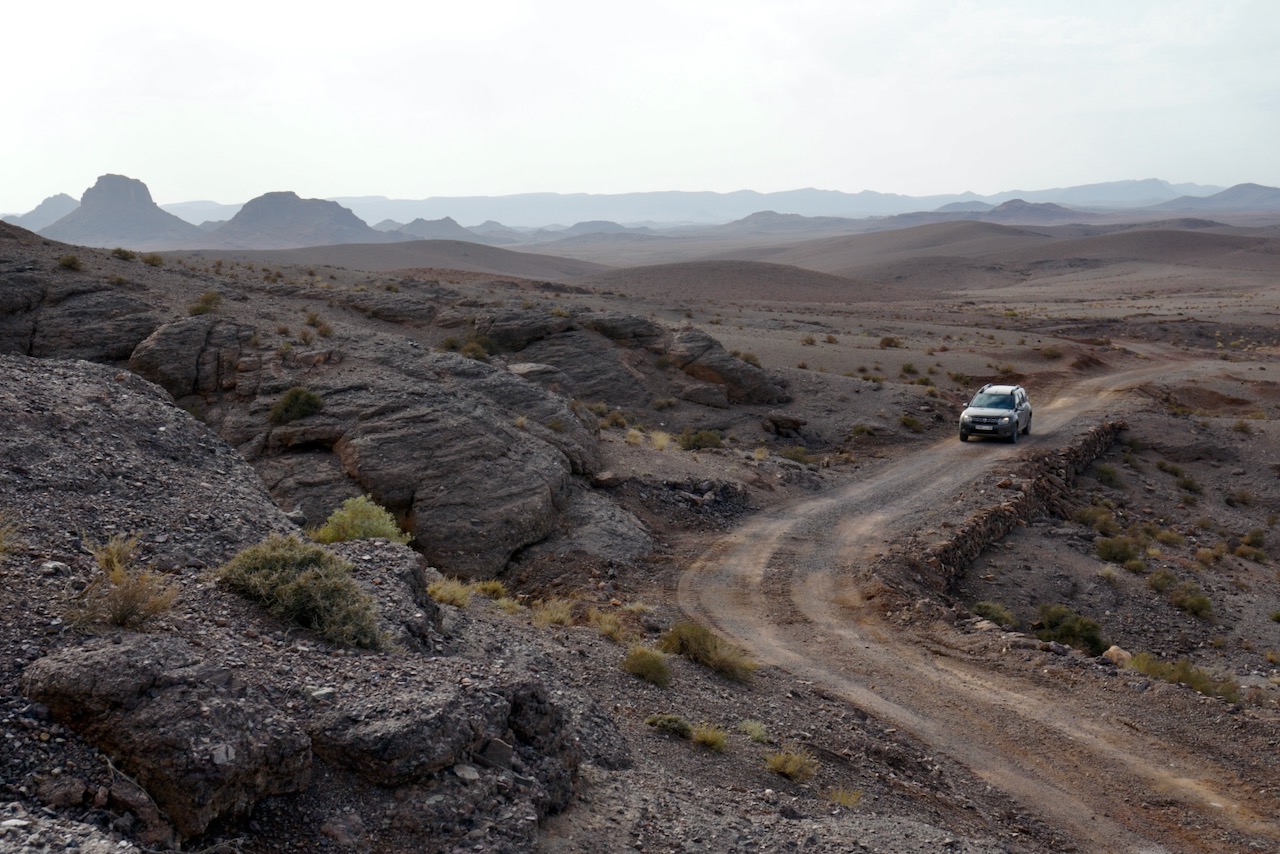
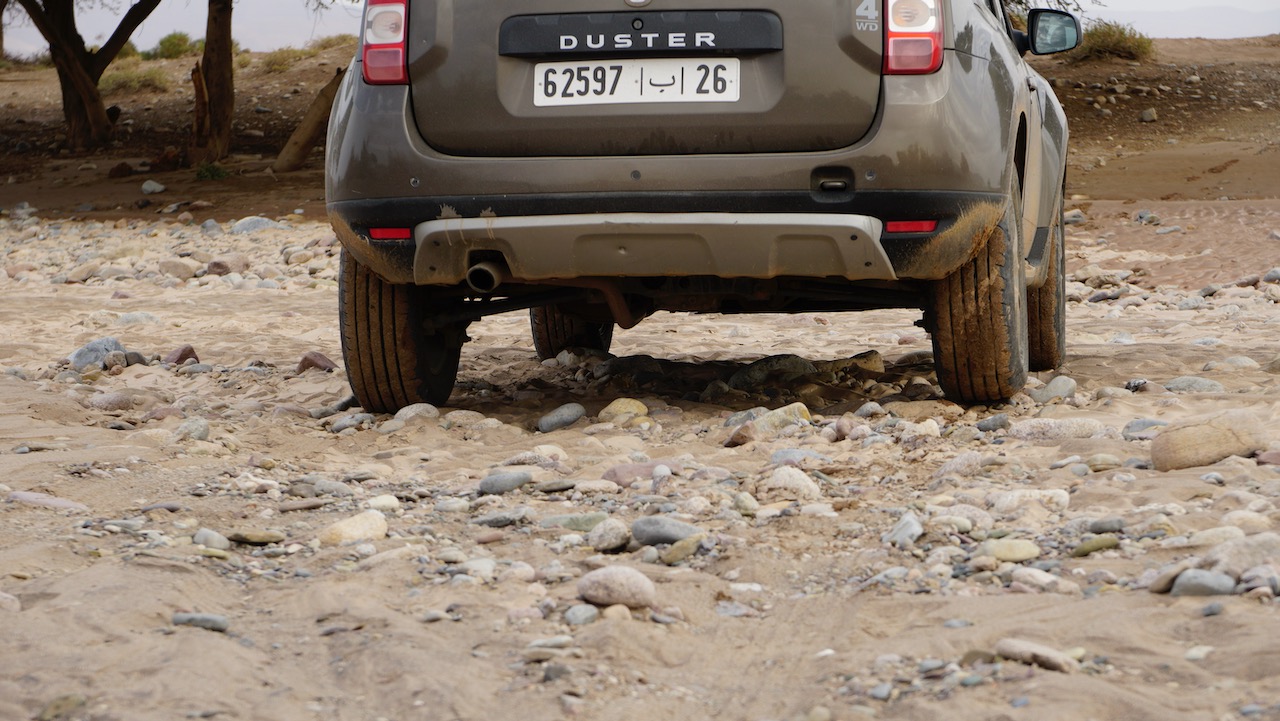
The independent coils all round give pretty good articulation and as mentioned, if nothing else, the clearances lapped up the piste. On the road the car was nippy in southern Moroccan traffic, didn’t roll much in bends and the brakes were OK. Six gears was a new one on me but if you don’t rush it you got it right most of the time. I’ve not driven a manual for over a decade but had I not read it before, I’d not have noticed first was extra low. Sixth is definitely an overdrive that drops the revs and noise.
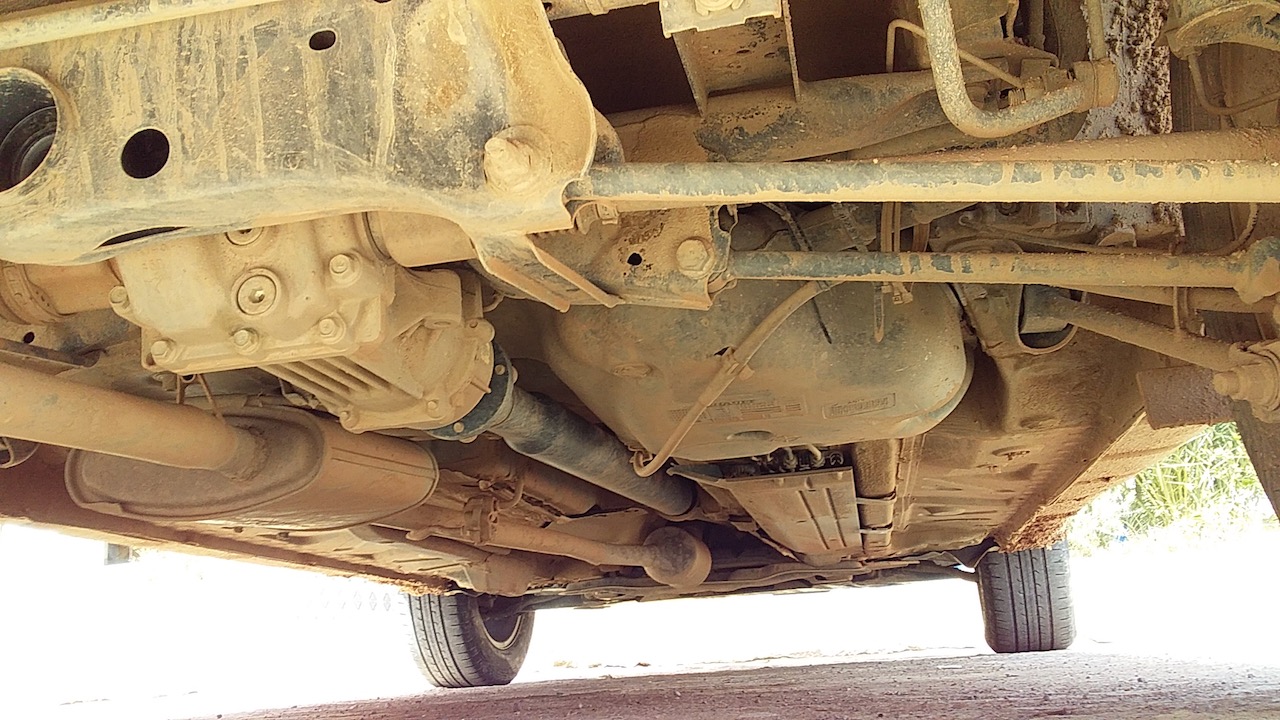
The Duster’s clearance is nearly as impressive as it looks; not once did we scrape either bumper; more than I can say for the stock Prado I used last October (The Prados we used just before this trip were notably lifted).
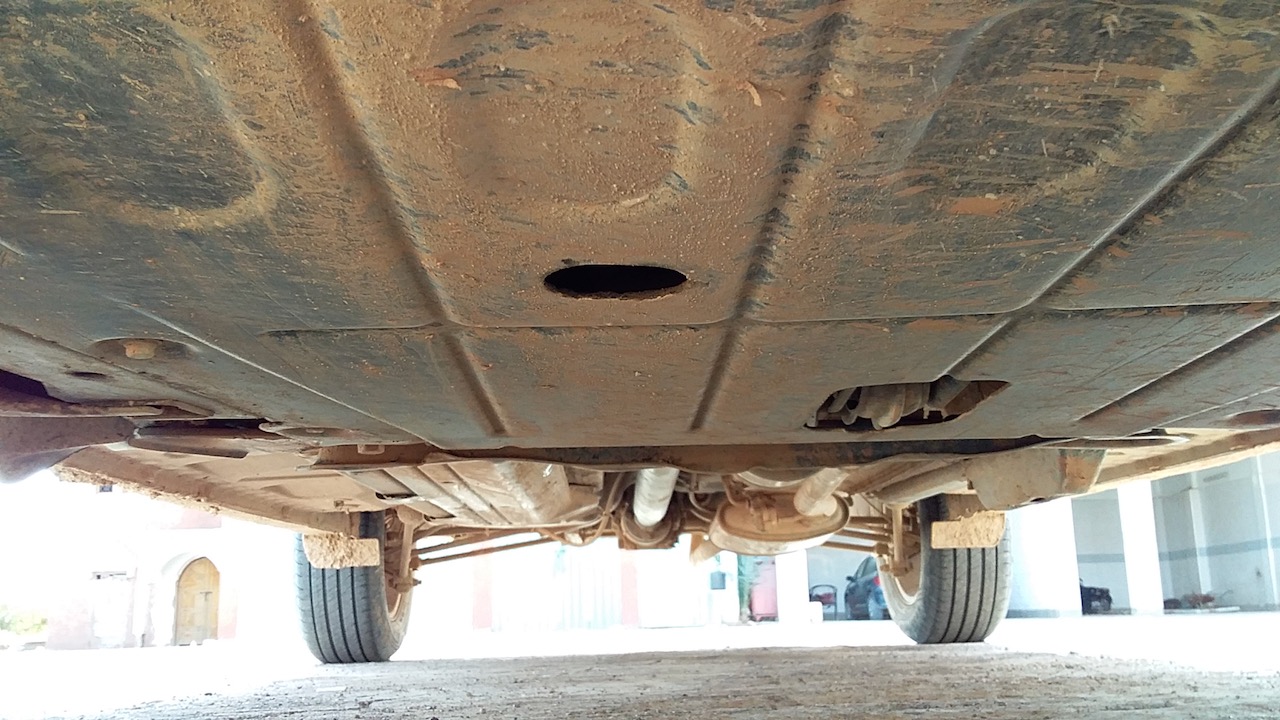
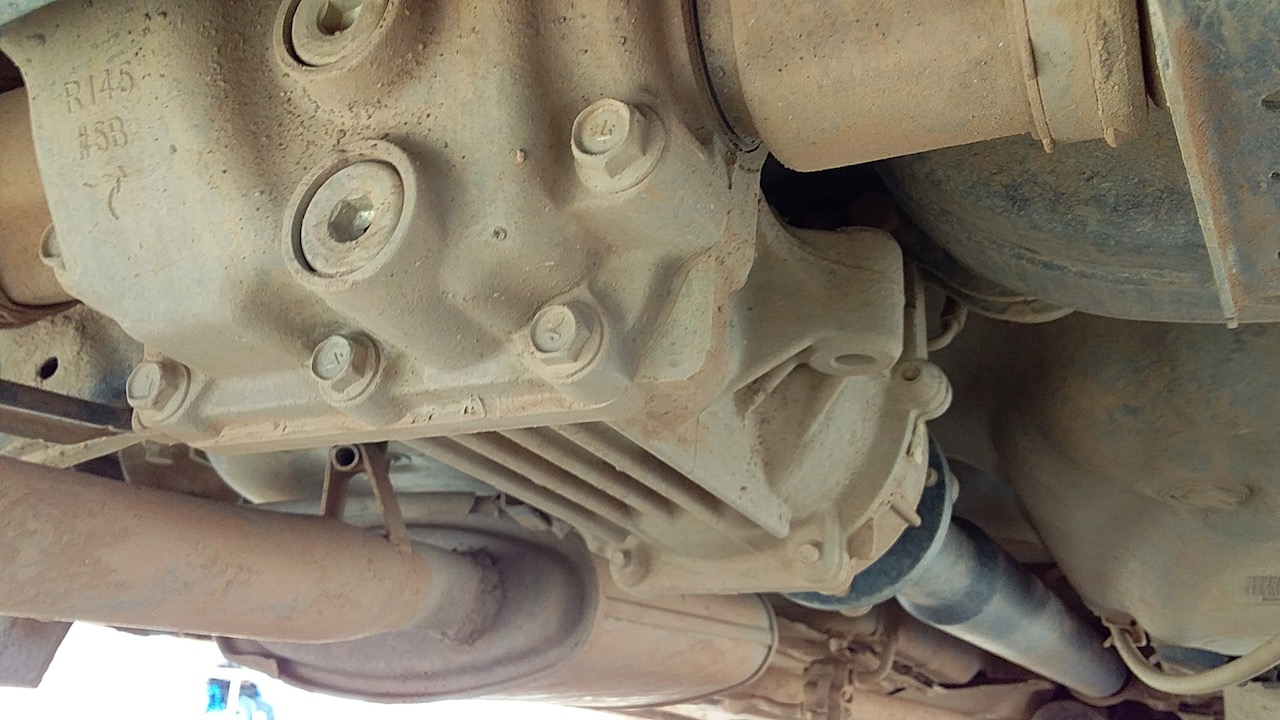
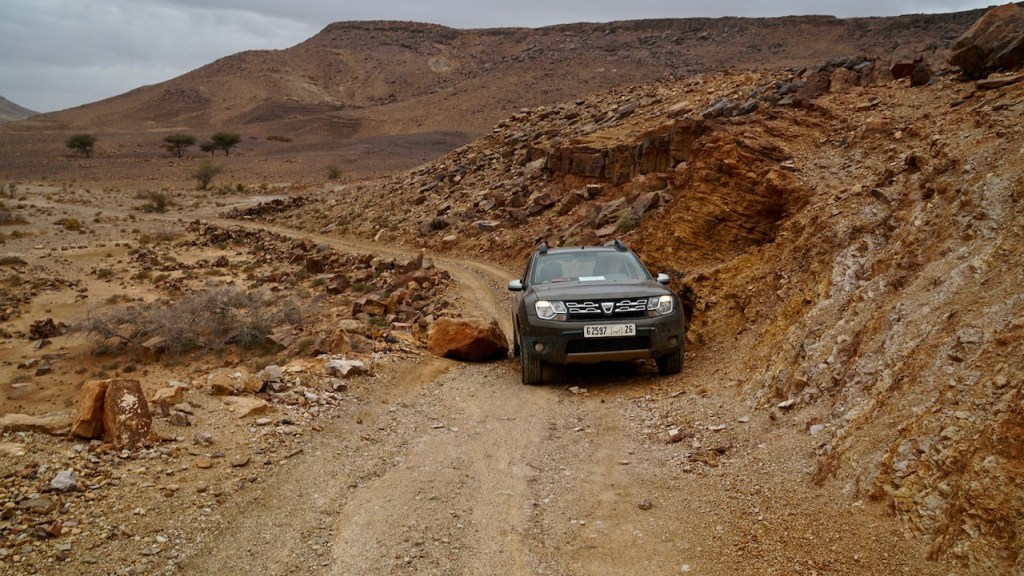
So we were surprised when the undercarriage scraped, grounded and thumped on deeper twin-rut central humps. Looking underneath there is actually some steel protection, but the full-width bashplate under the engine (below left) seemed to be the Duster’s point of contact, along with maybe the forward edge of the rear diff housing (below right). Seeing that neither was getting pulverised made the occasional scrapes and thumps easier to endure, but it was irritating to have to drive deep ruts off-centre like a regular 2WD car to avoid excessive contact.
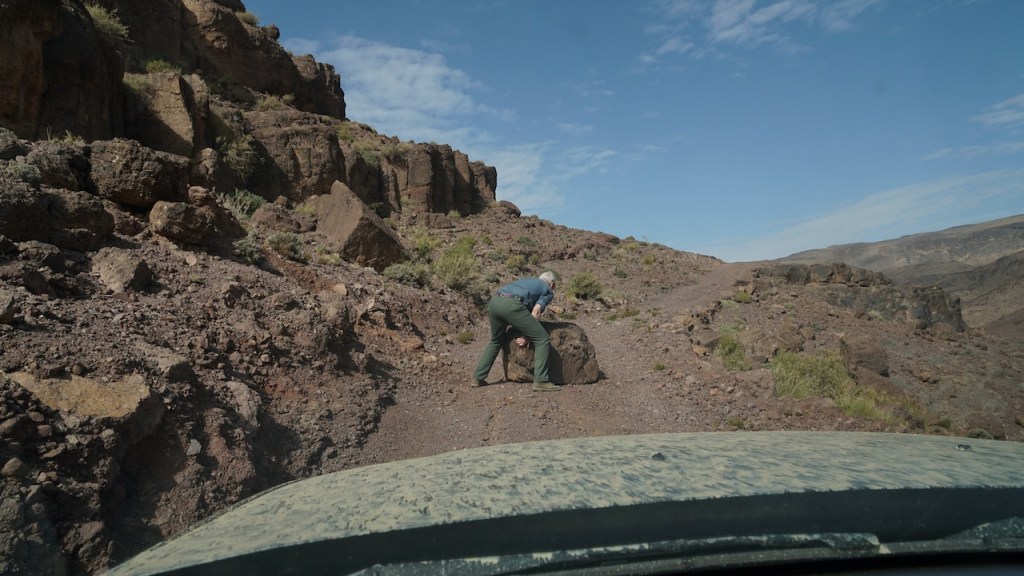
As it was, on many occasions one of us hopped out to either move rocks and/or guide the driver over tricky ground to avoid needlessly bashing the undercarriage.
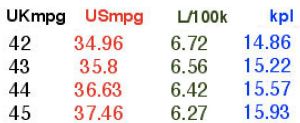
A switch on the end of the wiper stalk I’d have never found toggles a nifty read-out on the dash which includes remaining range, live and average L/100km, odometer and outside temps. The Duster has a centrally mounted 50-litre tank and averaged the low to mid 40s mpg (6.5L/100km; 15kpl) which was pretty good. I doubt the hefty Tojo Prado ever exceeded 30. Accelerating the Toyota you could almost hear the gush of fuel pouring out of the pipe as the 3-litre engine heaved the 2.5-ton car into motion.
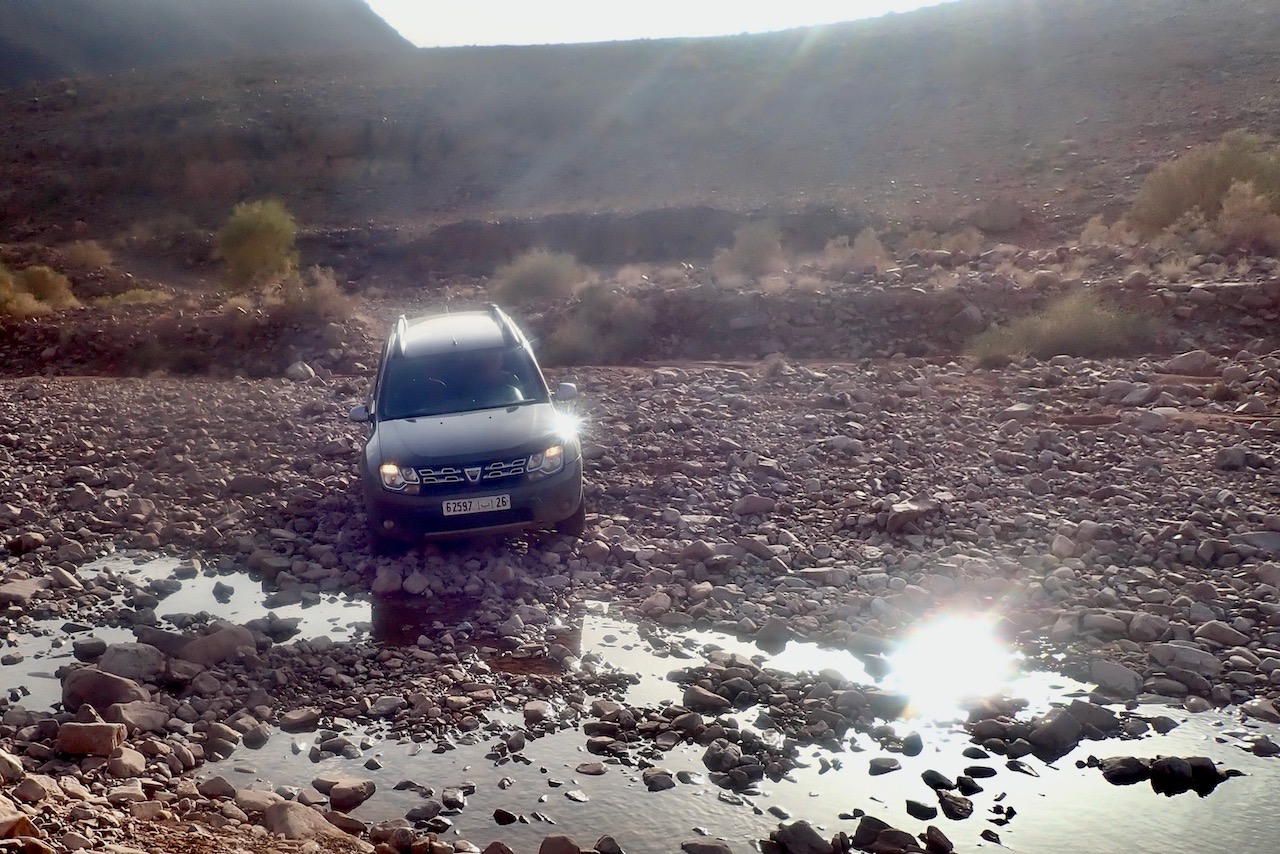

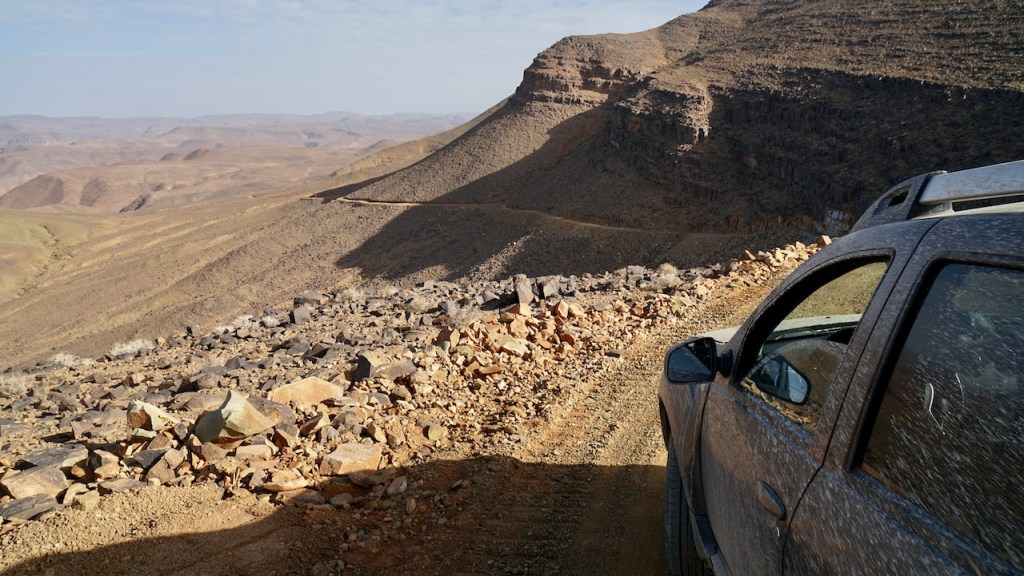
We did get caught out on one little used track which we started late, had it turn unexpectedly gnarly (above), and with us low on water and with no signal. The fuel range dived under harder use, compounded when a dash warning light came on (left) and power dropped off. Limp-home mode?
From day one Barry thought the turbo was playing up; not knowing the car I wasn’t so sure. But we couldn’t decipher the warning icon on the dash as the only handbook in the glove box was for the sat nav (it needed one). We checked for drips underneath and under the bonnet and carried on into the night. It was a tense couple of hours.

It wasn’t till next day in Tamnougalte when we got online to find that orange warning lights are less critical than red. We also got a tip to check the turbo inlet hose. Up to that point we’d assumed the turbo had gone (Barry’s failed on his Defender at just 14k). But Medloc did not respond to detailed emails explaining our problem, or requests for a replacement car. Calling was the answer (trickier for me with shakey French) to which they suggested we buy a new turbo and get it fitted (for 1000D we were advised; one could have come down from Ouarzazate next day).
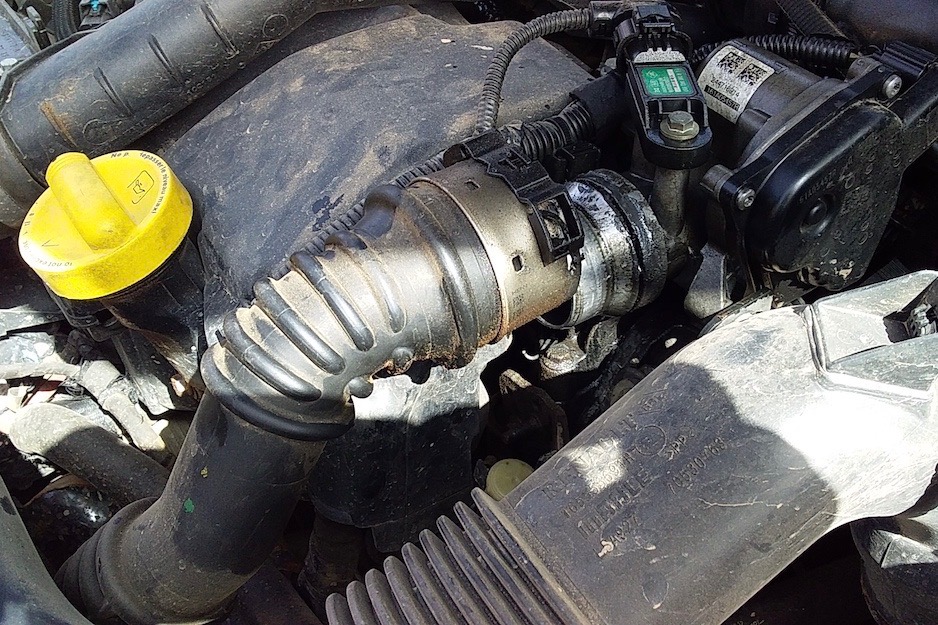
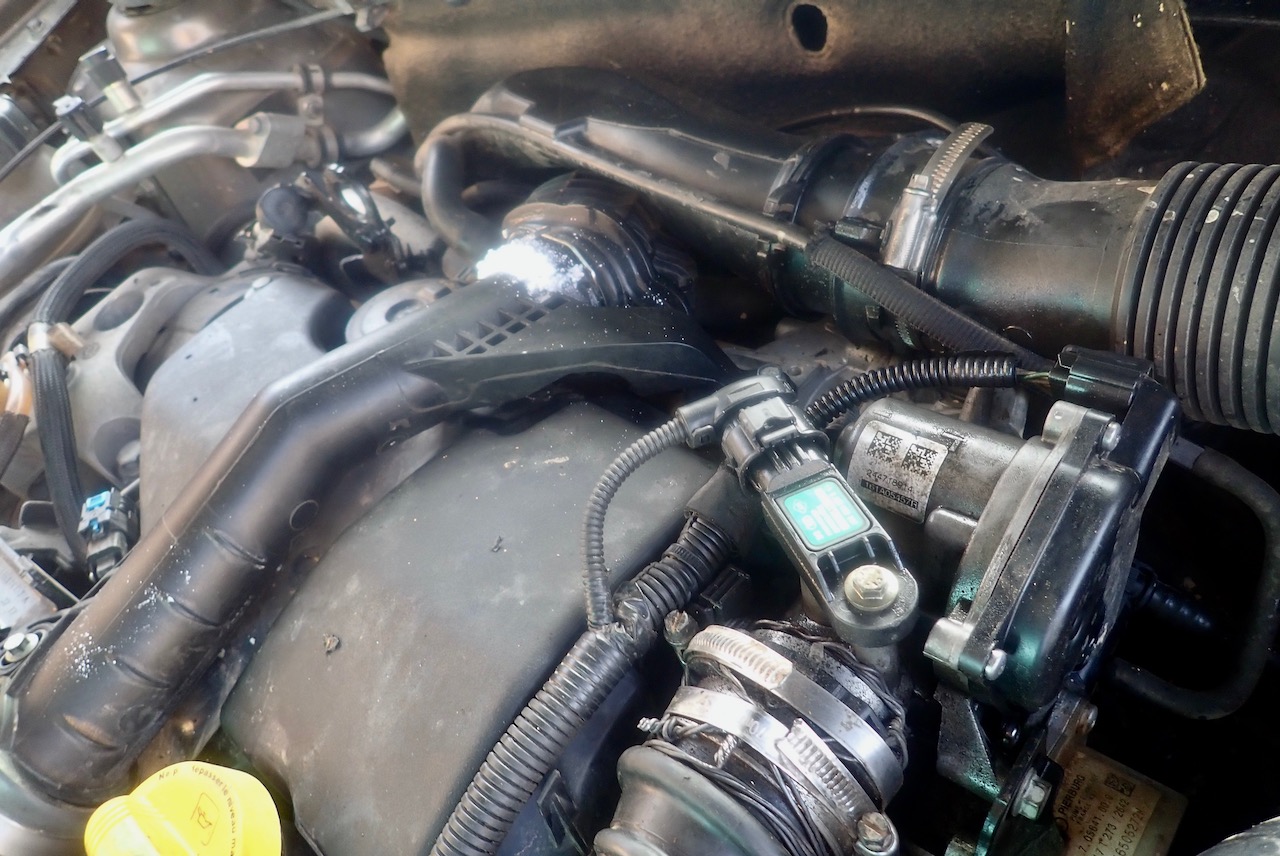
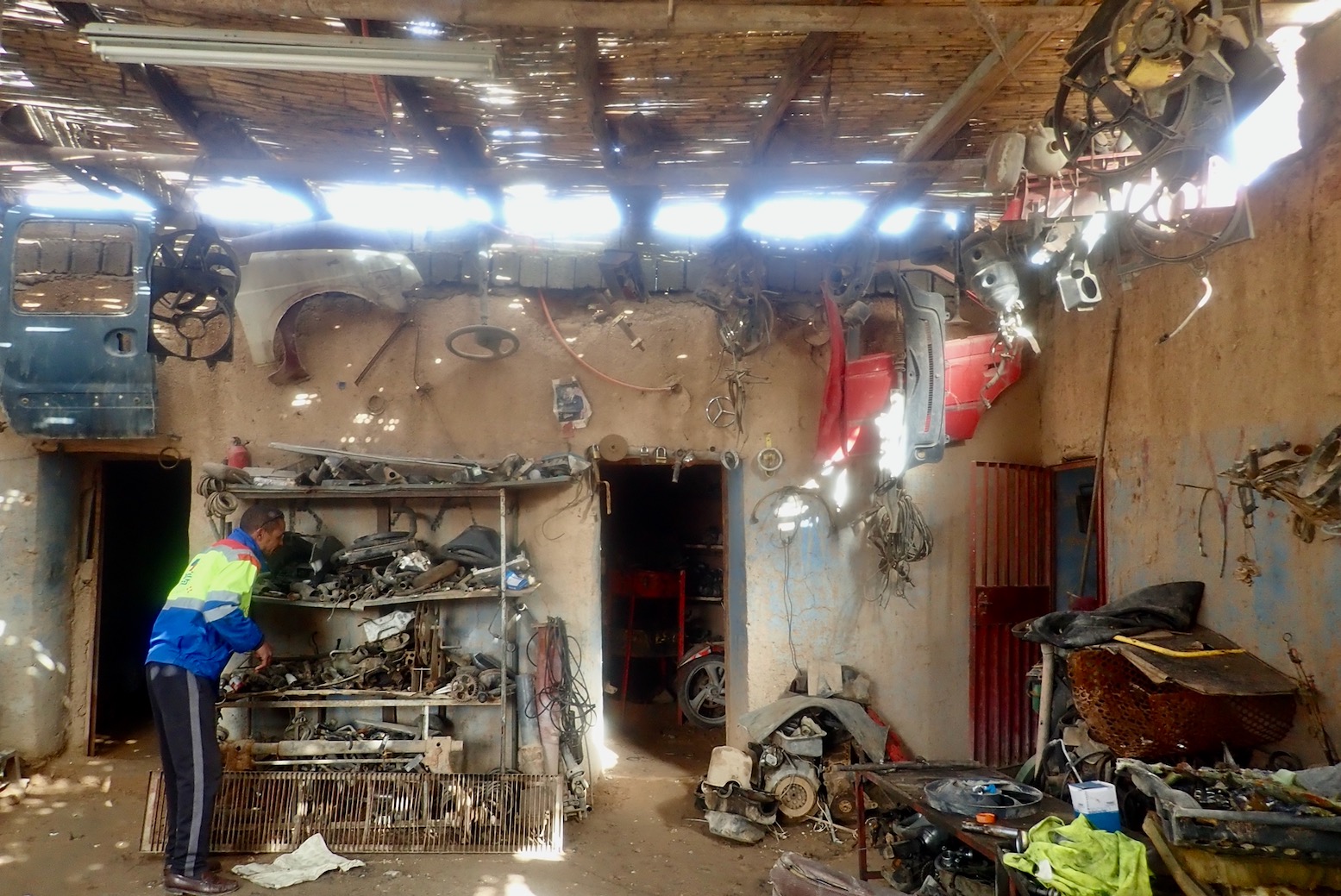
We should have spotted the loose hose on the piste; rev the engine and it blew off and remained displaced, producing black smoke so common to many older diesel bangers in Morocco. But the plastic hose (as opposed to more flexible rubber) wouldn’t push back onto the turbo and stay there; some attachment/clip was broken, caused I presume by old age plus the engine rocking on the chassis mounts over rough ground. I’ve had this engine-wobble/hose-strain problem before with the Land Rover 101 and other vehicles. Once our spliff-tooting mechanic had firmly lashed the hose back on with bailing wire and two jubilee clips, normal performance resumed and stayed. Was the turbo whining more? Hard to tell.
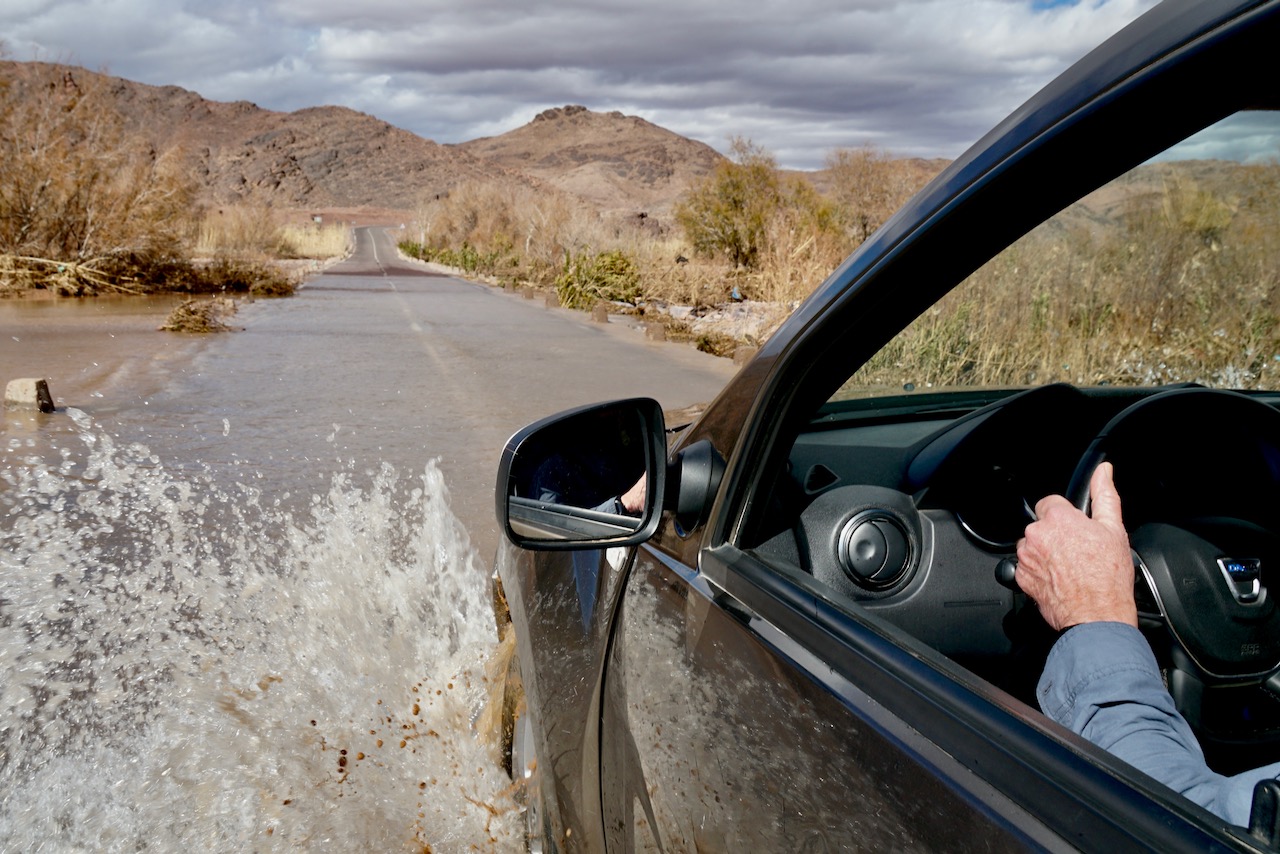
Above all, what impressed me with the Duster was its lightness – or how little it took to get the combined 1500kg mass moving with very little throttle or a relatively high gear. Often you could trickle along a piste in third. And when things got a little rough this lack on mass translated into non-self destructing impacts where the mass of a proper 2-ton 4WD would have either broken something or bashed you against the insides. This really was a revelation in the Duster and why I’d rent one again. Just maybe not such an aged banger. A few months later I did – read here
If you been on one of my Morocco Fly & Ride tours you’ll doubtless remember our overnight stop in Assaragh after our steep ride from Aguinane up the cliffside overlooking the dry cascade – and perhaps a walk we took to the cliff edge later that afternoon. Below is a video found by one of the riders recently, shot by a local in late 2018 of the usually dry waterfall in full spate. the force of the water looks quite staggering.
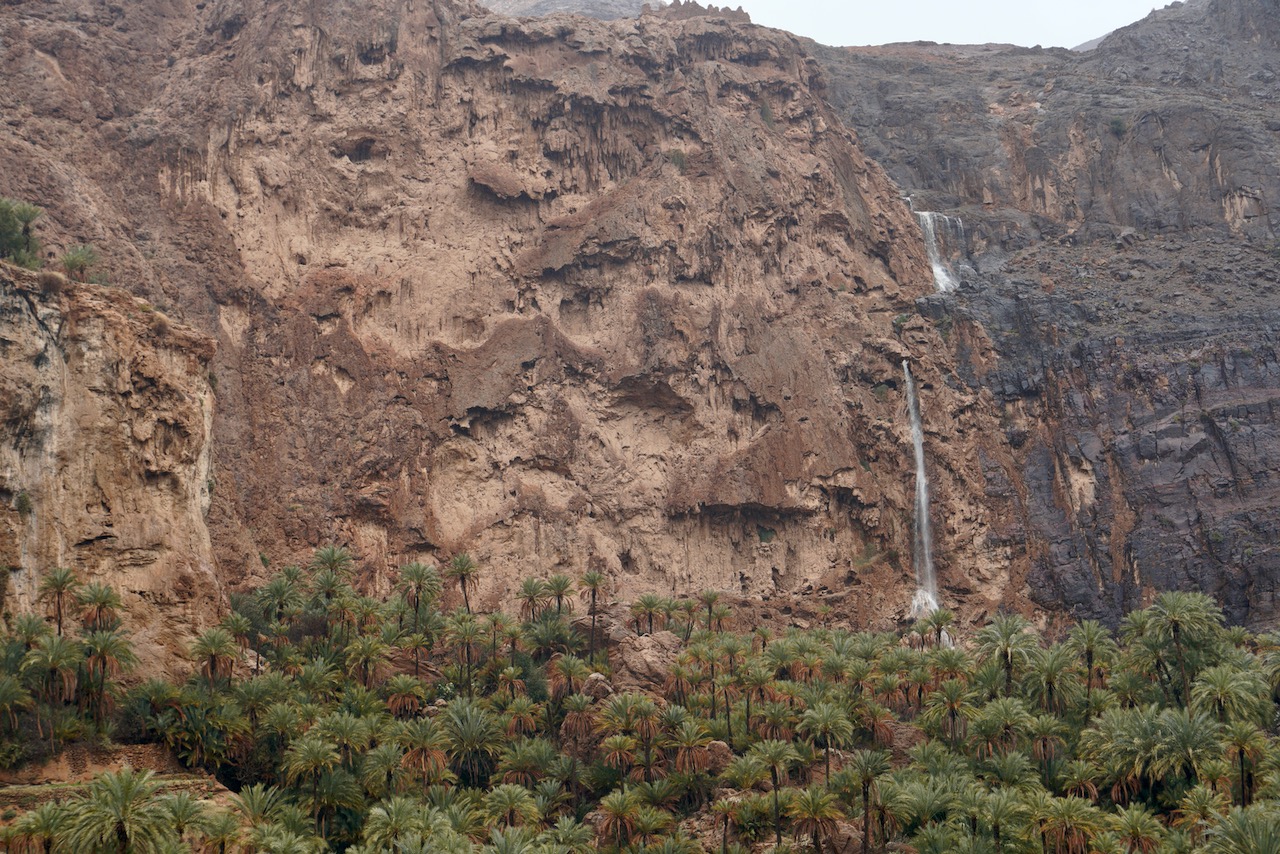
In February 2023 we came up to Assaragh to see it flowing a little for the first time, getting bigger as we watched, following a week of rain. But when we came back 2 hours later after getting snowed off the road to Agadir Melloul, it had stopped.
Then, two days later back in Taliouine I was shown a vid from that afternoon just like the one above. All roads south of the N10 were cut and the river at Assaka bridge (below), just west of Tali which had been trickling yesterday was running full width and several feet deep and heading for Agadir.

Description
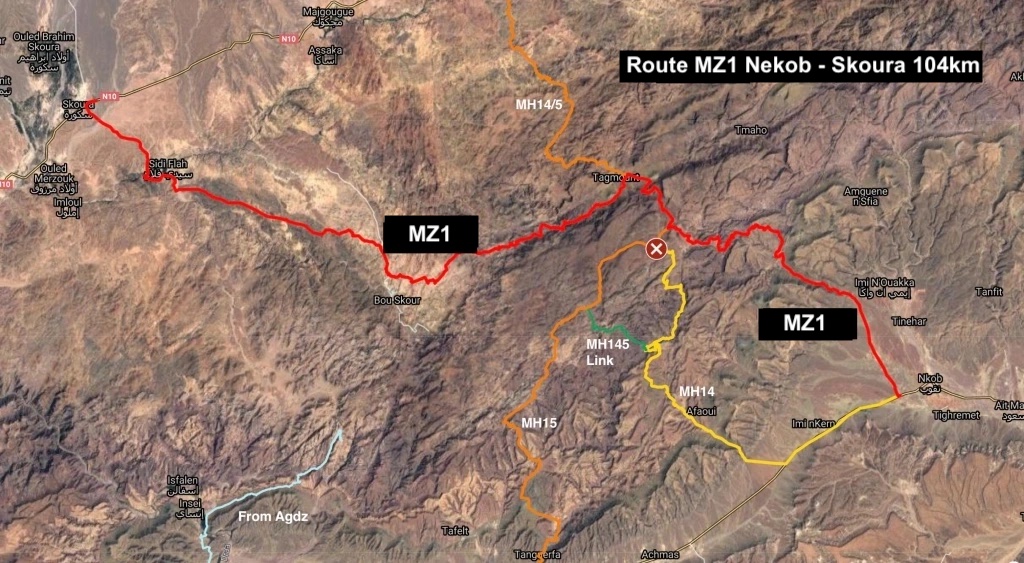
Now that the once classic MH4 from Nekob to Tinerhir (or Dades) is fully sealed, the southern sections of MH14 and MH15 still offer challenging off road crossings of the western Saghro mountains, with more routes to the east.
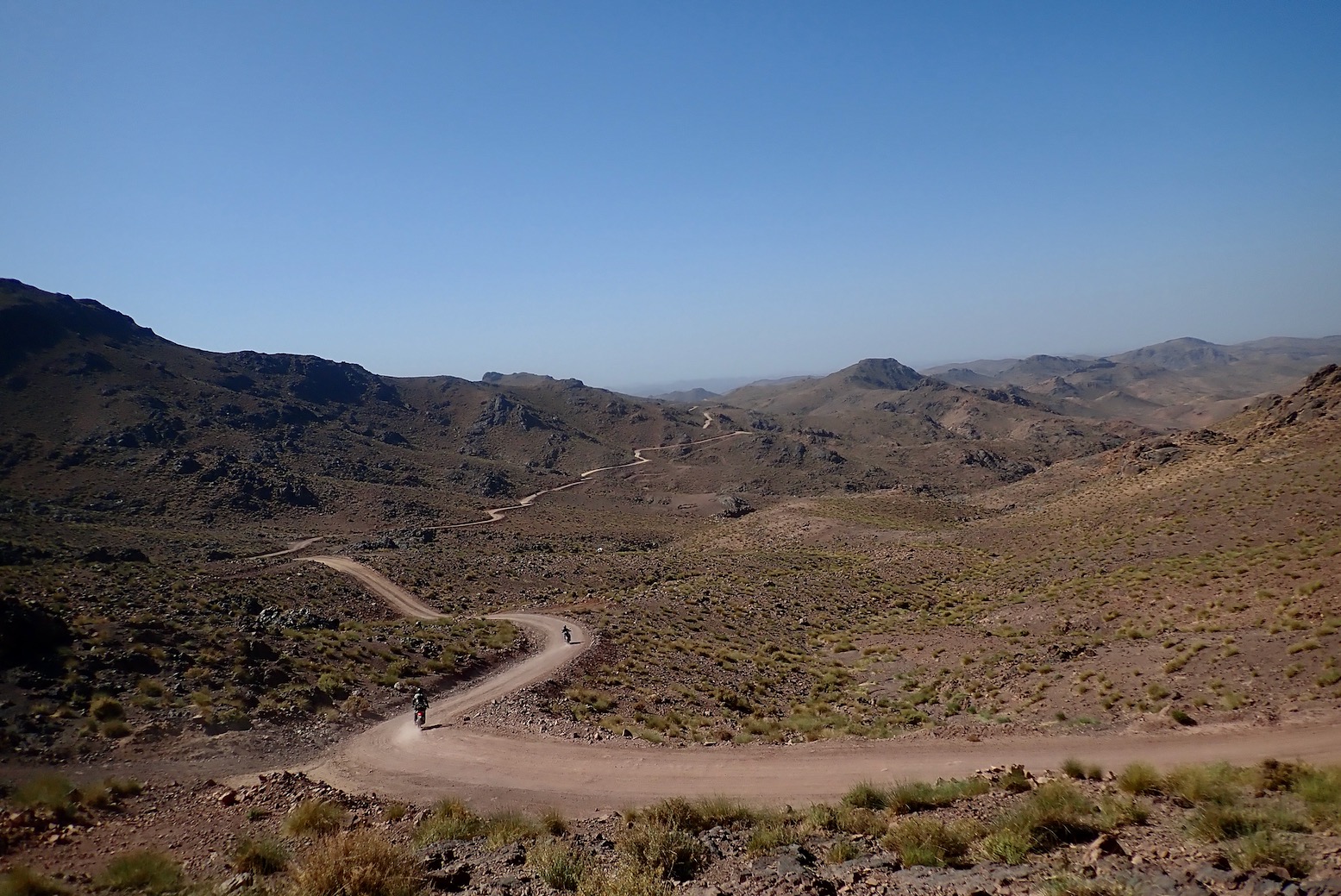
This route offers an easy way to access the range, initially following a well-maintained haul route west into the hills and down the other side on an easily followed mountain track.
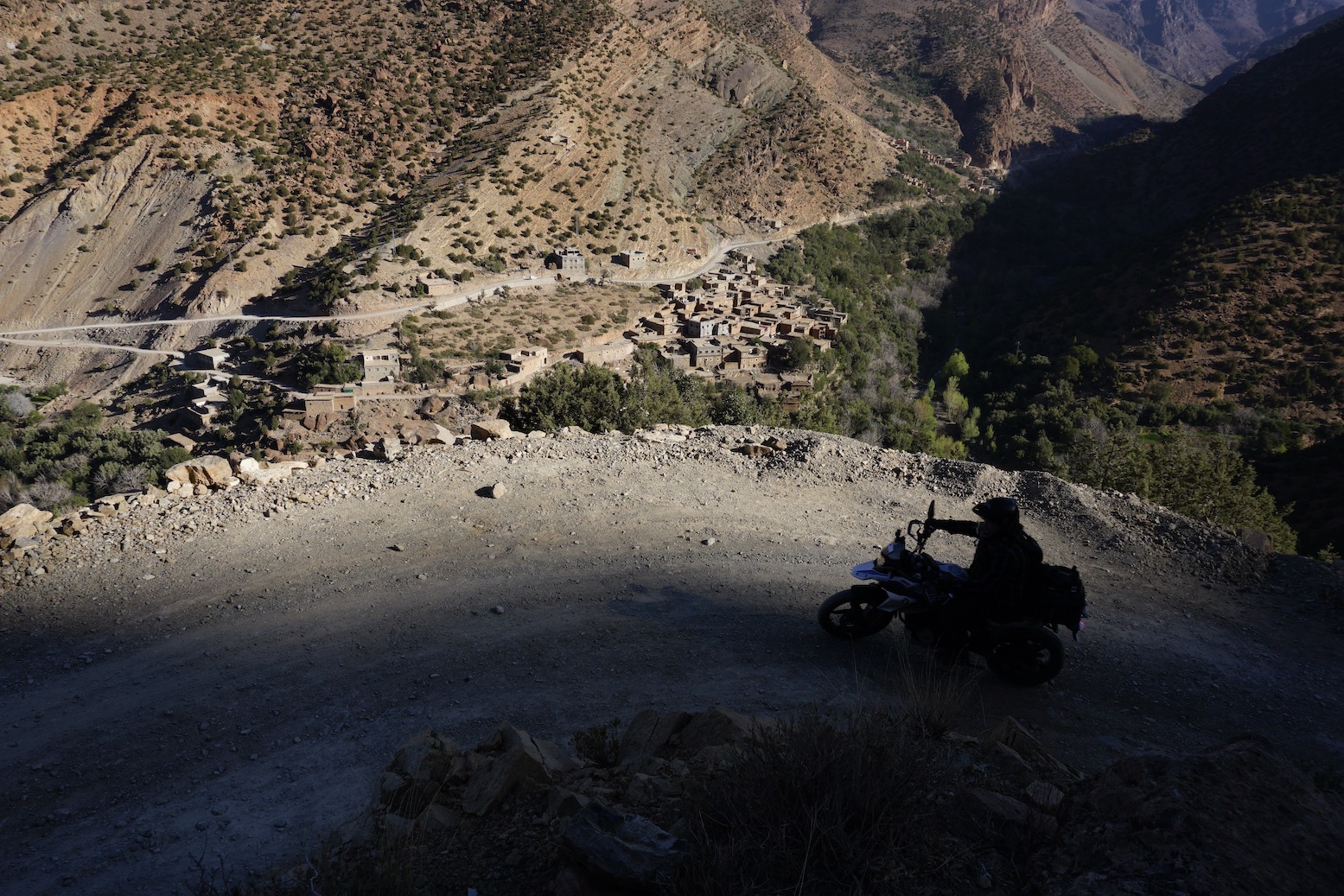
You get all the distinctive drama which make the volcanic ranges of Jebel Saghro but since I first road it, haul truck axles (combined with a lack of rain?) have ground almost all the bends into deep powder. This has now made the route tiresome on a bike; you won’t fall off unless you’re careless, but any flow is disrupted as you slither or paddle your way through the powder, bend after bend after bend. Coming into Tagmout from the west in January 2024, the ride was no fun; heading back north along MH14/15 towards Kella was loads more enjoyable, like MZ1 used to be. Even the col (not even a bend) just west of Tagmout on MZ1 is now thick with powder. In a car it’s not an issur; just expect clouds of dust.
Westbound, the drama subsides around KM70 heading towards Skoura, but in that time, above 1600m you’ll have passed several epic vistas that can make it all worthwhile. Thanks to local geologist Saad B for pointing out this route.
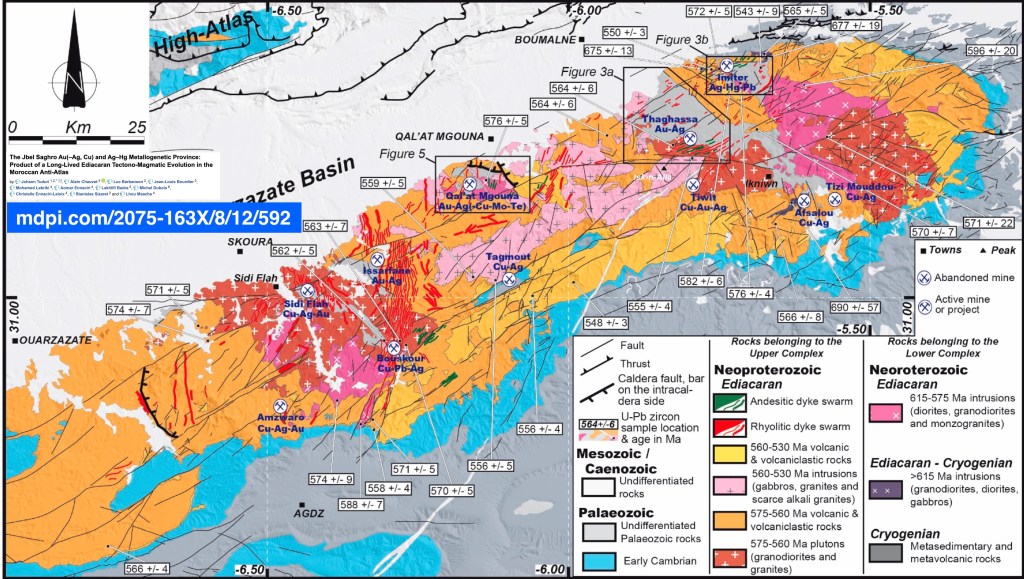
Away from either end, the only ‘village’ is Tagmout (KM43), a few smallholdings and a mosque strung out in the basin and overshadowed by the gold/copper excavation just to the north. This mine must be why the eastbound part of the track got carved out of the hills; it’s not like there are a string of others lonesome hamlets up here needing a link to the outside world..
Mapping
There’s nothing on paper of course, unless you print it yourself, but you can track it clearly on Google satellite and Apple Maps, as well as free digital maps like the particularly good GarminOpenTopo. There were only a few scraps of trail showing on my v3 Garmin Topo (v4 is current).
Off-Road
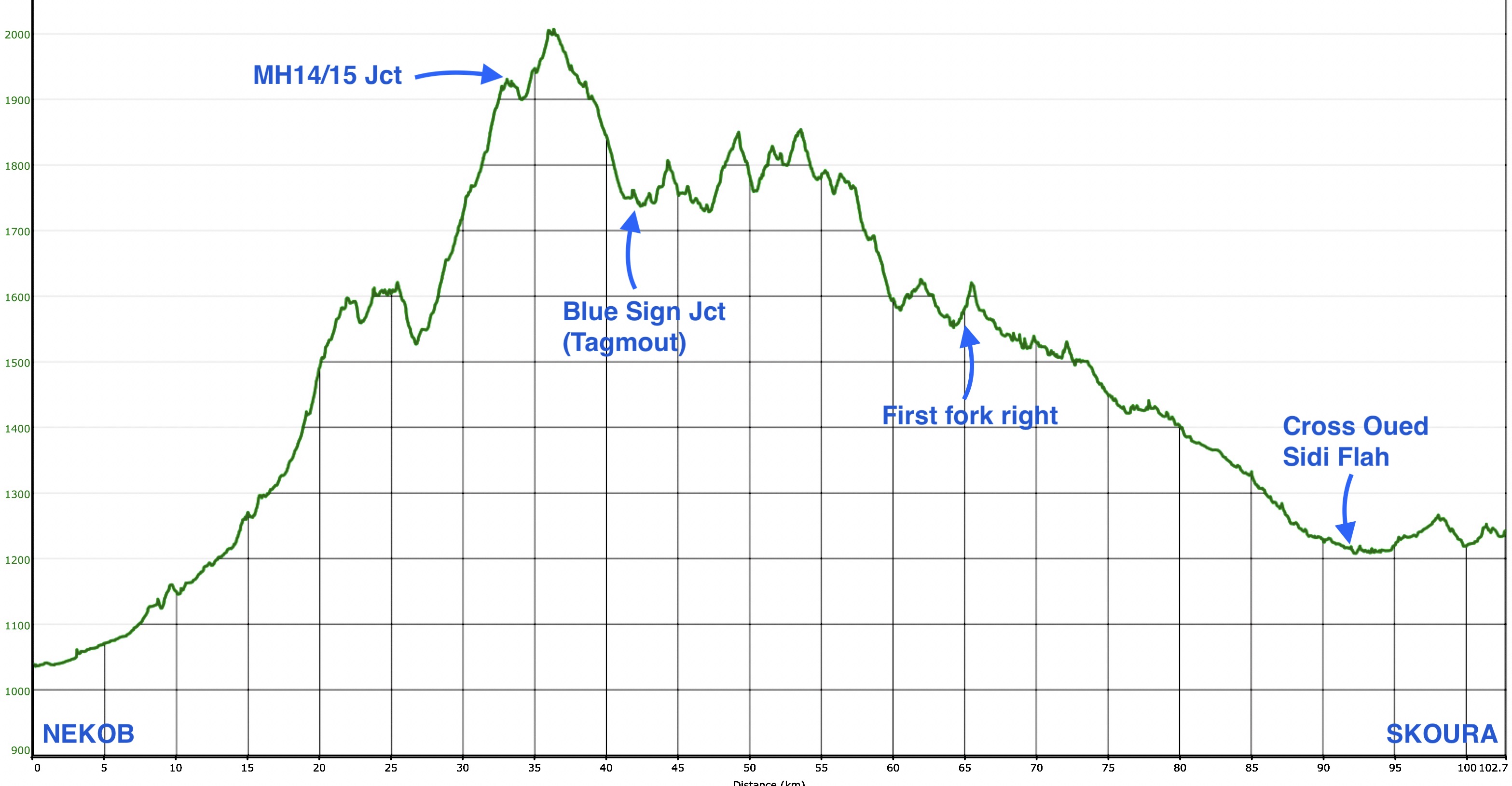
Because the east section is used by mining dump trucks (I saw three just as I left Nekob in 2021; one in 2022), east of Tagmout this track is wide and in great shape and so remains doable with any car or bike. On an Africa Twin in 2021 I did find the countless western switchbacks – ground down to powder by the trucks’ scrubbing tyres – needed to be inched around. A more stable KTM 890 (with a group) made easier work of these in 2022, and a week later 310GSs were easier still to manage but riding in spring 2023, I had the feeling it was getting pretty sandy on the west stage and was pretty awful by January 2024; with the wrong front tyre it will be tiring. A 4×4 will barely break into a sweat or low range.
Route finding
After studying Google satellite I traced a putative kml along what looked like the clearest route, and it all panned out fine with no wrong turns. Westbound, you can’t go wrong up to the blue sign in the Tagmout basin (KM42; Berber women selling trinkets) and beyond here most forks of substance are to the right on the downward section, passing north of Bou Skour village and mine site (which you don’t see) to the big village of Sidi Flah.
I saw no other traffic bar the three dump trucks rolling into Nekob in 2021 and in 2022 we saw a couple of Berber shepherd 125s and a lorry.
Suggested duration
Allow half a day in a car or 4 hours on a bike with scenic stops.
Route Description
0km (104) Nekob west Afriquia fuel. On the other side of the main road, 200m to the west, a tarmac side road leads north to villages.
5.5 (98) A track splits left off the tarmac. There was some roadworks here in late 2022; work your wat round towards the pass to the northwest. Soon you cross a oued and enter a small palm gorge at which point the climb begins.
19 (85) Col at 1420m.
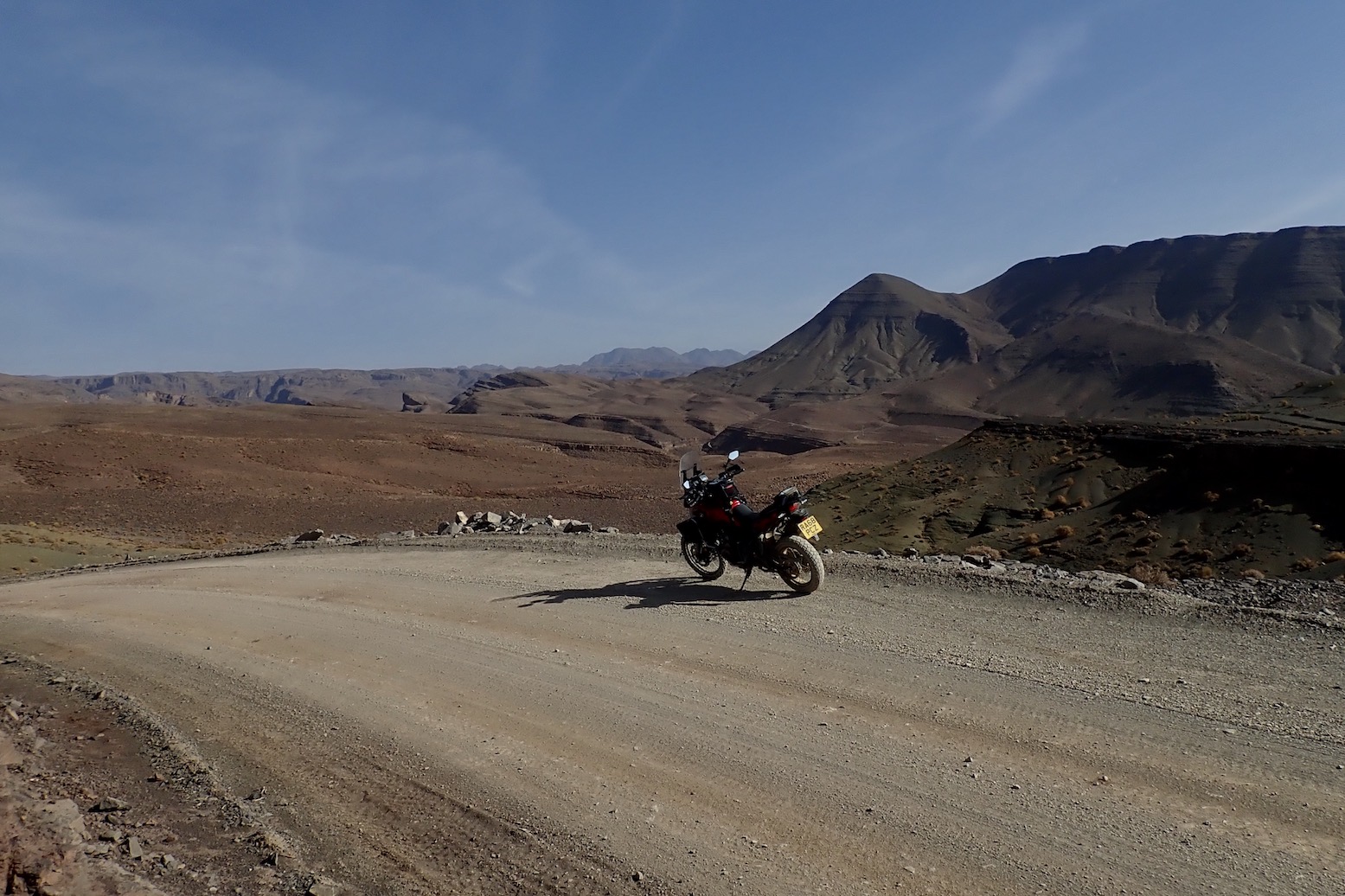
25 (79) Approach the impressive buttes of Jebel Agoulzi to the southwest (below). More noteworthy vistas follow.
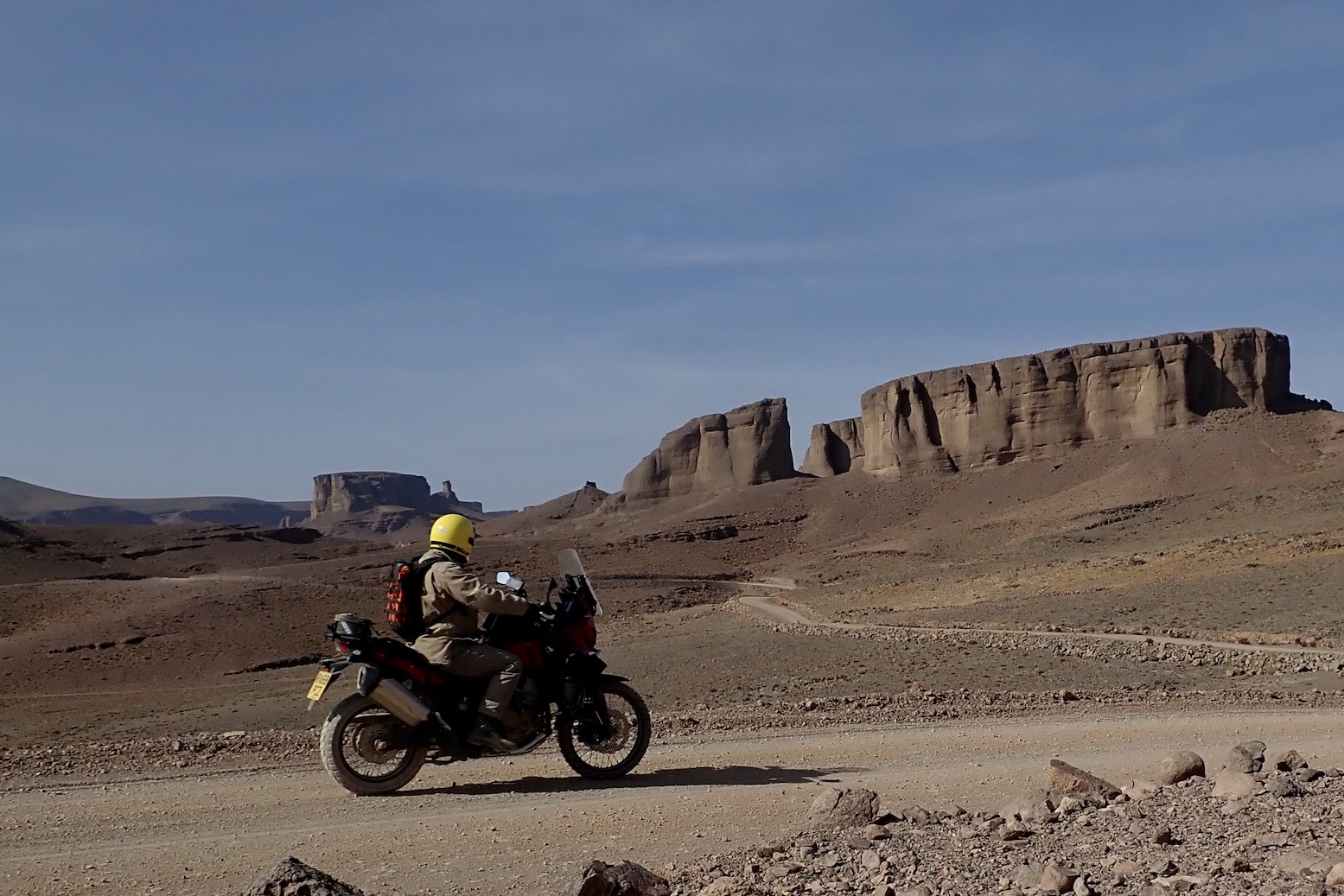
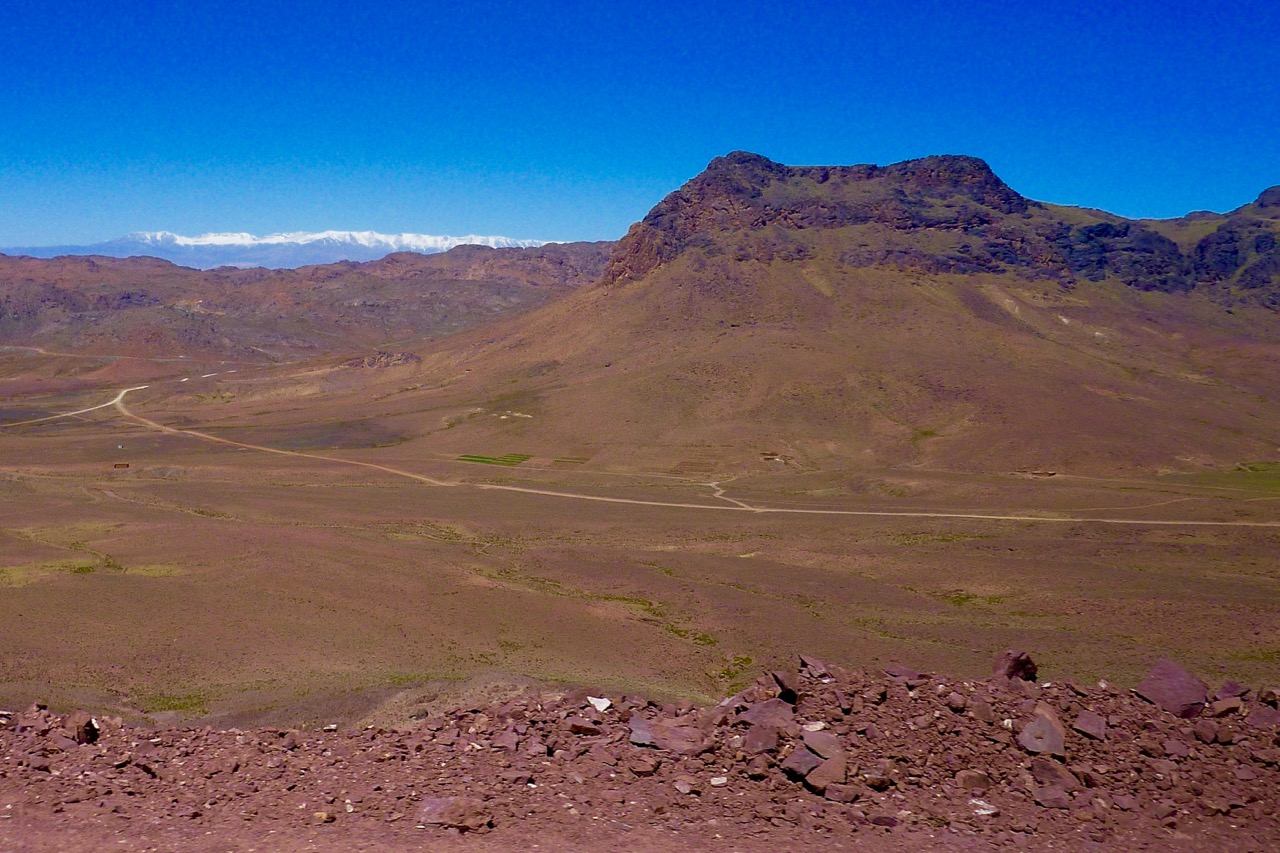
33 (71) Reach a junction with tyres on cairns which is a 3-km link SW to MH14. MH15 comes in about 3km later (KM36) up from the south. You now head north for 9km, on the way passing the 2004-m high point with great views of the snowy High Atlas (below), if the season and conditions are right.
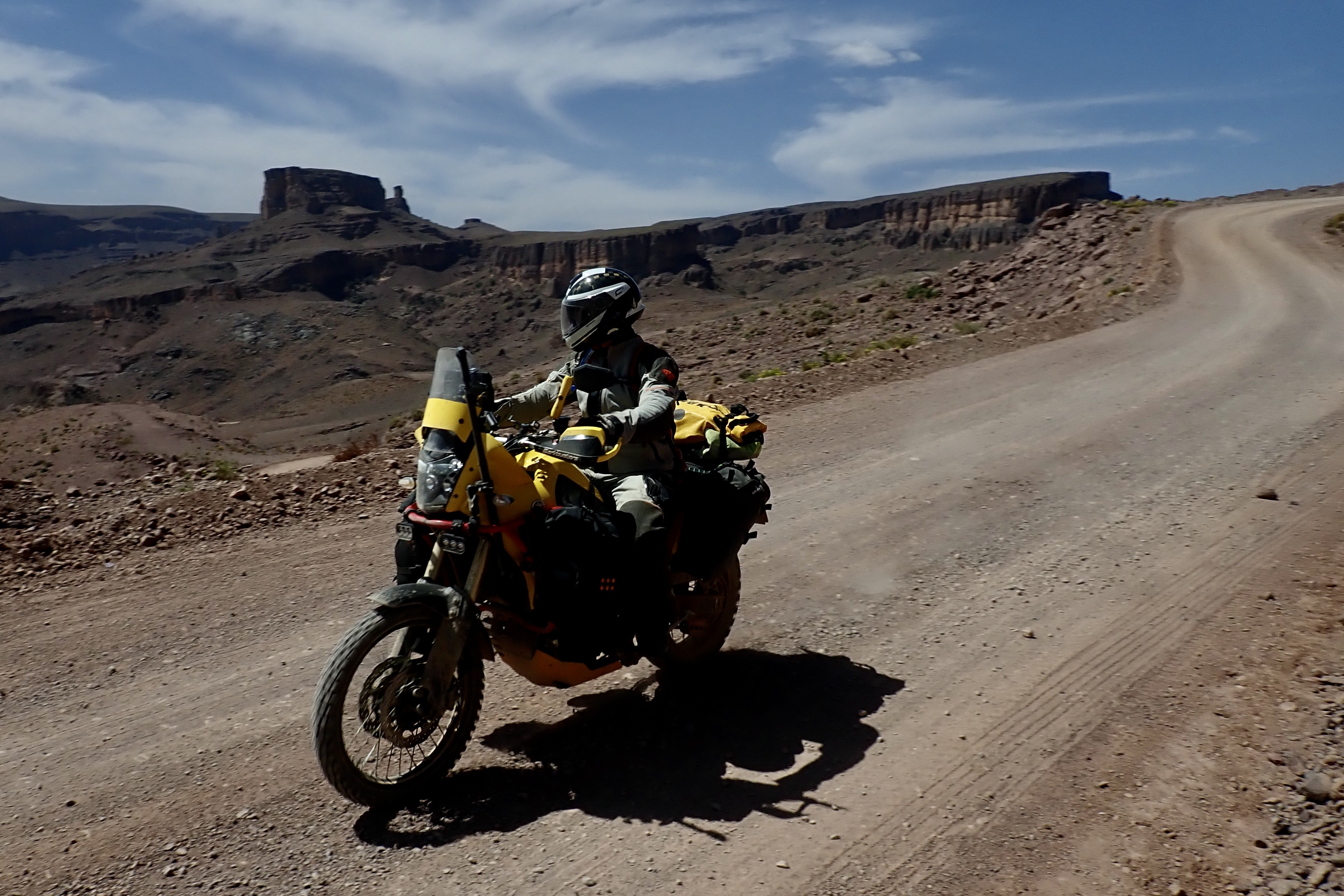
You then work your way down sweeping bends into the Tagmout basin with a mine on its northern flank and where tracks diverge.
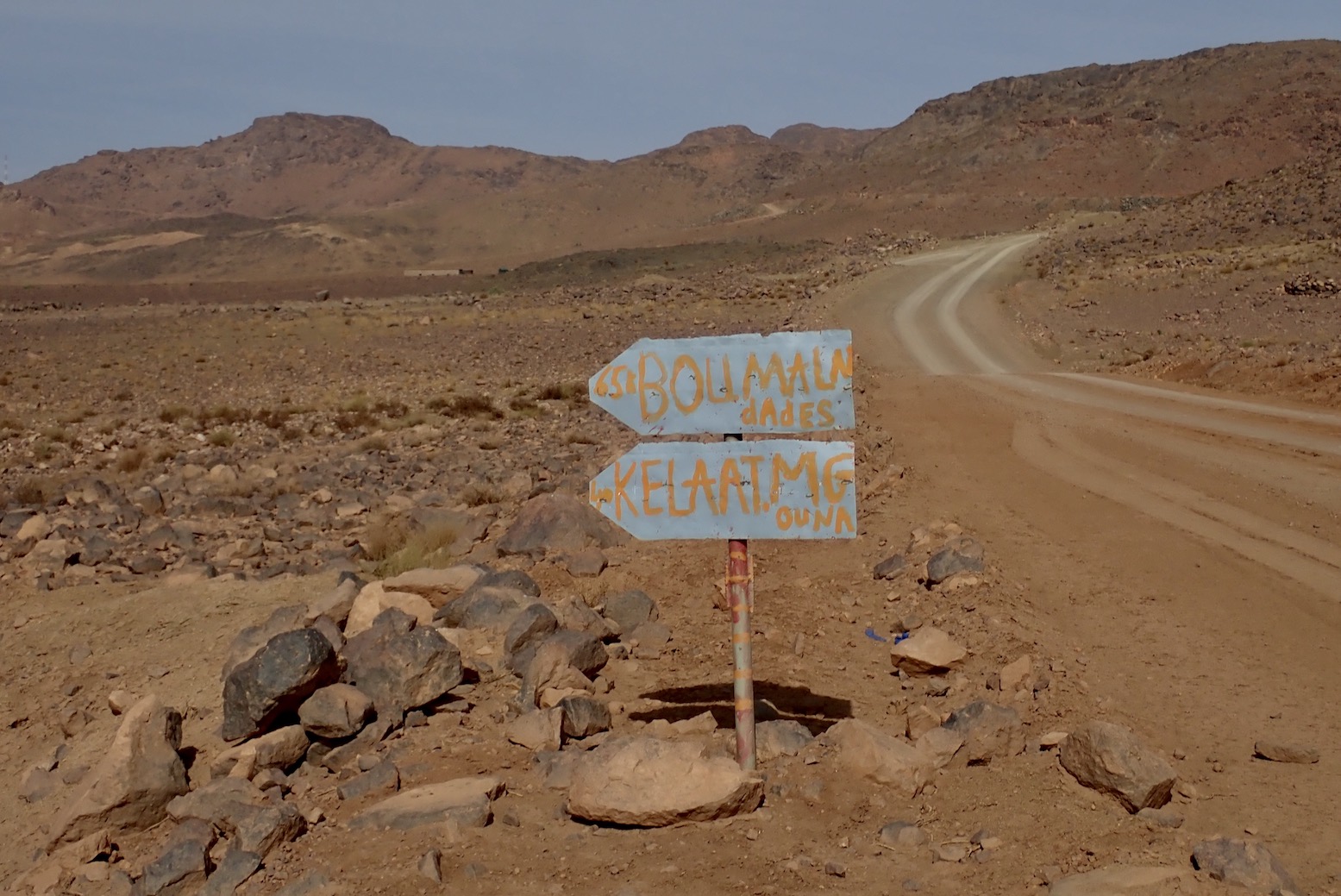
42 (62) Blue sign junction just east of Tagmout ‘village’, such as it is. Turn left for both Kelaa (as signed; MH14/15) and almost immediately left again (no sign) up to the Tachbouft Pass (KM45; 1805m) visible to the southwest for the run west to Bou Skour.
Over the next 20km the track rises and drops over the ranges with several impressive viewpoints (below).
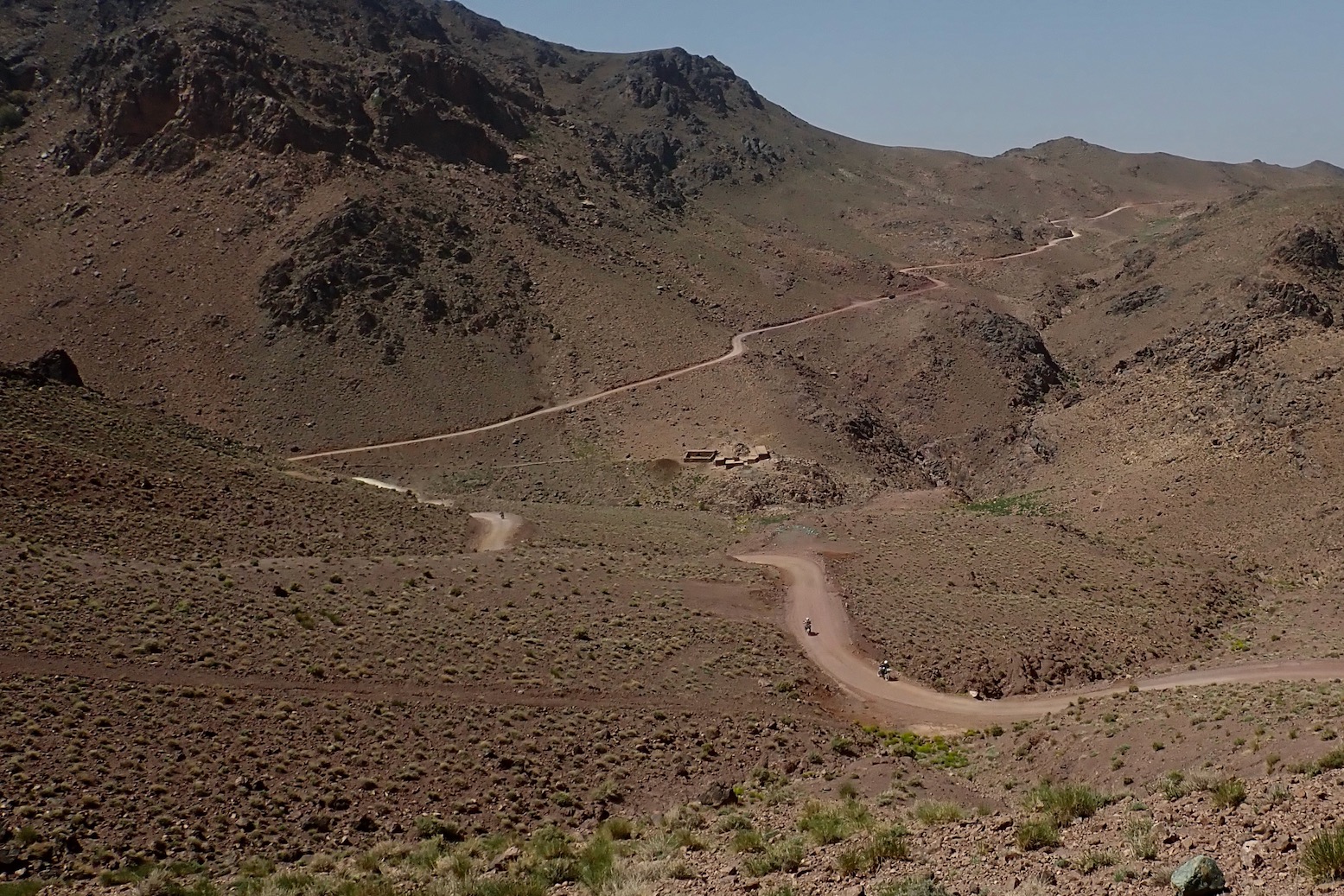
65 (39) Fork right. (Left leads down to Bou Skour village south of the mine). The most dramatic part of the crossing is over as the terrain loses elevation.
69 (35) Fork right again north of Bou Skour mine. In a kilometre keep right again just before some trackside machinery, and soon (around KM70) the main track from the mine (P1514 on Google) joins up from the left (south). You now follow the P1514 heading north then west.
79 (25) Fork. Keep left on the main track.
86 (18) Converge with a minor track coming from your left and where a red sign says ‘Bouskour 18,4km’ (pointing the way you’ve come from).
88 (16) Track joins from your right. All these three side tracks over the last 10km are minor: the main track is clear.
91 (13) Just after a passage alongside a farm wall, you cross a tributary of the nearby Oued Dades and swing north. Soon you pass through the small town of Sidi Flah. In 3km cross a bridge over the Oued Dades.
103 (1) Near a power station, at a lone, unconnected orange pylon keep right to reach the N10 visible up ahead. Once there, turn right for the Inov roadhouse on the eastern outskirts of Skoura. Left is for Skoura and the N10 to Ouarzazate. Straight across leads up to the actual town centre and Amzeria (Amerzi; see update Update 3.0.14 – May 2019)
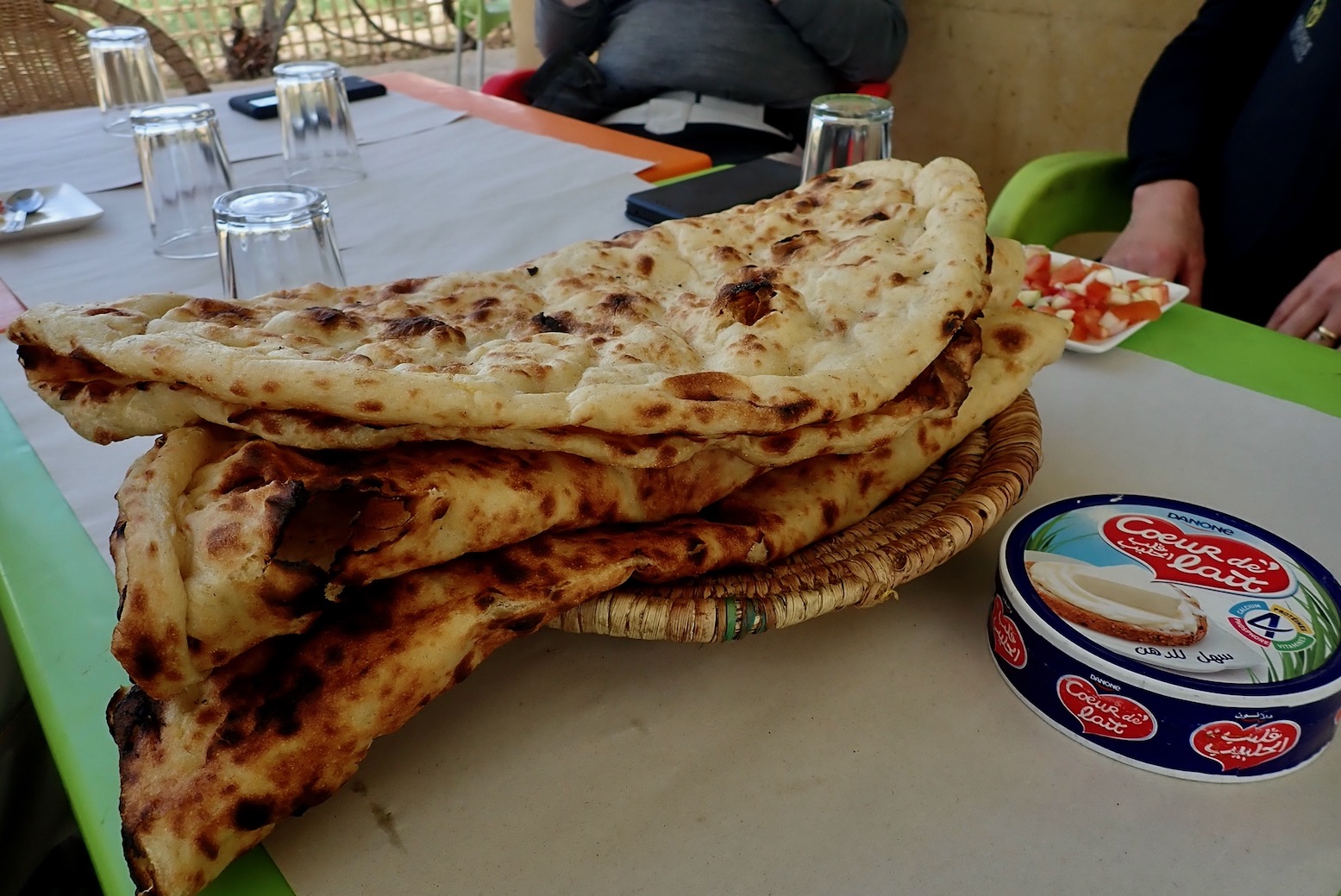
104 Inov roadhouse. (100km from Nekob on a 310GS odo). Lovely fresh tafernoute bread if you time it right.
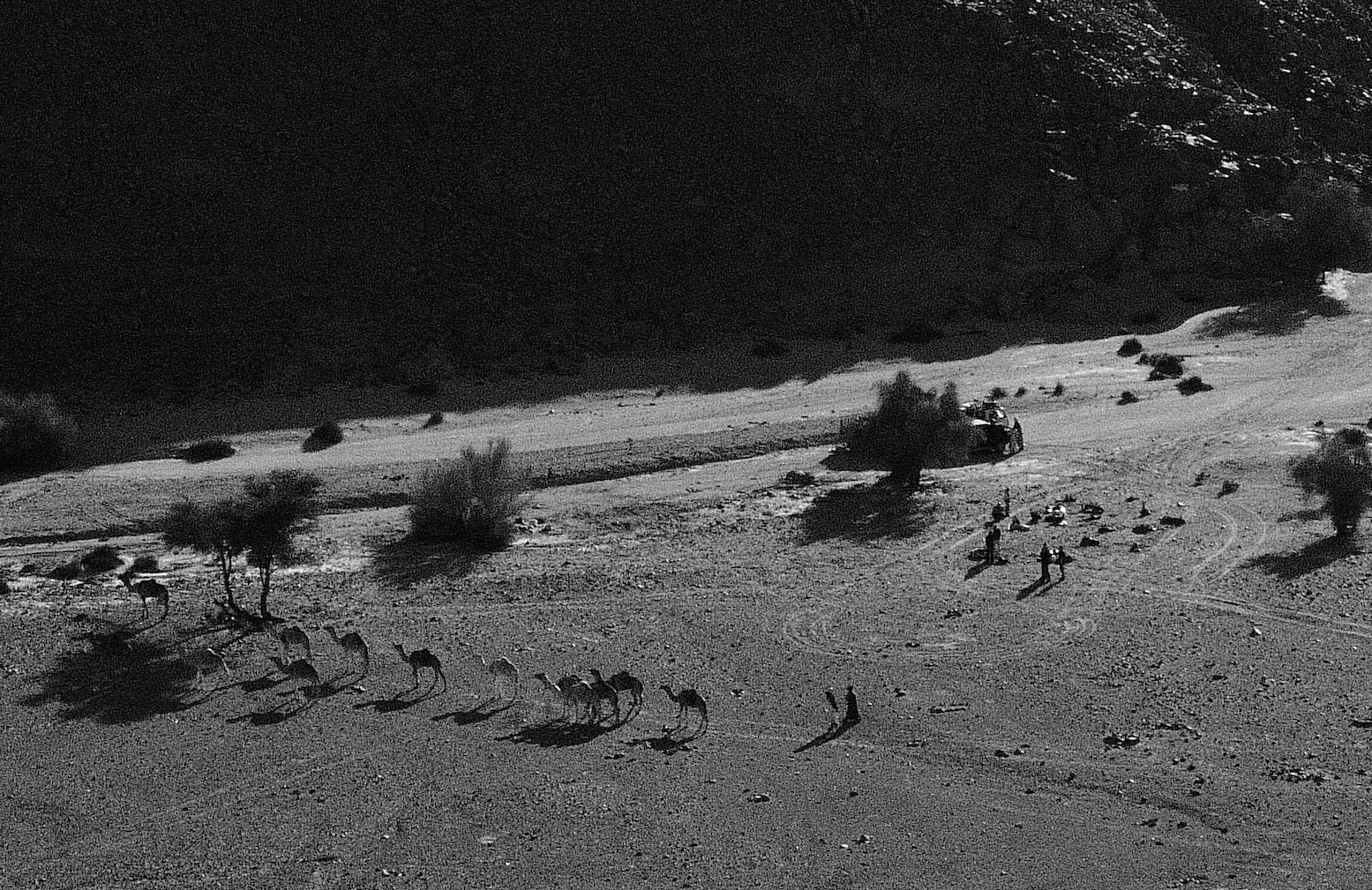
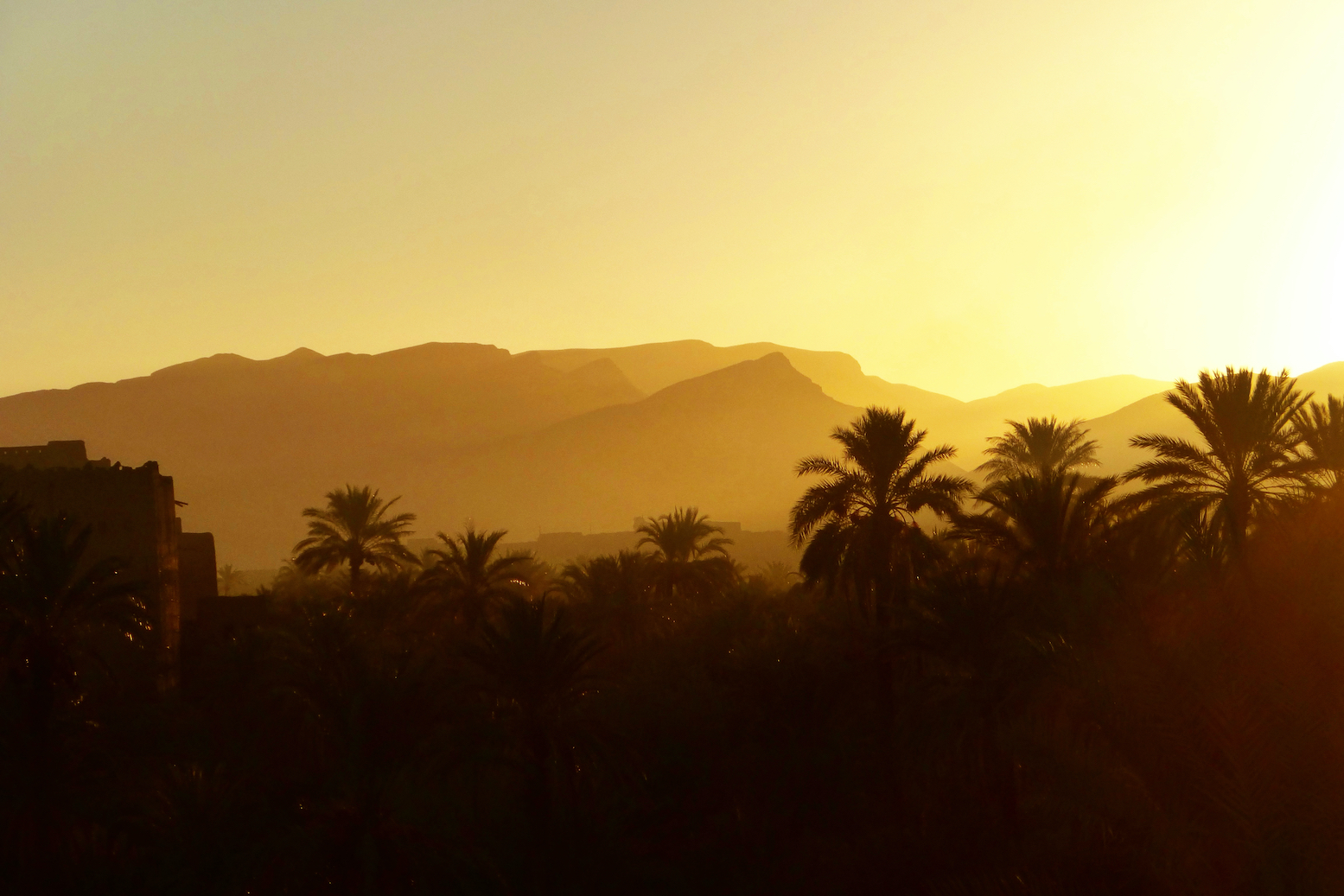
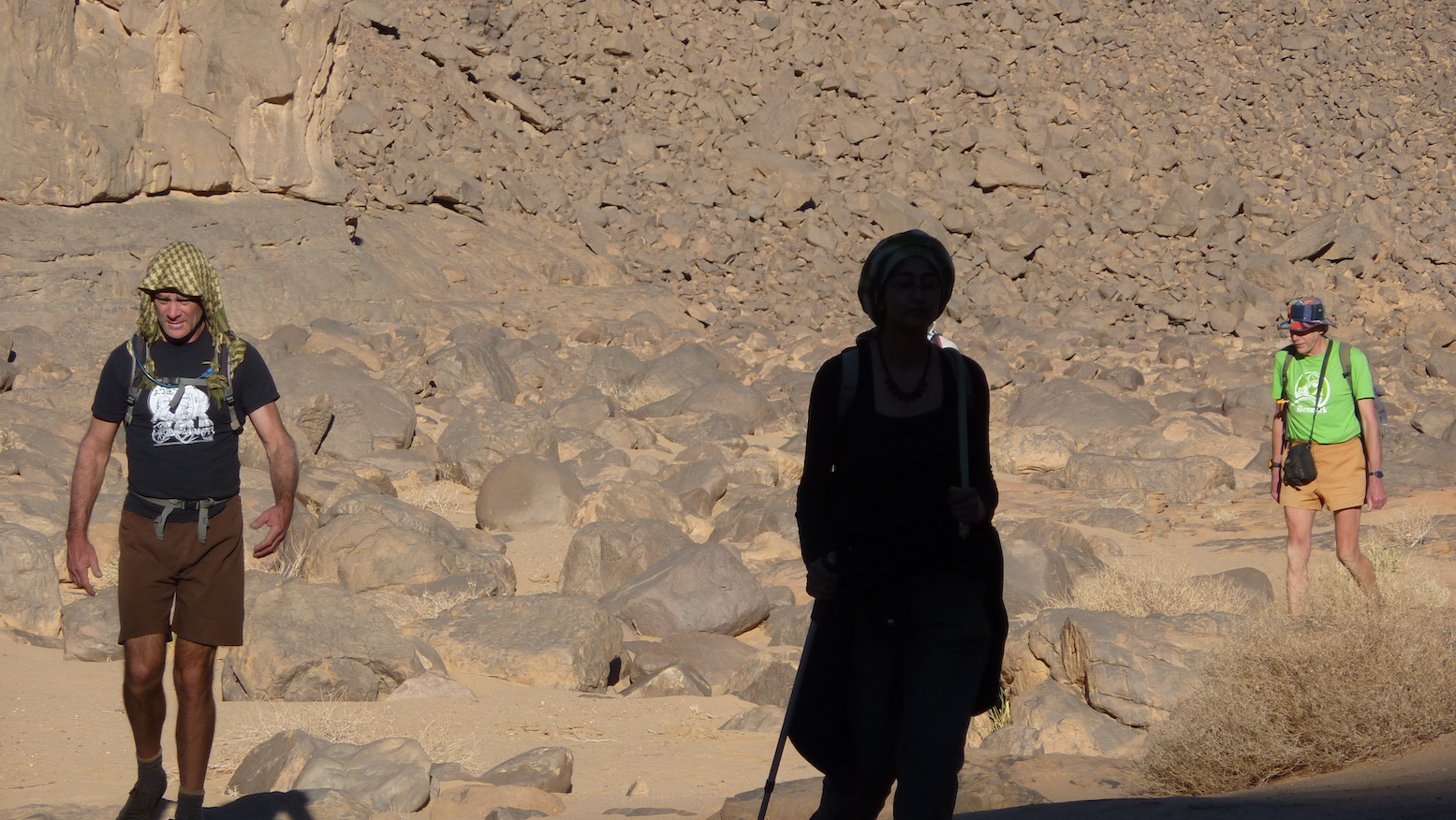
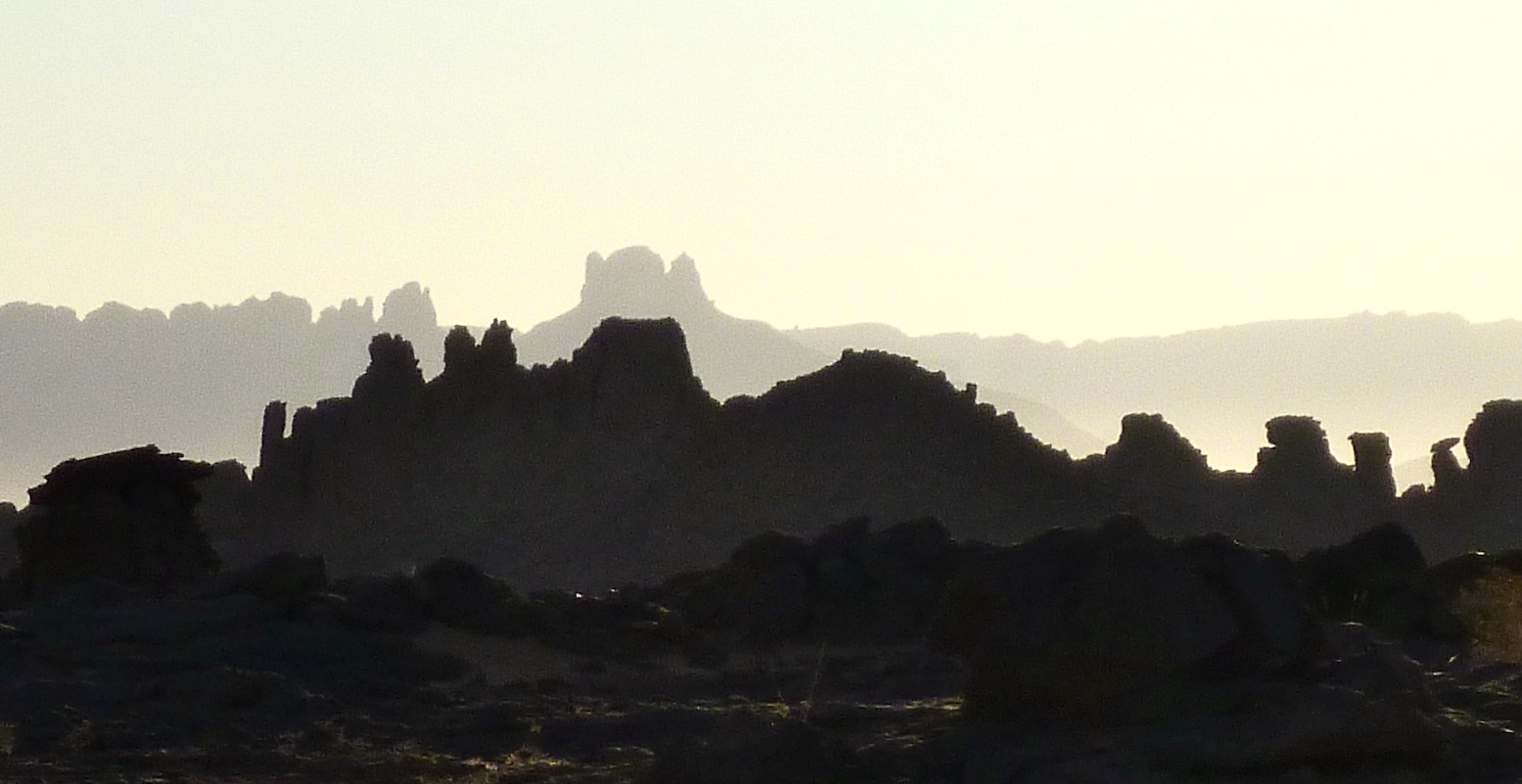
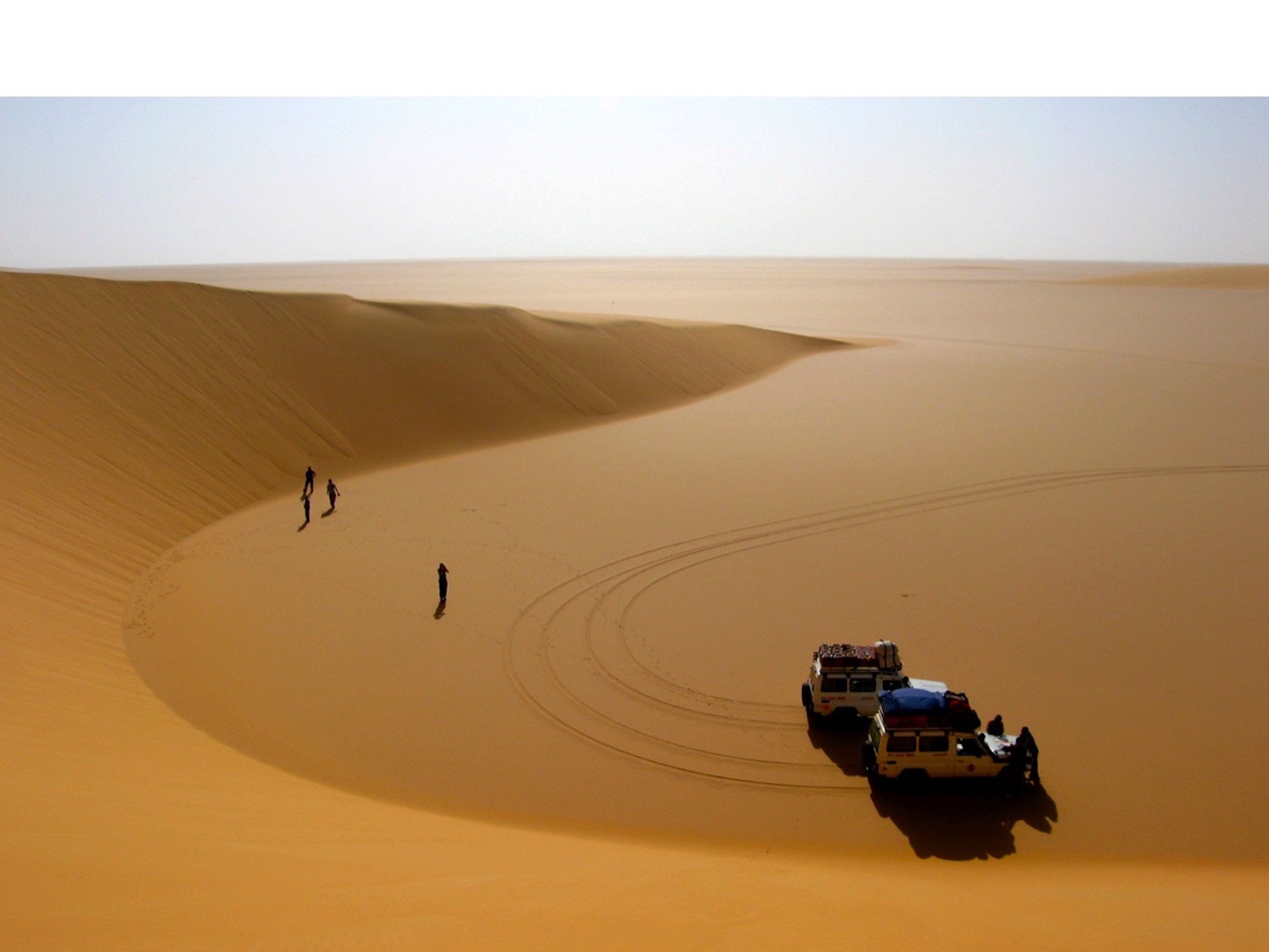
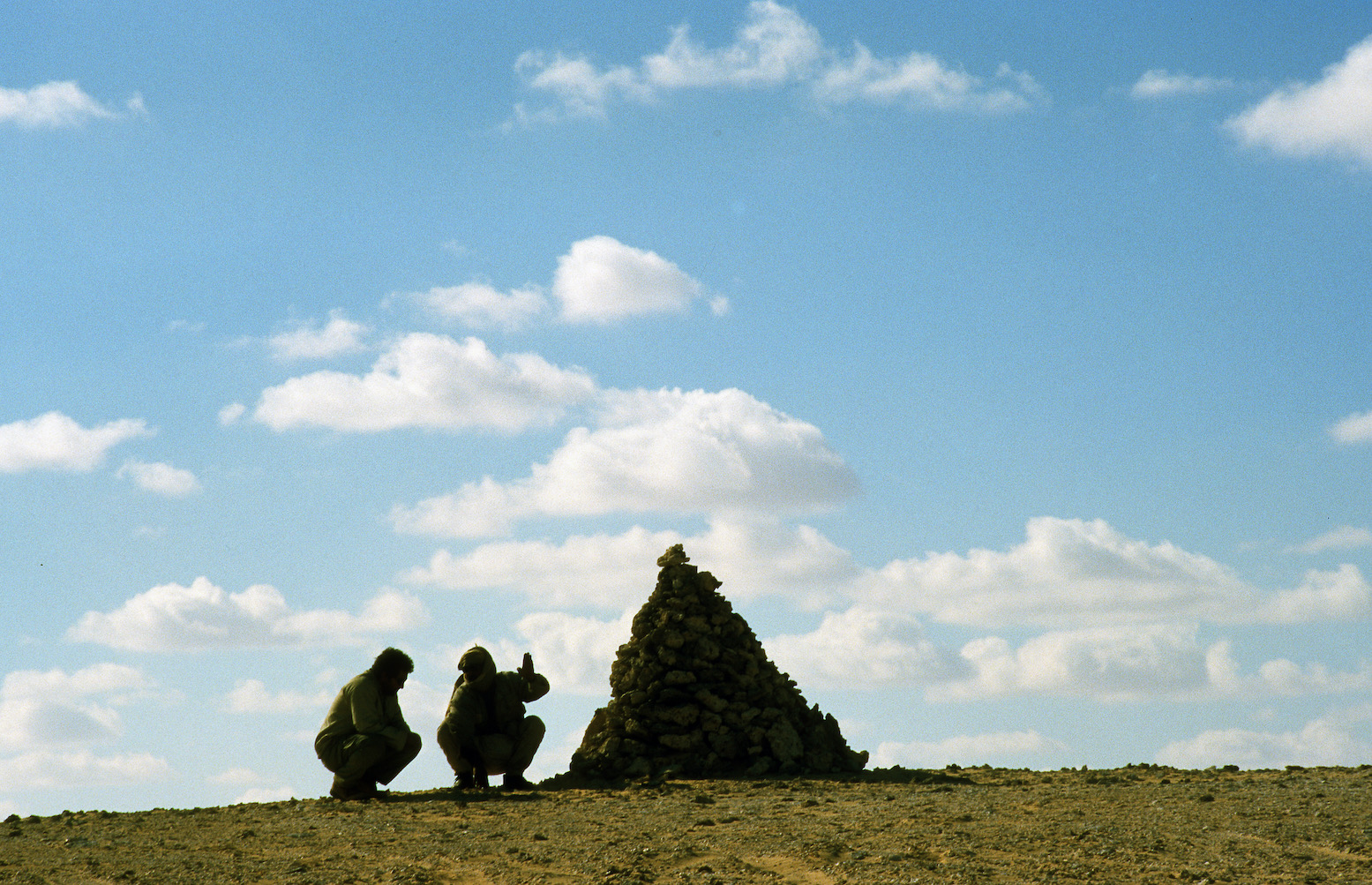
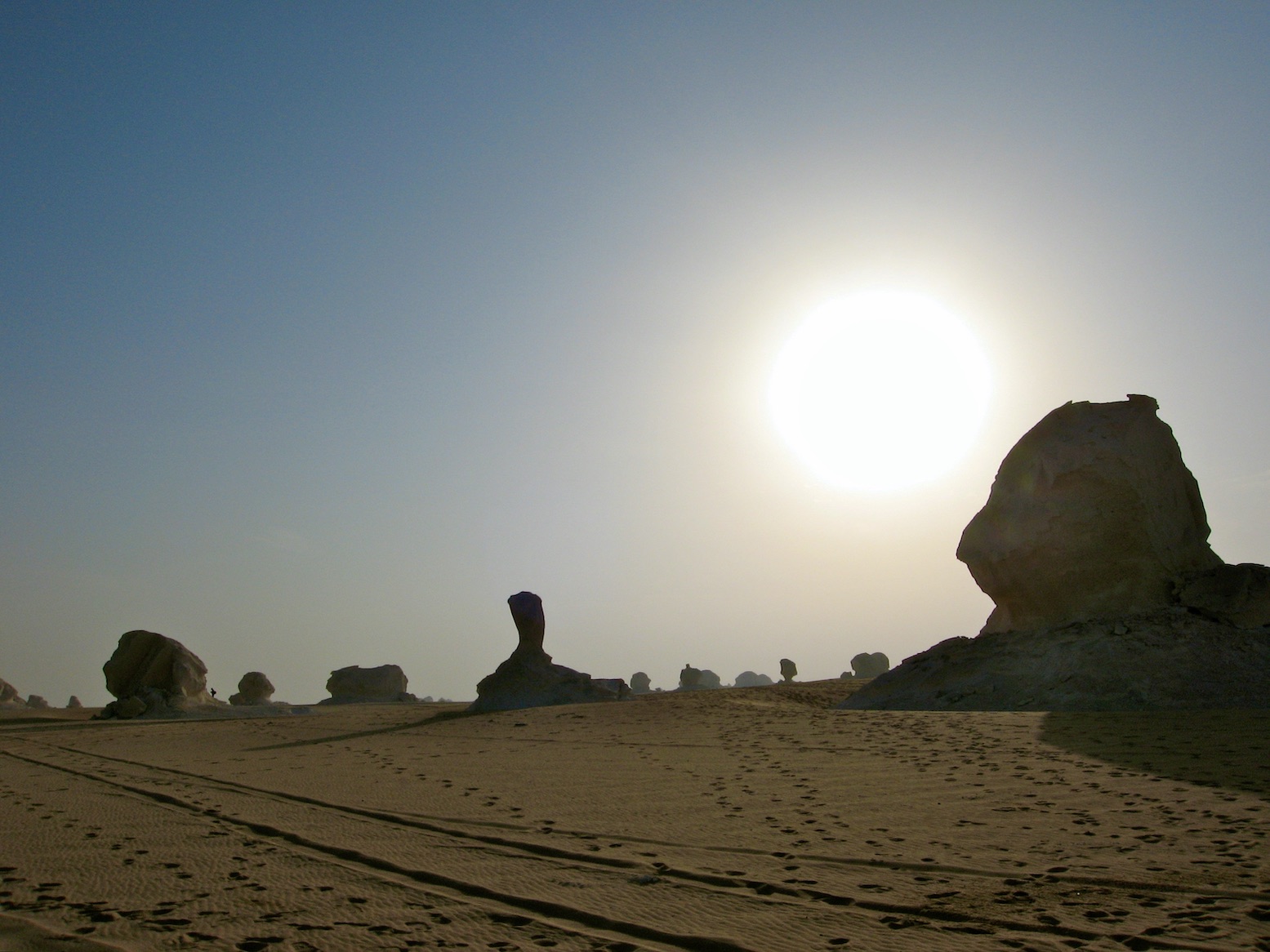
More Sahara silhouettes here and here.








Buy Desert Travels 2021 on Amazon
Book Chapters:
16 Arak
17 Bad Day at Laouni
18 The Far Side
19 A Blue Man
20 The Hills are Alive
After my batty Benele excursion of 1984 I brushed my hair, straightened my tie and bought a sensible XT600Z, just like I always knew I would.
This was the slightly better 55W version of the original kick-only Tenere, distinguishable by sloping speedblocks on the tank (more here).
All I did was add thicker seat foam and fit some Metzeler ‘Sahara’ tyres – a rubbish choice for the actual Sahara, as I was to learn. Using no rack was another mistake which nearly cost me the bike. My learning curve was still as steep and loose as a dune slip face.
In fact, there was so little to do to the Yahama that I moved the oil cooler from down by the carbs up into the breeze over the bars. And I painted it black because I still hadn’t shaken off my juvenile Mad Max phase.
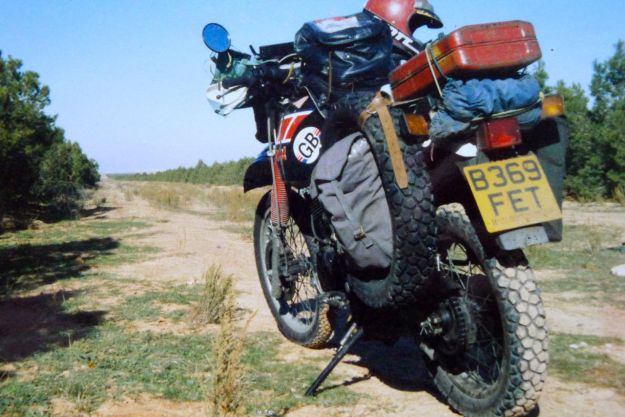

With my £5 ex-army panniers slung over the back, in December 1985 I set off for Marseille, bound for Dakar via Algeria, Niger and Mali.
As I mention in the book, I was going to try a new ‘go with the flow’ strategy’. Instead of being ground down and resentful by the setbacks of my previous adventures, I’d just take the reversals on the chin, bounce back, and move on.
On this trip that stoic philosophy was to get a thorough road test!




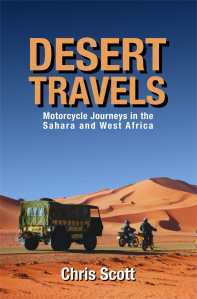
Buy Desert Travels 2021 on Amazon
This is part one of a bonus chapter which does not appear in the book.
You’d think I’d have learned something after my 1982 Saharan fiasco on the XT500. Well I did. Despite it all, I was still fascinated by the Sahara and wanted to go back and do it properly this time. When it was good it was epic and other-worldly, and if you came from one of the less edgy suburbs of South London, the Sahara made quite an impression: nature stripped back to its raw bones of sand and rock. Across it lay the frail ribbon of road they called the Trans Sahara Highway which I’d ridden off the very end of a couple of years earlier on the XT.

By 1984 I’d settled for an easy way of despatching for a living: working long but steady hours for a London typesetting outfit, delivering advertising copy on the one mile between Holborn and the West End. (You can read all about that and a whole lot more in The Street Riding Years.)
There was no longer a need to ride an IT250 or a 900SS should you get sent to the other side of the country on a wet Friday evening. For this job a dreary commuter bike was sufficient. And none came drearier than Honda’s CD200 Benly twin (below left), a single-carbed commuter ridden by stoical Benlymen. Riding up to 12 hours a day on a hyper-dull CD can drive you a bit crazy at 24 years of age.
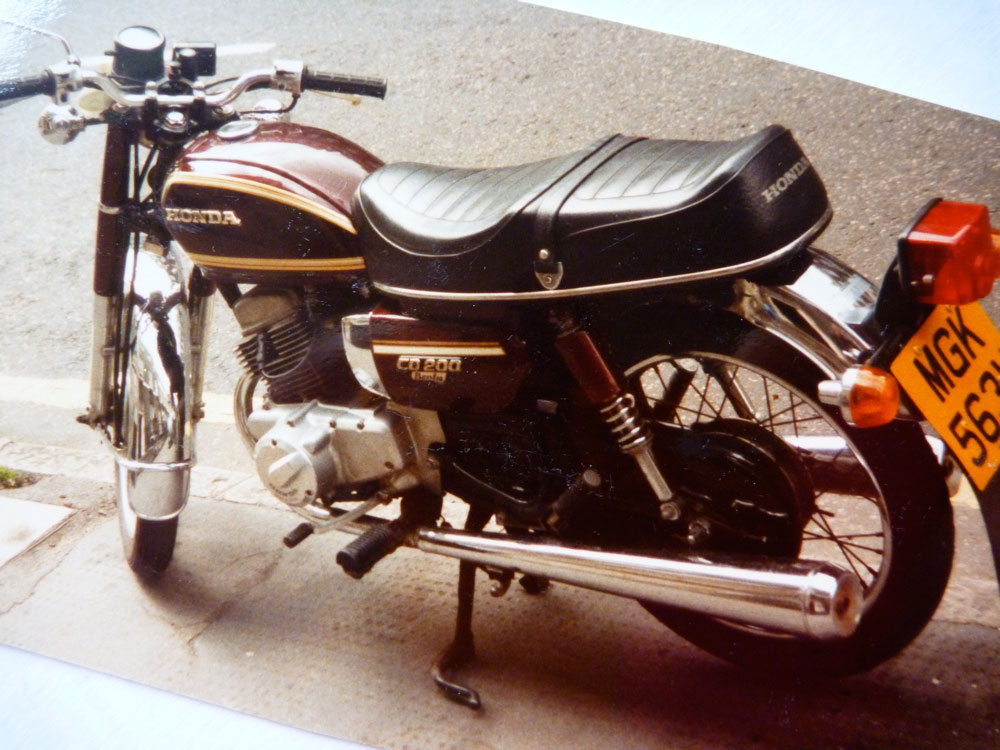
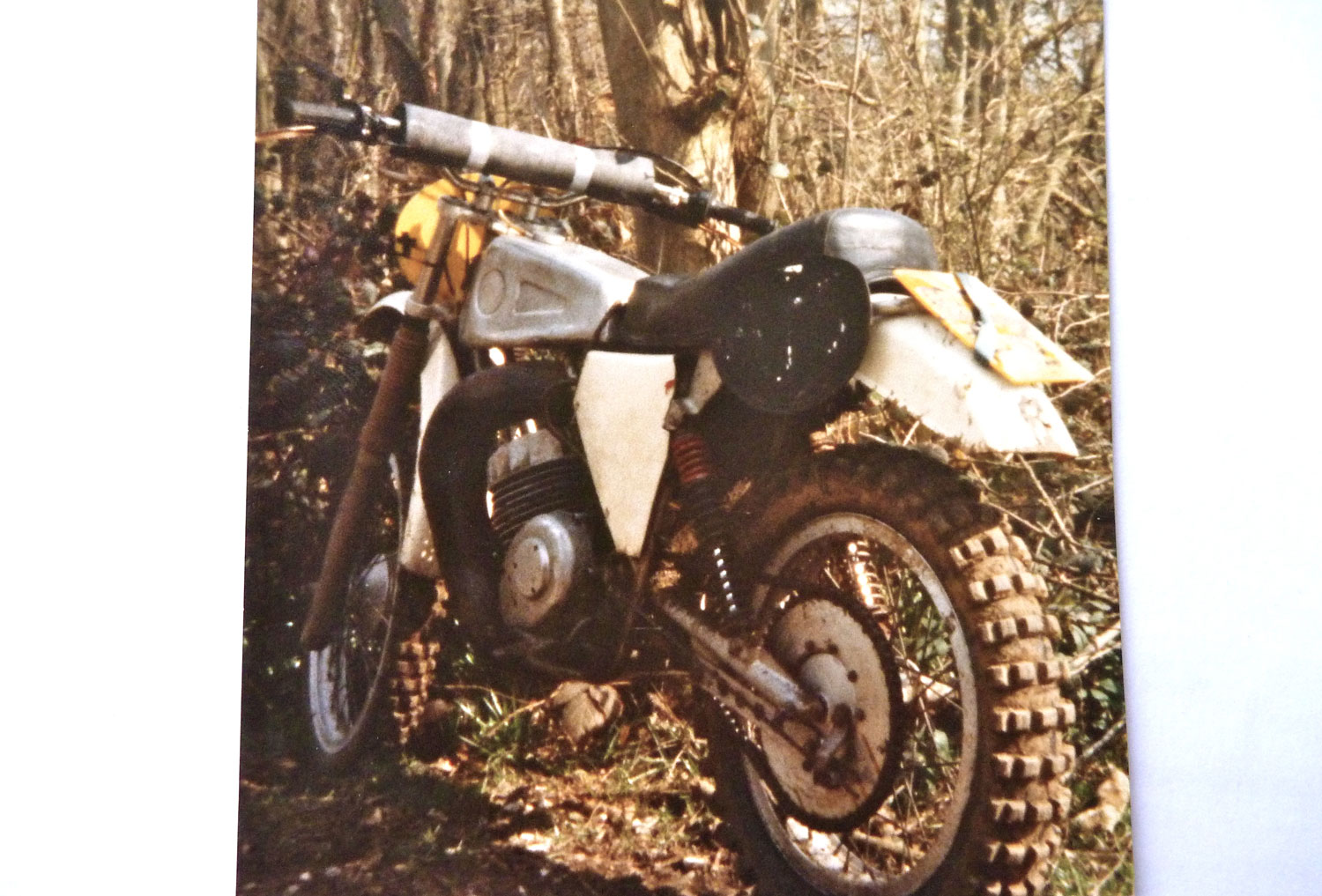
Knowing I was into dirt bikes, a mate put me on to a mate flogging an AJS 370 Stormer (right) for fifty quid. The Stormer was a vile, shin-kicking British two-stroke motocrosser that was the polar extreme of the Benly. In a flash of brilliance which years ago had given birth to the Triton cafe racer cult, I figured I could marry the two and make something more desert rideable and less boring: a Benly-engined, MX-framed desert racer!
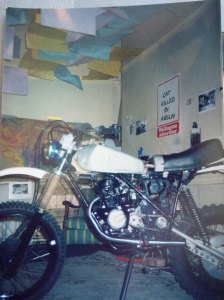
Over the summer of 1984 the machine took shape in my artfully appointed bike design studio in London’s literary Bloomsbury district. It took two goes to get a bike shop to correct the engine alignment mistakes of the former. But here it was, suspended by some Honda XL250S shocks as long as truncheons, and silenced by VW Beetle tailpipes, a cunning, lightweight trick you may recall from the BMW I rode with in Algeria in 1982.
Later on, the job was finished off with gearing more suited to horizontal applications, and an RD250 tank with a sexy ‘Moto Verte’ sticker so there’d be no mistaking what an international, Franchophilious guy I was. I took it out to the woods near Addington to see what it could do.
The answer was similar to dragging a dead dog around on a lead. The VW pipes reduced the power at the rear wheel to quite possibly single figures. The foot of clearance needed a running jump to get on the bike. And the AJS conical hub brakes where a requirement by the then powerful Ambulance Drivers’ Union to ensure their members were never without work scraping Stormer riders off the sides of buildings.
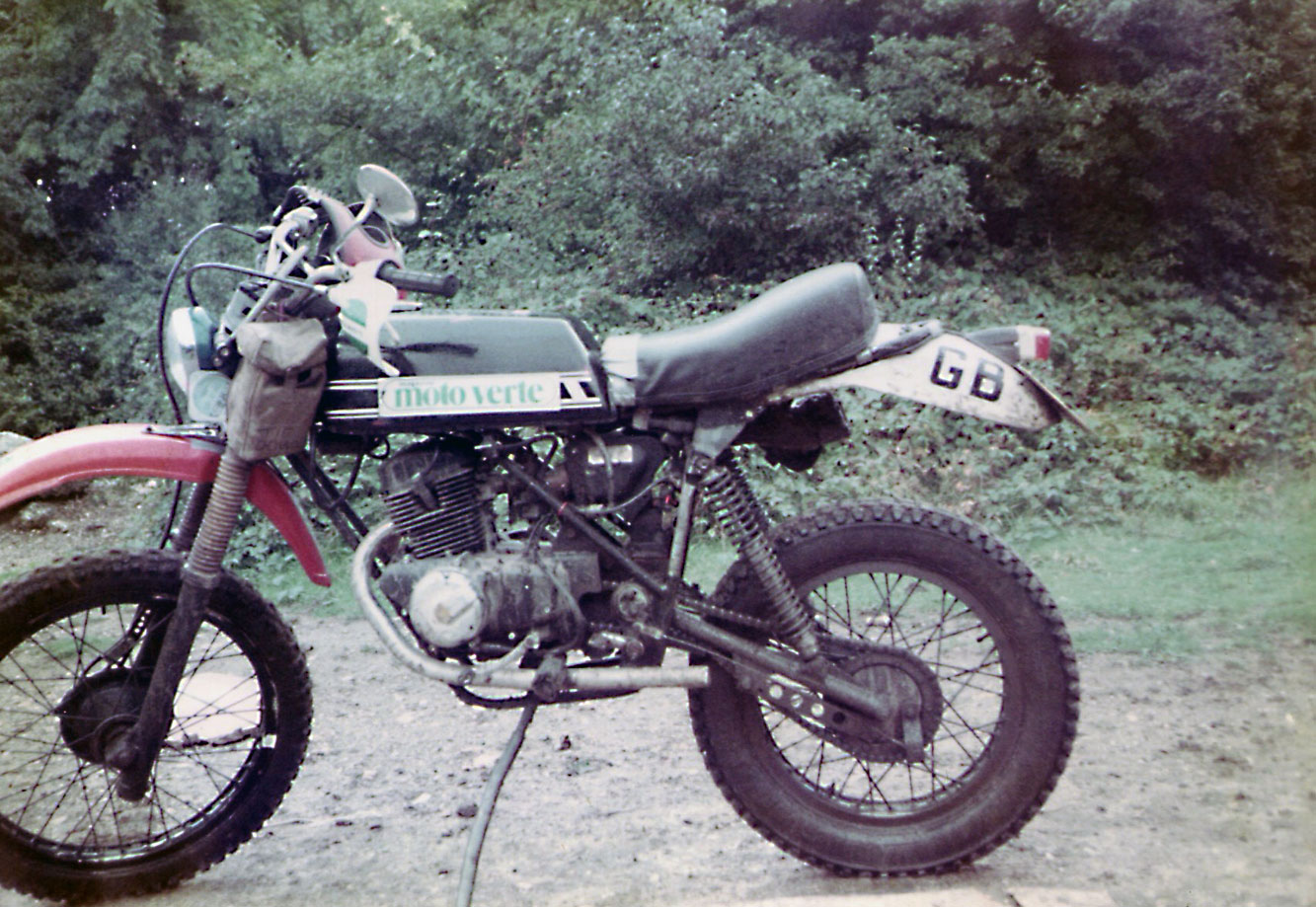
I dubbed the bike a ‘Bénélé‘ in envious recognition of Yamaha’s near-perfect XT600Z Ténéré which I’d spotted in a Sydney bike shop a year earlier, and which was itself based on Yamaha’s Dakar Rally desert racers. More about them, later.

So what do you do with a dumb-arsed desert racer? You ride it to the Sahara of course, in a little less time than was available. You pack a 3500-mile trip to North Africa into two-weeks and you schedule it for September when you imagine peak summer temperatures are on the wane. This time there’d be no fear of enduring the mid-winter transit of Europe and the northern Sahara, as in 1982.
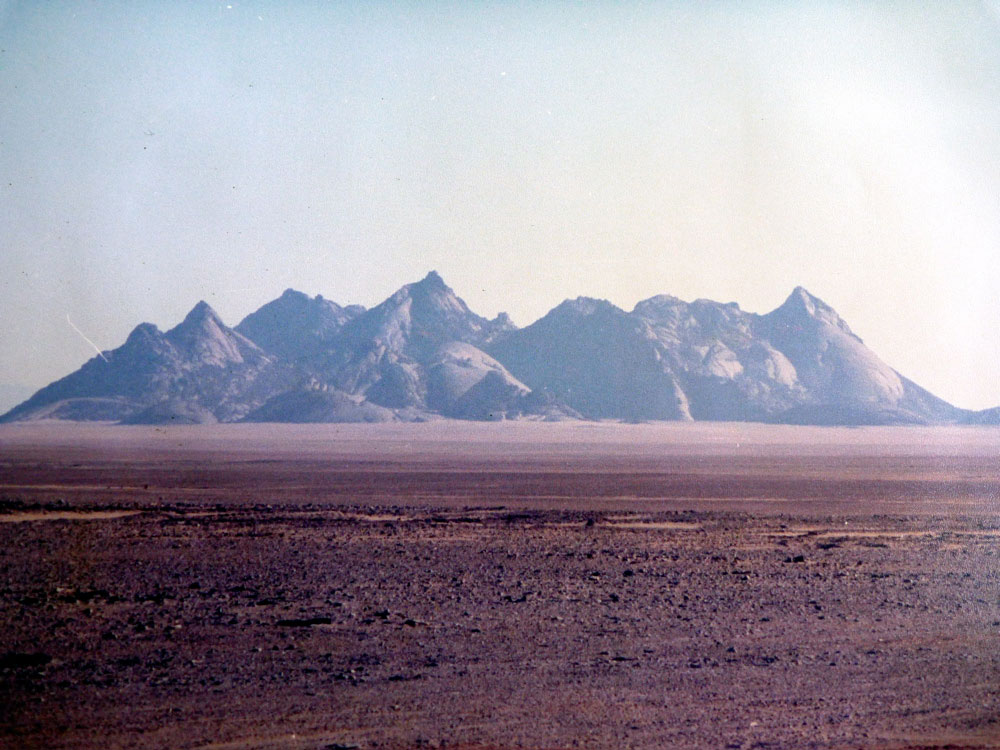
My goal that year was a mysterious massif of conical peaks which I’d passed by, south of Arak on my way to Tamanrasset in 1982 and which I’ve since learned is called Sli Edrar.
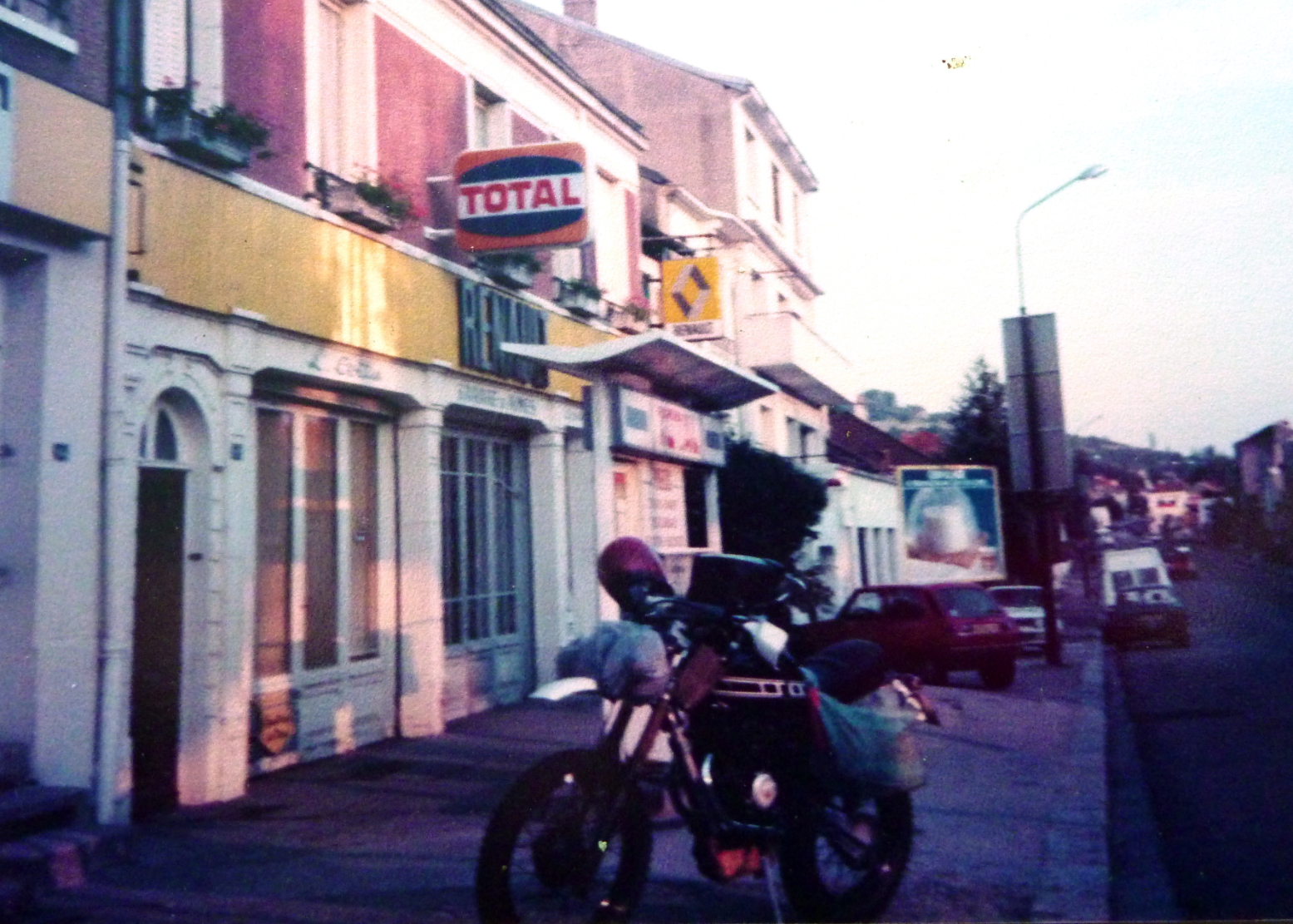
The Bénélé’s top speed was no more than 53mph, and even at that speed it felt unsafe, should a squirrel run out in front of me. So to get a good run-up I rode straight from work on Friday night down to a mate’s in Canterbury, close to the port of Dover, ready to catch an early Dover ferry next morning.

By maintaining momentum, Monday night found me camped back among the magical limestone outcrops of Cassis, near Marseille, ready to hop on the ferry to Algiers the following morning.
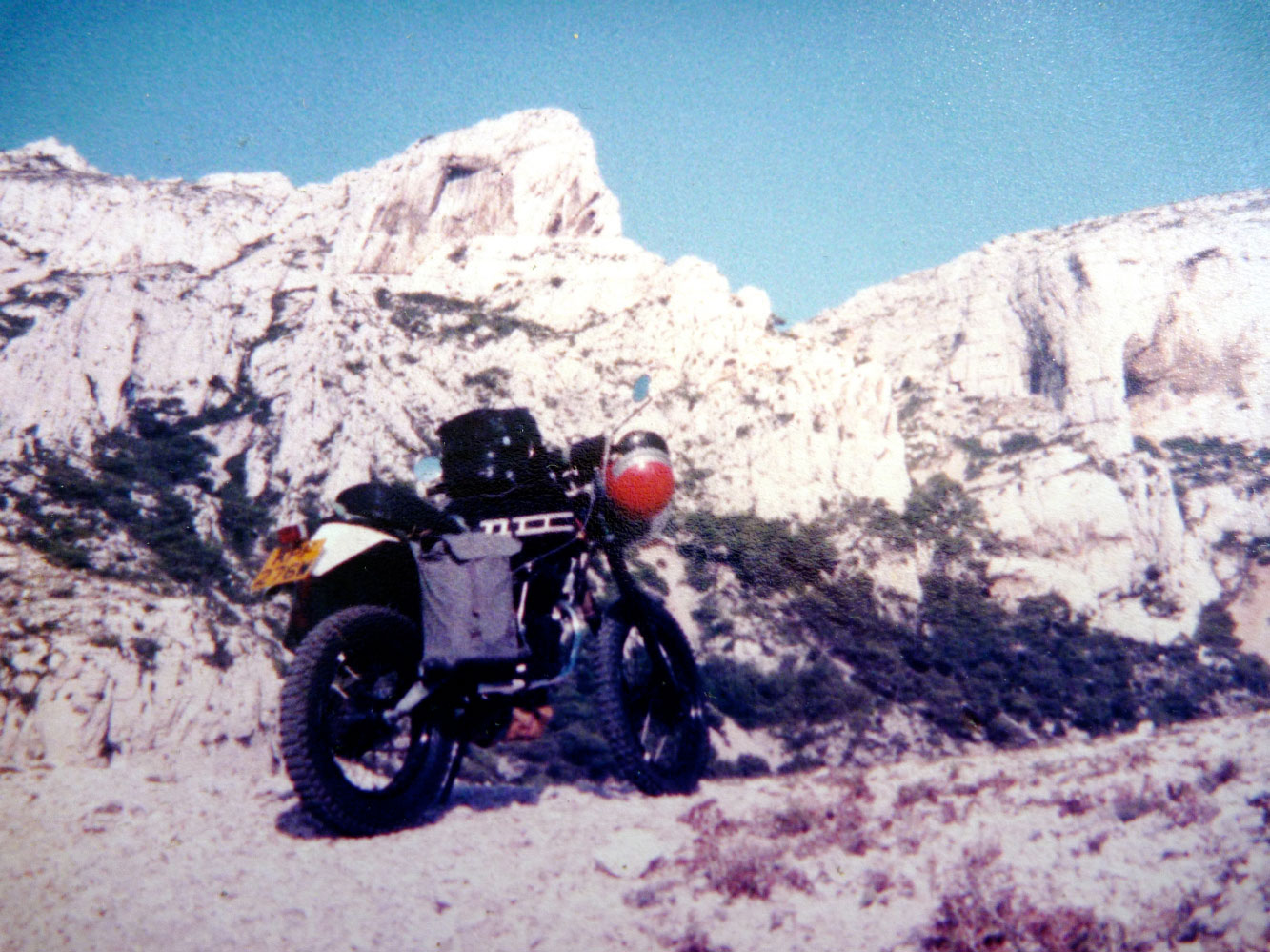

You can see I had an all-new soft luggage set up. No more sawn-off chemical tins poorly lashed to Dexion racking.
This time I had a small canvas pannier hanging on one side where a 10-litre jerrican slipped in; a thin cotton Times newspaper delivery bag dangling off the other with 10 litres of water, and an over-huge tank bag which sat on the flat-topped RD tank. A sleeping bag in front of the headlight – Easy Rider style – kept the bugs off the Benly headlight. Cunningly, I lashed a tool bag with other heavy items under the lofty engine. If my mass had been any more centralised I’d have become a Black Hole right there and then.
My first memory of Algeria that year was being a little unnerved that as far north as El Golea it was already 35°C by 9am. If you live in Yuma that’s probably no big deal in September, but for a South London boy it was a bit of a shock.
I filled up in in town and set off across the Tademait plateau which had spooked me on my first transit in ’82. The town (or anything) was 400km away. I buzzed along at 9.8hp/hour and by early afternoon dust devils or mini tornadoes were whipping across the baking gibber to either side. I recalled how a mate said he’d been knocked off his XS650 by one in Turkey earlier that year.


I was already tired, thirsty, sore and hot when up ahead what looked like a huge wall of sand hundreds of feet high hurtled right across the blacktop. Only as I neared it did I realise it was the mother of all whirlwinds, a huge cauldron of rotating sand. I turned the wick up and and the motor droned as I punched the Benele into the sand wall.
Inside, all visibility was lost as grains pelted me from all directions and I struggled to keep upright or even know which way it was. And then, as I slipped into the windless eye of the maelstrom, the sand grains briefly turned into pelting raindrops. WT jolly old F was going on!? Search me but before I knew it, I’d blasted out of the tornado’s far wall, this time shoved left onto the roadside gravel. Now I knew how those roadsigns got flattened into the dirt…

Just as in 1982, the Tademait had terrorised me and I vowed I’d ride into the dark to be off the plateau before stopping. I rode into the dusk, pulling up briefly with the engine running to remove the sleeping bag off the headlight, before pushing on into the big switchback descent from the Tademait to the desert floor.
That night I stripped off and lay in the dirt by the bike, listening to what sounded like the oil boiling in the crankcases, hours after switching off.
I wasn’t hungry but I drank and drank and soon fell asleep where I lay. Tomorrow I was heading past In Salah, the hottest town in Algeria, before heading deeper into the Sahara.