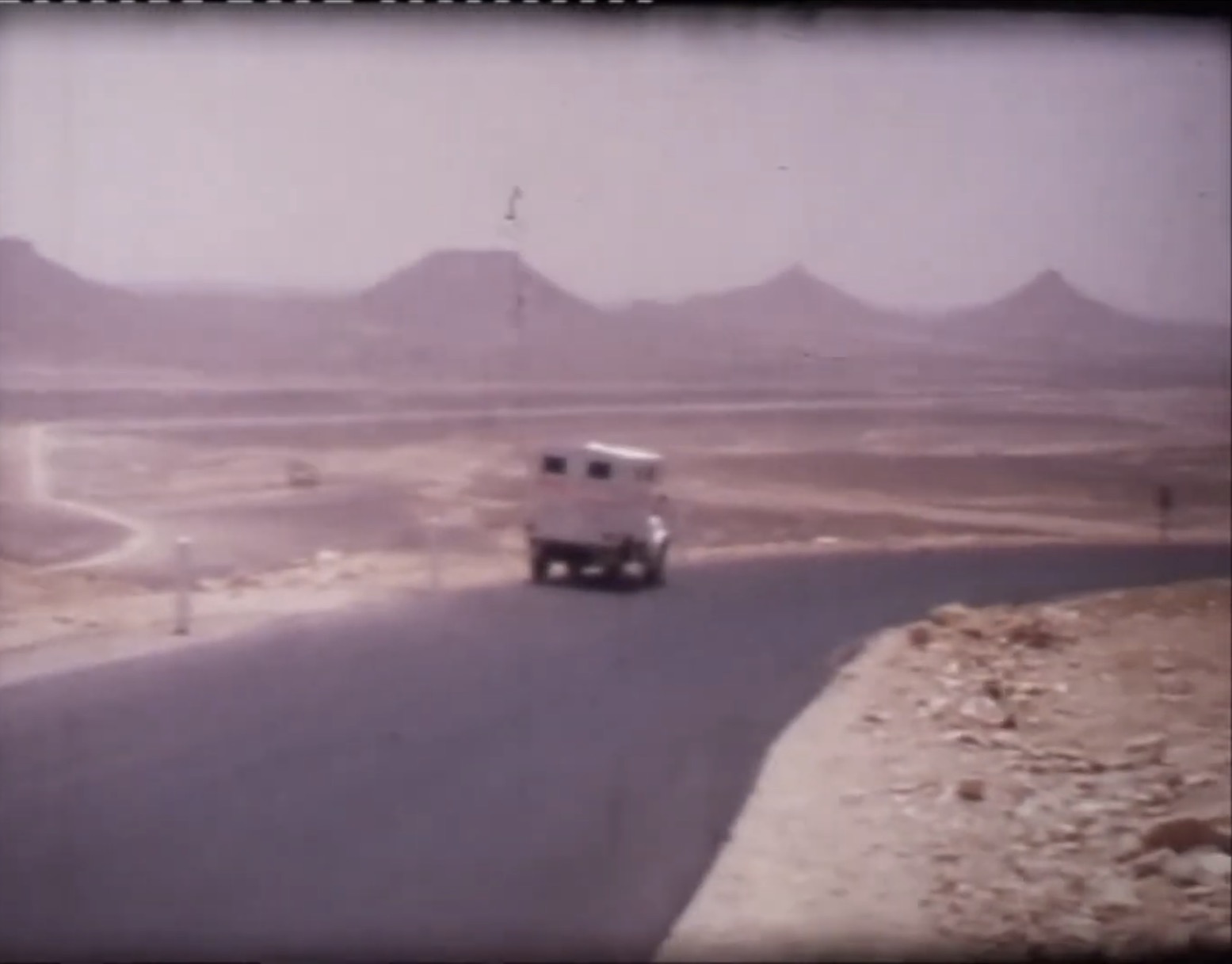
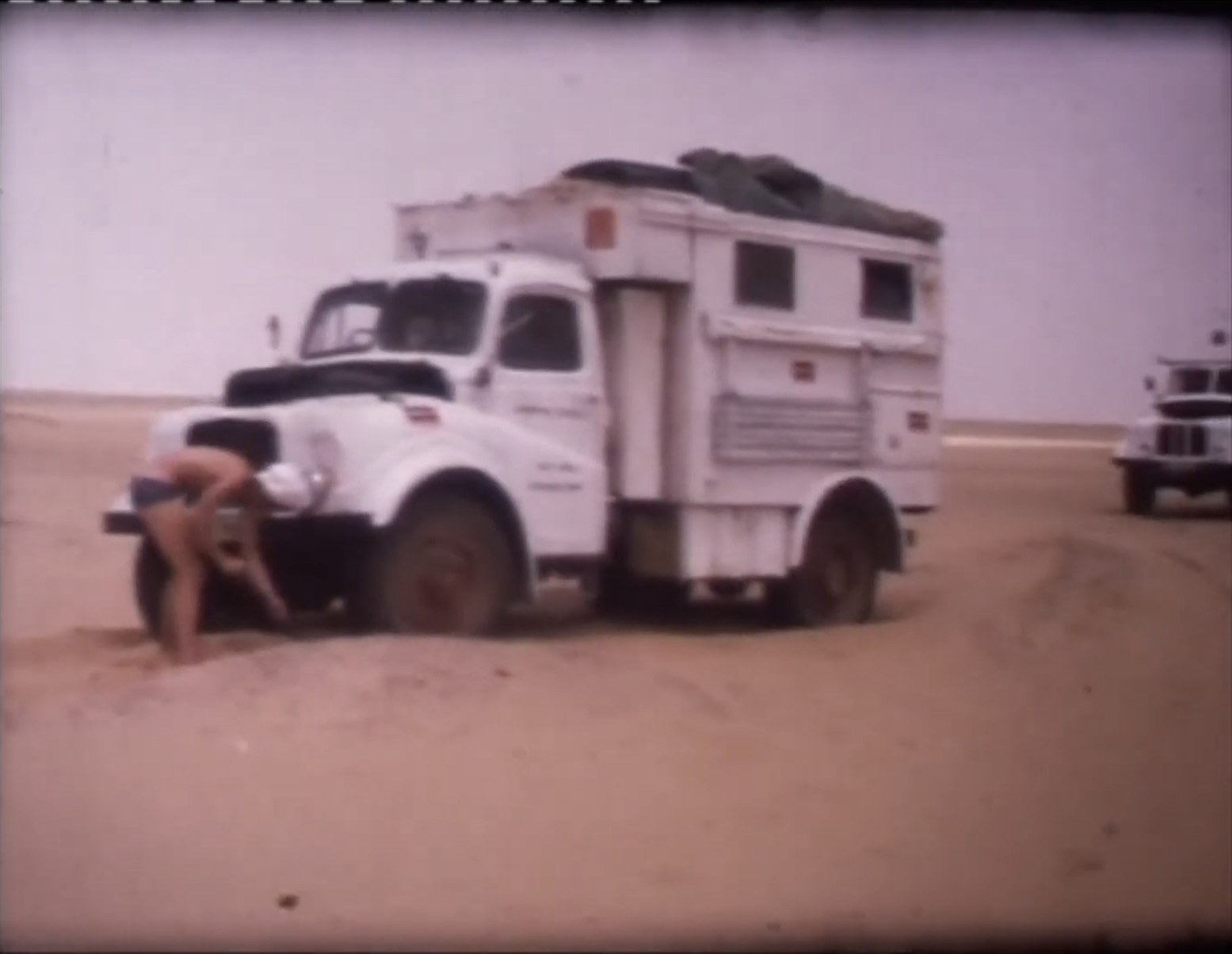
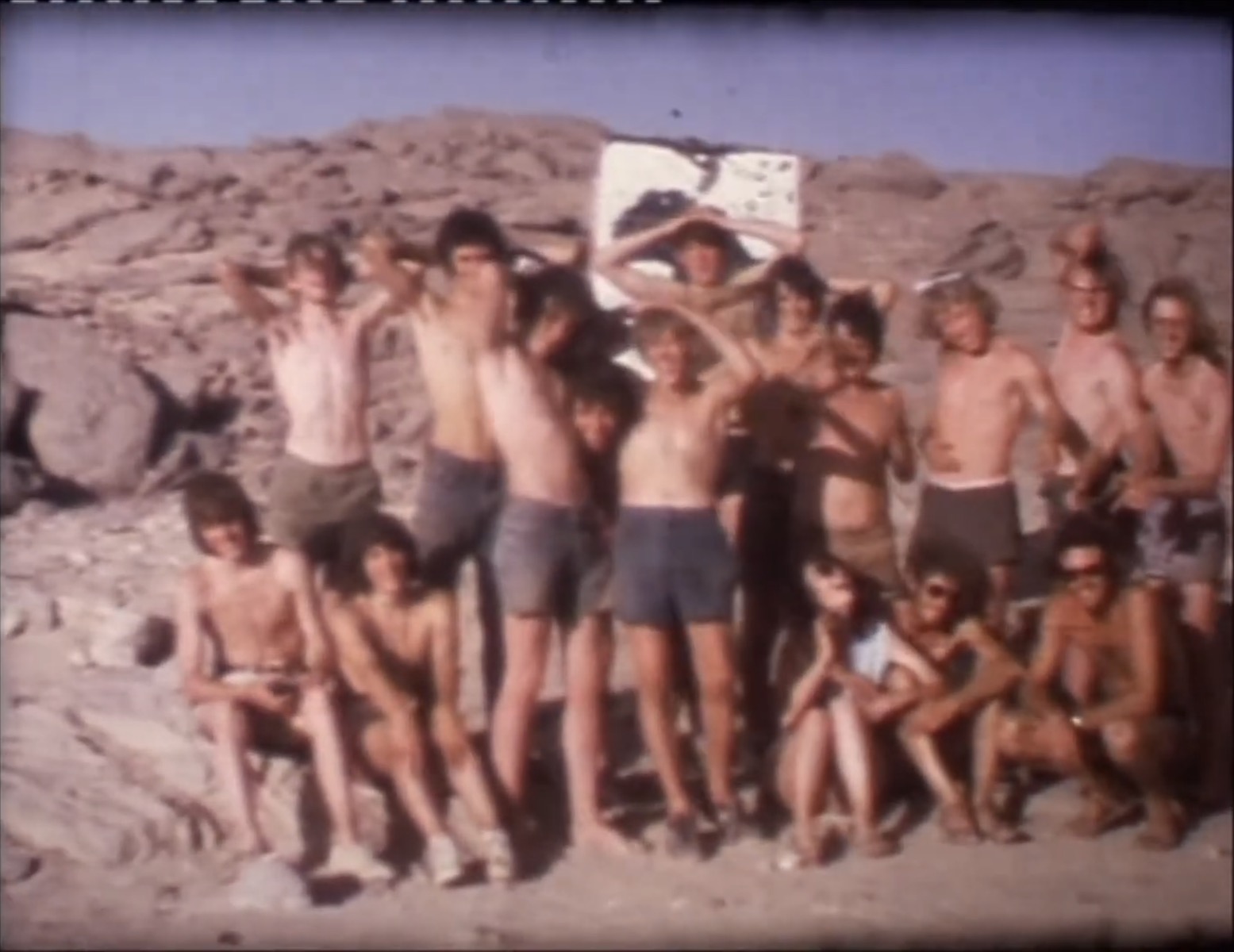
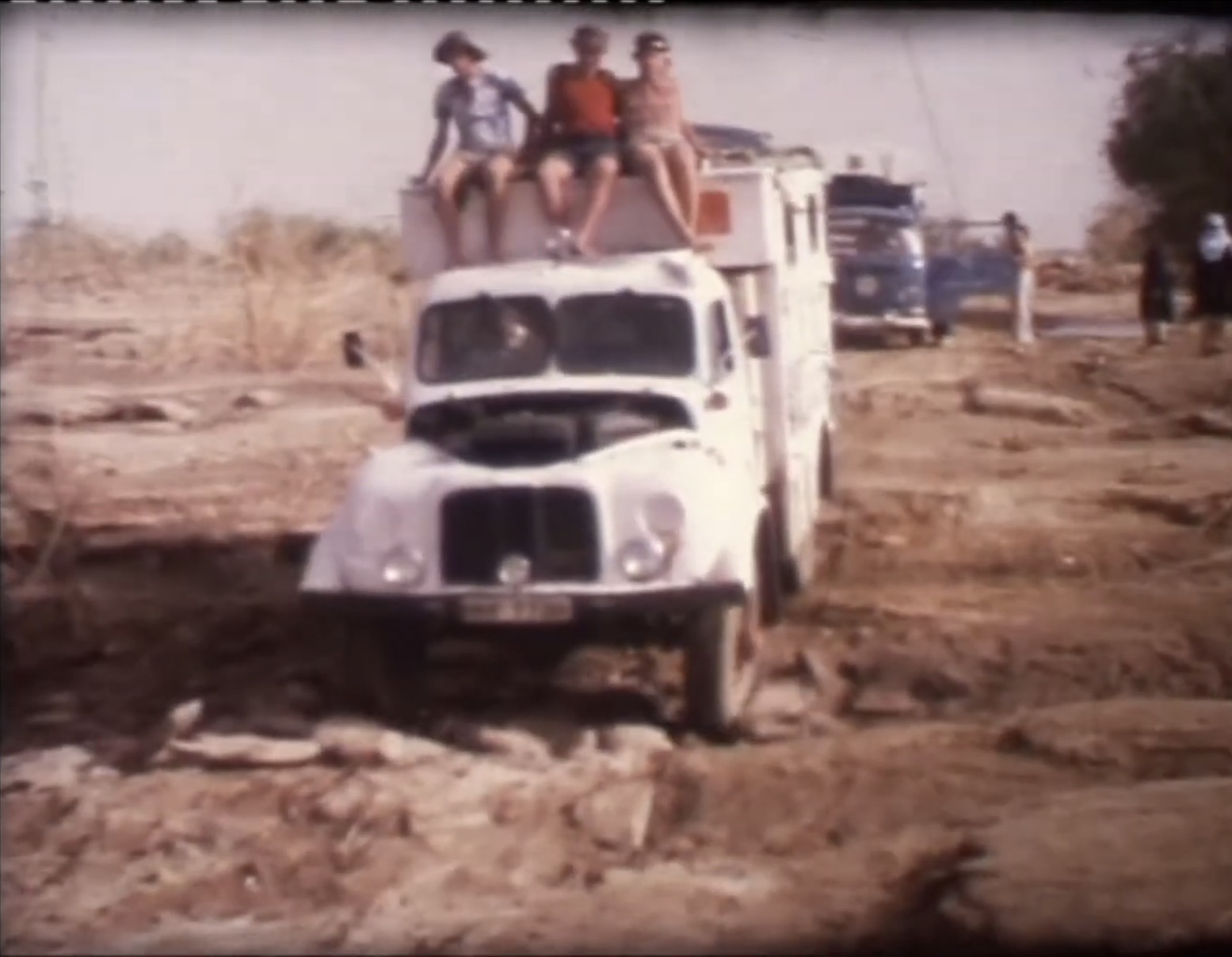
Nature in the raw, the awe-inspiring power of wild places, has the most immediate influence on the youngsters. Initially, it is alien and threatening, but as confidence grows they come to terms with it. They respect its power and violence, but at the same time they are drawn to the peace and beauty of the empty places. Alasdair Kennedy
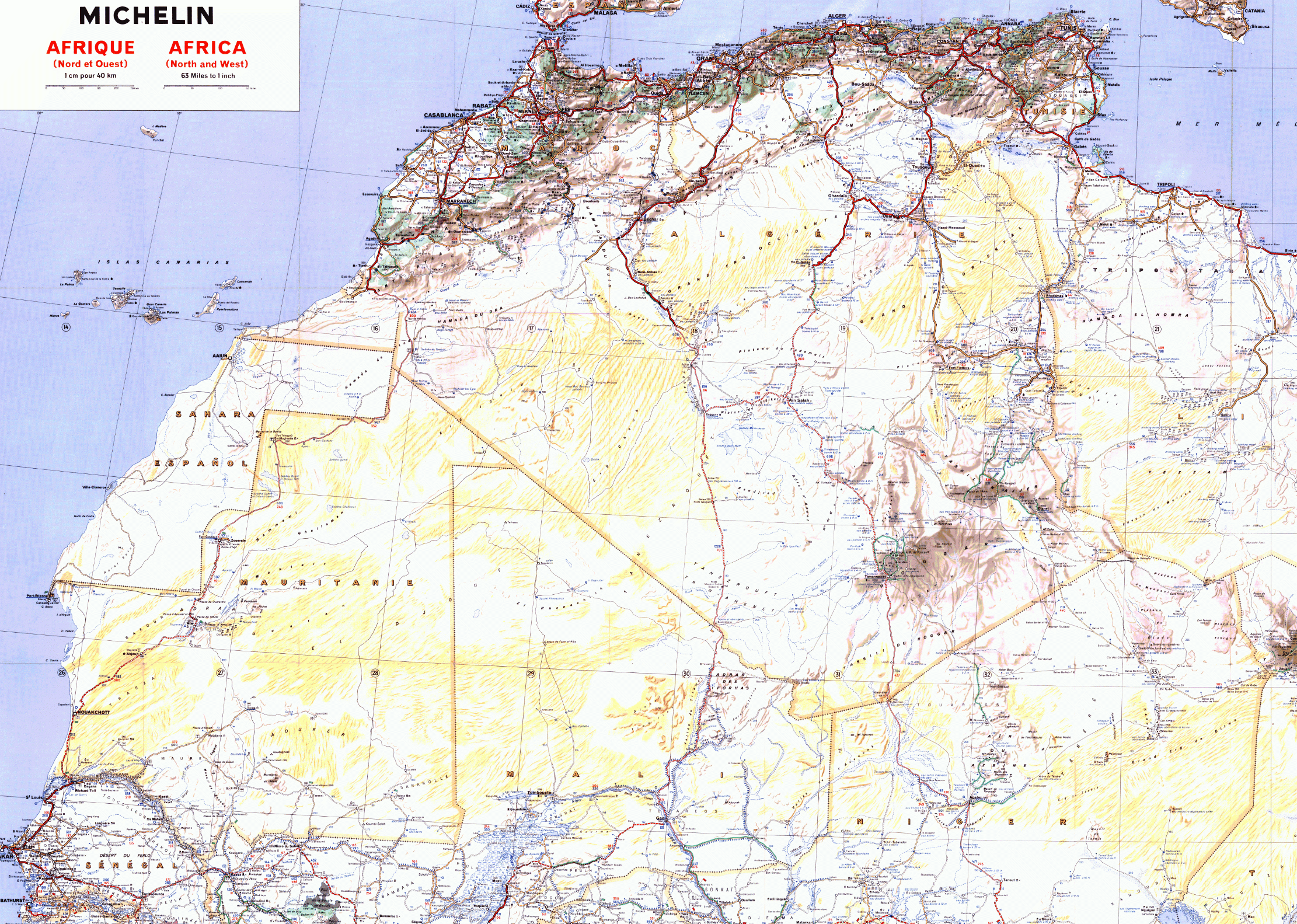
Back in the early 1980s I joined The 153 Club, a bunch of Saharan enthusiasts who’d travelled in the area covered by the ‘Michelin 153’ map (right). In fact, having been there was a condition of membership which at one time cost £1.53p.
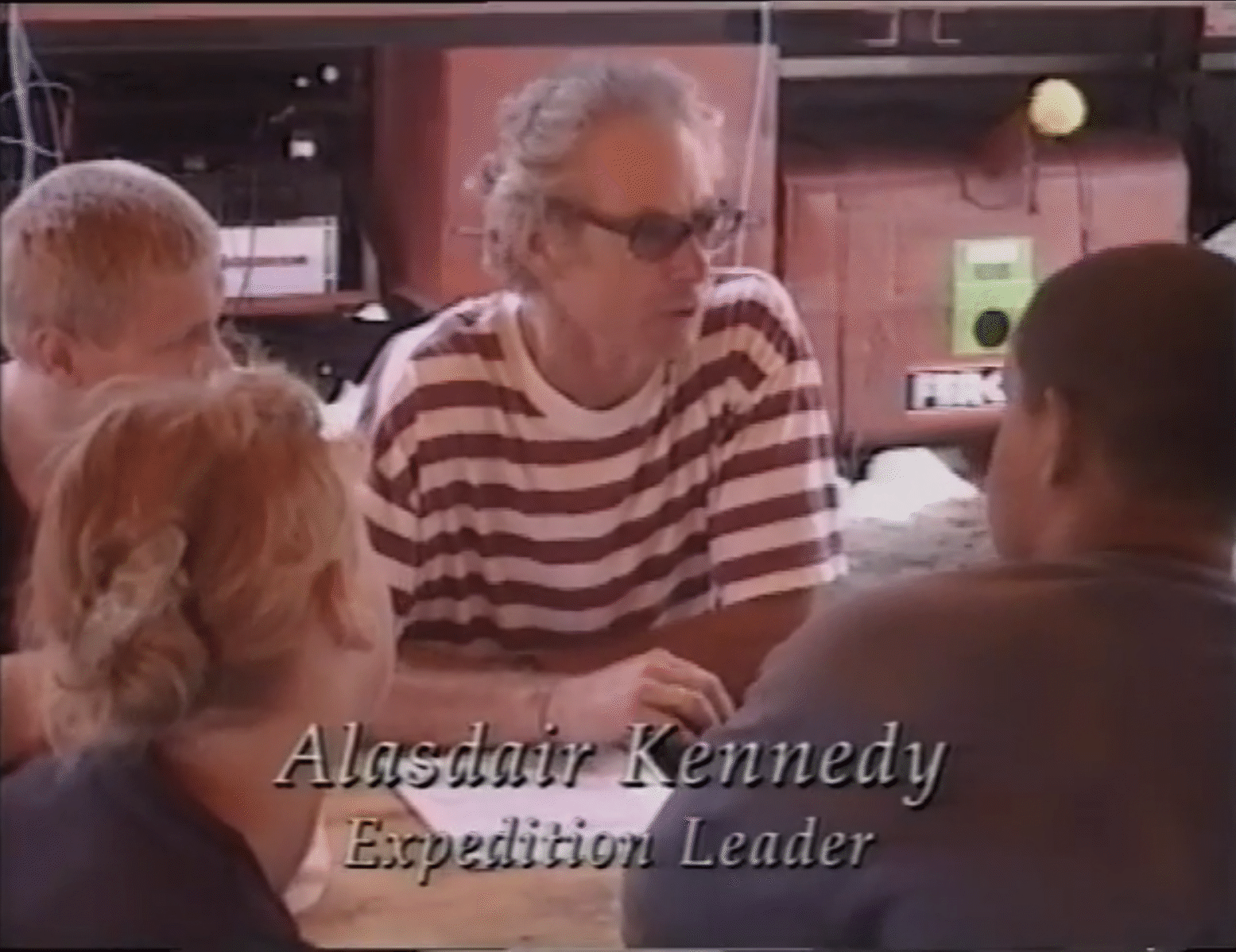
Apart from the Sahara Handbook, information on desert travel was hard to come by then, so I’d joined in the hope of getting that from the three-monthly newsletters as well as maybe meeting some other active Saharans. My recollection was actually more of a reunion group of mostly former Minitrek clients (an early overland company). I attended a couple of club meetings in London, sent in a couple reports, then went my own way, though I did get to know ex-Minitrek driver Mike Foster who, in 1991, wrote Sai Bilma about joining the gruelling Bilma salt caravan. One of the newsletter’s more lively contributions (as opposed to reminiscences), came from a geography teacher called Alasdair Kennedy from former Shorefields School in Dingle, Liverpool (now King’s Leadership Academy). From 1970 he organised summertime school trips to Algeria and beyond for over 15s (from ’82 including girls), using cantankerous 1950s ex-army 4×4 trucks. It was writing up the mid-80s Imps trike fiasco which made me recall Kennedy and his similar adventures for unprivileged youths from ordinary schools. As Kennedy said in his book, below, ‘such activities can no longer retain the image of being indulgent “jollies” for a fortunate few.’ The school’s address was given as Dingle, but in later reports Kennedy switched to the adjacent Toxteth suburb to underline the school’s deprived locale. In 1981 Toxteth had gained notoriety as one setting for the many inner city riots of that year, partly attributed to heavy-handed policing. Though not involved, we were raided ourselves following the Brixton riots a few months earlier.
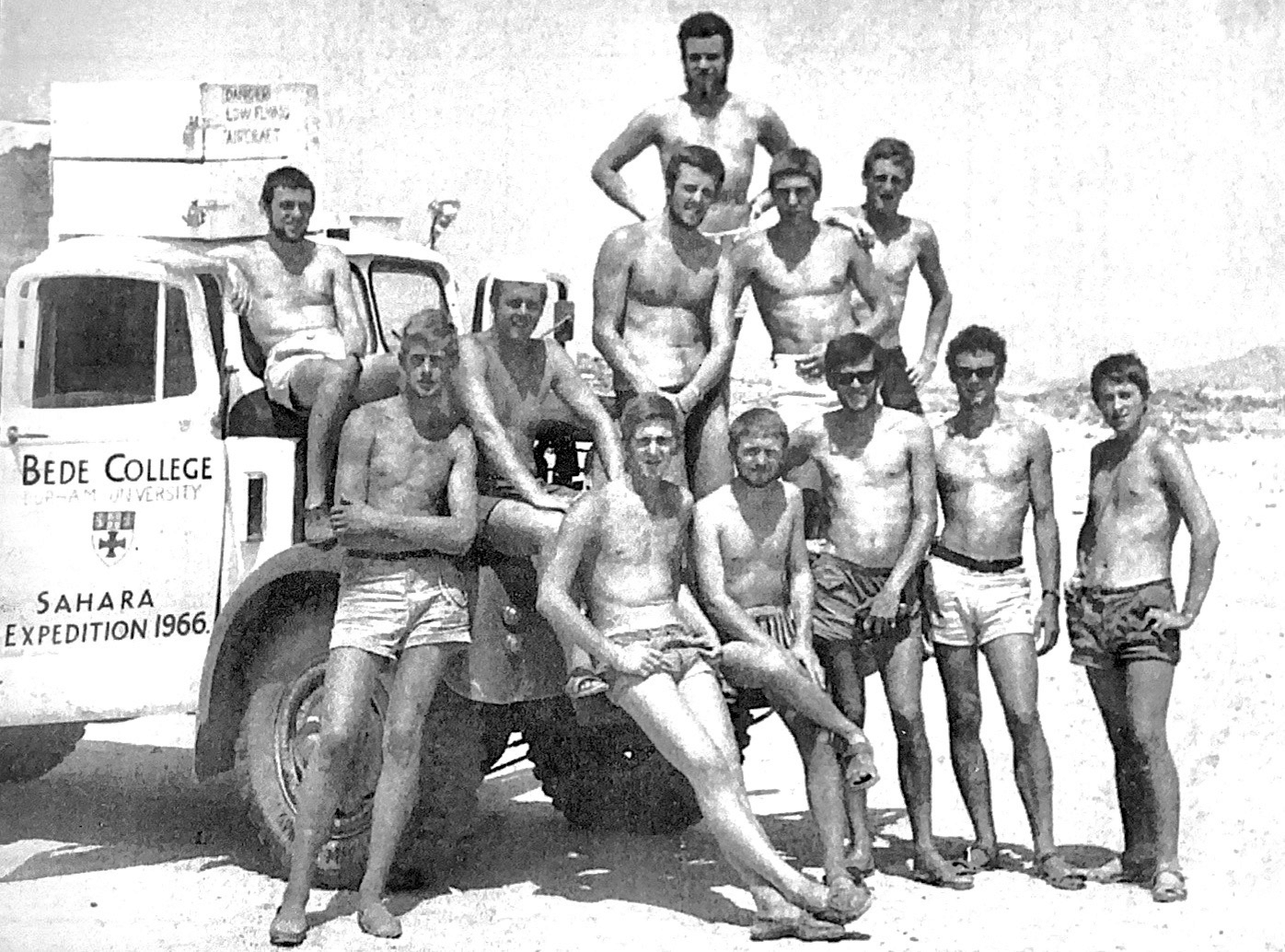
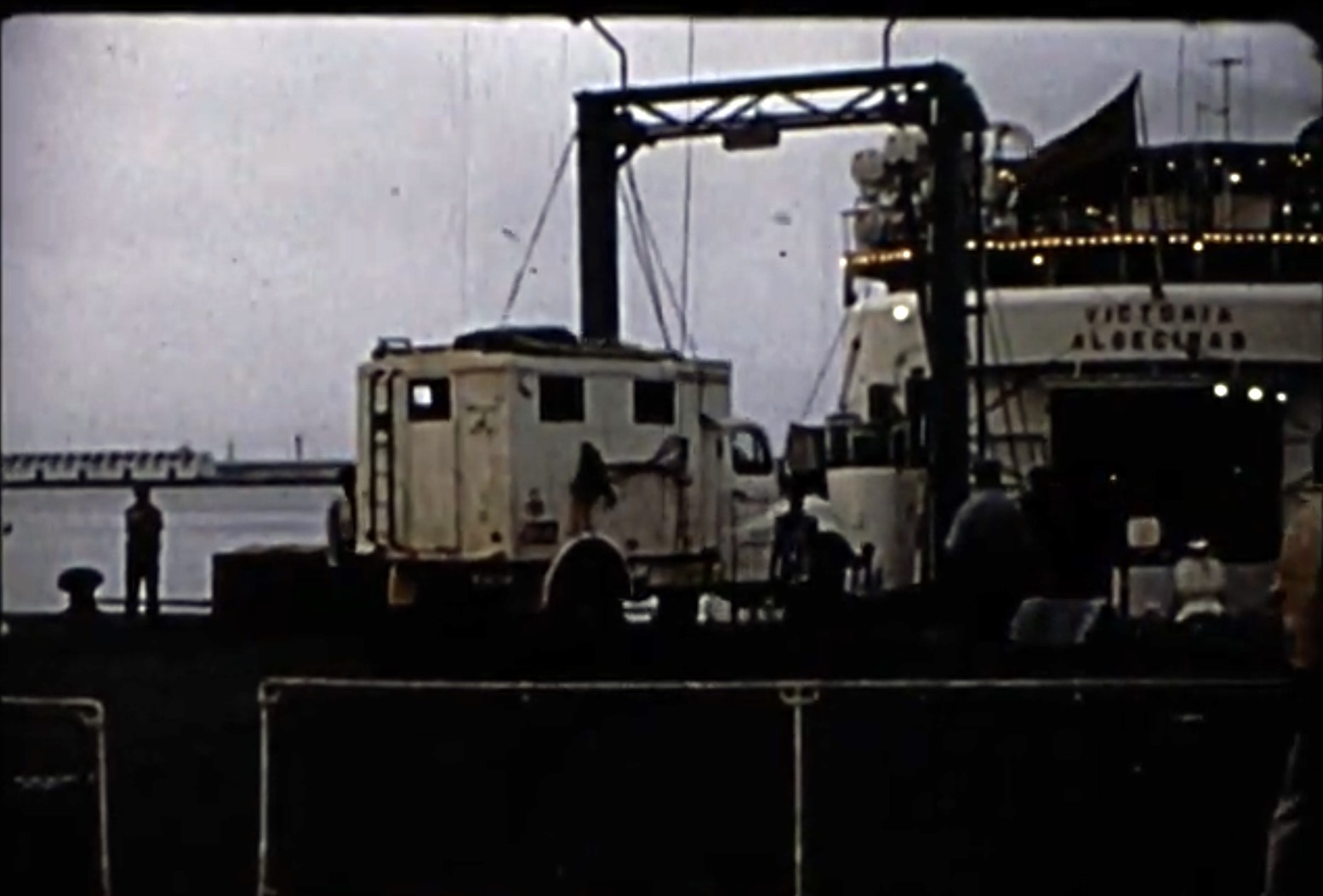
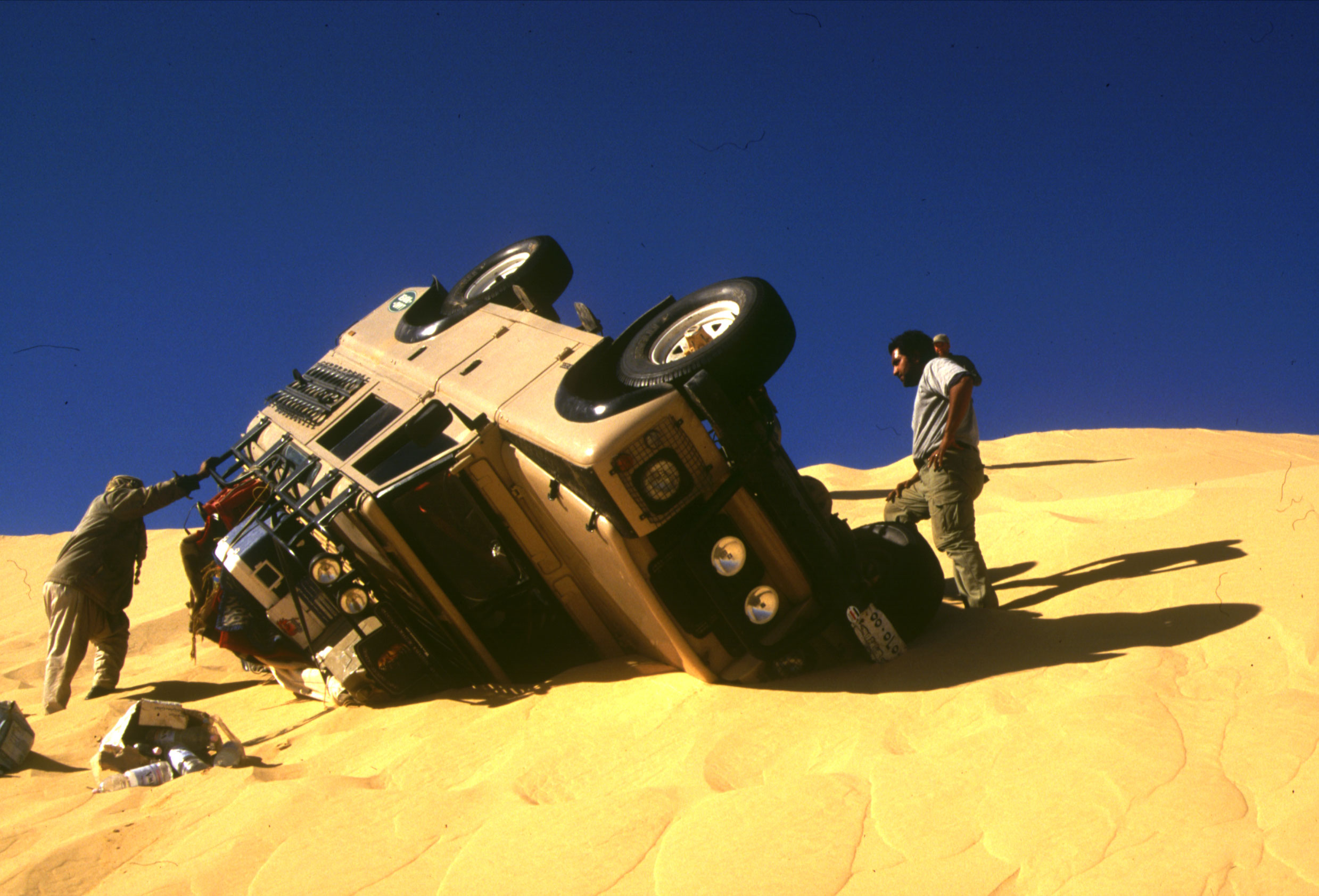
Kennedy had first co-organised a scientific visit to Assekrem in 1966 while a student at Durham University using a pair of Morris one-ton trucks (above left). One truck got wrecked in the Hoggar and was towed back as a trailer, bringing to mind Emile Lelay’s 2CV motorcycle stunt. Once qualified as a teacher Kennedy developed the Sahara expedition idea, but with teenagers and using old trucks was the cheapest way to do it. The kids or their parents had to raise the fee (£340 by the early 1990s), and once there, all were fully involved in keeping the show on the road, as well as undertaking small-group mini overnighters through the Hoggar or Mertoutek village, which became a home from home for many future expeditions, before sometimes heading further south. In 1994 the curtailed Moroccan expedition was featured in a short Channel 4 documentary. This was a couple of years after Kennedy wrote a how-to book or thesis: The Expedition Experience as a Vehicle for Change in the Inner City. On p26 1992 book notes:
When this learning takes place in demanding natural surroundings, where there is an element of risk [Sahara], it ceases to be something artificial which is imposed for reasons of convention, and becomes something which is welcomed, because of its survival value.
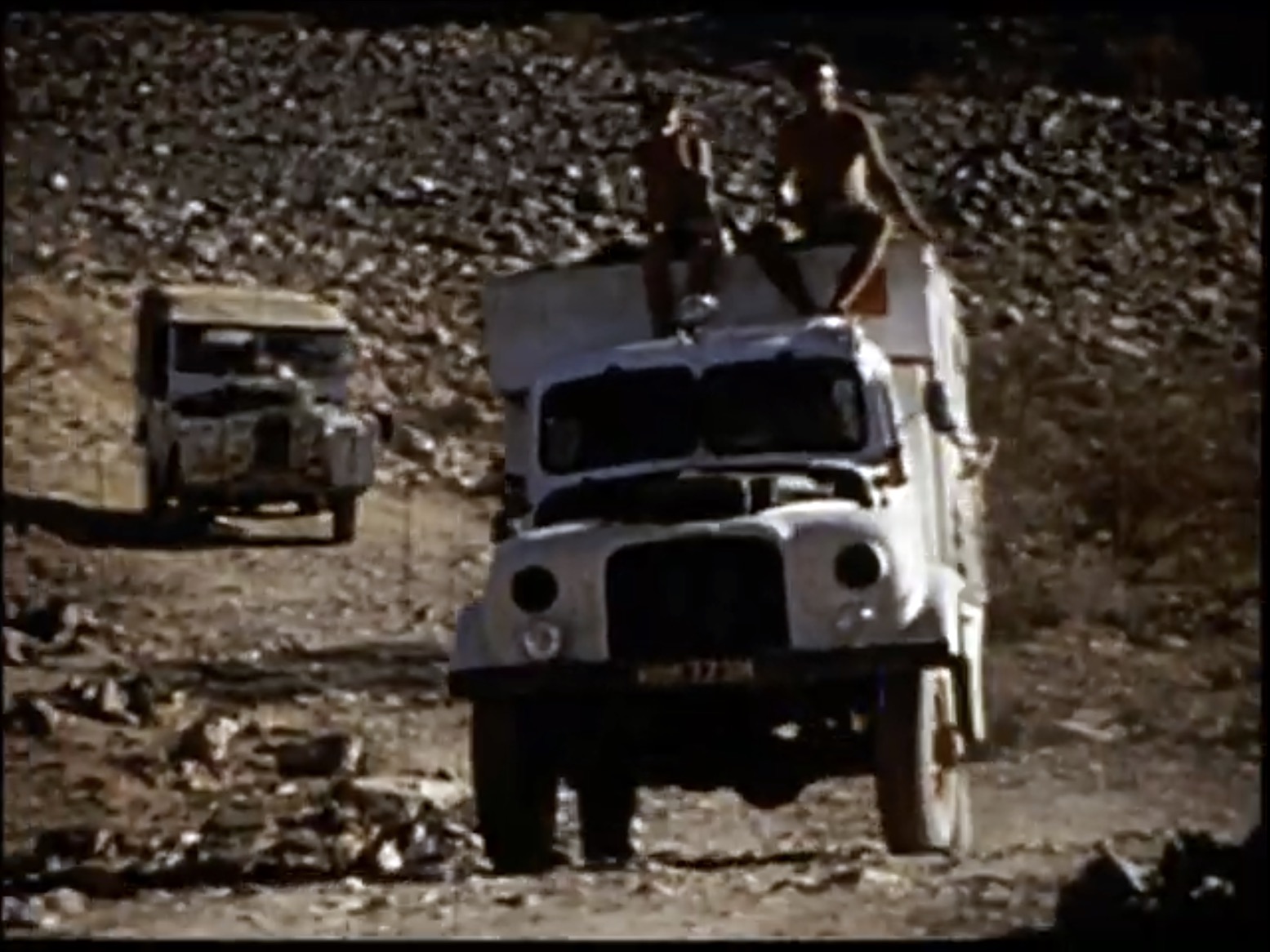
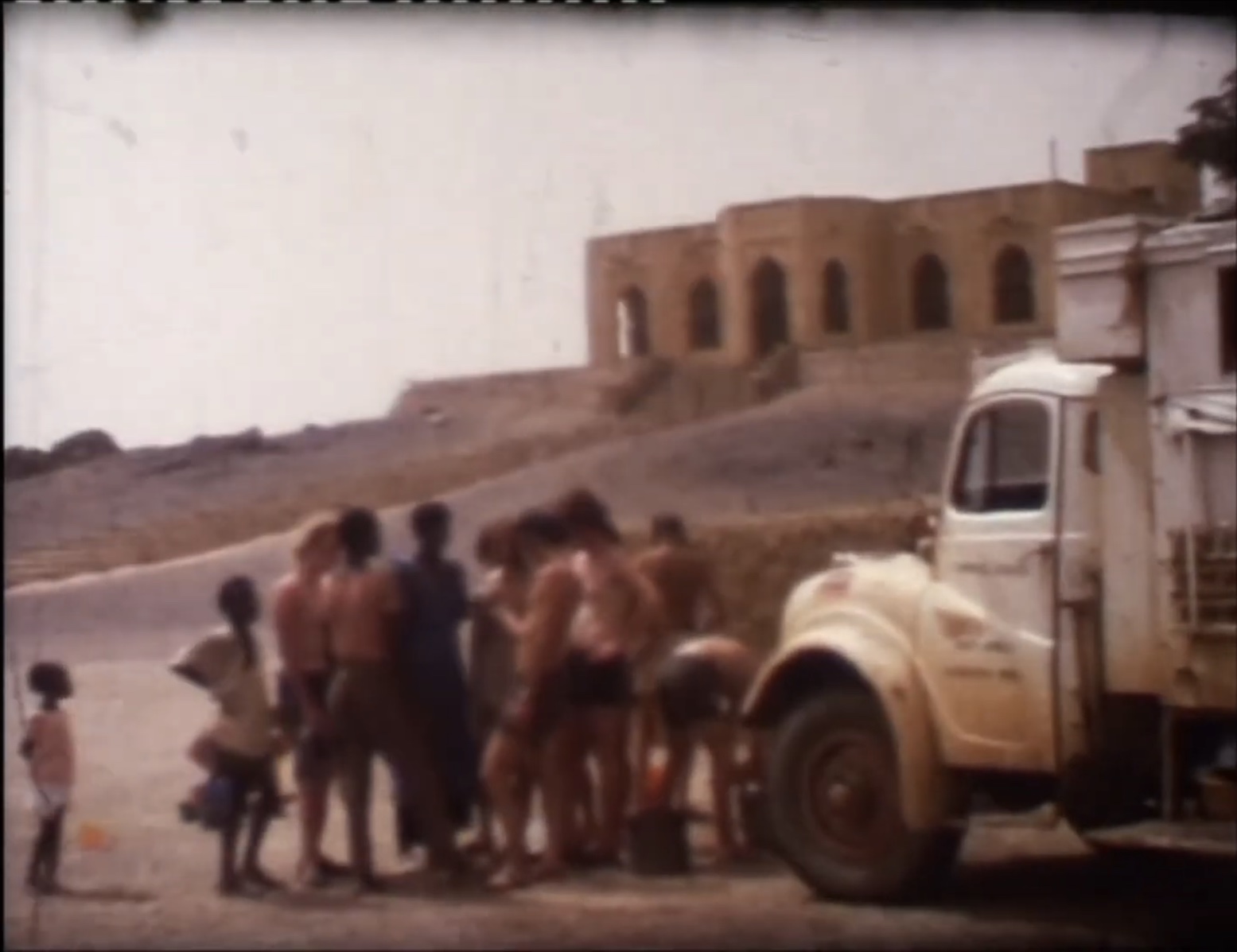
Over 25 years over 300 kids from Shorefields and other schools got to experience a central Saharan adventure, and now there’s a Shorefields Sahara Expeditionsblog recalling those expeditions, along with YouTube vids and photo galleries. It’s worth repeating these long trips took place in the school’s summer holidays when the Sahara and Sahel are a heck of a lot balmier than Merseyside! Many of the reports describe unusual weather phenomena common at this time of year, including strange, windless mists of fine dust rolling over the camp or vehicles, choking visibility just before the main sandstorm strikes, often ending in a brief rainstorm and, on one occasion, heightened levels of static electricity when merely touching metal would give you a sharp zap. The soundless vid of the 1973 above trip went all the way down the Hoggar route to Agadez in Niger, then back up the Tanezrouft via Tessalit in Mali to Reggane and on to Ceuta – in mid-summer all jammed in the back of a poorly ventilated, ex-army Austin K9 radio wagon and ambulance. (The same route was repeated in 1988). By the time they got to wet season Niger they were running with the bonnet’s off to help shed heat, but the 4-litre petrol sixes still suffered from vapour lock, and you imagine a whole lot more. (Later, diesel Bedfords were used.) Back then that’s what desert overlanding was – lurching from one breakdown or reversal to another which, along with your health, was pushed to the limit by the intense heat, dust and Sahelian humidity.
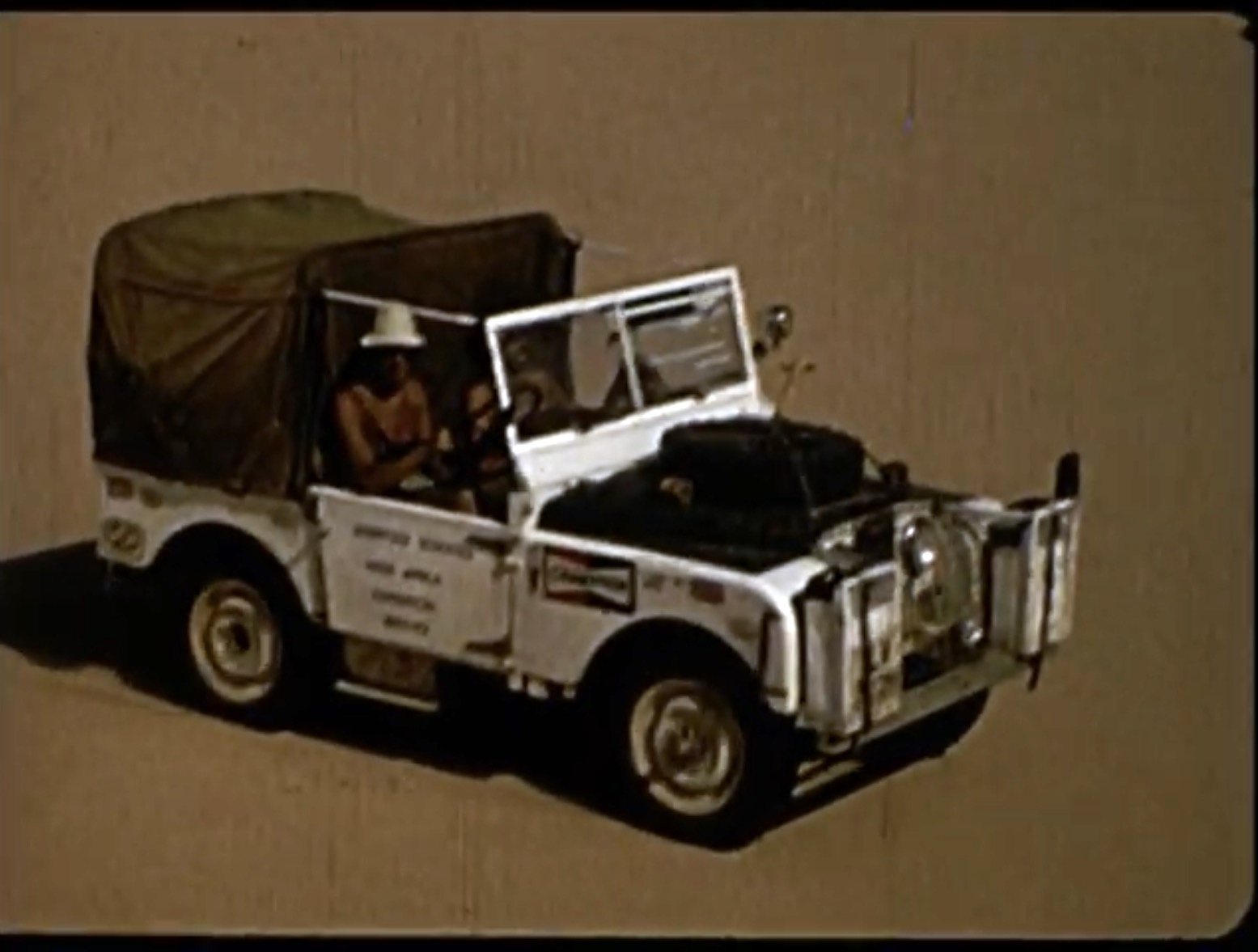
The 1971 trip (pics, report, vids above) sounded especially gruelling, staying entirely in the enervating desert for several weeks. On this one a SWB Landrover accompanied the Austin K9 and a similar Morris truck. Having come from Djanet via Tam and the Aïr, in Agadez, they’d run out of time to visit Kano in northern Nigeria, but took up an offer to join some French heading across the Tenere to Dirkou. It was sort of on the way back north and a loop I more or less did, but over a couple of trips.
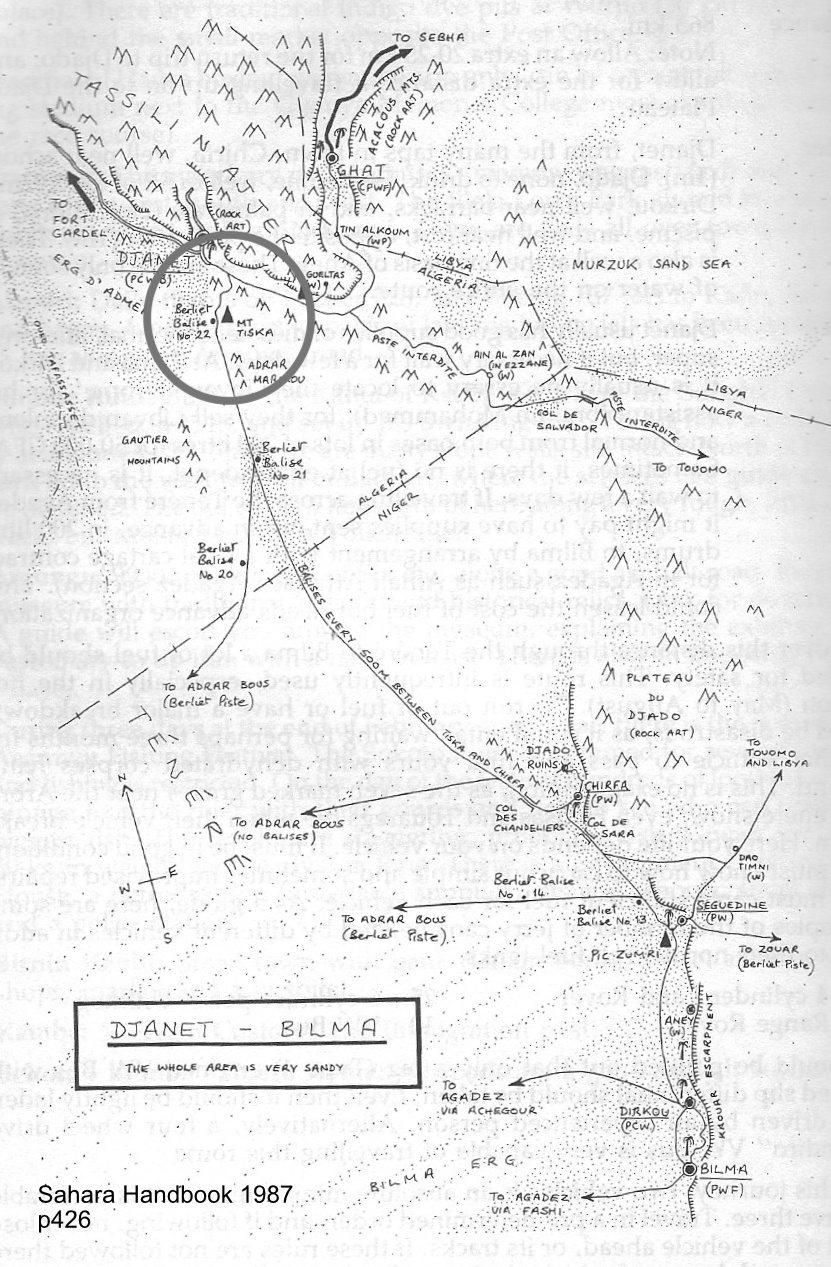
Passing the then extant Arbre Tenere, after a visit to Jerome’s fuel depot in Dirkou (bragging, as he always did with Brits – like me 33 years later – about fighting with Monty in WWII), the three vehicles set off alone for Djanet along the desolate, Berliet-balised Chirfa piste (left). The intense heat combined with crappy fuel from Jerome’s played havoc with the Morris which was down to 2mpg – so bad the Landrover had to shoot ahead hundreds of kilometres to Djanet to bring back more fuel. Like the 1973 film, the end of 1971 Part 2 video rushes to the end and skips most of this drama. You wonder how this was for the kids engaged in a combination of an Outward Bound course and Foreign Legion selection? It’s hard to keep a grip on your own struggles let alone maintain the morale of a bunch of heat-struck teenagers. It must have taken skilful and thoughtful leadership, like Roy Pratt demonstrated in the mid-80s Imps expedition, except with greater experience, Kennedy seemed far better at planning for the multiple contingencies the summertime desert throws at you. At such times the best place to be was probably sat clinging on, in you baggy Y-fronts, to a pitching truck cab’s roof! A few stills below from the YT vids. Loads more on the WP blog.
Tassili 1971
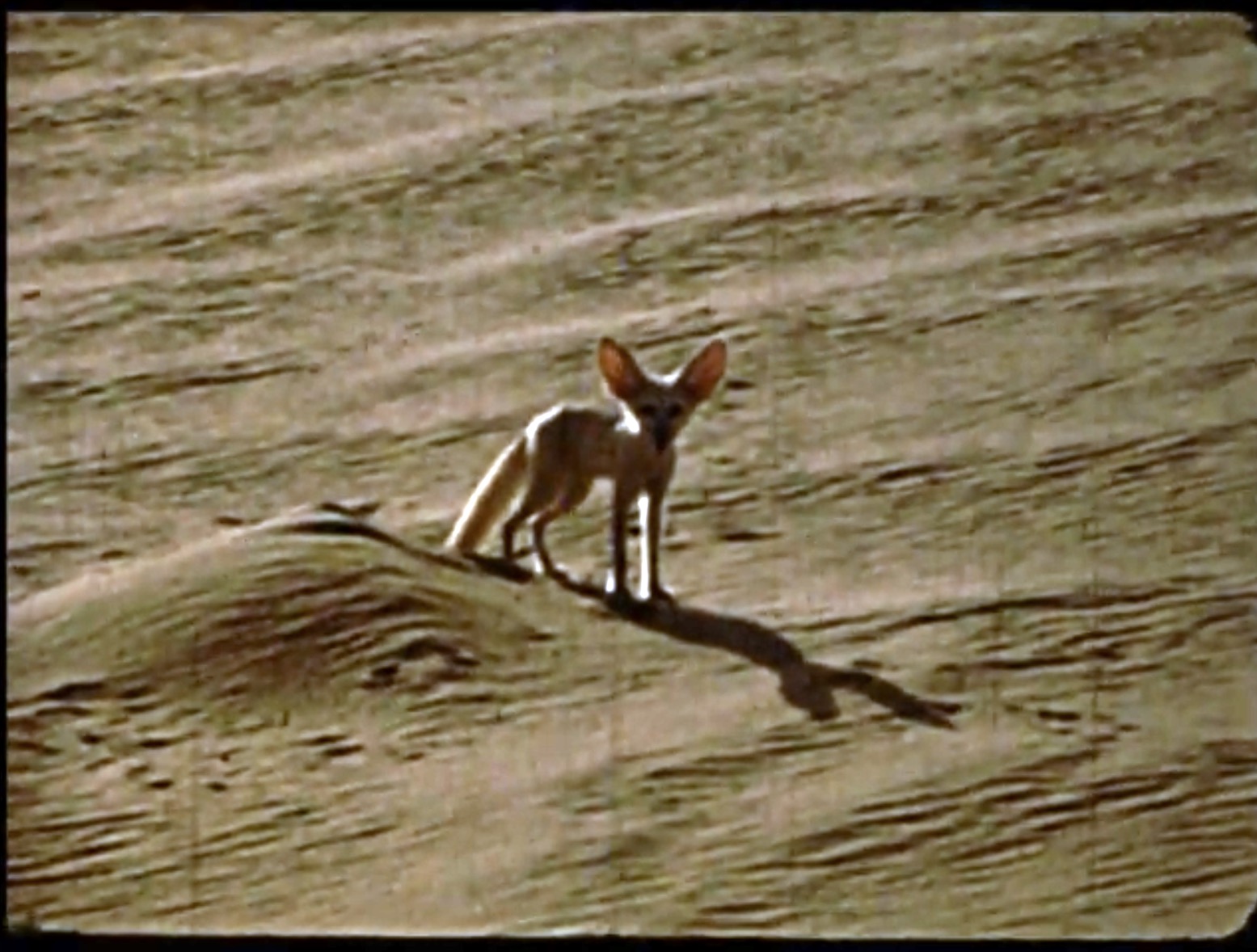
Fennec near Bilma, 1971
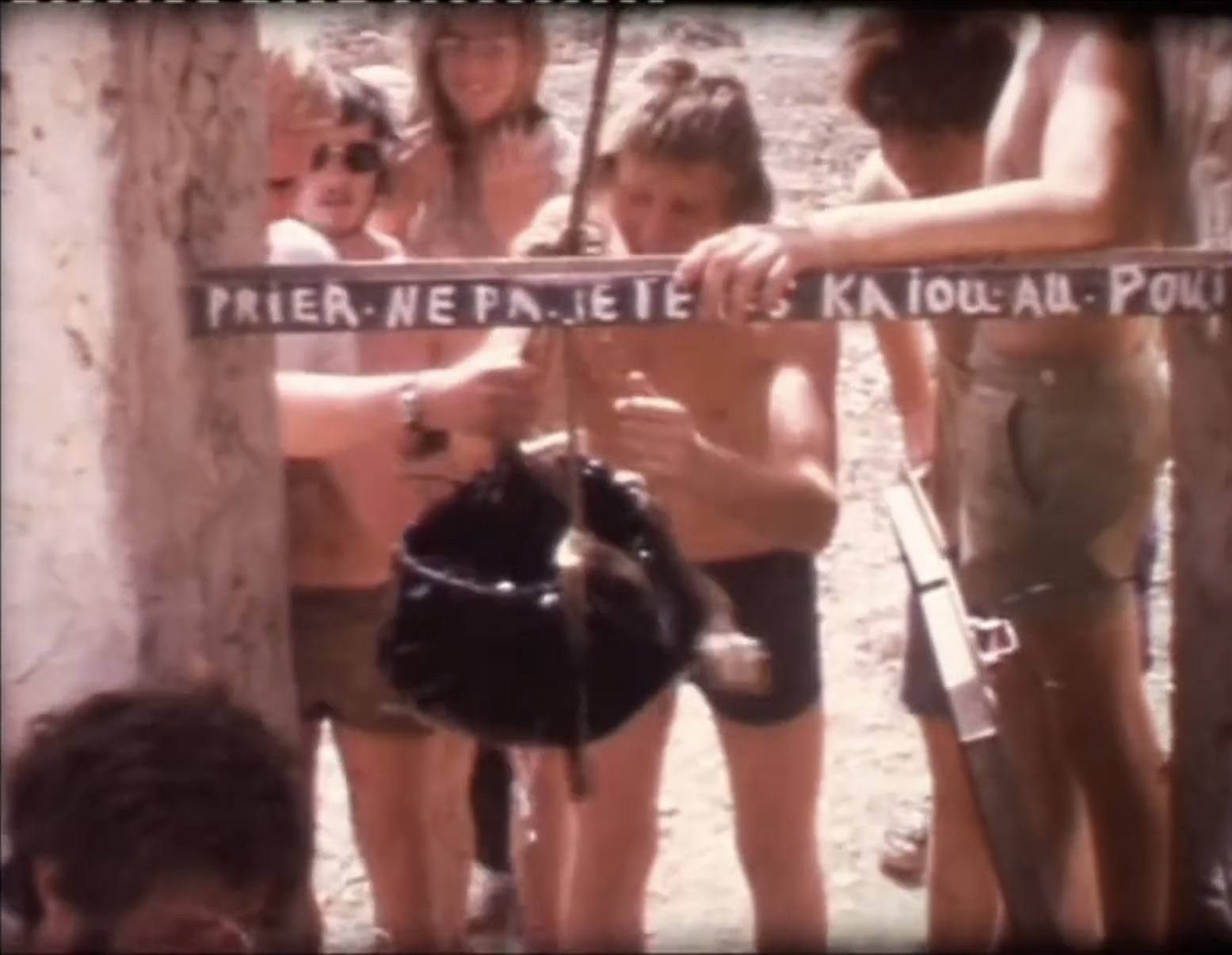
Phonetic Afro-French. If only French, or all languages, could be spelt like that
Tademait descent 1973. The only year ever this part of the Trans Sahara Highway road was that good.
Digging out the K9 on the Tademait. It’s hard to believe the kids are cooped up in the back
The 1971 gang, Hoggar. You’d think they’d all get laid low by heat stroke
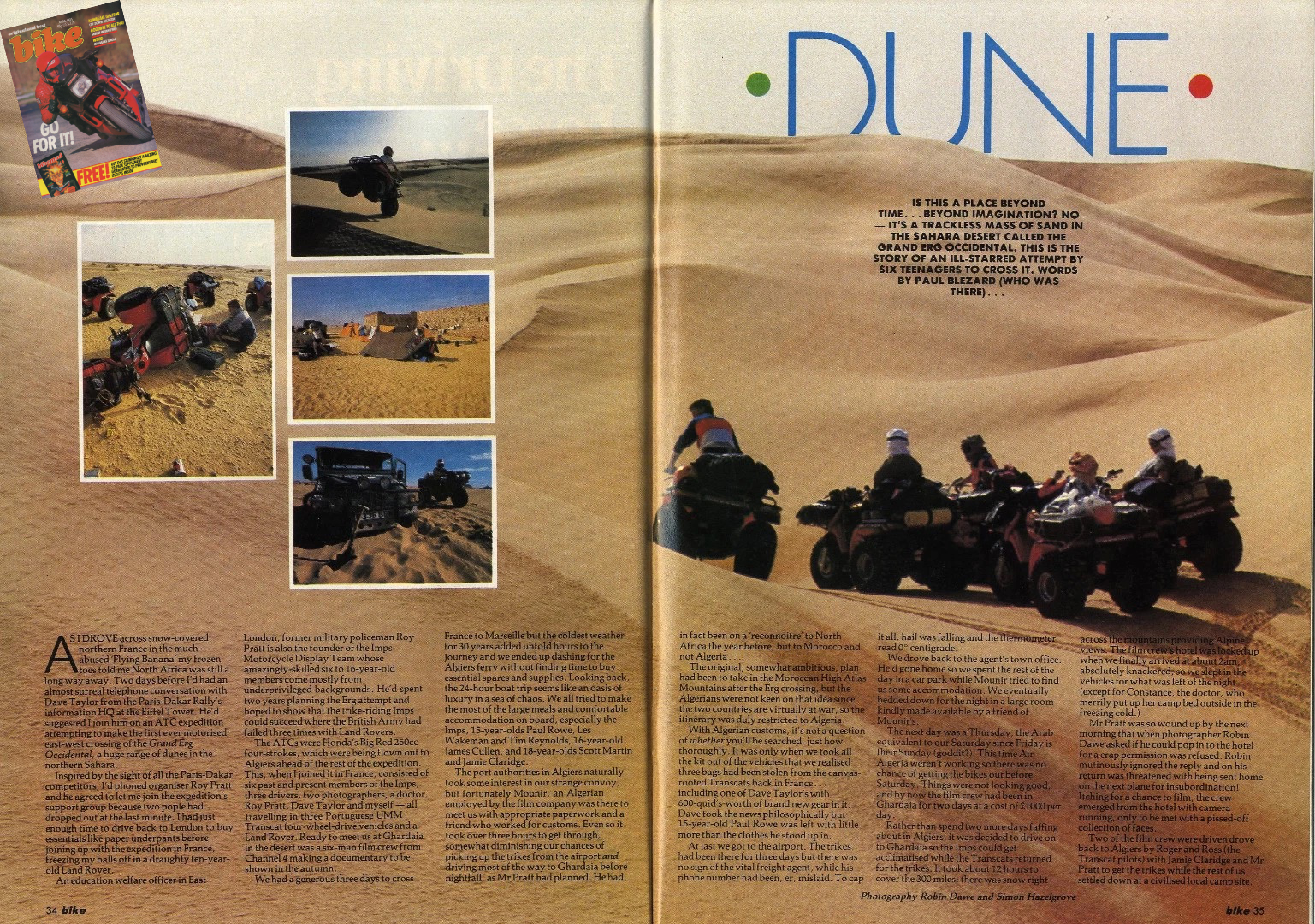
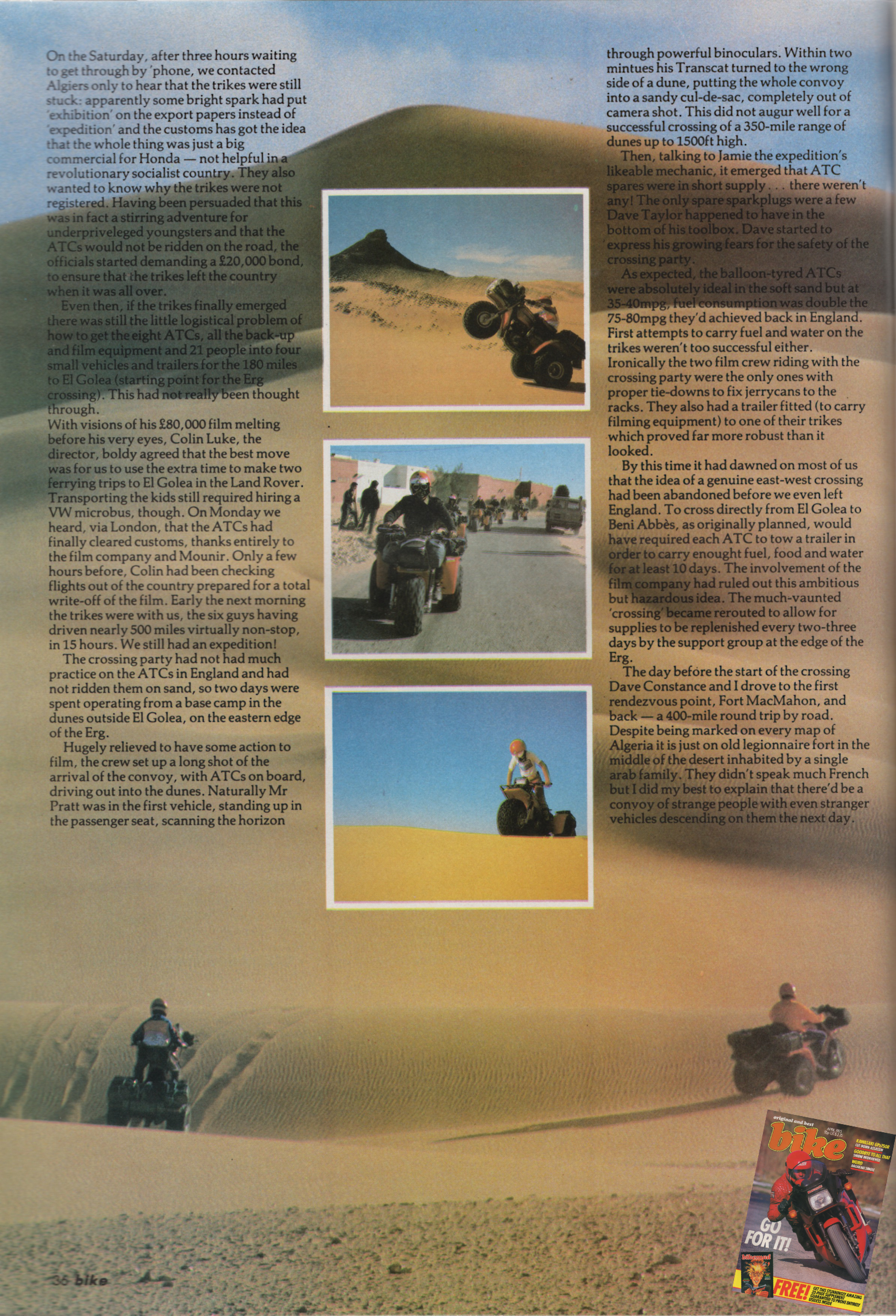
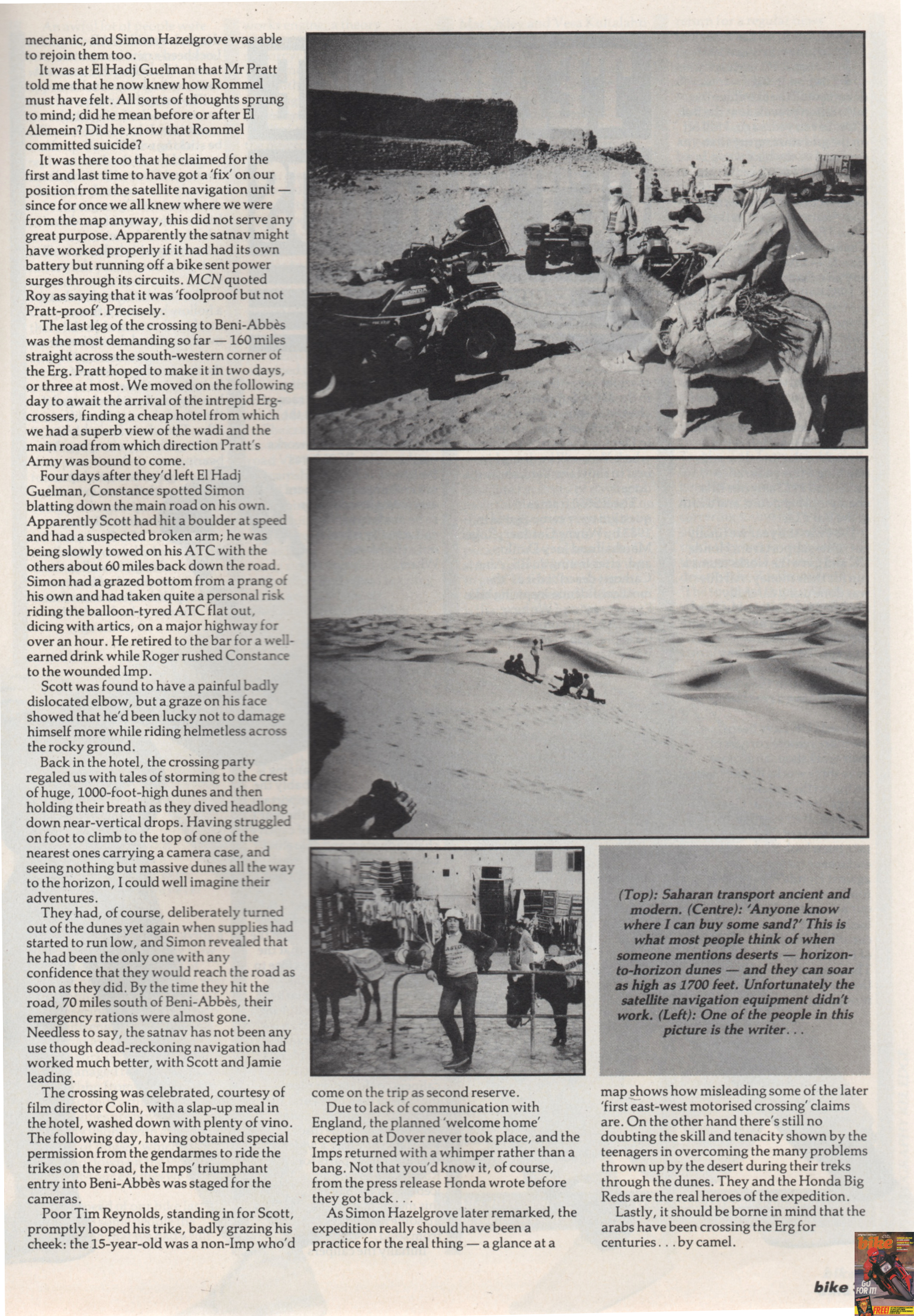
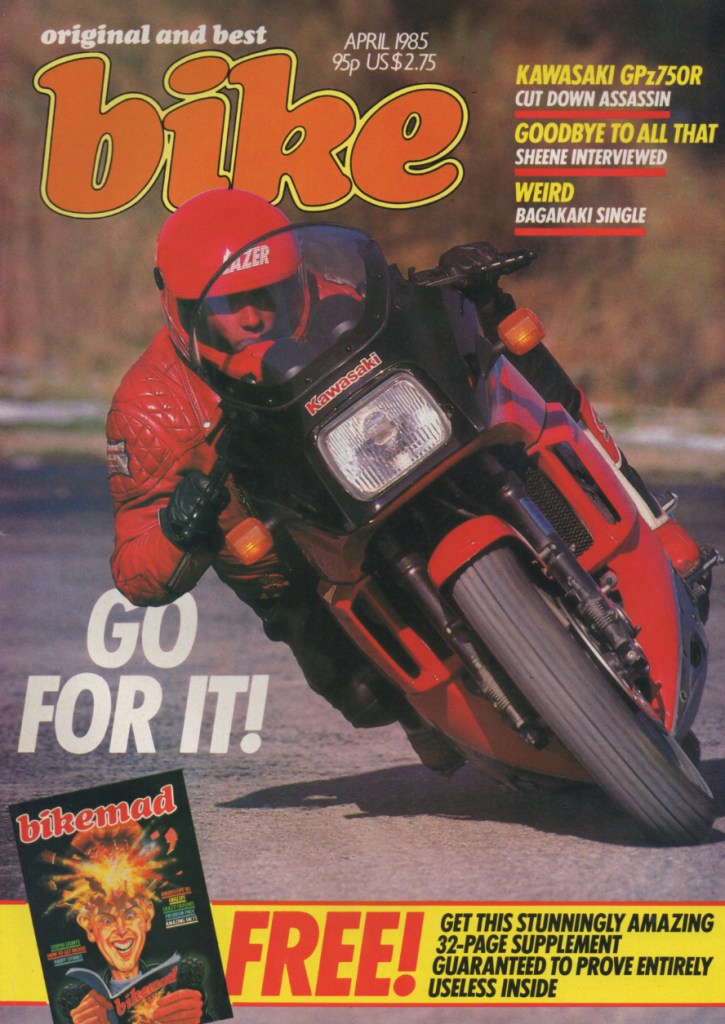
An enquiry revived memories of a 1980s Sahara ‘quad’ bike expedition across the Grand Erg Occidental in Algeria involving ‘Wheelie King’ Dave Taylor (left) and which I recalled was a bit of a cock up. Then, a connection, Paul Blezard (below right) set me straight on the Honda 250ATC trikes they used, plus the link to the Channel 4 doc above which features Paul as expedition translator. After watching the doc, I thought it was no more of a cock-up than my first Sahara trip or three which routinely set out with equally over-ambitious goals and inappropriate equipment. The ferryman must be paid a few times before you venture across the sand seas. But after posting this page I read Paul’s forthright accounts published in the biking press (below; Bike 1985; more to come). Yes indeed it was a rolling calamity from start to finish, led by poor planning, preparation and logistics, followed by opportunistic thefts and irksome breakdowns leading to subterranean morale among the harried support crew. It might not have been helped by, as Blez calls him, ‘Mr Pratt’s’ leadership style. As Paul wrote for Trials & Motocross News (TMX) around Christmas 1985, just after the film aired:
To sum up, the first successful east-west crossing of the Grand Erg Occidental, as the TV film proclaimed, was only really successful in that no-one died and the trikes came out of it still running well.
Never mind the C4 doc. Blezard tells it like it was in Bike mag.
The adventure was the idea of the late Roy PrattMBE, a former military policeman and army display rider. Now a social worker, he founded the Imps charity in 1970, a youth motorcycle display team (left), like the adult White Helmets of that time. Pratt sought to rehabilitate and inspire disadvantaged east London boys with his two-wheeled initiative. After over 50 years, in 2025 the Imps charity closed down in accordance with Roy Pratt’s last wishes and soon after his death, aged 86. During that time well over 2000 boys from as young as six years old had been part of the Imps, learning important life skills like teamwork. bike maintenance and constructing human pyramids.
Trikes – Yikes! An ATC trike was a motorised recreational or utility tricycle, especially popular in the 1980s North America until issues with inherent unstability saw them axed. Originally pitched as all-season, ‘snow & sand’ scoots which even children could ride, like the Reliant Robin car, trikes proved to be deceptively dangerous when too deviating sharply from a straight line, leading to countless injuries, deaths and law suits. By 1988 new sales were banned in the US (or production was voluntarily suspended) by which time better turning quads had gained a foothold – but without trapping your actual foot.
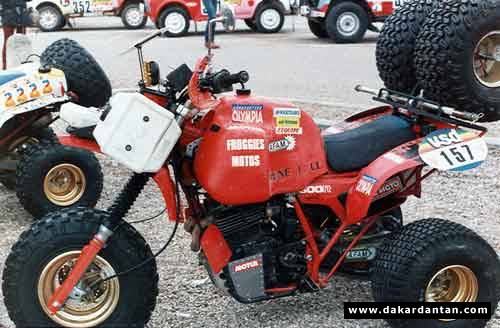
Despite being geared to only reach 45mph, the tubeless-tyred 250s used by the Imps would certainly have offered great traction in sand without a motorbike’s need for momentum to avoid getting bogged. Roy Pratt must have encountered the phenomenon at its peak and like many, assumed three wheels were safer and easier to ride than two. He was not alone: as Paul Blezard wrote, that year three riders entered Honda ATCs in the Dakar Rally (#156, #157 and #158). All were ATC dirt racing pros who’d mastered the all-or-nothing skid-steering technique mentioned in the F9 vid above to get the trikes to corner on all three wheels. One racer, Paul Bonnet, even squeezed what may have been an XR600 motor into his trike (below). None of the Dakar trikers got any further than the Algeria-Niger border which was already 2000km over just four days of flat-out riding across the desert. But then again, of the 135 bikes which entered the Dakar in ’85, only 25 made it to the Senegalese capital.
It’s unclear if Pratt had any desert experience (perhaps from the army, like Tom Sheppard?) or why he settled on leading a bunch of hand-picked former Imps to be the first to cross the width of the Grand Erg Occidental – one of several huge sand seas that fills the Algerian Sahara. There’s talk of a failed ‘Guards Regiment’ attempt on the GEO, as well as a Durham University expedition in 1982 which, among other things, proved the efficacy of trikes in on a shorter, north-south GEO crossing. I wonder if crossing a sand sea is what a person who doesn’t know the Sahara thinks of as the ultimate desert challenge, until reality whacks them in the face like a garden rake. Like an avalanche slope, normally you avoid dunes where at all possible, or at least minimise your time there. The Dakar Rally of that era knew this, as do many visitors to Erg Chebbi in Morocco.
Car, bike or anything in between, dunes are where the accidents happen. The paradoxical need to maintain speed in a 4×4 to avoid getting bogged (and the laborious digging which follows), must be balanced with going slowly enough to spot and navigate over slip faces which can be invisible at certain sun angles. Once inadvertently airborne on a moto, very often it’s a tumbling machine that causes the injury. In a car it’s the impact of a nose-dive or fully somersaulting while battered by loose items. Above left: way too fast: vehicle destroyed, driver lucky to be alive. Above right: relatively harmless fall roll over descending a slip face a little too briskly and at an angle. No harm done.
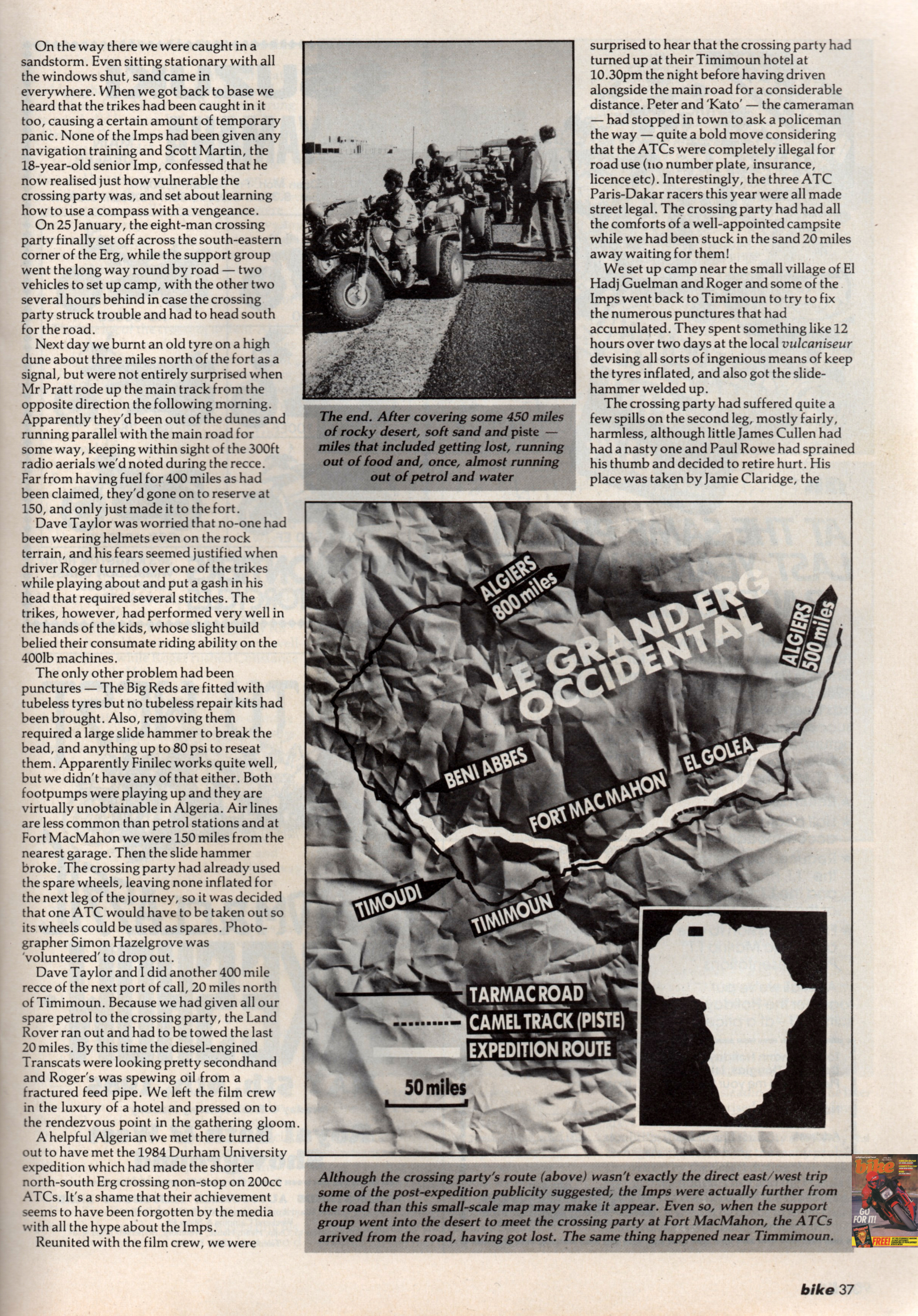
Probable route as interpreted from watching the film. Inset bottom left: fantasy route from the doc.
Great Sand Sea
The Imps’ original plan had been to plough west directly across the erg from El Golea to Beni Abbes like a fat-tyred Columbus. A distance of nearly 500km, as Paul wrote this would have required days of towing power-sapping trailers. Wisely, that plan was ditched before leaving the UK. Apart from being a very long way, it would also have been ‘across the grain’ of the dunes’ SSW/NNE linear orientation, something that’s visible when zoomed in on sat imagery. We found that out for ourselves one morning in Egypt’s Great Sand Sea in 2000. Driving over successive dune cordons makes for extremely slow and at times risky progress (right). On that occasion we gave up and followed the inter-dune corridors south and out of the Sand Sea. It seems the Imps ended up doing the same during much of this trip. After suffering a series of ongoing thefts, the unregistered trikes were now stuck in Algiers Customs. Early on in the doc and with group tensions and low morale already flagged up, Dave Taylor, a well known stunt rider turned motorcycle safety campaigner, presses Roy Pratt on contingency plans if things went wrong. With too much post-reality-TV cynicism, you wonder if it’s a genuine exchange or a staged conflict set up by the TV people. Reading Paul’s accounts, it was almost certainly the former – and was just the tip of the tottering iceberg. All the support cars towed trailers for the trikes, but even an unhitched 4×4 would have struggled to reach, let alone keep up with the trikes in the dunes. So two C4 TV cameramen followed the Imps on their own ATCs, one towing a small trailer. You imagine they had a story of their own to tell at the end of it all.
The four-vehicle convoy merely followed the Timimoun road south of the erg. I’d ridden that road three years earlier until I ran out of fuel. The dunes were unseen, far to the north. On top of everything else, we’re told radios were playing up as radios do, putting the Imp support cars even further from being able to offer assistance. Instead, there was talk of burning tyres at pre-arranged times, as well as flashing mirrors. Both were possibly set-ups for the TV because at any point all the trikes had to do was head south to the nearby road. I was thrilled to see three new UMM 4x4s (below) making up the support convoy. Never seen those used in the Sahara, or indeed anywhere. A UMM was a slab-sided Portuguese built, Peugeot engined workhorse based on the 1960s French Cournil with nods to Jeeps of that era. With the Peugeot 504’s solid reputation in the desert, I’d looked into getting a UMM for my own group of two-wheeled ch’imps in 1989, but ended up with a Land Rover 101FC for a bigger payload. From what Paul wrote later, it sounds like I made the right choice. The Imps support crew also included a 1973 SWB Landie which at one point seems to have given its frazzled driver a black eye (left), but which is probably still running today.
The team had flown directly to Ghardaia and after a mooch around the market (‘ain’t no gews nowhere…’) and with the bikes released from Customs, they based themselves outside of El Golea before setting off along the erg’s southeastern perimeter towards semi-abandoned Fort Mac Mahon. From here they continued west along the Meguidene gravel plain (see yellow map below), ending up riding alongside the road to Timimoun because the trikes were struggling but not road legal. On the way they suffered a staggering ’27 punctures’ resulting in a 16 hour day, but as Paul wrote, they’d forgotten the vital plugs which makes tubeless tyre repairs so effortless, providing you have a compressor. Desert sand soon ruins foot pumps, as I’d also found myself in ’82.
A Navstar antenna? (11:41)
Once in Timimoun (where in ’82 I got dropped off after a creepy lift late night lift, having left my bike in the desert), the Duneriders move up to El Hadj Guelmane oasis, in the erg north of town. After two long days having punctures repaired, this was the last point where Pratt managed to get a fix out of his sat nav, as it’s claimed the trikes lacked the battery power to fire it up. I didn’t know there was land-based sat nav in 1985, unless it was an earlier version of the pre-GPS Navstar we used in 1990. Early on in the film, the antenna on Pratt’s Honda (left) resembles a Navstar unit.
Judging by the film, it seems only from El Hadj Guelmane that the trikes – we’re told without even working odometers so unable to record distance – get stuck into dune riding (above) like you’d see in today’s Dakar Rally in Saudi. They give themselves three days to cover the 250km to Beni Abbes, a very long distance to navigate hundreds of dunes without a mishap. In dunes like this the Big Reds’ 12-litre tanks would have given the 250s about a 300km range, plus another 300 from a jerry.
This whole area north of Timimoun is fascinating, dotted with small, date-producing oases and ancient fortified ksars. The Duneriders’ camp at Guelmane was just 15km from what’s become called the Ksar Draa of Timimoun (above), which looks like something from a fantasy film set.
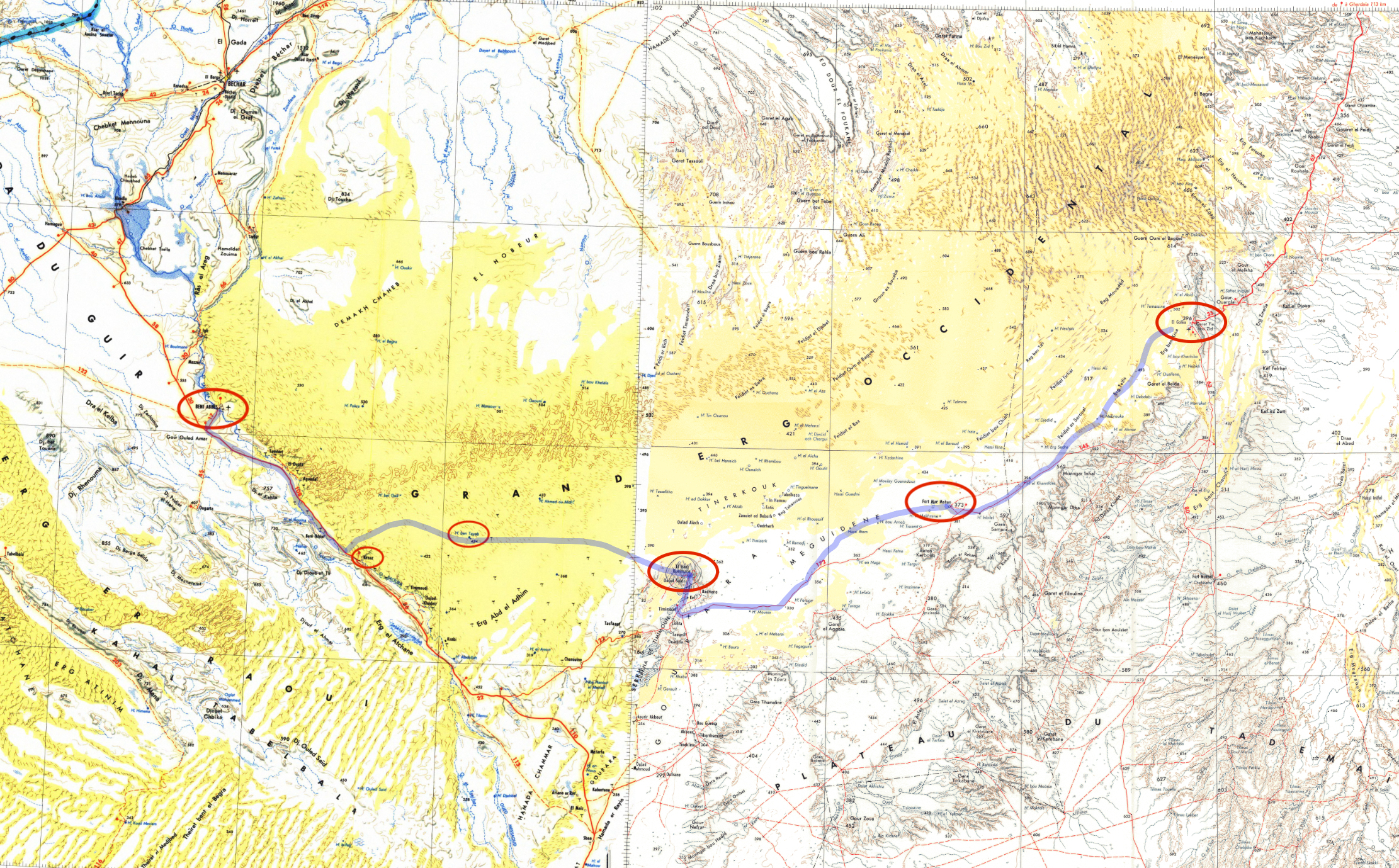
IGN maps NH30 ‘Bechar’ and NH31 ‘Ouargla’. Probable actual route shown
Dead Reckoning into the Erg Initially we’re told the Imps follow a bearing of 290° then 285° (~WNW), possibly aiming for Hassi ben Taleb. At the end of that day Pratt plays the ‘guess where you think we are’ navigation game which we also played with the Navstar in 1990 while waiting the half an hour or more for it to get a fix. Pratt has no working sat-nav of course, but estimates ‘to the right of that highpoint, 424’, pointing to an IGN NH-30 Bechar map (left). Spot height ‘424’ on that map is just to the right of Hassi ben Taleb (on the map above). Although there’s no talk of this marked well being a destination, it’s amazing to think they might have covered the 90km of dead reckoning through the dunes and got so close. Of course they might have been anywhere in the GEO, and Taleb as a destination is just my guess.
Unless you know better dead reckoning – estimating a position from just a bearing held and distance covered – is an exceedingly sketchy way to navigate while winding through chaotic sand seas. The self-effacing Pratt credits the boys with the route finding then spells out the impossibility of accurately estimating their position after all the zig-zagging to find rideable passages. Their key nav aid would have been knowing the N6 highway was just a couple of hours to the southwest, albeit through possibly massive dunes. These can appear daunting, but are actually easier to manage than the small dunes further north (as we found in 2002 entering the Grand Erg Oriental from El Oued; left). Towards the end the film seeks to jack up the ante as the anxious support crew search the horizon from the Beni Abbes hotel terrace. But then we cut back to the trikes and the narrator suddenly throws in: ‘… the one safe course to follow is south, down from the dunes towards the plain and hopefully the road. After two days they’d supposedly run out of food, despite Pratt’s baffling instruction telling the support crew to wait eight days before coming to help. You wonder if Roy & the Imps could see the writing on the slip faces: this sort of riding was not sustainable. Although it’s not evident on sat imagery, the IGN map above (and which Pratt had) shows a band of even higher dunes blocking their way to Beni Abbes. But it’s a happy ending as the riders appear right on schedule, having bailed from the Erg and headed for the road, maybe because of– or just before another accident. We’re told they hit the N6 about 80km from Beni Abbes, so just northwest of Kerzaz (below).
Kerzaz 1982
After recovering and refuelling my abandoned bike and getting going again in Timimoun, in 1982 I well recall stopping in amazement at Kerzaz to crawl up the monumental dune behind the town (above). Whatever lay in the erg behind there, it’s no surprise that triking it eventually ended with a suspected broken arm, one of countless tumbles suffered by the Imp trikers while riding the comically unstable three wheelers.
The film can’t disguise that in the end, by mostly tracking the erg’s southern perimeter, the Imp’s expedition was no more a triumphant crossing of the Grand Erg Oriental than the JSE ‘west-east Sahara’ crossing a decade earlier. But more importantly, Roy Pratt (right) did succeed in delivering an adventure and hopefully a life-changing outlook for a small group of young ‘ackney teenagers which you imagine they’ll remember to this day.
Gunning through the Hadjhadj valley, 2003, just before the party ended
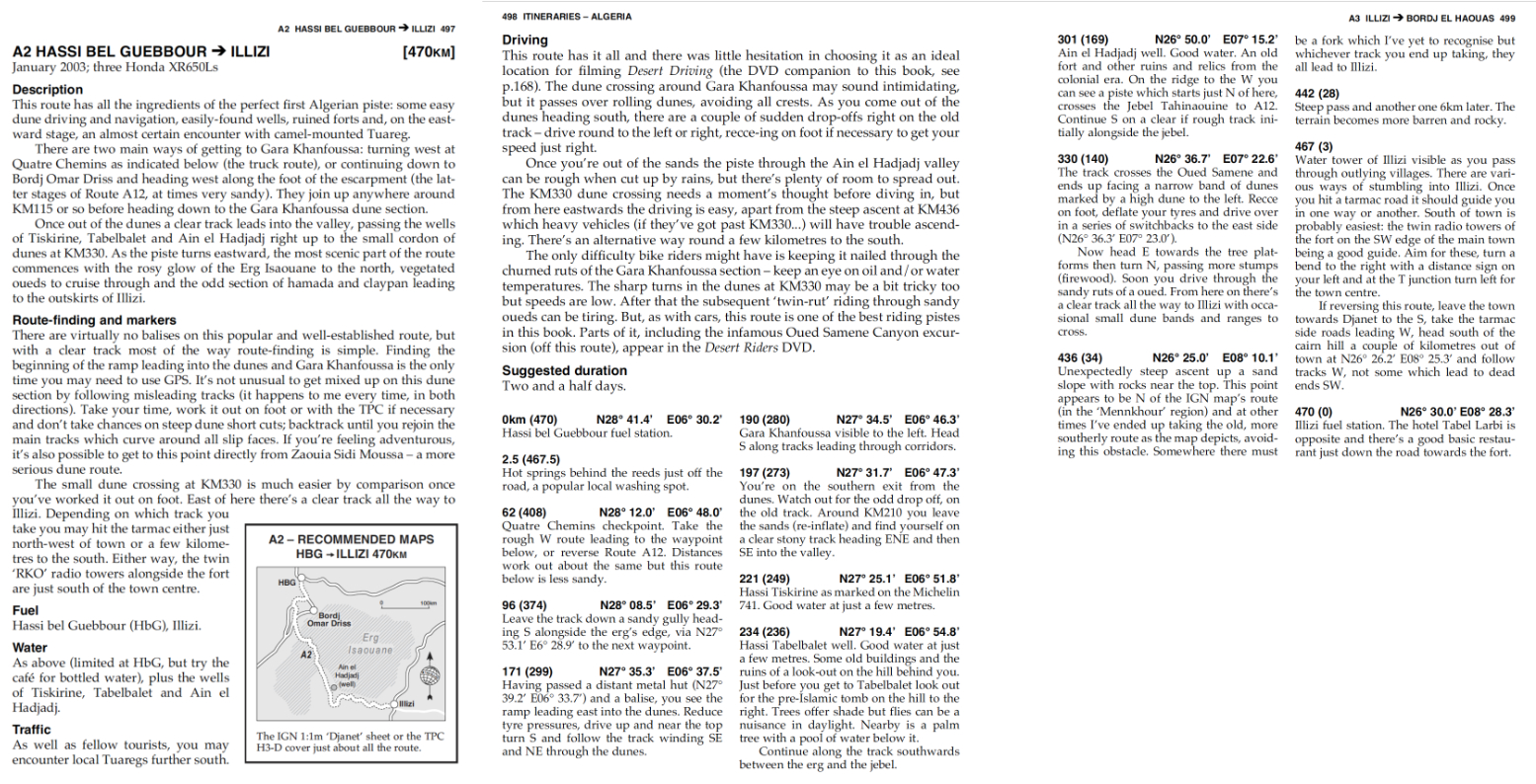
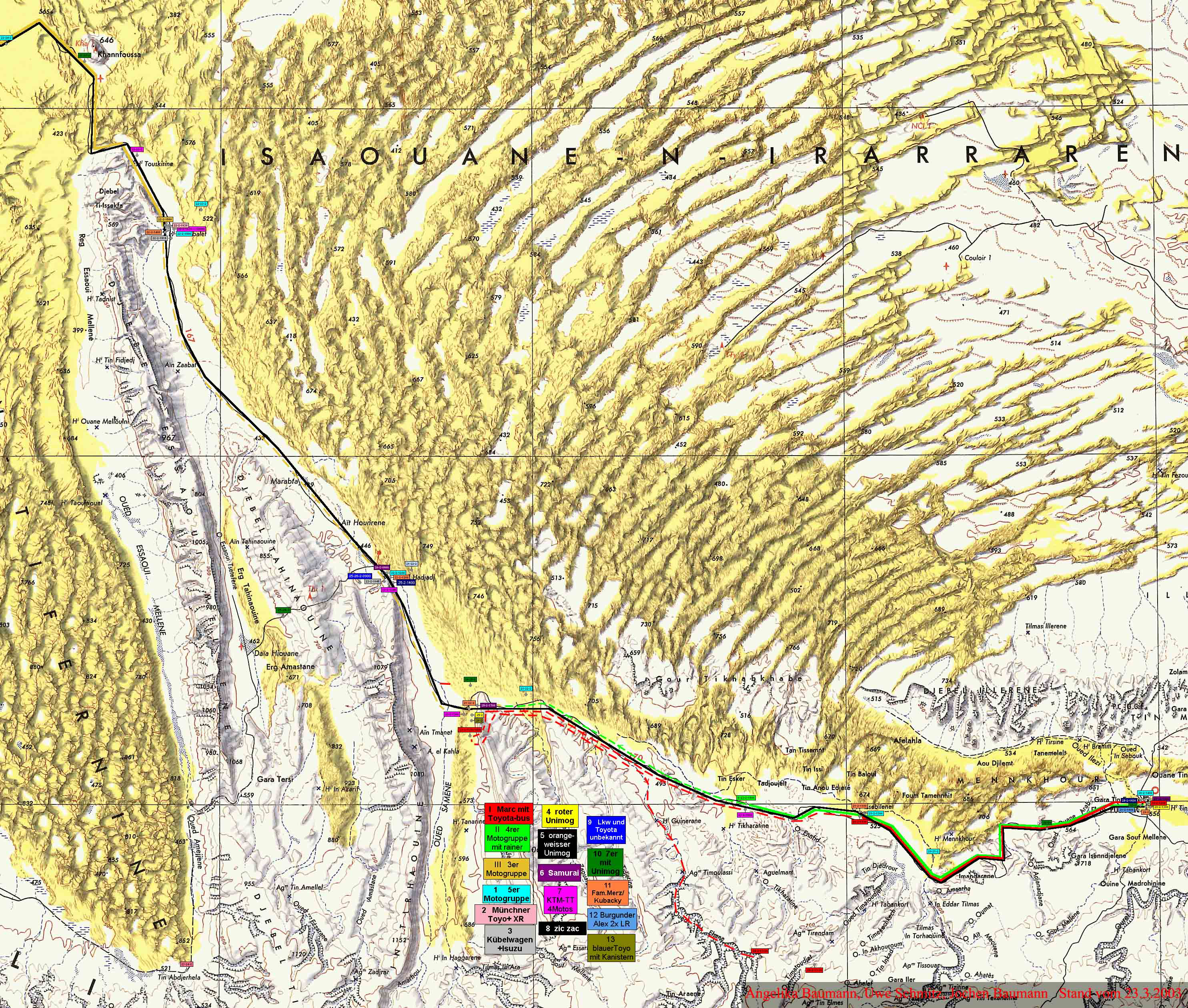
Many old Algeria hands will fondly remember what I called the 470-km Graveyard Piste from Hassi bel Guebbour (‘HbG’) to Illizi, just before the epic Fadnoun plateau crossing to Djanet. We first did it in 1990 and, with a combination of dunes, jebels, nomads and wells, it added up to the best 1000km of off-roading in Algeria at the time. In Sahara Overland It was called Route A2 (below); the macabre name giving it an added cachet. When it came to covering Dunes for the Desert Driving dvd in 2002 (below), Toby Savage and I shot it along the ‘Graveyard Piste’. In fact I’m told the true Gräberpiste was coined by a German guidebook writer in the early 1980s and refers to Route A12 from Amguid which after passing under Erg Tiffernine then cut across the Jebel Tahinaouine to join A2 at Ain el Hadjadj via the Erg Amastane (above right), passing this unusual structure, a probable vestige of the Senussi battles which raged in this valley in 1916. a link I’ve always wanted to make. From there it continued to Illizi along A2. There’s a whole Wikipage on the Gräberpiste and France’s battles with the Tuareg there.
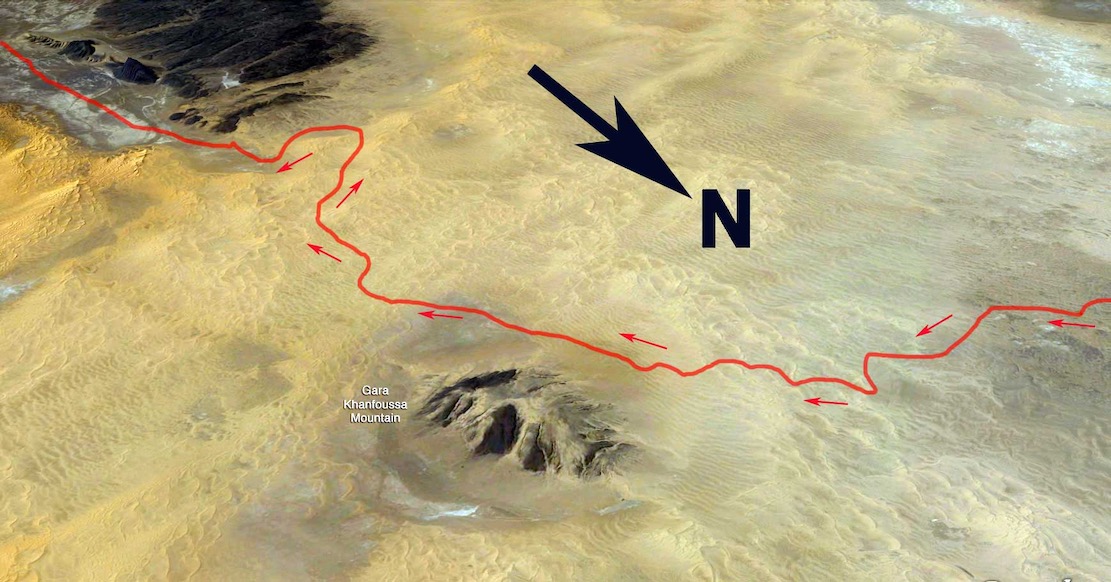
Back then to access the dune-rimmed ‘Hadjadj’ valley which led to Illizi, you had to turn west at Quatre Chemins junction south of HbG and head out towards Amguid until you saw a metal hut. Here, you headed east up a sandy ramp that led into the rolling Erg Issaouane dunes until you saw Gara Khanfoussa hill (below). At this point you turned south. You usually followed tracks in the loose sand and passed a pole or two, but in the pre-tracklog era, in the three or four times I did this crossing, it was always nerve-wracking navigating the maze while maintaining momentum to avoid getting stuck. Car or moto, I never went the same way twice.
Old A2 dune crossing of Erg Issaouane to Tabelbalet well
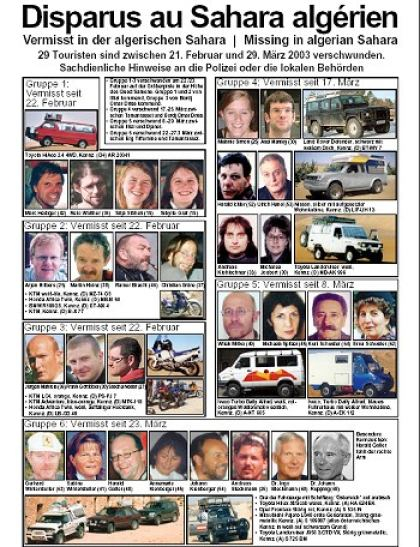
The ‘Graveyard Piste’ – so named because of the pre-Islamic tombs and even Christian colonial soldier graves in the vicinity – became so popular it gained unwelcome notoriety in 2003 when the GSPC Islamist group kidnapped several tourists near the small dune crossing at KM330 (below left). We’d ridden this way on Desert Riders about three weeks earlier (left), aiming for a food and fuel cache before continuing south along Oued Samene in a doomed attempt break through the watershed to the Fadnoun.
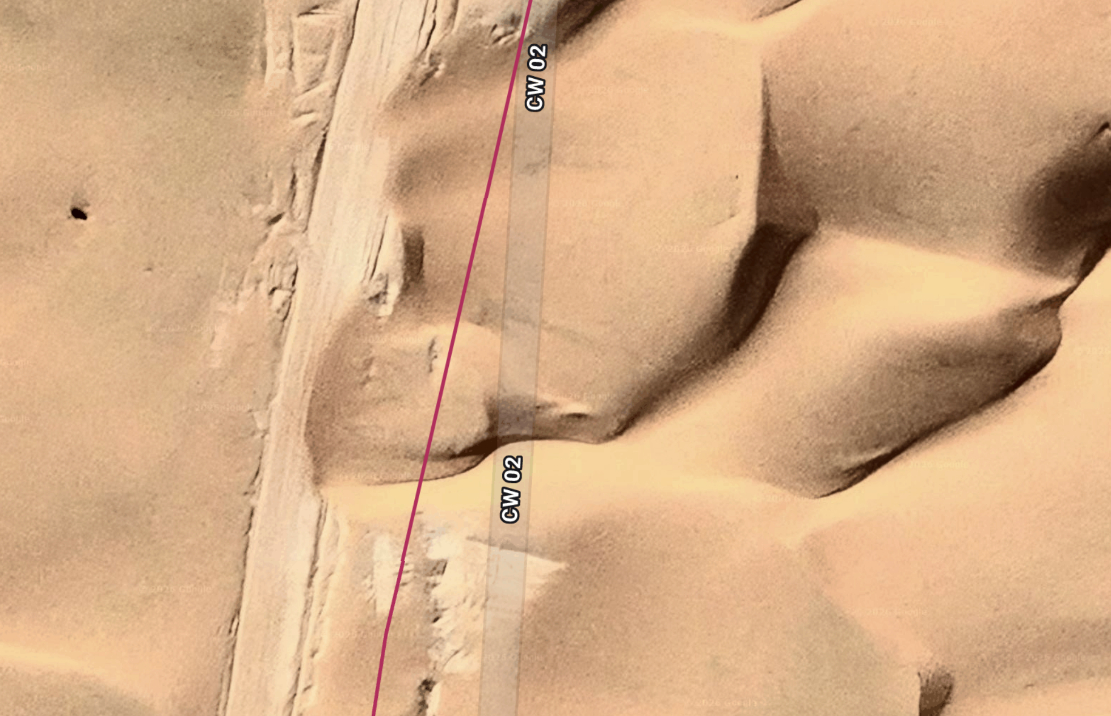
Today a compacted track has been laid across the sands directly south of Bordj Omar Driss towards Gara Khanfoussa (below). This new route is also on OSM maps and is labelled CW2/CP2. It passes east of the hill then turns to meet the old A2 route at a rejuvenated Hassi Tabelbalet well. Cantone came up this way in April 2024 in windy conditions and had a good look around Gara Khan before continuinh north to BoD.
CW2 plies the sands from Bordj Omar Driss
Stuck at KM330
Ain el Hadjadj well (below right, 2003) is now an army base, and the tricky dune crossing at KM330 (left) has also been graded and stabilised just to the north of the old crossing. I do wonder how you lay a track over dunes that’s strong enough to support trucks. Maybe a metre of rocky rubble does the job? But even then, as shown in the satellite screen grab below, as all over the Sahara, dunes will eventually creep back over the track, requiring regular clearing.
Hassi Tabelbalet, 2003Ain el Hadjadj well, 2002
At this point the route gets renamed ‘CW2’, and the last 100km east to Illizi are sealed, making the distance now just 330km, fuel to fuel and doable in a day. You won’t see all the route on Google; it’s clearer on ESRI sat platforms, like Apple Maps or Bing.
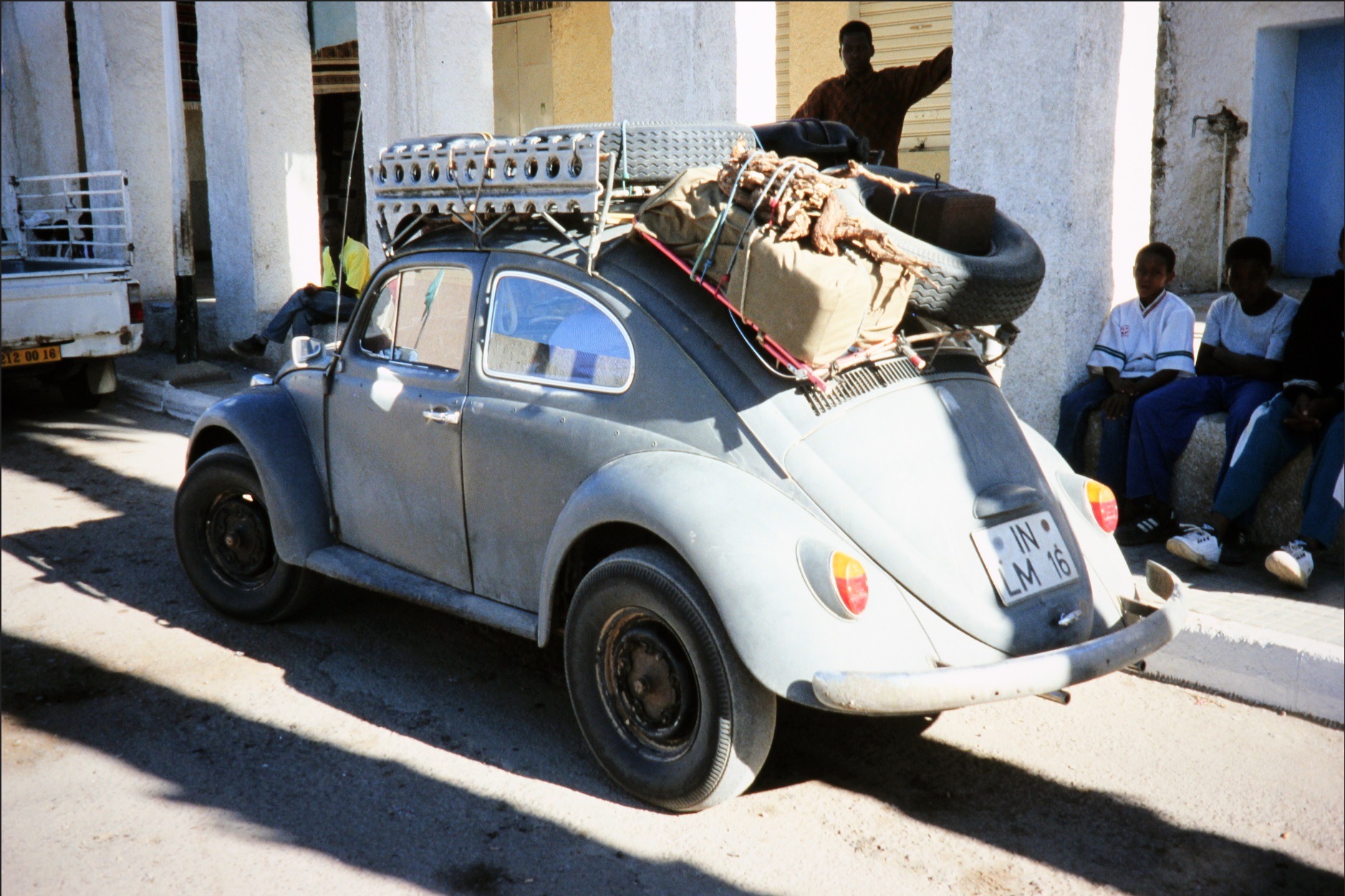
In 2026 a group of intrepid, escort-dodging Polish riders managed to be, afailk, the first party in years to follow A2 from BoD to Illizi, which has been off limits to tourists since the kidnappings (depending on which agency you ask). The old and new routes join near Tabelbelet well where in 1990 we met a jacked-up VW Beetle (left) that had come across the Khanfoussa crossing just ahead of us. You can view the Polish riders’ raw gpx with photos on Wikilocs and read about their ride and a whole lot more here.
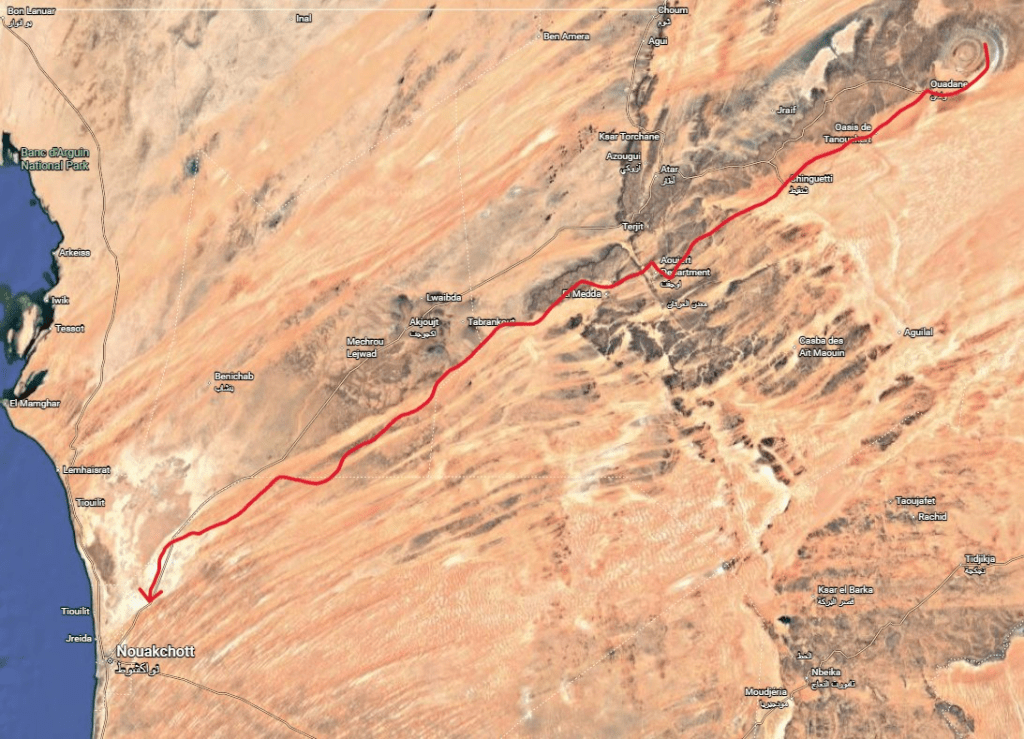
Exped 233; a 700-km walk from the Eye of the Sahara to Nouakchott
by Simon Cope
December 2025-January 2026
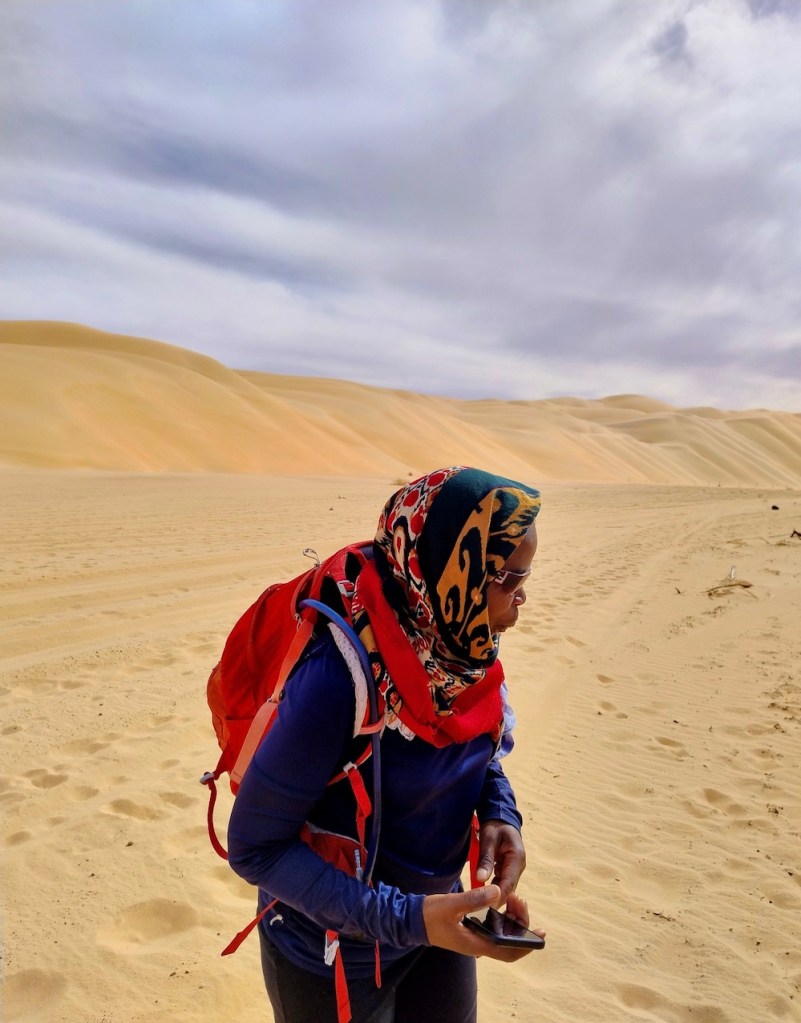
The Richat Structure, often called the ‘Eye of Africa’ is a prominent circular geological feature at the northwestern edge of the Taoudeni Basin, on the Adrar Plateau of the Sahara. The structure gained international attention in the 1960s when astronauts spotted it from space during early space missions. The name of our expedition (233 Degrees) refers to the bearing we followed for much of the latter half of the route as we made a direct line to Nouakchott. The estimated distance was around 700km. The actual distance walked was 679km due to short-cuts taken where possible.
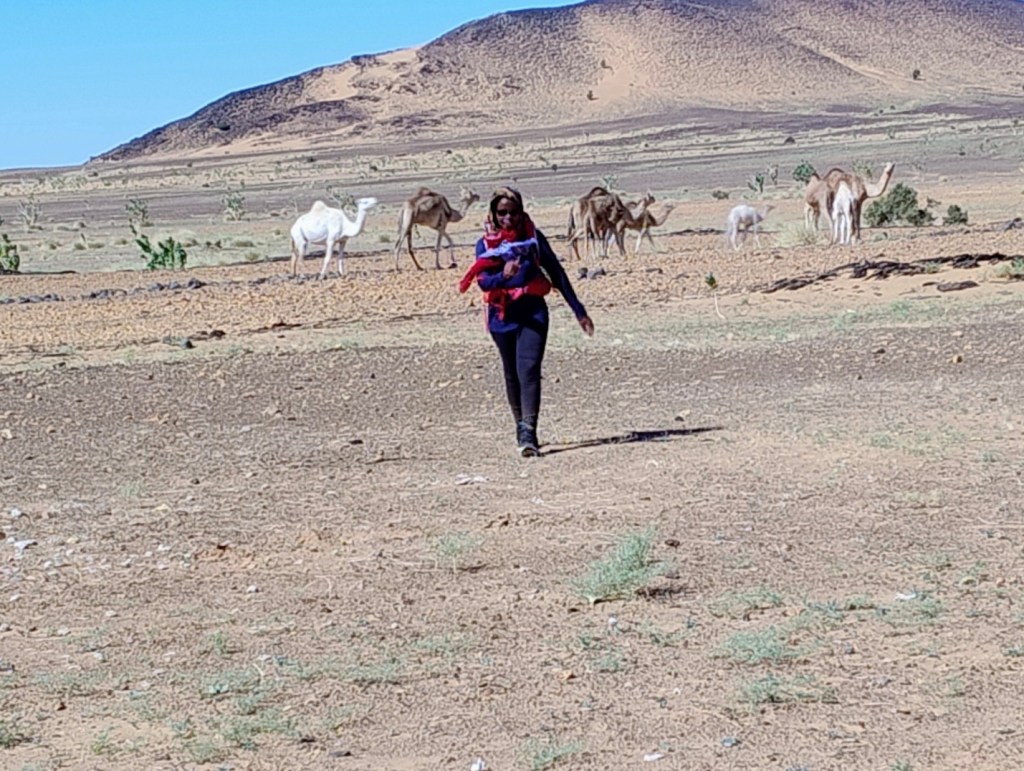
Expedition members Husband and wife team: Fatuma Babirye and Simon Cope, FRGS
We started walking from the Richat Structure on 17 December 2025. We arrived on the outskirts of Nouakchott on 1 January 2026. The last day was notable due to thunderstorms in the area. In order to avoid camping in the rain (which would be miserable since our camping kit was not designed for heavy rain), we walked 47km on 1 January to finish the walk ahead of schedule.
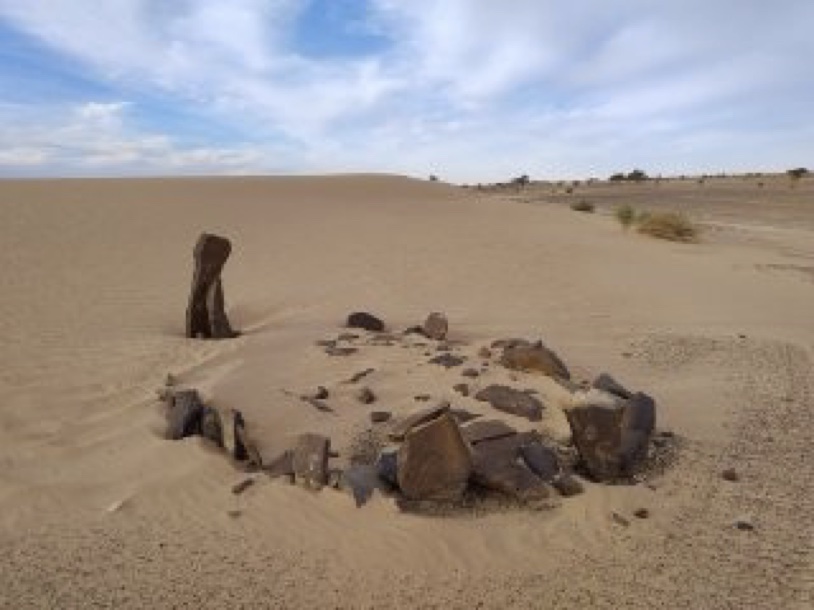
Islamic (as opposed to pre-Islamic) grave site
Dangers and difficulties
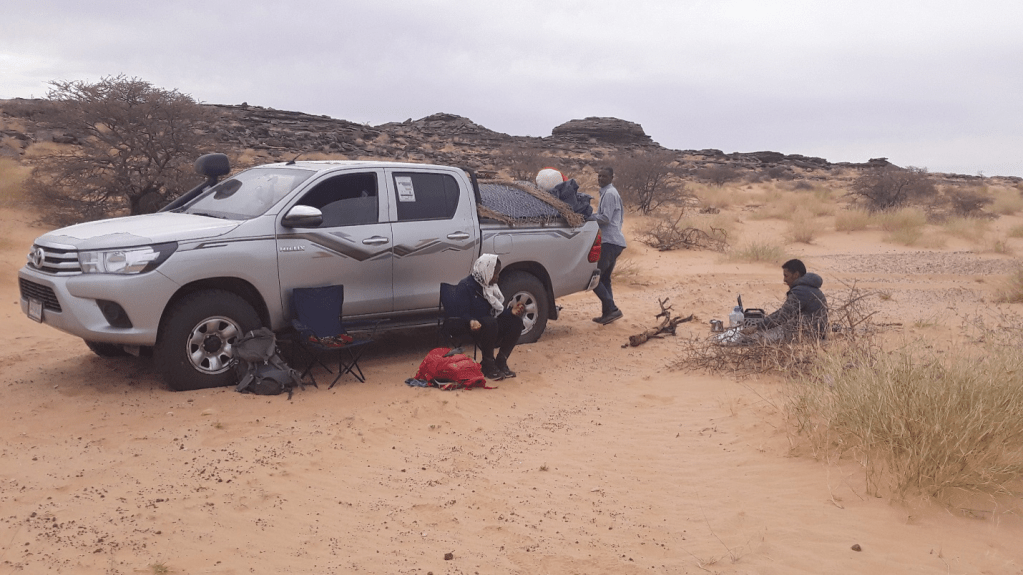
The main challenge was being able to sustain walking 35-40km per day. This necessitated considerable walking in the afternoon into the sun at its most intense. Although the air temperature was rarely above 29C, the desert sun was strong. In addition, there was no breeze since we were walking in the direction of the prevailing wind. We therefore found many afternoons to be unpleasant. Navigation was not a significant problem since the support vehicle was normally ahead of us at prominent locations (track junctions, crests of dunes or hilltops) to guide us. There were times when we had no support vehicle for navigation, such as first thing in the morning since they were dismantling the camp or collecting supplies. On these occasions navigation was by compass bearing (often 233 degrees) and was relatively straightforward. Fortunately, we did not encounter any sandstorms.
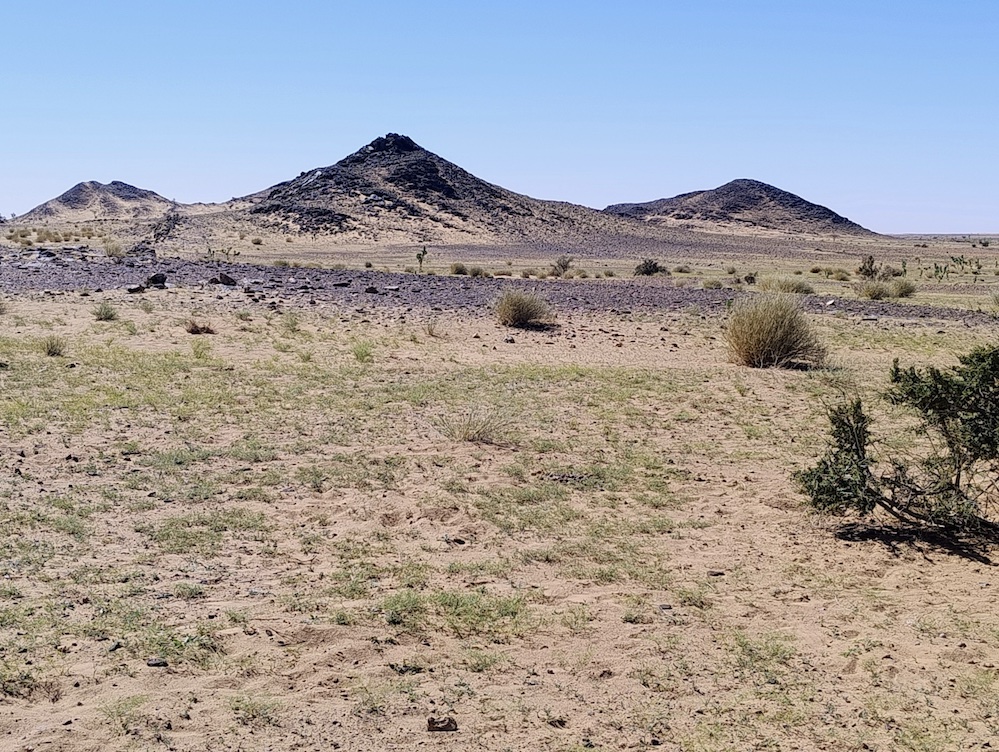
One of the greener areas we walked through
The need for local support
A local tour company, “Tour in Mauritania” was contracted to provide vehicle support, food and water and camping equipment. We considered using camel support instead of vehicle support for a more authentic experience. However, camels would be restricted to 20-25 km per day and would need regular food breaks. Having a vehicle would give us more flexibility as well as the ability to cover longer daily distances.
Big skies on the coastal plain
Terrain
Minimal elevation gain/loss. The start of the trip near the Richat structure was around 550m whereas Nouakchott was at sea level. The second half of the trip was almost completely flat. The first third of the trip had some areas of deep sand, which considerably reduced our daily distances. Wherever possible we would seek firmer ground such as tracks and trails. Once on the coastal plain, we were able to travel cross-country relatively easily since the terrain was much firmer.
Not all was flat
Observations
Lessons learned. – The trip was planned to travel in a southwesterly direction to keep the prevailing wind behind us and to traverse deep sandy areas during the first part of the expedition when we were fresher. On reflection, the expedition would have been more enjoyable if done in reverse since we would have the sun to our rear in the afternoon when it was at its most intense ands we would also be cooled by the prevailing wind. There would have more deep sand towards the end of the trip, however on balance it would have been more pleasant.
Deep sand
– Ensure that the support team understands the nature of the expedition and the calorific and nutritional requirements of walking 35-40km per day in a desert environment. There were a few occasions where food supplies were running a little low.
– Kit we did not bring but would be useful on future trips:
– Many thanks for Hadrami Bouh, owner of Tour in Mauritania, for vehicle and logistic support and to Imane Kaa who provided accommodation and hospitality in Nouakchott and was able to accommodate our earlier than anticipated arrival.
– Would we do it again? Yes, but a different route. We heard from Hadrami about a previous expedition from Chinguetti to Timbuktu (an estimated distance of 1,200 km) many years ago. This route follows historic caravan trade routes and the pilgrimage route to Mecca. We would love to do this, however, the security situation in eastern Mauritania and northern Mali means this is extremely unlikely to happen in our lifetimes.
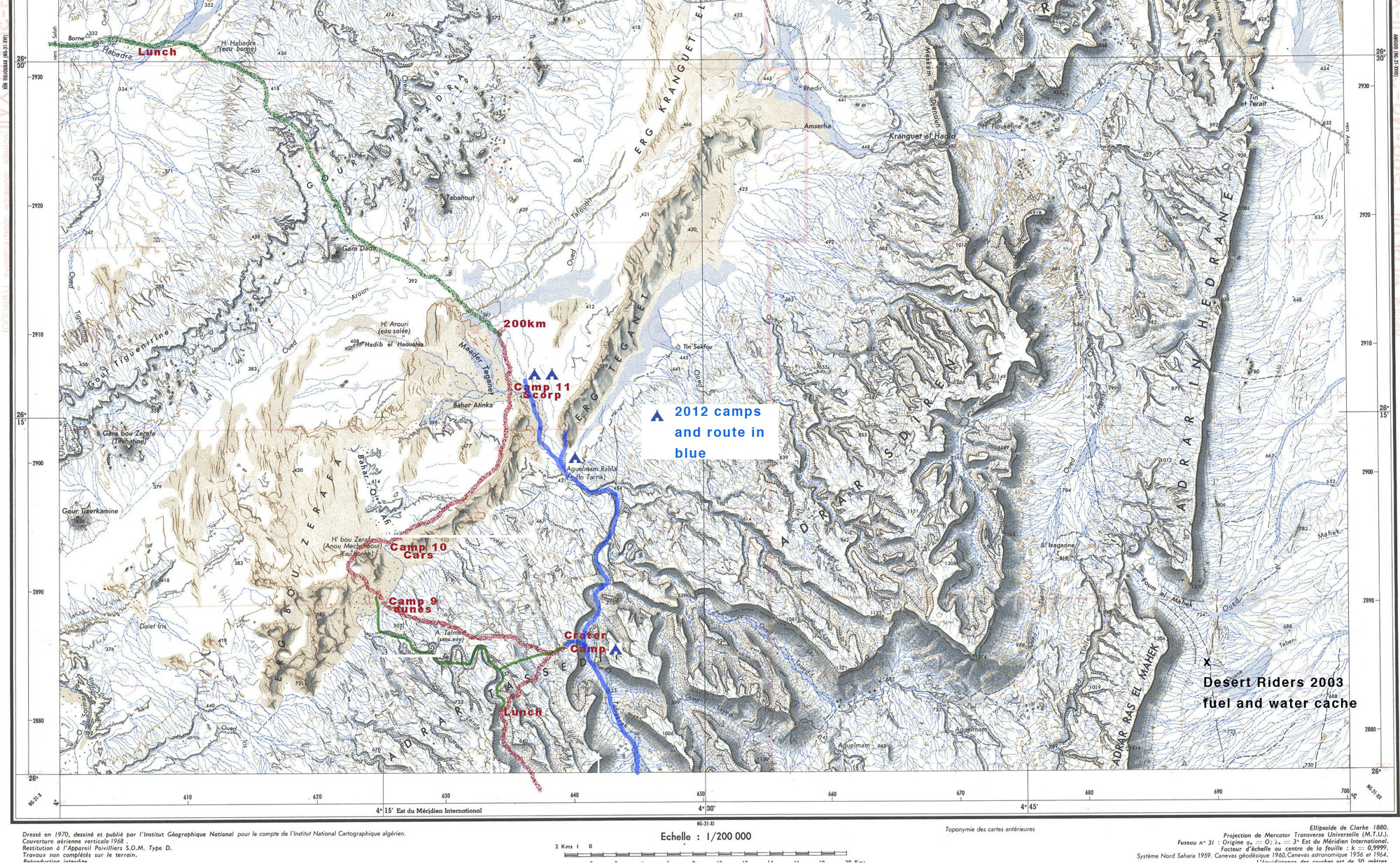
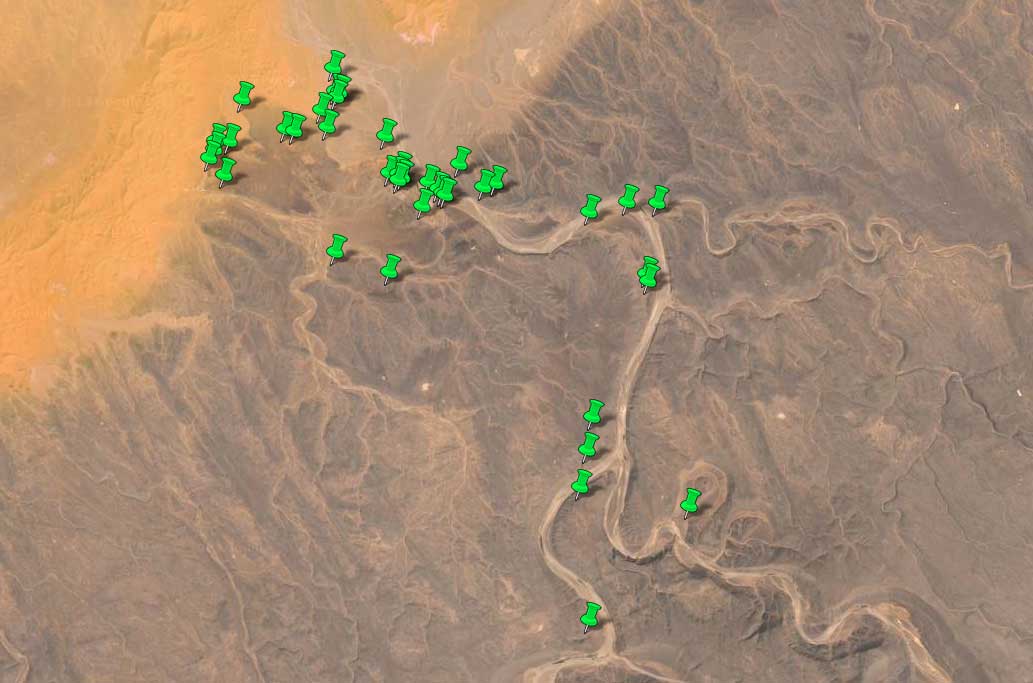
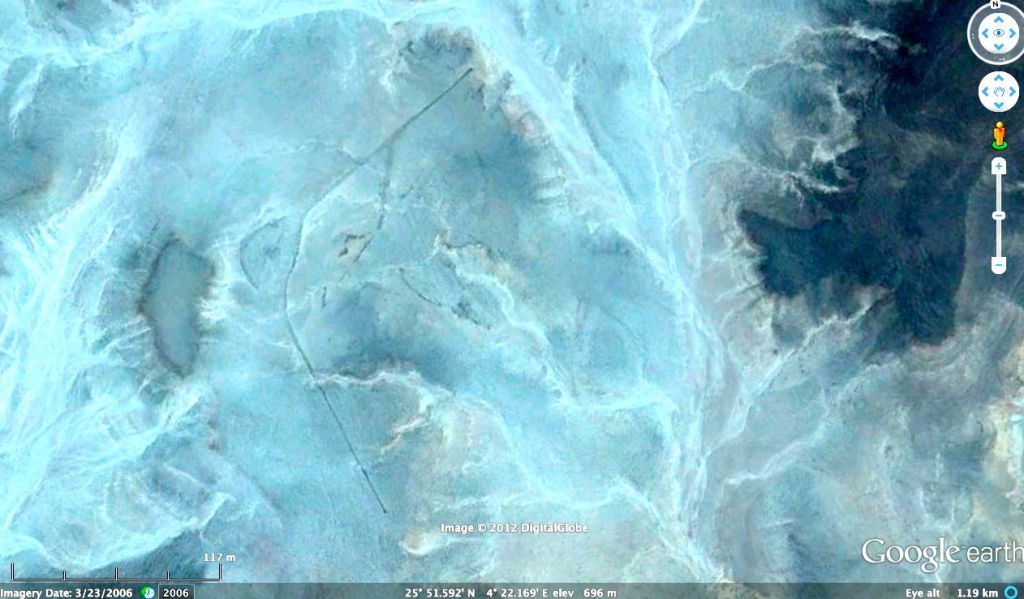
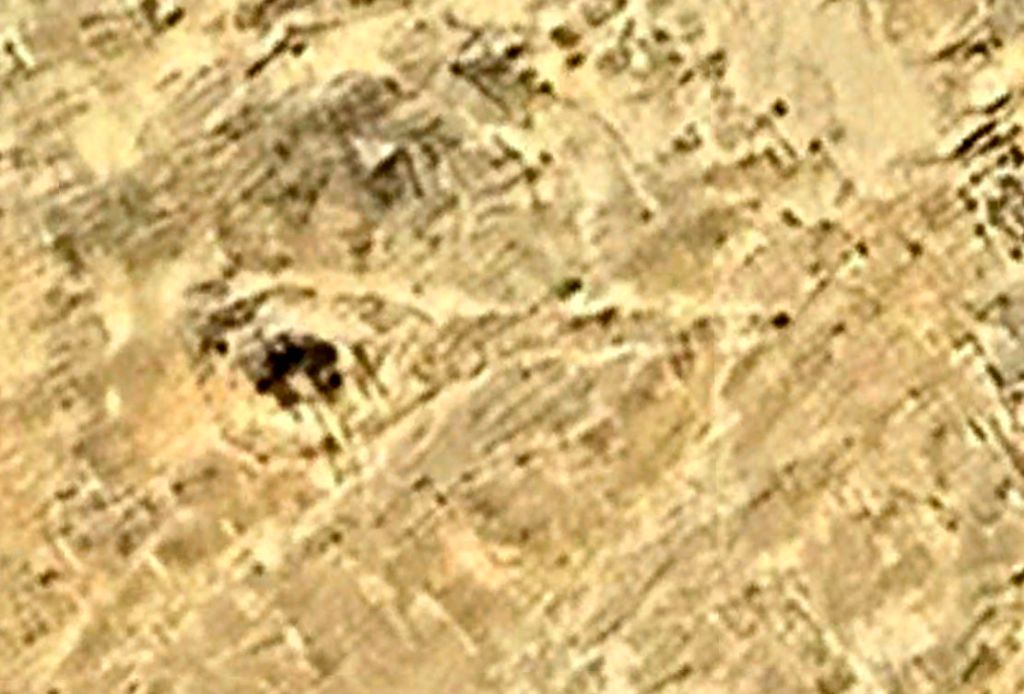
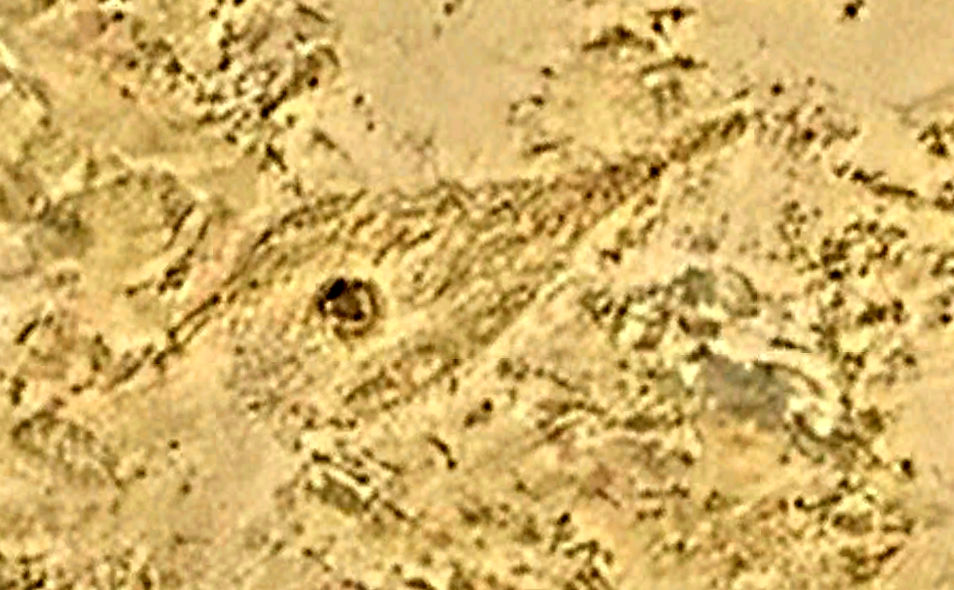
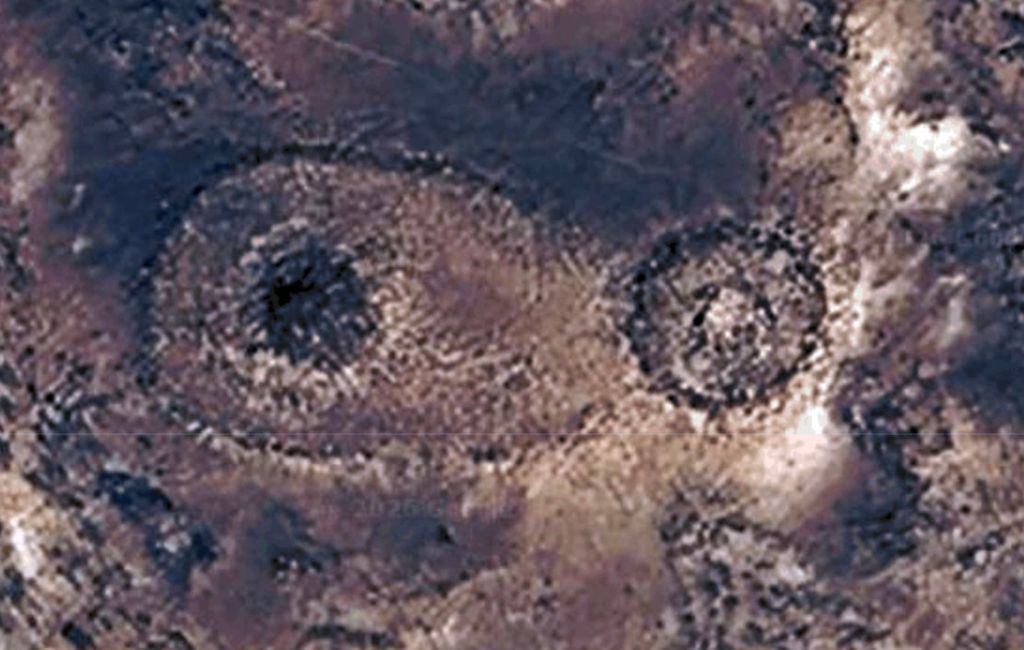
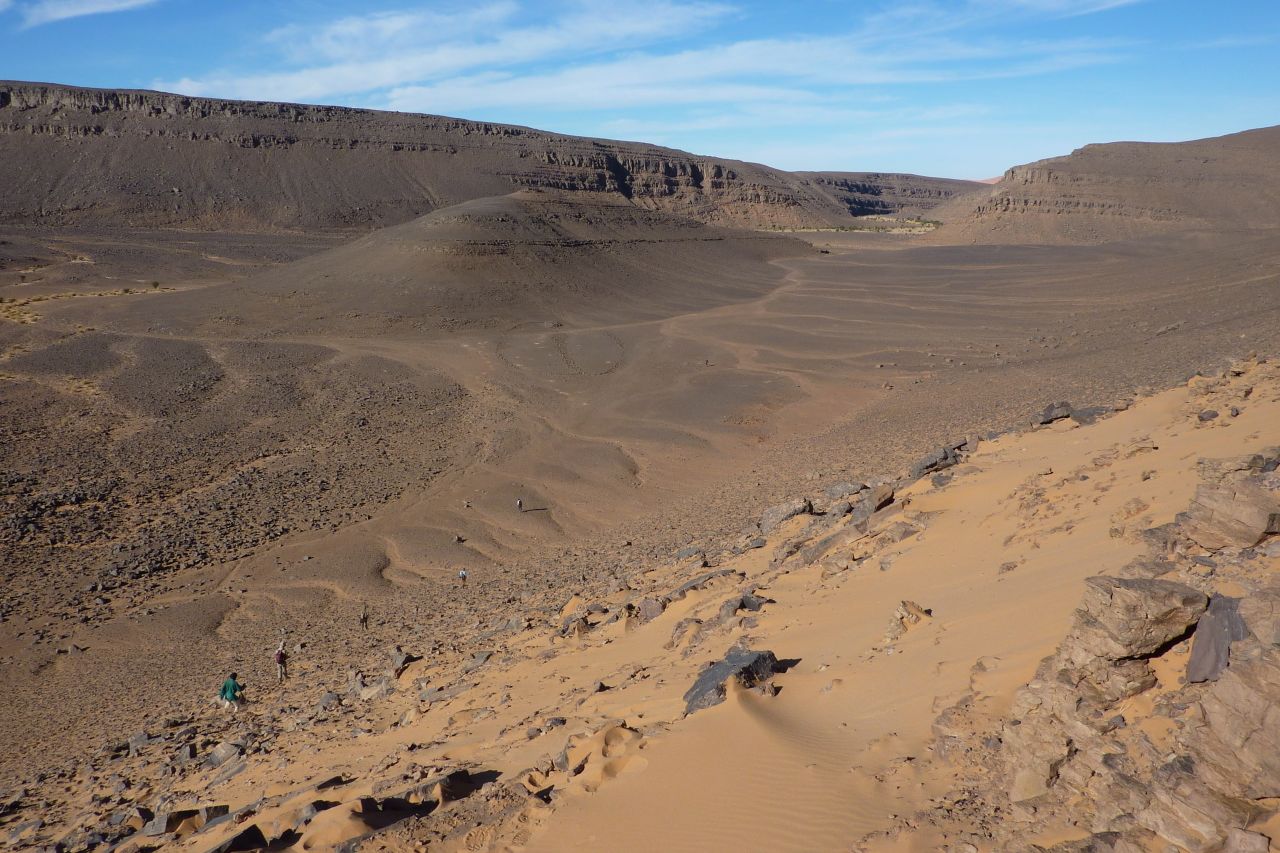
As on previous occasions, the route of our camel trek through the Immidir will rest a day at Aguelmam Rahla, a reliable waterhole at the mouth of the Oued Tafrakrek canyon (blue line on map, left) where the Tissedit plateau drops down to meet a band of dunes. I’d been wanting to make a diversion here since scanning Google Earth a few years back and noticing the innumerable pre-Islamic tombs (‘PIZ’) in the area (below).
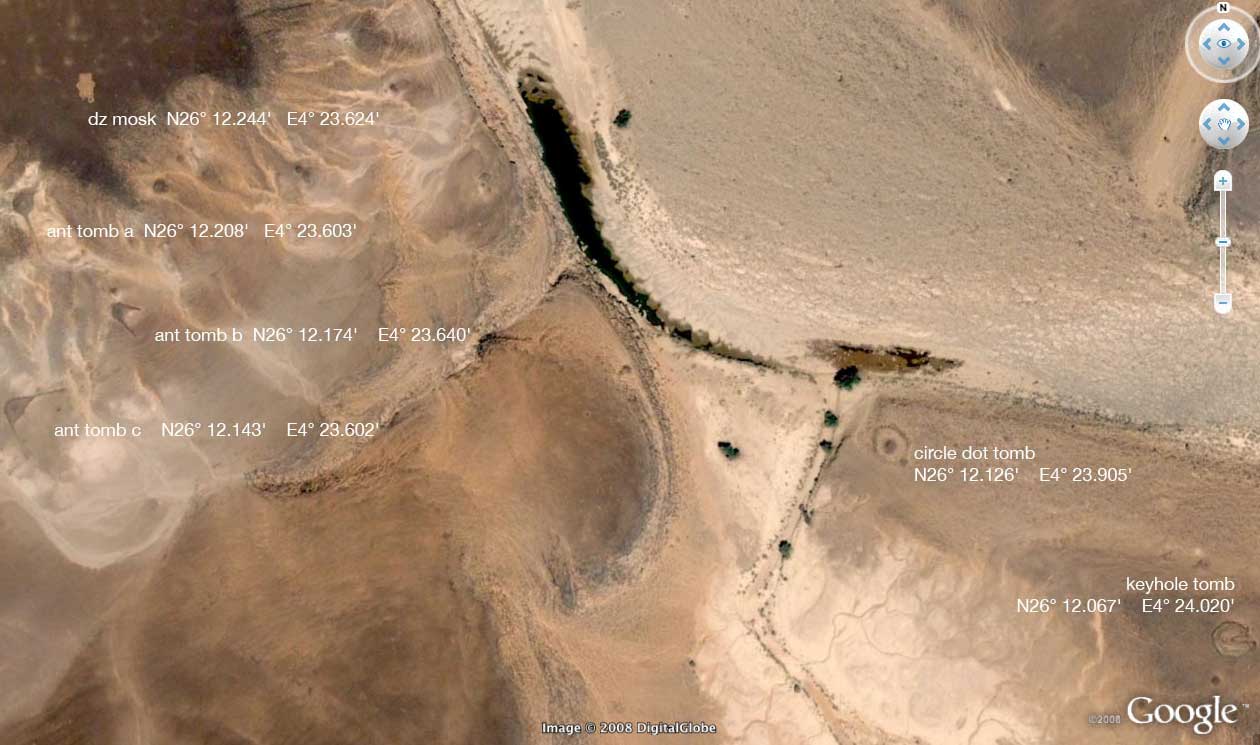
Tombs around Aguelmam (‘waterhole’) Rahla.
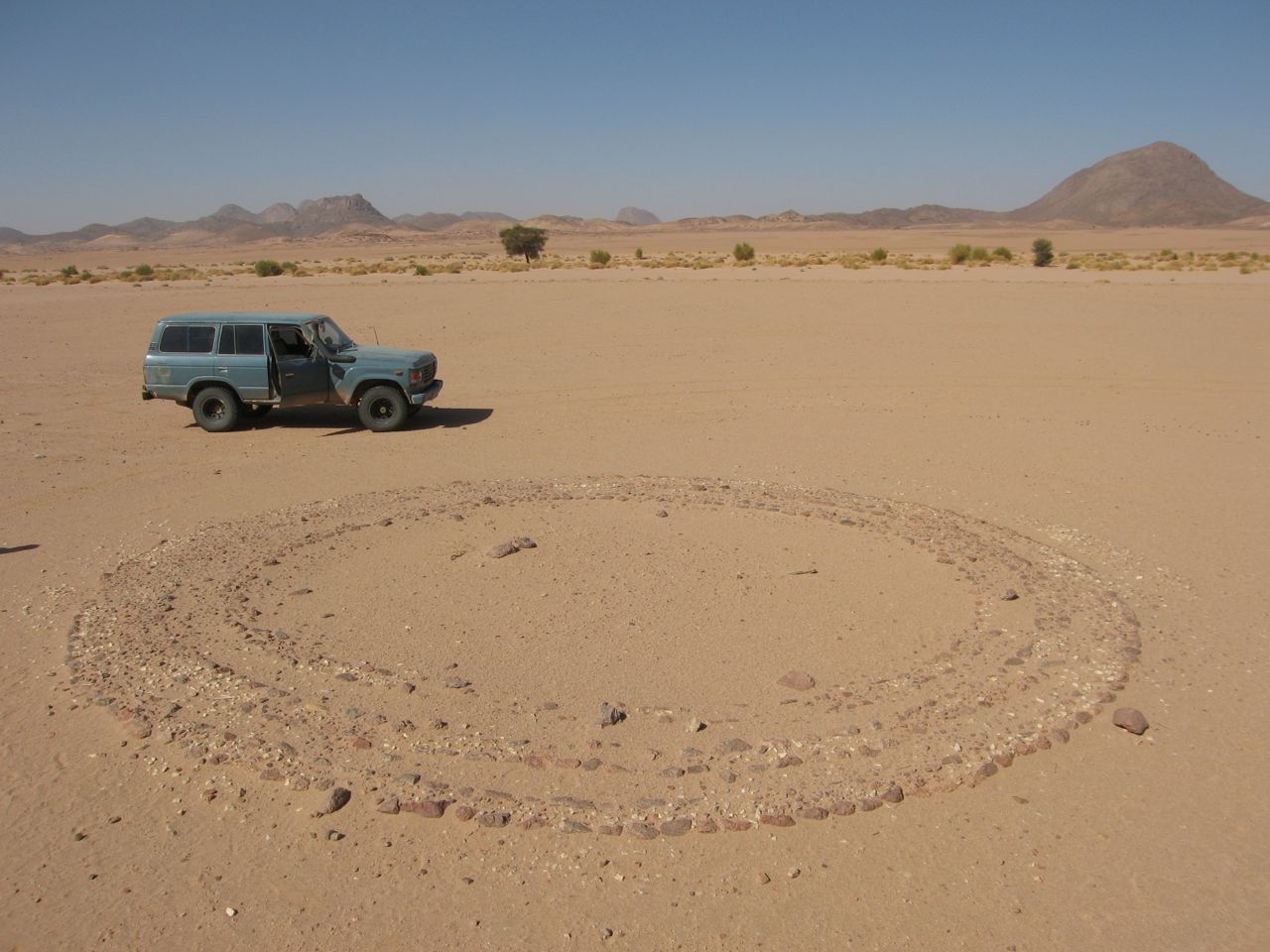
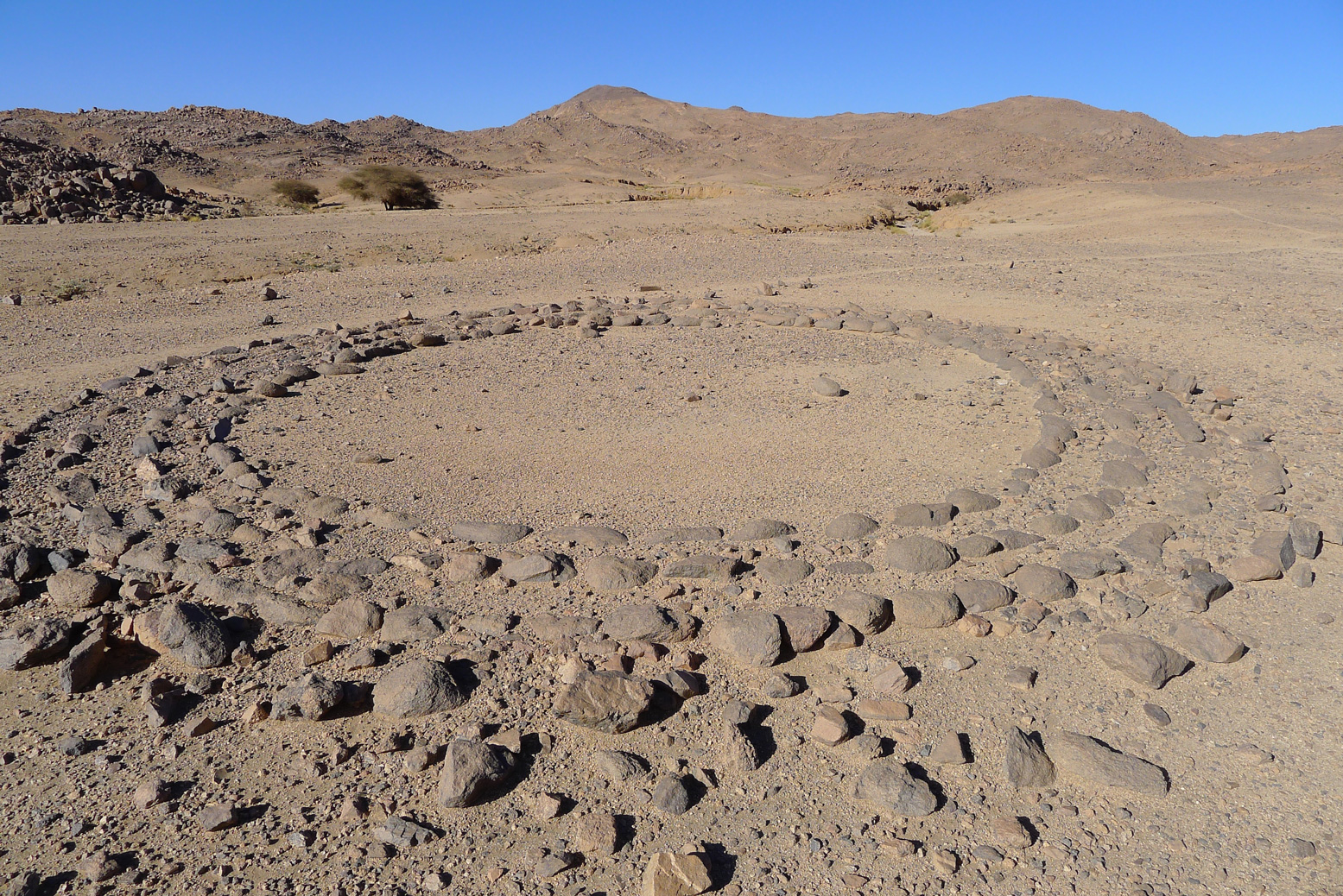
Looking again on Google Earth some time later, less than an hour of nosing around revelled three dozen keyhole, antenna or mound-ring tombs within a few kilometres of the waterhole. I didn’t bother counting the less distinctive mound tombs or just plain tumuli. In fact the proliferation of tombs here isn’t so unusual, given the topographic features already listed: edge of a plateau, former river mouth, band of dunes – all common factors found at former Neolithic occupation sites.
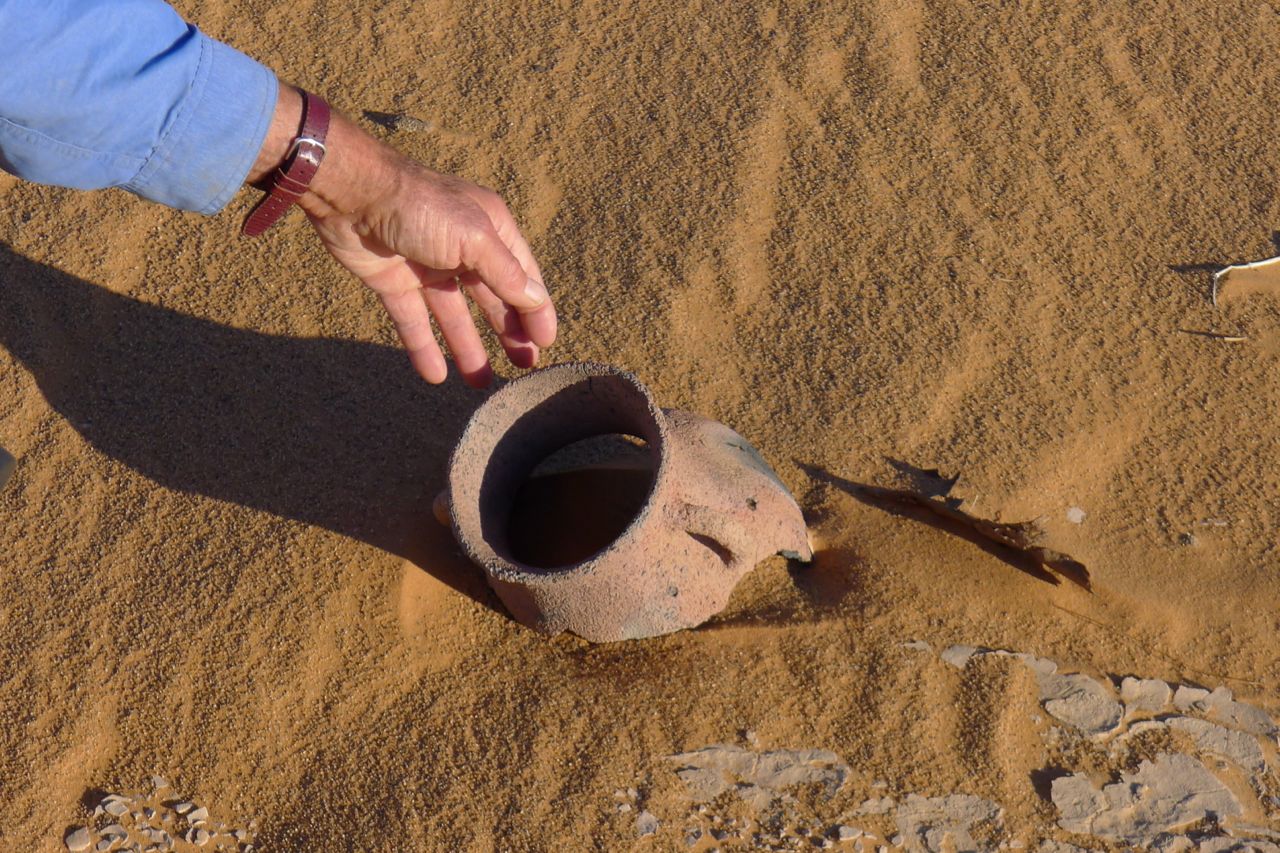
On the first crater tour in 2007 we walked along the base of the dunes, northeast from Aguelmam Rahla, and discovered several grinding stones and other artefacts at the foot of the dunes. And in 2012 one of us came across a near intact pot (left) at the foot of a dune, as well as napping (stone tool chipping) sites. You commonly find ceramic shards or even larger pieces, but I’ve never found an intact pot.
Location of tombs along the Oued Tafrakrek canyon and on the Tissedit plateau, with a cluster around Aguelmam Rahla at the canyon mouth.
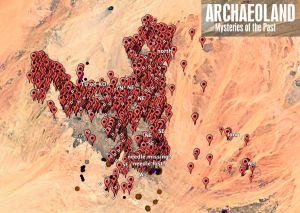
There’s something compulsive about Sahara tomb spotting on Google Maps, searching the featureless desert floor for the clear signs of prehistoric human activity. Once out there it can give a purpose to a journey that’s otherwise just agreeable recreation and adds a hint of treasure hunting. It reminds you that the Sahara of 6000 years ago was not a desert, but a much less arid savannah. Among others, KenGrok spent years scanning and collating unusual imagery on Google Earth’s layers, including pre-Islamic tombs in the Sahara. In 2019 Google erased his work, but his baton has been picked up by ‘syzygy‘ on Google Earth Community, as well as Manfred Boelke at archaeoland.eu (his image below).
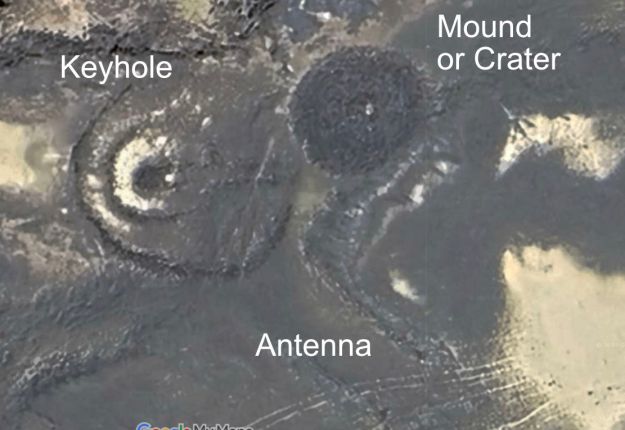
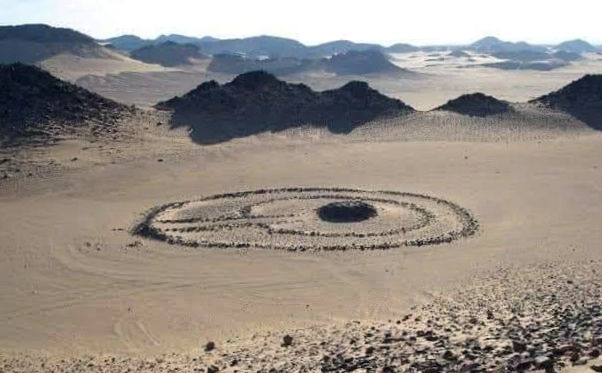
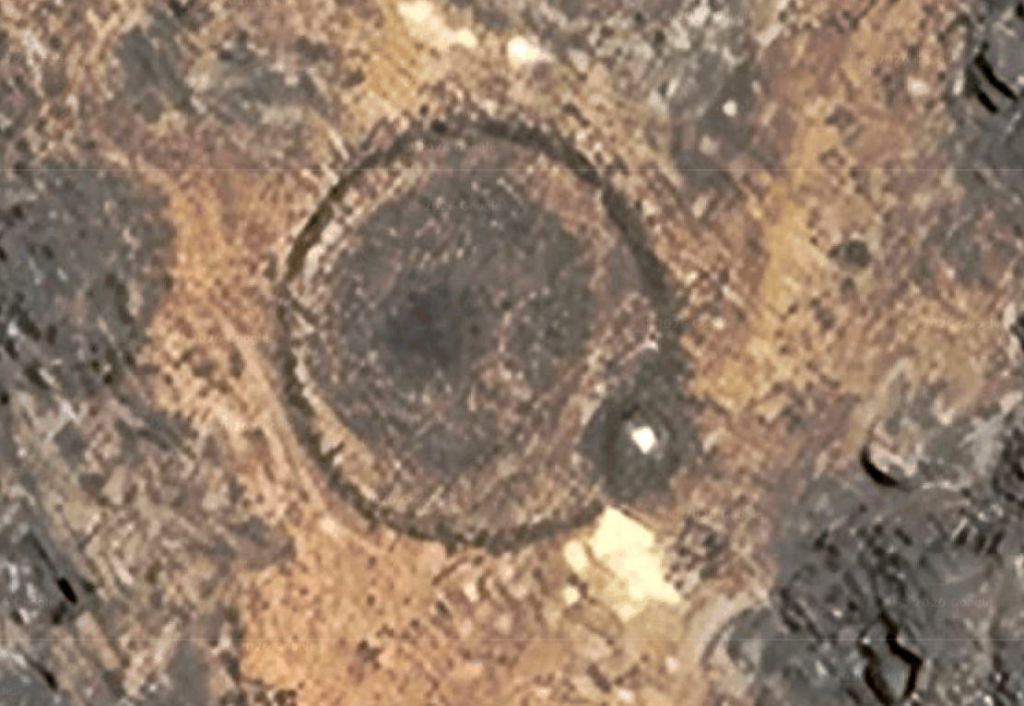
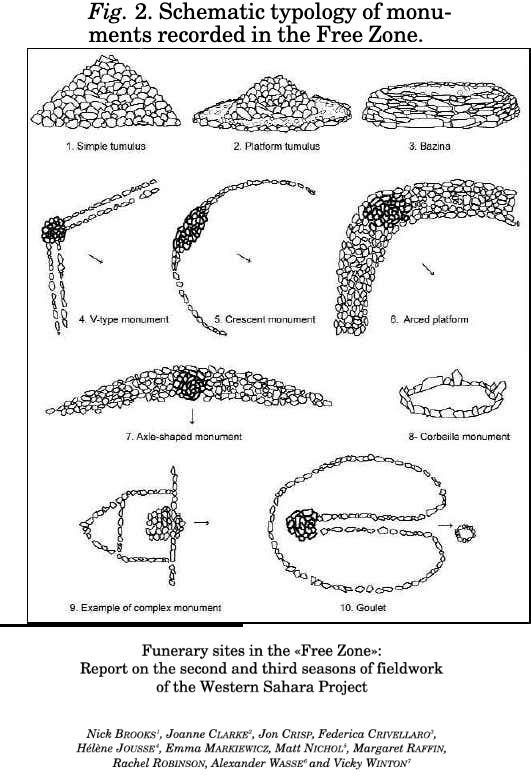
Broadly speaking, half a dozen tombs styles have been identified with clear regional limits as shown above. The most common is simply a mound of stones or tumulus which can be huge and can have a central depression to resemble a volcanic crater. Sometimes the mound may be surrounded by a ring – a mound-ring tomb. All over the Sahara tombs are usually found in clusters; find one and you’ll find others nearby. It suggests an auspicious place for burials or just a former occupation site with an adjacent burial ground.
A very unusual assembly of three types of tomb on the edge of the Tassili plateau near Djanet. The superimposed mound suggest the keyhole is older. As we know from rock art found in the same area, it’s common to cover what came before.
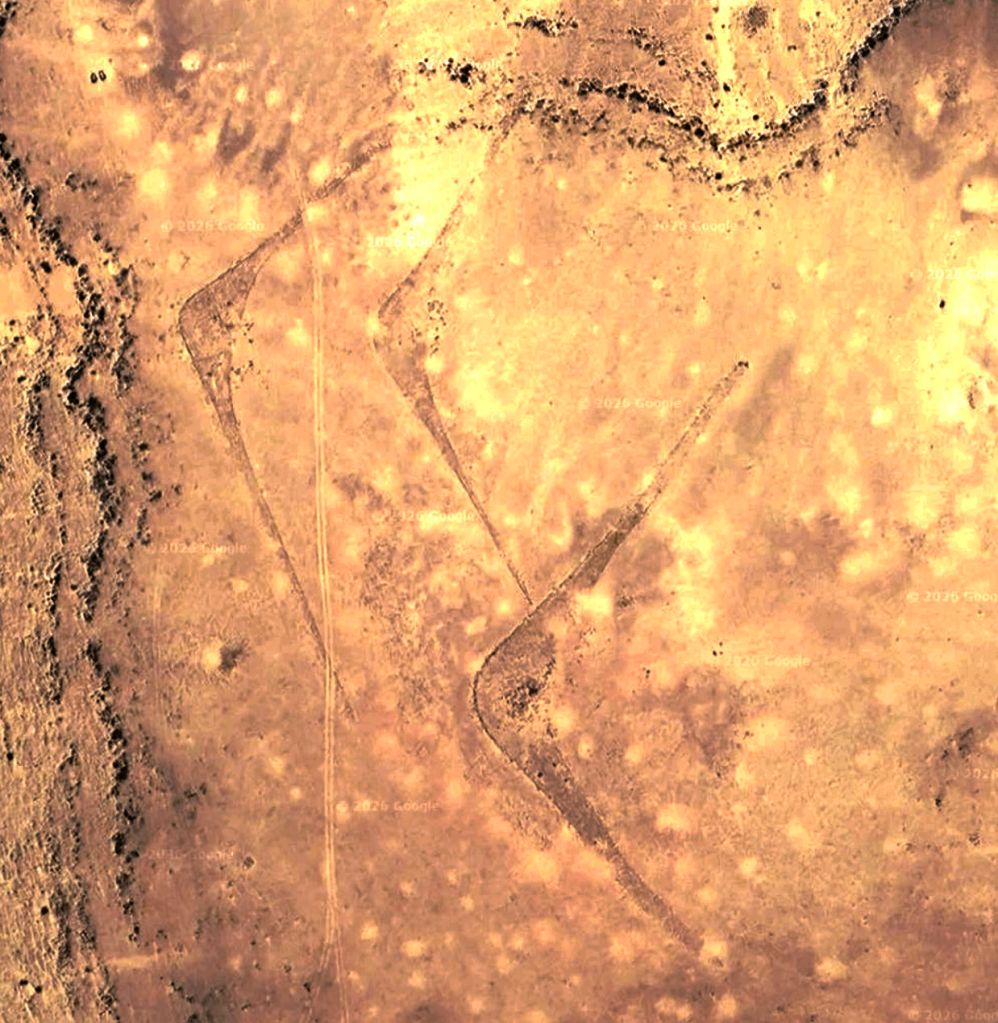
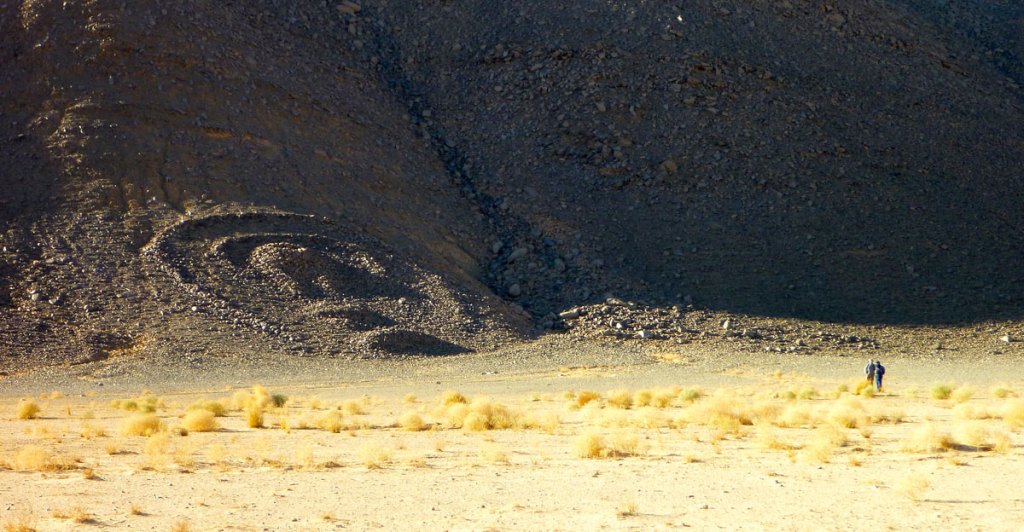
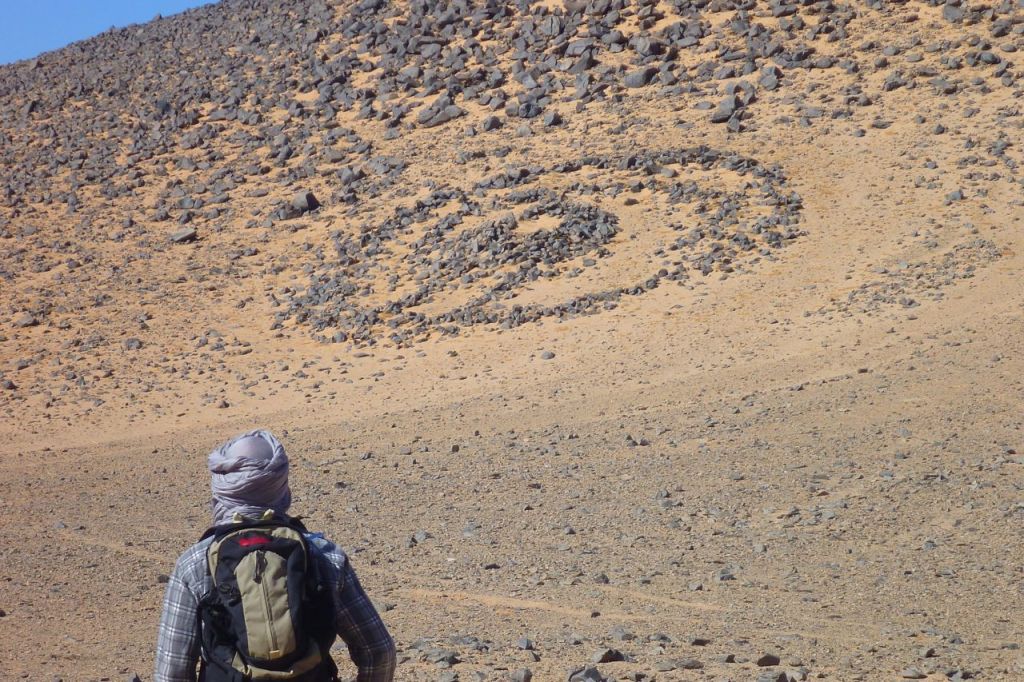
Antenna or crescent tombs have open arms spanning out from a tomb mound apex at around 120° and can be up to 250 metres or more, end to end. They are prolific in southeastern Morocco (bottom left; 27.6971, -10.8665), but are also found in Algeria by the thousand (25.86007, 4.36847). The finest ones have long, slender arms while small ones can be stumpy and even almost simple hemispheres.
Keyhole tombs are two concentric round or oval rings with the tomb mound near the middle and a corridor leading to the outer ring. Below is a famous keyhole near Djanet at the base of the Tassili n Ajjer plateau where you’ll find them in their hundreds.
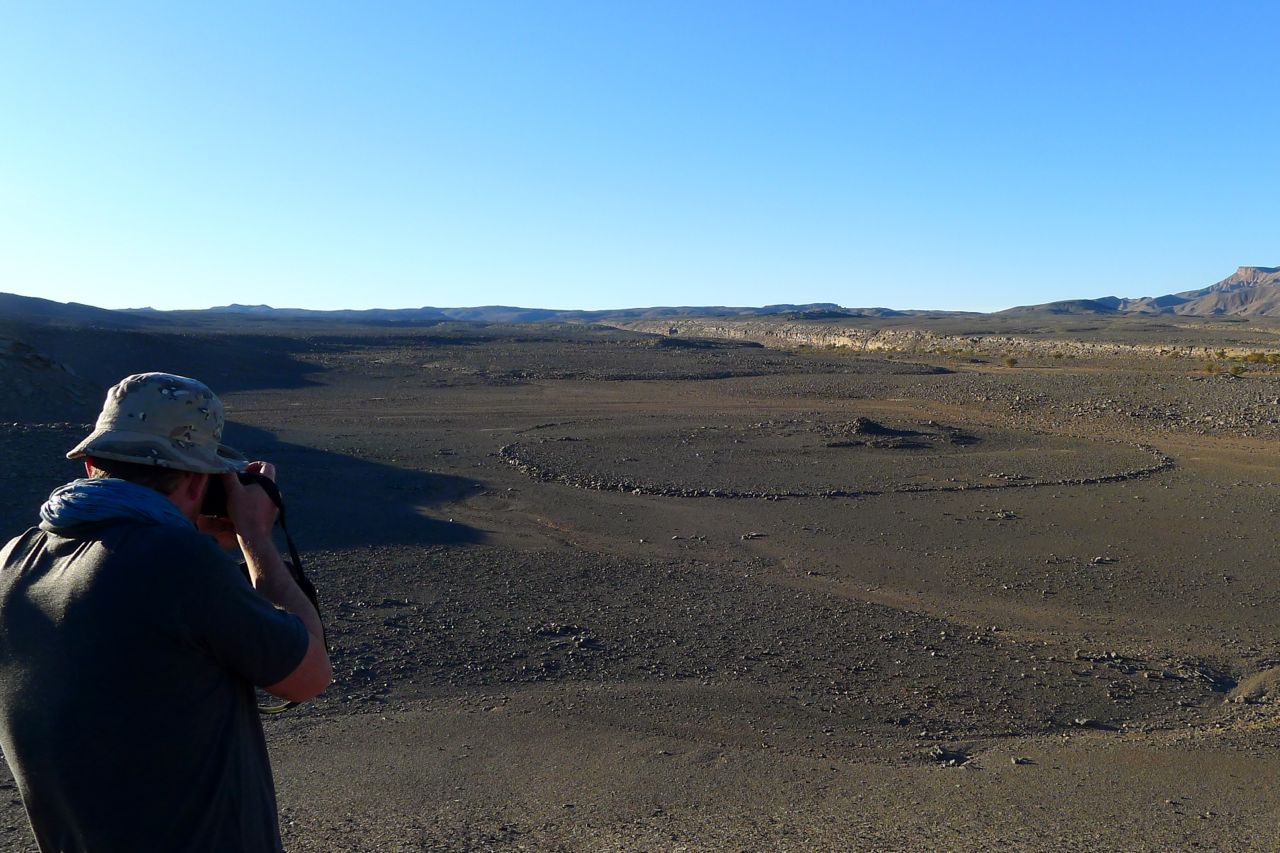
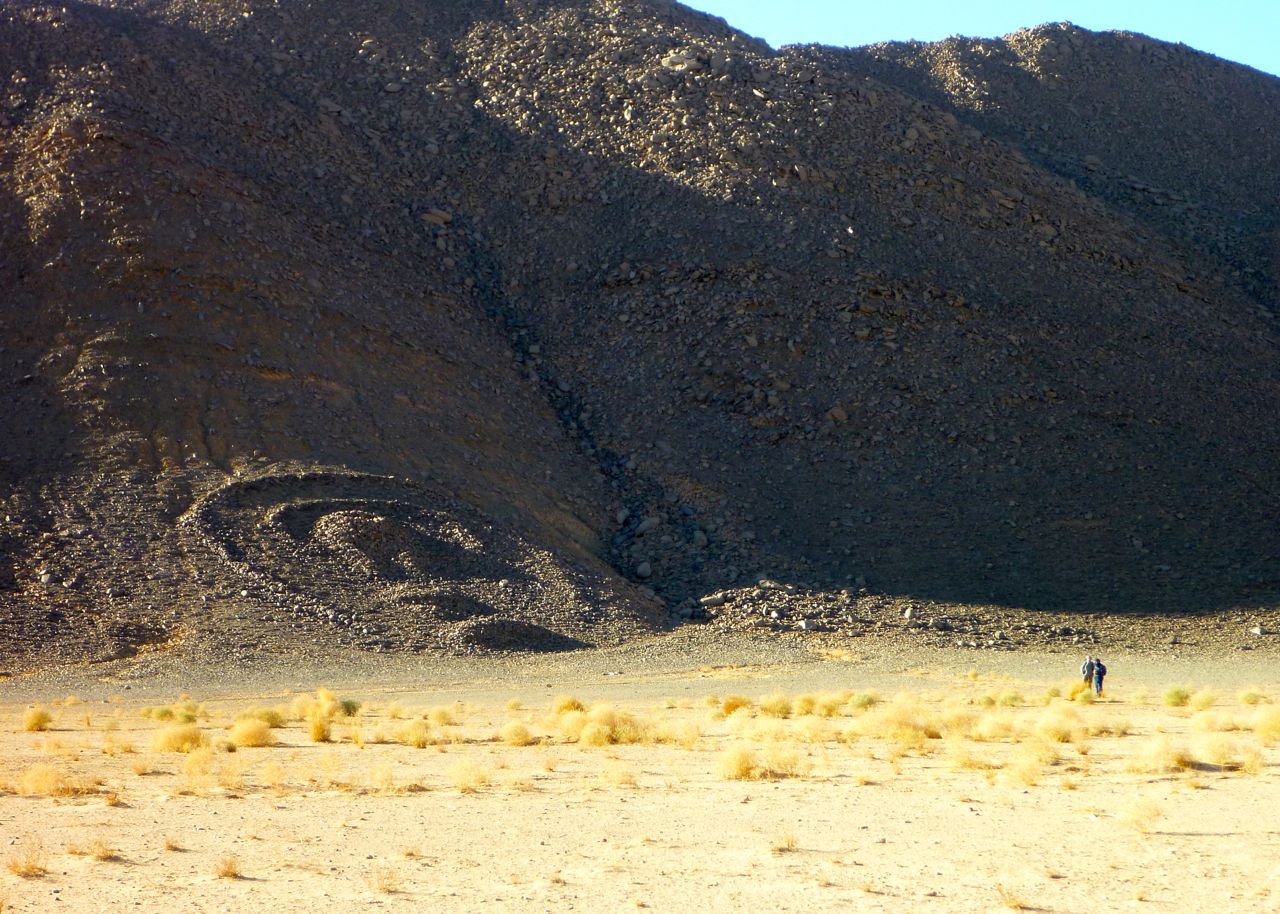
A version of the keyhole is called a goulet tomb (below; French for narrow passage, as in ‘gullet’). They have a large perimeter ring with the tomb mound on the ring’s edge and a line or corridot of stones bisecting the circle. I find these much less common.
Huge goulet tomb in the Immidir
A version I’ve read about but not seen is called the rather ill-named compass tomb which is found exclusively in the Tibesti massif of northern Chad (left). In the clearest examples like below, an arm or spike extends from the oval ring to one side, resembling a tadpole, tennis racket or snow show. As always, in the centre of the ring you will see the tomb mound.
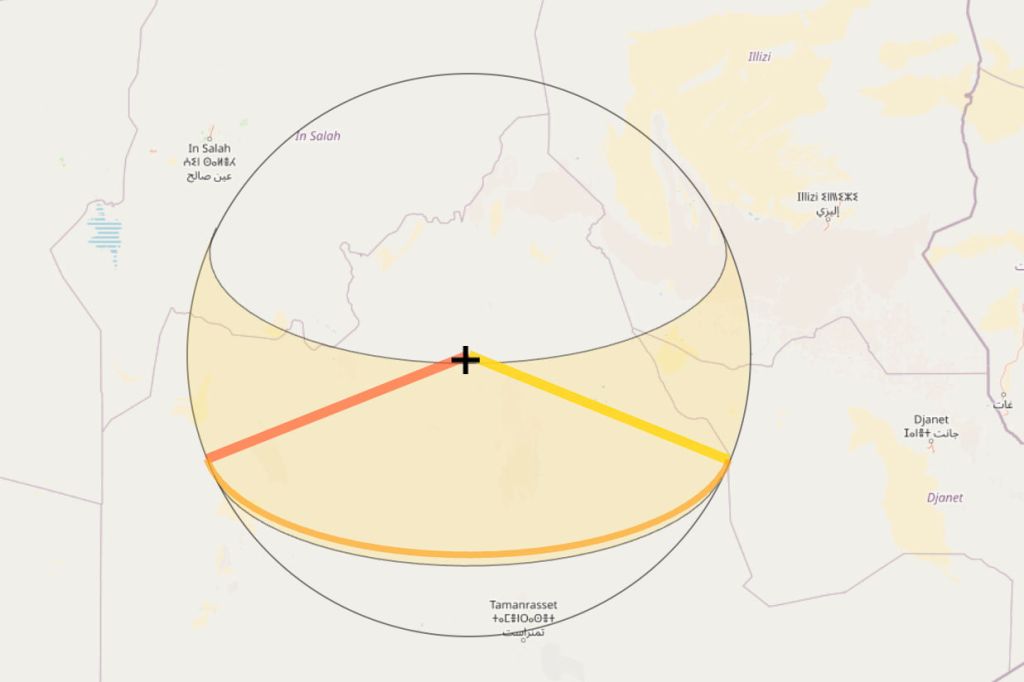
Sunrise orientation By now you may have spotted a common directional theme among the non purely circular pre-Islamic tombs: they all have orientations and elements which point at about 110° which, at these latitudes of around 25°N is towards the rising sun. Just as with many ancient, pre-monotheistic civilisations, the sun was the key element in their cosmology, with ‘the way to rising sun’ suggesting rebirth or afterlife. But just like builders, occasionally they got it wrong, like the compass tomb above right in the sands of the western Tibesti.
Sunrise and sunset points on the horizon at 25°N (Ie: much of the Sahara)
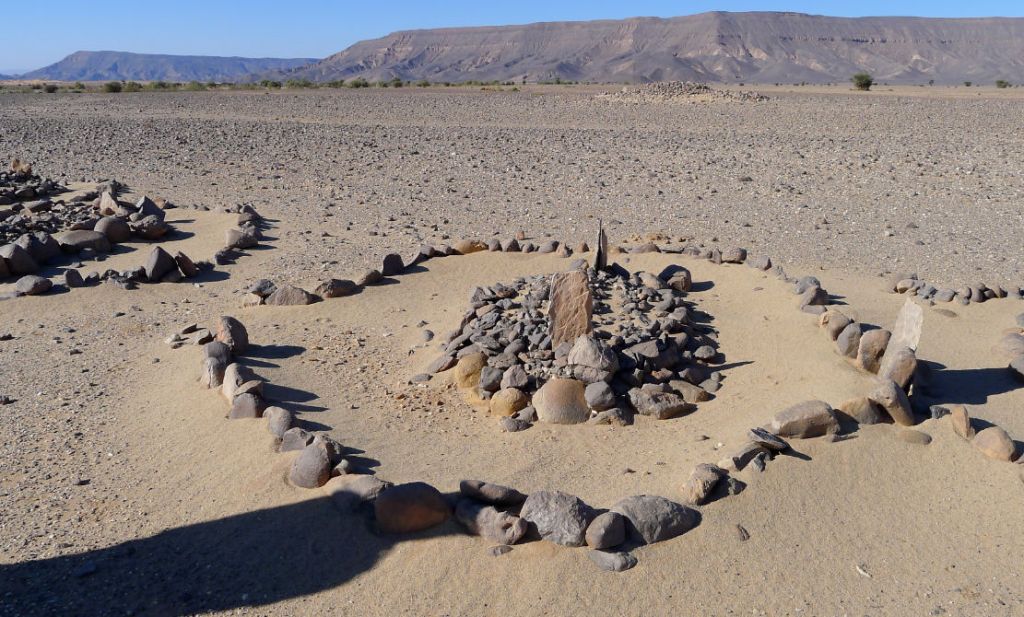
There is one final category of tomb which is also commonly foiund in the Sahara. The Islamic tomb. Contemporary Moslem cemeteries on the edge of desert towns are relative plain affairs, cleared rough ground covered in plain head stones. The ornate tombs below are out in the desert, far from the nearest village (Arak, Algeria). Usually the headstone is at the eastern end of the tomb, though of course with Islam that’s related to the direction of Mecca, not sunrise. These tombs, which might be said to have an entrance on the left and an east-pointing mihrab (‘altar’ niche) in the perimeter ring, will be a few hundred years old.
Islamic tomb
Not all pre-Islamic tombs fit the above categories. Below left, a keyhole shape but with no corridor, overlapped by a mound-ring tomb. Perhaps the corridor stones were reused for the mound-ring. Below right, a mound-ring with a perimeter mound like a goulet – a descendant’s tomb? I read here that excavated tombs in the Oued Draa of southern Morocco were more like mausolea, with a walled crypt under the stone mound where successive generations were interred. I’ve never read of a tomb being excavated like this in the Sahara, though I’m sure it must have been done, by either grave robbers, archeologists or the curious. I remember one time in the exceedingly remote Gilf Kebir, we came across a plain, desolate tomb (rare in that area) on a day-walk. Someone half-heartedly dug it up but found neither bones nor treasure. It didn’t seem like the right thing to do.
Antenna; unimpressive at ground level
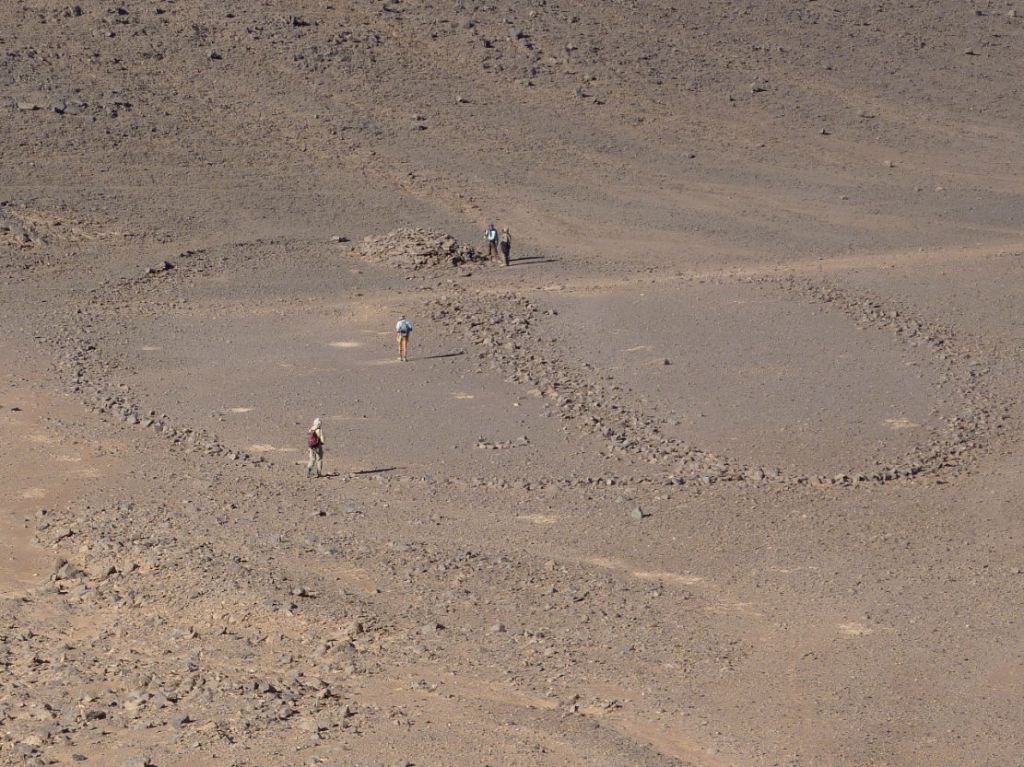
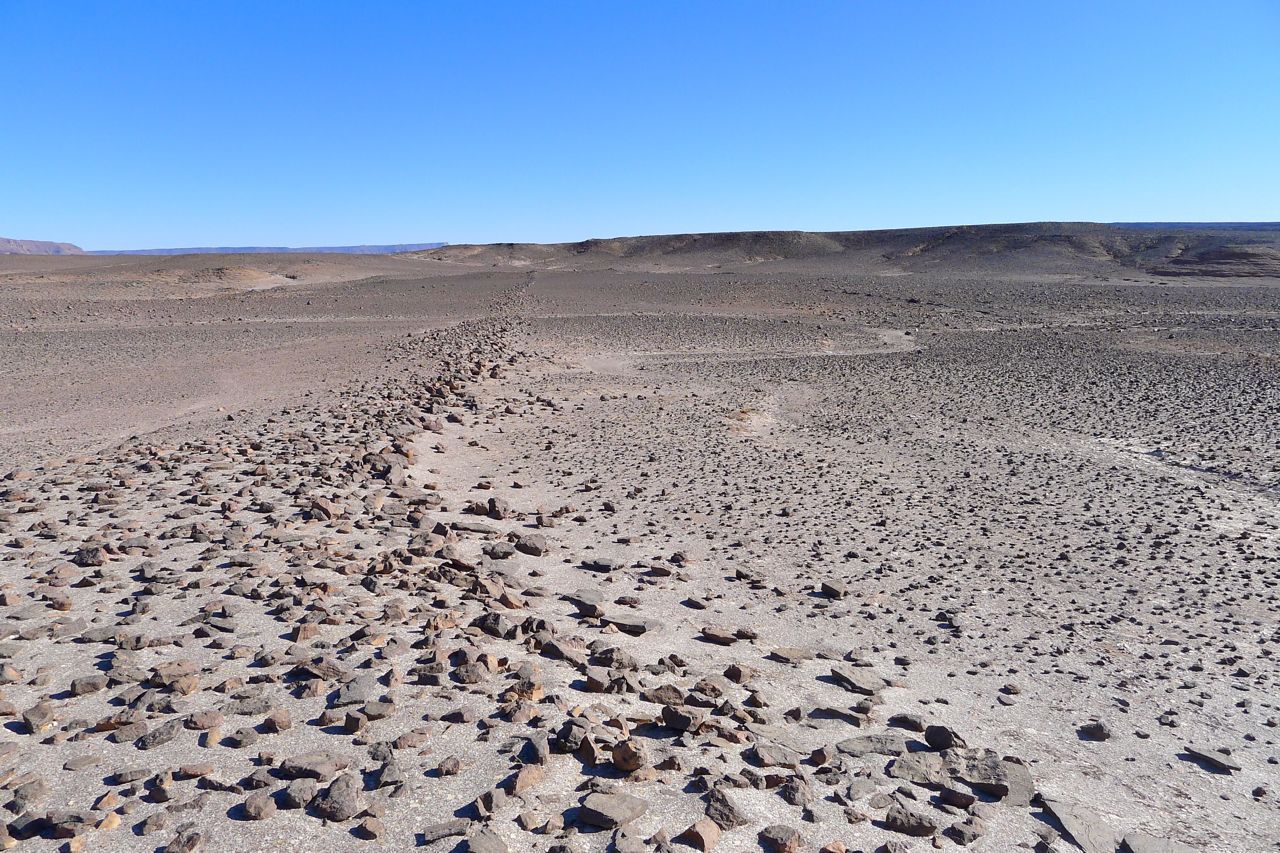
Often this fascination and excitement with pre-Islamic tombs falls a little flat on actually finding one on the desert floor. On a 2012 Immidir trip I was excited about finding a huge antenna tomb that lay close our path on Day 6 or so. On Google (above) the massive structure with a span of over 300m looked amazing, but by the time we tracked it down (left), it was too big to appreciate from ground level. My group seemed to say… ‘and the purpose if this diversion was…?’. ‘Flying’ over these tombs on satellite imagery, like Peru’s Nazca lines, is how they’re best appreciated.
How old are these ‘pre-Islamic’ tombs? Well in the central Sahara I’d say the Islamic era began to have an impact a couple of hundred years after the Arab Conquest of North Africa between AD 647–709. I imagine this swept like a tide west along the south Mediterranean coast, down the Atlantic to present-day Mauritania and then ‘eddied’ back west towards places like Timbuktu. Other eddies may have spun off sooner to places like Ghadames in Libya, following trans-Saharan trade routes into the interior.
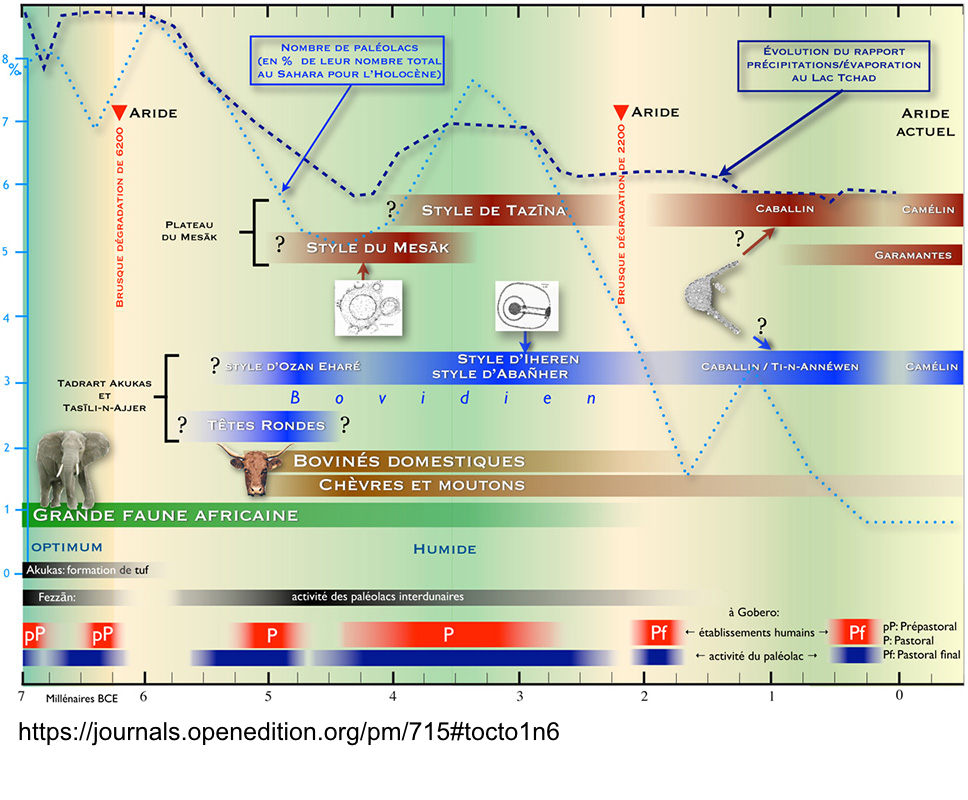
Chances are these tombs, like the huge keyhole on the right in the Immidir (above), are only around 4000 years old, maybe double that. That means they followed the apogee of rock art some 6000 years ago following a climate change (the ‘Humide’ in the image below) which briefly repopulated populated what is now the Sahara. By this time megalithic tombs and temples became widespread across the ancient world, most spectacularly in ancient Egypt and western Europe.
You don’t have to venture into the deep Sahara to see keyhole tombs. In southern Morocco, just a short distance from Erg Chebbi and three miles west of Taouz, on the west side of the Oued Ziz are a cluster of tombs. Like Aguelmam Rahla they’re situated on the edge of a plateau and by a former big river as well as an erg – and not all with entrance ways pointing east.
Below, a curious structure on the Oued Tagant valley midway between Tam and Djanet. And below that, another in the Hoggar, just southeast of Assekrem. I’ve seen these elsewhere in southern Algeria but their meaning is unknown. The guides and old Saharan expeditions just call them ‘tombs’ but they look different and newer than PIZs. More about them here.
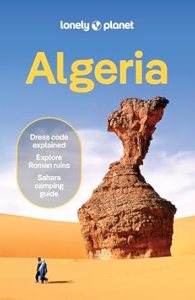
Eighteen years after the first edition (review), original author Anthony Ham returns with new co-authors to give this huge country another sweep. In that time guidebook sales have collapsed, but by all means knock yourself out online trying to collate the broad spread of information amassed here. Providing it’s done well – never an easy job, even with today’s internet resources and let alone in Algeria – this is why a pocket-sized guidebook still works. And after half a century in the business, LP have a new look which has refined the art of laying out a guidebook to be eminently ‘dippable’ while perhaps dumbing down on old-school authoritative content which made LP the leader in this field. This unimpressed poster on Trip Advisor describes the new look as ‘experience-focussed design’ but flick open any spread and you’ll be drawn to something of interest. My pros and cons below:
Great price for what you get despite the flaws listed below
Reader-friendly design
I don’t know the north, but it looks superficially well covered and interesting
Need for guided tours plus escort aggro not glossed over
Locals’ and influencers PoV and contributions a nice touch.
As before, fails to get the big picture down south
Maps are plain, many with small errors, don’t distinguish main highways from tracks (some non existent), nor show road numbers or some places referenced in the text
Couldn’t find a legend for the tiny, inscrutable map icons
Generic library photos feel disconnected from body text – as if there were two separate editors at work
Loads of repeated info/boxes (eg: Foucauld) plus a few pointless or obsolete boxes carried over too, like 153 Club
Despite apparently being in the Immidir for ‘1000s of years’ (p259), you’d think the Tuareg (pictured on the cover) would make a good two-page spread
Many place names or spellings are unknown or unrelated to long-established mapped precedents
Grumbles about sourcing ancient paper maps; so why not research/suggest an alternative for a device?
‘Bedouin’ tents/tea/etc – in Algeria?
Detailed maps of ‘Sefar plateau’ and Tadrart would be helpful to ID the many places mentioned
Insistence on amusingly alliterative headings doesn’t always work and makes what follows all the more fluffy
Odd absence of other/European sources of background, history, adventure, reading, coffee-table books and so on. Deliberate or just an oversight?
1990s civil war and resultant contemporary social issues also overlooked
Confusion about travelling with ‘… Camel or on Foot’. Despite what’s implied for Sefar (p300), ‘Camp[ing] out under Saharan skies‘ (to quote the back cover) is contingent on pack animals or a jeep. You won’t survive long in the desert without either
To people like me who’ve visited le Grand Sud dozens of times over several decades, Algeria is the Sahara and the Sahara is Algeria. Scenically, culturally and historically it’s all here in one huge, relatively safe and welcoming country. But this being an LP, the populated north (not so safe at the time of the first edition, iirc) gets the full treatment: coastal cities, Roman ruins, Kabylia and the Aures mountains and beaches. We must have beaches. The far west (Tindouf and the the way to Mauritania is not covered nor explained. Despite global tourism’s onward spread, your average Planeteer may need reminding that Algeria resembles Iran, Myanmar or North Korea in terms of visa applications and travel restrictions. Since the 2003 mass kidnappings, you need a local travel agency invite with an approved itinerary followed by chaperoning in the deep south. On a fly-in tour or in a big group, that’s not a problem and can be fun. For travellers used to independence, especially in an enticing expanse like the Sahara, it soon gets costly and frustrating, especially if lumbered with a crap tour agency crew. Dodging the agency escort rule is possible in the north (and, for a couple of years recently, in the south too), but down south there’s a good chance you’ll also get roped into pointless gendarmerie (not ‘police’) highway escorts (including protracted changeover waits), even when travelling with an approved agency. This is addressed openly and repeated often, and is what holds back Algeria’s overseas tourism potential.
What They Say Discover Algeria’s most popular experiences and best kept secrets from sandboarding or quad biking in the spectacular desert oasis of Timimoun; to exploring Tlemcen, an architectural jewel of medieval mosques and palaces; and gazing in awe at the 15,000 prehistoric petroglyphs [sic] at Tassili N’Ajjer National Park. Build a trip to remember with Lonely Planet’s Algeria travel guide:Covers: Algiers, Tipaza, Constantine, Djemila, Annaba, Timgad, Tlemcen, Oran, M’Zab Valley, Timimoun, Beni Abbès, El-Oued, Tassili N’Ajjer National Park, Assekrem, Tassili du Hoggar [not covered].
Review The guidebook is divided into into four sections. Only bold sections below were read end to end; the rest was scanned. Added up, the two Sahara chapters cover about 40% of the Guide section.
PLAN YOUR TRIP – 50pp (Highlights) THE GUIDE 230pp – Algiers – 28pp – Northeast – 42pp Algeria (Roman ruins) – Oran – 20pp – Northwest Algeria – 18pp – Central Algeria and the Grand Ergs – 44pp (Northern Sahara) – Tamanrasset, Djanet and the Sahara – 48pp (Deep south and southwest) TOOLKIT – 14pp (Travel practicalities) STORYBOOK – 14pp (Cultural background)
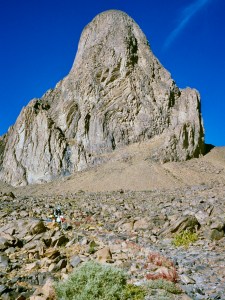
Opening the book, a striking Shutterstock image of granite monoliths (below) jumps off the Contents page and is reused here. Captioned ‘Tassili N’Ajjer NP’, it didn’t resemble the distinctive sandstone ‘tassili’ ramparts and canyons I knew. Searching online drew no answers, except for this similar image by Tom Sheppard, which I’m fairly sure is in the distinctive Tesnou region west of the TSH and miles from the Tassili NP. This isn’t the first guidebook I’ve reviewed recently that’s entirely illustrated with library photos, with authors now template-filling content providers. But as listed above, it’s common to read an evocative description and think ‘I wonder where that is or what it looks like’. The text and imagery, even the maps, often feel disconnected.
Tassili NP?
Ilmane
Upfront, Plan your Trip lays out highlights of the Guide’s five regions followed by suggested Itineraries. The northern ones look good, but what do I know? Down south ‘Into the Heart of the Atakor’ oddly suggests going from Tam up to Assekrem, then coming back 80km and back up the western approach as far as isolated Ilmane peak (left) which is just 22km west of Assekrem. It’s hard to think why this wasn’t a straightforward 200-km overnight loop via both locales, except later on the missing link is described as a ‘dangerous short-cut’ or ‘perilous clifftop traverse’. Really? There follow spreads including when to go, Ramadan, dress and manners, visiting the desert and choosing an agency (I tried a few; only two replied; usual story), the food scene, getting a visa (pre-approved VoA a staggering €365 for 30 days, vs £85 at a consulate) and the Outdoors.
Algiers kasbah
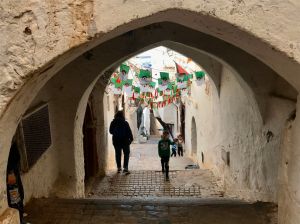
After the Guide Toolkit practicalities cover arriving, getting around, money (black market recommended, but why US dollars?), lodgings, health and safety (‘avoid Algeria’s border with ‘Western Sahara’; except there isn’t one), women travellers, language and so on. The book ends with Storybook articles which tackle a sketchy History in 15 Places rather than chronologically, a skimpy ‘Meet the Algerians’, Algiers artists, prehistoric rock art and the Algiers Casbah (left) – site of bitter independence battles in the early 1960s and now an ‘old town’ tourist attraction. Storybook would have been a perfect place to expand on the Tuareg, their enduring mystique, origins, traditions, clans, rebellions, persecution and all the rest. Libraries and the web are awash with material. Backing up to the two Saharan sections of the Guide, the Ergs and Oases looks like a pretty good account from El Oued to Taghit via Ghardaia and Timimoun. In El Oued the ‘Top Experience’ spread covering camping and quad biking in the dunes is rather reluctantly rendered, and there’s confusion about the location of the Tademait as well as Ghardaia being ‘south’ of Ouargla (it’s WNW). On p212 there’s another typical example of repetition: a column on the left talks of Convoys (escorts) while the body text alongside has a heading ‘Police escort’ – the same thing. They mean the paramilitary gendarmerie (a big difference), but where is an editor? I also get the feeling that too many of author’s subjective encounters are passed off as typical reader experiences because of a lack of actual background knowledge or context. In the meantime, it looks like I’ve long missed the boat to visit once lovely Taghit; now reduced to a dune-bashing desert resort, like Erg Chebbi, just 190km to the west. Moving on to ‘Tam, Djanet & the Sahara’, as with the previous edition it’s either one or the other with no connection between the two towns or ‘hubs’, other than proposing a flight, which if in daylight ought to be amazing. As mentioned above, the suggested convoluted itinerary into the Atakor (Assekrem) seems odd, and is there really a place called ‘Guelta’ near Terhenanet? Maybe authors no longer get to check finished proofs. And you’d think the beautiful Tazrouk loop out of Tam, let alone the N55 to Djanet would’ve been a great desert itinerary too. Meanwhile, the distinctive Tefedest and Arak Gorge (marked earlier on the ‘Action Areas’ map as an ‘extreme adventure’ locale) share a sentence, then don’t get another word. In Salah turns into a masterful exercise in padding – another sunset dune venue (yawn), while dodging actual POIs, scant though they are. It may only be listed to pitch as a hub to visit the nearby Immidir (below), by which time the author is definitely winging it in full flow. One person can’t be expected to visit every amazing corner of the desert, so why not track down contributors to fill the gaps? In Djanet the famous Tassili plateau walk is listed and illustrated with stock images of the best known places, but doesn’t seem like it was actually done. The now over popular Tadrart (Oued In Djerane canyon, not ‘plateau’) may have been visited – maps for here and the plateau rock art walks would help readers visualise these regions. After that it seems the author was taken on a random drive to Tasset on the Fanoun (no mention of amazing Afara round the corner) followed continuation to dead-end Ifni, of all places. Around here I realised there was not a single image nor mention of the massive megalithic pre-Islamic tombs (below) which you drive right past in these areas.
Pre-Islamic tombs
In the face of hotel booking websites, the formerly tedious job of researching the best lodgings for the reader has been revised down to a quick handful of ‘Places we Love to Stay’, even in the north where you might wander unchaperoned and value curated suggestions. There are only eight in the entire South – three a-piece in Djanet and Tam where the old town centre Hotel Tinhinan is described as a right dump. Thanks for the tip: in five seconds great alternatives where I would love to stay spring up on Google.
Box canyon behind Arak, southern Immidir
In the end the desert south reads too much like a quick update to the first edition which itself was skimpy. A night in In Salah, a couple in Tam ticking off Assekrem, with a bit more time rightly spent in the Djanet area. No serious attempt has been made to get under this amazing region’s skin. That’s a shame but may be the reality of today’s budget-constrained guidebook research and production. To be fair that’s also reflected in the book’s price where you’ll still find 15 quids’ worth (or less on amazon) of ideas and inspiration between the covers.
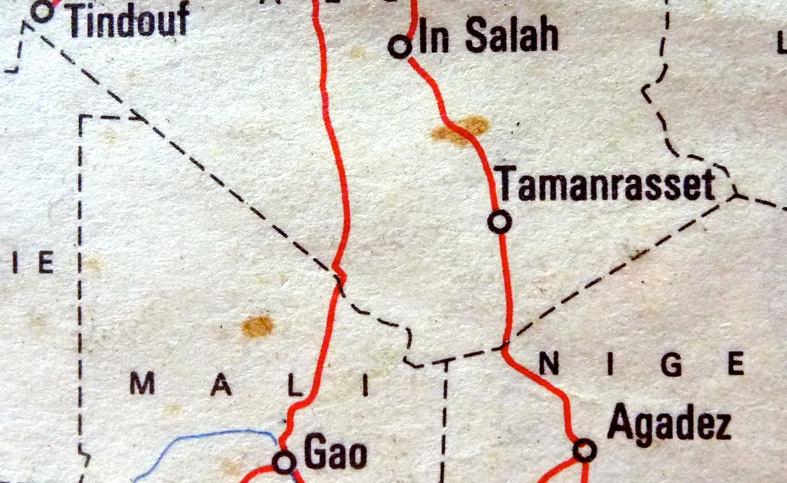
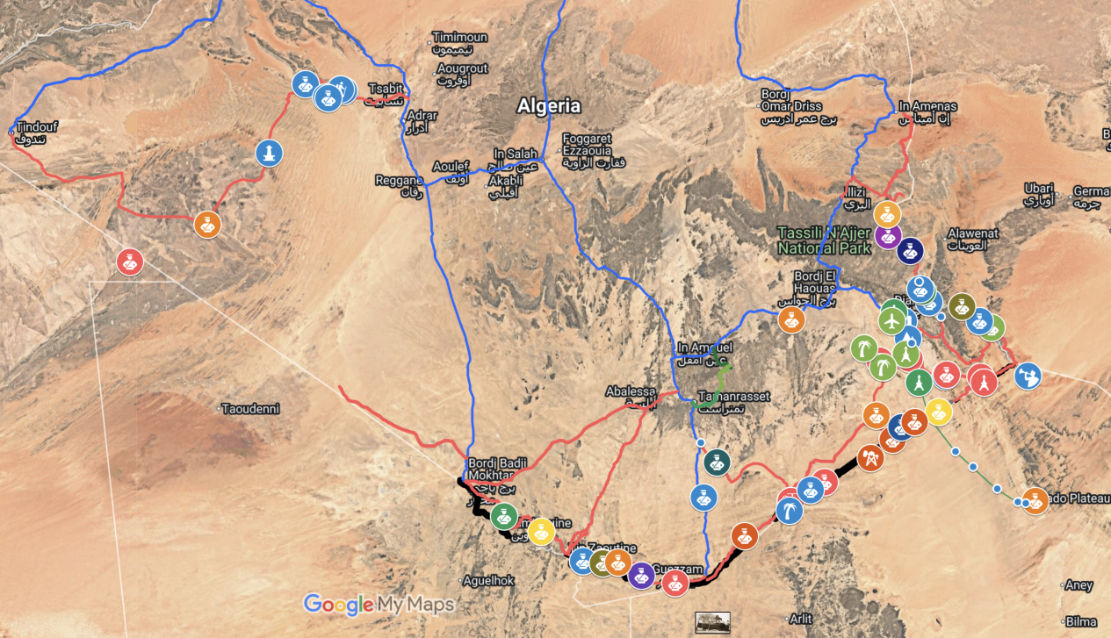
Over the span of some 2300km, along Algeria’s southern perimetre two largely straight lines (below) radiate northwest to Tindouf and northeast to the Salvador-Anai border tripoint. They mark Algeria’s desert frontier with Mali and Niger. For decades as porous as a string vest, they’re crossed by the original trans Sahara routes established at the dawn of the motor car era in the 1920s: the Trans-Sahara Highway from Algiers via Tamanrasset to Agadez in Niger, and the more desolate Tanezrouft from Reggane via Tessalit to Gao in Mali (below). Both are now largely sealed in Algeria but for years have been off limits to travellers.
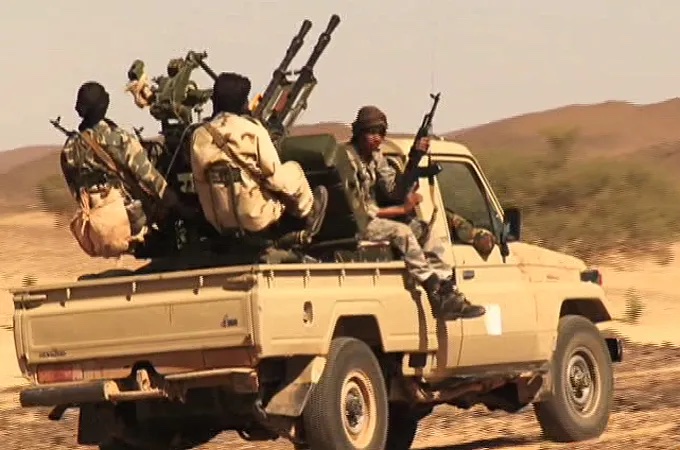
In 2011 the already dangerous Sahara was further unsettled as Gaddafi’s regime collapsed, and militias raided arms depots across Libya. Much of that weaponry flowed west across the desert to northern Mali, long controlled by Islamist insurgents (left) or Tuareg separatists.
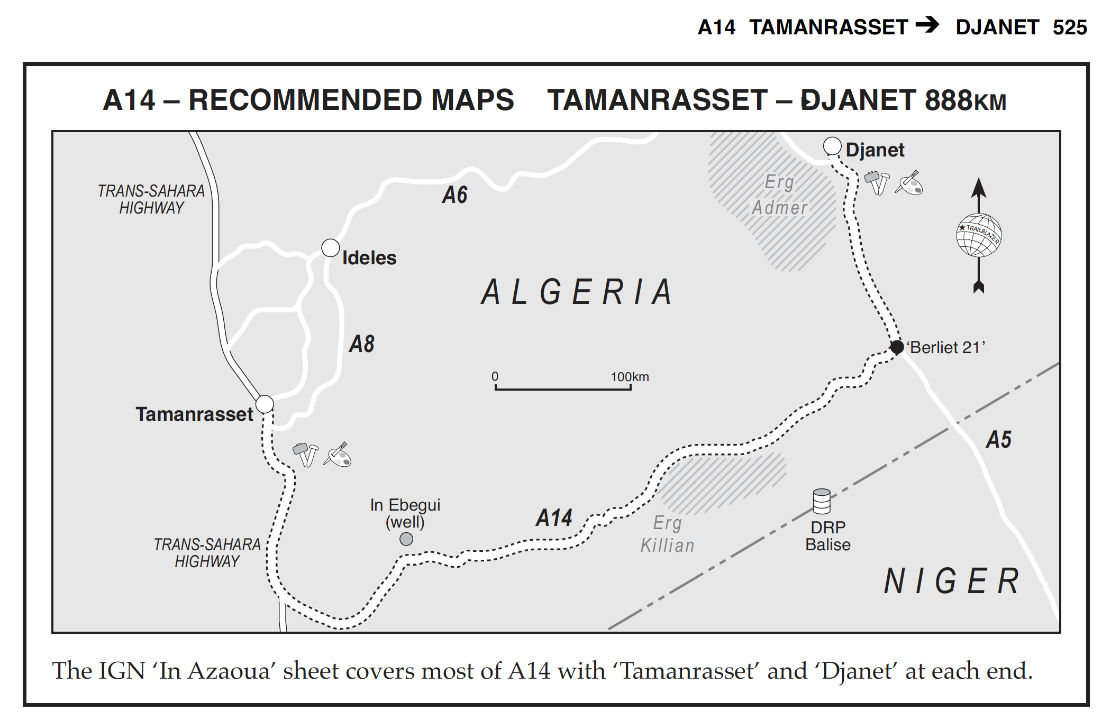
The quickest route was across southern Algeria, because south of the well-used road between Tam and Djanet, the 200 kilometre band of desert to the unmarked Niger border was entirely unpopulated but easily navigable. Even when we did Route A14 (left) in the early 2000s, we were surprised how well developed and even corrugated parts of this obscure track was. At that time Algeria had its own smuggling networks running between Mali and Niger, but come 2011 had nothing to gain and much to lose from the added instability brought about by the redistribution of Libyan arms. These days controlling the flow of sub-Saharan migrants is probably the bigger concern. In Algeria most come up from Niger around In Guezzam (TSH) or the Chirfa piste (route A3 from the book), and are openly seen walking along the road or wrapped under a speeding pickup tray’s sheet, on the TSH north of Tam, or hanging out in Bordj el Haouas bound for the Fadnoun plateau on the N3, before being rounded up and deported en masse at In Guezzam. I remember way back in 2002 encountering what I later realised where dumped migrants on the Fadnoun, an hour south of Illizi, and later sharing the cliff path climb with others on the ascent to Jabbaren. For migrants this was a short-cut to Ghat in Libya and – long before the advent of Med boat crossings – the possibility of work there.
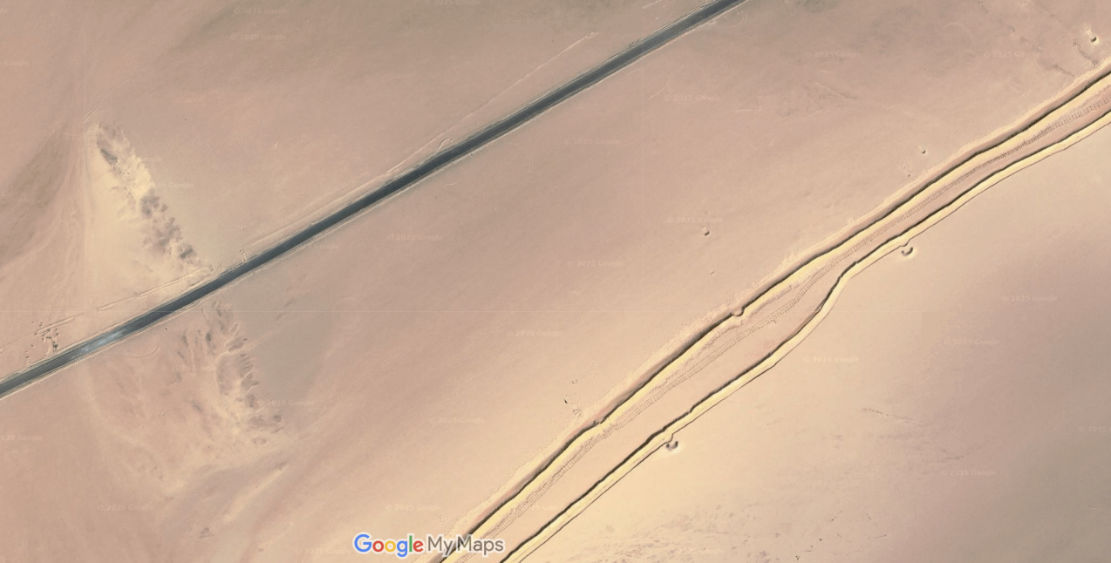
Berm and patrol road, alongside the Niger border in the northern Tenere close to the Chirfa piste.
The answer to the latter has been an attempt to seal the exposed southern border with a series of double berms (car-blocking sand ridges; above) filling out the long gaps between impassable natural topography. This is just what Morocco did in the Western Sahara decades ago to define a de facto border with the PFZ, and what Algeria has also done along its Moroccan border to reduce illicit traffic.
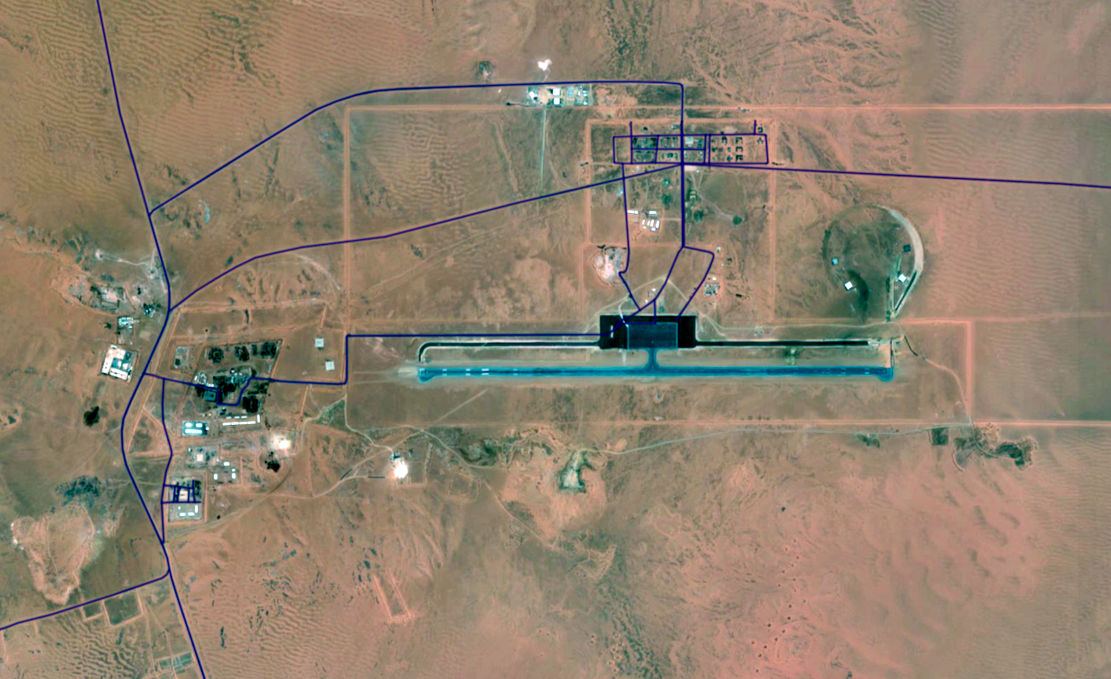
These efforts may be funded by the EU or other agencies and the berms (part-mapped below, in black) are backed up by new military access- and patrol roads (red, below), all linking scores of bases, some with huge runways (above) in the middle of nowhere. They run near continuously from the In Amenas oil producing area south of Ghadames in Libya, all the way round to Bordj Moktar and beyond. West of there towards Chenachen or Tindouf, the Erg Chech acts as a natural berm.
Berm in black. National highways blue. Border patrol roads in red. Not all roads and places shown. ‘Bases’ may be other, non-military installations.
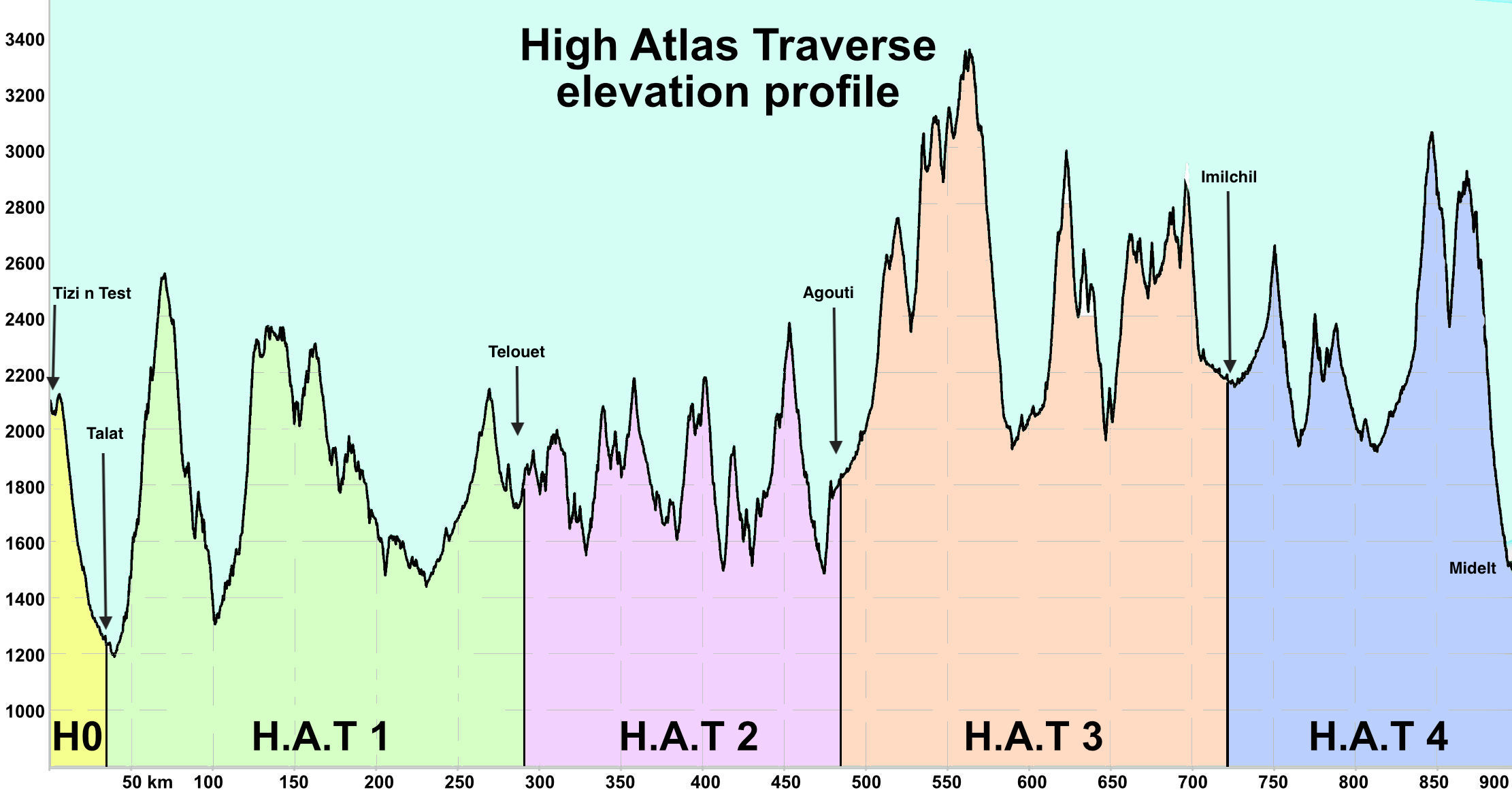
The 900km High Atlas Traverse is now online with the maop getting 1000 views a day. Download the gpx files at the link above. The H.A.T is like the TMT: quiet backroads and mostly easy trails – but it follows the mountain watershed via the highest motorable passes. Only about 15% overlaps the TMT and it reaches up to 3340 metres (nearly 11,000′) and permanently stays above 1500m from Stage 1 onwards. Bigger bikes and longer vehicles may struggle on some of the climbs. More on the link above and some pics from our recce below.
ScreenshotTime to leave the mothershipH0 near the TestH1 out of IjoukakH1 Coming into AbdallaFuel and coffee break in Aguim (H1)Way above the tree line on H3H3 Zerkane crossingSimon gets mobbed by his TikTok fansH3 The trail sweeps down into DadesHighest through trail in MoroccoH1 Ait QallaCafe Louta in TilmiH3 Hidden valley on the Zerkane crossingA shot of v-fuel in AnerguiTilmiH2 Looking down on the old Demnate road2963mH2 Lunch on the Demnate roadJob done. Enjoy the H.A.T!H3 Leaving Ism Souk for the high crossingOver the OuanoChilly auberge near Bou AzmouImilchil, start of H4H3 First 3000-m colH1 Jebel RhatRoad finished east of ZerkaneLast few chilly miles to Bou AzmouH3 The high trail goes on for 65kmBob & a mosqueTTR still breathing at 11,000′H1 near TiliwineH1 Ait Qalla plateauH0, KM0. The H.A.T lays before usH3 Breather on the Zerkane colH3 Nearing the Zerkane col
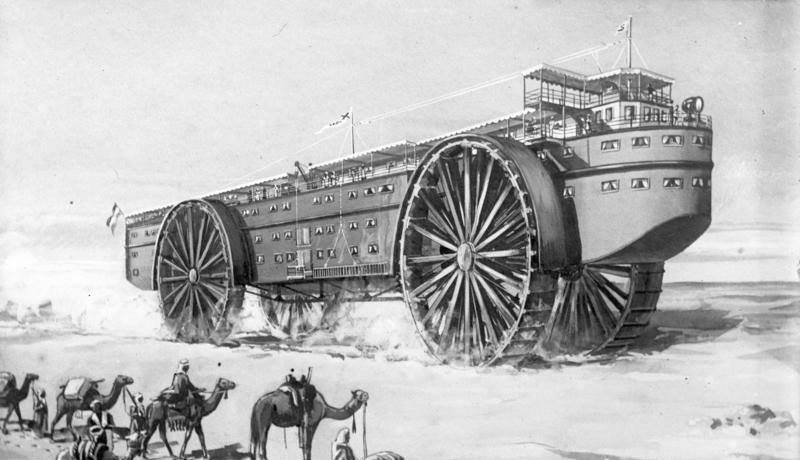
For centuries camels were the way to go in the Sahara. Introduced from Arabia around 0AD, they proved to be ideally adapted to transporting heavy loads without needing water (providing they was daily herbage or straw). A couple of centuries ago huge caravans numbering thousands of camels would transport salt, slaces or sold from the souks of the Sahel. Today, camelling is still a satisfying way to travel in the desert. You don’t ride; the camels carry all the provisions. But besides the obvious motos, 4x4s and aircraft, here are some other ways people have chosen to cross the great Sahara.
Steam Powered Landship
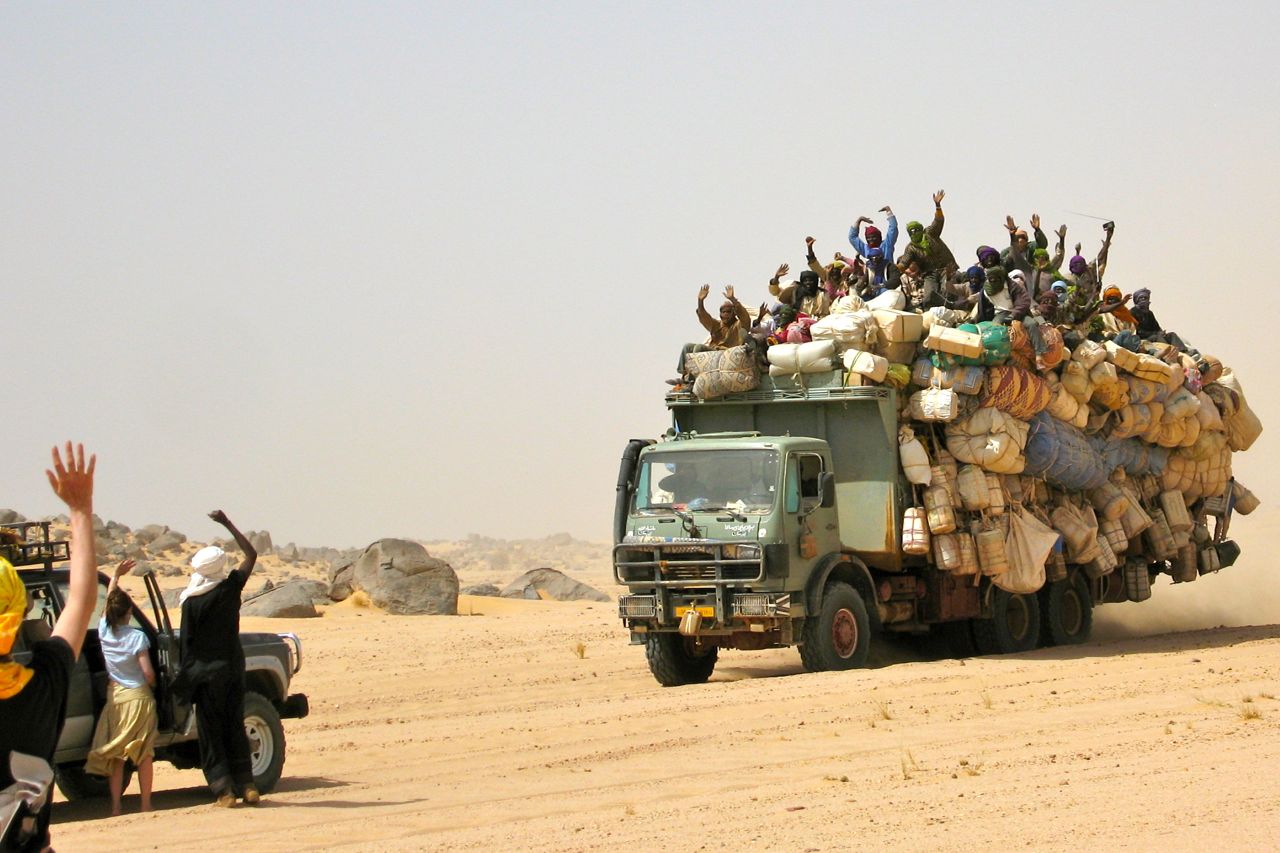
Gros porteur heading back to Agadez
In the Edwardian era of luxurious, steam powered ocean liners, why not a desert liner to tame the vast sand oceans of Sahara? Like something from a Jules Verne novel, giant traction wheels would glide over the sands while desert tribesmen looked on in awe. This one never got beyond the drawing board, but today massively overloaded gros porteurs (left) from the pre-electronic 1980s diesel apogee still grind across the desert sands.
Sauterelle Propeller Car
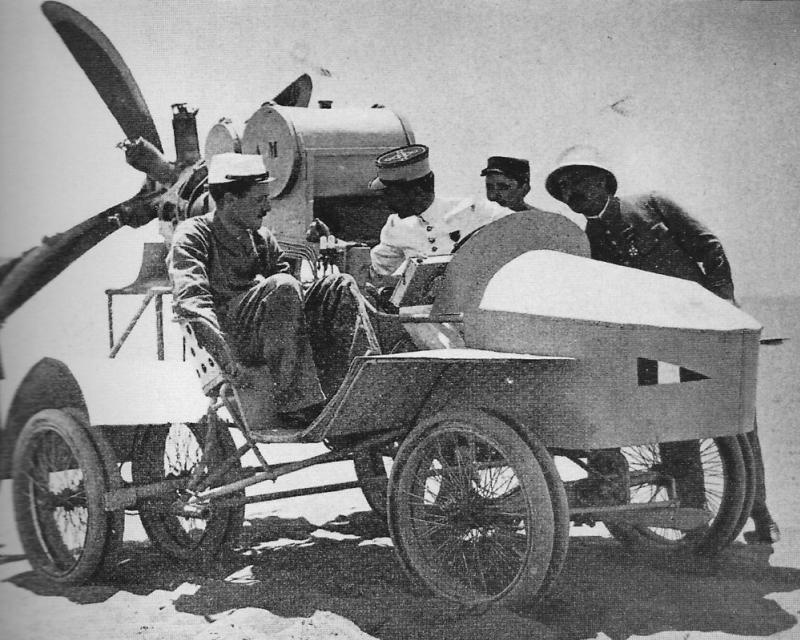
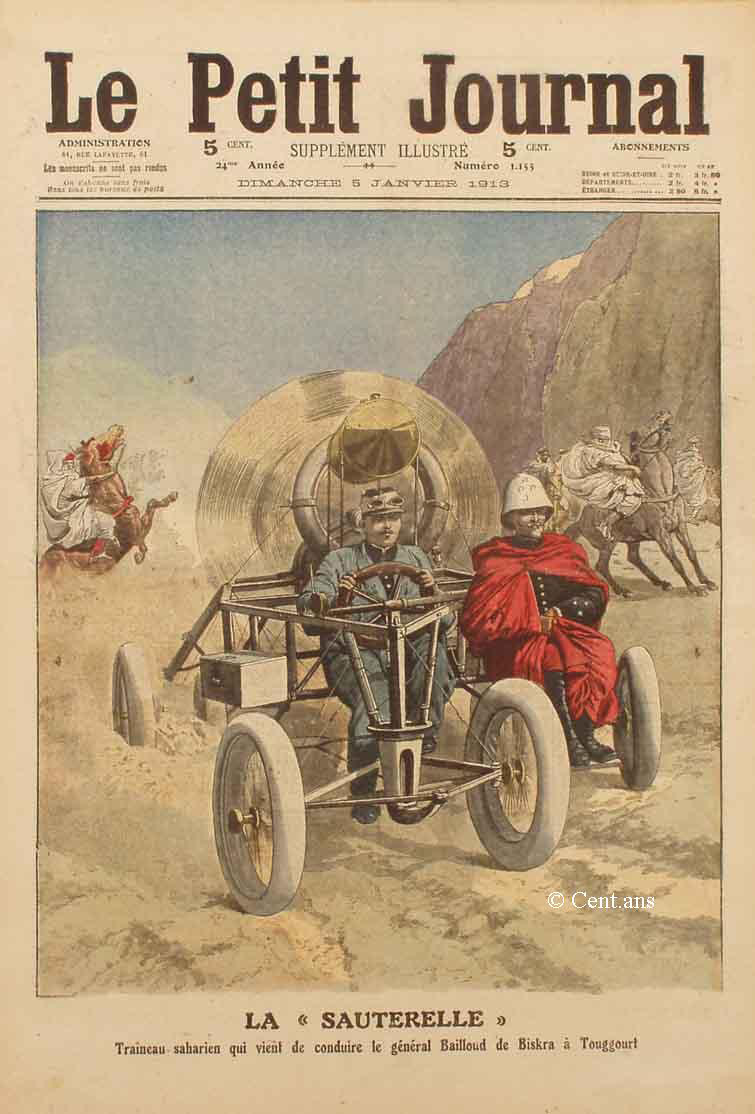
With the advent of the gasoline-powered motorised cart, or ‘car’ for short, traction in the desert sand was the problem with early, low-powered and inefficient engines. Those new fangled flying machines never this issue, so how hard can it be to combine the two? Behold the wingless, deafening wonder known as the Sauterelle propeller car of 1912 which could literally put the wind up you. Nicknamed the ‘mobile guillotine’ (not really ;-) it was tested near Ouargla and never heard of again. Read more here.
Citroen Half Tracks & Renault Type MH ‘Douze-Pneus’
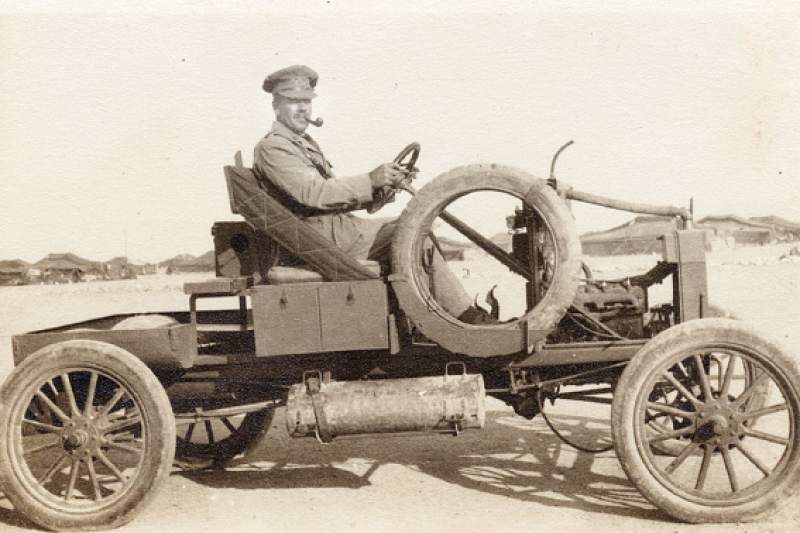
Motor cars were catching on but traction in the desert remained a problem. During WW1 the Brits under Pat Clayton adapted ultra light, 2WD Model T Fords for the Light Car Patrols in Egypt (left). Desert adventurer Ralph Bagnold used these Fords to travel deep into the hitherto unexplored Libyan Desert.
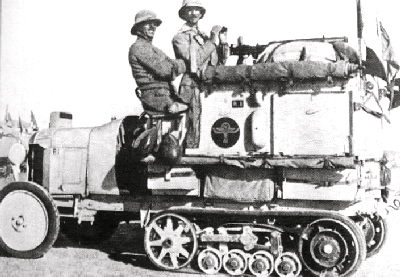
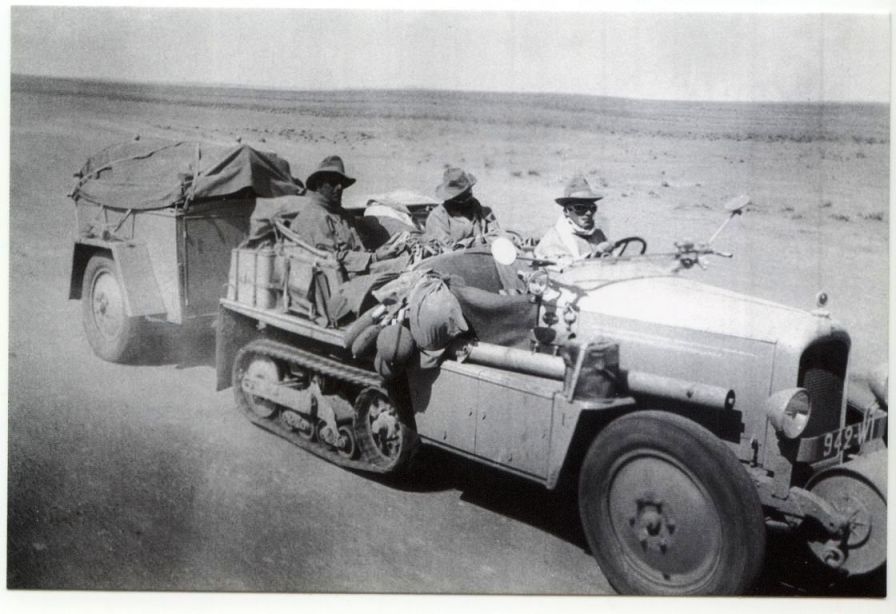
Around this time Citroen were the first to cross the great desert via the largely flat but very long Tanezrouft Piste in a vehicle fitted with ‘autochenille’ or Kegresse half=tracks (below). Very slow but not as noisy or deadly as la Sauterelle, they crawled across the desert and were used by Prince Kemal el Din (left) to ‘discover’ the lost plateau of the Gilf Kebir in southwestern Egypt.
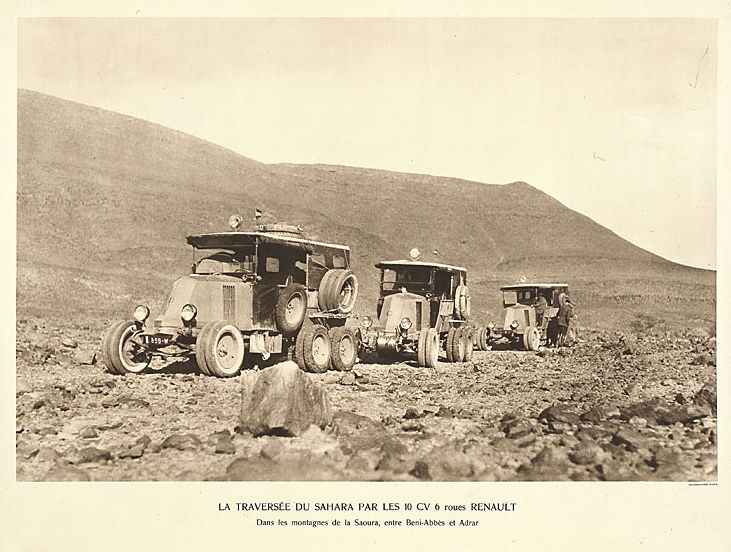
Competitor Renault’s solution to the traction problem was the 6×4 10CV Type MH featuring doubled wheels rubber and twin rear axles. Nicknamed ‘le douze pneus‘ (not really ;-), Renault trounced Citroen’s trans Sahara expedition of 1922 with a full, 23,000-mile trans Africa in 1925, the first cars to cross the continent.
Sand Yachts
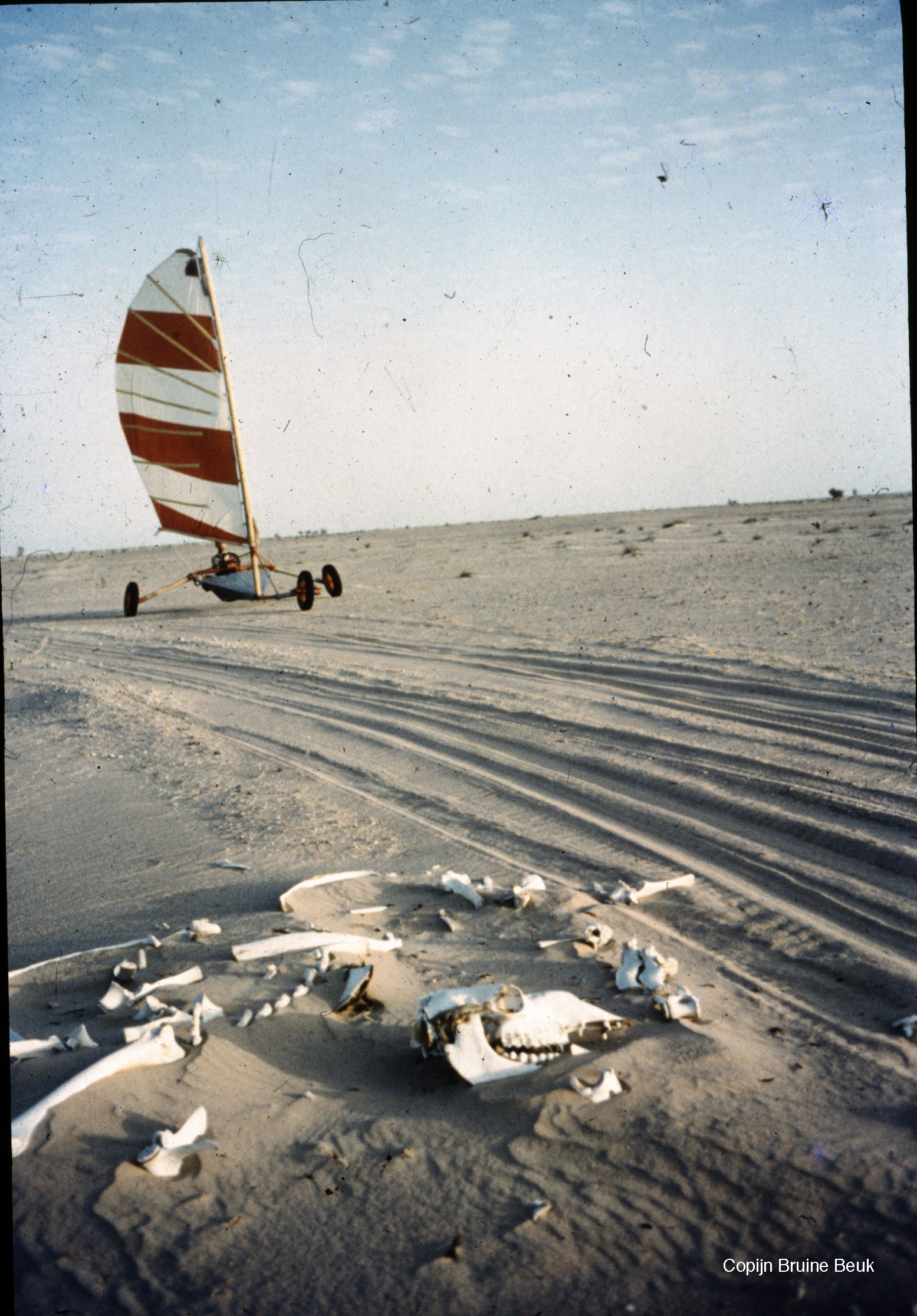
You got wind, you got sand, so why not Sand Yacht across the Sahara to Mauritania? Full story.
Chinese Wind Barrow
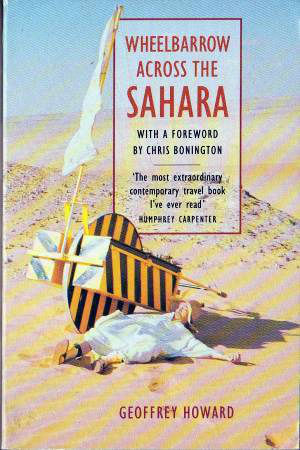
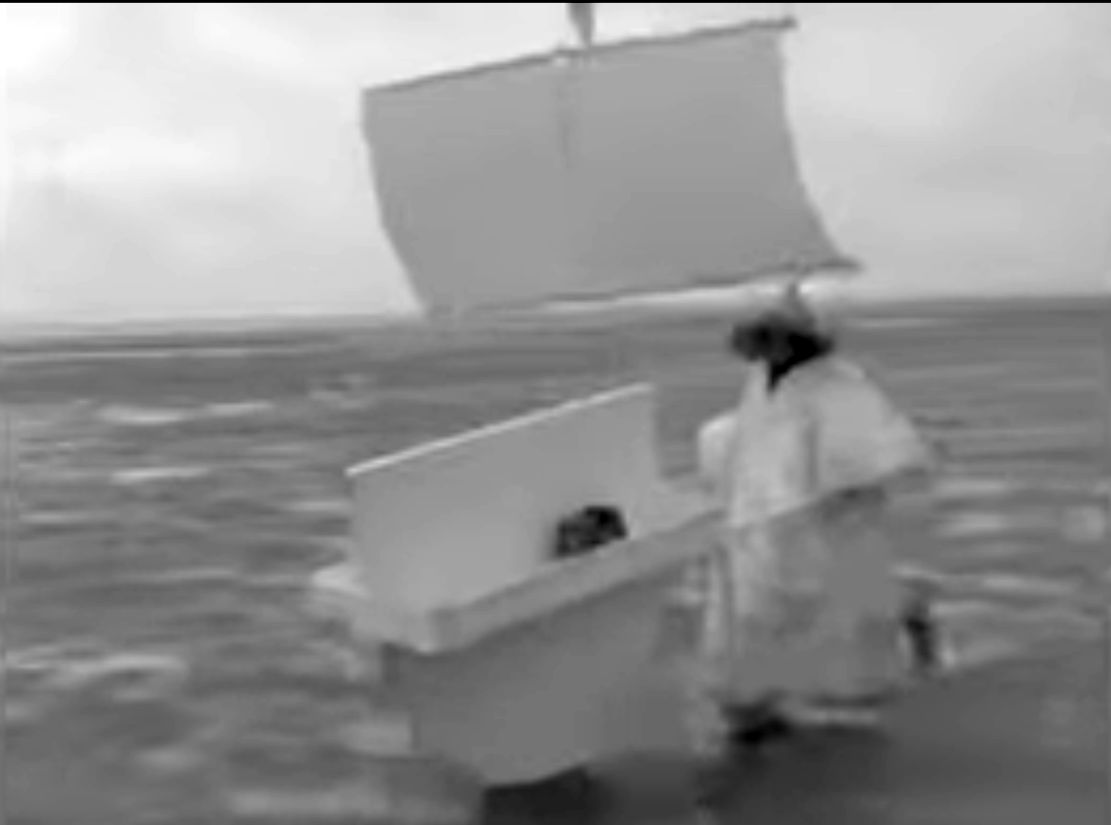
Regular family cars like Morris Oxfords were now commonly used to cross the Sahara (sometimes ending in tragedy), so lorry manufacturers among others, undertook costly, promotional but essentially pointless Sahara west to east expeditions. People were running out of stunts to stage in the Sahara until 1974 when priest Geoffrey Howard came up with a new angle that sounded like a lost sketch from Monty Python. Lately back from volunteering in Nigeria with his wife, he had a Chinese sailing wheelbarrow built, then set off to cross the Sahara ‘unaided’ from Beni Abbes to Kano, raising money for the poor while also positing a new means for locals to transport their goods (not unlike the initial motivation of the 1980s Africar project). As one reviewer observes: ‘That he was assisted by two British soldiers … in a Land Rover and accompanied him most of the way makes it sound easier – but this was a safety consideration, and he made his own complex rules about how and when they could assist.’
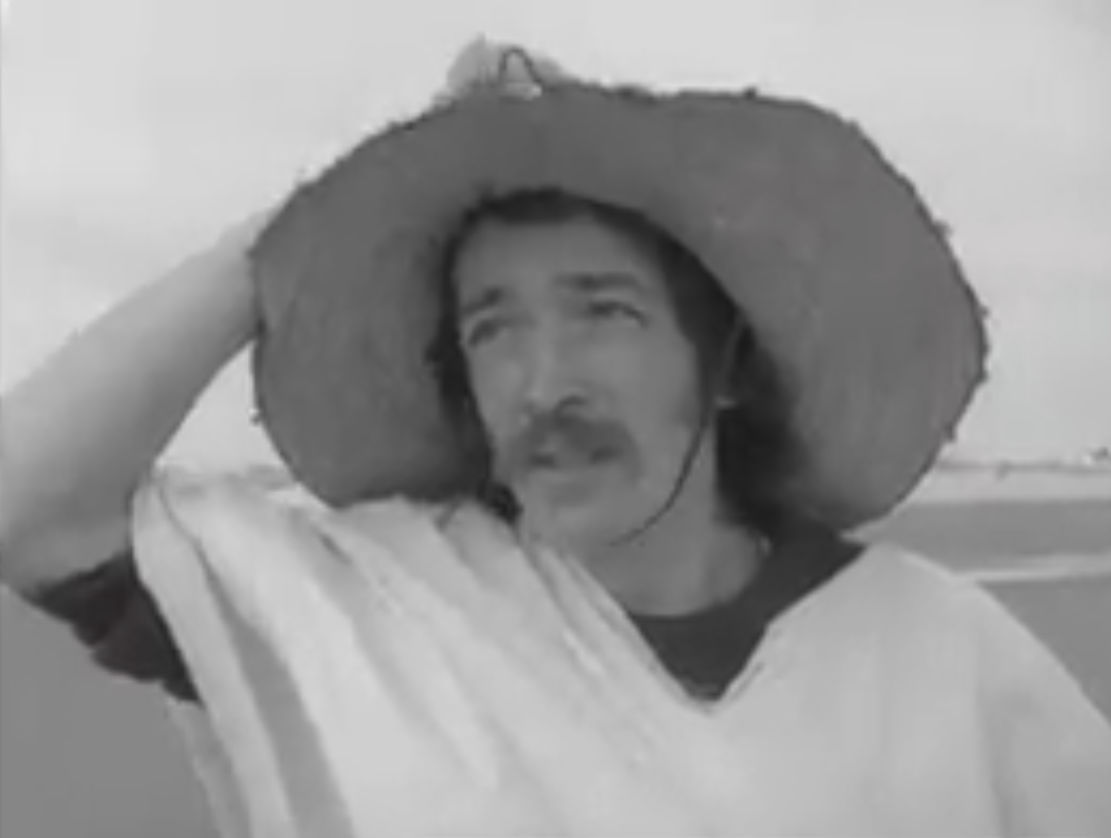
National mountaineering treasure Chris Bonington contributed a harsh foreword: ‘Not much of an adventure’ I thought, ‘pushing this ridiculous wheelbarrow along a well travelled road or track with a [support] Land Rover in constant attendance.’ You’d hope that line is followed by ‘… but Howard’s monumental endeavour changed the face of human powered adventuring…” or some such. I can’t recall, but do remember similar conclusions to CB on reading the book decades ago: a silly stunt that turned into an endurance test. The sail idea soon proved useless so he had to resort to pushing the barrow for the three-month, 2000-mile crossing in his flapping get up. There’s some grainy archive film on the BBC of a lightly mocking Bob Wellings (remember him?) interviewing Rev. Howard training on Morecombe Sands in full costume. He ends with ‘I have no fears whatsoever’ The 1990 book is easily found online, new or used.
Three wheel- 2WD FatBike
A regular bicycle will struggle on the piste to carry more than a couple of days of water. One answer: Jean Naud’s 2WD, three-wheeled fatbike replicating the multi-tyred Renaults of yore. And like a modern lorry, to reduce the pedalling effort, one axle on Naud’s contraption could be lifted and disengaged (left) when payloads dropped or the terrain allowed. It worked too, he crossed the Sahara twice on fat bikes. Read more.
Microlight
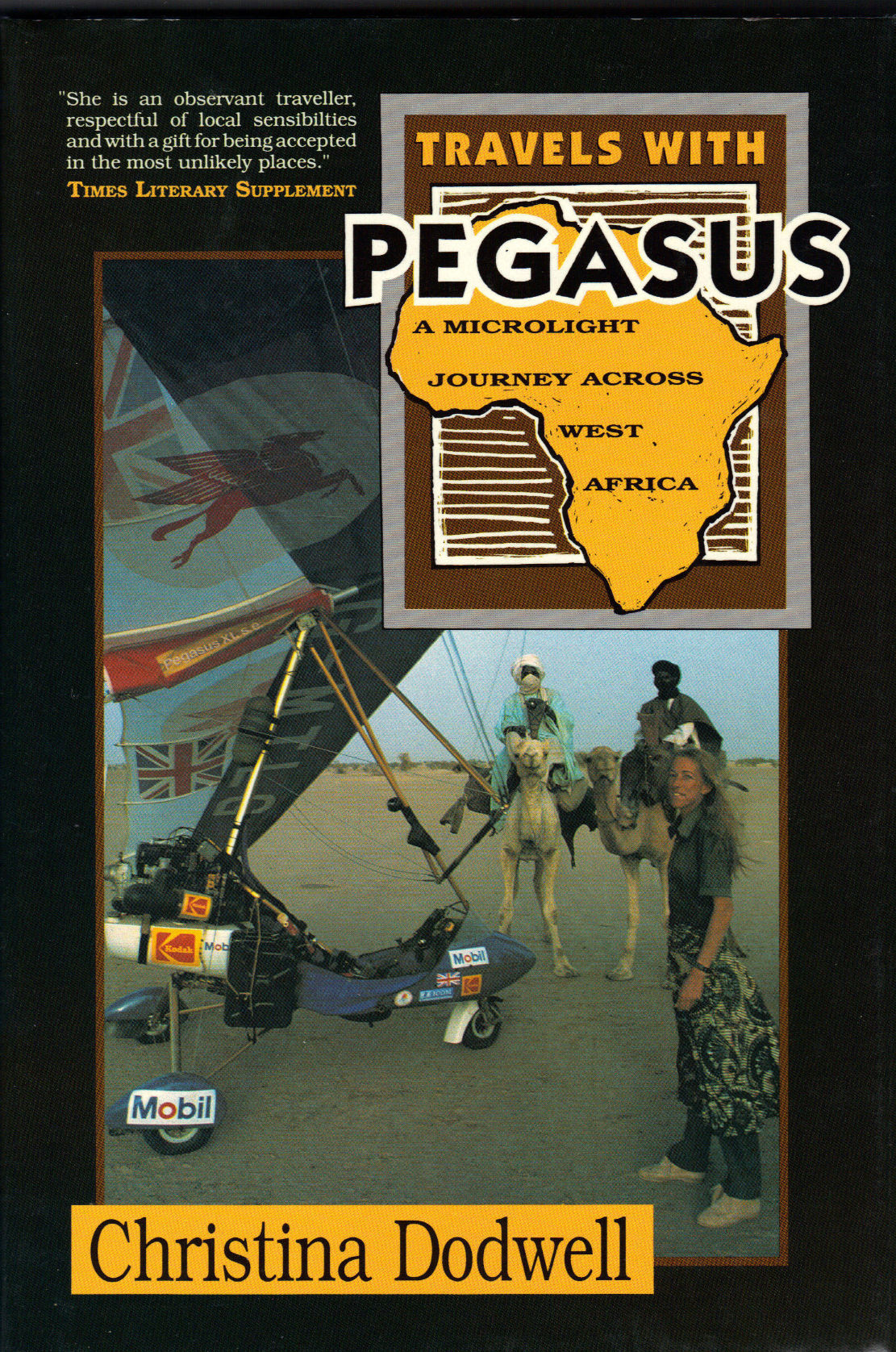
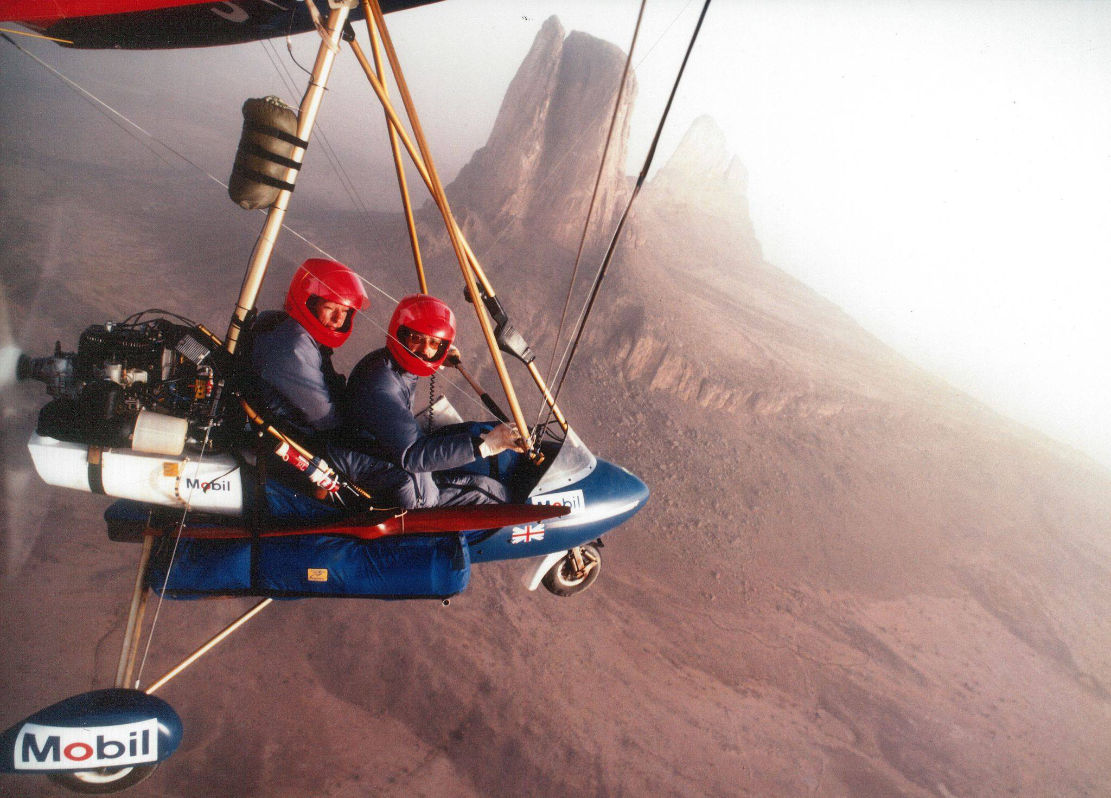
In 1988 prolific adventure travel writer Christina Dodwell teamed up with experienced microlight pilot David Young (recently back from a close shave in Nepal) to fly 7000 miles in a Pagasus XL from Cameroon to the Atlantic in what was still the pioneering era of microlighting. I knew of it but never read this one; it’s not a trans-Sahara, more of a Sahel traverse via the Aïr mountains and Timbuktu. From the back cover map it looks like they followed roads and main tracks for navigation, maybe due to range and landing issues. Luckily they didn’t do an Icarus and all ended well in Dakar four months later. There’s a book of course (right), one of Dodwell’s many which is widely available online.
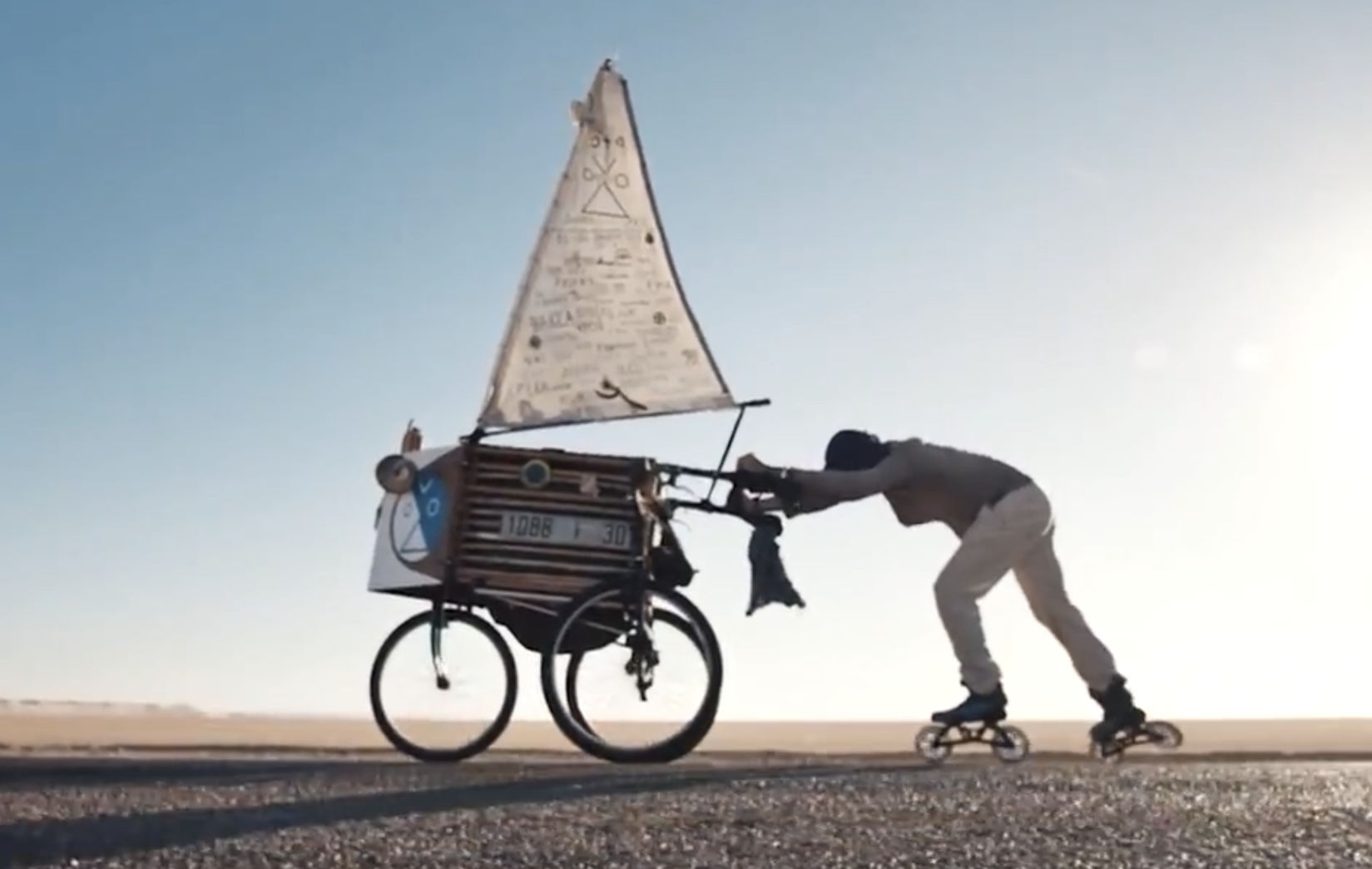
With the 21st century bringing a choice of no less than three asphalt roads spanning the Sahara at 1500-mile intervals, it was time for the rollerblade (or ‘inline skate’) and the humble push-cart sail-tricycle to have their day in the sun. It’s what rollerblades and bitumen were made for. Five thousand clicks from Spain to Dakar, watch Mark Heuss’ cool short film below.
Did I miss any other batty trans Sahara crossings?