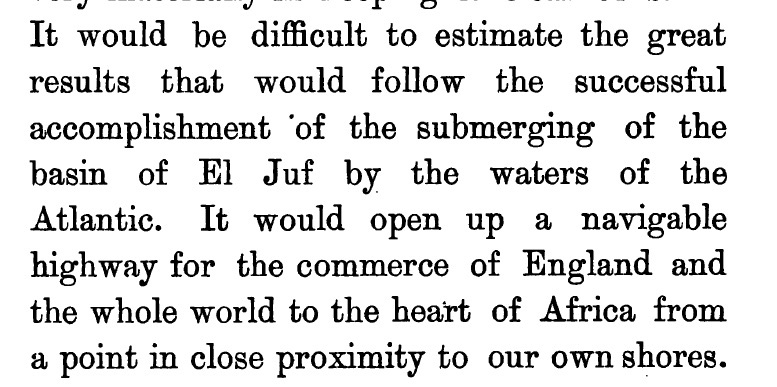
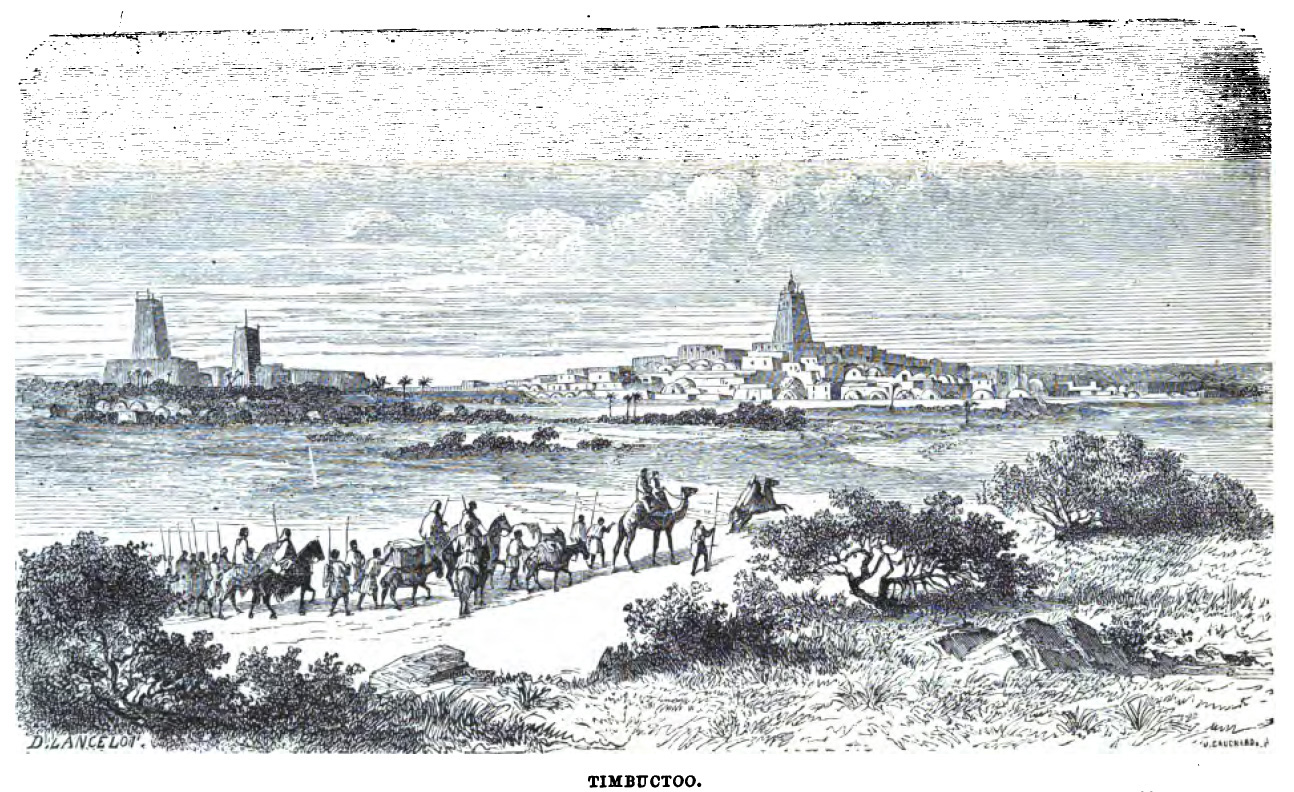
… I had reason to believe that there existed, in the Western Sahara, a vast depression which might be submerged by the waters of the Atlantic, thus opening a navigable way to [Timbuktu]…
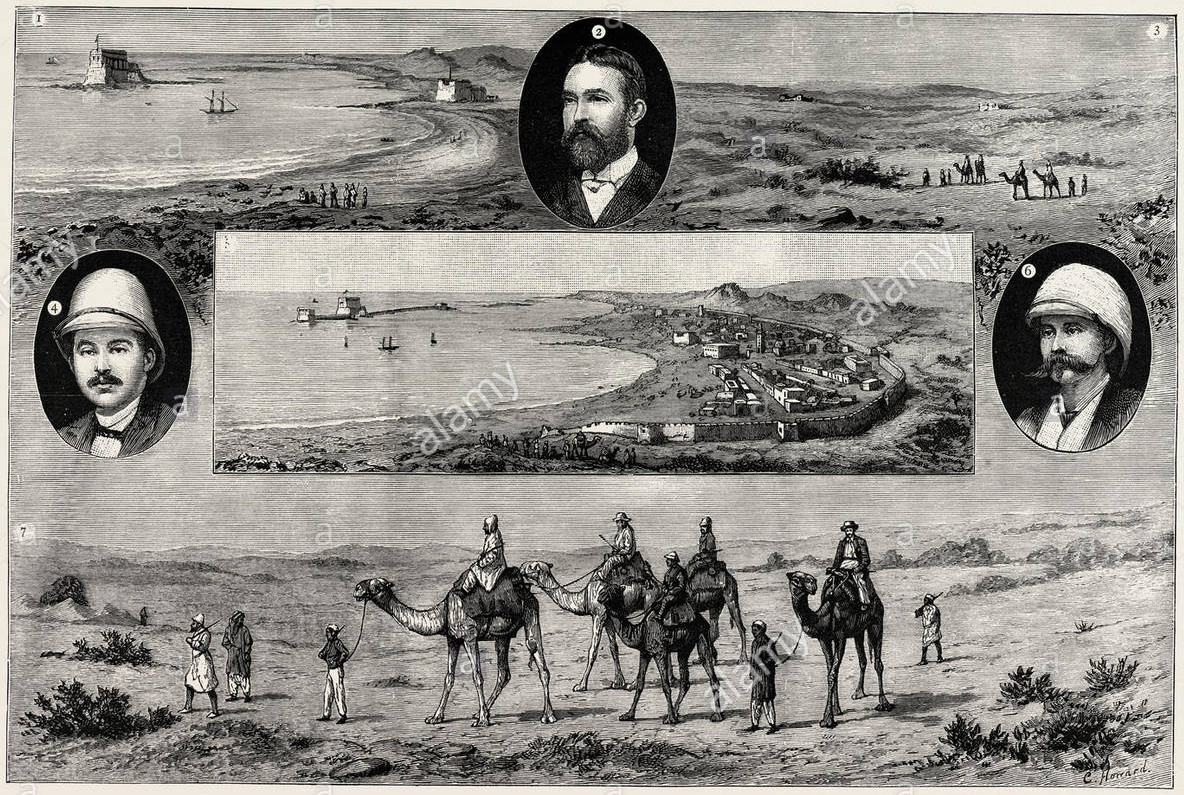
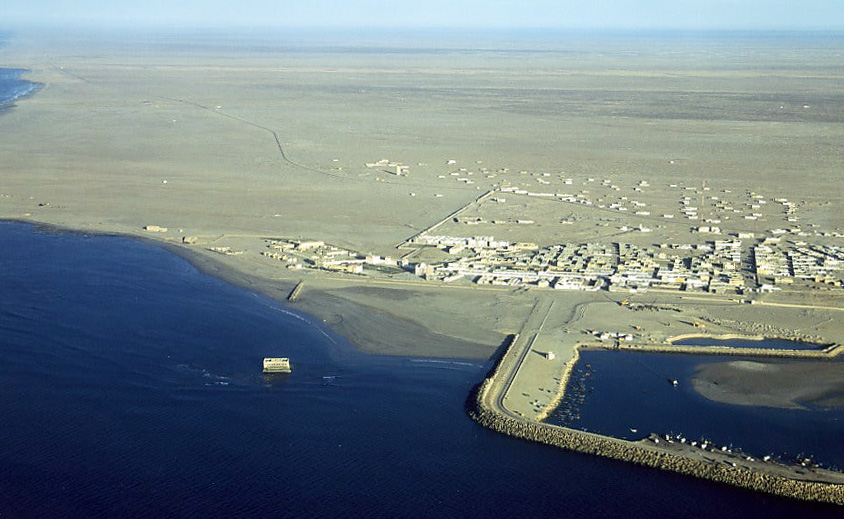
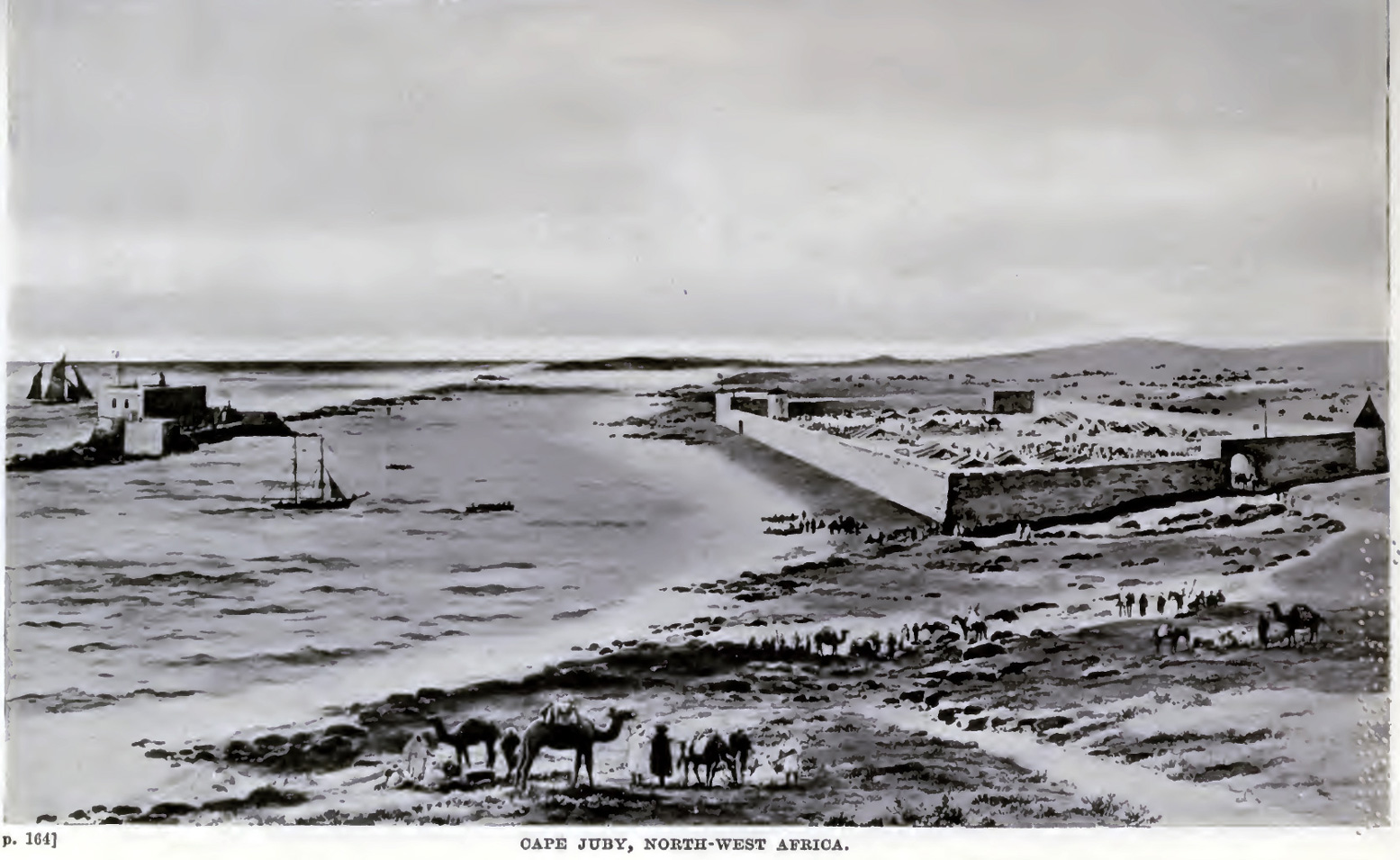
Visit Tarfaya on Cape Juby and just offshore you will see the curious Casa del Mar fort, beyond the St Exupery monument. Port Victoria or Mackenzie’s factory are other names for the trading post of the North West Africa Trading Company, established by Scotsman, Donald Mackenzie in 1882 during the ‘Scramble for Africa’.
Mackenzie’s venture hoped to capitalise on the recent westward swing of the trans-Saharan caravan trade emanating from Timbuktu, by intercepting caravans before they reached the terminus at Wadi Noun (near today’s Guelmin). In fact, in a decade or more the NWAT Co barely covered its costs after compensation was finally agreed against an earlier raid and to abandon the post in favour of the Moroccan sultanate.
It reminds you that colonisation at the time wasn’t purely a state affair, where armies marched off to conquer distant lands and bring back the spoils. Ahead of them strode adventurer-entrepreneurs with funds raised from venture capitalists and who gambled everything on striking it rich. It was their reports, or better still, securing a government charter to supply a commodity or service, which preceded more cautious colonisation, very often spurred by other European rivals nosing around for an as yet unclaimed slice of the cake.
It’s hard to find out much about Donald Mackenzie, but in 1877, a few years before he set up the North West Africa Trading Company, he had a far more radical idea to capitalise on the trans-Saharan trade. He proposed nothing less than flooding the interior of the Sahara from the Atlantic so that, with the addition of a few canals which had proved so successful in Britain prior to the age of rail, ships could sail directly to Timbuktu and the Niger river in a matter of days, avoiding the arduous overland journey of weeks. As a side benefit the flooding would ‘green’ the Sahara, enabling agriculture to thrive across the wind-blown sands.
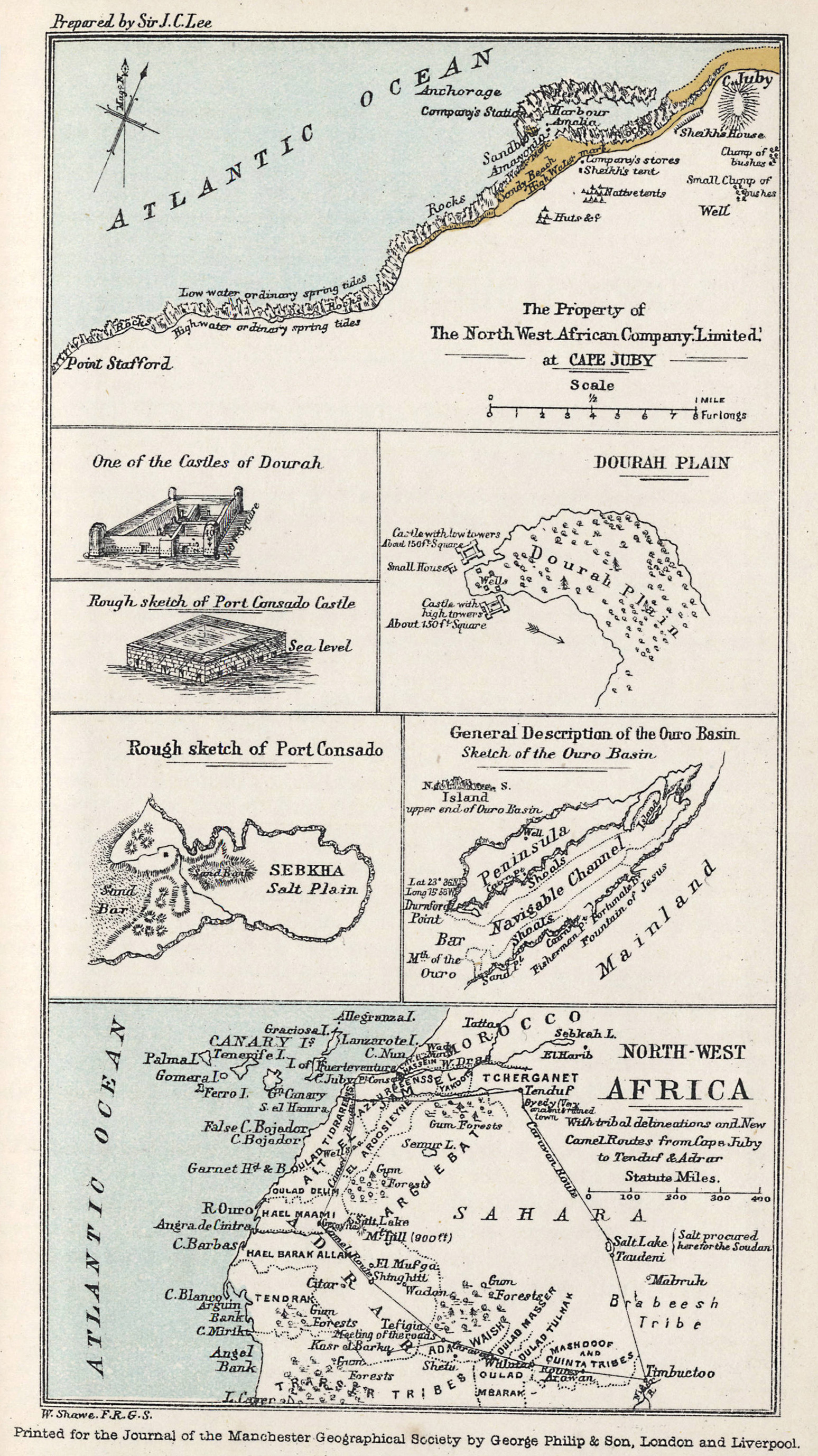
This was the era of grand engineering projects like the Suez Canal (completed 1869) and the Panama Canal (first serious attempt 1881). A canal to the trading heart of West Africa could be a similar commercial coup. It’s hard to think what gave Mackenzie this idea, other than conflating lurid traders’ descriptions of El Djouf (left) with the small depressions or sebkhas found near Cape Juby. The biggest of these is the Sebkha Tah, some 55m below sea level and just 15km from the Atlantic, but still no bigger than Malta. For some reason he believed that the vast El Djouf (part of the million-square-kilometre Majabat al Koubra or ‘Empty Quarter’) was one huge depression which had been connected to the Atlantic via the Seguia el Hamra or some such, but had become cut off and dried out.
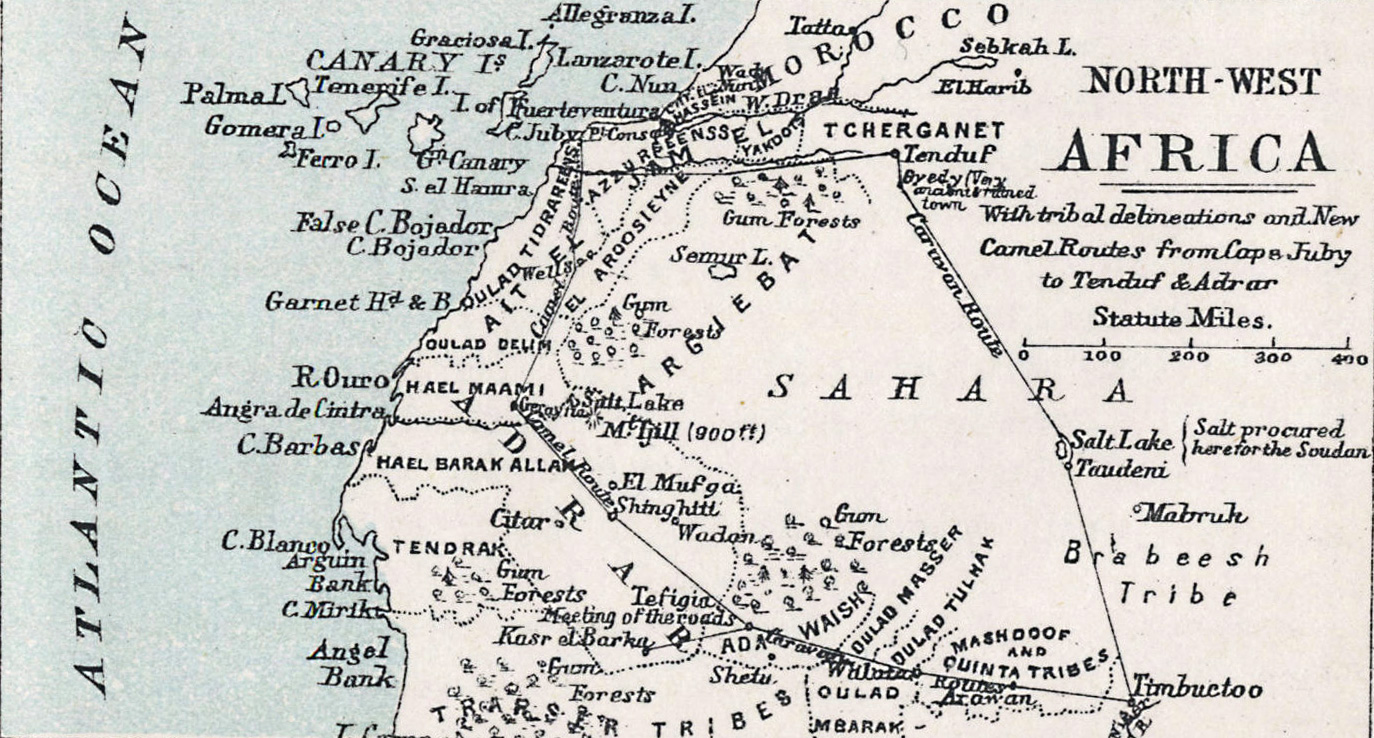
Mackenzie had never actually travelled in this area (other than a camel tour up to Port Consado (present day Khenifiss) and down to Layounne during the NWAT Co era (map above and right) but had read of other larger desert depressions in Tunisia and Egypt, similar to those near Cape Juby. All these basins held seasonally dry salt lakes which may have suggested that flooding was plausible. He believed an inland sea the size of Tunisia or Oklahoma would soon be formed, paving an inland seaway to Timbuktu.
Mackenzie diligently read up on all your great 19th-century Saharan explorers: Barth, Rohlfs, Caille, Duveyrier, Clapperton, and in 1877 published an exhaustive proposal [available online] to ‘The Presidents and Members of the Chambers of Commerce of Great Britain‘ stressing ‘the importance of holding commercial intercourse with the interior‘. Vividly detailing at third hand the riches, economy, geography and ethnicities in this corner of Africa, he firmly believed his northern route reaching down into the African interior was the key, avoiding the disease-ridden equatorial jungles and pagan tribes further south in favour of the more sophisticated vestiges of the West African Islamic states. Under his proposal, land distances for the annual camel caravans from Timbuktu would be halved, with Cape Juby just nine sea days from Britain. De Lesseps himself, the force behind the Suez and original Panama canals, supported the idea of Saharan flooding, believing a side benefit would somehow improve the European climate while greening the desert for agriculture.
Mackenzie also thought that trade and communications would help liberate the sub-Sahran population from the slave trade. And this wasn’t just a ploy to appeal to investors’ morals or religious beliefs – Mackenzie’s later work in East Africa long after the NWAT Company dissolved suggested he was always a genuine abolitionist.
According to his upbeat proposal (is there any other kind?) Mackenzie has it all worked out: do a recce to get the tribal chiefs on board at Cape Juby and Timbuktu, locate the channel in El Djouf and unplug that Atlantic cork. I have no doubt of the ultimate achievement of this project, he wrote in the proposal’s introduction. But investors seemed less keen and, were it even possible, you’d think by creating a shallow, hyper-saline lake, the only thing that would grow would be salt crystals. The fact is the interior of the Sahara, including the dune-filed expanse of El Djouf spanning the Mali-Mauritania border, is a low plateau some 3-500 metres above sea level. Someone ought to tell Conde Nast Traveler.
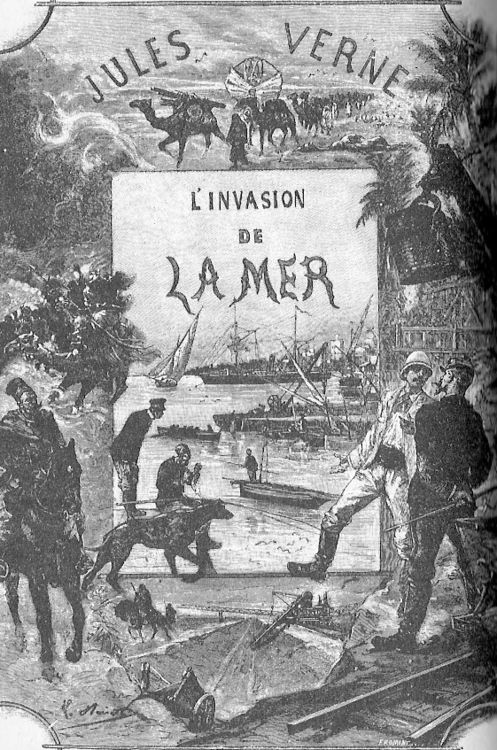
Mackenzie had slightly less difficulty finding investors for Port Victoria a few years later, and decade or three after that, Jules Verne fictionalised the idea of a flooded Sahara in his last published book, The Invasion of the Sea, set in Tunisia.
Present-day Tarfaya or Cape Juby, with Mackenzie’s fort visible offshore.
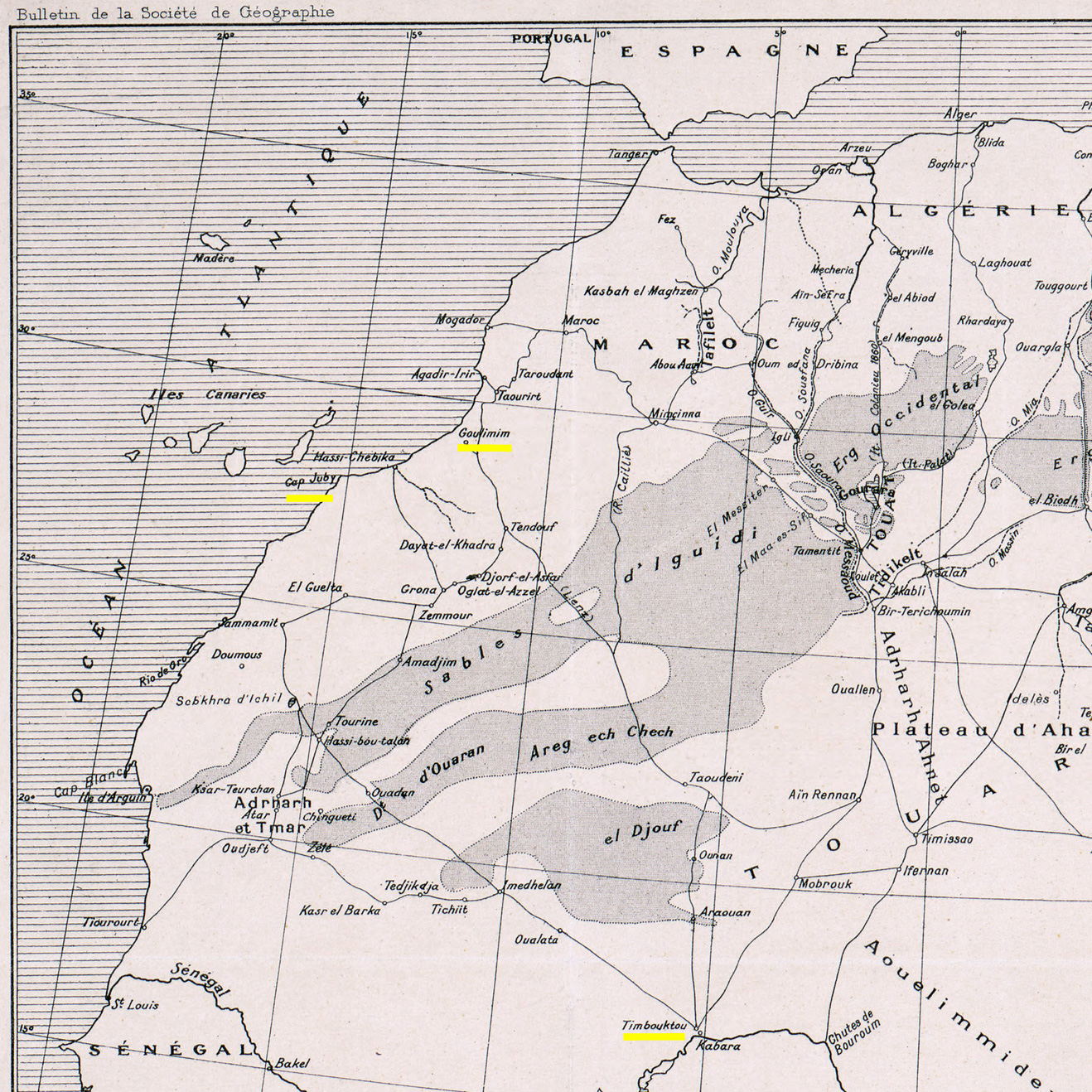
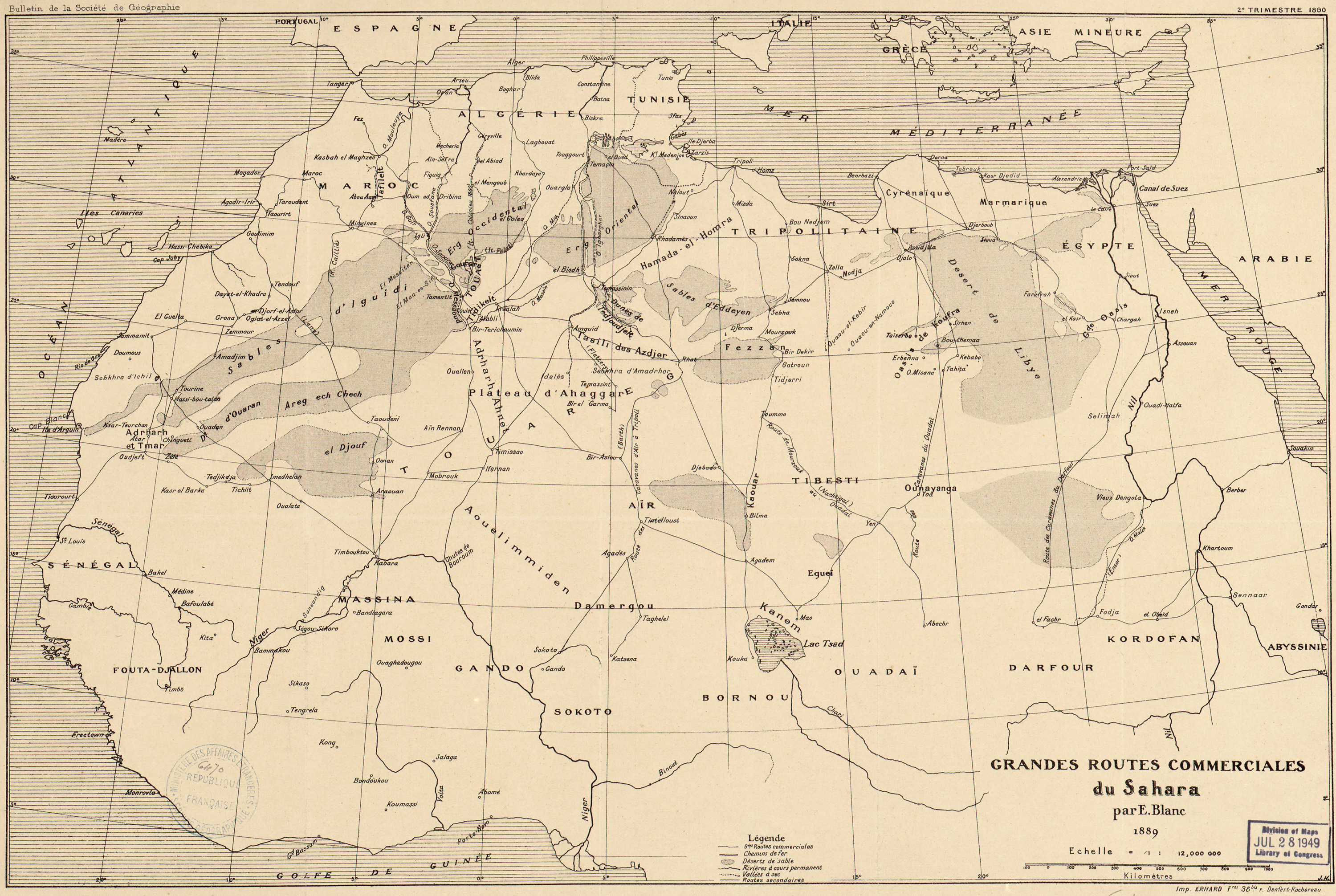
I came across this old French map of the Saharan trade routes from 1889 [full-size source]. As always, it’s interesting to see where was prominent then and what has come since. Old spellings and some names differ.
Not a lot of people know that an earlier name for Marrakech was ‘Maroc’ or Morocco. Once this area was all known as ‘Mauretania’ – the Land of the Moors (Blacks) from which all these names derive. Mogador is today’s Essaouira. Other well-known Moroccan towns are present, as well as the 52-days road to Timbuktu from Zagora or Sijilmassa (Rissani), all depicted with other names. By this time most camel trade took the western route to Goulimim (Wadi Noun), which explains the vestiges of the tourist camel market there today. The original site is actually here.
Cap Juby (today’s Tarfaya) we’ll be hearing more about shortly, but inland from here a tough route from Tindouf led to Taoudeni and also Timbuktu. Southwest from Tindouf another track leads to Mauritania, the old colonial overland route to Dakar mid-last century, as driven by this nutter.
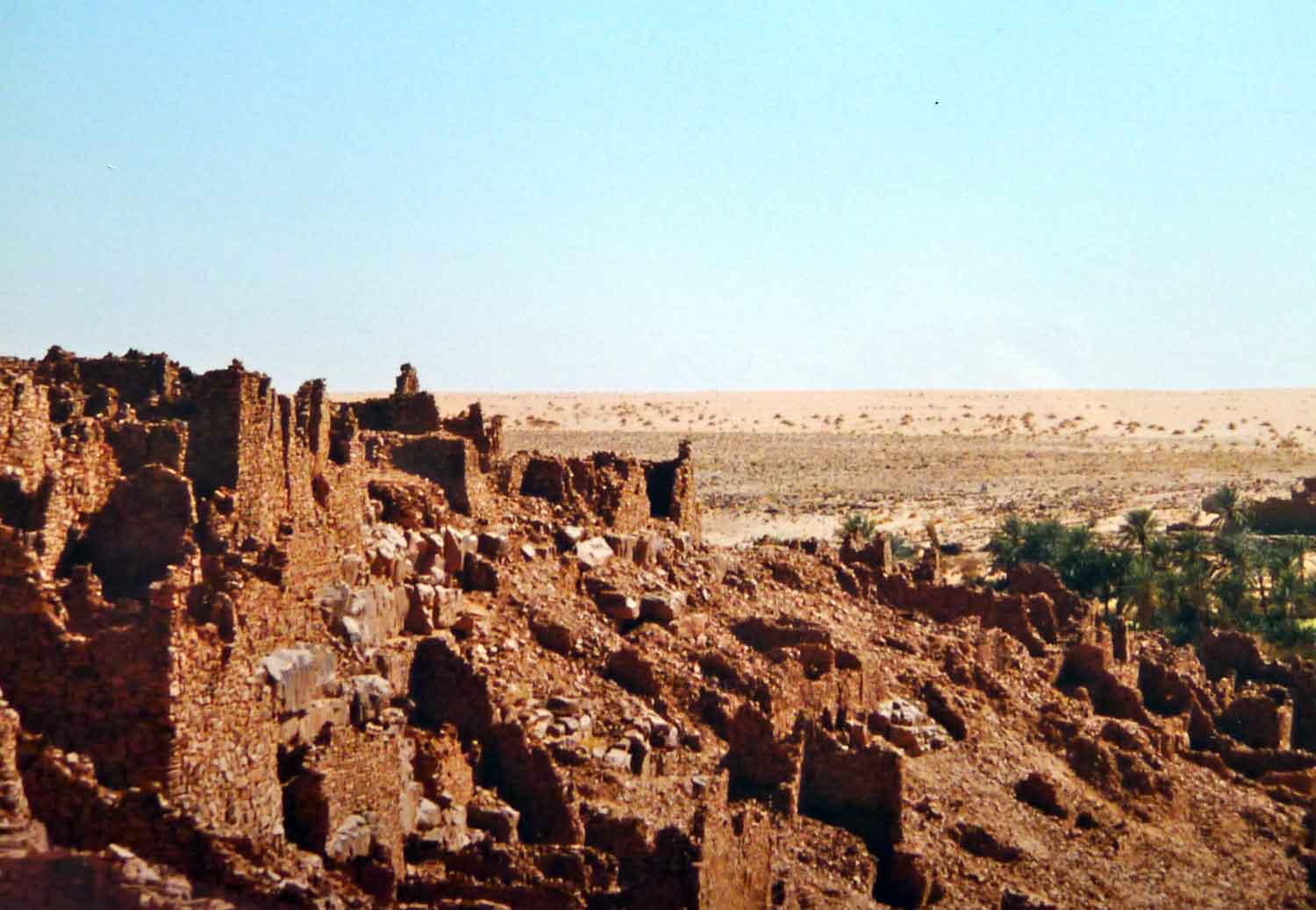
Mauritania has many familiar places like Atar, Chinguetti (right), Ouadane (left, where we coninued east across the Majabat for Algeria in 2006) as well as Oujeft leading to the ruins of Ksar el Barka, Tidjikja, Tichit, and Oualata for Timbuktu. But no Nouadhibou (Cap Blanc) or Nouadhibou (Tiourourt) yet, far less Zouerat. And no Dakar back then; St Louis was the colonial capital of French West Africa.
In Mali Timbuktu is central, with trade routes leading north via Araouane, or Tim Missao well (left) in Algeria where we stopped in 2006 and 1989 (right). No Tamanrasset or Djanet – the two biggest towns in southern Algeria today, but In Salah, Amguid and Temassinin (Bordj Omar Driss) are present.
In Libya little seems to have changed: Ghat and Ghadames are there, as well as Germa (Ubari) and Murzuk on the route for Lake Chad via Bilma (left). To the east the oases making up Kufra lead down to the Ounianga lakes in northern Chad. And east of there is the Darb al Arbain (Road of Forty Days) from El Fasher in Sudan, via Selima across the sand sheet (right) towards Kharga and Asyut on the Nile.
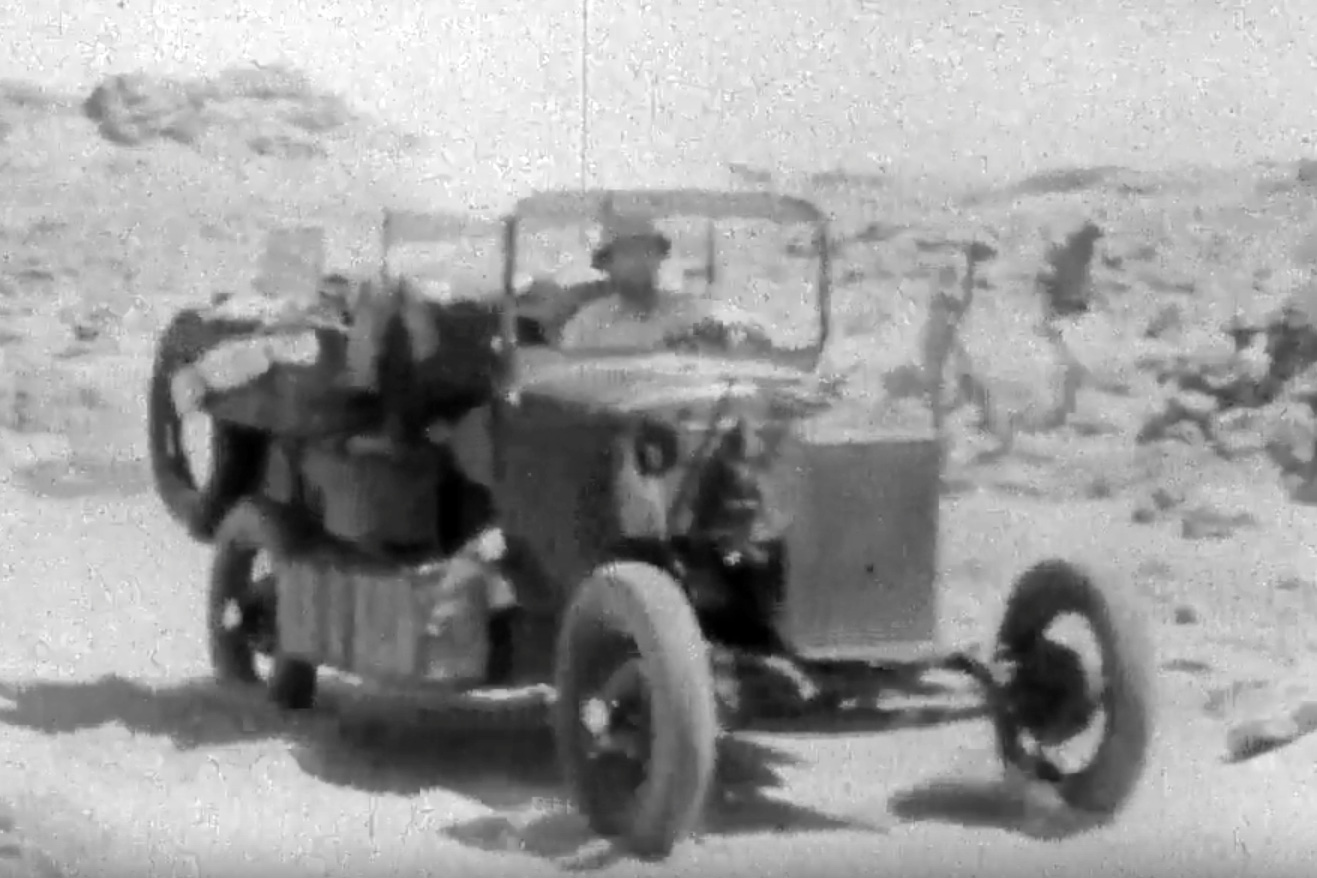
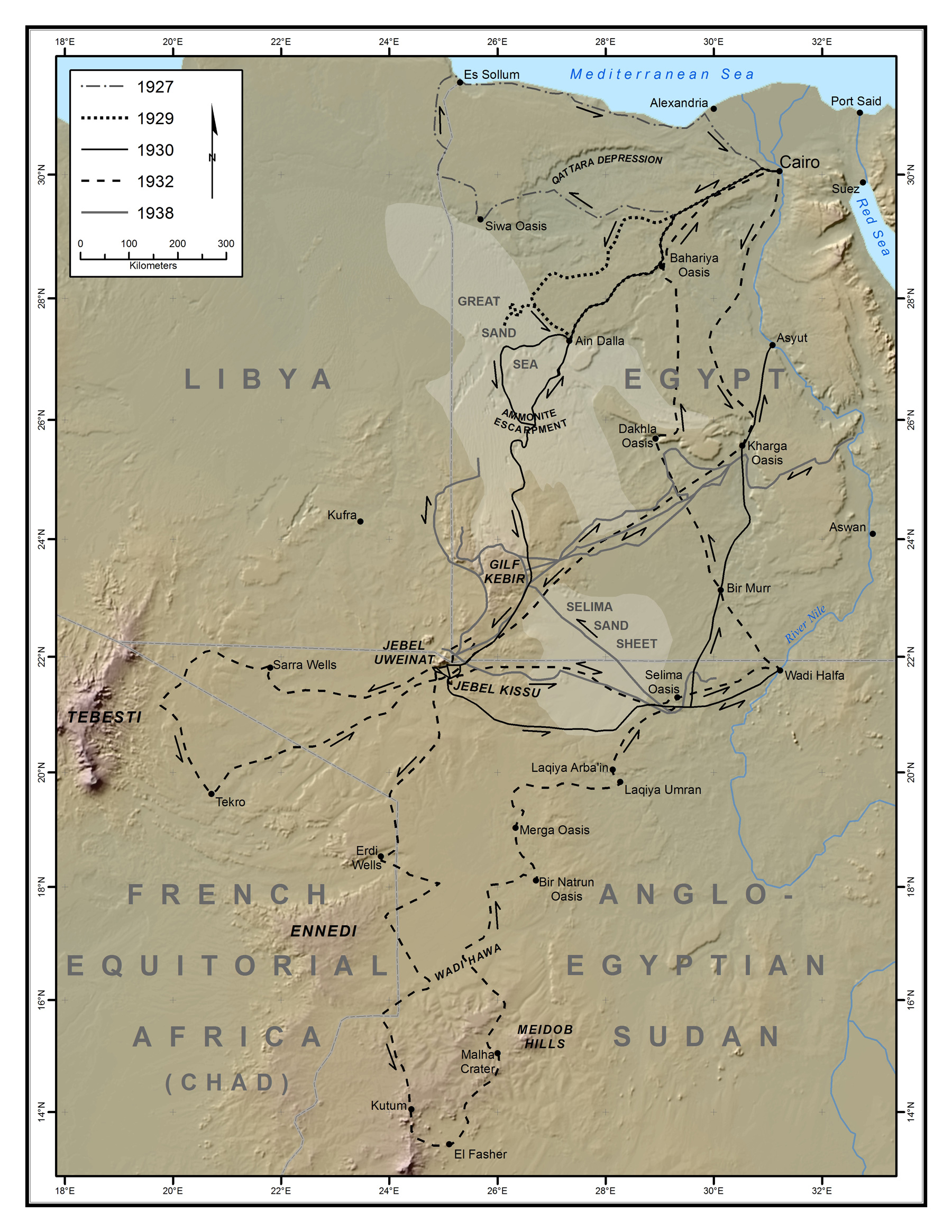
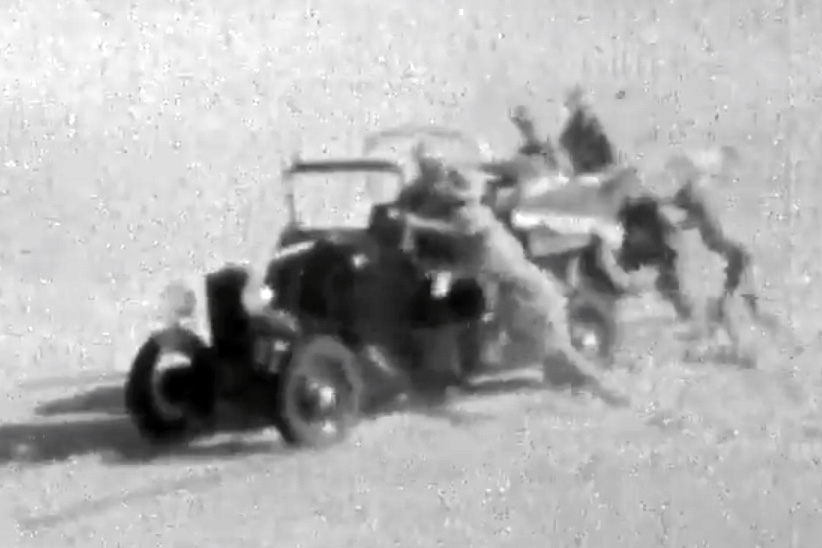
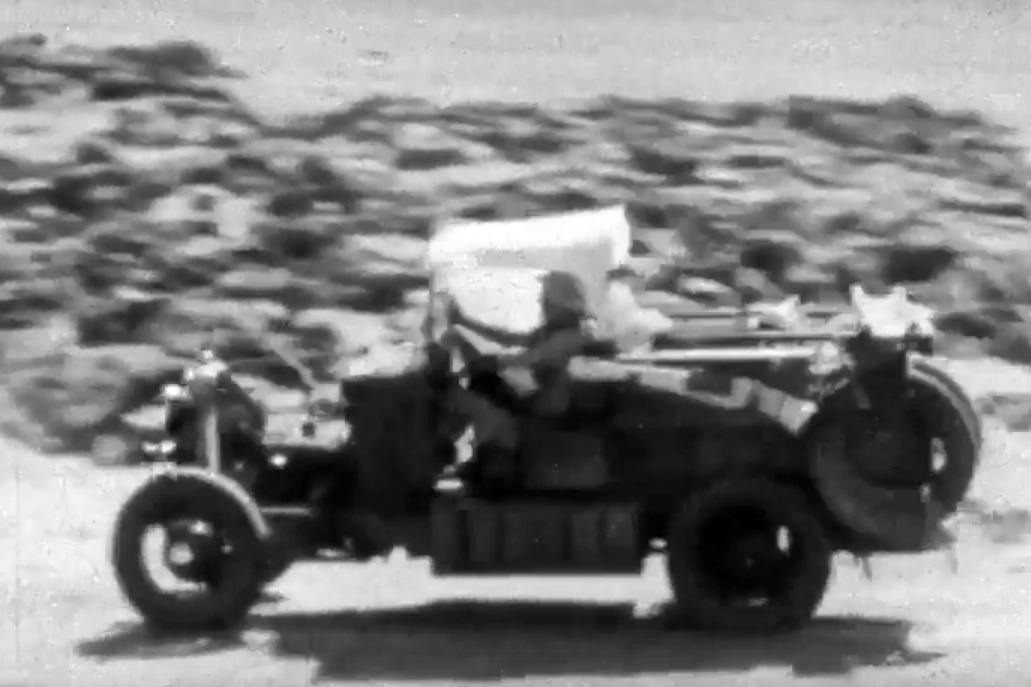
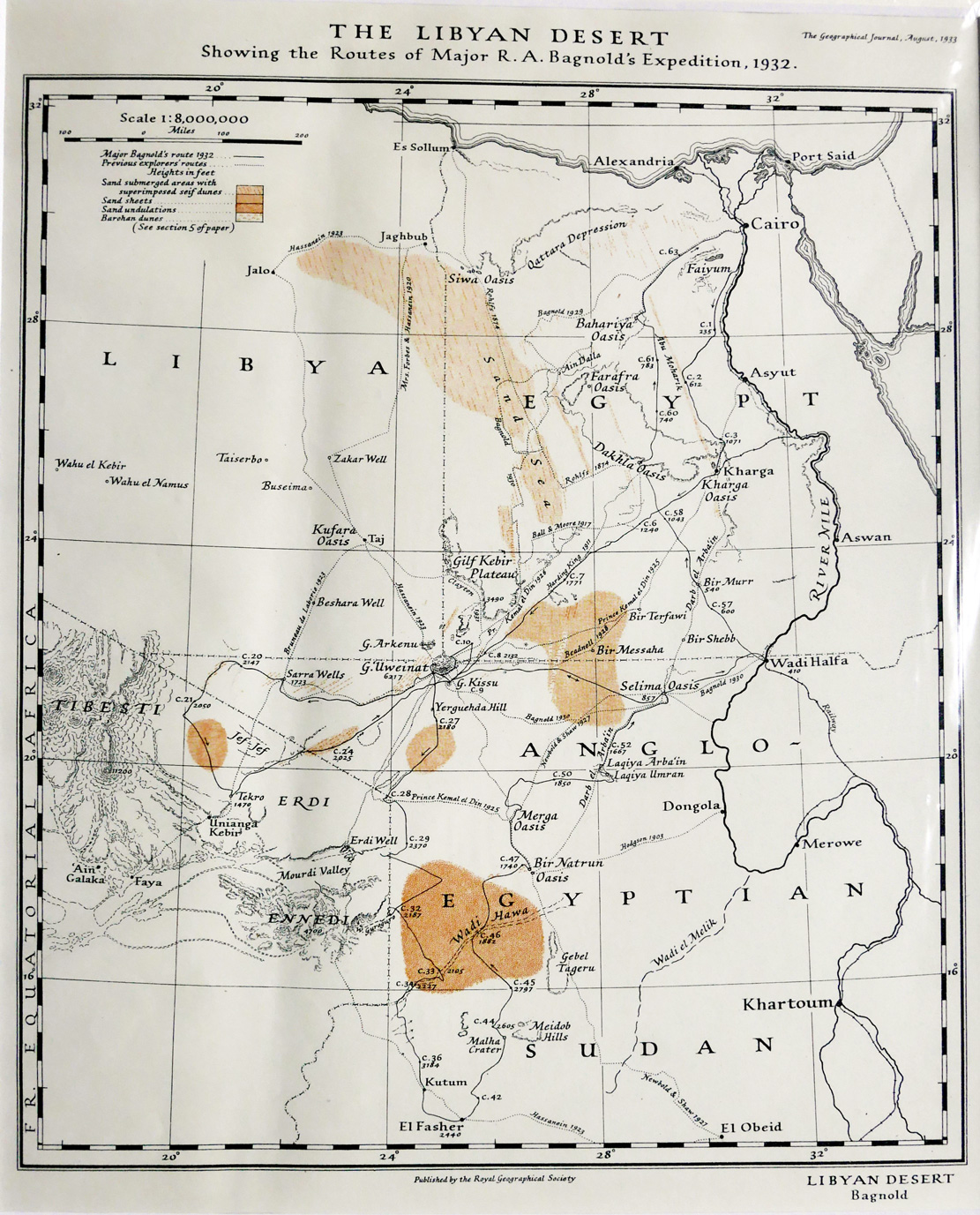
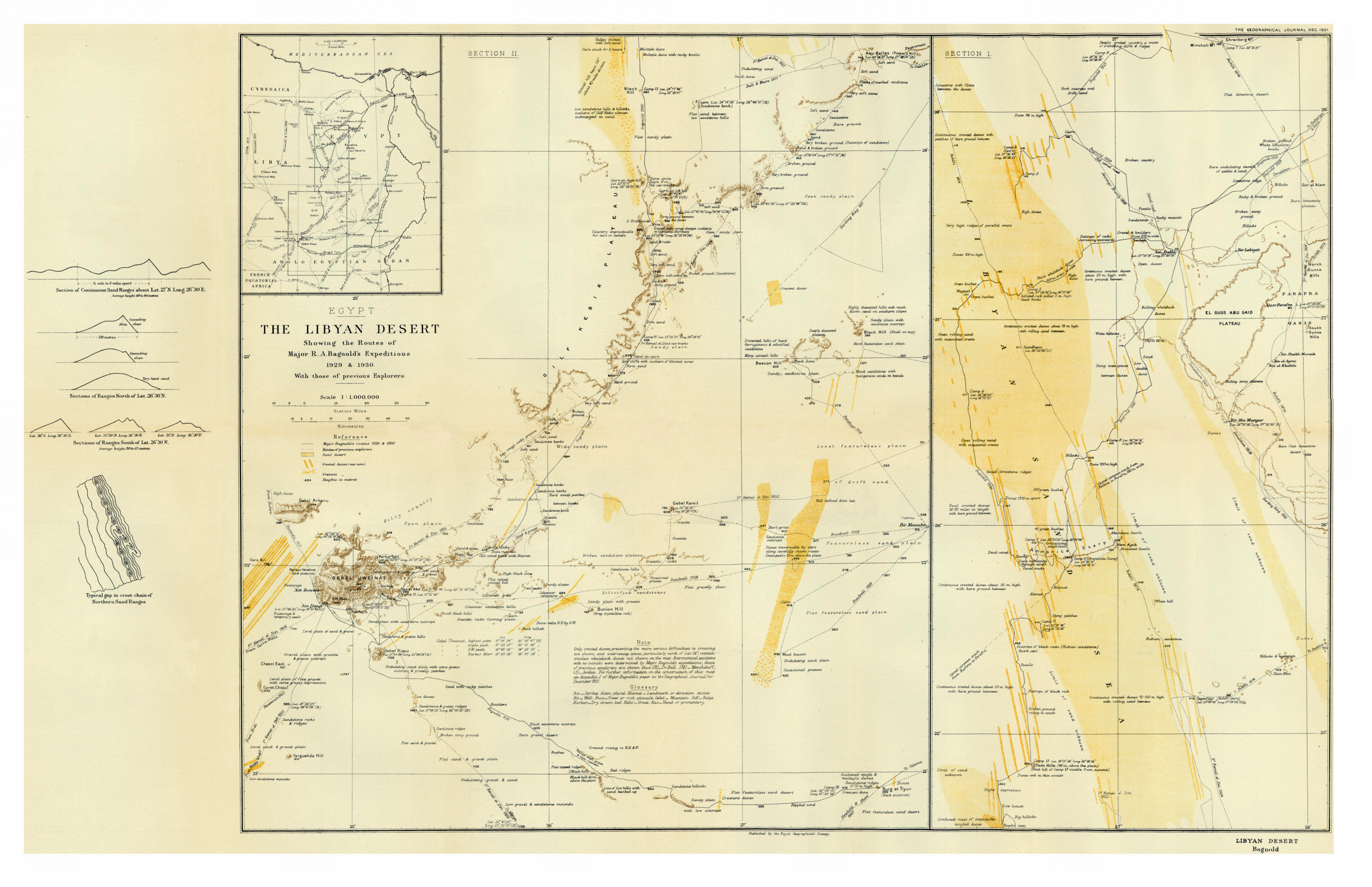
A few months ago the British Film Institute released an archive film of the early motor expeditions of Ralph Bagnold and his crew, exploring deepinto the Libyan Desert. (Click BFI if youtube below gets deleted). The map below shows all his expeditions in the 1930s, and there are more, original maps further down.
The 49-minute-long film describes the original recce in 1929 into the Great Sand Sea of the Western Desert via Ain Dalla spring. It was here that Bagnold’s group found lowering tyre pressures, as well as using sand plates and rope ladders, enabled heavy vehicles to traverse soft dunes.
A year later they set off towards Jebel Uweinat, a massif located by Ahmed Hassanein less than a decade earlier during a camel trek along Libya’s eastern borders. At Ain Dalla camels brought in extra fuel, and the cars continued to Jebel Kissu in today’s Sudan and south of Uweinat, then east for the Nile via Selima oasis.
In 1932 they based themselves again at Jebel Kissu where they refuelled from Selima, then explored the Sarra Triangle (now in Libya) as well as northeastern Chad.
Heading south to El Fasher, they passed herds of ostrich and oryx, since shot out by rifle hunters, before heading north for Merga, back to Selima and home via Wadi Halfa for a tot of rum.
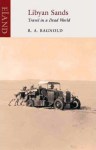
The maps on the left and below show the routes of all these trips and Bagnold’s book, Libyan Sands (right) covering all these expeditions and more and is well worth reading. Reviewed here. Short bio of Ralph Bagnold.
Part of an occasional Sahara A to Z series. Hang around long enough and you’ll get the full set.
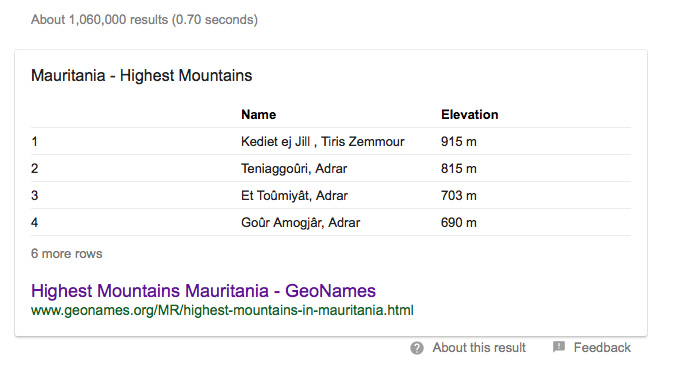
Search Google for the highest peaks in Mauritania, and the list on the left from Geonames pops up – and the same data gets propagated ad-internetum.
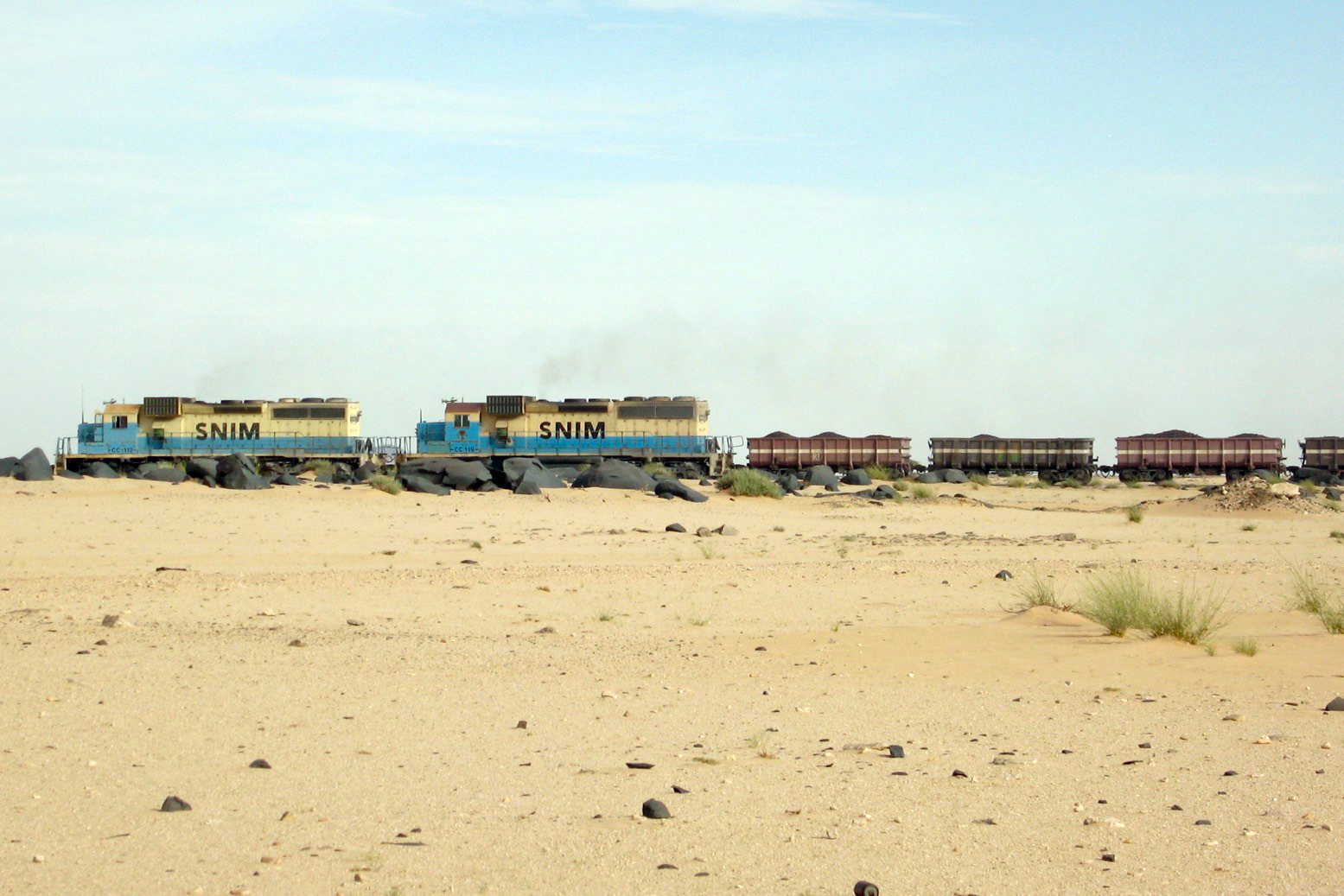
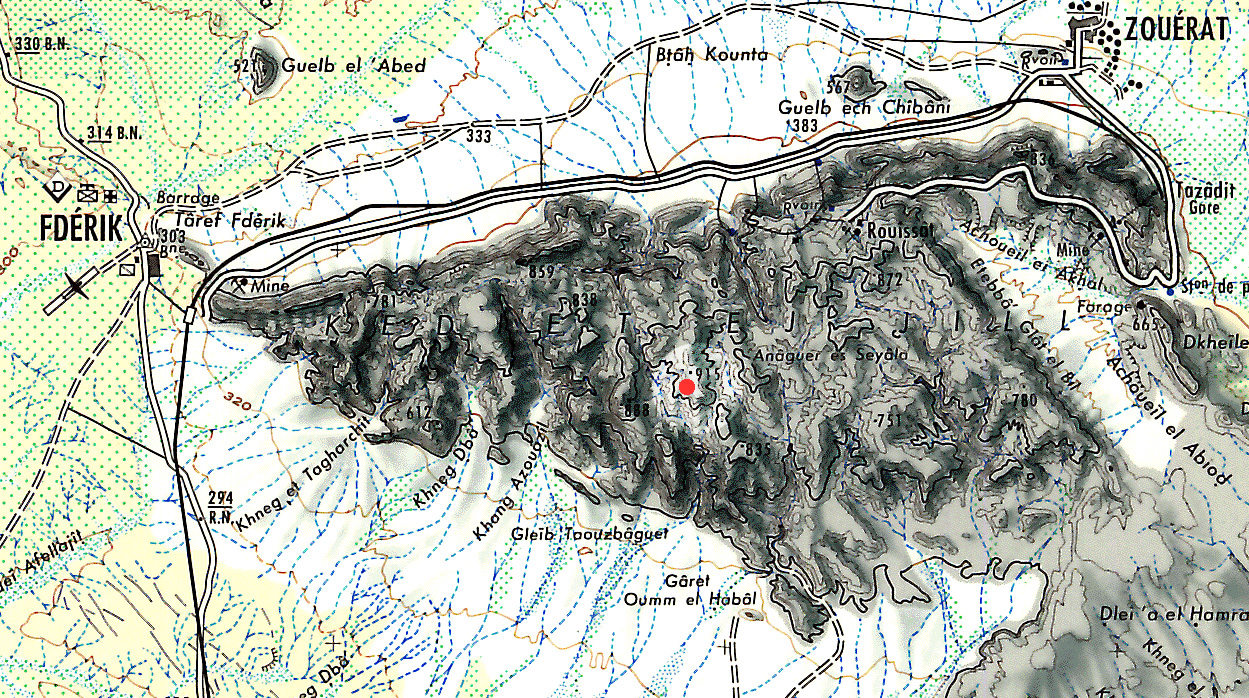
The tallest point is on the massif of Kediet ej Jill, rising above Zouerat mine site; a metal mountain that’s slowly having its iron-rich core eviscerated and railed across the desert (right) to the port of Nouadhibou. The actual high point is often erroneously pinpointed online. Not here it isn’t! It’s quite hard to find on the old 200k IGN map, below.
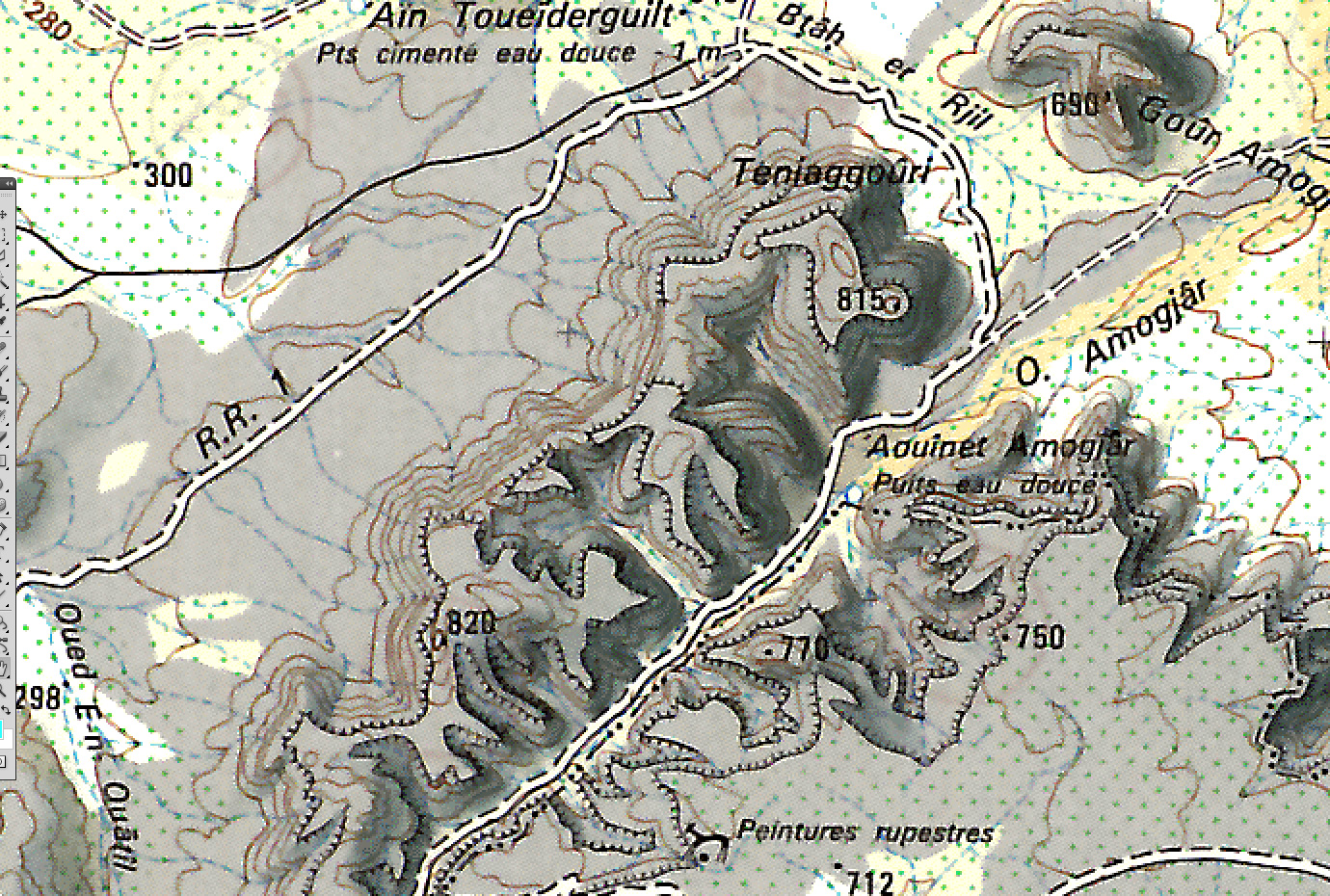
The second highest peak is listed as Teniaggoûri at 815m. That’s 815m as probably copied from the French IGN 200k map surveyed in the 1960s (right and below). This time IGN got it a little wrong.
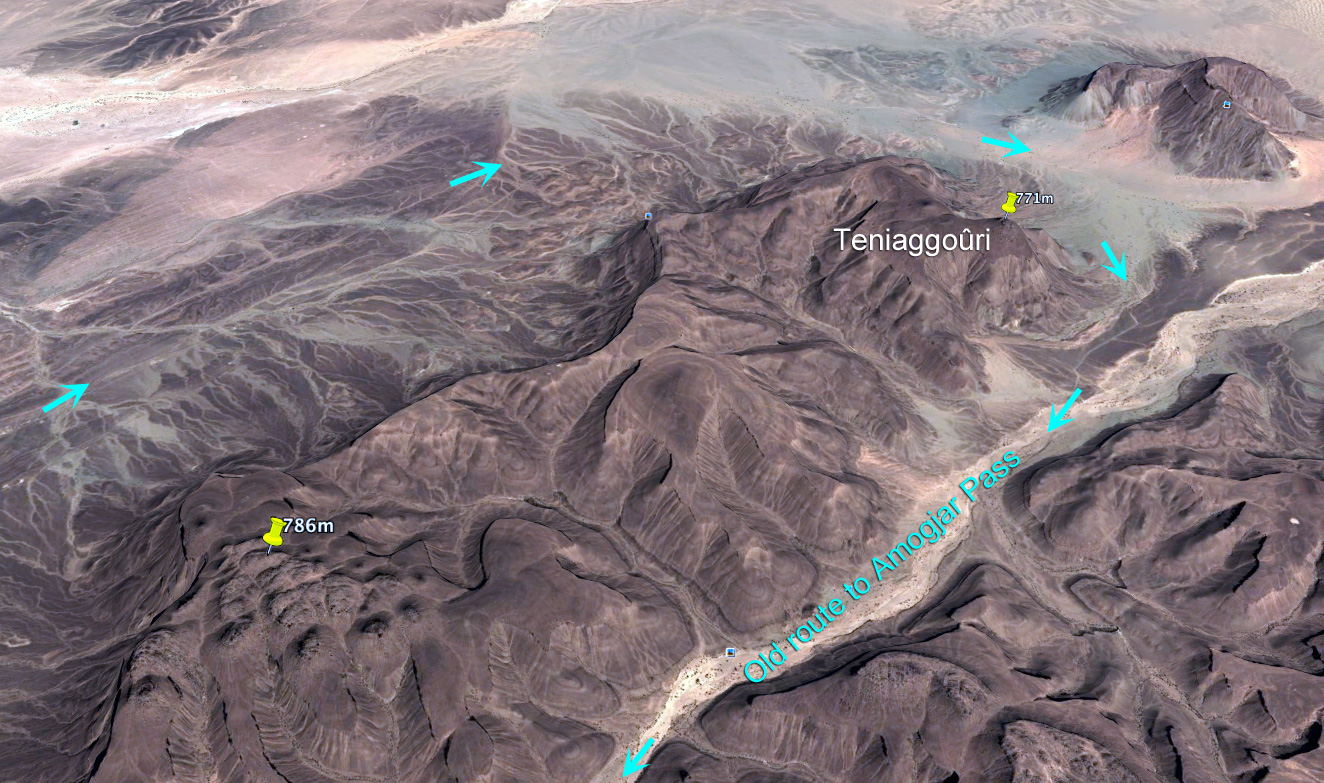
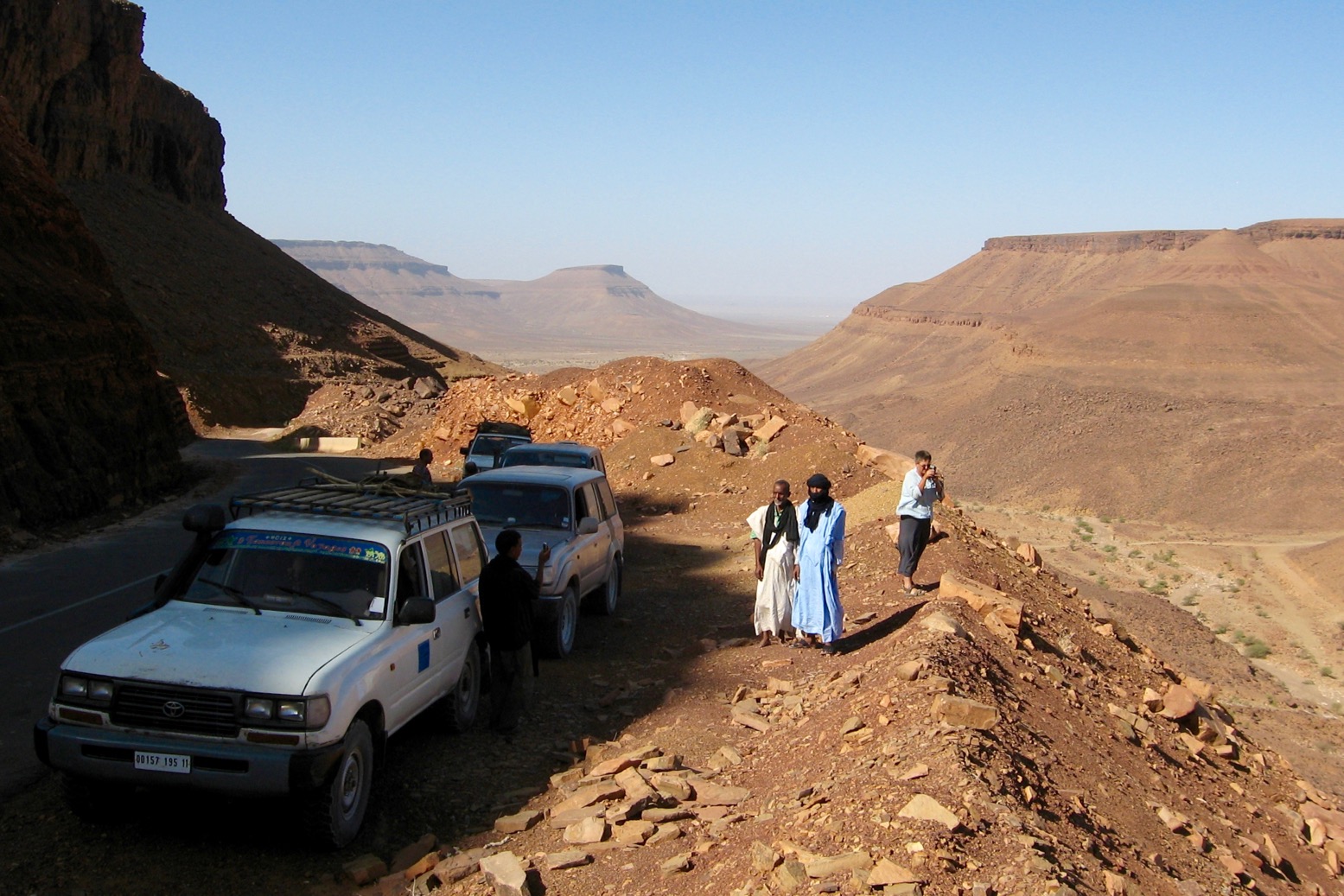
In the old days you curved round this flat-topped outlier of the Adrar massif on the way to the rough climb up the Amogjar Pass for Chinguetti and Oudane. The distinctive summit of Teniaggoûriwould have been a key landmark if coming round from Atar or in from the arid playa of El Beyyid to the east. Now the newer and more direct Ebnou Pass (right) climbs straight onto the plateau out of Atar.
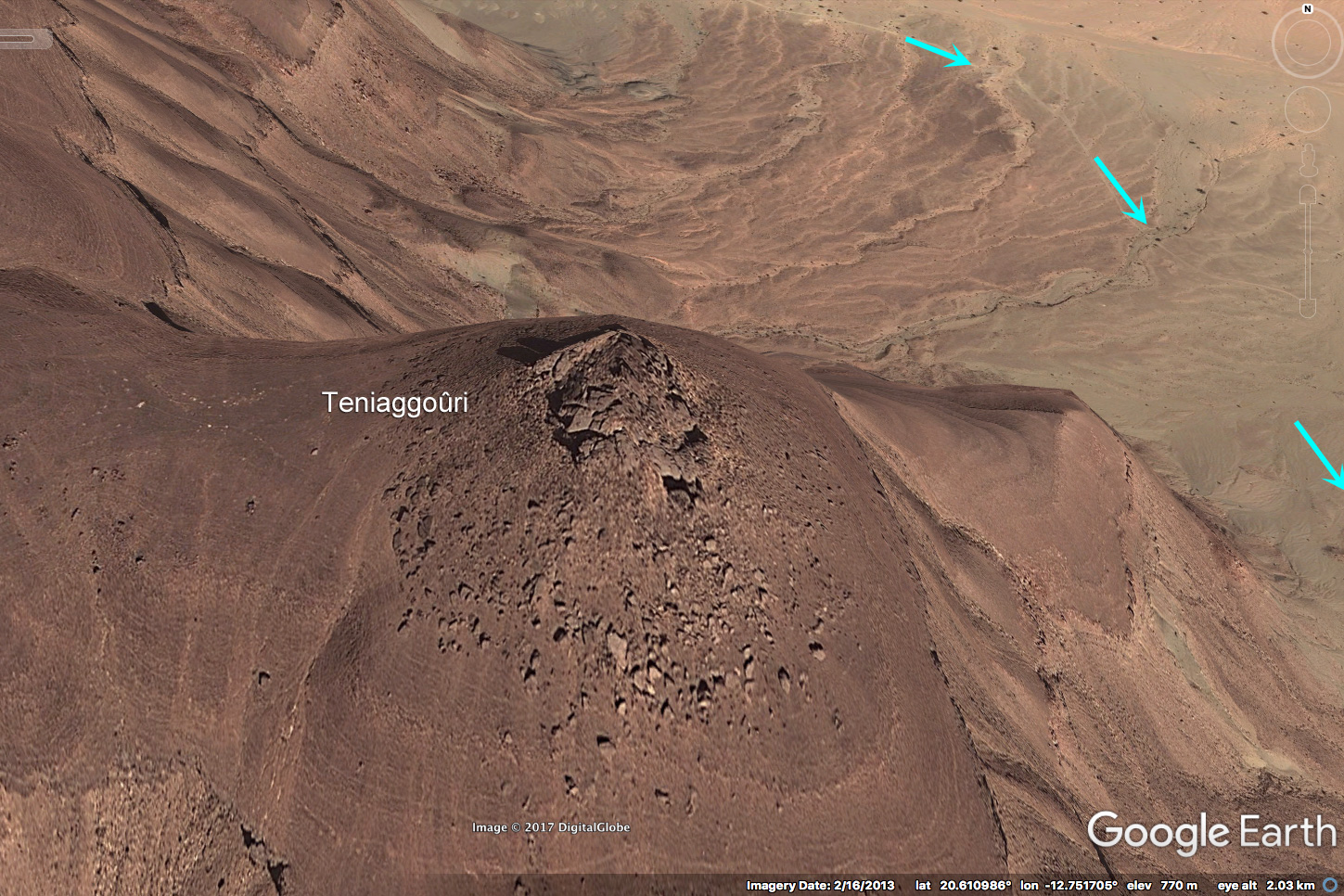
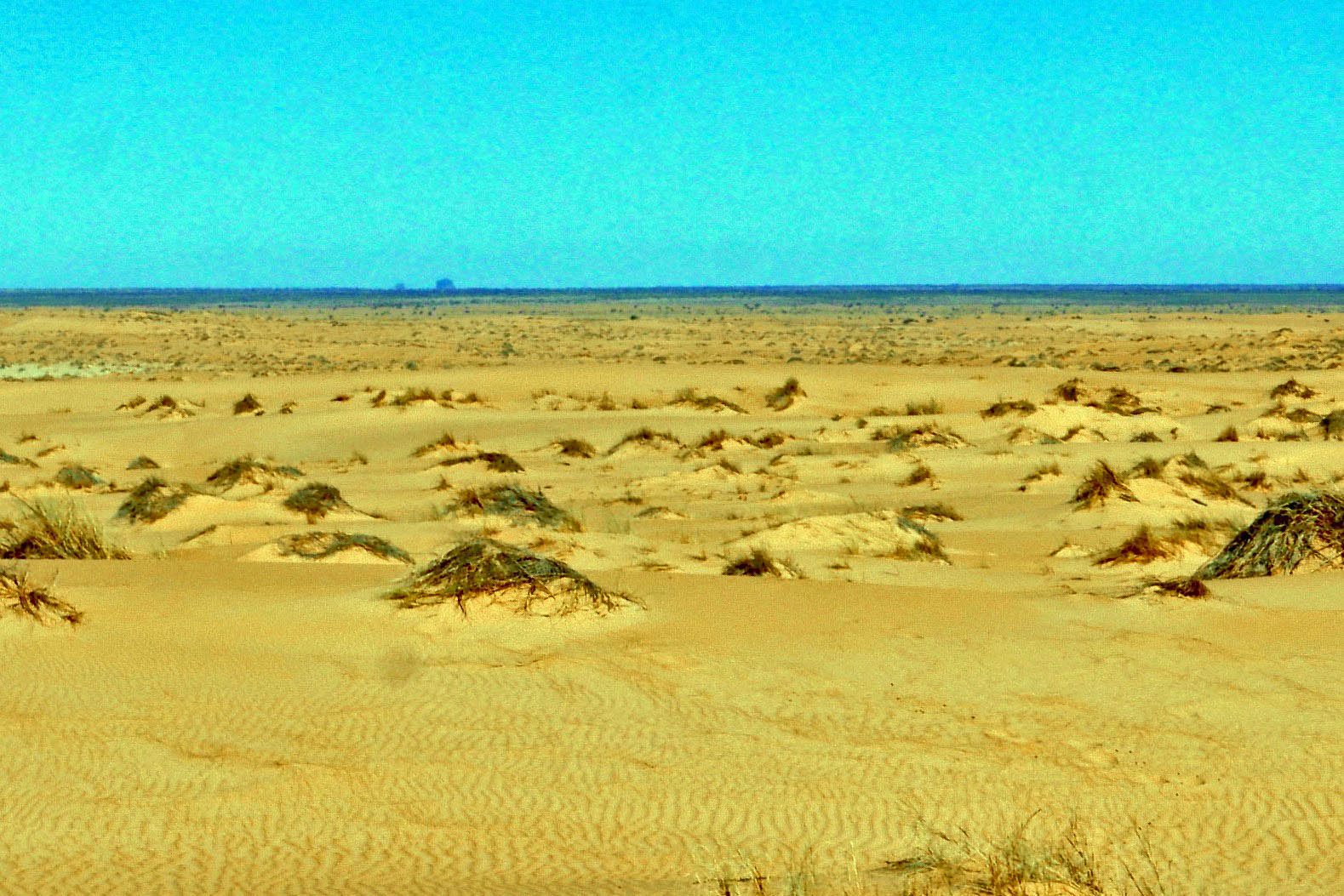
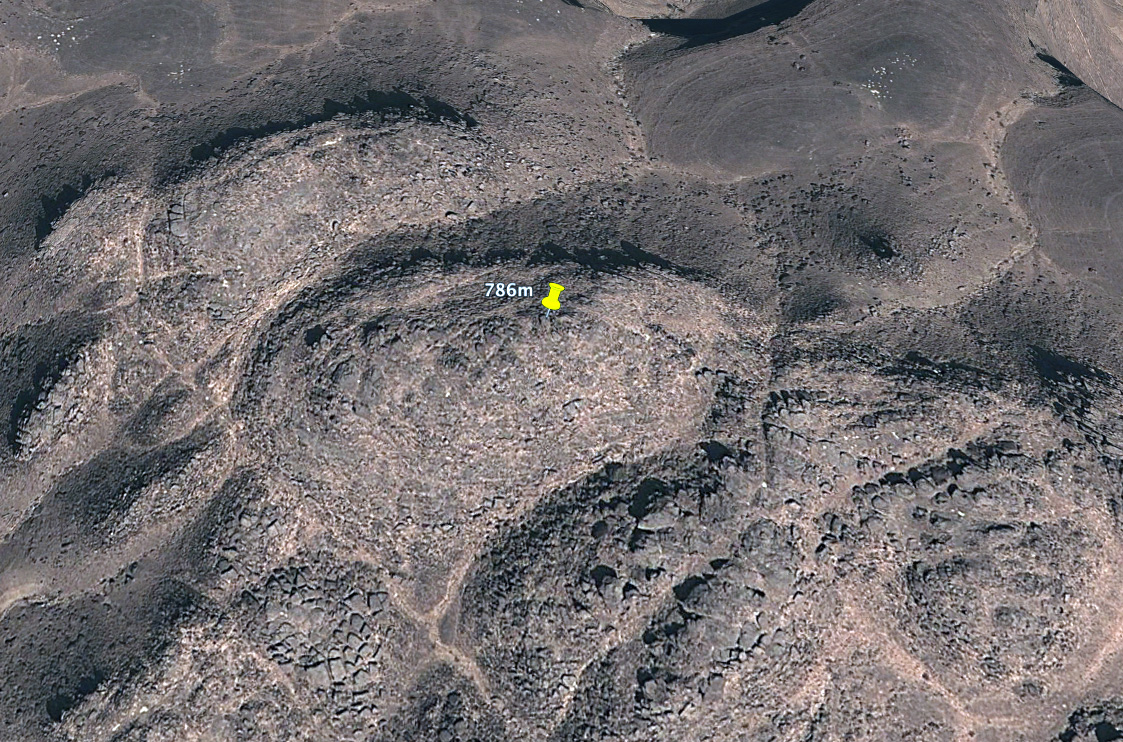
But a quick look at a French 200k map (above) shows an unnamed spot height, 7km to the southwest of Teniaggoûri and which is labelled at no less than 820m. Set in the middle of the ridge, it may not be a prominent prow and landmark like Teniaggoûri, but even Google Earth’s estimated elevation data shows comparative heights of 771m for Teniaggoûri and 786m for the dome cluster. From the Oued Amogjar valley to the south, either point is little over a hundred metres elevation and a couple of miles walk above the desert floor. Left; just north of Zarga, the peaks on the horizon are what out guides called ‘Amogjar’ and what could be Teniaggoûri given the impression of additional elevation in the heat mirage.
Of course, it’s quite possible the local name for this entire ridge may be Teniaggoûri (as with Kediet). Nomads don’t give a toss about actual high points, but sure have a use for landmarks. So there may be no real need to rename the point, just the location. Now we know.
Part of the occasional Sahara A to Z series Hang around long enough and you’ll get the full set
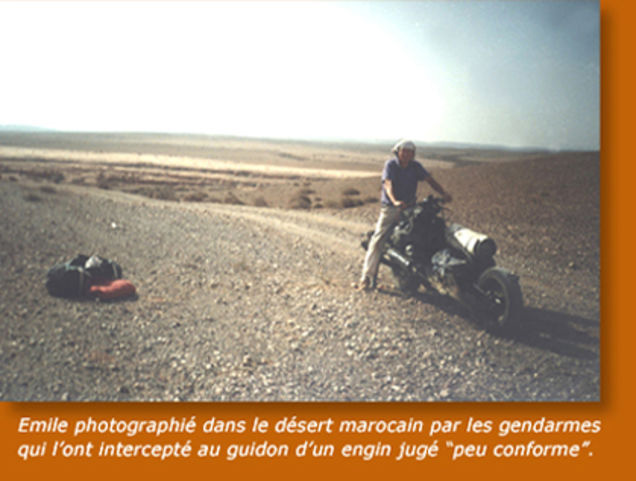
Pictures from Emile Leray’s website [dead link] and the web
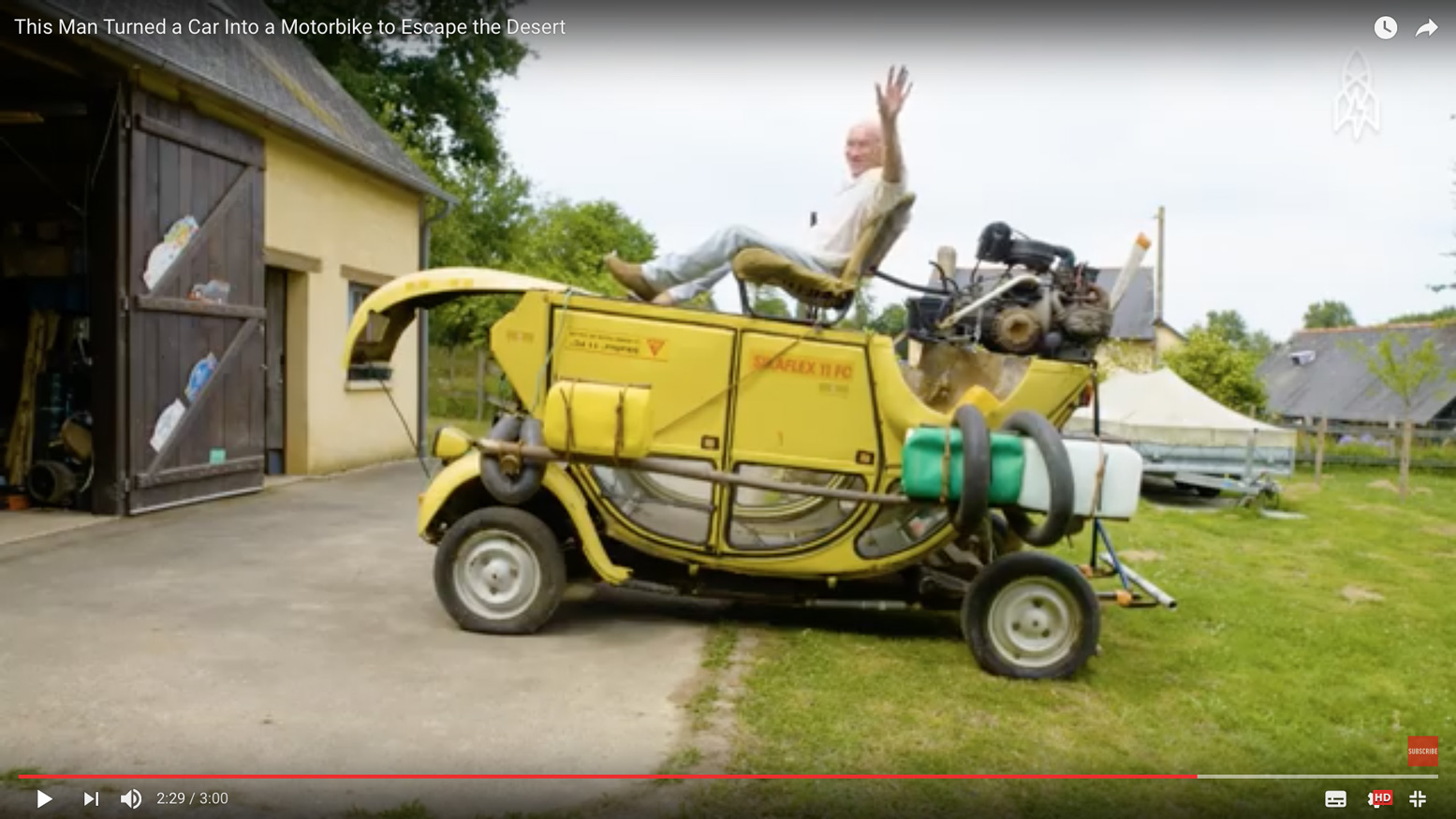
In July 2012, a couple of years before fake news had become a thing, online media tripped over itself to syndicate a compelling Saharan survival story evoking the gripping 1965 desert drama, Flight of the Phoenix. Then, five years later a video appeared on youtube (below) where the aged and batty-looking French adventurer again recounted his incredible desert caper.
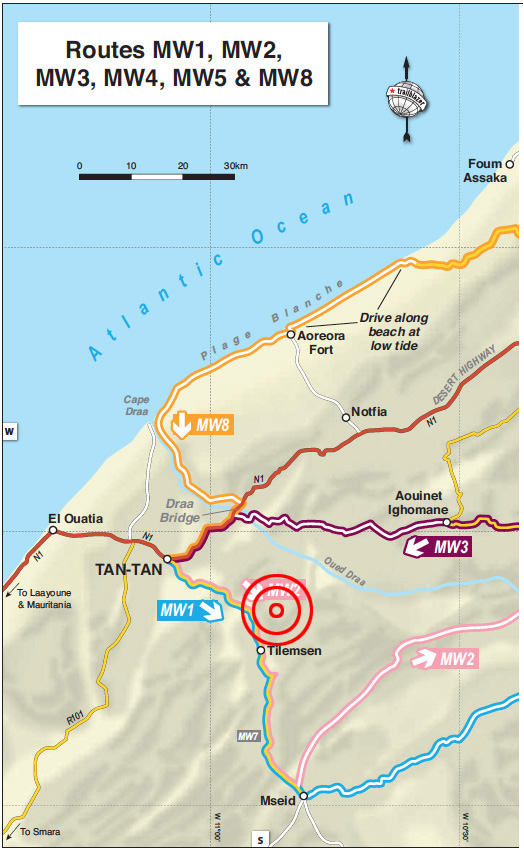
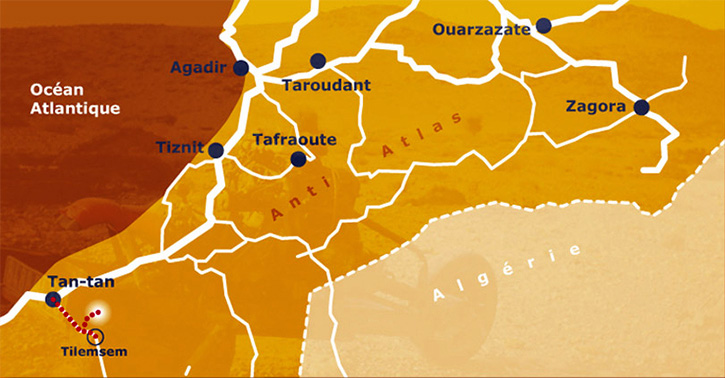
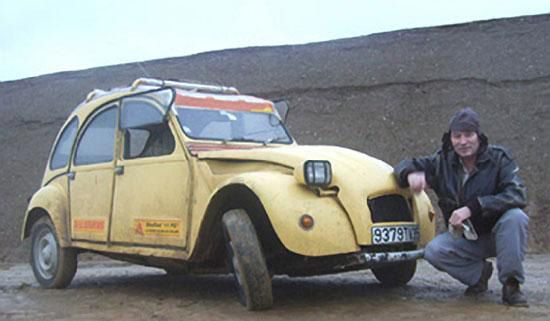
Back in 2012 full details and motivations were skimmed over, but the story goes that in March 1993, 43-year-old Frenchman Emile Leray set off from Tan-Tan near the Moroccan coast to drive his Citroen 2CV east to Zagora – more or less Route MW2 from my Morocco guidebook (below), followed by MS8 from Tata.
But with the Polisario ceasefire just 18 months old and frequently being broken, at Tilemsen the Moroccan army stopped him from continuing south towards Mseid, the former Polisario front line. Leray turned back towards Tan-Tan, but not before incurring some animosity from the army by refusing to give a soldier a lift back to town – a common request at remote Saharan checkpoints.
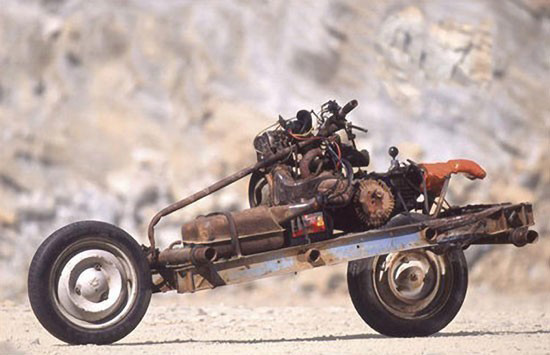
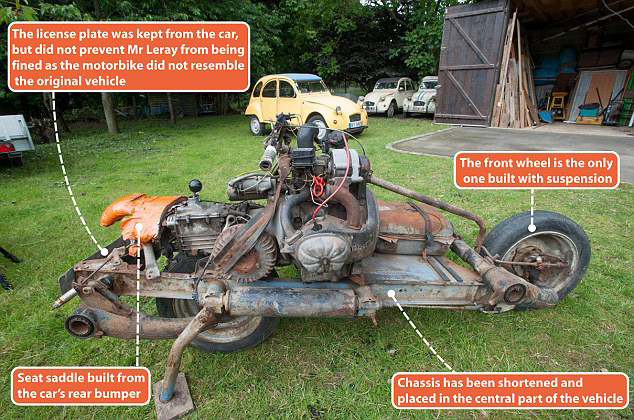
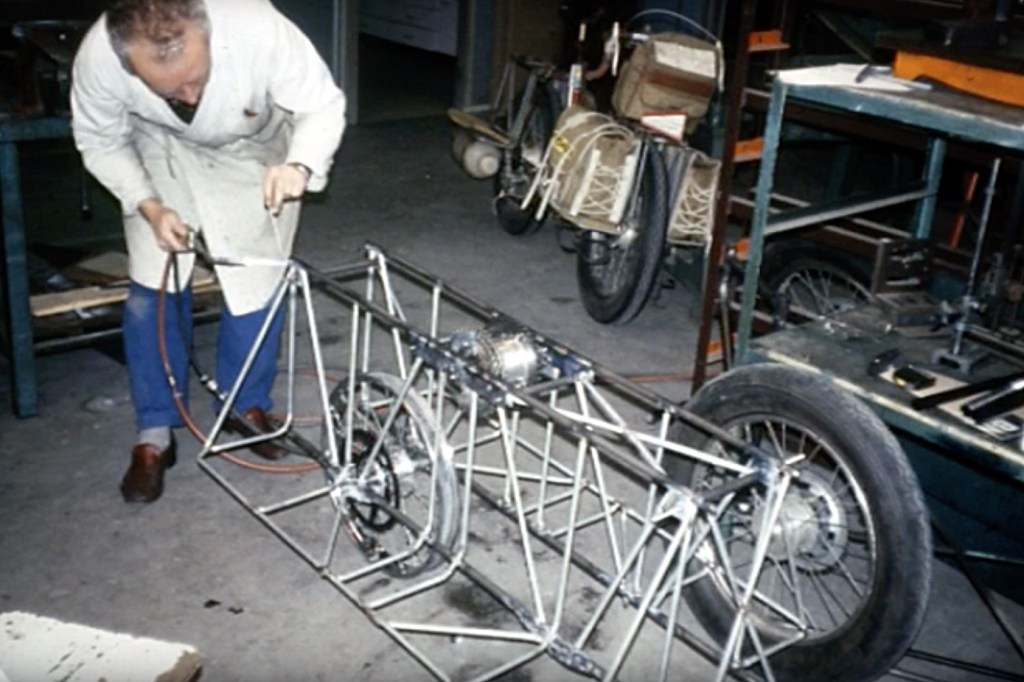
Just west of Tilemsen, Leray ‘had an idea’. He decided to circumvent the checkpoint to the north (see MW1 KM22), and rejoin MW2 eastwards. But once on the piste (or ‘off-piste’, as claimed) one of the 2CV’s suspension arms broke after hitting a hole too hard. With ten days’ provisions on board but reluctant to easily walk-out and leave his car vulnerable to theft, he decided to strip his crippled Citroen and rebuild it into a rudimentary motorcycle, then ride out as if nothing much happened. The unusual powertrain and suspension arrangement of a 2CV makes such a conversion plausible.
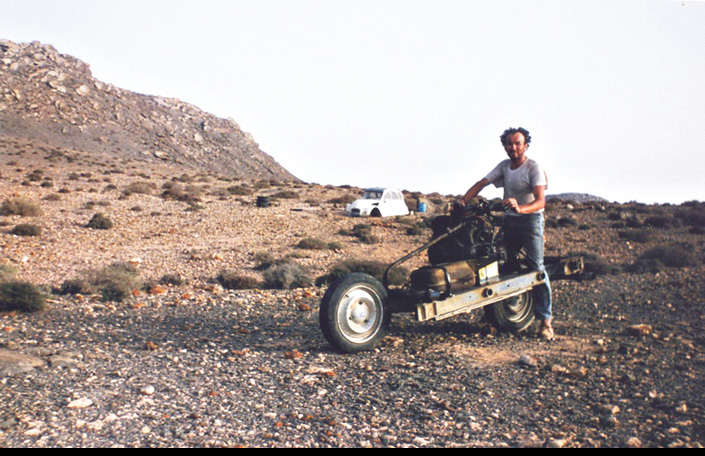
The way the story was initially reported in English – using images shot later in a quarry (above) – Saharan know-alls like myself were initially sceptical. If it really happened why not just walk back half a day to the road? I researched the yarn more closely for my Morocco guidebook and came across his own account published in a 2CV enthusiasts’ magazine a decade after the events. A faint ring of truth came through. Perhaps he did build the 2CV bike, but not in quite the circumstances he claimed.
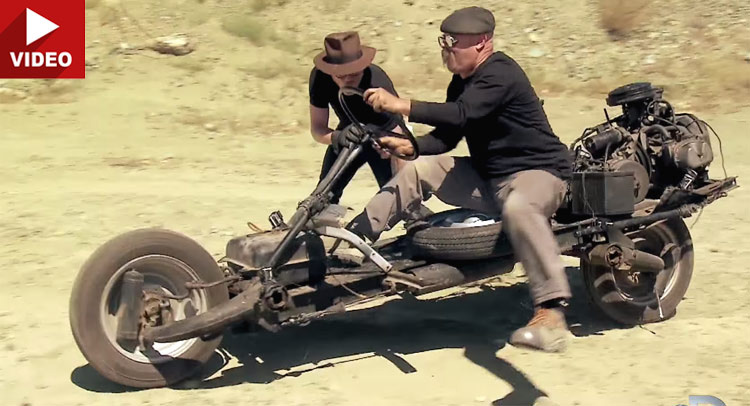
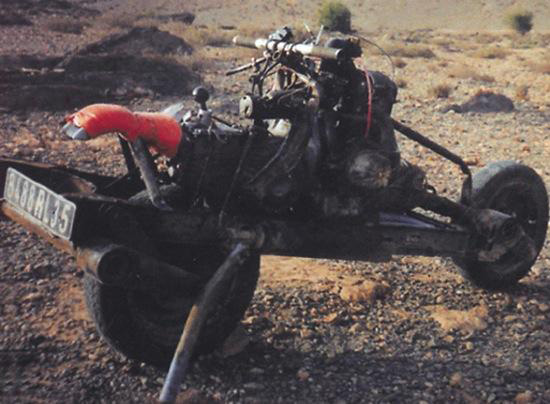
As the TV show, Mythbusters proved for themselves, his contraption was barely rideable (left) and within a day of leaving the rebuild site, Leray says he was caught by a patrol while camping in the desert and instructed to lead them back to the car’s remains to corroborate his story. Ironically, he goes on to claim (with convincing documentary evidence) that he ended up paying a 4500-dh fine (about €450) for driving a vehicle which did not conform to the one he originally imported to Morocco a few weeks earlier, even though he’d taken pains to tack on his ‘Steel Camel’s’ original license plate.
I believe the 2CV bike was indeed built in the desert, much as Leray claims, but he set out from France with the explicit intention of performing this task. Otherwise he’d have walked out like any normal person in a similar situation. His claimed unease about leaving his stricken car doesn’t ring true, let alone the spontaneous idea of making it into a two-wheeler. Tellingly, in 2006 Leray went on to build a ‘2CV boat’ in Mali. He clearly likes mucking about with 2CVs. Fair play to him!
Below is the translated story as posted on Leray’s website so you can form your own impression. Bear in mind there’s no reason to believe this account, but it may have been the original version.
In March 1993 Emile Leray set off to follow a route from Tan-Tan to Zagora. He left Tan-Tan with the required reserves of fuel and provisions as well as tools to keep his old 2CV on the road. As soon as the Royal Gendarmerie arrives, they strongly discourage him from continuing further because the zone beyond Tilemsem is prohibited, following new developments in the conflict between Morocco and Western Sahara.Emile must obviously turn around and the soldiers are asking him to take a passenger back to Tan-Tan.
Analyzing the situation, and seeing his project thwarted, Emile claims an insurance problem that does not allow him to take passengers, arguing that his 2 CV is already very loaded. He knows full well that in Africa it’s seen very badly to not take soldiers aboard his car in these circumstances. He claims naivety and misunderstanding in adopting the attitude of a tourist not familiar with local customs. Emile then returns to Tan-Tan under the disgruntled and disapproving look of the soldiers. He starts off at a good pace as he’s afraid he will be followed and he wants to remain out of sight of those whom he has just left. His plan is to bypass the area off-piste and return to his original direction … After a few kilometres he leaves the track to the north and traverses uneven and rocky ground.
After bouncing more strongly, the car jumps and brutally strikes a rock. He must stop because the 2CV does not respond very well. And for good reason – a folded wheel arm and broken spar … Émile organizes his encampment around the broken 2 CV and reflects on the situation. He is a few miles from Tan-Tan which he could reach on foot, but he runs the risk of leaving is car certainly in bad point but still able to attract theft, including its equipment. In the desert nothing is permanently lost, especially for the one who knows where to look.
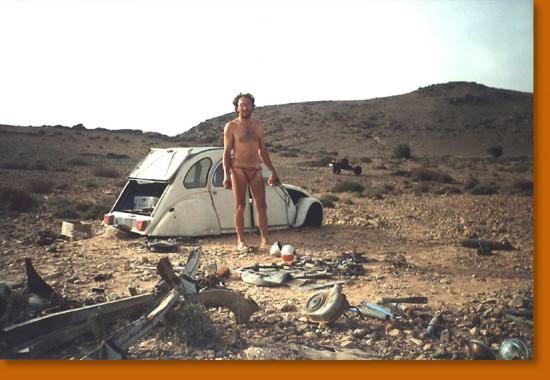
He has enough food and water so makes a decision which is to say the least, amazing: from his wreck, he will build a two-wheeled machine! One by one he carefully considered all the technical obstacles that this entails, and this master of African bush mechanics has all the tools and the elements to succeed in the task. The next morning he began to dismantle the 2CV, first removing the body which he will use as shelter against the cool nights and sandstorms. Having no long-sleeved shirts, against the burning sun he makes sleeves from a pair of socks.With what remains of the car, Emile Leray will try to build a motorcycle. Overnight he mentally reviewed all the stages and difficulties involved in this rather crazy project … A project that he had probably imagined for a long time but without having had the opportunity to realize it.
The wheel arms (to be removed with a hacksaw) are nested upside down on a reduced chassis of the front and rear side rails. The engine and the gearbox are then placed on the chassis in the center. Space should be reserved for the battery and the fuel tank and to keep space for luggage without neglecting the layout of the steering system.
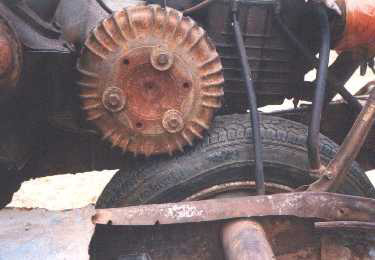
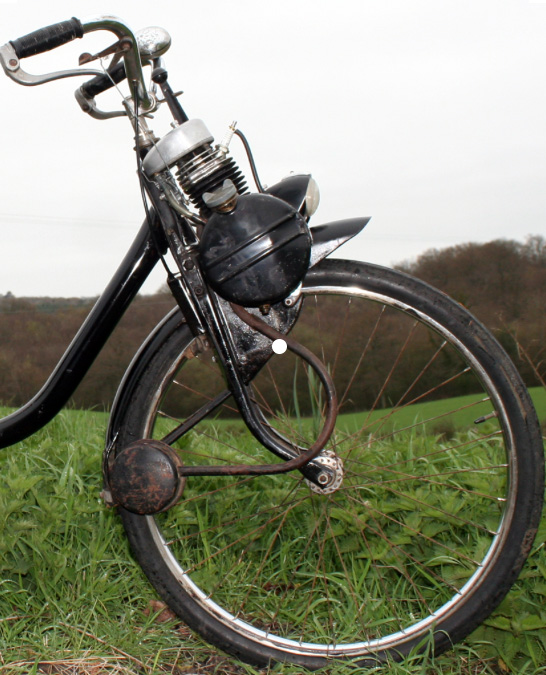
The most surprising thing about this 2CV motorcycle is the transmission. It was inspired by the Vélosolex moped idea (right): the engine drives a drum which in turn turns the tyre by friction, and which, by the laws of physics and mechanics, obliges it to roll with the reverse. Disassembling the gearbox to reverse the differential would have been too risky in this universe of sand …
It seems unthinkable to assemble this machine in the desert without the help of a drill and welding station. All parts were assembled by screwing. When drilling, it will be done in the African way: the piece of metal is folded to 90 ° to form an edge. At a fixed point this edge is weakened by a hacksaw or round file. At the limit of the drilling, the piece must be replaced flat to perforate the filed point with a hammer or a needle. The assemblies were made as much as possible according to the original holes of the chassis or engine-box unit. The rest is only a matter of time dependent on the quantity of his provisions. Émile believes he must spend three days building his bike – in reality it will take twelve … There was a great deal of uncertainty to carry out this project and it wasn’t so easy to realize as one might think. The possibility of failure remained present throughout the adventure, giving some anguish to the stranded mechanic.
The 2CV motorcycle was obviously not conceived for the sake of comfort, it is a rather secondary notion that was not imperative in what we can call the specifications. The prototype has therefore not benefited from some desirable improvements. It should be noted that, for example, the exhaust is free, so the nose and the ears are affected greatly by the engine’s gases. The bike does not have a brake, nor does it have foot rests which allow some control of the trajectory with the feet, because the craft lacks stability. On the first test the bike fell over, causing a great scare to Emile, who almost found himself crushed under his 200-kilo machine. The arrangement of the clutch and accelerator controls were particularly tedious. It was necessary to dismantle, adjust and reassemble the parts for optimum operation. Similarly, the tests were punctuated by frequent falls. To lift the two-wheeled steel camel proved particularly physically difficult … All these circumstances contributed to prolong Emile stay in the desert. The final day was be spent adjusting and testing and cleaning the bivouac site. It was an occasion to immortalize the moment thanks to a small camera with the trigger connected by a long wire. Émile poses in the middle of a place that in March 1993 was the theatre of his unusual feat.
He leaves the next afternoon leaving the parts that he will not use in the body shell of the 2CV. He takes with him the rest of his food (more than a litre and a half of water), the bed, the tool box, not forgetting maps and compass. A small foam mattress and a towel sewn together will serve as a tent. After a bumpy ride and a few stops for mechanical improvements, he encamped and slept at the edge of a track. In the night, he is awakened by three soldiers in 4×4, one of which immediately recognizes the “tourist” of Tilemsem. Very irritated to find him in the forbidden zone, he strongly doubts Emile Leray’s explanations; an accident followed by the transformation into a motorcycle. Intrigued by the machine, but totally incredulous, the soldier demands to see the carcass of the 2CV to have proof of this incredible story. The officer puts an armed guard by the tent and the motorcycle, then embarks with Émile in the 4×4. After an hour of research in the dark, the remains of the 2 CV cannot be found. Back at the camp, Émile is allowed to rest near the motorcycle until dawn, guarded a hundred meters away by the military in their 4×4. The next day, the carcass was found and the soldiers relax. Émile will learn later that his interlocutor wanted to recover the abandoned pieces for his brother-in-law …
In the early morning, Emile was ordered to take his motorcycle back, and ride in front of the 4×4. The convoy sets off slowly towards Tan-Tan but several falls seriously annoy the soldier, pestering against this unstable machine. Eventually the soldier calls by radio for another 4×4 to come to recover the 2CV motorcycle. Arriving at Tan-Tan on April 6th, things get complicated with a lot of bureaucratic hassles. At the provincial governor’s office, a report is drawn up, as well as by the Royal Gendarmerie. The vehicle is impounded
Emile has the disagreeable surprise of learning that he has to pay a tax of 4500 dirhams. He is very unhappy because the customs officers had spoken to him on the eve of mere formalities. The vehicle is regarded as dangerous and no longer corresponds to the description of the registration documents. “Delay in importing a non-conforming vehicle” is the charge, and by paying the fine he can regain his freedom and recover his contraption, but not be allowed to drive it.One could say a lot from this misadventure about the complicated relations between Africans and Europeans on the issue of money ...
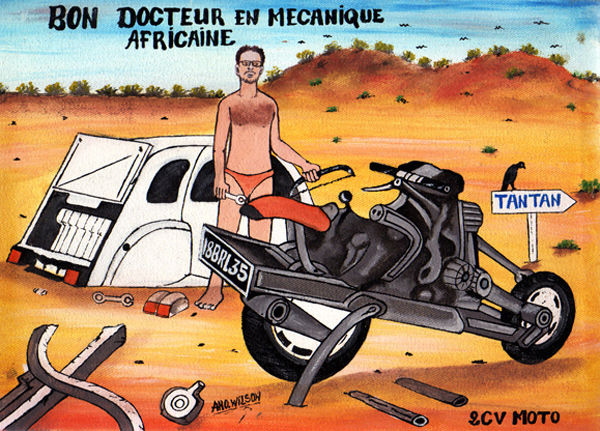
The next day Emile is summoned to sign the forms to exit the territory, and leave for France. He thinks he should come back as soon as possible to get the bike back, but by then he must find a place to park it. There is no question that he leaves her in the pound, it may cost him dearly, and the place is not guarded. A customs officer who is more sympathetic than his colleagues offers to take the steel camel home while waiting for him to return to Morocco. A month later Emile made the 3500-km journey between Rennes and Tan-Tan with another 2CV to pick up his motorcycle, now dismantled in three parts … Since then, the steel-motorcycle camel has enjoyed the honors of the press and participated in a few events such as the Aventure and the Inventors of Rennes, the fiftieth anniversary of the 2 CV in Saint-Quentin-en-Yvelines, Without forgetting the Motards have heart. Émile returned several times to Africa, and in 2006 took a new opportunity for the Doctor of African mechanics to exercise his transformational talents on the steel camel [below]…
For more information: full story and technical details in 2CV Magazine March-April 2003.
In 2006 Leray went on to build a 2CV boat in Mali. He clearly likes mucking about with 2CVs!
Updated January 2024 Now only 2 + 10km of piste remains, but plenty of gravel and broken tar
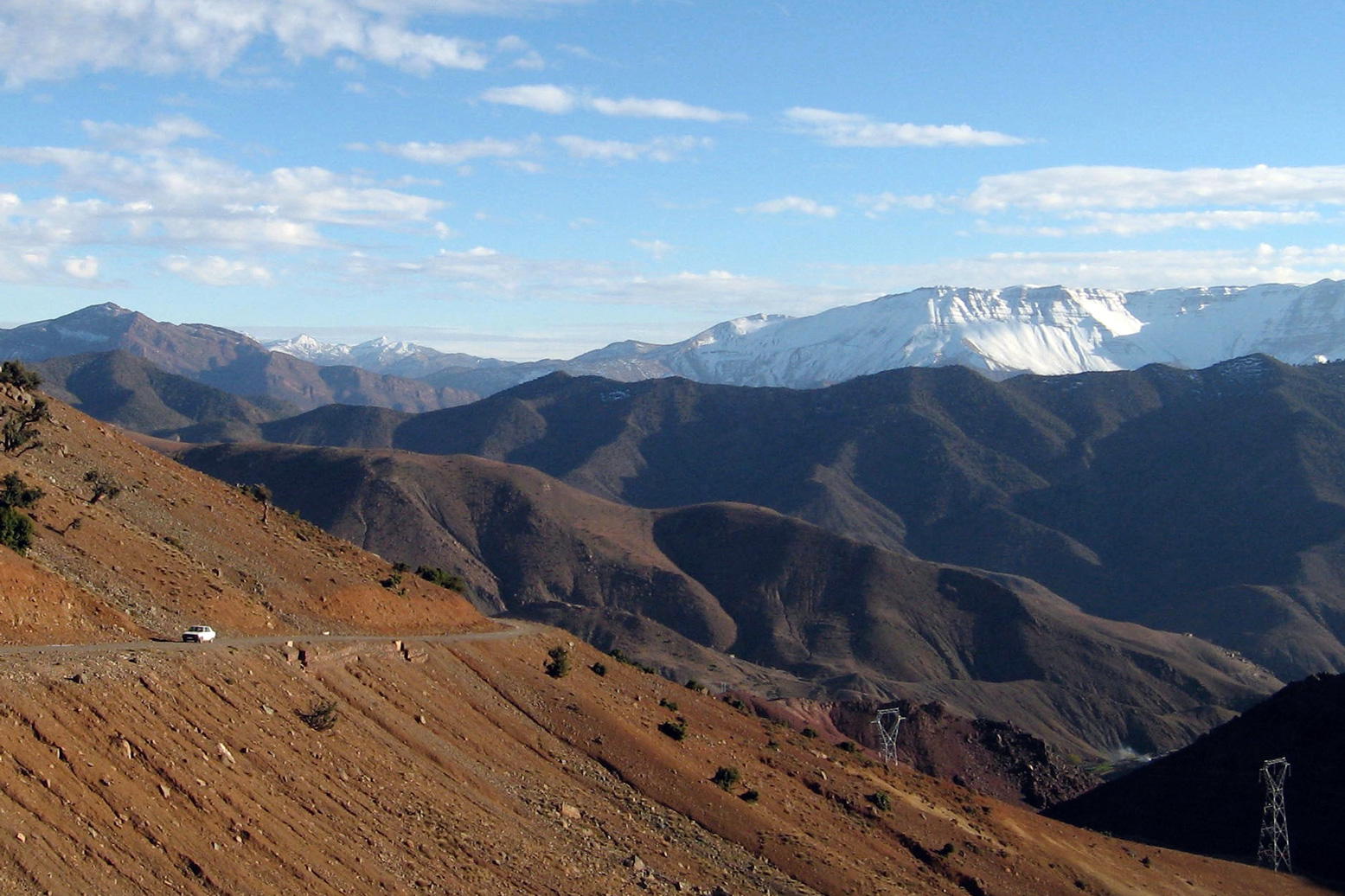
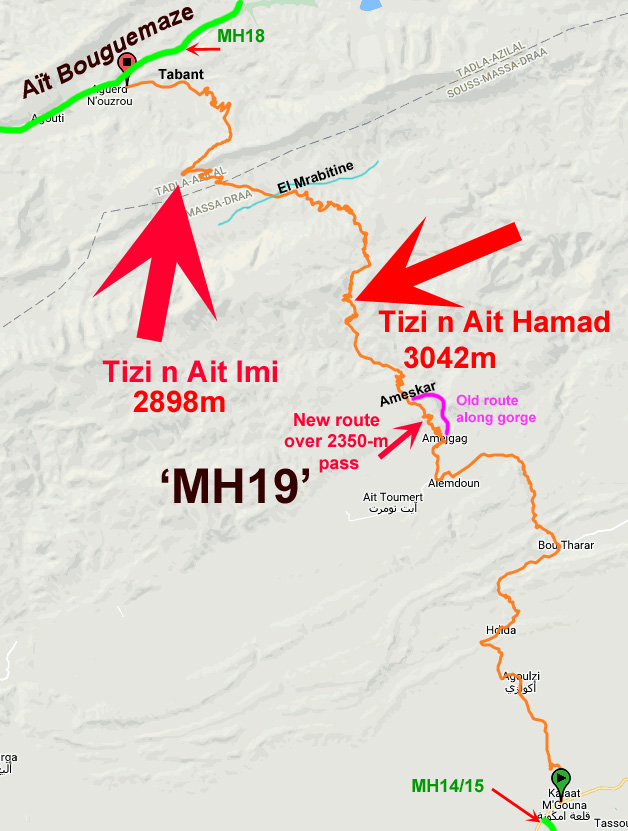
In 2017 Moroccan road builders completed a new High Atlas crossing. I heard about it too late to describe fully in the 2017 edition, although it is mapped on page 110.
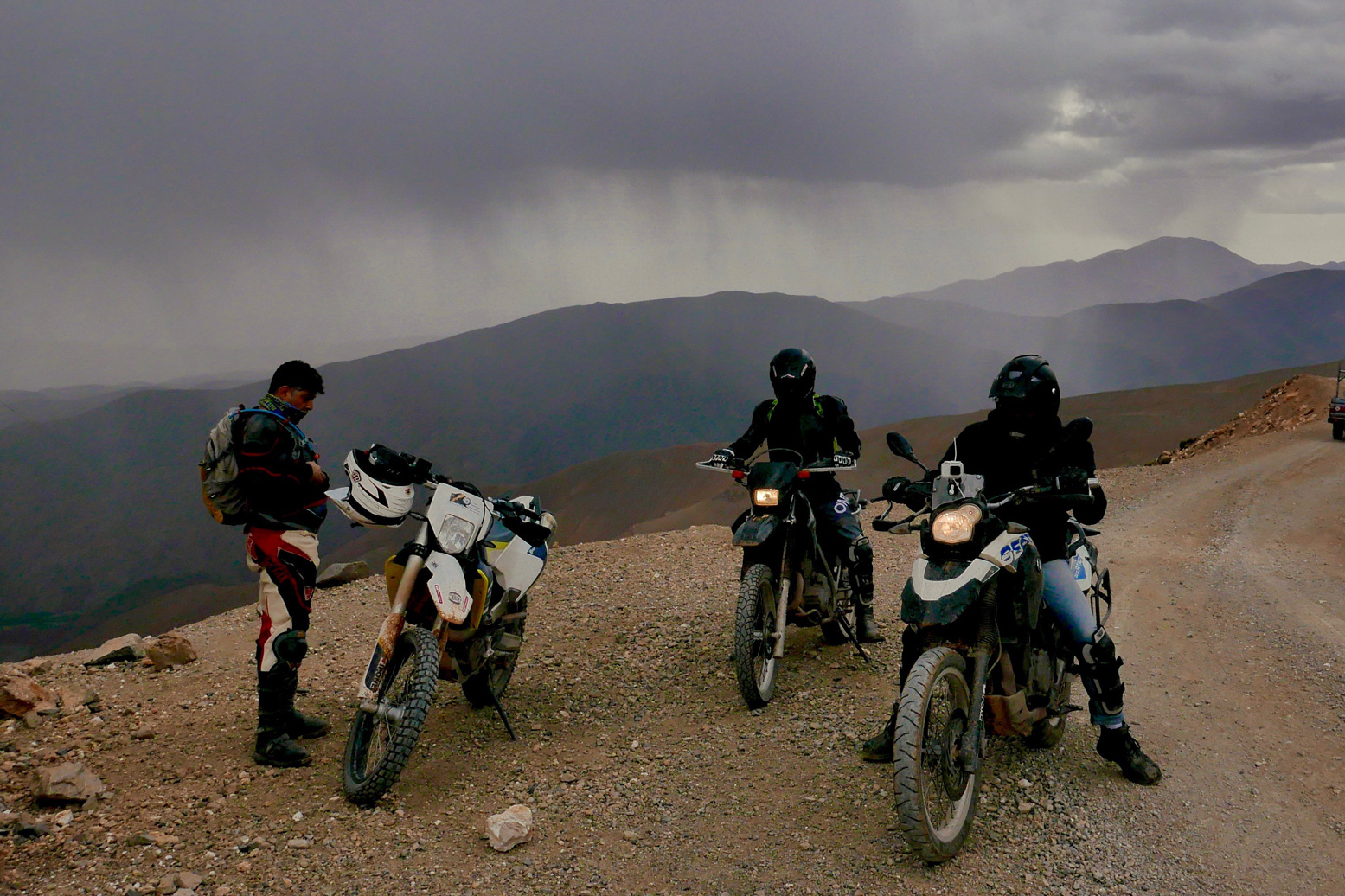
I got to ride the route on a 250 just as the book was published in October 2017, and again about a month later southbound in a 4×4. Now it’s a straightforward drive once you find the start points, doable without much of a description or GPS. Northbound, all you need to know is: 1. Pass through Alemdoun village and stay on the tarmac and first right over the first pass. Southbound, just east of Tabant turn right (south) over the ford for the easy 17-km climb to the Ait Imi pass.
Fuel Aït Bouguemaze end, the nearest fuel is either Azilal, 79km to the north via MH17 – a fabulous drop from the pine forests. Or stay on MH18 west to Demnate; 83km – about 90 mins of near-constant bends. Also ‘Ouaoui‘ further north via the Cathedral cliff. You can also buy fuel by the litre from shops in Alemdoun and Tabant and other small towns.
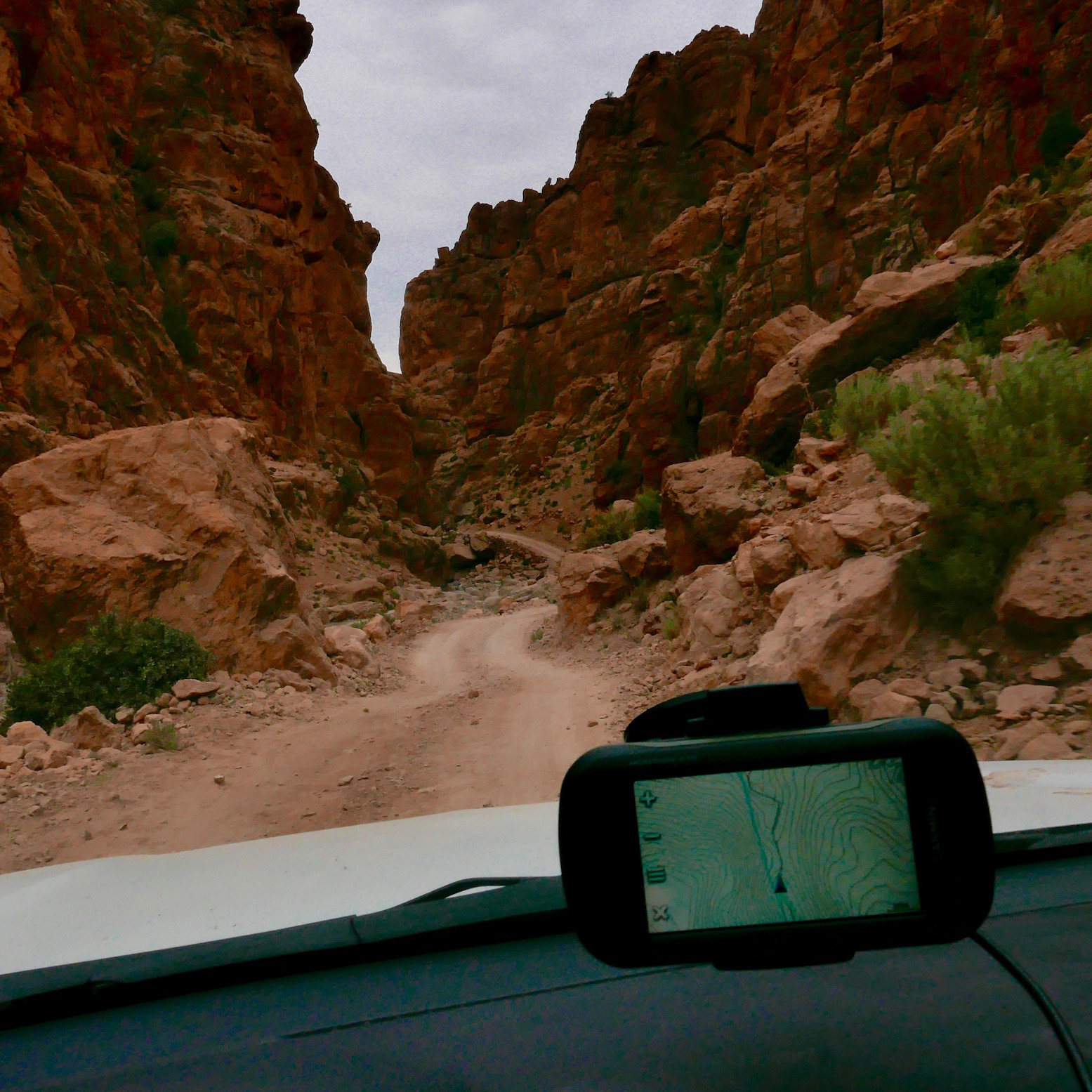
One time at Amelgag we chose the gorge route (right) instead of the climb over the pass to Allemdoun, a great diversion (and the original route) which is still used by local Merc taxivans. Coming north, turn off right at the bend as you enter Amejgag village and wind your way north through the village to the gorge.
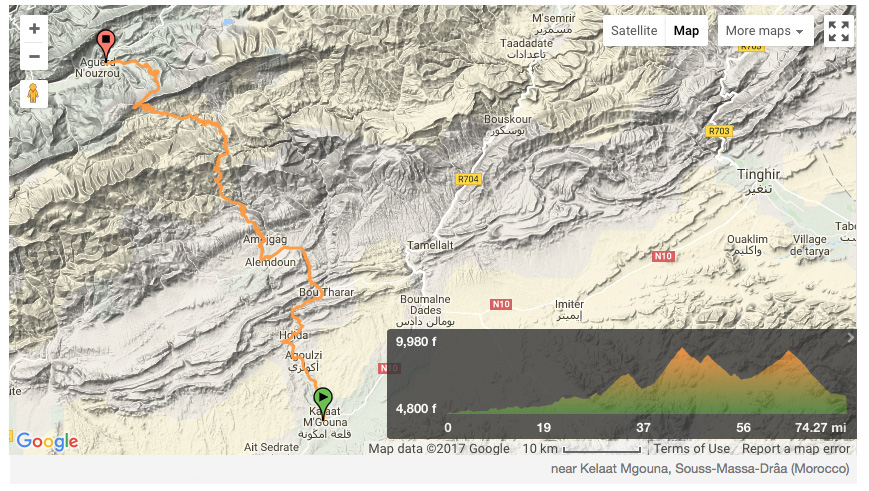
The sealed route takes you up over a 2350-m ‘AmejgagPass‘ (KM50) before dropping down to Ameskar and joining the gorge route (KM56). Now the steep climb begins to the 3042-metreTizi n’Ait Hamad (~KM65). From the top of this pass (left; telecom tower; bloke in a hut) Jebel Mgoun summit (4071m; second only to Toubkal) is a 16km walk to the west.
You descend from the Ait Hamad (above), climb an intermediate pass then descend into the valley of the Mgoun river, bypassing some remote villages around El Mrabitine. Cross the Mgoun stream (KM83) and climb less steeply on dirt for 10km to the Tizi n’Aït Imi (2898m; ~KM98). At the top Aït Bouguemaze valley lies 20km below. Busy Tabant village(KM117) has shops and basic bap cafes before you join MH18(if heading west). As the whole area is popular with trekkers, there are several auberges hereabouts.
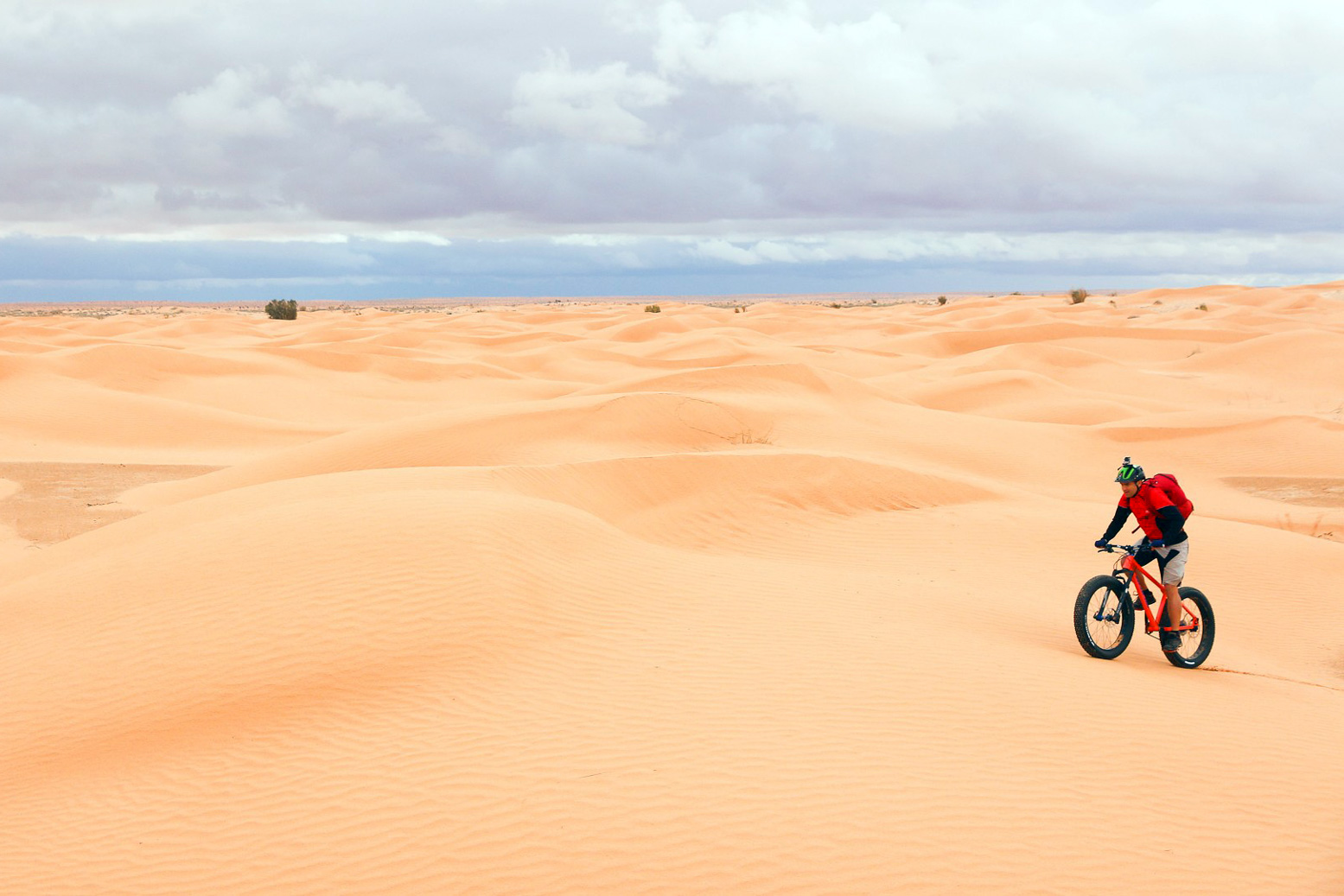
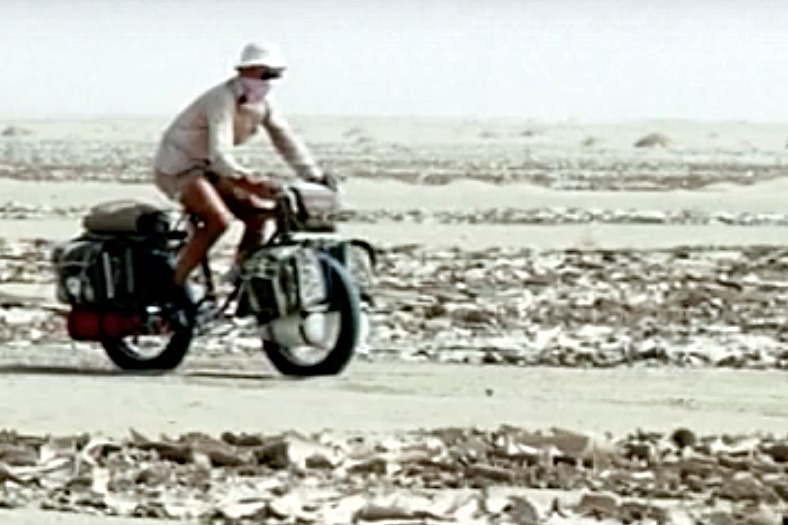
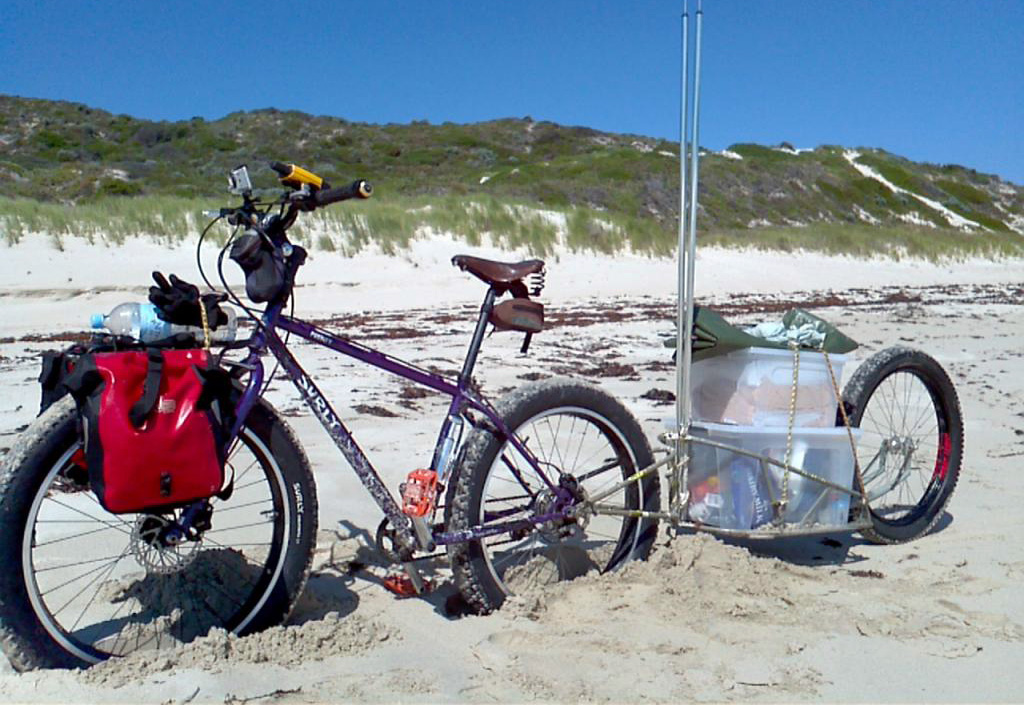
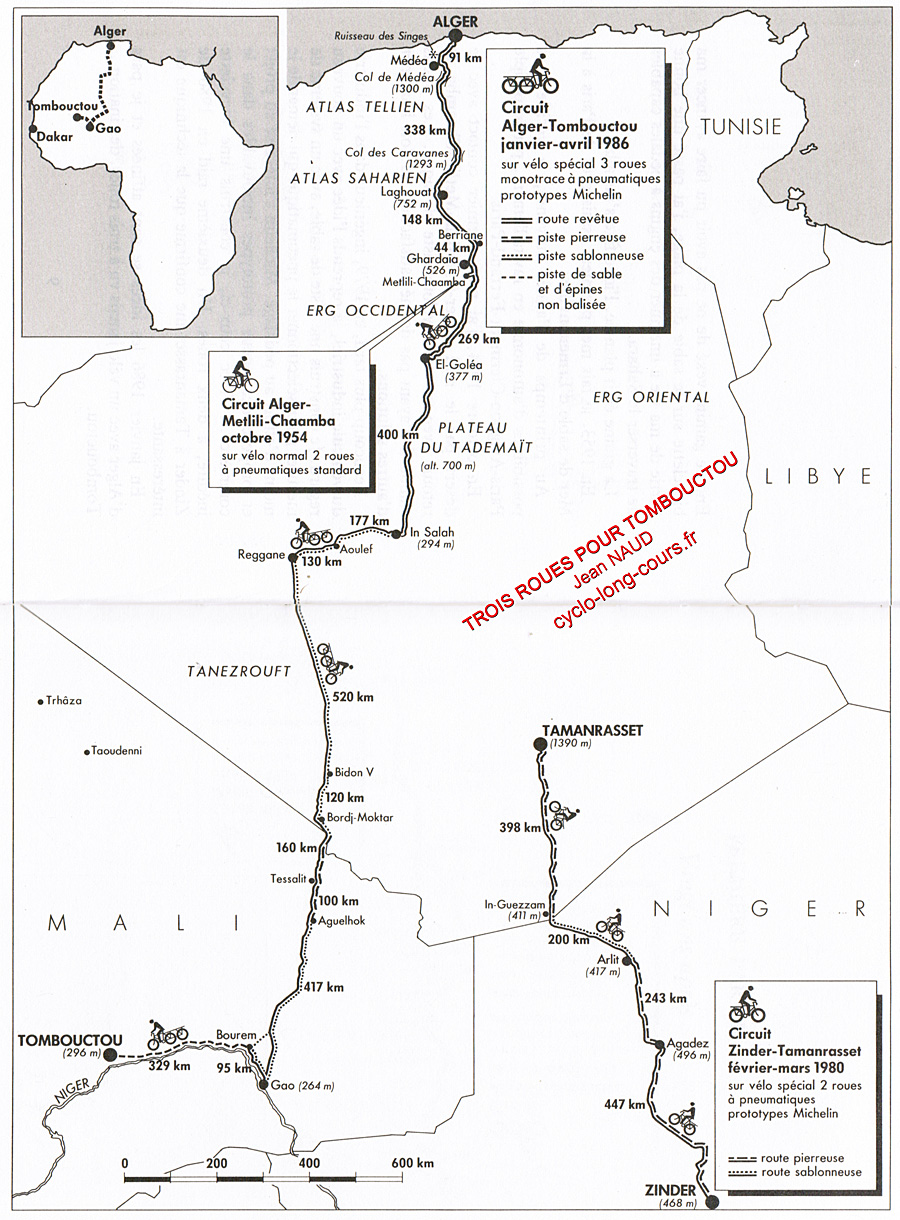
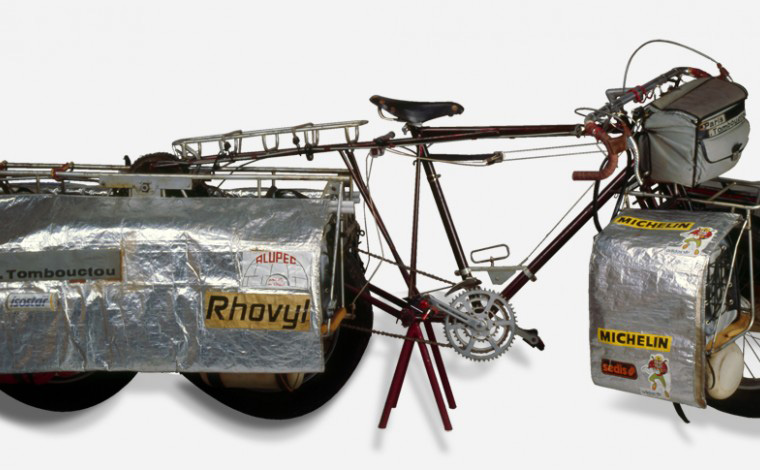
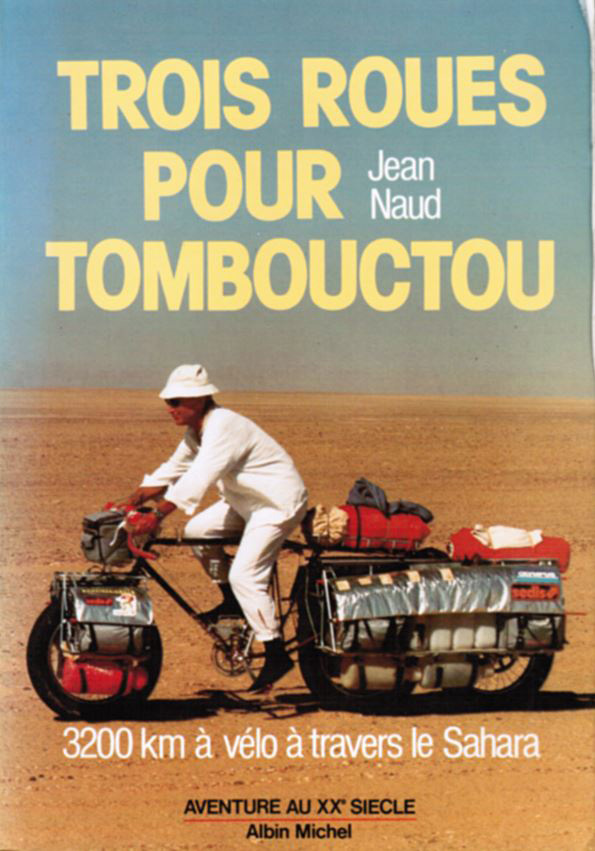
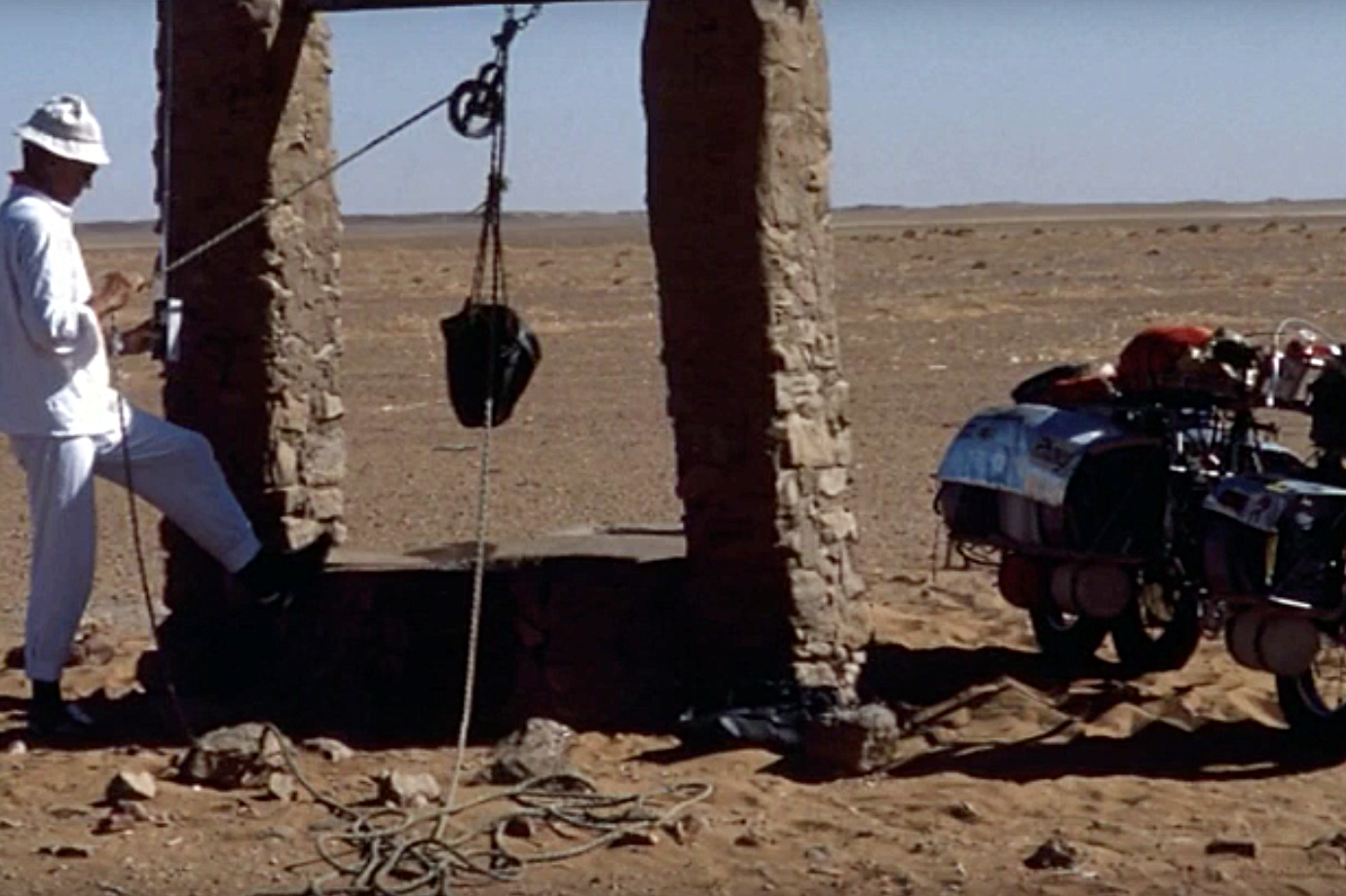
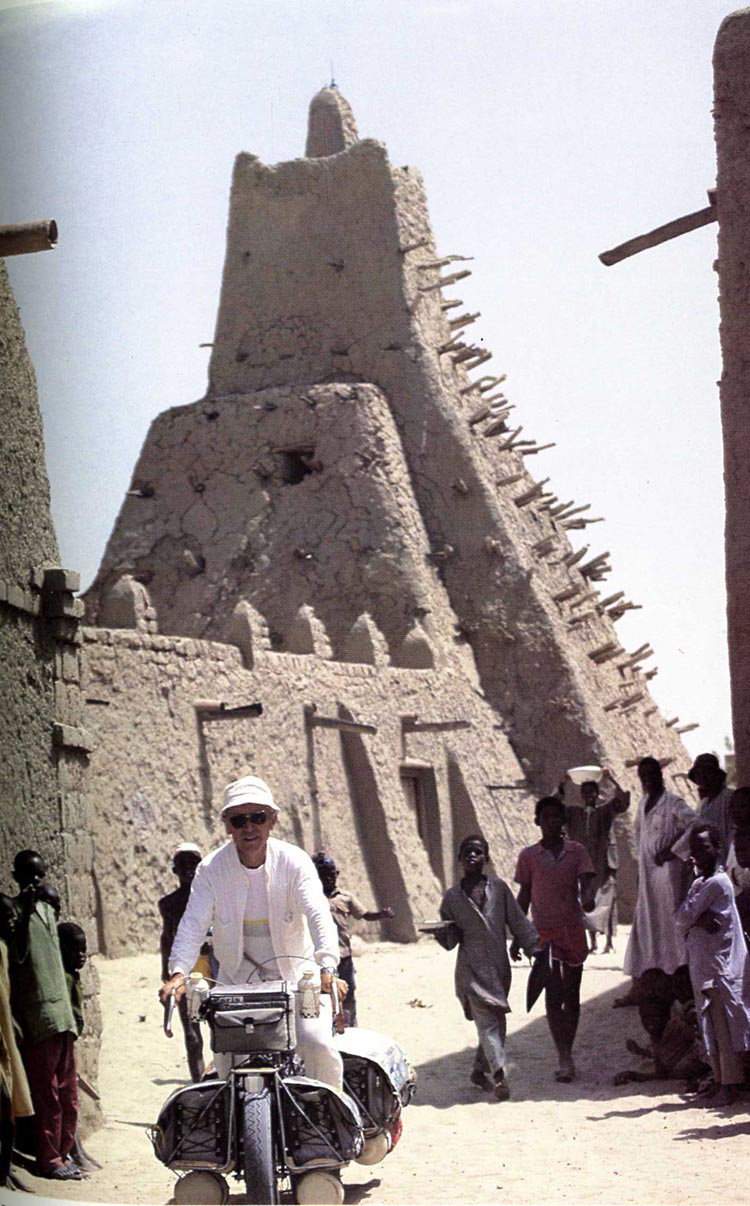
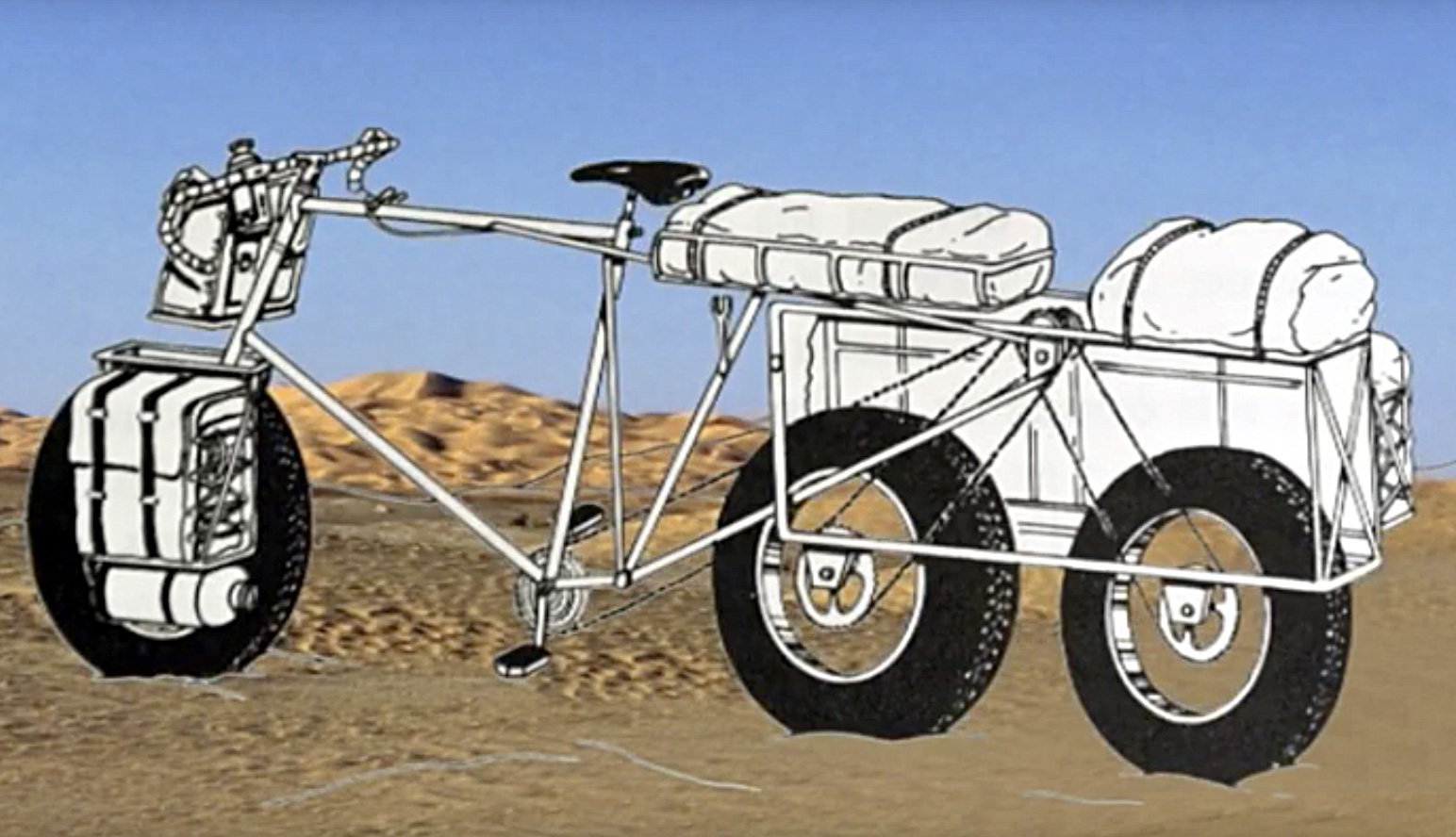
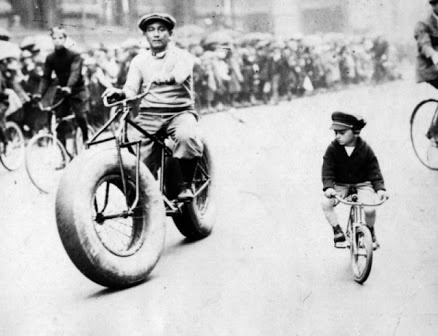
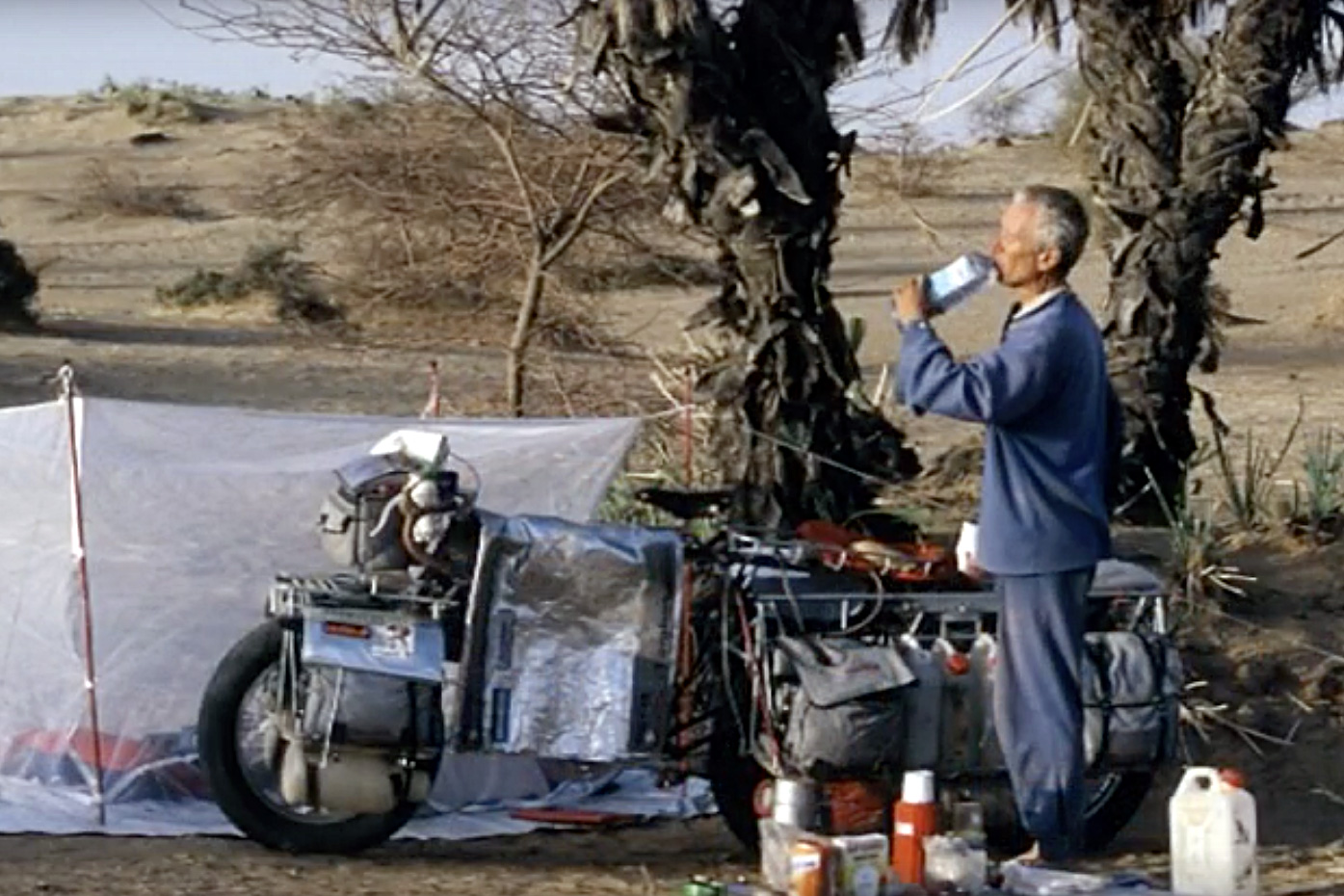
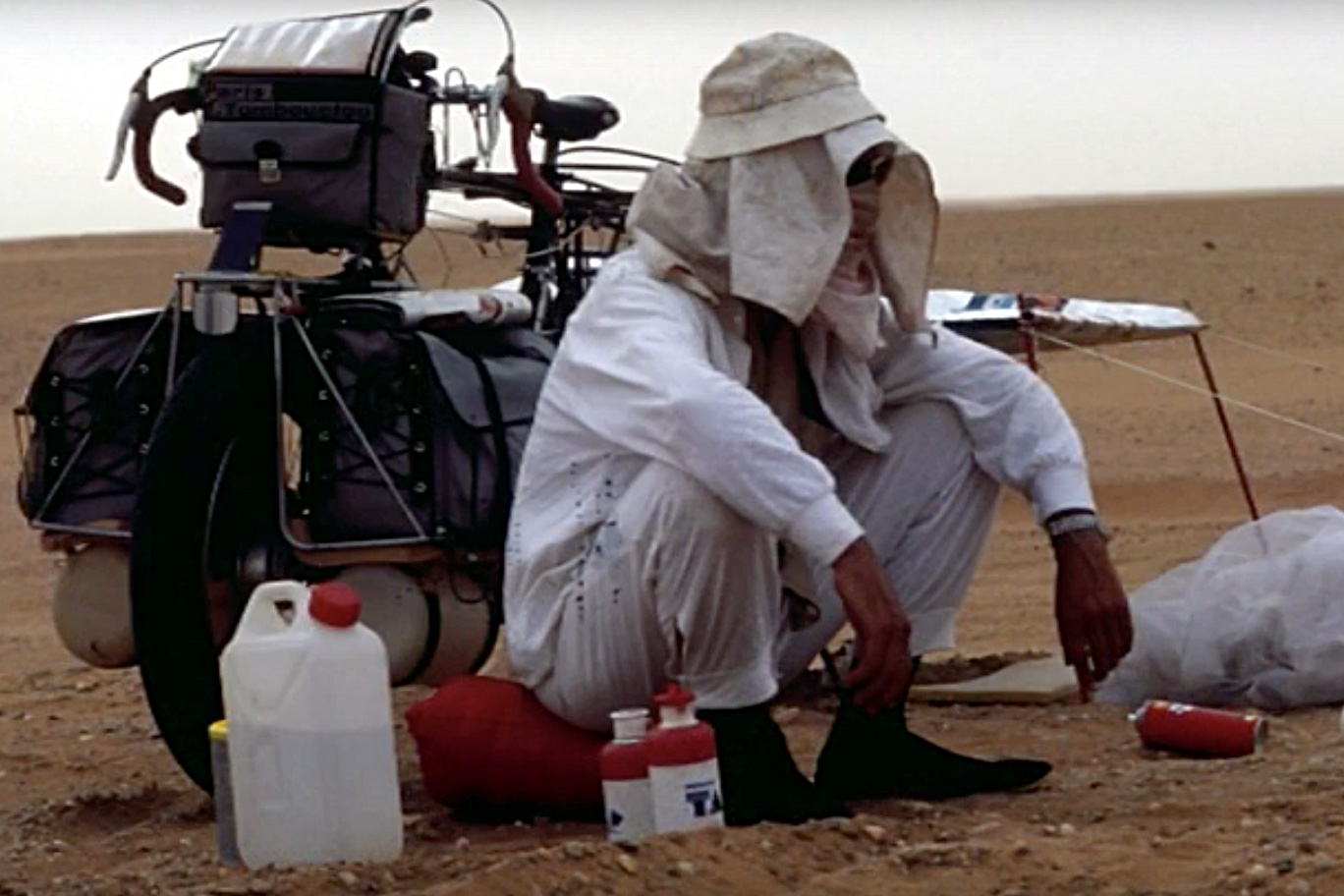
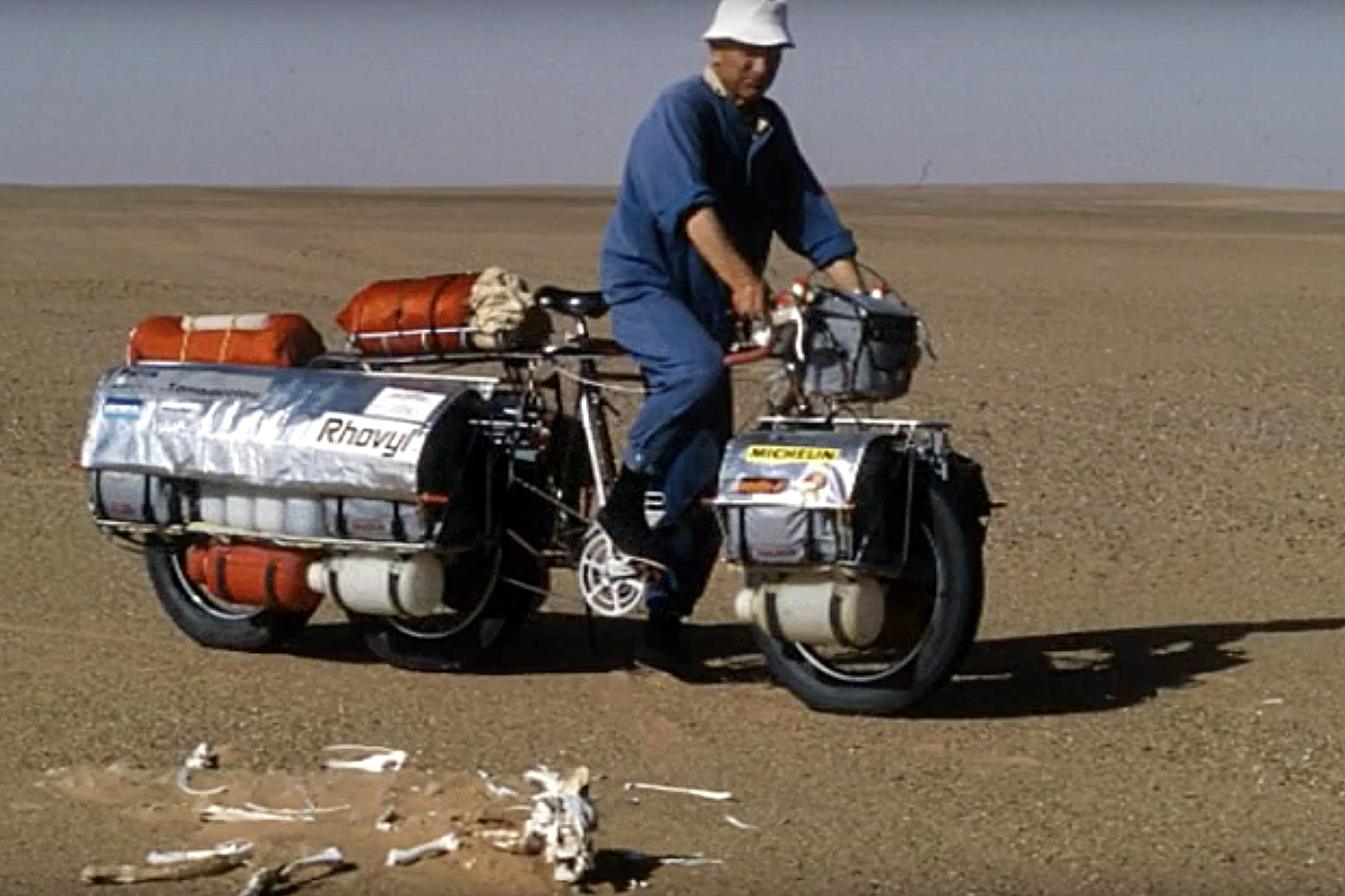
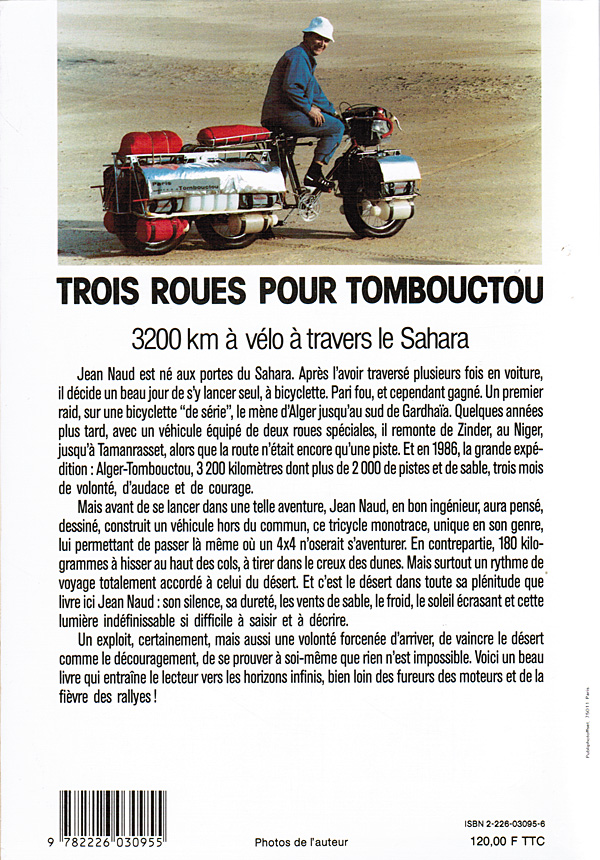
In 1986, long before the current fat-bike fashion (left), Jean Naud, a 55-year-old Frenchman set off to ride his three-wheeled bicycle 3200-km across the Sahara from Algiers to Timbuktu.
Brought up in Blida, just south of Algiers at the foot of the Atlas mountains, Jean Naud had made two previous cycle tours in the Sahara. Once, as a 23-year-old way back in 1954, from Algiers as far as Ghardaia where he was born in 1931. And another in 1980 (below) from Zinder in Niger, north via Agadez and across the Sahara to Tamanrasset – a distance of some 1300-km. This time he was riding a bike running prototype, low-pressure Michelin fat tyres. At that time this route would have been just about all piste, but he recalls passing some Brits stuck in the sand near the Algerian border in their Peugeot 404, as he cycled silently past.
Although the Sahara isn’t all a wasteland of soft sand dunes, the thin tyres of a regular bike would easily sink or damage the rims on rocks under the required loads needed for desert travel. I’ve met the odd cyclist in the Sahara. The big problem with off-highway pushbiking is the load needed to maintain autonomy, not least, water. On a conventional bike it’s barely possible without relying on passing traffic, because the tougher the terrain the greater your water consumption. Even in winter in the central Sahara, I’d guess you’d need five litres to cover about 60 kilometres on a sandy piste. And that would be a long day.
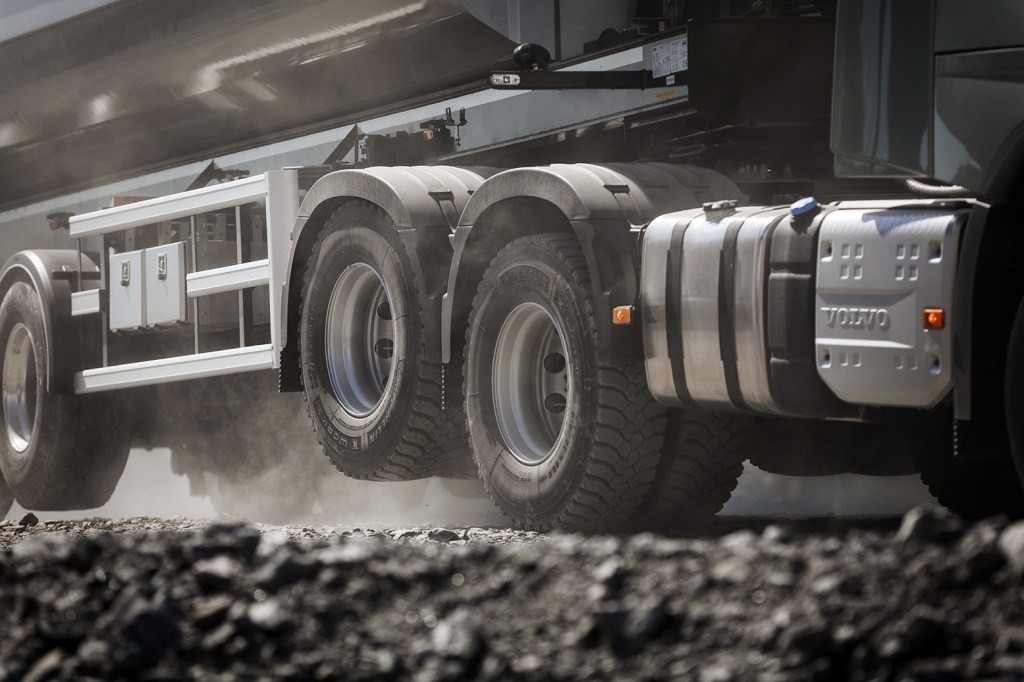
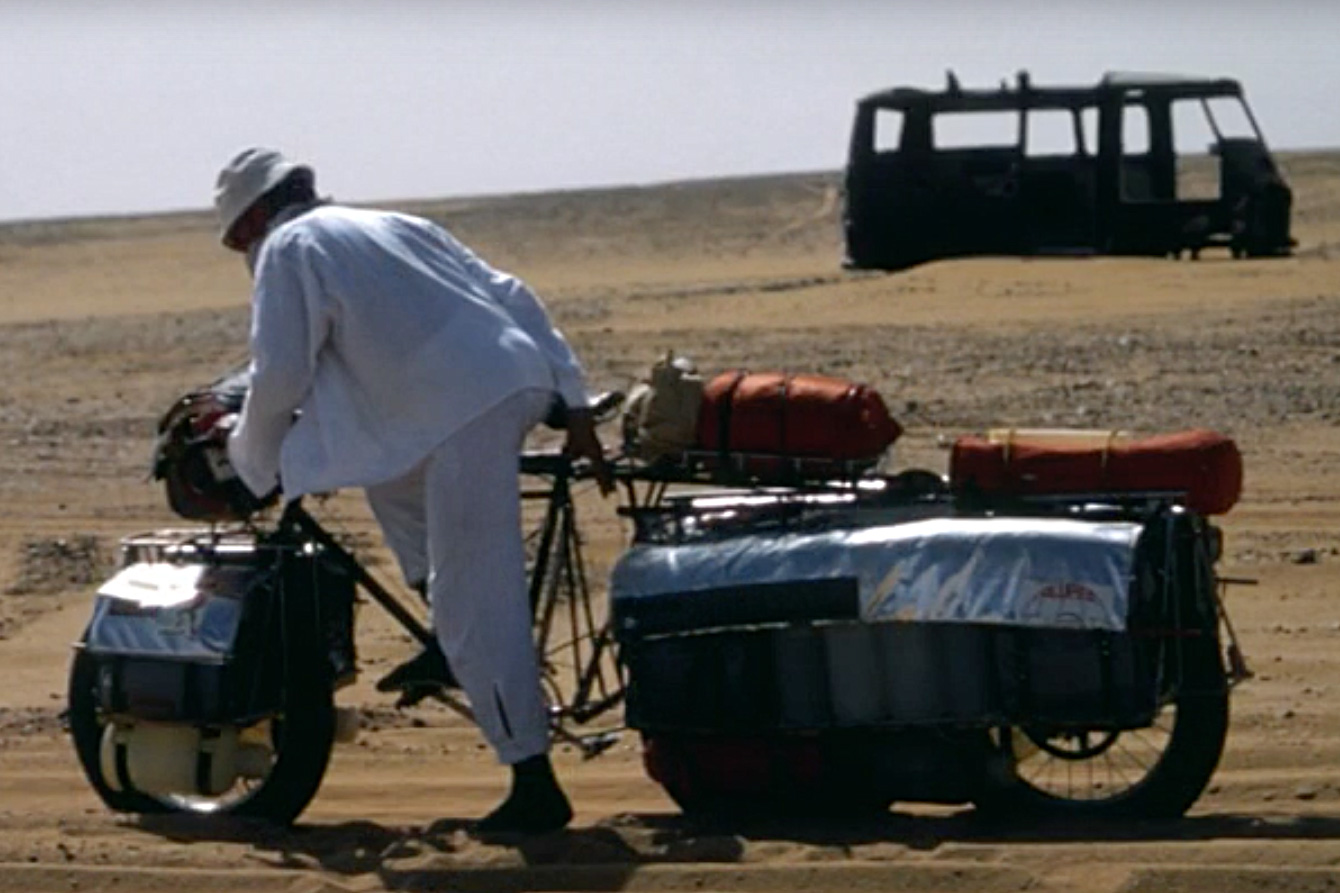
An automotive engineer, Jean Naud’s initial solution was to run fat tyres in 1980 in NIger. This time he added a second driven rear wheel to improve traction and aid flotation at pressures as low as 7psi. He then went one step further and devised a hefty hinged subframe (above) which could both raise and disengage drive from the middle wheel to reduce the drag and pedalling effort on firmer surfaces, or when running lighter loads. Mechanically, disengaging axles (as well as hubs) was commonly done on pre-electronic 4x4s in the 1980s, for the same energy-saving reasons. And today on lorries we commonly see lifting axles.
Using the modern Bob trailer on a fat bike (left) is a similar and probably more efficient solution. The added effort in towing the loaded-down third wheel, rather than powering it as Naud’s 2WD bike could have done, is negated by the weight savings and the lower centre of gravity. You get the feeling Naud was merely experimenting with novel engineering solutions, as he discusses in the video below.
Naud’s three-wheel ride to Timbuktu (below) included at least 2000-km of piste. The route he took to the Mali border across the Tanezrouft is actually a firm gravel plain, about as easy surface to ride or drive as you get in the Sahara. Naud reckoned 20kph was easy. Beyond that, it gets progressively rougher and sandier down towards the Niger River and, having ridden it on a moto in 1989, it’s hard to believe he managed to cycle the final section west along the Niger’s north bank to Timbuktu. It’s very sandy.
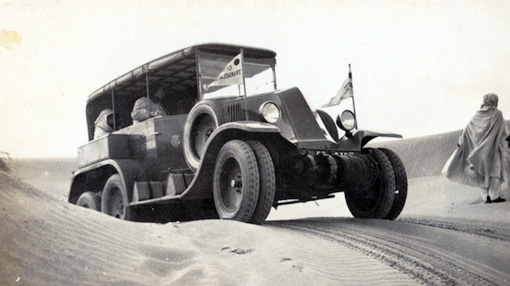
Even then, the Tanezrouft was the preferred route of the earliest Saharan motor crossings from the 1920s onwards by Citroen and Renaults (left; also using a ‘double-wheel’ idea to spread loads). The only problem in Naud’s time, was the Tanezrouft route lacked regular wells compared to the sandier but shorter Hoggar Route which Naud rode in 1980.
After visiting his childhood home in Blida, early in the trip while still unfit, it took Naud no less than eight hours to cover 14km on the climb to the 1300-m Col de Medea where the N1 tops out in the Atlas, before descending to the Saharan peneplain. Once fully loaded with 72 litres of water and another 60kg of gear, his 50-kilo monotrack three-wheeler weighed in at 180 kilos. That’s at least three times more than a modern touring bike, or five or six times heavier once fully loaded. Or, about the same as a small lightly loaded motorcycle ready for the desert. Imagine pedalling that!
Jean Naud died in 2011 aged 80. You can find his 1987 book covering all his Saharan cycling adventures, on amazon France.
His bike may still be on display at the Museum of Sport in Paris
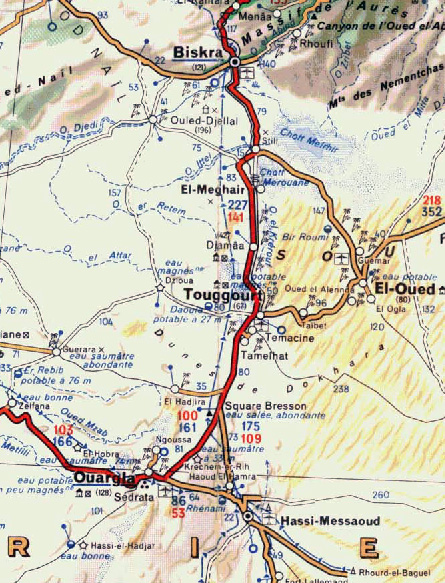
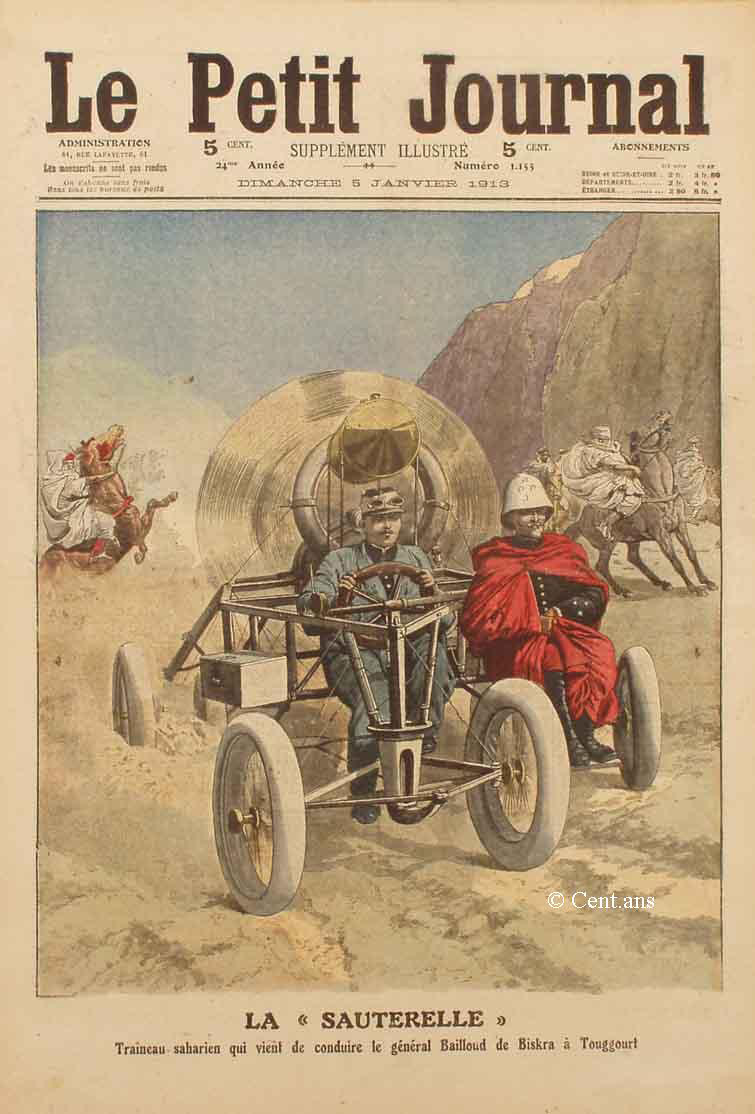
“We left Biskra with Corporal Dewoitine as a mechanic, and took hours to reach Touggourt, averaging 50kph, despite a trail of frightful ruts. Our arrival was all the more sensational than in an airplane because I drove right down the main street in a torrent of dust, skimming past walls and passers-by with with my propeller, causing burnous, guenours and chèches to fly in all directions. It was a beautiful panic!
The two adventurers quickly left Touggourt in a cloud of dust, heading for Ouargla, but the infernal locust began to show its first signs of fatigue: sand gnawed the leading edge of the propeller and the engine dropped to half power. De La Fargue ordered Dewoitine to head for Square Bresson, a junction and small oasis 50km away.”
Just before WWI, at the motor era matured on land sea and air, various self-propelled contraptions came to be tested as a means of penetrating France’s vast Saharan territory. Lacking the railways which by then traversed America and southern Asia, up to that time columns of men had to trudge alongside huge camel caravans, making them vulnerable to still hostile desert tribes.
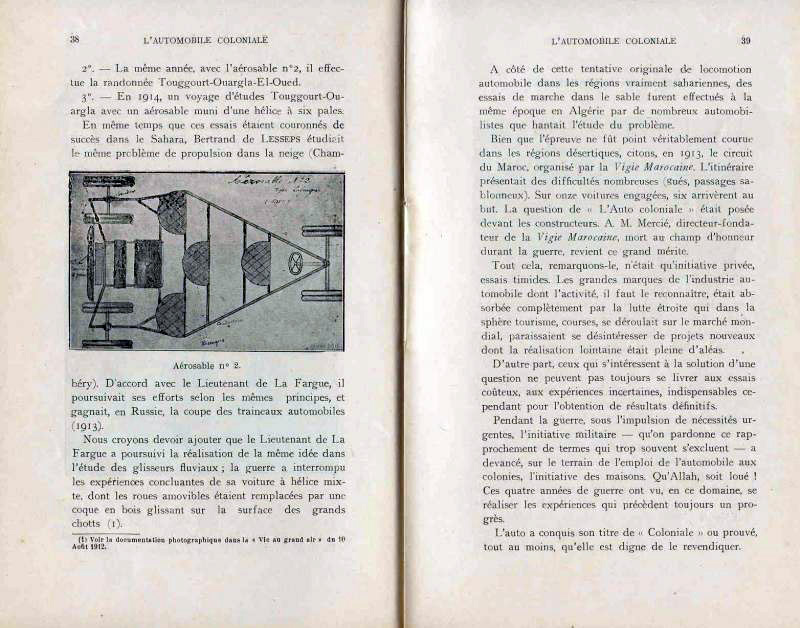
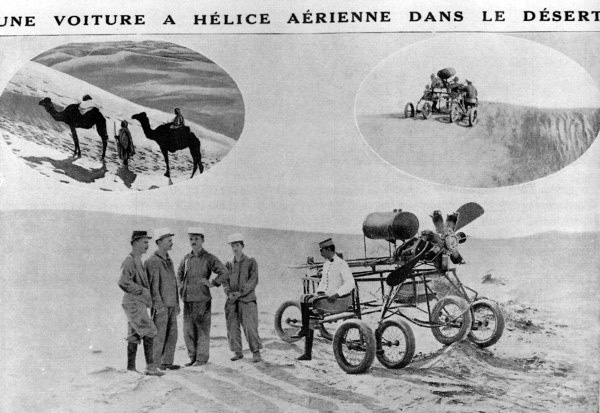
An ingenious combination of airplane landing gear with a cab stuck on top, the distinctive propeller car was one short-lived solution to enable rapid communication across the desert. Invented by Corporal Gustave Cros, the chassis was an elongated triangle on three axles, each carrying twin wheels, while a propeller directly fixed to a 50-hp motor thrust the vehicle forward. It’s said an ingenious form of highly articulated independent suspension allowed each of the wheels to track the terrain, however rough.
This curious but surely deafening machine proceeded in a series of jumps which supposedly allowed it to cross large sand dunes, hence the name Sauterelle or ‘grasshopper’. You’d hope seat belts were mandatory, less an unexpected lurch while climbing a steep dune launched you backwards…
Early models, like the one right, were considered too light to be stable but nevertheless progressed from two to four to six blades. Capable of 60kph, in the summer of 1914 the Sauterelle left the rail terminus at Biskra for a 200-km test run to Touggourt. The main difficulty was said to be slowing down and stopping, but that didn’t stop a chap called De La Fargue modifying a 60-hp Brasier car; his six-bladed ‘Aerosable’ hopped its way to Touggourt in just two hours. Encouraged by this achievement, he went on to consider an amphibious vehicle whose wheels could be replaced by a wooden hull for sliding over the salty Saharan chotts where even camels feared to tread.
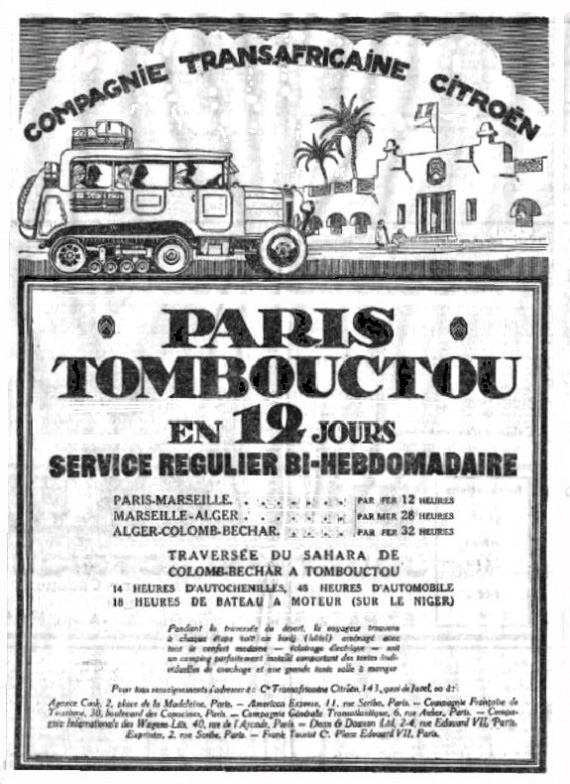
You do wonder what they were thinking. Presumably it was a solution to the problem of powered axles digging in to soft terrain. Perhaps pneumatic tyres were crude and couldn’t reliably be run at low pressures to elongate the footprint and so increase flotation, or that idea was not yet known (in Libyan SandsRalphBagnold wrote of discovering this technique in the 1920s). Hence, doubled wheels all round, like the Renault (above left), or the Citroen half-track desert taxis (right) which were also used on epic trans-continental proving expeditions, long after the Sauterelle had hopped itself into the scrapheap of automotive dead-ends.
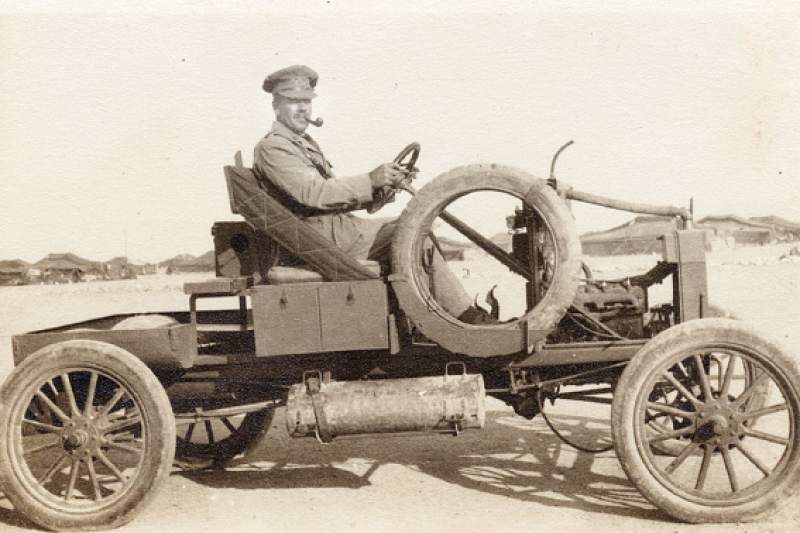
By the end of the 1920s, this period of wacky inventions had run its course while several esteemed French Saharans died in lonely desert plane crashes, But from as early as 1916, on the other side of the Sahara, the British Light Car Patrols were successfully deploying conventional but stripped-down Model T Fords deep across the Libyan Desert, and all without trailing a deafening sandstorm wherever they went.
Translated and adapted from this postby Oliver Boulwhere you’ll find lots more interesting stuff.
Half a century ago when the Sahara was more accessible, lateral crossings, all of them west to east, used to capture the imagination of adventurists, both private and corporate. Although such transits aren’t what it’s about to me, I wrote a box for the final edition of Sahara Overlandabout the four best-known vehicular transits which, broadly speaking, set out with this goal in mind, and expand on this page:
As I suggested in the book, a true, unbroken, all-desert lateral crossing of the Sahara with vehicles had yet to be achieved and as things stand, never will be in our time. If you combined the British route across Mauritania and Mali, then follow the French or Germans to Dirkou in Niger and the French or Belgians east of there, you have a pretty good line. As it is, even with a lot of road-driving in Algeria, I’d say from Tan Tan 9000km east to Port Safaga near Hurghada on the Red Sea, the Belgies get the nod (map below but note the oddly misaligned borders, not least Niger-Chad).
The chances of achieving a true Saharan traverse are currently about as slim as they’ve ever been. Much of the Sahara of Mali, southern Libya, northern Niger and Egypt are unsafe or off-limits. Eastern Far western Mauritania is said to be the same, and much of southern Algeria between Bordj east towards Djanet (as we did in 2006) is now restricted.
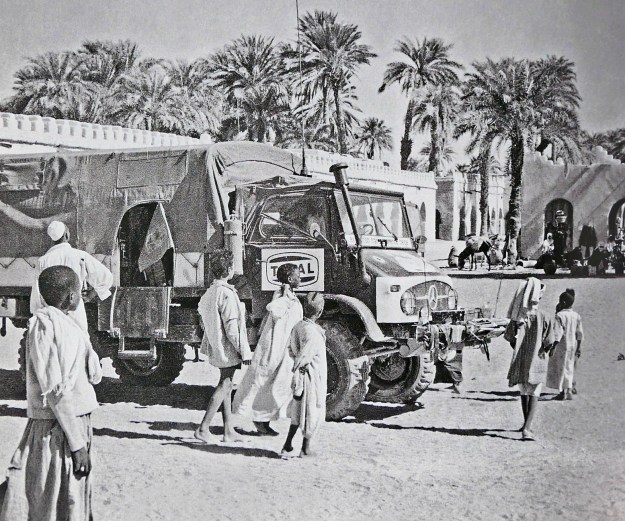
Unimog in Faya, 1965
Northern Chad always presented difficulties from the mountainous terrain, let alone permissions and security issues. Meanwhile, people smuggling convoys still roll into Libya across northern Sudan above Darfur and are preyed on by bandits.
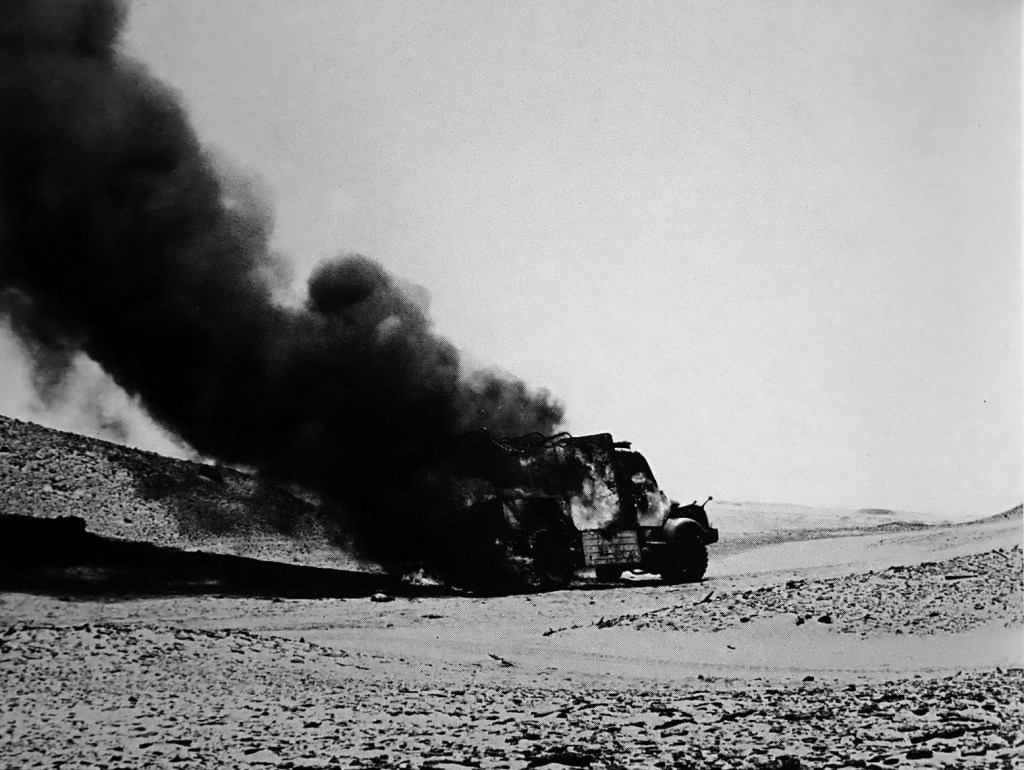
One Hanomag burned out in the Gilf or thereabouts.
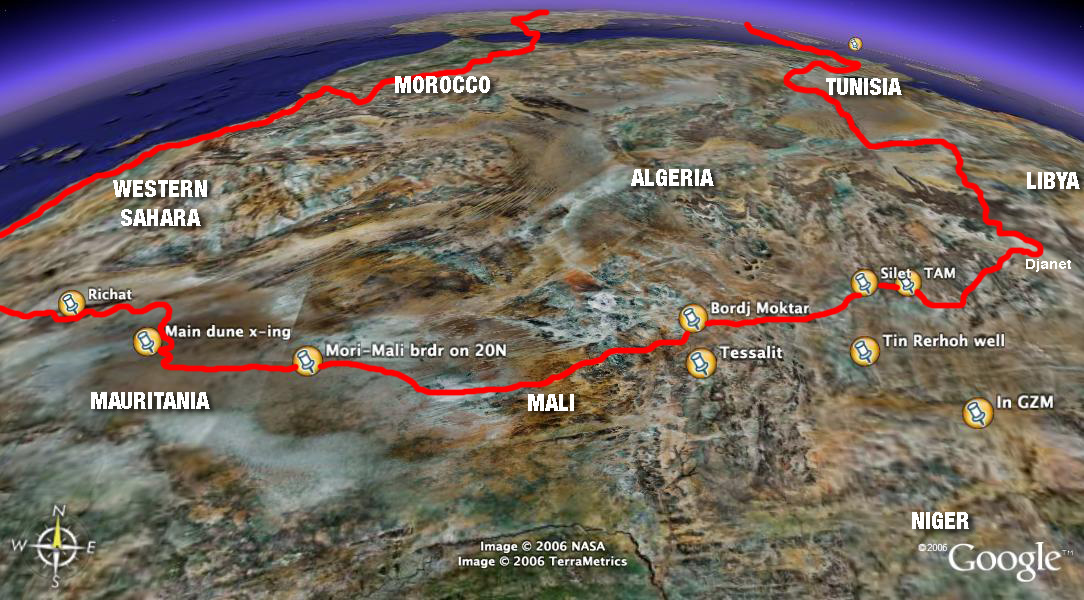
JSE 1975 route
In southern Egypt the Gilf has so many access regulations that few bother any more. Even in the west-east expedition era, permissions heavily restricted access: the Belgians had to enter Algeria from Spanish Sahara, not Morocco; the Brits couldn’t enter Algeria at all which kiboshed their plans and they went via Nigeria (left). Meanwhile the Hanomagers bounced for over 16,000km between the Maghreb and the Sahel like pinballs, but did a whole lot of classic desert routes; and the French seemed to dodge Algeria and Chad.
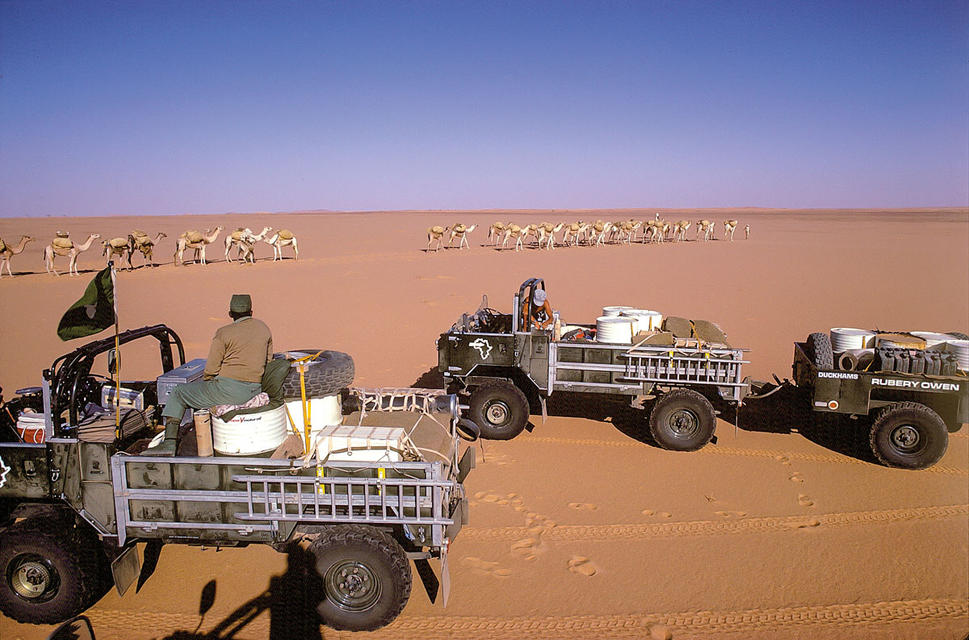
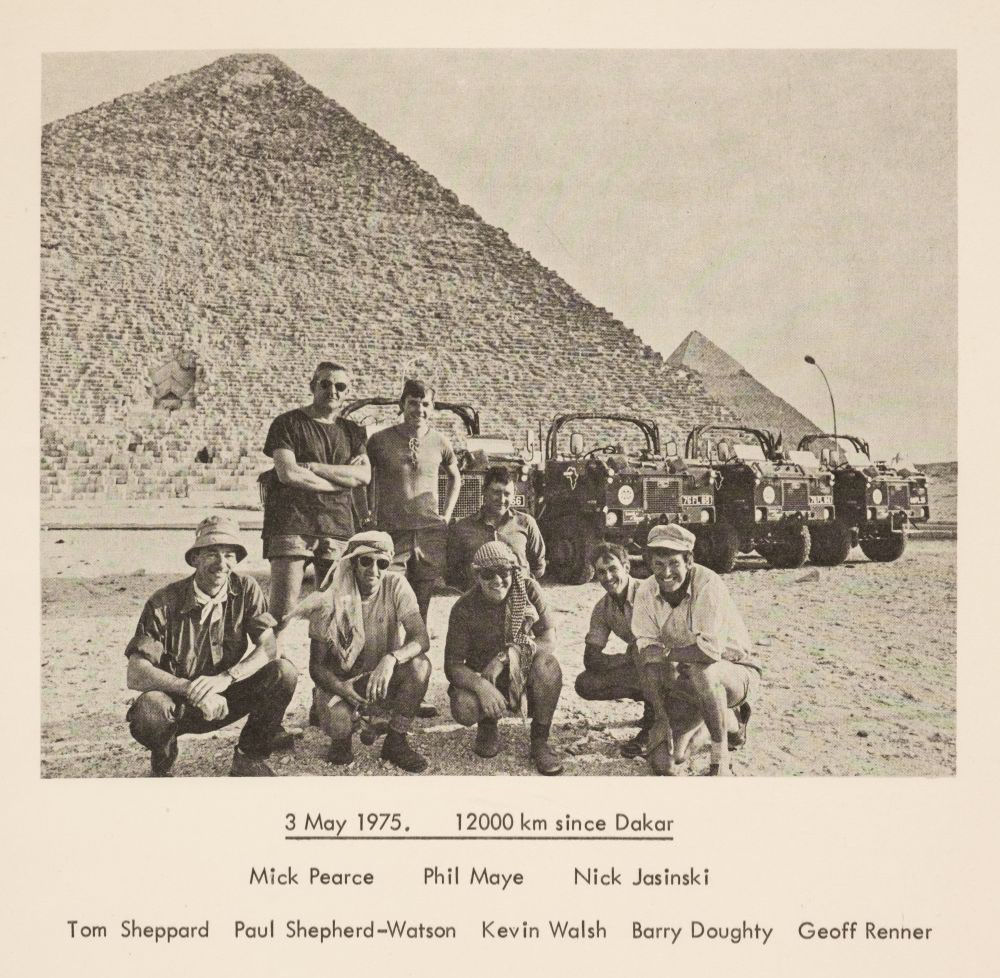
British Joint Services 101s in Sudan, 1975. More here
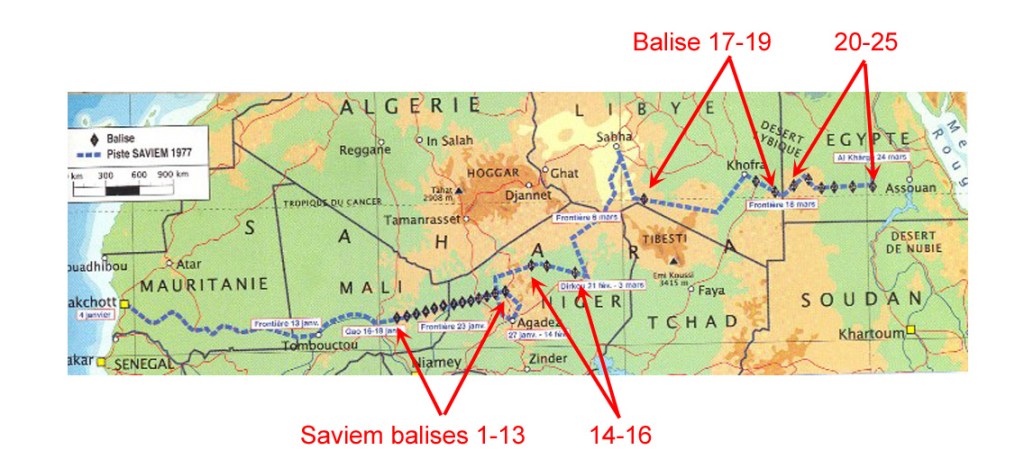
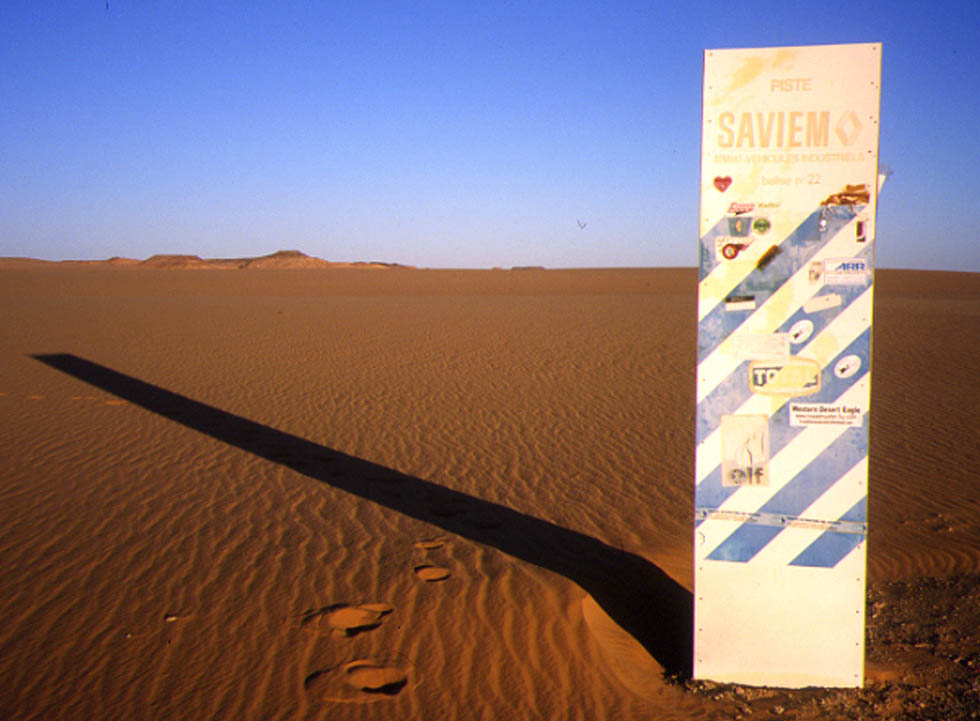
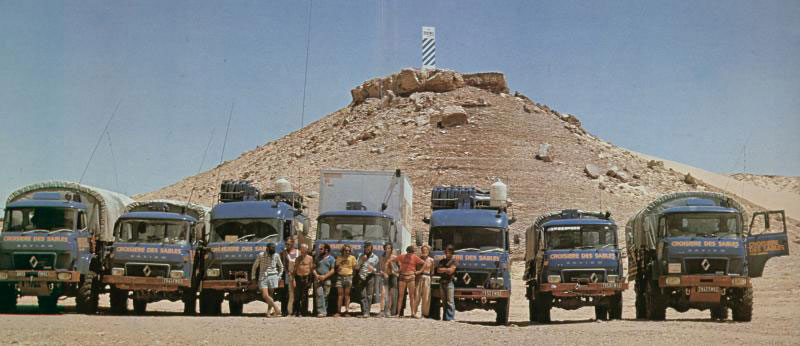
The Saviems of 1997 made a pretty good job of it once they left Mali, planting at least 25 of their distinctive blue and white balises across the desert is a bid to establish a new lateral trade route across the width of the Sahara. The value of that is clearly rather dubious, but it was a good excuse to promote the lorries and have a big Sahara nadventure, using trials bikes and even parascenders to help recce the route ahead.
In my travels I’ve come across remnants of Saviem #16 in Niger, as well as an intact Saviem #22 east of the Gilf Kebir (below). And there’s a photo here of Saviem #10 just a couple of years after it was installed.
Saviem balise #22 in Egypt’s Libyan DesertSaviem TP3 vans and SM8 trucks spinning down in southern Egypt, 1977, below the final balise #25, somewhere south of Kharga on the Darb el Arbain around here.
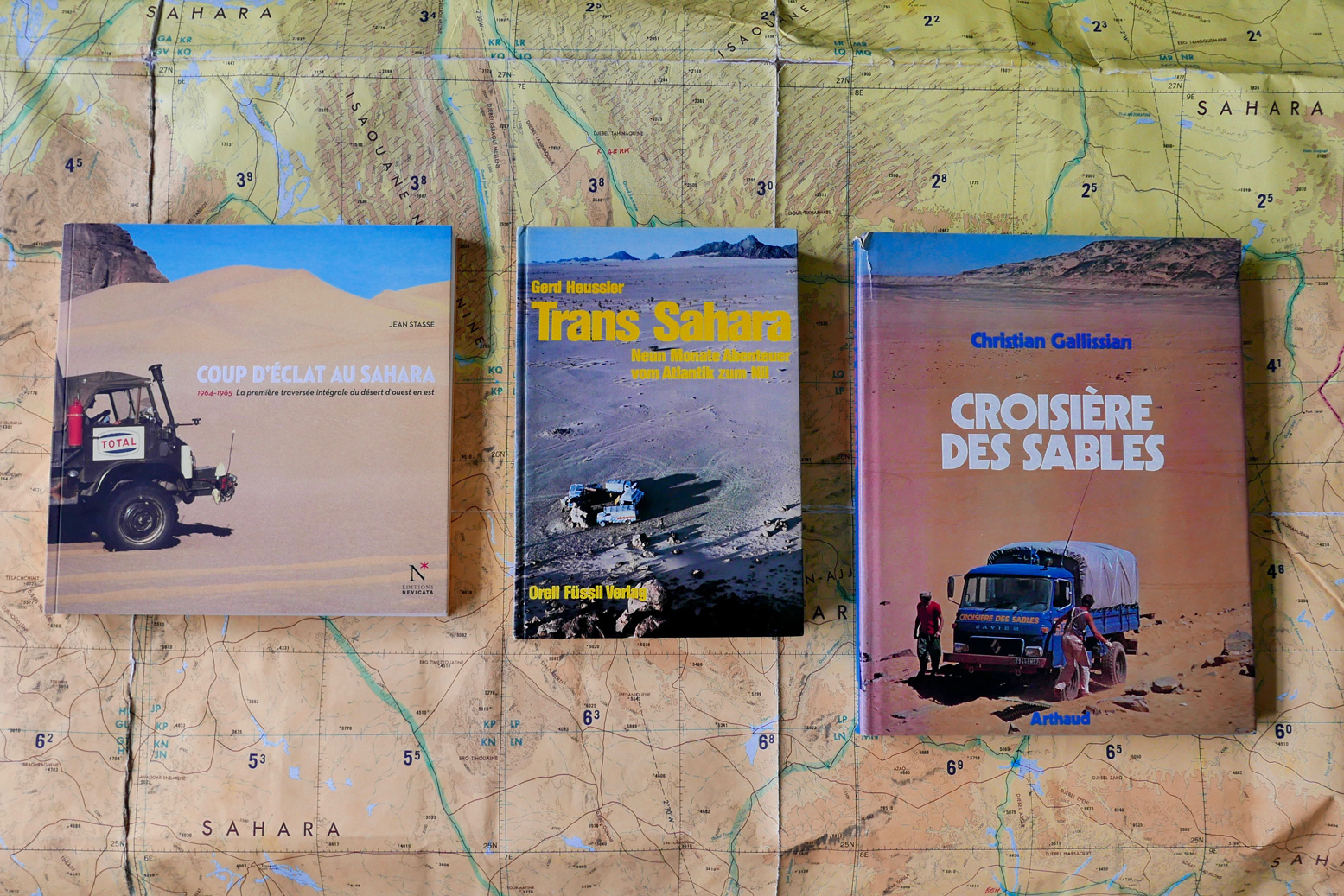
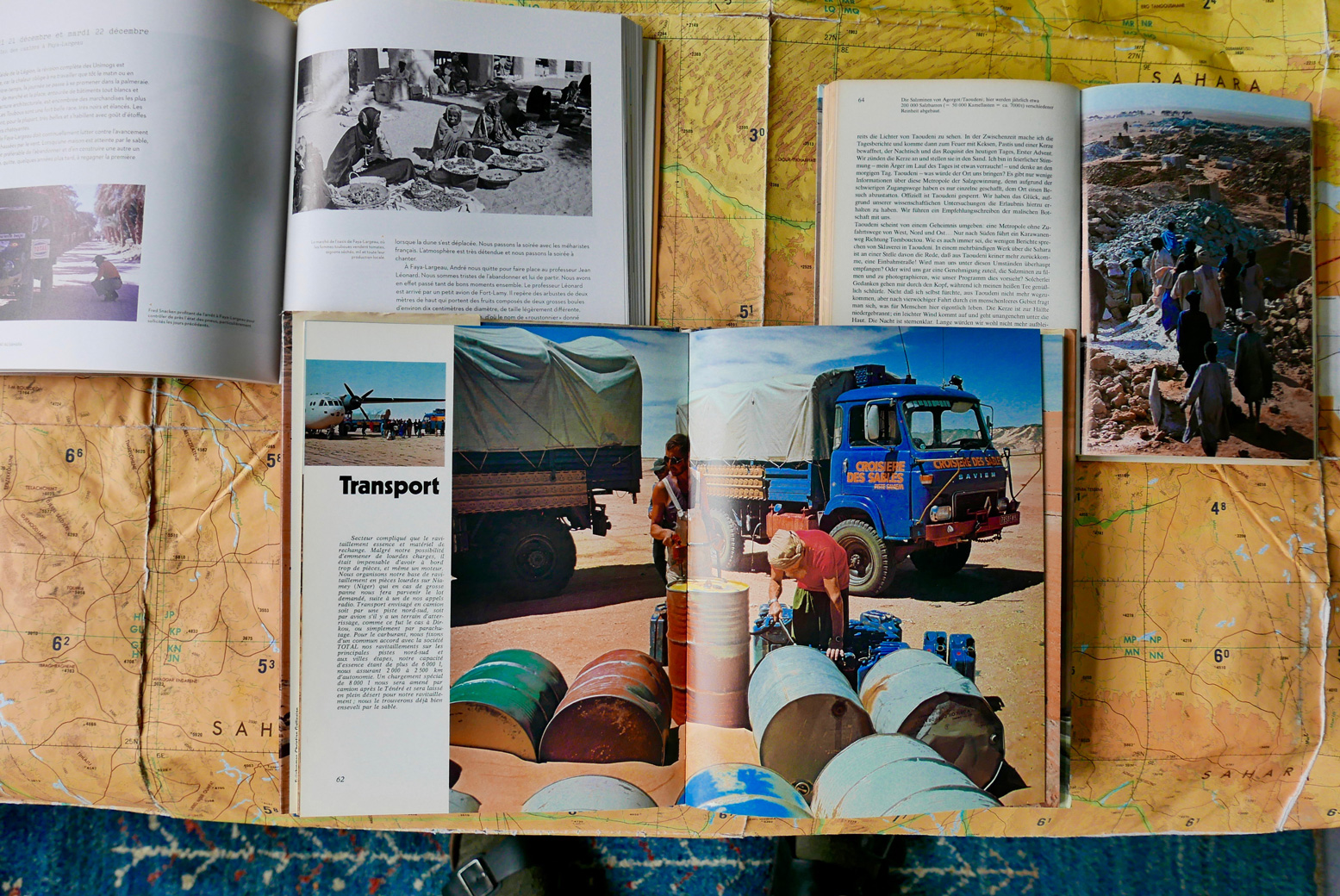
Of the four expeditions mentioned here, the three continental ones produced illustrated books in French and German (below). If you don’t read either language any better than me, the big-format Croisiere des Sables is a good one to get – mostly pictures and under a tenner on abebooks last time I looked.
Coup d’Eclat au Sahara, Jean Stasse (2011, available new) Trans Sahara – vom Atlantik zum Nil, Gerd Heussler (1978) Croisiere des Sables, Christian Gallissian (1977)
Even though Tom Sheppard has published a couple of lavish Sahara picture books on his own travels, it looks like we’ll never get a full account of the JSE 101 crossing (but see below). There was an appropriately dry expedition report for the Geographical Journal in 1976 which you can read on JSTOR (map below).
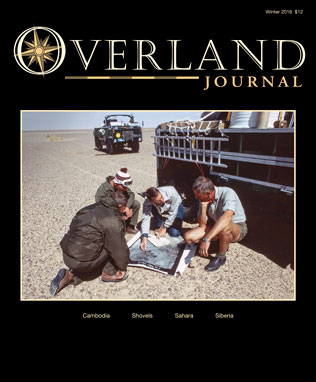
Tom Sheppard also wrote a well illustrated summary in the winter 2016 issue of Overland Journal (right). In 2022 I received an email from a reader who’d just acquired the full and exceedingly rare 150-page report which was being auctioned here. Looking further, it seems there may be a hard copy at the National Archives in Kew, too. Watch an interview with Tom here.
My own lateral crossings
A while back, before things really got bad in the Sahara (right) it occurred to me that, with one small effort I could link up my own lateral crossing of the Sahara between the Nile and Atlantic. Of course it would have taken me several years, but mainly across three trips: Libya 1998 (researchingSahara Overland);Egypt 2004 and our big SEQ 2006 crossing (below) I’ve covered all bar around 800km of the distance.
Part of my informal west -east crossing
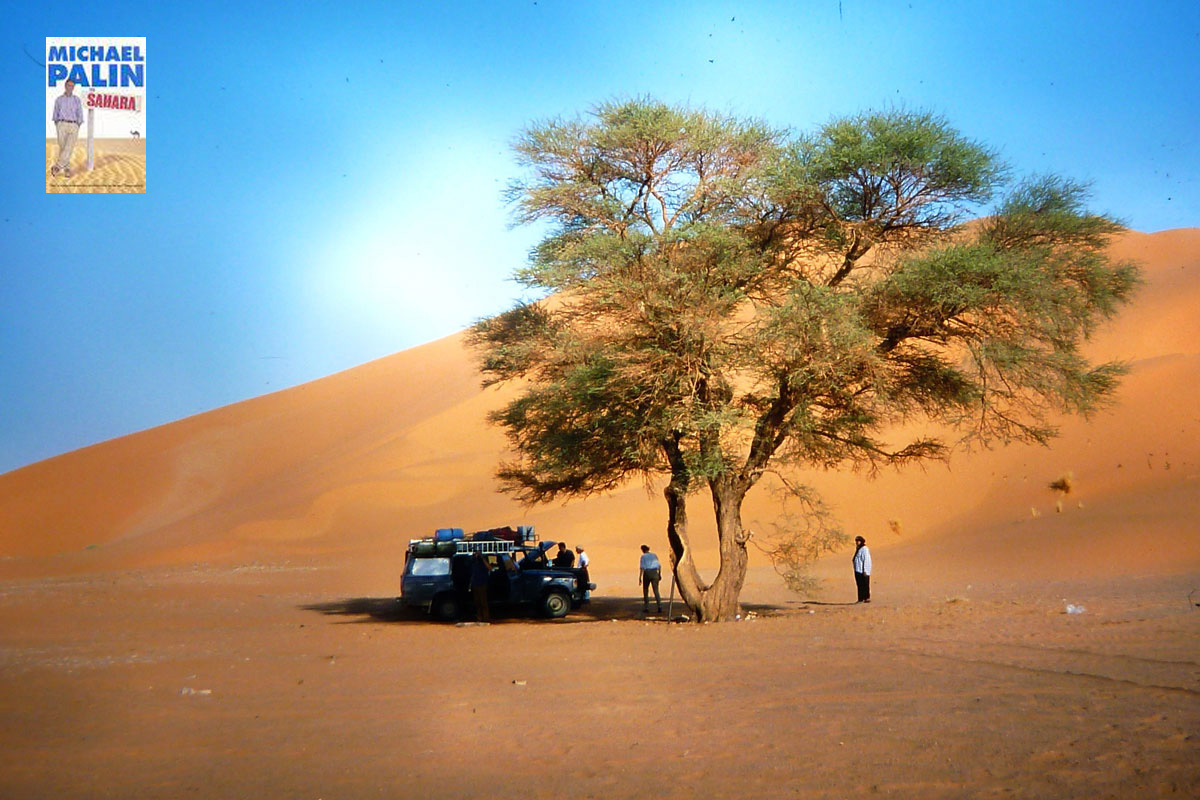
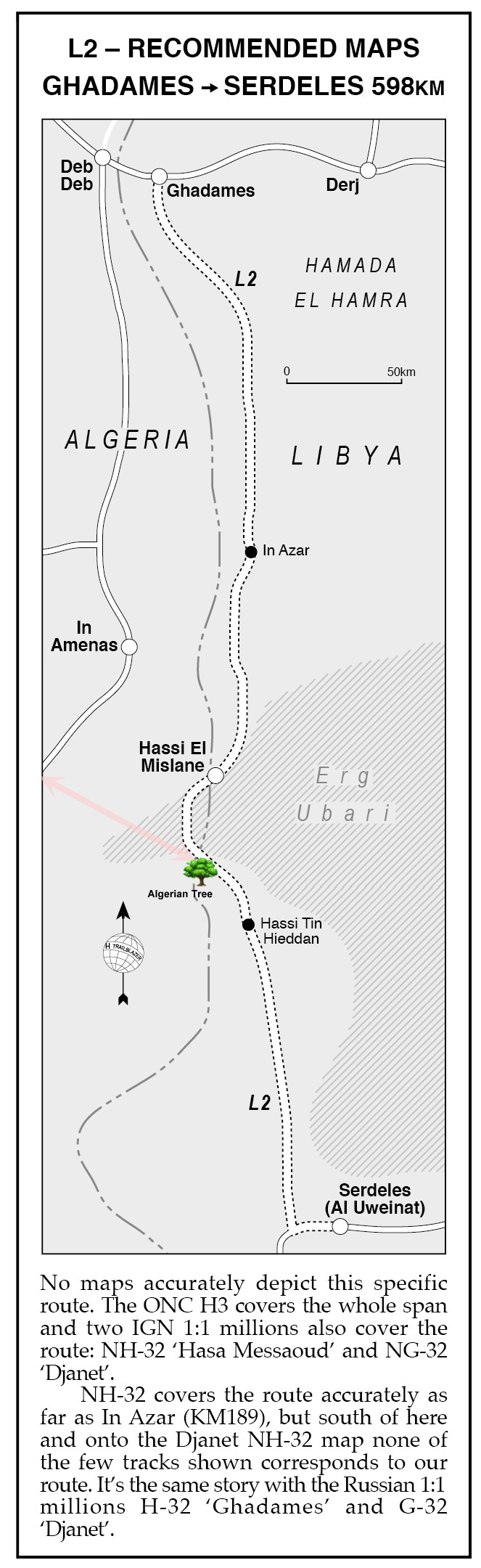
All that remained was a short, 70-km gap in the far eastern Algerian oilfields near In Amenas to the Algerian Tree (visible on Google sat and pictured left in 1998). It was whereRoute L2 from Sahara Overland (below right) strayed briefly into Algerian territory to avoid the worst of the Idehan Ubari’s dunes. Some may recall Michael Palin visited this very tree for his Sahara TV show in 2002 and on arriving proclaimed:
‘this spare, uncluttered, beautiful spot was one of my favourite places in the Sahara‘. Well, he’s easy to please!
And in fact, I’ve since realised that when we treked with mules to Sefar on the Tassili plateau in 2013, I was within sight our 1998 route into the Libyan Akakus.
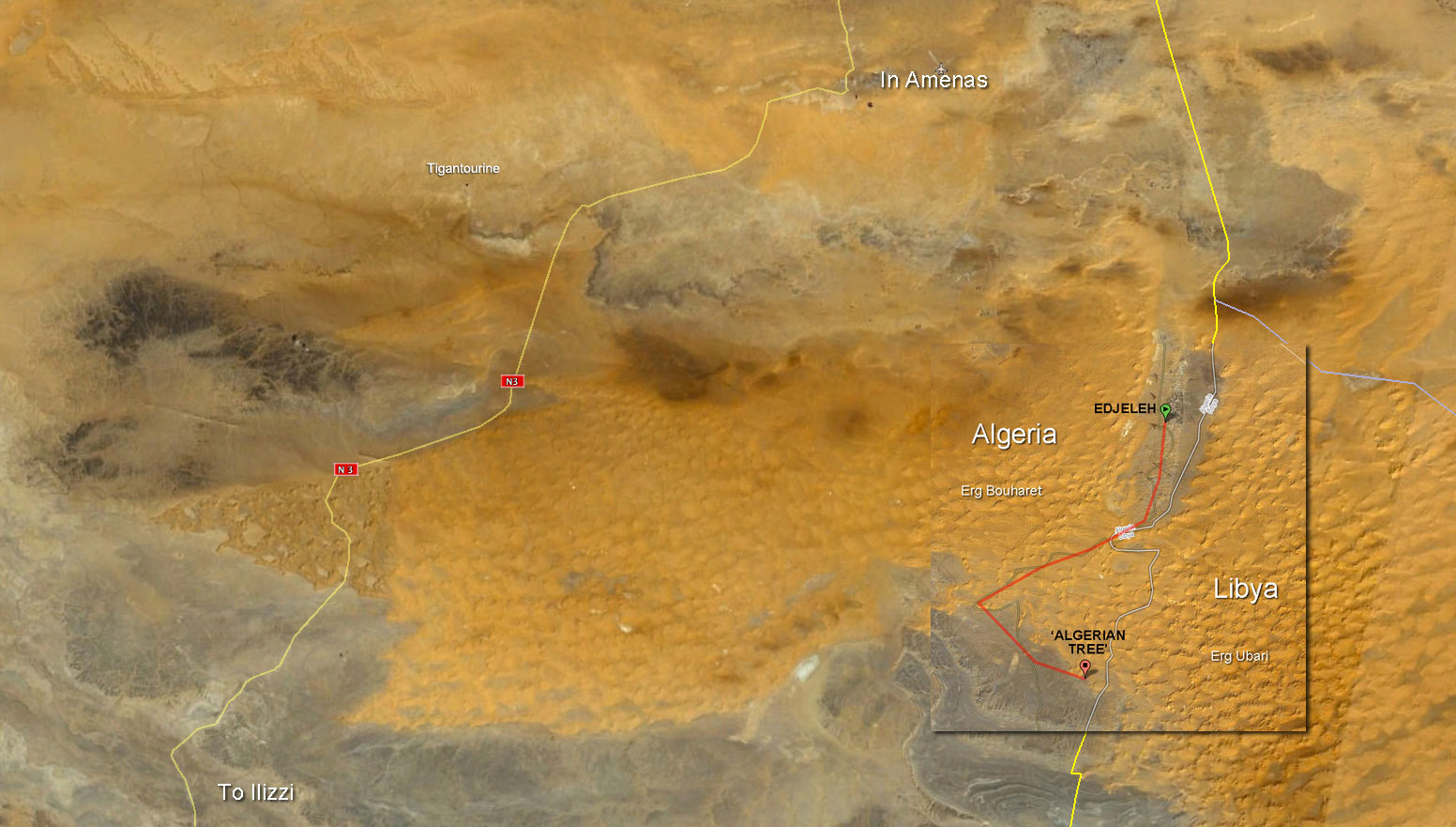
Up until the gas plant attack at Tigantourine that year, I could probably have knocked out my crossing to the Algerian Tree at any time. Either driving down to Edjeleh oil camp right on the Libyan border then scooting over the dunes as shown below).
I recall making contact with an oil worker based in Edjejeh one time, asking him about civilian access in the area but he wasn’t very forthcoming. Alternatively, one could just nail it 100km east from the N3 highway south of Erg Bourharet. The stony reg thereabouts is criss-crossed with oil exploration tracks, but, post-Tigantourine that area will now be closely watched.
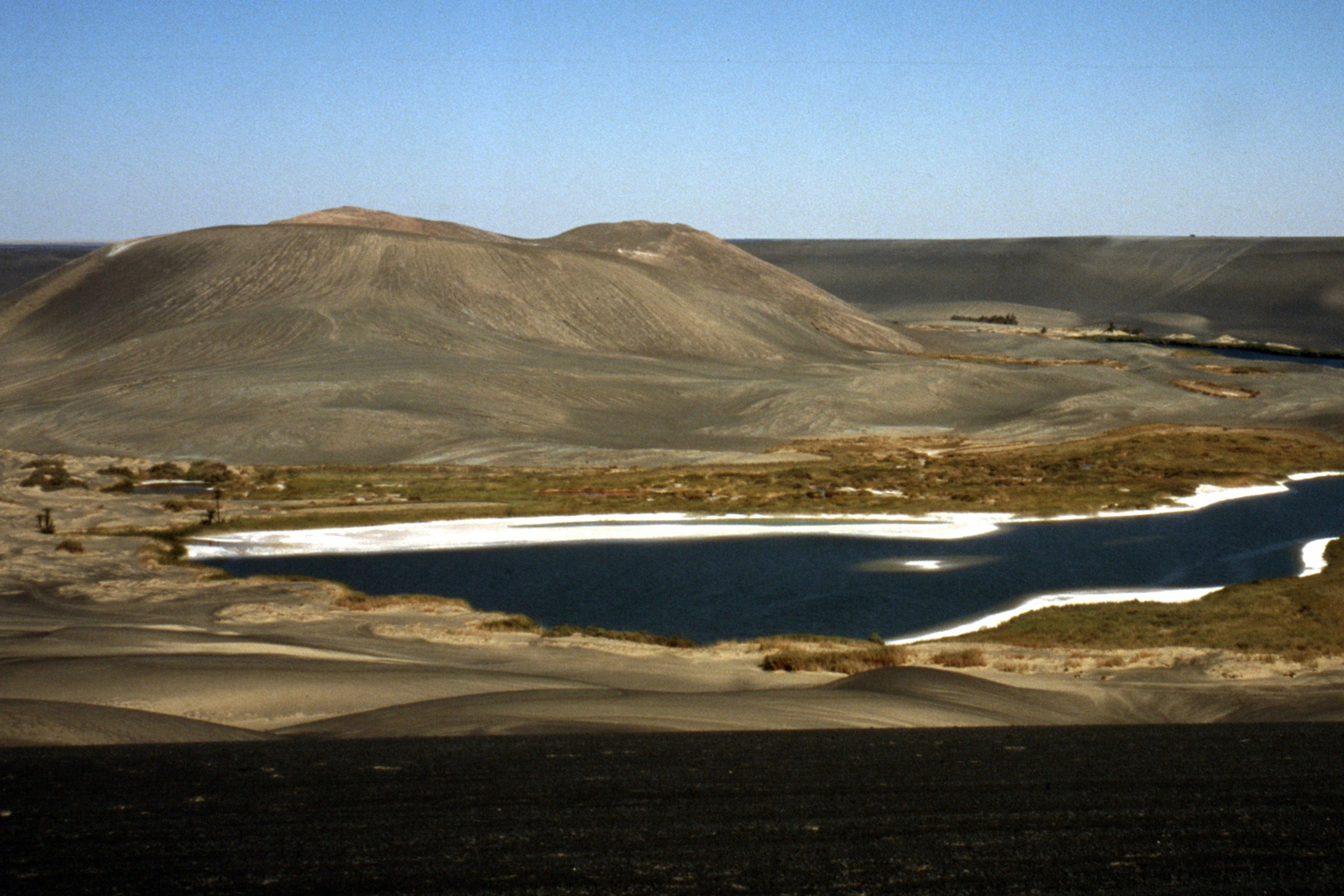
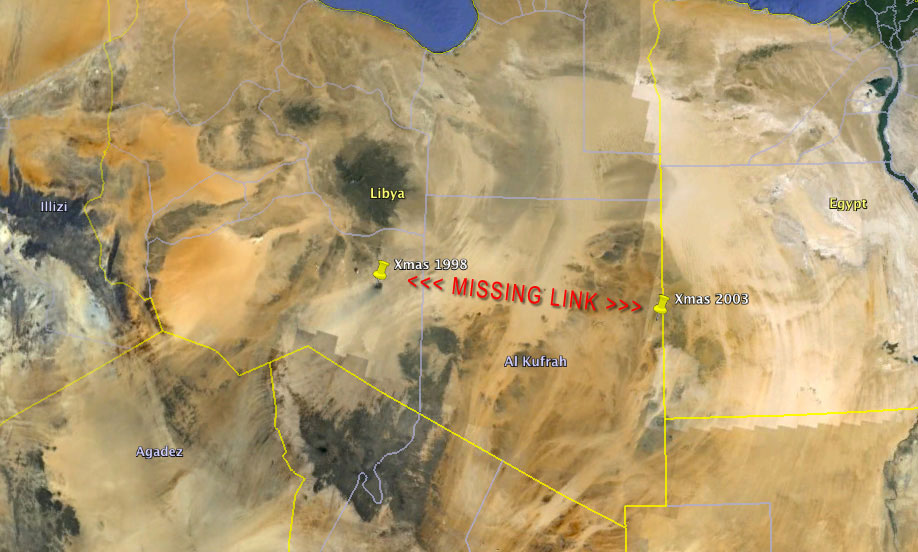
Then there’s a much more substantial missing section to get my West-East certificate in eastern Libya: from Waw Namus crater which we visited in 1998 (below) …
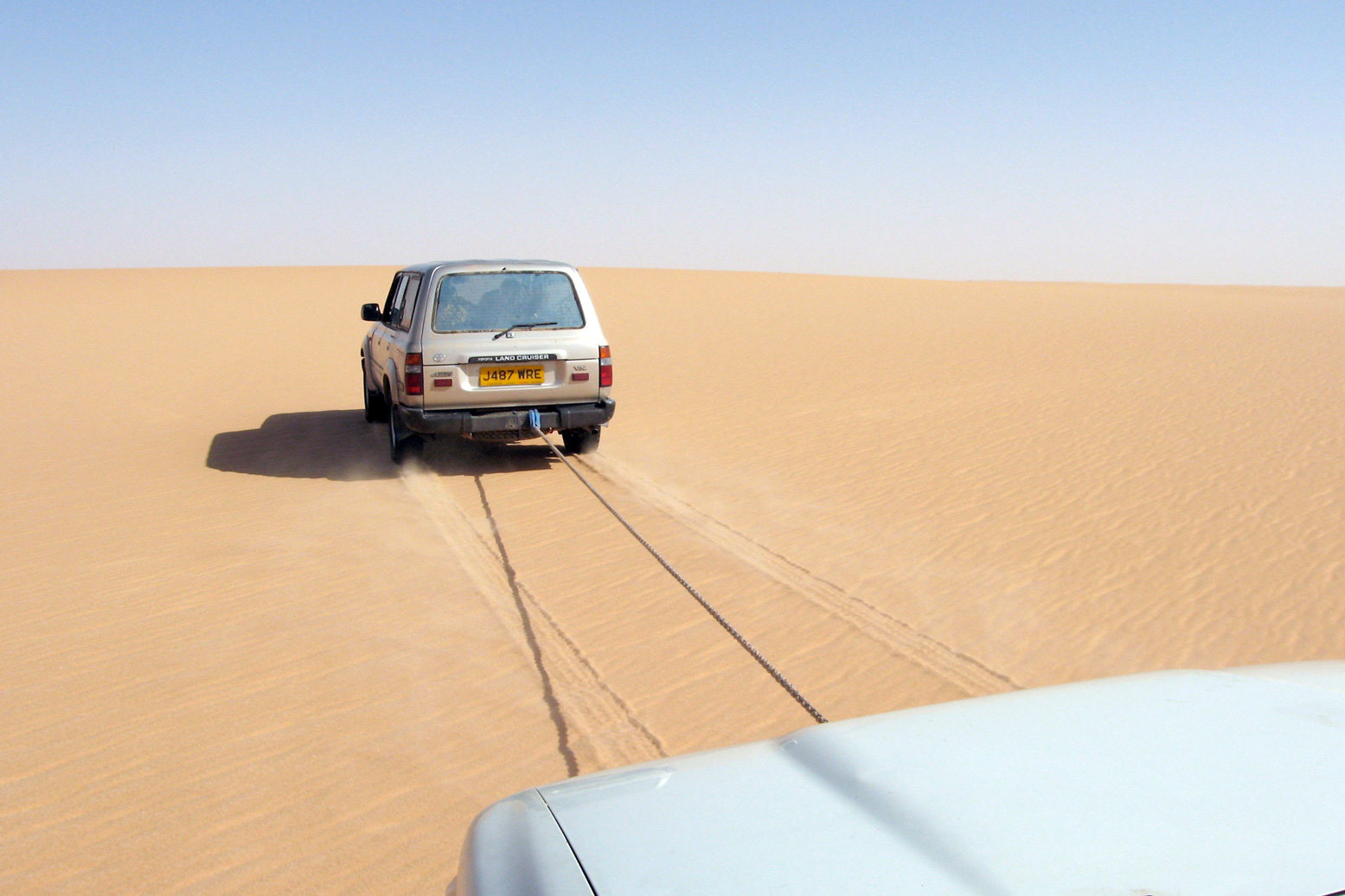
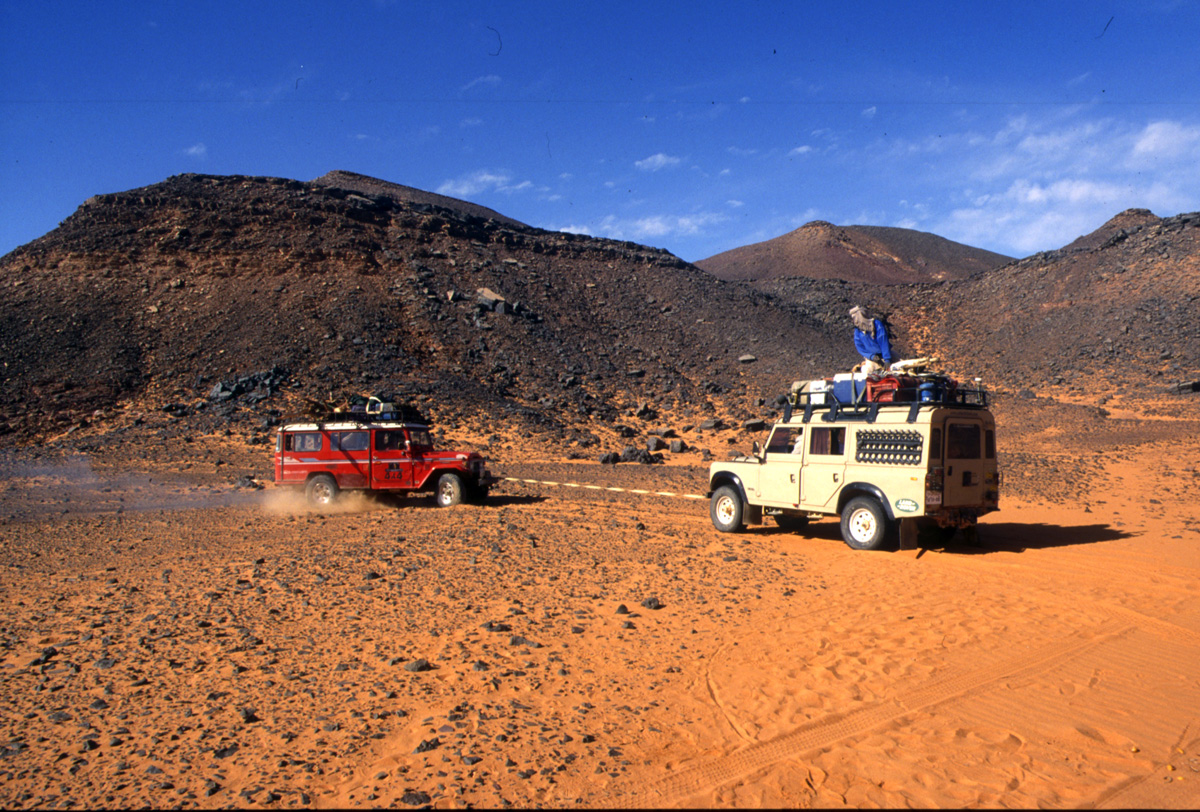
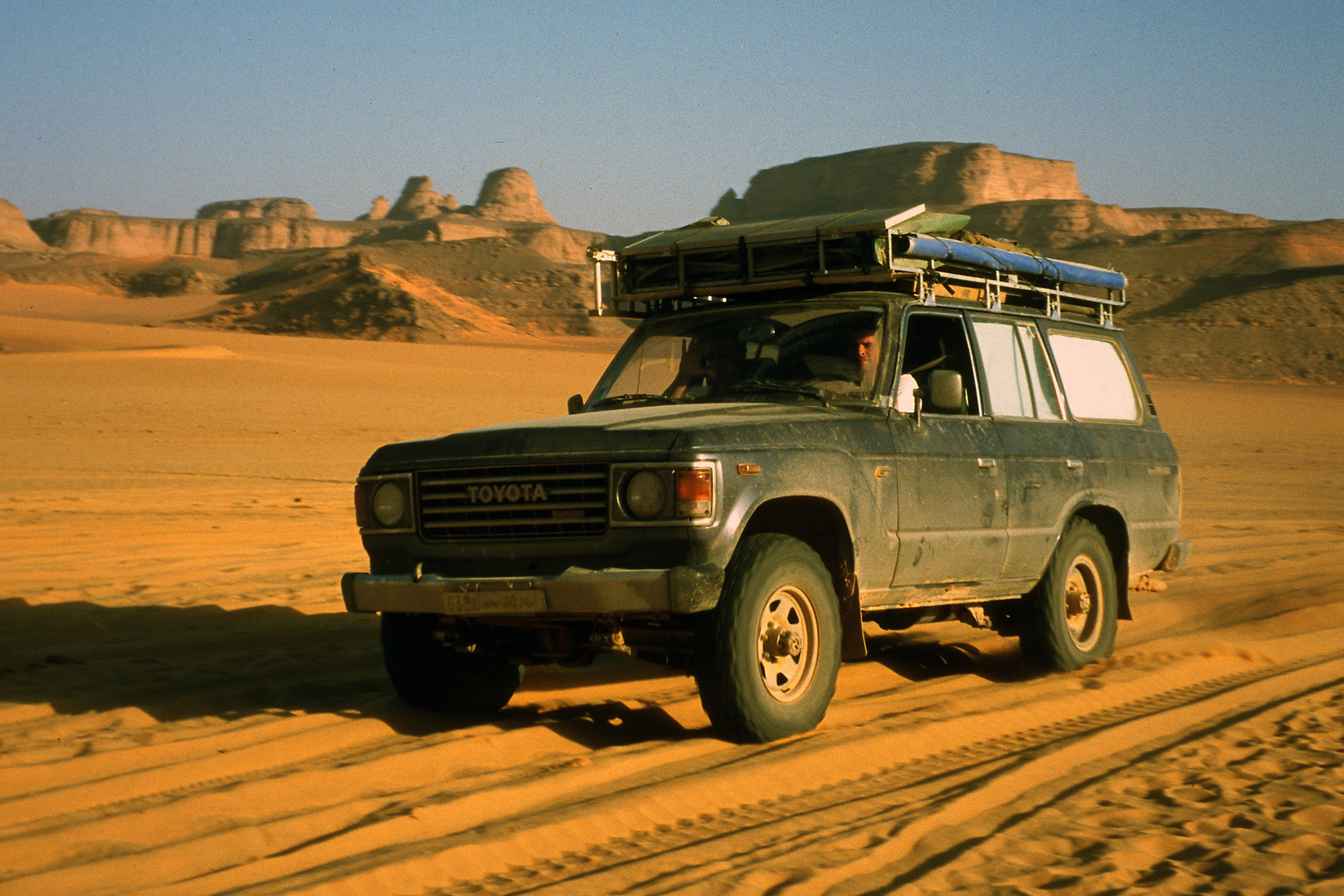
I remember that Christmas well; we had more trouble than normal getting Mahmoud’s Toyota-engined Series III running, dragging it to life with the Land Cruiser (below) after setting a fire under the chilled engine. With us that time was Toby Savage (my Desert Driving dvd co-presenter) who in 2012 travelled through the Gilf with WWII-era Jeeps, while possibly outnumbered by escorts and soldiers.
Staaaart you bastard!
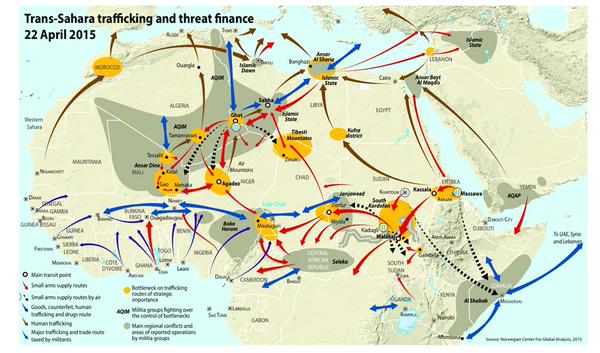
No tourist has driven in southern Libya since the fall of Gaddafi in 2011. The south was now controlled by the Tuareg (with a bit of AQIM and IS) and the Tubu who battle it out for the control of lucrative people-trafficking and other commodities coming up from Niger. As things stand now in Libya, ticking off that final 720-km stage from Waw crater to Xmas Camp may have to wait for a rainy day in the Sahara.



 Mackenzie also thought that trade and communications would help liberate the sub-Sahran population from the slave trade. And this wasn’t just a ploy to appeal to investors’ morals or religious beliefs – Mackenzie’s later work in East Africa long after the NWAT Company dissolved suggested he was always a genuine abolitionist.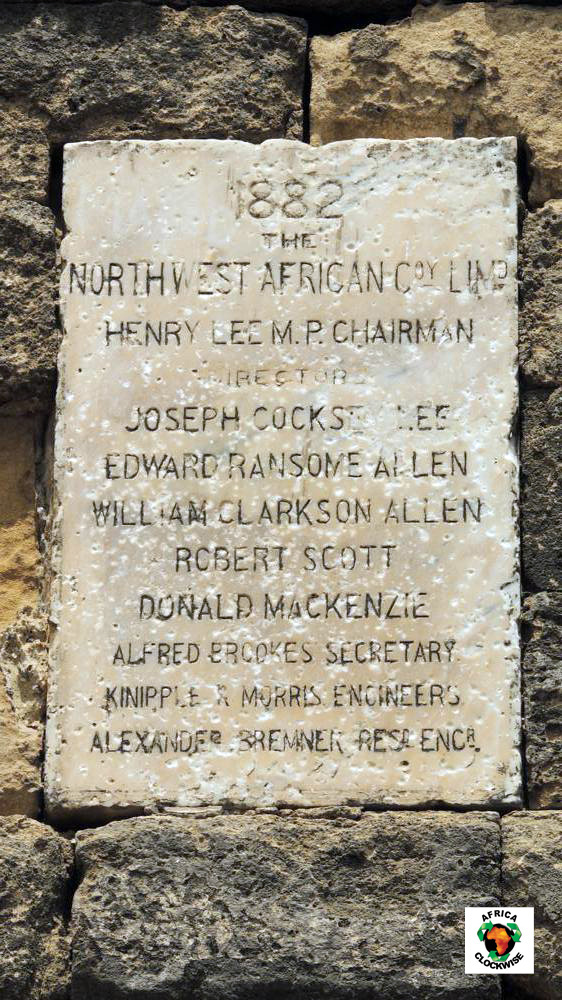







 Sahara Overland