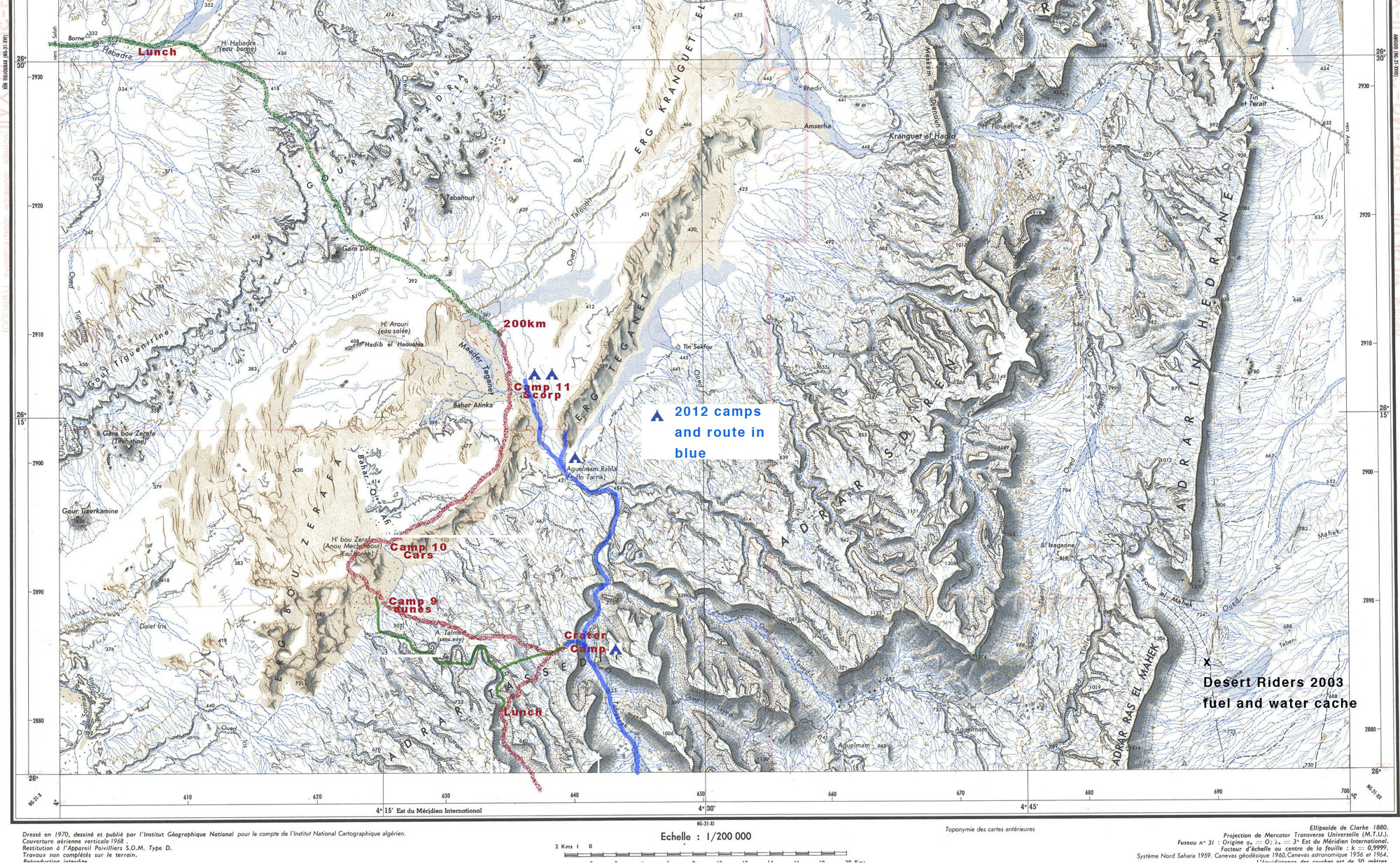
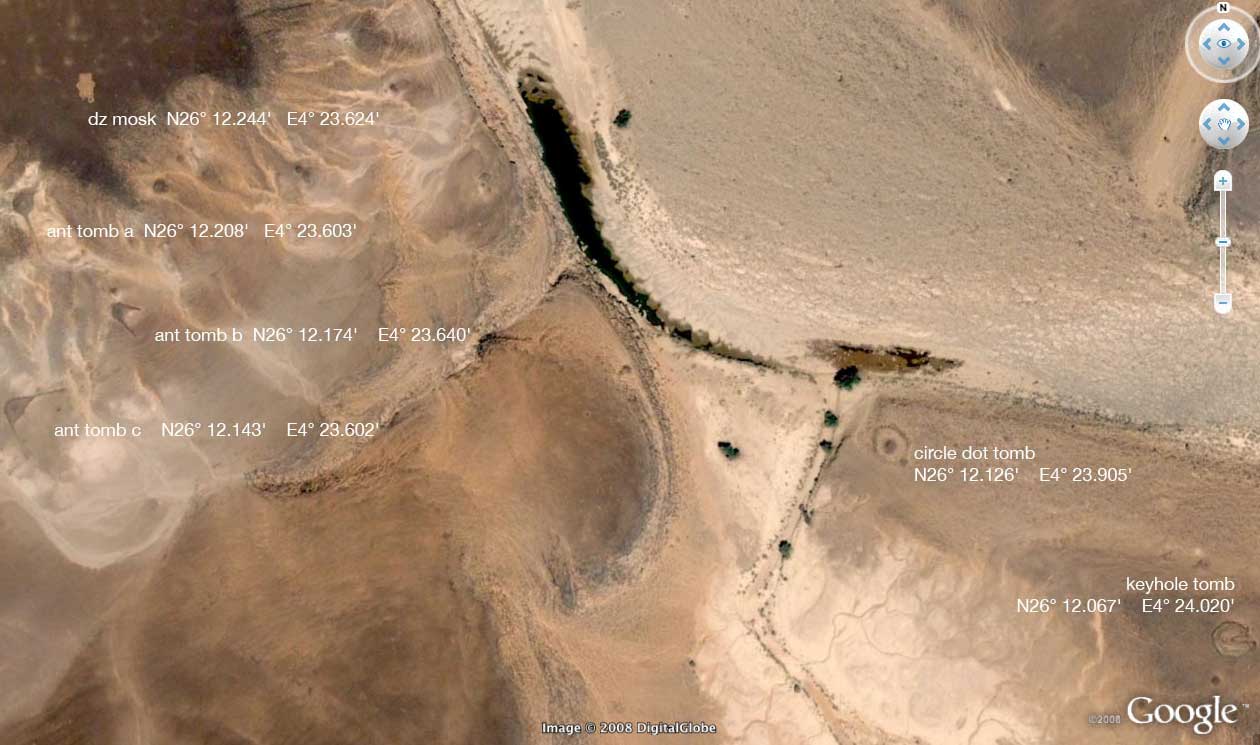
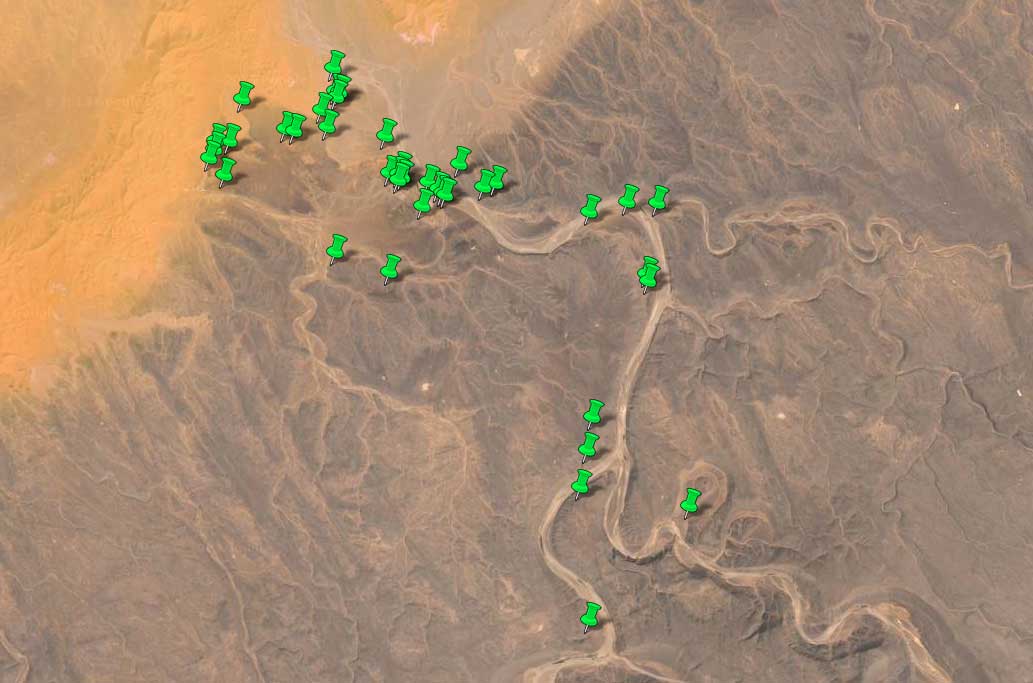
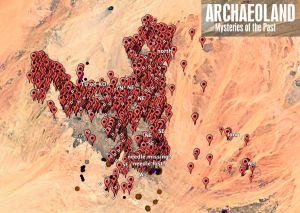
As on previous occasions, the route of our camel trek through the Immidir will rest a day at Aguelmam Rahla, a reliable waterhole at the mouth of the Oued Tafrakrek canyon (blue line on map, left) where the Tissedit plateau drops down to meet a band of dunes. I’d been wanting to make a diversion here since scanning Google Earth a few years back and noticing the innumerable pre-Islamic tombs (‘PIZ’) in the area (below).
Tombs around Aguelmam (‘waterhole’) Rahla.
Looking again on Google Earth some time later, less than an hour of nosing around revelled three dozen keyhole, antenna or mound-ring tombs within a few kilometres of the waterhole. I didn’t bother counting the less distinctive mound tombs or just plain tumuli. In fact the proliferation of tombs here isn’t so unusual, given the topographic features already listed: edge of a plateau, former river mouth, band of dunes – all common factors found at former Neolithic occupation sites.
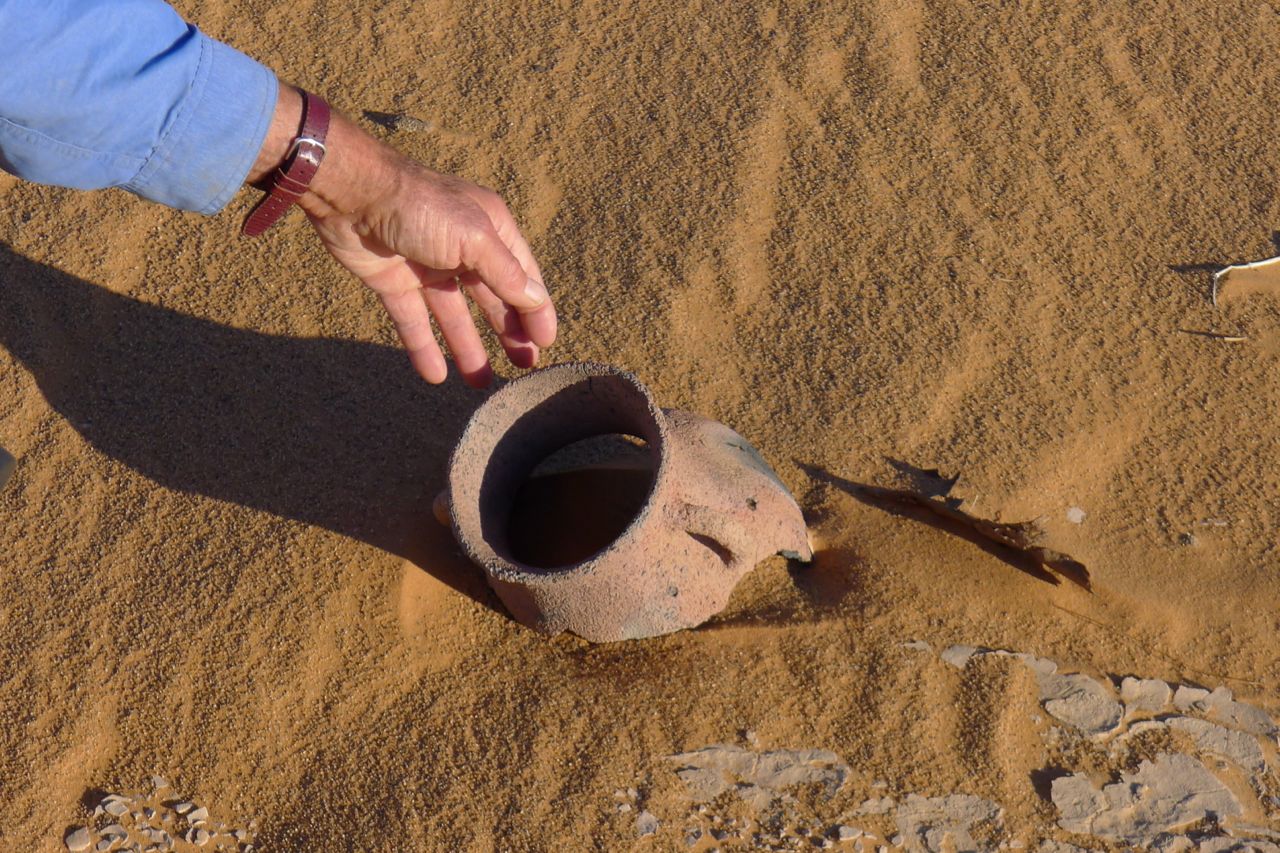
On the first crater tour in 2007 we walked along the base of the dunes, northeast from Aguelmam Rahla, and discovered several grinding stones and other artefacts at the foot of the dunes. And in 2012 one of us came across a near intact pot (left) at the foot of a dune, as well as napping (stone tool chipping) sites. You commonly find ceramic shards or even larger pieces, but I’ve never found an intact pot.
Location of tombs along the Oued Tafrakrek canyon and on the Tissedit plateau, with a cluster around Aguelmam Rahla at the canyon mouth.
There’s something compulsive about Sahara tomb spotting on Google Maps, searching the featureless desert floor for the clear signs of prehistoric human activity. Once out there it can give a purpose to a journey that’s otherwise just agreeable recreation and adds a hint of treasure hunting. It reminds you that the Sahara of 6000 years ago was not a desert, but a much less arid savannah. Among others, KenGrok spent years scanning and collating unusual imagery on Google Earth’s layers, including pre-Islamic tombs in the Sahara. In 2019 Google erased his work, but his baton has been picked up by ‘syzygy‘ on Google Earth Community, as well as Manfred Boelke at archaeoland.eu (his image below).
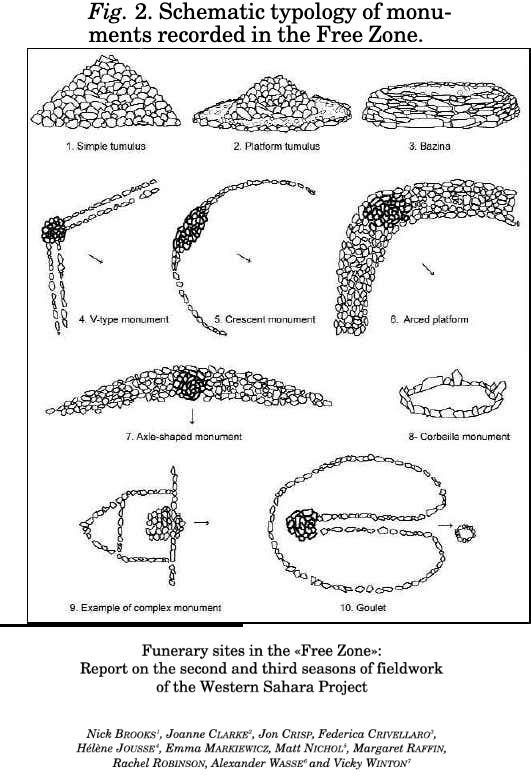
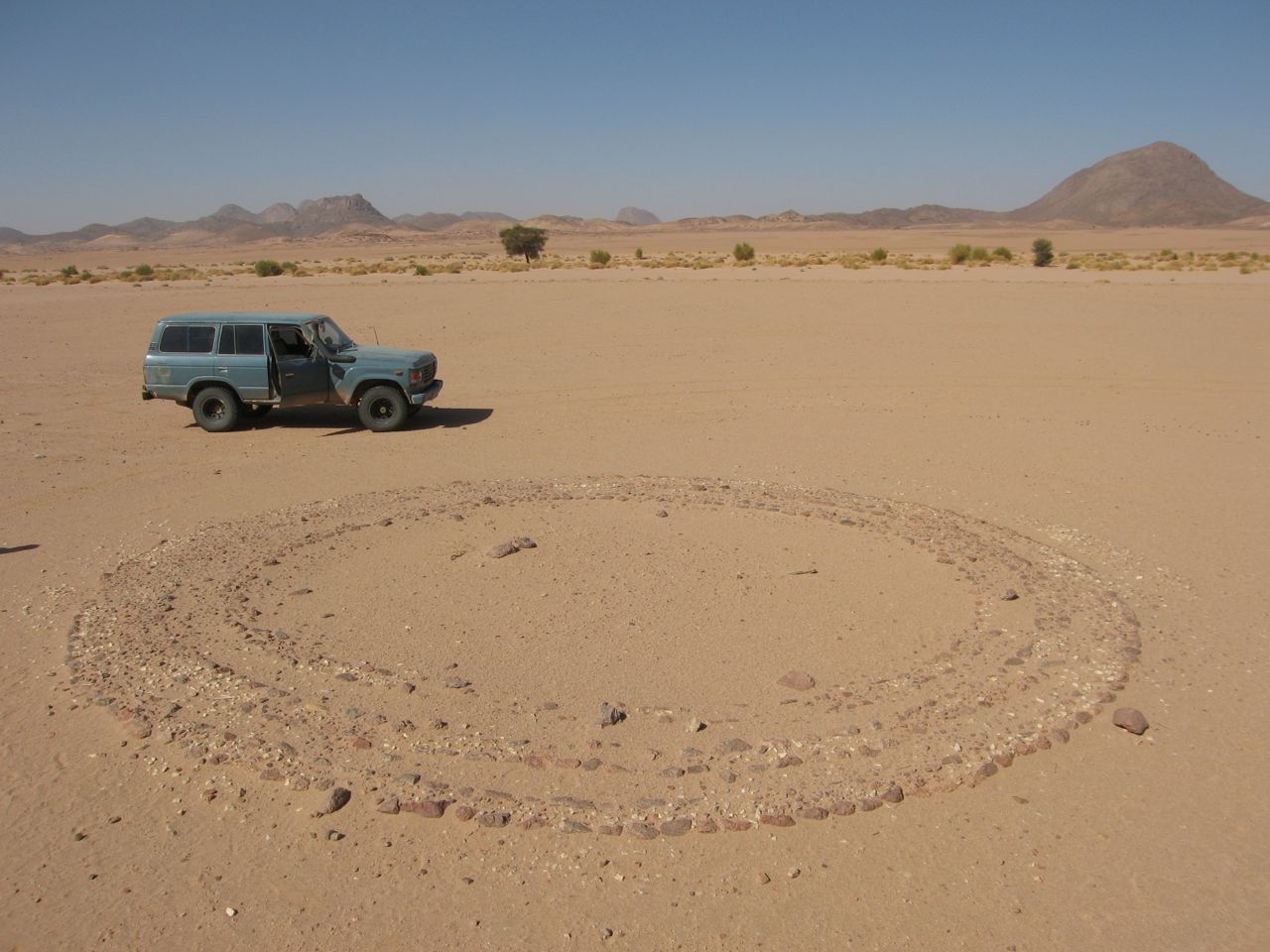
Broadly speaking, half a dozen tombs styles have been identified with clear regional limits as shown above. The most common is simply a mound of stones or tumulus which can be huge and can have a central depression to resemble a volcanic crater. Sometimes the mound may be surrounded by a ring – a mound-ring tomb. All over the Sahara tombs are usually found in clusters; find one and you’ll find others nearby. It suggests an auspicious place for burials or just a former occupation site with an adjacent burial ground.
A very unusual assembly of three types of tomb on the edge of the Tassili plateau near Djanet. The superimposed mound suggest the keyhole is older. As we know from rock art found in the same area, it’s common to cover what came before.
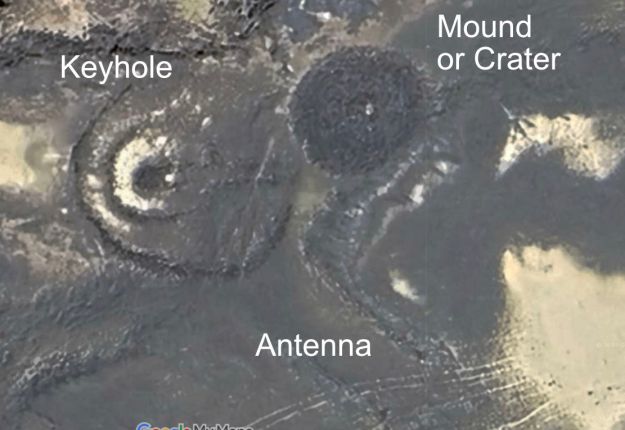
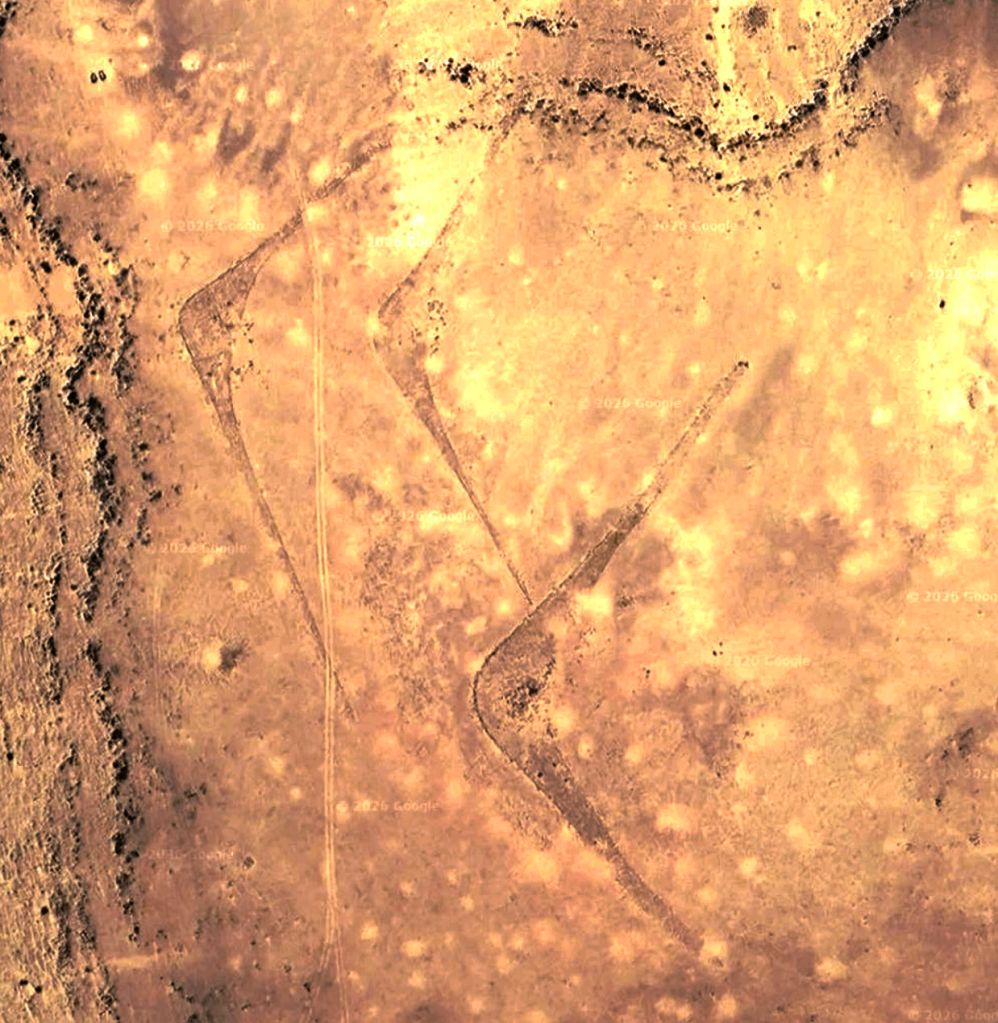
Antenna or crescent tombs have open arms spanning out from a tomb mound apex at around 120° and can be up to 250 metres or more, end to end. They are prolific in southeastern Morocco (bottom left; 27.6971, -10.8665), but are also found in Algeria by the thousand (25.86007, 4.36847). The finest ones have long, slender arms while small ones can be stumpy and even almost simple hemispheres.
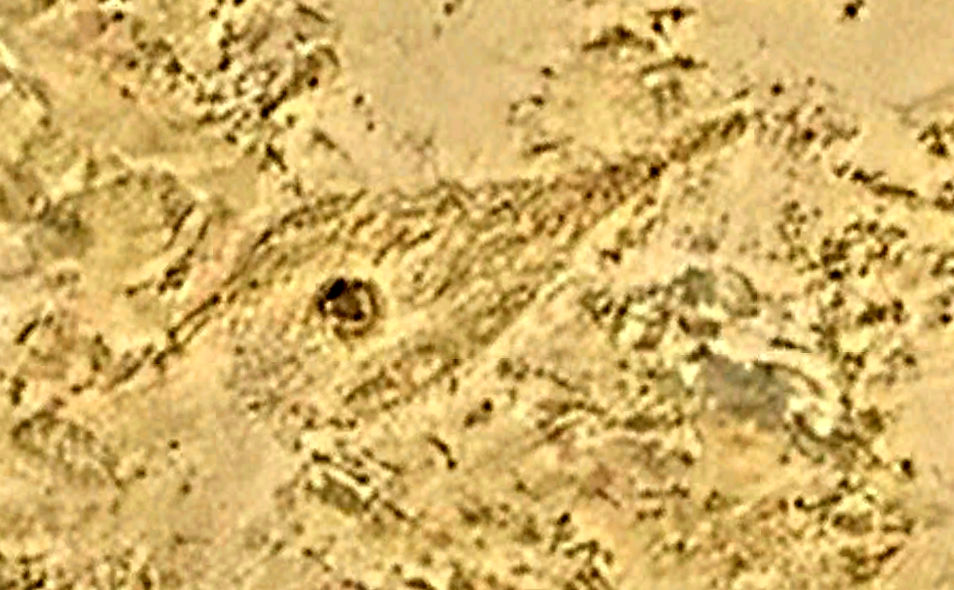
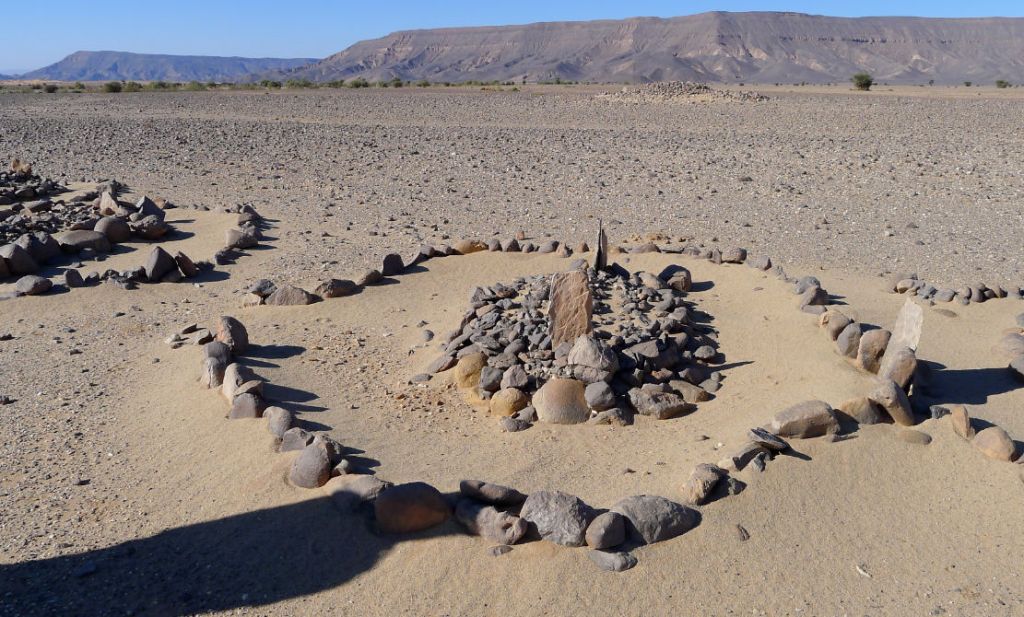
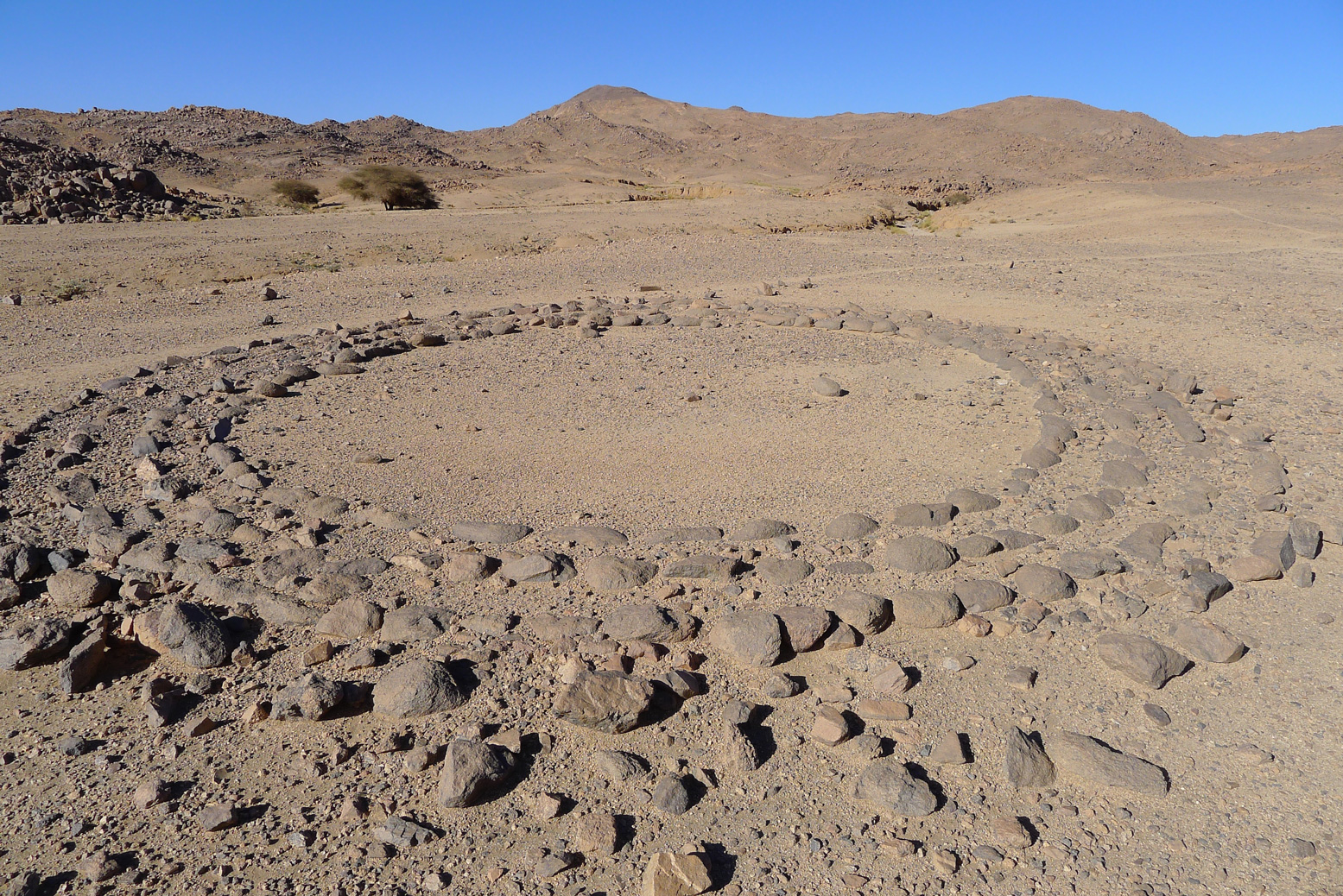
Keyhole tombs are two concentric round or oval rings with the tomb mound near the middle and a corridor leading to the outer ring. Below is a famous keyhole near Djanet at the base of the Tassili n Ajjer plateau where you’ll find them in their hundreds.
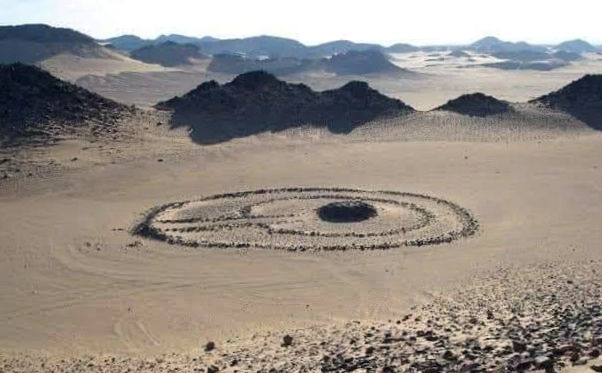
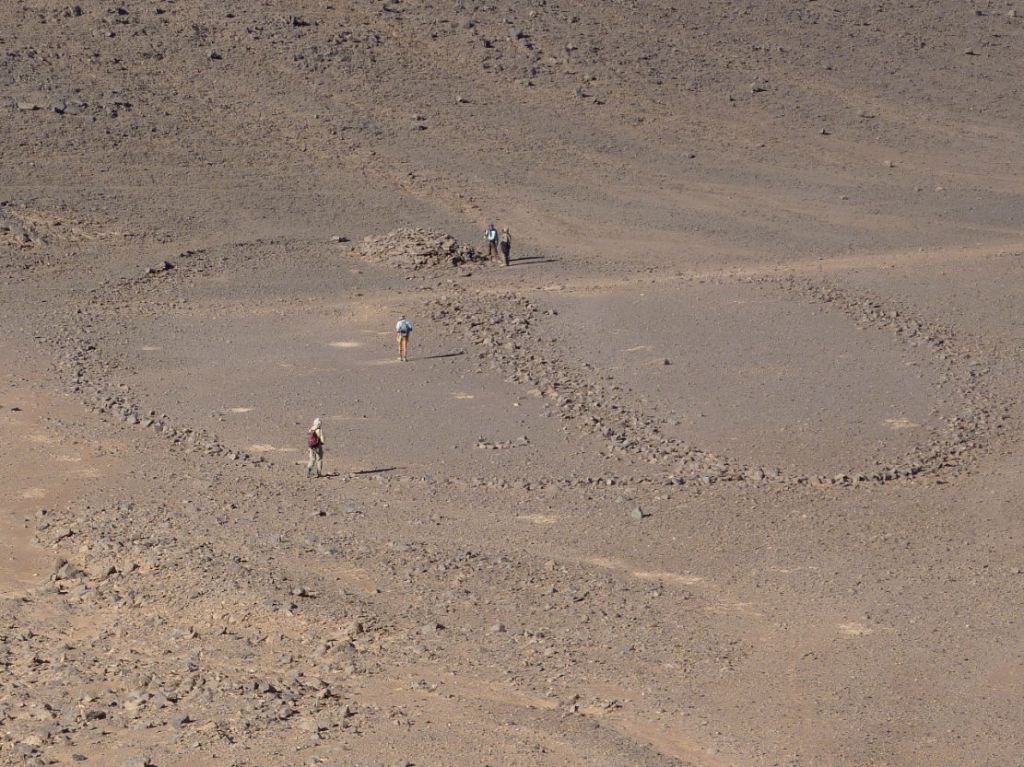
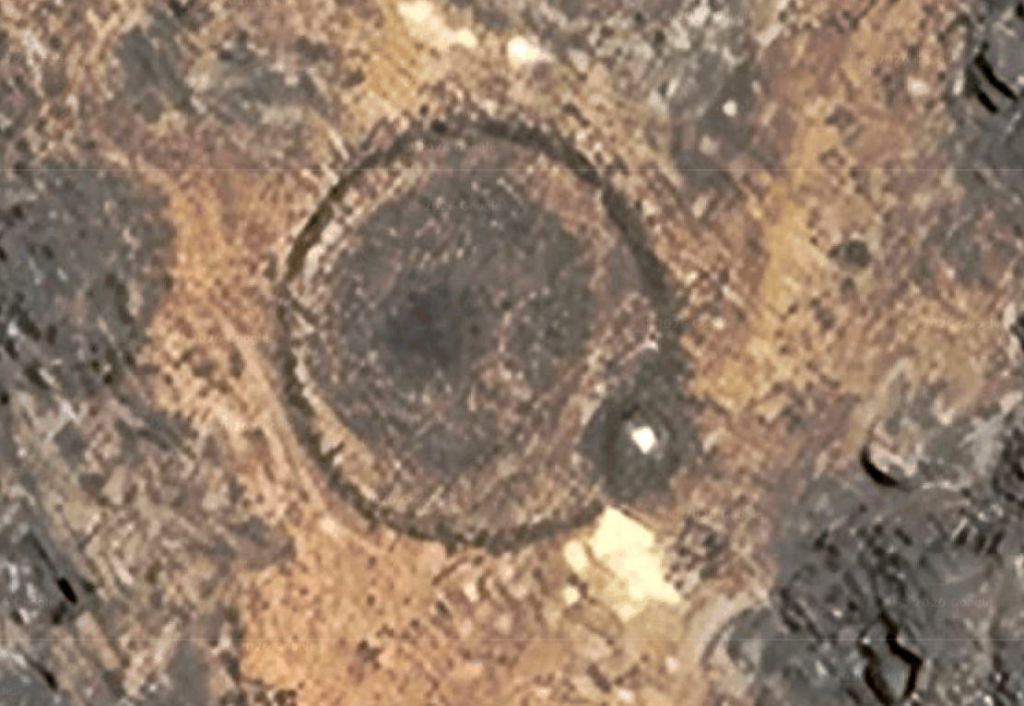
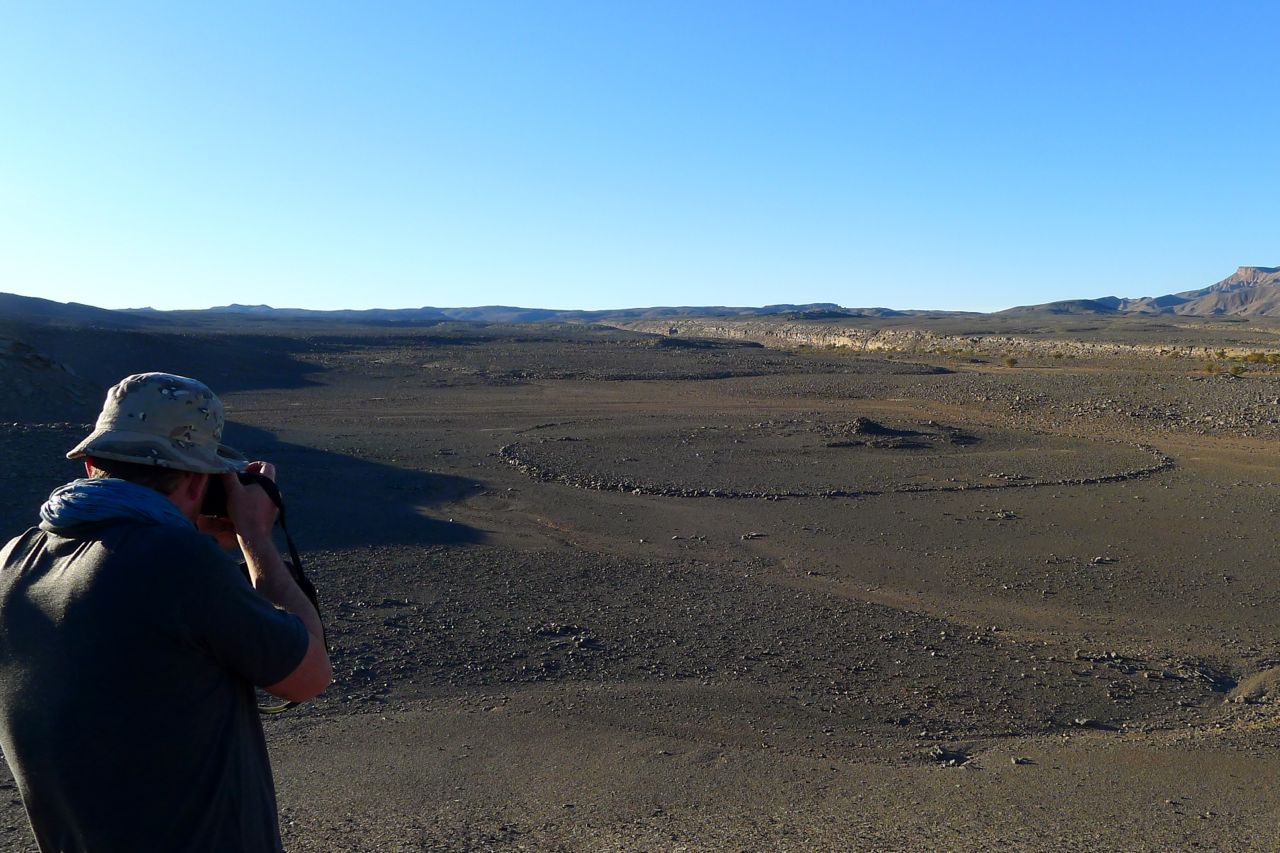
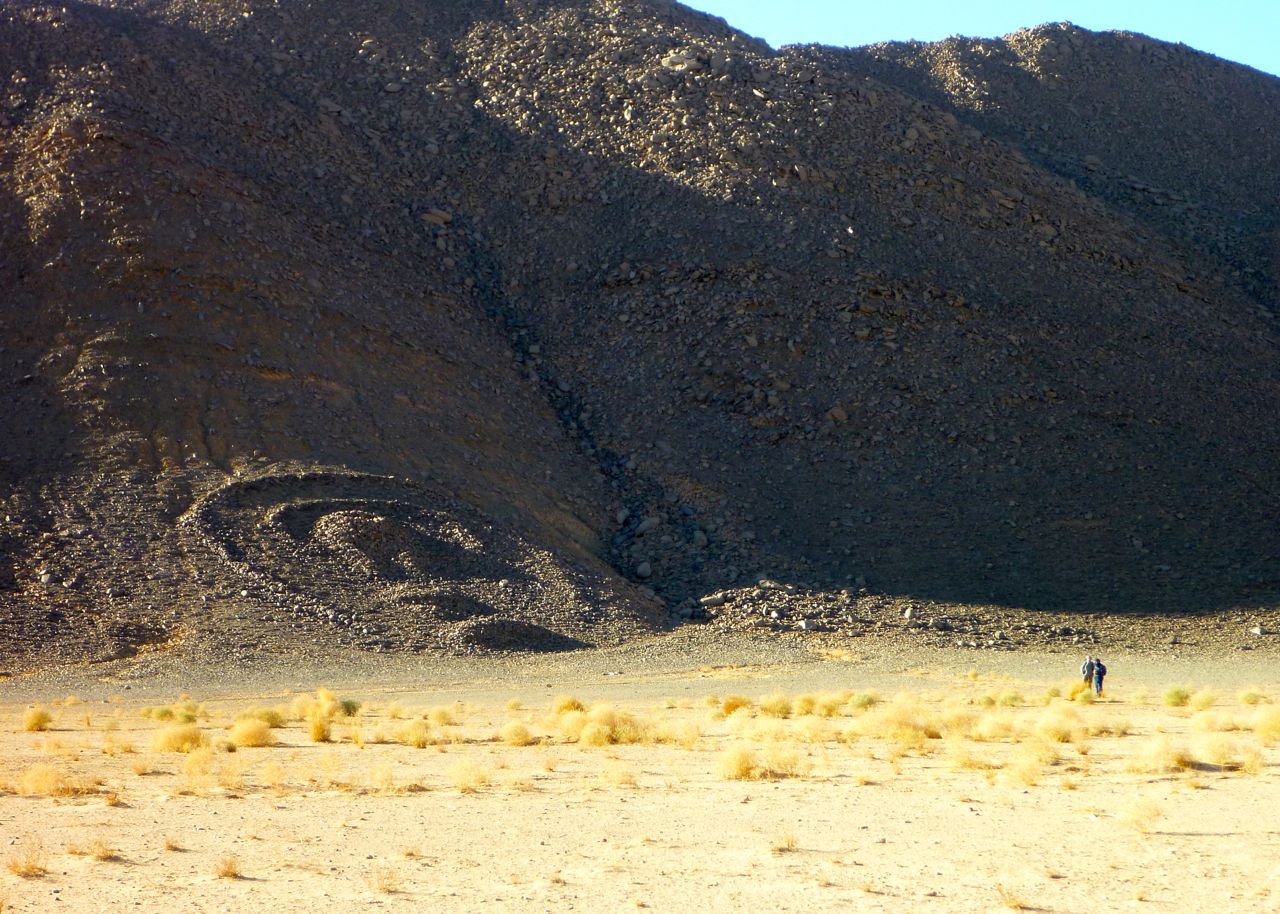
A version of the keyhole is called a goulet tomb (below; French for narrow passage, as in ‘gullet’). They have a large perimeter ring with the tomb mound on the ring’s edge and a line or corridot of stones bisecting the circle. I find these much less common.
Huge goulet tomb in the Immidir
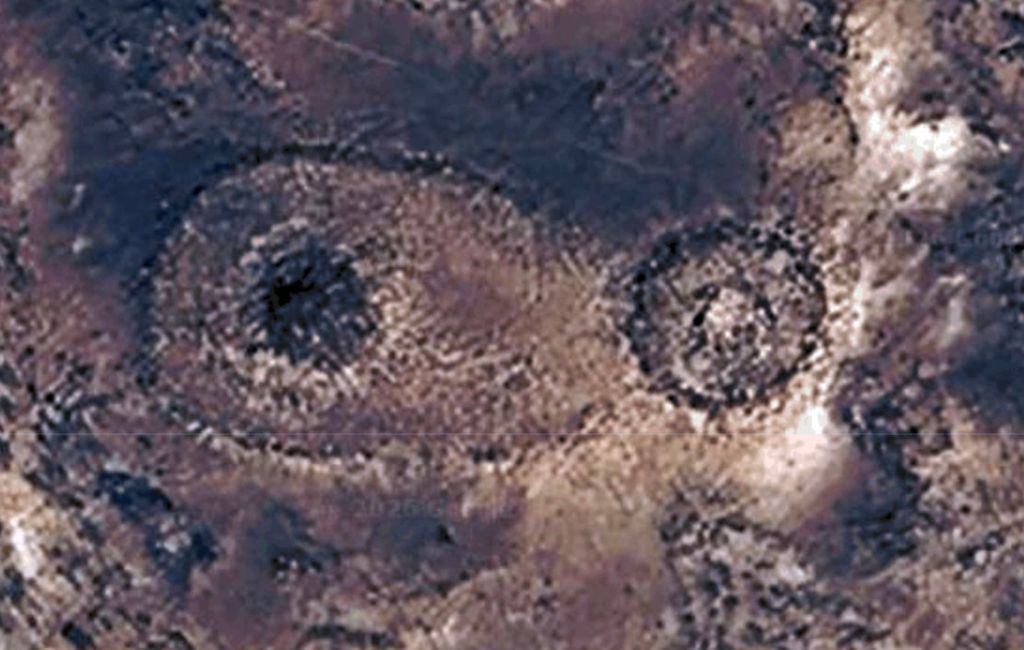
A version I’ve read about but not seen is called the rather ill-named compass tomb which is found exclusively in the Tibesti massif of northern Chad (left). In the clearest examples like below, an arm or spike extends from the oval ring to one side, resembling a tadpole, tennis racket or snow show. As always, in the centre of the ring you will see the tomb mound.
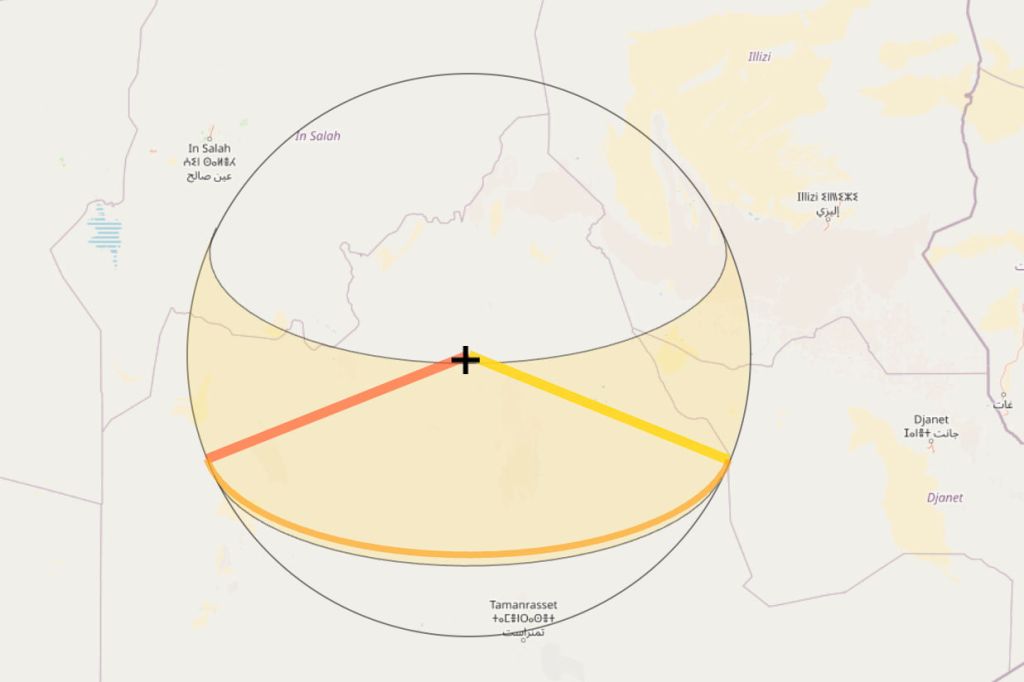
Sunrise orientation By now you may have spotted a common directional theme among the non purely circular pre-Islamic tombs: they all have elements which point at about 110° which, at these latitudes of around 25°N is towards the rising sun. Just as with many ancient, pre-monotheistic civilisations, the sun was the key element in their cosmology, with ‘the way to rising sun’ suggesting rebirth or afterlife. But just like builders, occasionally they got it wrong, like the compass tomb above right in the sands of the western Tibesti.
Sunrise and sunset points on the horizon at 25°N (Ie: much of the Sahara)
There is one final category of tomb which is also commonly foiund in the Sahara. The Islamic tomb. Contemporary Moslem cemeteries on the edge of desert towns are relative plain affairs, cleared rough ground covered in plain head stones. The ornate tombs below are out in the desert, far from the nearest village (Arak, Algeria). Usually the headstone is at the eastern end of the tomb, though of course with Islam that’s related to the direction of Mecca, not sunrise. These tombs, which might be said to have an entrance on the left and an east-pointing mihrab (‘altar’ niche) in the perimeter ring, will be a few hundred years old.
Islamic tomb
Not all pre-Islamic tombs fit the above categories. Below left, a keyhole shape but with no corridor, overlapped by a mound-ring tomb. Perhaps the corridor stones were reused for the mound-ring. Below right, a mound-ring with a perimeter mound like a goulet – a descendant’s tomb? I read here that excavated tombs in the Oued Draa of southern Morocco were more like mausolea, with a walled crypt under the stone mound where successive generations were interred. I’ve never read of a tomb being excavated like this in the Sahara, though I’m sure it must have been done, by either grave robbers, archeologists or the curious. I remember one time in the exceedingly remote Gilf Kebir, we came across a plain, desolate tomb (rare in that area) on a day-walk. Someone half-heartedly dug it up but found neither bones nor treasure. It didn’t seem like the right thing to do.
Antenna; unimpressive at ground level
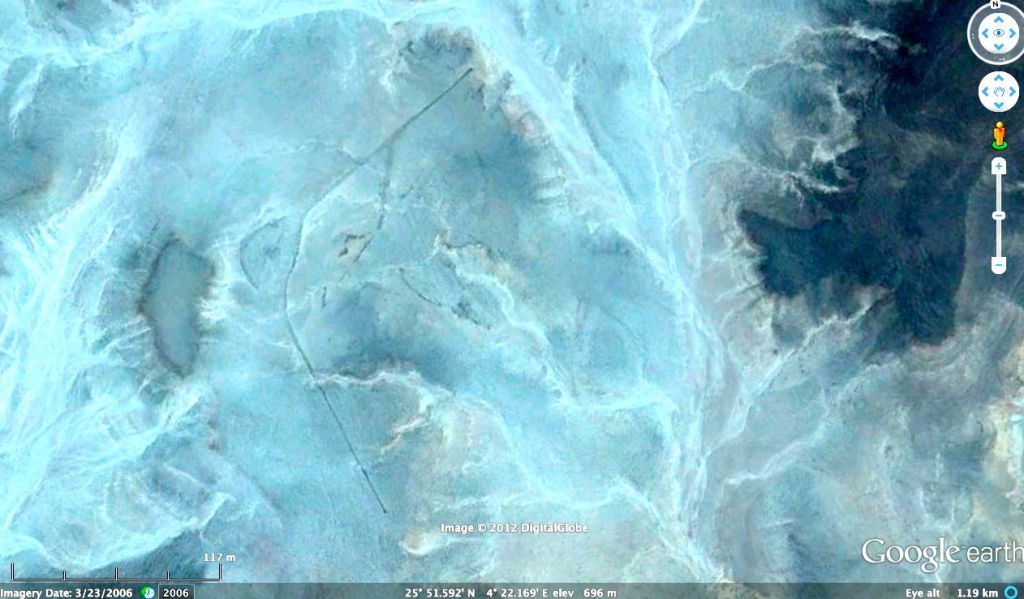
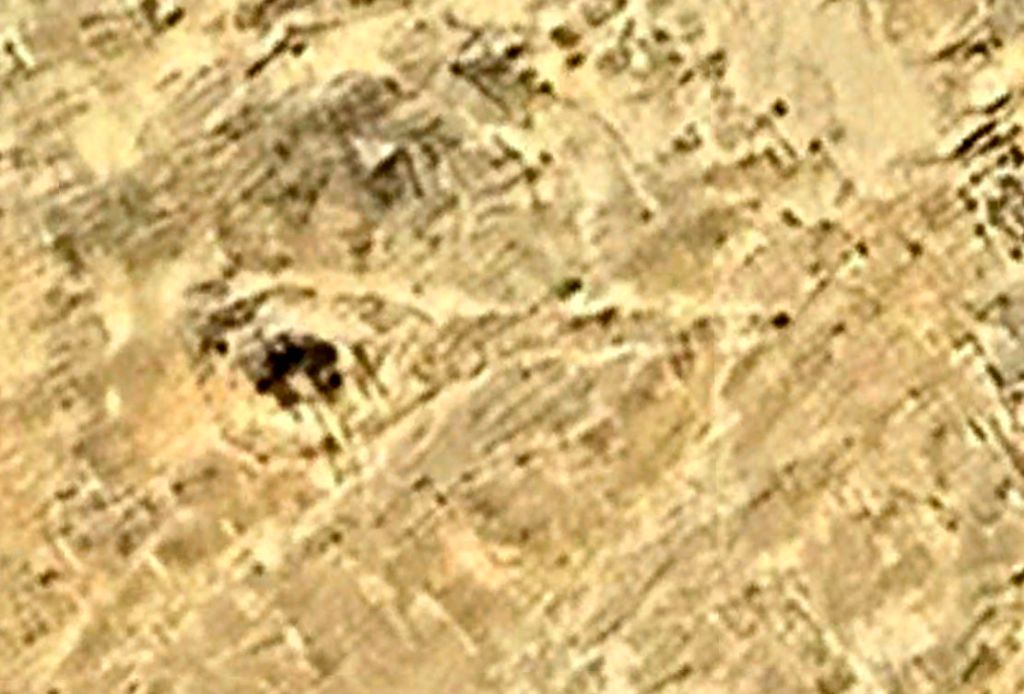
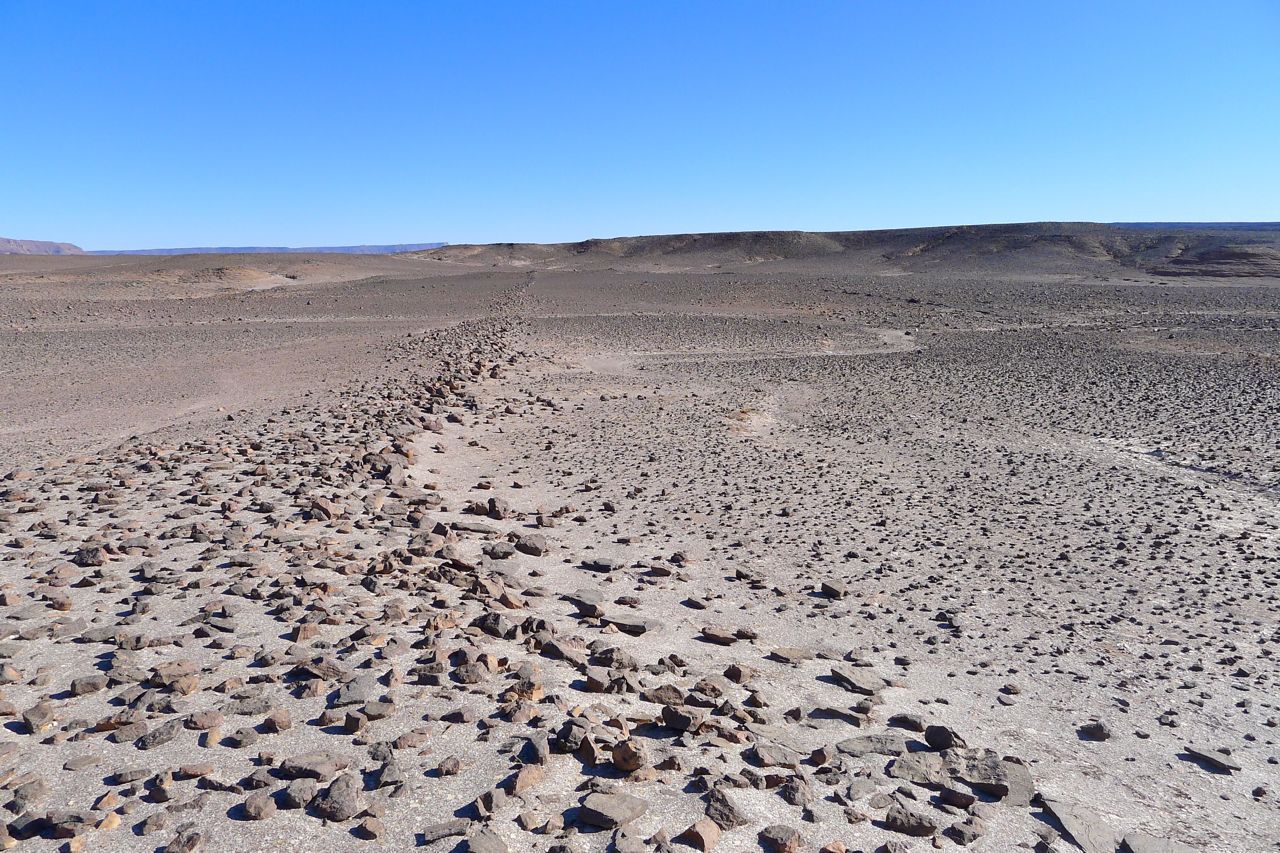
Often this fascination and excitement with pre-Islamic tombs falls a little flat on actually finding one on the desert floor. On a 2012 Immidir trip I was excited about finding a huge antenna tomb that lay close our path on Day 6 or so. On Google (above) the massive structure with a span of over 300m looked amazing, but by the time we tracked it down (left), it was too big to appreciate from ground level. My group seemed to say… ‘and the purpose if this diversion was…?’. ‘Flying’ over these tombs on satellite imagery, like Peru’s Nazca lines, is how they’re best appreciated.
How old are these ‘pre-Islamic’ tombs? Well in the central Sahara I’d say the Islamic era began to have an impact a couple of hundred years after the Arab Conquest of North Africa between AD 647–709. I imagine this swept like a tide west along the south Mediterranean coast, down the Atlantic to present-day Mauritania and then ‘eddied’ back west towards places like Timbuktu. Other eddies may have spun off sooner to places like Ghadames in Libya, following trans-Saharan trade routes into the interior.
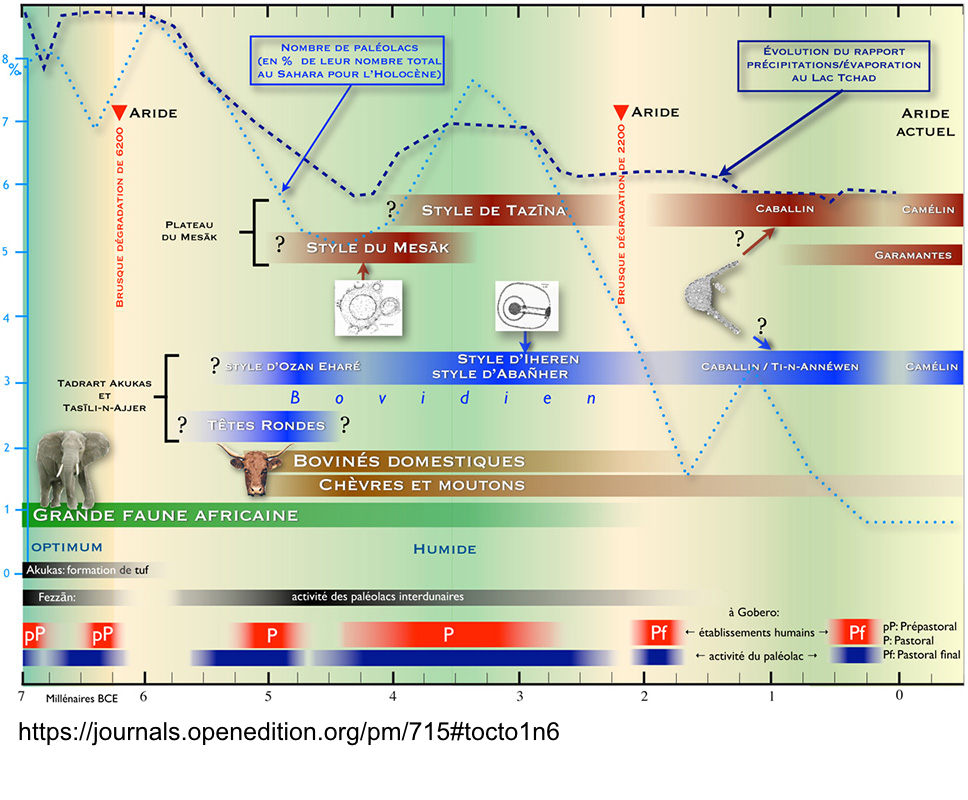
Chances are these tombs, like the huge keyhole on the right in the Immidir (above), are only around 4000 years old, maybe double that. That means they followed the apogee of rock art some 6000 years ago following a climate change (the ‘Humide’ in the image below) which briefly repopulated populated what is now the Sahara. By this time megalithic tombs and temples became widespread across the ancient world, most spectacularly in ancient Egypt and western Europe.
You don’t have to venture into the deep Sahara to see keyhole tombs. In southern Morocco, just a short distance from Erg Chebbi and three miles west of Taouz, on the west side of the Oued Ziz are a cluster of tombs. Like Aguelmam Rahla they’re situated on the edge of a plateau and by a former big river as well as an erg – and not all with entrance ways pointing east.
Below, a curious structure on the Oued Tagant valley midway between Tam and Djanet. And below that, another in the Hoggar, just southeast of Assekrem. I’ve seen these elsewhere in southern Algeria but their meaning is unknown. The guides and old Saharan expeditions just call them ‘tombs’ but they look different and newer than PIZs. More about them here.
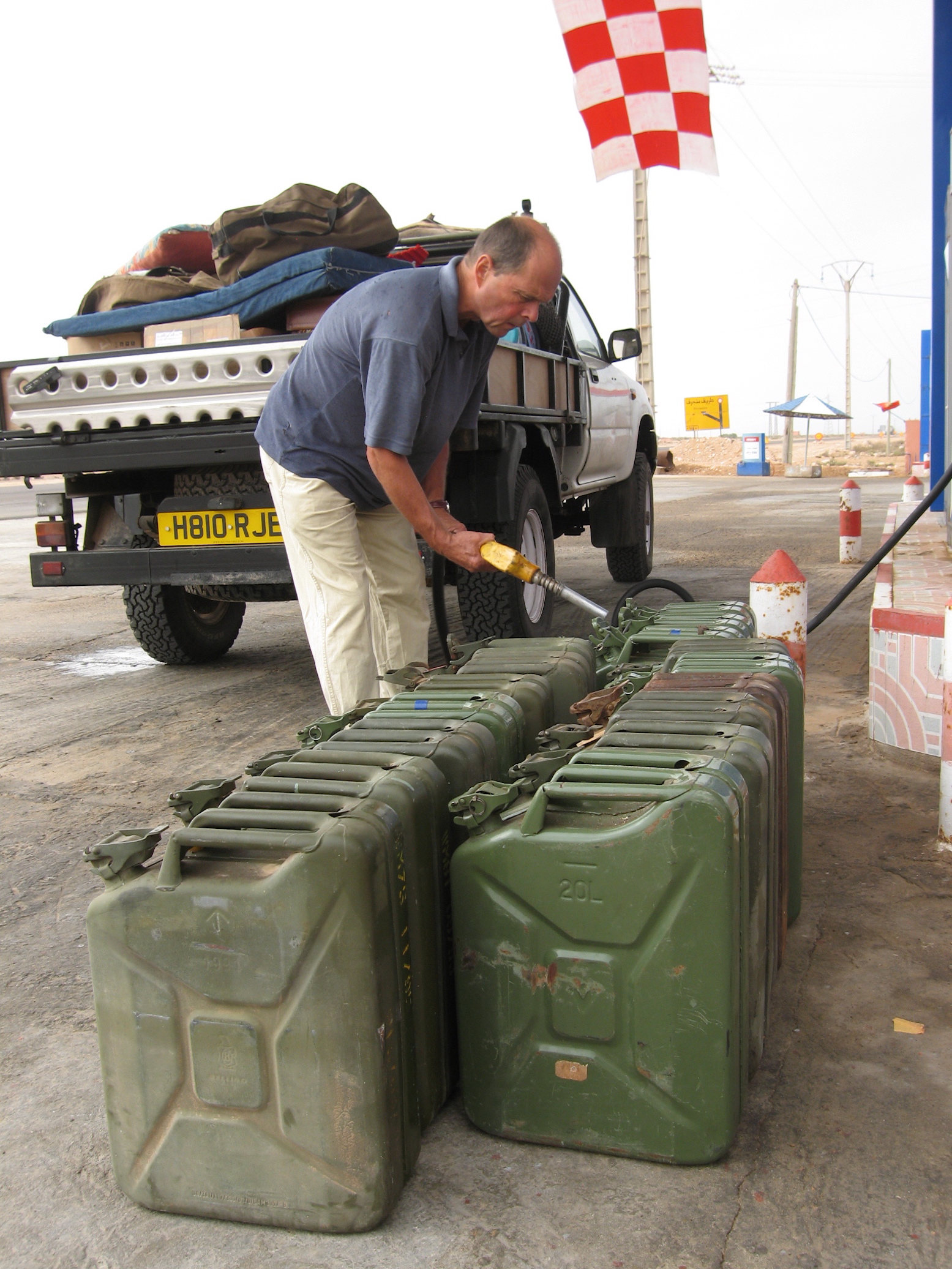
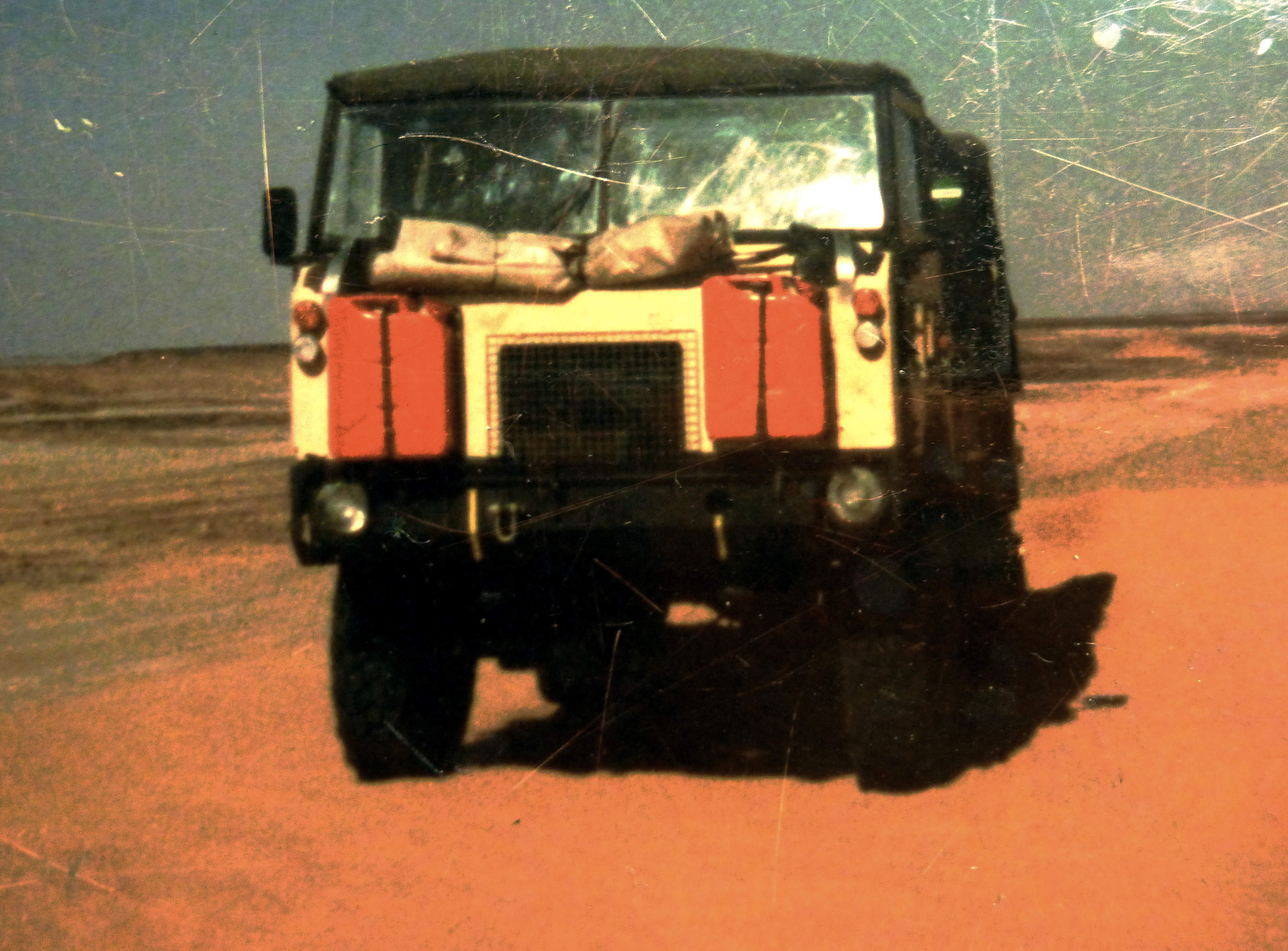
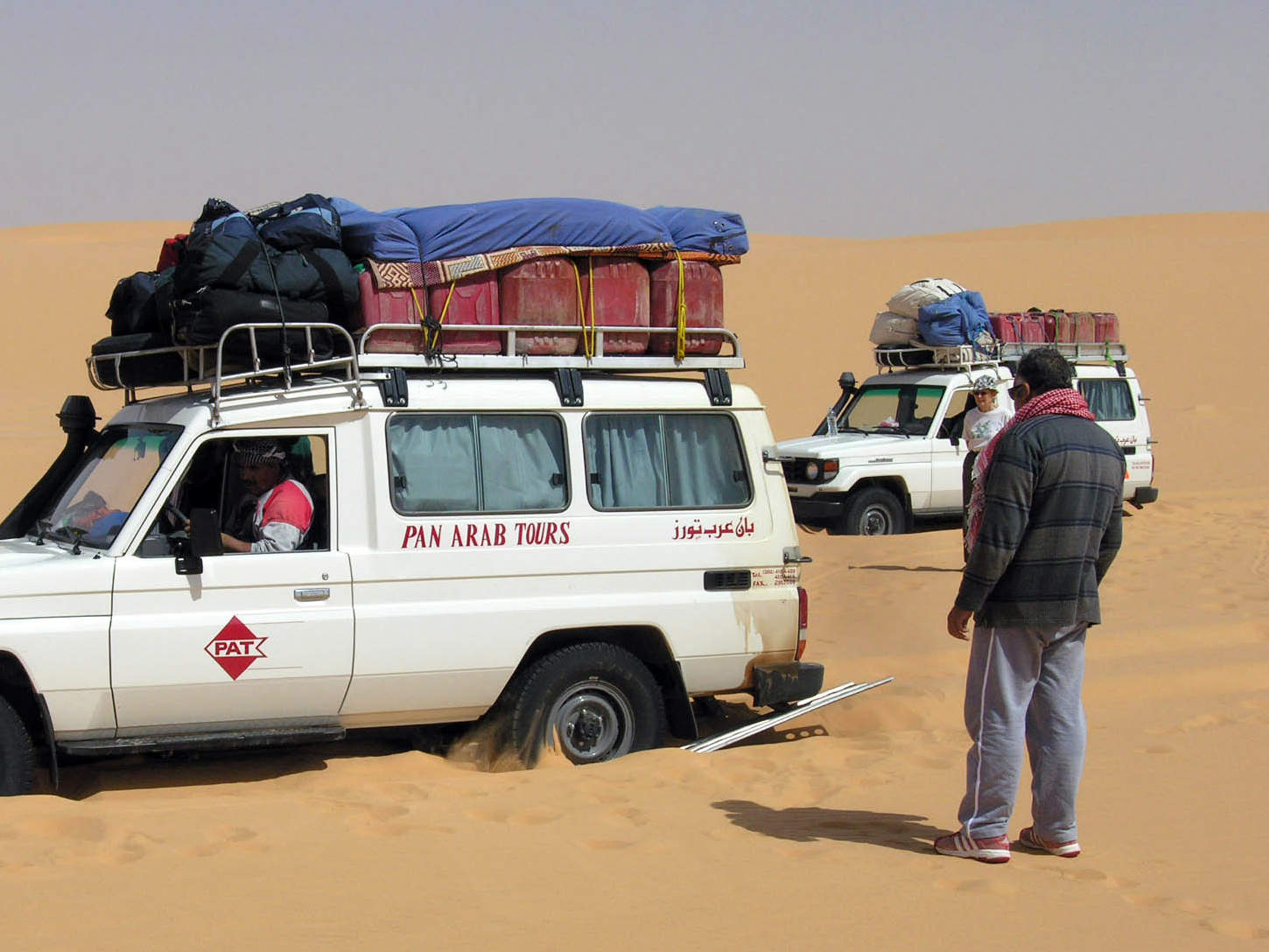
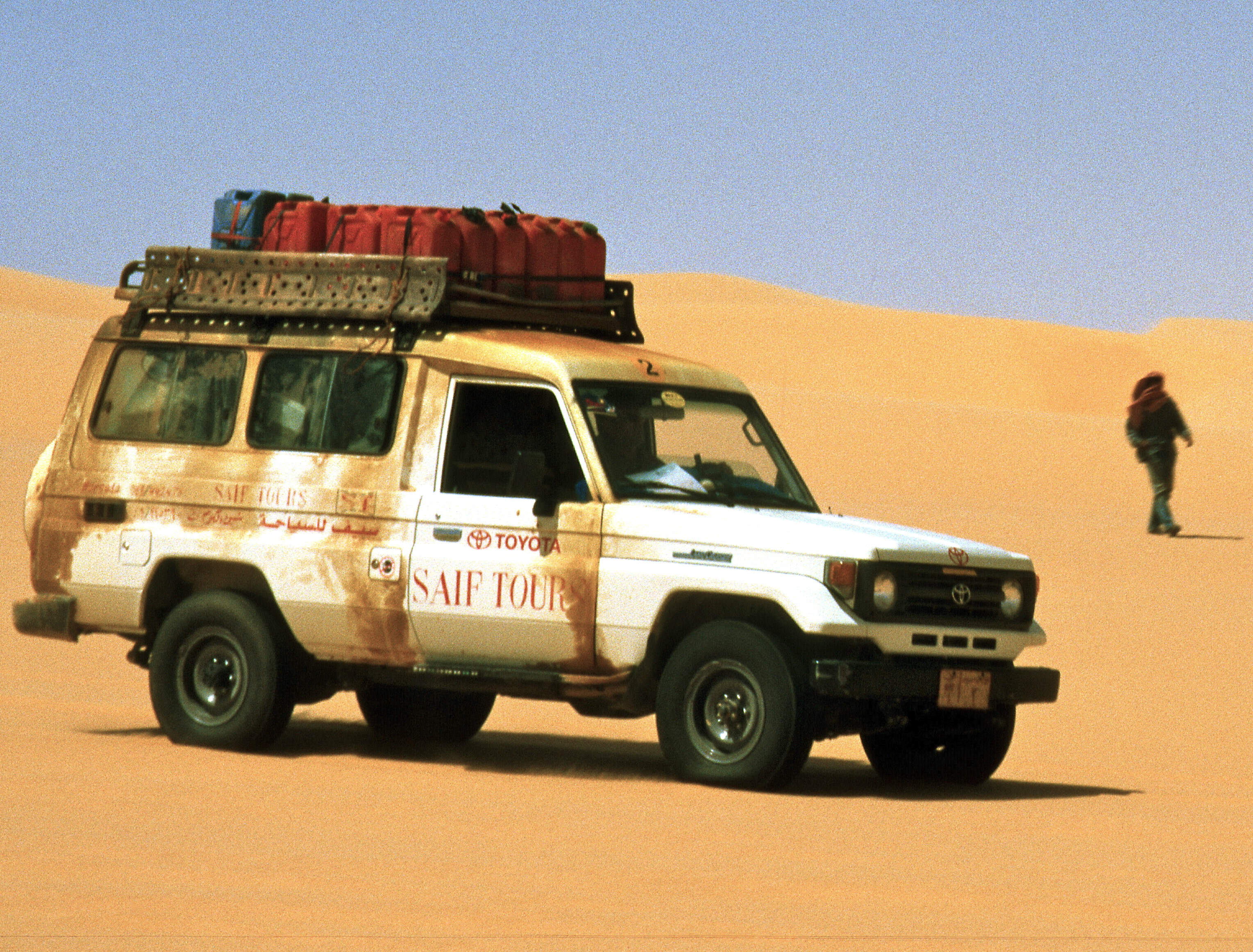
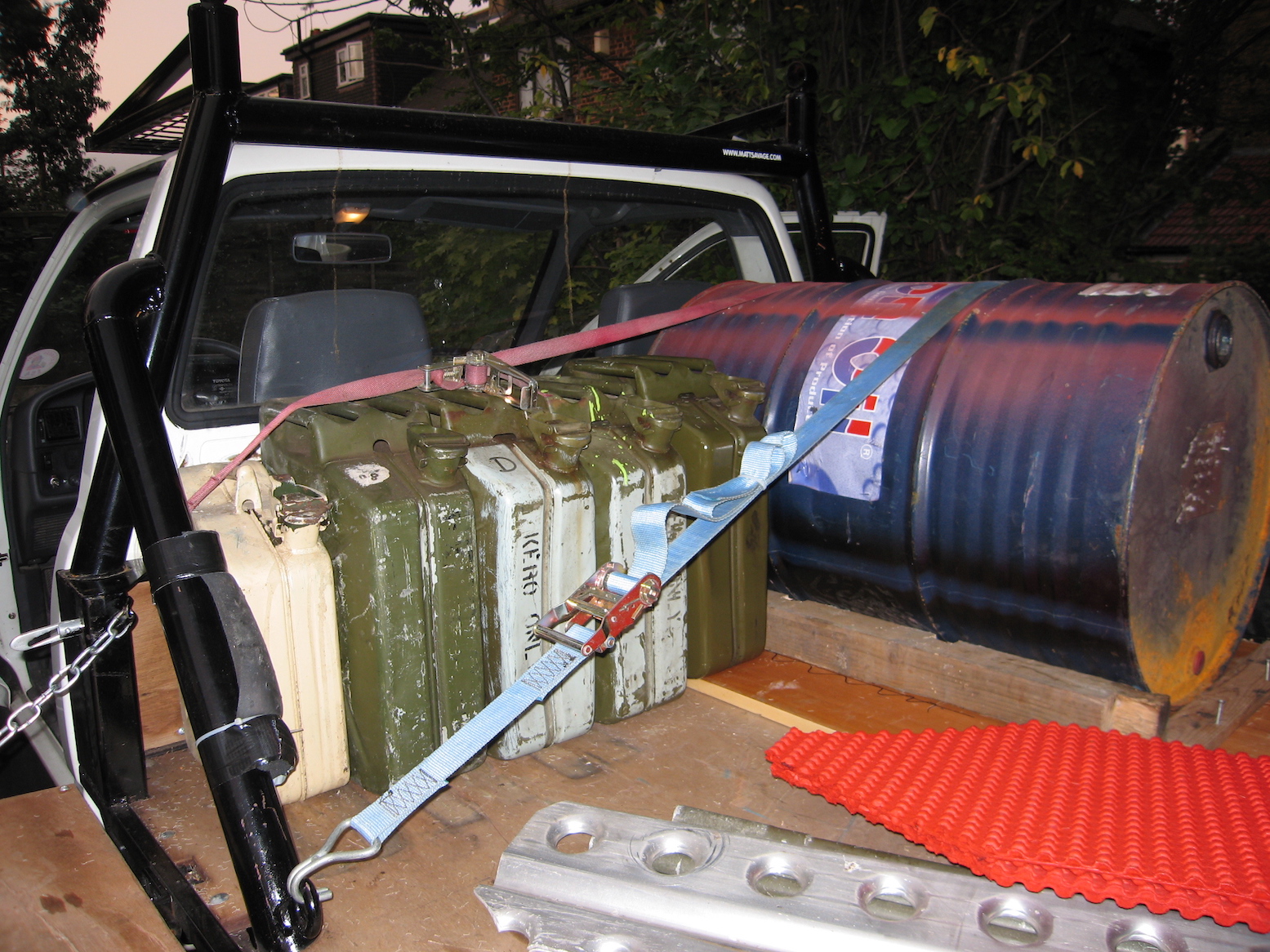
For travellers who don’t expect to be making a lifetime of Sahara travel and haven’t got limitless funds, jerricans provide the simple answer to increasing your vehicle’s range. Available sometimes still unused from military surplus outlets for around £10, they make reliable and robust fuel containers.
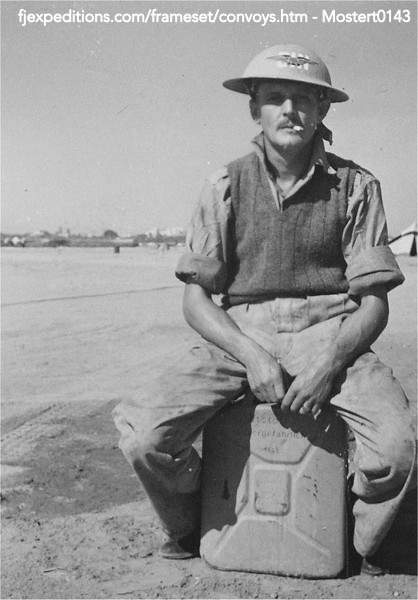
Captured WW2 kannister
The standard steel jerrican is a German design (hence the name) from the late 1930s, developed to support their blisteringly effective blitzkrieg invasions. The fact that the design remains unchanged today shows how well they succeeded with the ergonomics of carrying, pouring, sealing and storing fuel. During the war in North Africa, the LRDG prized the discovery of any jerricans, while the Germans were ordered to destroy them on retreat.
LibyaWestern SaharaAlgeriaMali
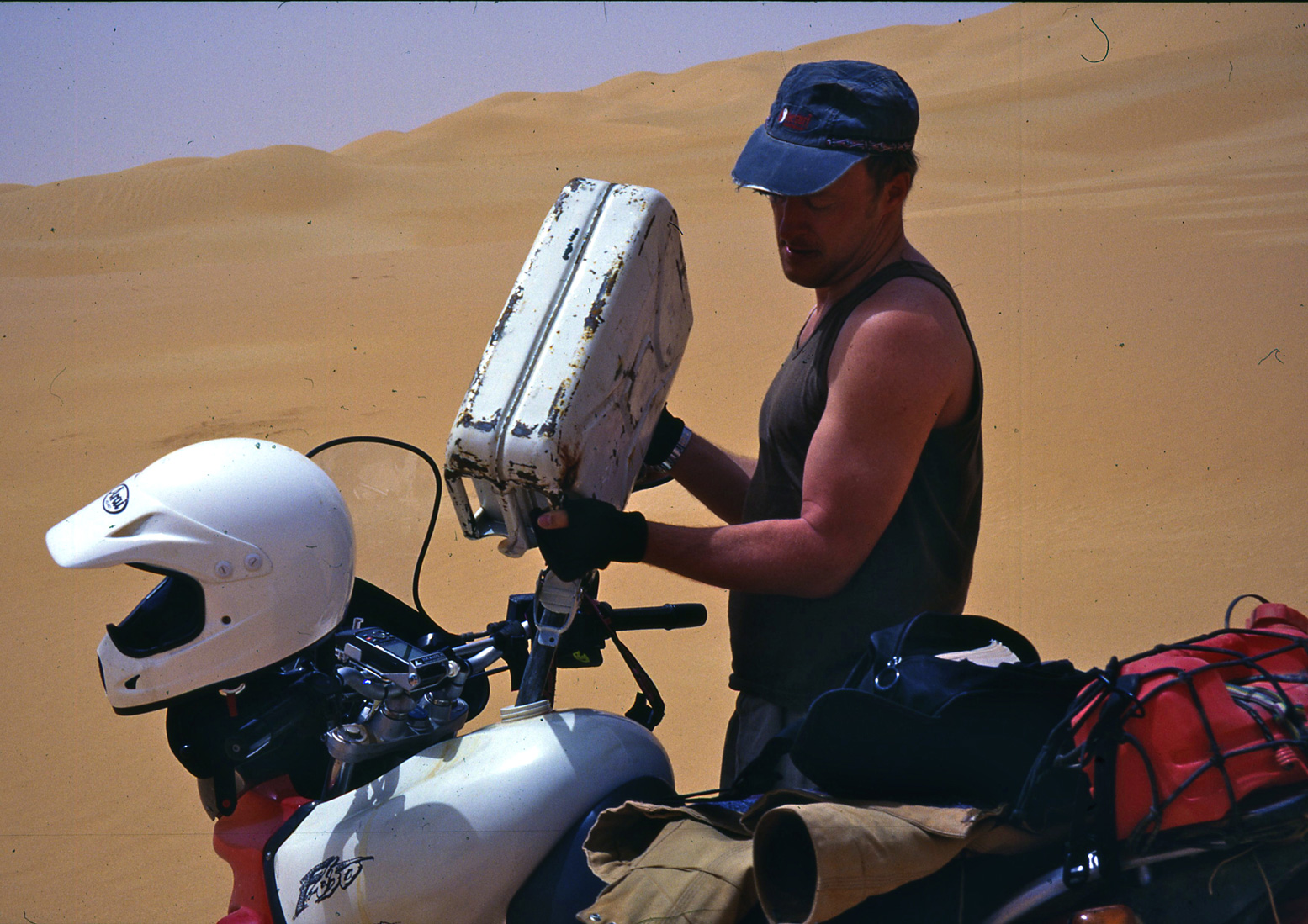
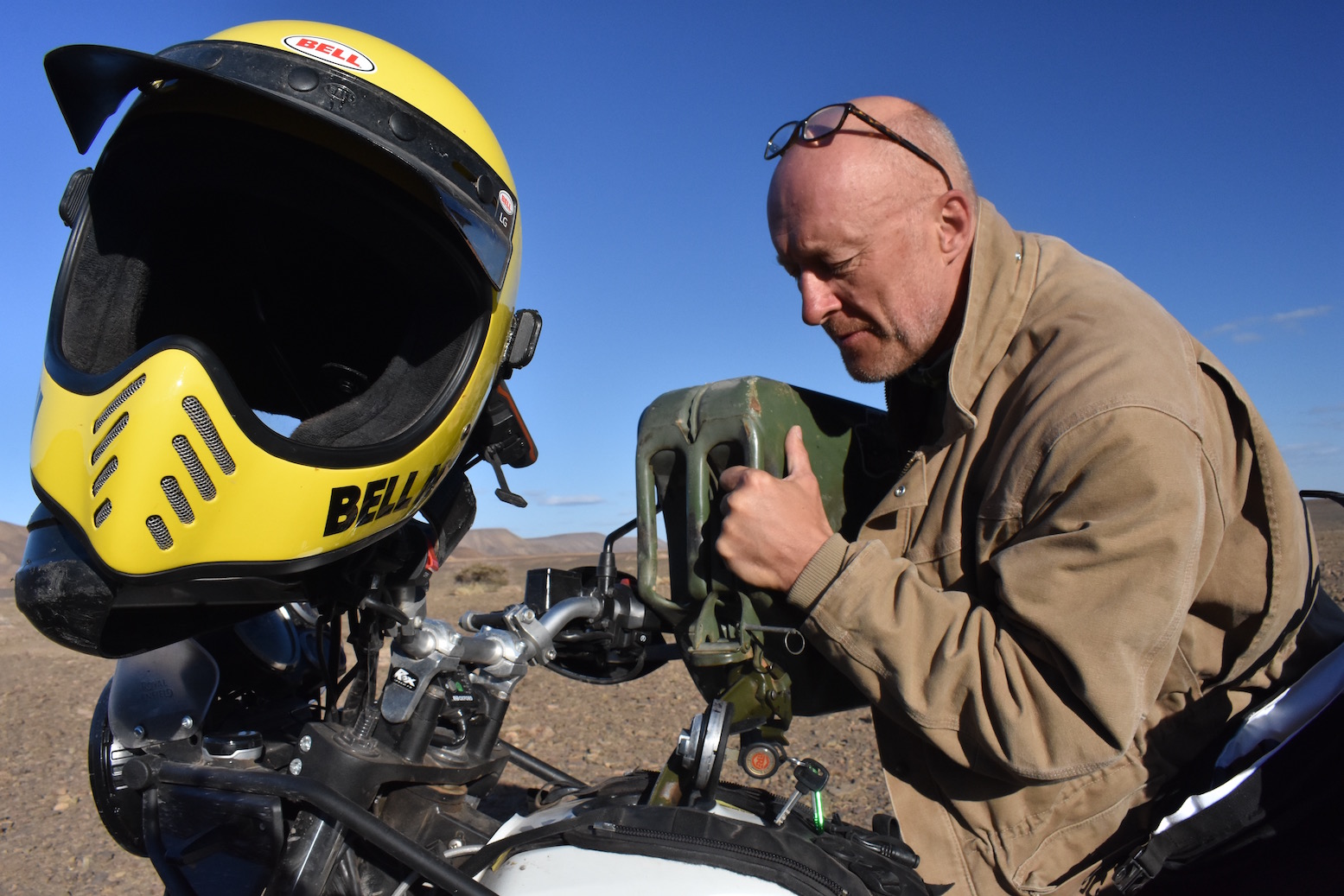
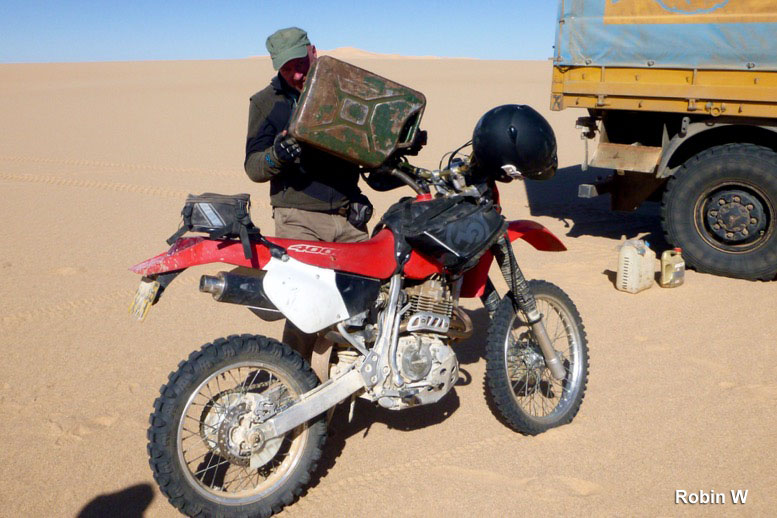
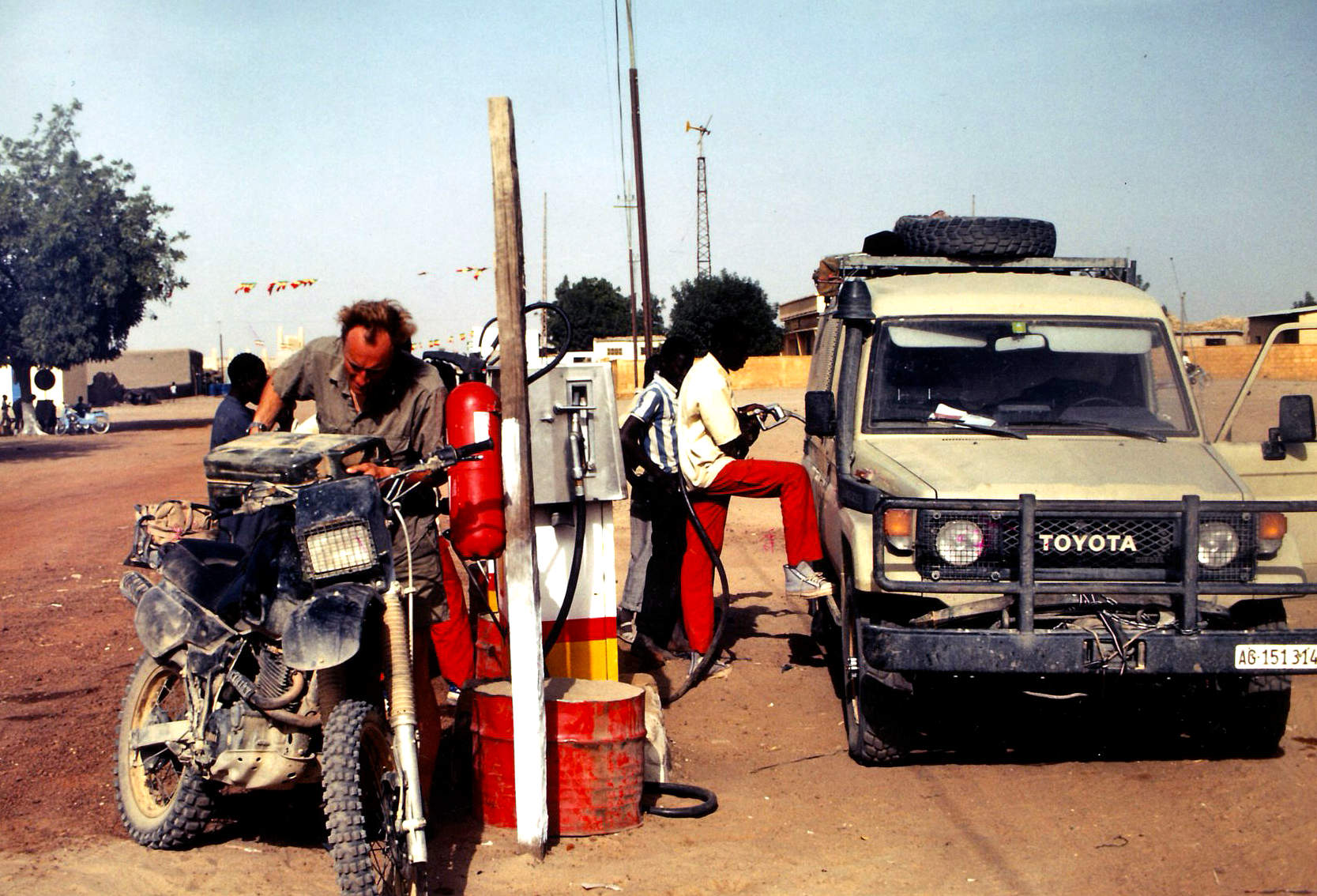
A jerrican holds 20 litres (4.45 gallons; 5.28 US gallons) when filled in the upright position. This leaves an air gap just below the handles which shouldn’t be filled with fuel (by tipping the can backwards) unless you’re really desperate. The air pocket, as well as the X-shaped indentations on the sides, enable the can’s sides to bulge as fuel expands; especially the case with petrol which is more volatile than diesel. Once warmed and shaken on your roof, take care to open the cap very slowly (the cap’s clamp design makes this easy) to avoid a spurt of fuel, which, besides being dangerous, is messy and wasteful.
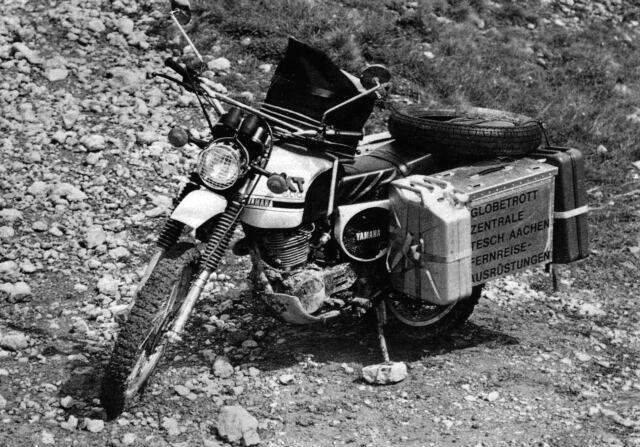
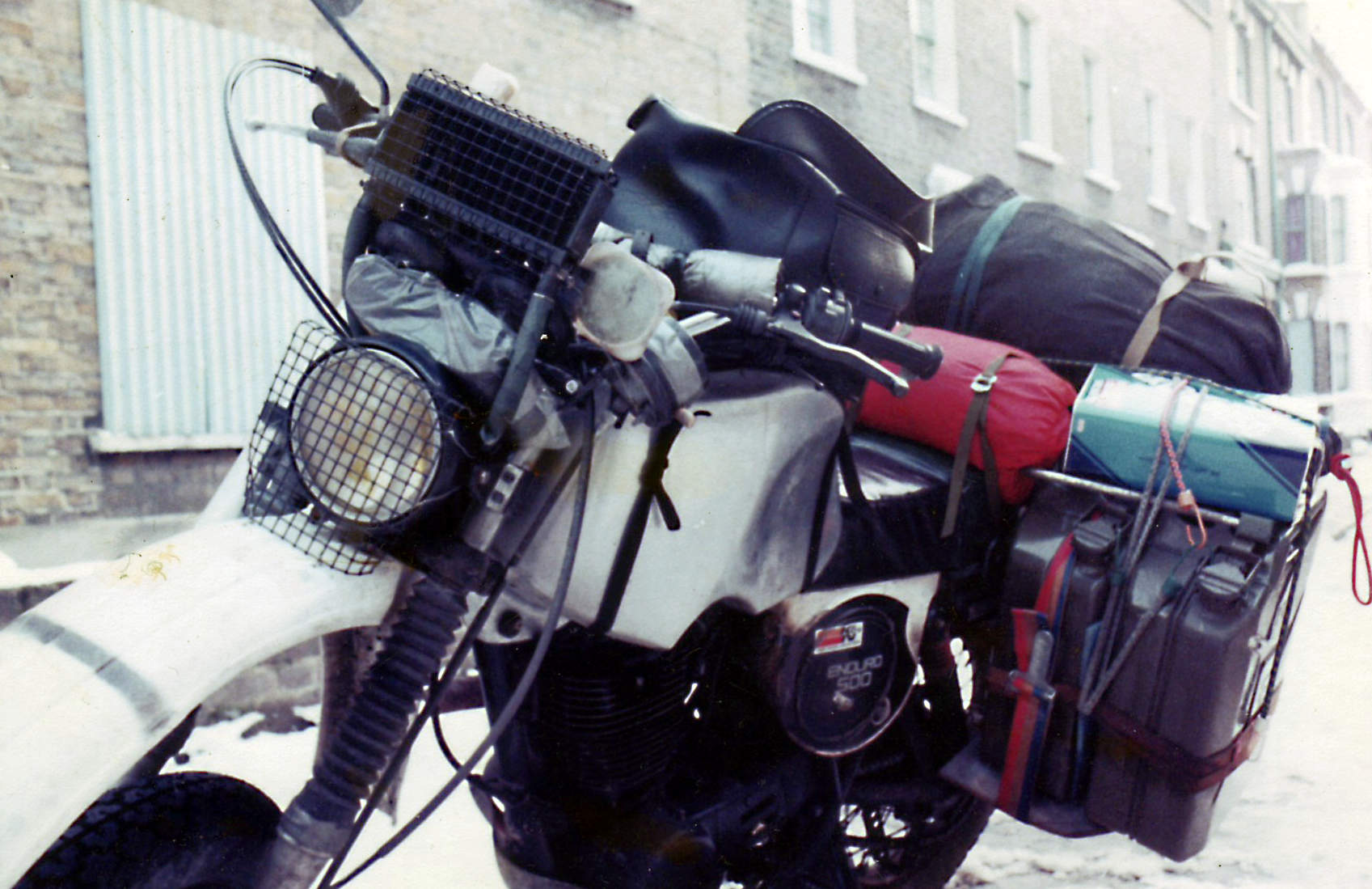
Bernd Tesch’s XT500, 1976My XT500, 1982. The jerries were soon sold.
Algeria
A clamp-on spout (some with an integral gauze and breather tube) should make topping-up while holding a heavy can easier. But I find these clamp-on spouts often don’t seal well, fuel runs down your leg and their internal gauze slows down the flow rate, prolonging the effort in holding them up. A wide-bore funnel takes half the time. Rigid funnels get messy with diesel and are awkward to stow, so I prefer the ‘collapsible’ vinyl items with the end snipped off to make the hole bigger. Store them in a plastic bag or flat lunch box. Cutdown mineral water bottles will also do the job.
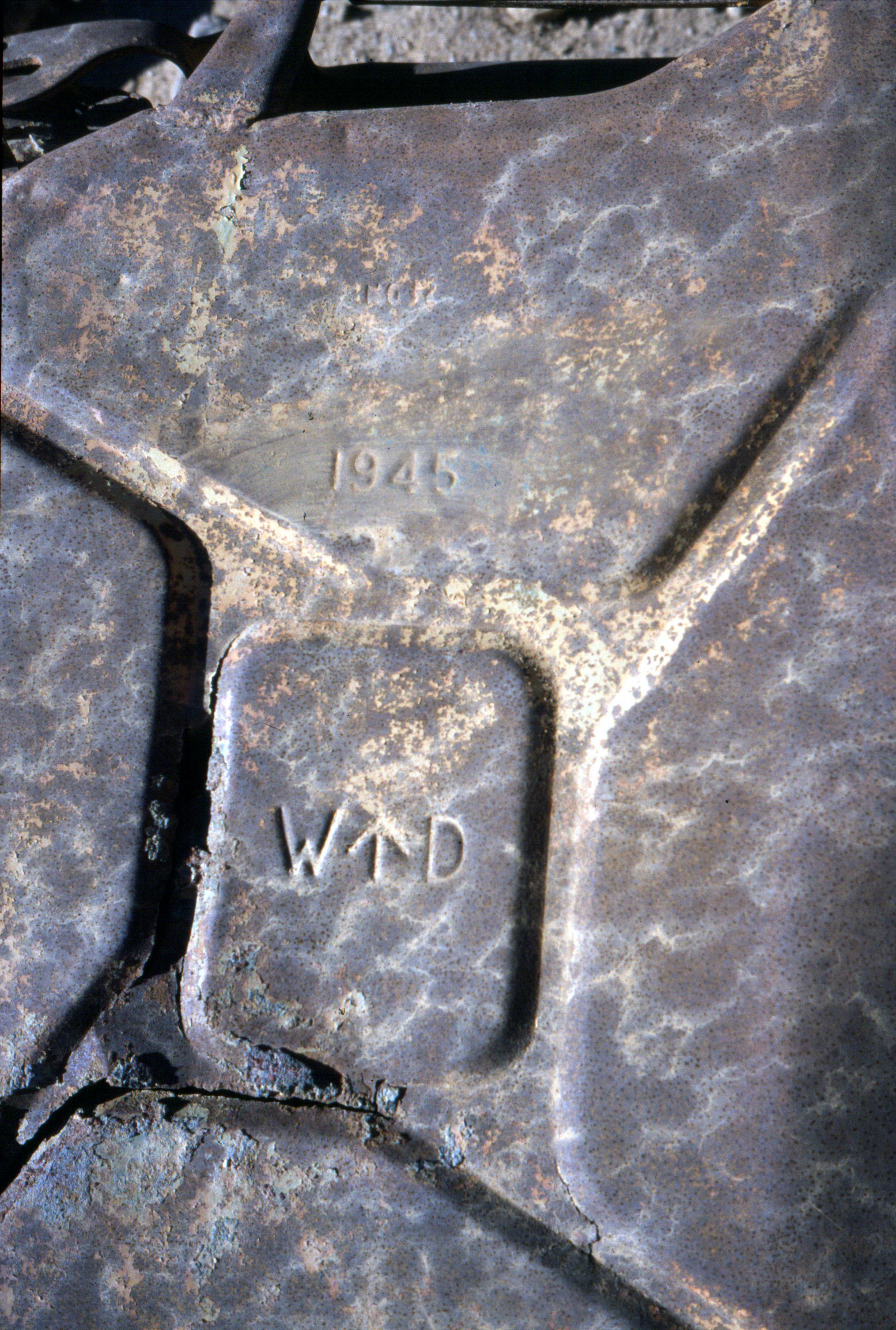
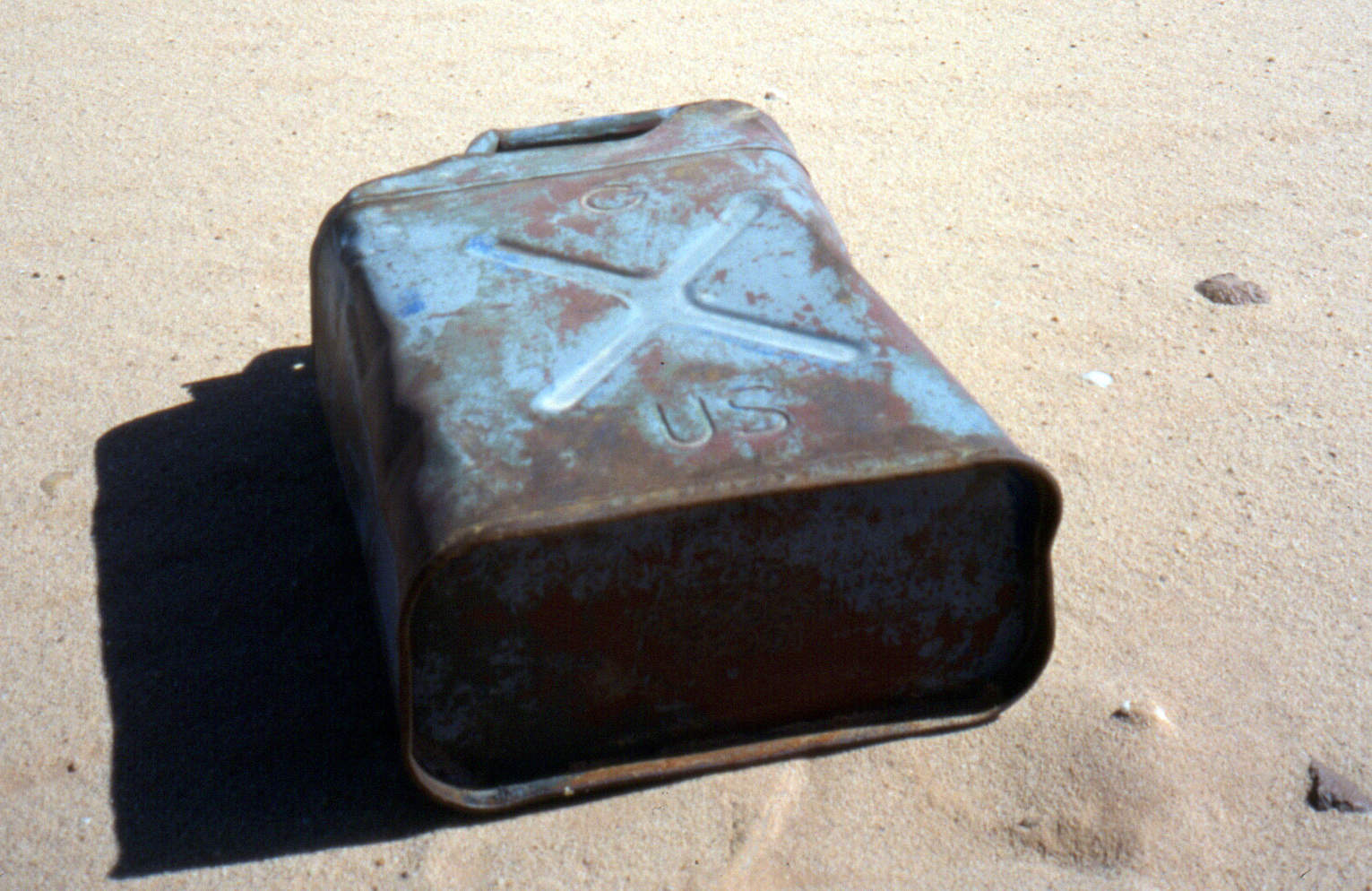
Pinched or copied following Al Alamein, a Brit WD jerry at Jebel Uweinat (Sudan).A US-army ‘Ameri-can’. Not quite as good. Or not as legendary.
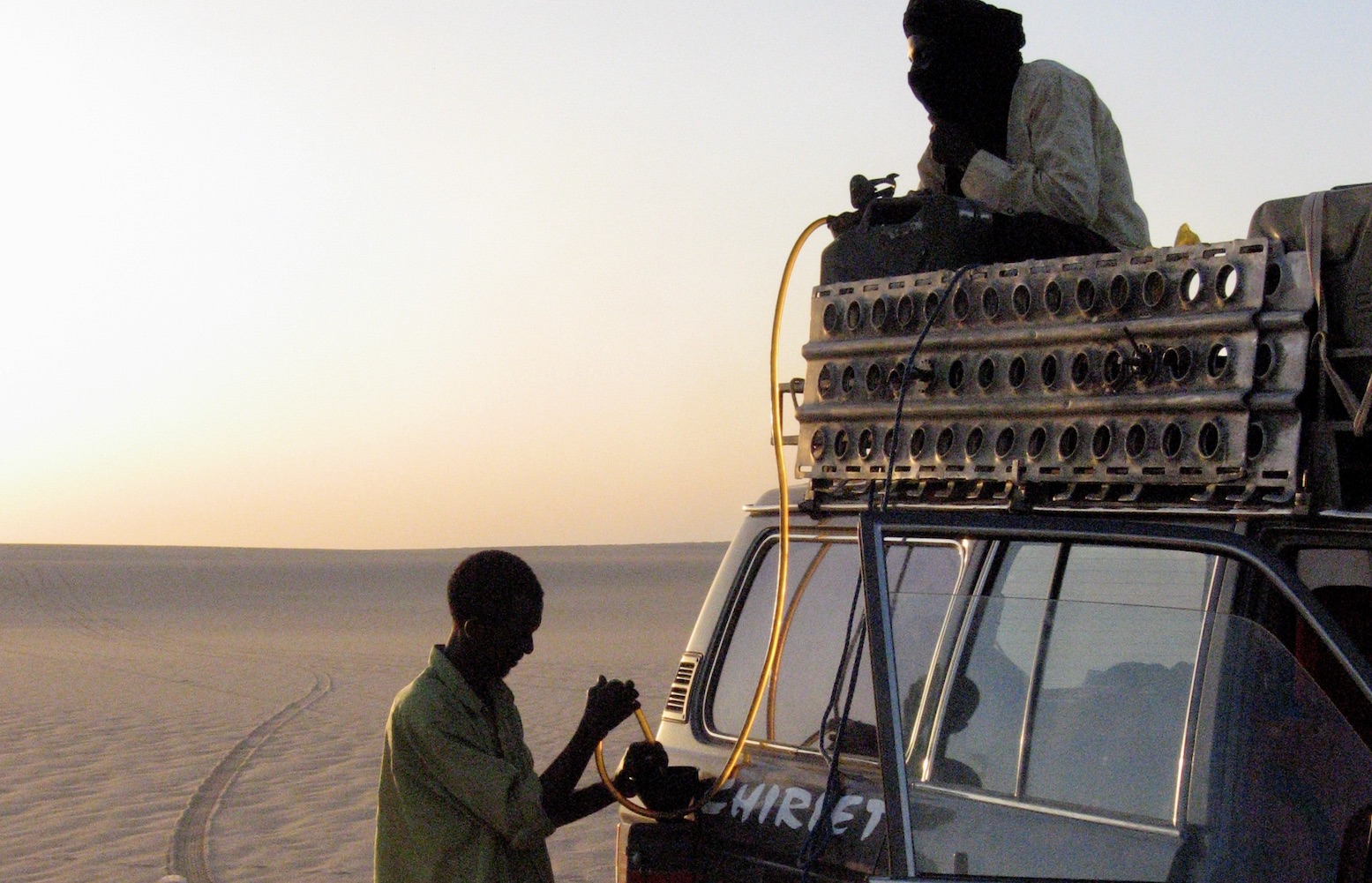
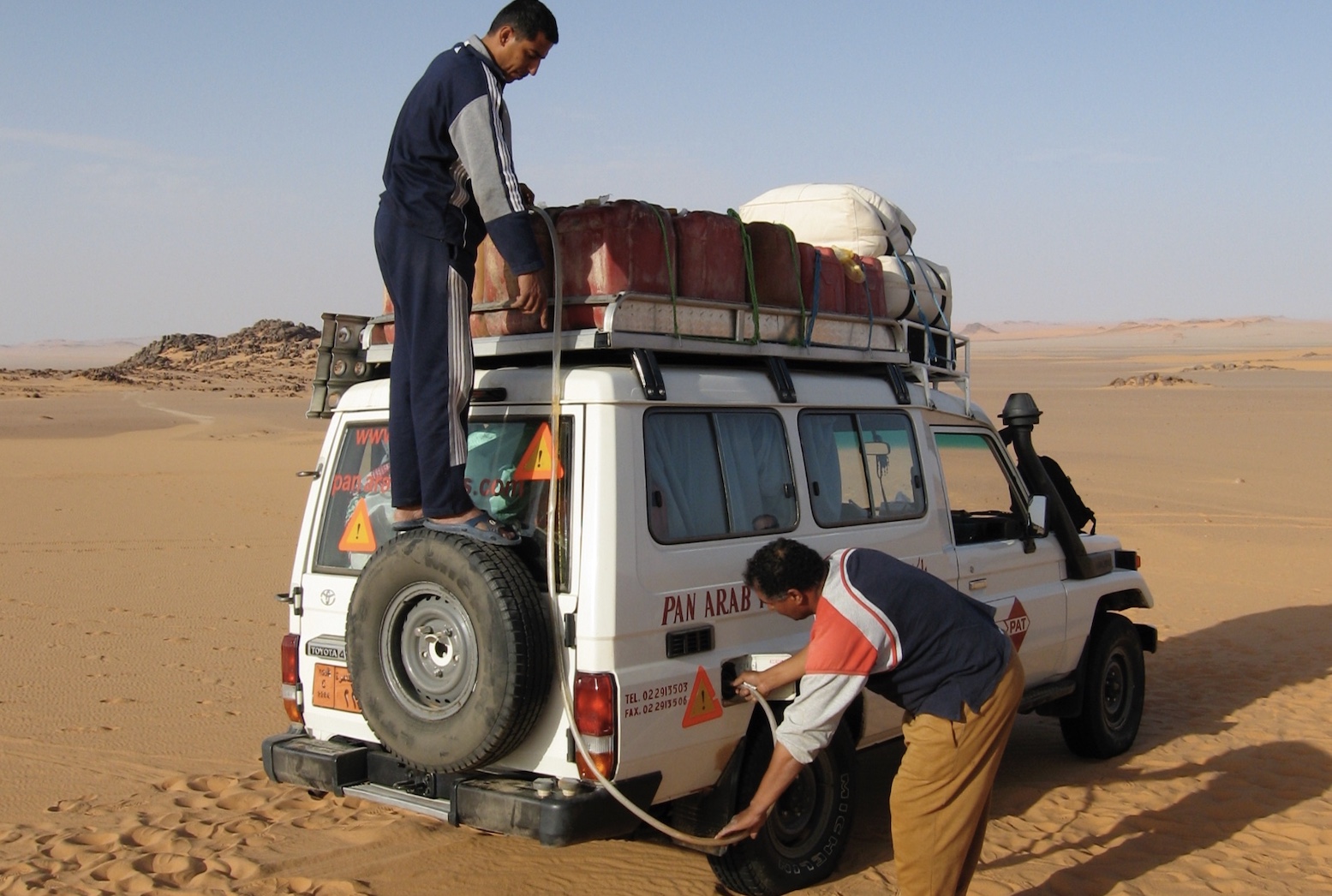
Better still, leave the can where it’s stashed on the car and siphon the fuel into the tank either with a simple tube or a manual siphon-pump. Until mastered, the mouth-sucking method to get a siphon going is understandably unpopular with motor fuel. If you have no siphon pump bury the whole hose into a full jerrican (a flexible, clear, thin-walled hose is best). With the other end fully submerged, put your thumb over the end and draw out the tube which should stay full of fuel. Poke the tube into the fuel tank filler and the weight of the dropping fuel will create a siphon.
Tenere (Niger)Sudan (Selima)
Jerricans themselves can be knocked about for years: I’ve never seen a welded seam leak, though cap seals do leak. You can buy spare seals or, failing that, a chopped-up inner tube clamped across the mouth will work.
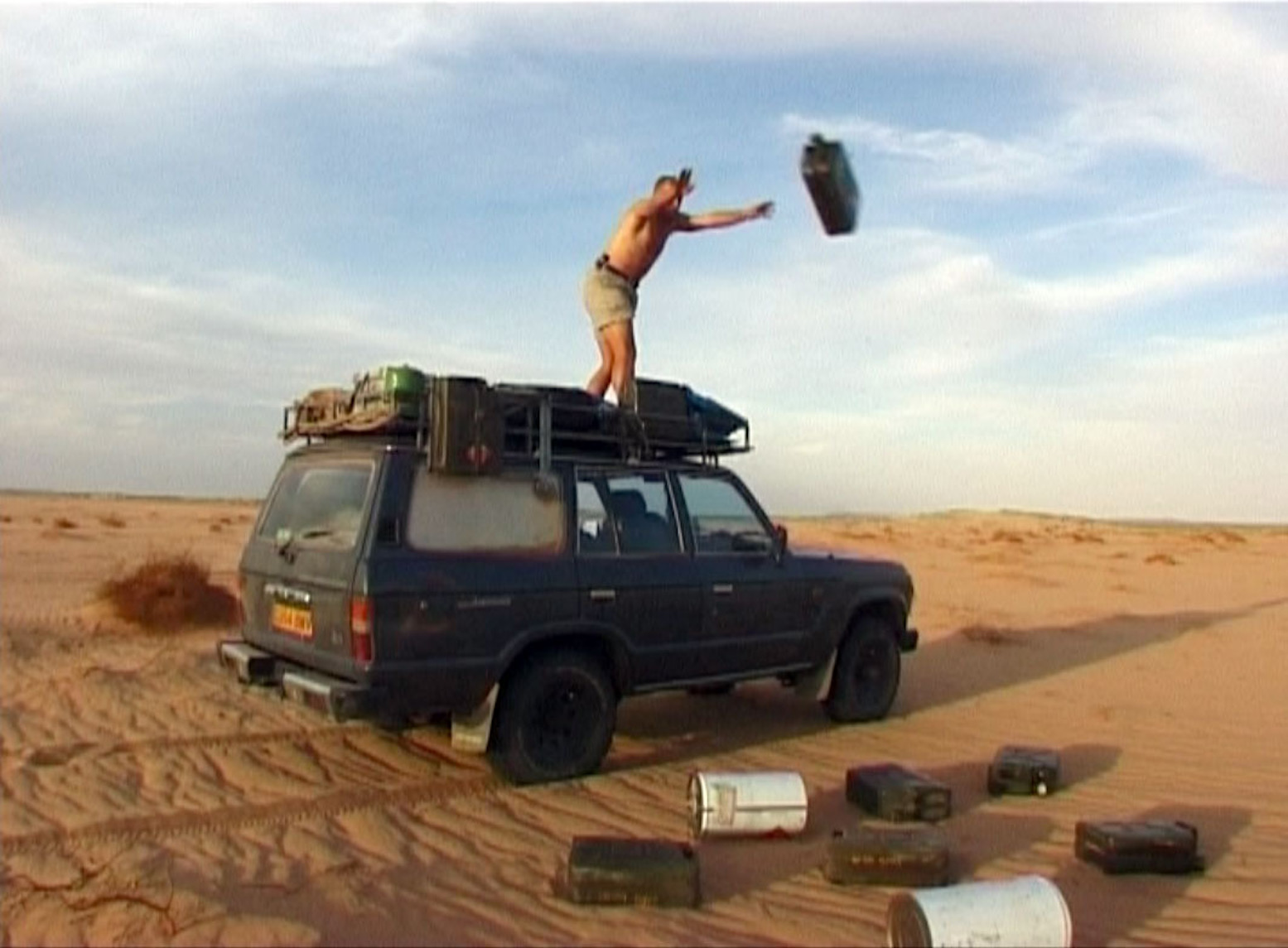
Treat ’em rough (laying a fuel cache, Algeria)
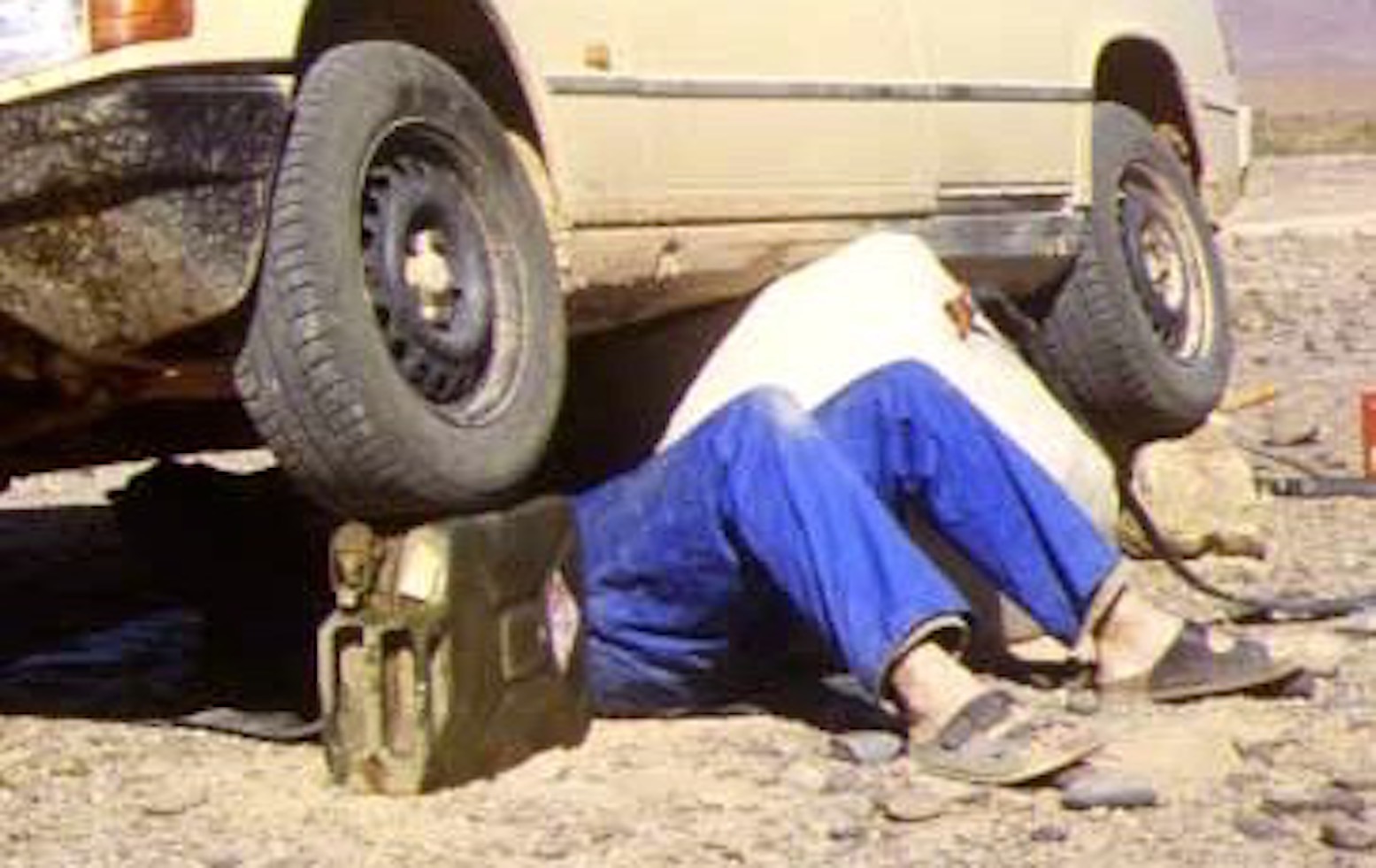
Once rust or flaking paint begin to come out of a jerry, either make sure you use a fine pre-filter or get another jerrican. Neat ten-litre versions are available and even mini five-litre models, all using the same clamping cap. They can also be robust containers for spare motor oils and other fluids and make good jack stands when working under a car.
Ten-litre jerries on a Land Rover101FCHandy wheel-stand (Morocco)
There is said to be a small risk from static electricity in the dry desert atmosphere when refuelling vehicles, especially petrol. Earth the car by touching it before opening the cap and pouring in the fuel.
Cheap plastic jerricans (Egypt)Heat up, expand and leak. A few days later
‘Jerricans’ copied in plastic should never be used for long-term fuel storage. The soft slab sides and screw-on caps are unsuited to the expansion and will swell like a balloon before splitting, leaking or bursting. I once drove a car carrying nearly three dozen cheap plastic jerries on the roof. Within a couple of days fuel was running down the sides of the car as the liquid expanded and caps leaked; I even had to use the wipers as it ran down the windscreen. It was very messy and bad for the rubber components.
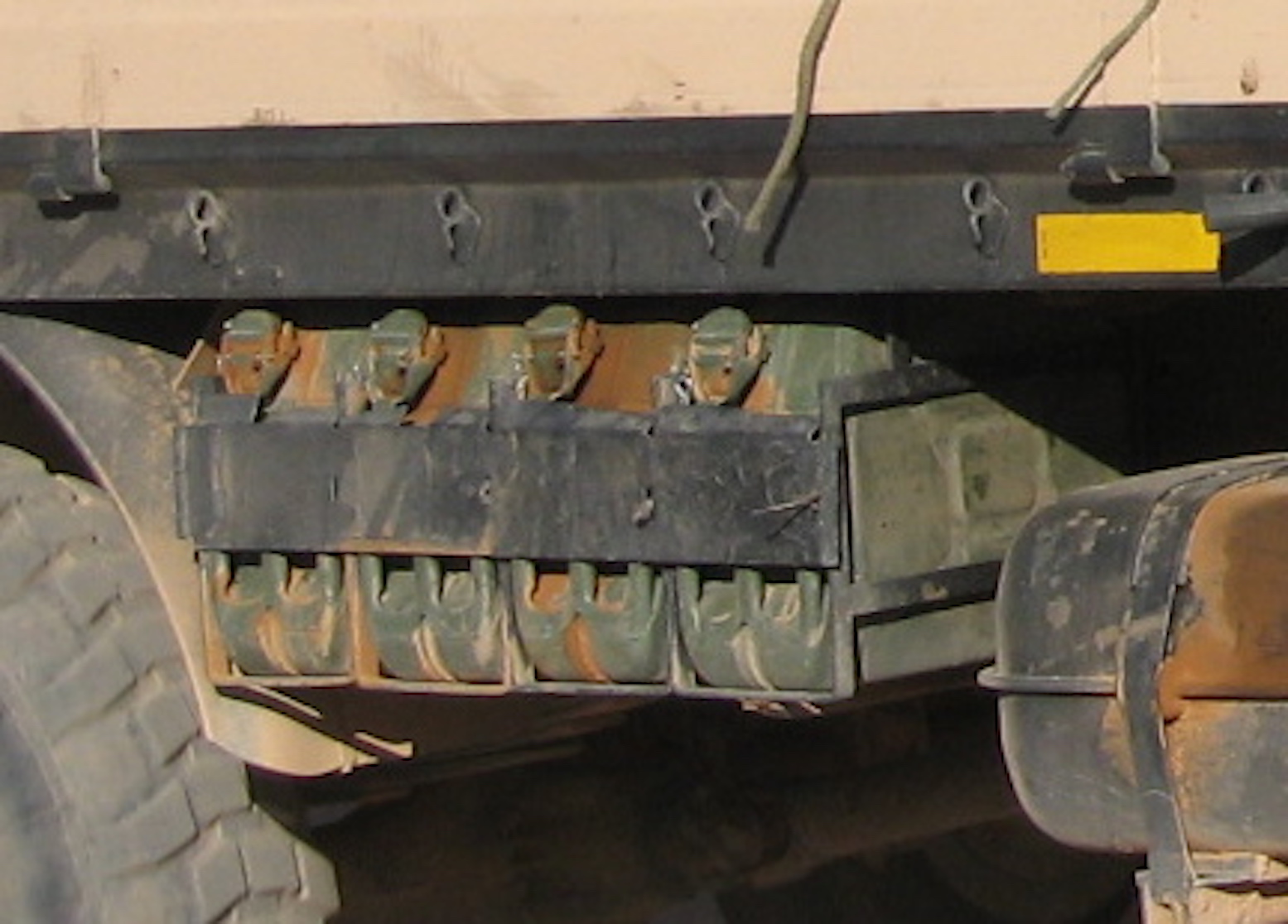
Rack of easily accessible jerries under an M.A.N.After jerricans come oil drums. Ten times bigger and as cheap or free.
Update 2025: no one’s been here for years and years
My fascination with the Tenere probably started after reading the alluringly sparse route descriptions in the old Sahara Handbook in the early 1980s.
Several stillborn attempts followed, resulting in a clearly inadequate description in my own Sahara Overland guidebook of 2000. I decided it was time to cough up two grand on a tour and enjoy a relaxed recce that wouldn’t put my own Toyota at risk (there was a high chance of losing your car in this area at the time).
No Brit operators covered this part of the Sahara and, looking at various itineraries and prices, I chose Suntours, a German operator long established in the region. I may have communicated better with a French-speaking group, but Suntours’ 22-day itinerary looked the most thorough, including the lost valley or Enneri Blaka deep in the Djado plateau, with its mysterious ‘submarine’ formation which would have got Clive Cussler going. See the vintage helicopter video bottom of the page. I met the group in Paris and we flew straight down the Tanezrouft (no window seat, alas…), reaching Niamey at sunset where it transpired half of the group of nine’s baggage was missing. We had to hang around next day in the hope the bags might turn up from Abidjan that evening. Like most sub-Sahara capitals, Niamey isn’t what you come to Africa for, but for 20p, the museum was a bargain, while brochettes at sunset on the terrace of the Grand Hotel is the done thing. That night a few more bags turned up and, with only three missing, it was decided to take the 1000-km drive to Agadez; the luggageless ones would have to make do. This long drive is a drag. Flying direct to Agadez from Paris would be ideal, though I can see why Suntours don’t trust the Le Pointe’s charters who had a bad reputation for cancelling flights if not full enough. The American tour that got robbed at Temet (more below) suffered a typical, late Le Pointe cancellation on the way out, then had to cough up for a scheduled flight. Glad I missed that trip! As it happens, the night drive in two minibuses wasn’t so bad as most of us could stretch out on a bench seat and get some sleep. Leaving around midnight, we got to Agadez thirteen hours later for lunch at Ewaden Voyages’, the local partner of Suntours. Soon after, two old Sixty-series Land Cruisers and a Patrol were loaded up and we headed for the hills.
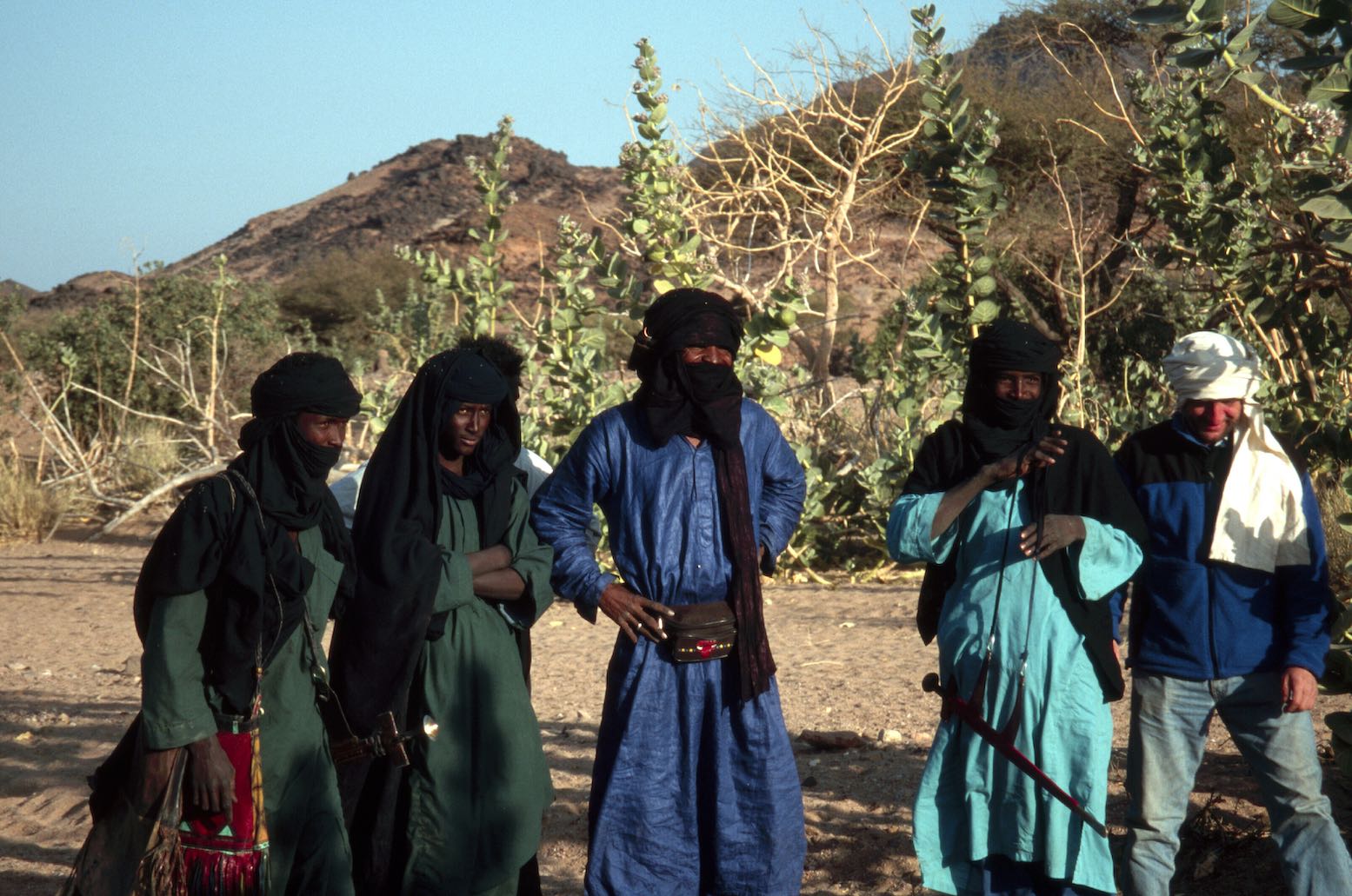
AïR I’d been warned that I might find the Aïr a rough and dull drive – it’s not the Tenere. In fact, it was quite satisfying on the way out at least, when it was all new. Out here Tuareg dudes really do wander around from village to village on camels with their takouba swords by their side. I’ve never encountered the semi-sedentary ‘Kel Aïr’ Tuareg before, but now realise how much Tuareg mythology might be based on the colourful culture of this region’s accessible clan.
Tuareg swordsmen
We camped in a oued (“never camp in a oued!”) where Ibrahim cooked the first of many spectacular meals. How long could this last I wondered, and sure enough, by the time we got to the Kaouar in the east, things got a bit plainer, but his outstanding lunchtime salads were works of art, composed of fresh ingredients for much longer than you’d expect in fridge-free motoring. Another great aspect of this tour was letting us loose on foot while the morning (and sometimes lunchtime) camp was packed up by the crew. With a bit of luck you could get a quiet couple of miles under your soles before the cars caught up.
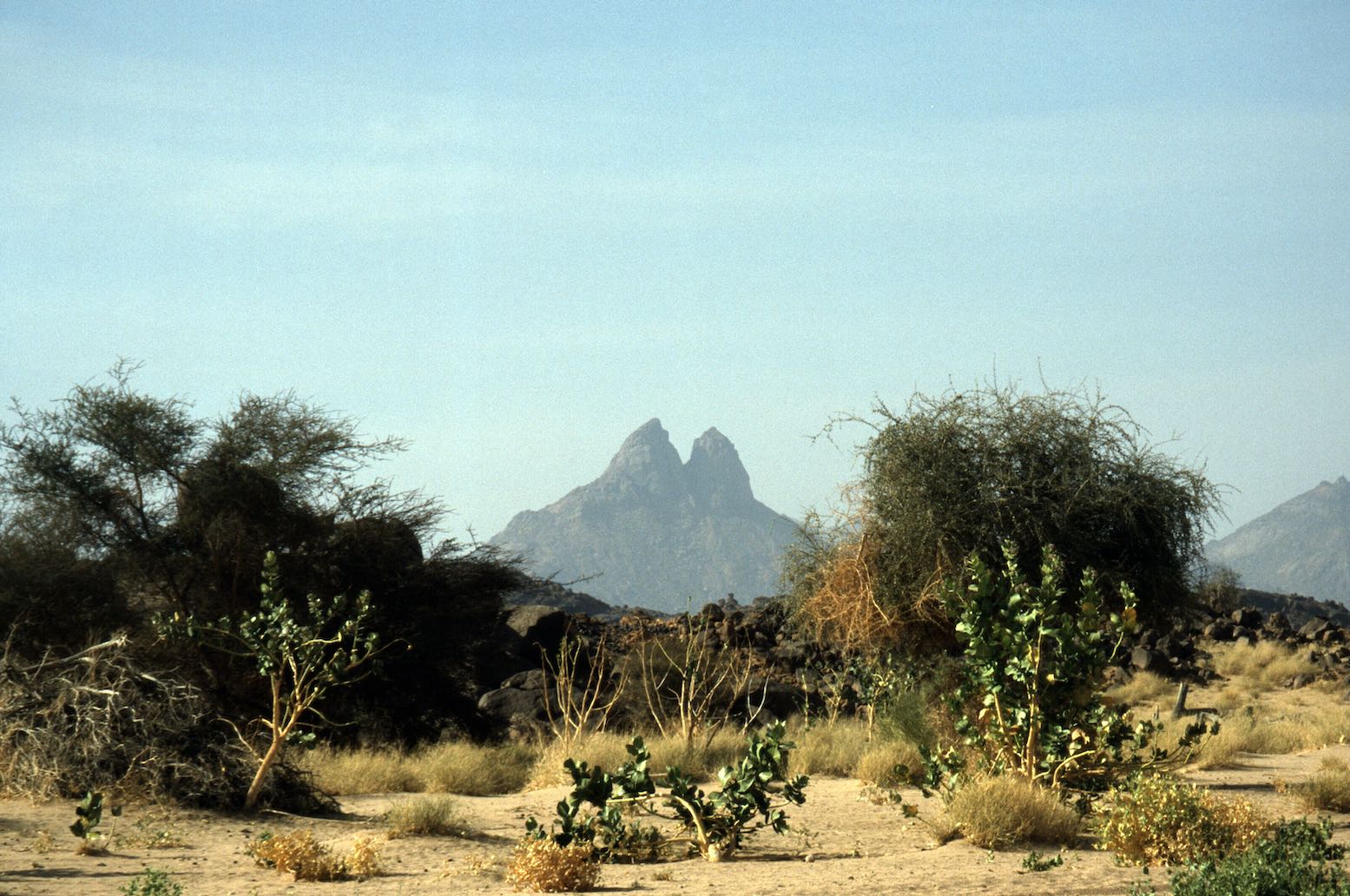
Twin Peak mountain, near Timia.
No one could have complained that too much time was spent cooped up in the cars, although the constant attention the old bangers needed added to frequent cig’ breaks. On the whole trip I doubt if we drove more than half an hour without one car stopping to fix something. That said, it was soon clear these drivers drove their vehicles with great care; a first for me in Africa. I was in the Patrol where Madougou treated the machine like his own. I’d have been happy for him to drive my car (and if you know most desert drivers, that’s quite an admission!). The southern Aïr is a Sahel of low reddish hills which darken and rise towards Timia and the volcanic extrusions thereabouts. Settlements and nomadic encampments focus round the gravely oueds, some with nearby gardens and enclosures. You’re never far from others in the Aïr.
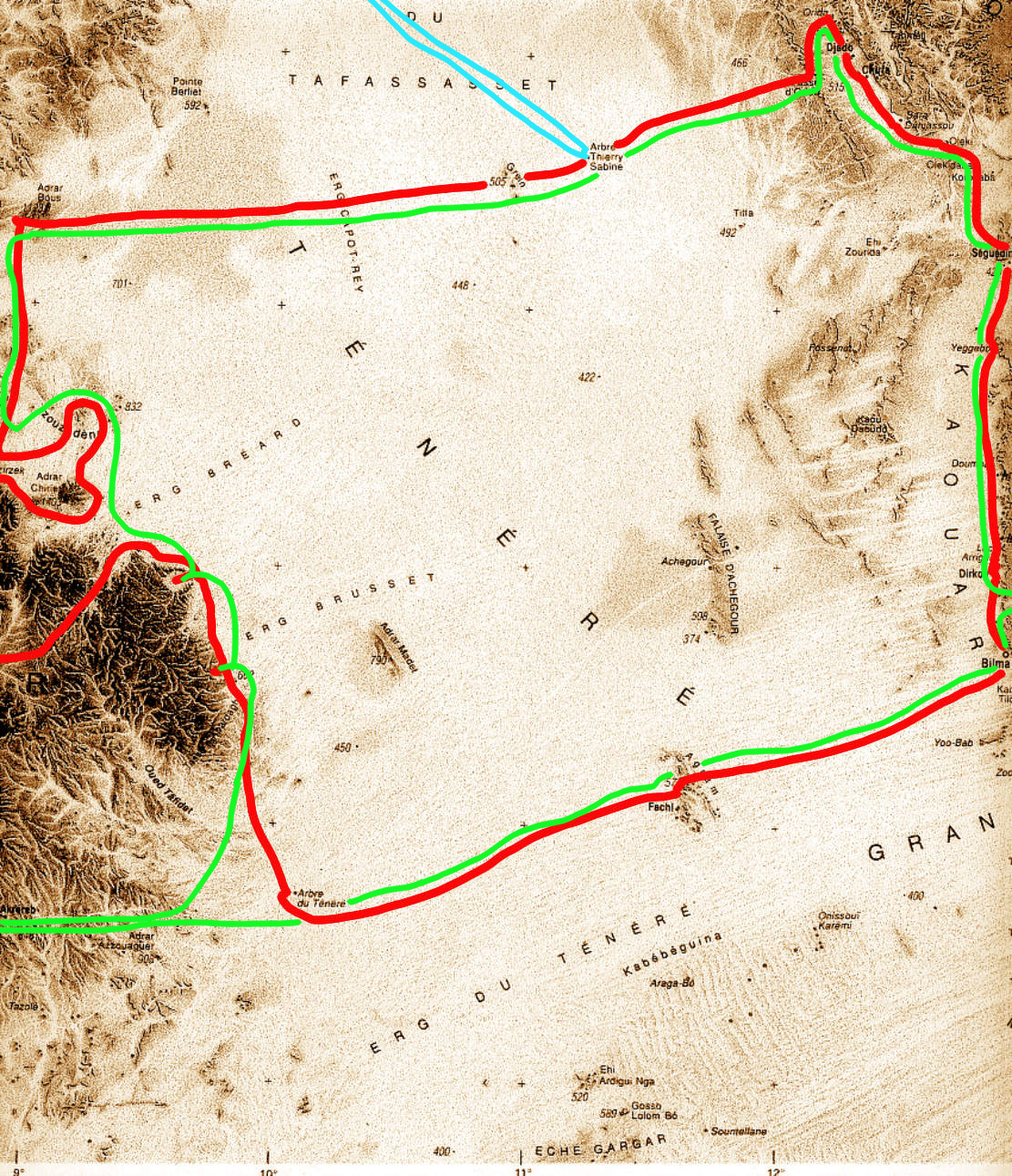
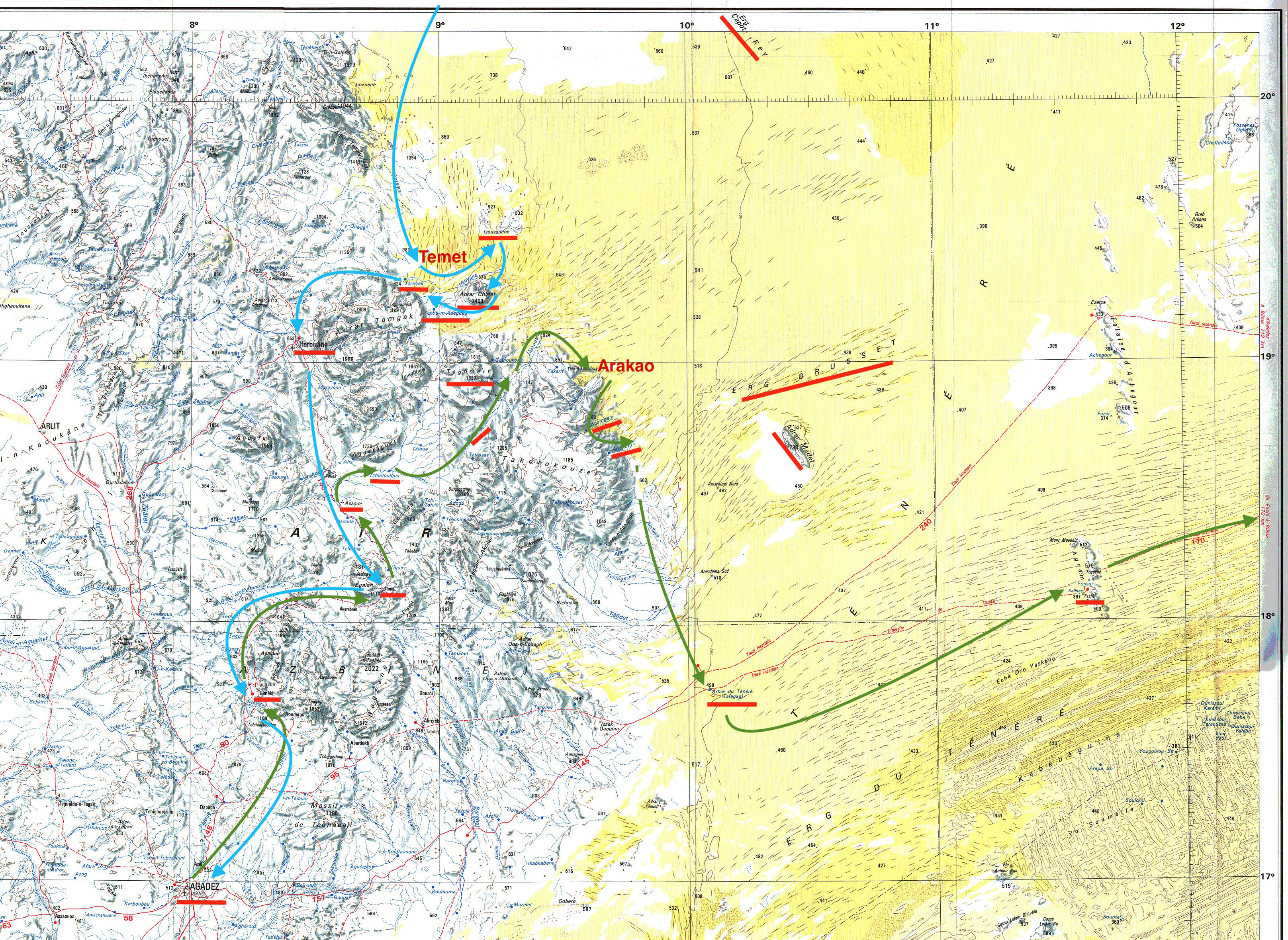
Green route on the way out, blue on the return
With the frequent stops, at times I suspected we were hung out to dry among the cadeau-crazed village kids a little too long for comfort, as if it was pre-arranged ploy so we’d crack and splash out on Tuaregobilia. By the time we got to Timia I sensed the group had had enough of this, and being sent off on a futile tour of this unremarkable village had us all pining for the desert.
The hand pump in Timia
“Do you know Alex Marr?” a young Timia boy asked me in French. Well, as it happened I did. I’ve never actually met him, but Alex was on the front cover of my fourth Adventure Motorcycling Handbook. He came through here on his way to Bilma in 1999, thinking he could ride from there to Lake Chad because of a black line on the Michelin map; not the first to make that mistake. (I noticed Alex also entered the Dakar Rally in 1988). I had the novel experience of receiving a cadeau to pass on to Alex. While deflecting vendors’ parries, I got talking with a French visitor to Timia and an elder Targui, and asked about the robbery at Temet dunes a couple of weeks earlier. Who were the culprits and had they been caught? The old Tuareg shyly slid behind his cheche at the mere mention of the event, while the French guy realised it was associated with the ‘Madame Tortoise’ (Turtle Tours) he’d heard so much about in the village. She worked with Dunes Voyages, an established Agadez agency, but you can see from that link, Irma Turtle’s customers were not a happy bunch, even when they weren’t being robbed. I’d already asked Hans our guide about it, but he pretended not to understood me. I never found out if the rest of our group knew of the raid (known chiefly to the Saharan online community), and if they were bothered about it. Two months later another tourist group like ours was turned over close to where we’d spoken.
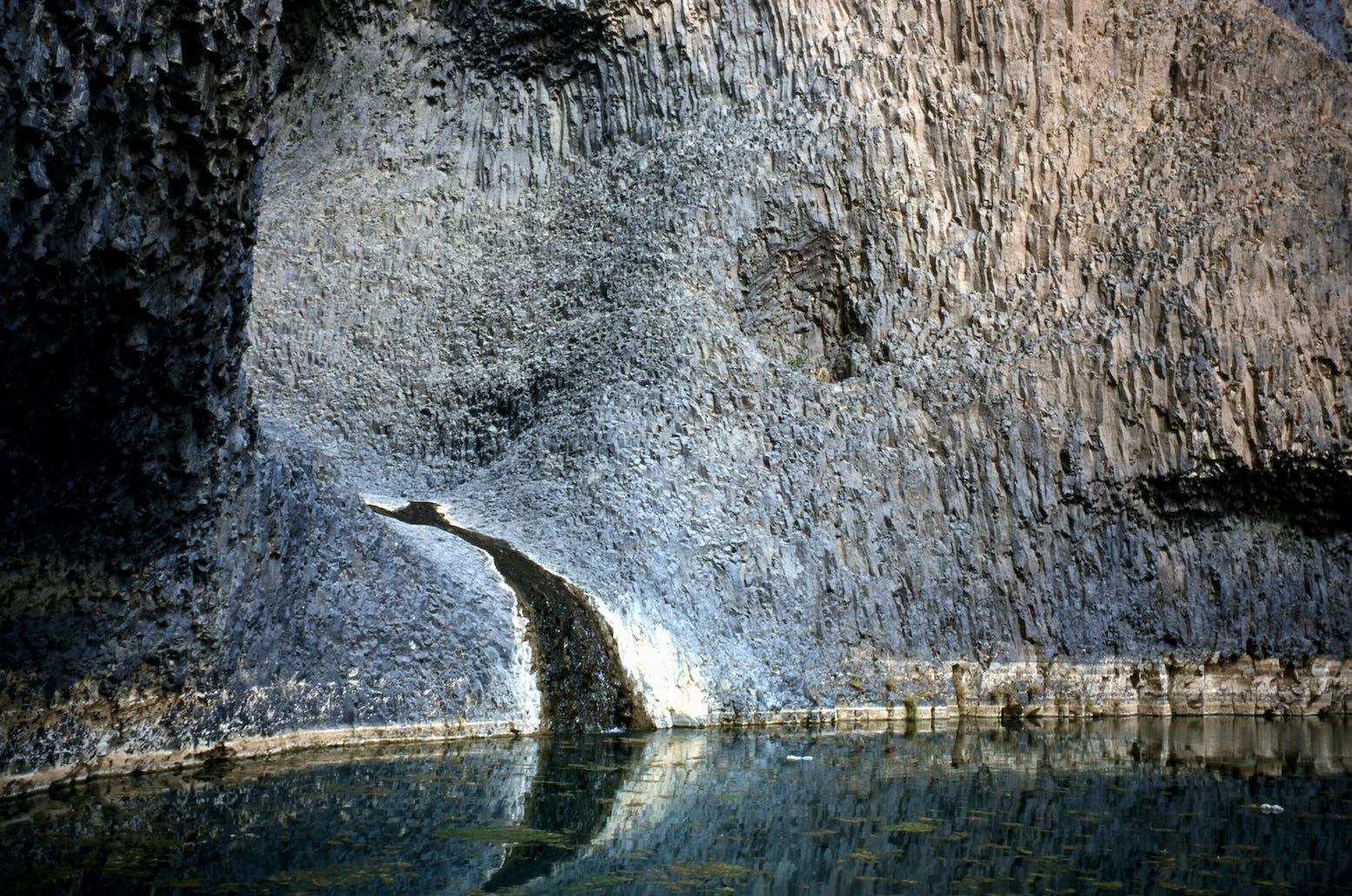
The waterdribble near Timia
The volcanic geology around Timia is interesting, including the cascade which reminded me of Mutujulu Springs running off Uluru (Ayers Rock). At this beauty spot an orderly line of vendors sat behind a line of rocks imposed by the European agencies on pain of dropping this stopover from their itineraries. Next day we visited the surprisingly substantial ruins of Assode, the old capital of the Aïr before Agadez became pre-eminent a few centuries ago. With that ticked off, by lunch time we watched the women watering their goats at Tchintoulous well, enjoying more relaxed shopping opportunities as they discreetly laid out their wares near us. Then, at the top end of the Zagado valley we spent out last night in the Aïr facing the Taghmert plateau (below).
Zagado facing the Taghmert plateau
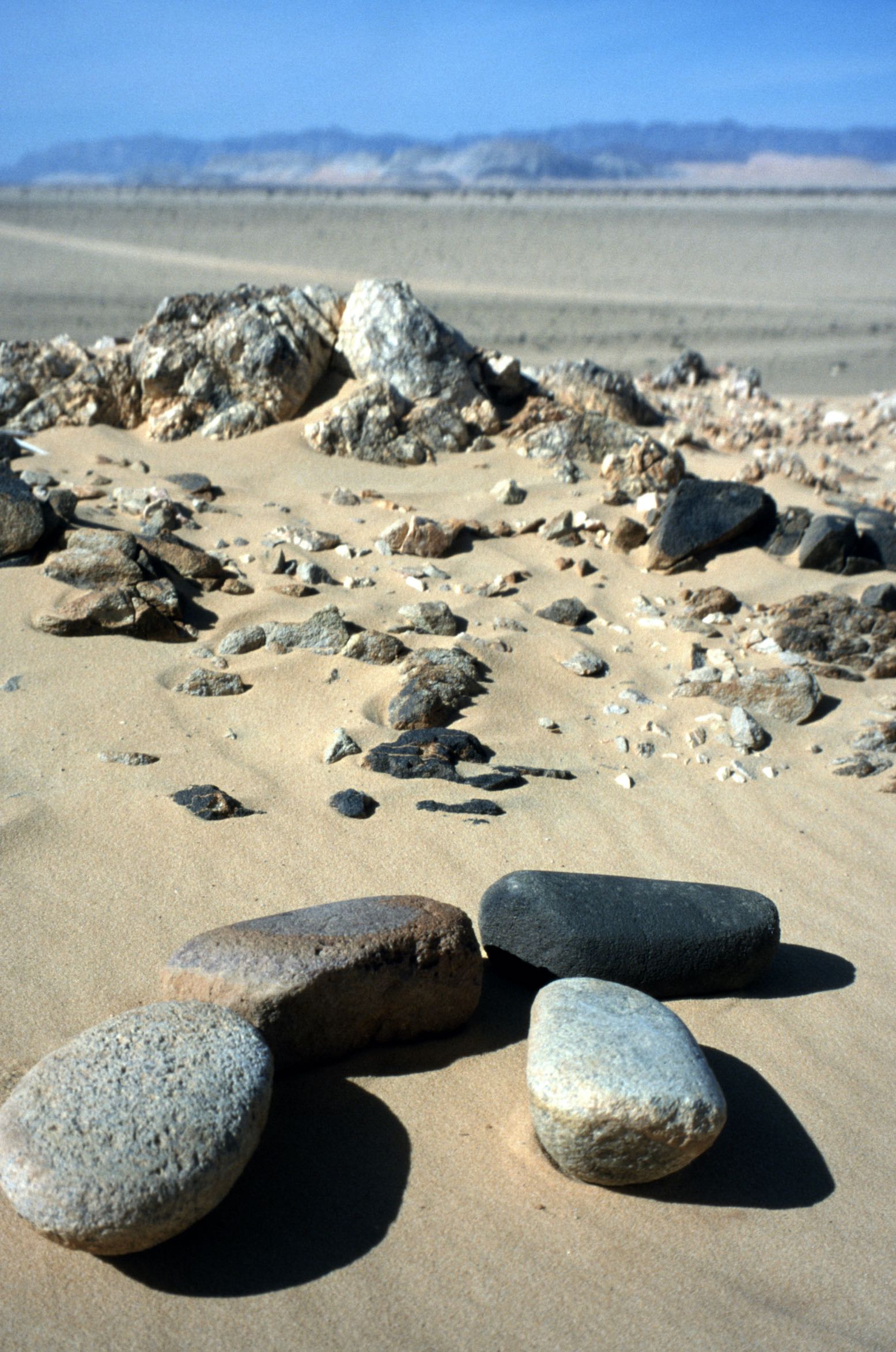
ARAKAO TO THE TENERE TREE We were now traversing the Neolithic borderlands of the western Tenere and soon pre-Islamic tombs became discernible on the hillsides. Stops hereabouts revealed the usual Neolithic artefacts and at one point I found four grinding stones (left), their easily found milling stone (or moule) plates having long ago been grabbed by collectors. Some consider the collection of Stone Age artefacts tantamount to grave robbery, but to me they’re just non-degradable Neolithic relics that tell a story. Finding them is like beach combing and a lot more satisfying than haggling over a silver Tuareg cross. And it’s more acceptable that pinching Tuareg heirlooms like swords and camel saddles from impoverished villagers. But, although the collection of artefacts was not discouraged on our tour, I’ve changed my mind on this practice now. Leave these things in the desert. In many countries it has become illegal to remove them.
Arakao: the crab’s claw
A tongue of jumbled dunes spill through the mouth of the cirque of Arakao (above), dividing the easily visited south side from the less accessible northern half. We camped on the crest of the dune cordon and spread out to explore. As one would expect, a sheltered site like Arakao was inhabited during Neolithic times and probably long before that. We visited several tombs in the southeast corner and kicked about for more artefacts, usually made from the distinctively green flint-like jasperite found in this region.
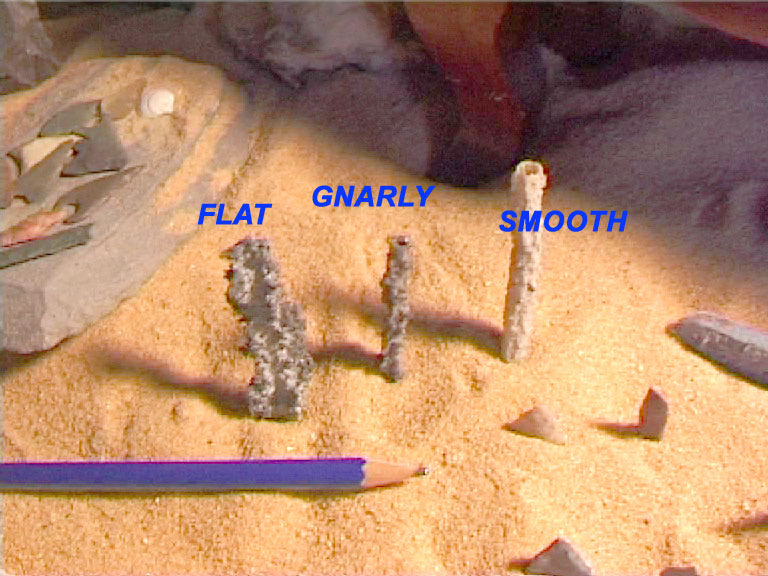
Fulgarites
Hans, always energetically scanning the sands, found me an amazing rod of fulgarite in the dunes: a brittle, pencil-thin tube of petrified sand caused by a lightning strike. Since I first found some on the edge of Algeria’s Oriental Erg years ago (without then knowing what it was), this stuff has always amazed me: lightning turned into stone: a true wonder of nature. Walking back from a dune summit I found Hans’ spot and excavated another slender undisturbed twig over half a metre long. Who knows how deep it went.
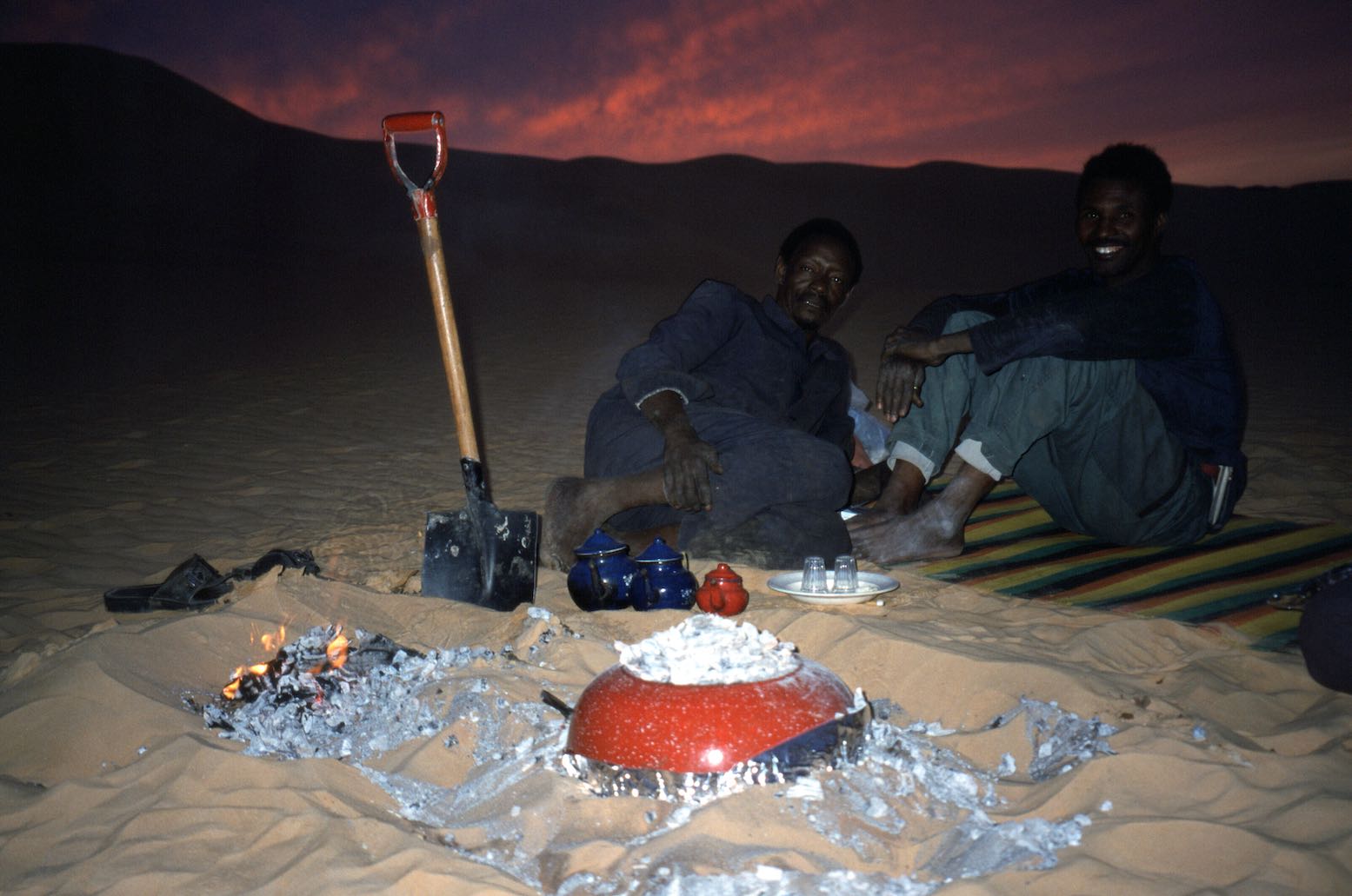
Desert pizza
Traditionally Ibrahim always baked a pizza at Arakao we were told, keeping up the circular theme. A thick and chewy Margarita the size of a Land Cruiser wheel is quite an achievement using just enamel trays and embers, and while we all gave him full marks for audacity and presentation, sadly the dough didn’t quite make it.
Tanakom
We cruised down the east side of the Aïr, stopping to admire the amazingly and bizarre engravings at OuedTanakom and Anakom, at times driving continuously over stones all fashioned into tools over the millennia. One can visualise the Neolithic settlements spread out by a long-gone river running out of the mountains, while wild game and herds grazed on the plains of the Tenere, now covered in sand. At ‘Long Stones Pass’ we could make out the mass of Adrar Madet and the Erg Brusset to the east, and later that afternoon finally shook off the Aïr’s margins and headed across the serir for the Tree.
Or is it Anakom?
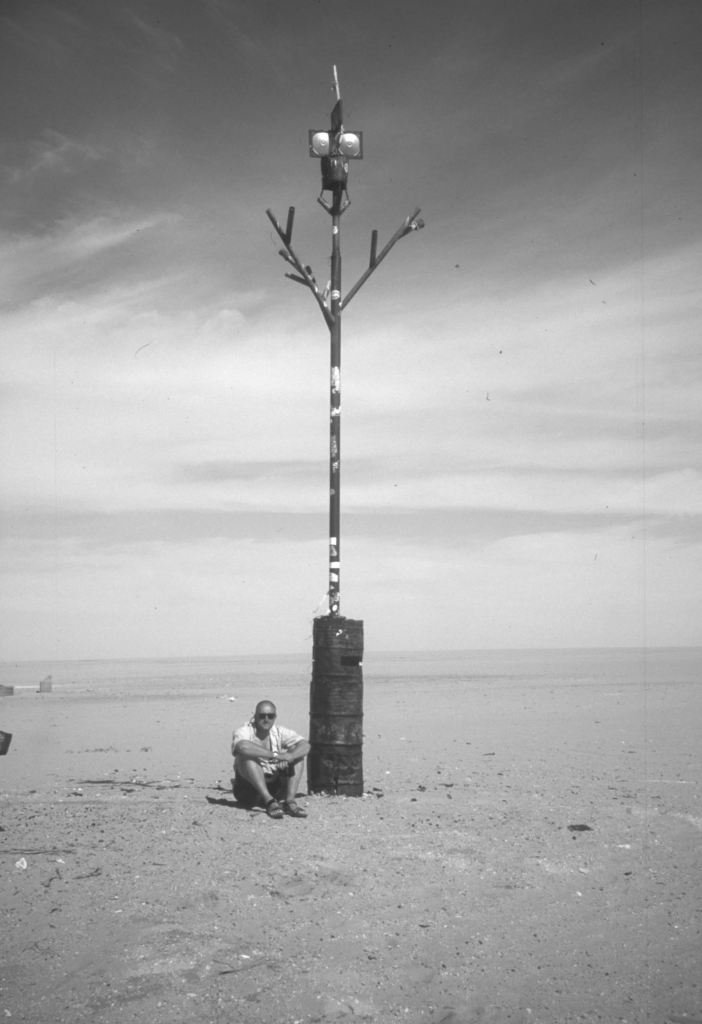
THROUGH THE ERG TO BILMA To finally see the Arbre du Tenere after reading about it over the years was quite a buzz. These days there’s a lot more there than just a bad well and the old metal tree (the original is in Niamey Museum looking as interesting as a bag of crisps). Some Japanese recently built a wacky pylon, and there’s the usual litter, other structures and a water tank. There are even a couple of new trees (“tropical species, pah!” exhorted our biologist guide, Hans) which you’re asked to water when you are there. As Tony Gastel reported in 2000, the water is far from ‘tres mauvais’ as the Michelin map states, but it is very deep, taking three men to haul up the bucket nearly 150 feet. While they watered the cars, we had a chance to wash and then headed along the dune corridors towards Fachi.
Deep well at the Arbre du Tenere
Bilma this way
At first we drove over irritating tussocks and I had the impression we were going south. A lunchtime GPS check validated my preternatural sense of direction; Abdullai the local guide having deliberately dropped down a few corridors to pick one which lead directly to Fachi.
Soon the vegetation disappeared and we were passing among the low, pale yellow dunes of the northern Tenere Erg with very few tracks and no balises. To me, sat in the passenger seat, the driving and navigation of this famous route appeared relatively easy, with the odd bogging easily reversed. Occasionally we came across an old azelai salt caravan camp with masses of camel dung and other rubbish, and a little later some abandoned kantus (salt pillars) with the dead camel nearby. But we encountered no actual caravans as Tony had last October: the azelai season.
Salt pillars fallen off the back of a camel
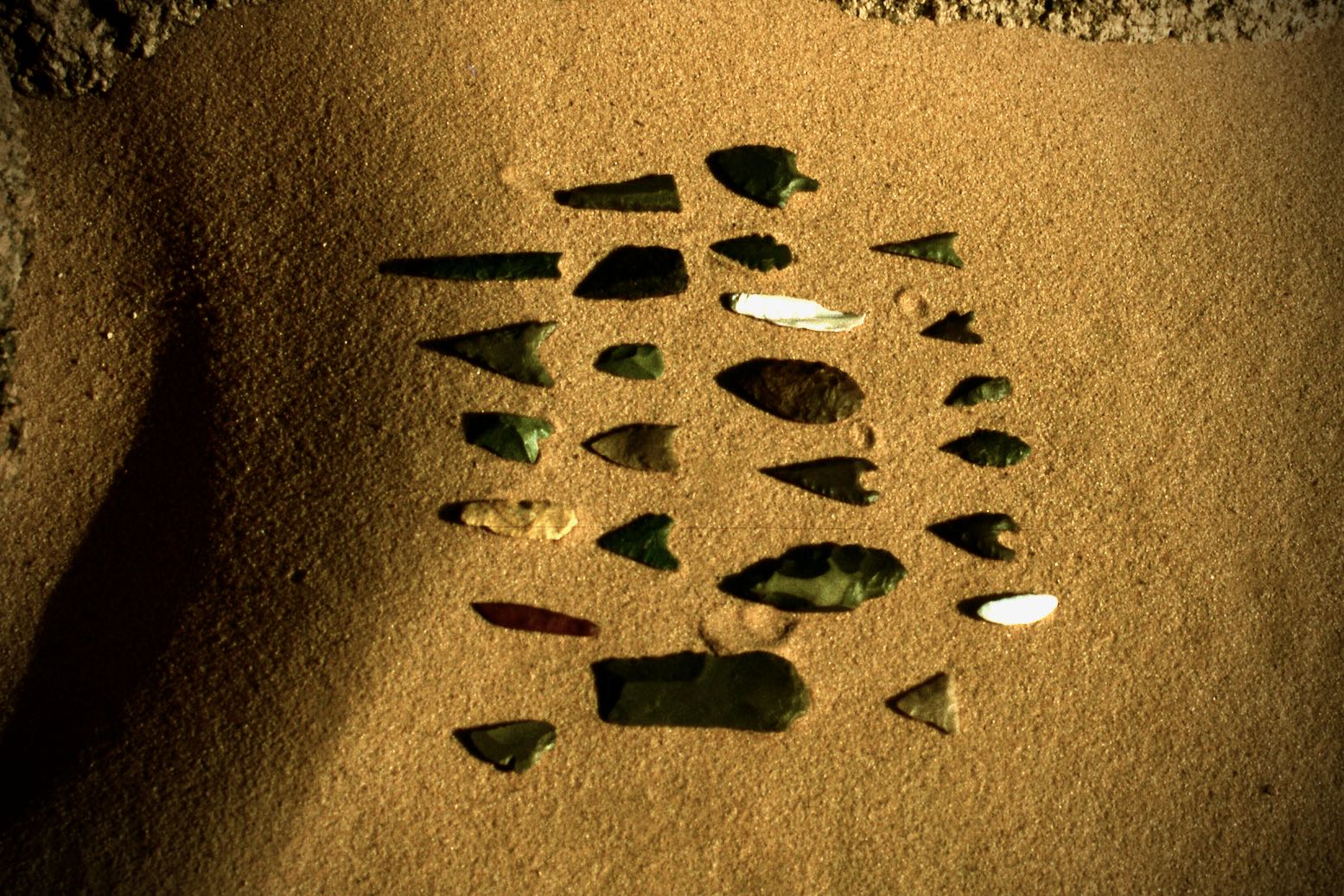
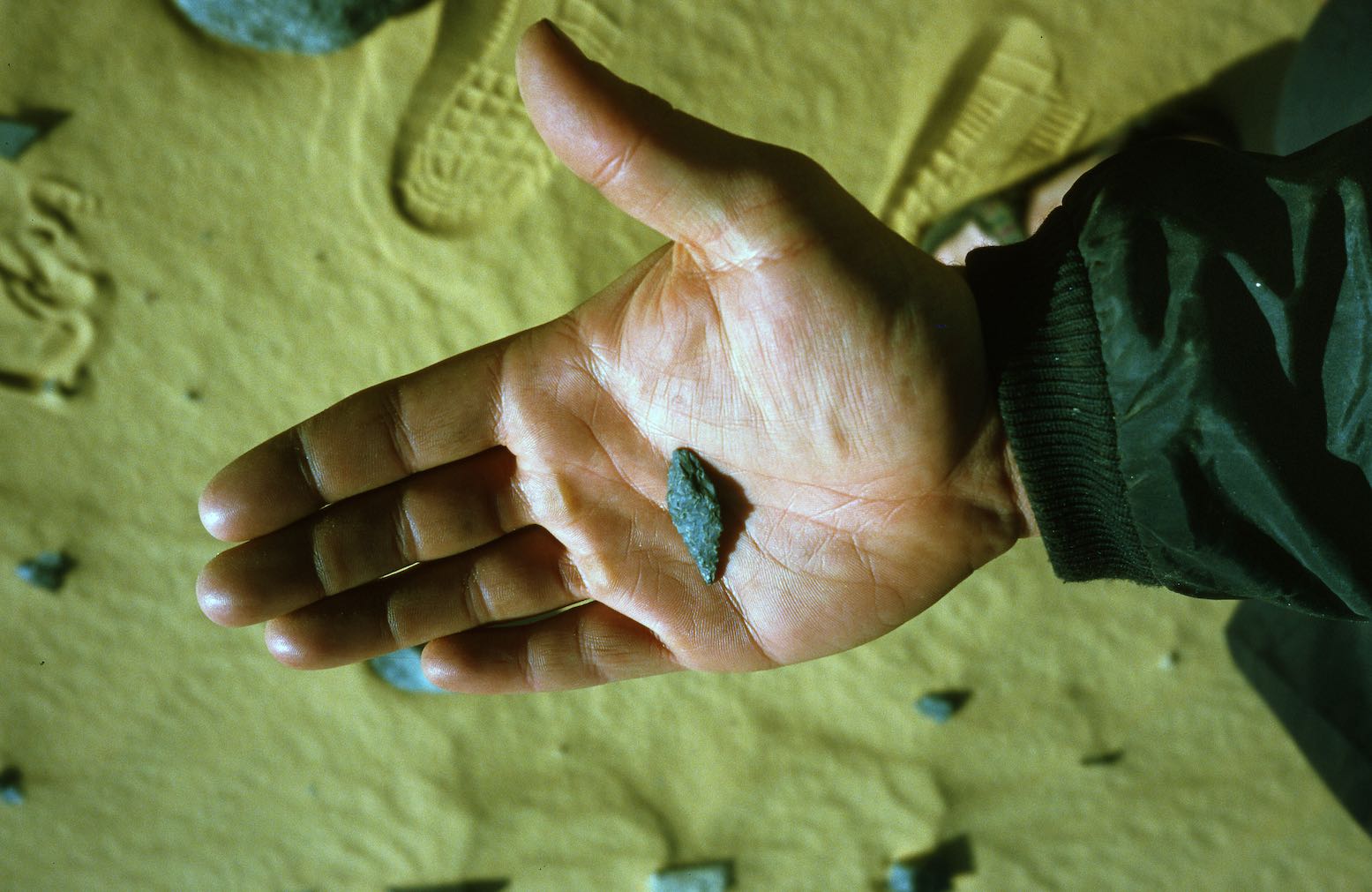
Some gravel pans in the corridors harbour the odd patch of Neolithic chippings. We found tiny arrowheads, something I thought all but impossible with casual fossicking. The fine craftsmanship and variety of these centimetre-long spikes is nothing short of amazing. They may only be a century old of course, but are probably much older. I imagine like moules, they were found and reused for centuries and centuries.
Tiny arrowheads
We camped in the lee of a dune. Next morning we approached Fachi – lovely in Jean Luc Manaud’s famous image, but well camouflaged below the Agram escarpment. The sand-filled streets and tamarisk trees give Fachi a nice, ex-colonial appearance. This was Kanuri (or Beri-Beri) country, not Tuareg nor Tubu, though Hans suggested that Kanuri are merely Tubus of the Kaouar region of eastern Niger. I have read that Kanuri (‘from Kano’) like to deny this. We got watered at the well, checked in with the sultan who was entertaining a Spanish TV crew, and then went for a look around the old town escorted by the sulky sultan’s son. Although I find old ksars as evocative of the Sahara’s romance as anyone, the giant wheat urns inside the old fort was about as interesting as Old Fachi got.
Fachi High Street
Back by the cars, we were left to stew among the cadeau kids until nice and tender. I went for a wander up a street, looked down an avenue and got spotted whereupon a tidal wave of kids surged towards me. I wouldn’t be surprised if each of us was asked 50-100 times for bics or whatever. It’s all part of being a tourist in Africa, but what was the delay? Having had a quiet time since Timia a few days ago, it was clear that the group was getting irritated by this. Maybe it was a way to string out the tour for three weeks.
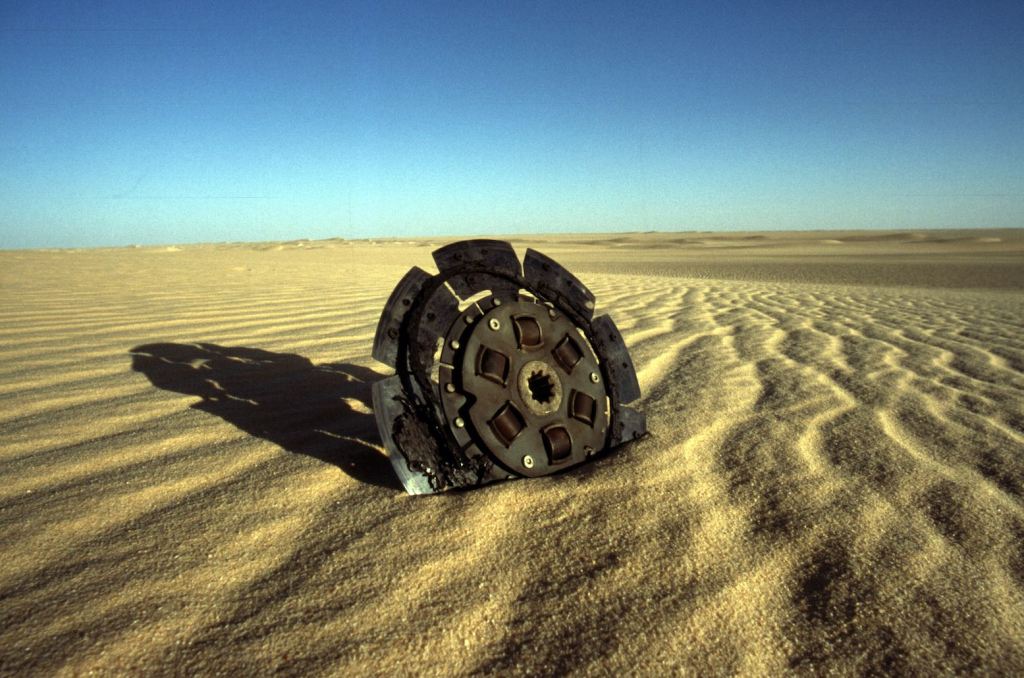
After a visit to Fachi’s salt evaporation pits (salines) round the back, and lunch in the palms north of town, we headed up a sandy pass in the Agram escarpment where the sand softened noticeably. All the cars struggled and Kaiou’s red HJ60 – which at the best of times smoked like a Ukrainian steelworks – started frying its clutch. We could smell it burning from our car, but he kept pushing and eventually it disintegrated down to bare metal. Luckily Abdullai has a spare and, with the aid of ropes, two jacks and some legs, Kaiou’s Cruiser was running again four hours later.
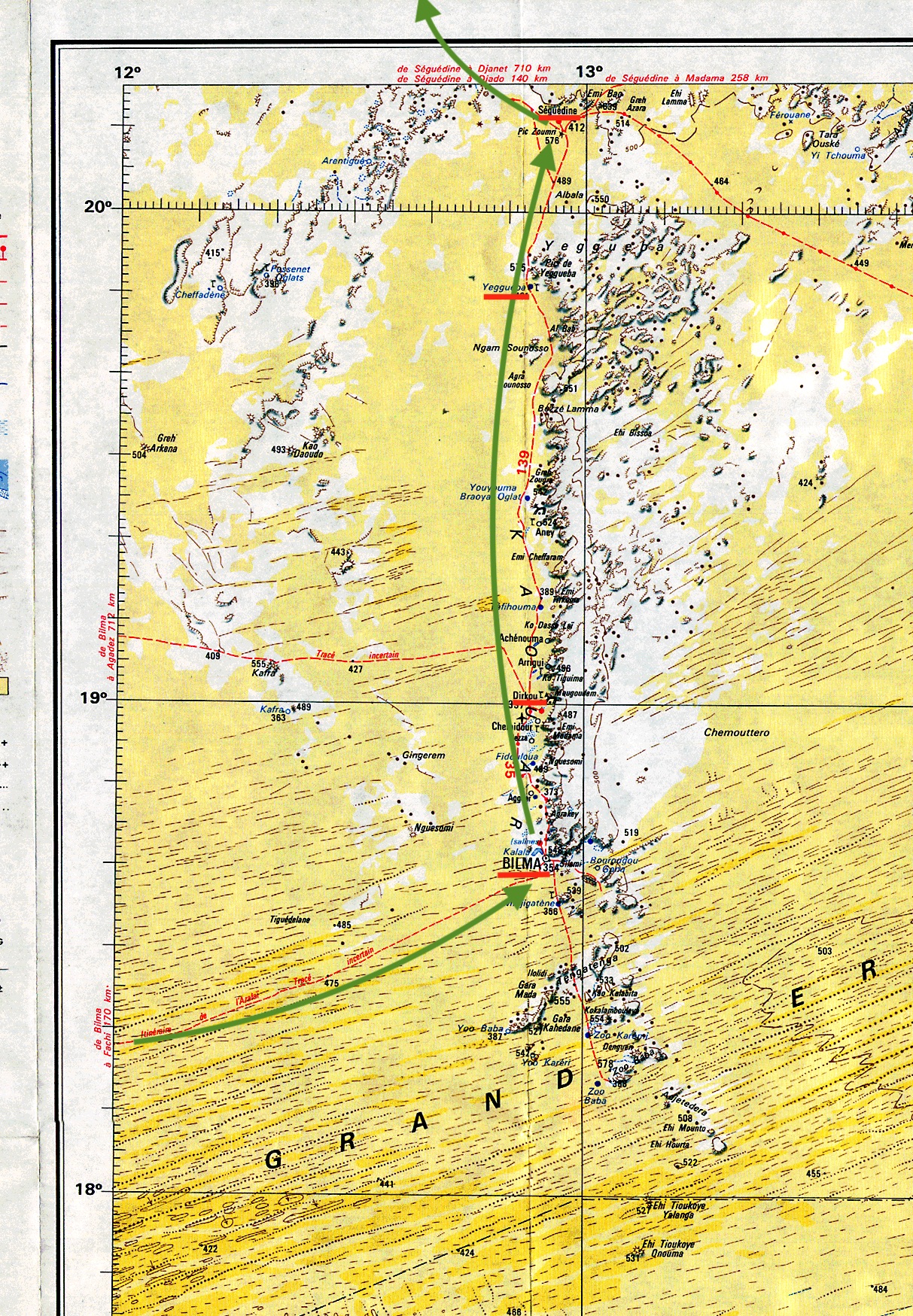
The cars drove in strict formation. Abdullai up front, Madougou with us in the Patrol and Kaiou last. But Madougou was a bit slow and sometimes Kaiou got ahead, belching his unburned black puke all over us. Sensing our latest irritation, they half-heartedly tried to fix it later, but the car ran so what was the problem? Worn diesel injector pumps are the problem in the Sahara, and the mixture on his car was far too rich. Kaiou ran out of fuel before Bilma. With the ridge of the Kaouar behind it, Bilma is easy to spot. I had the impression that crossing from the Tree was relatively easy. The corridors line up just right and in good visibility you can’t miss the Agram or Kaouar escarpments. Finding the Tree without GPS if coming from the east would not be so easy, but even then, grasses and converging tracks would be a clue that you’re close. Hans described Bilma as a dead town and I find Tony’s figures of 12,000 population unlikely (even for the massive Bilma district). We stopped at a garage for water. An HJ75 was getting fresh oil and a 109 Land Rover waited outside: two classic Saharan cars. On this side of the Tenere you also find plenty of Nigerians washed up on the road to Libya and so English is spoken, but as in much of West Africa, everyone speaks several languages. Our guides chatted in a mixture of Tamachek, Arabic, French, Djerma, Hausa and Tuburi (or ‘Kanuri’). With the jerries full, we drove round to the fort to hand in our passports and pay the provincial tax. Out here you officially need stamps in Bilma, Dirkou and Chirfa which takes up a good page or two of your passport. Near the fort are a couple of market stalls full of Nigerian goods and junk sold by Hausas who I get the impression, are like ‘Moorish traders’ on this side of the Sahara. Knowing this, it made sense to learn that the famous Bilma salt caravans or azelais are organised and managed by Hausa or Peul, not Tuareg, though Tuareg camels and guides are hired for the job. And the good news is that these caravans are far from the dying tradition many think. Tony’s reports of seeing several caravans was no fluke.
DIRKOU TO DJADO AND ORIDA Next day we hit Dirkou, a thriving frontier town that’s the true capital of the Kaouar. Nigerians and other desperadoes head north on top of Mercedes lorries to a life of slavery in Libya, only to get sent back following one of Gaddafi’s purges, sat on the piles of subsidised or stolen goods on the same Mercedes gros porteurs that pass daily through Dirkou.
Mercedes gros porteur. Underneath all that stuff is a full tanker of Libyan diesel
By the compound where Andy and Richard spent their Dirkou detention, is a Tubu technical shot to smithereens and left as a reminder that the government won that particular rebellion. Passports handed in, I had a choice to go see Jerome or check out the town. Lively though Dirkou looked (and free of hassle, I was told later), I went to pay my respects to the late Diesel Prince of the Tenere, finding a friendly old man instead of the money grabbing Shylock I’d expected. He can afford to smile, selling Libyan fuel at a 1000% mark up, but still a tad less than the official Nigerien price. A big Mercedes was unloading and I got talking with the driver who originally came from Djelfa in northern Algeria, while his two boys bounced oil drums off their heads, Tubu daggers tucked in their belts. He was full of praise for ‘Le System Mercedes’ but didn’t have much to say about the run down from Sebha that I could understand; some diesel may have seeped into our brains over the years.
Although 75 years old, Jerome was lucid and delighted to meet a Brit, claiming to have fought for Monty at El Alamein and all the rest. He rolled off a string of generals’ names and dates which sounded plausible, but later Hans suggested had I been German it would have been the same story under Rommel. In fact, a mate who has since met Jerome found out he is indeed an Anglophile, proudly showing an old WWII photo of himself in a Brit uniform. Gerbert van Der Aa, another S-Files Tenere contributor, interviewed Jerome for a Dutch paper a year or two ago before he died in 2003. Back with the group, Luggageless Erich had bought himself a Hausa outfit, complete with hat. Erich was not all there following a bungled operation in his early forties, and was quite a laugh in a subversive, boyish way. Vendors zoned in on his naïveté and he ended the trip, grinning and draped in Nomadobilia.
Bilma and the Kaouar
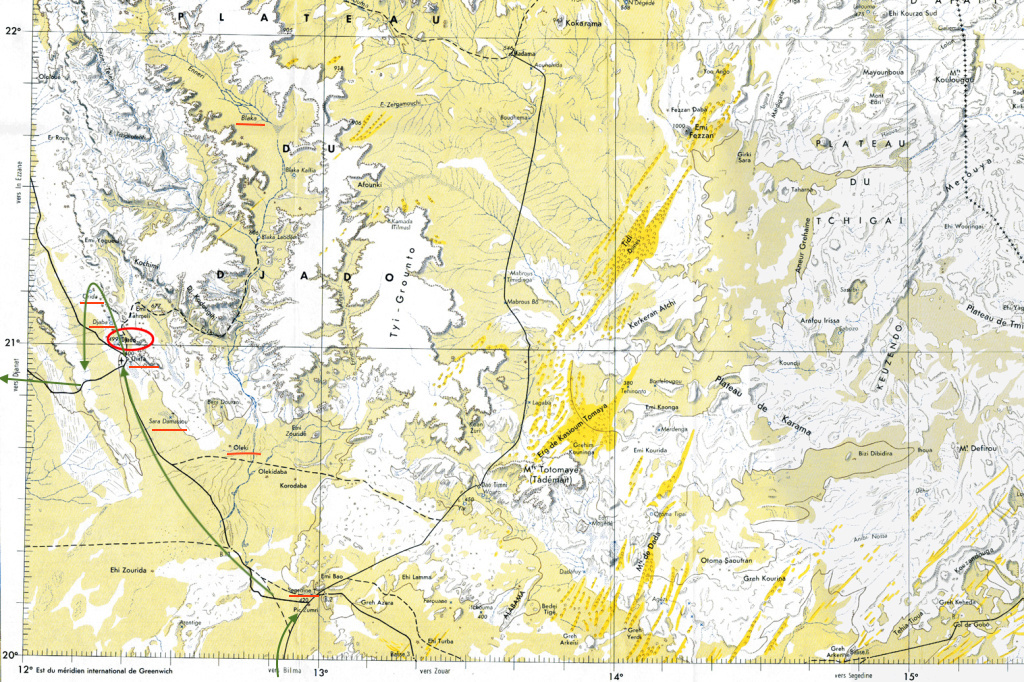
The landscape of the Kaouar was a bit grubby for my liking. We dropped into the salt works north of Dirkou where natron salt was mined. I noticed Madougou took some with his chewing tobacco, as they do in these parts. By the time we got to Yeguebba – the northern end of the Kaouar escarpment – the colour of the sand was a pleasingly orange again. We stopped to collect some firewood (there’s plenty of firewood here and masses in the Aïr) and drove across to a soak where the last car mired. What a mess, the quicksands wobbled like jelly and it makes you appreciate how easy and clean dry desert sand is to get out of. But with sand plates and a tow, the car was out and we spent the night nearby in the rocks where a fennec (desert fox, sort of) popped in for a visit. Since Bilma it had become clear our drivers were getting tired and probably anxious at being out on the far side of the Tenere in their old bangers. Their banter became restrained and you could see they longed to be back in their own country. We were having an easy time of course, waited on hand and foot and with nothing to worry about other than, for some, grabbing the best camp spot for the night. I couldn’t join in the evening chatter but it didn’t bother me, though I can now say ‘schpoon’ in German. Anyway, with time to myself I had a fresh batch of hare-brained schemes to nurture through their delicate development stage. Years ago, I recall reading in the Sahara Handbook about the importance of finding Pic Zumri to get to Seguedine from the north and now, there it was and the village laid out in the dip below. Here, the Adadez truck piste from Achegour splits, heading northeast behind the Djado plateau for Tumu and Libya or even east for Chad – a long closed route. Following a visit to Seguedine’s checkpoints, multi-coloured salines, and some gentle bartering with the wily Tubu women, we set off northwest across stony plains, passing petrified wood, the landmark of Oleki peak, and stopping for lunch at Sara ‘oasis‘. A hot wind was blowing from the southwest today, hazing the sky and raising the temperature to the high 30s. But lunch with Suntours was never less than a shady two-hour siesta, finished off with three glasses of ‘chai’. On this occasion Abdullai resoldered his burst radiator on the fire. Earlier, I noticed he’d tried to use clay dust as we’d done in Algeria years ago. I can report that bodge is no less effective at the hands of a wizened Tuareg desert driver than in mine… Hans was a great guide and had a good way of melting the ice at checkpoints by bringing photos from previous visits (this was still the camera film era). At the Chirfa control post, where the guys in their football kit always have a gun close by, the photos caused much delight, as they did in Chirfa village where we picked up some water and veggies from the garden. All through this trip it was clear that Suntours has developed a close rapport with many communities and individuals over the years. At many places Hans discreetly handed over medicaments to the village pharmacy (eye drops and aspirins were much in demand).
Djado plateau
I’d been urged to make sure our tour visited Old Chirfa (aka ‘Tebeza’) a short distance from Chirfa village, and sure enough, it was on our itinerary. The old citadel is part of a string of medieval fortified towns that run up from Seguedine and maybe once even Bilma and further south, tracing a defunct trading route which explorers Clapperton and Oudney followed in the 1820s down to Lake Chad, later followed by Barth and Hans Vischer in 1906 (see Shadows Across the Sahara). Strolling around Old Chirfa was thrilling but for me the true highlight of the trip, as expected, was mysterious Djado, the following morning.
DjadoMore Djado
Djado from the air
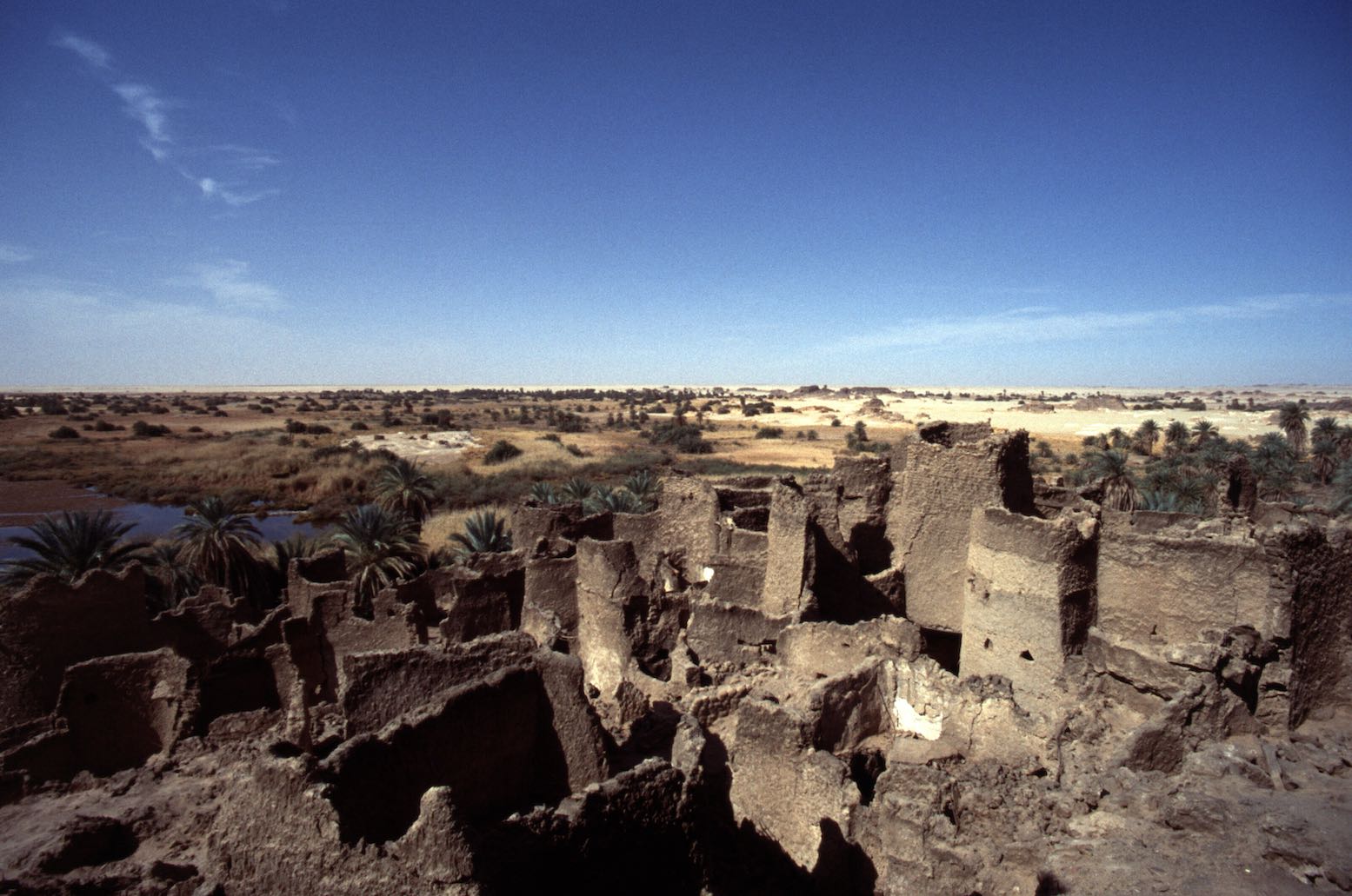
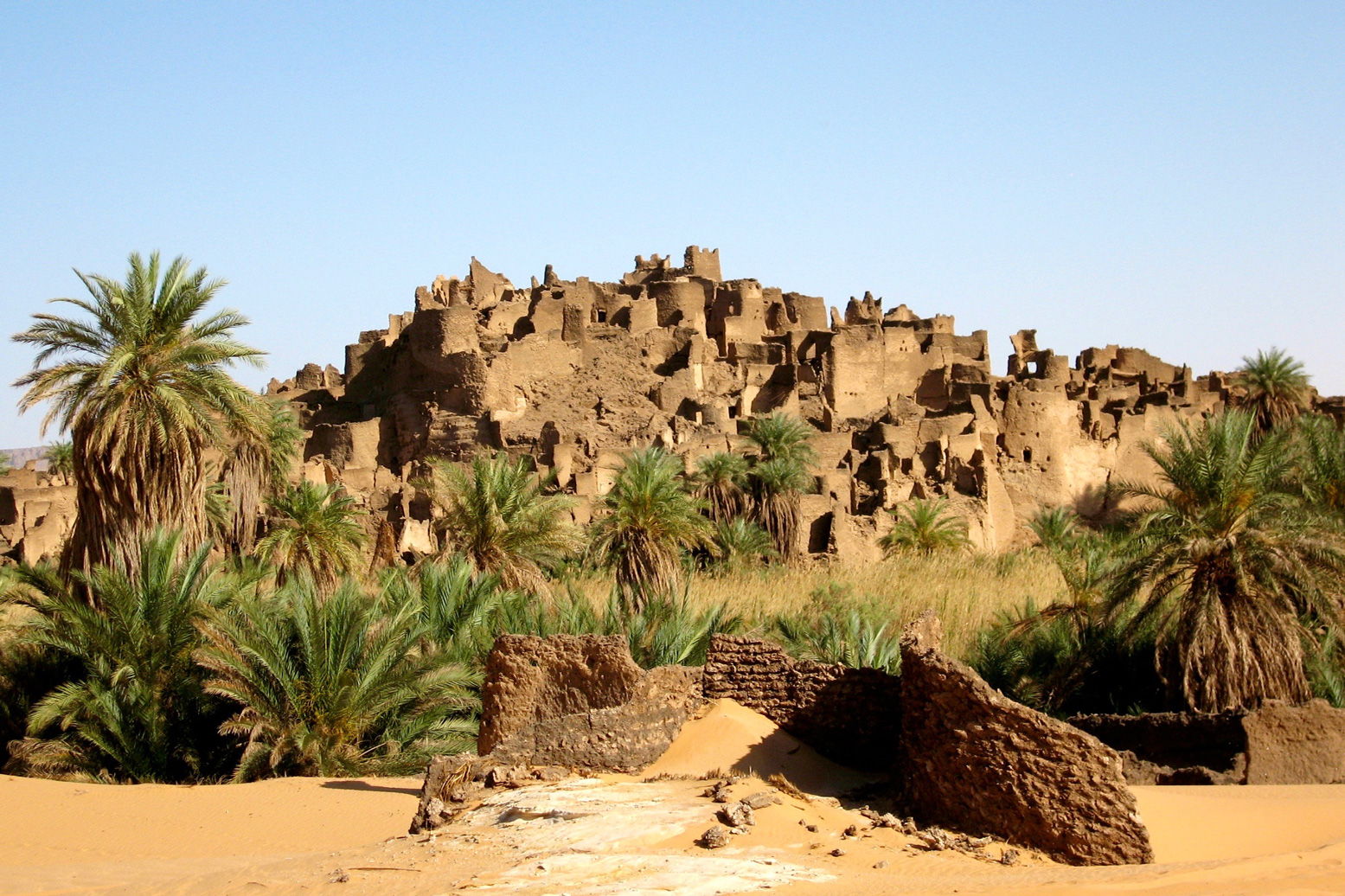
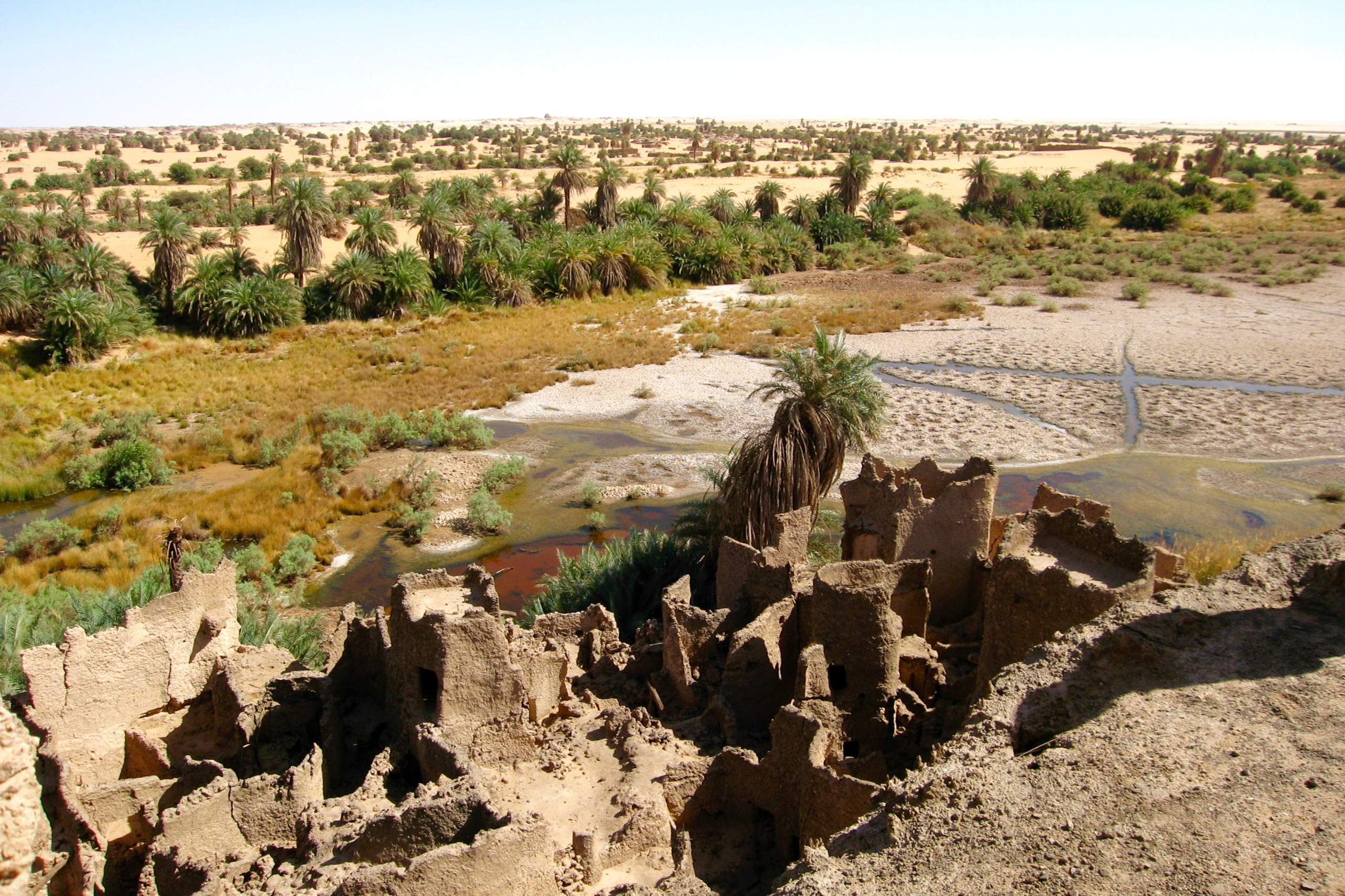
Djado (photo Klaus W.) is a huge complex which must have housed thousands a few centuries ago. In winter it’s surrounded by a lake of brackish water which I’m told oddly, disappears in the rainy season. In autumn the whole of Chirfa moves here to harvest the dates from the many palms; their zeriba huts ring the ancient ruins. Exploring the crumbling town was incredible, every corner revealed a stunning view of distant escarpment, desert sands and waving date palms. My camera had passed out in Fachi, but luckily Klaus had a bag full of lenses and film and agreed to keep shooting for me. Hans poured scorn on the theory of pseudo archeologist Uwe George in Geo magazine. He’s discovered a room with a cross relief (now called the ‘eglise’) and who went on to claim that Christians migrated here from Ethiopia in the first millennium. I’m all for interesting theories, but it does indeed sound implausible if not an outright publicity stunt which some publicity-savvy academics are fond of pulling off.
Djado
We were about to enter a region controlled [at that time] by unreconstructed Tubu outlaws – an anomaly tolerated by the Niger government who let them have the remote Djado plateau to themselves (and maybe pull off the odd tourist and car heist on the edge of the Aïr?). No longer did our guides stop to chat with every passing car, mumbling a string of greetings. Now it was just ‘get out of my way’ crabbiness you’ll find in any city. We crossed a sandy ridge near the no less photogenic ksar of Djaba and stopped at a Tubu checkpoint where Abdullai gruffly handed over a 5000 CFA ‘tax’ without so much as a “Sallam alei…
Djaba in winter
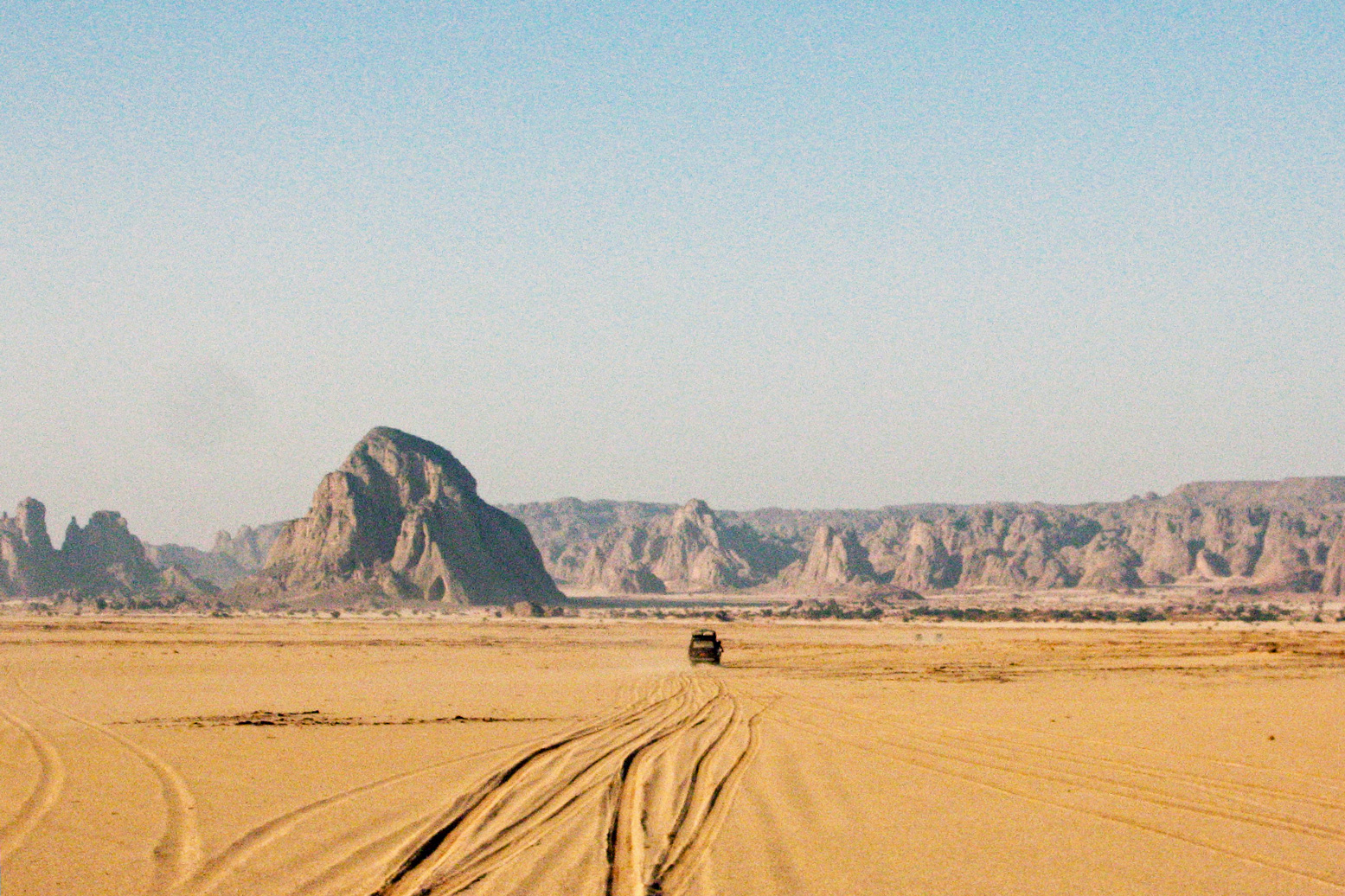
Ahead of us rose the massive monolith of Orida prominent since yesterday, and behind it the arch and the forbidden rim of the Djado plateau beyond. The landscape and warm colours evoke the tassilis of the Ajjer and Akakus with which the Djado plateau is contiguous. Most Ewaden guides would not come this far into Tubu territory, let alone reach out towards the intriguing Enneri Blaka (which was listed on our itinerary but we didn’t visit). Lunch was under the palms near Djaba. Some Tubu girls parked up and set up their trinkets on a mat. This sort of ‘silent trading’ was much more agreeable and relaxed than the bombardment we got in the Aïr villages. But it works both ways: Tuareg tend to make more agreeable company than grouchy Tubu.
We returned to Chirfa to pick up more water and our passports, then headed out along the Djanet track to the Col de Chandeliers (aka ‘Pass de Orida‘). A cozy camp was set up among the sun-warmed rocks while to the west, the plain of the Tenere du Tafassasset spread out like a becalmed ocean. It’s a corny simile for the desert I know, but this is the first place I’ve seen in the Sahara where it was appropriate. This was the real Tenere – a word usually used to describe the whole of northeast Niger and the Tamachek translation of the Arabic ‘Sah’ra’ or empty quarter.
ADRAR BOUS, TEMET AND CHIRIET The awe of this emptiness was lessened next day by the clear tracks running west to Arbre Perdu (which we visited on bikes in 2003) and on to the isolated hills of Grein. But further on, beyond the northern outliers of Erg Capot Rey, even the tracks and wind-aligned ripples disappeared until it was hard to tell if we were moving at all, baring the drone of the engine as it hit a soft patch. Running at these high speeds caused a whole new set of problems for the aged Toyotas and while a puncture was fixed, Ibrahim prepared a quick lunch in the shade of the cars. We continued west through the void and in the late afternoon the profile of Adrar Bous mountain loomed out of the western haze.
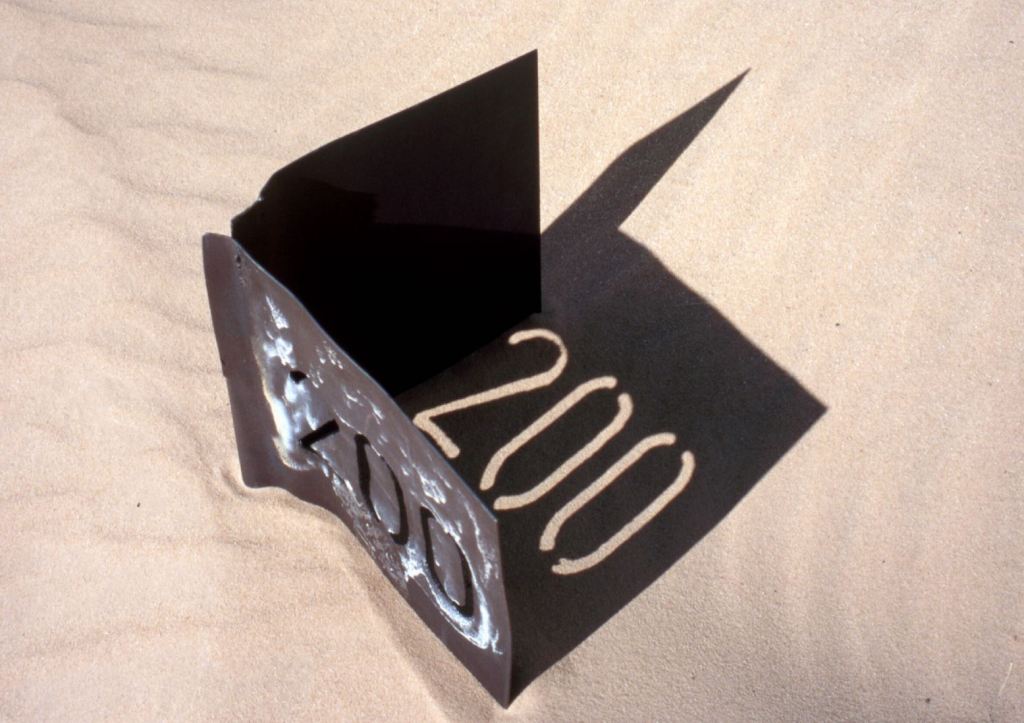
Only 200km from somewhere
Adrar Bous is well known as a locality of Neolithic knick-knacks, and we parked up by a Stone Age ‘chip pan’ and shuffled around for more arrowheads, then camped in a sheltered creek; an old Tuareg hide-out from the days of the rebellion. All of our crew were former rebels who’d fought in the bitter war of the early 1990s. Since then, the Tuareg of the Aïr have won some concessions on the organisation of tourism; the whole of Niger’s tourism depends on their kudos after all. But in the poor villages of the Aïr, aid still struggles to make much impact. All the better then is tourism like this where our money goes straight into the hills. From Adrar Bous we were back on the tramlines of the Tenere Loop which winds down the eastern side of the Aïr into the dunes of Temet where the Austrian and American groups had been robbed a couple of weeks earlier. I’ve since got the full story from one of the people involved (see link above) and it was no hit and run raid, but a thorough and thoroughly intimidating robbery of all involved, and in which the drivers of the American group from Dunes Voyages excelled themselves in stopping all the cars being taken. One hears it may have been renegade Mali Tuareg behind it; they’ve been behind most of the tourist (and rally) robberies over the last couple of years, though such events are always blamed on ‘foreigners’. I’ve since read the ‘leader has been caught’, hopefully not just any old Tuareg in the wrong place at the wrong time. We had lunch at the site of the robbery where I probed our drivers, but didn’t get much of a response so left it and walked up the huge dune with the rest of the group. Since then, there was another raid of a German group in Timia in March. A winding corridor led east out through the dunes and we spent the evening at Izouzadene, the striking outcrop of marble veined with cobalt salts known as the Blue Mountains. From a distance they do have a distinctive pale blue hue, but close up the grey veins look less impressive and the masses of tracks in the area could almost make it Morocco.
From here we drove south through the dunes to Adrar Chiriet, visible from the summits of Izouzadene, enjoying the classic east Aïr panoramas of dunes lapping against a backdrop of purple-grey plateaux. Driving into the massif, Ibrahim stopped to grab a bunch of wild grass to concoct a herbal infusion for later; a change from the endless Tuareg tea we drank daily. West of Chiriet, a rocky track led to Tchou-m Adegdeg well. Just on the other side of the Teghmert plateau was the point at the Zagado valley where we’d emerged from the Aïr nearly a fortnight ago. Here Tuareg nomads watered their herds and a camel sipped from the bowl in which my shirt stewed in detergent.
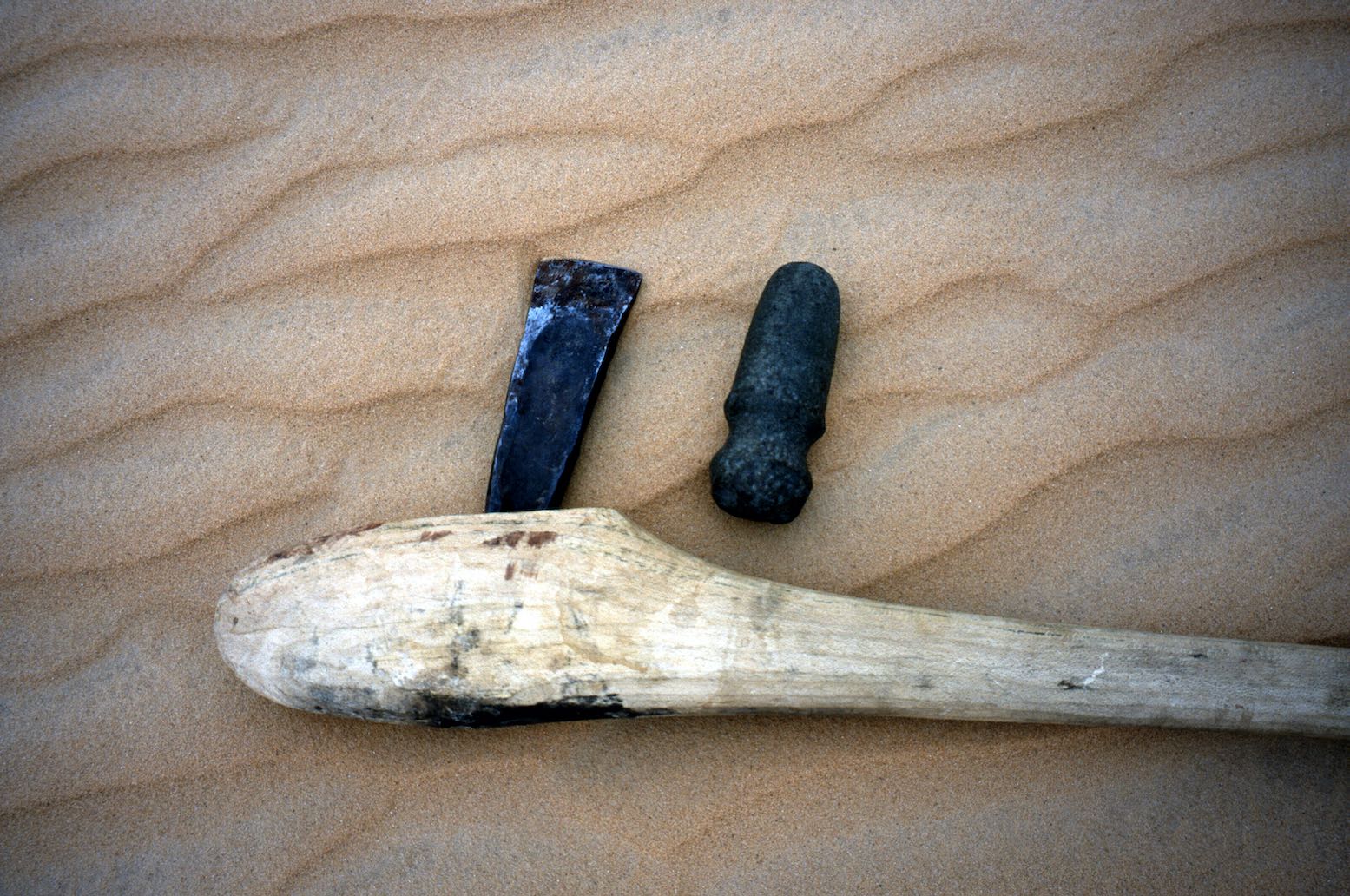
Two axes and a few thousand years in between
Between here and the nearby Tezerzik well is a lovely scenic drive through dunes featuring a distinctive lip below their crests. At Tezerzik the drivers bought a nomad’s sheep for a tenner and slung it on the roof. At the nearby camp in the dunes I watched them slaughter and butcher it with the same casual effortlessness they’d employed to repair the clutch a few days earlier. Interestingly, there’s not much blood when the throat is cut and once the hide has been peeled back the thing in hung on a stake, its ribs pulled apart and the innards removed for the drivers subsequent delectation; we got the tender meat in a cous-cous. Normally I find cous-cous an over-rated North African ‘must-eat’, but the way Ibrahim prepared it, both the millet and the sauce were as good as it gets.
BACK INTO THE AïR FOR AGADEZ From here the desert section of the tour was over and we had a dreary three-day drive back down through Iferouane and the main track via El Meki to Agadez. It was March now and the nights were irritatingly windy, but the drivers were brightening up, pleased to be back on home turf. I had the feeling these last days to Agadez were strung out with unnecessary stops to fill the time. The third night in yet another creek full of thorns and dung, just a couple of clicks out of Agadez seemed unnecessarily stingy. In my experience a tour should end on an upbeat note if possible, not dribble away the final days. I gather the others also complained about this retracing through the Aïr – ‘for fresh vegetables’ they were told, but our last lunch in the bush was all tinned. Despite the day lost in Niamey, maybe we could have nipped out to Enneri Blaka, after all, but I know well you do need to keep a few days in hand, especially somewhere edgy like the Djado plateau. I’m sure Suntours have developed their itinerary carefully over the years, but leaving the desert at the very last minute – along the track from the Tree to Agadez for example, would have been more satisfying.
Agadez mosque
We had an option for a hotel in Agadez that night and, wanting to check the town out in my own time, I took up the offer with the two couples and spent the night the Hotel Tidene near the mosque. I checked out some other agencies but as advised, Agadez itself doesn’t have much to offer. Next day the tour regrouped and set off for the long hot slog back to Niamey, getting home by the skin of our teeth following an Air Afrique strike and cancelled flights. Should I return with my own vehicle I think I’d repeat the recent tour of an Italian friend: leave Djanet without checking out and with stacks of diesel and a Niger visa, then do my own thing in the northern Tenere around Grein, Adrar Bous and down as far as Chiriet maybe. If you get caught at least you have a visa and if you don’t, no one knows any better and you slip back into Algeria (as we did in 2003 on Desert Riders). If anything, doing it this way is less prone to getting hijacked than the local tours whose timetables and routes make them easy targets. But it’s a risk that will probably never go away (and within two years got very much worse).
SUMMARY This tour indeed proved to be a great recce of the famous Tenere I had long wanted to visit. I found the Aïr and its Tuareg life more interesting than I thought, and the run in both directions across the Tenere less impressive than I imagined. The whole Djado region is of course amazing, as are parts of the eastern Tenere bordering the Aïr, but the Tenere is no longer the wild Sahara of my imagination. TV crews and tours have put the place firmly on the map and, beautiful though it is in its entirety, getting off the tracks would have been more fun, something that you can only do yourself and in good vehicles.
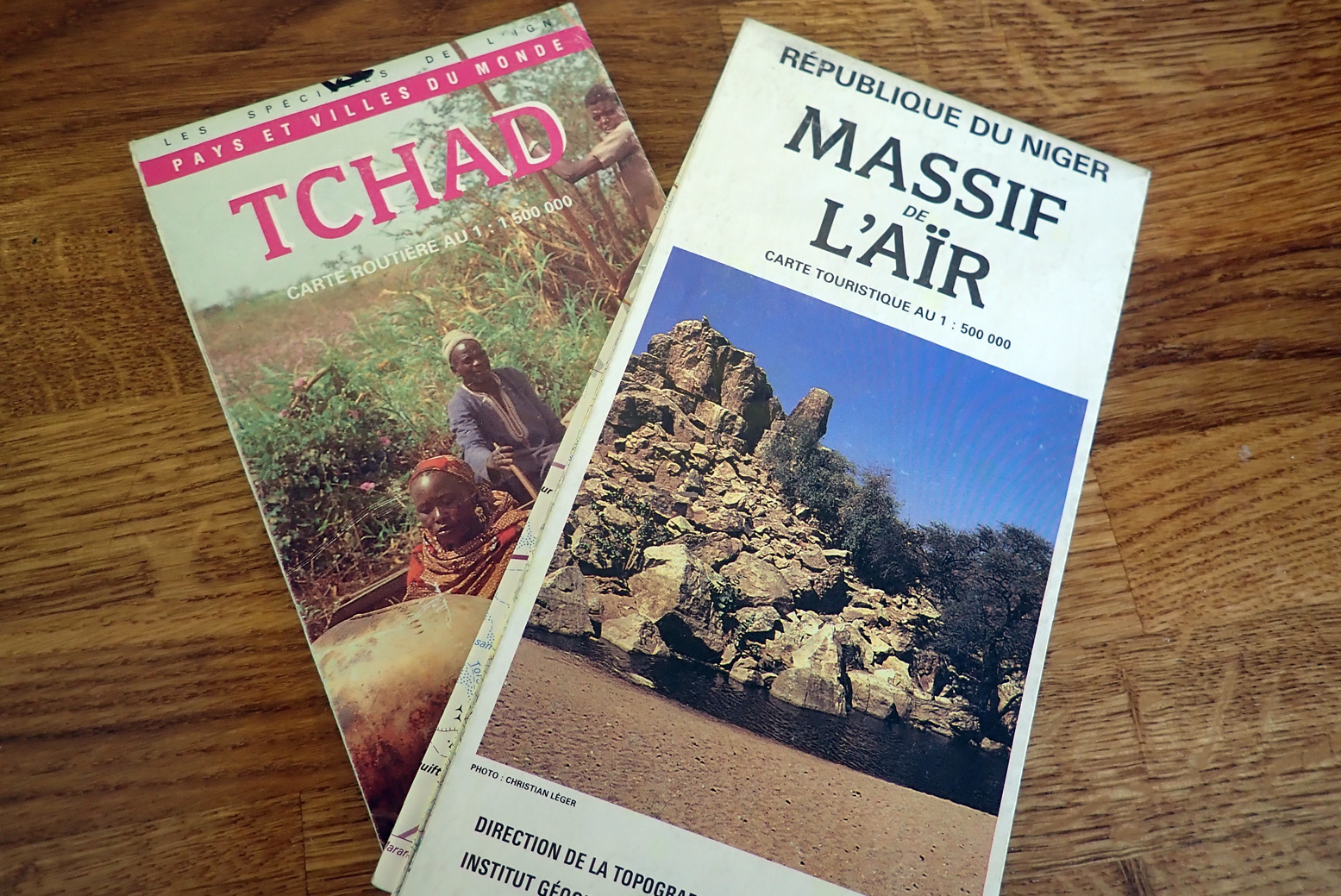
I found this nice IGN half million map of the Air in Niamey. Dating from 1991, it’s a similar style to the Niger country map from IGN but I can’t say I’ve ever seen this one in Paris. In many ways it’s superior to the one million IGNs which are pretty old now and don’t show recent roads. Mine cost me 50FF, plus old paperback and a small argument from the side of the Grand Hotel.
I returned to the Tenere with my own tour for the Eclipse of 2006, and visited many of the same amazing places with another great crew (and ran into Abdullai in Chirfa). Our two-weeker was a perfect Saharan adventure.
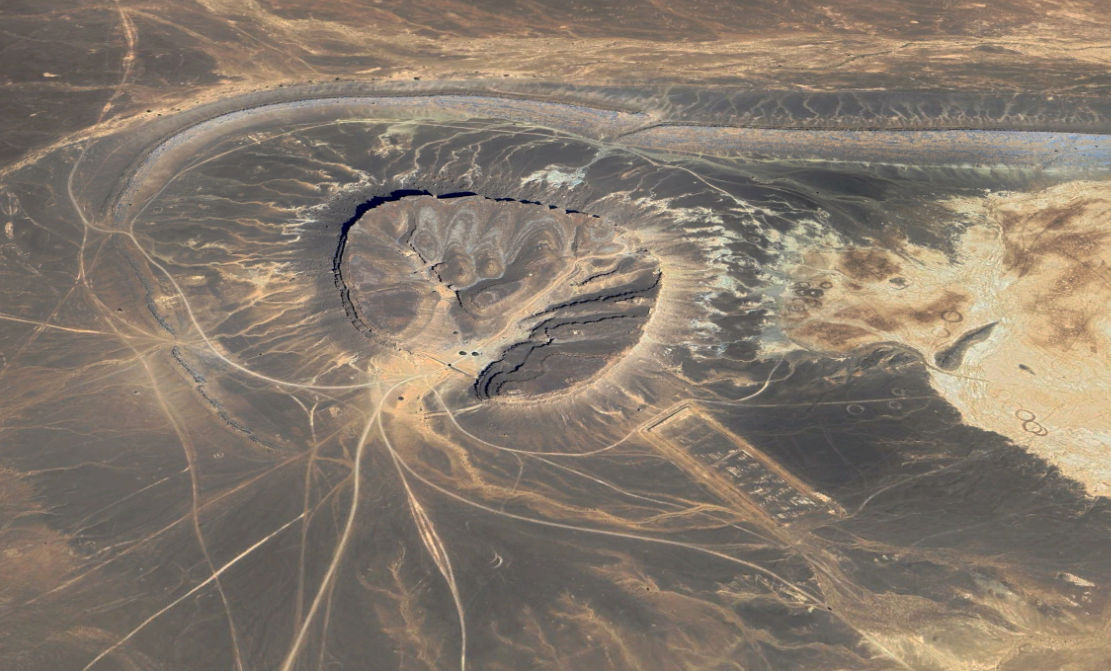
People used to ask: where was the front cover of your Morocco Overland 3 book? Gara Medoaur, I say, though I’ve yet to actually go there. A distinctive outcrop just north of the N12 near Rissani, the epic cover was shot by desert trucker Marc Heinzelmann with a drone, something that’s increasingly tricky to smuggle in these days. Despite appearances, Gara is not an ancient volcano – the near-horizontal sedimentary strata give that away. Time and again I hear or read of people attributing the desert’s dramatic formations to volcanism, though you get that too. But Gara sure looks good and, like so many isolated hills in Morocco, large and small, it was used as a strategic natural fortress and observation post from a millennium ago when nearby Sijilmassa, was a northern terminus of the medieval caravan trade from Timbuktu. Inside Gara’s ‘crater’, shallow ravines were dammed to collect water and there are long eroded remains of dwellings. In later years it’s said it was a Portuguese prison, a similar enclosure for slaves, or just a storehouse.
Though filmed since at least 1988, the outcrop rose to fame with the release of the 1999 film, The Mummy for which a ramp was built up through the ancient wall on the southern side. Thereafter, it grew to become a destination for tourists as well as other films and commercials. But more than the nearby Todra Gorge, you can see why it’s uniquely compelling. Not only does it resemble an impressive natural ‘volcanic’ fortress – a Bond producer’s dream – but from the rim you get a great view across an arid desert plain as well as a killer viewpoint spot perched on the exposed crag.
Photo from Morocco Overland. Neil Burns
The earliest record I’ve found of Gara Med being used as a film location is as the magical “Speaking Mountain” in a 7-part Italian mini series from 1988 called Secrets of the Sahara. With English speaking actors and a soundtrack by Ennio Morricone, it was also condensed into a film. But it was 1999’s The Mummy which put Gara on the map, and which may again have featured in TheMummy Returns (2001). Since then Gara Medouar has been seen in several films as well as product promo videos seeking to evoke the arid Saharan wastes without having to go more than a couple of miles off road or too far from five-star civilisation. Here’s my list with vid clips below. Did I miss a few? Probably.
Secrets of the Sahara (1988) Seven-part Italian TV series. Gara is central to the plot
Secrets of the Sahara (1988) Short movie version
Prince of Persia: The Sands of Time (2010) Disney fantasy movie with magical daggar
Spectre (2015) Baddy’s lair in a Bond movie
Zero Zero Zero (Sky, 2018) Better than average drug cartel drama series
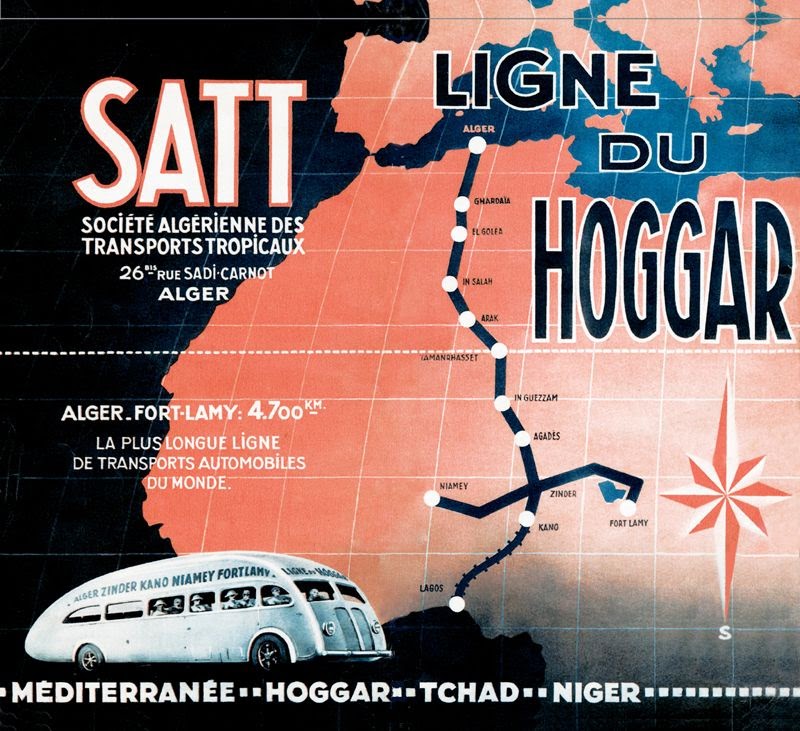
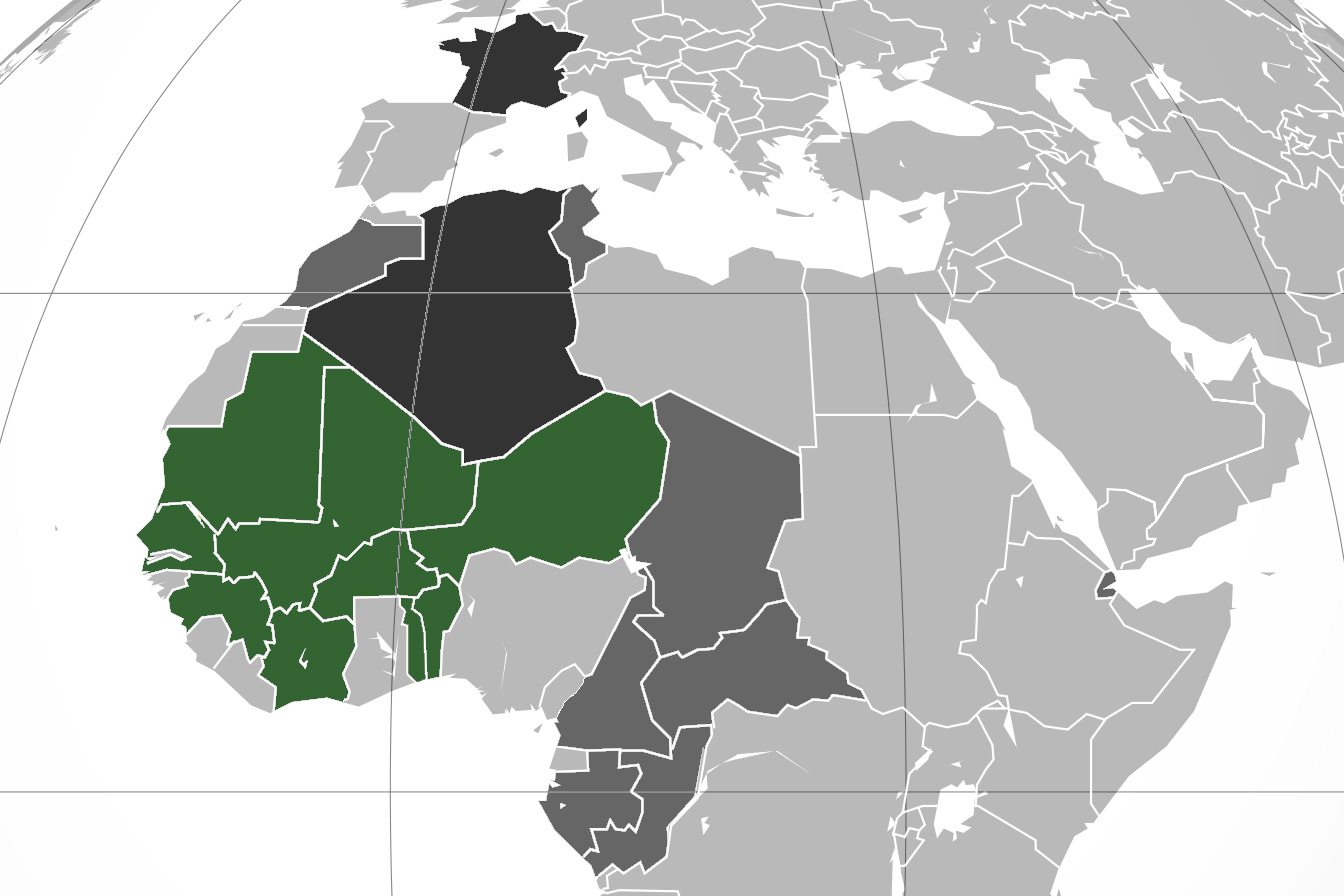
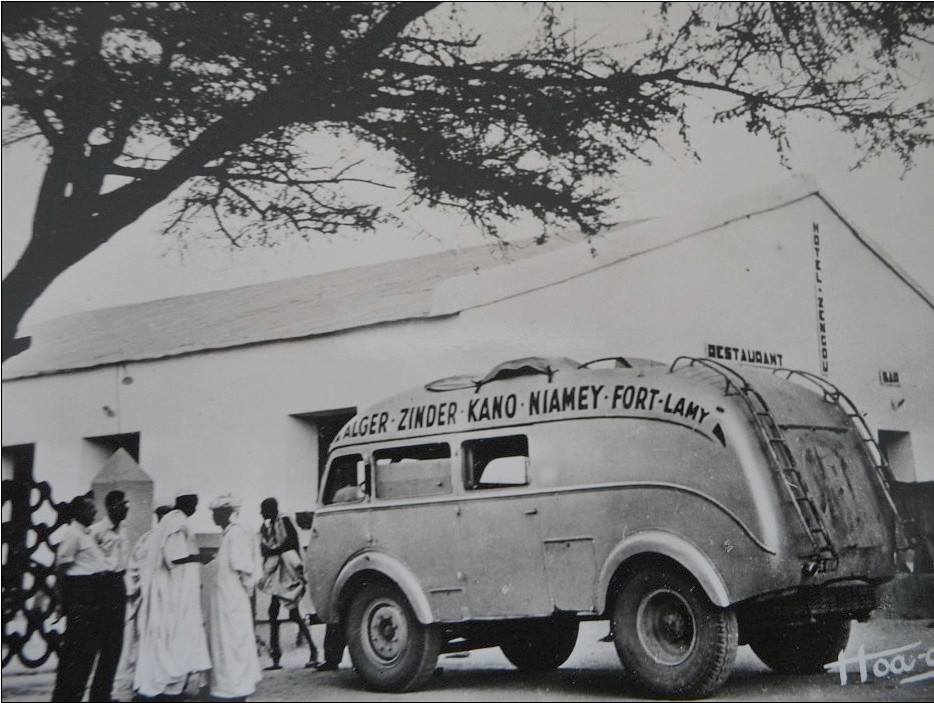
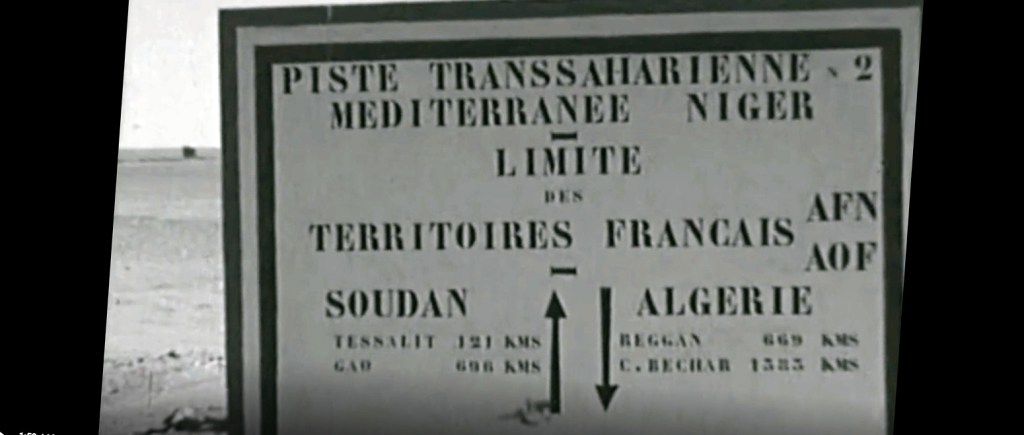
In the last decade of France’s colonial presence in North Africa, their part of Sahara was divided between three territories: Algeria, Tunisia and Morocco (‘AFN’), ‘AOF’ (French West Africa) from Mauritania to Niger, and ‘AEF’ or French Equatorial Africa which included present-day Chad. One could travel the pistes across the desert between the Mediterranean coast and the Sahel, and even scheduled bus services traversed these ‘Imperial Routes’ to the sub-Saharan capitals.
Pre-war editions were more aviation based
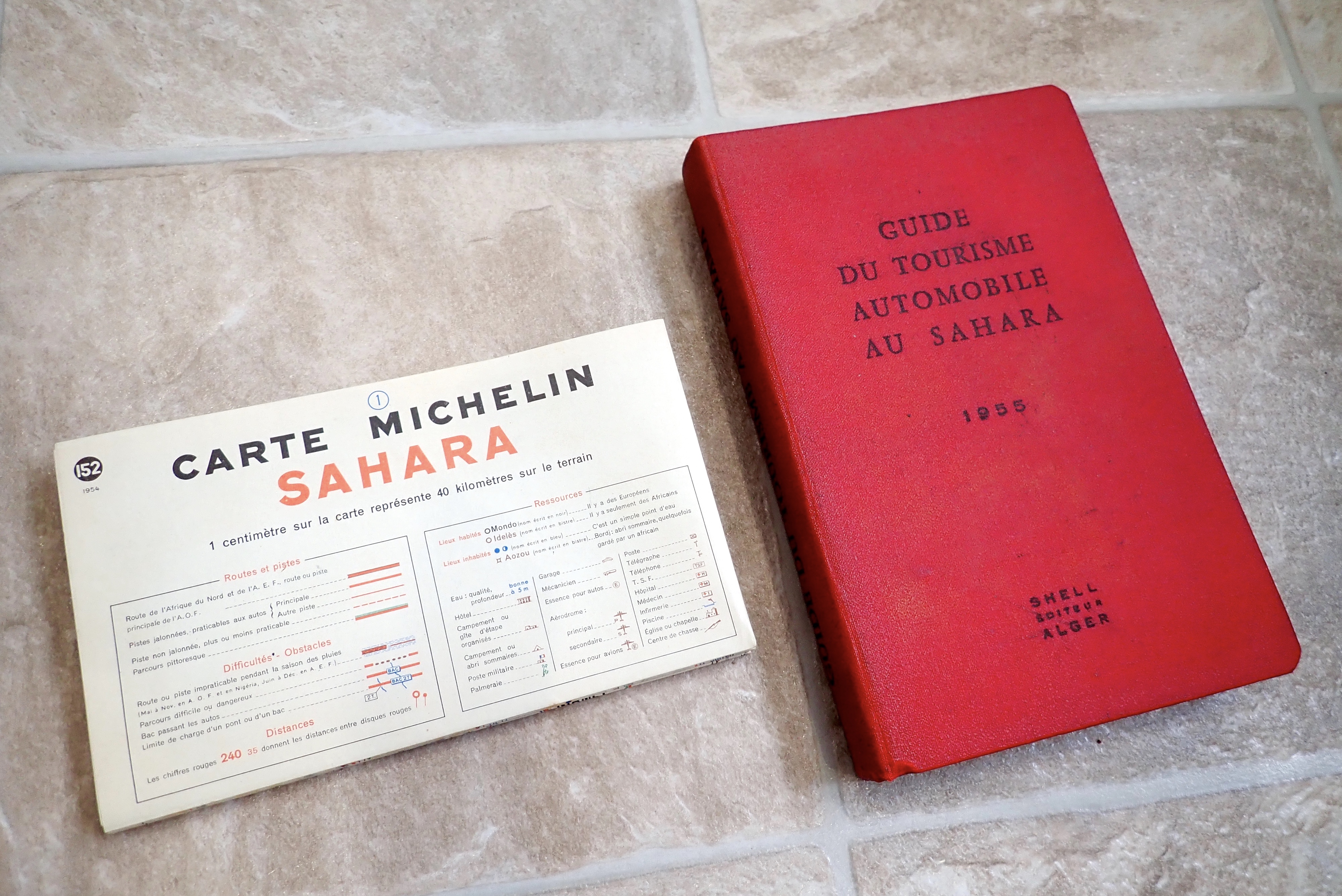
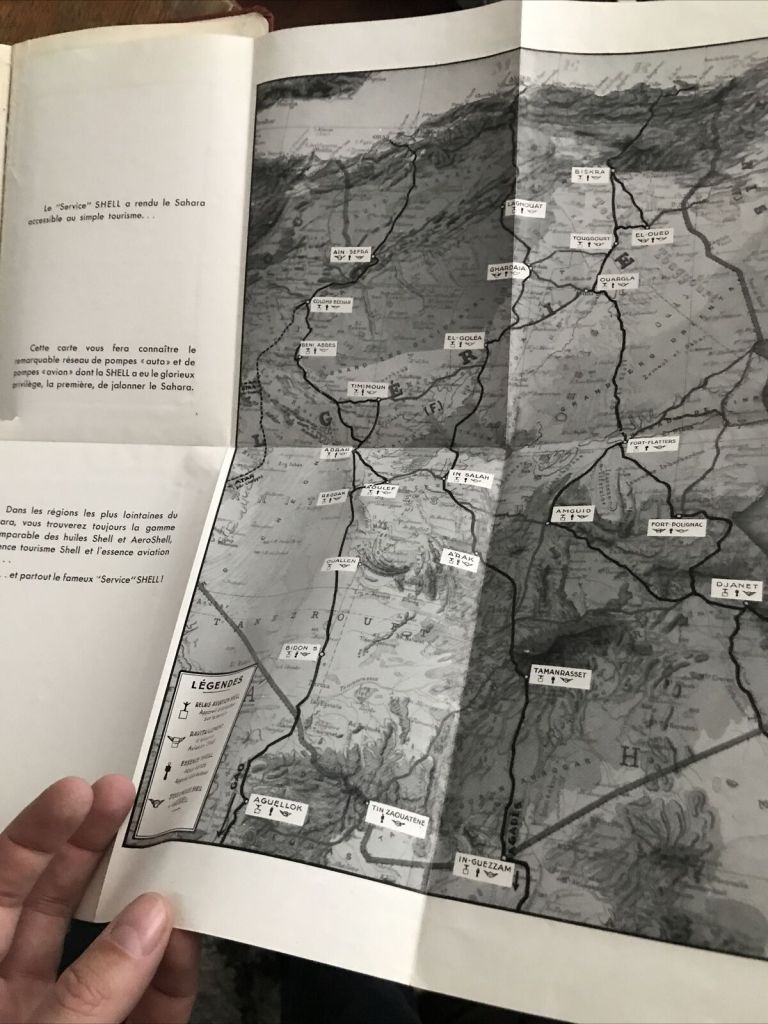
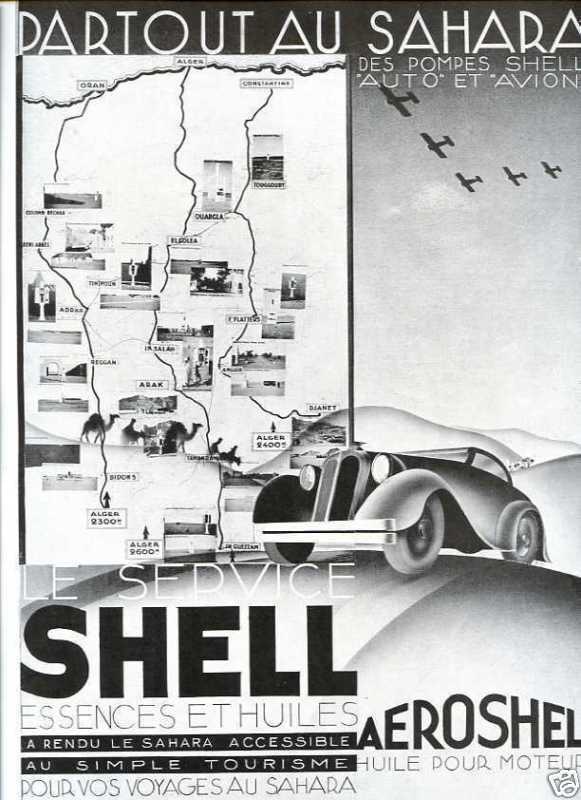
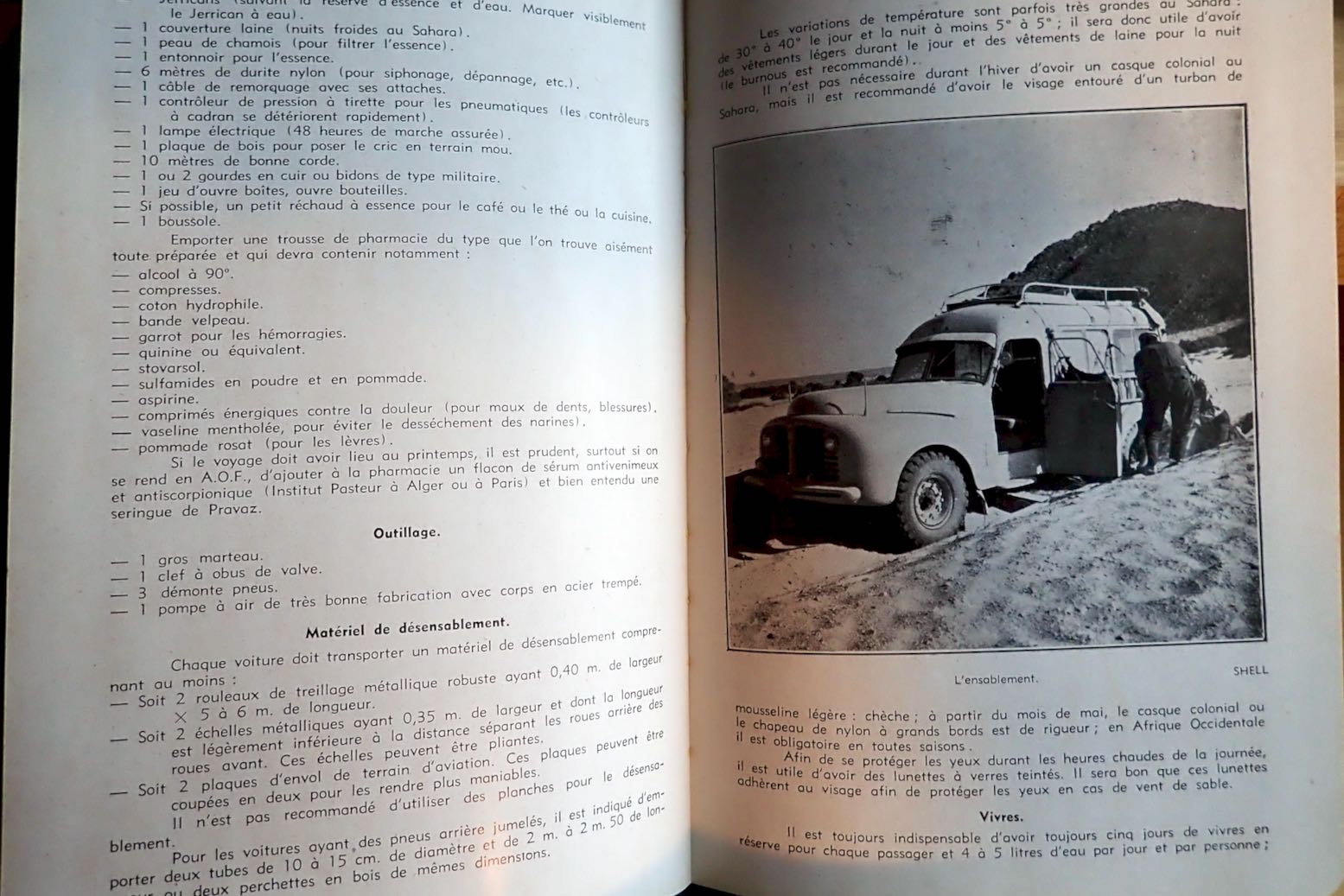
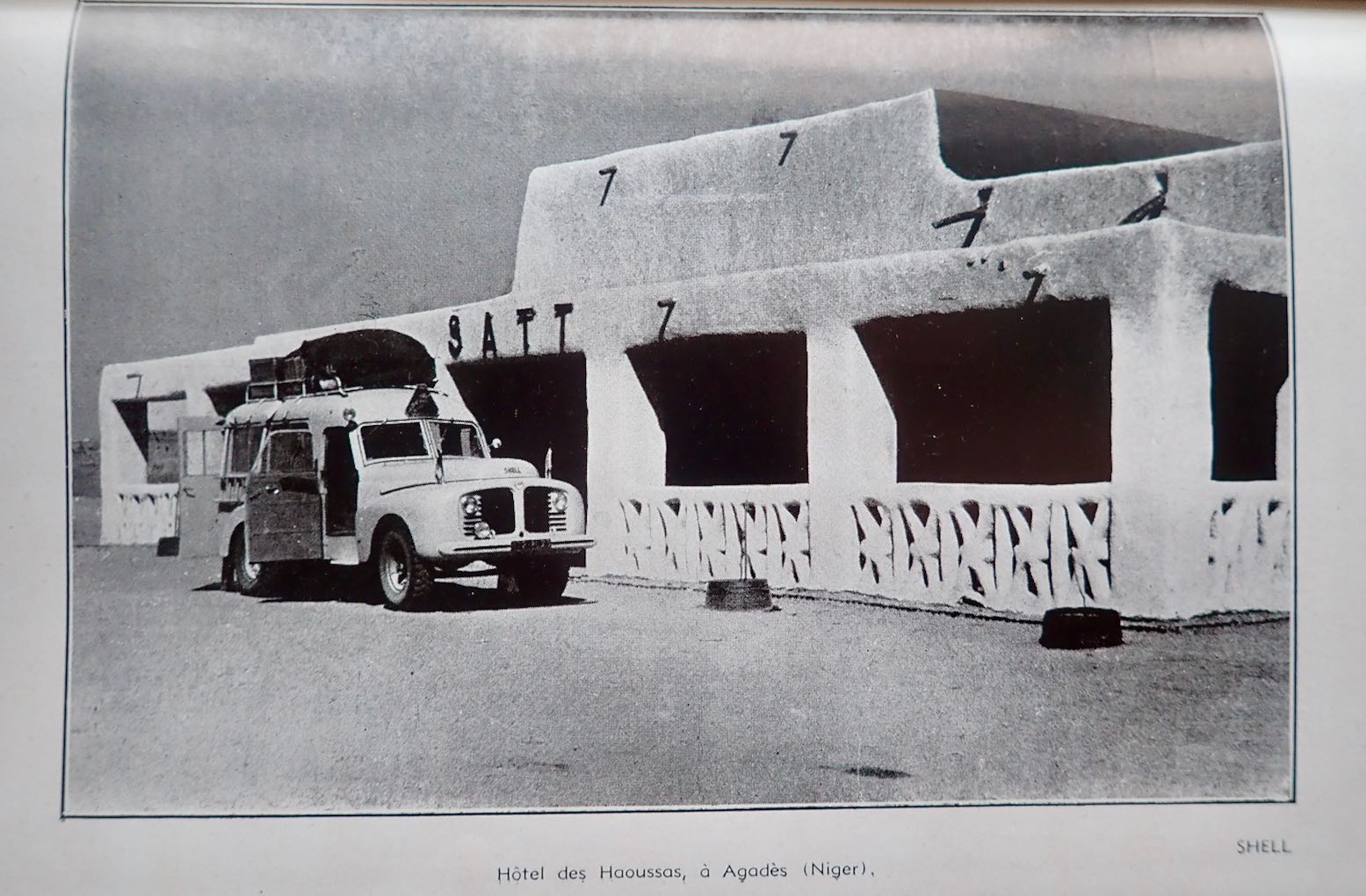
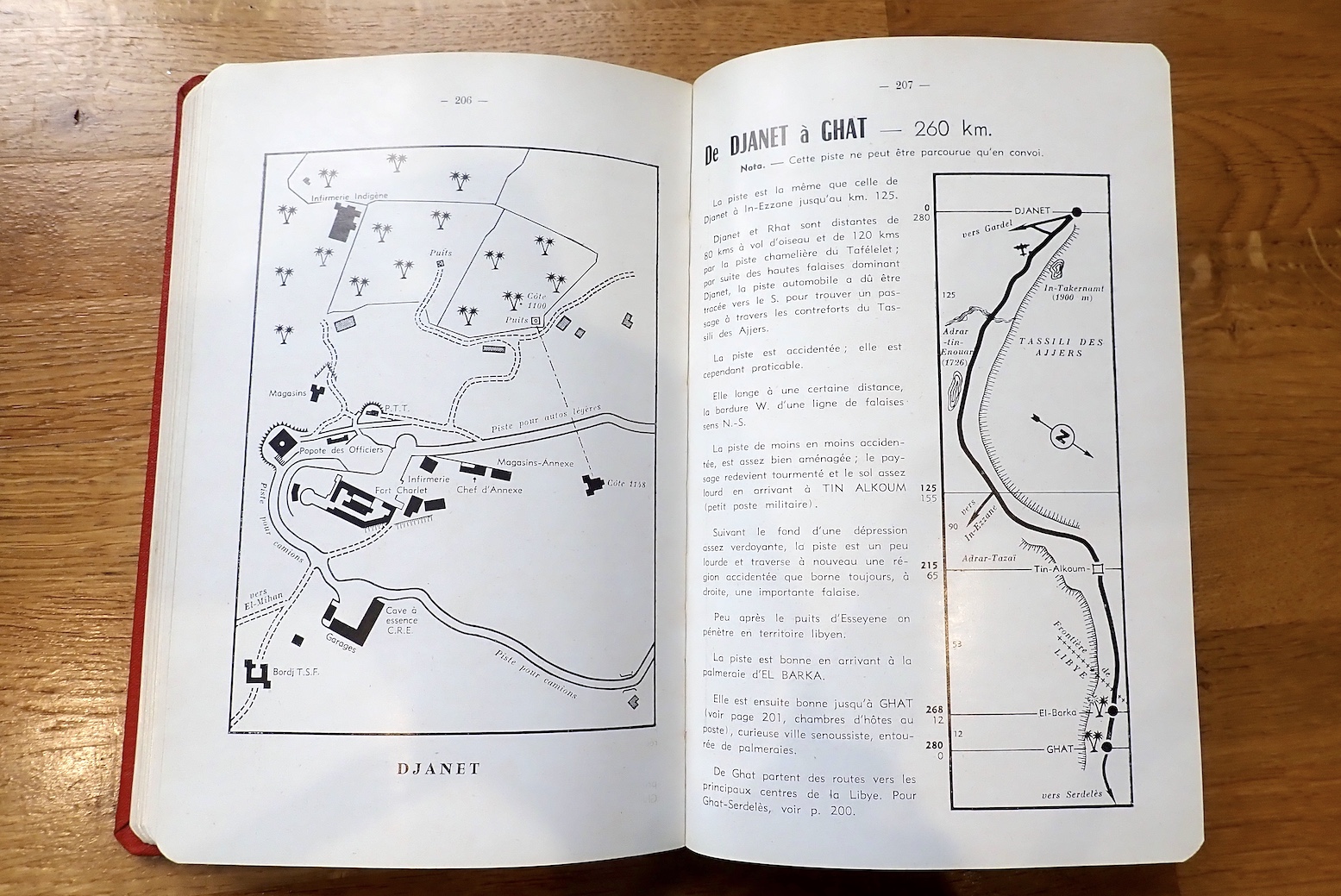
Just a couple of years before these colonies were dissolved and became the independent countries we know today, Shell released its fifth and final edition of the Guide du Tourisme Automobile au Sahara. The 345-page book is in French and there are still plenty around; mine cost me €25 from France, althpugh make sure you get the lovely map inside the back cover sleeve. Originally published way back in 1934 (link to pdf) and just seven years after Shell started distributing fuel in Algeria, it must have been the first guidebook of its kind, preceding my own Sahara Overland by nearly seven decades.
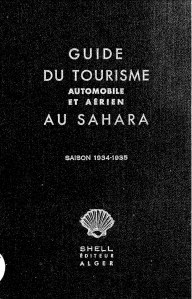
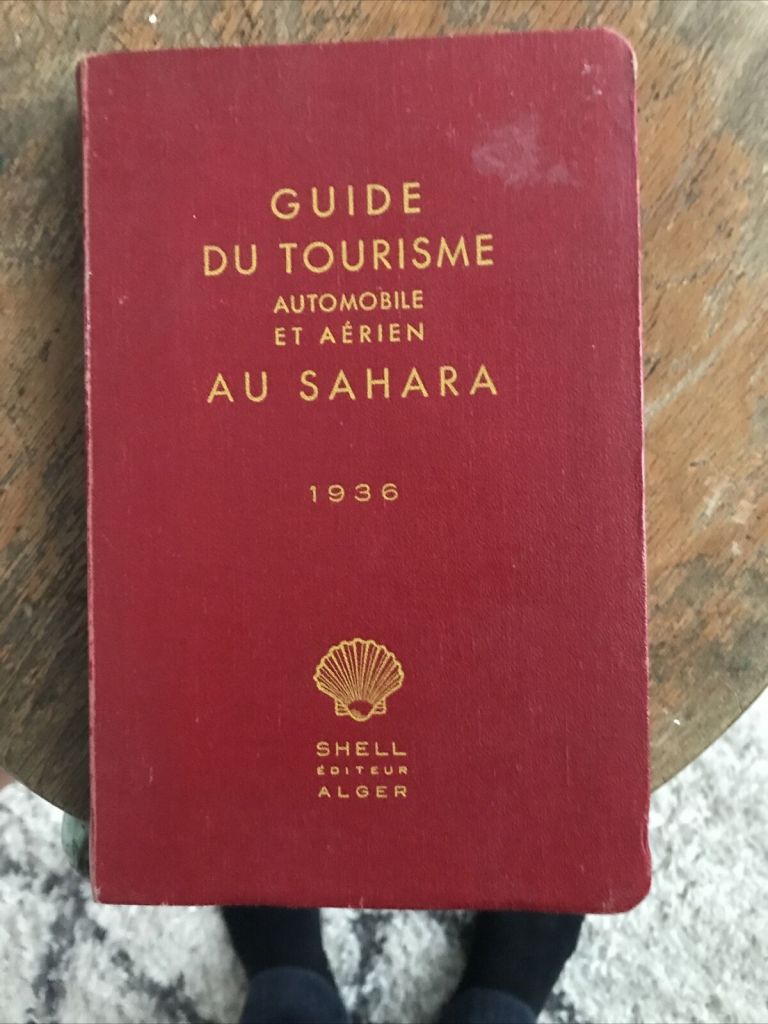
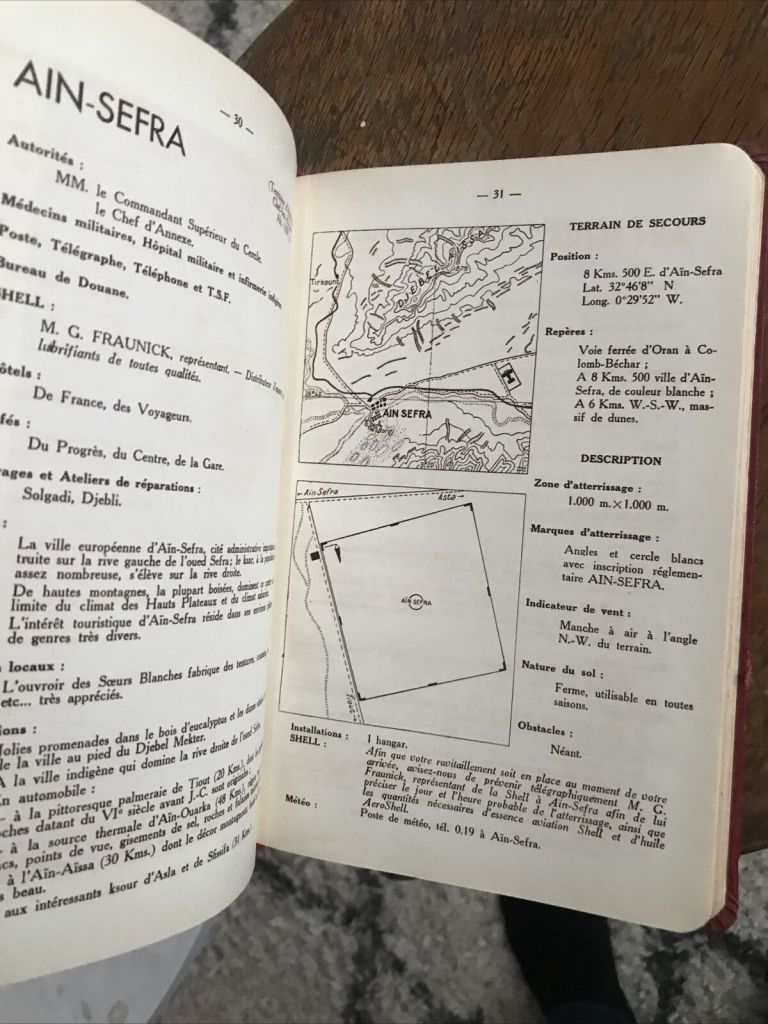
The three pre-war editions (1934-5 pdf; 1936 below and 1938) were thinner books but also covered aerial tourism: fuel and landing strip information. Perhaps back then private planes were still seen as comparable or superior to with cars for getting to remote places. By the mid-50s commercial flying had taken off across the world, and flying around the desert was no longer a thing, unless you were very rich.
1936 2nd aero edition
Even if it was nothing more than fully funded exercise in self-promotion, it’s still odd that an Anglo-Dutch oil company produced such a presumably prestigious project to showcase an important French colony, especially as it had the feel of an official handbook. In the 1930s Shell became well known for their illustrated guidebooks to Britain; perhaps publishing was not a thing that interested French oil companies like Total and Elf. Only Shell produced guidebooks, although road mapswere widely branded by some of the oil companies of the era.
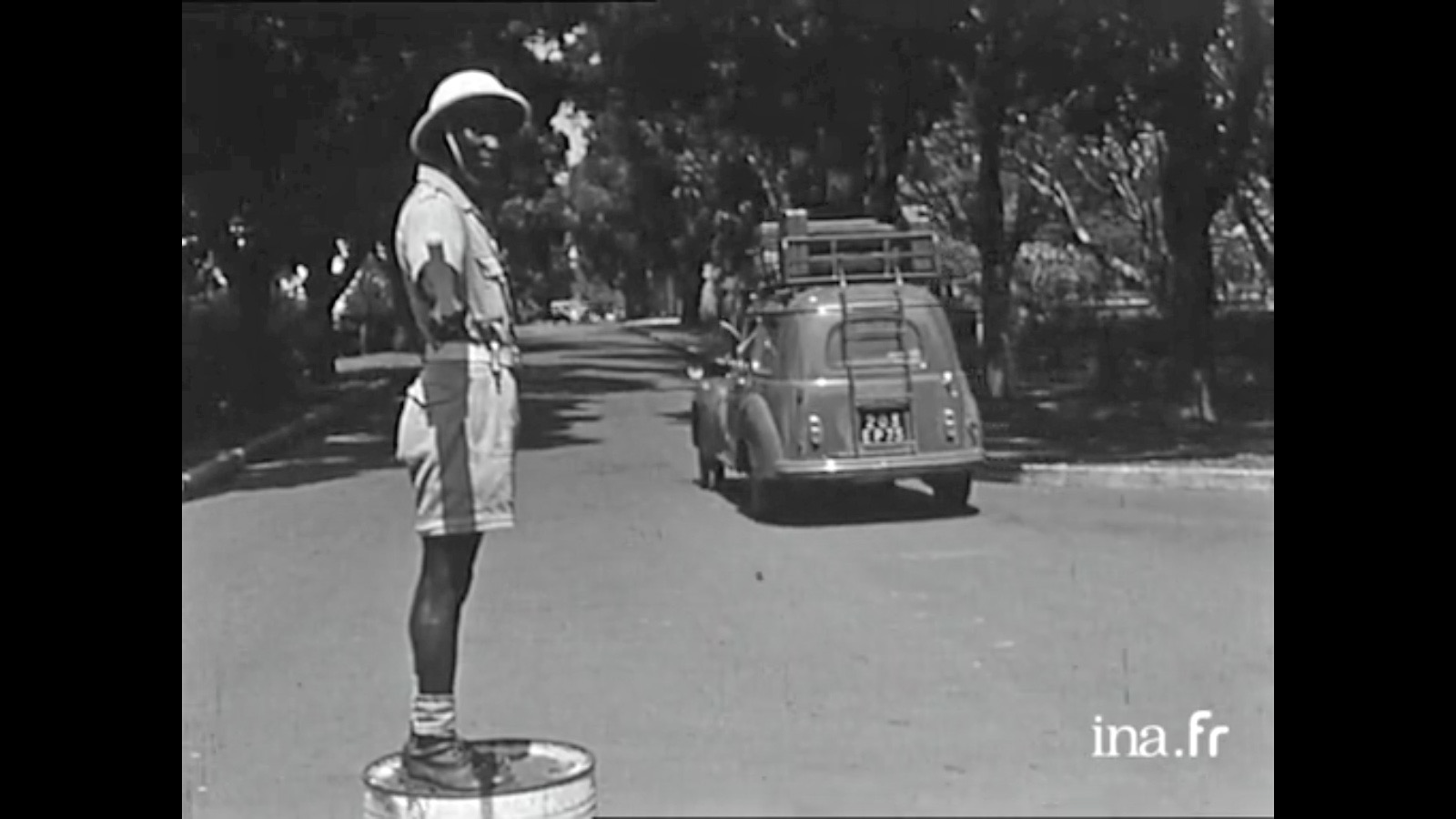
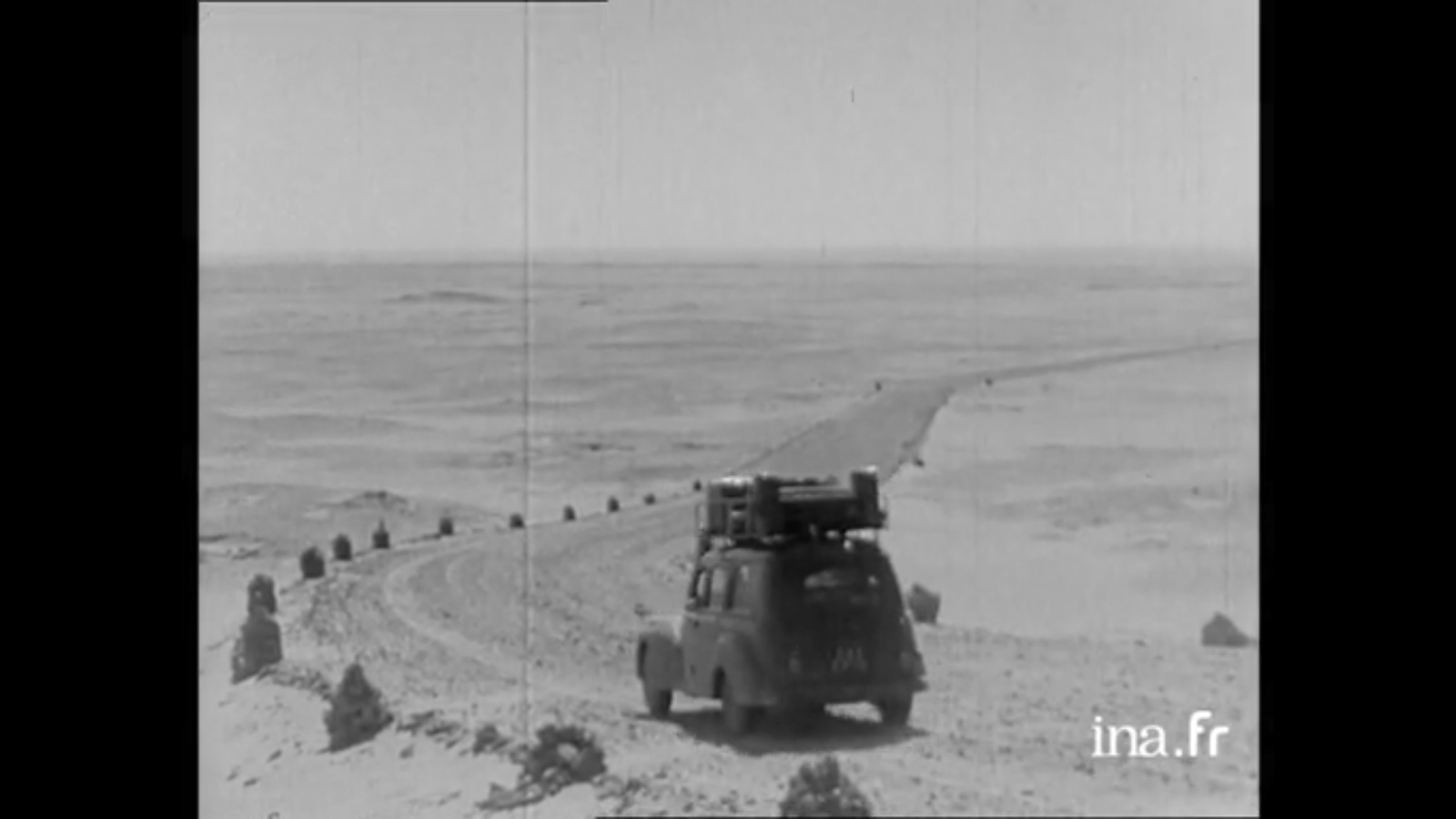
You can imagine the three French women (France Degand, Janine Delbert and Michèle Cancre d’Orgeix) had a copy of a Shell in the glovebox of their Peugeot 206 wagon before setting out their double crossing of the Sahara in 1956 (video below).
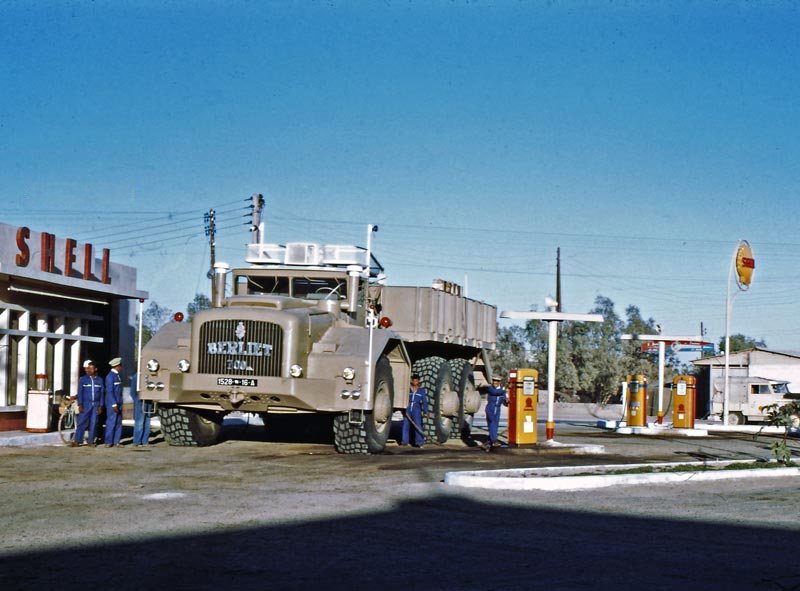
The 1950s were the apogée of the colonial era when, even in the Belgian Congo, trains ran through the jungle on time and roads drivable by regular cars snaked over the equatorial escarpments. In the Sahara pistes were well maintained, regularly patrolled and for the most part, well marked too. The Sahara still had its rough edges and expansive voids, but had been effectively tamed by the colonial administration, including a desert-wide network of Shell stations: ‘In the Sahara, as in your garage‘ the guidebook boasts. It was the vestiges of this investment in desert infrastructure which we inherited in the 1970s and 80s by which time the whole region had seen 15-20 years of independent rule. The Shell emblem was long gone, replaced by nationalised fuel companies distributing the commodity with had become integral with global progress and development.
The Guidebook
Until 1939… the book starts… conditions for the harmonious development of winter tourism were coming together in the Sahara. Excellent temperatures, admirable sites, distant horizons, interesting populations, verdant palmeries [and] distinctive architecture: behold the country.
It then goes on to introduce the Sahara, using a flowery style which I’ve seen in more recent French guides to the Sahara. The book doesn’t miss a chance to include an exposition of the magnificent French achievements in the Sahara since 1919.
A year after this edition was published, after decades of searching (during which time French explorer and geologist Conrad Killian mysteriously met his death) prospectors finally struck oil in Edjeleh near In Amenas, and a short time later in Hassi Messaoud. By the end of the next decade Algeria became a major oil producer in North Africa.
It’s interesting to see how the content of the guidebook conforms with a modern day equivalent: a geographical breakdown of the desert’s geology, relief and topography, river courses and wells; ethnicities add up to either Arab or Berber, with pre-colonial history leading to exploration, colonisation and pacification right up to the period of the automobile and the aeroplane.
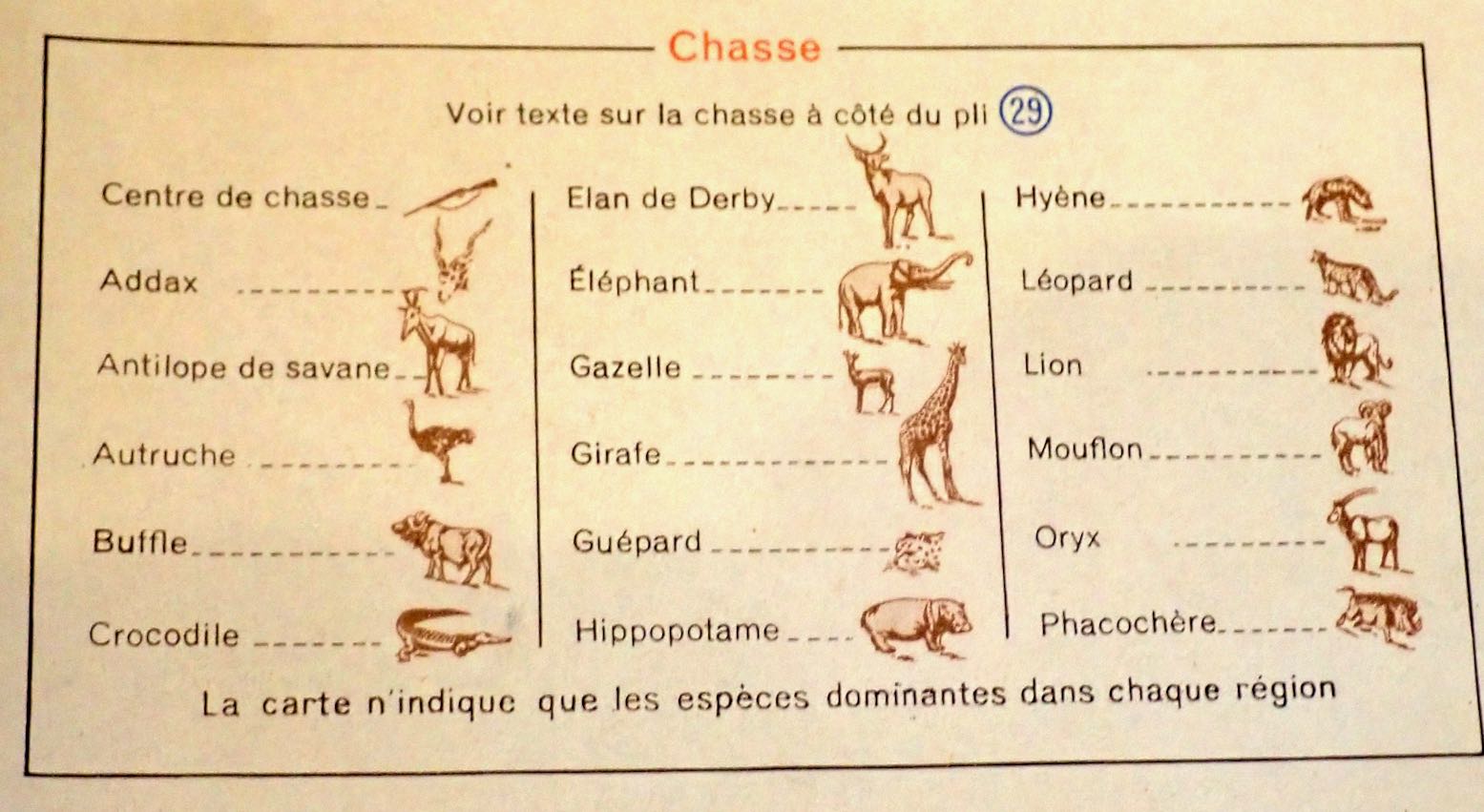
Short sections cover local artisans and the souvenirs they made, a bibliography, recreation and sports and not least hunting for hides, heads, horns and ivory. Happy days!
As for vehicle choice, the guide advised not to worry about using touring cars, by which I think then meant a regular RWD sedan or estate, like the Peugeot 206, above. Rightly it said the 4x4s of the time: Land Rover, Jeep, Willys and the near identical Delahaye V.L.R were significantly less comfortable.
It’s worth recalling that many regular cars of that era had bigger wheels and better ground clearance – garde du sol – ‘an important factor in vehicle choice‘… ‘Consider fitting bigger tyres, but not too much or you’ll stress the transmission and steering.’ ‘Power to weight is also a factor for tackling soft passages.’ …’avoid dual rear wheels…’ It’s interesting to see all these strategies were well known, even back then. It does however list a long and very heavy list of spare parts. Durability must be one thing that’s improved over the decades. In a way today’s SUVs have similar characteristics, but of course no one would consider taking one somewhere as outlandish as the Sahara, not least because 4x4s have improved to become much less utilitarian.
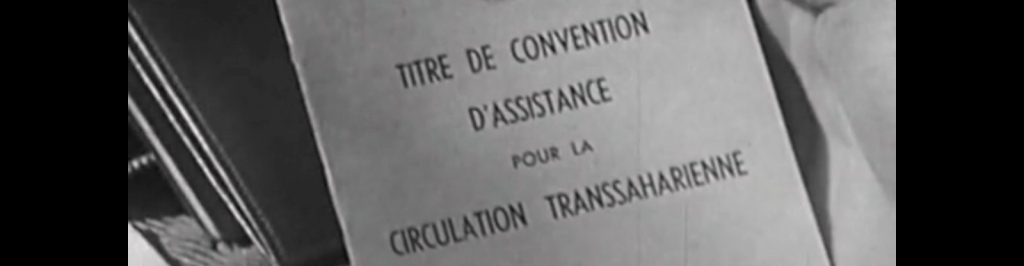
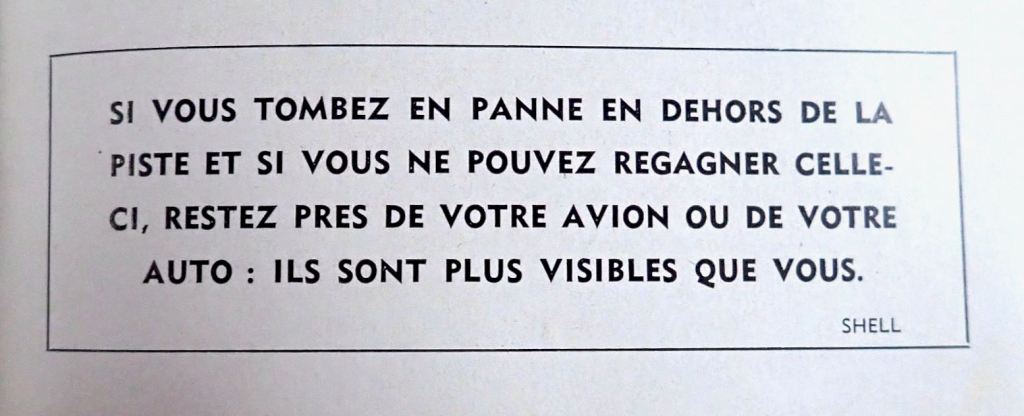
Code Saharien de la Route In that time of French control a detailed list of safety protocols needed to be followed before before setting off along a piste. ‘Pour votre securite‘ as they used to say to us in Algeria where the system endured into the 1980s (but without any actual back-up or support; you were on your own). The Code was a check on whether you were equipped to tackle what lay ahead, followed by the requirement to check on on arrival. If you followed the rules and were overdue, they’d come and look for you. You also needed some sort of contract with a local recovery service in case of a breakdown. The last 40 pages of the book detail the full list of these requirements for each of the three territories.
You might be able to see someone pencilled in additional points along the hyper-remote Ligne du Djouf to Nema.
The Itineraries
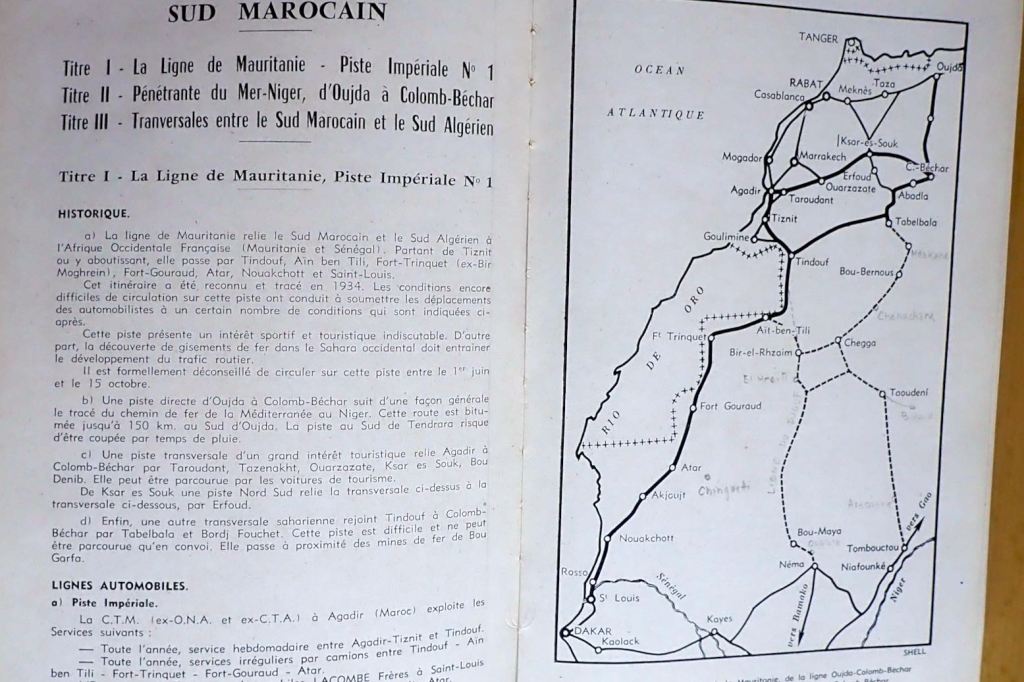
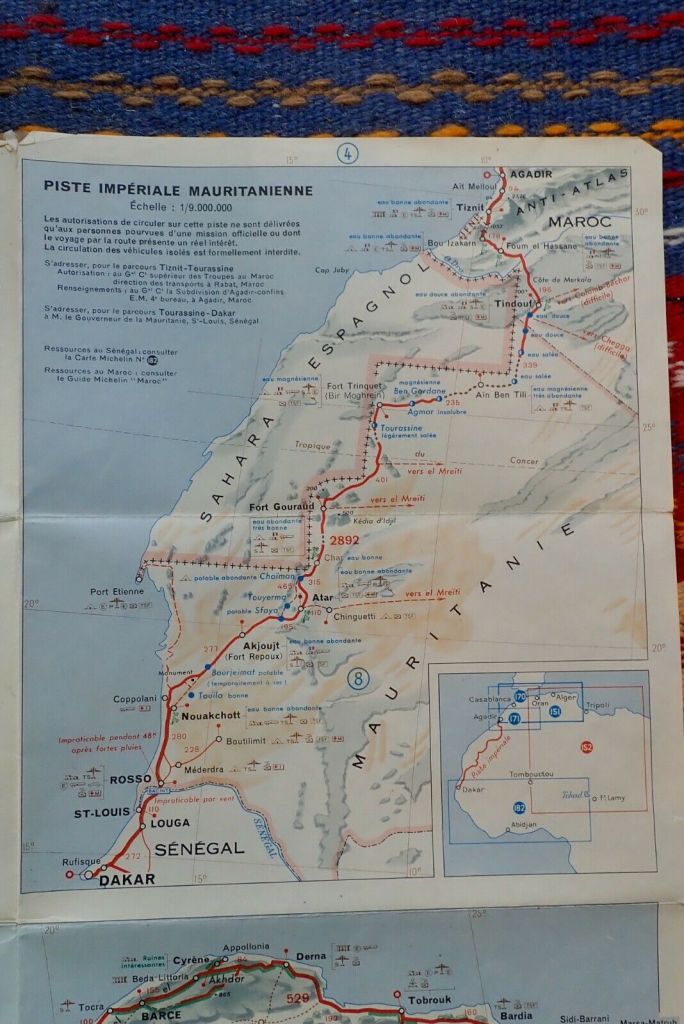
The route guide breaks down the Sahara into four sections: southern Morocco along tracks which are now mostly roads. Then came the grandly named Imperial Tracks, starting with N°1: the Mauritania Line (above) which was recently reopened by Algeria. Back then, this was the direct route through all-French territory from Tiznit in Morocco or Colomb Bechar in Algeria, to St Louis or Dakar which circumvented the Spanish Rio de Oro colony on the Atlantic coast. Closed between June and mid-October, this was also the ‘Forgotten Path‘ which David Newman followed in his Ford Corsair touring car in 1959, just as the territories were breaking up.
The route description for the 2550km from Tiznit to St Louis goes on for 15 pages including a few photos and plain maps. It left Moroccan territory south of today’s Foum el Hassan, a small town between Akka and Assa on what I call the Desert Highway in the Morocco guide. I noted a passing reference to ‘Merkala‘; an escarpment watchtower marking the border between Morocco and Algeria which still survives as the enigmatic ‘Tour de Merkala’ on the Michelin 741 map. In Tindouf we learn that prior to the French establishing a garrison in 1934, the settlement, had been abandoned for three decades due to persistent raids by the nomadic Reguibat. The Berbers must have welcomed a bit of law and order. From here the lonesome track led to Ait ben Tili on the Spanish Sahara (today’s PFZ) border, with balises (marker posts) every 5km, but plenty of tole ondulee: ‘corrugated iron’ or washboard/corrugations to you and me. Like today, there’s nothing much for the traveller at AbT. Back then wild game added up to gazelles and long-gone ostriches. Once you got to Fort Trinquet (Bir Mogrein) you could add moufflon and leopards to that list.
From here it was 405km south to Fort Gouraud (Fderik) and the piste was poorly marked, sandy and rutted. The old route ran for another 310km from Fort Gouraud via Char fort to Atar didn’t get any less sandy, and the iron ore railway was still another 8 years away. Maybe a touring car, even with good clearance, wasn’t such a good idea after all.
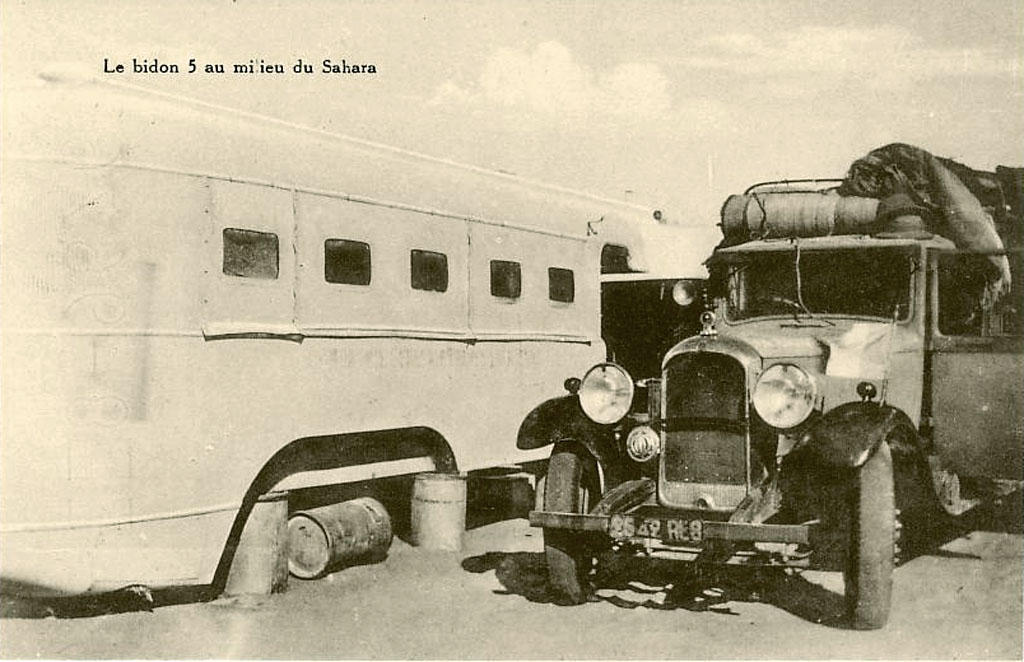
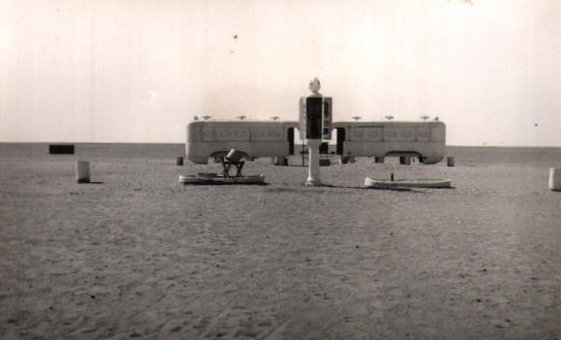
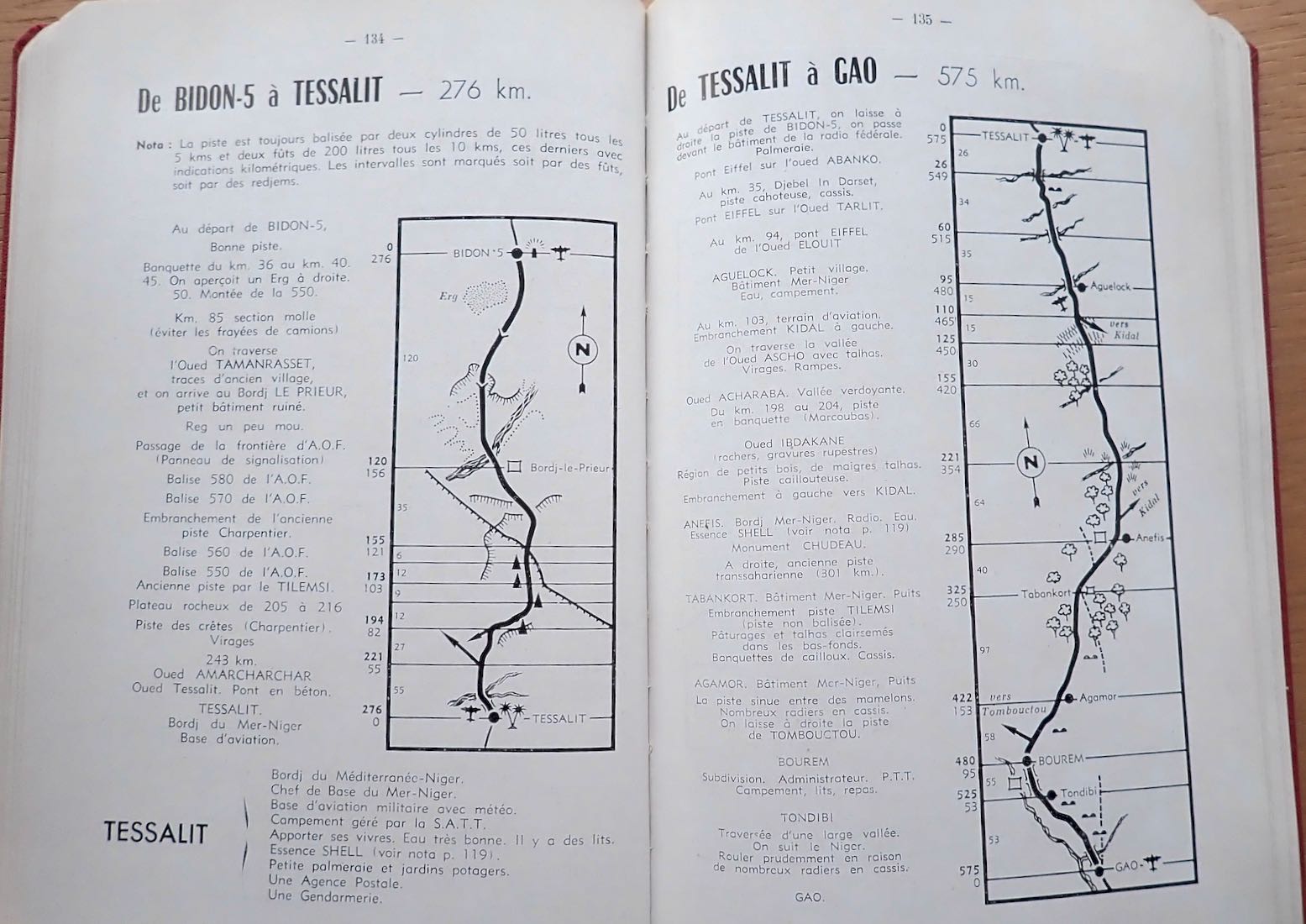
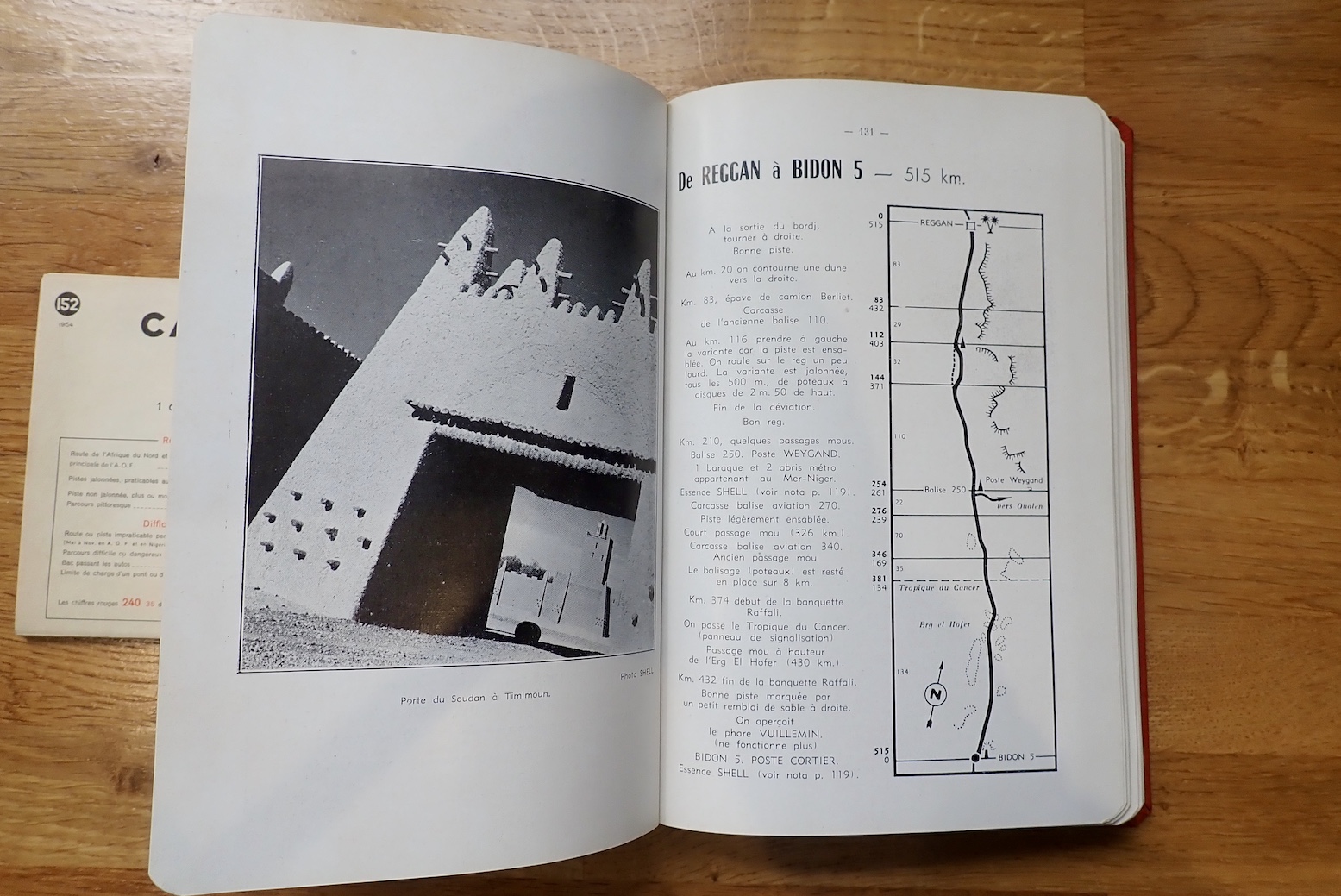
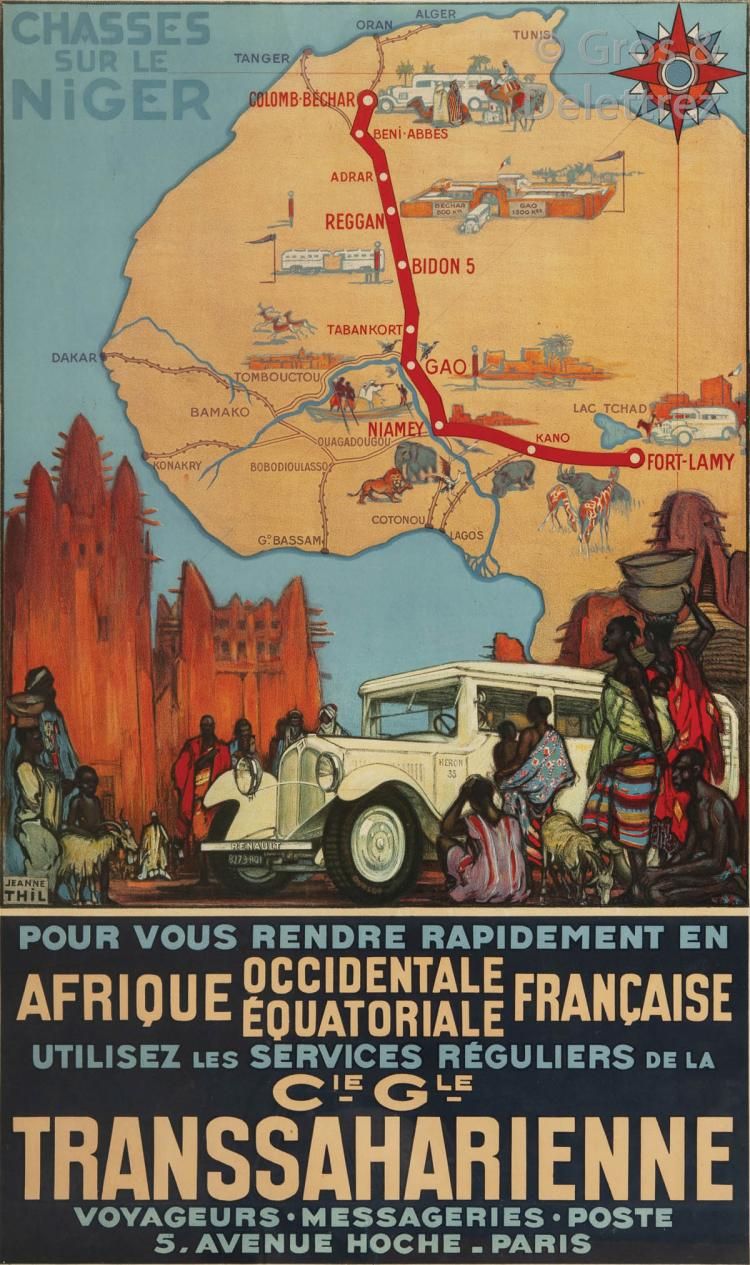
Imperial Track N°2 was the Tanezrouft Line from Colomb-Bechar to Gao on the Niger river. This was the route chosen by the first cars to cross the Sahara in the early 1920s. It’s interesting to see how quickly the commercial drive towards tourism follows what was once terra incognita. You could say we’re seeing the same today in space; something which would have been hard to imagine in the middle of the Apollo programme. It was on this desolate route that Bidon V (‘Oil drum 5’, below) made a name for itself as a desolate travellers way-station between Reggane and Tessalit in present day Mali. At one point the lighthouse shone into the night, planes could land for a refuel and a couple of bus bodies where parked up on oil drums to provide lodgings for passengers the Mer-Niger bus route.
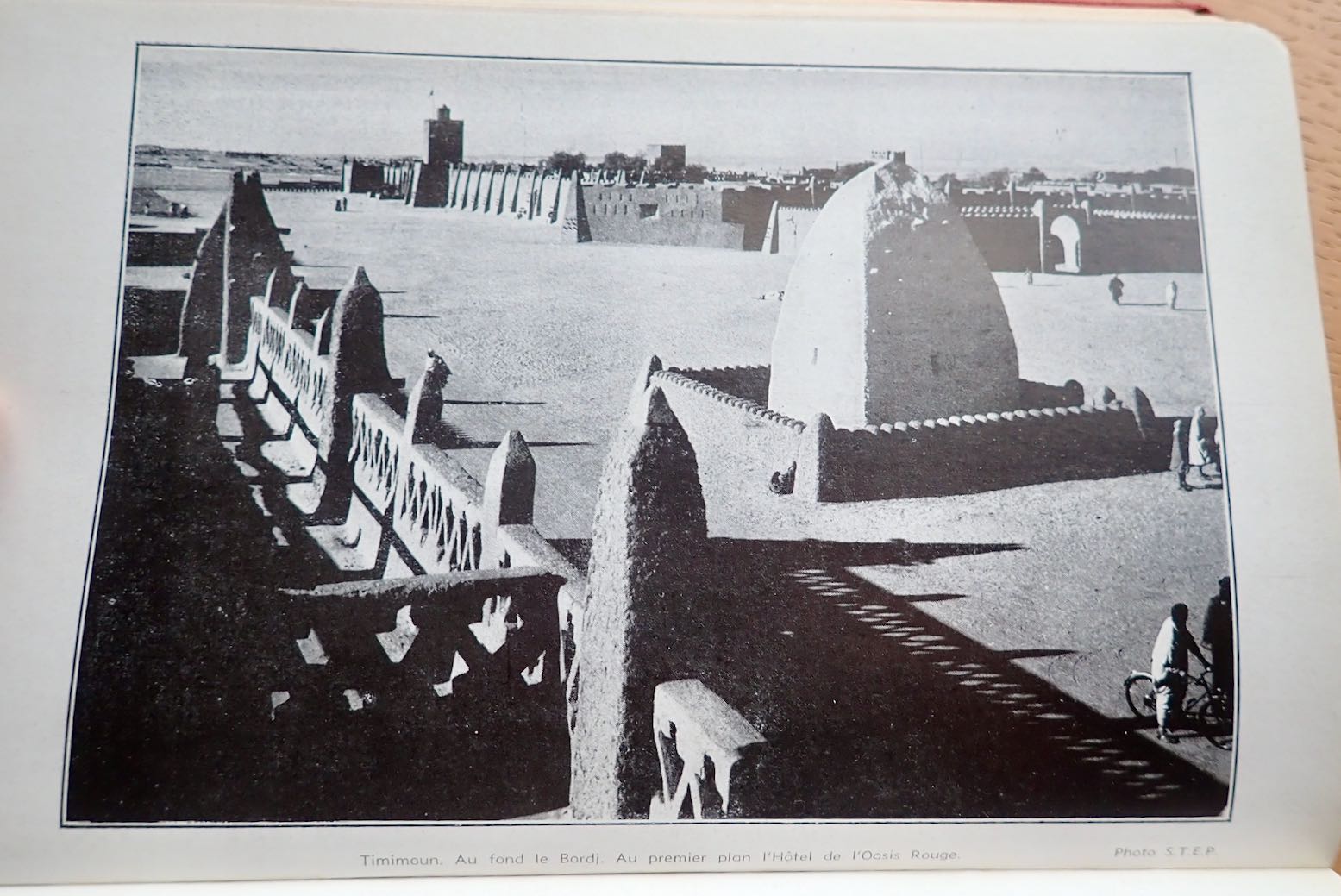
Timimoun
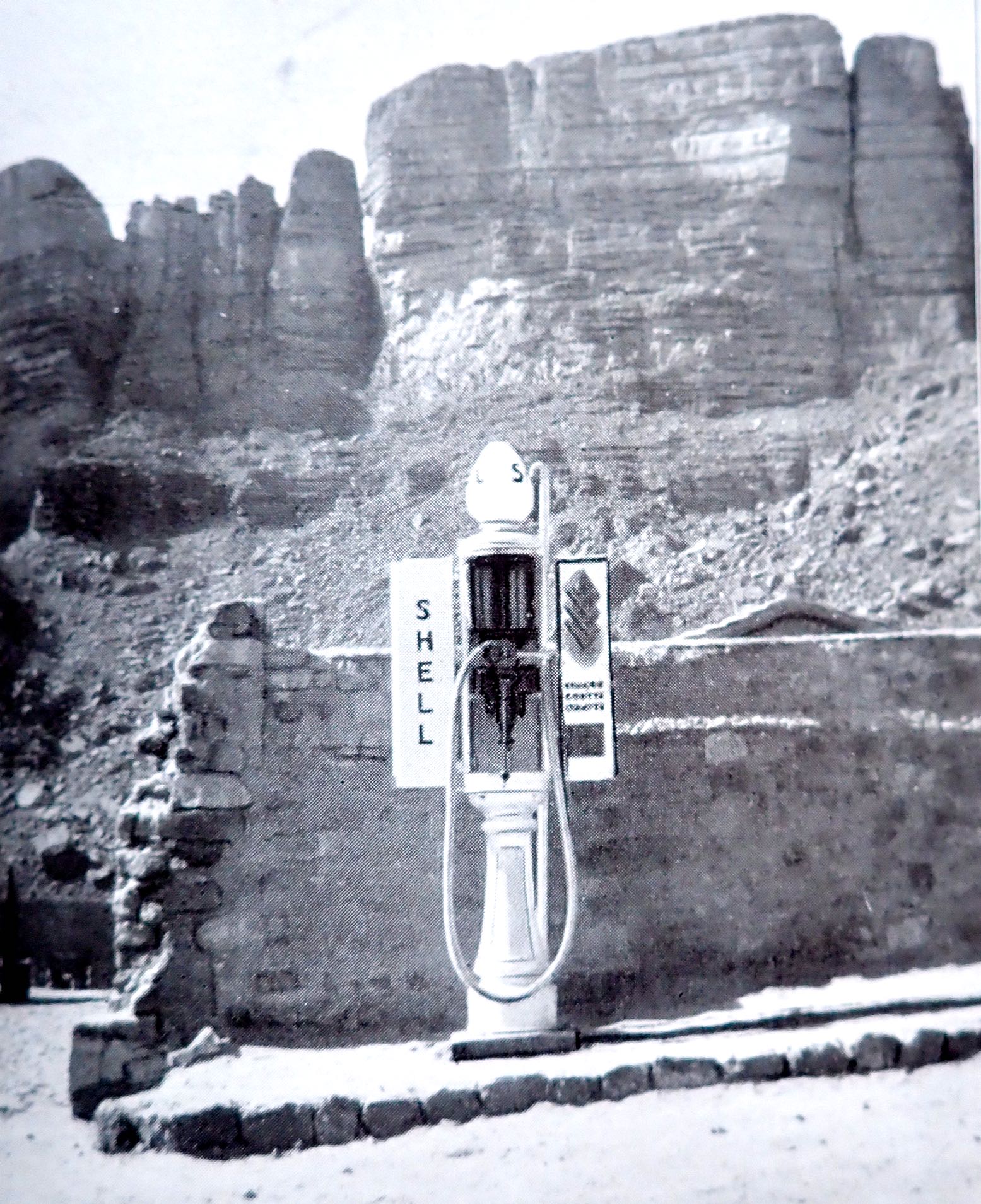
The book continues with other well known routes in the Algerian Sahara, though not exactly what we have today. Imperial Route 3; the Hoggar Line – today’s Trans Sahara Highway – ran further east between El Golea to In Salah, and again on to the Arak Gorge where a friendly Shell bowser (left) stood by at your service.
From Tamanrasset, excursions up to Assekrem along today’s route were already established (fold out map included), and the now paved track to the border via Laouni was the same, but once in AOF, the track went straight to Agadez via In Abangarit to the south. It was on this route that the drama vividly described in Trek, met its climax. There was no Arlit until uranium was discovered there about 15 years later. Zinder, close to the Nigerian border, was the end of that road.
The Ajjer and Tibesti Line was Imperial Route 4: from Biskra all the way to Fort Lamy (N’djemana) in Chad. From Djanet the route dropped down to Bilma, the long established administrative capital of the eastern Tenere, before you back-tracked north to Seguedine to head east for Zouar, Faya and even Fada before turning down to Abeche and Fort Lamy. This was the route which the lavishly equipped Berliet expeditions of 1960 sought to open up for trade, just as France’s overt control over the Sahara slipped away.
Back then getting to Djanet meant dodging the Fadnoun Plateau (Tassili N’Ajjer). From Fort Flatters (today’s Bordj Omar Driss) you headed out over the sands southwest to Amguid, then southeast along the base of the plateau. Right up to the 1980s this was truck route to Djanet until they sealed the winding road over the Fadnoun which to this day still catches some truckers out.
If you could get to Fort Polignac (Illizi), a car route did actually cross the Fadnoun. You left Polignac to the east then either pitted yourself against the very sandy Imirhou gorge (left) , or all the way to Tarat fort on the Libyan border, before turning south to join today’s route at Dider. On bikes for Desert Riders in 2003 (the full movie is on YouTube), this was a tough but epic ride across the tumbled escarpments of the Tassili which took us two hard days. But the time we reached the final descent from the plateau at the Tin Taradjeli Pass, we couldn’t wait for the sands of the wide open Tenere.
From 1943 up to 1951 the French administered the Fezzan province of Libya and may have had had hopes of annexing it. But by the time this edition was published, growing calls for independence put an end to that idea. Meanwhile. the northern deserts of Chad remained as obscure and little visited as they are today.
The Map
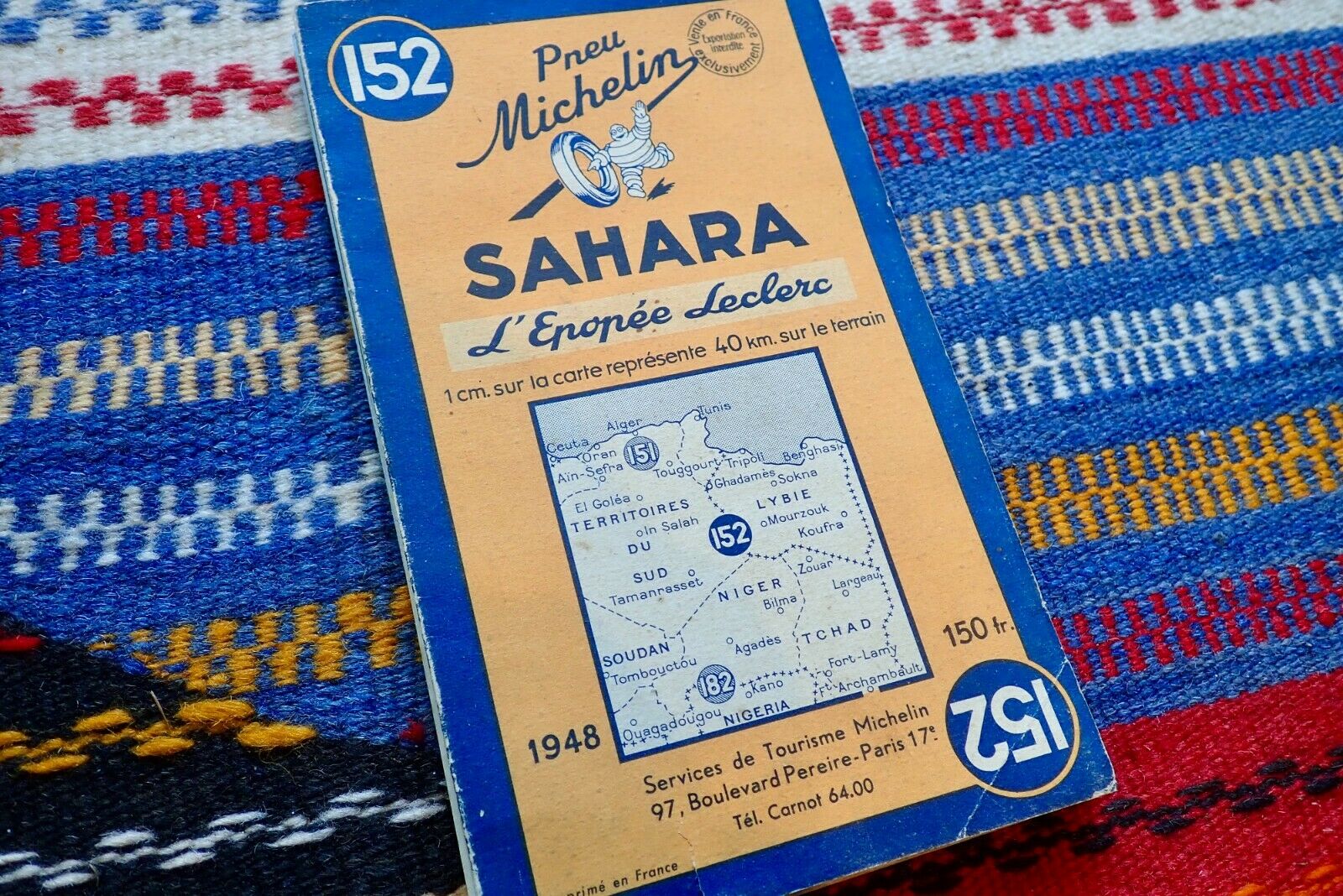
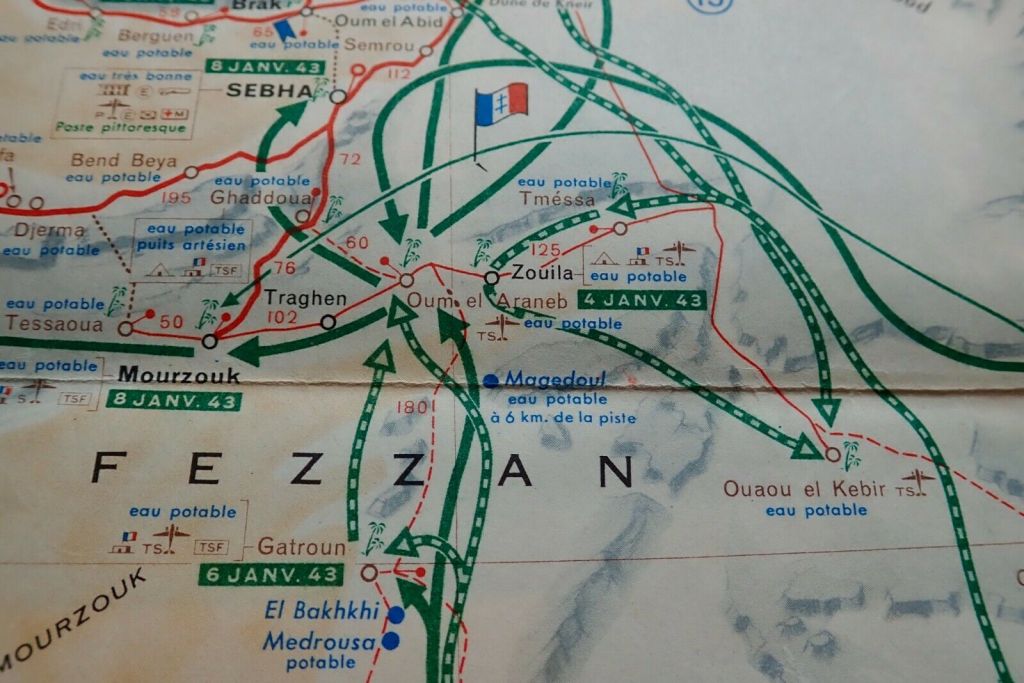
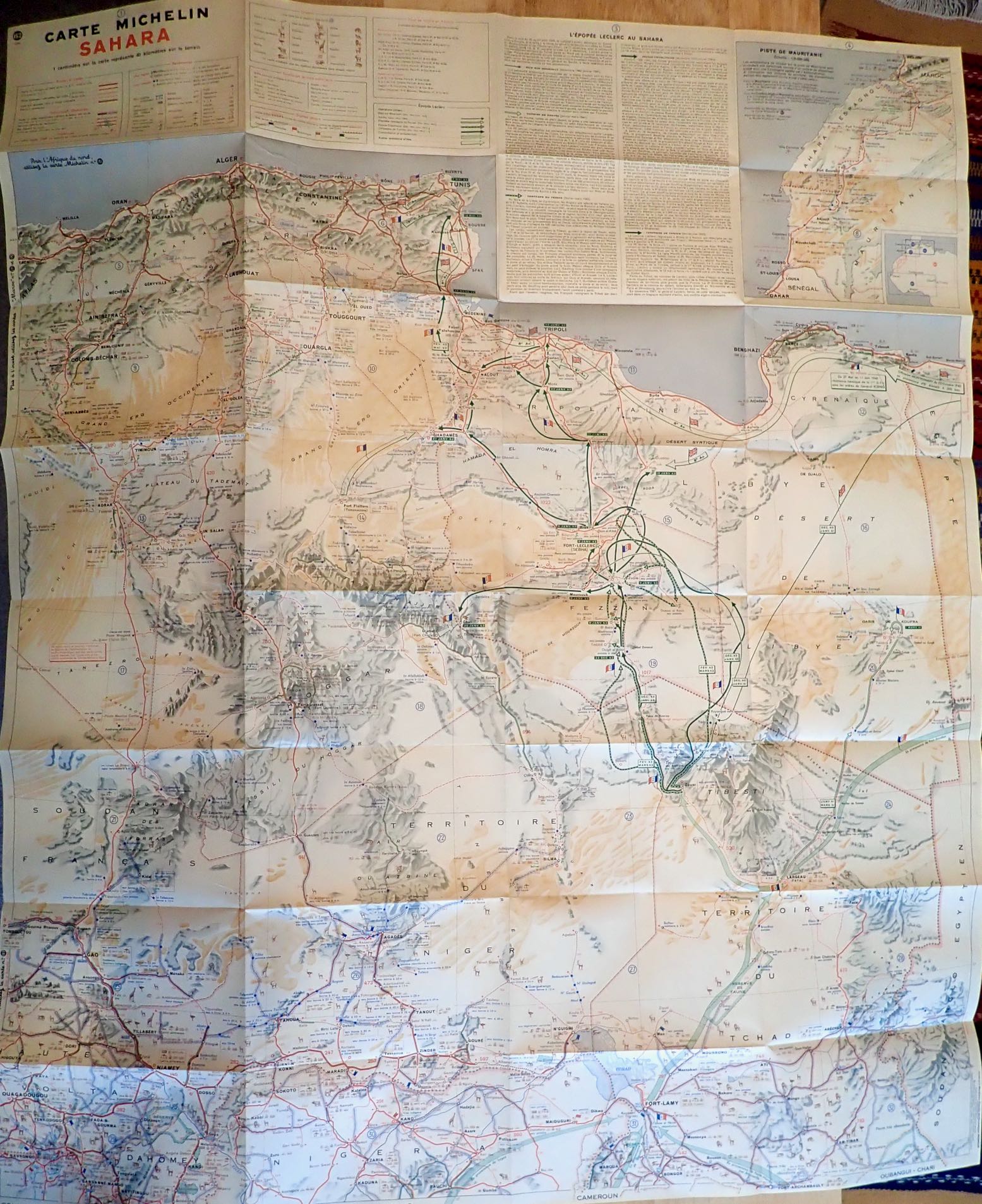
The Shell guide includes a 1:4m scale map folded into the back cover. It’s more or less Michelin’s 152 of 1948 which to some may alone be worth it the price of the guide. It doesn’t have the full coverage of the 153 North & West Africa which came later, but shows the routes described, and much more. This detail has long made the Michelin map indispensable in the Sahara, even if it is a rather skimpy navigation aid to setting off along one of the Imperial routes. The Mauritanian Line gets a 1:9m inset (below left) while in Libya (never a French territory) the map proudly shows the routes of General Leclerc’s desert campaign during WW2 which ended in the famous raid on Murzuk in co-ordination with the Long Range Desert Group.
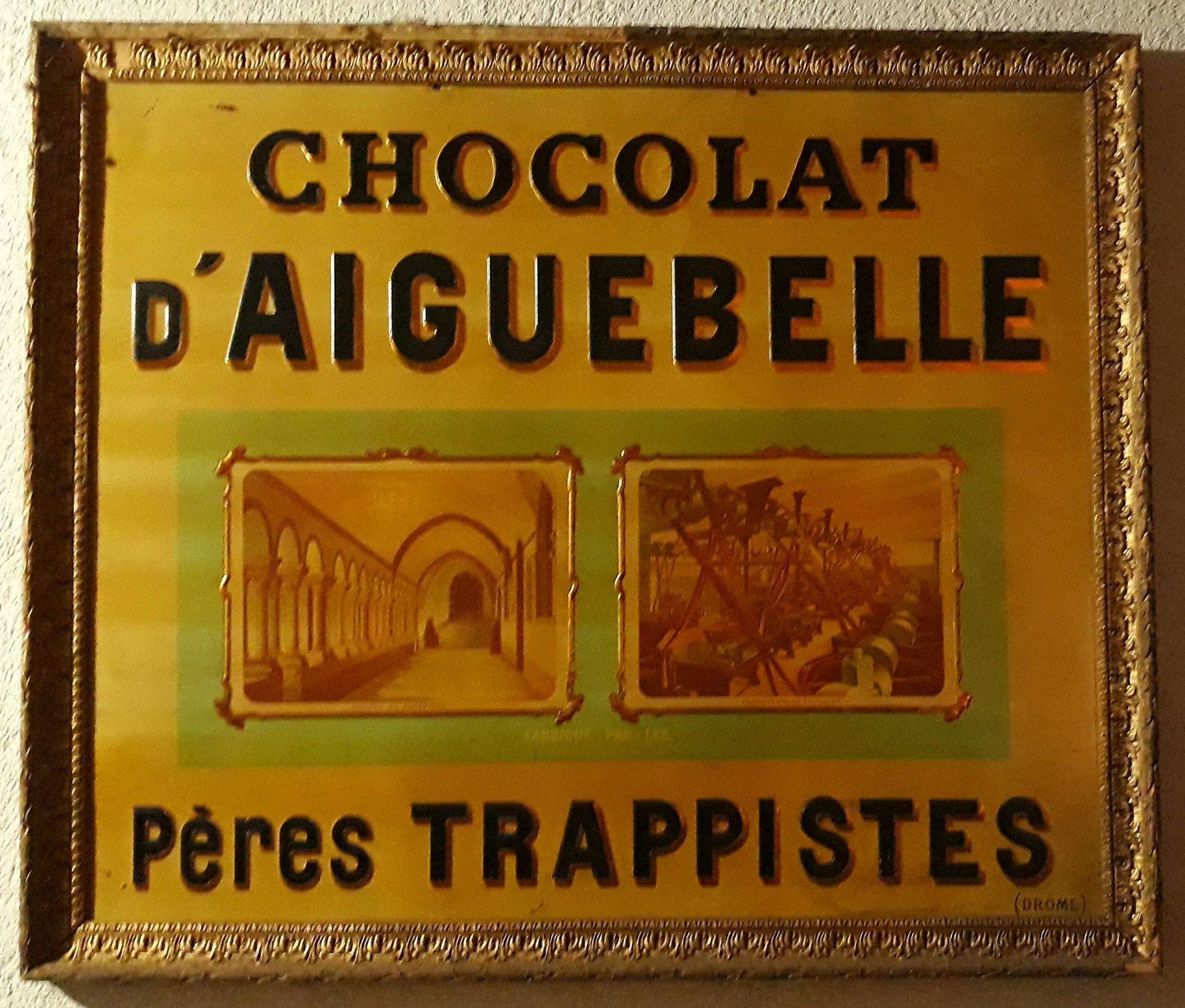
With the help of the internet I can affirm that the Chocolaterie Aiguebelle was founded by a medieval order of French Trappist monks in the mid 19th century to make a bit of money on the side. As explained here, they also got into producing advertising cards to entertain, educate and inform. It’s unclear whether these cards came with your chocolates or were distributed from hot air balloons. Probably the former, as that’s what drove me to collect inducements in the 60s and 70. You”l find loads of Chocolaterie Aiguebelle cards on ebay.
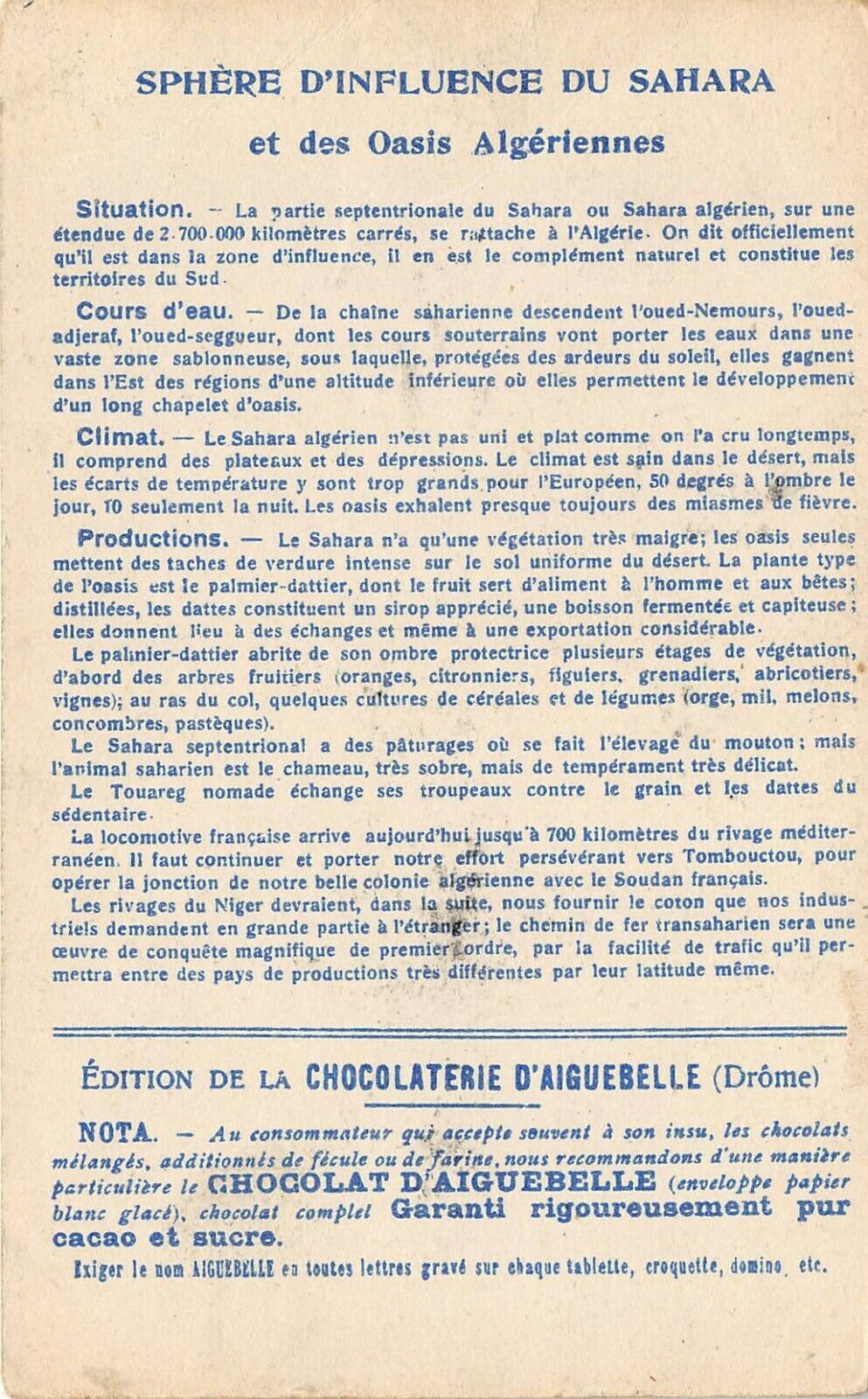
The operation shipped out to North Africa at some point where it’s still around today and which may explain the card below. Yes it’s another interesting map of the Sahara. No date is given but it looks like the state of colonial expansion in the late 19th century.
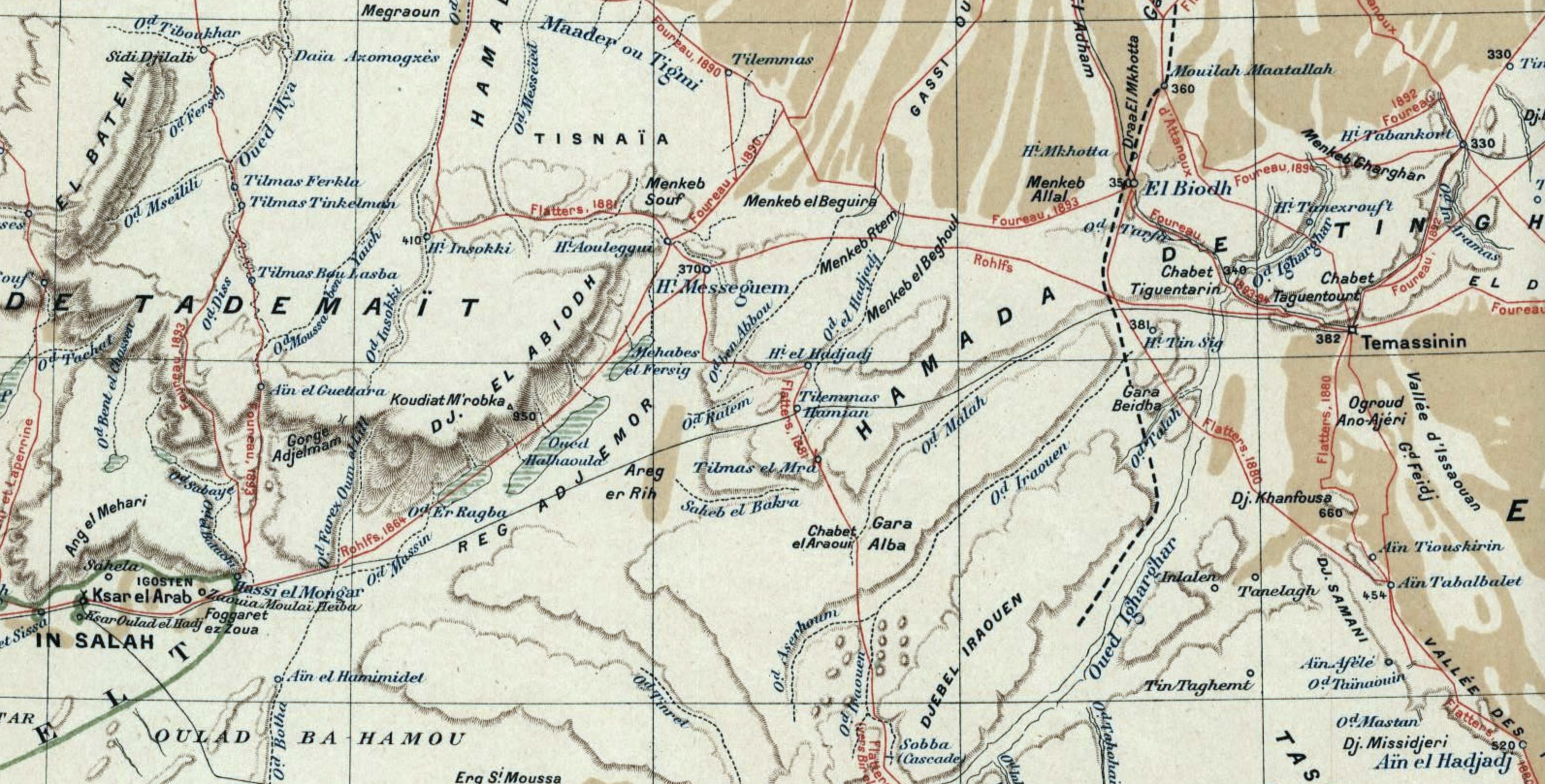
As always it’s interesting to see what is shown and what is not. Ancient Timbuktu seems an odd omission (though it’s mentioned on the back as a worthwhile destination for the trans-Sahara railroad). Tamanrasset was just a village at this time so gets skipped and Timassin is Timassinin, later Fort Flatters under the French and today Bordj Omar Driss (BoD). Not far to the west, Messagem and El Biodh were nothing but wells on the caravan route from In Salah to Ghadames, but it seems if early European explorers were led through these places by their guides, then they acquired a cartographic life of their own. They’re all on the map below from 1898. In the late 1980s we travelled this ‘forbidden’ piste from Fort Mirabel to below the westernmost ribbons of the Grand Erg, coming out at the checkpoint of Hassi bel Guebbour, just north of BoD. By the post war era these obscure wells had slipped off the maps and back into obscurity.
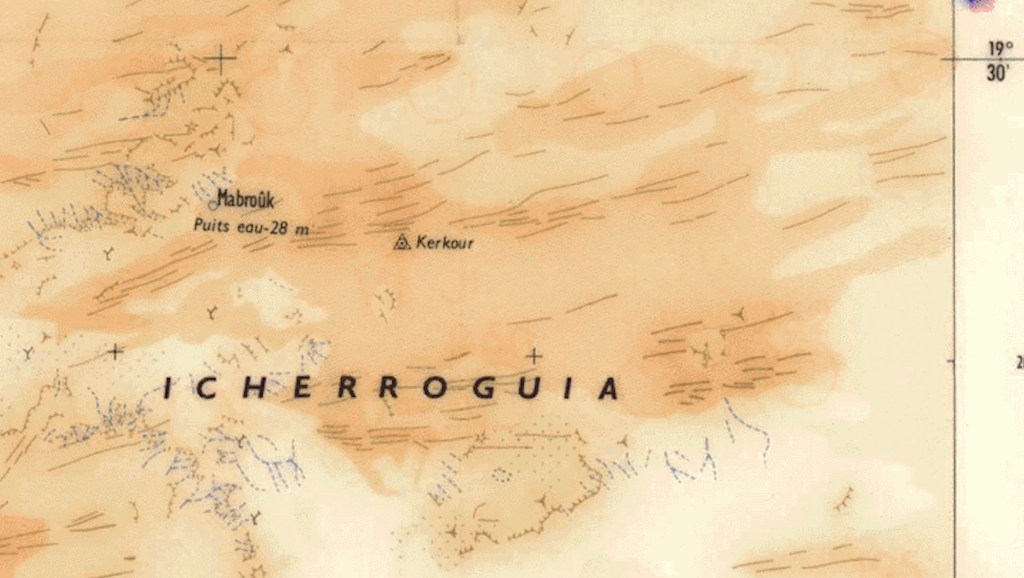
Interesting that remote In Zizawaterhole features, even though it’s not on any trade route, while Taoudenis was then still an important point on the 52 Days Road between Morocco and Timbuktu. East of there, it’s hard to think of today’s lonely well of Mabrouk being any sort of piste junction. Although the wiki waypoint matches the map below, today there aren’t any tell tale vehicle tracks, even though it’s not far from Timetrine where western hostages got shuffled around during their long captivities with AQIM.
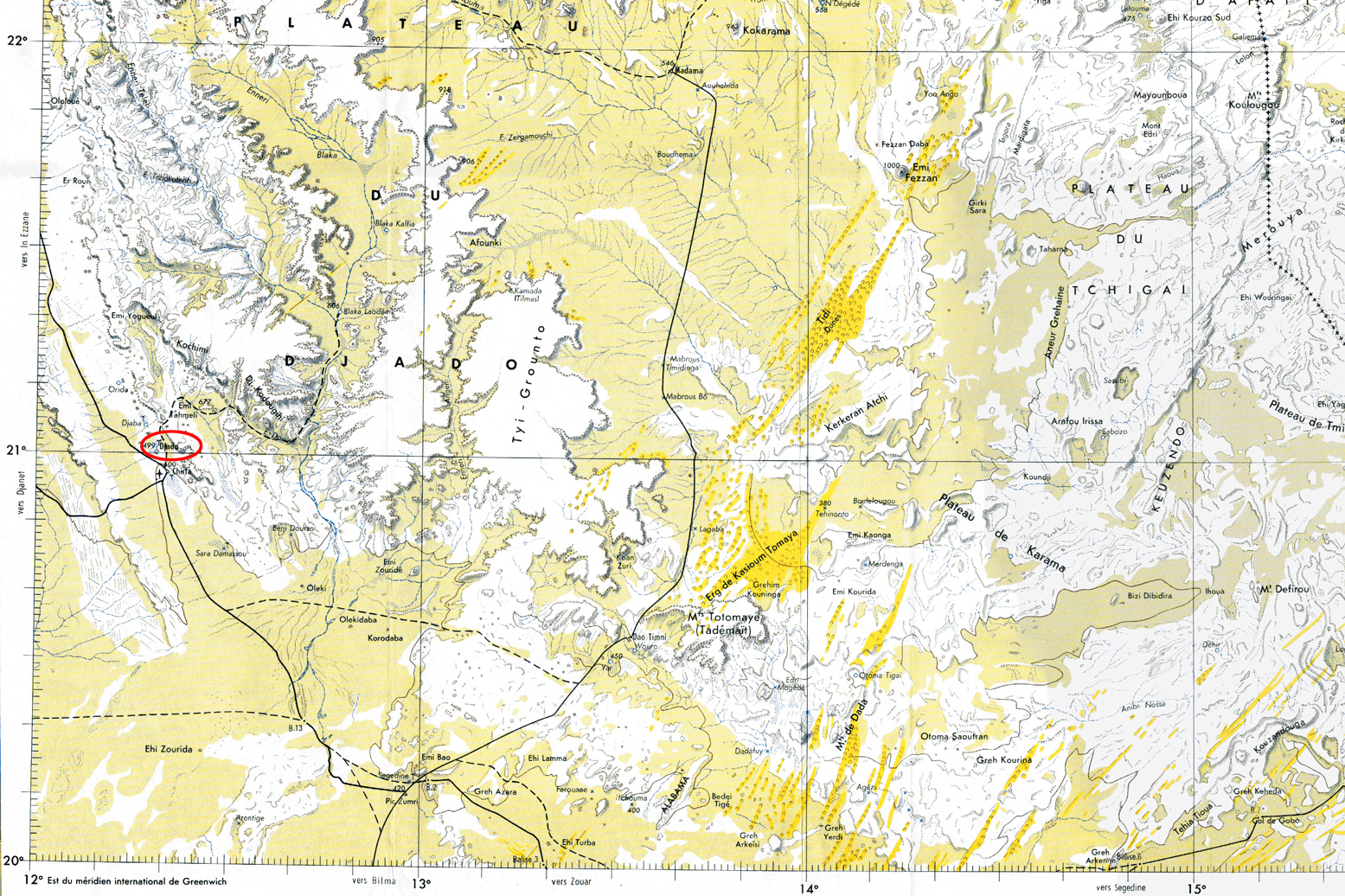
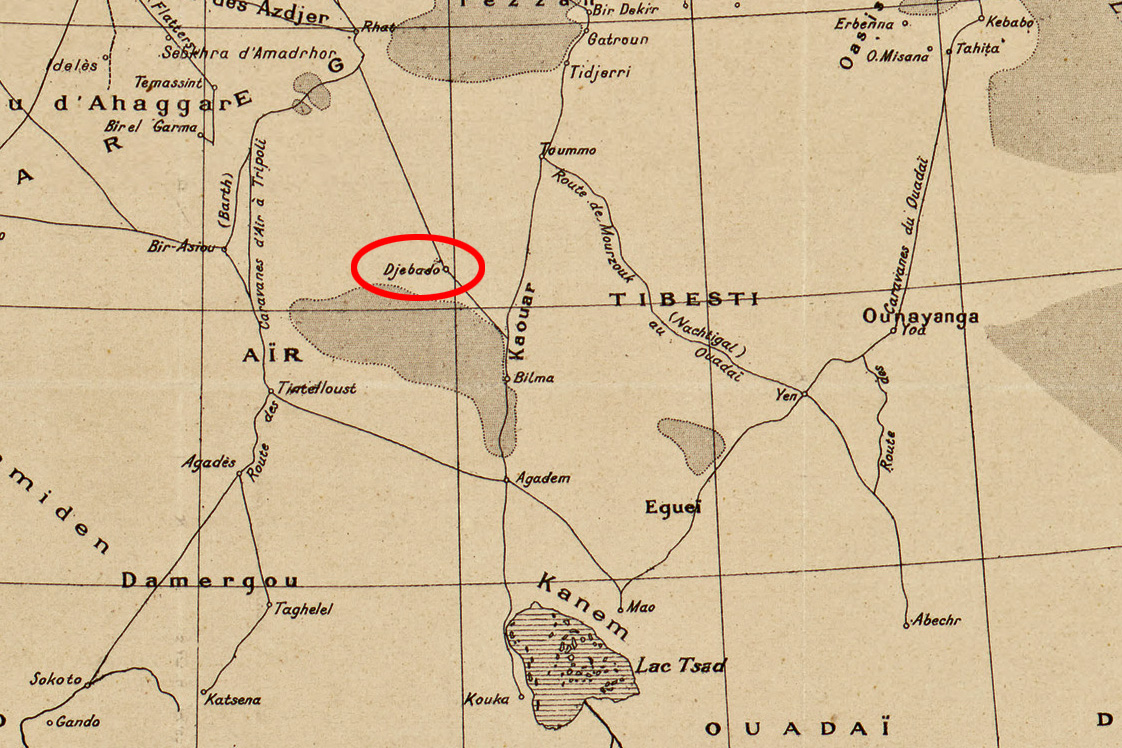
On the Atlantic coast Tarfaia is there with more about it here. Never heard of Groha near or maybe Smara, not Djorf el Asfar near present day Bir Lehlou in the PF Zone. Further east in present day Niger, the Oasis of Djebado is the old name for Djado looks as important as Bilma and the other Kaour oases, but not enough get a marker point. It’s hard to know what Yat might be other than Seguedine or a misplaced and misspelt Ghat, or Tao which appears on other old maps (maps often repeat their predecessors mistakes).Maybe it’s Dao Timni, today a military base in the middle of nowhere.
‘Le ksar de Djado. Mont Saint Michele du Tenere‘ (see vid below)
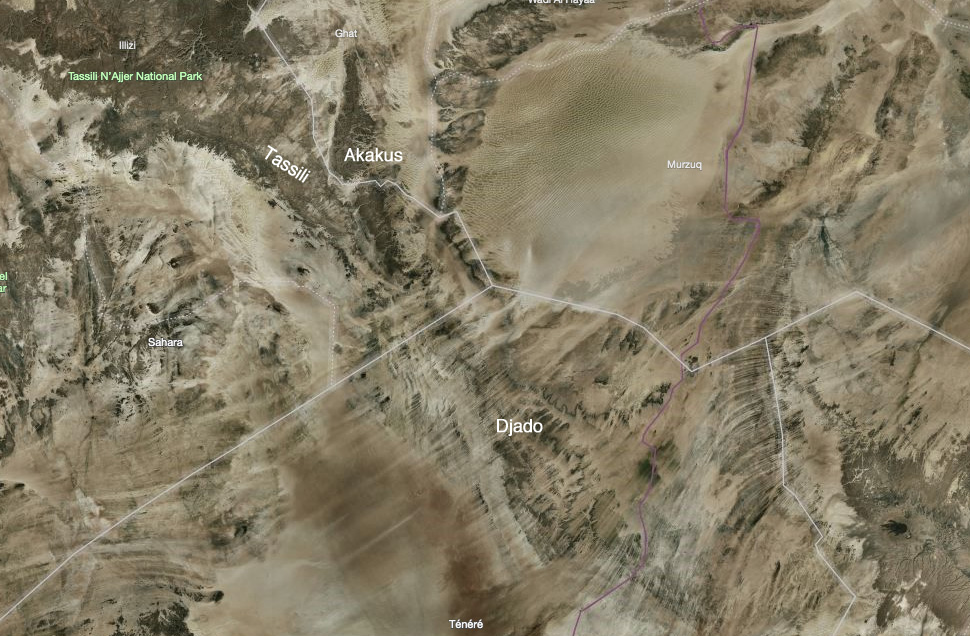
On the far side of Niger’s Tenere Desert lies the Djado Plateau, a frayed maze of low escarpments, sand-choked canyons and wind-carved outcrops, geologically contiguous with Algeria’s Tassili N’Ajjer and Libya’s Akakus (right).
Approaching Orida from the Col des Chadeliers.
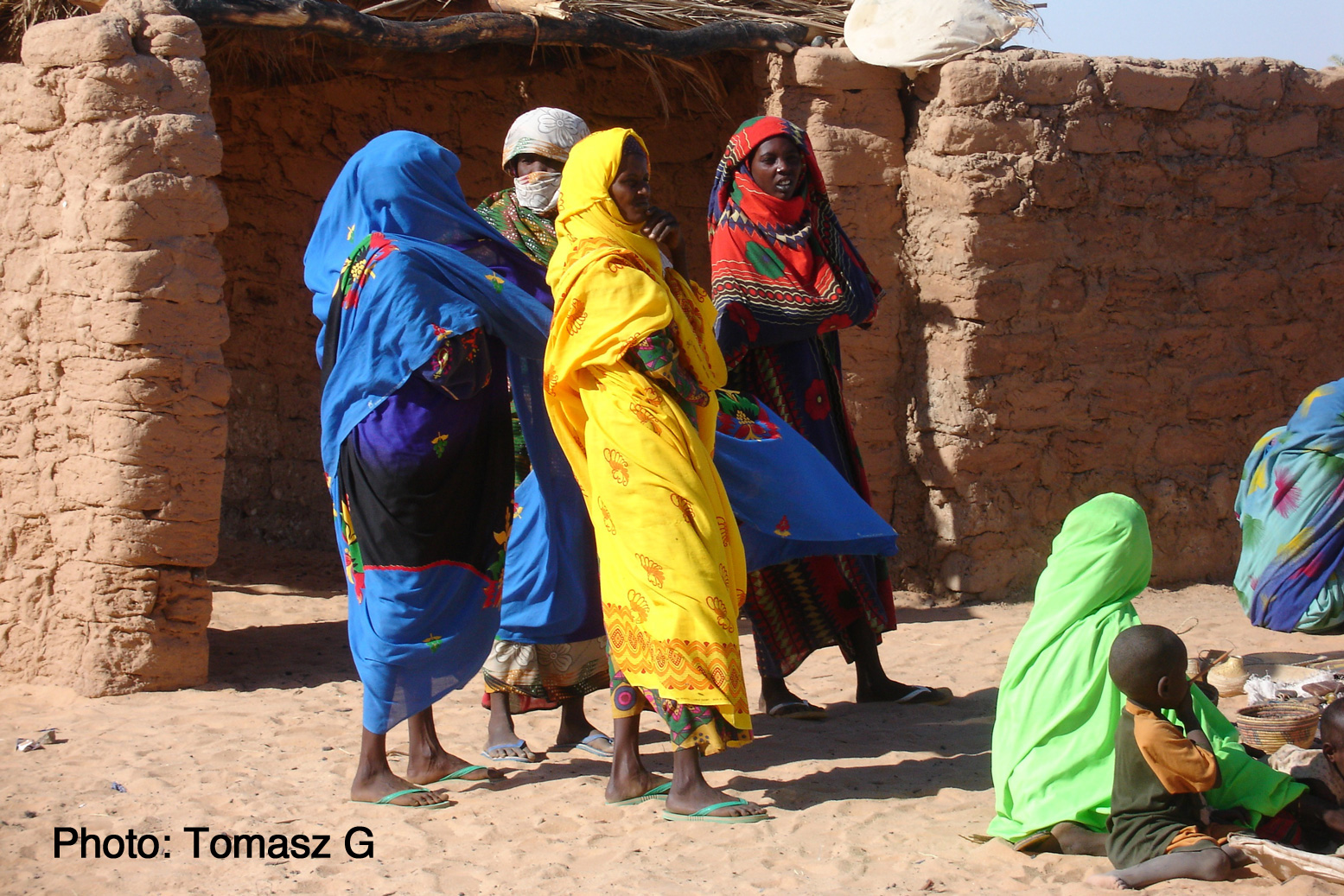
This is Tubu and Kanuri country. The latter are an ethnically related group originating from Kanem or Kano in northeastern Nigeria. Tubu nomads are best known in northern Chad and, unlike the arriviste Tuareg, are the Sahara’s original inhabitants. When I first visited this area the Tubu of far-eastern Niger where in revolt and a ‘checkpoint’ at Orida took tribute from passing tour groups, all led by Tuareg from Agadez. East of here was a no-go area and was mined, by either the rebels or the Niger army. On old IGN maps the topographic names are derived from the Tuburi language: a peak or hill is ‘Emi’ rather than the Tuareg ‘Adrar’ or Arabic ‘Jebel’, and ‘Enneri’ is a valley, like a ‘oued’ or ‘wadi’.
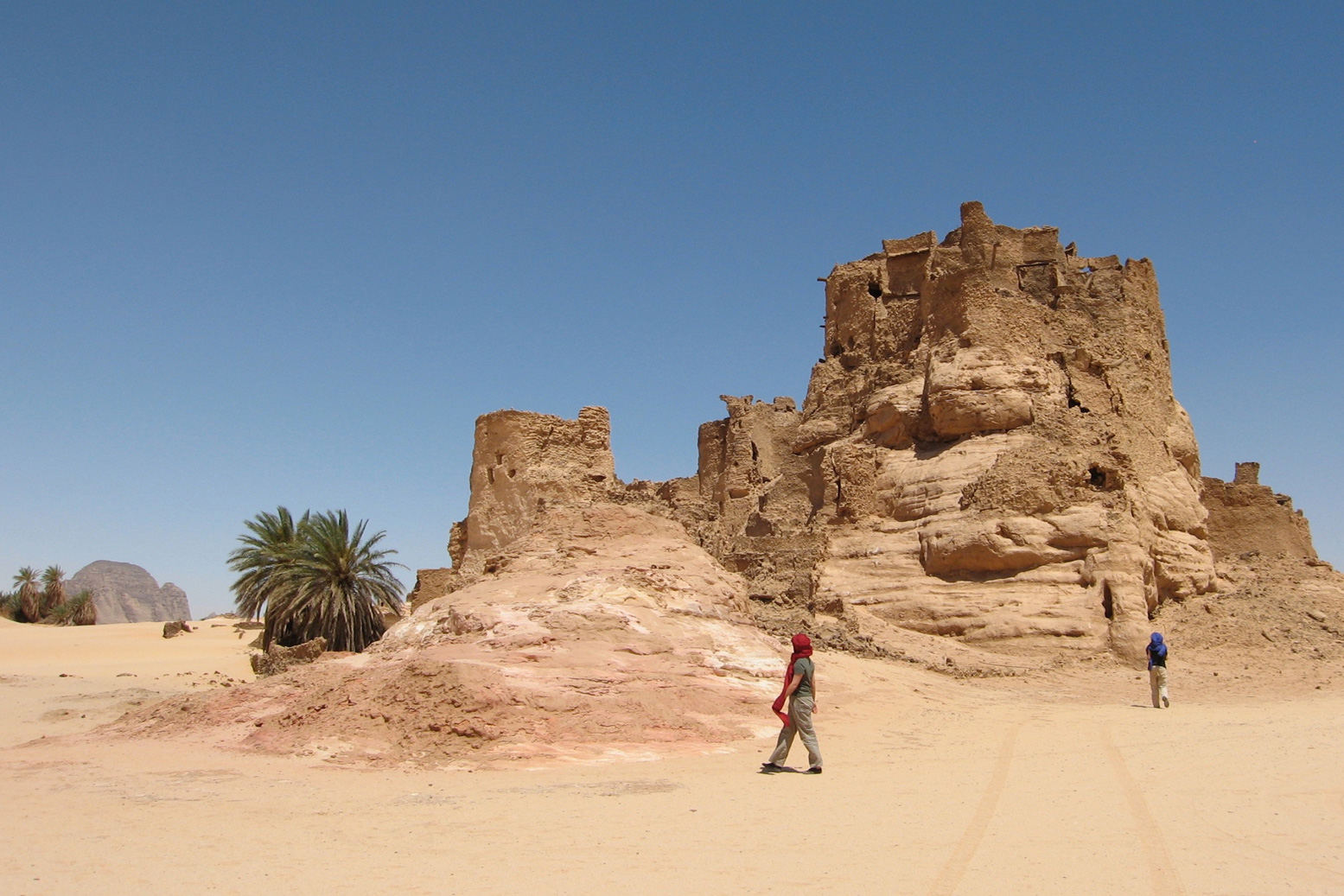
Perched on an outlying outcrop at the plateau’s edge, like something out of a Tolkein novel is the ruined citadel of Djado (21.016 12.308), a mudbrick warren of passages and collapsed chambers worn ragged by the weathering of passing centuries. Below the fortress, a shallow seasonal pool of brackish water is ringed by reeds and palms.
Such fortified ksars are not unusual in many old Sahara towns like Djanet, Ghat, Dakhla in Egypt and Ouadane in Mauritania. But all are adjacent to a modern town which has since grown up around them. That such a large citadel should located hundreds of miles from the nearest town appears an enigma. Djado personifies the Sahara’s romantic mystique, a Lost City crumbling into the sands. Who lived here, what did they do and where did they all go?
It’s origin may well date back to the late Kanem-Bornu Empire as a station on the trans-Sahara trade route which evolved between Lake Chad and Tripoli. Any place in the Sahara where the groundwater reaches the surface becomes important. By the 17th century, Tripoli – the capital of Ottoman Tripolitania – became the Mediterranean’s busiest slave market. From Lake Chad a line of wells and oases run north via Agadem to the salt mines of Bilma, Aney and on to the smaller salines of Seguedine. Here the route split: the busier arm led northeast to Tumu and the famed slave trading post of Murzuk. The other branched northwest towards Ghat. All of these places would have had a fortified ksar similar to Djado, though not so dramatically isolated.
Around the 18th century it’s probable the inhabitants of ‘Djebado’ (as it’s called on the 1888 map, above) either gradually lost out to the dominant Murzuk trade route, were harassed by Tuareg or Tubu raiding parties, or just succumbed to the growing infestations of malarial mosquitoes which still inhabit the reedy lake today.
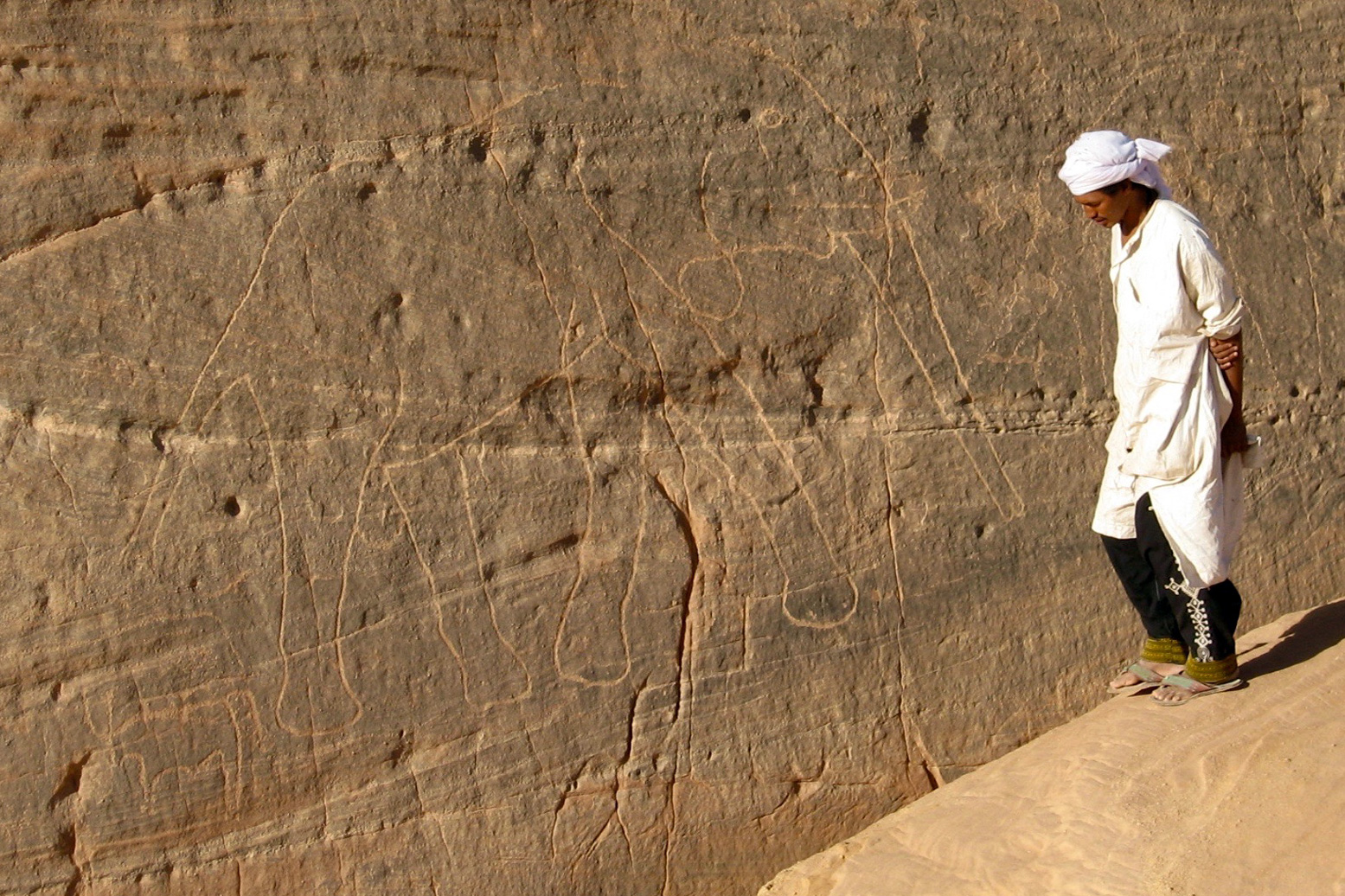
The Djado plateau, and more especially the Aïr mountains on the far side of the Tenere, are rich with ancient petroglyphs (left) and other rock art, some 6-8000 years old. At this time the Sahara was a savannah widely populated by the last of the nomadic hunters or early pastoralists. Many show animals long since extinct in the desert: bovids, crocodiles, giraffes or elephants (left). But it is a mistake to conflate the medieval ruins of Djado with the relics of the prehistoric era. The ksar is no more than a 1000 years old and much more likely, half that. To the north is a smaller are more intact ruins of Djaba (below) and beyond that, the well at Orida, 500km from Ghat.
Today the Kanuri whose ancestors were said to have inhabited Djado, live out on the desert plain in the nearby village of Chirfa, though annually they return to harvest the dates which grow alongside the ruins.
Below: an excerpt from the film of the 1960 Berliet Tenere Expedition. An accompanying helicopter surveys ‘Le Mont Saint Michele du Tenere’.
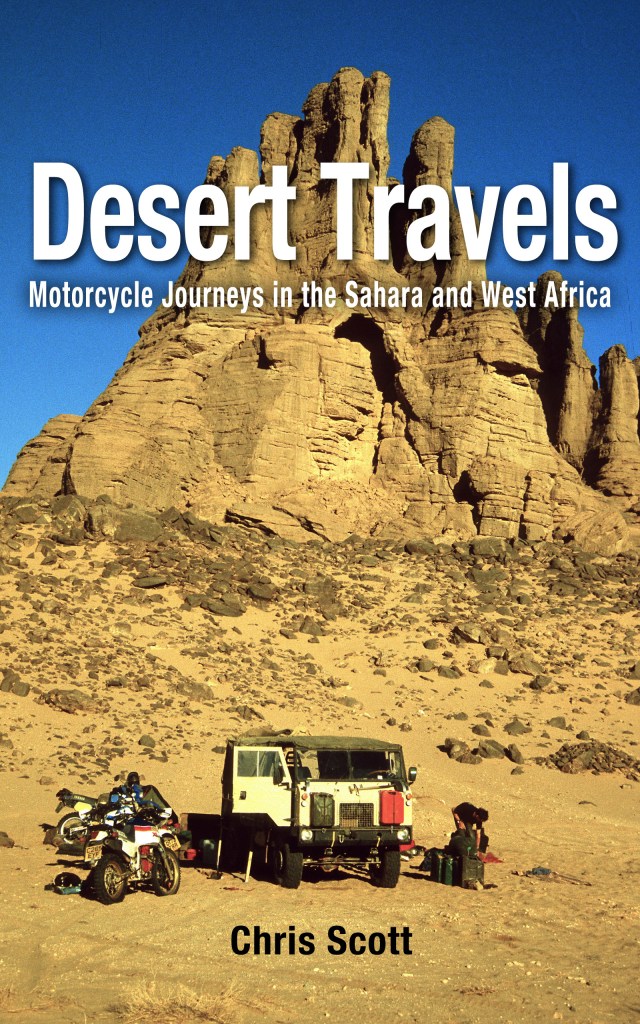
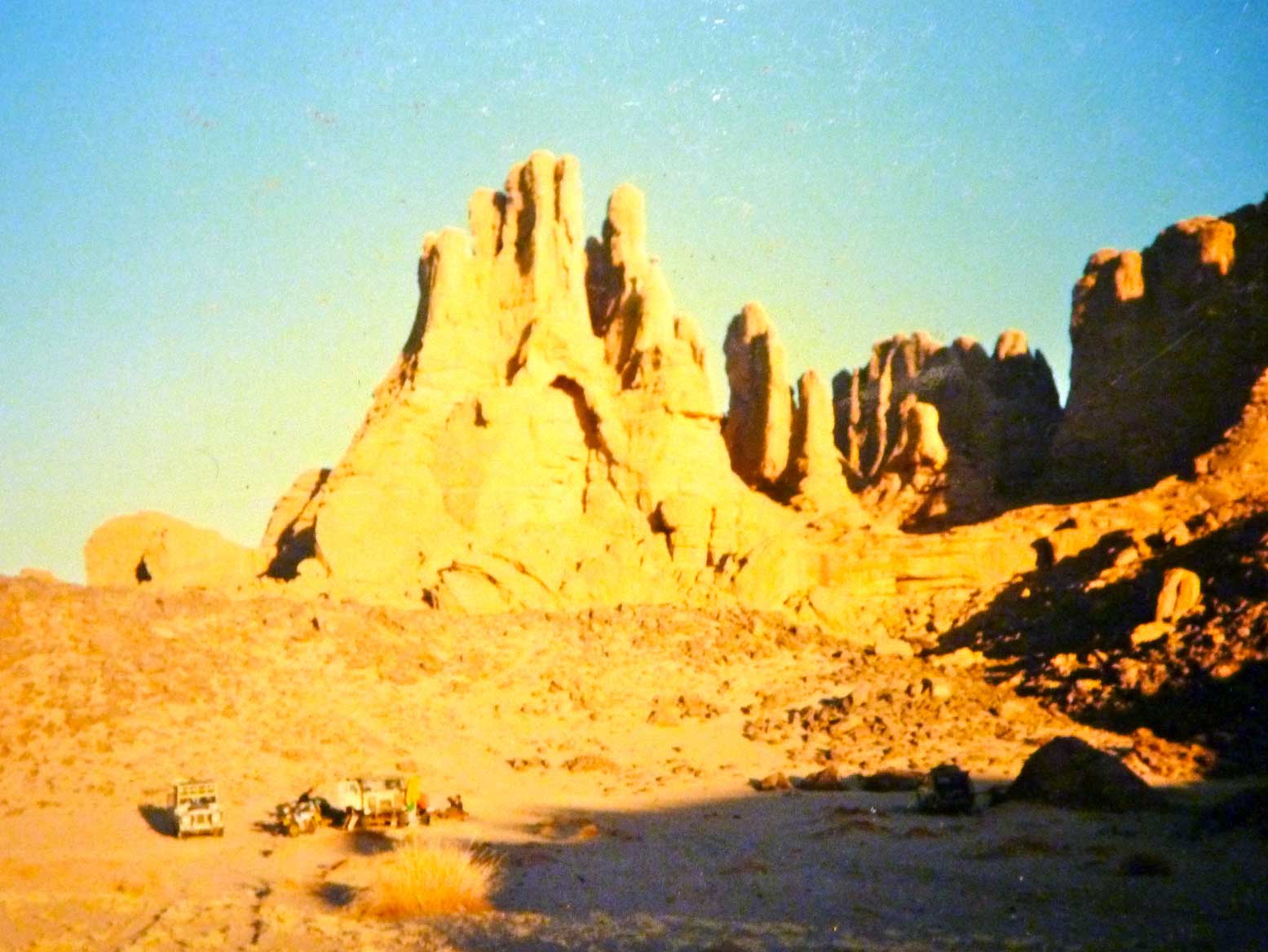
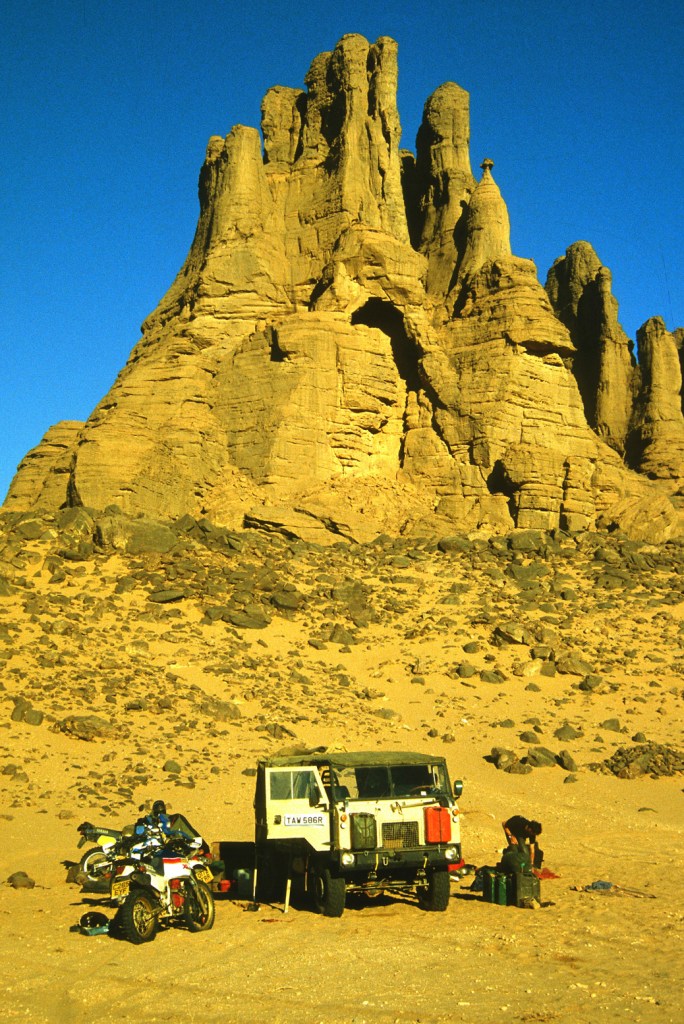
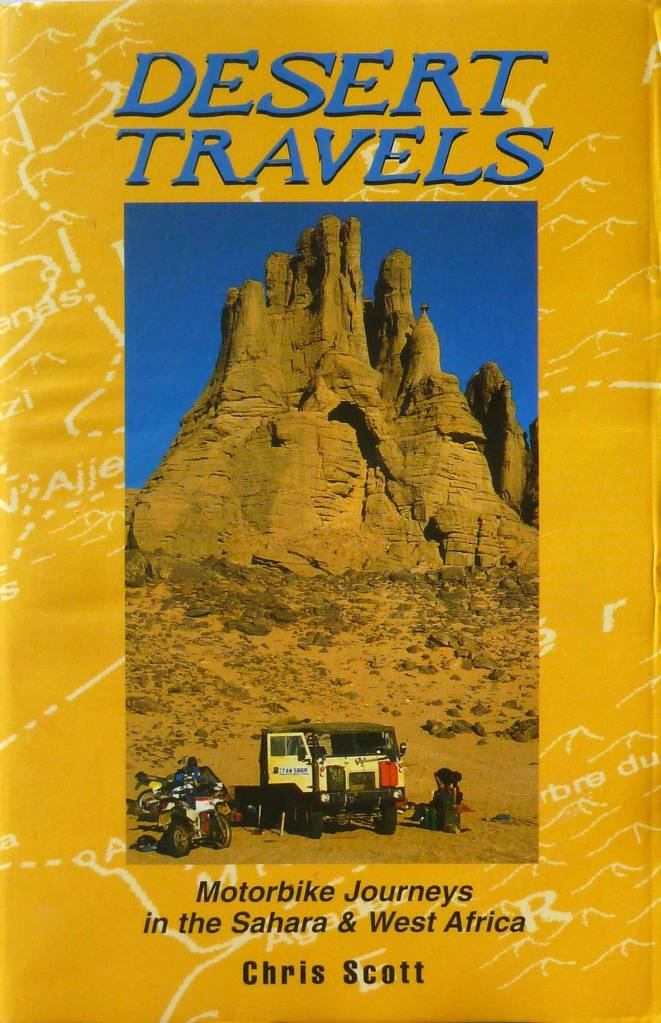
The original 1996 paperback edition of Desert Travels (and an earlier version of the ebook, left) featured us camped below a striking cathedral-like formation. I’d always wondered where that place was. The relevant chapter in the book is called The Cathedral, referring to the spires and church-like ‘portal’ of the pinnacle-capped outcrop. It was shot by Mike Spencer who had a proper camera and slide film.
This was before GPS and at the time I was too preoccupied keeping track of the bikes and my Landrover’s numerous issues to attempt to follow our progress on a map with dead reckoning. Our guide, Chadli, knew his stuff but was rather reticent – they teach them that in guide school. I knew the vague location within 50 square miles – the photo credit in the book says ‘near Tin Tarabine’ which is true enough, but that area, if not the whole Tassili-Hoggar southeast of Tam, is famed for unusual rock formations.
I had a rough idea the cathedral (above, with my crumby camera) was somewhere after Tadant canyon well and before Tin Tarabine oued. Then in 2006, coming towards the end of our epic traverse from Mauritania across Mali and Algeria towards the Libyan border (see: Sahara: The Empty Quarter) we passed through that area. I’d not been there since 1988, but coming at it from a different direction, it was all new to me.
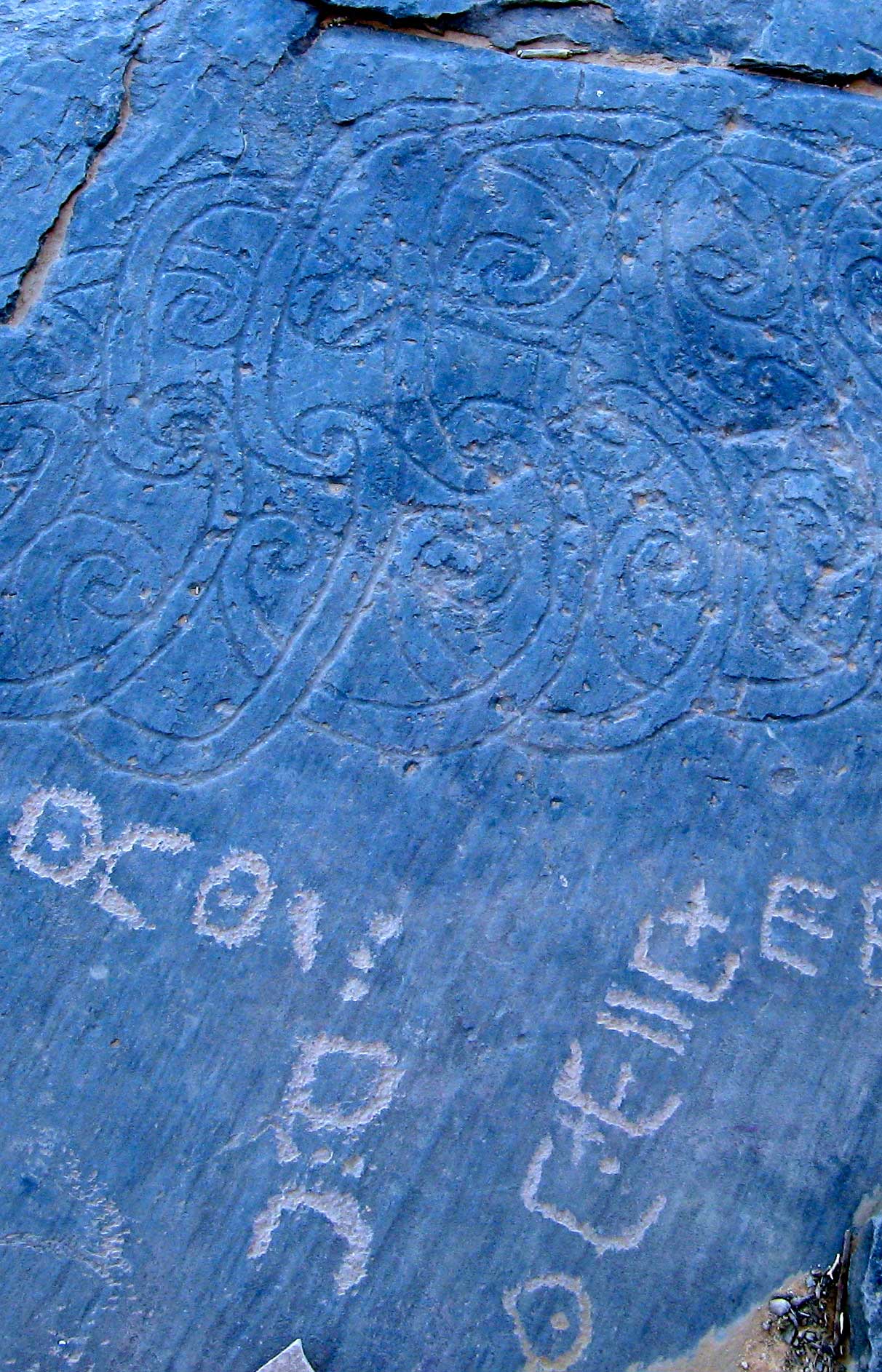
As we’d crawled steeply out of Tin Tarabine oued and away from the famous Youf Ehakit – an amazing area of eroded rocks and bizarre, neo-Celtic engravings (left) – our escort’s car needed the clutch repaired yet again.
They pulled up onto a flat rock shelf to to a proper job this time, while I and the others dispersed for a wander. Climbing the outcrop up above the cars, I spotted some intriguing spire-like formations across a plateau a few kilometres to the north. Could I have stumbled on the location of the original DT cathedral cover after all these years?
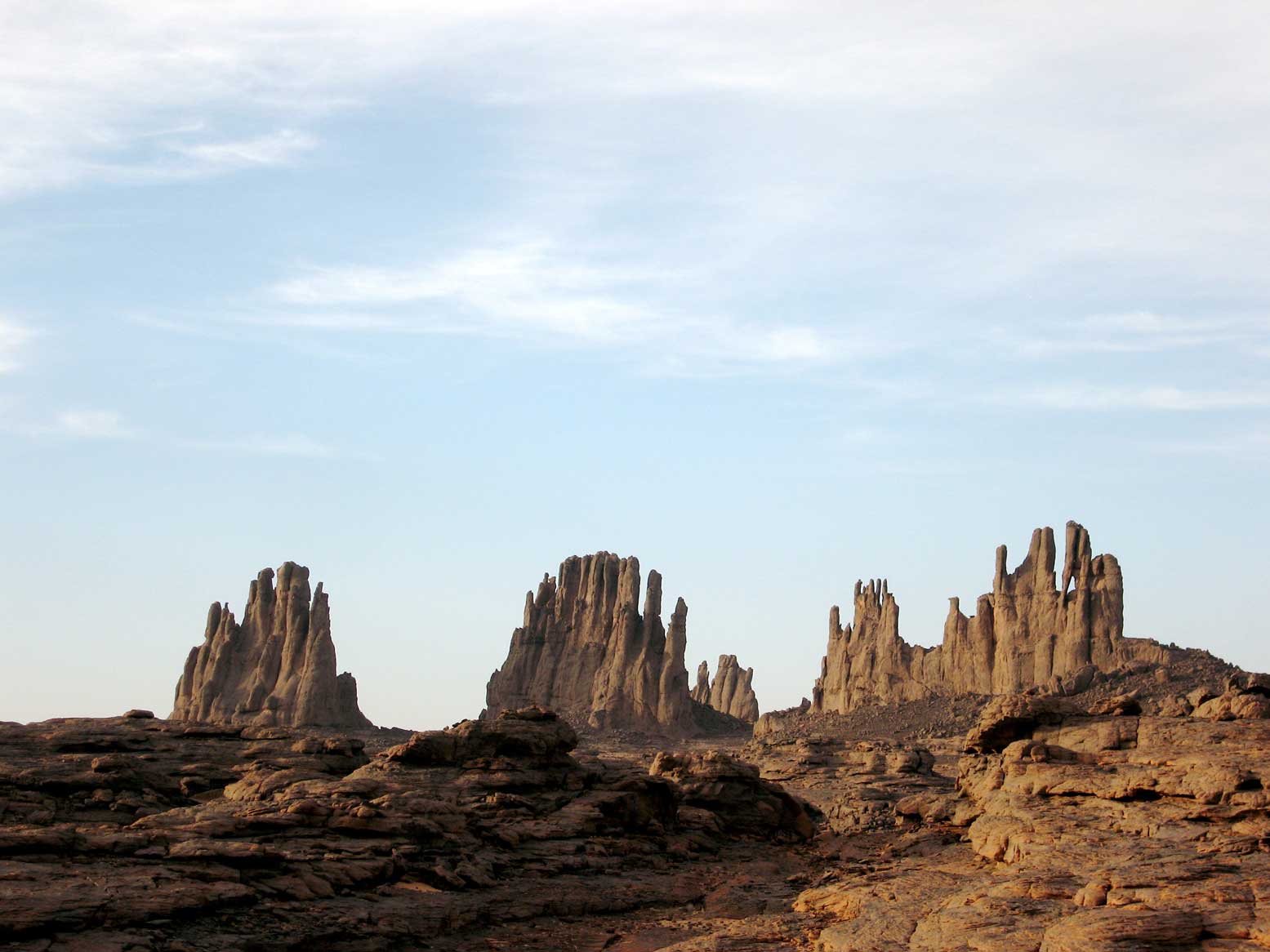
I grabbed a water and the GPS and set off cross-country, passing pre-Islamic tombs (left), then dodging down into little canyons and over outcrops as the terrain became rougher. I didn’t have a copy of DT with me, but the huge, hand-like pinnacles in the far distance looked very familiar.
After about an hour and a half I was running out of daylight to get back, but got close enough to the weathered spires. I took a few hurried shots (above) and the following waypoint which I see now is actually just a kilometre from the formations. But when I got home and looked at the book’s cover closely, I realised they were similar but were not the Cathedral, even if I was looking at them from behind.
I forgot all about it for a few years then began to wonder again if the Cathedral could be tracked down now that we have masses of imagery of everything everywhere and any time. I scanned people’s Panoramio and Flicker albums as well as the embedded photos on Google Earth (often irritatingly misplaced, as we all know…). There were plenty of amazing rock formations in the Tassili-Hoggar vicinity, but no distinctive Cathedral.
In the end I knew the best people to ask were the Germans – der uber-Saharans. I may know the Sahara well, but in Germany there are hundreds more experienced and better travelled Saharans than me. In the good years they explored every corner of the desert, but most didn’t feel the need to write guidebooks about it afterwards.
I posted my question with a picture on Wuestenschiff, one of the main German Sahara forums. Within a couple of days I had a name for my location: the Cathedrals of Tin Eggoleh and the waypoint: N22°21’6.75″ E007°5’12.20″. About 50km to the northeast of the ‘false-sprires’ of 2006.
Mystery solved and somewhere good to aim for next time…





















 Sahara Overland