Category Archives: Desert bikes

Night out on Mt Tiska

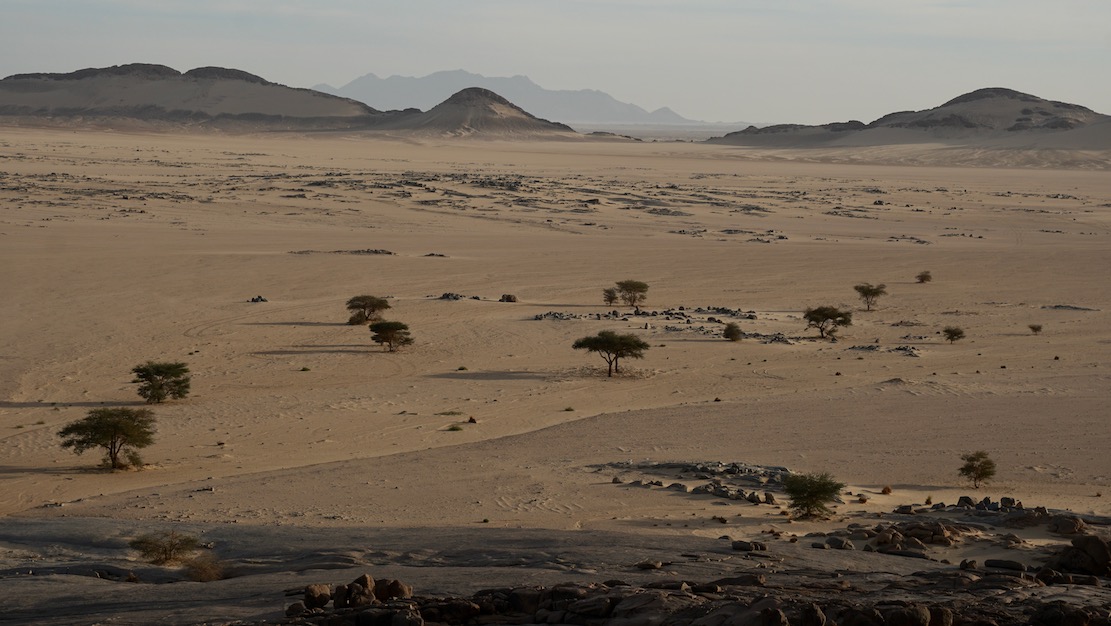
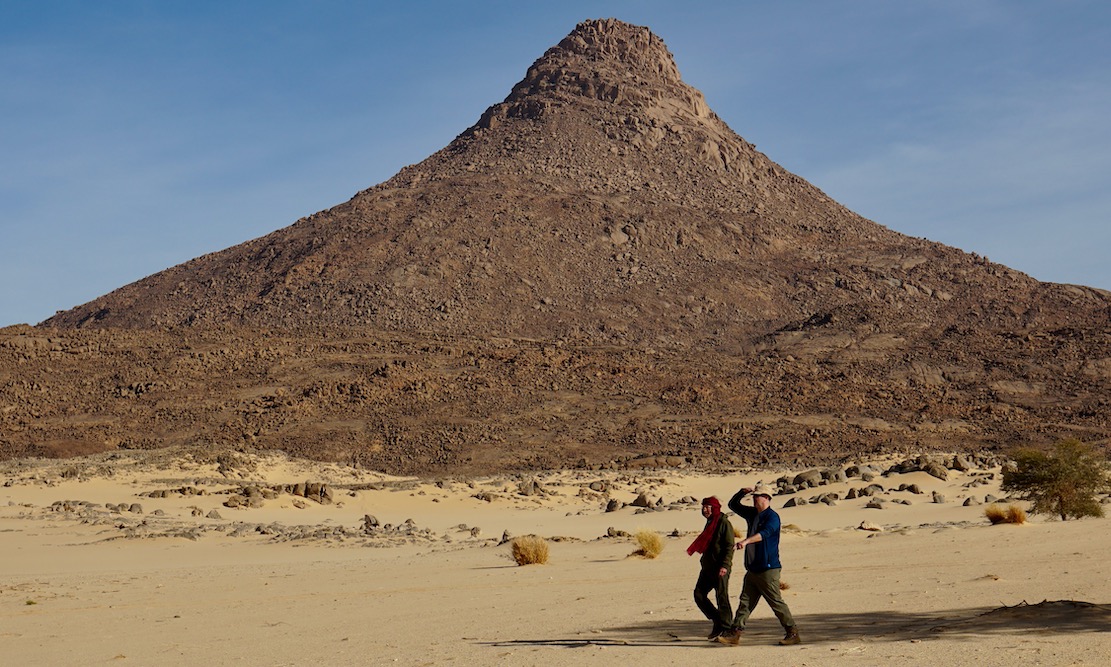
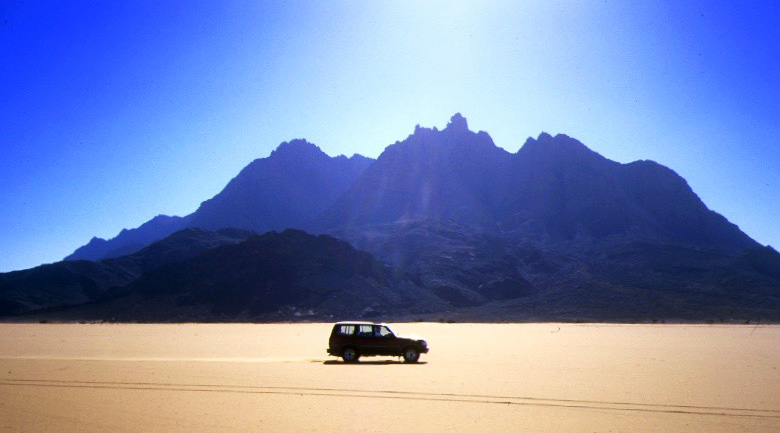
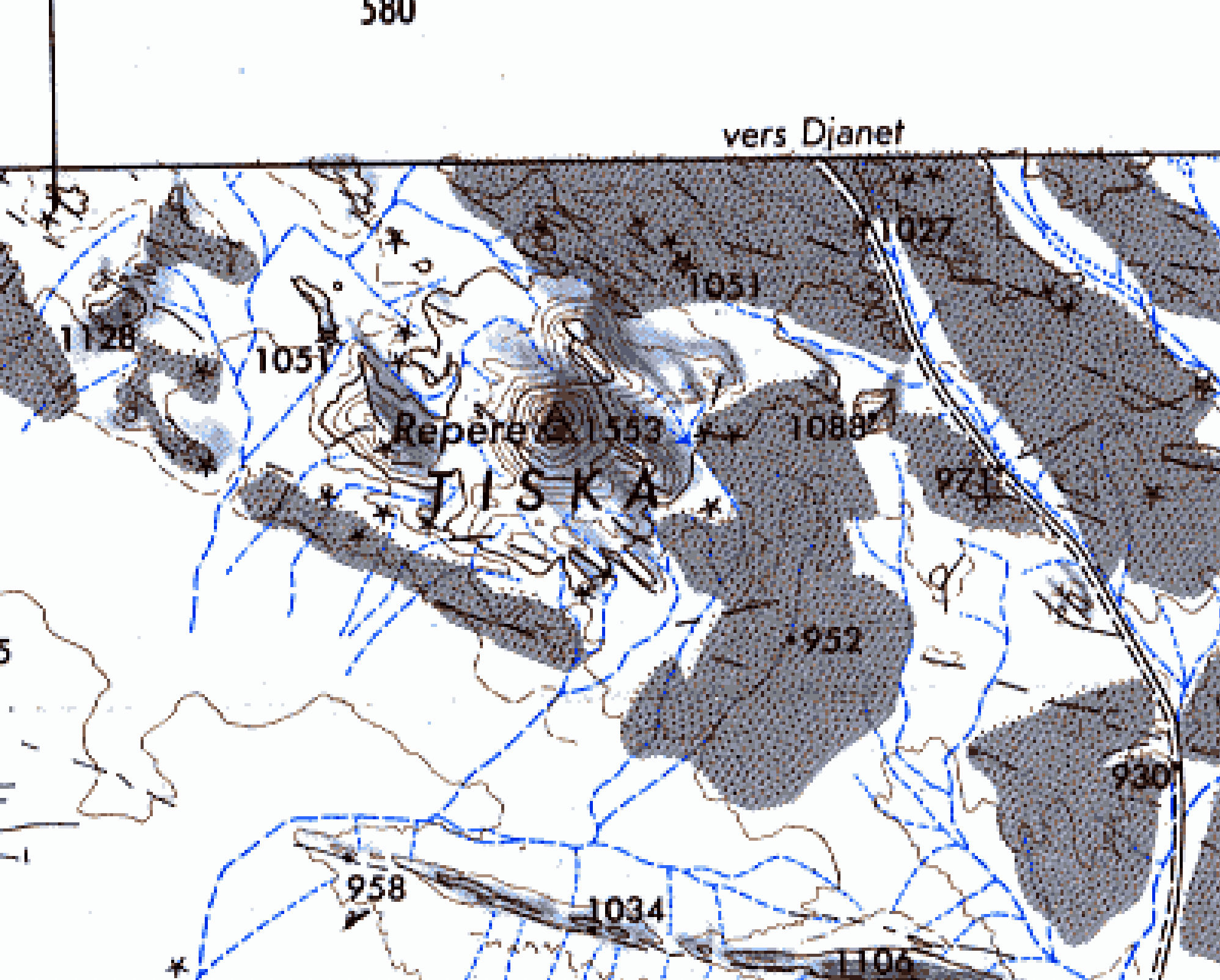
In early 2025 we pulled off a deserted new road and headed across the sands to camp at the foot of Mt Tiska.
I’d been looking forward to this moment for nearly 40 years. My first view of Tiska’s distinctive but distant conical form was from Djanet’s old aerodrome way back in 1987. As I write in Desert Travels:
One evening Philippe, a skinny middle-aged Frenchman who had the habit of walking around the campsite in a saggy pair of Y-fronts, invited us to the airport to inspect his old aeroplane. He was immensely proud of his historic plane, a twin-engined machine from the Golden Age of Aviation. He was keen to point out the enlarged fuel tank which former owner, Lady Vanderbildt or some such, had fitted for a one-hop flight to the States as the war turned on Germany… Philippe started up the engines, but I was far more interested in the view down the runway. From this flat vantage point … south of Djanet you could clearly see the unmistakable conical profile of Mount Tiska … the first and only landmark in the featureless expanse which lead across the Ténéré to Chirfa and ultimately Bilma, nearly 900 kilometres away.
A waterless expanse of flat, soft, sand, this was the route I’d planned to follow with the only partly cognisant Pete: Yamaha Teneres to the Tenere Desert: it could have been adventure biking gold until his breakdown near Illizi had sunk that idea. At that time I knew only a little more than Pete about the realities of remote desert crossings, and it’s no more likely we’d have made it to Bilma than if we’d tried to paddle to Tristan da Cunha in an upturned umbrella.  
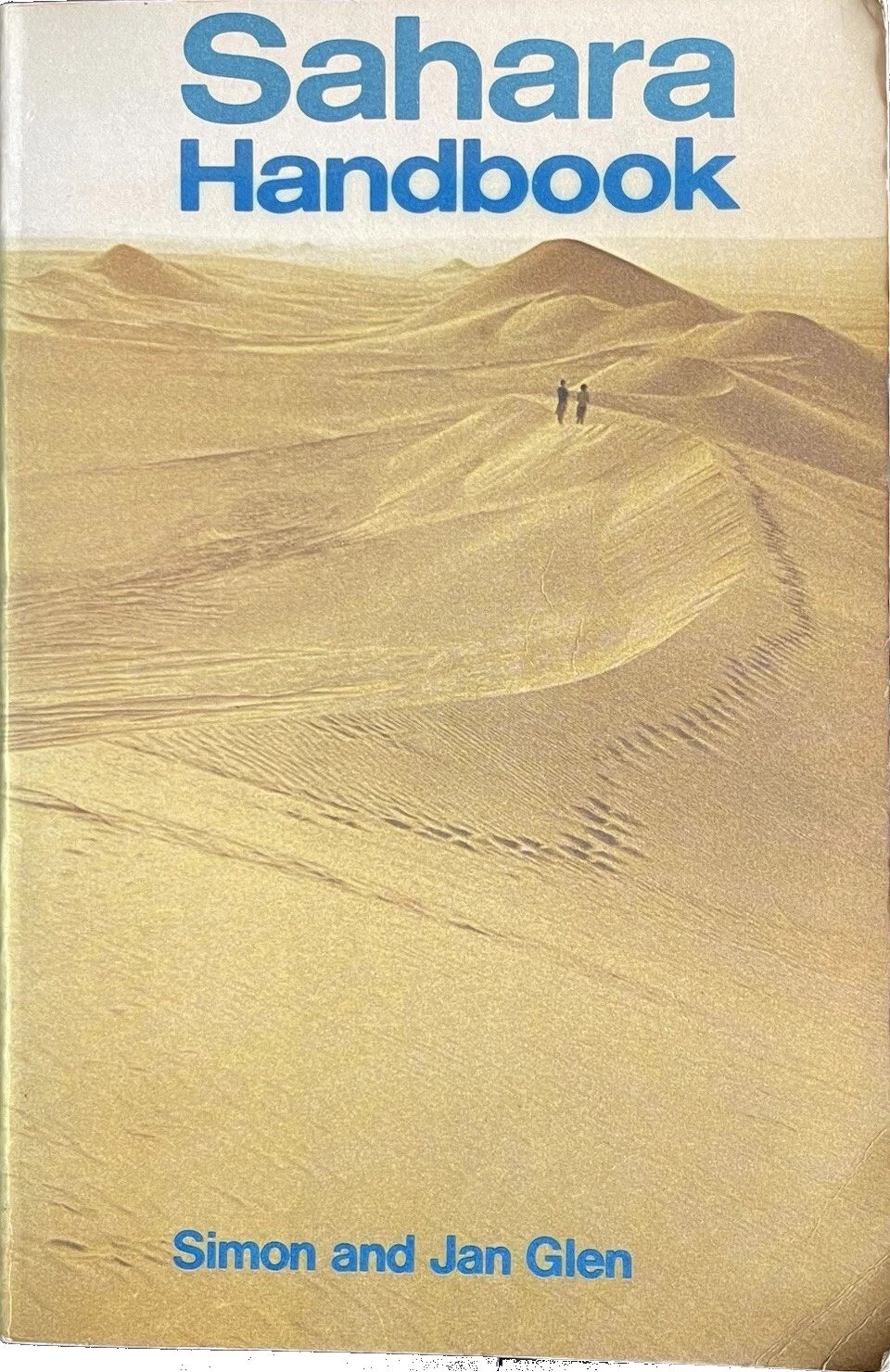
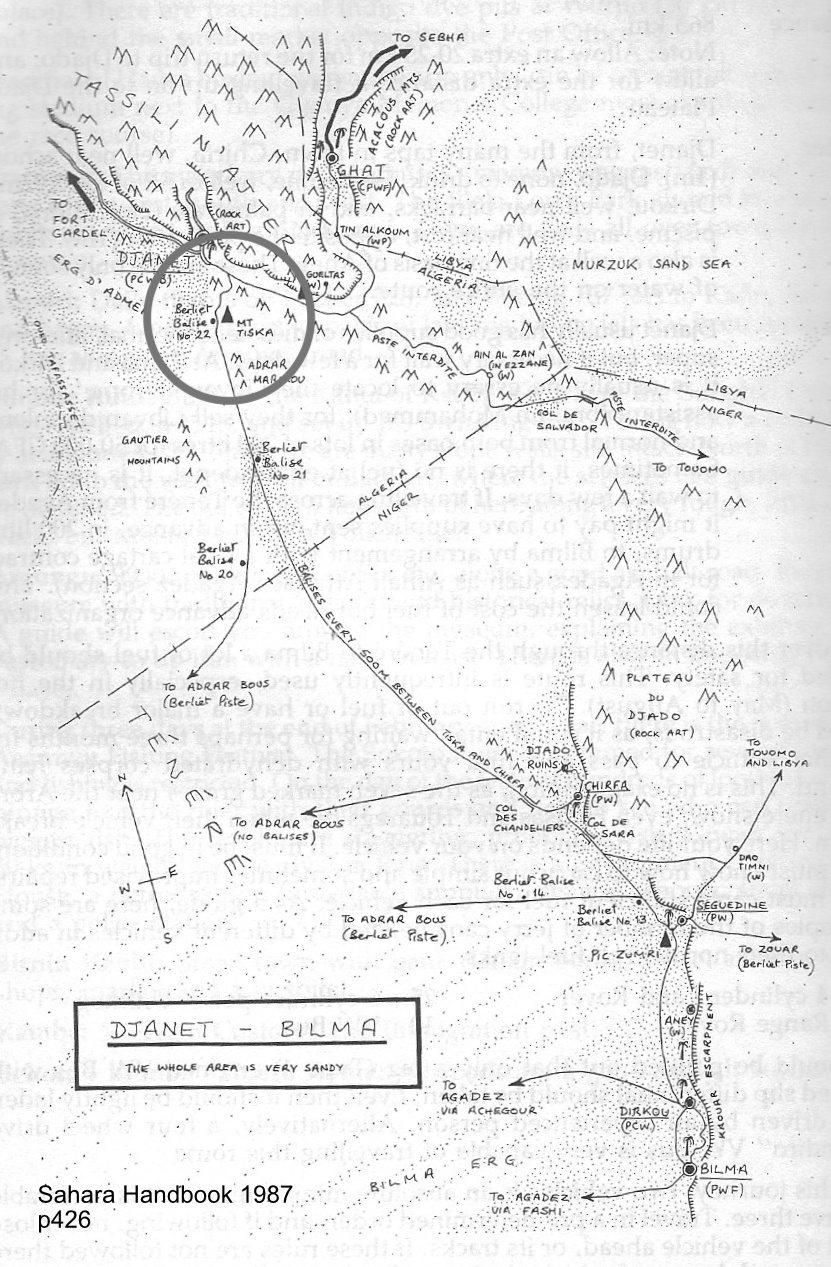
An ancient, pre-GPS landmark, I’d read of Tiska’s significance while leafing back and forth through the original Sahara Handbook (right) in the early 1980s.
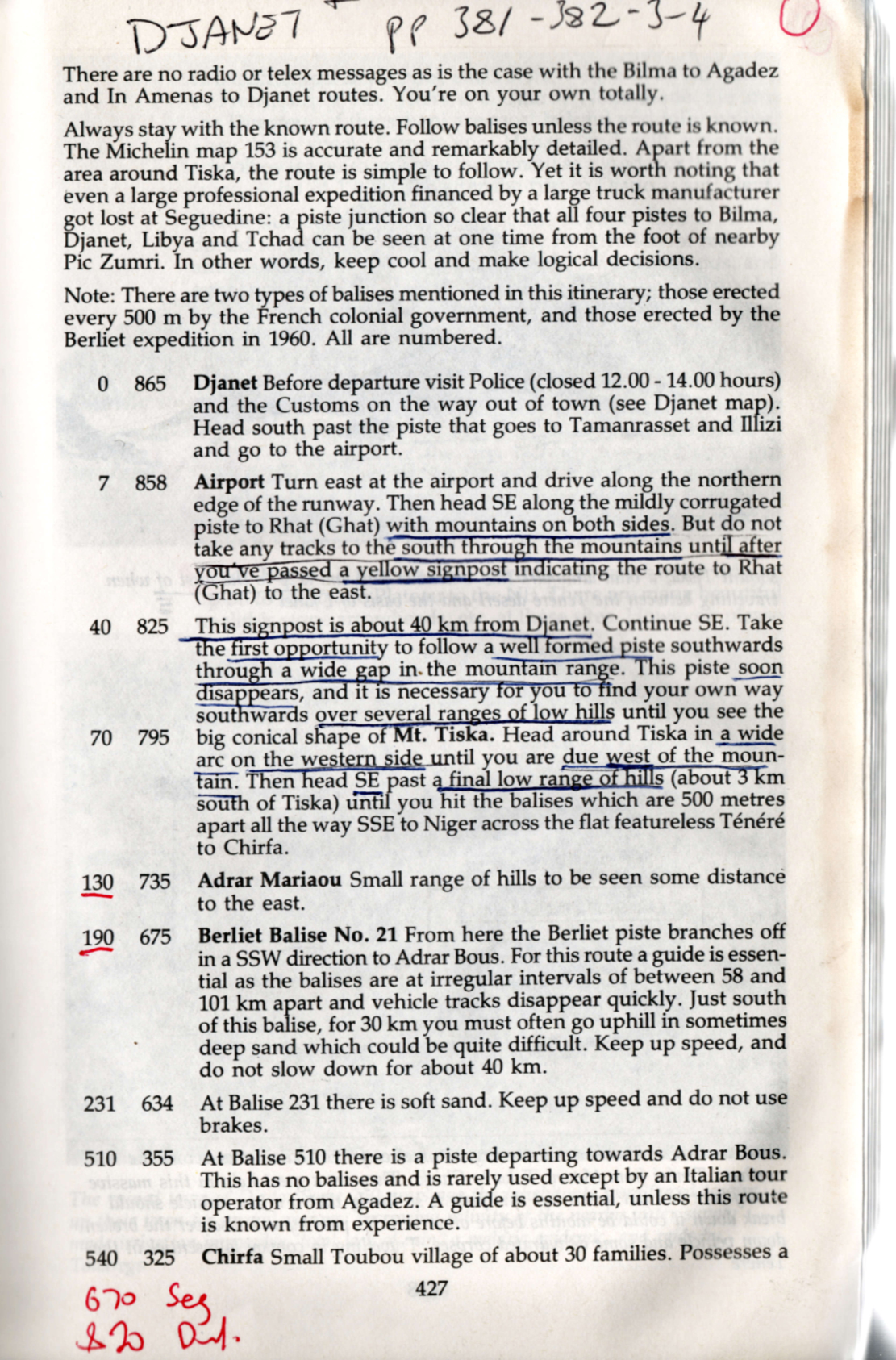
We all have books that leave strong impressions in our early years; the first Sahara Handbook would be high on my list. In it Simon and Jan Glen’s description of ‘Itinerary No. 19: Djanet – Bilma’, reads like call to adventure. You can see my annotated pages notes left, and might marvel at the sparse landmarks including Mt Tiska, with some spaced up to 200km apart. At no less than 865km, this was a serious desert crossing and the Glens did not mince their words.
To run out of fuel or have a major breakdown could be disastrous, as it could entail waiting for perhaps three months for another vehicle to pass and find tours with dehydrated corps lying around. This is no exaggeration, as the seven marked graves near Arbre du Ténéré show… Here your life depends on your vehicle.
On leaving Djanet for the south, no authorities are interested in how well your vehicle is equipped … [nor] interested in whether you make the journey or not. There are no radio of telex messages as in the case with Bilma to Agadez and In Amenas to Djanet routes. You’re on your own totally.

By the time that was written (final edition three, 1990) the piste to Bilma was little used. It’s said that in 1979 four Land Rovers were lost without trace on this route, and as a result the Algerians closed the crossing and pulled up many of the balises (three-metre-high steel marker posts, below) which the French had erected every 500m from Mt Tiska to Chirfa, the first outpost in Niger and a distance of nearly 600km.
That information was not known to Pete and myself when in 1987 we set off with plans to blithely ride across the Tenere from Djanet to Niger on Yamaha XT600Z Tenere motorcycles. It was a very long way on a bike, but with a balises every half kilometre, it felt doable providing we had visibility and could carry enough fuel and water.
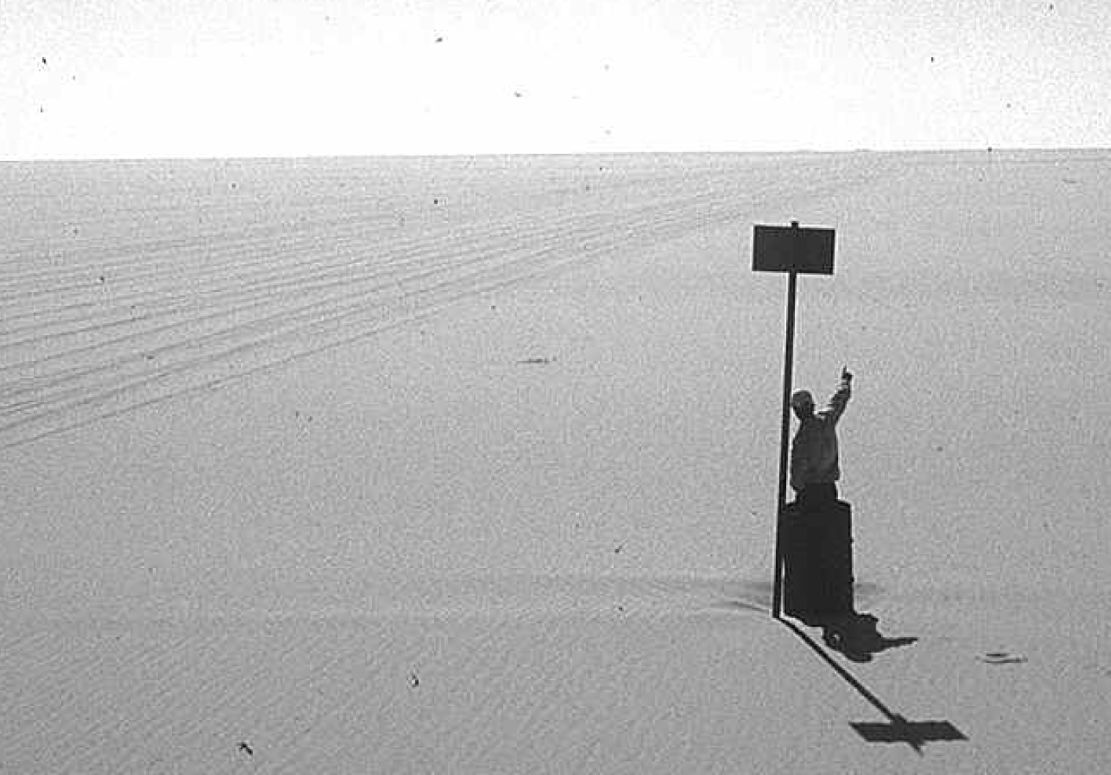
About 1200 of these balises once marked the entire Tiska–Chirfa crossing, like buoys at sea. You can just see the next one, 500m in the distance.
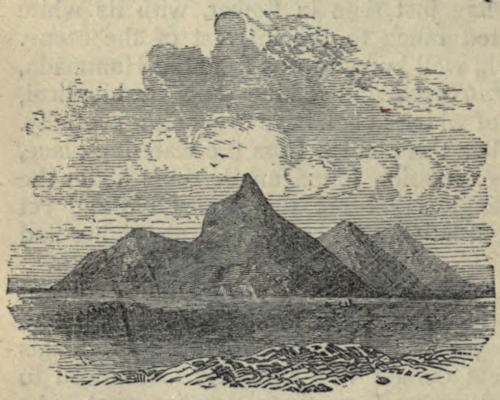
Mt Tiska 1860, H. Barth

Coming up from Niger, the cone of Mt Tiska (and larger mass of Adrar Mariaou 34km to the south) had long been important landmarks on the caravan route between Ghat and Agadez. In 1860 Heinrich Barth wrote.

August 2 After a stretch of nine miles, an interesting peak called Mount Tiska, rising to an elevation of about six hundred feet, and surrounded by some smaller cones, formed the conspicuous limit of the rocky ridges. The country became entirely flat and level … and there was nothing to interrupt the monotonous plain but a steep ridge, called Mariaw, at the distance of about five miles to the east [probably Adrar Mariaou; 34km south].
The nature of this desert region is well understood by the nomadic Tuarek or Imóshagh, who regard the Mariaw as the landmark of the open, uninterrupted desert plain, the “ténere;” .

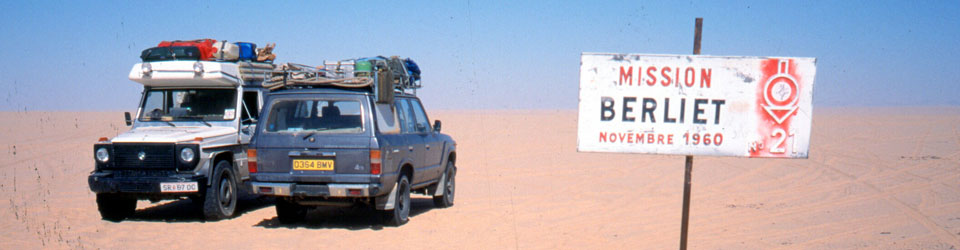
But in 1987 Pete didn’t even make it to Djanet on his Tenere. And soon after I arrived I learned what I now know. Since that aborted crossing, I’ve met others who tackled the route anyway and either got in big trouble in Dirkou in Niger (2001), or got brutally robbed before they even made it to the Niger cut line (2002; probably following a tip off in Djanet). Also in 2002, we came up the balise line from Erg Killian, the Monts Gautier and Berliet Balise 21 (below), but from Mariaou headed directly to Djanet across the very soft sands, bypassing Tiska.
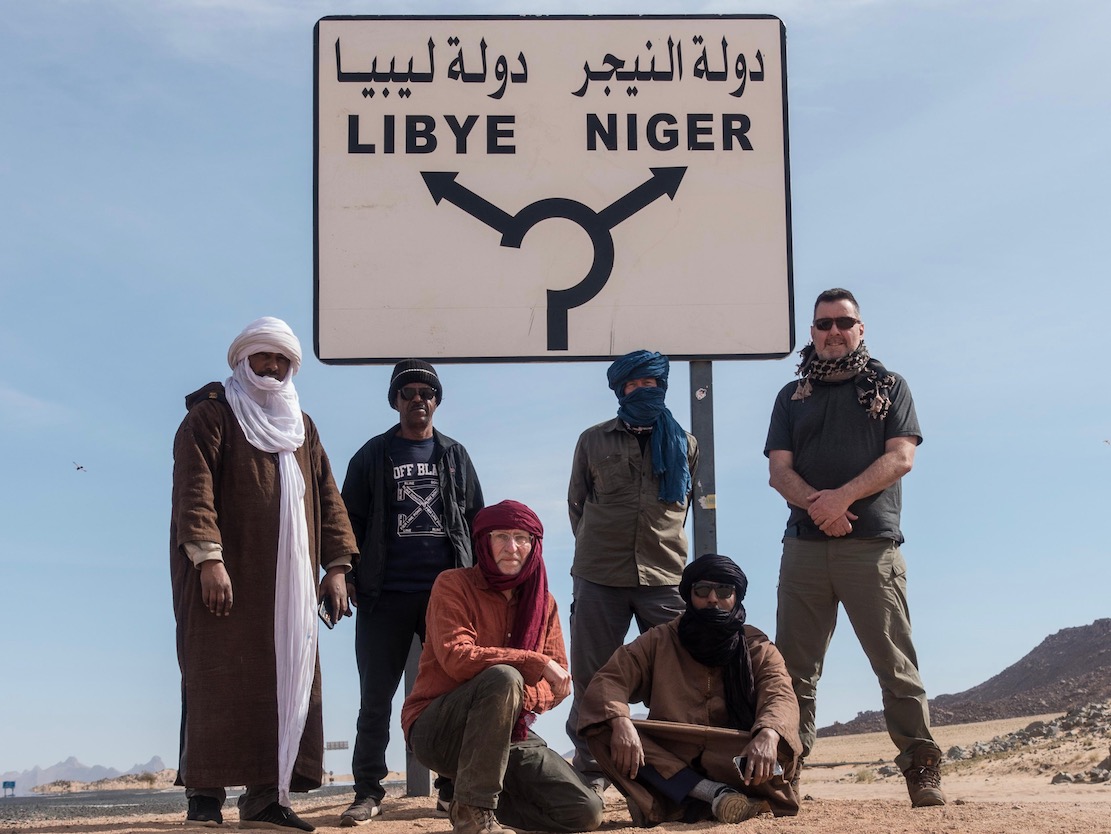
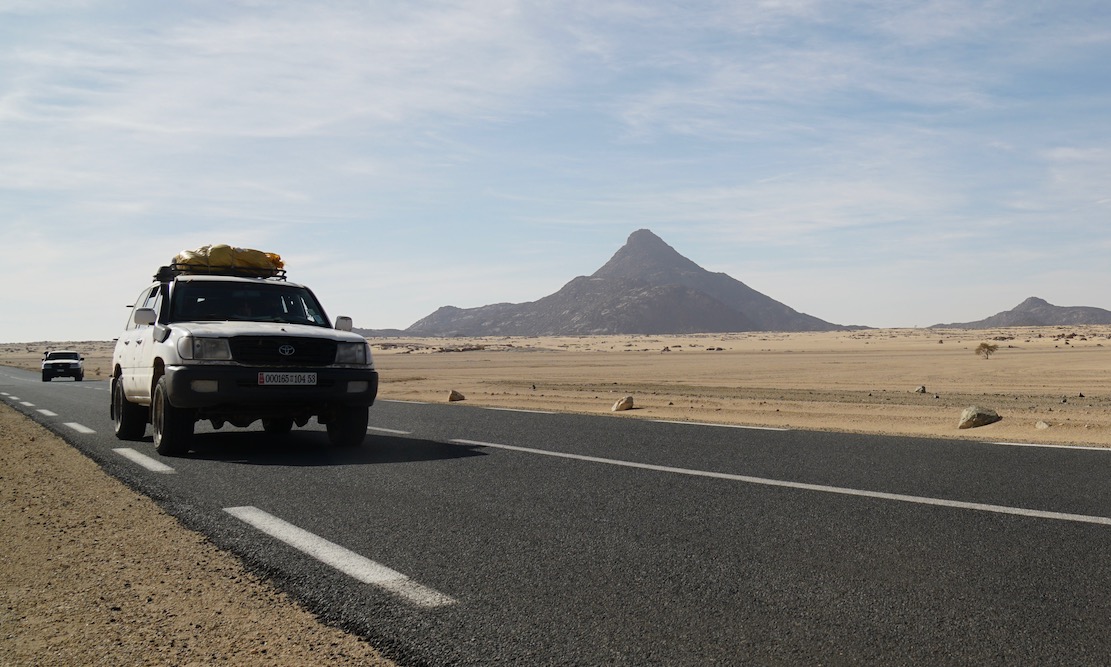
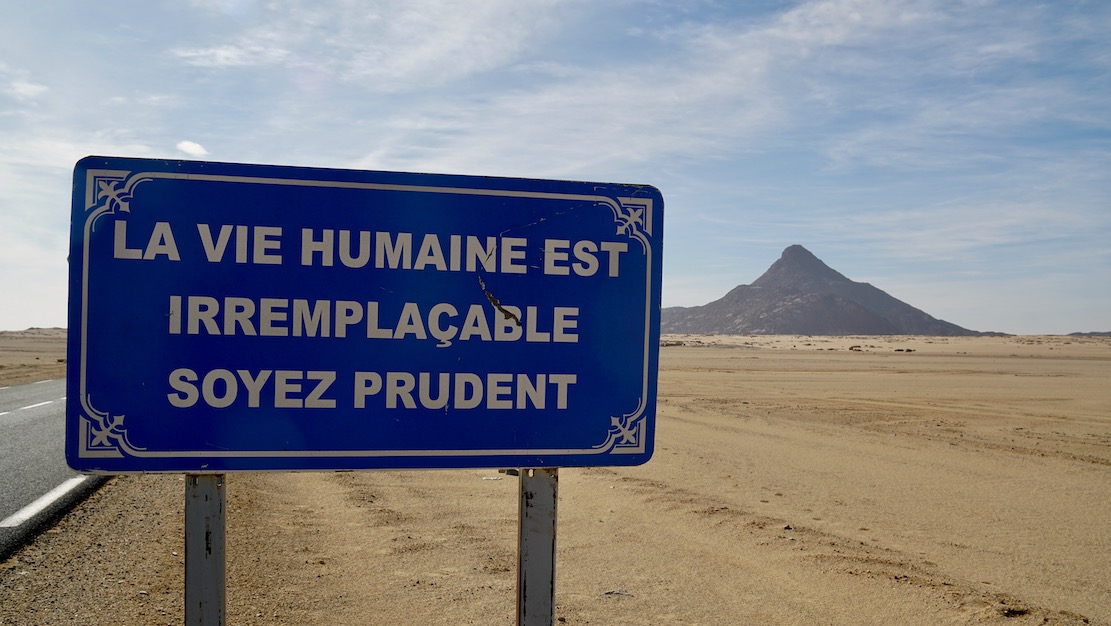
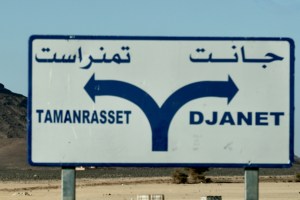
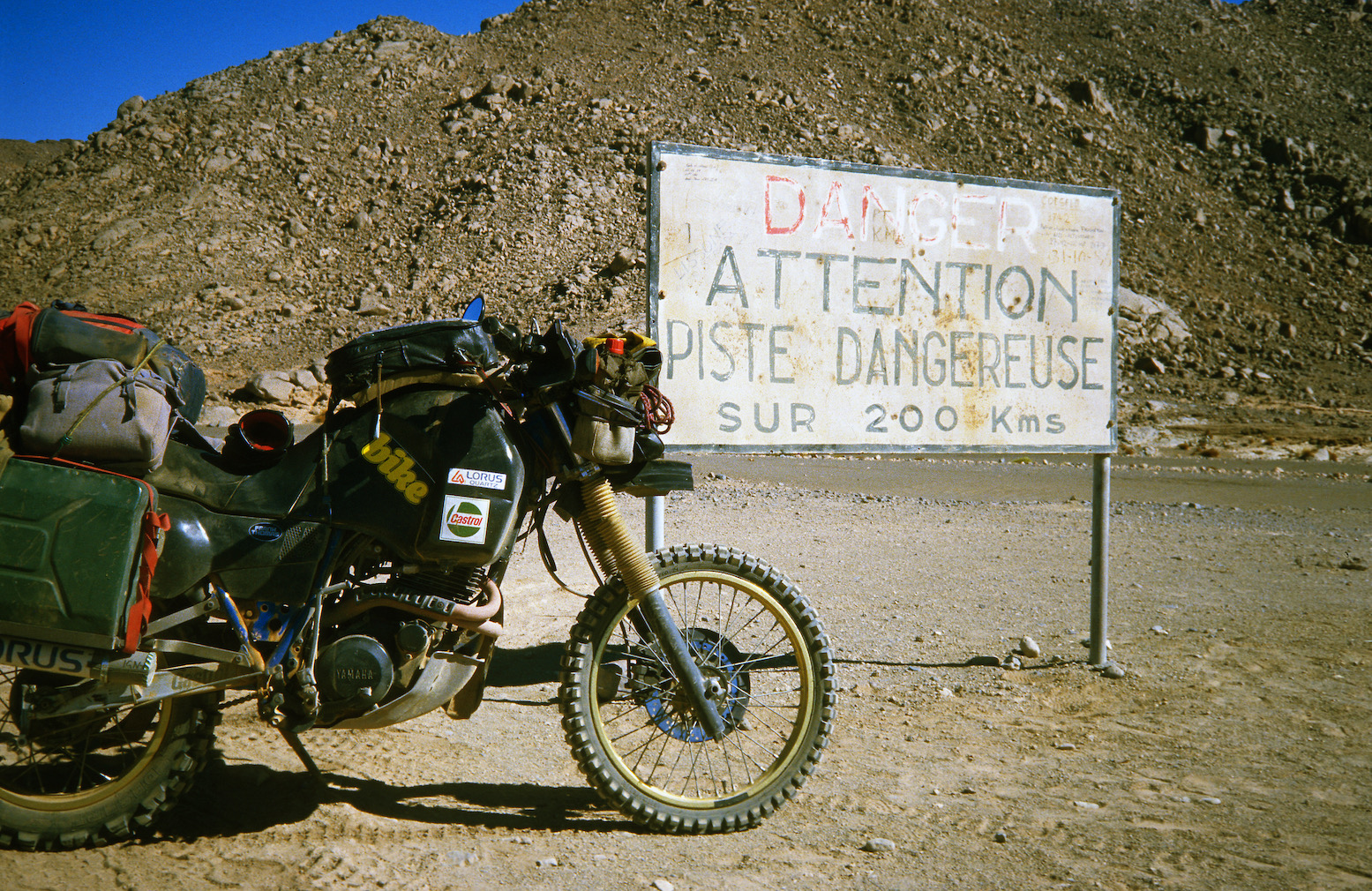
Today, an hour or two from Djanet a tarmac road leads off a roundabout in the middle of nowhere near the famous sign (left) and heads south to pass right by Tiska.

It’s part of a vast network of military roads, remote bases or perhaps migrant camps or prisons, and berms (sand walls) which Algeria has put up in the deep south to control smuggling, migration and jihadist movements.
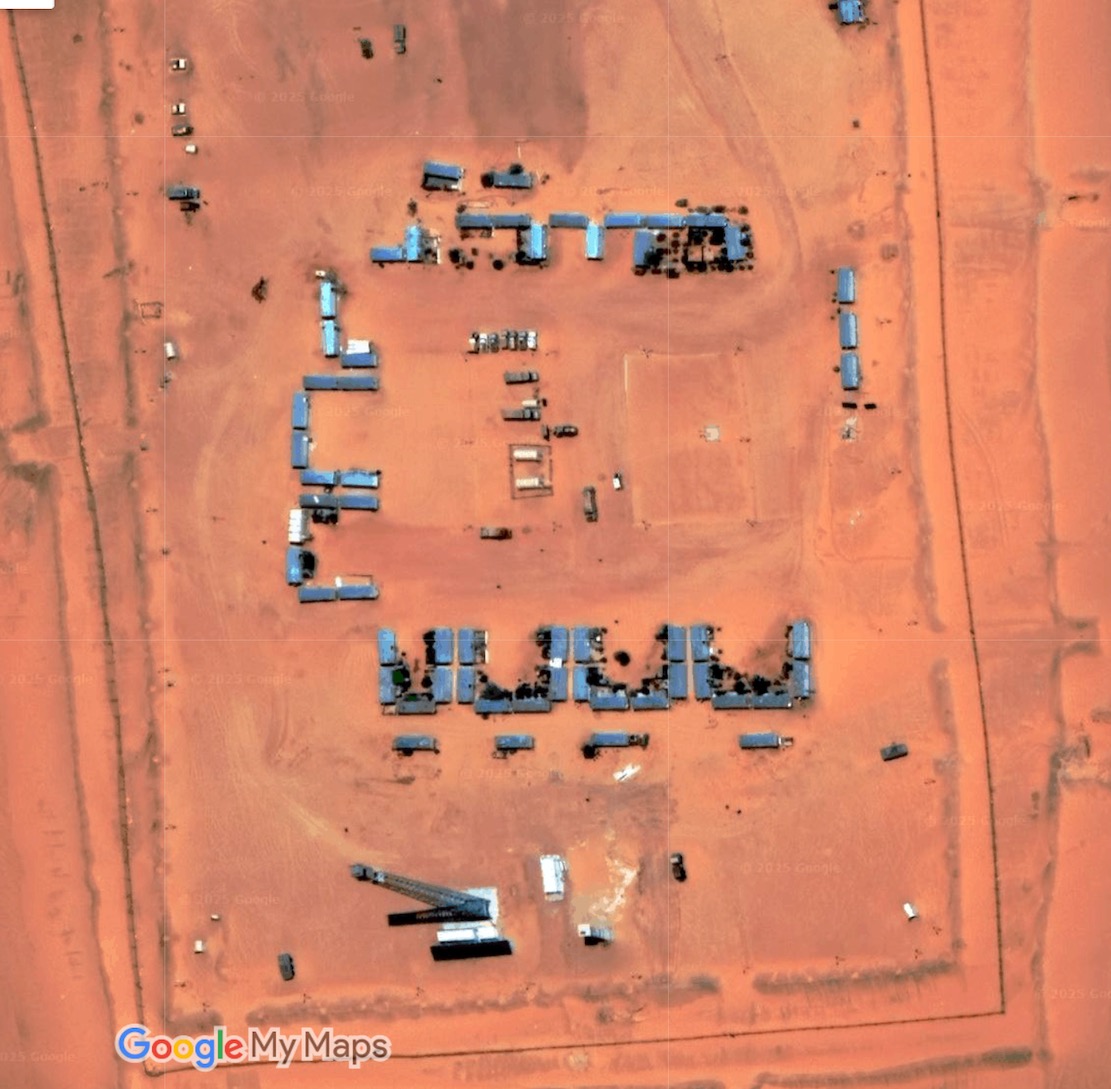
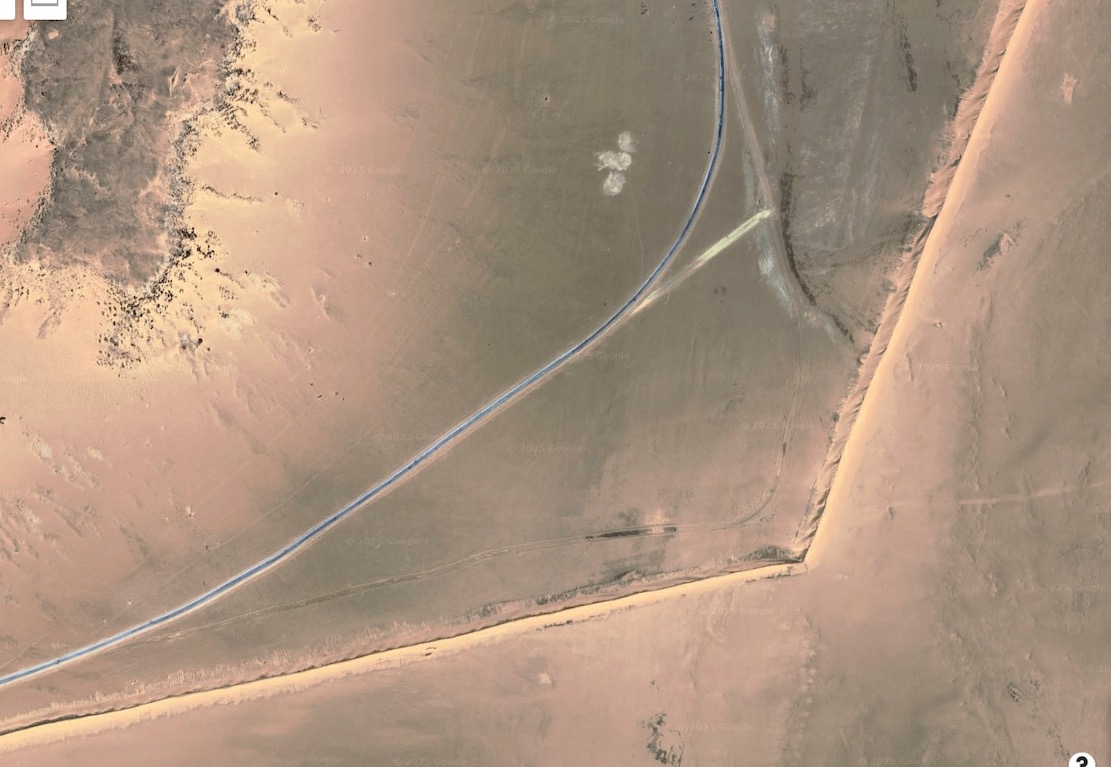
We pulled into a sheltered dip at the southern edge of the hill (below) and the cook got a fire going. Normally I’d have at least tried to climb to the top but at 500m above the desert floor, Tiska is bigger than it looks, one of the last outliers of the Tassili N’Ajjer before the ocean of sand that is the Tenere runs south to the Kaouar hills behind Bilma and the isolated Termit massif which is already in the Sahel, close to Lake Chad.
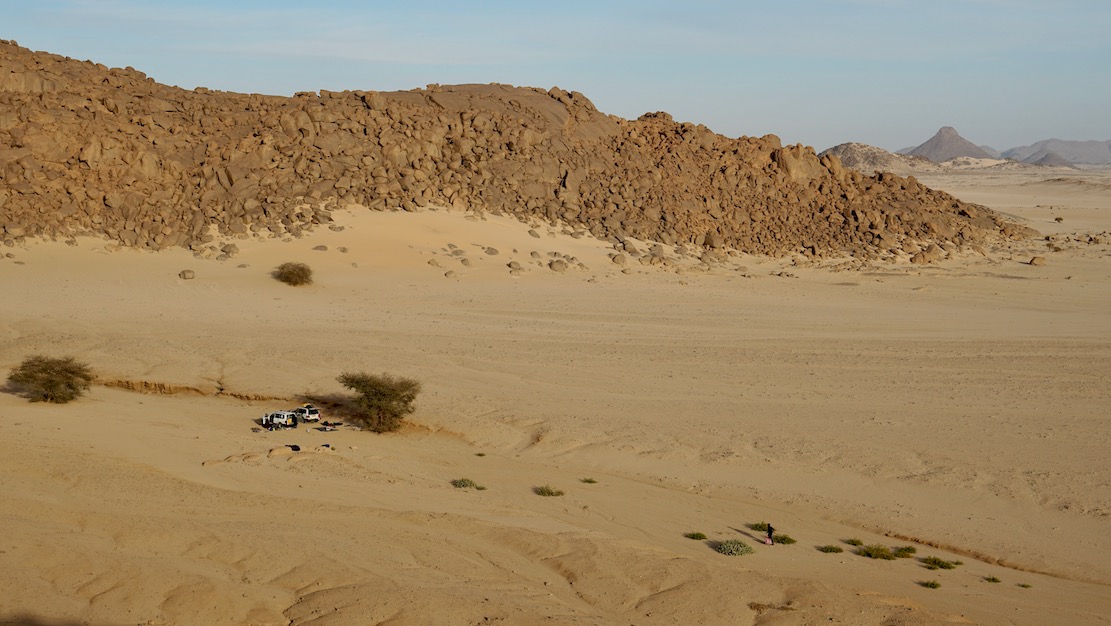
It was sure nice to stretch the limbs after being cooped up in the car for days, but it’s these cars which get us to such places. As always walking in the desert, it’s the tiniest things which catch your eye in the void.
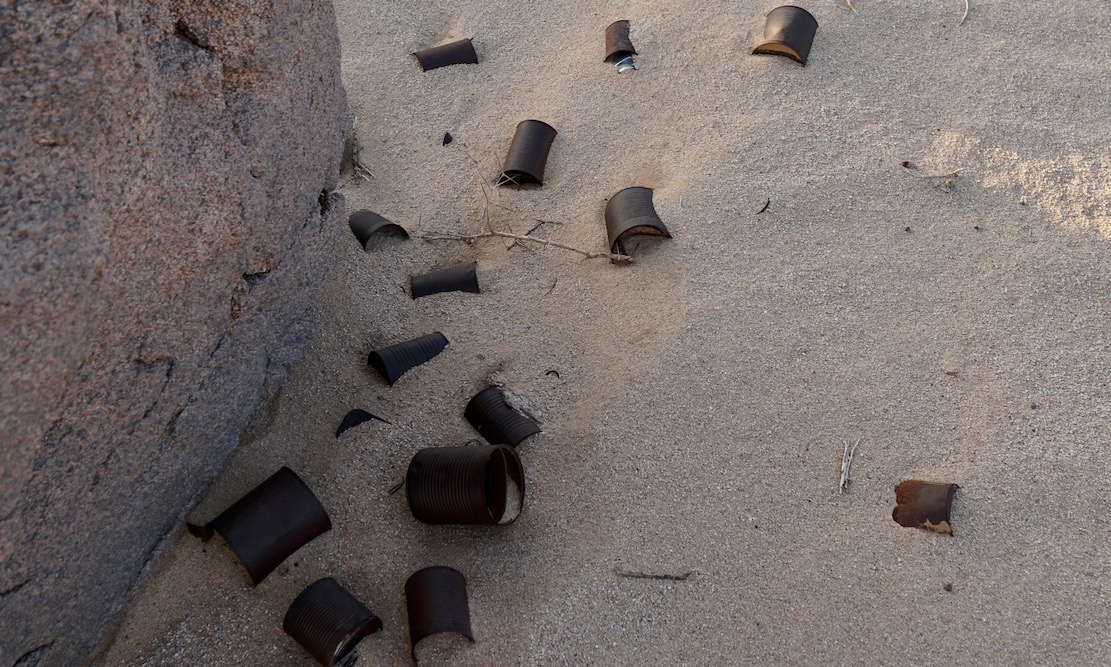
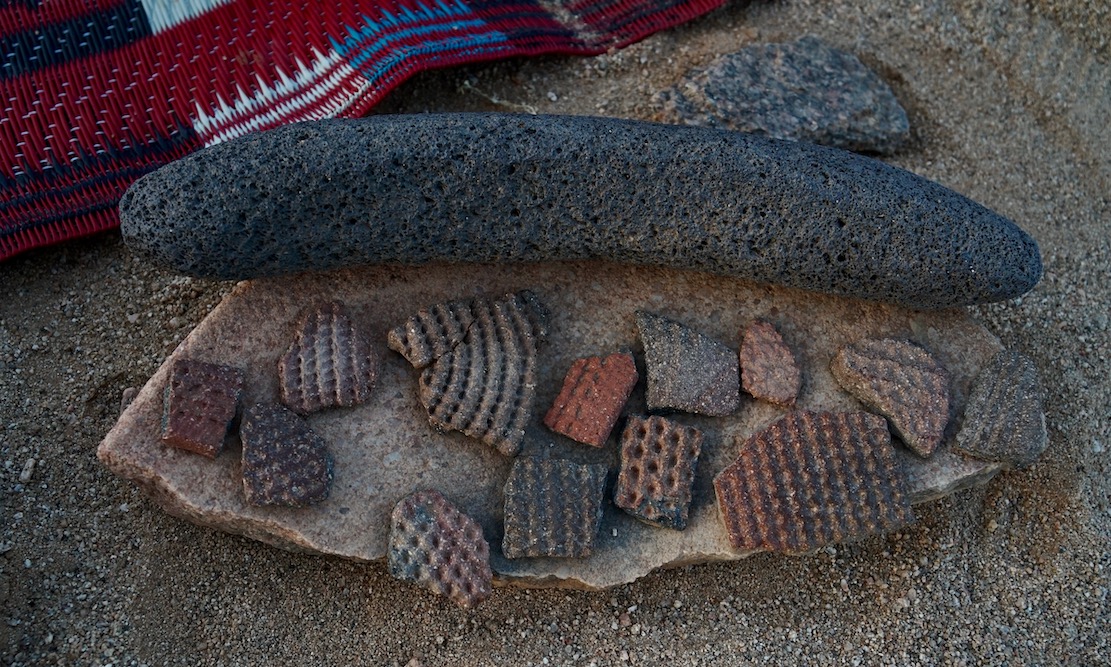
A trove of tin cans dumped by who knows who and who knows when. Anywhere else they’d be rubbish.
More rubbish perhaps dating back to the Neolithic era or earlier when the Sahara was less arid. Ceramic pottery fragments (commonly found) and some sort of grinding tool I’ve not seen before.
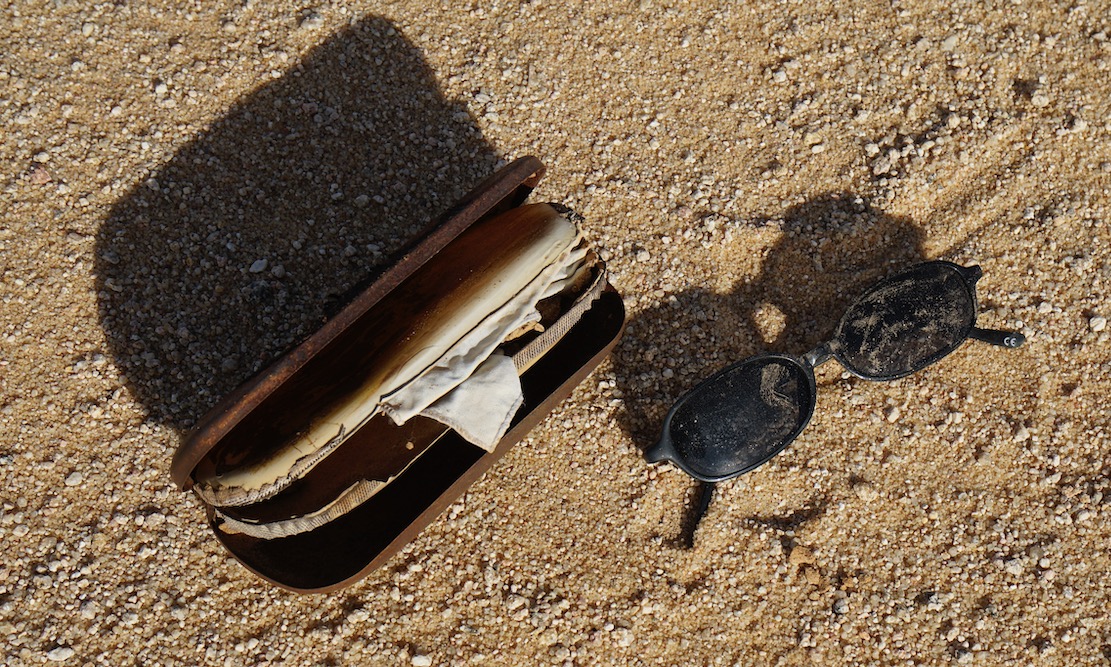
Cheap shades probably dropped by a migrant heading north to the Libyan border and a boat to Europe. Long before the current waves we met lines of migrants way back in in 2002, boldly marching over the Tassili towards Ghat.
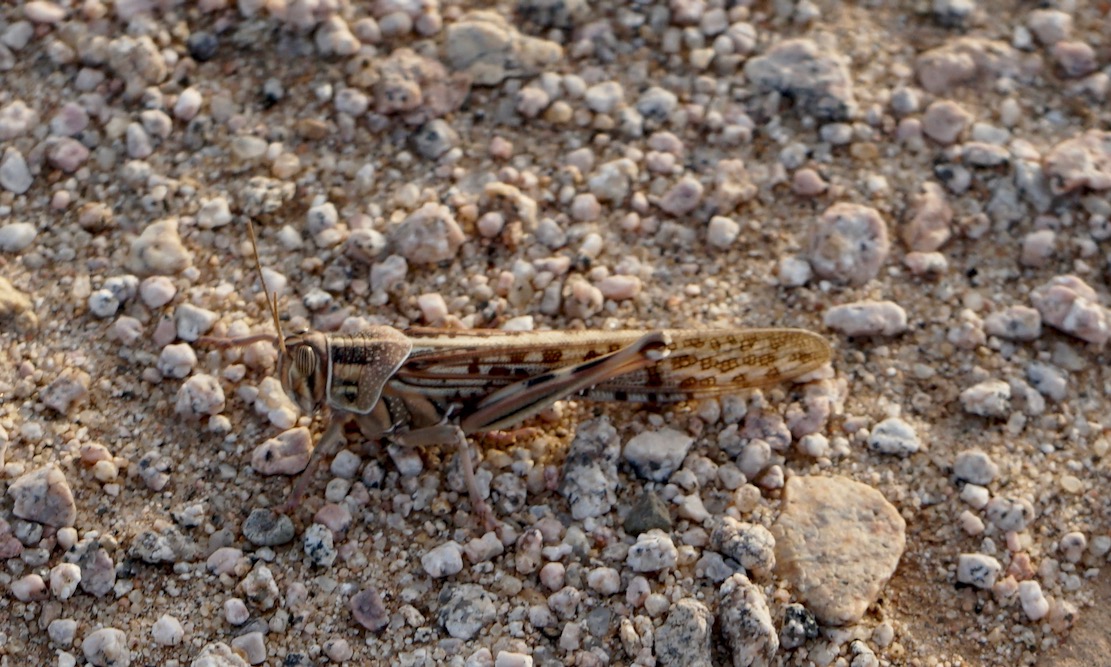
A locust takes a breather
In the foreground the balise line used to start just beyond the ridge. And on the horizon, the mass of Adrar Mariaou and the piste to Chirfa in Niger.
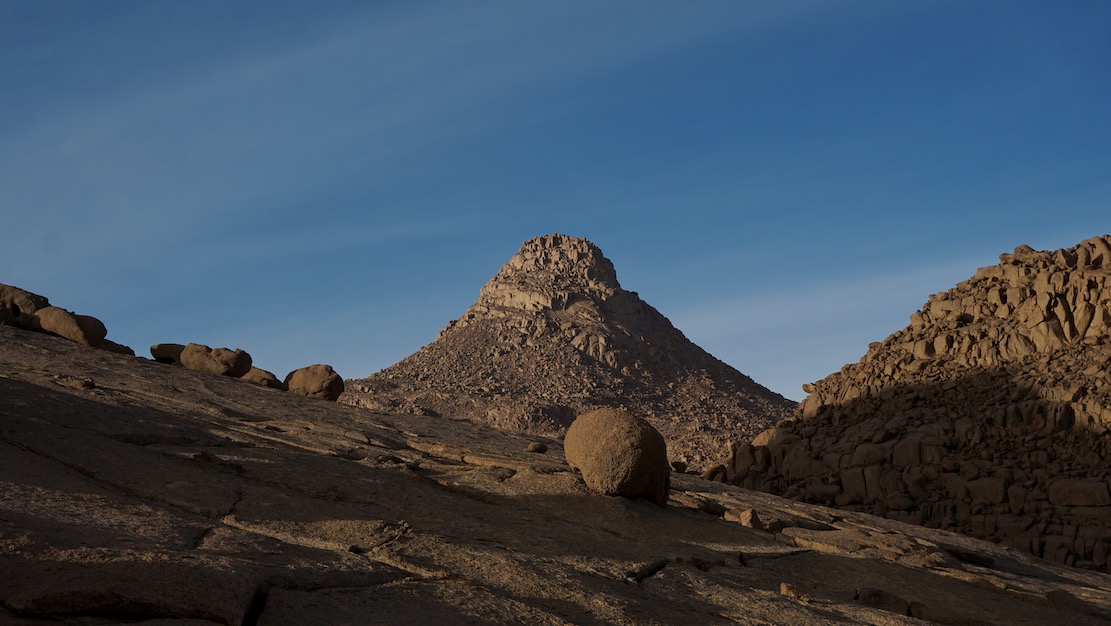
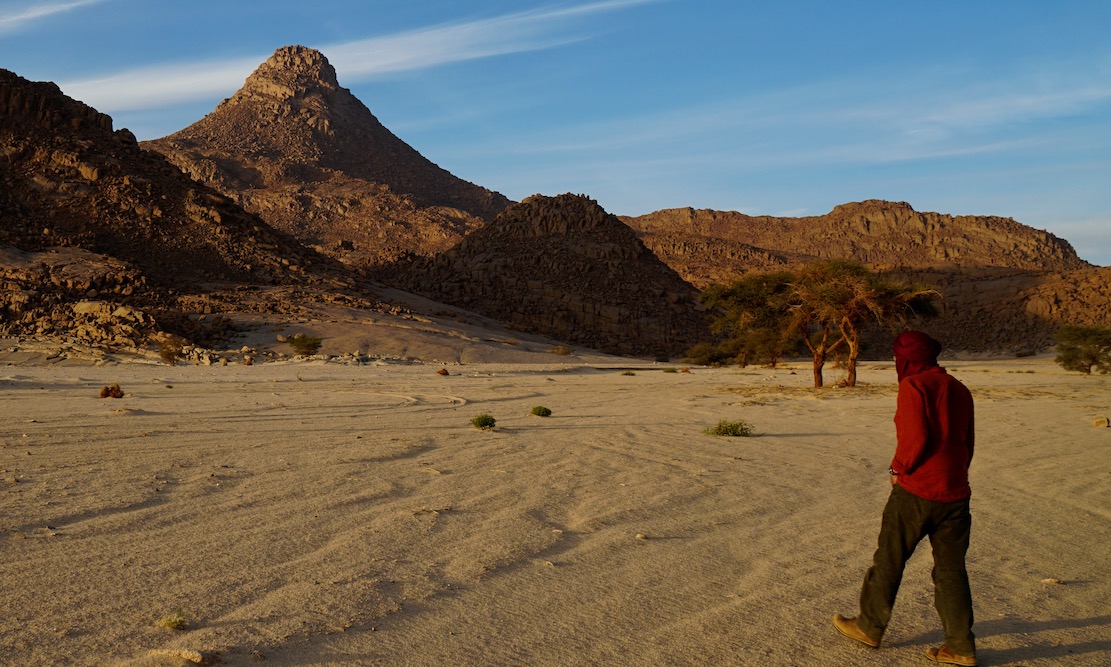
The granite cone of Tiska. I could run a tour in south Algeria hoping from one granite T-mountain to the next.
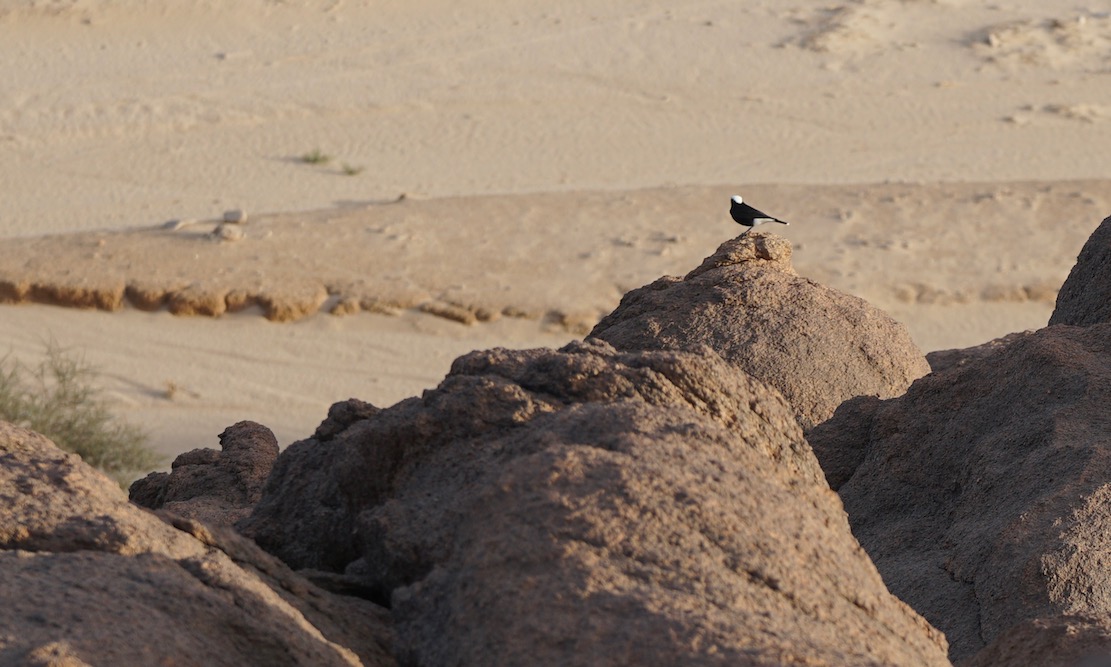
Moula Moula bird, the pigeon of the Sahara.
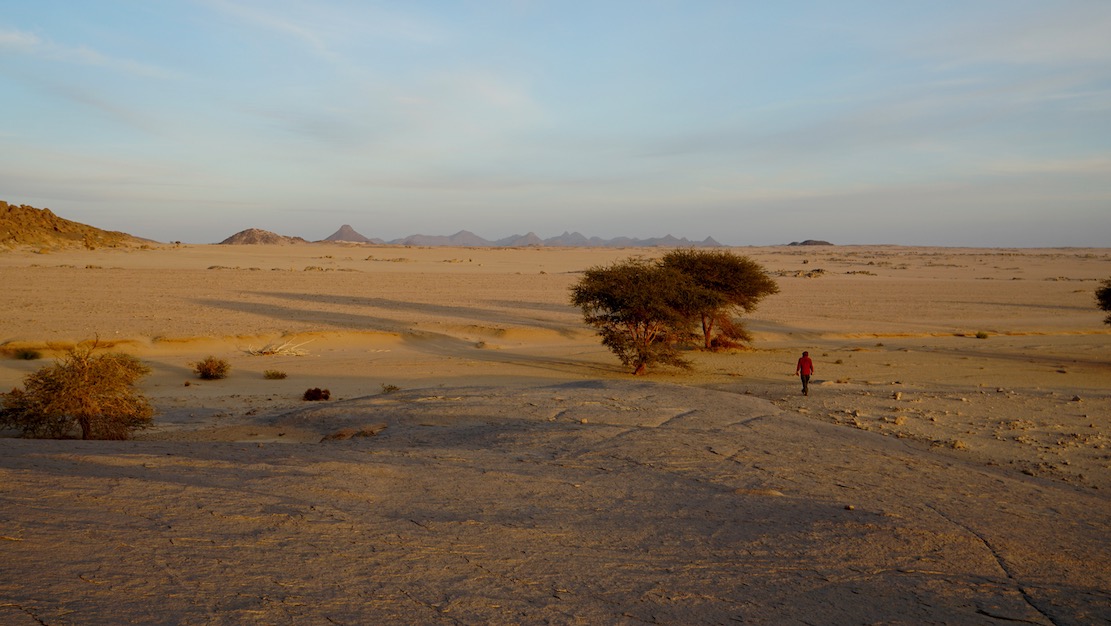
Sunset across the desert sands
Next morning the three of us set off to walk around the mountain while the crew pack up and catch us up. We carried on clockwise round the mountain, into a hidden bandit valley on the north side, and then back to the road.
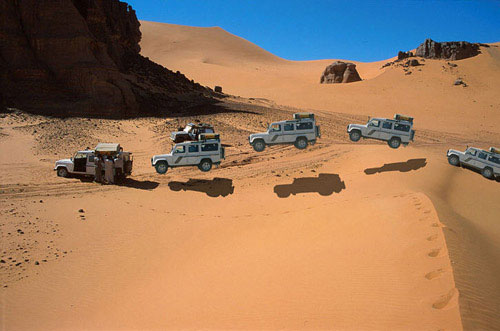
Heading back to Djanet after a night out on Mt Tiska.

The road from Djanet to Tamanrasset

Updated February 2025

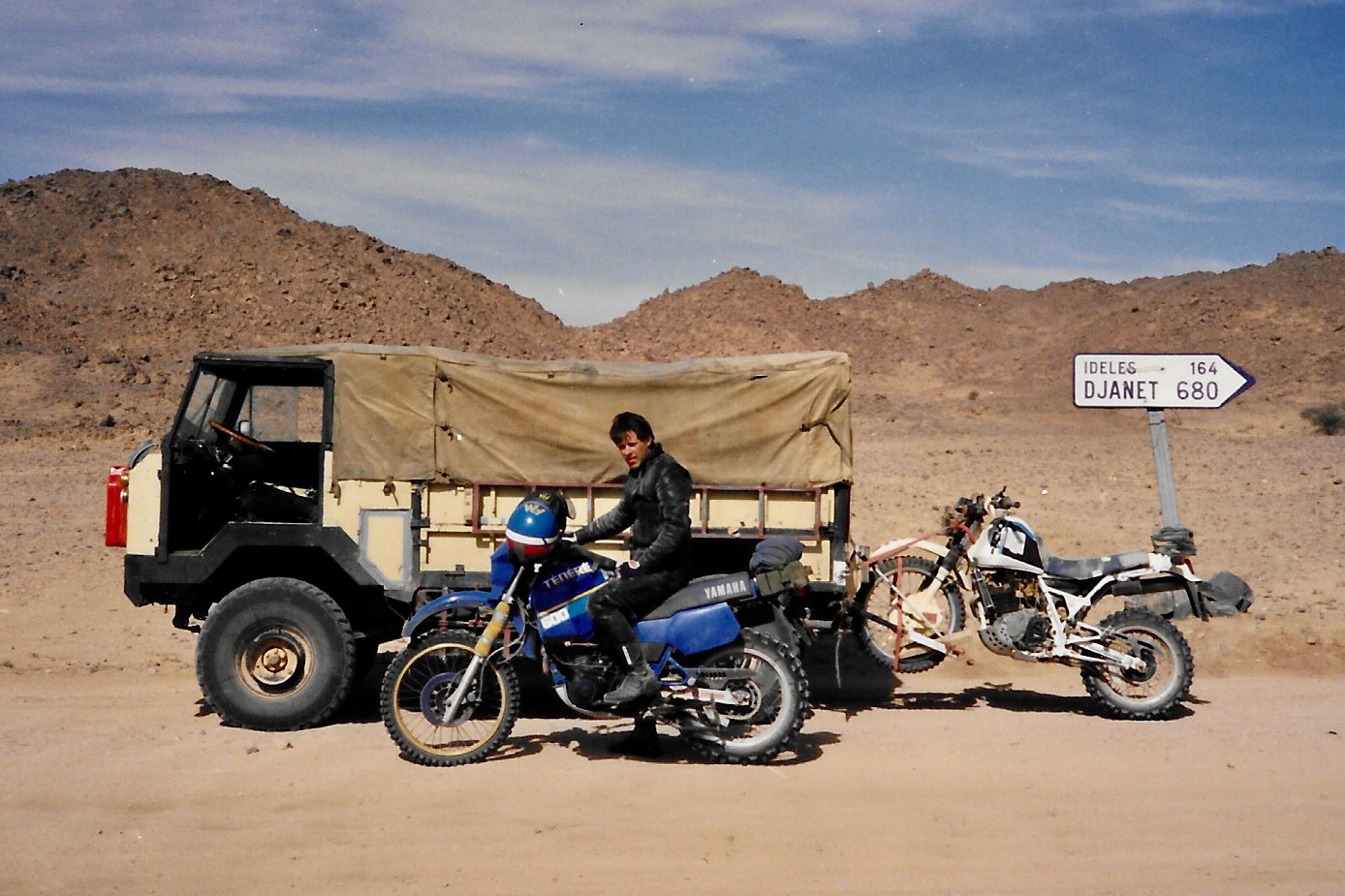
South of Tazat, 1987
Ideles 2025

Recently traveller’s reports have revealed that these two southern Algeria towns will soon be joined with a ribbon of asphalt.
We were there in January 2025 at which point the gap was just 94km, a drop of about 25km from 18 months ago. At that creeping rate it’ll probably take a few more years to link up.
How the surface with survive the baking summers remains to be seen, but that’s been an issue since they finished Trans Sahara Highway from Algiers to Tam in the early 1980s. It’s said the TSH remained intact over its 2000-km distance for just one year before flash floods, poor engineering and overloaded trucks beat the bitumen back into rubble. In January 2025 we did the full TSH too; there’s probably 100km of diversions over sand and gravel.

Djanet to Tam
About 8km west of Serouenout checkpoint (270km from Djanet) the tarmac ends. After 24km there’s a short, 20-km section of tarmac, and then you’re back on the piste south of the new road’s alignment for about 70km. Once back on the road it’s about 71km to Ideles roundabout and 220km to Tam via the TSH, or about 270km along the scenic high route via Col Azrou and Tahifet.

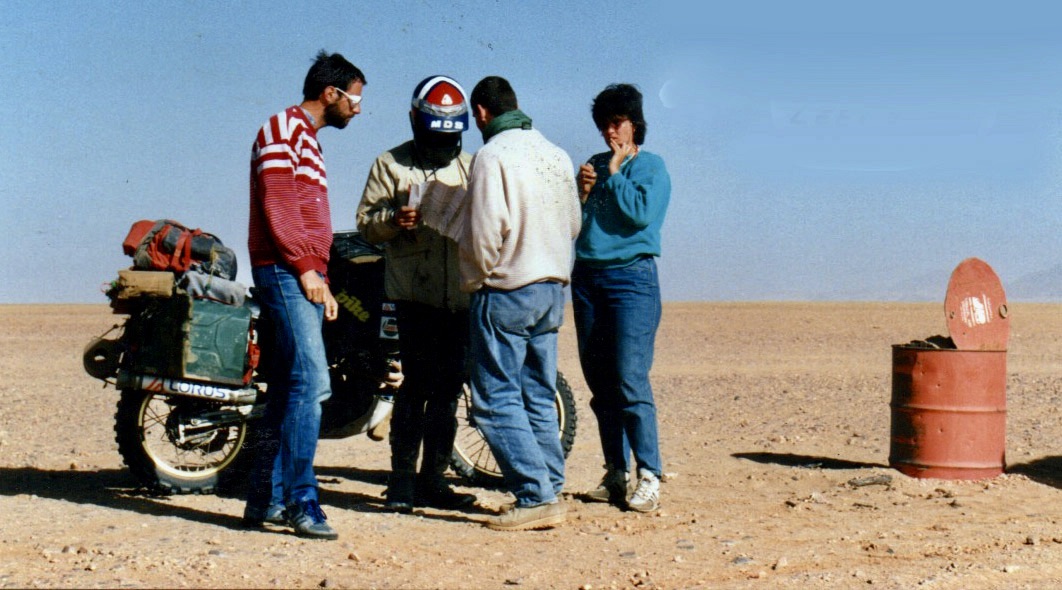
Puzzled near Borne; 1987

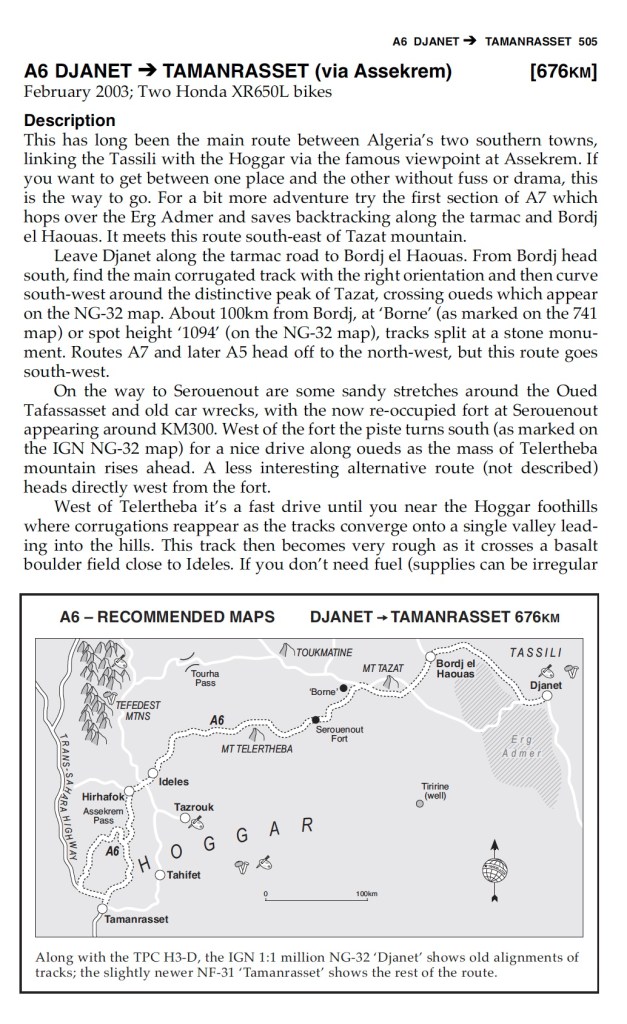
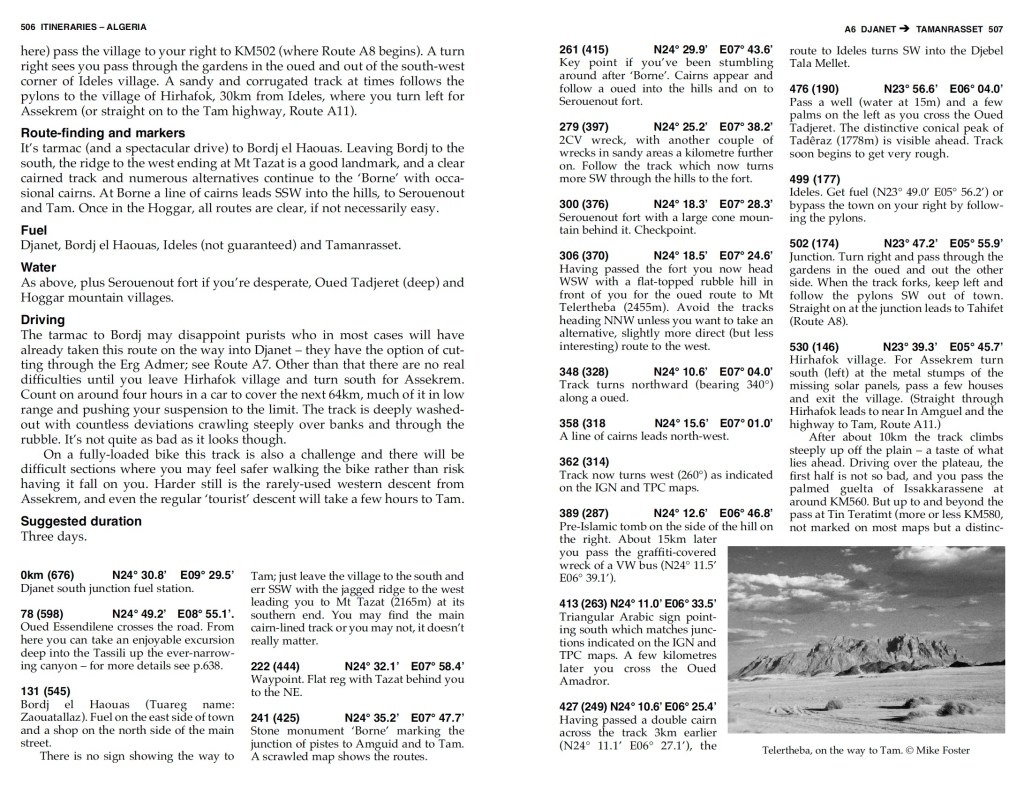
Route A6
In the good years (70s & 80s and 00s) the various tracks between Djanet and Tamanrasset and Hoggar mountains all combined to make classic multi-day adventures in southern Algeria.

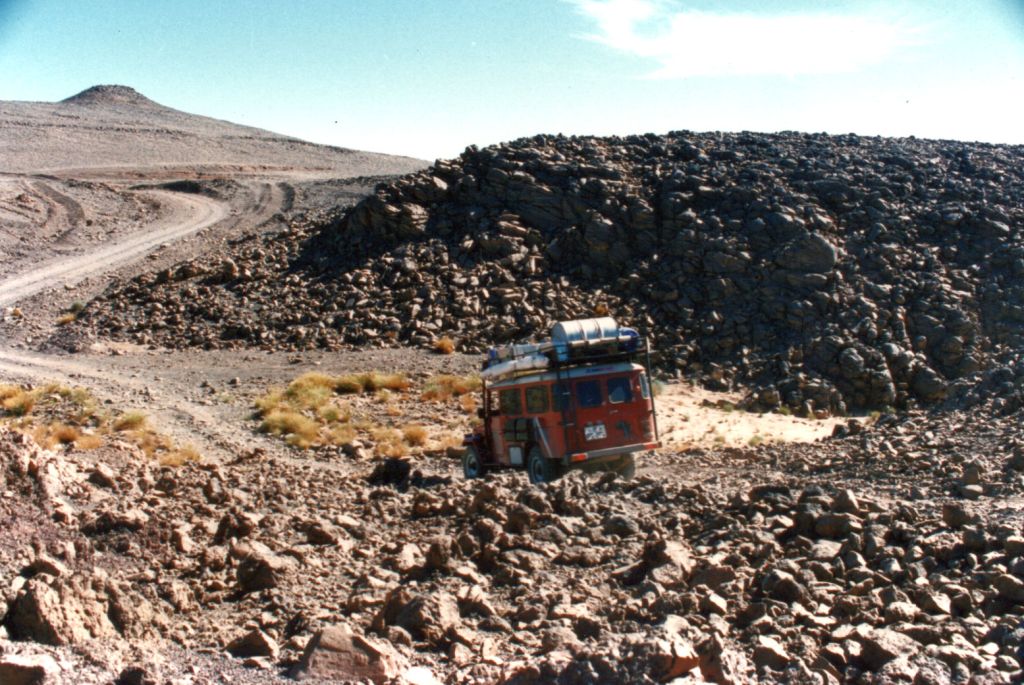
Heading west on Route A6, you traversed below the ramparts of the Tassili N’Ajjer plateau, long famed for its prehistoric rock art, then either turned southwest at Bordj el Haouas for Tazat mountain (below right), or used the same mountain as a landmark after crossing the dunes of the Erg Admer (below left),

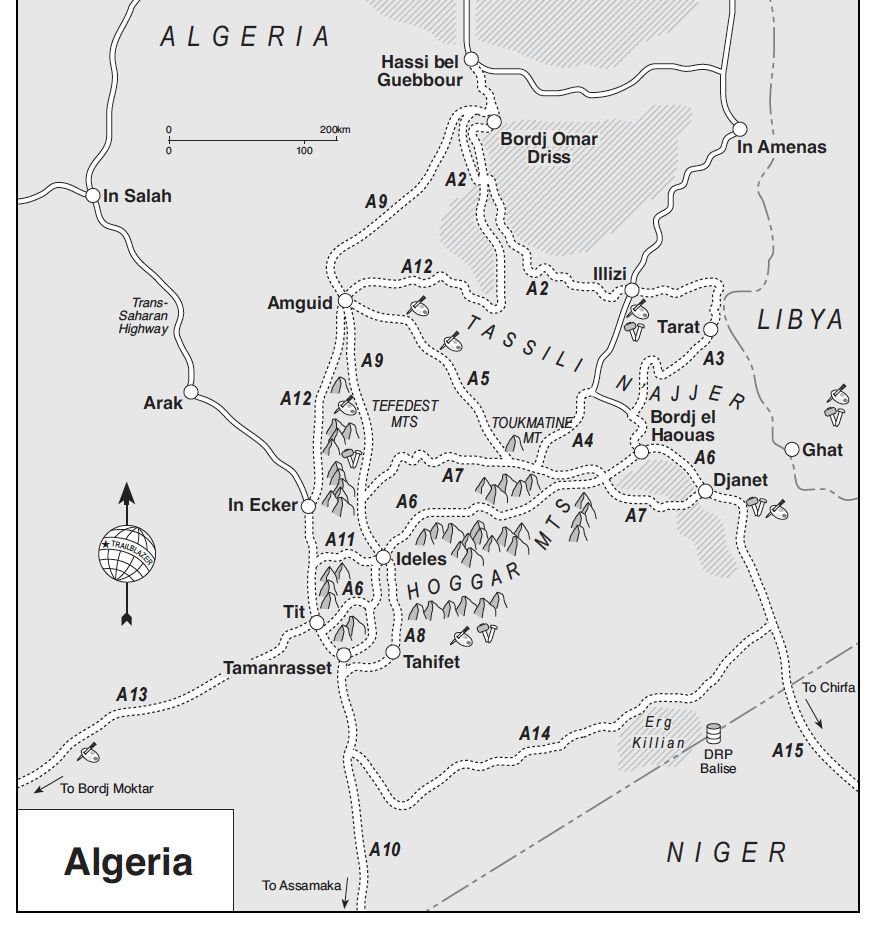
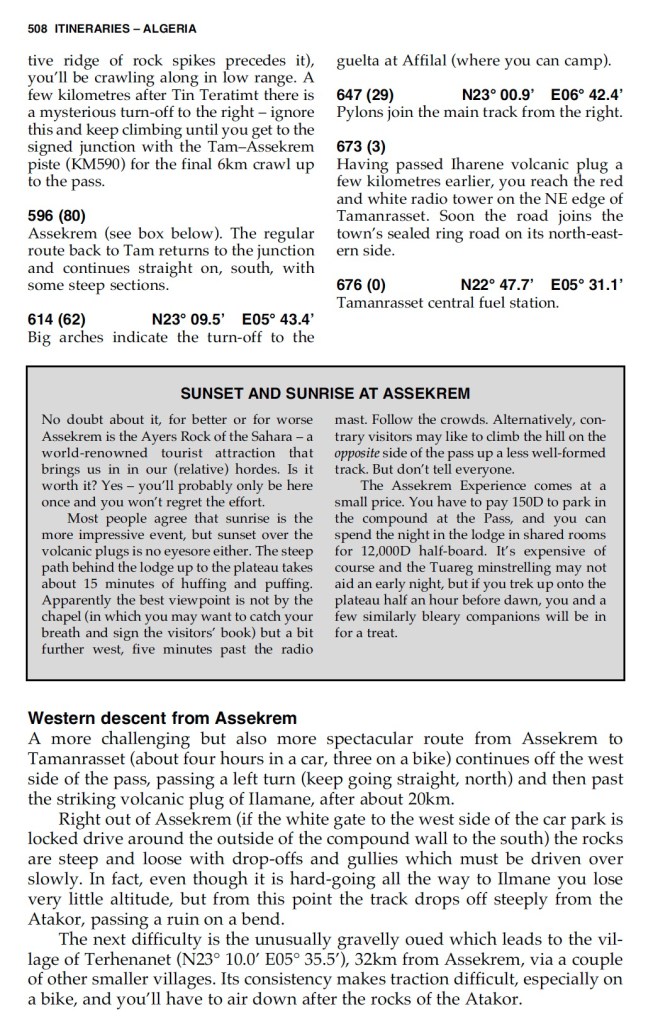
Passing isolated volcanic cones, plugs and other outliers, the basalt rubble of the once molten Hoggar lifted you up to Assekrem, a few hours from Tamanrasset and a refuel. The main route used by non-clandestine locals (A6 in my old Sahara Overland guidebook bottom of the page) was still nearly 700 kilometres or two desert nights for most. It was also on the limit of what an moto could manage.

Ajjer sands, 1987

When I first did it in 1987, the road from the north ended in Illizi, 400km from Djanet over the Fadnoun plateau. That all added up to over 1000km and one of the best all-dirt stages in southern Algeria (above), with just enough pre-GPS navigational challenges to keep you on your toes. It was rare to pass more than one or two other vehicles during the transit.

Fallen MAN, 2018

In the 80s the army were tasked with building a road over the Fadnoun’s switchback escarpments. Up to that point trucks supplying isolated Djanet had to take a huge, sandy detour to the west via Amguid, nearly doubling the road distance. Today the Fadnoun (below) is sealed and still a great drive, even if occasionally lorry drivers fall foul of the Fadnoun’s curves, as left.

Gara Ihadja n Kli, one of the Fandoun’s escarpments, 2018

Morocco is famed for sealing it’s southern desert pistes faster than we can keep up, but Algeria is catching up too, only over vastly greater distances. Despite minimal population, insurgents and migrant traffickers south of the border have accelerated development of sealed roads or defensive berms.

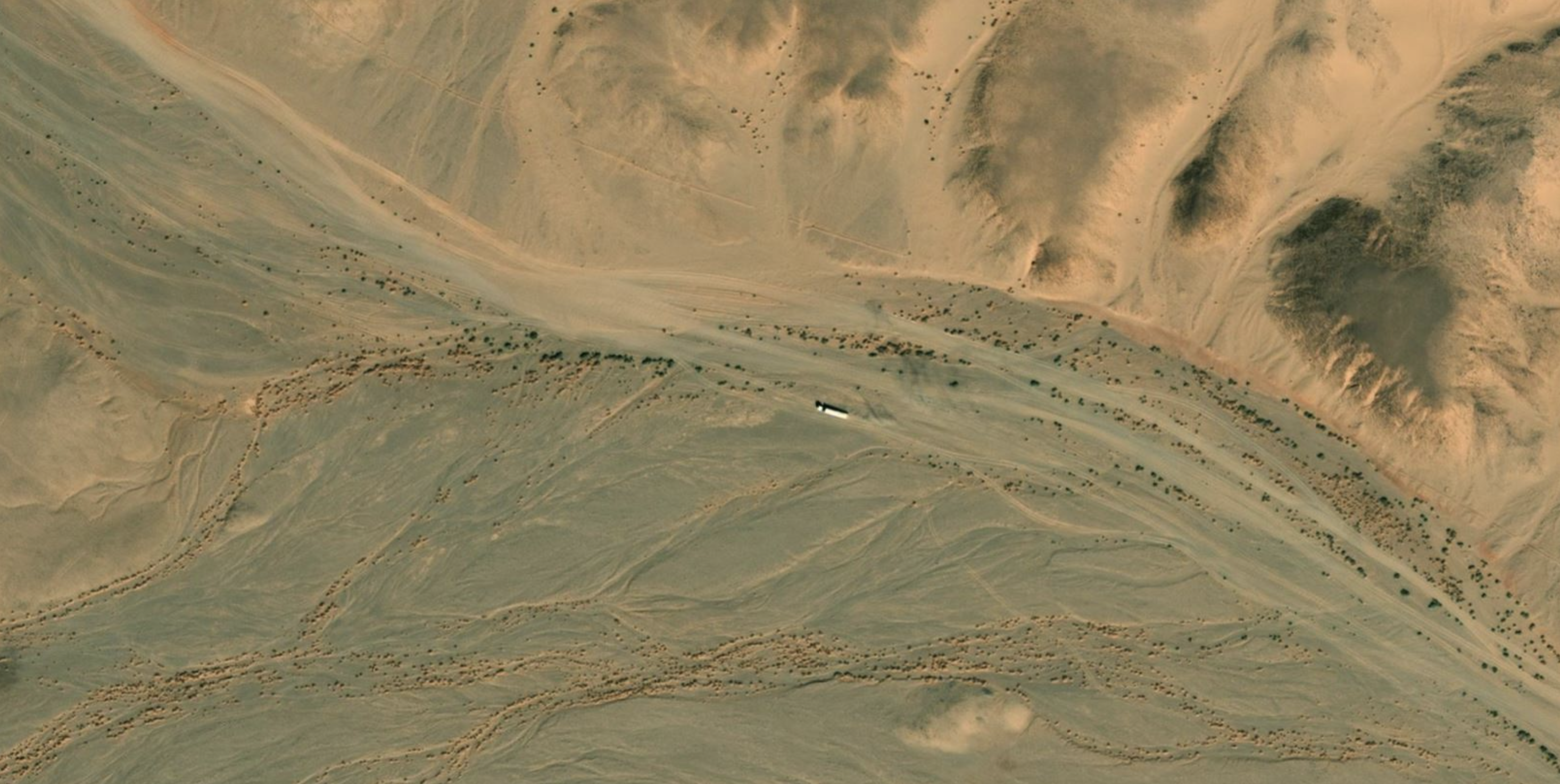
Caught on camera west of Serouenout (Bing Maps)

Even when they succeed in sealing this traverse, A6 Tam-Djanet will still remain one of the great routes in the Sahara, but there’s no need to follow th road. There is A7 to the north which we also partly did in 2025, A14 in the deep south I last did in 2007, and at least one more route via Tiririne, Tarabine which we did in 1989 and again in 2006 on the way back back from Mauritania on Sahara: The Empty Quarter.

The Men Who Ride Like Goats

… until Tizi n Telouet: there, all greenery ceases; the burning breath of southern winds denudes the mountain’s rocky skeleton.
Charles de Foucauld’s Reconnaissance au Maroc, 1883–1884

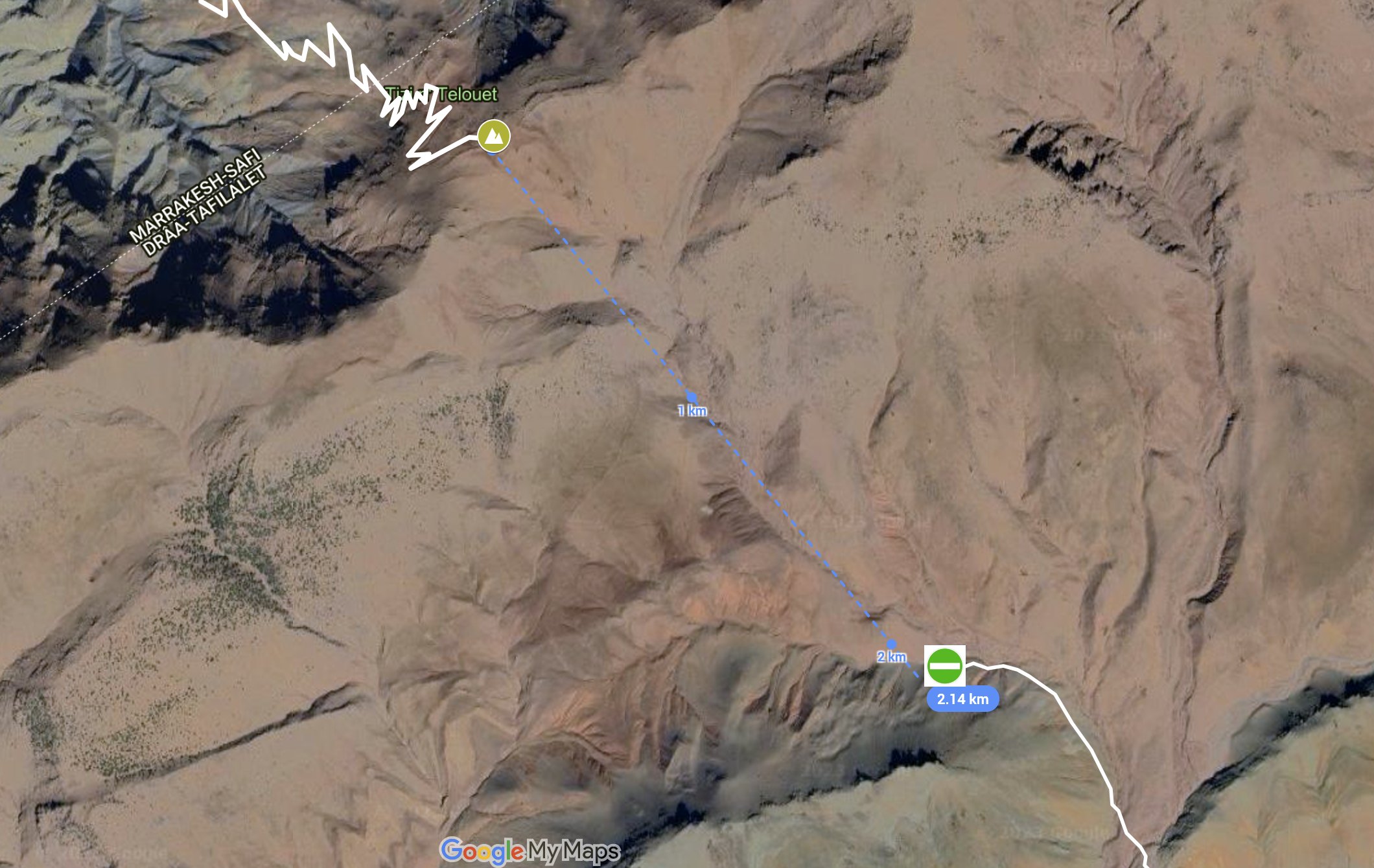
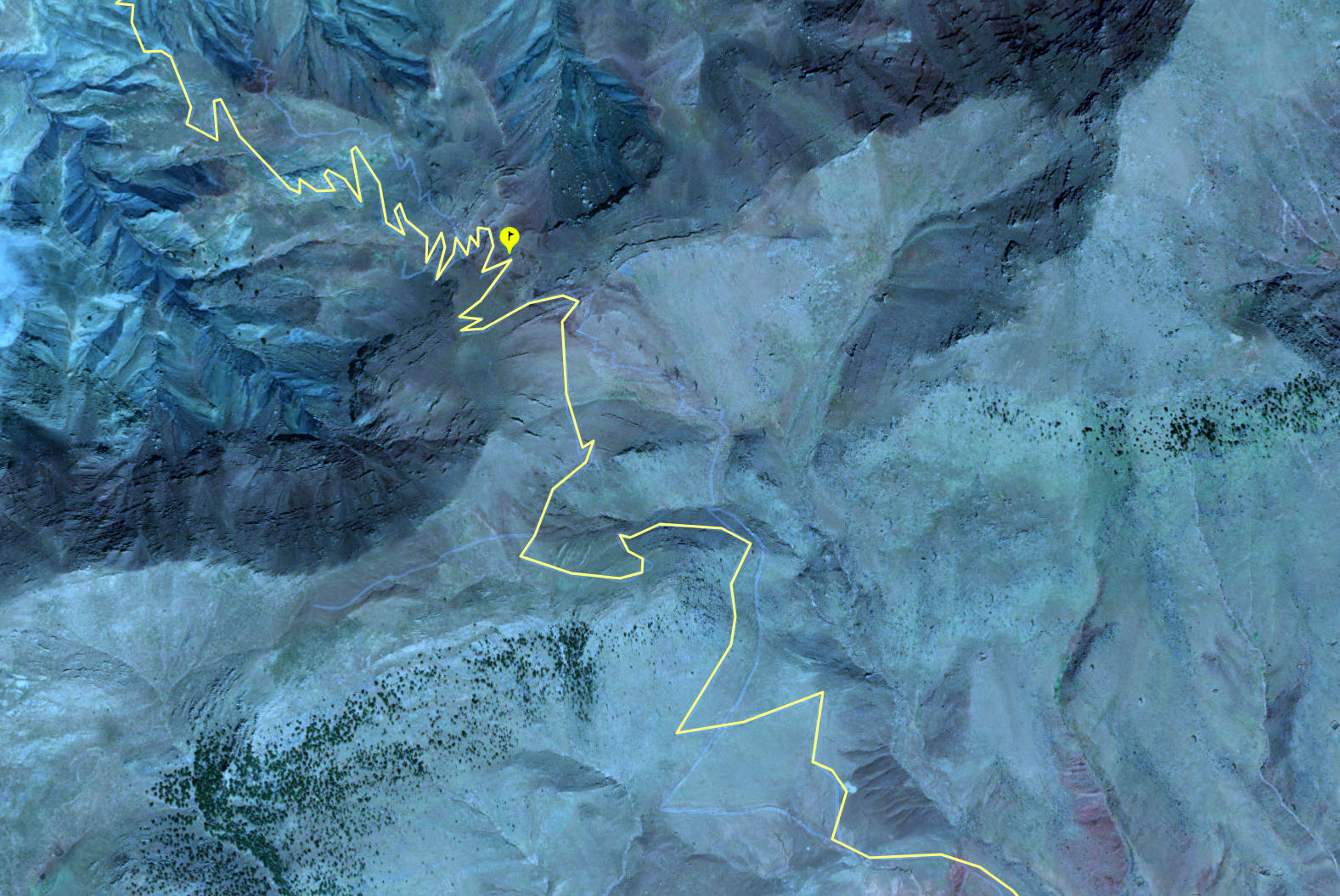
While scanning aerial mapping for new pistes in the High Atlas I came across an intriguing possibility. A seemingly good track lead 24km off the N9 via a village or two to the 2450-m Tizi Telouet pass on the High Atlas watershed (31.3372, -7.2663), a few miles east of the Tichka pass on the N9 trans Atlas. From that point southwards the way ahead was an obliterated mule path, but picked up rideable terrain in just two kilometres, with Telouet town visible nearby. Downhill on a light bike, walking where necessary, it might be doable, no? ‘Who wants to go first?’, I quipped on Twitter.

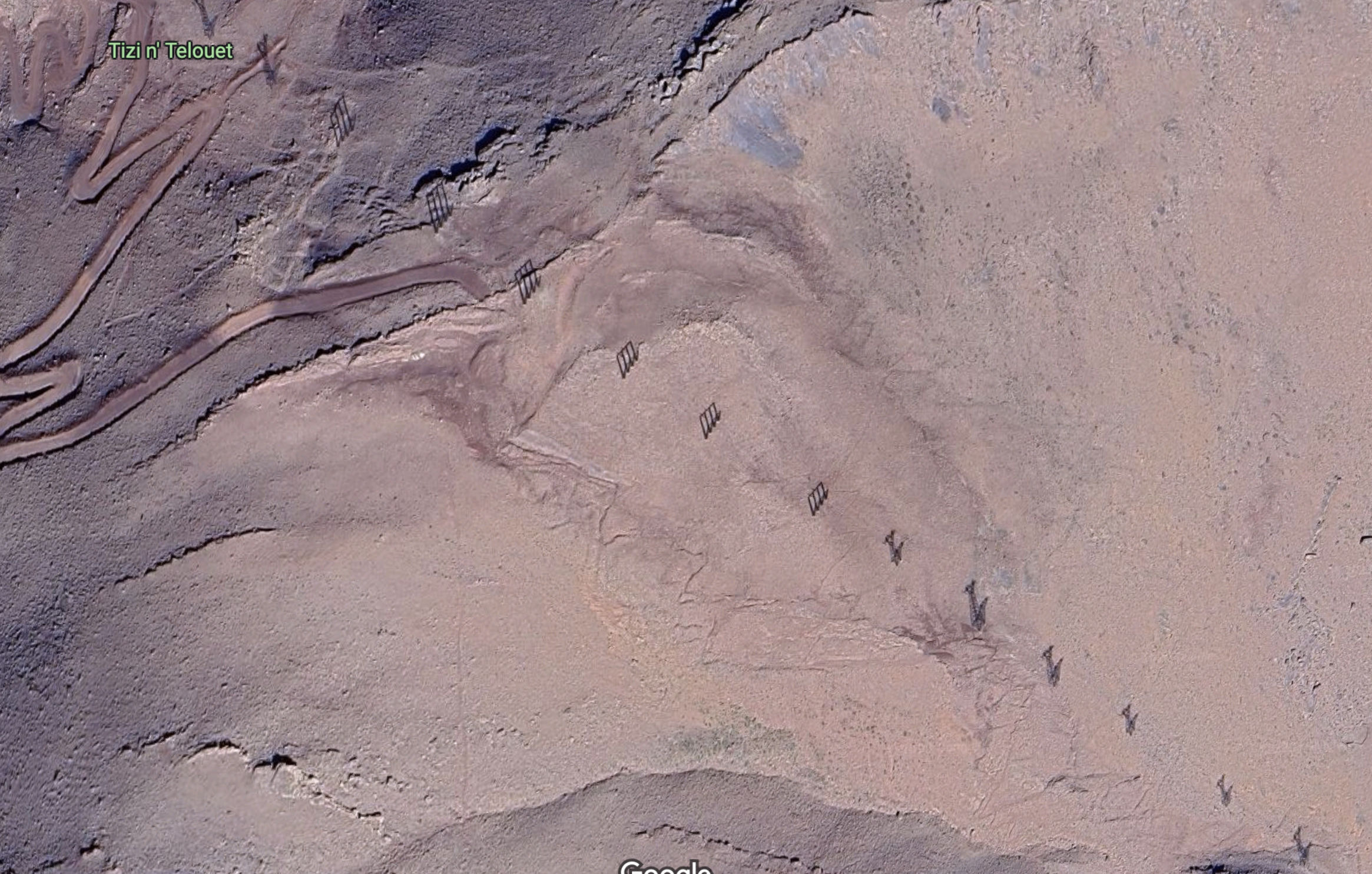
Once it was mule trains of salt from Telouet’s mines, but today, like the grand old Duke of York and his 10,000 men, a column of pylons marches up and over the col, bringing power from the massive Nour solar plant, 50km away near Ouarzazate.
You’d assume some sort of vehicle crawled up the slopes to erect the pylons, but no service track is evident on the south side. Still, at the very least, riding the switchbacks up to the col for a quick look might be possible. In my experience damage from water run-off gets less severe the higher you go, as the volume, momentum and sludge density all decrease with elevation. The real damage gets done down in the valleys.

I mentioned this recce to a mate who’ll join me out there next week. He soon found some Spanish KTM-ers – a YT channel called Enduro Aventura – who pulled off the Tizi n’Telouet descent (and a whole lot more) in 2002, filmed it all and capped it off with a tracklog on Wikiloc, classified as ‘Very Difficult’.
They call the Tizi Telouet ‘Collado Torretas’ or ‘tower/pylon col’? They confirm ‘the north face has been fixed with a track with a thousand curves and somewhat broken by the rain‘ but continue… ‘the south face on the way to Telouet is a narrow and broken trail with a lot of stones… This hill [trail] seems to be disappearing…‘. They speculate that a new road might get put in as the truncated northside track suggests, but I’ve found tracks or roads often come to a dead halt at provincial boundaries, which this watershed is. The col was just an efficient, ‘as-the-crow-flies’ route for the power cables from Nour to Marrakech.

On the track to Tizi n’Telouet. Though we knew we’d never manage the descent with my 300L, let alone James’ 890, we had half a mind to reach the col for a look, so took the track at Ait n Amer off the N9. We did a few clicks but realistically, it was late in the day and we probably wouldn’t have got back to the N9 before dark.

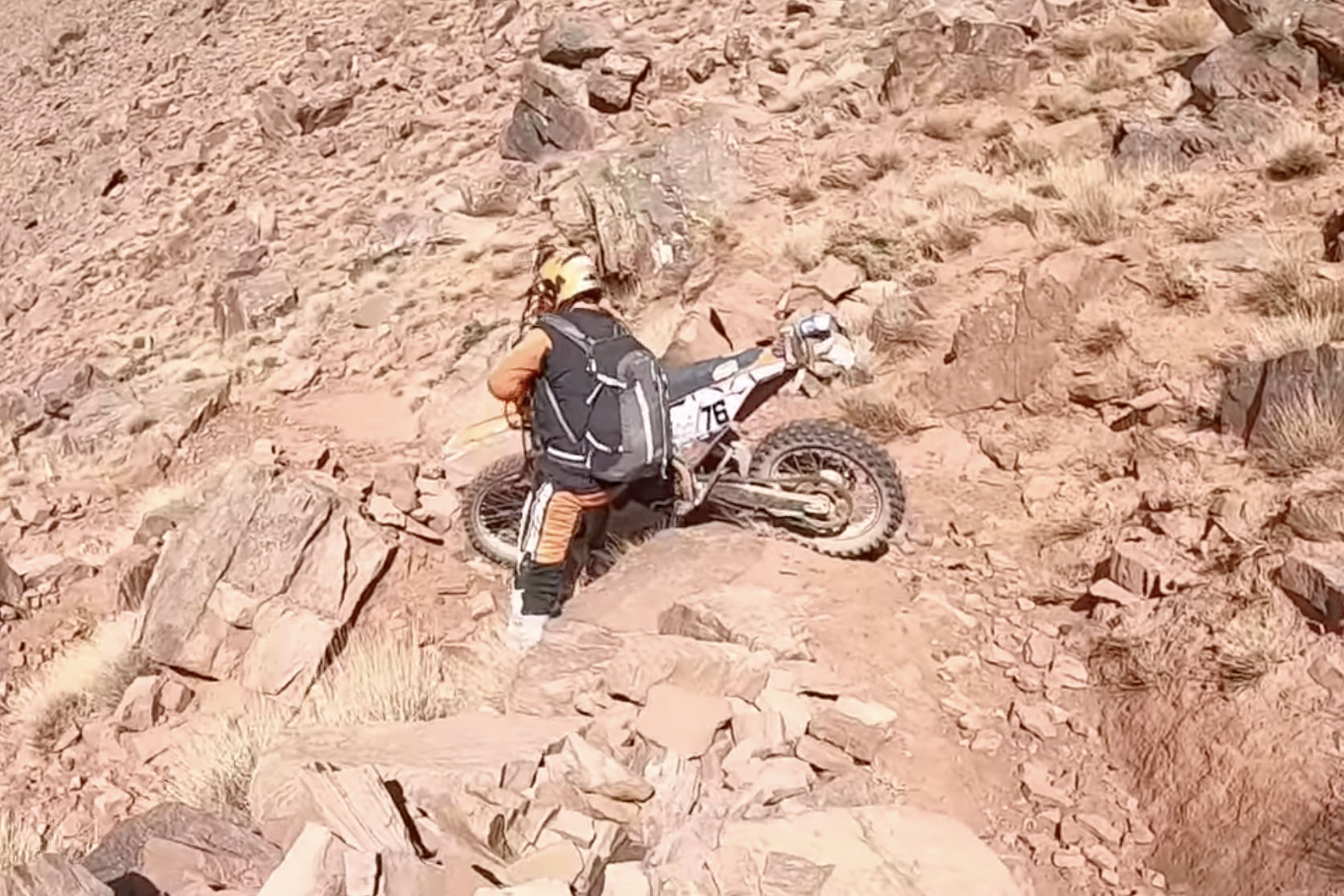
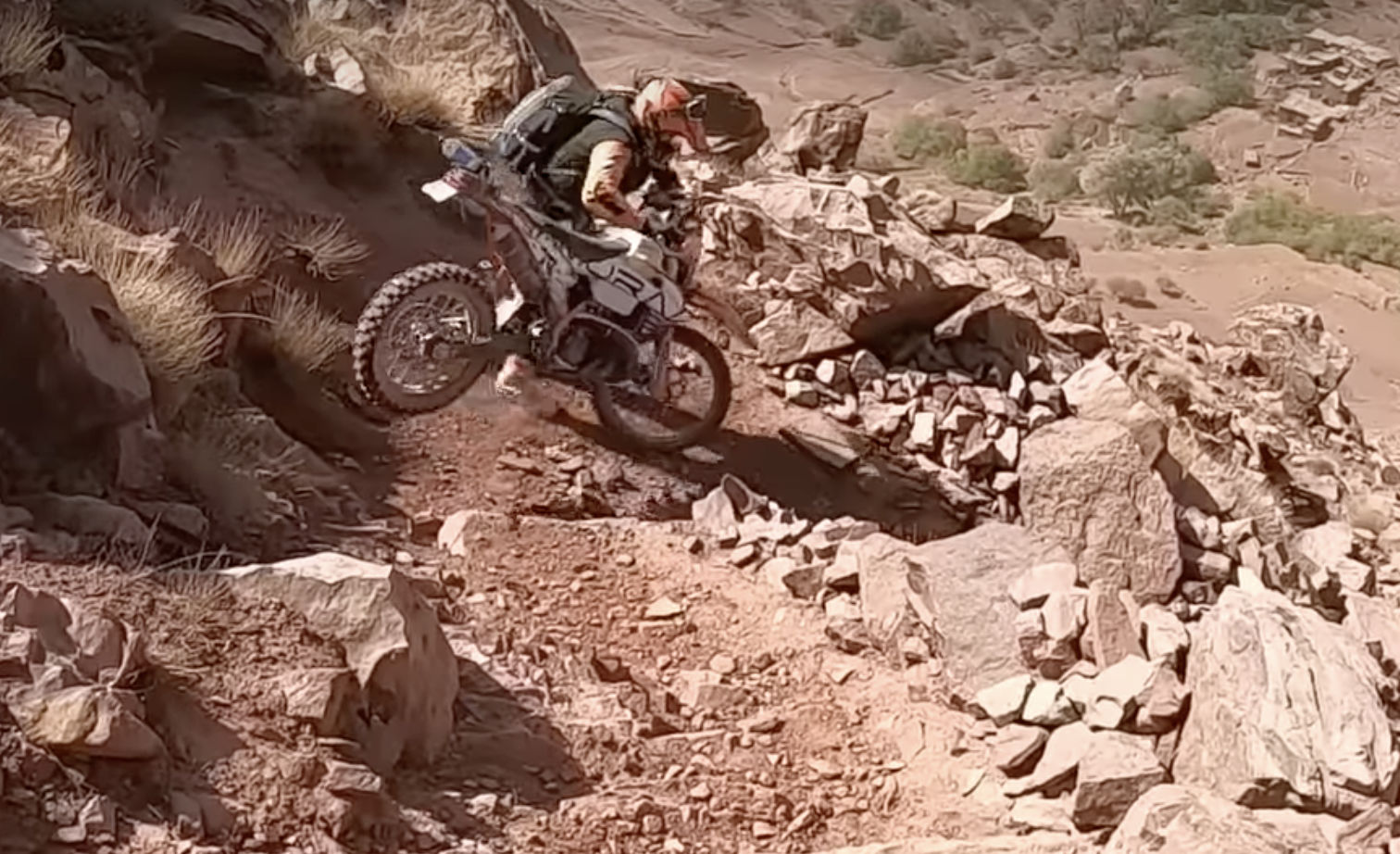
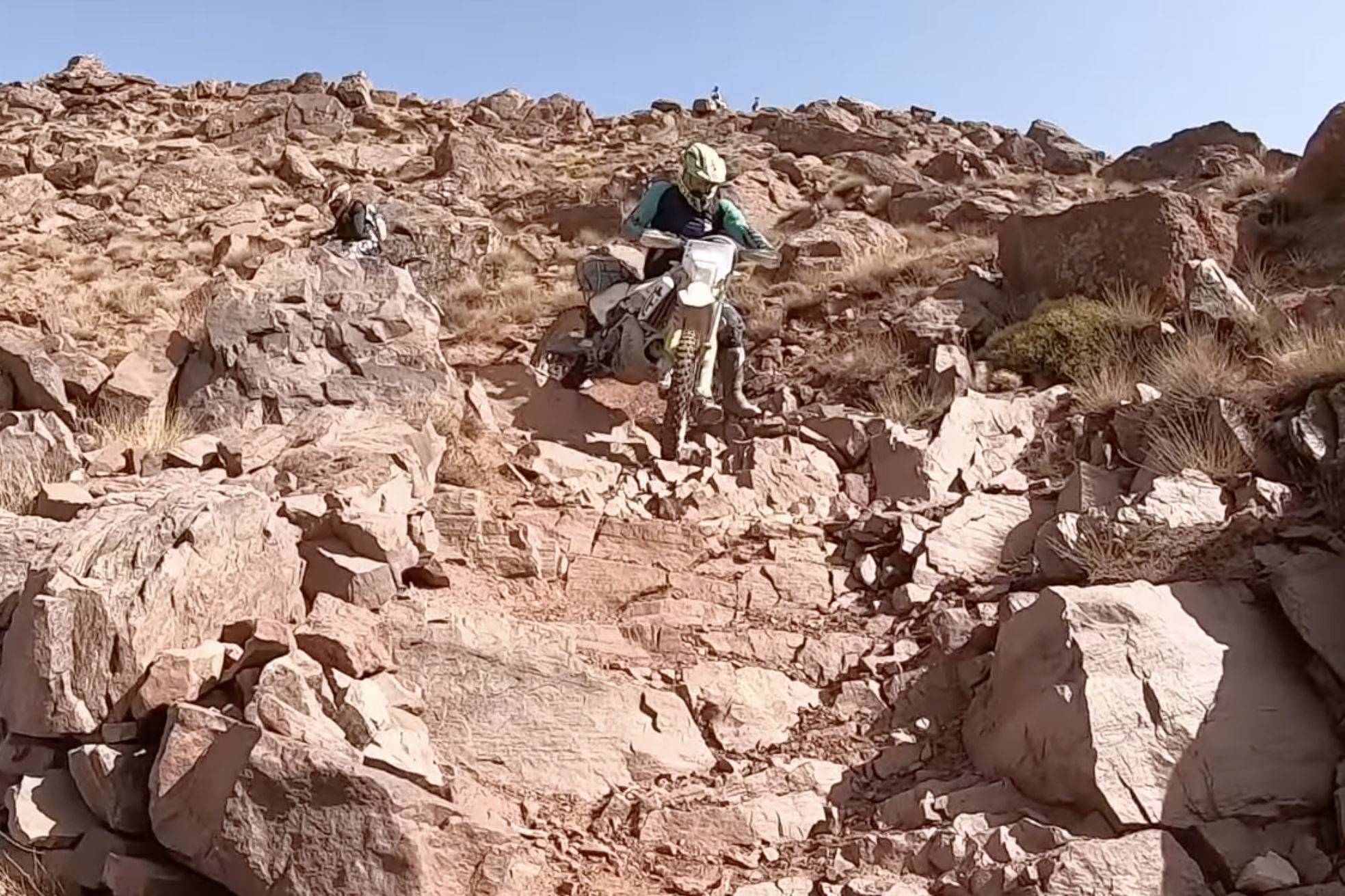
Their 80-minute vid below is timed to start at the Collado Torretas stage (covering just a few minutes). It’s soon turns gnarly af (stills above). But scan any other random minute in the vid and you’ll see just what light and lightly-loaded KTMs (including 2T) can achieve off-road in the hands of a fit and determined crew. You’ll be staggered to see what these guys blithely attempt. Chapeau to Enduro Aventura I say! The Men who Ride like Goats. Me, I think I’ll take the long way round.

Riding Sand

Just the right amount of momentum is key

As we all know, there are a lot of moto vlogging know-alls out there whose sketchy credentials don’t necessarily affect their channel’s popularity.
But in a well produced 9-minute vid on sand riding, this guy below gets it and keeps to the point. He won me over when he advised: ‘if you see a patch of sand on the road, avoid it if you can’; ‘hop off and push when you must’ and ‘you can get away with less airing down on knobbly tyres’ [because traction is innately better].
That said, I don’t know what GS12 tyres runs normally, but I was surprised he recommended two bar (29psi) on the sands. Even just 5psi less would make a big difference, but perhaps that bike’s huge weight has something to do with it. I bet there’s at least another 9 minutes of bogged-down outtakes ;-)

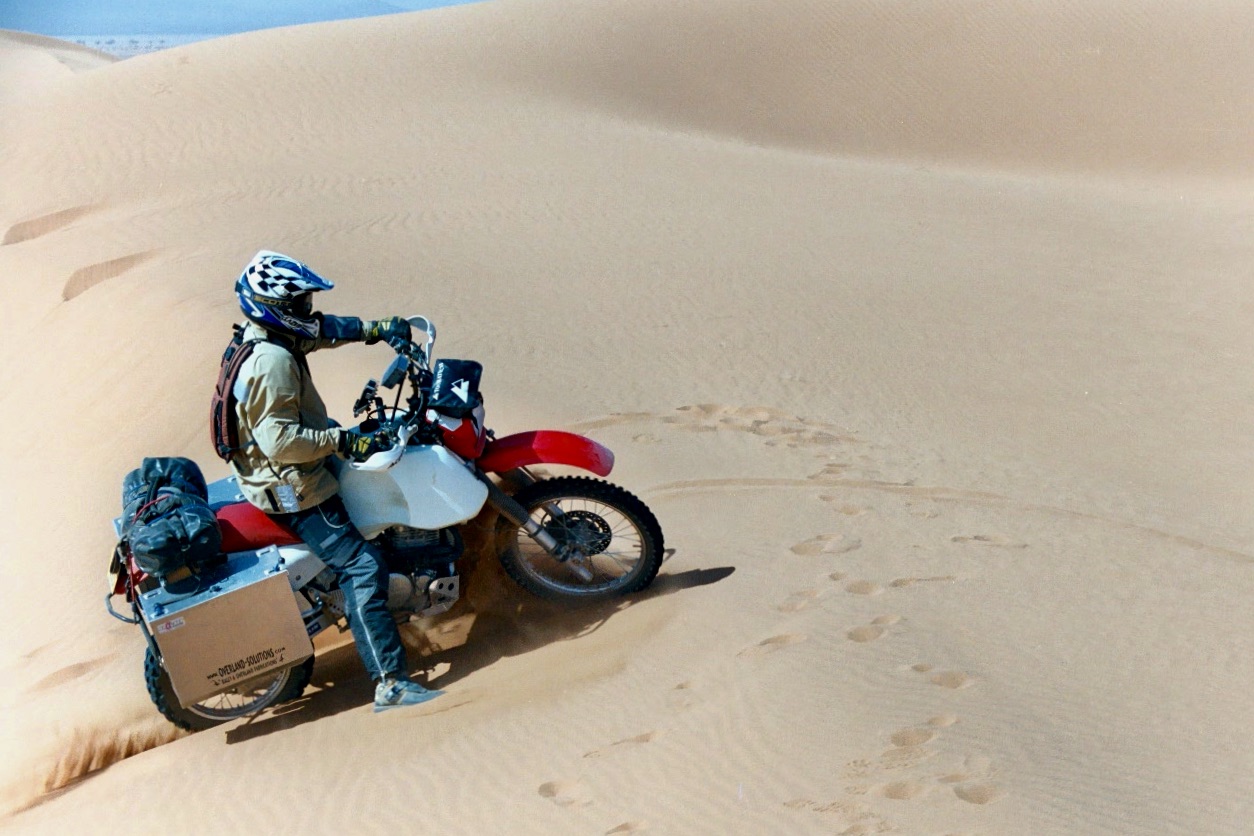
The film’s setting in a low-risk play area of small dunes drops the ante somewhat, but that’s probably where most curious big-bike riders would start – and very soon get it out of their system. Engaged in a long-distance travel adventure, like our 2003 Desert Riders trip across Algeria and into the Tenere Desert (below), I would add.

  • Avoid big dunes, where possible – it’s not a game
  • Keep out of sandy car ruts, where possible [rarely so, that’s why they form]
  • If you can’t, air down to 1.5 bar and deploy all the tips the video mentions
  • Air back up, asap (carry a good tyre pump)
  • Metal side cases? What were we thinking?! Go soft off road

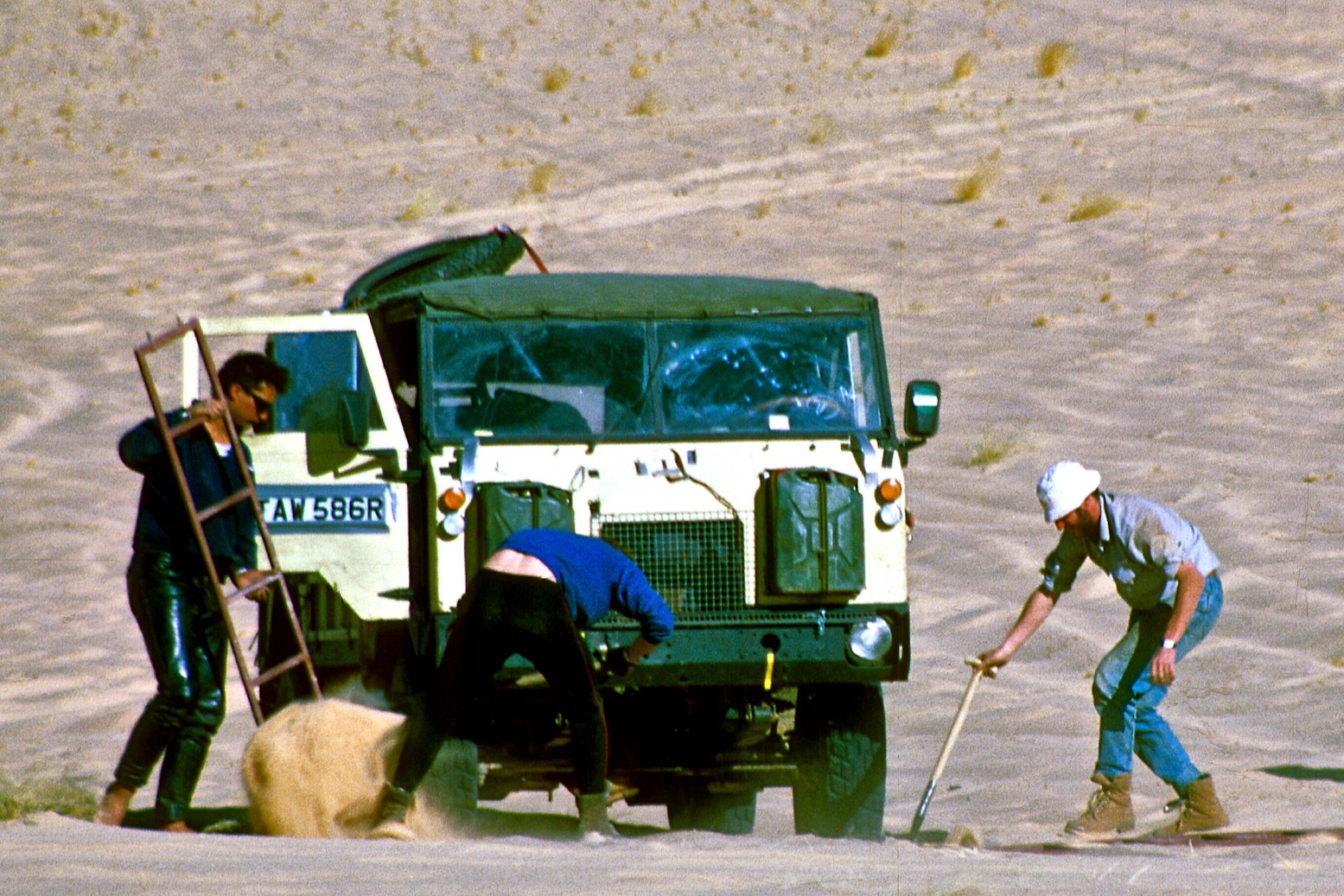
Overlanding in the desert, once you add the need to keep tabs on navigation, water, fuel and energy levels, your fellow riders, and even visa durations, it all becomes quite a challenge. Which is why, without support, you don’t want to add avoidable technical difficulties when it comes to terrain. Bike or 4×4, in my experience dunes are where all the accidents happen. That’s how Desert Riders ended for me ;-)

Morocco 2023 Fly & Ride film

By Mike D and Group T1, early November 2023.
A great souvenir of our one-week ride on G310GSs.