Author Archives: Chris S

The Men Who Ride Like Goats

… until Tizi n Telouet: there, all greenery ceases; the burning breath of southern winds denudes the mountain’s rocky skeleton.
Charles de Foucauld’s Reconnaissance au Maroc, 1883–1884

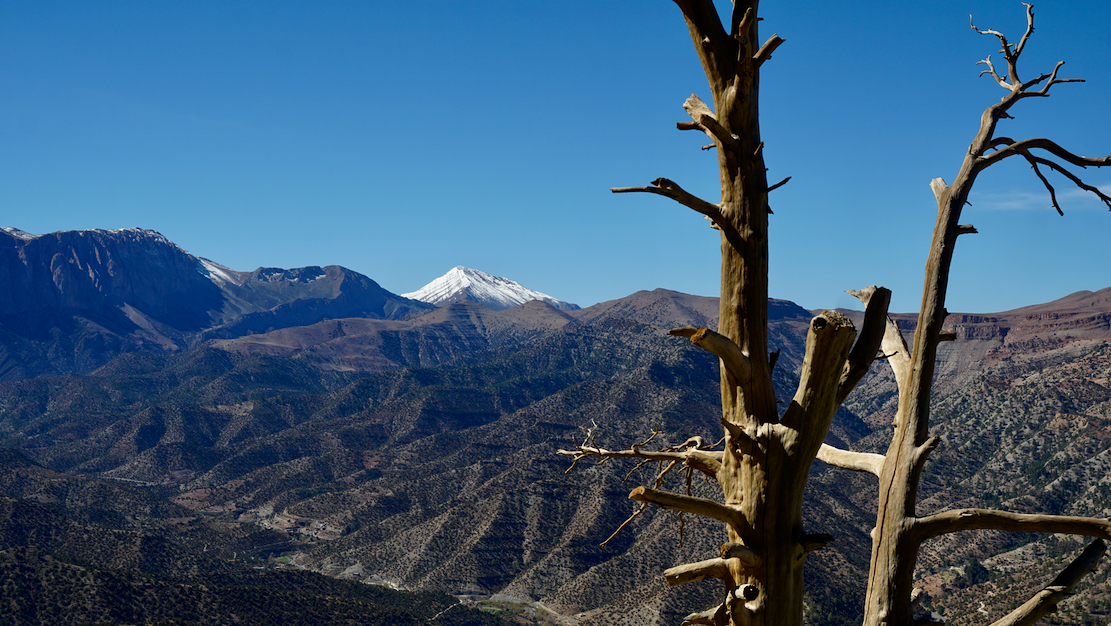
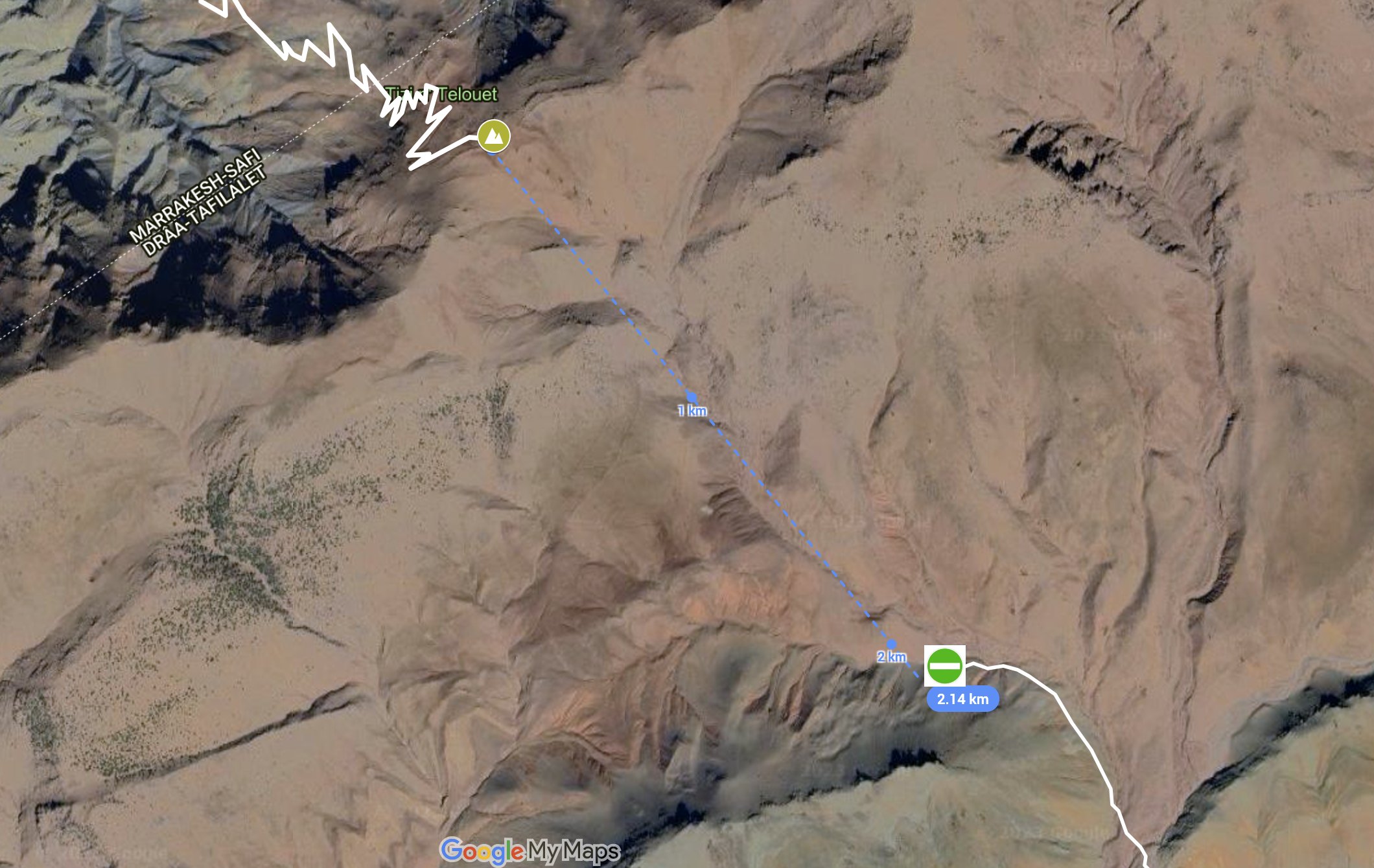
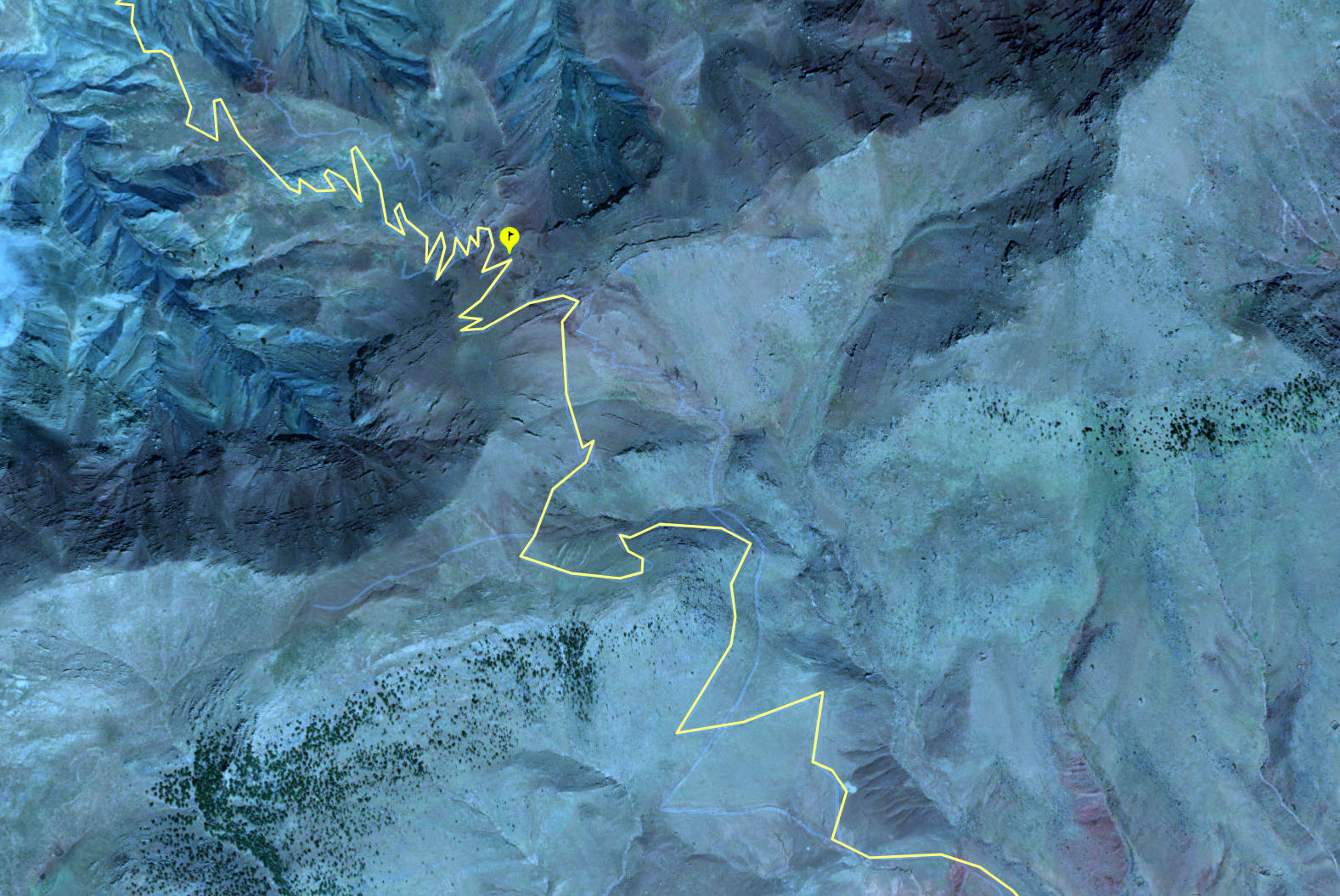
While scanning aerial mapping for new pistes in the High Atlas I came across an intriguing possibility. A seemingly good track lead 24km off the N9 via a village or two to the 2450-m Tizi Telouet pass on the High Atlas watershed (31.3372, -7.2663), a few miles east of the Tichka pass on the N9 trans Atlas. From that point southwards the way ahead was an obliterated mule path, but picked up rideable terrain in just two kilometres, with Telouet town visible nearby. Downhill on a light bike, walking where necessary, it might be doable, no? ‘Who wants to go first?’, I quipped on Twitter.

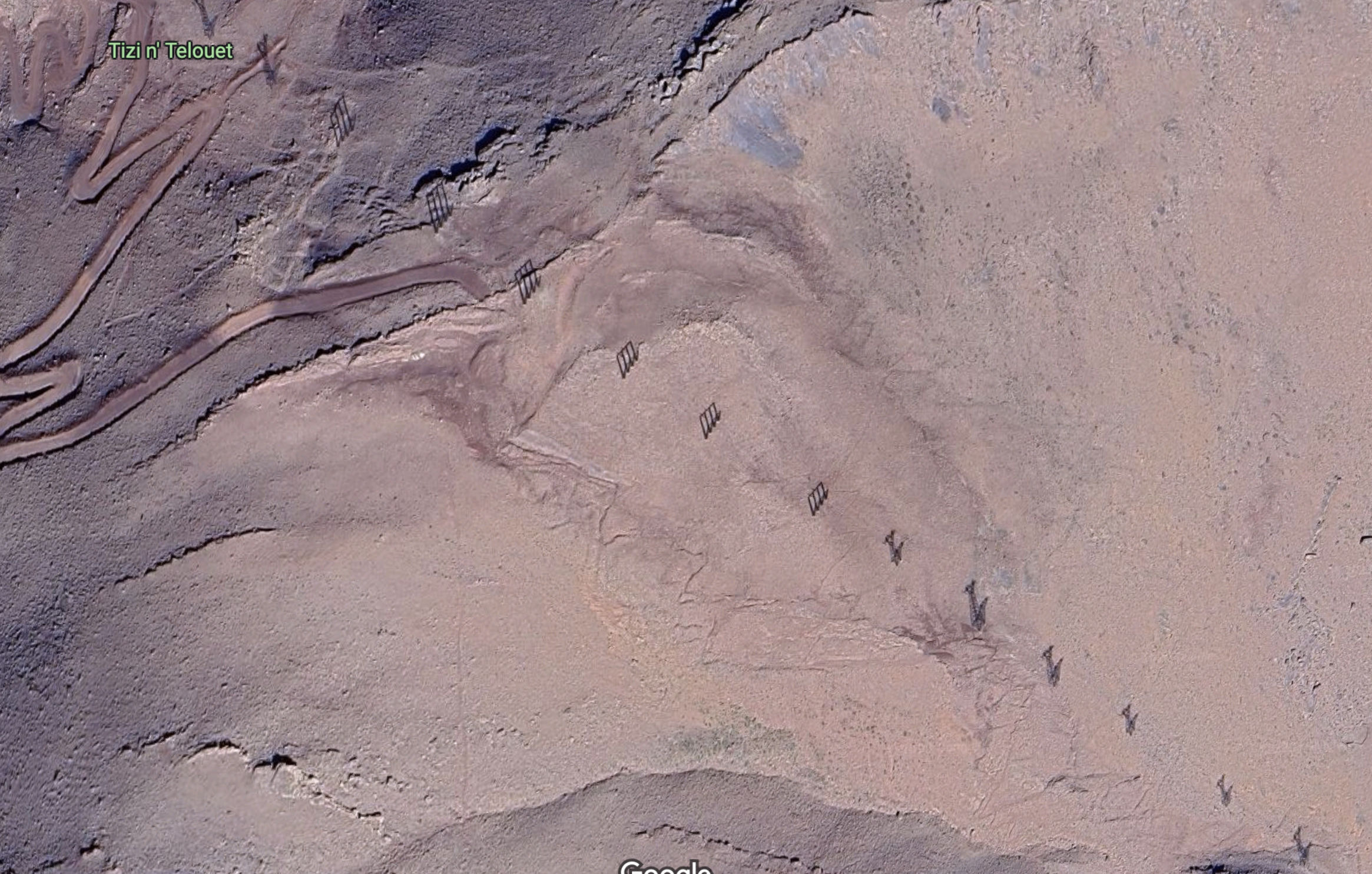
Once it was mule trains of salt from Telouet’s mines, but today, like the grand old Duke of York and his 10,000 men, a column of pylons marches up and over the col, bringing power from the massive Nour solar plant, 50km away near Ouarzazate.
You’d assume some sort of vehicle crawled up the slopes to erect the pylons, but no service track is evident on the south side. Still, at the very least, riding the switchbacks up to the col for a quick look might be possible. In my experience damage from water run-off gets less severe the higher you go, as the volume, momentum and sludge density all decrease with elevation. The real damage gets done down in the valleys.

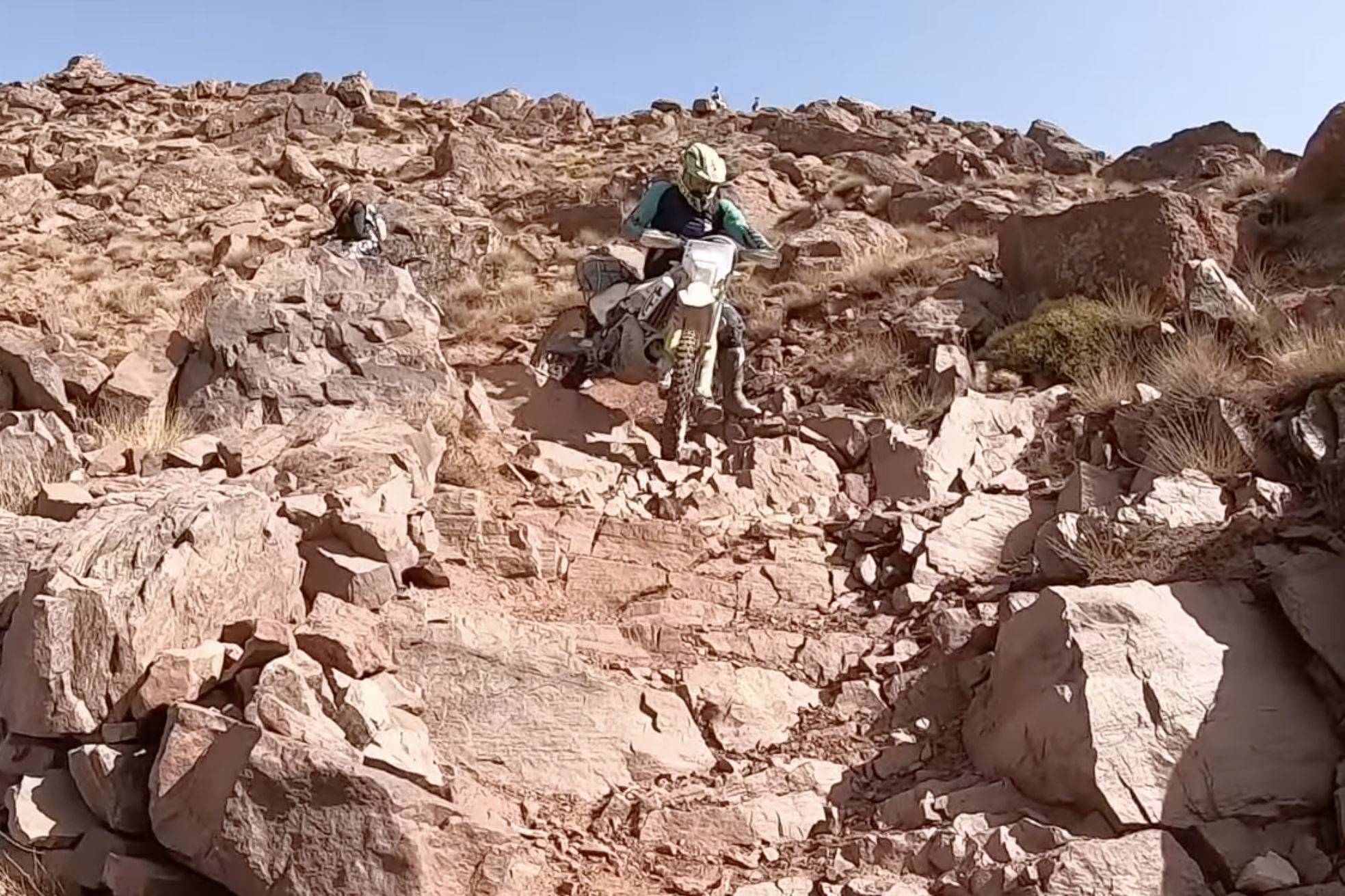
I mentioned this recce to a mate who’ll join me out there next week. He soon found some Spanish KTM-ers – a YT channel called Enduro Aventura – who pulled off the Tizi n’Telouet descent (and a whole lot more) in 2002, filmed it all and capped it off with a tracklog on Wikiloc, classified as ‘Very Difficult’.
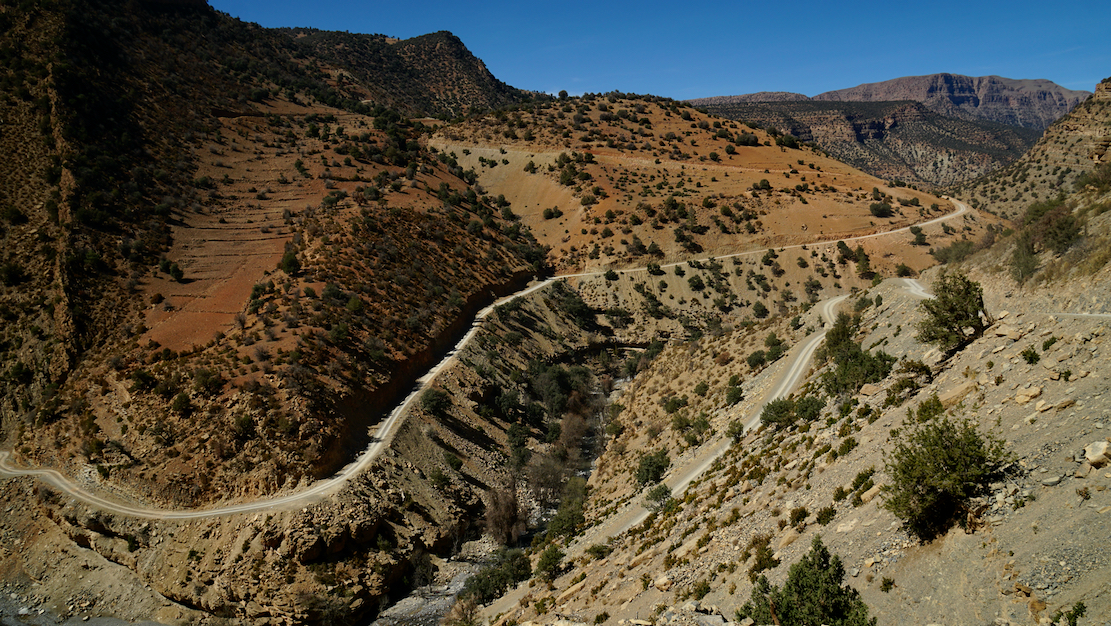
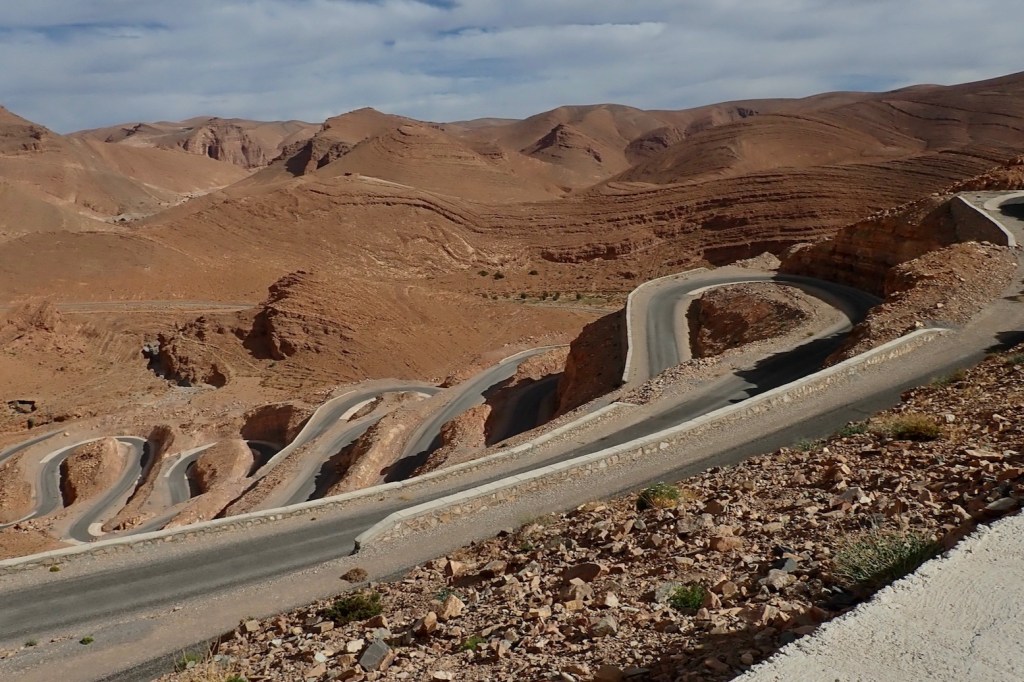
They call the Tizi Telouet ‘Collado Torretas’ or ‘tower/pylon col’? They confirm ‘the north face has been fixed with a track with a thousand curves and somewhat broken by the rain‘ but continue… ‘the south face on the way to Telouet is a narrow and broken trail with a lot of stones… This hill [trail] seems to be disappearing…‘. They speculate that a new road might get put in as the truncated northside track suggests, but I’ve found tracks or roads often come to a dead halt at provincial boundaries, which this watershed is. The col was just an efficient, ‘as-the-crow-flies’ route for the power cables from Nour to Marrakech.

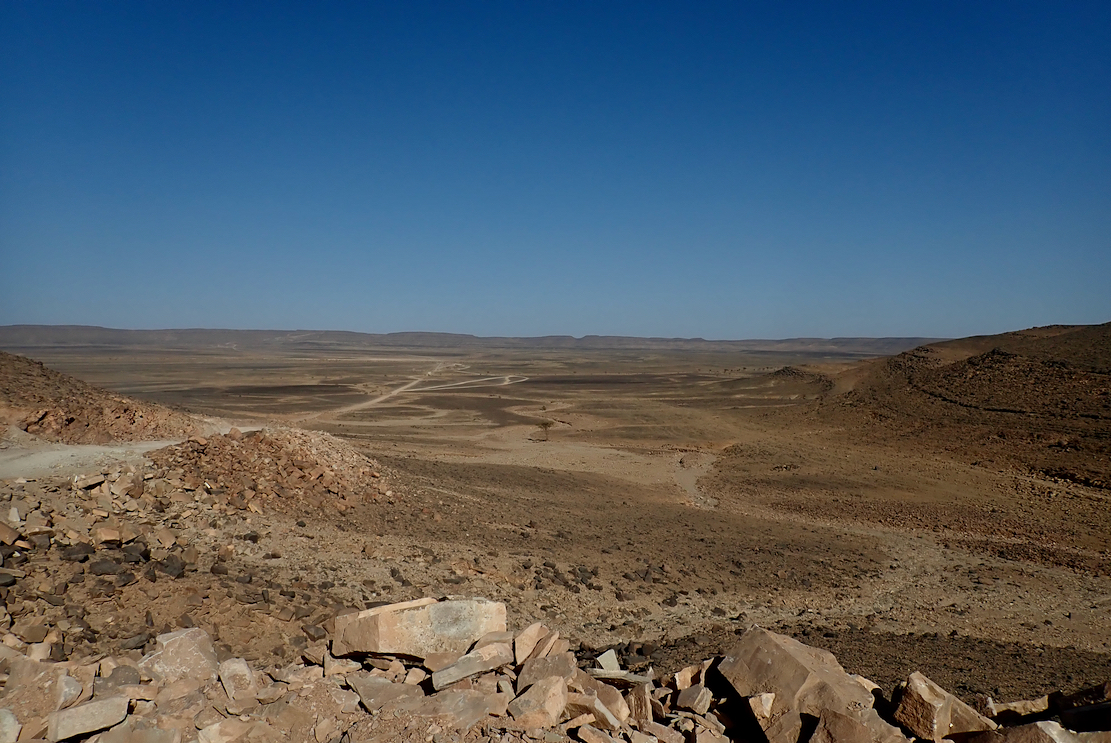
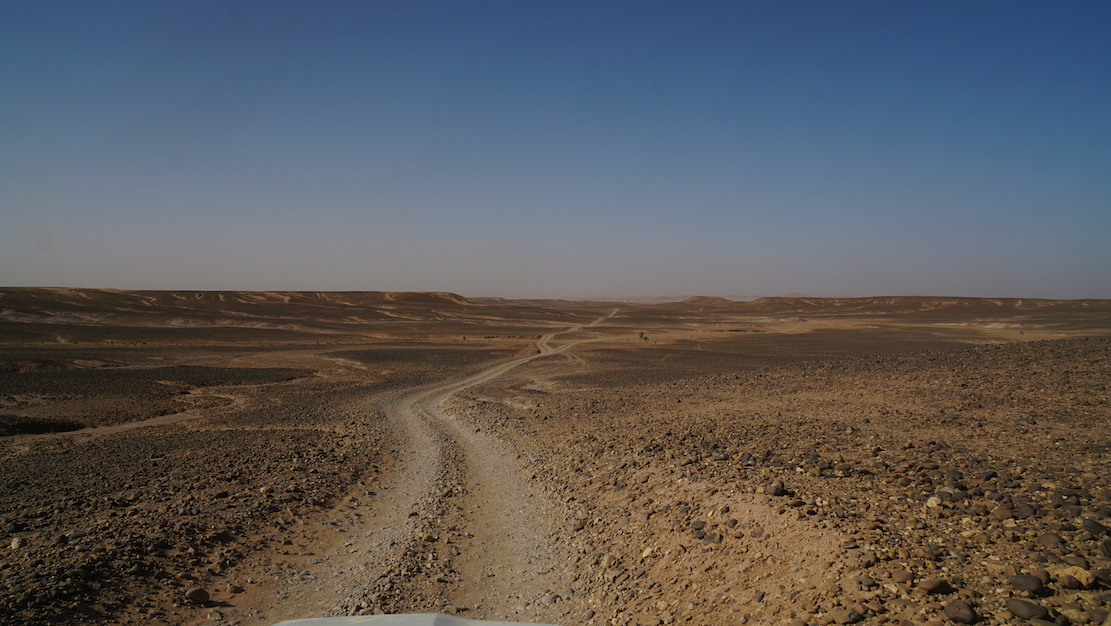
On the track to Tizi n’Telouet. Though we knew we’d never manage the descent with my 300L, let alone James’ 890, we had half a mind to reach the col for a look, so took the track at Ait n Amer off the N9. We did a few clicks but realistically, it was late in the day and we probably wouldn’t have got back to the N9 before dark.

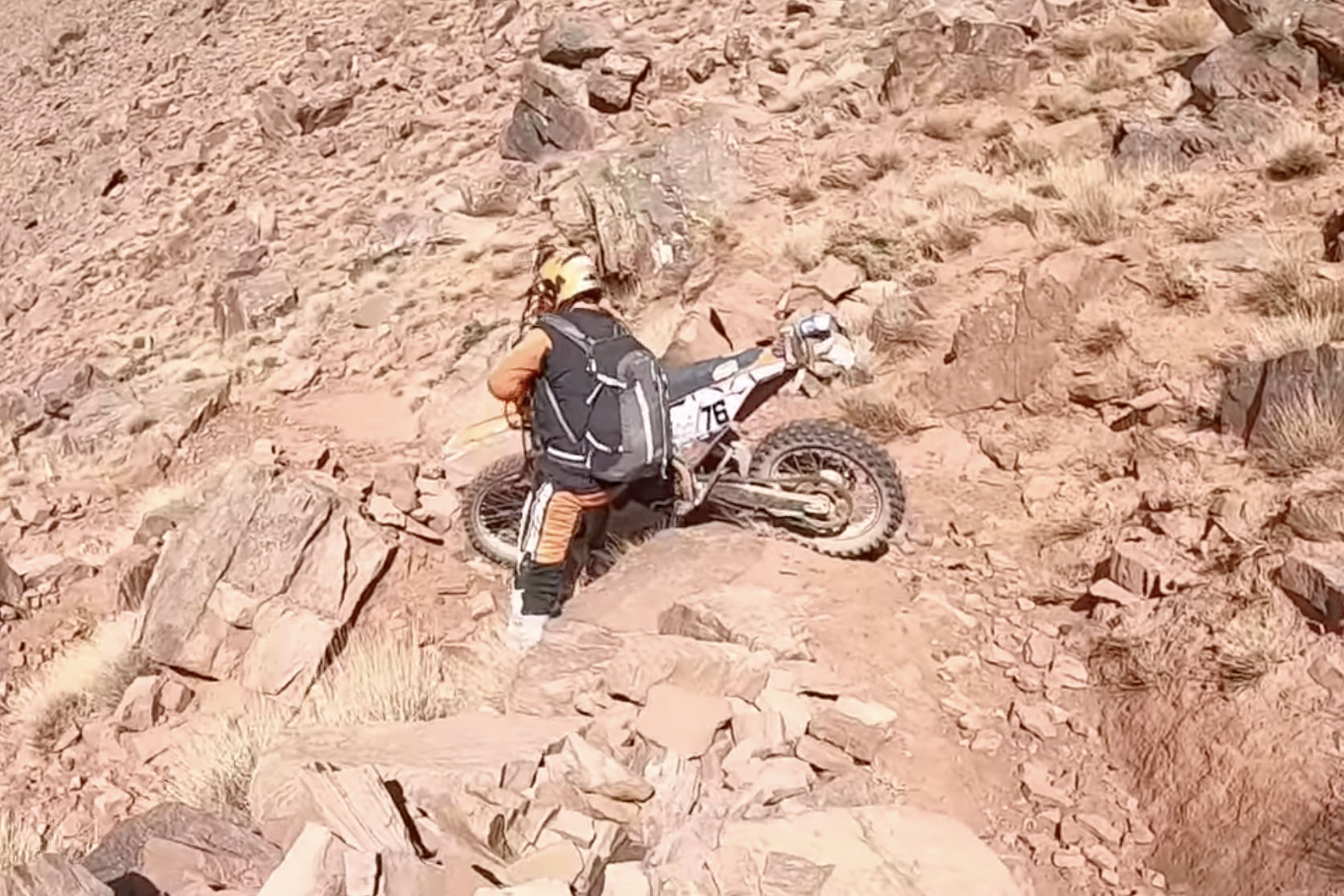
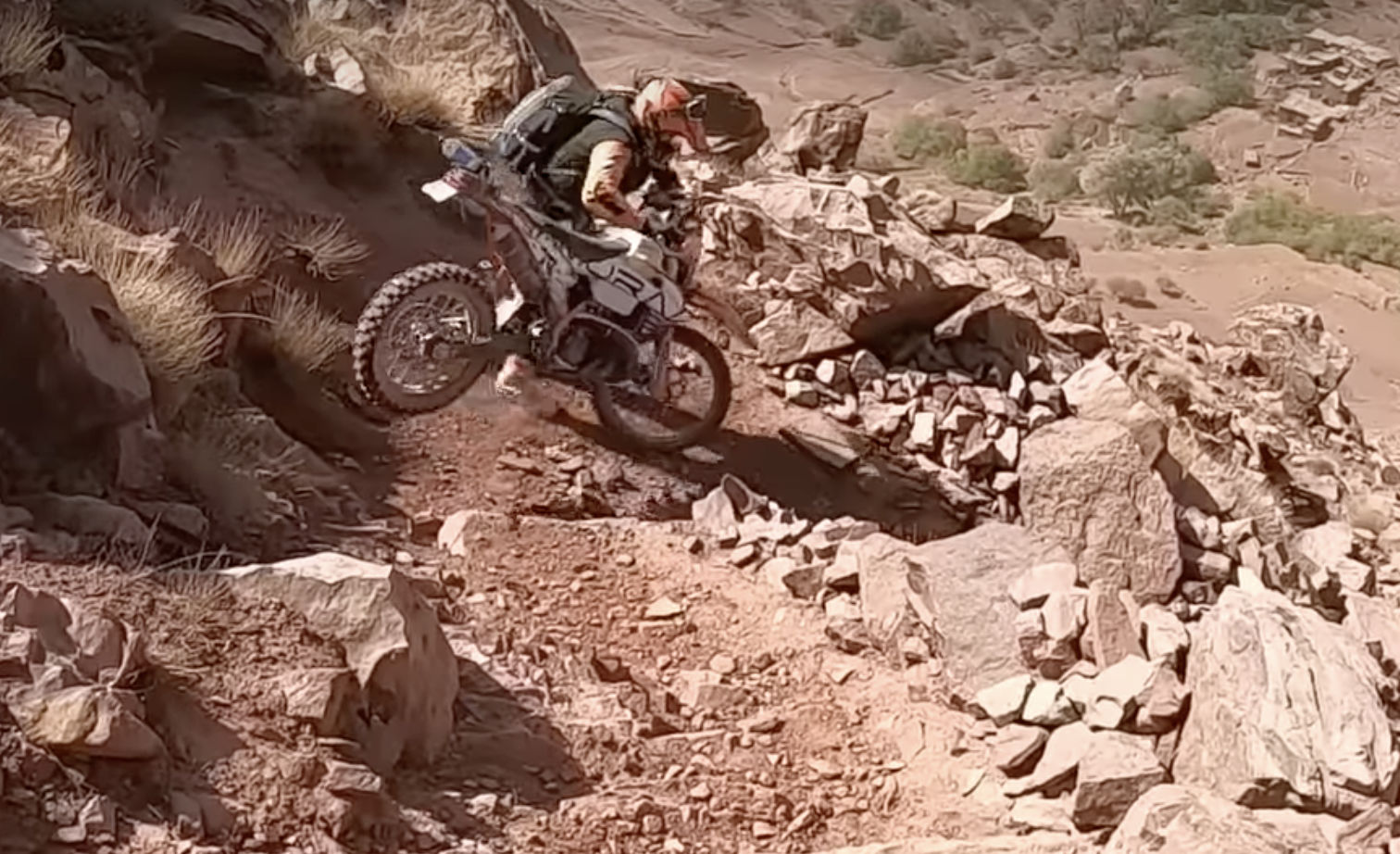
Their 80-minute vid below is timed to start at the Collado Torretas stage (covering just a few minutes). It’s soon turns gnarly af (stills above). But scan any other random minute in the vid and you’ll see just what light and lightly-loaded KTMs (including 2T) can achieve off-road in the hands of a fit and determined crew. You’ll be staggered to see what these guys blithely attempt. Chapeau to Enduro Aventura I say! The Men who Ride like Goats. Me, I think I’ll take the long way round.

Riding Sand

Just the right amount of momentum is key

As we all know, there are a lot of moto vlogging know-alls out there whose sketchy credentials don’t necessarily affect their channel’s popularity.
But in a well produced 9-minute vid on sand riding, this guy below gets it and keeps to the point. He won me over when he advised: ‘if you see a patch of sand on the road, avoid it if you can’; ‘hop off and push when you must’ and ‘you can get away with less airing down on knobbly tyres’ [because traction is innately better].
That said, I don’t know what GS12 tyres runs normally, but I was surprised he recommended two bar (29psi) on the sands. Even just 5psi less would make a big difference, but perhaps that bike’s huge weight has something to do with it. I bet there’s at least another 9 minutes of bogged-down outtakes ;-)

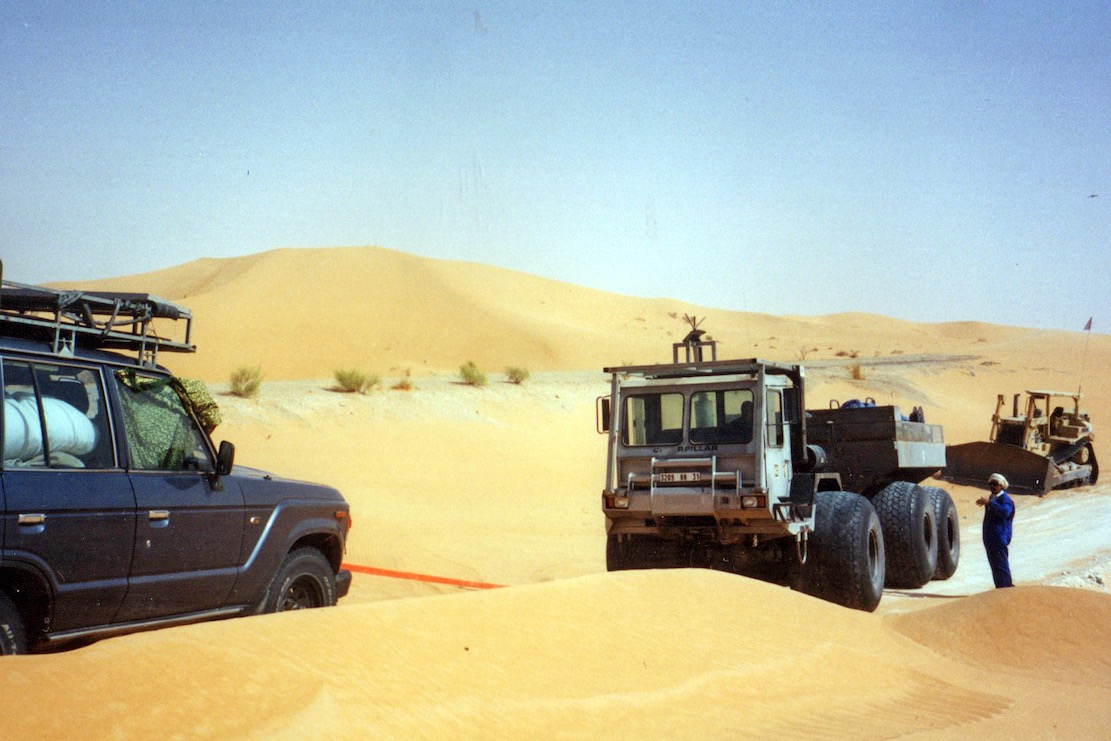
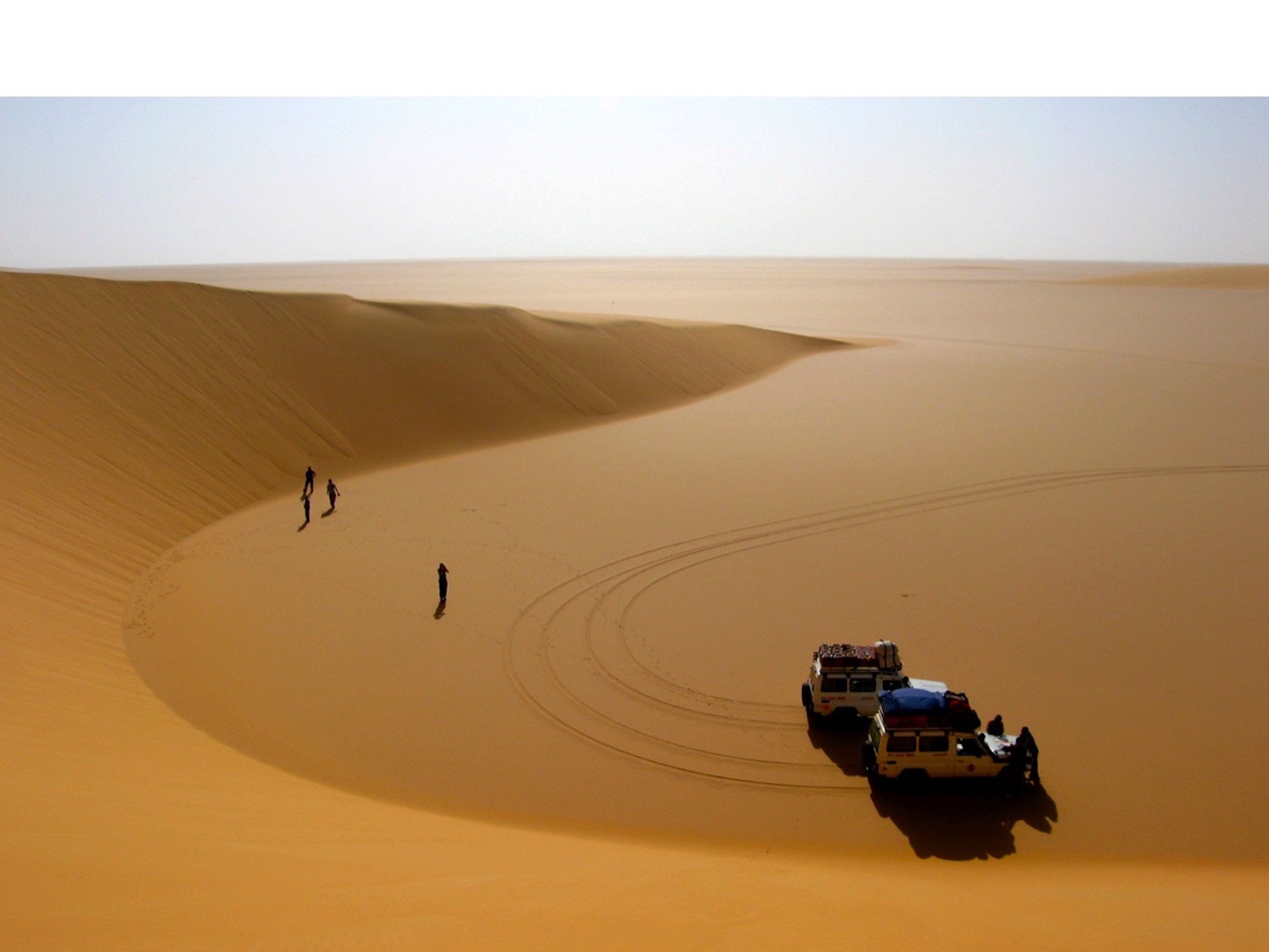
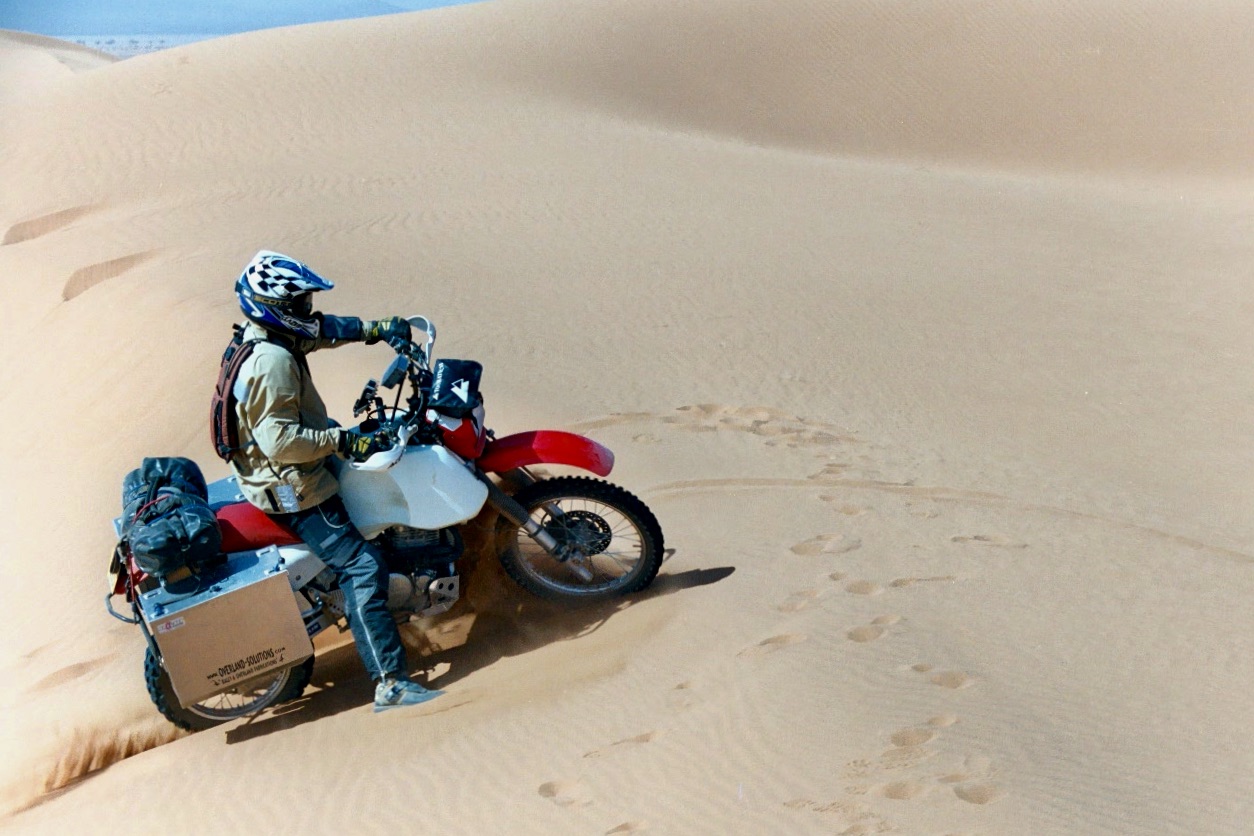
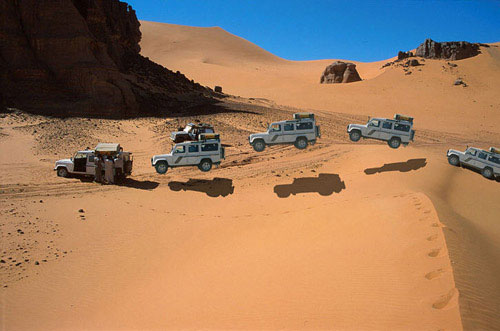
The film’s setting in a low-risk play area of small dunes drops the ante somewhat, but that’s probably where most curious big-bike riders would start – and very soon get it out of their system. Engaged in a long-distance travel adventure, like our 2003 Desert Riders trip across Algeria and into the Tenere Desert (below), I would add.

  • Avoid big dunes, where possible – it’s not a game
  • Keep out of sandy car ruts, where possible [rarely so, that’s why they form]
  • If you can’t, air down to 1.5 bar and deploy all the tips the video mentions
  • Air back up, asap (carry a good tyre pump)
  • Metal side cases? What were we thinking?! Go soft off road

Overlanding in the desert, once you add the need to keep tabs on navigation, water, fuel and energy levels, your fellow riders, and even visa durations, it all becomes quite a challenge. Which is why, without support, you don’t want to add avoidable technical difficulties when it comes to terrain. Bike or 4×4, in my experience dunes are where all the accidents happen. That’s how Desert Riders ended for me ;-)

Tom Sheppard interviewed by Scott Brady

See also
Sahara West to East

Fascinating interview with desert explorer and overlanding author, Tom Sheppard by Scott Brady from Overland Journal.

Morocco 2023 Fly & Ride film

By Mike D and Group T1, early November 2023.
A great souvenir of our one-week ride on G310GSs.

Dacia Duster rental in Morocco 2

See also
Dacia Duster 1
Toyota Prado TXL

Dustering

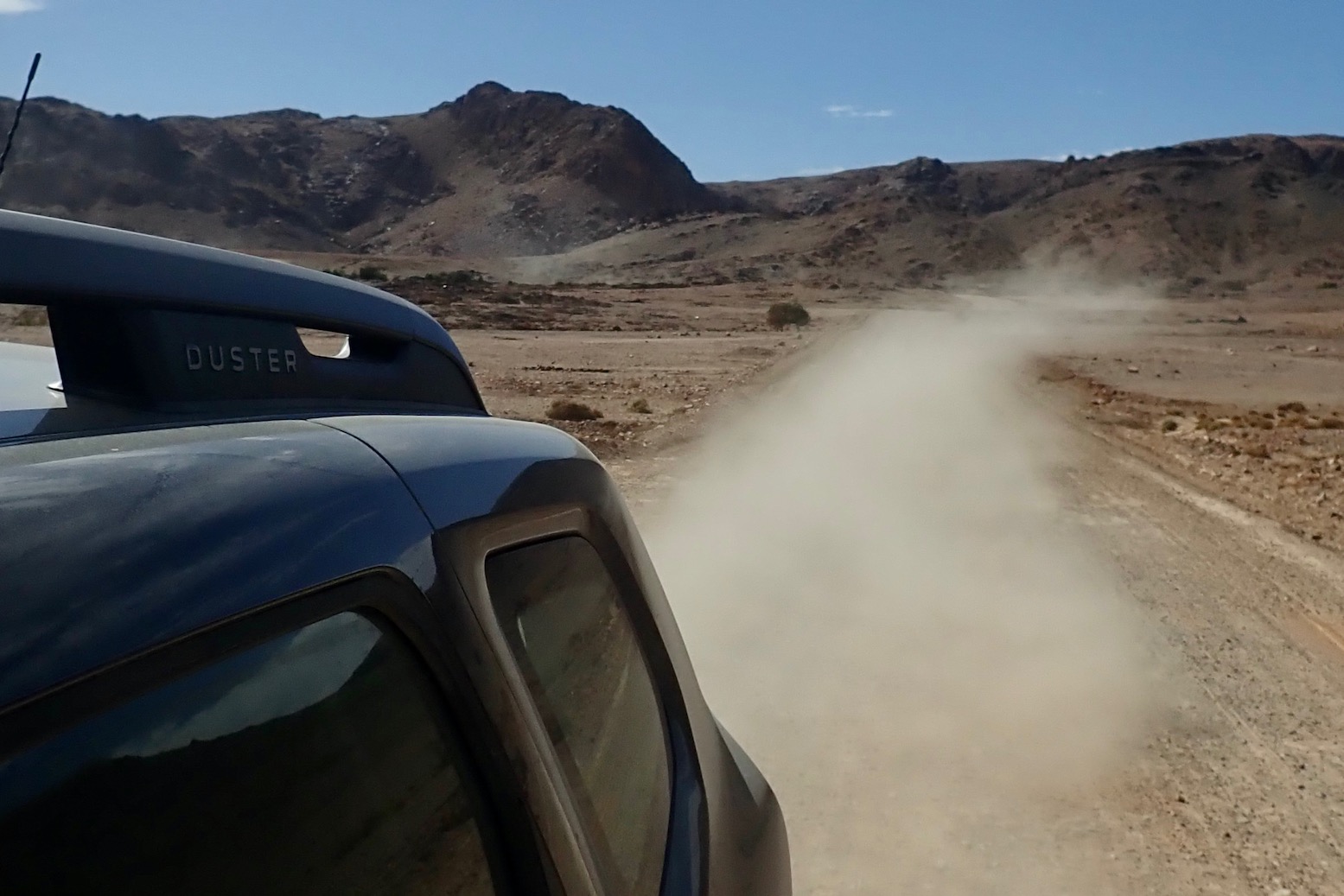
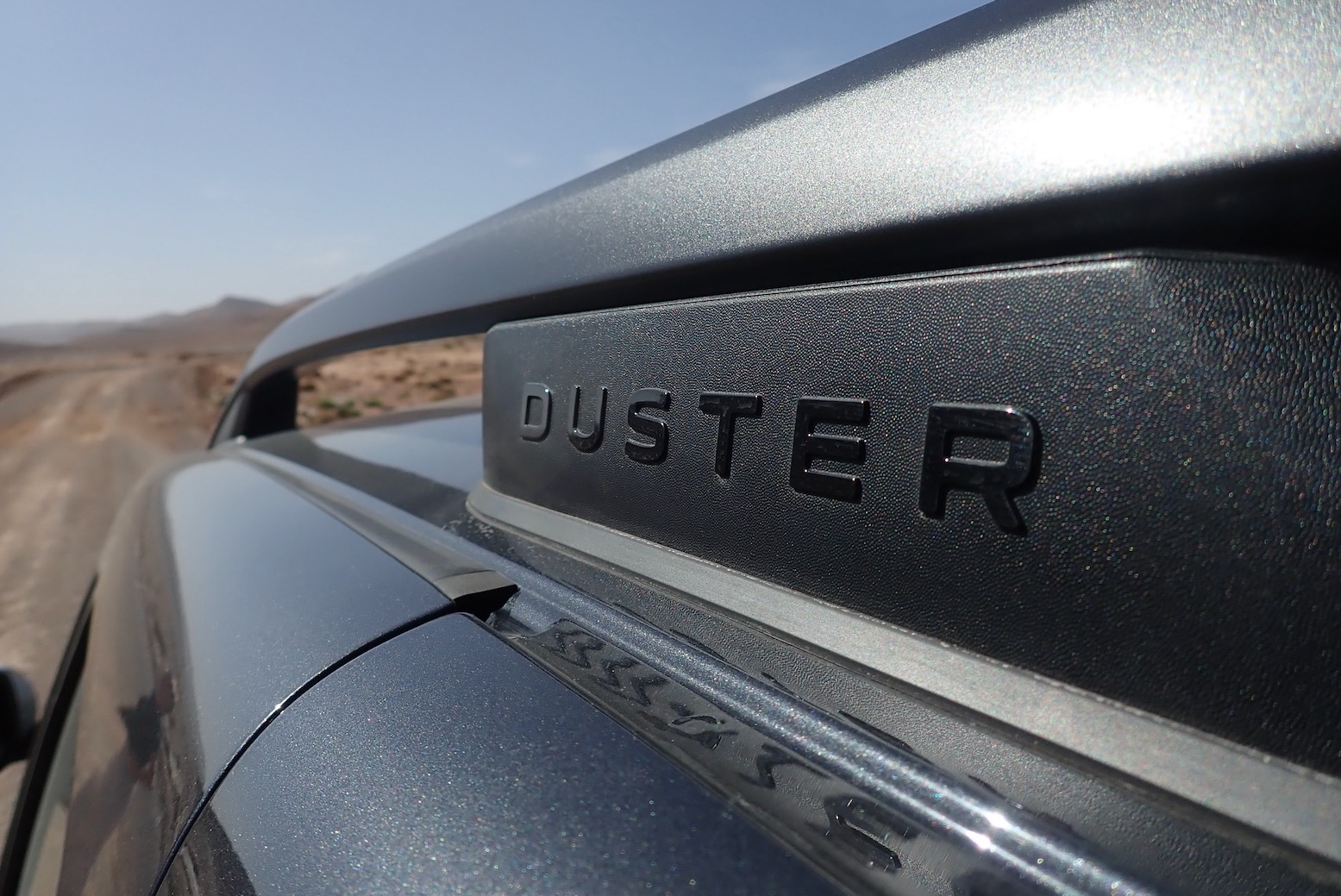
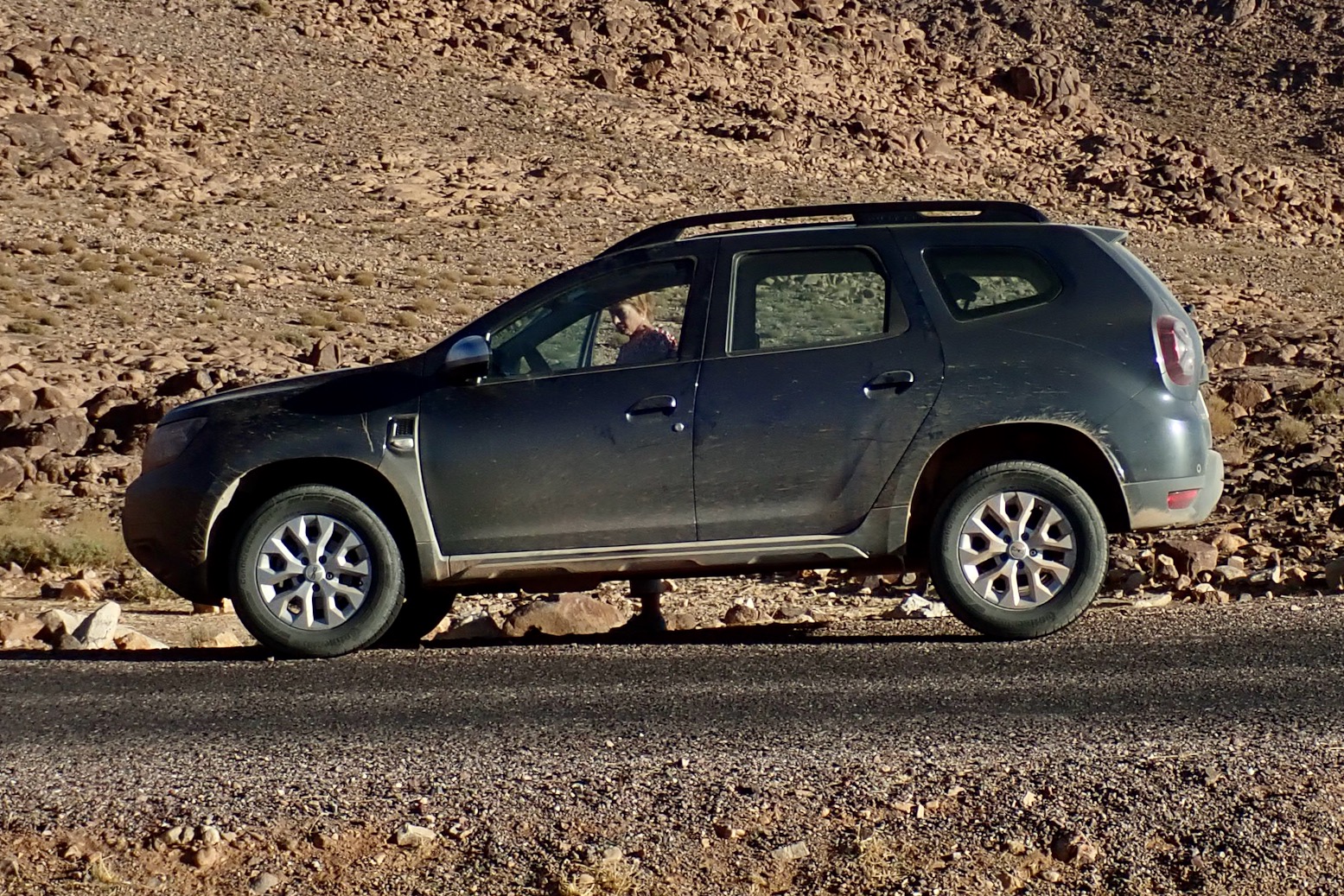
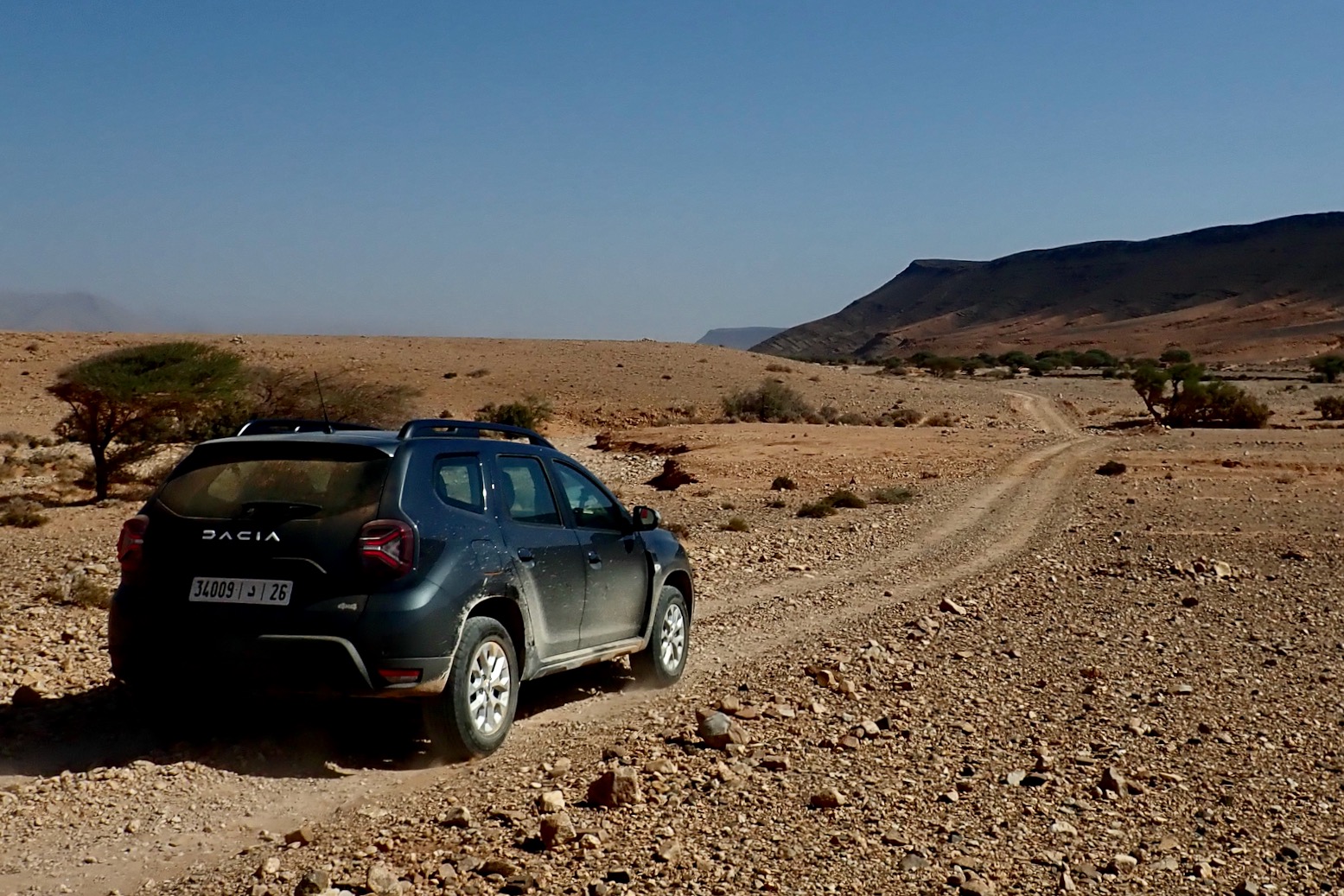
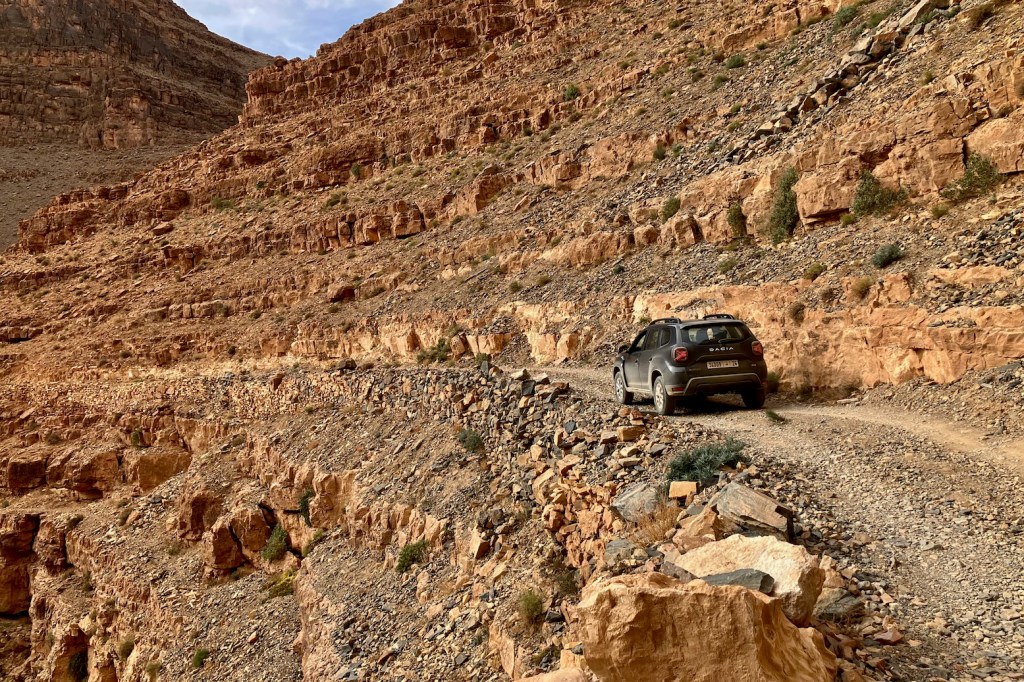
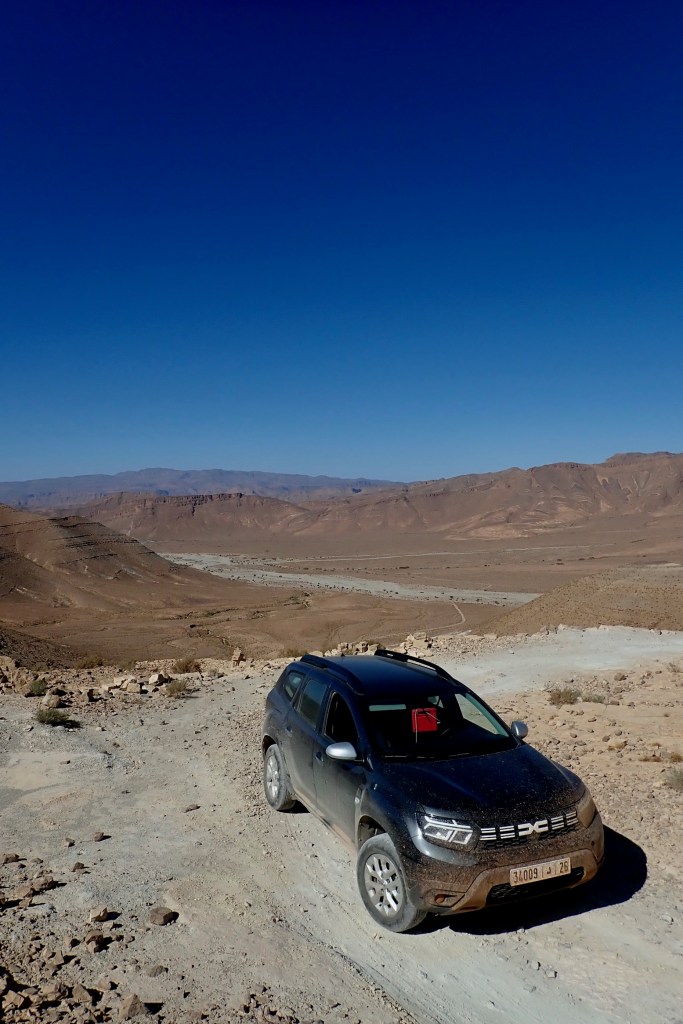
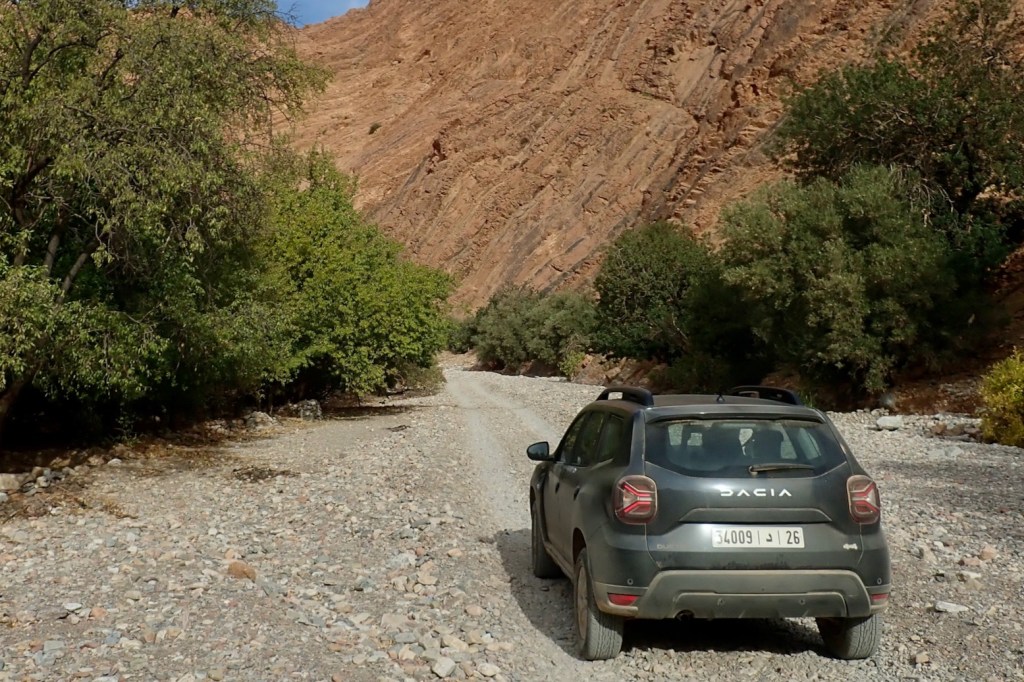
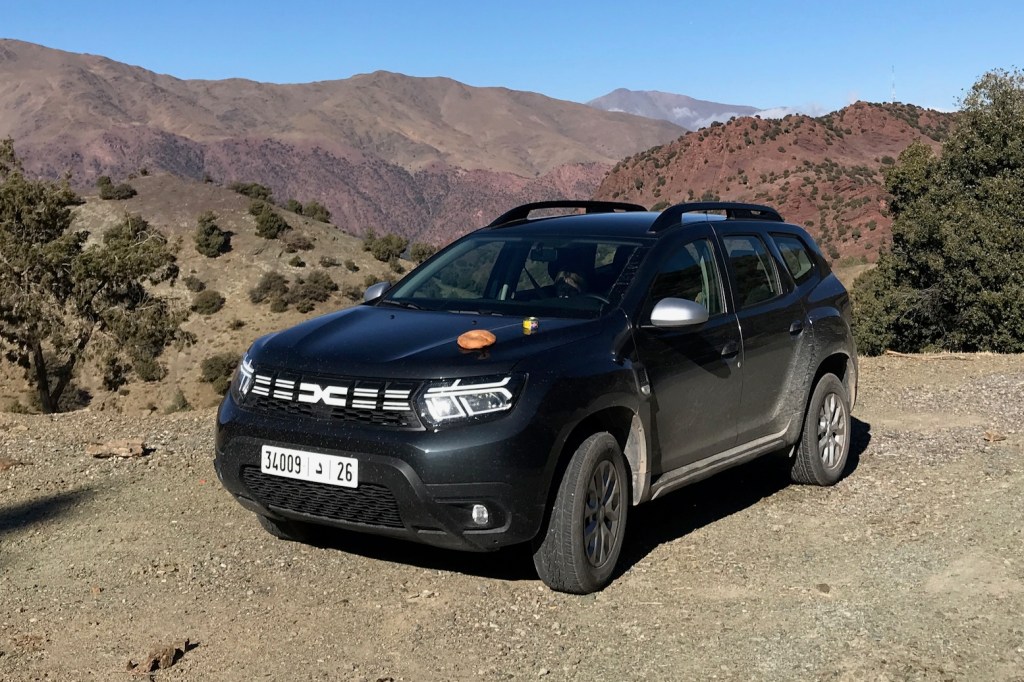
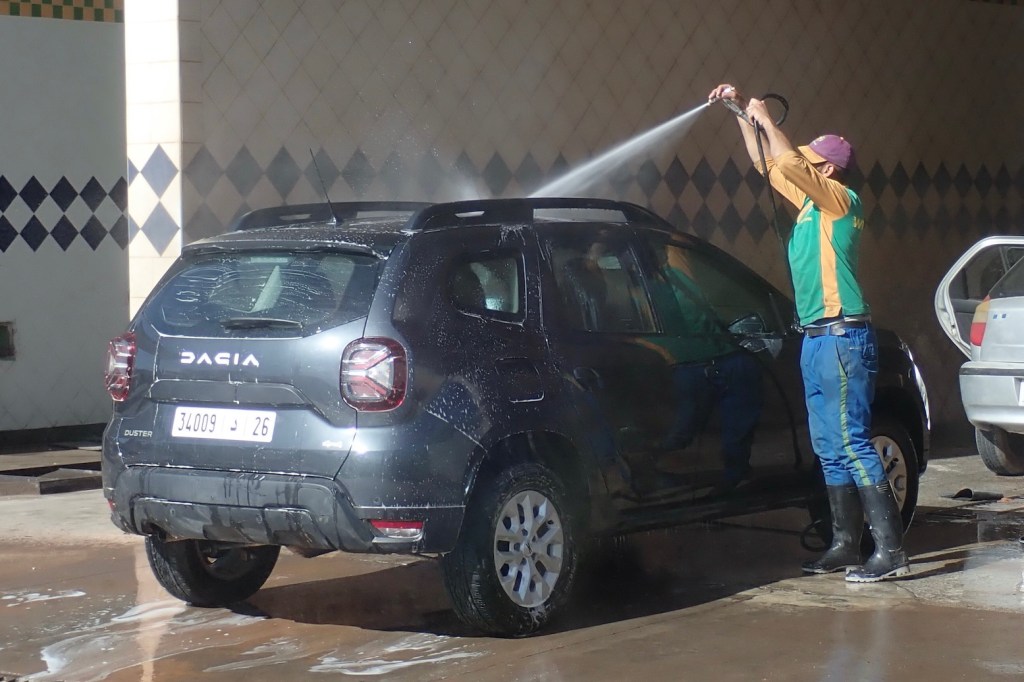
In November the Mrs flew in between my moto tours and we hired another Morocco-built Duster from Medloc Marrakech to scout routes for the M4 book, covering the western corner of Morocco to the Atlantic and within an hour of Smara. Only this time they had a 2023 model with just 14,000km on the clock, but still just €65 a day – about half the price of a Toyota TXL.
For more on the rental experience and my unchanged pros and cons, read Duster 1 from earlier this year when we drove a 100,000-km far, but got little done due to preceding rains having damaged many roads and tracks. By the time we got this newer model all the tracks we tried to do and more were in great shape, and so were able to push the car less hard.

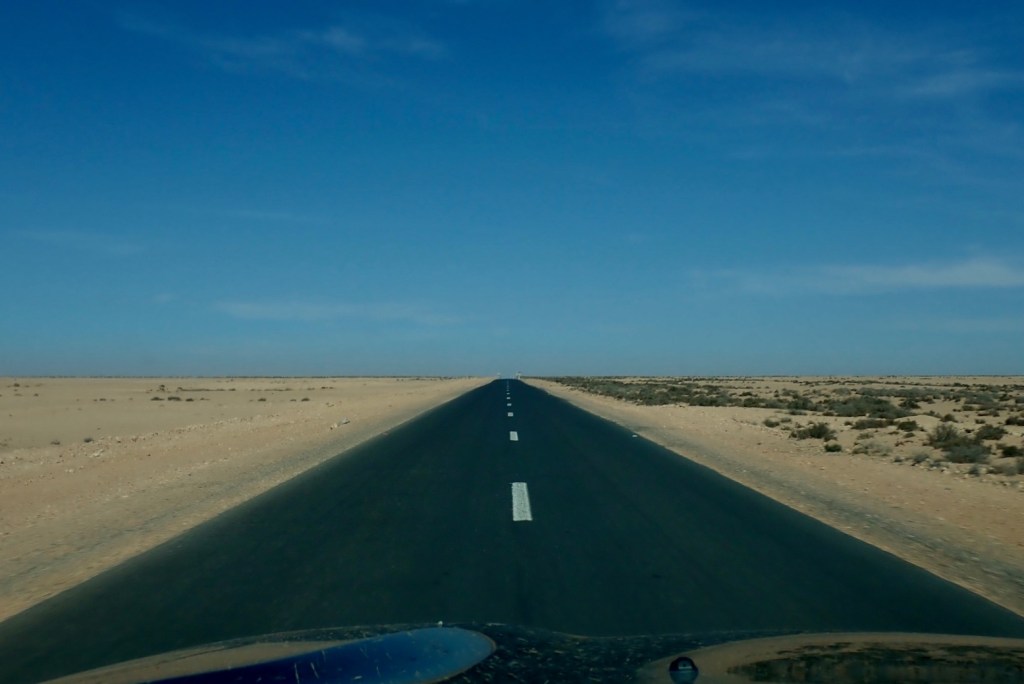
A Duster can restore you cynicism in the SUV craze by having genuinely utility on regular tracks (but see below), plus enough power to sit at 130kph on the desert highway – as fast as you’d want to go with camels roaming about. At the same time it’ll reliably do up to 45mpg or 15kpl giving a massive 800km range. And these modern diesels are quite amazing: torquey, quiet and nippy. With an auto box it would have been even better.

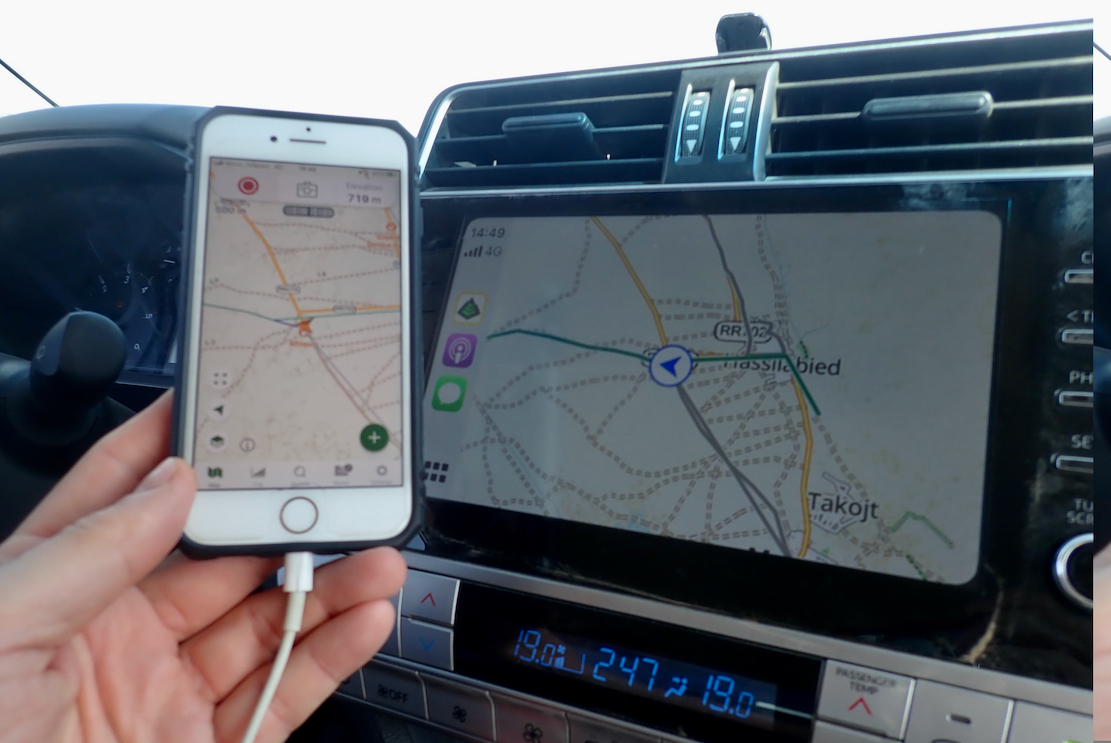
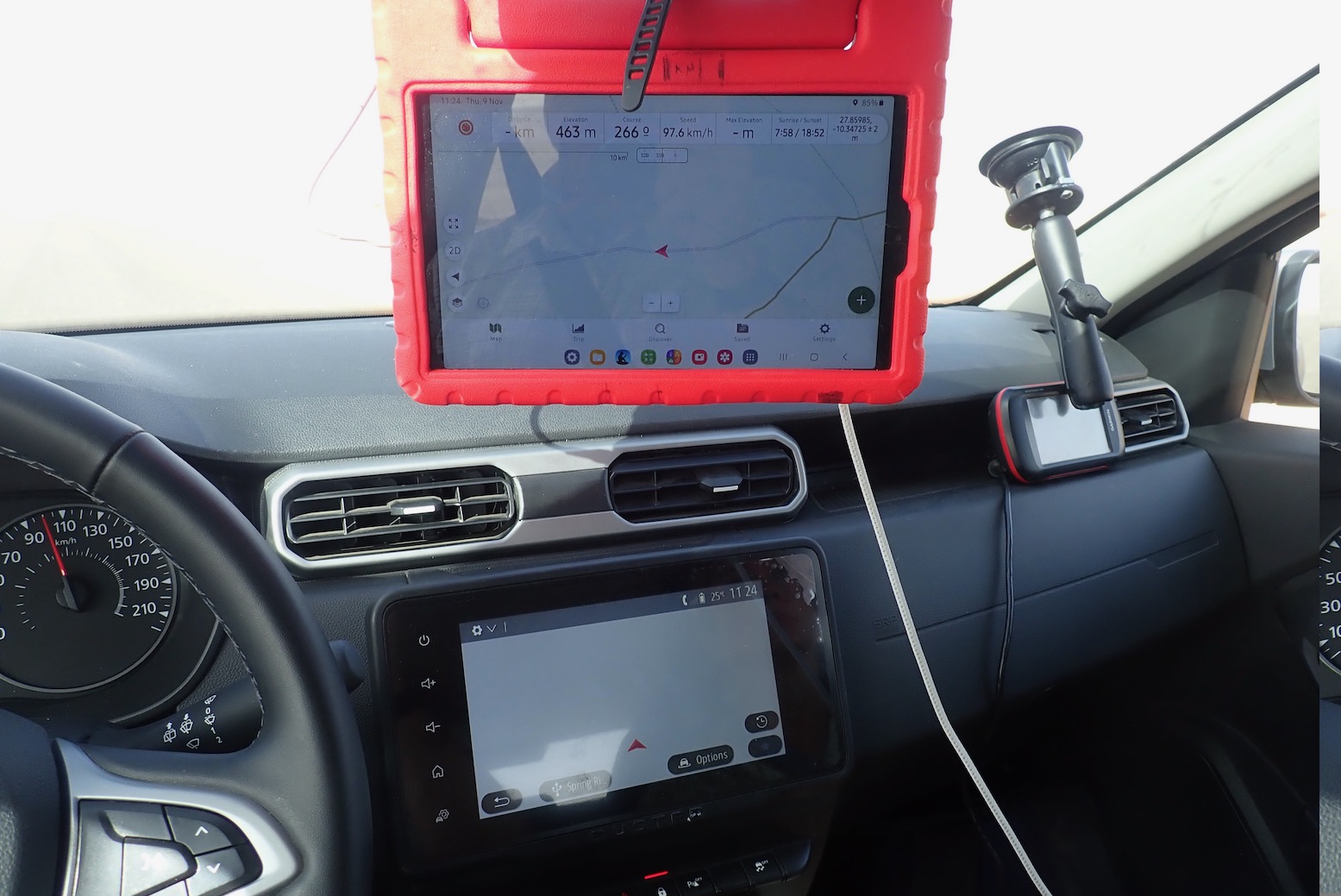
On our one the air-con actually cooled properly which was a relief, the switches and dash have been re-organised, but the fitted satnav was bogus. Yes there was a map displaying our position on an unnamed road or track most of the time, but there was no other info at all and no routing function. This confused us until we read you have to visit the Renault (Dacia’s owners) website to download a map/app? onto a USB stick or some such. You couldn’t even pair a smartphone screen (or we failed). Be warned: unless we got something wrong you will need your own nav device. We had my Garmin Montana, as well as a more readable Samsung tablet running Gaia maps (above). I did happen to have my music on a USB stick and that system worked intuitively, through the speakers are not the best.There was music pairing off one iPhone too.

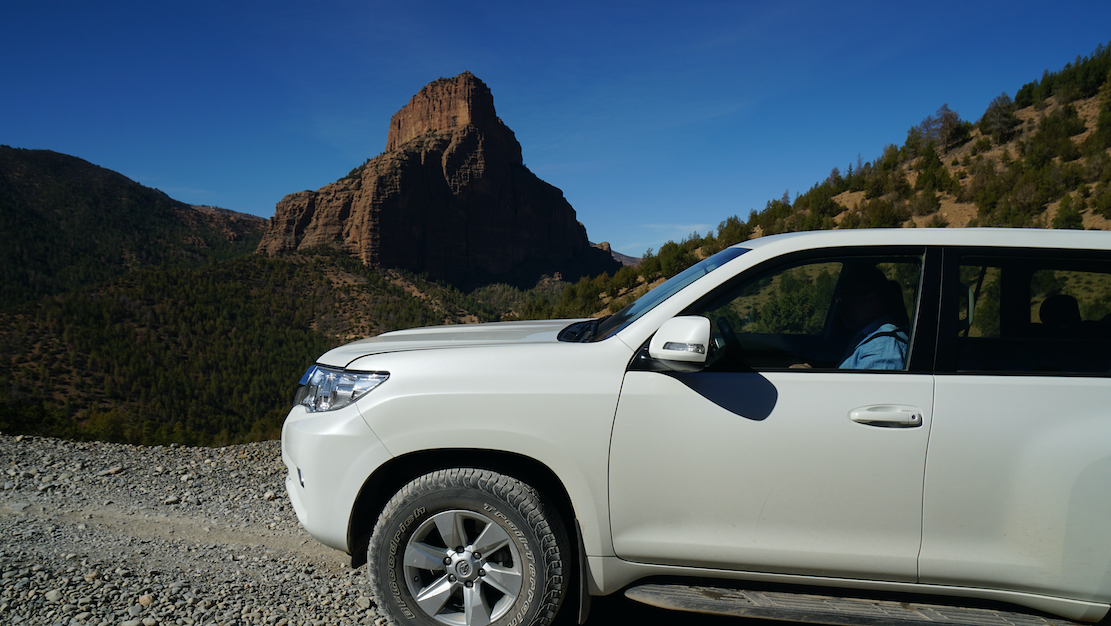
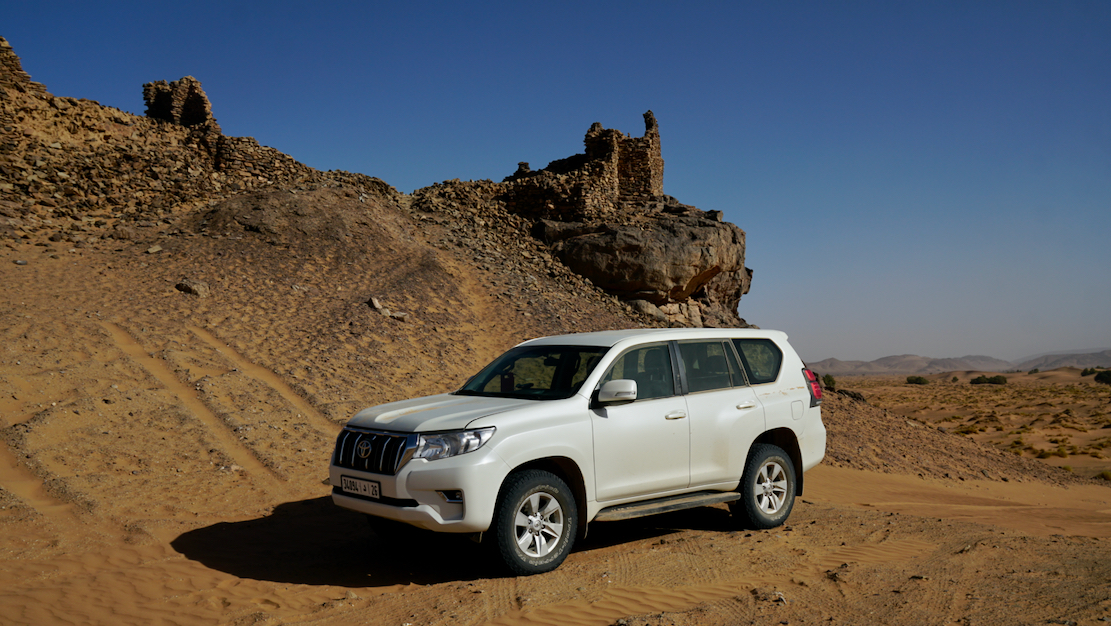
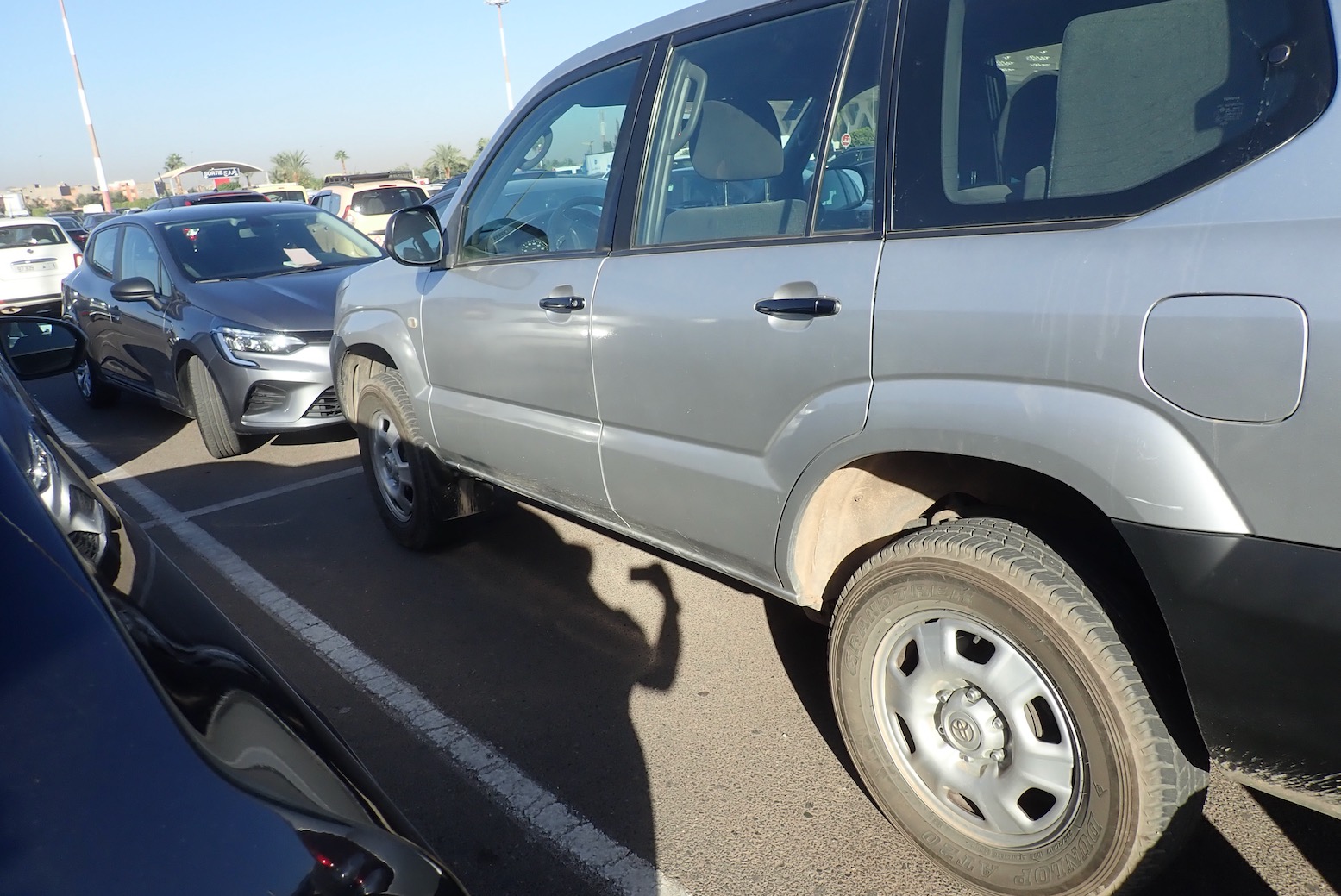
Toyota’s Prado TXL is the other main 4×4 rental in Morocco but tough though it may be by reputation, the autos can be comparatively portly slugs and unless lifted (left), are also bottom scrapers.
As it is, I’d not be surprised if the 1.5 litre, 110-hp 6-speed TD Duster has a superior power to weight ratio than a TXL. It certainly takes off and overtakes effortlessly out on the road and handles bends well thanks to anti-roll bars. Only for deep sand or exceedingly rocky climbs – rare or avoidable in Morocco – might a Prado’s Low Range be needed.

Within hours we got a flat on the ropey Tizi n Test road, luckily just as we stopped in Ijoukak for supplies and close to a tyre repair shop. This was a bit worrying on the road; were the Continental tyres cheapies? I had the means to plug flats with a spike/worm, but better to get a shop to remove a tyre and vulcanise a patch from the inside.

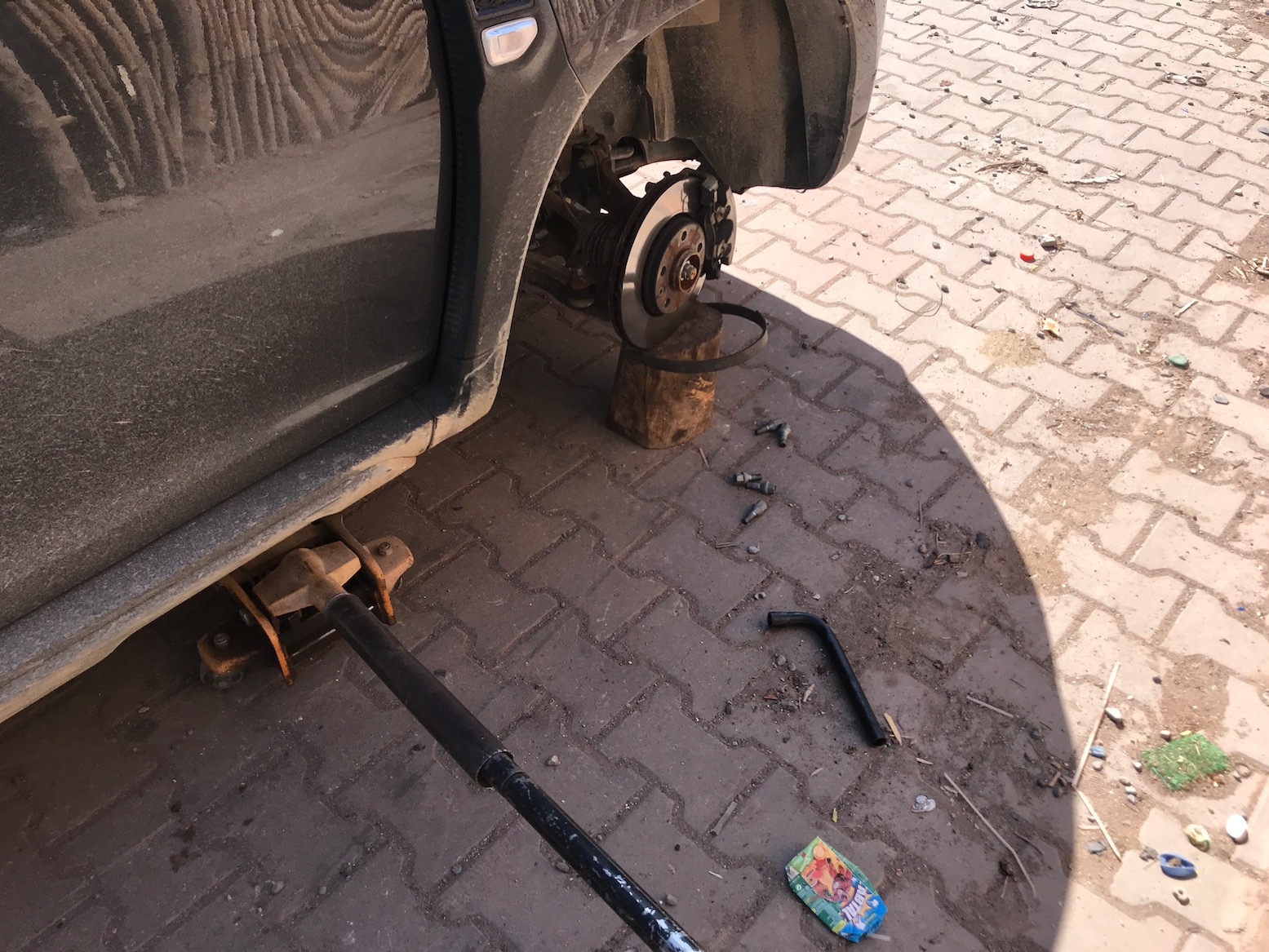
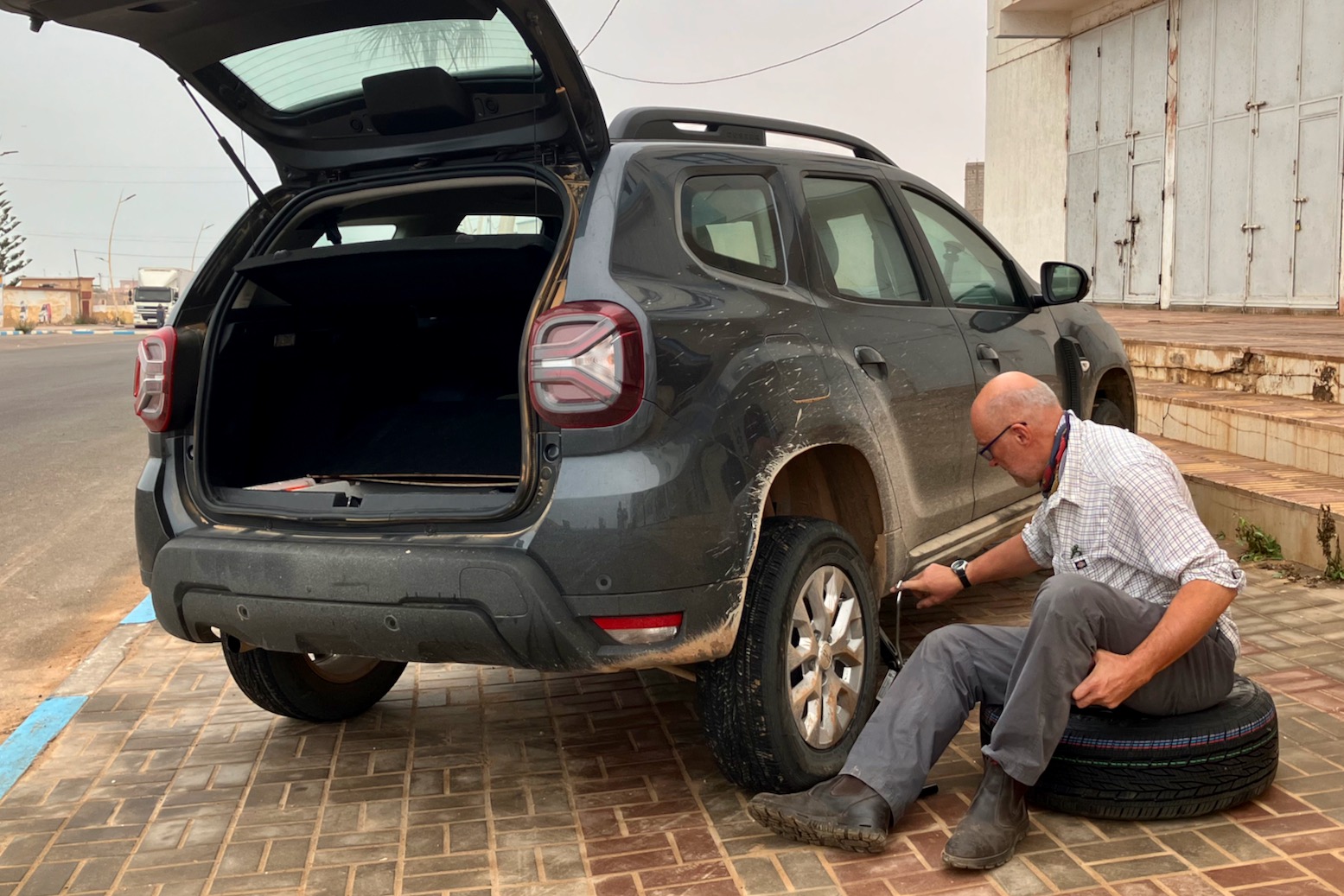
We had another flat in Tan Tan Plage which needed the spare fitting to drive to the tyre shop. This spare is speed limited to 120kph which seems fast enough, and looked the same size tyre, but on a steel rim.
Note that the scissor jack has only just enough reach to lift the rear, and be careful about positioning it correctly until the metal sill, not the plastic trim.

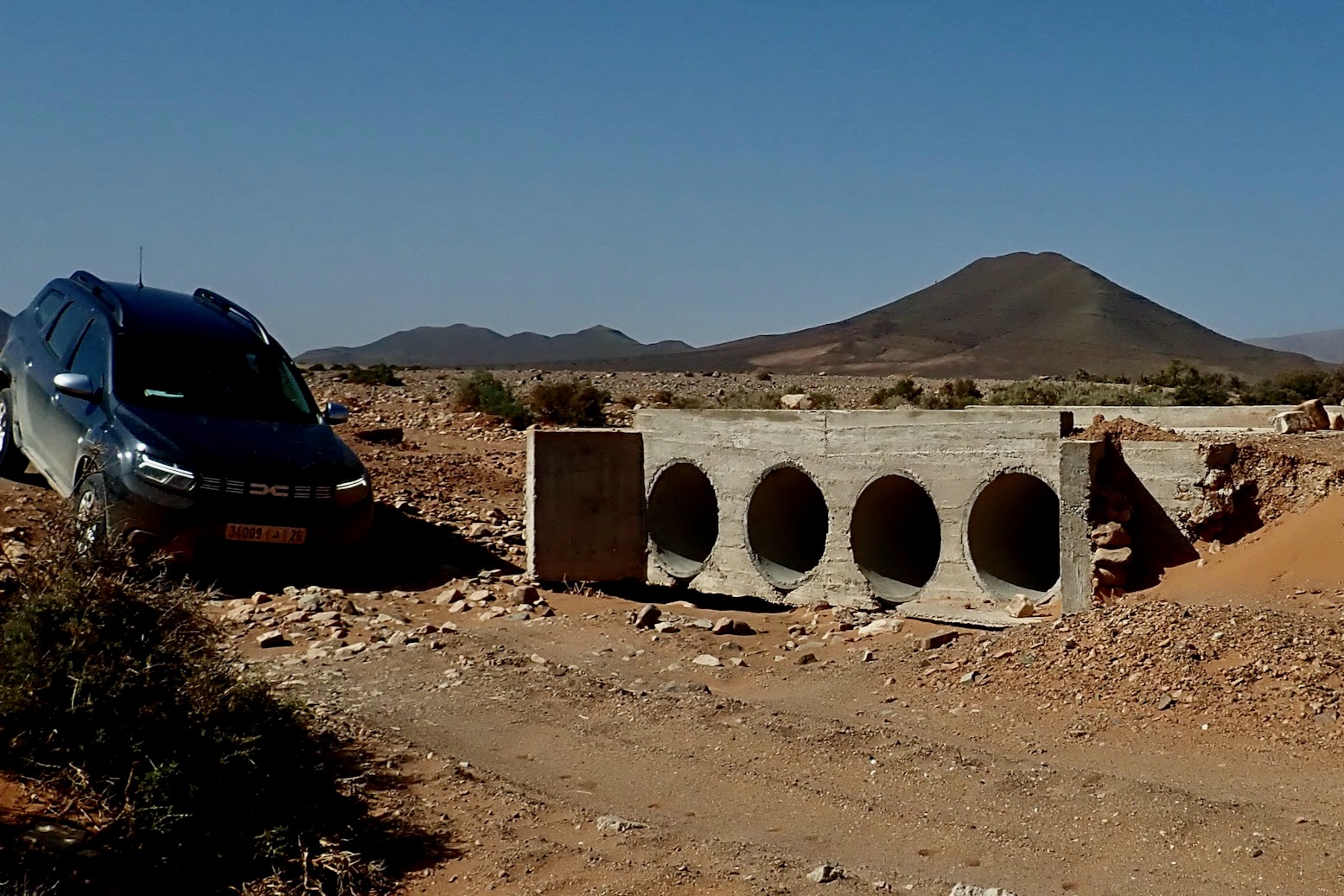
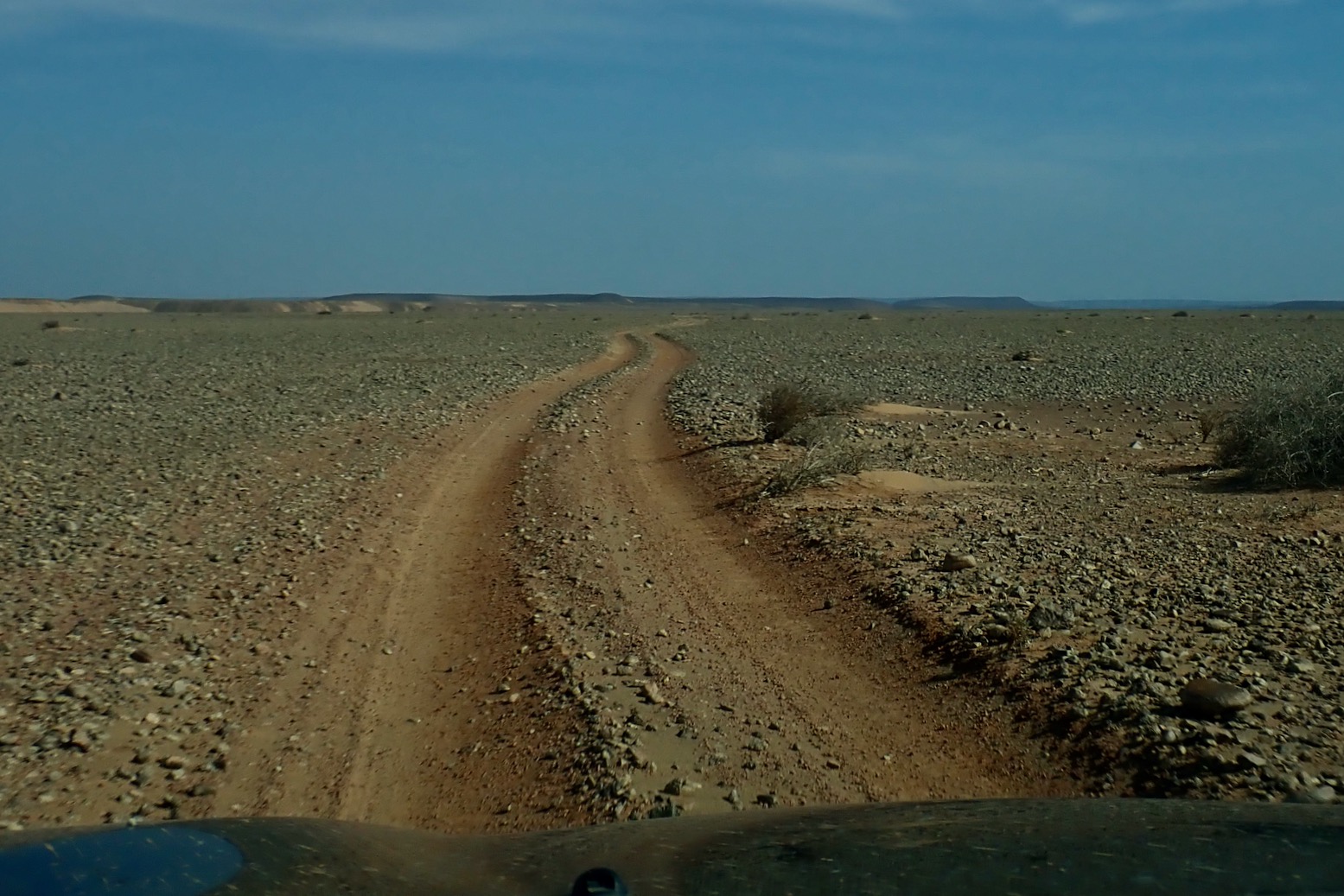
Off road obviously you take it easy in a rental when alone in the desert. So many SUVs, even AWDs have disastrous frontal overhangs but I never scraped the front or rear bumpers driving in and out of ditches or oueds. Same with the ramp clearance.
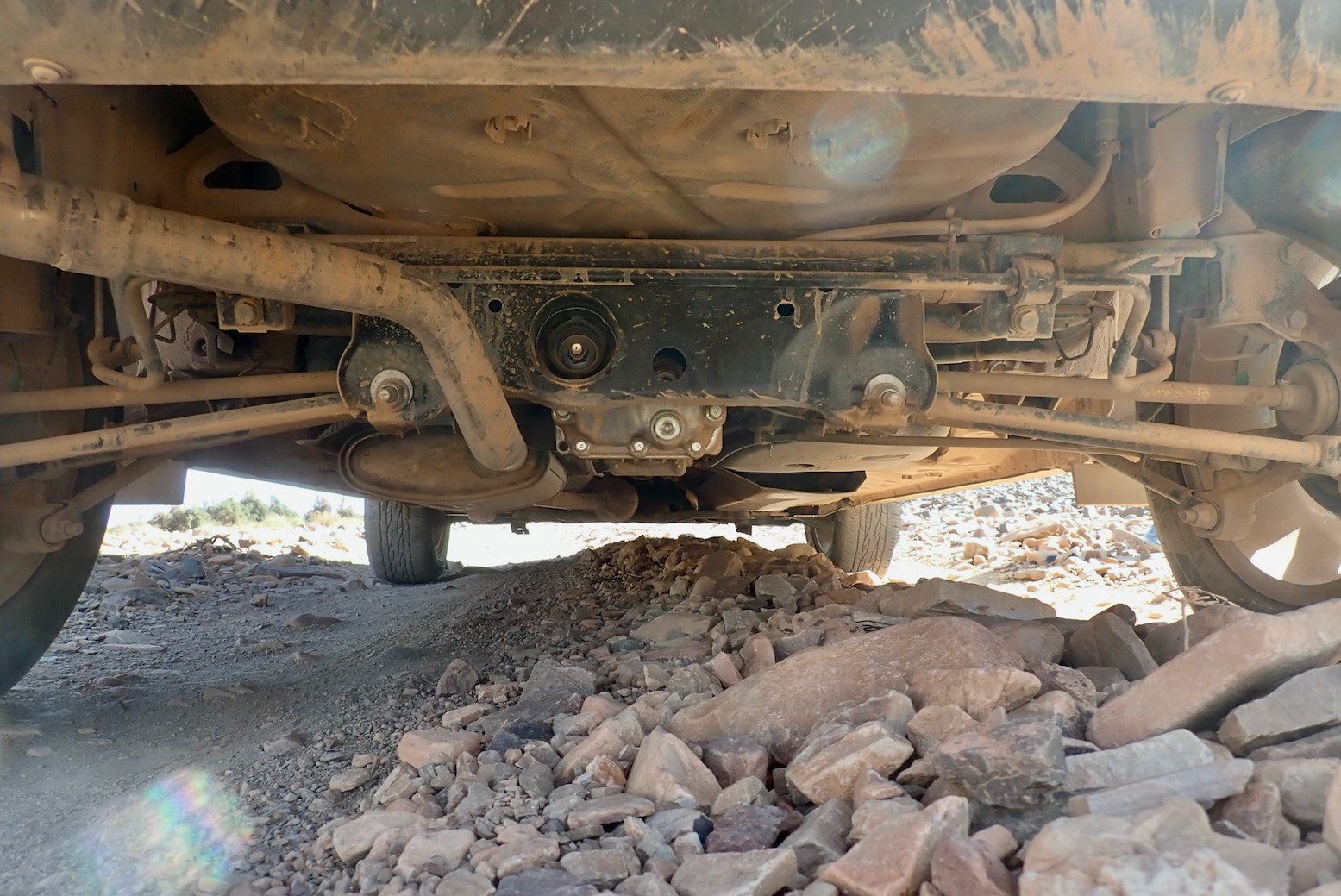
But as before, the ‘axle’ clearance is oddly not as good as it looks and you find yourself having to straddle ruts to one side (above) to maintain clearance. A full tank may not help, but we just had two bags in the back. As you can see below it’s quite tidy and nothing sticks out – it must be down to the plush suspension so you just need to slow down to limit compression and contact. We left the tyres are 2 bar road pressures.

The scraping was frequent until I got a feel for the clearance but the noise is probably amplified by the protection hardware, and we’re talking piled rocks, not solid impacts.
Dust crept into the covered boot space so the rear hatch door seal may not be so good. Had I remembered, I’d have done that trick of parking on a bank with one wheel in the air, then closed/opened a door to evaluate body twist as we did with th TXl a few months later. Door closing cleanly = good stiffness.

In 3000km I probably turned on ‘4WD Lock‘ for about 500 metres, mostly to spread traction while crawling out of stony oueds and on one sandy climb in the wastes of Western Sahara.

All up, I’d happily rent a Duster again from Medloc. If you have experience driving 4x4s effectively you soon recognise the limits of a Duster (largely no Low Range). If you’re new to off-road but want to go in hard, you might feel better in an automatic Toyota. Having done a few thousand kilometres in both over the last year, for normal road and track exploring, a Duster is more than adequate and better value for money.

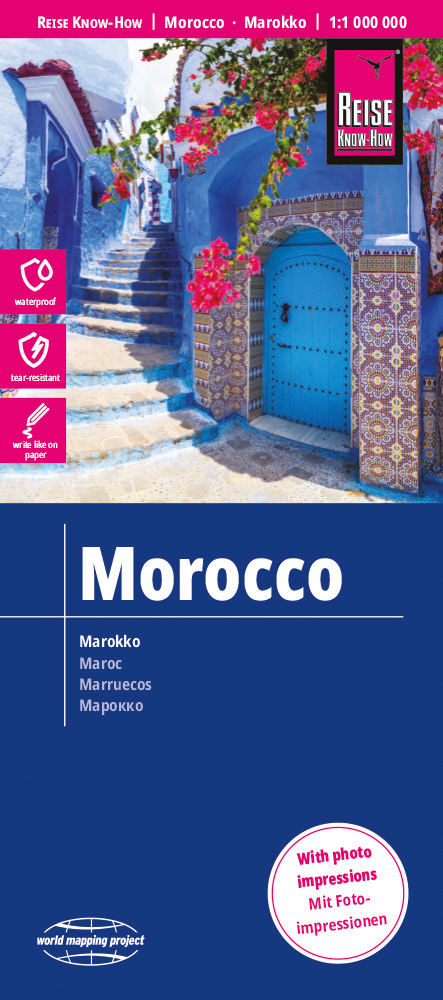
Map review: Reise Know-How Morocco 1:1m (2023)

See also:
Morocco Maps
Time for my Tablet: Samsung Tab + Gaia GPS vs Garmin Montana
How to trace a tracklog
Michelin 742 Morocco (2024) map review
Map review: Reise Know-How Morocco 1:1m (2023)

In a line
If you have the previous edition, save your money – this time round they’ve made more changes to the cover than the actual map itself.

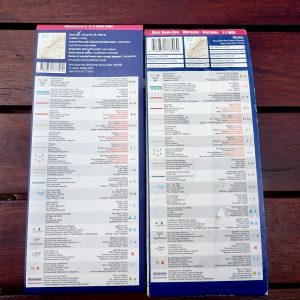
Note: in December 2022 a traveller had his RKH map confiscated at the Ceuta border because it showed ‘Western Sahara‘ – (like all other paper maps, afaik). Actually the back cover (see below right) always gave the impression it is all Moroccan territory, but inside they mark the ‘Moroccan Wall’ and the Polisario ‘Free Zone’, which is correct and more detail than most maps, but might also get up the Moroccans’ noses.

For the very latest mapping digital, OSM updated by users (used by Garmin and many others) is useful. But not everyone gets on with digital maps which are far from perfect of accurate, At the planning stage you can’t beat a paper map spread out before you. Out of habit I routinely carry a 2019 RKH out there, though almost never refer to it now as i know all the southern roads. I have much more success finding unknown pistes as well as verifying newly sealed roads from aerial imagery.
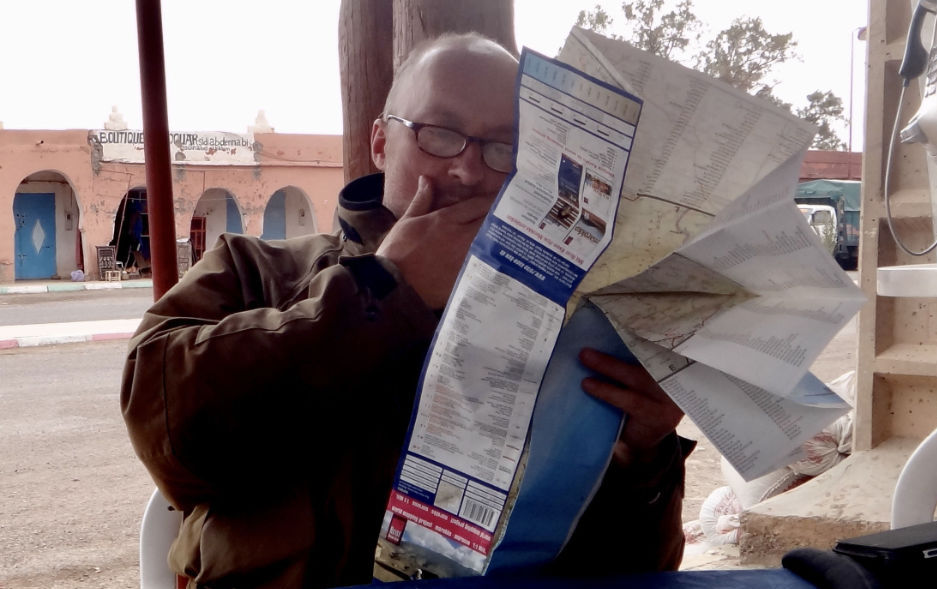
As you can read here, the German Morocco Reise Know-How (RK-H) is one of the least bad paper maps for Morocco. It’s double-sided, the plastic paper is tear-proof and compact at 70 x 100cm, and it has an intuitive 1:1m scale (1mm = 1km). They also show both old/new road numbers which changed in 2018, but unlike Europe, this information is of little use in Morocco (* see bottom of page).
In 2023 RK-H published the 13th edition of this map. The big question is, given the amount of road-building going on in Morocco, is it a properly updated edition like the previous one, or just a new cover with a few updates, as Michelin like to do? The answer is that in the south there appear to be virtually no changes to the actual mapping in the 2023 edition.

What they say
Reise Know-How maps are characterized by particularly stable plastic paper that can be written on like paper, even with a pencil. The cardboard cover is detachable so that the card can easily be slipped into any pocket. A protective cover is not required. The cartographic presentation focuses on the most important information for travelers and is particularly easy to read. Colored elevation layers are used instead of hillshading.
  • Contour lines with elevation information
  • Colored elevation layers
  • Classified road network with distance information
  • Sightseeing features
  • Detailed local index
  • GPS accurate
  • degrees of longitude and latitude
  • Legend in five languages ​​(German, English, French, Spanish, Russian)
  • Einklinker Western Sahara
  • Larger places also in Arabic script

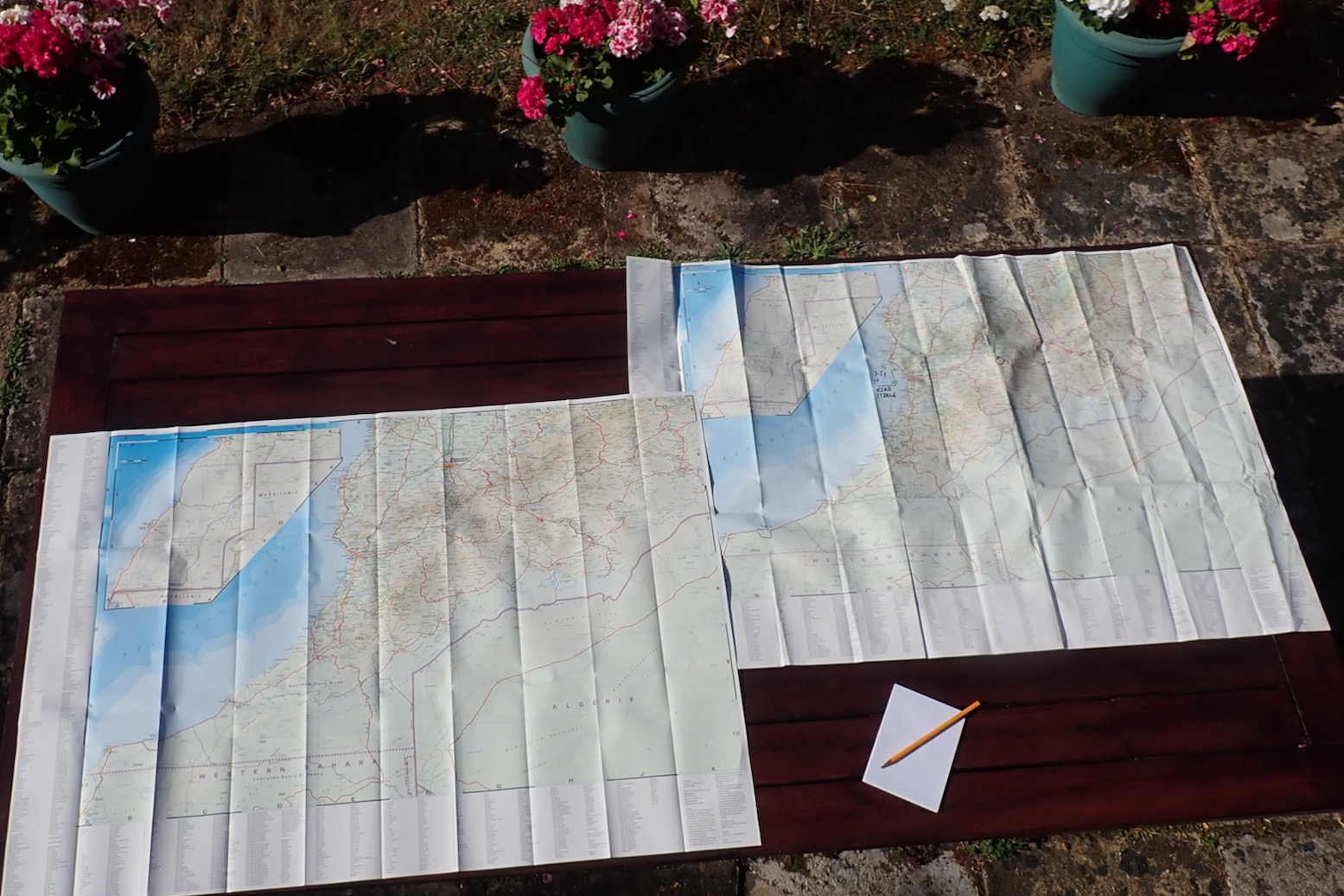
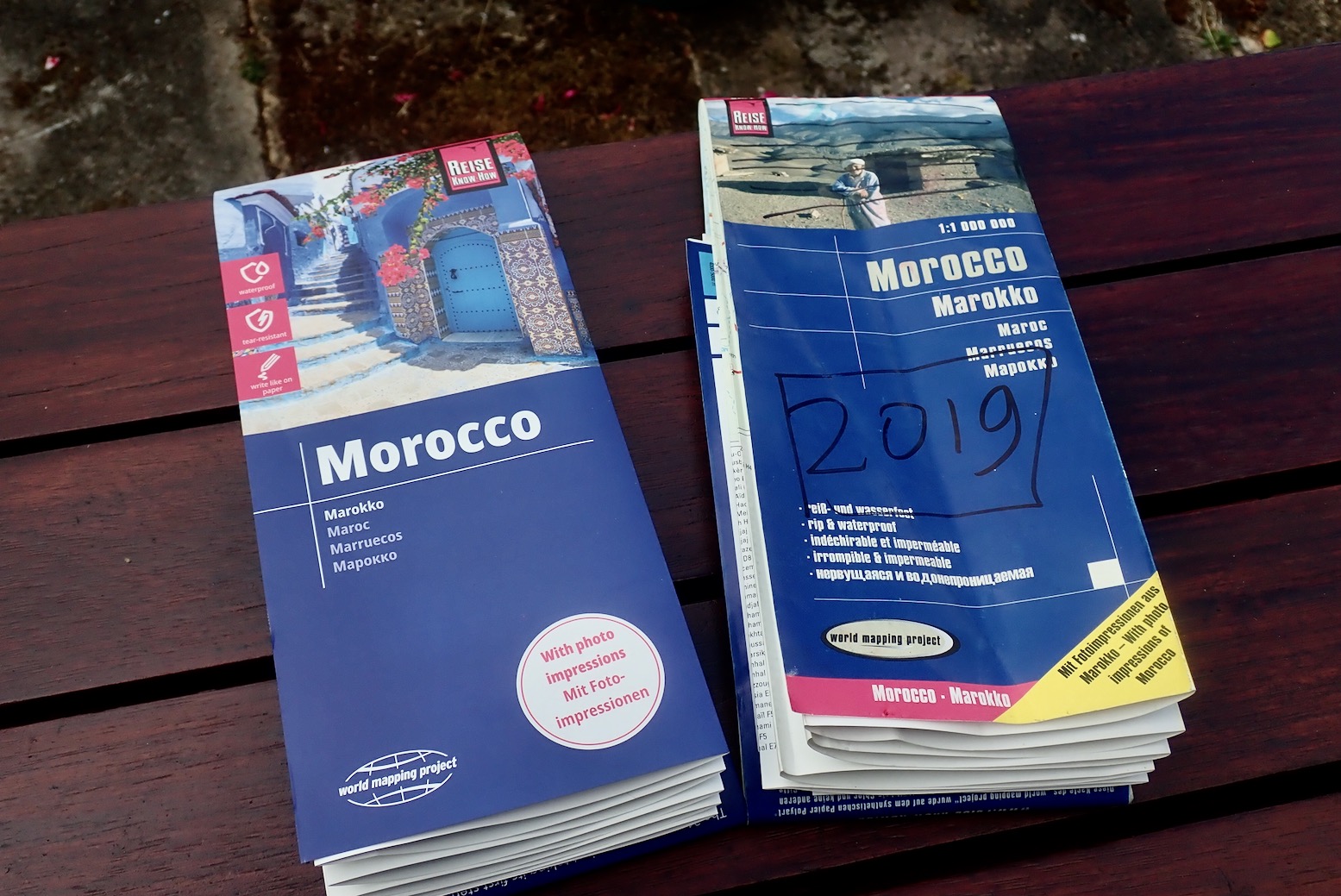
With the 2023 edition laid out alongside my crumpled 2019, what’s new? The cover; that’s about it, but it does include a redesign of the back cover too! Even the decorative pictures on the northern side of the map are unchanged. I may have missed some of course, but a few minutes scanning familiar roads and pistes in the south brought up precisely two changes, maybe three. Everything else appears identical.
2019 – 2023; spot the difference. The notepad is tellingly blank.

1. What was a yellow ‘Secondary Road’ for Route ME4 (Korima Pass in Morocco Overland 3) has now changed to ‘Track’ although it was actually a ‘Gravel Road’ imo. It suggests a user’s correction was actioned, but ironically it’s now sealed up to KM41 or beyond. I bet there are many more sealed roads let alone tracks on the nearby Rekkam plateau.
2. Another former road they’ve admitted was a piste all along is the R704 (Route MH1) High Atlas crossing from Dades Gorge to Agoudal. Again, the irony is that piste is about to be sealed too!
Thirdly, down in WS in the bottom left corner they switched ‘Laayoune’ with ‘El Aioun’ on the main panel in line with the inset; it was probably a typo.

In your dreams…

Elsewhere, right across the area I know well (not the north), pistes and even roads are still missing (Route MW6 to Labouriat) while many more pistes have become roads, in some cases over a decade ago, eg: Routes MW1/2/7 to Mseid; Route MH6 from Aguim as well as Routes MH7/8 south and west of Asakoun and Route MH4 Jebel Saro, etc, etc.
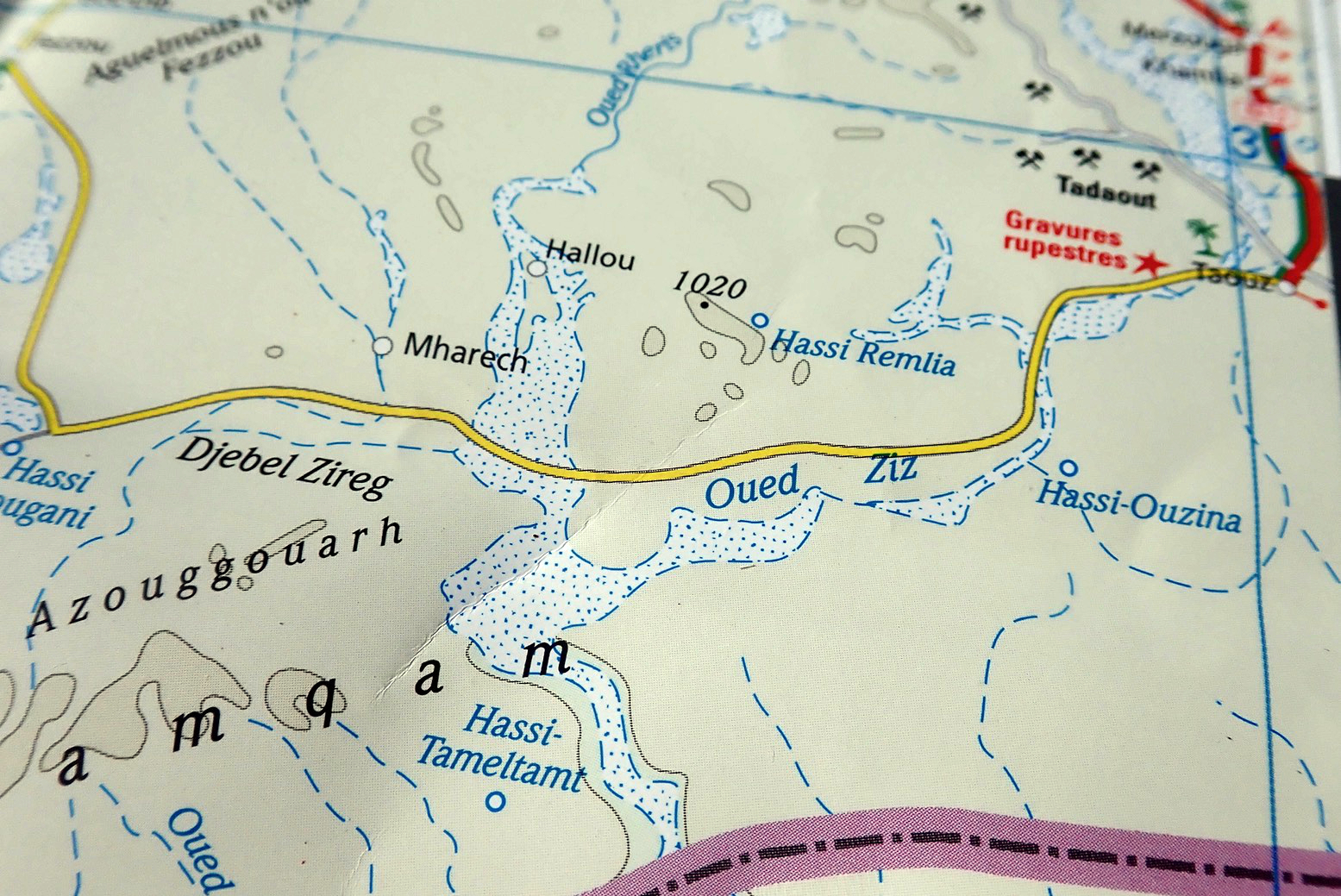
Old edition and new, Route MS6 (left) is shown as a secondary road all the way to the Sidi Ali Tafraoute (bafflingly shown as a well: ‘Hassi Fougani’ on the map). Imagine arriving at the notorious Rheris crossing in your campervan! But west of Sidi Ali they miss out the well-used track carrying on directly to Zagora just south of Oum Jrane. And I’ve just noticed in the WS panel on both editions they’ve shown the 1000-km Tindouf Route as sealed all the way (via the PFZ no less) to Zouerat, complete with bypass! No wonder Moroccan hats are confiscating this map at the border. You can understand them not keeping up with all the asphalting, but the practise of calling a piste a road is hard to fathom. Where do they get this information – QAnon?
These are just a few of the glaring errors that jumped out at me. There are loads more in the Anti Atlas, plus areas depicted as forest which are barren mountain hillsides and contour shading that jumps in 300- and then 600-metre stages. That means within one shade the elevation could change by nearly 2000 feet. Not a great map for push biking then.

To be fair the previous edition did appear to be a genuine update with tangible changes but this edition is near identical to its predecessor. And I know the Michelin equivalent follows the same practise of ‘cover updates’ and can be just as flawed, last time I looked. All the others maps for Morocco are even worse. Sadly, this appears to be the state of paper mapping in the early 21st century – the money no longer exists to update maps properly, nor even action users suggestions. Good thing then there is Morocco Overland with Updates & Corrections as well as the Horizons forum taking up the slack for the adventurous traveller. I gave the 2023 map away.

Got a 2019 edition? Save your money then.

* Are Moroccan road number even useful?
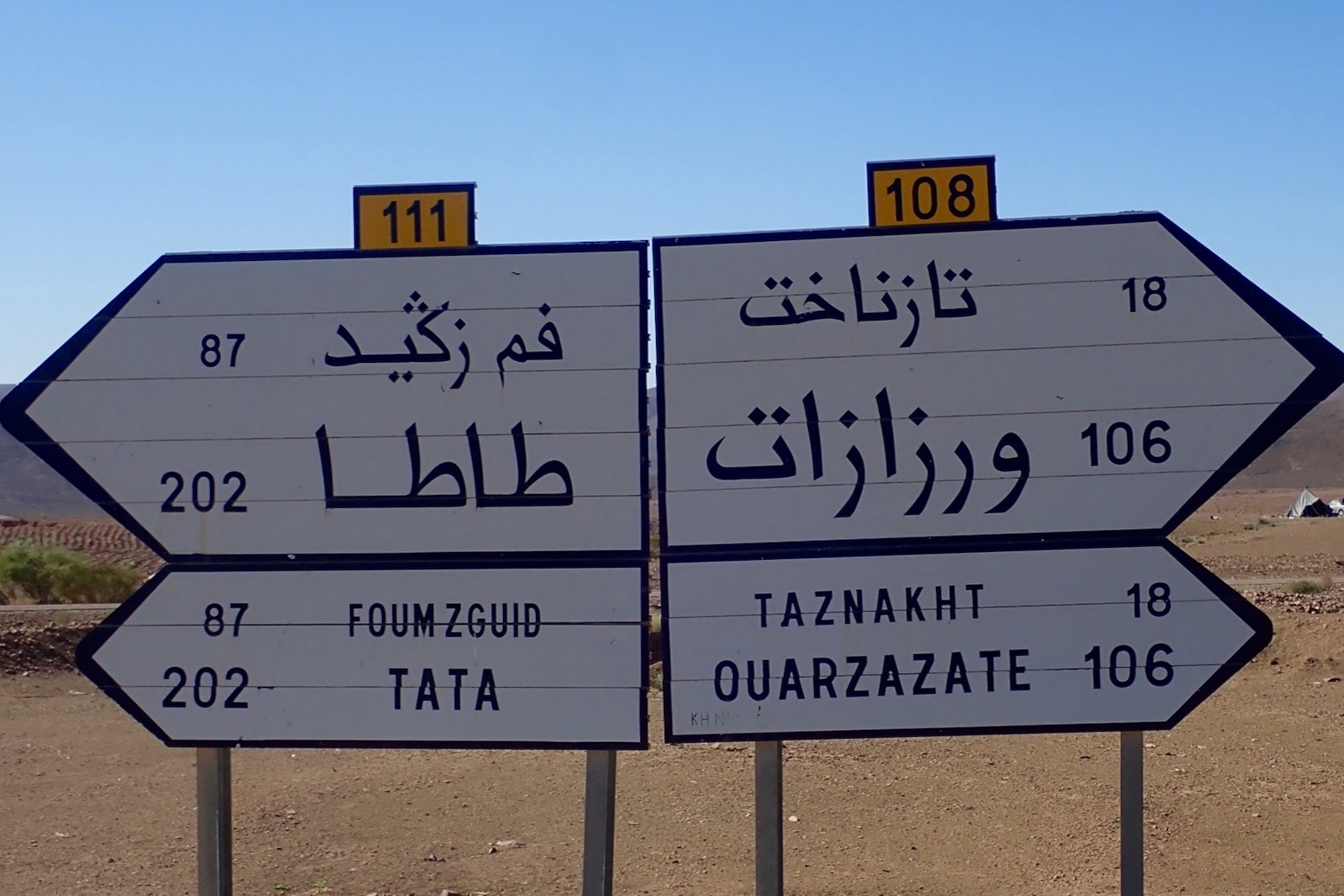
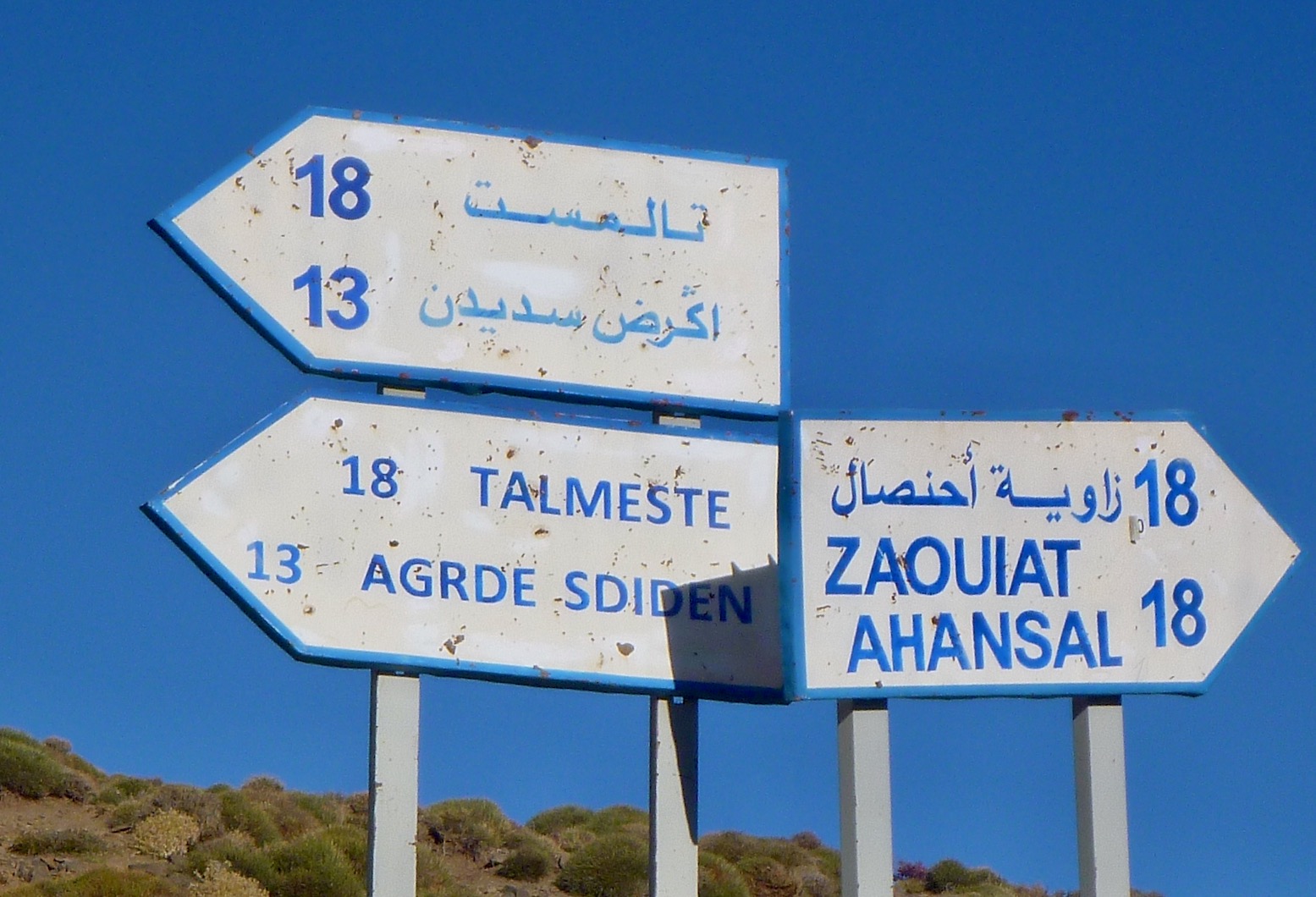
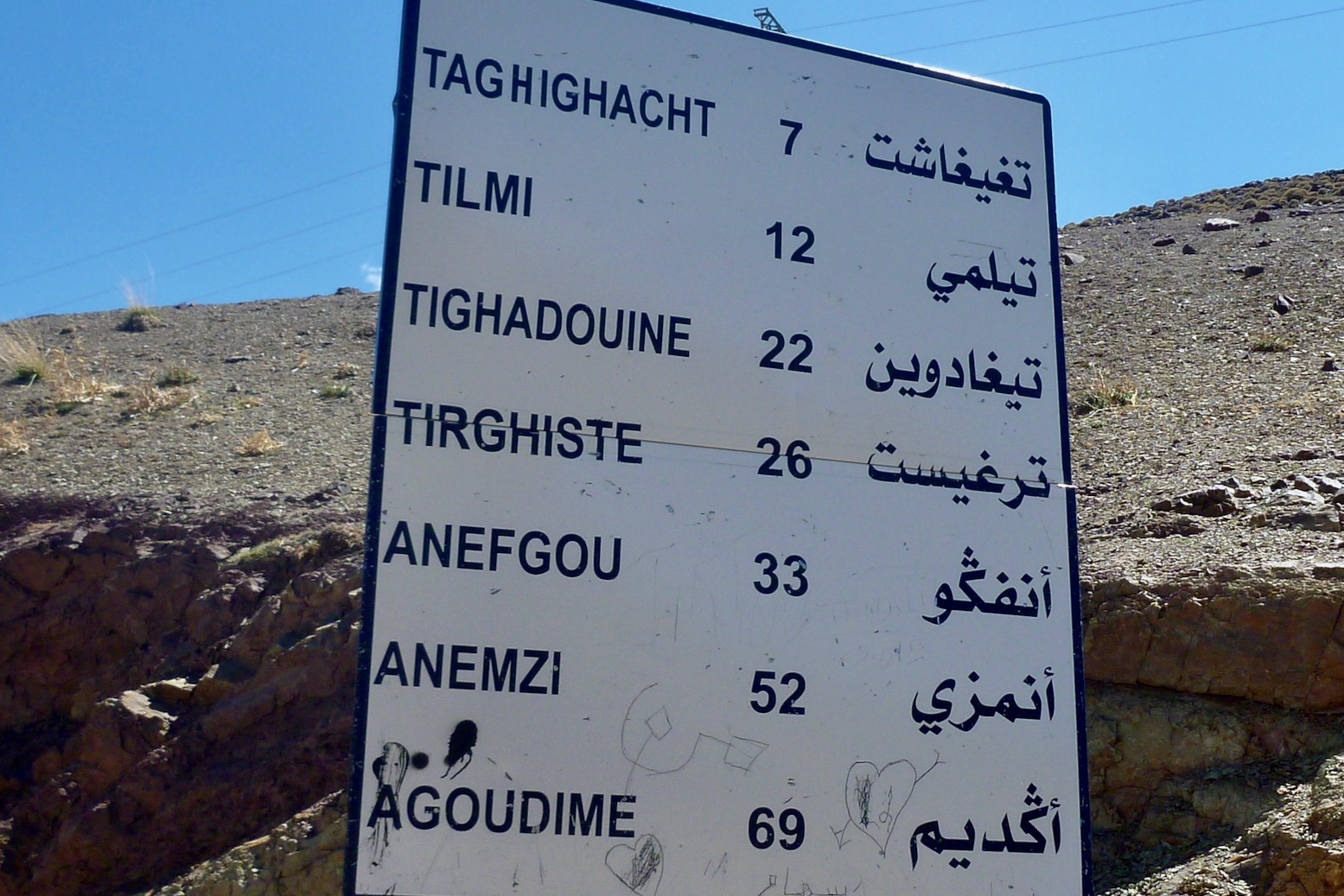
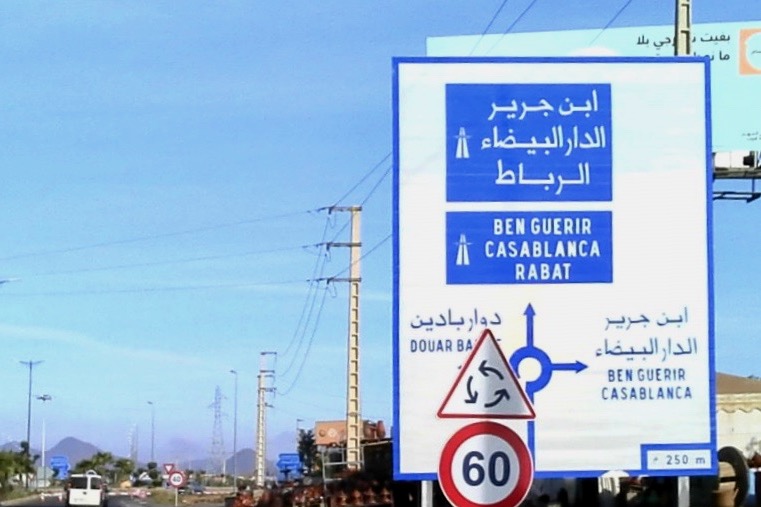
Unlike in the UK and Europe, in southern Morocco road numbers rarely appear on road signs, be they at junctions or showing distances. First photo is a positive example, below. So knowing – or wondering if – you’re on the R504 now called the RN4 will be near impossible to ascertain on the ground and therefor of little value. Of course a road sign saying ‘Foum Zguid 87 [km]’ will be what you want to know.
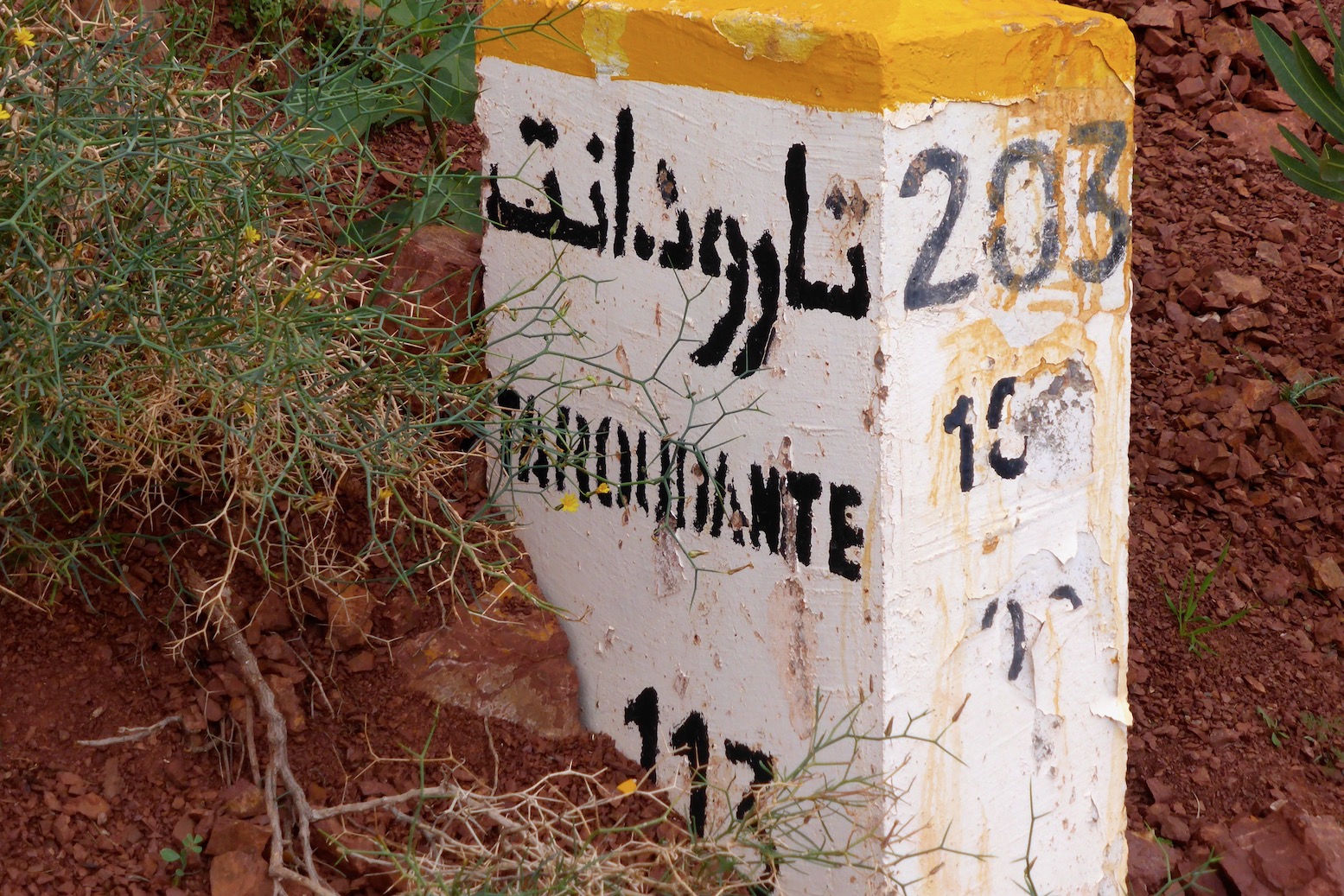
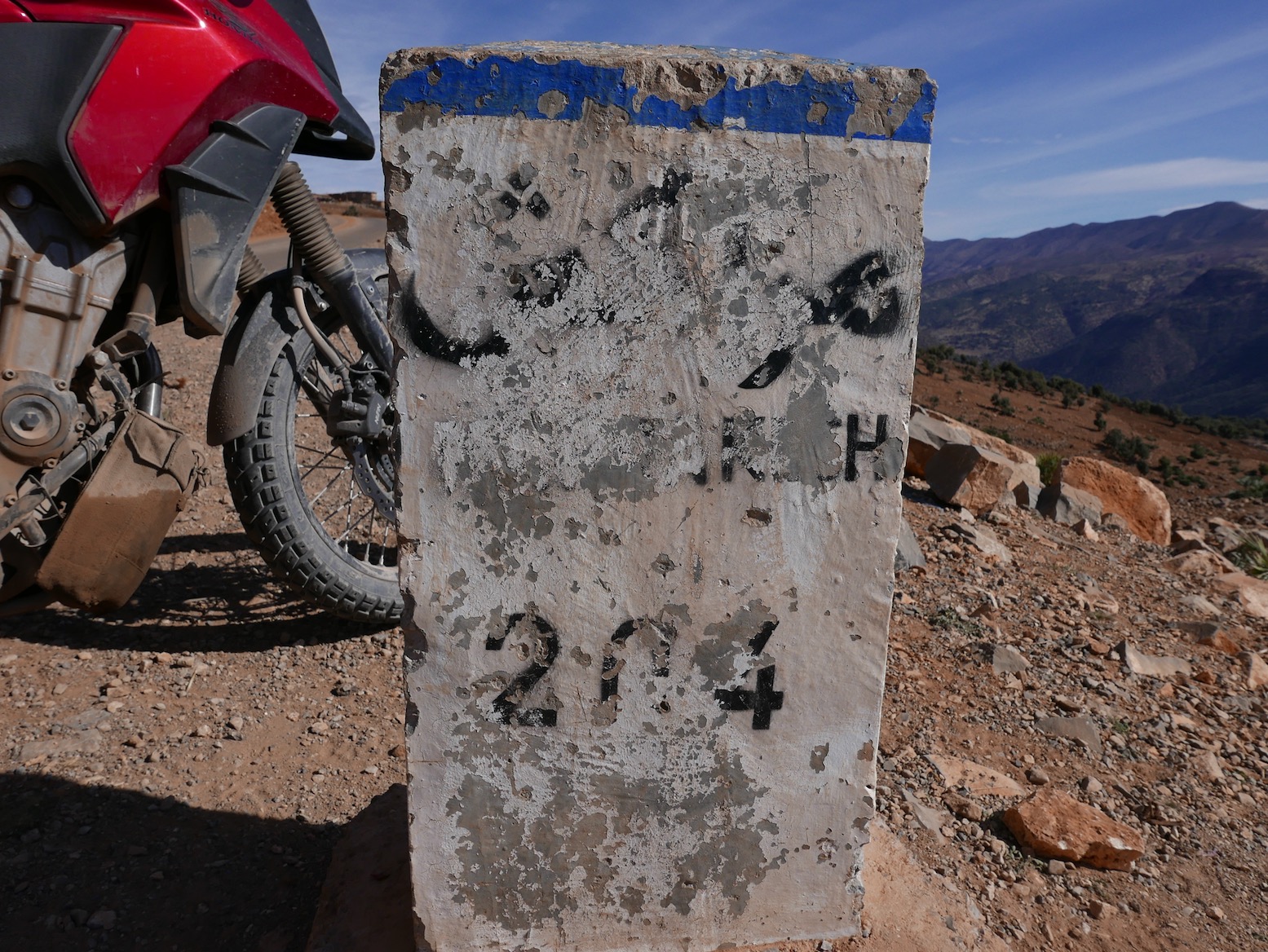
Infrequent and often weathered mileposts dating from the colonial era may show a road number. Example: the R203 Marrakech – Taroudant road via Tizi n Test, now called the RN7.
In most cases in the 2018 shake up, only the prefix changed so the ‘N10’ became the ‘RN10’ and so on, but elsewhere if there was a new number like the old N12 now called the RN17, I am fairly certain no one has since gone around Morocco updating mileposts and road signs.

The Hills Have ‘I’s • Ineos Grenadiers in Morocco

I was involved as one of the guides on the recce for the Hard Way Home back in October 2022, repeating the course again just before following the actual filmed event in February from Ouarzazate to Marrakech. The first three Grenadier customers picked up their brand new cars from the middle of nowhere in Morocco and drove them home.
The 500-km route we mapped out was a spectacular mix of mountain and desert, but as you’ll see, with snow down to 1800 metres, bad weather disrupted the actual launch event. ‘The Grenadier Route’ will be in 4th edition of Morocco Overland, due early 2025.
see also: Scott Brady from OJ in the Ineos.

Trans Mauritania with electric FatBike [videos]

See also: Empty Quarter 2006

Mauritania and Citroen 2CV specialist, Cyril Ribas supports his son Evann as he cycles his Gorille e-MTB fatbike from Aïn Ben Tili on the PFZ frontier south for over 1500km to the Route d’Espoir highway paralleling the Senegalese border.
Cyril is recharging spare bike batteries as he tracks his son’s progress while keeping out of sight. Evann has to keep the e-bike in Eco power mode to extract up to 130km in a day.
The northern half of the route is relatively flat but from Ghallaouiya, east of Guelb er Richat they must cross the Mrayer Sand Sea before entering the tussocky region leading down to Tichit and the Aouker basin.
As you’d expect, there are some sublime drone images of the immense desert.

How to trace and save a GPS tracklog online

See also:
Morocco Overland Routes
Updates and Corrections
Morocco Maps
Time for my Tablet: Samsung Tab + Gaia GPS vs Garmin Montana
Michelin 742 Morocco (2024) map review
Map review: Reise Know-How Morocco 1:1m (2023)

Fyi, I do this all on a desktop computer or a laptop at a pinch. It may well be possible on a mouseless smartphone or tablet but would drive me nuts. Also, note this is a reliable but labour intensive procedure which does not necessarily align with modern ‘I-want-it-all-I-want-it-now’ sensibilities.

Particularly in the desert, these days aerial or satellite imagery from Google Maps and ESRI (Bing, etc) is so good you can spot passing vehicles and whether a road is sealed, a car track or even a little used donkey trail. This is the sort of age-sensitive information you won’t always get from maps, be they digital or printed.
When planning new off-road routes, I find tracing the probable route in advance helpful for all the obvious reasons. It also provides a good preview of the area and what features I might come across (mineral mines; climbs, gorges, junctions).

Using Google satellite mapping services, tracklogs can be drawn, saved and exported in two ways:
Using Google Earth Pro – no Google account needed but your annotated maps won’t be automatically saved online/in the cloud. I’ve drawn tracklogs using this method in Moroccan hotel rooms prior to setting off along remote tracks (above left), benefitting from the reassurance of knowing a track exists and where the junctions are.
See the images and captions below for more.
Note: this is a reliable but labour intensive way of doing it which does not necessarily align with modern ‘I-want-it-all-and-I-want-it-now’ sensibilities. You can track a route much more quickly off something like Garmin Basecamp using the ‘Create a Route’ tool. But afaik Basecamp doesn’t have an all important satellite layer to verify against an actual track on the ground.

First: download Google Earth Pro (it’s free).
Either search for your place or zoom in on your start point.
Now choose the Ruler in the top tool bar and then select Path (blanked out above when selected).
With your mouse trace a path click by click, point by point along the track you want along the ground.
The extent of precision is up to you. When you’ve finished, Save.
The tracklog your drew is saved. Now right-click and choose Save Place As…
It saves as a .kml or .kmz file (same difference, more or less).
You may now need to convert the Google .kml file format to .gpx to import into Garmin satnavs and smartphone/phablet nav apps.
Garmin BaseCamp (free) can do it, or use also free online converter like GPS Visualizer.
Import the .gpx into your device and you can now set off to navigate your MYO tracklog.

With a Google account (…@gmail, etc) you can save your routes on a Google ‘My Map‘ as has been done for the Trans Morocco Trail. It can have as much detail (tracklogs and waypoints) as you like, but Google ‘My Maps‘ are limited to about 10 layers. Layers are a bit like folders (with infinite capacity) and sometimes you have to shift tracklogs or waypoints into a pre-existing layer to free up a new one so you can import more.
This map can be shared or exported but will be saved online and be viewable/editable wherever you have internet.

Open Google Maps and once signed in, click the Menu top left.
I already have Saved maps so look for My Places or My Maps and click.
In the sidebar click Maps and Create New Map.
You can give your map a name and save. Google autosaves every few seconds so long as there is internet.
You may also like to Name your first layer in your map and Save.
To trace a tracklog you need to change the map’s base layer to Satellite.
It looks like this – people often call this ‘Google Earth’ though that’s actually the app above.
If you don’t know where your start point is and it’s waypoint, use Search.
I chose Chenachen base, as close as I’m ever likely to get to this place.
It’s not strictly necessary, but click Add to Map to save your searched place as a waypoint.
You can also add and name a waypoint anywhere using the toolbar above (top arrow).
Useful for important junctions, I find.
Right-click and you can edit a waypoint’s Icon and Colour for better visibility and classification.
Now, to draw a tracklog along a desert track, click the Draw icon in the toolbar and choose ‘Draw a line or shape‘.
Trace the track with successive mouse clicks. As before, levels of precision are up to you.
Unless you are going cross-country there will be a clear track on the ground.
Or, if the track is shaded by Google, it means it is ‘routable‘.
You can automatically trace it, up to a point.
This method is much less tedious but hard to control.
Click on a start point on the shaded track. It will be saved as ‘Point A’.
A new ‘Driving’ layer (not ‘Import’) will be created.
Now follow the track with the cursor; it automatically highlights it in blue and keeps going as
long as it lasts. The problem is, the track may not go the way you are.
At the end click again on the track and ‘Point B‘ is created and the track’s directions are
saved as whatever Google calls it: ‘route sans nom’ in this case.
Click on the 3 dots and the distance and other data are shown.
You can export this Driving Route (not a hand-drawn track) by clicking the 3 dots
alongside the map’s name at the top. Choose the layer you want: ‘Directions from Route sans…
and it will save as a Google format kml file which you can then convert to .gpx to be read by
a GPS or non Google mapping.
Back to hand-drawn. Click the track’s end point to Save and give your track a name.
Again, you can edit your track’s width and colour to make it more visible on screen.
The contents (waypoints; tracks) of an individual layer can be saved and exported by clicking on the layer’s 3 dots sub menu, choose Export Data and save as KML/KMZ.
Download your kml or kmz to the desktop.
The layer’s data is downloaded as a kml/kmz.
You can also Share your data online in various ways.
If you have saved several layers and tracks, you can save and export the entire built up map as a kml.
Then convert to .gpx as explained above and import into your nav device.
Above, the top red line is the tracklog I traced the night before.
The second red line with an arrow is the ‘live’ or ‘true’ tracklog I am recording.
And the grey line below is the same unverified track as depicted on my digital map and which sort of eliminates the need for your own tracklog, assuming you trust the map. In some cases, not a good idea.