Back in 1965 the pro-Western Kingdom of Libya was just fourteen years old. US and UK military bases used the desert for training and testing, then the discovery of high-quality, low-sulphur oil just 200km from the coast transformed Libya’s fortunes.
Gaddafi’s coup was still a few years away.
Like many former french colonies, Chad had gained independence in 1960 but, as has been the case on and off since then, France retained military and Foreign Legion bases there. In the film you’ll see a French tricolour still flying in Zouar.
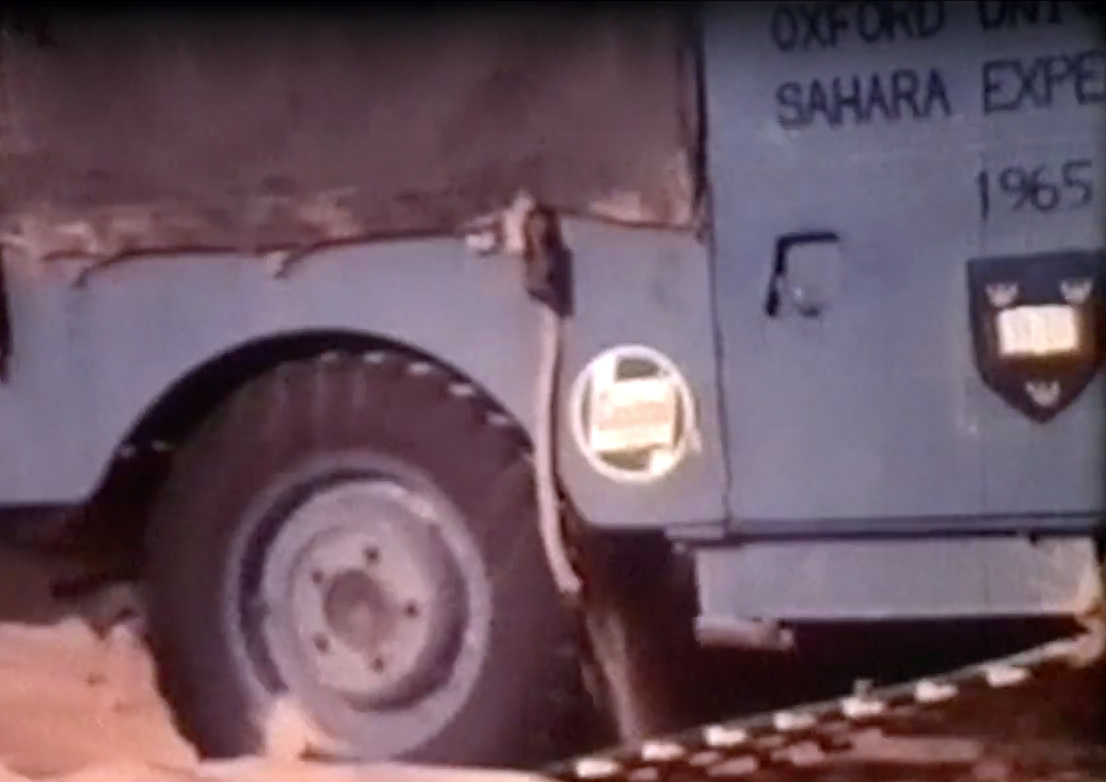
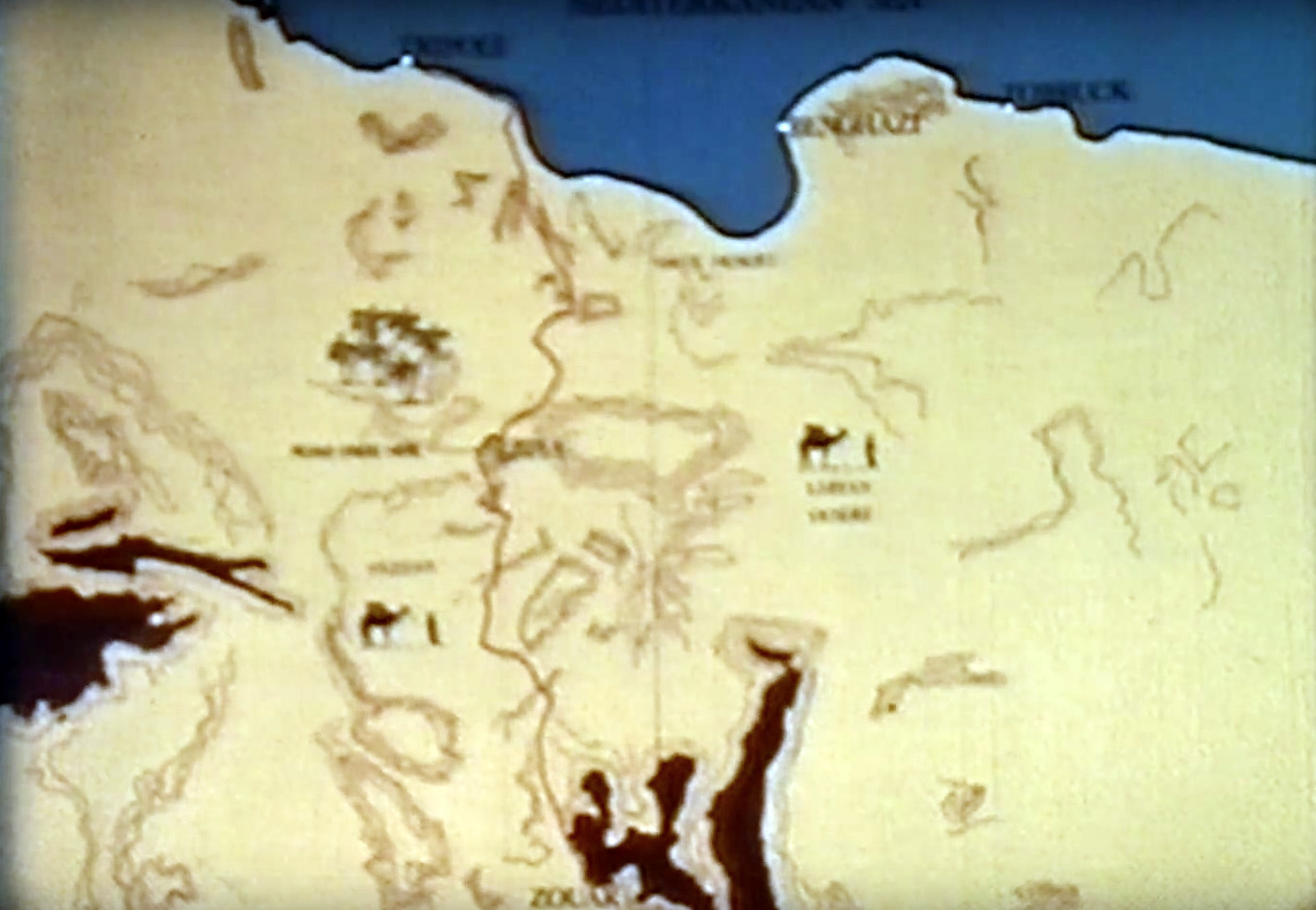
And best of all, the Chadian civil war was still a few months away, so what better time for a bunch Oxford university students to drive 5000 miles to Zouar for their summer hols in a a couple of 88 Landies and a 2WD Ford D-series lorry loaned by Ford. This was a time when it was still common for truck manufacturers to prove their vehicles on Sahara expeditions.
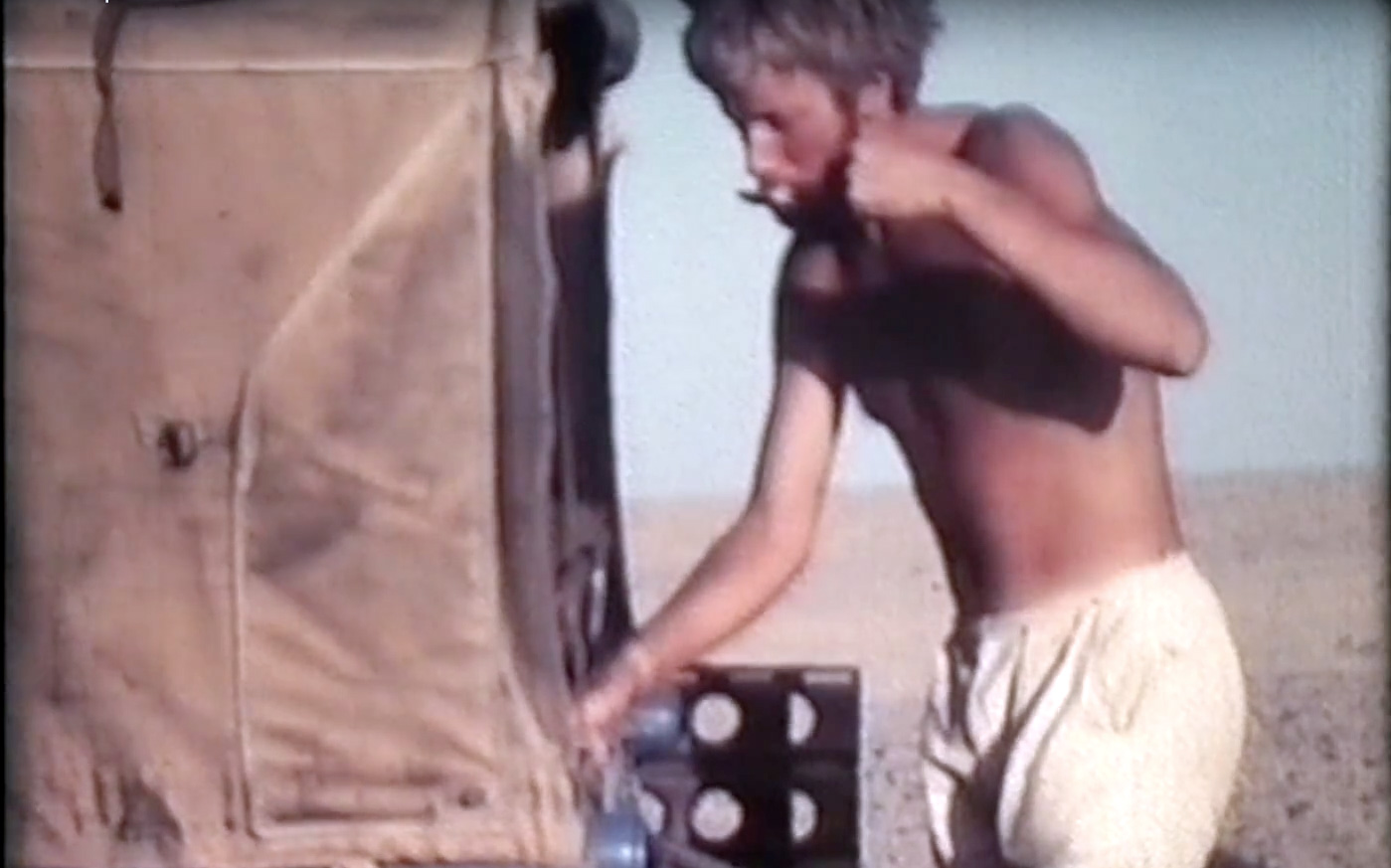
The film includes episodes of Tubu horseplay, lashings of corned beef and a Landrover door that just will not shut!
Interestingly you’ll also see a woman making flour with a grinding stone of the sort still commonly found abandoned all over the Sahara, wherever people once lived. As the narrator says ‘in remote parts of the world it’s hard to tell when such [Neolithic] tools were last used.’ At 14:20 there’s also an engraving of what might be a Garamantean chariot. Germa, the former Garamantean capital in southern Libya, is not so far from Zouar.
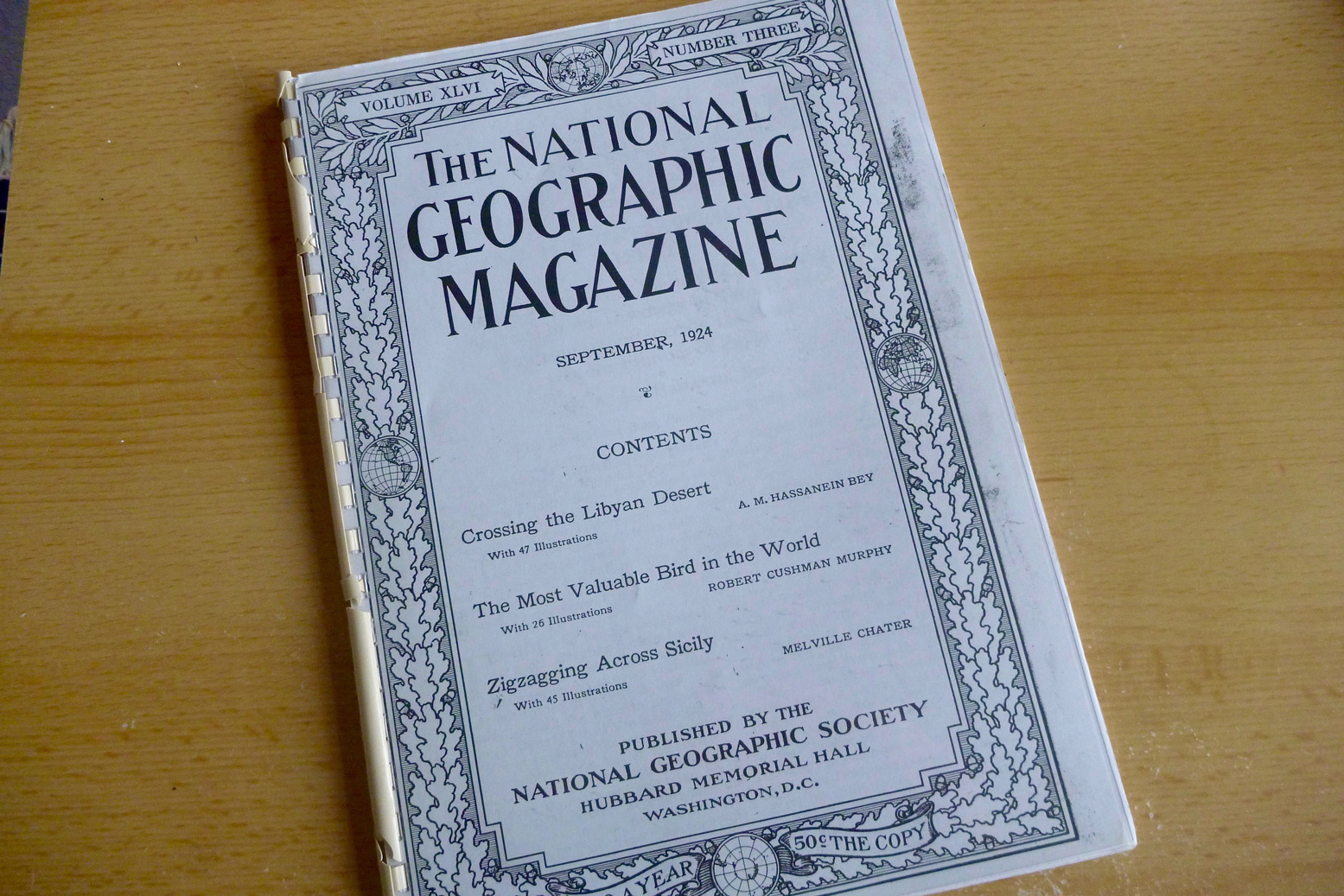
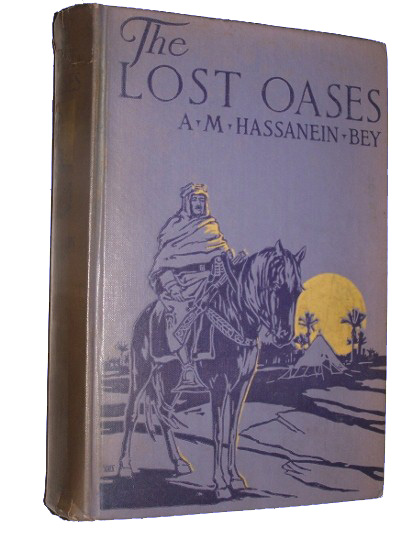
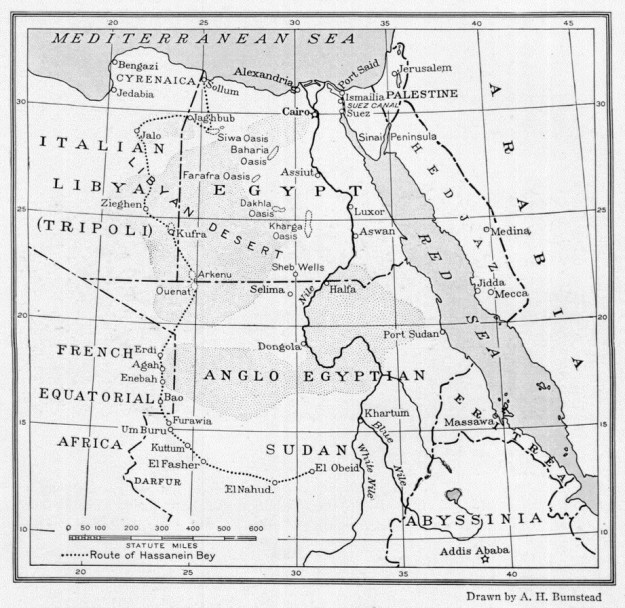
I recently read Ahmed Hassanein Bey’s 1924 National Geographic article about his six-month camel journey from Saloum on the Mediterranean to El Obied in the Sudan. (Read an online version here). Two years earlier he’d travelled as far south as Kufra in sotheast Libya, then at that time the centre of the xenophobic Senussi sect. And in 1925 he published The Lost Oases which the NG article summarises and which is still available in print at normal prices.
On that 2200-mile journey he located the ‘lost oases’ of Jebel Arkenu and Uweinat (see map above). At Jebel Uweinat he speculated correctly that the rock art depictions of animals he saw there must pre-date the 2000-year-old camel era which were not present in the imagery.
At one point in the latter half of the trip when the caravan is forced to travel at night to avoid the intense daytime heat, he describes how the guide navigated by the stars when there were no faint landmarks to aid orientation. It surprised me by being rather less intuitive and mysterious than I thought.
The manner in which a Bedouin guide finds his way across the desert at night is a source of wonder to the uninitiated. In a region which provides no familiar landmarks he depends solely on the stars. As we were proceeding in a south-westerly direction during most of our night trekking the pole star was at the guide’s back. He will glance over his shoulder, face so that the pole star would be behind his right ear, then take a sight on the start of the south in that line. He would march for perhaps five minutes with his his eye riveted on this star, then turn and make a new observation of the pole star for of course the star to the south was constantly progressing westward. He would then select a new staff of guidance and continue.
He goes on to explain that the technique floundered around dawn and dusk when the stars weren’t visible and at which point he took over with his compass.
This review was originally for Garmin’s2016 Topo North Africa v3 Light map and compared it with easily downloadedfree OSMs, Garmin’s basic global base map and other digital maps, where available. V5 was the last version in 2023 still a £20 bargain, then the priced jumped back up to £110 for the current ME&NA map which I suspect is little changed. At the current price I’d save your money
Navigating the Sahara Having used them since before the advent of GPS, I’ve got to know my Sahara paper maps well. Then, when GPS came along, I could pinpoint my position on a paper map with an accuracy that was more than adequate for desert travel. Some of these colonial-era maps such as the IGN 200s are cartographic works of art, and unlike current nav technology, in the deep Sahara topography changes at a geological pace. In other words: a paper map of the deep Sahara from 1960 may still be accurate today. Tracks may become roads and villages become towns and even cities, but the open desert itself remains relatively unchanged. Is there a benefit in having a tiny map on your GPS rather than simply a waypoint to aim for or a tracklog to follow, even if your position on the map is displayed live? That’s essential for navigating a busy city with a Nuvi, but the Sahara is more like the sea where more often what you want is…
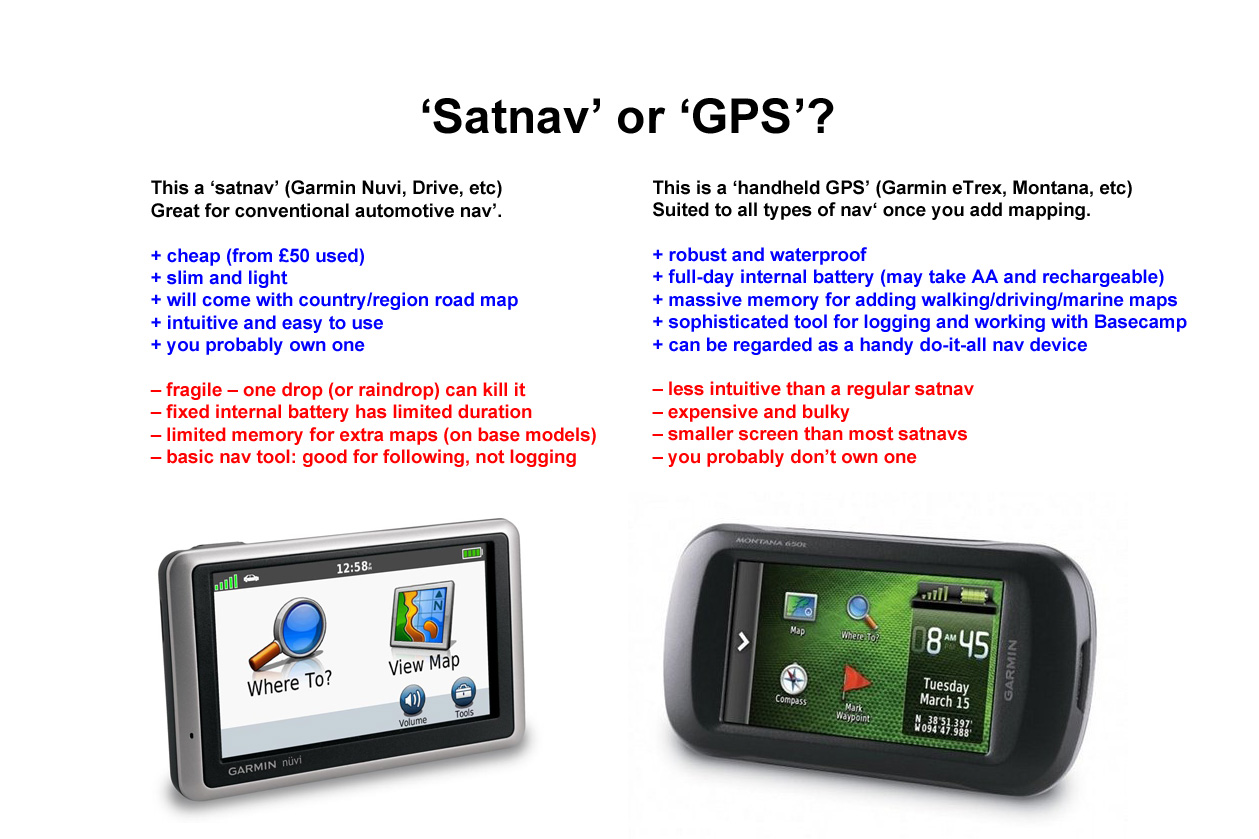
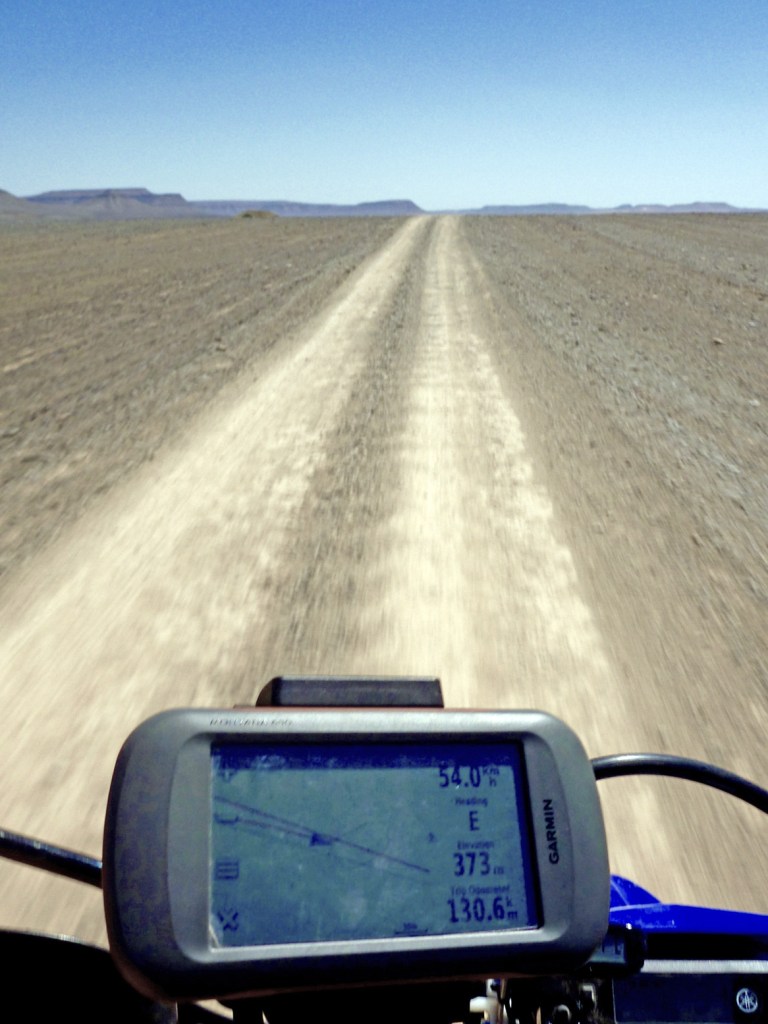
… the big picture A typical handheld device like my Garmin Montana (left) has a screen a little bigger than a playing card and which is hard to read on the move – especially on a bike. For me a ‘GPS’ (as opposed to a ‘satnav’ like a Nuvi – see below) is best at displaying simple data like how far, how fast, how high or which way, not fine topographic detail. A paper TPC map can display six square degrees over some 18 square feet – what you call ‘the big picture’. That’s what you need travelling with a vehicle in an expansive area like a desert, while at close range concentrating on negotiating the terrain.
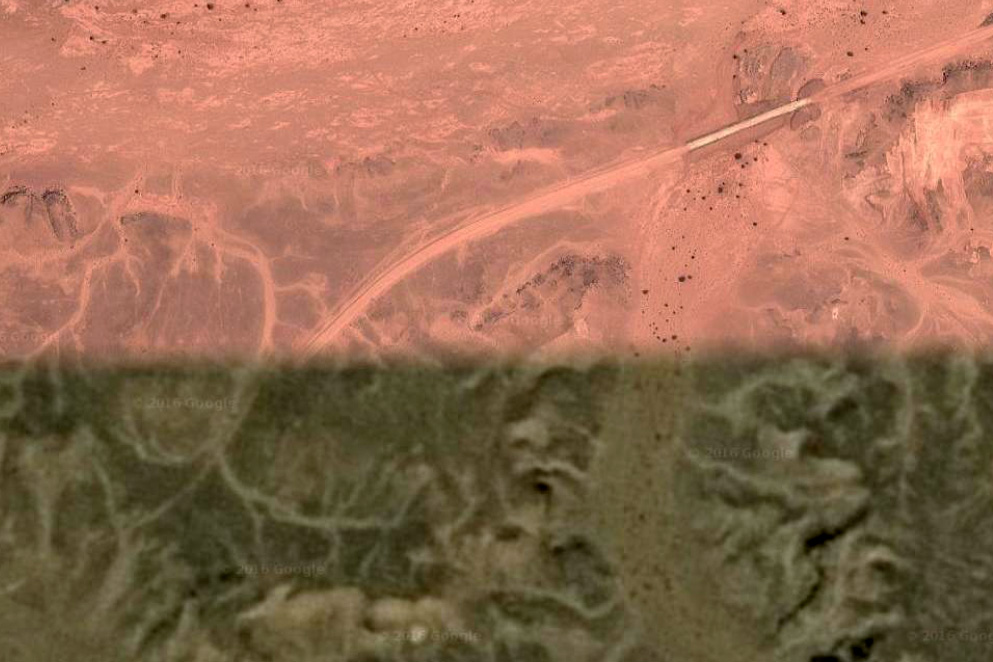
On top of excellent paper mapping (now widely digitised), we also have the wonder of Google or Bing sat imagery (Bing was often better, now Garmin have the edge) providing a clarity that varies from stunning (being able to trace car tracks) to a brown mush (both shown left). Google sat is great when planning, and now for a reasonable annual subscription, Garmin offer Birds Eye satellite imagery for the whole globe; the long-sought after ‘Google sat in your GPS’. With all these resources navigating in the Sahara couldn’t be easier.
Garmin Topo North Africa v3 Light (now ME&NA, see above)
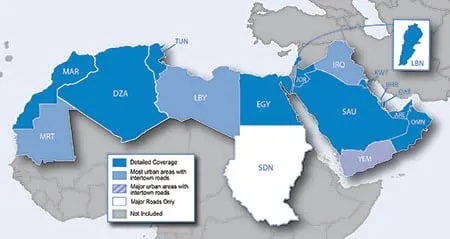
Current ME & NA coverage
Short version Even though in 2021 old Olaf from 2009 still measures up well, the similar topographic detail of the Garmin means it’s well worth £20, certainly over the plainer, but also free OSMs. In 2018, following a refurb/repair of my Montana, the v1 2016 version of this map was lost or could not be reloaded. I had to buy the v3 version for another £20. A quick scan shows that not much changed, but if it has (based on OSM user updates), it will be in Morocco – the place where most users of this map will visit.
Long version You download the Garmin Topo map directly into your device (takes about an hour) and only when your GPS device is plugged into a computer, will it display on BaseCamp. Unplug the GPS and the map disappears from BaseCamp.
Switching BaseCamp between Olaf, OSMs and even the Garmin base map which comes free with a GPS unit, it soon becomes clear that the Garmin Topo has a level of detail and refinement that’s superior to the next best thing at the time: Olaf.
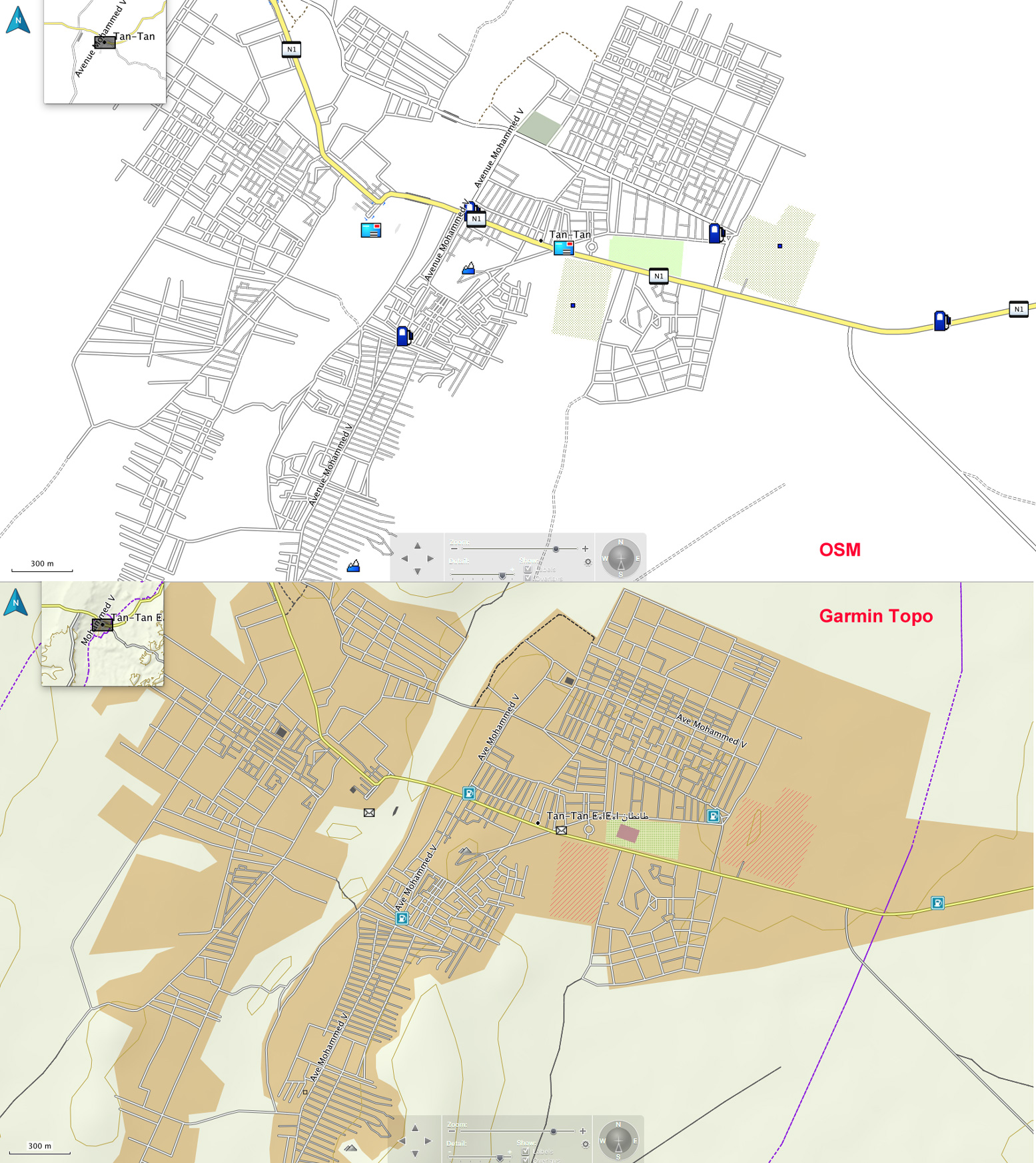
Occasionally at village level the OSM’s street-by-street detail is better, but that’s hardly vital. In towns and cities the extra shading distinguishes the Garmin from the plainer OSM, as shown for Tan Tan, left.
Tan Tan
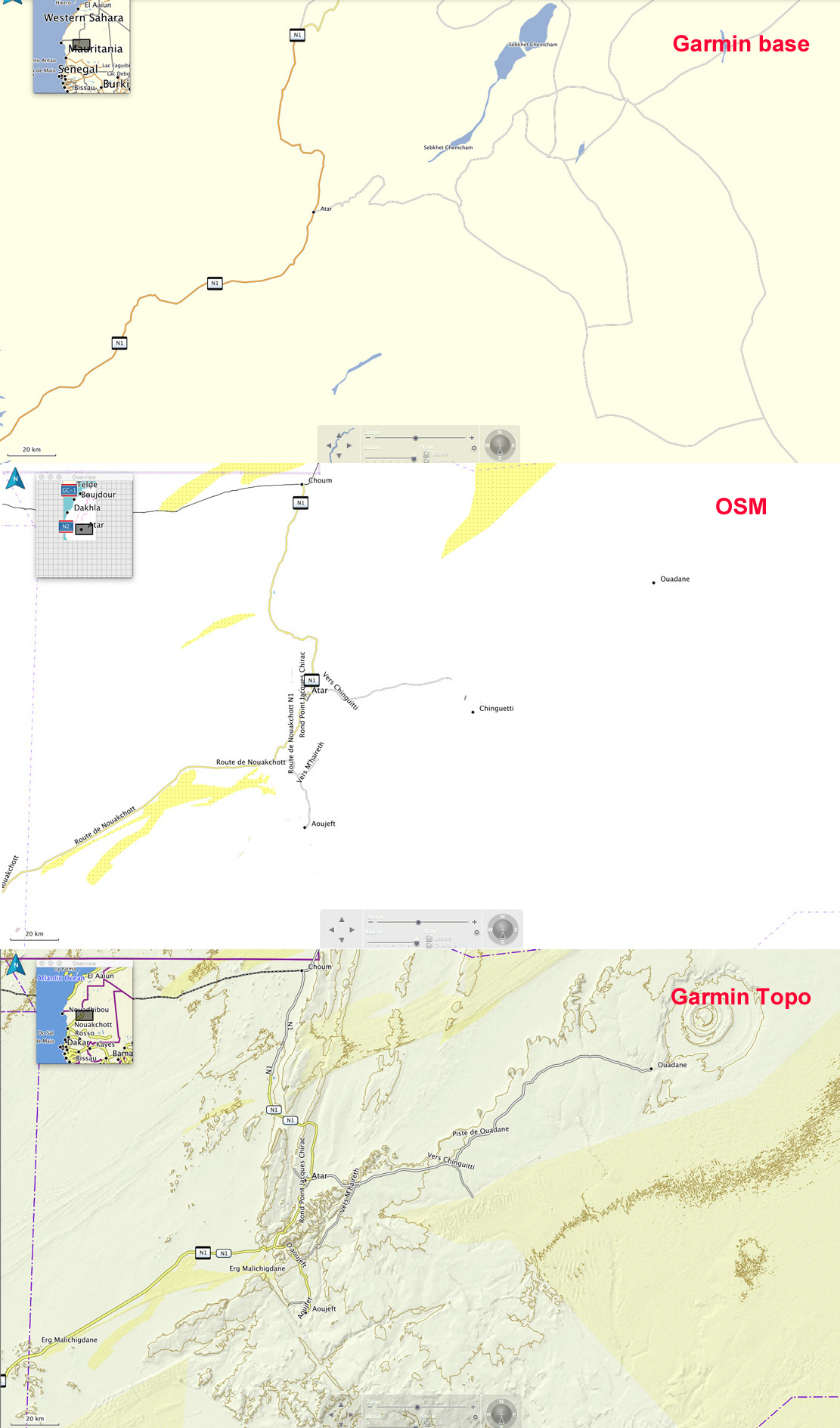
The chief difference is in the desert where the Garmin depicts relief and surface with more detail and clarity using shading, contours and colour where OSMs only use colour and Olaf only used contour lines which can be distracting. Look at the Atar region (RIM) above right – an area of escarpments, canyons and dunes – all are reasonably accurately shown on the Garmin Topo. There’s an anomaly on the Topo map on the left (bottom panel) in that the (presumably automatically recorded) elevation variation in dunes depicts them as lots of small hills (which in a way, they are), but only once they’re above a certain height. Identifying dunes with contours is not helpful nor a cartographic convention. Shade and colour is best.
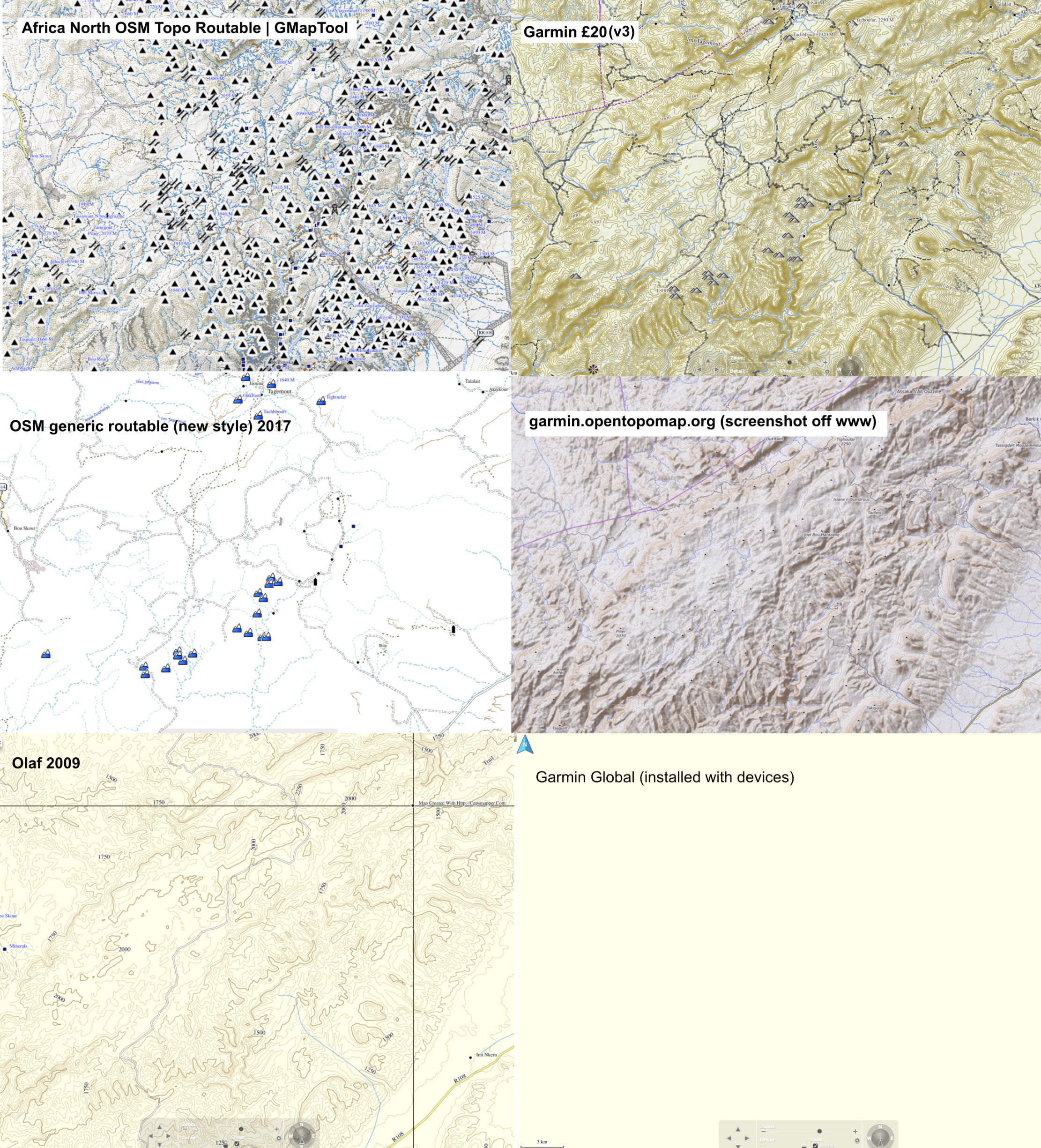
Six digital maps compared 2021– screenshots of Jebel Saghro, Morocco. Garmin v3 is #2.
The piste and road detail on the Topo is pretty good: yellow for national highways, twin lines for secondary roads or piste, and a single line for a less used piste. A quick check in Morocco shows they’re all there; most of the ones I know are there in Mauritania too. In southern Algeria only a few main pistes are shown and certain ‘national highways’ are actually remote pistes never likely to be sealed. The Topo map would not be so useful here. In any country dashed lines may well be walking trails, but as far as I can see, there is no key or legend with the Topo map. Some POIs are there too – just fuel stations and post offices as shown on the Tan Tan map, above.
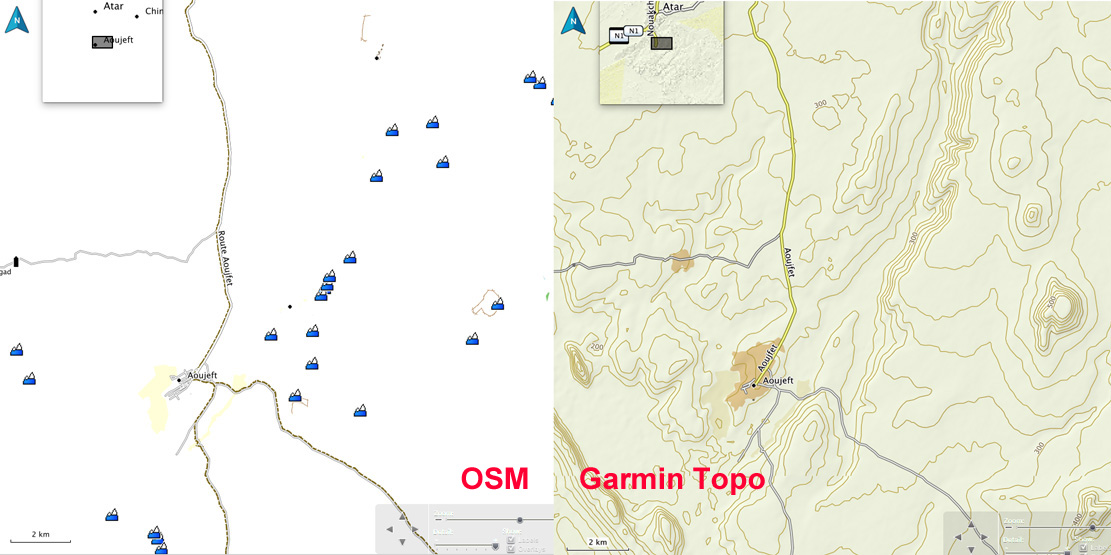
In places the Garmin copies OSM’s annoying habit of again, marking high points (automatically?) as mountains which is a distraction, let alone inaccurate – for example when an escarpment gets shown as a string of peaks. If you drop the detail level enough notches on BaseCamp, these peaks (left) only disappear once all the useful tracks and place names have gone too. It’s great (and a bit puzzling) that this stuff is produced for free at all by OSM supporters, but the quickest flip to sat imagery would reveal the true nature of the relief.
So does the Garmin Topo map mean I’ll stop using Google or Bing imagery in the planning, or paper maps on the piste? The former, I don’t think so; the later in Morocco yes, but elsewhere in the Sahara I’d still rely on paper maps. In places like Morocco the extent of marked pistes can be converted into accurate tracklogs, but with better surrounding detail than OSMs. And, unlike Olaf, there’s no aggro importing into a modern, touch-screen GPS. When I want to quickly verify where I am, a glance at the Garmin Topo will may be adequate.
I’ve been using the Garmin Topo map quite heavily on BaseCamp last couple of days, preparing a new edition of Morocco Overland. It’s an intuitive-reading map and I’ve found one benefit of using a Garmin map on Garmin software is that when stringing out a track with the ‘create a route’ tool, it automatically snaps onto even the thinnest track on the map just like Google maps. But the BaseCamp tool won’t do that with other installed maps like OSM or Olaf, or even the basic Garmin base map. Sometimes you have to trick the tool to go the way you want, but it makes stringing together hopefully accurate routes (as well as distances) very easy. Occasionally only Olaf will show a route you want to follow, in which case you make the route with lots of short, straight lines. No so hard.
Getting routed: As the track was clearly visible, I traced the route I’m logging above (MW7) off Google Earth the previous evening (internet required), saved and exported the kml then imported it (as a gpx) into my Montana via BaseCamp. This was pushing the outer limits of my tech ability with this sort of stuff. GPS digital maps not really needed as I had the largely accurate self-drawn tracklog on the screen to follow, while recording my own live tracklog. Years later I used this same system (pre-trace route off Google Earth) again while logging MH23. The great thing with satellite is WYS is usually WYG, whereas with maps (paper or digi) WYS can be nothing at all.
The desert is ruthless It strips you of your vanities Your illusions Gives you the opportunity to see yourself for who you really are Character addressing Jesus figure in The Last Days in the Desert (2016)
More than other wilderness environments, the desert is commonly seen as a place for spiritual rebirth or just some contemplation. Some speculate that it’s no coincidence the world’s great monotheistic religions originated in the desert. Or perhaps it was the other way round: the Fertile Crescent along with timely wheat mutations and climatic cycles spawned great civilisations from which monotheism evolved. Anyway, just being in the desert it’s commonly thought one can be purged, cleansed and reborn. When striped of familiar surroundings and associations, you commonly hear travellers professing an awareness of their insignificance in the great scheme of things. Whatever, it’s always been seen as a good place to get away from it all, including other people.
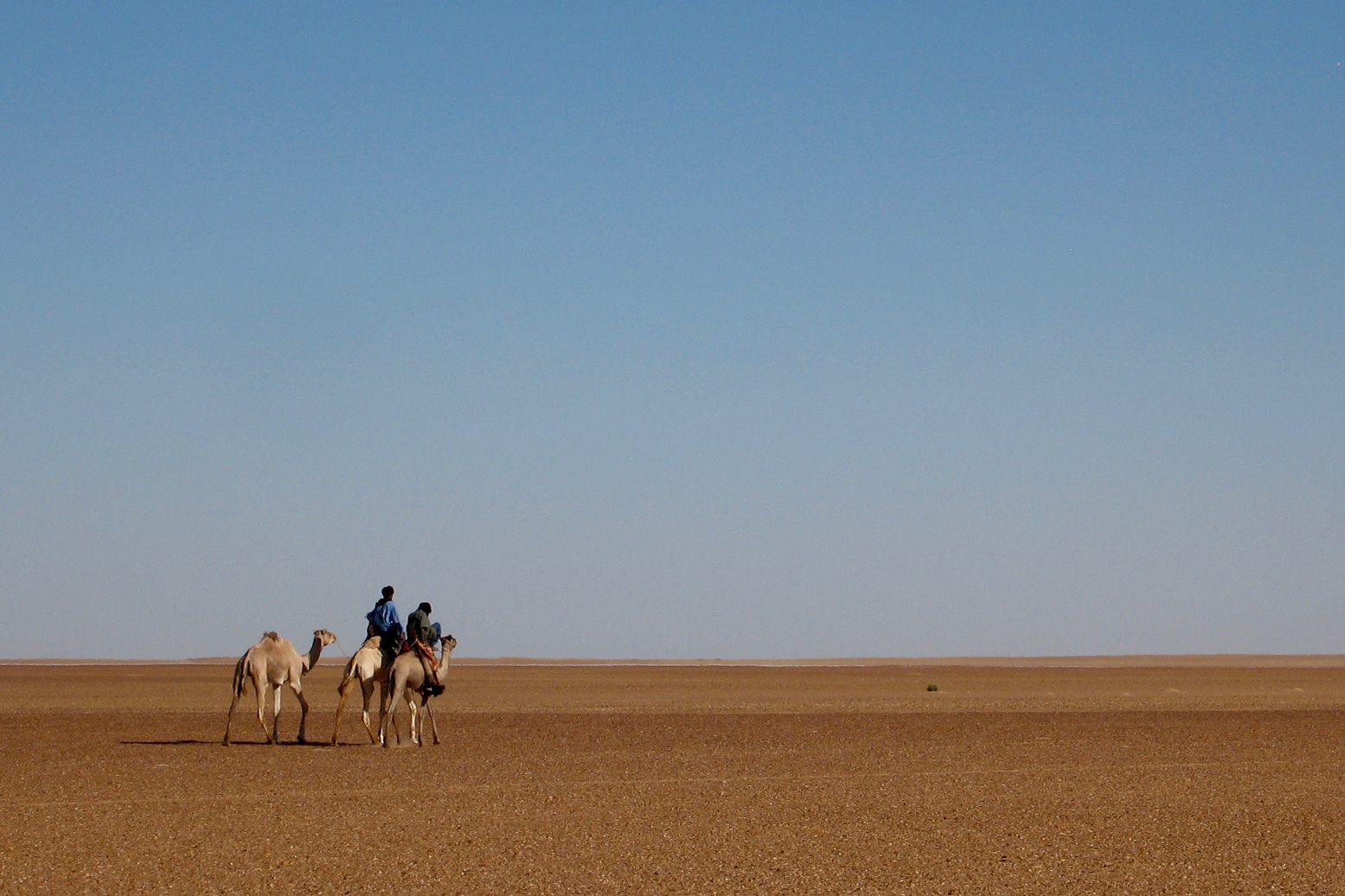
Another one of those periodic ‘I want to cross the Sahara by camel’ posts popped up on the forum the other month. The OP ‘…thought to myself ‘I want to have a life changing experience’ and thought this would be just that adventure.’ Across the width of the Sahara from Atlantic to Red Sea. There followed some clarification, good advice and some scorn, and within a few days the thread blew itself out. What is it about crossing the Sahara? Why do ordinary individuals get fixated on the idea of ‘crossing the Sahara’ at all costs? I know when I first went there the Sahara was something that was on the way to where I thought I was going, but so was France and the Mediterranean. I didn’t see crossing the Sahara as a life-affirming achievement or any sort of event – I was more looking forward to the simple challenge of some desert biking. Perhaps the words ‘cross’ + ‘sahara’ add up to a compelling soundbite that anyone anywhere will get instantly, like ‘climbing Everest’ or ‘rowing the Atlantic’, but perceived as a whole lot easier. I received a similar enquiry. A chap wanted to cross the Sahara with camels – it didn’t really matter where, it was the crossing that mattered. He suggested some catchy start and end points like Casablanca to Dakar without really thinking it through – padding alongside Morocco’s busy N1 highway with a troop of dromedaries strung out nose to tail. I made what I thought were some better suggestions that would give a real sense of travelling in the desert with camels while dodging the worst of the current political complications. I even sent him the camel chapter from the book (short version of this). I never heard back.
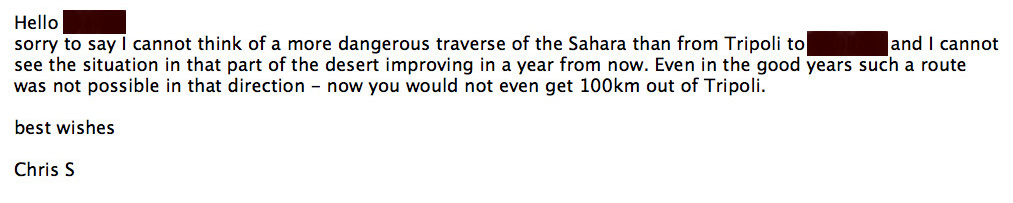
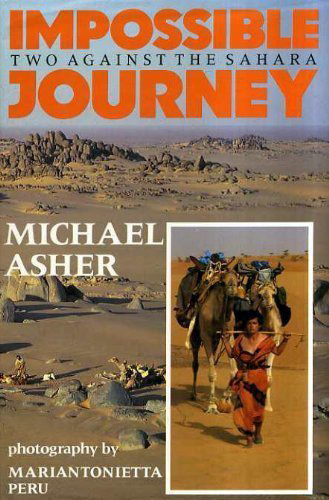
Above is my answer to another enquiry which boldly stated the intention to pull off a hare-brained scheme so I’d have no doubt of the total commitment. ‘Nothing is impossible!’ Never heard from her again, either. Maybe I am too blunt but I keep these emails as evidence of ‘well, I did warn them’ should they ever crop up in the news. It seems that people hungry for adventure lose something of their reason when it comes to crossing the you-know-what. They’re carried away by the concept which ignites the dream and set about with a steely determination to make it happen. To my mind camel crossing the Sahara north to south and especially laterally requires a solid background of experience which is why I respect the achievement of Michael Asher and Mariantonietta Peru when they did it in the 80s and went on to write Impossible Journey. At least they had a good idea of what they were taking on. These days the journey is a whole lot more impossible.
There must be something about camel trekking across the Sahara that makes it sound relatively uncomplicated and easily done alone. You traverse the wilderness with the unspoken companionship of your caravan and maybe a nomad guide whose language you don’t speak: ‘horses with no names’ who won’t question insecurities or flakey motivation.
Aside from the practicalities or logistics of such a monumental task, what irks me is that very often there’s little curiosity about the environment or the cultures they’re passing through. The conquest trounces all, and the empty Sahara is just a backdrop for a monumental vanity project, as it was for Geoffrey Moorhouse back in the 70s and several others before or since. As I was told recently by an individual who came close to death in his quest: It was a bad time and I made poor decisions. I desperately wanted it to be “me and the desert” and to have my own experience in solitude. I’m wiser now.
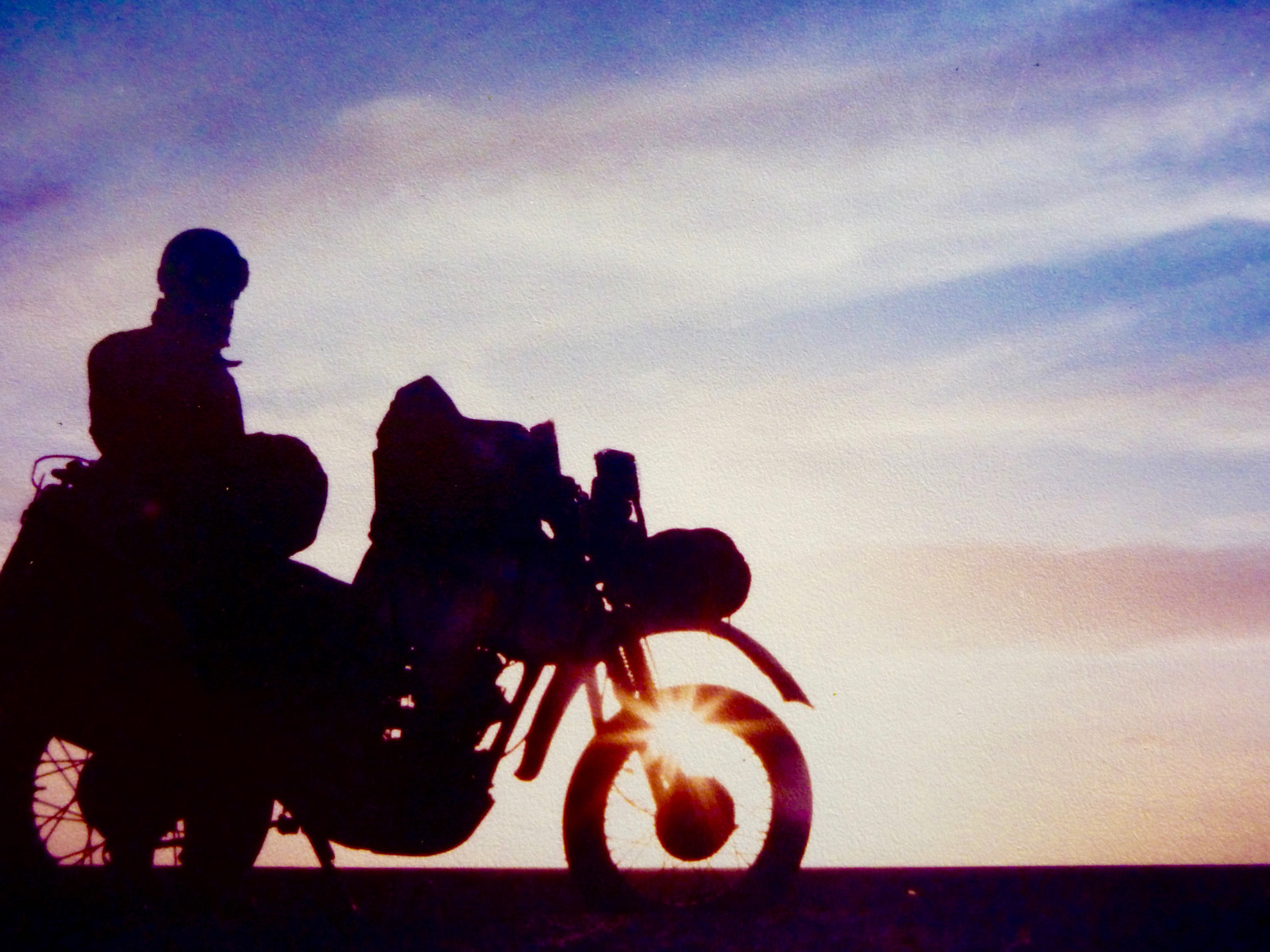
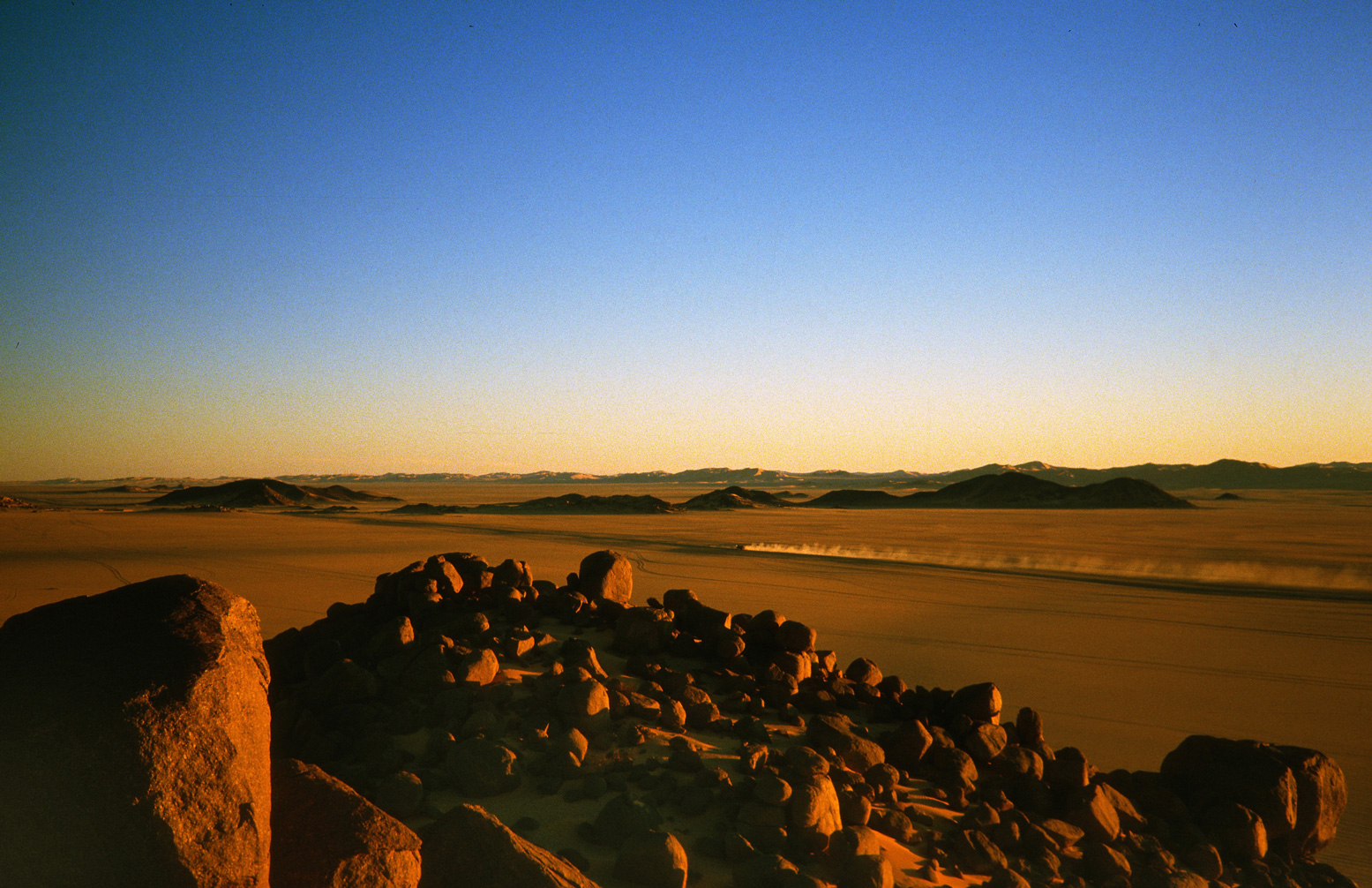
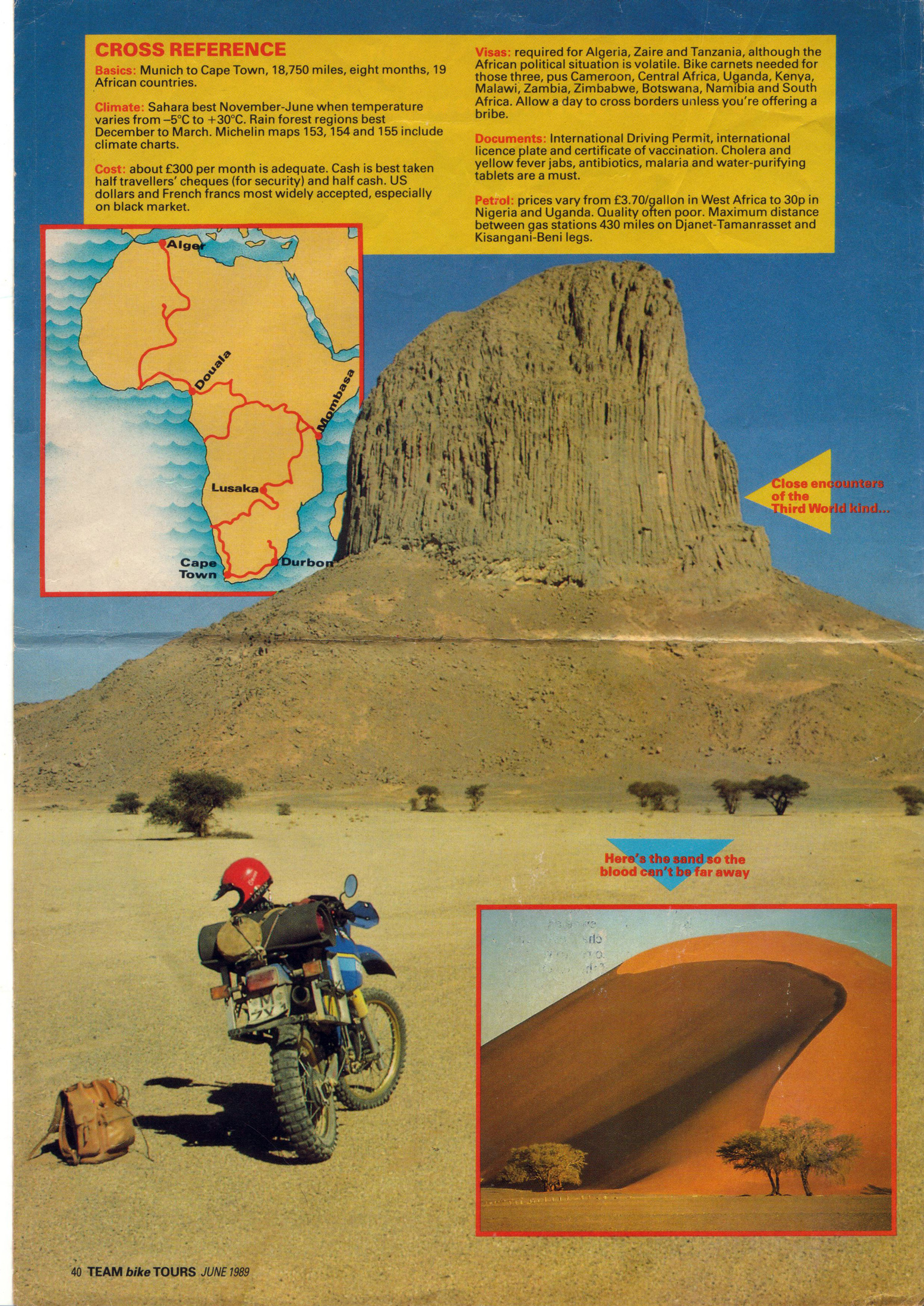
Once I get used to it and feel comfortable I like to be alone out there too, and in the desert that’s not hard to do. If anything it helps you re-evaluate human companionship which may be part of the catharsis some seek out there. But I find there’s no need to go to extremes to do this. One memorable desert camp is all that’s required to consolidate a feeling of well being. For me the image below sums it up nicely. Only a mile off the track to Djanet in 1988. For the moment the bike was running well and so was I. It was nice spot for the evening – comfortably alone. There have been many more nights like that out in the Sahara, with or without other people.
Usually though I’ve found travelling alone with a vehicle tends to extinguish any mystical retrospection. On a bike you’re totally preoccupied with keeping upright, not getting lost and all the rest – and in a car it’s the same plus the noise and the shaking. It is the evenings that are a blessed respite from the task, the heat and the wind and when the appeal of the desert is easily felt. In a group, walking with camels and crew is a far more satisfying way to enjoy the desert day or night, most probably because there’s so very little to worry about. You don’t have to know any more than how to walk, sleep and eat. It’s the very simplicity of such desert travels that strikes the chord, even if this is a fantasy enabled by the hired crew of desert nomads. The actual practicalities of making it happen and sustaining camelling independently get quite complex as many accounts that I’ve read have shown. And now you have to account for the unglamorous and unromantic political overlay.
I suppose the hope is that when one gets to the Other Side one is reborn or cleansed or at the very least feels a sense of achievement which ought to trump all insecurities. But no account I’ve ever read has admitted to that. Or perhaps midway through the journey there is some sort of epiphany with a closure and acceptance and an understanding that life must go on, at which point the epic challenge may lose its purpose.
After nine days, I let the horse run free, ‘Coz the desert had turned to sea.
Me, I just like being in wild places including the desert. It doesn’t have to get complicated.
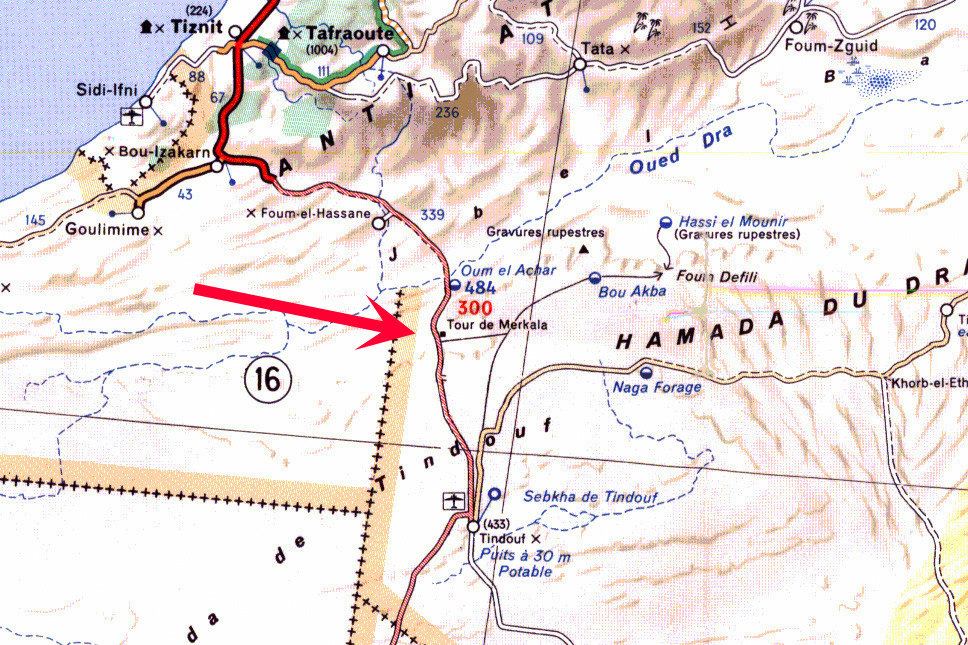
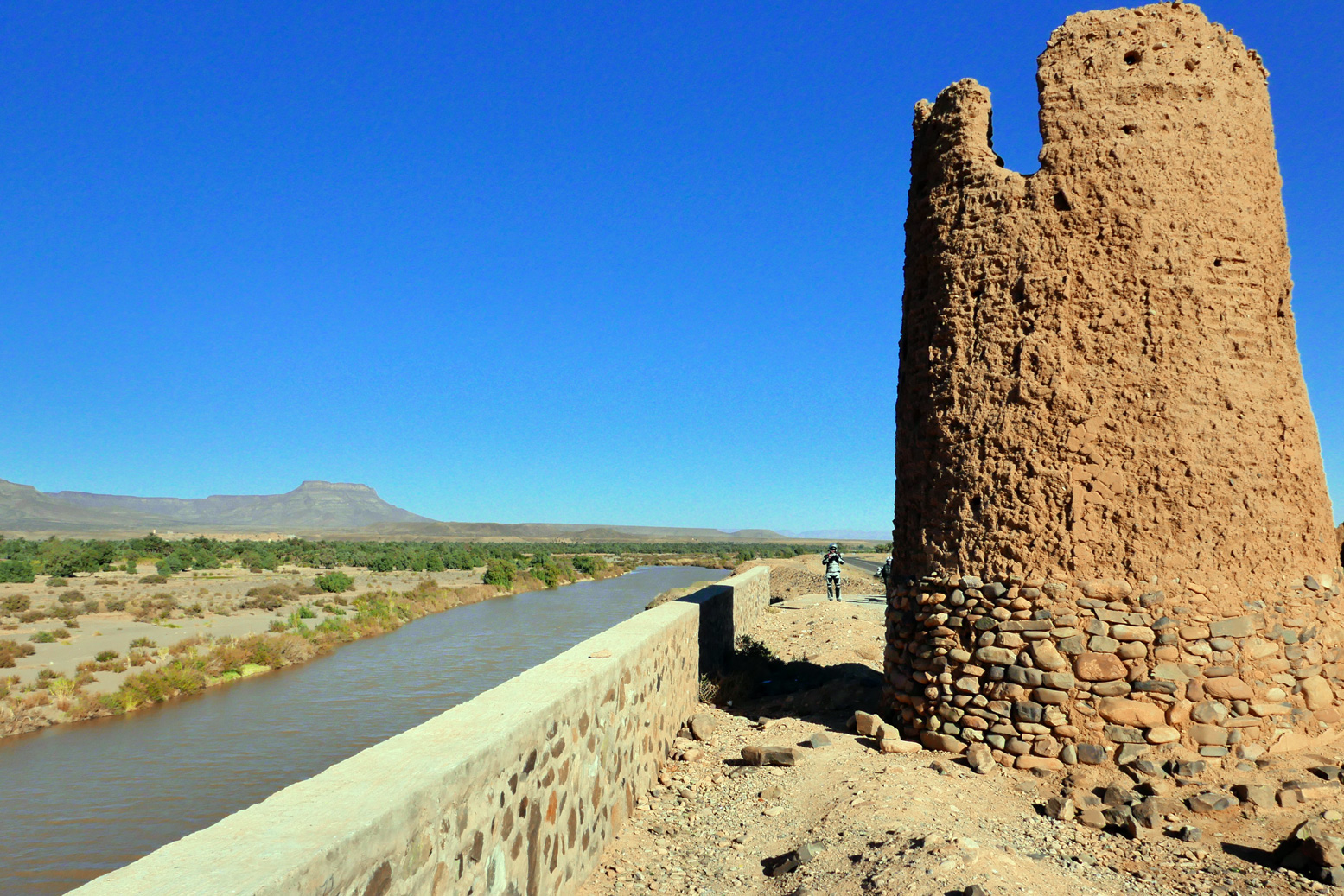
I’ve always been curious about the Tour de Merkala, identified on the Michelin 741 Sahara map (and left) on the Algeria-Morocco border, south of Foum el Hassan. Was it some ancient caravanserai or watchtower, like the one right, alongside the Oued Draa north of Zagora, which guided caravans in along the 52-days road from Timbuktu? Or perhaps just a French observation post from the colonial era?
No surprise that this time I searched, it was Yves Rohmer’s encyclopaedic Sahara pages where the answer lay, and there’s more here. In the 1930s the French were still busy subduing tribal resistance in the southern mountains of Morocco in the region between Tata and Assa, and while there decided Tindouf far to the south needed occupation too. But between southern Morocco and Tindouf lay the Jebel Ouarkaziz which still serves at a natural barrier today between the two countries.
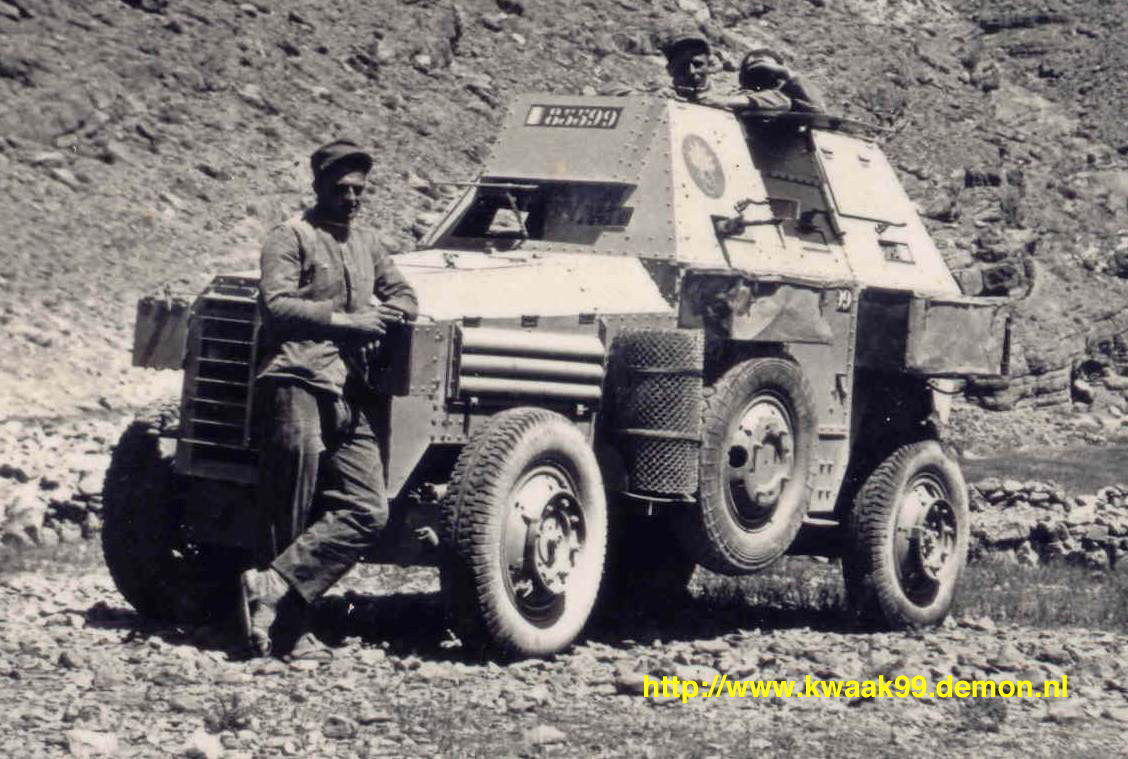
A column consisting of Berliet VUDB light armoured cars (left – note the big roll of chicken wire to use for sand boggings) set out from Akka and wound their way through the foums or gaps in the ranges until they came to the impenetrable cliff below Jebel Merkala. Here they spent a few days enlarging an old camel trail into a ramp to support their armoured cars, over two kilometres and 220m up the escarpment to the Hammada du Draa plateau on top. Once here the way to Tindouf was clear and a fort was established at Merkala.
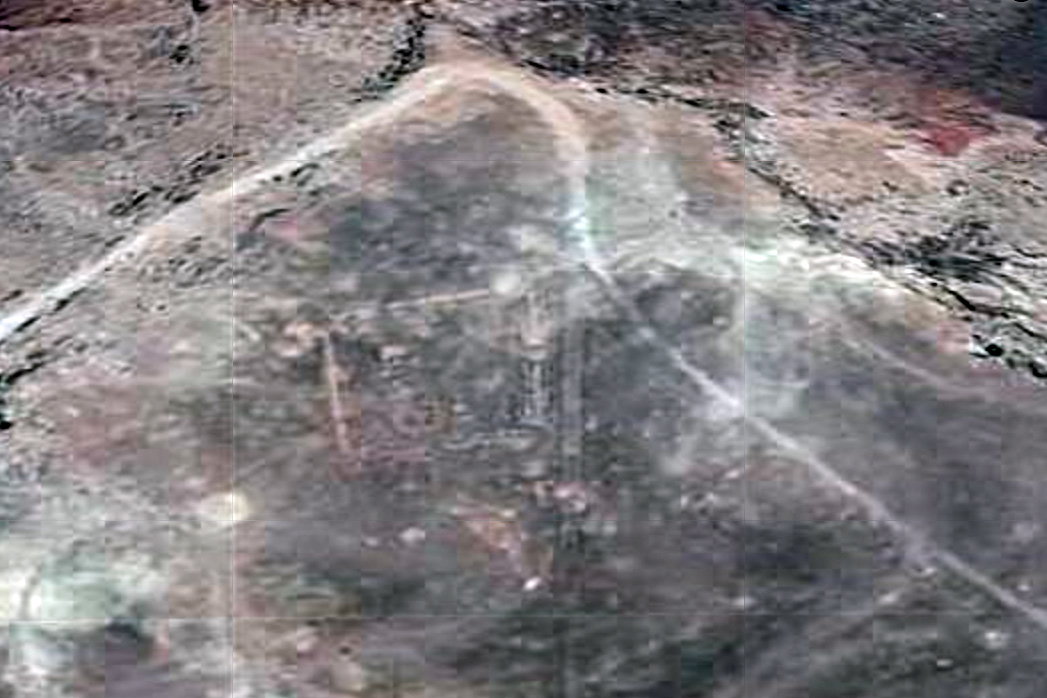
Even if there was a tower (unnecessary on top of a pass, you’d think), why they didn’t call it Fort or Bordj Merkala? Or Fort ‘Commanding-Officer’s-Name’, as was the custom at the time? Many former French forts in Algeria – Fort Lapperine, Polignac or Flatters – became villages and even cities (respectively: Tamanrasset, IIlizi, Bordj Omar Driss). I’ve yet to find an old picture of the actual fort at Merkala and there’s nothing much to see on Google. But as is sometimes the case, Bing has better resolution and shows faint traces of skewed-rectangular fort-like foundations at the top of the pass (right), as well more modern ramparts pushed up nearby. Click the Flatters link above to see what a fort from this era may have looked like.
Very soon this route was extended and improved to become part of the primary imperial N1 highway from Morocco into the AOF French colonies to the south, running from Agadir via Foum el Hassan over Merkala to Tindouf, then down via Bir Mogrein, Atar and eventually Dakar.
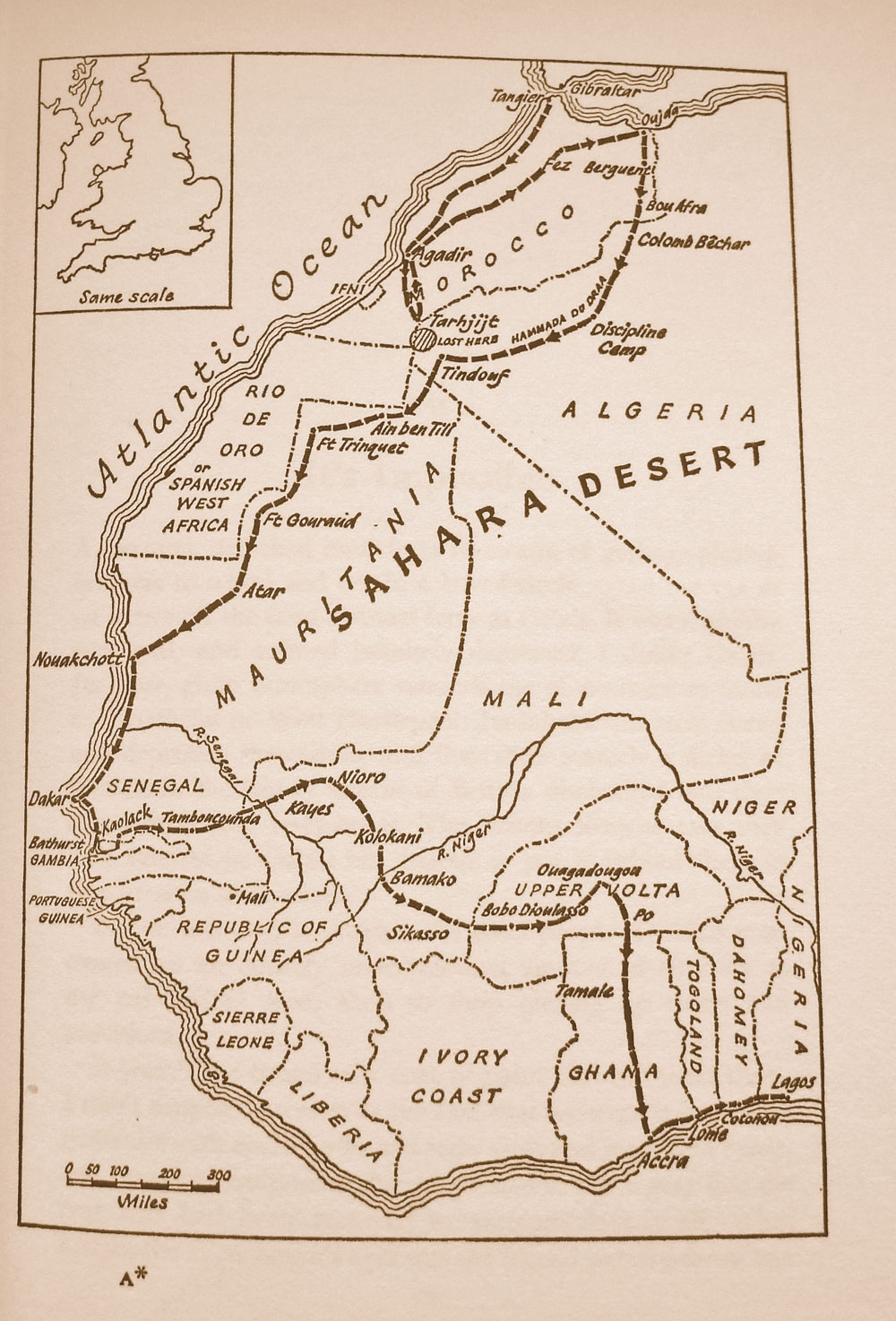
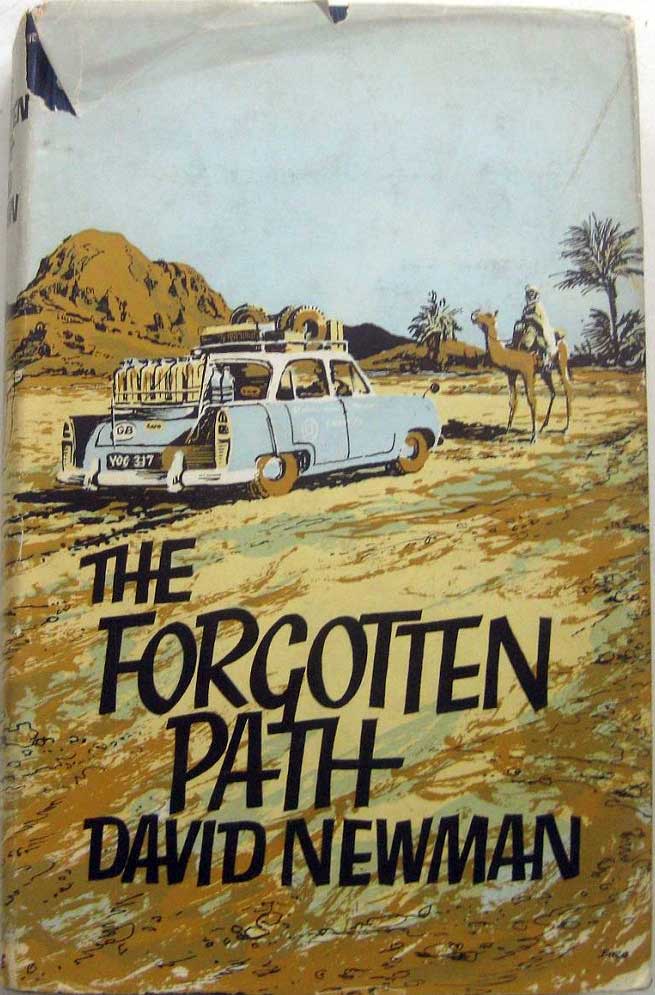
The Atlantic Route we know today wasn’t an option for the French back then as the Spanish colony of Rio de Oro. – today’s Western Sahara – was in the way (left). It was the N1 inland highway which David Newman took in his Ford Zephyr in the late Fifties, vividly described in The Forgotten Path, a somewhat unhinged account of his drive to Nigeria. He’d tried to go via Foum el Hassan and the Merkala tower, but to his fury was turned back as the area was harbouring the FLN who were battling the French in Algeria at the time. The Tour de Merkala became a battleground again a few years later during the so-called 1963 War of the Sands between newly independent Morocco and Algeria. No fixed border line across the barren desert had been thought necessary between the two nations until valuable minerals were discovered (you’ll see no border defined on the late 1940s Michelin 153 at the top of the page). For some reason Algeria attempted to annexe the village of Iche near Figuig, as well as a creek called Tindoub and the nearby well of Hassi Beida, some 35km south of Mhamid. The Moroccans responded by trouncing the Algerians, so establishing an enmity that fed into the Polisario war a decade or so later and which remains entrenched today with closed borders. You can still see the Hassi Beida bump in the border today.
Getting back to Merkala’s prominence on maps. Perhaps it’s just an anomaly not unlike Hassi bel Guebbour in Algeria. Looks like an important place on the map but once you get there it’s nothing but a checkpoint at an albeit strategic crossroads with a couple of chip- omelette cafes.






 Sahara Overland