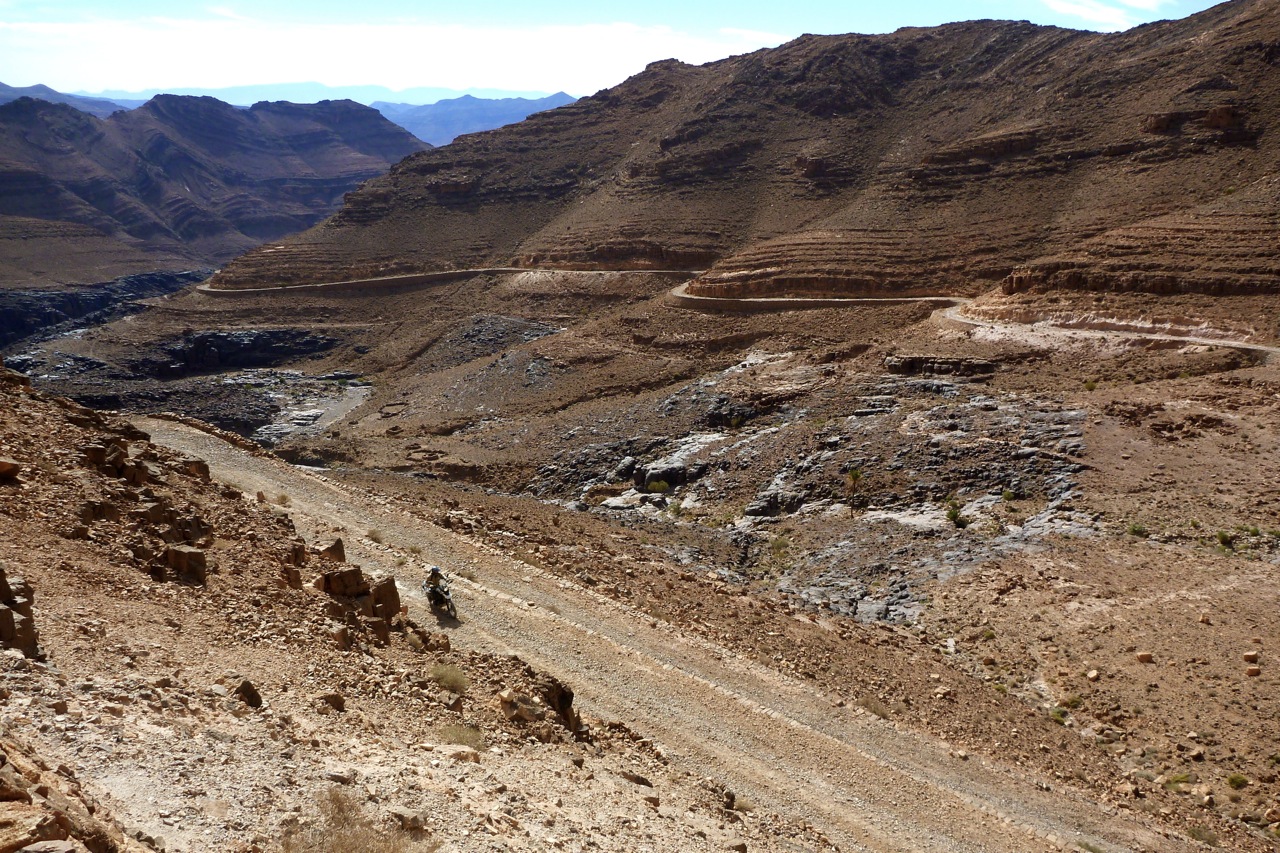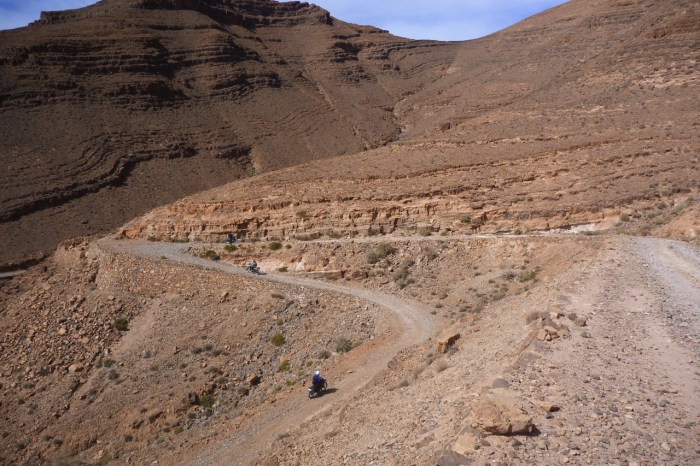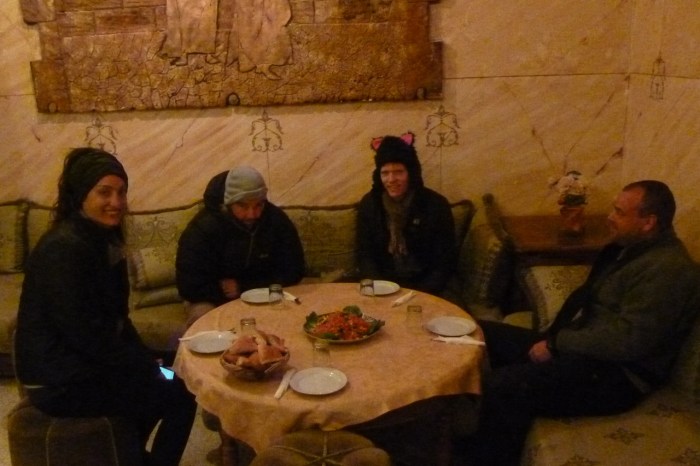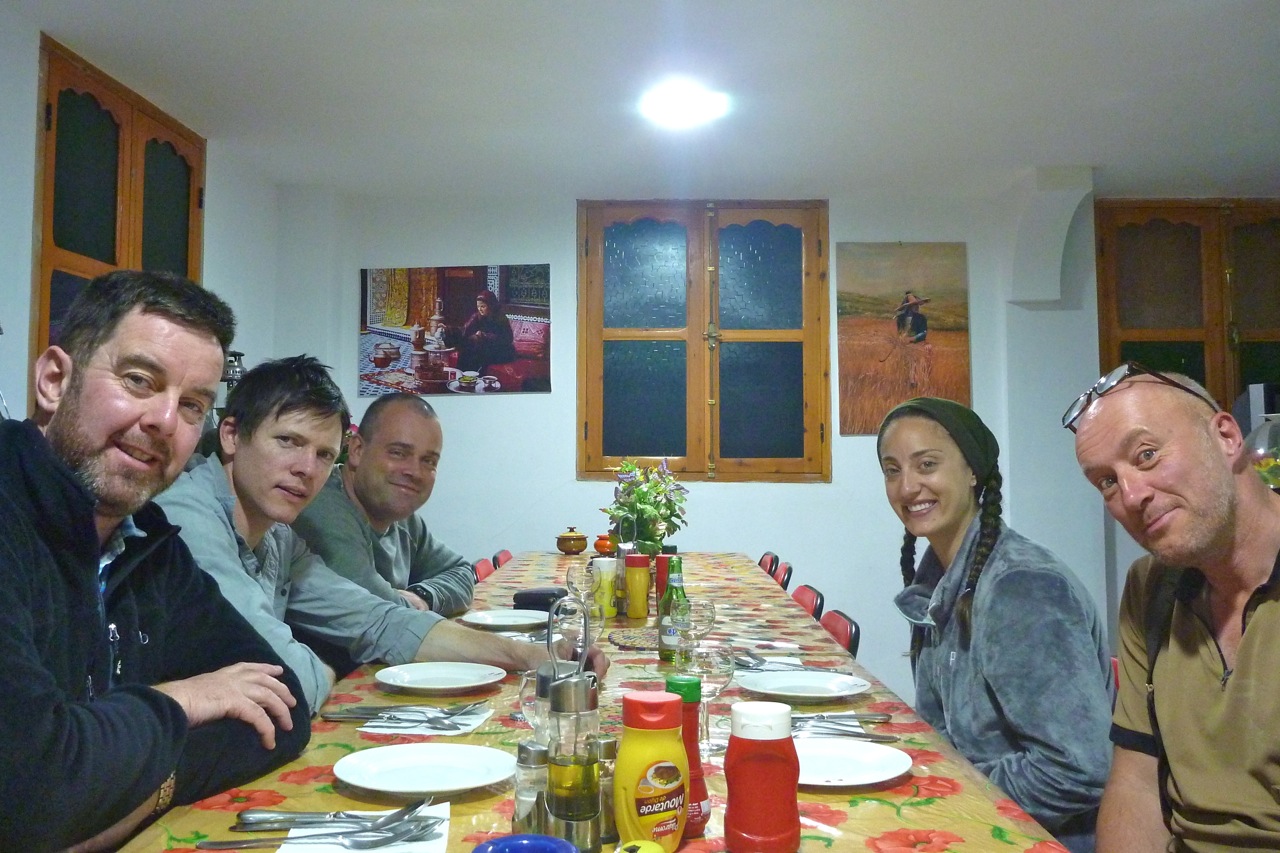
Author Archives: Chris S

R is for The Red Plateau ~ Libya 1998

Part of the occasional Sahara A to Z series

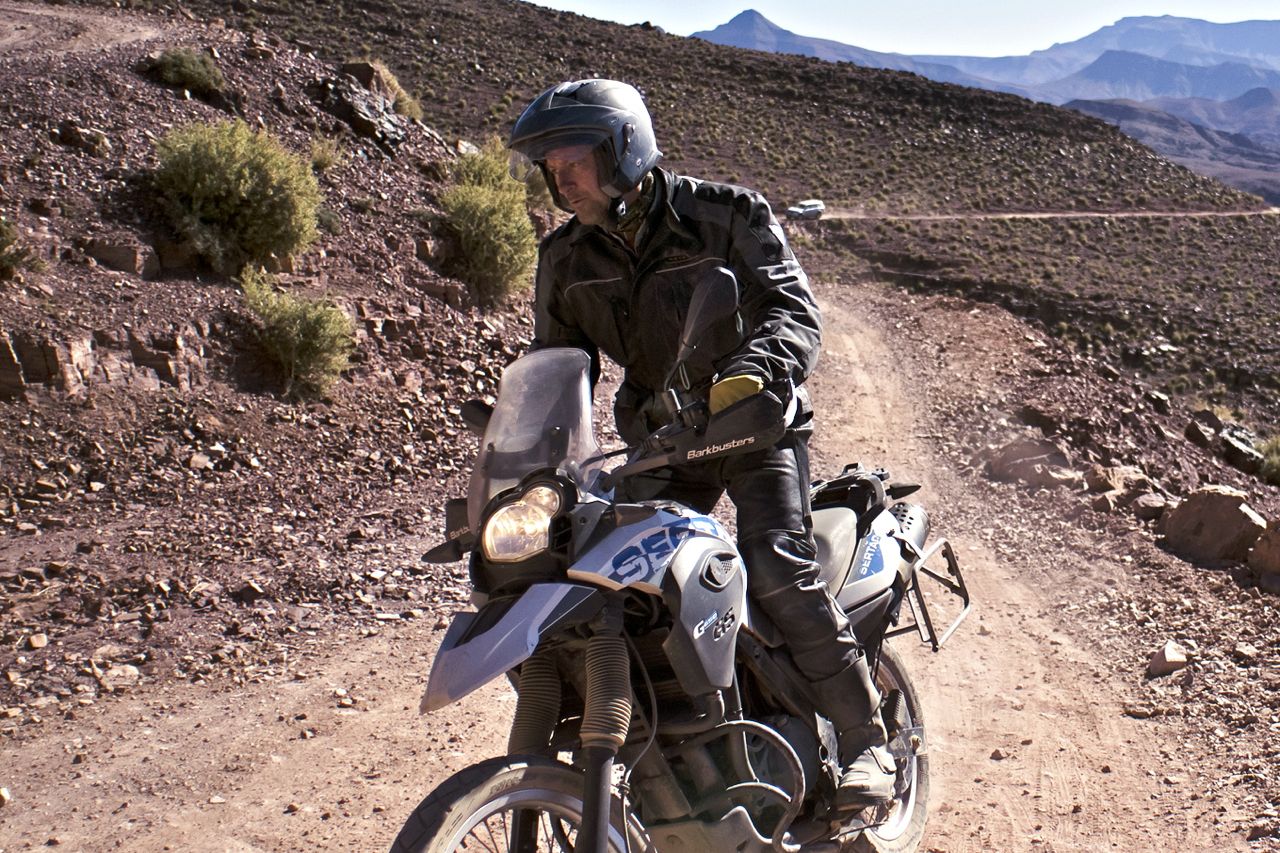
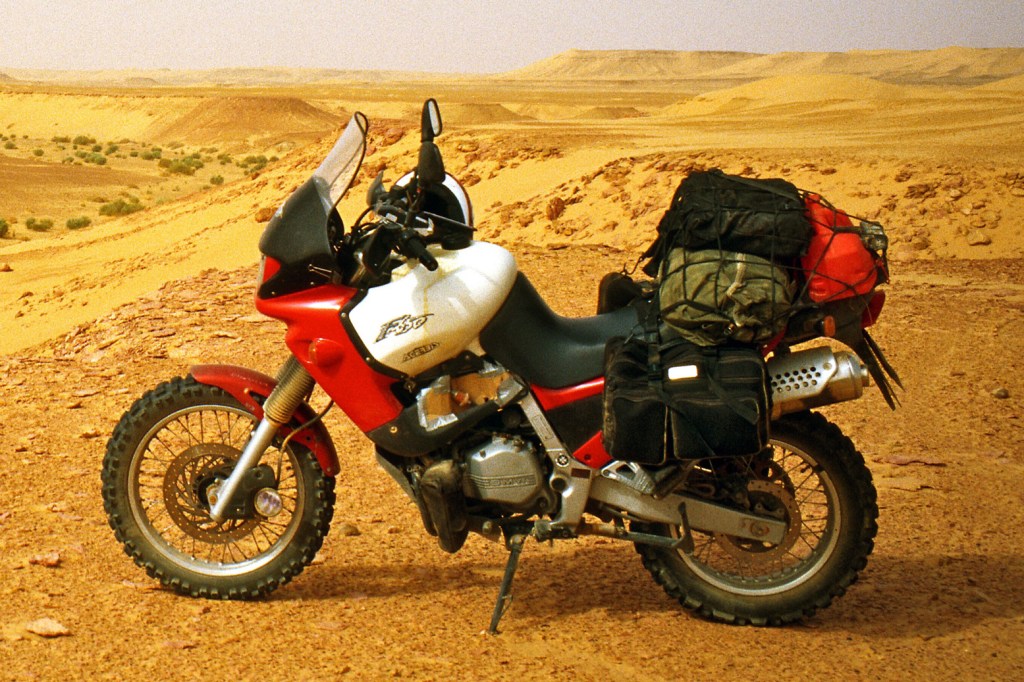
A 2008 BMW 650X was my 2014 project bike
gaddafi1998

Go to most embassies and at the very least you’ll find a few tourist pamphlets and a poster of a couple frolicking by a fountain. There was no such noncing about at the Libyan Interests Section in London’s Harley Street in the late 1990s. Down in the grubby basement mean-looking guys ground another fag into a Brit passport and ignored you purposefully. Tourist literature was limited to a defiant newsletter commemorating the ‘drawing of the Line of Death’ against imperial aggressors. Charming. Just the spot to enjoy a spring break on a bike.
‘Visa?’ I asked meekly. ‘Hello? Visa?’

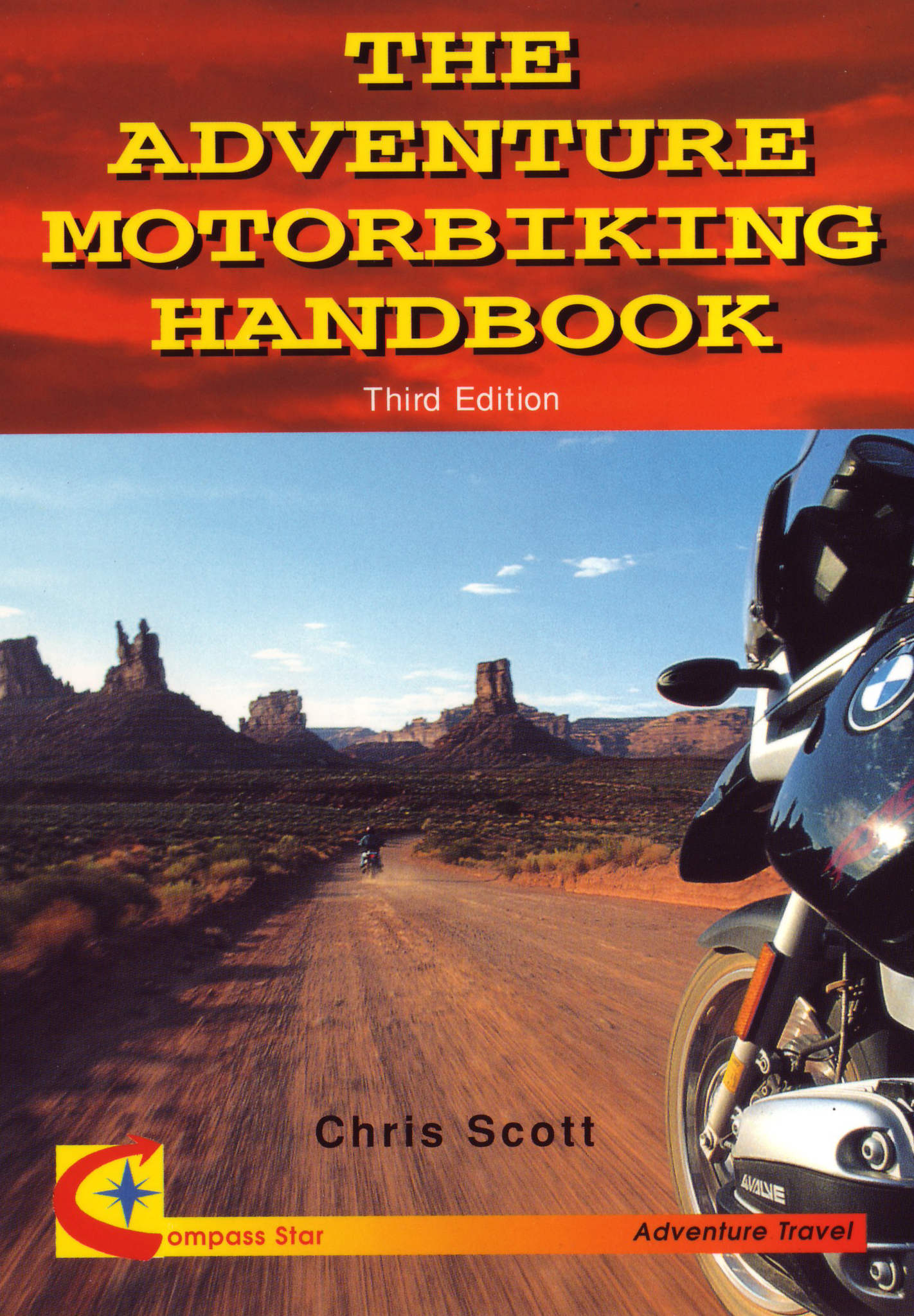
It has taken me months to get to this point. In November 1997 with the third edition of AMH completed, I decided it was time to practice what I preached. Libya sounded interesting and BMW’s Funduro trailie would make a change from another Yamaha XT600Z Ténéré.
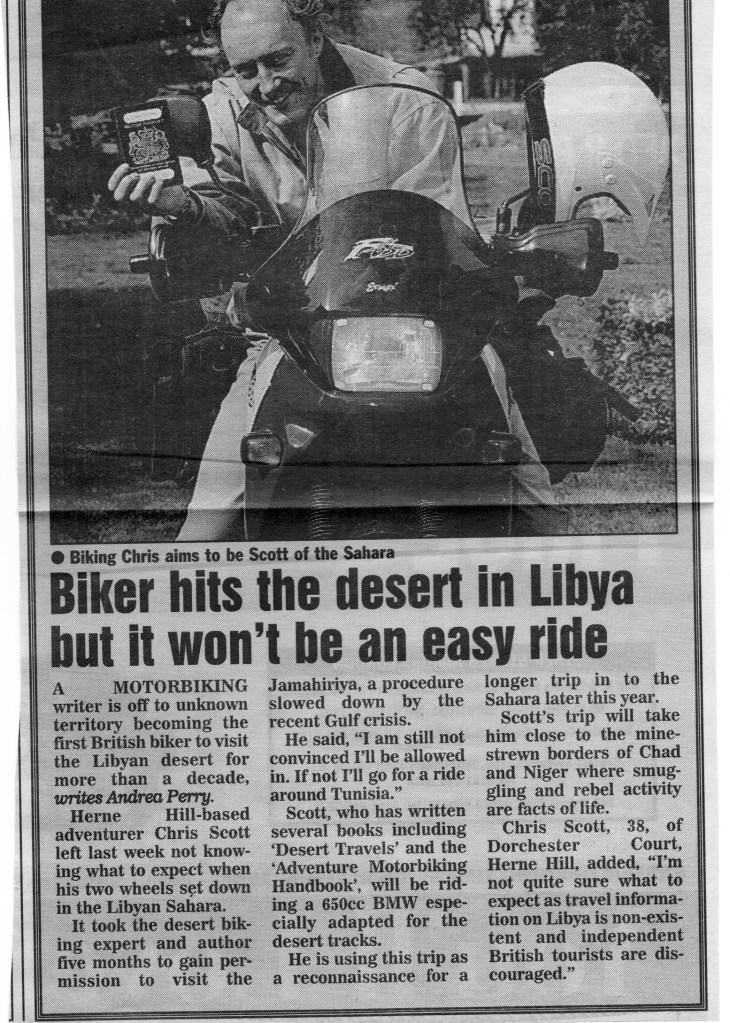
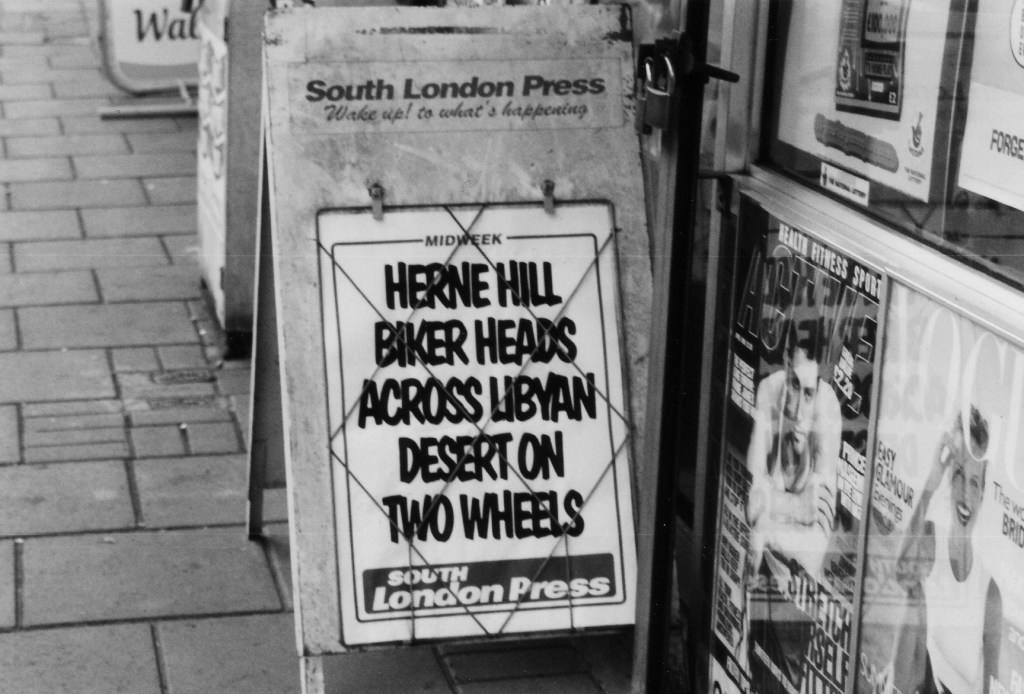
Before I left I even managed to attract the attention of the South London Press.

Buying a three-year-old F650 (bike #47) was easy; getting a Libyan visa involved countless dead-end faxes to various Libyan tourist agencies for the required invitation. Eventually, a mysterious internet connection provided an invite at a price and my permit was telexed from Tripoli in early April. A week later I was walking down Harley Street with the requisite stamp. There was no going back now.

funduroe

I may have been nervous about my destination but I was less uncertain about the bike. I’d always fancied trying the Funduro. They came out in 1993, a trusty combination of Rotax engine and BMW build quality plus a naff name and a look unlike anything else. No one had anything bad to say about them other than being a bit heavy for off-roading. The revvy engine took a bit of getting used to after my torquey XTs, but with the right tyres I was sure the 650 would be up for some piste bashing.

sf-red1

As I was hard-up modifications were kept to a minimum – or that’s the excuse I give myself. Truth is the bike should need the bare minimum of adaptions.
A fat Michelin Desert was squeezed on the back after a bit of sawing at the outer knobs. The front end took a ‘rear’ 19” Pirelli MT21 with a lot more knob-chopping and fitting a mudguard off a Honda VT500. Road riding on these tyres was initially unnerving, especially the ‘marbles-on-glass’ MT, but I soon got used to it.

The bike had come with a new o-ring chain, some brand I’d never heard of, but I figured it would last the trip. The 27-litre Acerbis tank managed to look barely bigger than the original but promised a useful 500km range. To help work out distances in kilometres, BMW UK gave me a metric speedo which saved on possible errors when converting from miles to kms. A chunky alloy Touratech GPS bar mount held my snazzy new Garmin 12 firmly in place, and a cheapo ball compass was screwed on the dashboard. Lastly, I fitted an in-line fuel filter, a cig’ lighter plug for the GPS, fork gaiters and a high screen. It was March now, high time to head south.
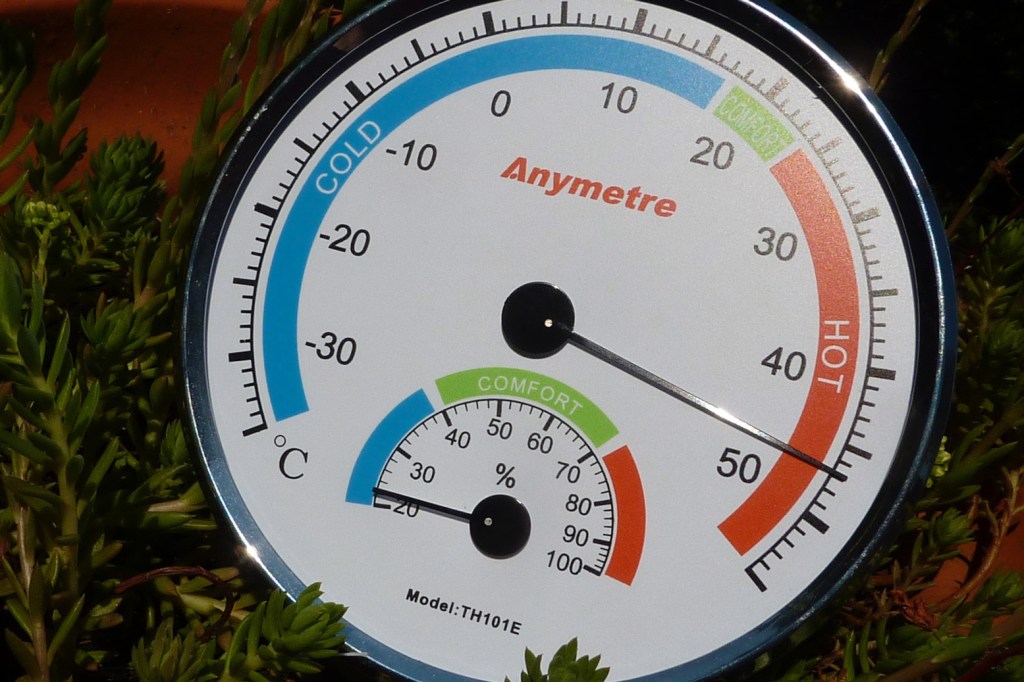
To save my knobs I took the overnight Motorail from Paris to Marseille and then caught a ferry to Tunis where ensued five hours of messing around from one counter to the next. If this was Tunisian immigration what would Libya be like? And another thing troubled me: had I left it too late in the season? By now temperatures were climbing steeply right across the Sahara and with it, expected water consumption and a host of other problems.

A couple of months earlier a New Year’s meet up with a guy who worked in the Libyan oil fields actually put me off the whole idea. He warned me about the enervating ghibli winds which blew in April and melted strong men’s brains. A story of a guy who’d driven out into the storm sounded especially grim.

About a month after the guy had gone missing a nomad came into the camp and asked if we wanted to know where our Toyota was? We said yes and it cost us. Then he asked did we want our body back – it cost us some more. Turns out the guy had just parked up with the engine running and walked out into the sandstorm.’

With a weather eye out for the ghibli, by the next afternoon I was close to the Libyan border with a wodge of illicitly bought Libyan currency stuffed down my crotch. At the border I was again resigned to hours of shuffling from one hangar to the next, filling out forms and getting stamps. But by chance one of the many Libyan travel agents I’d given up on recognised me and whisked me through the formalities in just twenty minutes (and only a hundred quid!). Stunned at my good fortune, I set off towards Tripoli in the fading light and soon pulled over to fill the tank up for just 60p. That’s right: sixty pence. Super petrol works out at 2.5p a litre, or if I you’re feeling stingy, regular costs just 2p.
sf-red-broled

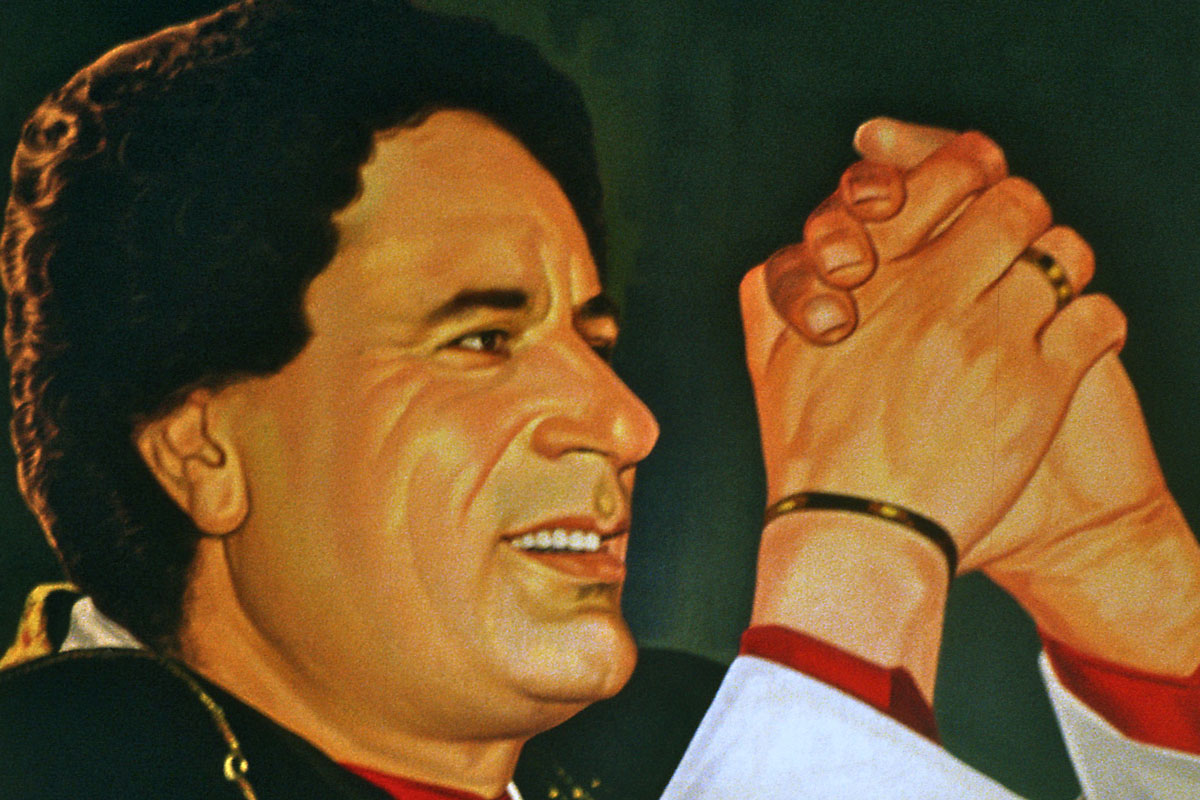
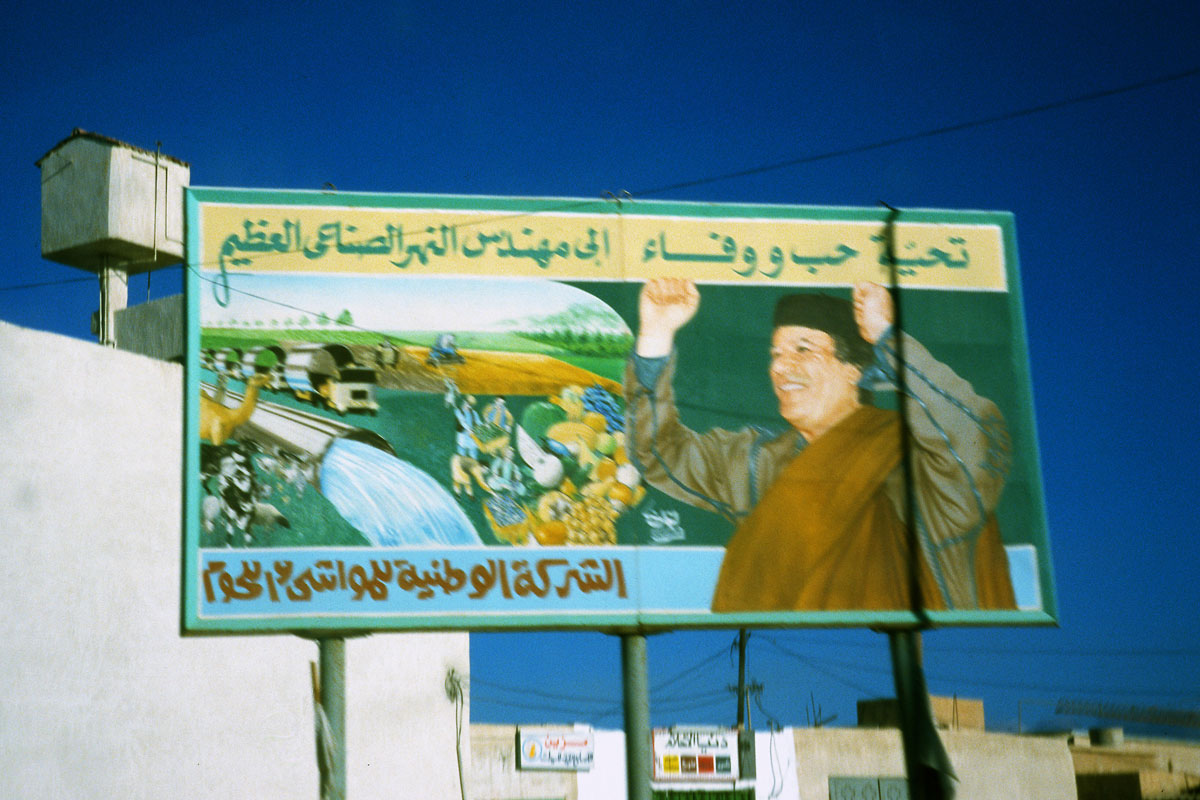
Dozens of the roadside wrecks traffic along Libya’s main coastal highway testified to the lethal mixture of ‘get-out-of-my-way’ gangsters in blacked-out Mercs and lopsided farmyard bangers piloted by granddad in coke-bottle specs. So after a night in the bushes, I was relieved to turn off the Death Highway south towards Ghadames, 550km away. Now the roadsides were only marked by posters of the Brother Leader, hands raised in a ‘we’re all in this together!’ salute.

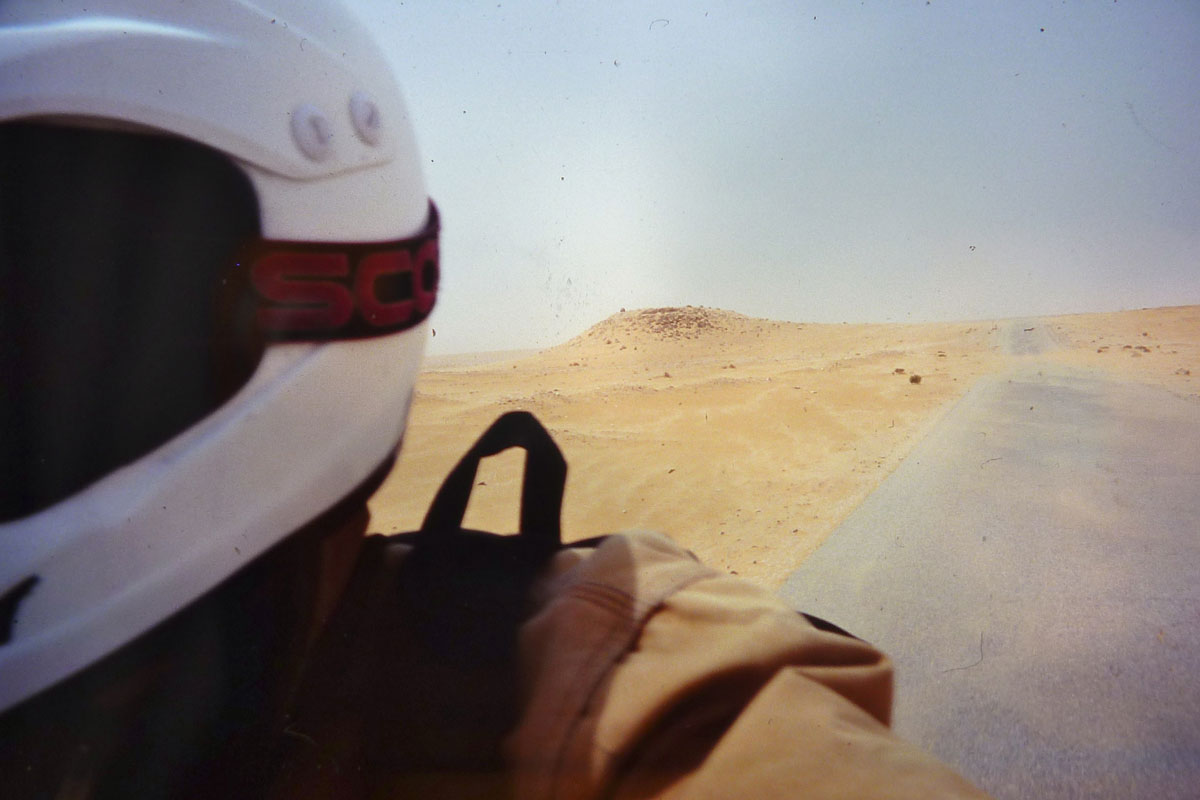
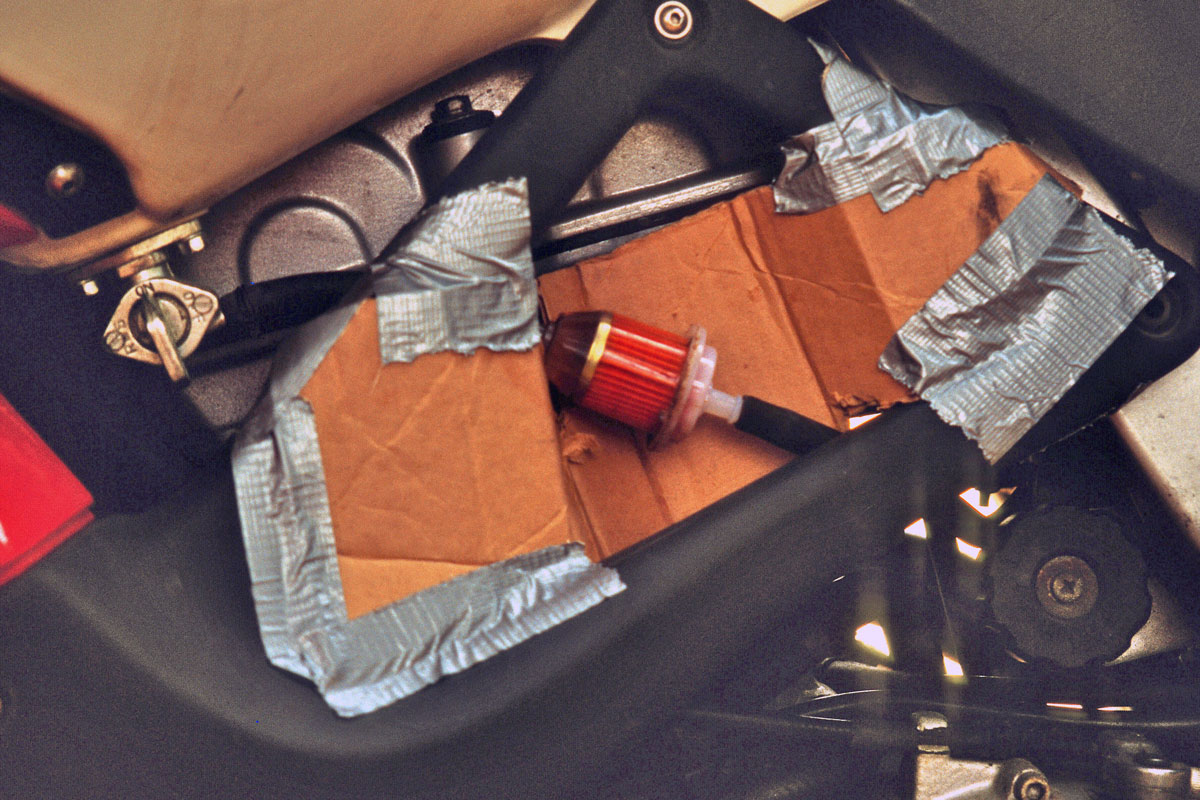
As I rode into the desert on super smooth blacktop I wondered when the real heat would begin. I didn’t have to wait long. By mid-afternoon the temperature had risen to the high thirties and out of the blue the bike started spluttering. Surely I haven’t got through the tank already, I thought? Undoing the cap revealed plenty of gas. The bike started up but a few miles later cut out again. I got off, had a look at things and guessed the cause. A combination of half empty tank and minimal throttle at cruising speed added to the afternoon heat saw the trickling petrol evaporate in the added fuel filter and cause vapour lock – cutting off the fuel supply. Stopping cooled things down and got the petrol flowing again. Later on, when pouring cooling water over the filter body I saw the petrol level rise instantly, I knew I’d guessed right.
sf-red-fuel

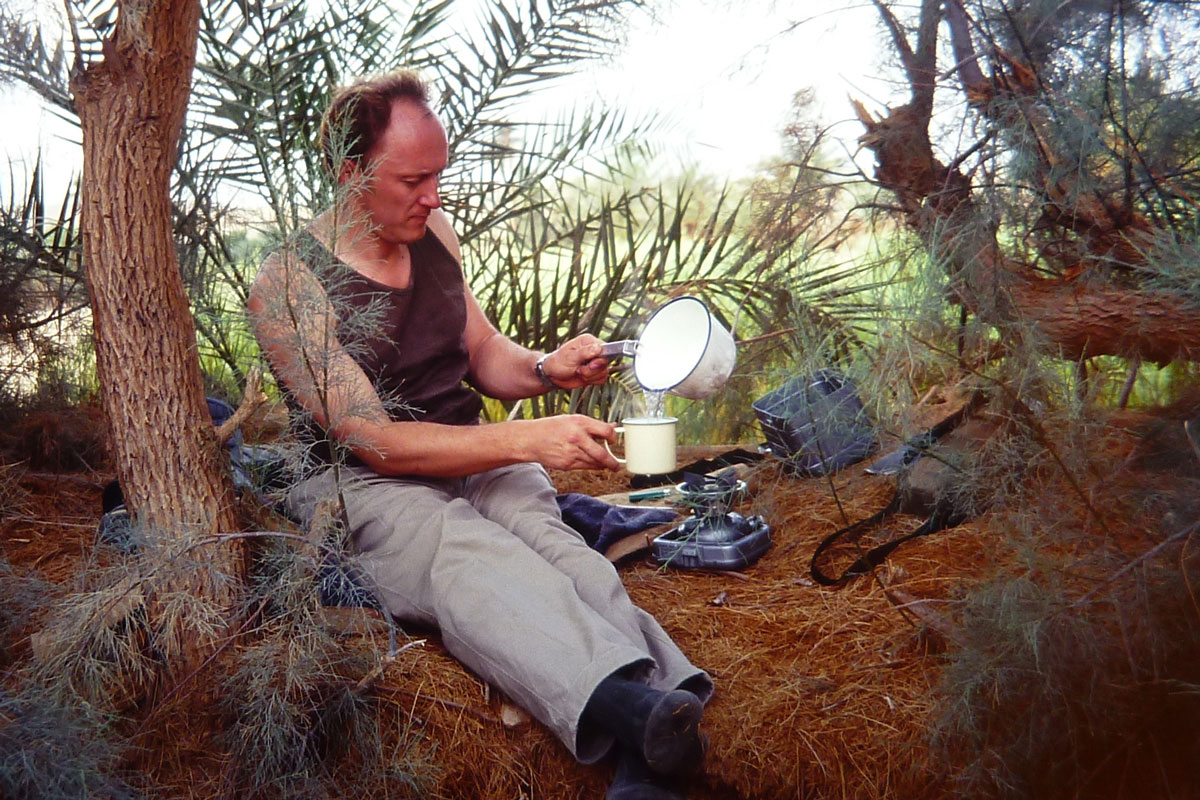
Knowing the problem was as good as solving it, so I filled up first chance and carried on to Ghadames, arriving zonked out at the empty campsite just as the sun set. Slumped out on the sand, I had a think. If it was reaching nearly 40°C this far north, how hot would it be further south? The vapour lock was easily fixed with a cardboard heat shield (above), but I was keen to get the BM on the dirt. Was I taking too great a risk riding alone? From here my plan was to ride across the Hamada el Hamra, or Red Plateau, then cut over the edge of the Ubari Sand Sea down to the Akakus mountains near the Algeria/Niger border, altogether about a week’s riding.

My French guidebook (all that was available) claimed the route across the plateau was a straightforward 450km gravel track with a well half way. Just about within my fuel range, though in these temperatures water consumption was another matter. I checked over the bike, wrote myself a road book and planned to leave early next morning.
sf-ham-camper

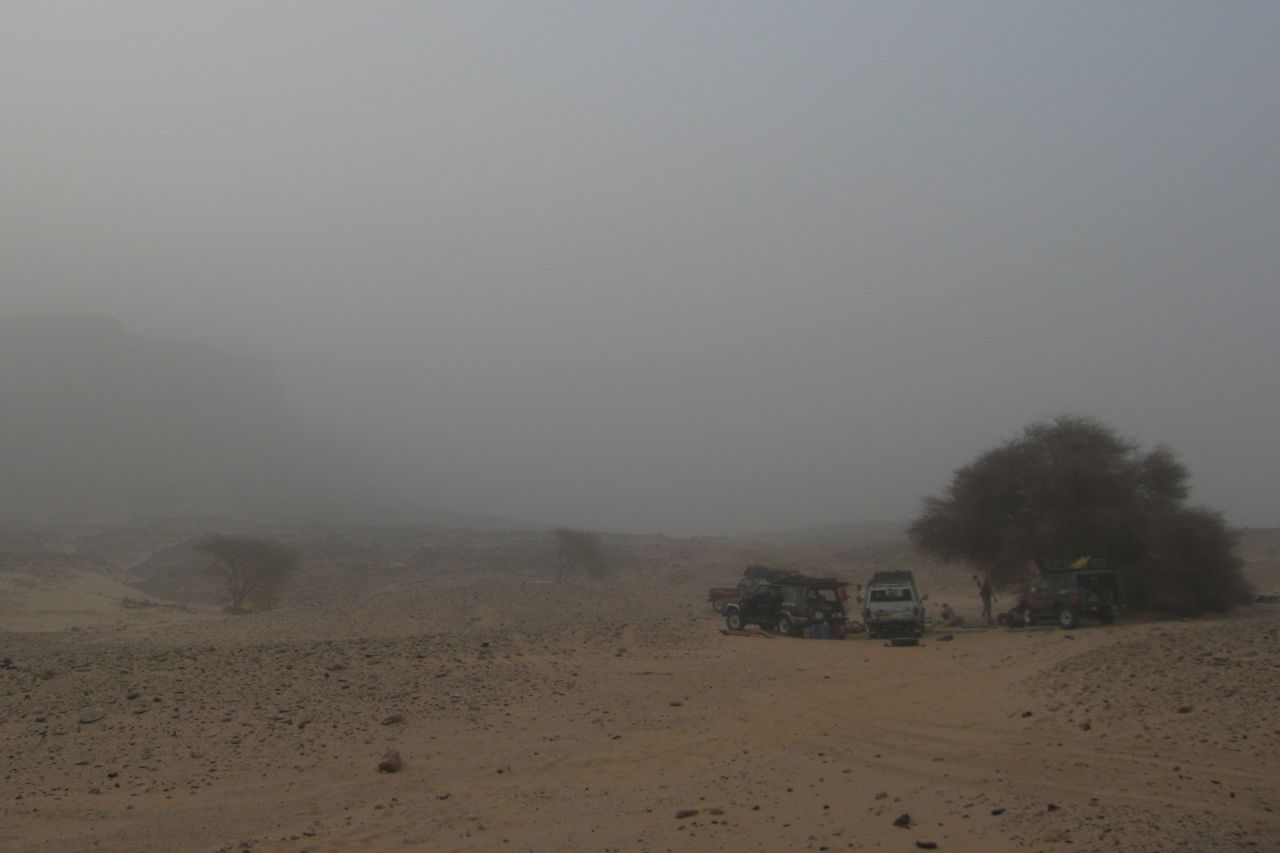
That night at 2am a rising gale woke me and I dozed fitfully as the tent wobbled and the palms flapped overhead. Dawn revealed an orange sky and a thick dusty haze. Was this the ghibli I’d been warned of? I postponed my departure, hoping it would die down, but in the end set off back to the village of Derj where the plateau track began. I’d reassess once I got there.

Topping up at Derj junction, I was on the verge of heading back to Tunisia. As I sat there mulling over ‘dare I’ with ‘should I’, the attendant leaned out the door and said
‘Eh, la mangeria?’
La what? ‘Mangeria!’ He made the universal mime for chow.
Ah oui, merci.’
In the desert I find I automatically slip into French, but unlike Morocco, Algeria, Niger, Mali and so on, Libya had actually been an Italian colony – and even then, only briefly. That’s presumably where this slang for food had come from. As I ate my bowl of oily stew a little German Isuzu pulled in and, as always in the desert, we sized each other up. A brief chat revealed that Rainer and Katja were also heading across the Red Plateau and would be happy to have another vehicle along for safety [Katja took most of these pictures from the car with my camera but I’m sorry to say I have not photos of them].

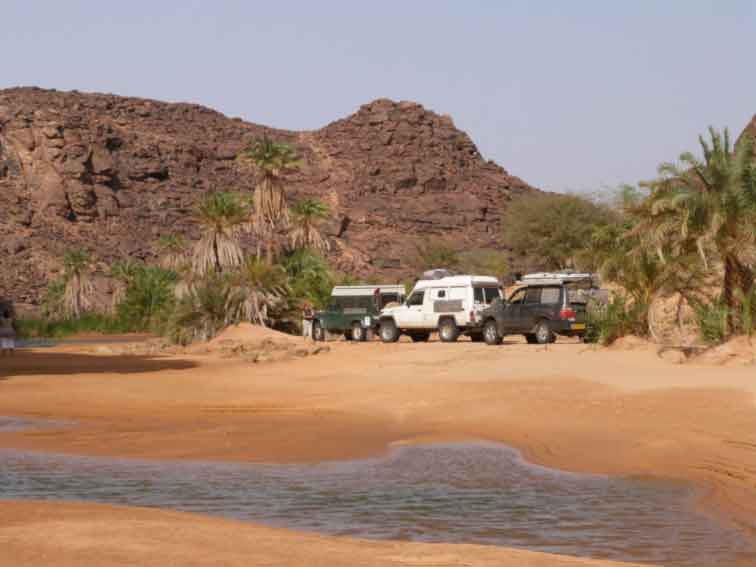
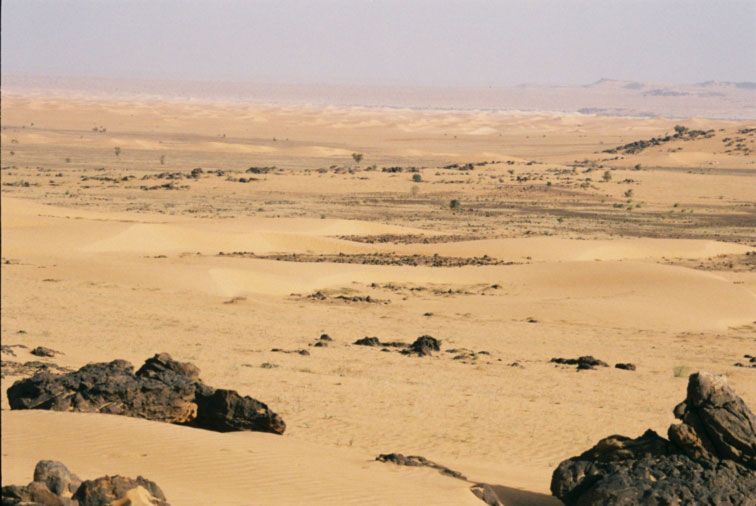
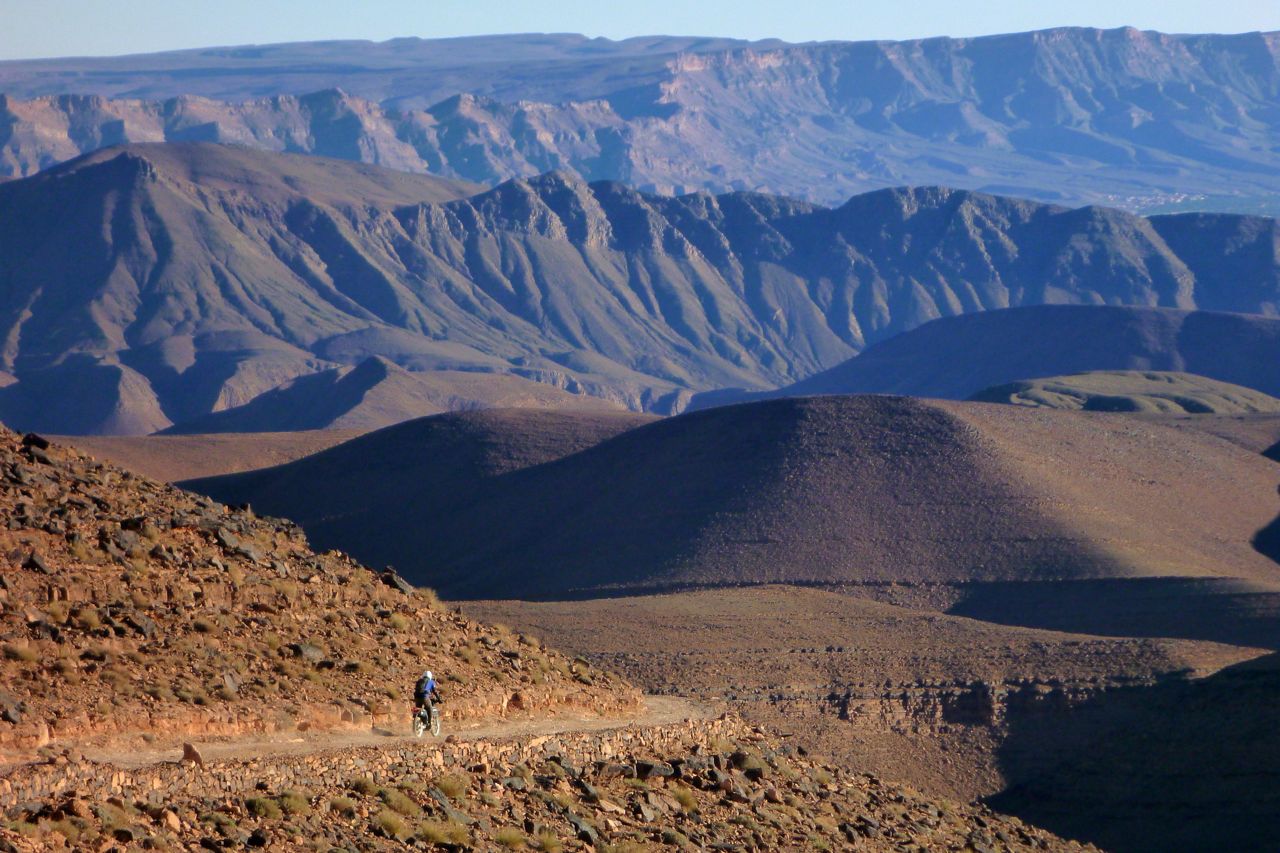
The aptly named the Red Plateau, a barren, undulating prairie of rust-coloured gravel cut by dry water courses. Rising to 800m, my oilfield mate hadn’t much good to say about it: a pitiless void that was either freezing or baking and criss-crossed with enough tracks to confuse even the wily nomads.

sf-hambike

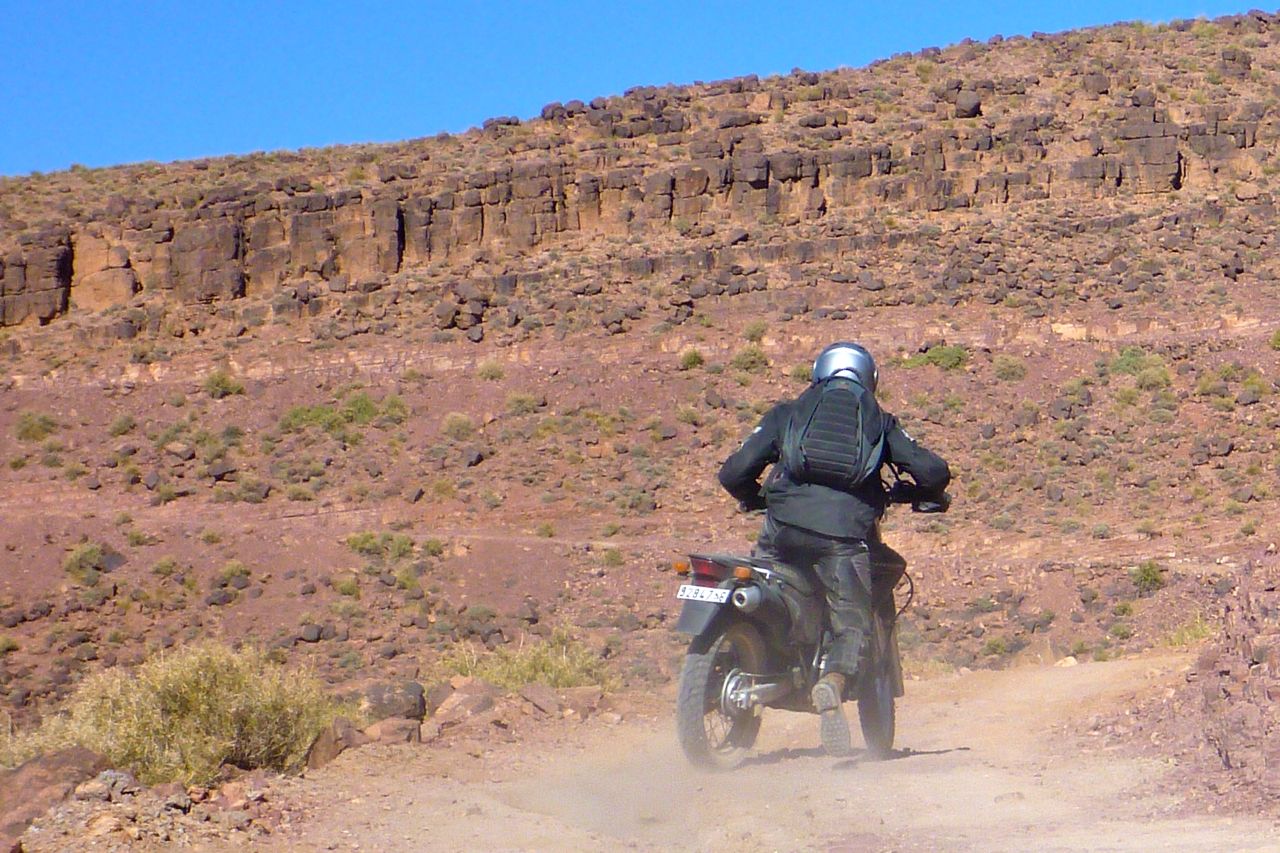
Enjoying the security of another vehicle, it felt great to be on the dirt at last. By myself I’d have been gnawing my lip into a frayed pulp. Shod with uncompromising tyres the BM handled the 40-50kph pace well enough, and it was fun concentrating on the riding instead of sitting on the blacktop. As expected, I was a lot quicker than Rainer’s ex-trans African Isuzu, but I didn’t mind stopping and waiting. Their very presence made this whole excursion much less tense. But there was one thing which bothered me…

‘Rainer, shouldn’t we be at Bir Gazell well by now?’
According to my speedo the landmark should have been close.
‘Bir Gazell? No, that is on the direct route, we are taking the southern route.’ ‘The southern route?’
‘Ya. Here, look. It goes down into the Ubari Sand Sea, turns east and follows the dunes to Idri. My guide book says it’s much more scenic than the boring direct route.’
‘How far is it?’
‘Oh, about six hundred kilometres.’
‘I doubt I’ve got enough fuel to go that far, especially if the piste gets sandy.’ 
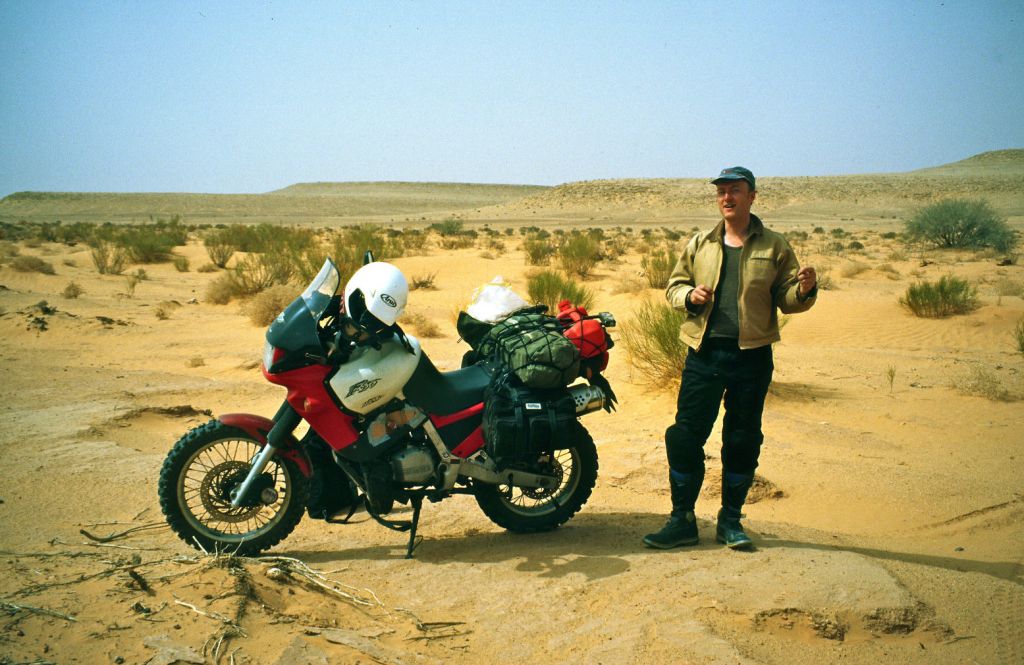
We paused for a moment to consider the implications.
‘Well, I have some spare petrol, about six litres.’ said Rainer whose Isuzu was diesel. We topped up the bike’s tank and decided to take a gamble and press on.
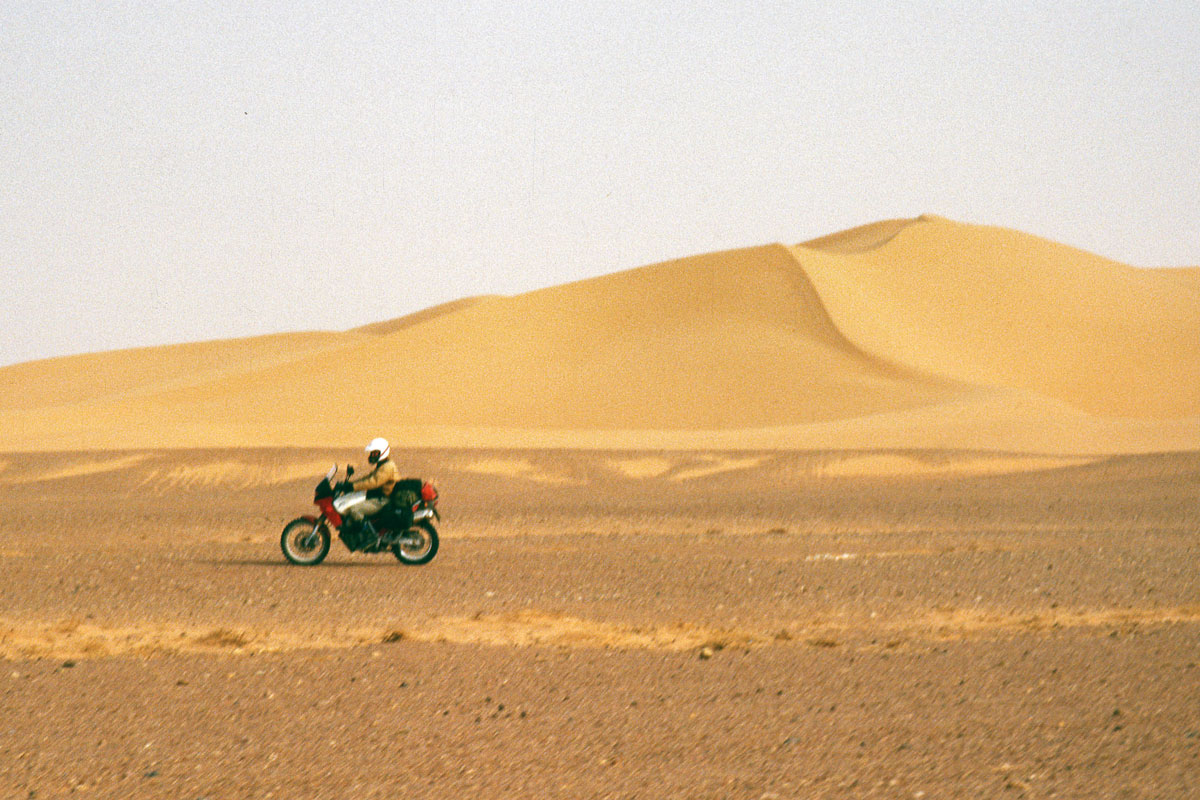
sf-ham-backdune

But by late afternoon we’d got ourselves lost. The next GPS waypoint was through the hills to the south, but our track was now heading west towards Algeria, the wrong way. This is all part and parcel of Sahara travel so, not unduly worried, we made camp in a oued and resolved to head directly for the waypoint next morning.

sf-ham-rox

Cross-country riding may sound fun on a trail bike, but in the desert it can be incredibly slow. Once you ride off tracks, however bad they are, you find yourself walking the bike down rocky slopes, blundering up dead-end valleys or edging towards drops. Even with an early start and the bike reconnoitring a way through the hills, it still took us till noon next day to cover the 14km to the waypoint and the route.

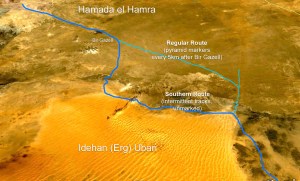
sf-ham-duner

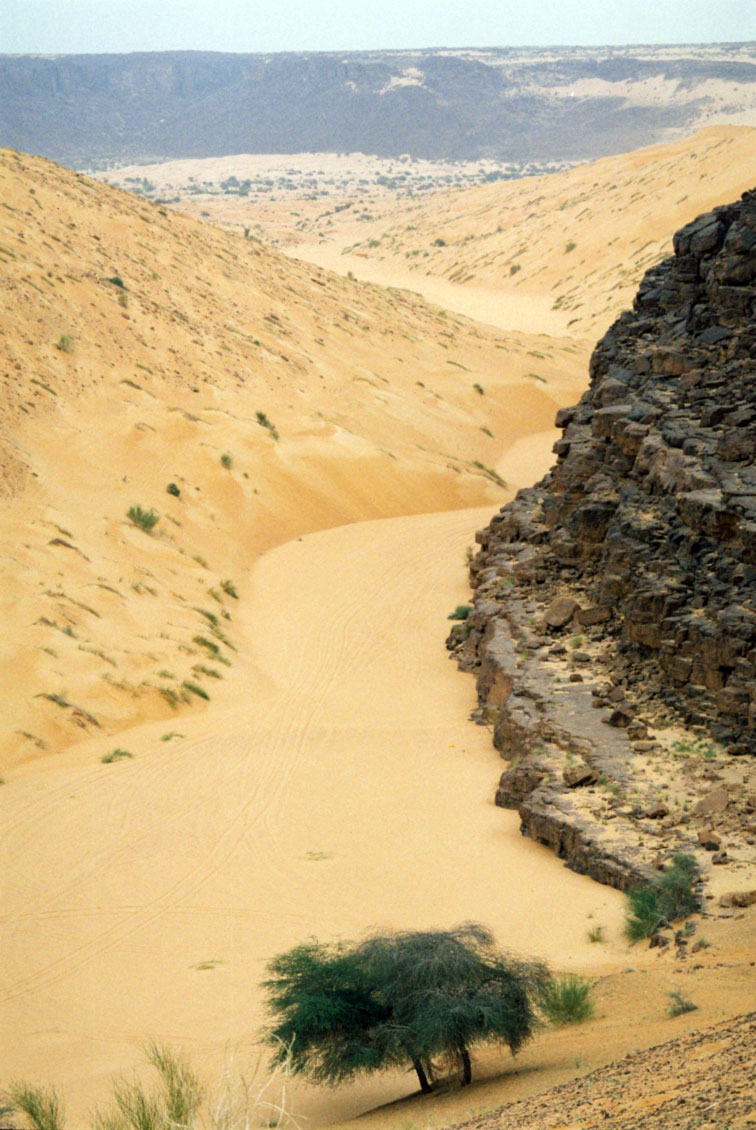
Having lost some altitude coming off the plateau, the day began to burn and as I feared, the plateau’s firm gravel turned into plains of soft sand. As all you beach racers know, soft sand has to be attacked standing on the pegs with a nailed throttle and eyes firmly fixed on the way ahead. There is no easy option: back off, the front wheel digs in and you’re off – go too fast and you risk crashing. I did my share of both and finished the day exhausted by more shades of soft sand than the Cote d’Azur.

By now I was already cutting into Rainer and Katja’s water reserves, so we needed to find a well. Their German guidebook identified a source 40km away. We located what seemed the right place and ploughed into the sands where the Isuzu soon mired. While they shovelled I headed over the dunes, riding the sandy banks in all directions just to keep from getting stuck. After a while I found the well – bone dry and full of sand, just like in the movies. This little excursion cost us two hours, a heap of energy and still more water and fuel. We flopped out under some meagre shade. No one said anything.

sf-ham-drink

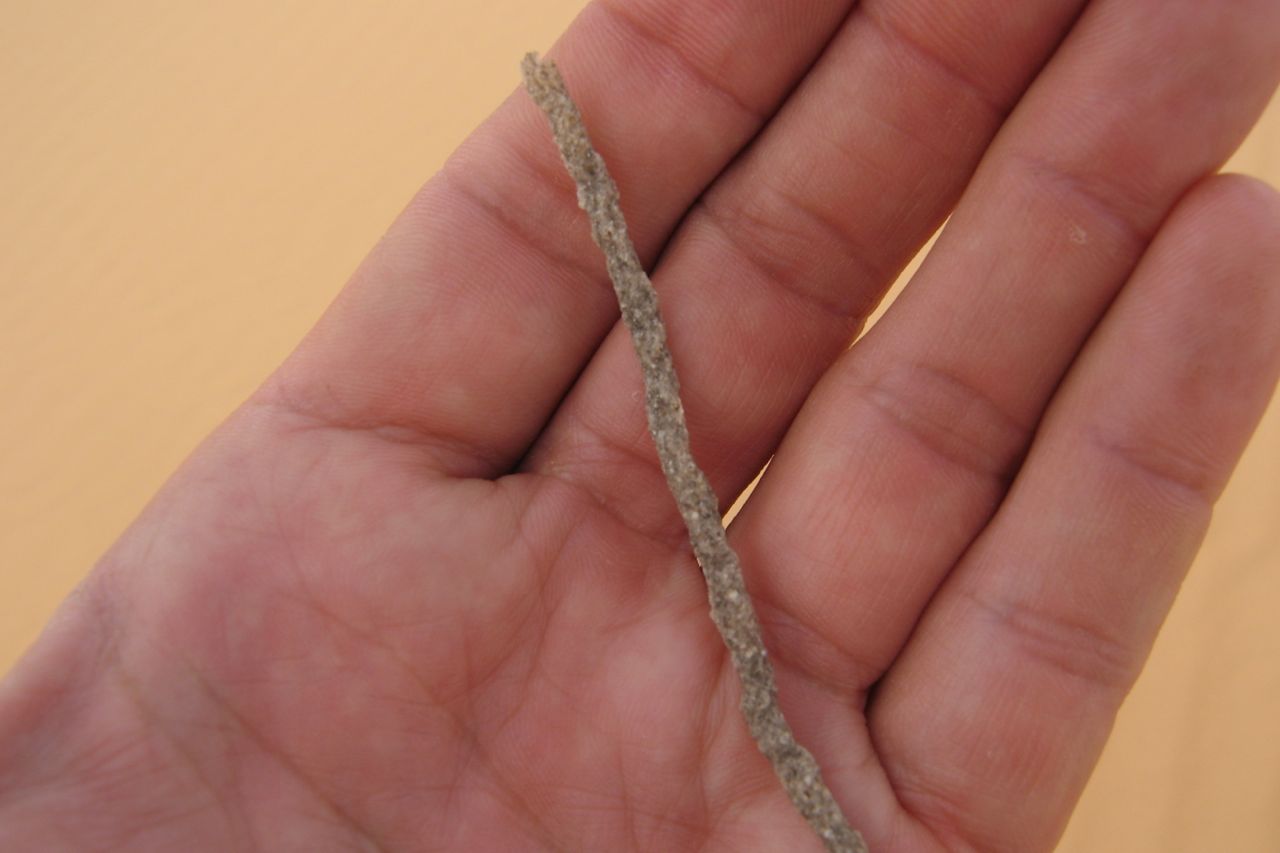
We moved on, at one point encountering the vile surface-crusted powder known as feche-feche. Regular bull dust is often mistakenly called feche-feche; it sounds cool and looks epic in photos but is just fine dust.
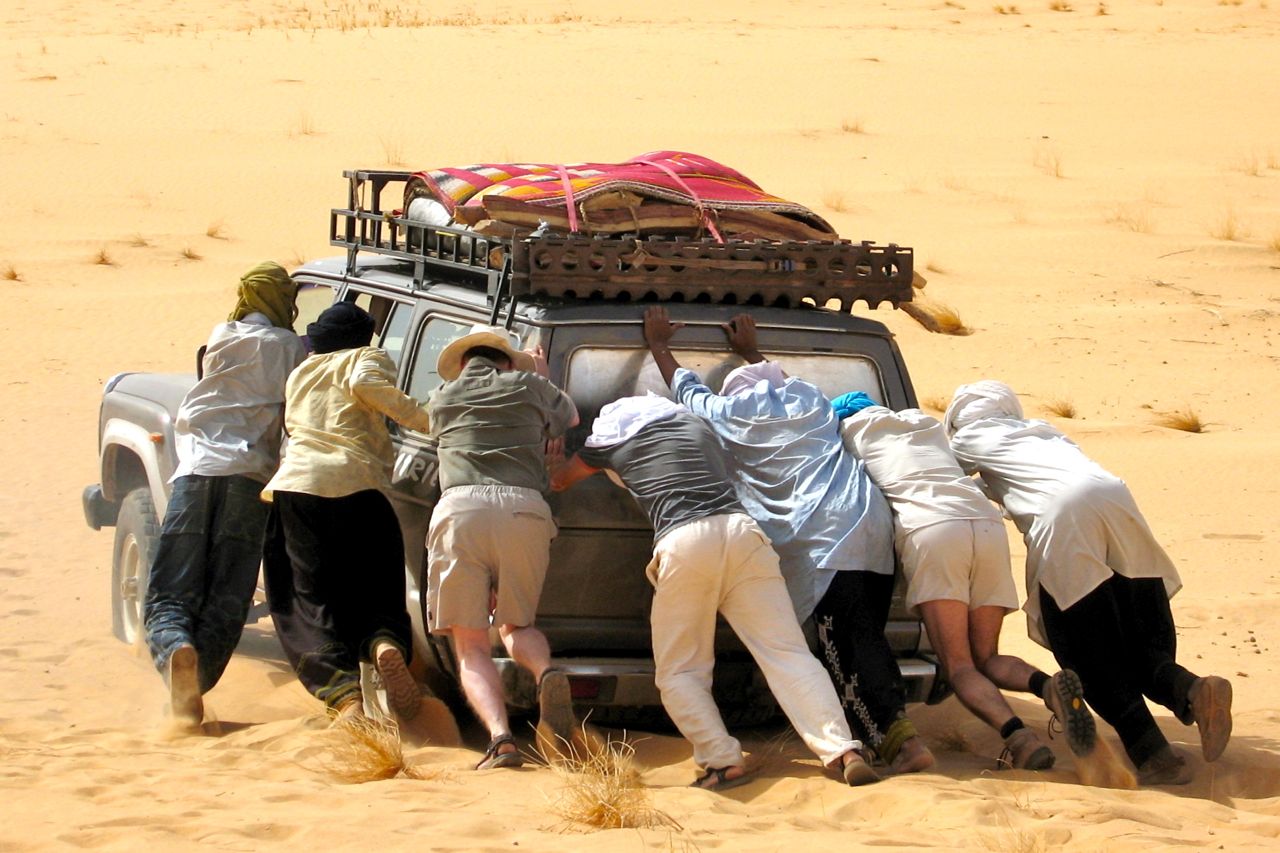
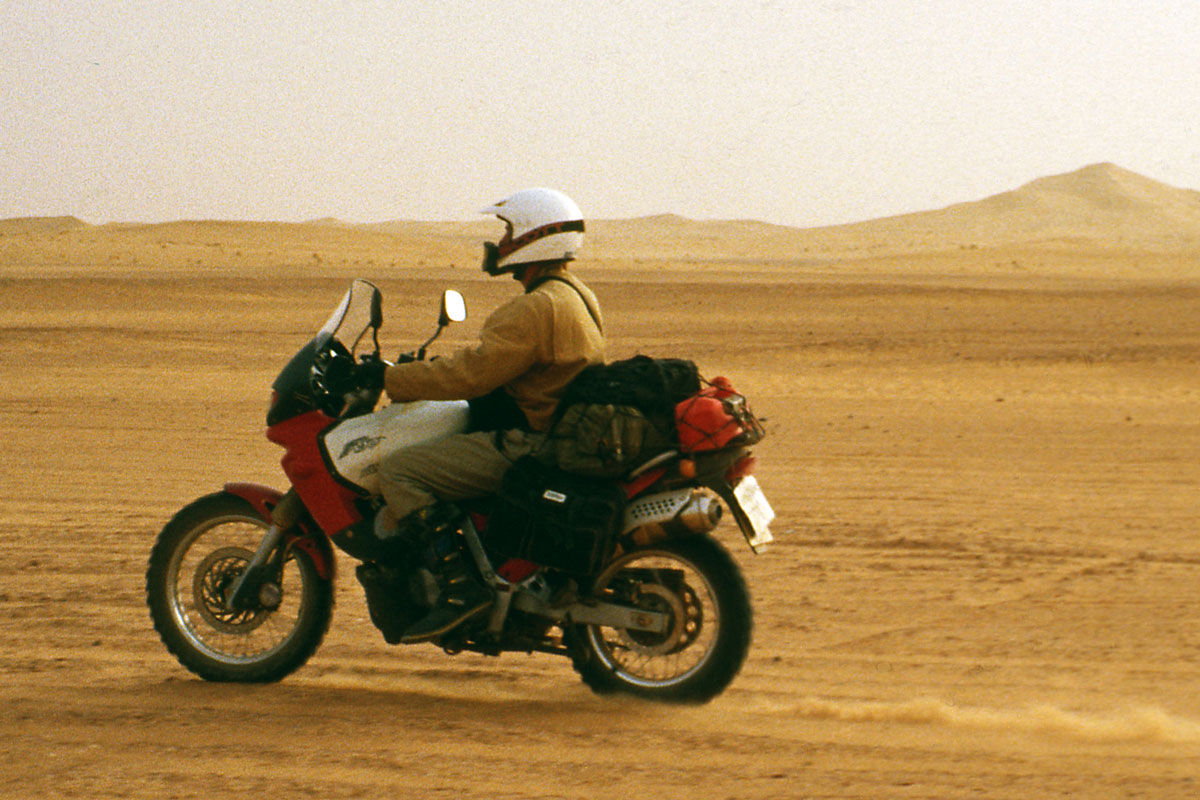
This was one of only two occasions I’ve ever encountered it in the Sahara. Often found on the edge of large sand seas, a hard pie-like crust forms and can support a vehicle. Or it might break though into the flour-like blancmange beneath. I spotted it too late, the gnarly tyred Funduro ripped through the crust and sank in, engine screaming in first gear as a 20-foot roost spurted up vertically from the back wheel. By paddling madly I just managed to regain firmer ground in time to grab yet another desperate slug of water.
sf-ham2

By now every minor exertion demanded a drink and these exhausting conditions went on for hours. In this sort of terrain the Funduro was just plain old Duro. Sure, the engine was amazingly zippy on the highway, but it lacked the grunt needed to chug through soft sand. And as I’ve found before, the super stiff Michelin Desert might do the trick on a hefty Dakar racer, but even at just 7 psi and with the tyre creeping round the rim (I was trying the self tapers-through-the-rim trick), it didn’t flatten out enough to provide traction. Result: lots of wheelspin and wasted fuel for not much forward progress.
sf-ham-well

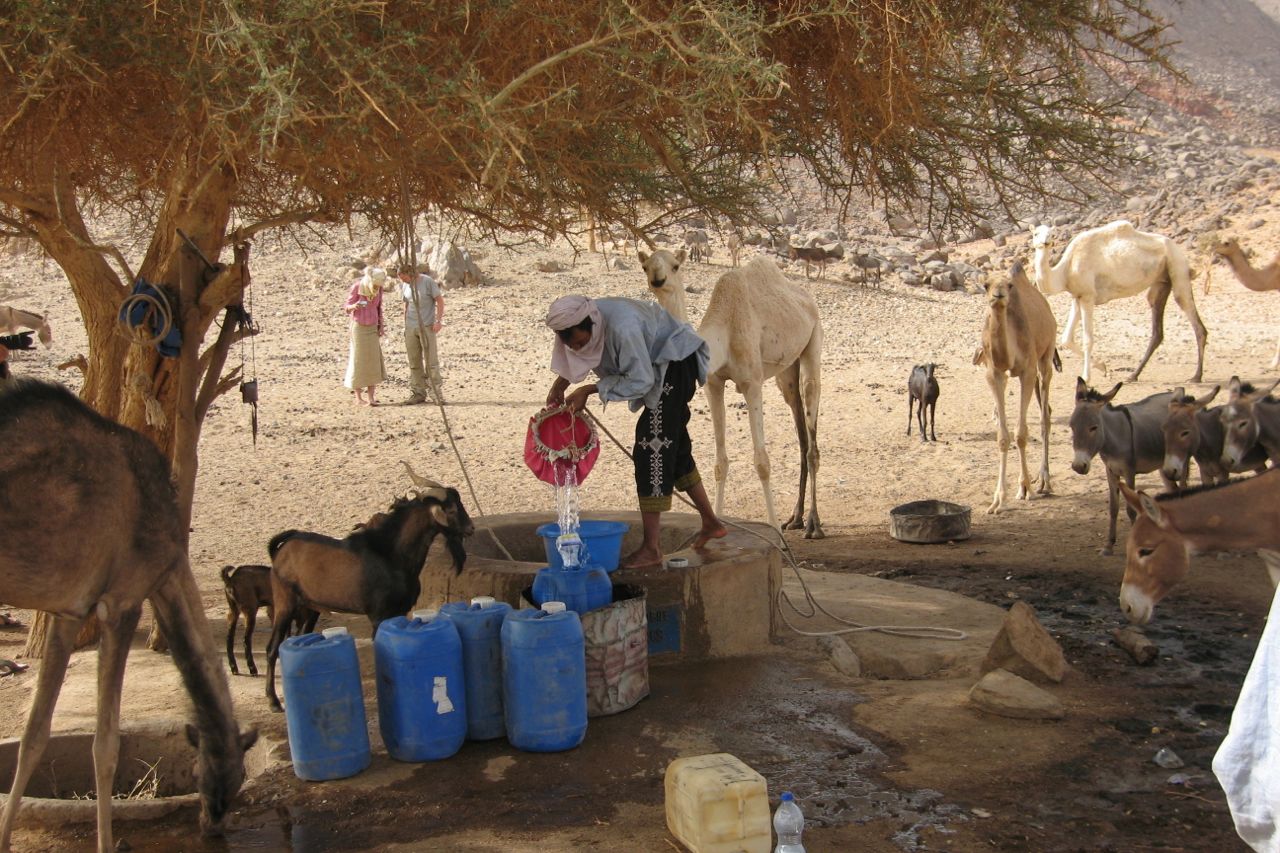
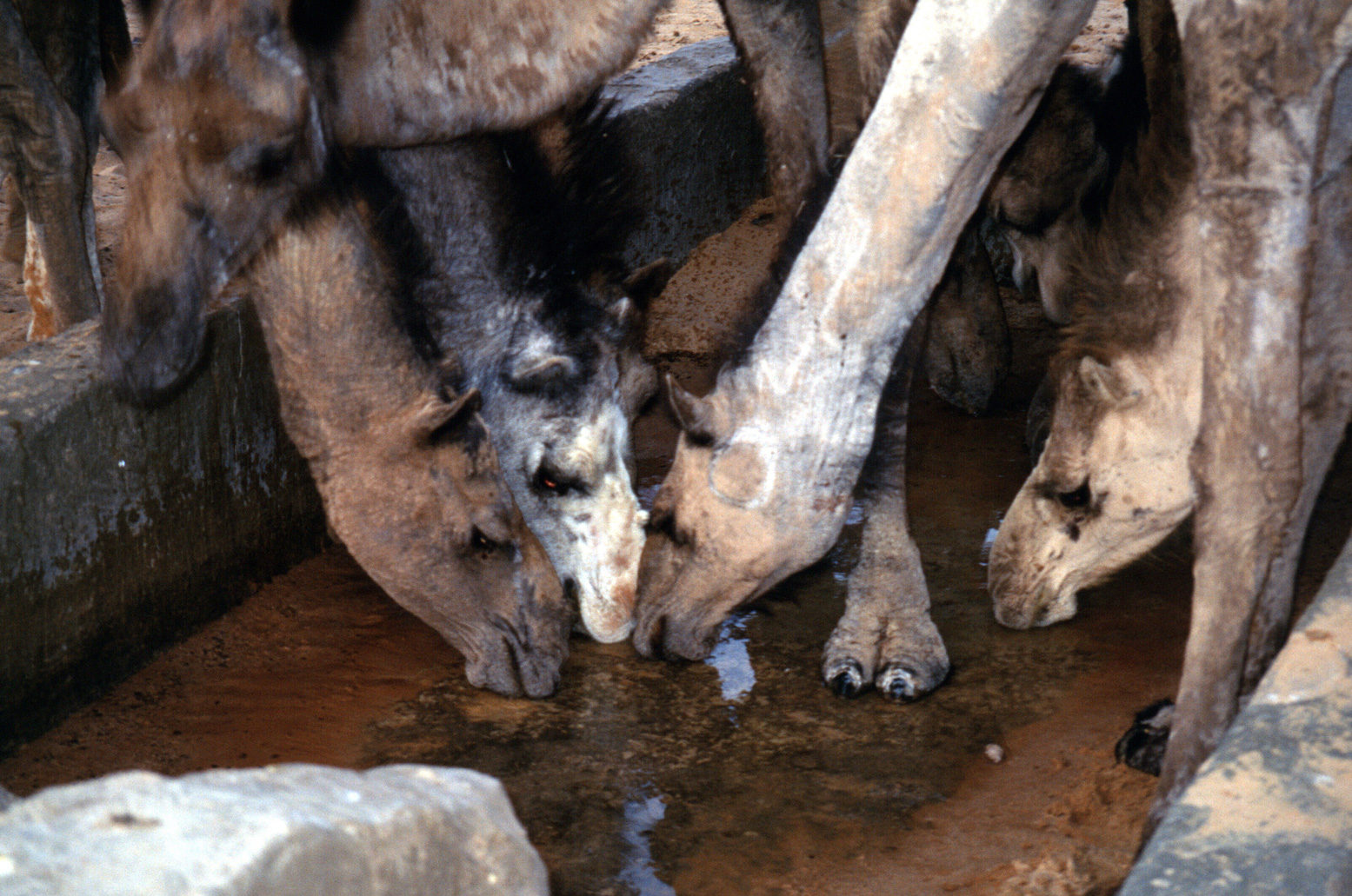
At dusk we located a proper well with a bucket and trough. We filled up everything with water while camels mobbed us for a hand out. Then, fit only to quickly cook up some grub, the three of us crashed out for the third night running. We all knew we’d bitten off a bit more than we could chew, but the end was surely in sight.
sf-ham-tent

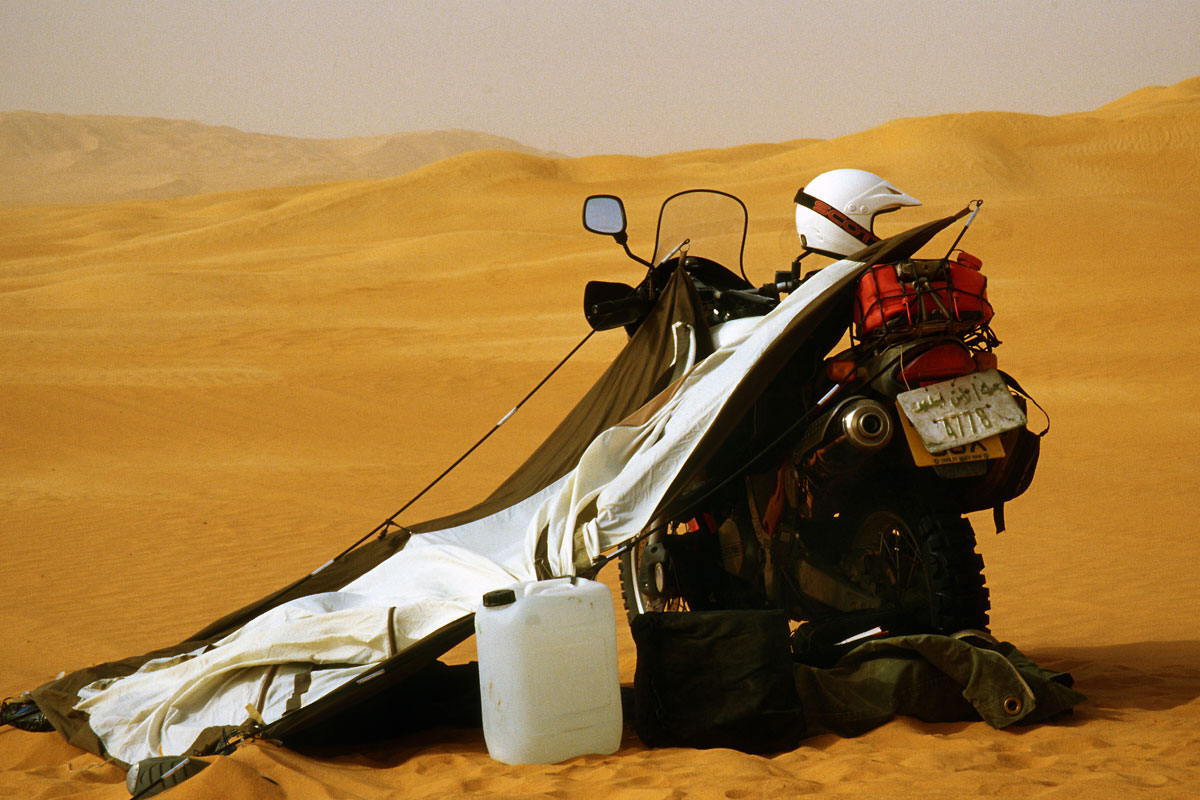
We got going early but by nine next morning the bike was halfway down a dune and out of gas. We’d seen no other vehicles since we left the highway at Derj, so there was nothing for it but to lug out twenty litres of water and watch the Isuzu chug off over the sands in search of fuel. With a bit of luck they’d be back tomorrow. I knew that lying still in shade was the best way to limit water loss, so I crawled under a make shift lean-to and waited.

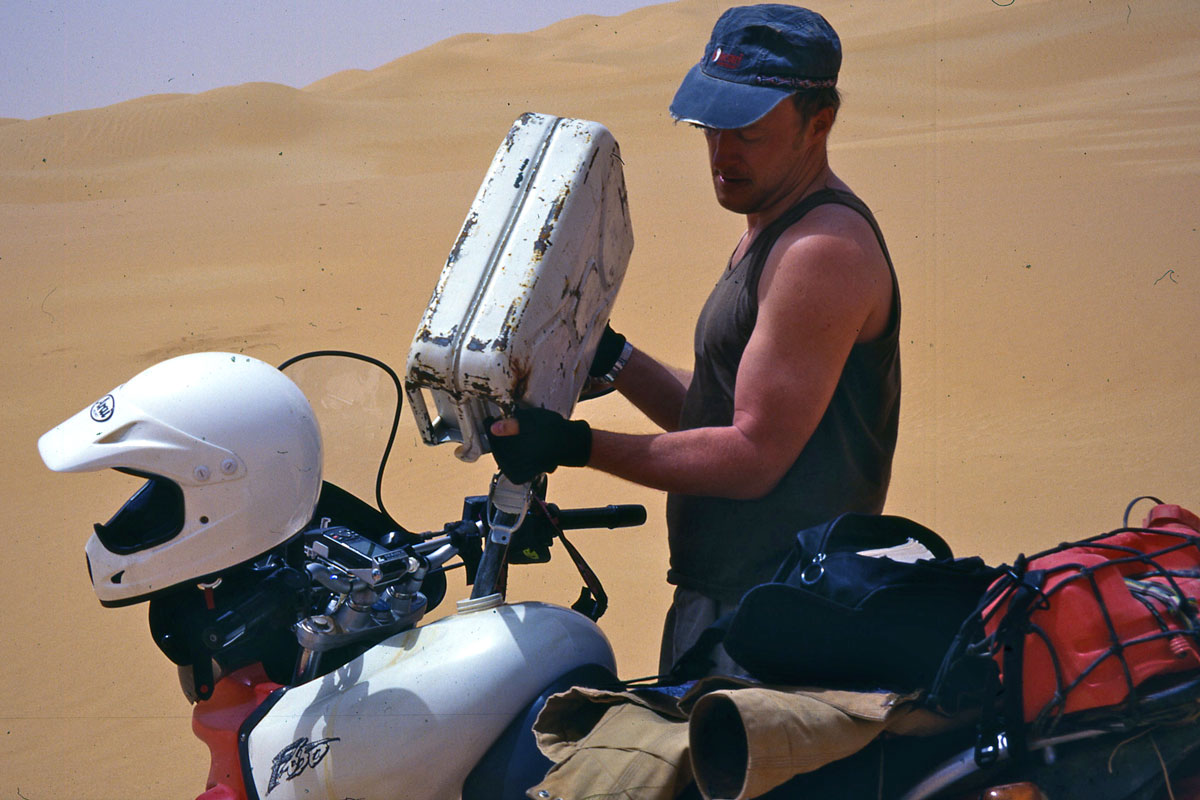
The burning sun inched across the sky and the scorching wind peppered me with sand. Then, just as I began thinking ‘What if…’ a toot-tooting heralded the early return of the little Trooper. An hour or so down the track they’d chanced upon a date plantation where a guy had topped off a jerrican’s worth from his pickup’s oil drum.
sf-ham3

I poured the fuel into the tank and we were on the move again, but now the riding became really hard as the track squeezed between the dunes and rocky outcrops. Again we found ourselves searching for wind-erased tracks or taking repeated blasts up boulder-strewn slopes that even the nimble bike couldn’t manage. We covered just 40kms, when the Isuzu got stuck on a dune we’d all had enough and called it a day. Hopefully another early start on firmer, night-cooled sand would finally get us to Idri. The Hamra wasn’t letting us go without a fight.

On the trail by 6am, another four hours saw us finally rolled into Idri, me caked in dust and all absolutely shattered. I felt like I’d done a four-day enduro on a heavy loaded bike in 40-degree temperatures. Hang on, I just did that! A week later I was still aching.

sf-ham-tree
sf-ham-roadride

At Idri I bade farewell to the tough German couple and headed north, butt-, leg-, arm-, hand- and back sore after the 600km pummeling. Heavy winds prolonged my retreat and at one point I had the distinctly novel sensation of leaning out round a bend while braced against a 50mph crosswind.
By the Tunisian border that cheap chain was on the way out – and when o-ring chains go they go fast. Back across Tunisia, back across the Med, another Motorail to save the chain and a quick coffee in Paris.
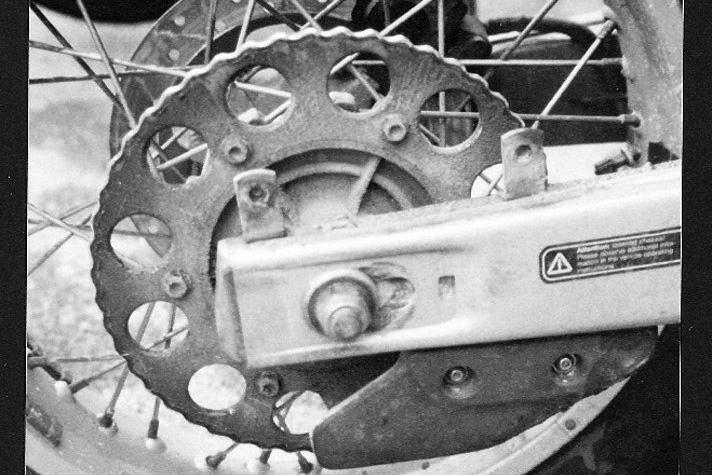
By accelerating very, very carefully I just made it to the Channel, but after only 2000 miles of riding and with the chain adjusted as tight as I dared, 20 miles from London the sprocket turned into a greasy knurled disc. Any thighter and the chain would pull out the countershaft srocket so there was nothing for it but to hire a van to get the bike home.
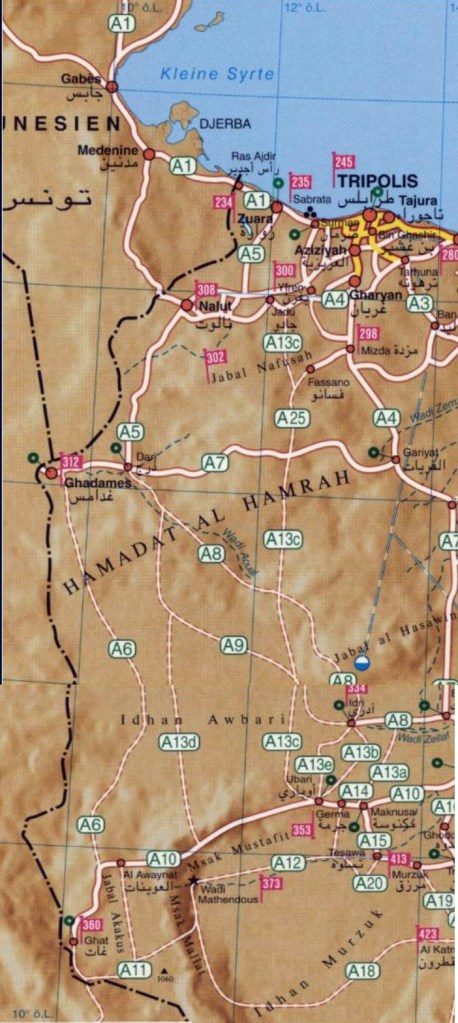
Years later, on a ferry back from Tunisia, I met Gerhard Gottler, the author of the German guidebook for Libya which Rainer and Katja had used. I explained how we’d struggled on ‘the southern piste’ (route ‘A9’ in his book), the waypoints didn’t join up and neither did the tracks.

“Route A9 is not a piste for beginners.”
P is for Plane wrecks in the Sahara: two stories

Part of the Sahara A to Z series
Phoenix4

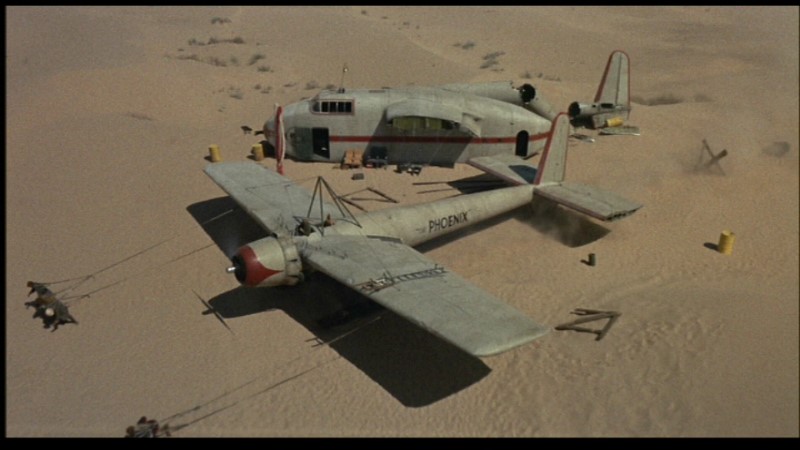
On page 350 of Sahara Overland II I wrote a box titled ‘If we’re done for we’re done for and that’s all there is to it‘ about some of the better known plane crashes in the Sahara. Anyone who’s seen the stellar cast at work in original 1965 movie, Flight of the Phoenix (left, not the dreadful 2004 remake) will know what a compelling story the tragedy of a plane crash in the desert can be.

memair
bbc1989

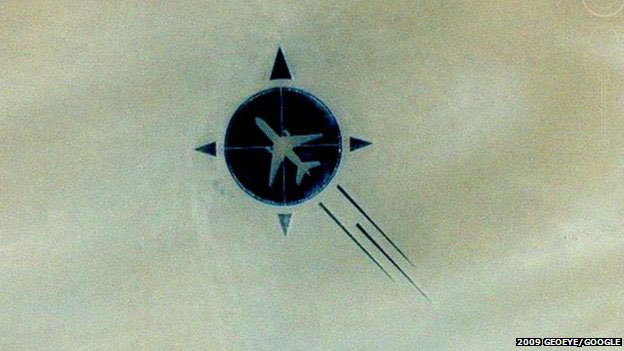
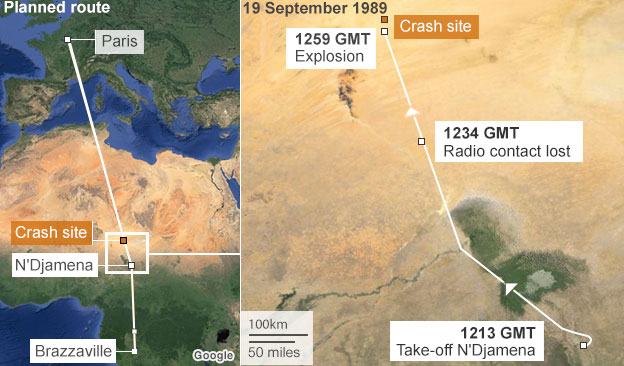
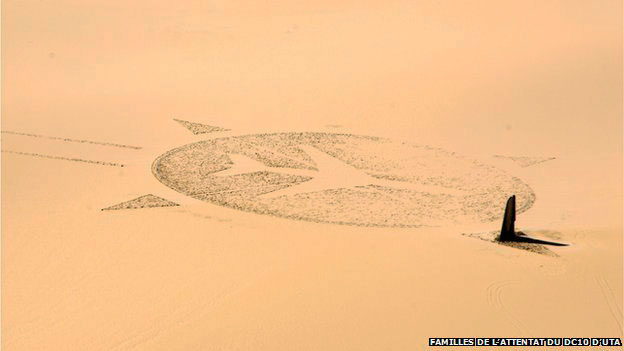
Last week a rather belated article appeared on the BBC where it trended for a day; the tale of how a victim’s relative from the September 1989 UTA 772 plane crash over Niger’s southern Tenere organised the construction of a striking memorial at the crash site to his father and the other 169 who perished.

UTA-772-Cockpit

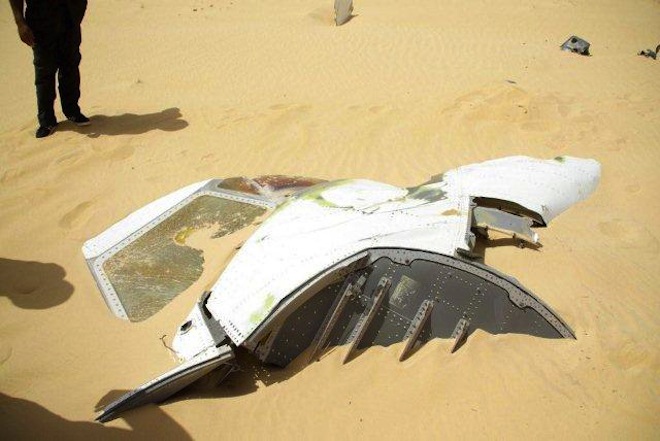
Less than a year after a similar event over Lockerbie in Scotland, a bomb – said also to have been set by Libyan agents – saw the DC10 break in the sky some 450km east of Agadez, close to the Termit massif. One still of what looks like the cockpit (right) bears a  resemblance to the similar well known image from Lockerbie.

tenerememo

Libya’s rather implausible motive was said to have been revenge for France’s support for Chad in the last stages of their border interventions into northern Chad’s Aouzou Strip between 1978 and 1987. This was a little-known Saharan war which had ended when they were roundly defeated first at Wadi Doum near Faya in the Tibesti, and then routed at Maaten al-Sarra, right in Libya itself. However, in July 2011, Gaddafi defectee and former Libyan foreign minister Abdel Rahman Shalgham, told a newspaper ‘The Libyan security services blew up the plane. They believed that opposition leader Mohammed al-Megrief was on board‘.
With part of the £104m compensation gradually handed out by the Gaddafi family, Guillaume Denoix de Saint Marc set about building the huge memorial sculpture close to the crash site. It was completed in 2007 and appears on Google maps today.

dgv
lanclast

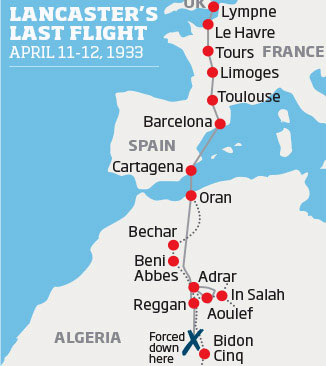
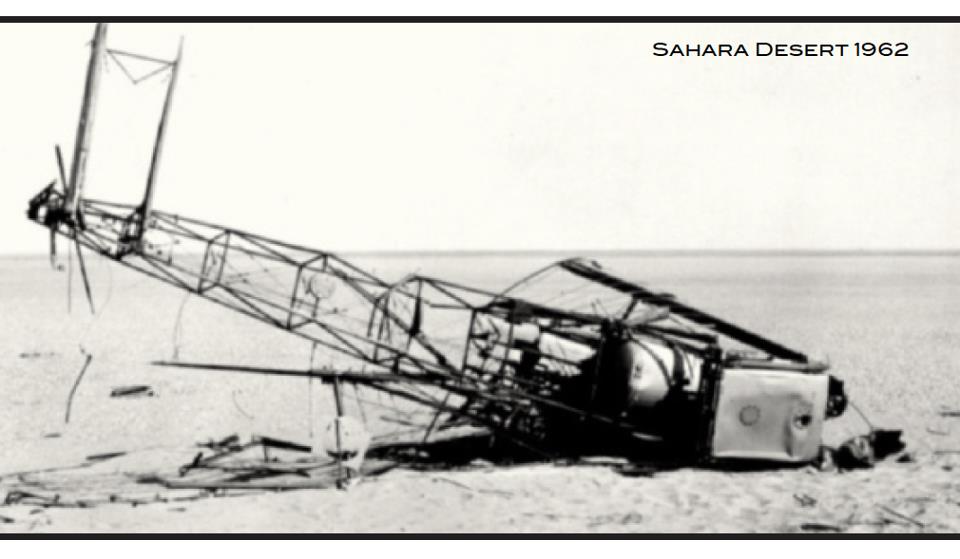
The other tale concerns an Avro Avian biplane which crashed in April 1933 between Poste Weygand and Bidon V in Algeria’s Tanezrouft. Featuring biplanes, romance and death in the desert, the story resonates with the popular but very fictional English Patient movie and book. But this tory is all true and a film-making  descendant of the loan pilot, Bill Lancaster, is close to completing a documentary about his forebear titled: ‘My Great Uncle; The Lost Aviator‘.

lancaster-letters
lanctabs

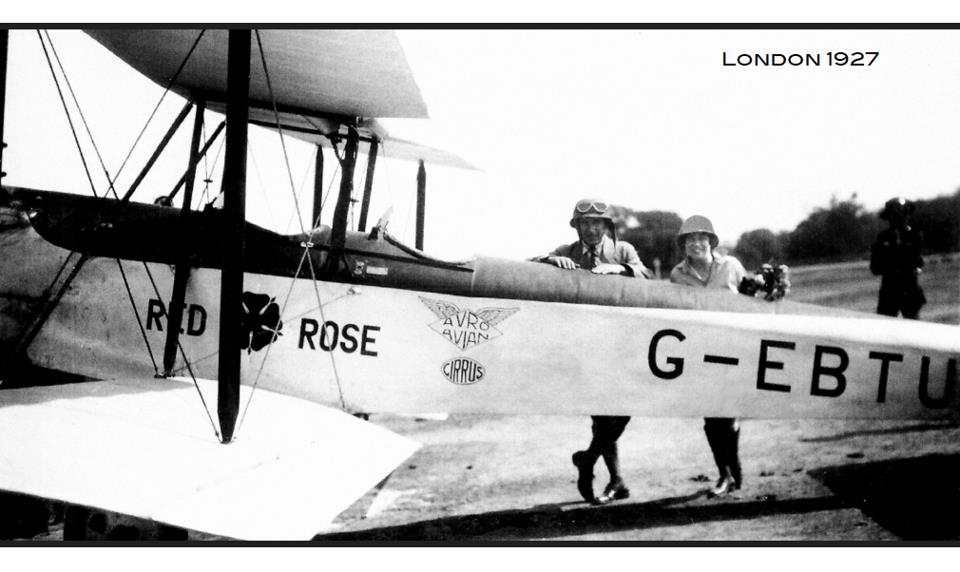
Bill Lancaster was a pioneering British aviator who found fame by flying from London to Darwin in 1927. Despite leaving a family back home, on route he fell for his co-pilot and financial supporter, Australian aviatrix Jessie ‘Chubbie’ Miller (not a nickname you’d think most women would covet).

lancplane

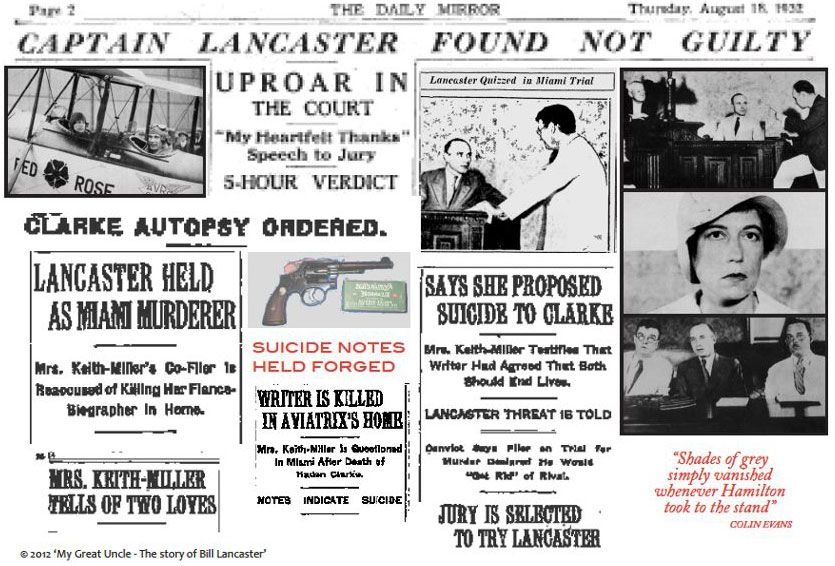
The adventuresome duo’s romance soon became the Posh & Becks of its day and the couple set up house in Miami. Their relationship then rose to become an outright cause célèbre when,  in April 1932 Lancaster was tried for shooting his love rival, Chubbie’s biographer and some say fiancé, Haden Clarke, at their Miami home
Cleared of the charges despite the compelling evidence, Lancaster set off to rebuild his reputation by flying across the Sahara.
While following what may have been the Tanezrouft beacons used by the Citroen motor crossing of 1922-3, his plane went down some 400 kilometres from the Mali border.

lancwreck

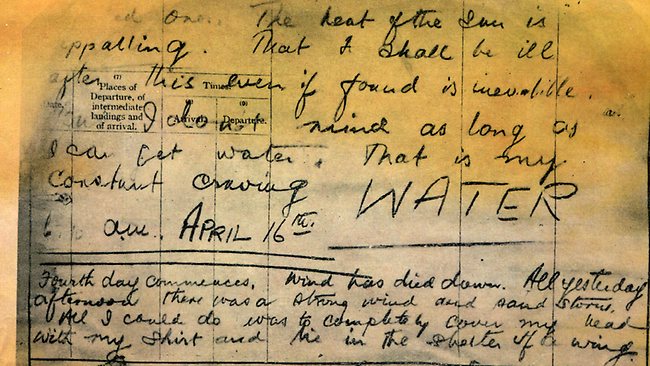
After eight days of suffering Bill Lancaster died one year to the day after Clarke’s unsolved murder. His body lay undiscovered by the wreckage of his Avro until 1962 where a recovered diary revealed his agonising last days (‘… the heat of the sun is appalling … my constant craving – WATER‘) as well as his undying love for Chubbie Miller.

denvol

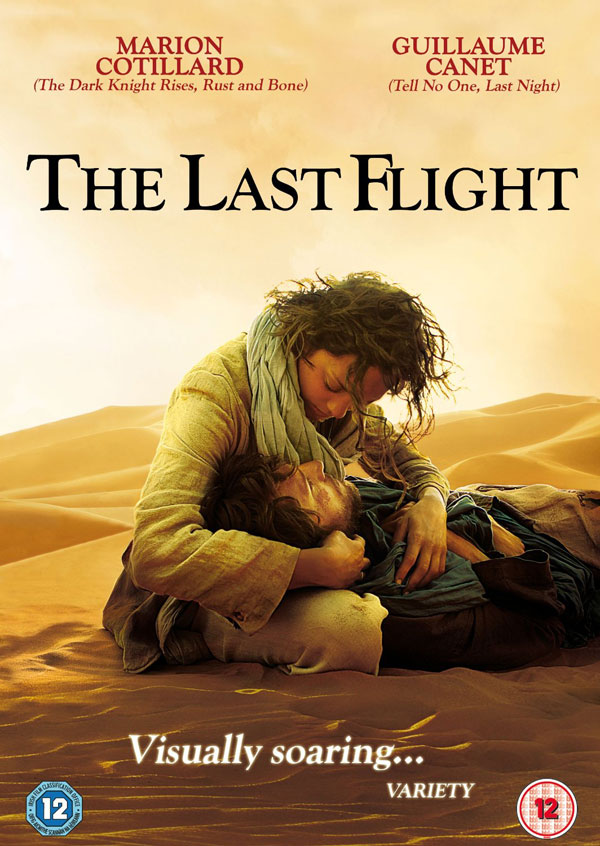
The story was fictionalised in 1985 as an Australian mini-series, The Lancaster Miller Affair and again in French in 2009 getting what looks like an exceedingly unsuccessful ‘English Patient’ makeover as Le Dernier Vol (The Last Flight, right) with Marion Cotillard. It sounds like the documentary based on true story may be much more interesting.

More on the Lost Aviator doc here and here and more pictures here.


Algerian Sahara Camel Trek 2012 (video)

Updated 2026: Immidir region has been closed

Trek2Cam

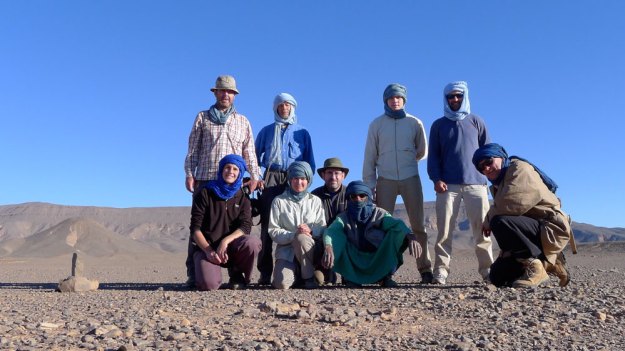
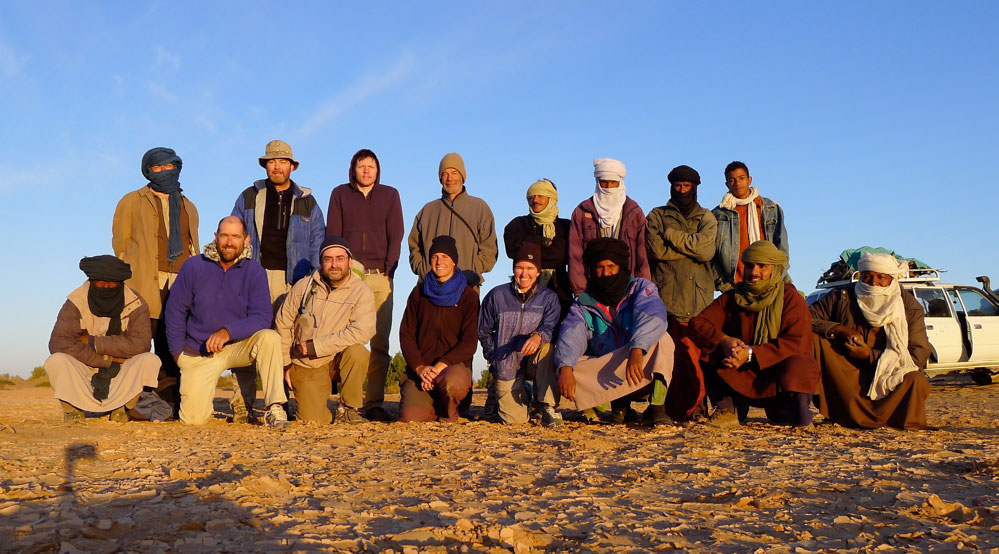
I was back in Tamanrasset, this time with a small group of camel trekkers. Year by year it gets more difficult to travel out here and a few weeks earlier Algeria cancelled all tourist visas to the desert– most probably due to weapons slipping out of Libya west towards Mali where some kind of rebellion has already broken out. As a result three missed out and only 7 got visas: 3 Americans: Diane and Steve from Tucson and Patrick from NYC, plus Rob from Bermuda, Hannah from Alderney, Rob from Bristol and Mike from Staffs who’d been on a 2006 Gilf trip I’d led for a tour agency. Right: Camel trekking ebook.

It’s nice to drive cars and ride bikes in the desert, but these days that can feel rather conspicuous as you come down from the north. With camels you slip into Tam on the midnight plane and 24 hours later are out in the sticks, largely unnoticed. Any anxieties I had about the ‘Grand Sud’ being closed and us getting stuck, or sent back from Tam came to nothing. And I knew once we were out bush all would be fine.

I’d originally planned a meaty 4-week trek from Tam to Djanet, but decided that left us exposed along the Niger border where an Italian woman had been grabbed a year ago. At the time she was one of 12 Europeans (as well as local police and others) in the hands of AQIM in north Mali. I’ve just started reading this book about the history behind these events and if nothing else, it underlines how dire it would to be dragged around the oueds of northern Mali for months at a time, suffering injuries and other ailments, with no shelter, terrible food and dirty water.

So, with Tam-Djanet a bit sketchy, the plan boiled down to repeating the reliable Amguid Crater trek I’d done a couple of times over the years for Simoon Travel, then drive back down to the Hoggar and spend a week walking up to Assekrem and back (report on that here). I was using a new agency, Ben Kada, now long gone but back then an established operator recommended by a friend of a friend. And so, along with all the other unknowns, I was hoping they were going to deliver, which in the end they did better than I’d expected. Last November a fake guide who’d infiltrated a well-known agency in Tam to set up a kidnap had been caught, so it’s hard not to be a little paranoid these days, even if the Algerian security services are on it.

7

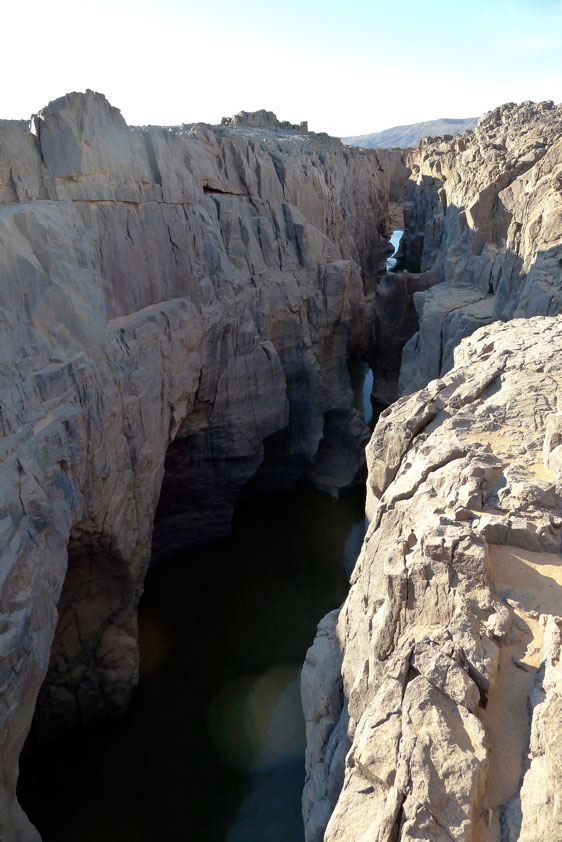
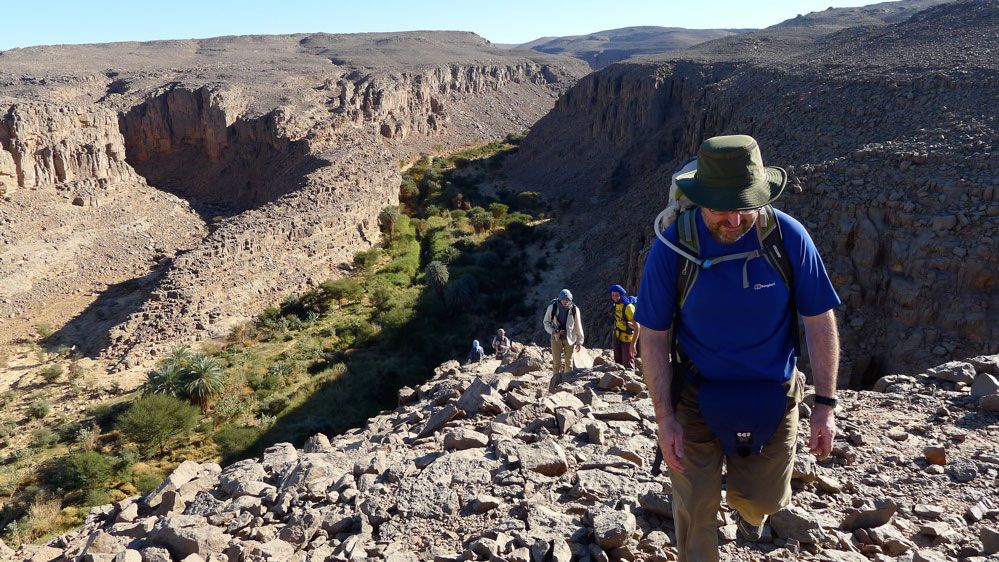
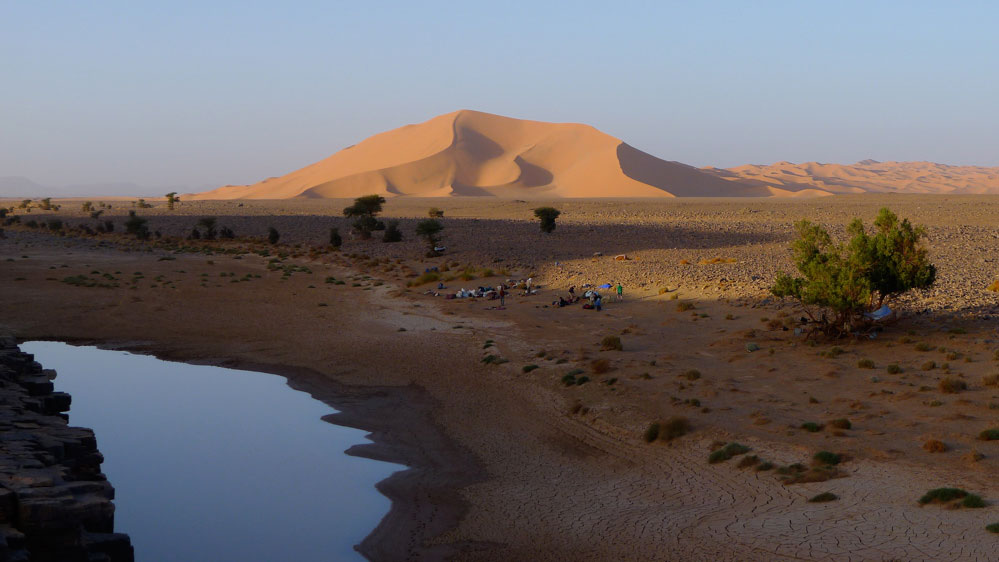
 Next evening we arrived at the same camp south of Arak (left) which we’d used on the recce tour in 2007 with Simoon. The first day kicked off a stiff climb around midday which had been tough on the fully loaded camels, but this time our caravan managed fine. New Year’s Day followed, a spectacular amble through the box canyons of Tissadout, with lunch under a lone tree, a guelta swim and a rock art cave all ending at a great camp spot in the Adjror valley (home of Beetle guelta; these names established on the 2007 recce). Here we met the only other tourists in Algeria who were taking a two-weeker out of Arak. There followed a long haul to Igharghar valley, past the Haribo Tree, the Lunch Cave and the desert mosque, before diverting to a deep slot canyon and tombs which I’d missed on previous visits. Interestingly the deep cleft (above) is actually the river which breaks out through the gap in the ranges at Tadjemout, where we’ve started the tour on previous occasions. Once at camp I got rather lost in the dark while looking for firewood, returning to the camp from the opposite direction, but no one seemed to notice.

13

Next day I asked to Mohamed, our genial 72-year old guide, to visit the impressive three-tiered gueltas (rain-fed waterhole) we’d lunched at in 2007, but which had been skipped by subsequent guides. On the way there, Patrick lost us while engrossed in the manual of his new Nikon Tankbuster, but did the right thing by getting onto high ground and was back on our trail by the time Mohamed had backtracked to find him. The same had happened to me hereabouts a tour or two ago when I’d stopped off and ended up chasing half-burned toilet paper in the breeze. Now Patrick also knew that chilling feeling when you lose sight of the group, any trace of their tracks, and haven’t got a clue which way is up.

9

As it happens the many tiered gueltas of Tin Karabatine were very low on water – as were many other rock pools in the region this year, but we managed to launder and wash anyway, while Mohamed instructed us to follow the canyon’s right rim upstream for 30 minutes to meet him and Tayeb the cook with the lunch camel in the valley above. It seemed a bit of a leap of faith, but we passed the test and met up close to the ever-serendipitous acacia which crops up at these times. Later on Tayeb was similarly tested by Mohamed, with less success.

11

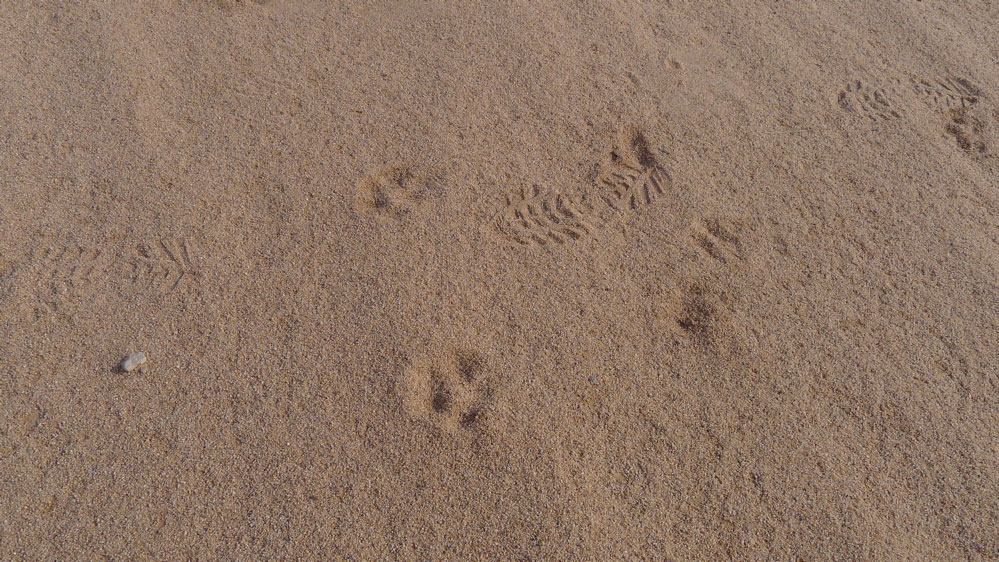
I knew well that the afternoon ahead was one of the nicest stages of the walk, made all the better by spotting a galloping mouflon (barbary sheep) as big as a donkey, as well as cheetah tracks (above), before we wound our way through the sandy outcrops down to woodless Camp IV. Next day was another long walk, 25km over to Tahaft; down into the big valley with a lazy lunch under a thorn-free tamarisk while the crew filled up from the soak.
As on previous walks, we staggered in as the sun was setting behind us, but very soon Tayeb had the tea and biscuits laid out while we waited for dinner. Up till that day, as with all that followed, there was very little wind until maybe the late afternoon which kept things warm, though it dropped to near-freezing most nights, and sometimes below.

6

Even with a waypoint, I blundered around next morning to locate our discrete 100KM marker from 2007, until Diane spotted it and we lined up for the now traditional photo (left).

Us at 100 kilo cairn

Mohamed diverted soon after to chat up a couple of bedraggled goat nomads about pasture and water up ahead. He’d been here once in the last 25 years if I understood him correctly, but knew all the spots and was still showing me new places and routes, even on my fourth visit here. After a splash in the Tahaft slot-guelta and another lazy lunch, Mohamed led us on a great cross-country scramble down to the ‘lost oasis’ of Tin Djerane where birds twittered and jackal tracks set hard in the mud.

22djerane.jpg
Abandoned In Djerane oasis

We heard their yelps on a few nights, but I’ve never actually seen one out in the desert. Along the camel trails you’ll regularly find stone slabs laid up into conical ‘goat holders’ to protect them from overnight jackals.

24
Huge keyhole tomb

More sparkling gueltas and even flower-clad lawns led to Camel Branding Camp V along the south edge of the Tissadert escarpment. This place is surrounded by ancient tombs, many of which had been annotated on Google Earth by ‘Ken Grok’ before Google erased the layer. There’s a ‘keyhole tomb’ a couple of minutes from camp (above), another 700 metres away which we passed close by later, but the strikingly huge antenna tomb I led us to with the GPS (below) was so big it was hard to visualise at ground level.

ant
Antenna tomb

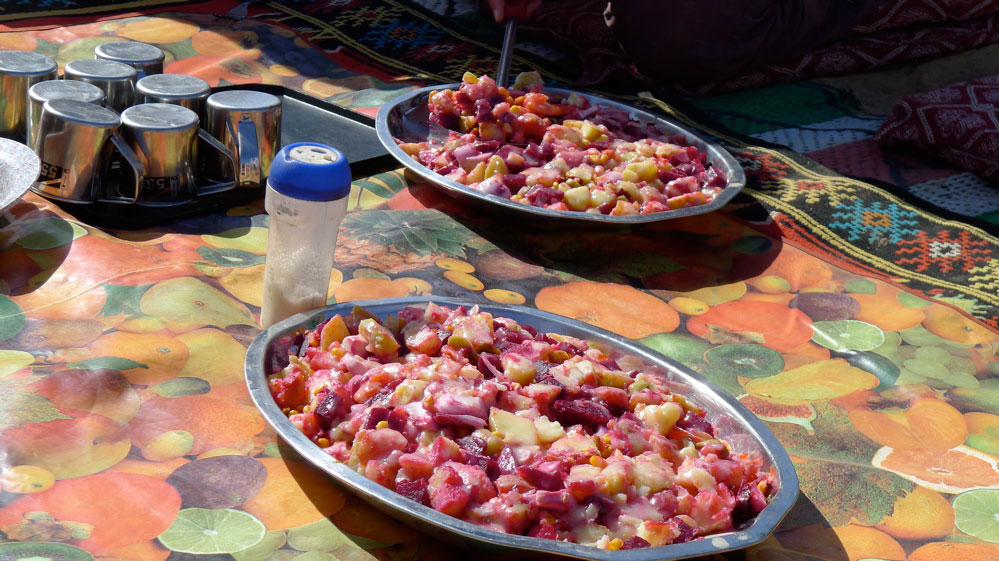
Following another swim at a big guelta, we failed to meet up with Tayeb and the lunch camel. Tayeb was from Tazrouk down in the Hoggar and this was his first visit to the Immidir which Mohamed and his aged crew, Halil and Ahmed, knew well. So it was a bit of a reach asking him to meet us up ahead in a creek he’d never seen. We zig-zagged around while Mohamed tried to pick up the trail and at one point I strolled right across another huge keyhole tomb. Eventually Mohamed found fresh tracks and around 3pm we spotted Tayeb sat patiently alongside an acacia-lined oued. Ravenous by now, he got an unfair bollocking while we tucked into the heaped platters of salad which Tayeb prepared for us daily.

32salad.jpg

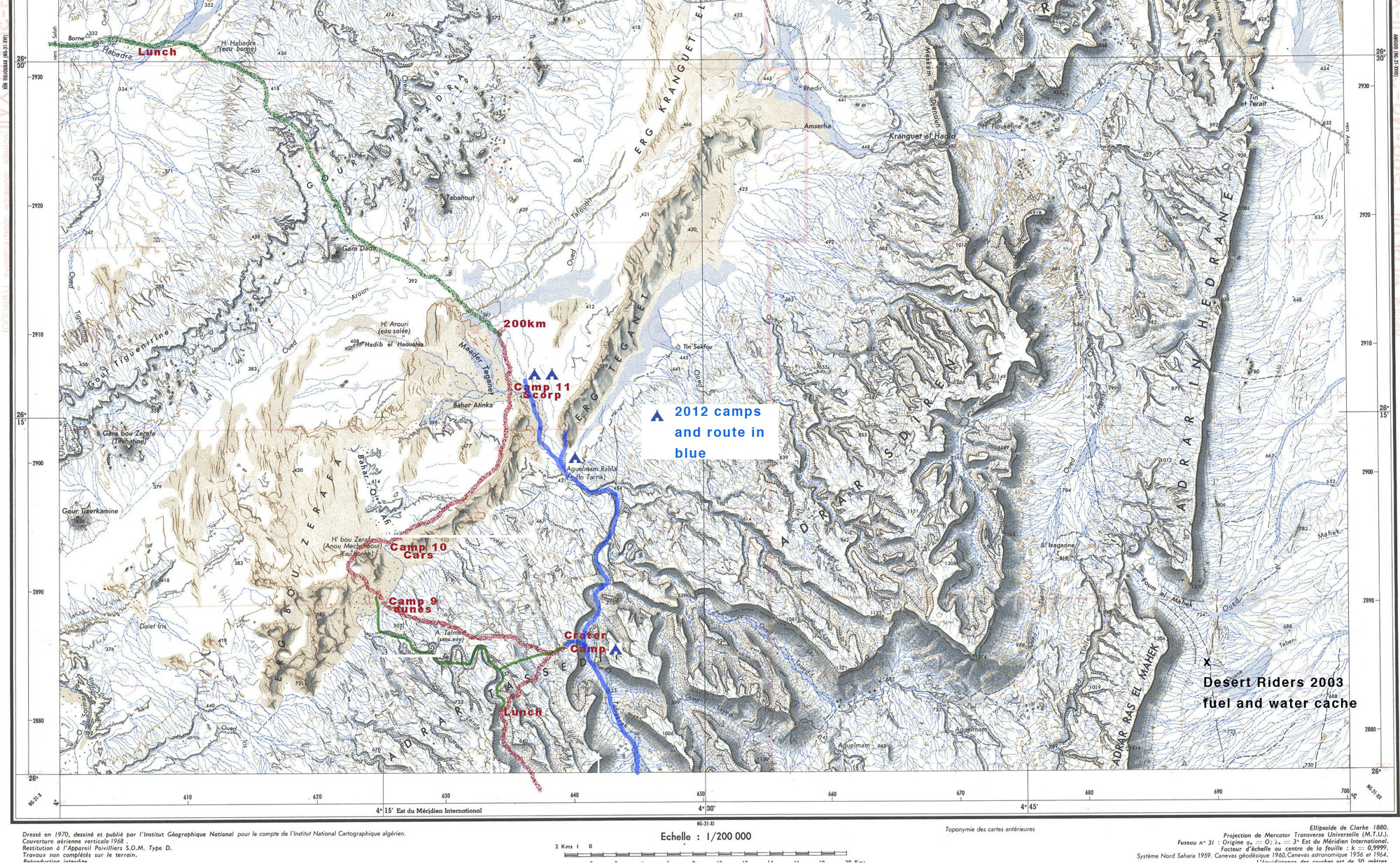
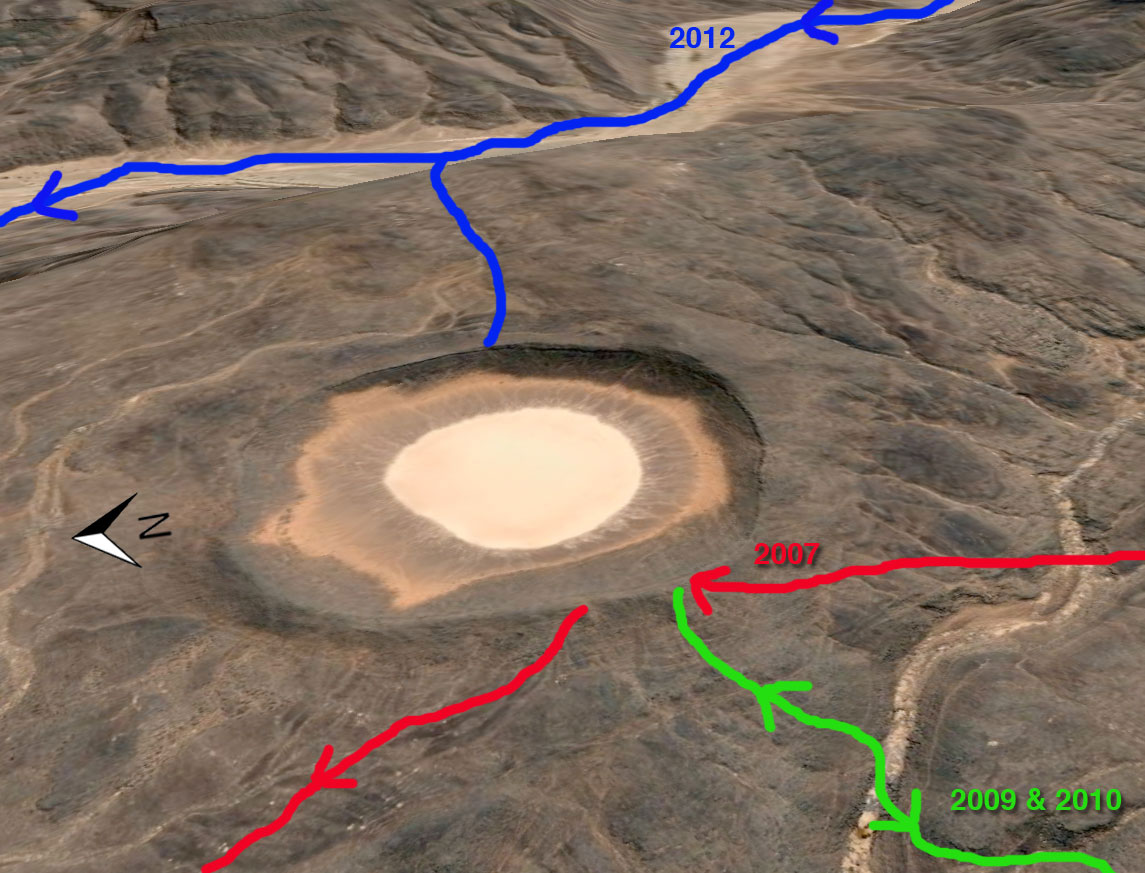
Mohamed had suggested that to get to the crater we take the next oued east after Tissadert, the Oued Taferekrak (according to the IGN map, below). Approaching the crater from this side was something I’d wanted to try for a while as the site lies just 500 metres from the canyon rim and ends up at the interesting Aguelman Rahla, surrounded by more pre-islamic tombs as well as dunes.

kranguet

This also happened to be along the approach route to the crater we’d planned on Desert Riders back in 2003, going as far as leaving a fuel and water cache at Foum el Mahek gap to the east a year earlier (see map above). That trip did not end so well, but having now walked up it, I’m not so sure riding the lardy Honda XRLs would have been at all easy up here.

27valley.jpg

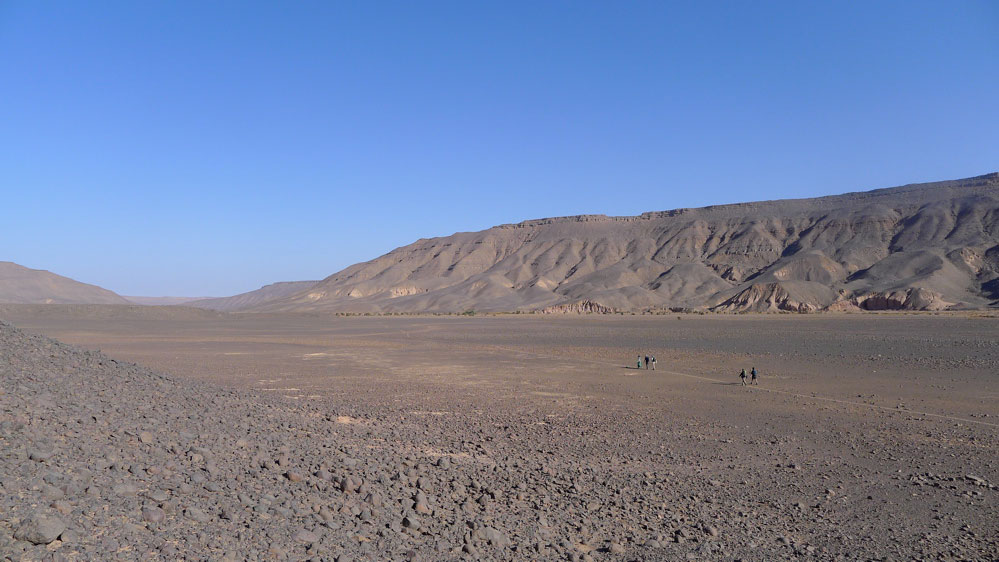
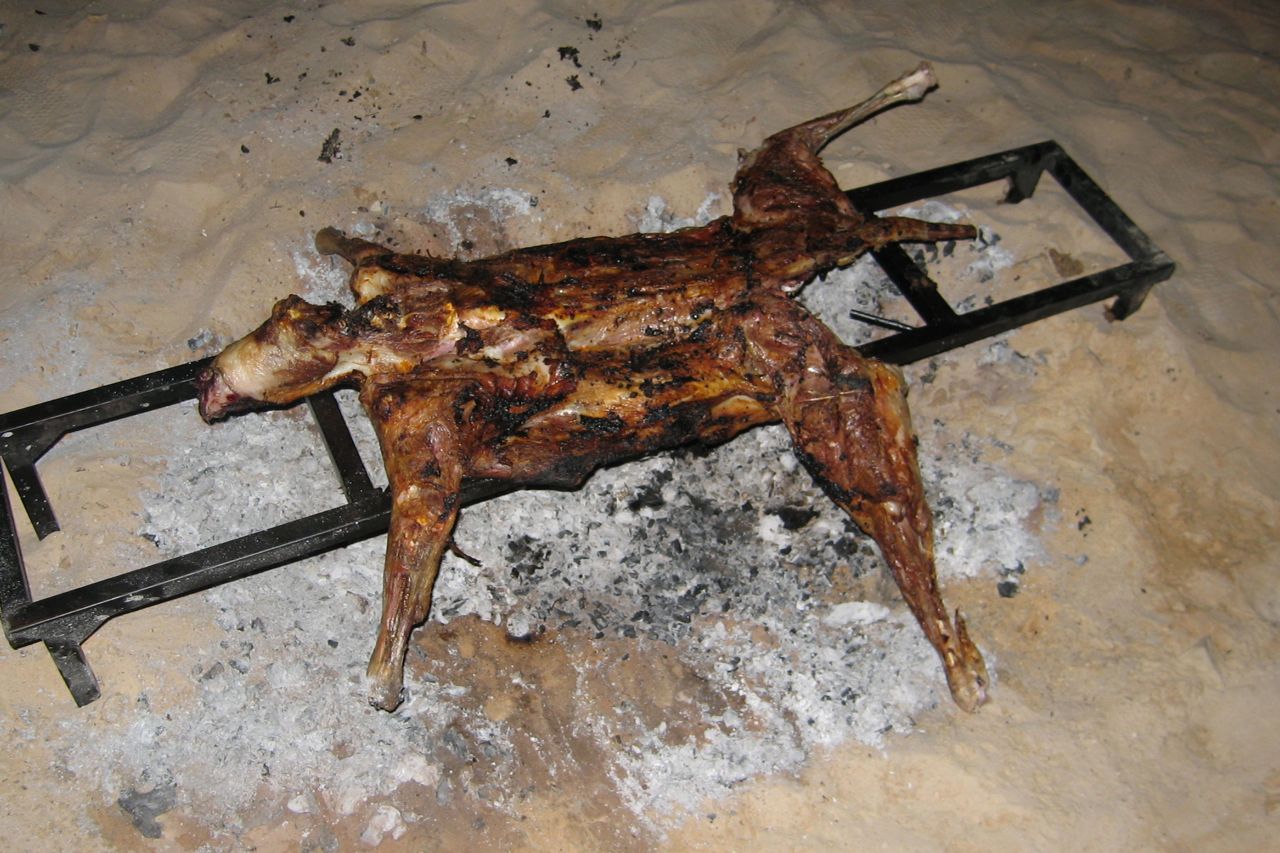
After a light overnight freeze, we set off up the wide canyon (above) and as expected, met some goat nomads who agreed to sell us an animal for a hefty €75. It had been the same price last year, but down in the Hoggar I was later quoted €50. Still, for a tenner each we ate well for three days and the crew got an unexpected treat too.

28

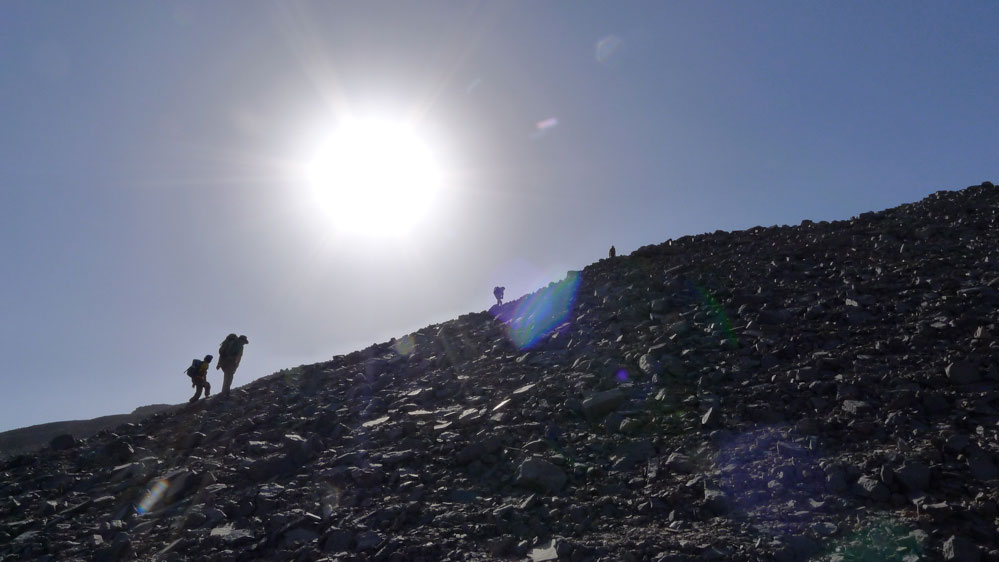
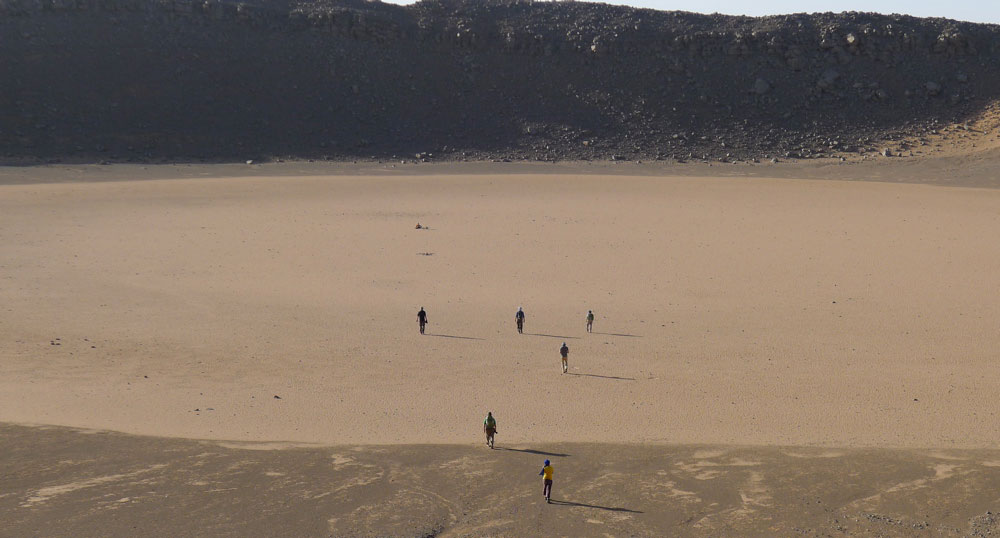
So, while the old men and Tayeb prepared to chop up the goat, we set off for the crater up the steep canyonside (above) with Salah, Mohamed’s 18-year-old son. After just an hour of huffing and puffing we looked down onto the crater (below), since sullied with stone-stencilled graffiti.

29

Some, including myself, thought it should be obliterated to return the crater to its natural form, but as some of it was clearly the work of Algerians from Ghardaia, others argued that, as foreigners, it was not our place to be meddling with locals wanting to lift their leg on the place. And at least the loose stones were not permanent. Maybe someone else will do the right thing.

crate-1.jpg
The various ways we approach the crater over the years

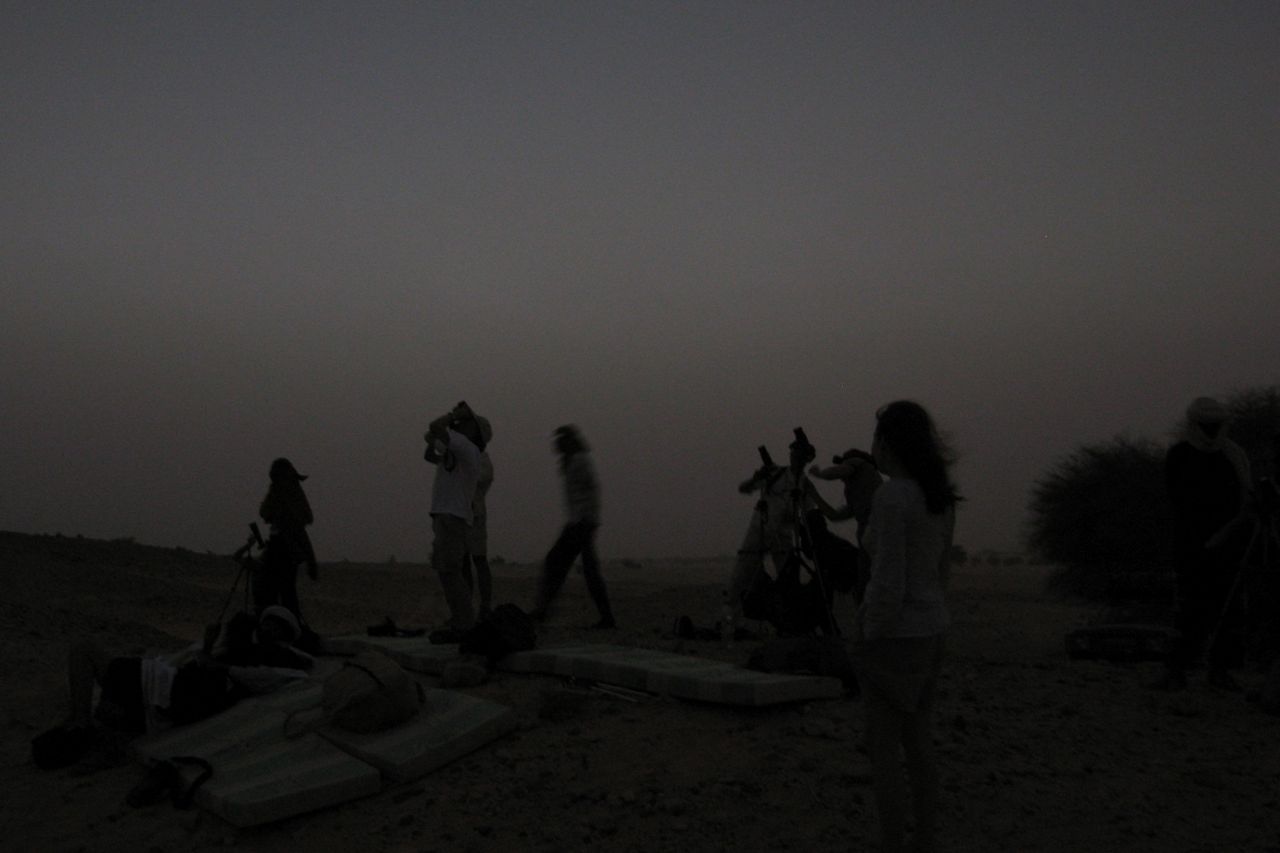
A dust haze had drifted up the valley that day, reminding me of the near disaster (from a visibility PoV) we’d had on the Eclipse tour in Niger back in 2006. Undeterred, Salah leapt back down to the canyon floor like a rubber gazelle where sure enough, a fresh goat stew was bubbling on the coals.

30dune.jpg
Aguelmam Rahla

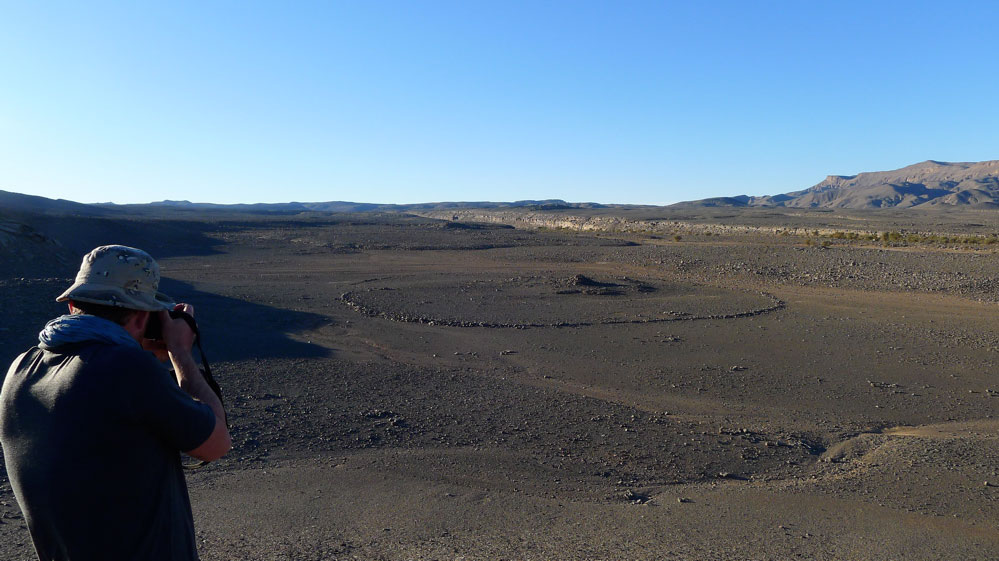
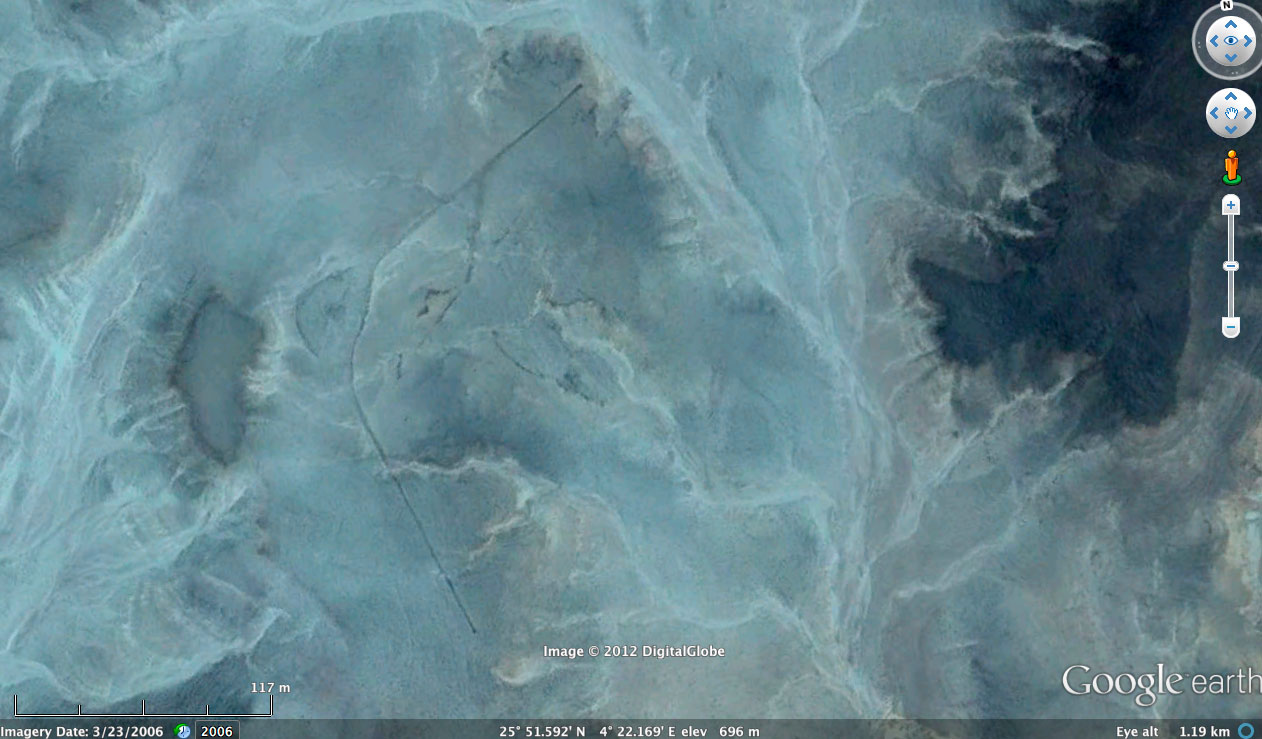
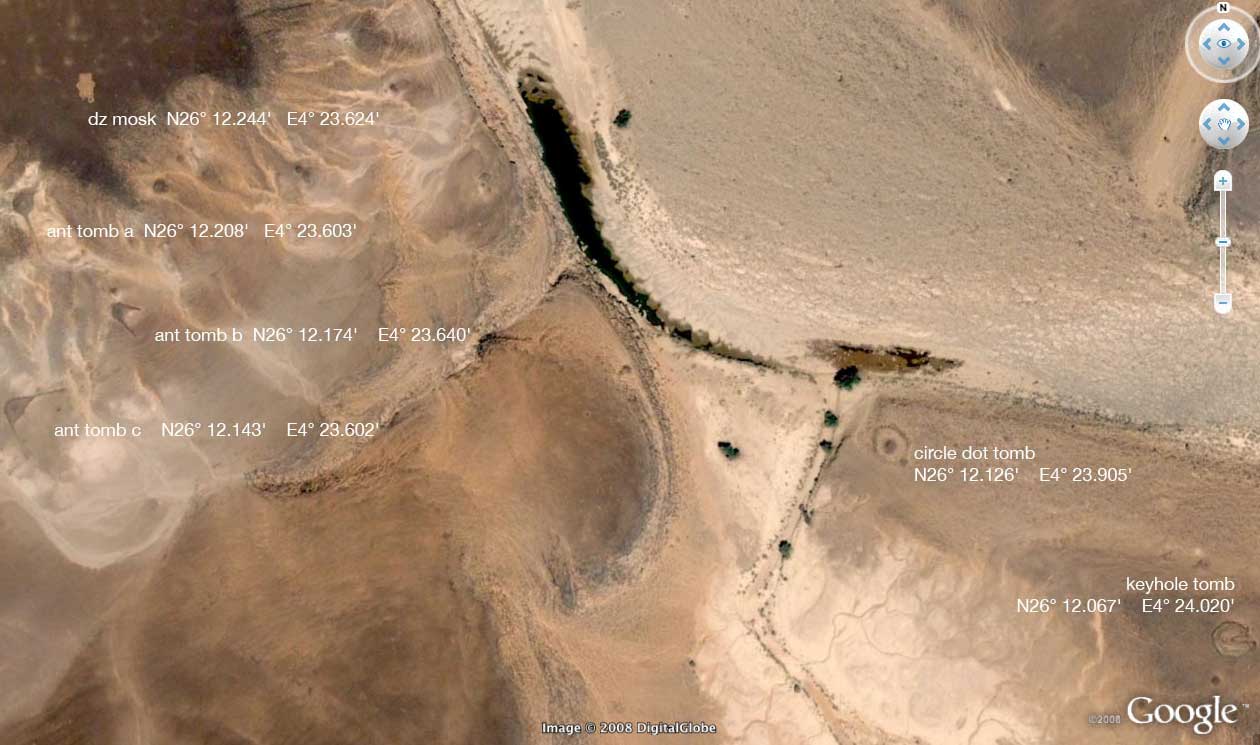
The following day we emerged from the Tafrakerk canyon at Aguelmam Rahla guelta (above) where we were in a little too much of a rush to wash off the dust of several days, much to the displeasure of Mohamed. He was quite right, we should have filled up and taken a bucket elsewhere, this waterhole is a key point for nomads topping off their goats prior to collection by Arab traders coming in from In Salah, two days drive northwest. A mile away, the terminal dune of the Erg Teganet (above) made a great backdrop to our camp as well as a challenge for some next morning, while I wandered around looking for the tombs I recalled seeing clearly on Google Earth a while back (below). More on tombs here.

aguelmam

After lunch we continued for half a day up the sandy Teganet oued in the direction of Bir Outene at around 200km. Here we had a day off waiting for the cars to arrive, as we’d saved a day taking the new route to the crater.

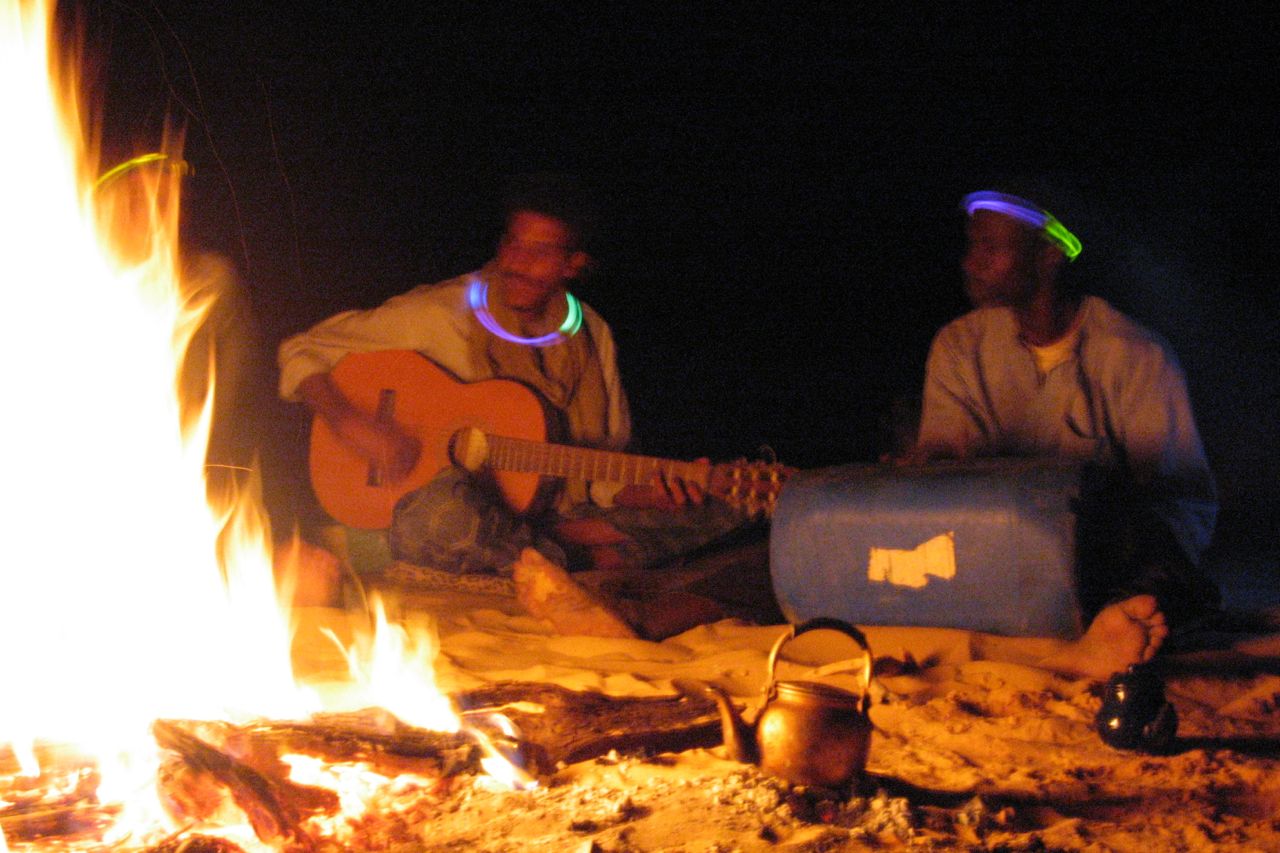
We sat around, moving with the shade while reading our books or Kindles until the late afternoon brought the distinctive hum of 4x4s churning up the river bed in low range. Too late to pack up now, one of the drivers had a guitar and later that evening around the fire we listened to him and Mohamed drumming on a plastic water can. Then, as the sands sucked in the cold we headed for our dispersed camps. It was an early start next morning for the long run to Mehajibat dunes and another day’s drive down the TSH to our Hoggar base camp. More about that here.

Since then, I’ve asked many times but am told the Immidir region is closed to tourism – as it the better known Tassili Hoggar region southeast of Tam. The only reason I can think is that Tamanrasset authorities would rather corral tourists around Assekrem, though that didn’t stop one getting kidnapped near there in 2025. The Immidir is inaccessible by car.

From the back: me, RobUK, Patrick, Steve, Sharif, Mohamed, Halil, Salah,
Ahmed, Rob, Mike, Hannah, Diane, Tayeb, Loukmane, Said.

Immidir practicalities
Tam-based Ben Kada agency had never run- or probably even heard of the crater route before, so I presume they took it upon themselves to track down Mohamed and his crew and ascertain that they could lay on the gear and knew the way. Ben Kada drivers dropped us off with the caravan and picked us up 11 days later, leaving it to the Arak guys to do the job.

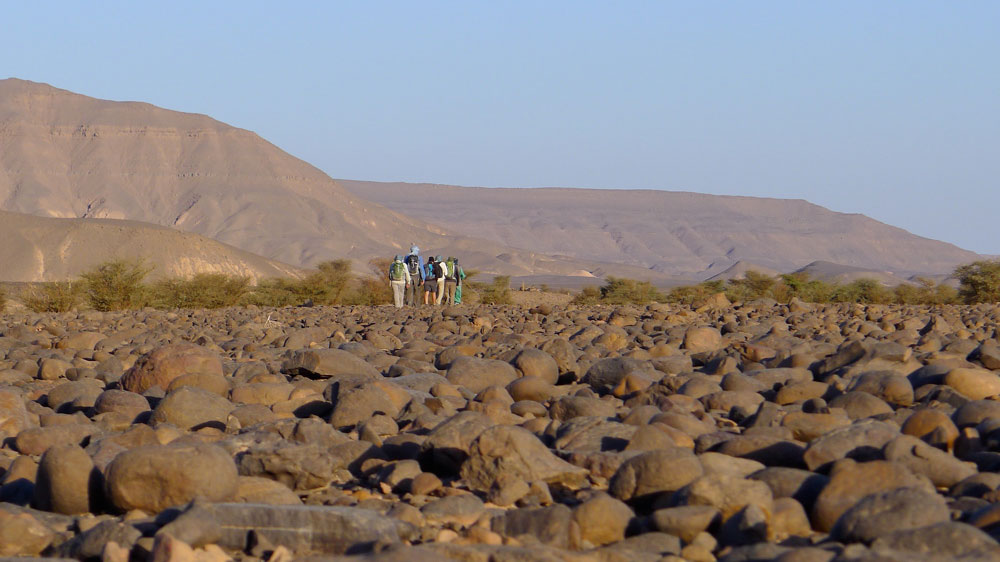
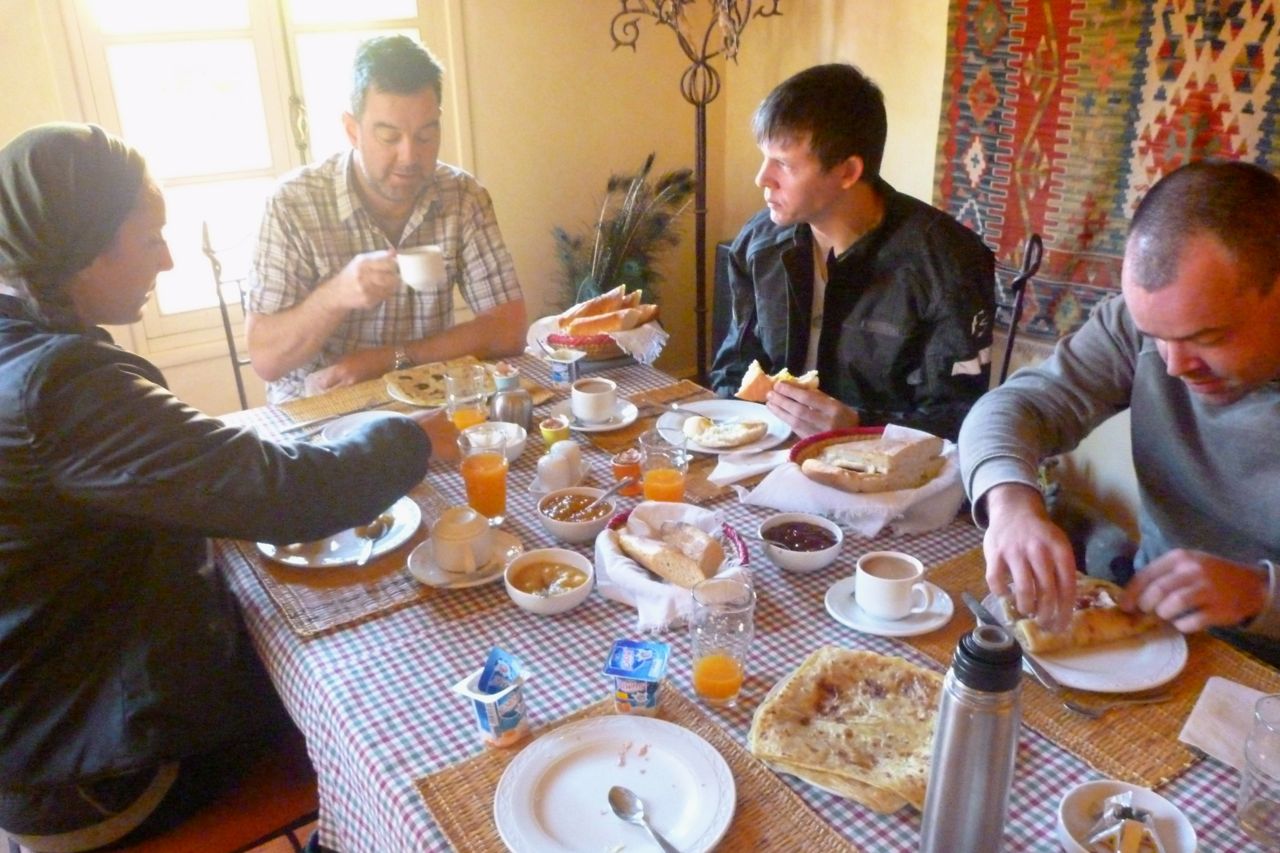
We breakfasted around 7.30am, just around dawn, and walked between 15 and 25km a day (10-15 miles), which was plenty given the terrain at times, although lunches were often 2 hours long. Most of the time we didn’t travel with the caravan and took detours which the camels did not follow. Sometimes we travelled with the kitchen camel and Tayeb the cook who prepared lunch, very often the best meal of the day. Breakfast was lean: tea or coffee, bread (baguettes or tagela ‘sand bread’), a solid block of marg, jam and Vache. As suggested beforehand, a couple BYO muesli or instant porridge. Once we had pancakes or French toast (eggy bread) or omelettes. Many carried day snacks, though I went without as I had some weight to shed but was pretty hungry at most meals. Hot drinks, peanuts and biscuits were laid out soon after we arrived at the camp – most welcome – and dinner was ready two hours later: soup followed by a muttony stew, sometimes with pasta or cous-cous or rice or bread, plus dates or oranges – and glasses of tea later. Most were asleep by 10pm.

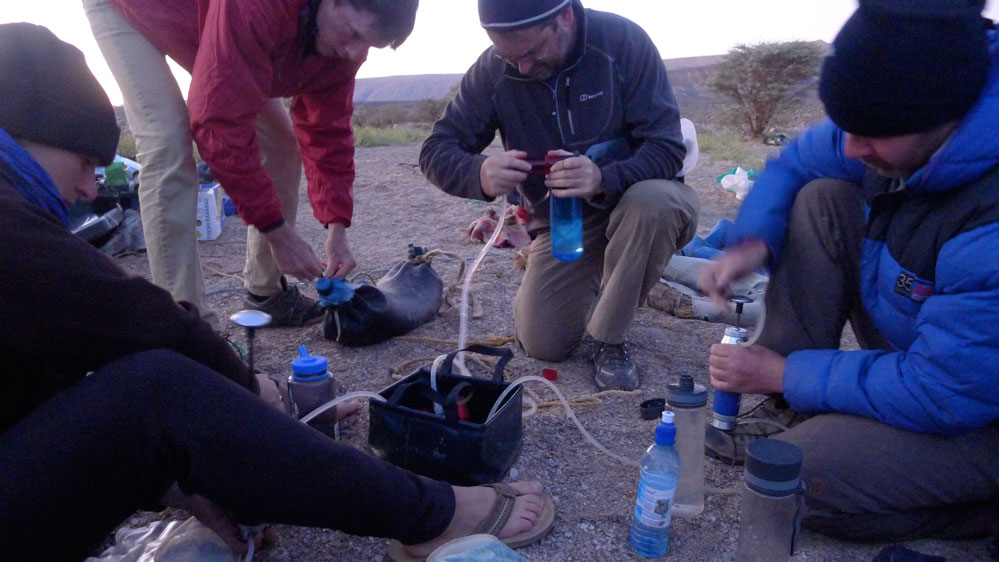
Once water was taken from gueltas we filtered it, though we all agreed it was more to get rid of unsightly sediment than microbes which might make us ill. We drunk enough untreated water from other sources and no one got ill. The sediment makes filters clog up within a litre or two so the uncleanable ‘squeeze bottle’ type got blocked early on, while the cleanable Katadyn and MSR ceramic core jobbies carried on working with regular cleaning.

Most of us had small blisters by the end and could do nothing about them except plaster them and keep them clean. No one’s walking was really affected; I had a really raw small toe but that recovered well enough on the two-day drive to Hoggar. I had a feeling my feet swelled up after a few days which may have led to this – thinner socks did the trick until they wore out. Interestingly Bermuda Rob did the whole walk in a $70 pair of Nikes. They survived, were very comfy and he had no blisters! There were no other injuries even though we worked out there had been no less than four million opportunities to miss a step and sprain an ankle

Most found it got cold around 6am: the mats supplied were pretty thin but once I remembered we had them, the extra blankets laid on were a great help with warmth (under or over).

The cook spotted one small, harmless snake on the trail which he killed without thought. Some were surprised by this, but desert dwellers have a different attitude to these and scorpions (none seen).

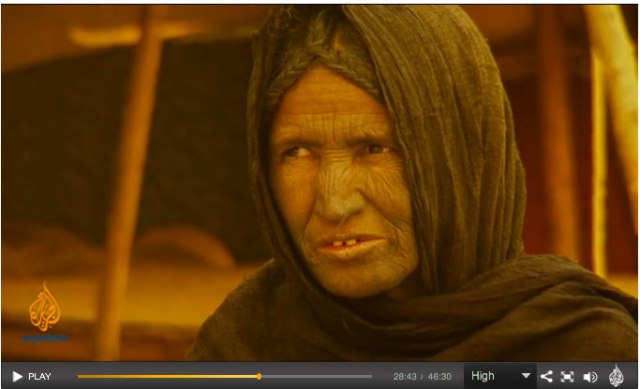
Tuareg documentary online at Al Jazeera

First in a three-part documentary on Al Jazeera online about the Tuareg of Niger and Mali following the fall of Libya from which many of them fled.

Can’t embed – the link is here or click image below. Well worth watching.

Also, an article by the film maker here. And another by Andy Morgan about the Tuareg cause.

Part Two ‘Rebellion‘ is online now too. Part 3 ‘Exile’ is in a week.
All also on Al Jazeera TV channel I presume.

aljt1

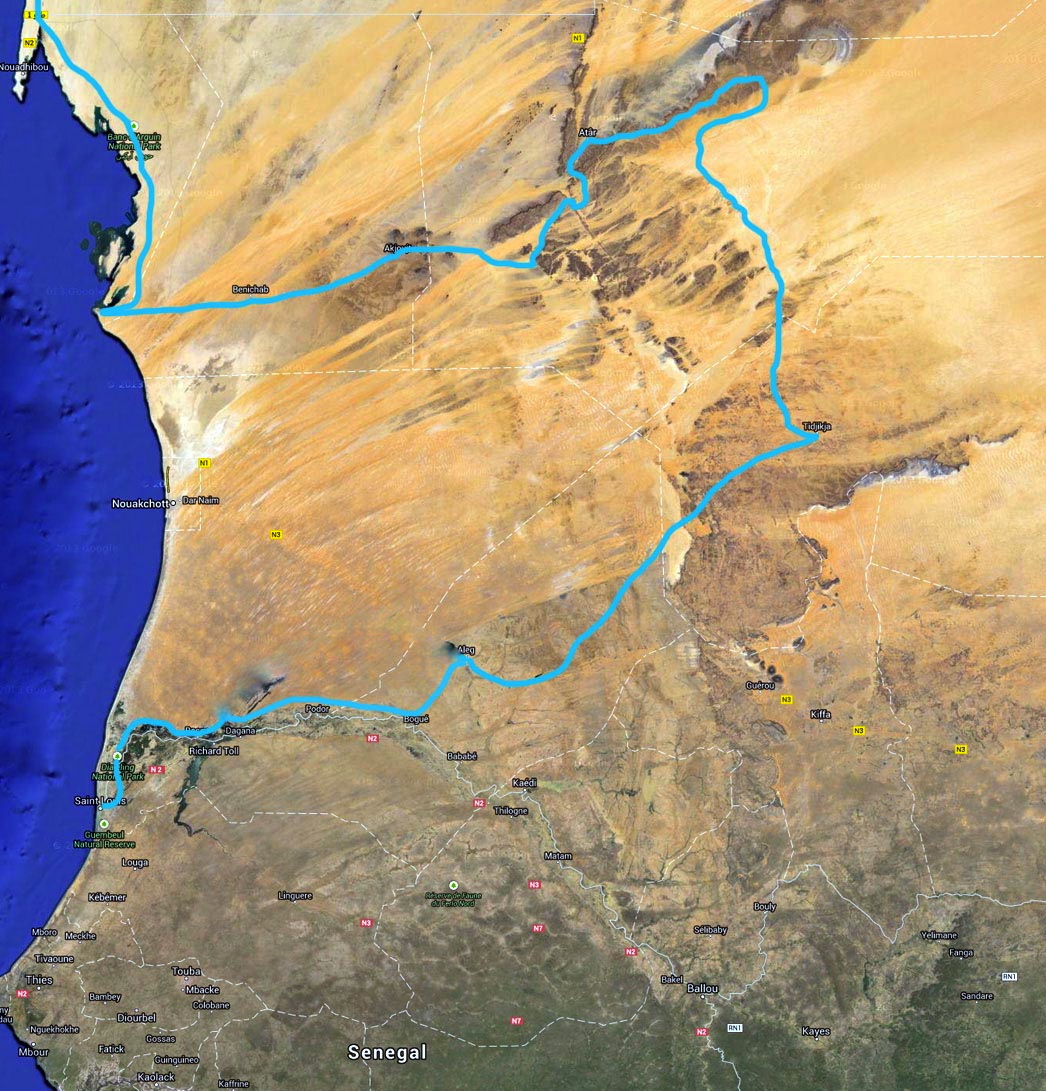
Mauritania 2013

by Robert R

Googled into English
rrmap

Carnet ATA: Pour le Sénégal seulement
Visas Mauritaniens: Double entrée, demandés via Lyon visa service.
Visas Sénégalais: Multi entrées, demandés au consulat de Lyon.
Guides: La Mauritanie au GPS (Cyril Ribas)
Le Routard 2013 pour le Sénégal et la Gambie (pas très fiable)
Lonely Planet pour la Guinée Bissau.


rr04
Aurora fort
rr01
Plage Blanche

Le voyage
1. Ferry Sete – Tanger le 28/9/13 avec GNV.

3. 11/10: On retrouve nos amis à Dakhla.

4. 12/10: Frontière Mauritanienne: c’est le souk côté Marocain car il y a pas mal de monde et l’organisation des   files d’attente laisse à désirer. On y passe au moins 4h! On retrouve notre guide Fadel, coté Mauritanien.
Bivouac au début de l’ancienne piste vers le Banc d’Arguin  (Pour les points, cf. bouquin Cyril Ribas).

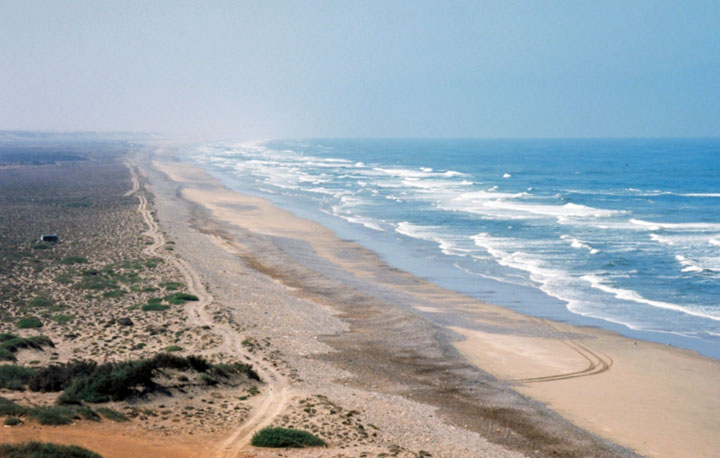
5.  13/10: Déjeuner à la plage d’Arkeist, baignade et bivouac.

6.  14/10: Traversée Banc d’Arguin –> Benichab. On quitte la piste de Nouamghar vers Tessot.

Croisement vers Tessot:
N 19° 28.249 O 16° 18.330 (km 0)

Points sur la (belle) piste:
N 19° 28.281 O 16° 17.244
N  19° 24.716 O 16° 04.127

On rejoint ensuite la route Nouakchott (vers le Sud, km 30)

Croisement de la piste pour Benichab (sur la gauche, juste après une station-service):
N 18° 52.840 O 16° 09.736 (km 97)

rr03
Benichab

La piste suit une direction Est Nord Est jusqu’à Benichab.

Points sur la piste:
N 18° 56.507 O 16° 05.012 (km 110)
N 19° 00.305 O 16° 01.321 (km 120)
N 19° 22.417 O 15° 34.351

Benichab: N 19° 28.130 O 15° 25.642 (km 212)

Benichab:
A Benichab, il a fallu discuter ferme pour pouvoir bivouaquer plus loin sur la piste d’Akjoujt. Depuis qu’on a quitté le bord de mer, il fait très chaud (pointes à 46-48°C!)

7.  15/10: Akjout puis traversée pour bivouaquer au pied des dunes de l’Amatlich.
Pour le parcours Akjoujt-El Abiod, on a utilisé les points du guide de Cyril Ribas car Fadel ne connaissait pas.

rr04
Akjoudt

Akjoujt: N 19 44.700  O 14 23.040

Croisement (sur la route d’Atar): N 19 54.897 O 14 05.388
Puit Tabrenkount:      N 19 48.686  O 14 02.149
Entree Amatlich:         N 19 42.926  O 13 42.535

8.  16/10: Traversée de l’erg le matin : C’est vrai que l’Amatlich c’est pas trop facile! Mais il y avait une bonne trace et le collègue qui était devant moi est un super pilote, donc derrière on voit bien les difficultés et plus facile à négocier: aucun plantage pour les 3 voitures mais il a fallu forcer sur le champignon!

Sortie Amatlich:   N 19 45 445  O 13 46.241
Puits d’Amazmaz: N 19 41.241  O 13 25.965

rr05

rr06
rr07

rr09
Amazmaz guelta

Puis détour vers la guelta

d’Amazmaz: pas facile à trouver la piste pour y aller et en plus elle est pleine de caillasses mais une fois arrivée à la guelta c’est le pied: baignade et bivouac.

9.    17/10:  En route vers la passe de Tifoujar, on traverse de jolis villages.

rr10

Hassi el Tisram     N 19 47.243  O 13 25.248
El Meddah               N 19 54.930 O 13 19.607
El Gleitat                 N 19 58.306 O 13 17.624
Passe de Tifoujar   N 20 05.537 O 13 11.882

rr11

 (La passe de Tifoujar, je ne connaissais pas, c’est splendide!), grande et belle descente vers l’oued El Abiod (toujours aussi beau malgré le temps gris et toujours aussi chaud), Oujeft et bivouac sur la  piste de Terjit (avec, en plus de la chaleur, un sale vent).

Toungad: N 20 03.193 O 13 07.208
Oujeft: N 20 01.609 O 13 02.940

10.  18/10: Terjit, courses à Atar et bivouac près de la piste d’Ouadane.

rr12

11.   19/10: Ouadane, Déjeuner à l’auberge de Zeida (left): elle est très sympa et elle nous a cuisiné un super plat.

Départ par le désert pour Chinguetti et super bivouac en route après un très joli village.

rr14

rr15

rrching

12. 20/10: Chinguetti (left), visite et déjeuner sous 1 bosquet dans l’oued et départ pour 1 visite à la passe d’Amodjar (que l’un   des équipages ne connaissait pas). Puis direction le mont Zarga pour récupérer la piste de Tidjika. Bivouac juste avant Zargas.

rr16

13. 21/10: Piste vers Tidjika (right), en suivant les points du bouquin de Cyril Ribas sauf quand la construction de la nouvelle route Atar-Tidjika nous a obligé à dévier (assez loin, d’ailleurs).

Joli bivouac à l’écart: Il faut noter que pour tous les bivouacs, Fadel nous a demandé de choisir un coin un peu éloigné de la piste ou de la trace principale pour des raisons de sécurité.

Pour tous les points de la piste Chinguetti-Tidjika, voir le bouquin de Ribas.

rr17

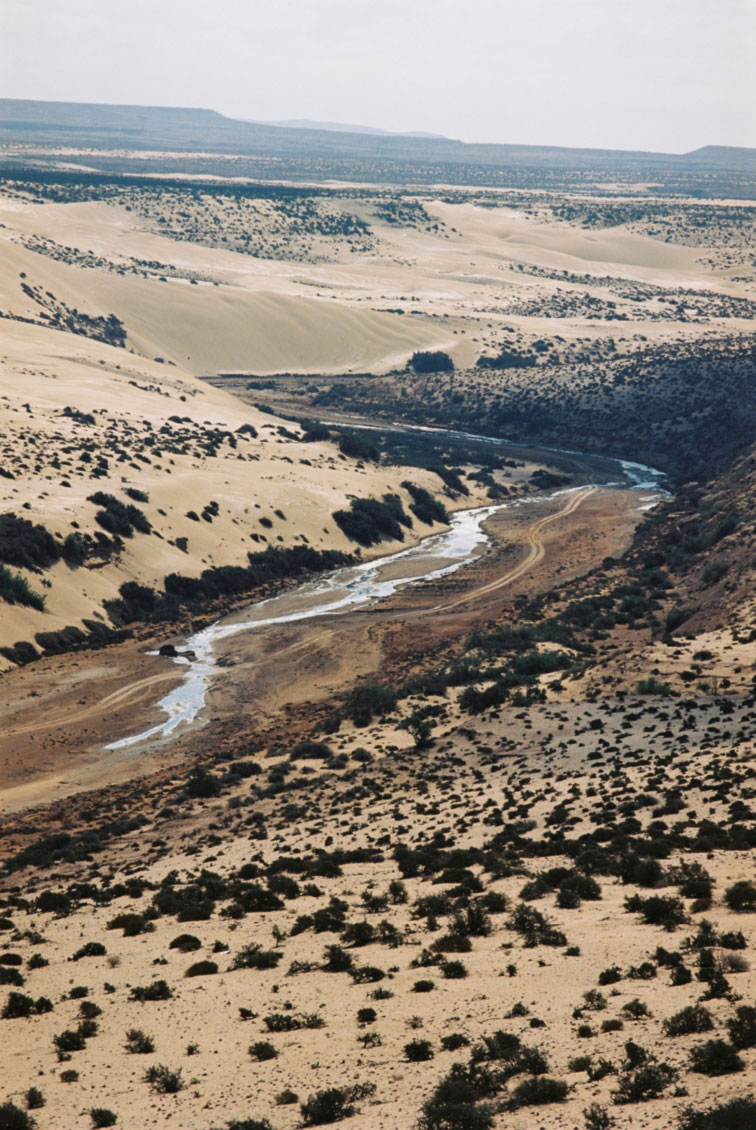
14.     22/10: Puis on a rejoint le magnifique Oued Rachid (right) pour le remonter.

Super bivouac non loin de l’oued.

15.     23/10: On continue à remonter l’oued, passage pas facile à trouver vers la fin car les pluies ont fait des dégâts.
Et on découvre une guelta: avec une magnifique séance de troupeaux à l’abreuvoir.

rr19

rr20

Arrivée à Rachid (left), quelques courses pour un super picnic à l’ombre (il fait toujours aussi chaud!) au bord de  l’oued. 

Puis Tidjika pour refaire les pleins et on récupère la piste vers Boumdeit.

16.     24/10: Passe de Néga (on toujours pas vu les singes!), Boumdeit et bivouac près de la piste vers Kiffa (le cram-cram commence à devenir envahissant et il fait toujours aussi chaud!).

rr21

17.     25/10 : Kiffa, puis route vers Aleg. Arret devant la stele à la mémoire des  4 Français et leur guide assassinés en Décembre 2007 (right).

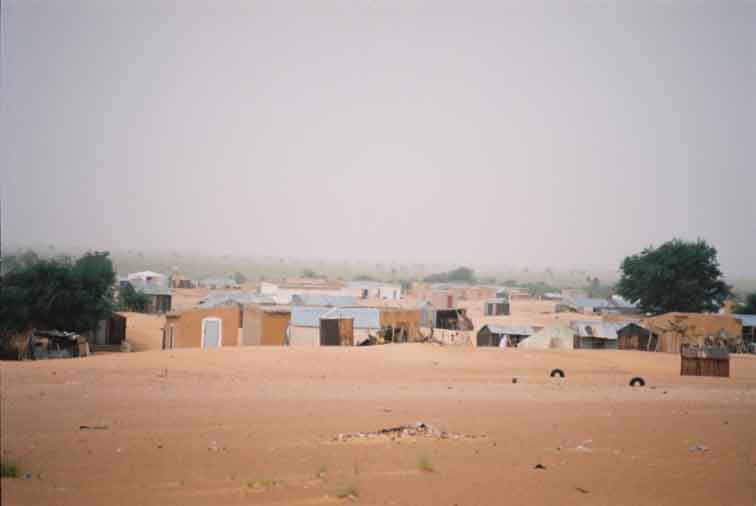
Beaucoup de contrôles sur la oute à partir de Kiffa. Bivouac à l’écart de la route après Sangafara. Nous quittons notre guide Fadel  à Aleg, cela a été un très bon compagnon de route et un bon guide. Fadel Habib: 00222 22 44 38 04.

rr22

18.     26/10: Route (c’est goudronné maintenant) vers Boghé, Rosso; bivouac avant Rosso.

19.     27/10: Piste vers Diama et passage de la frontière Senegalese sans problème. Nuit à Saint Louis.

rr23

Ten Days in Morocco ~ Husky • Sertao • XR ~ Final part

mk3-01

Parts One and Two here.
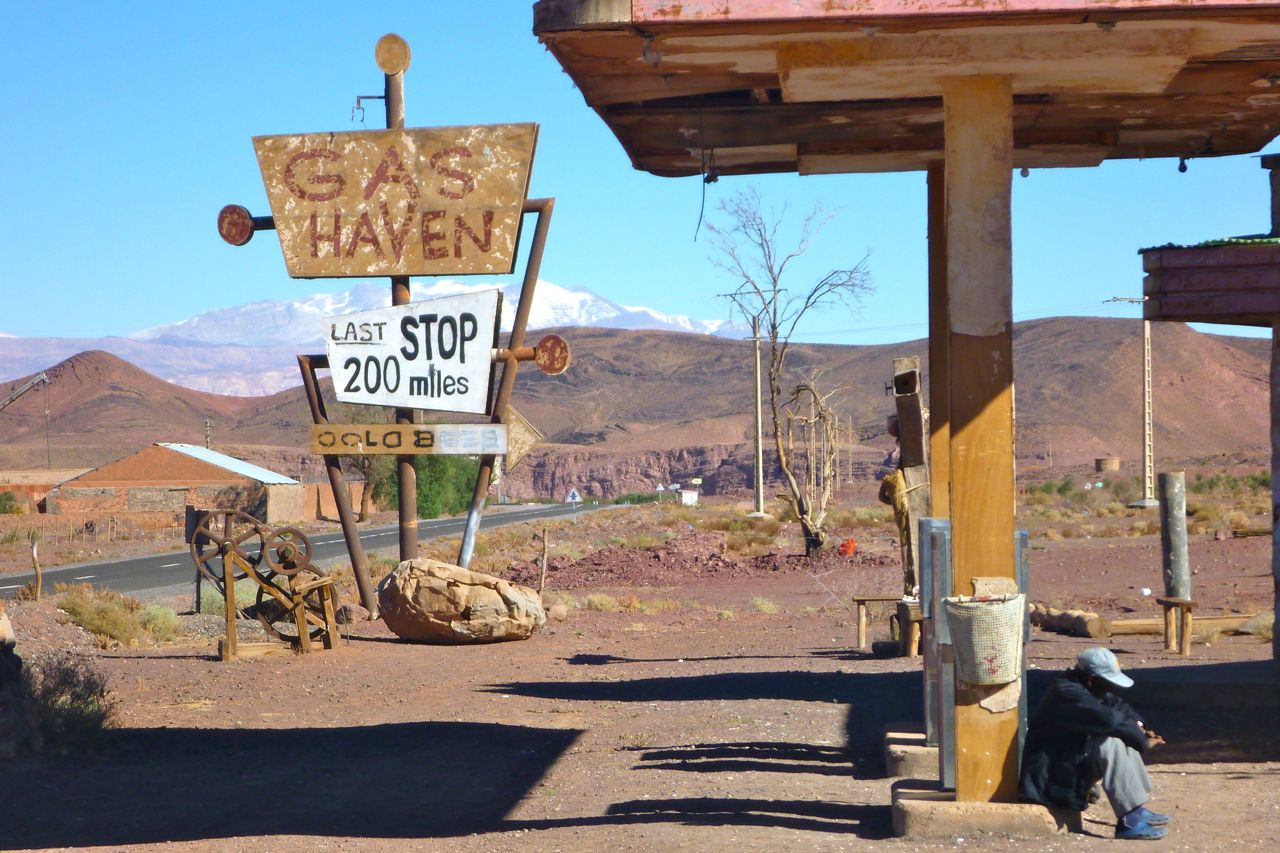
As two of the group are actors and Americans, from Tazenacht we take an excursion north to Gas Haven, a surviving film set from a 2006 remake of Wes Craven’s 1970s mutant hillbilly slasher The Hills Have Eyes. If nothing else it’s a great ride north through the Tizi n Bachkoum pass, chasing Andy on the Sertao.

mk3-02

Southwest American roadhouse an hour out of Ouarzazate. Even that boulder by the sign is fibreglass and wire.

mk3-03

Being an actor, Patrick knows a lot about about working behind bars.

mk3-04

Outside, desiccated, severed limbs swing in the desert sun.

mk3-05

There’s even a Wall of Death, but not the fairground one where a bloke rides round and round until he gets dizzy.

mk3-06

Chubby-cheeked babies charred by a nuclear experiment that went tragically wrong. Or something like that.

mk3-07

Lunch in Agdz – pronounced like ‘Agadez’ in Niger.

mk3-08

Rob takes a swing on the Husky.

mk3-09

Mustapha leads us to a viewpoint over Agdz palmerie with the Draa river in there somewhere. We’re riding up that hill tomorrow.

mk3-10

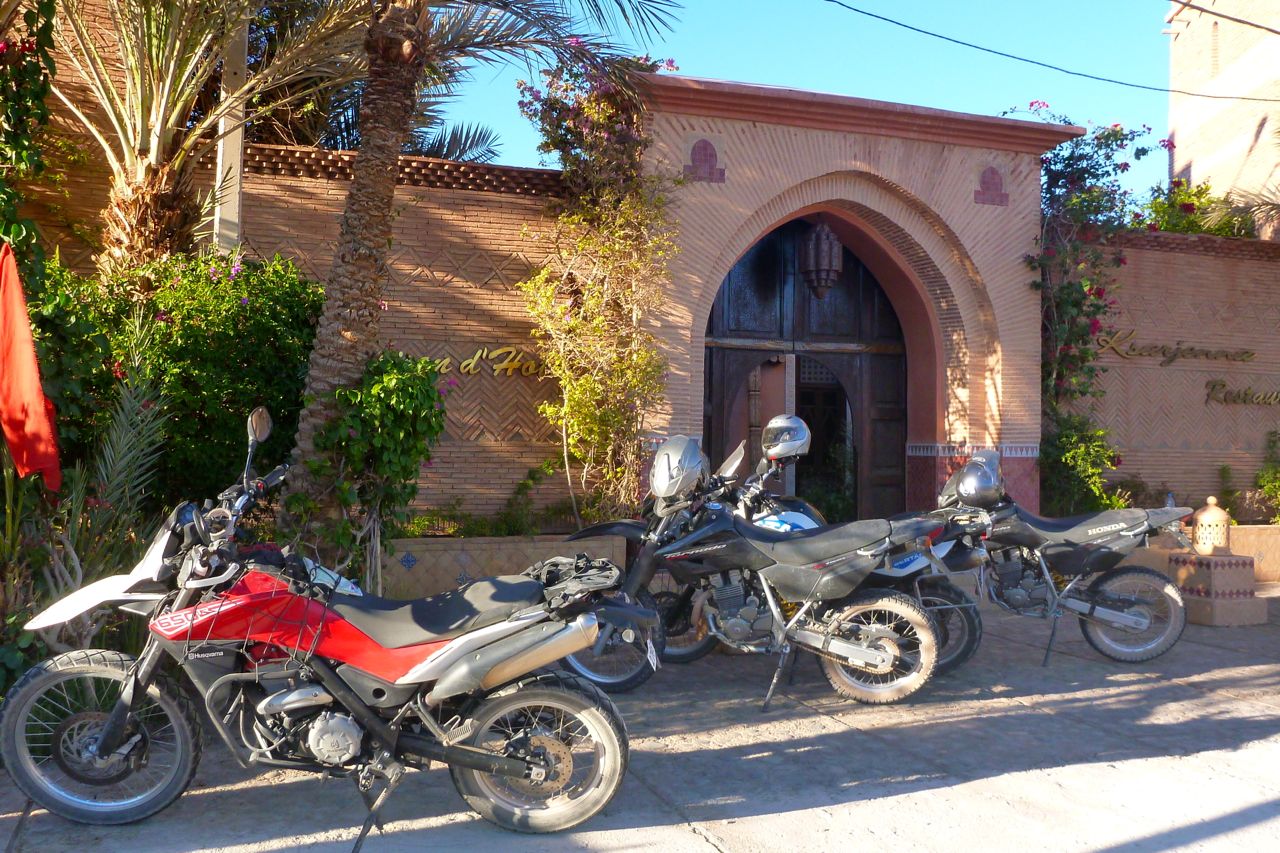
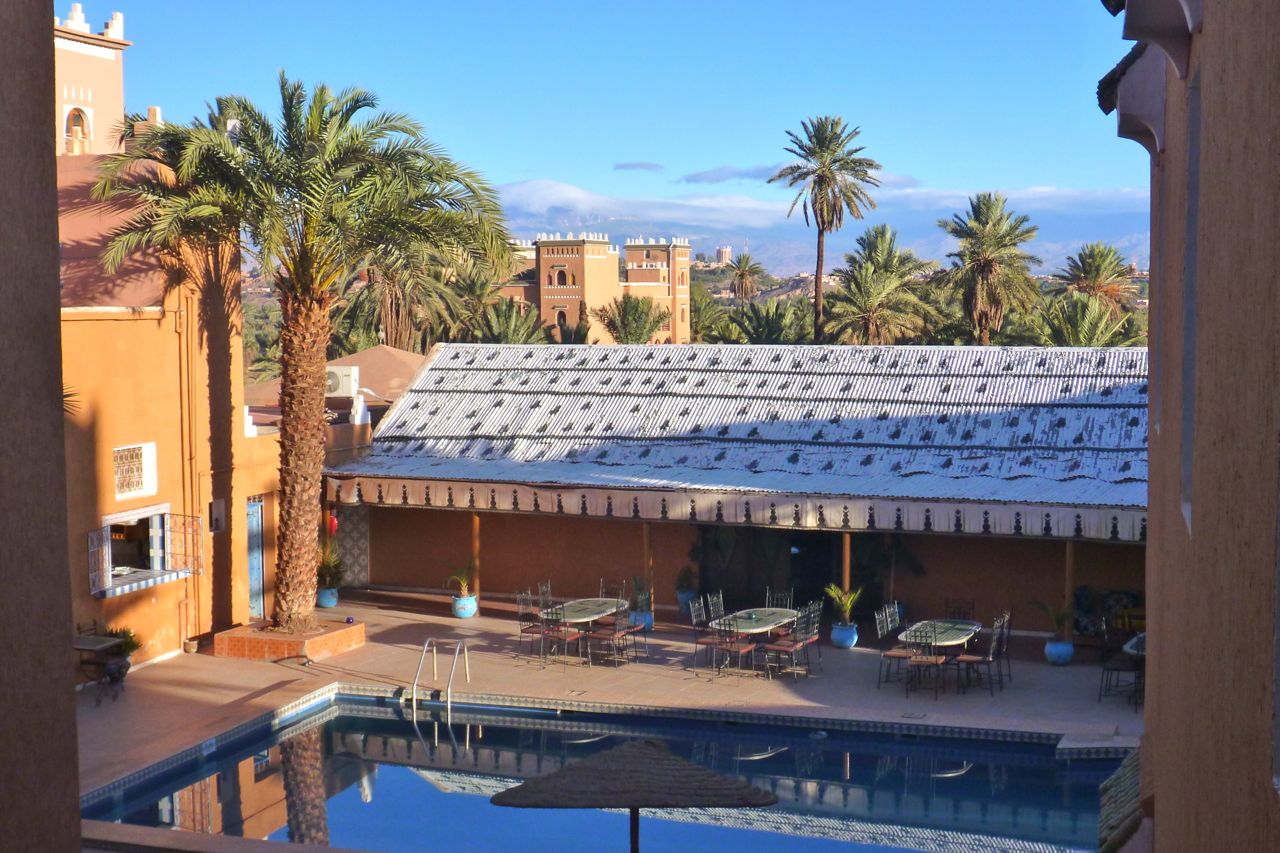
We arrive at the lovely Ksar Jenna on Nekob westside. We’re spending two nights here.

mk3-11

Night falls over Nekob.

mk3-12

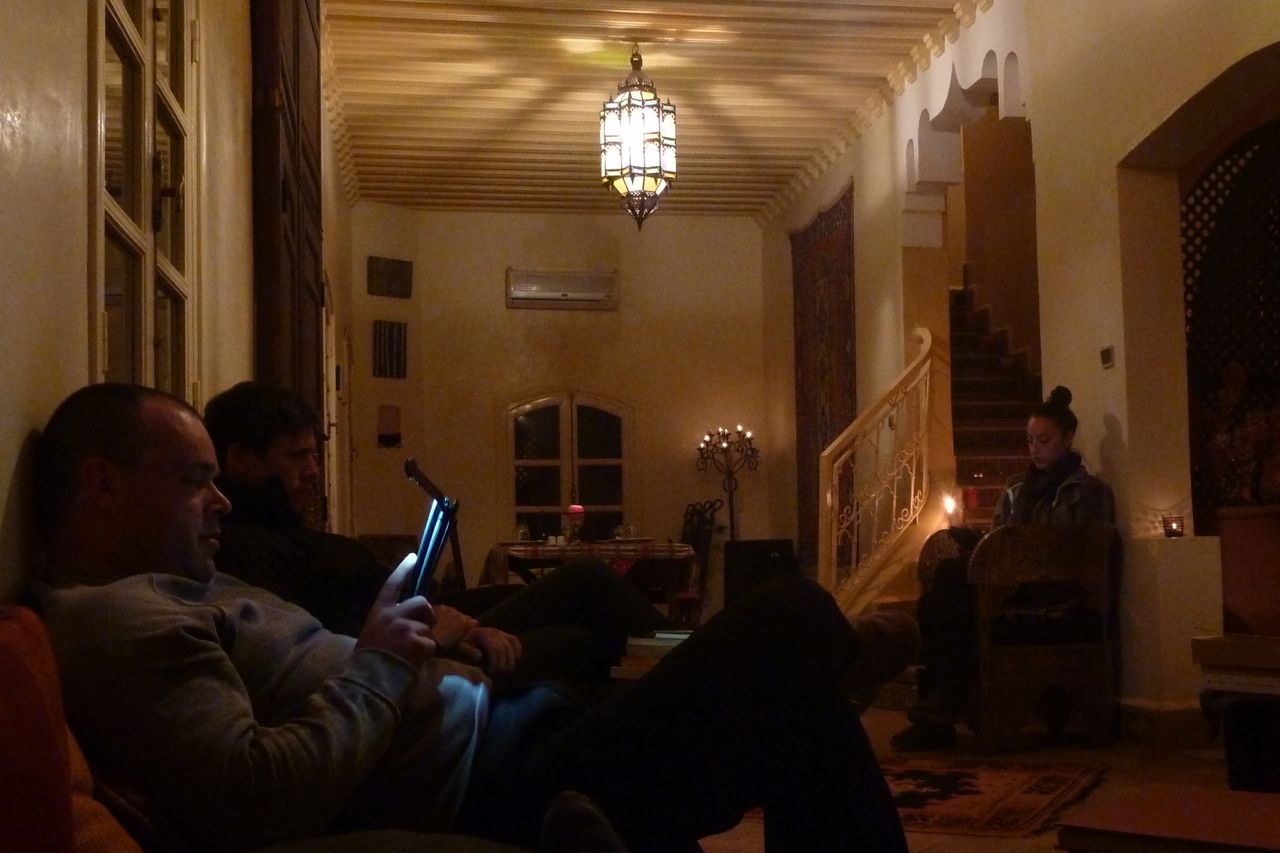
Inside, following another fine feast, the Kindles glow.

mk3-13

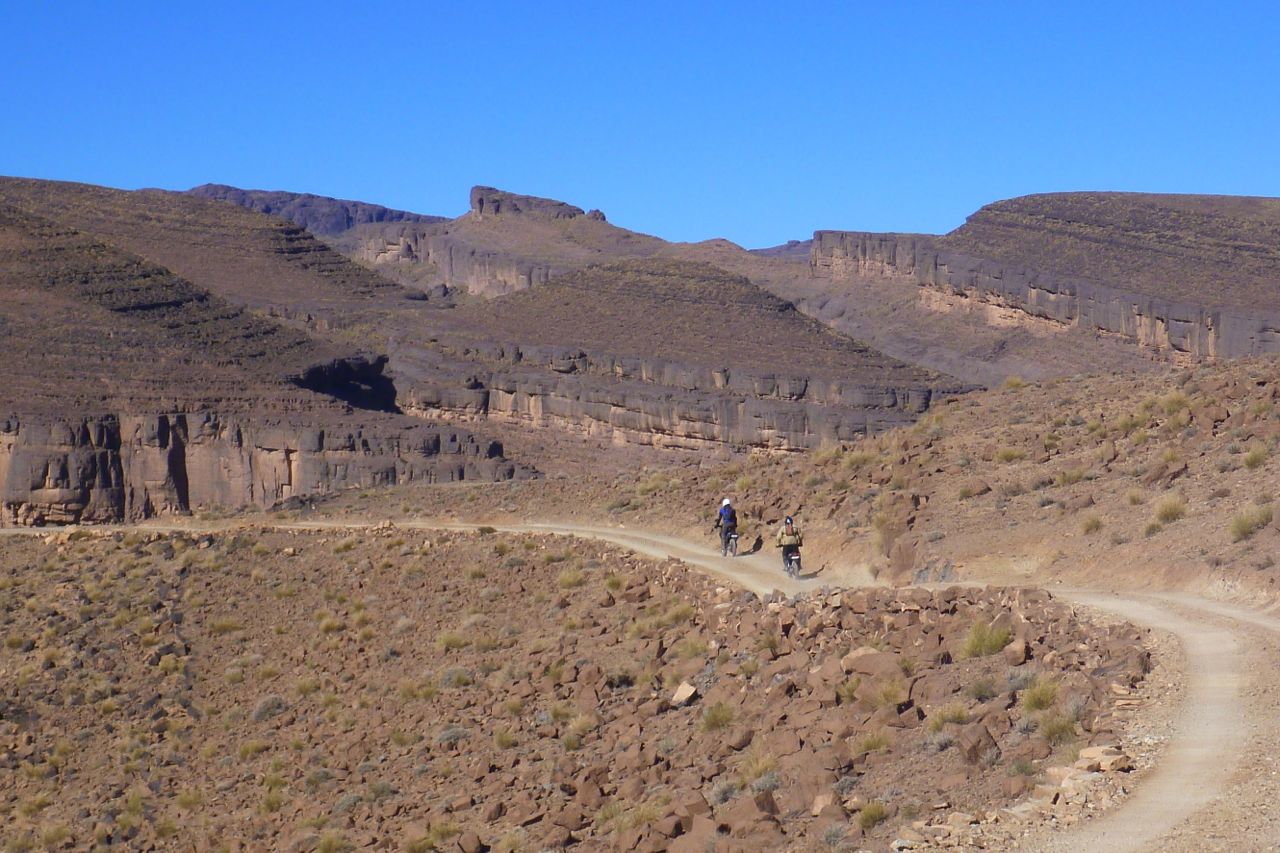
Next day Rob, Andy and I take a ride up MH14 ‘Sarhro West’ which I tried last year on the BMW 650 twin.

mk3-14

Patrick is doing his own thing today on the Sertao and Andy snatched his XR250 before I could.

mk3-16

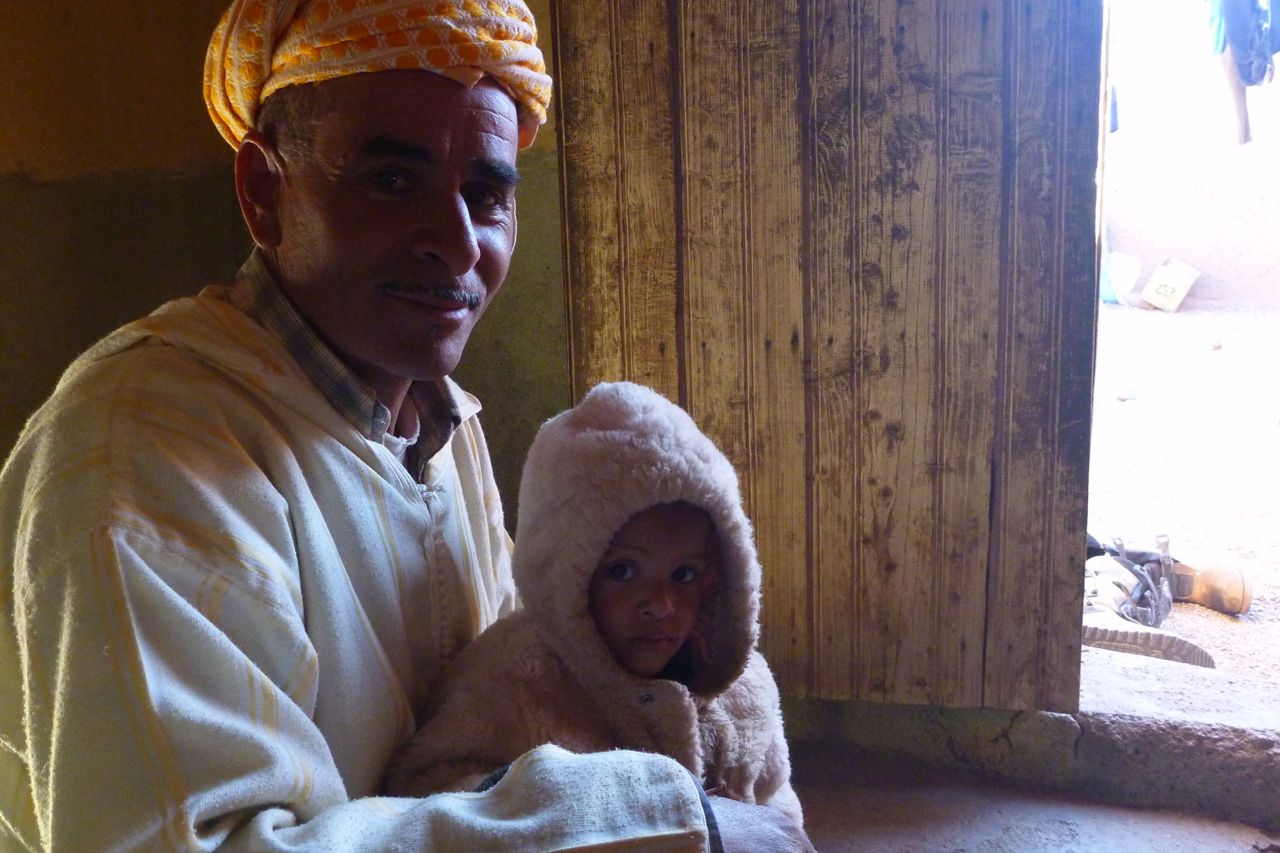
We stop for a tea and snack at the last dwelling up the valley. Hassan sits with young Ahmed in his woolly hoodie.

mk3-17

At the summit junction, KM46, I invoke the droite d’accompagnateur and depose Andy from the XR250.

mk3-35Undaunted, Andy hurtles off into the afternoon sun on the TR650, following an untried Olaf track which descends to the N9/N12 near the Draa river.

mk3-18

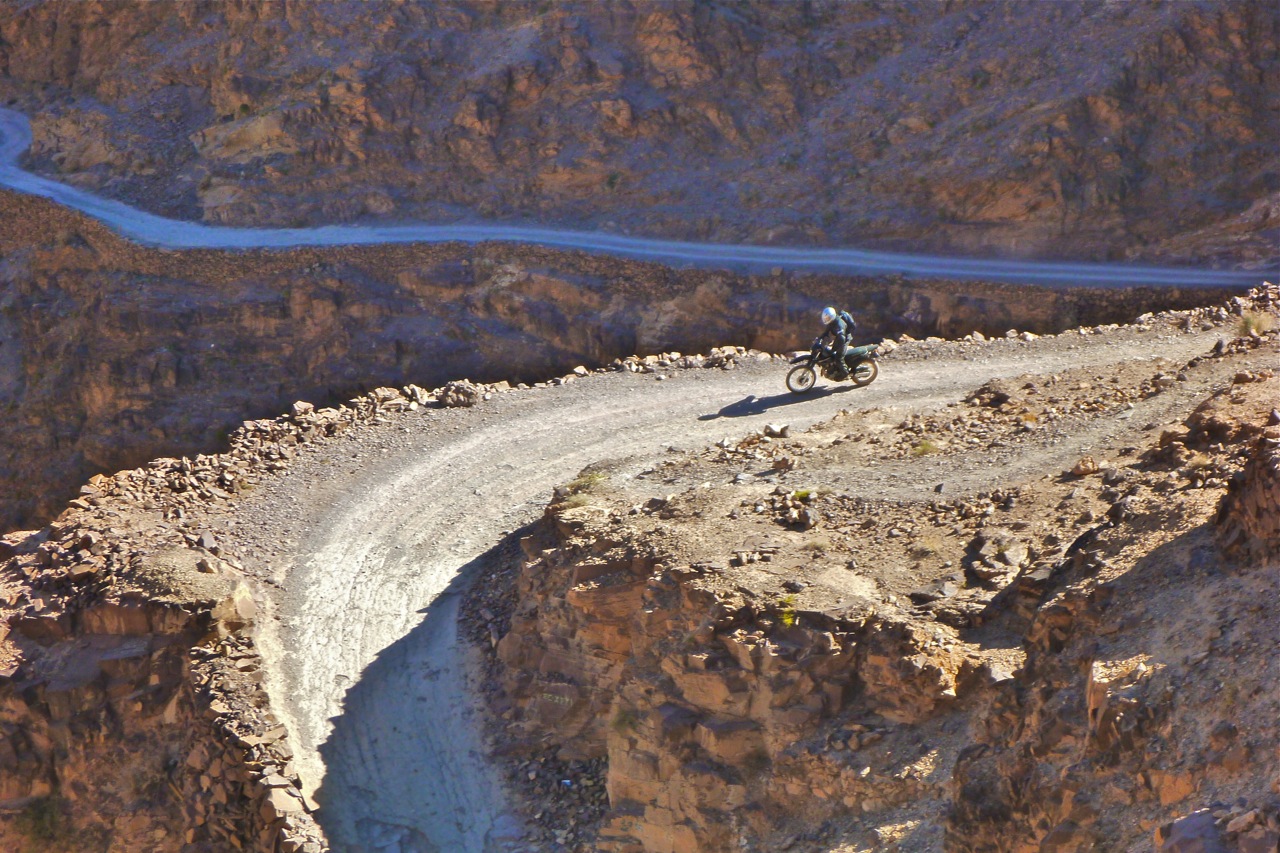
Once it drops off the plateau this piste proves to be as spectacular and exposed as I imagined. Morocco at its best.

mk3-20

mk3-21

Back on the N12 road a short distance out of Nekob, another palm-ringed kasbah shimmers in the crepuscular glow.

mk3-22

And another lavish breakfast at Ksar Jenna.

mk3-23

Today we’re moving on, off up the well-known 112-km piste over Jebel Sarhro to Tinerhir; MH4.

mk3-24

Just a week on a dirt bike and Patrick already has his arse-end aflame.

mk3-25

A rare shot of me on a motorcycle. I’m trying out the Sertao, but on the piste its characteristics are distinctly canine compared to the Terra. Nice engine but feels 20kg heavier.

mk3-26

This was all the ‘camping’ we could manage.

mk3-27

A coke stop near the pass.

mk3-28

Up past Iknioun the track becomes a wide and fast motorway and I blast along on the Husky in top gear for a while. But the classic piste (MH4) is now in the shadow of the amazing Sarhro West piste we did yesterday.

mk3-29

We haul 100km over to Chez Moha at Ait Youb hamlet in the High Atlas. A lovely spot all made of mayd and straw, but a bit chilly compared to what we’re used to.

mk3-30

Maybe better in the spring when I was here last time. Even then, we enjoy a fabulous cous-cous feast huddled by an electric heater.

mk3-31

Next day a cool morning but I enjoy a fantastic burn up down the Todra Gorge on the Husky, fix a quick nail puncture then we have a lavish grill in Tinerhir. A hundred miles down the road we check into the Vallee hotel in Ouarzazate southside. A little past it prime, but they have wifi and heating and beer and yet more great food.

mk3-32

Our room boasts some rather creepy psycho-erotic art. The longer you look at it, the more disturbing it gets. Or perhaps it’s just depicting the desecration of our Mother Earth. Either way, I do believe ‘Salah 07’ might be in dire need of some female company.

Next day, yet more brake warming, bend swinging action over the Tizi n Tichka pass back to Marrakech and a plane home.

mk3-34

So there we have it. A great group and a fab time buzzing around Morocco over 10 days enjoying a little bit of everything: cosy lodgings, amazing views, delicious fresh food, all linked by great blacktop and piste. I’ll offer something similar as a tour next November 2014 when the weather seems just right. Have a look at the Tours page around mid-December.

Ten Days in Morocco ~ Husky • Sertao • XR ~ 2/3

Continuing our short ride through southern Morocco. Part 1 was here. Part 3 right here.


Sunrise at the oasis.


I go for a walk, passing unusual dwellings designed to slide downhill in the event of an earthquake.


Not a place to stagger back to late one night, fumbling for your keys.


We go for a ride back up the cliff

.


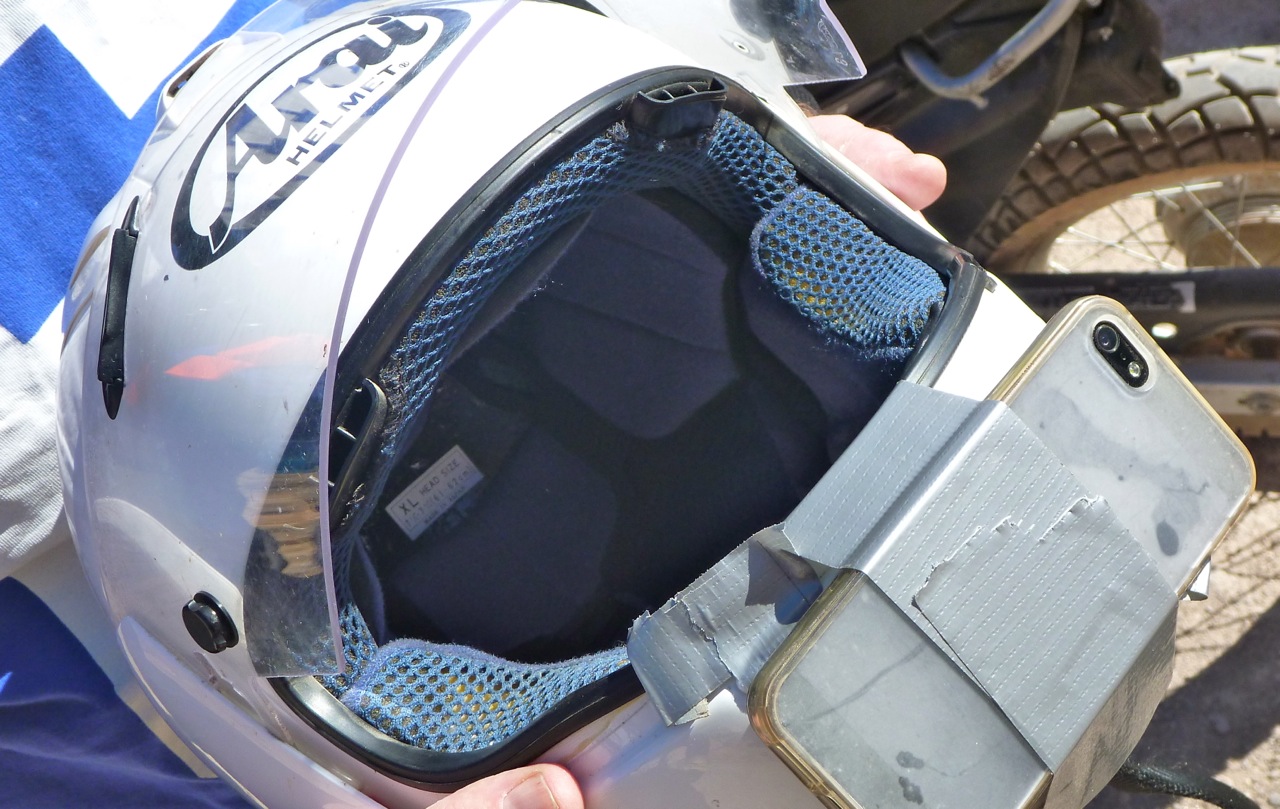
Rob tries out his new Touratech Arai-iPhone adapter mount, called a Digital Utility Camera Transom. You’d think they could come up with a snappier name.


Down below, a carefully tended mosaic of gardens lap up the autumn sun.


We take a walk over to the kasbah (fortified dwelling) at Assaragh


Then ride back down…


… to the auberge for lunch. It was built by a local who did well abroad, and chose to return something to his community. A common practise in Morocco.


After a siesta we head out to a curious ruined tsar (similar to a kasbah but more castle-like) which I passed last year.


We wind out way up into a maze of crumbling walls and collapsed palm-trunk beams.


But at the doorway it looks a bit dodgy to go further without a hardhat and full body armour.


Next day we’re back on the piste.


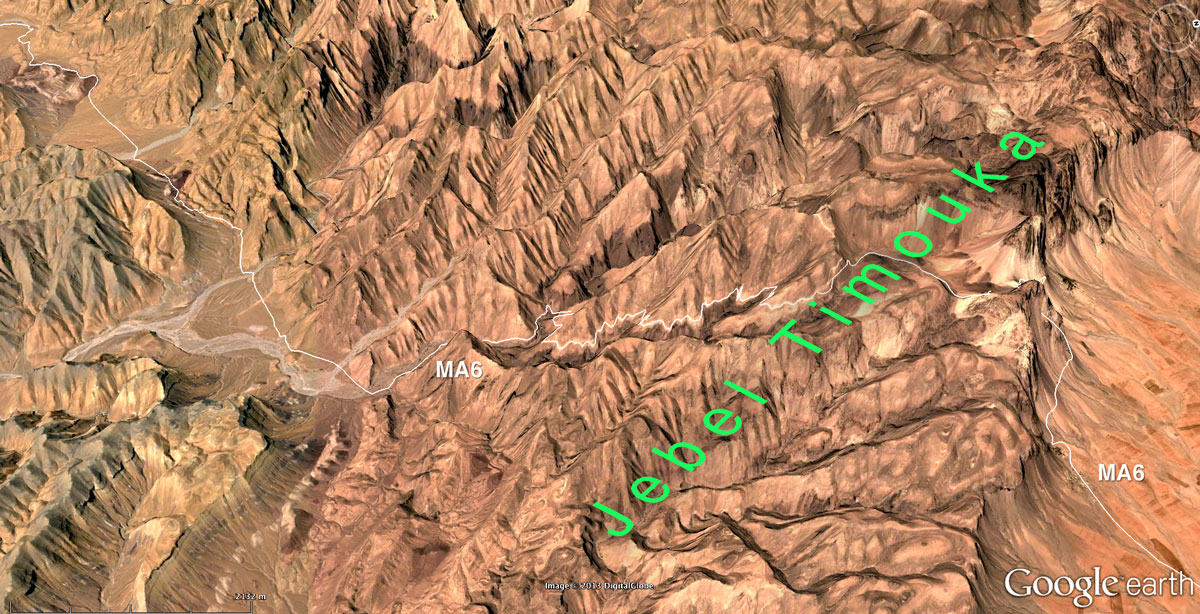
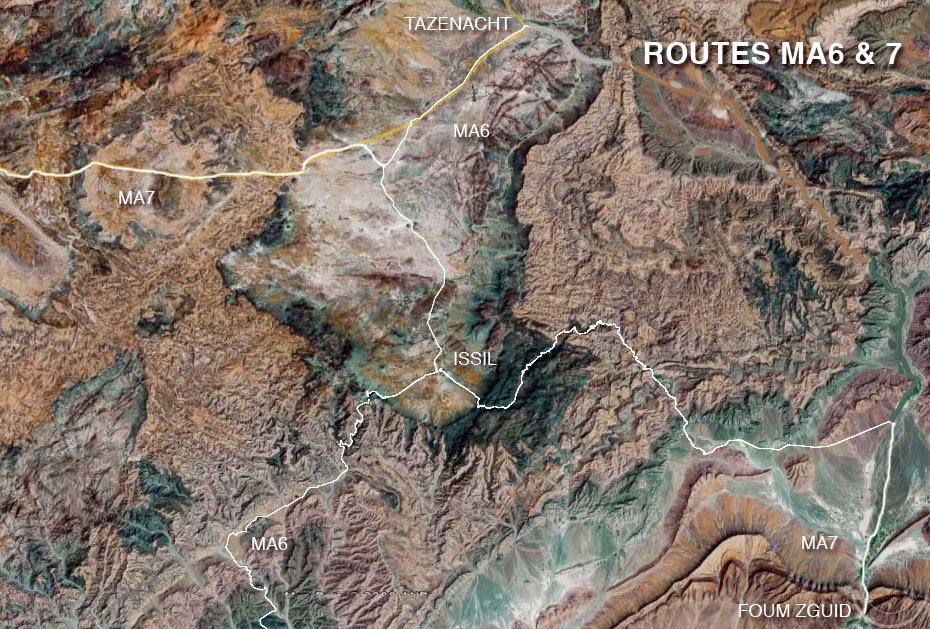
Heading up over Jebel Timouka, Route MA6 in my book.


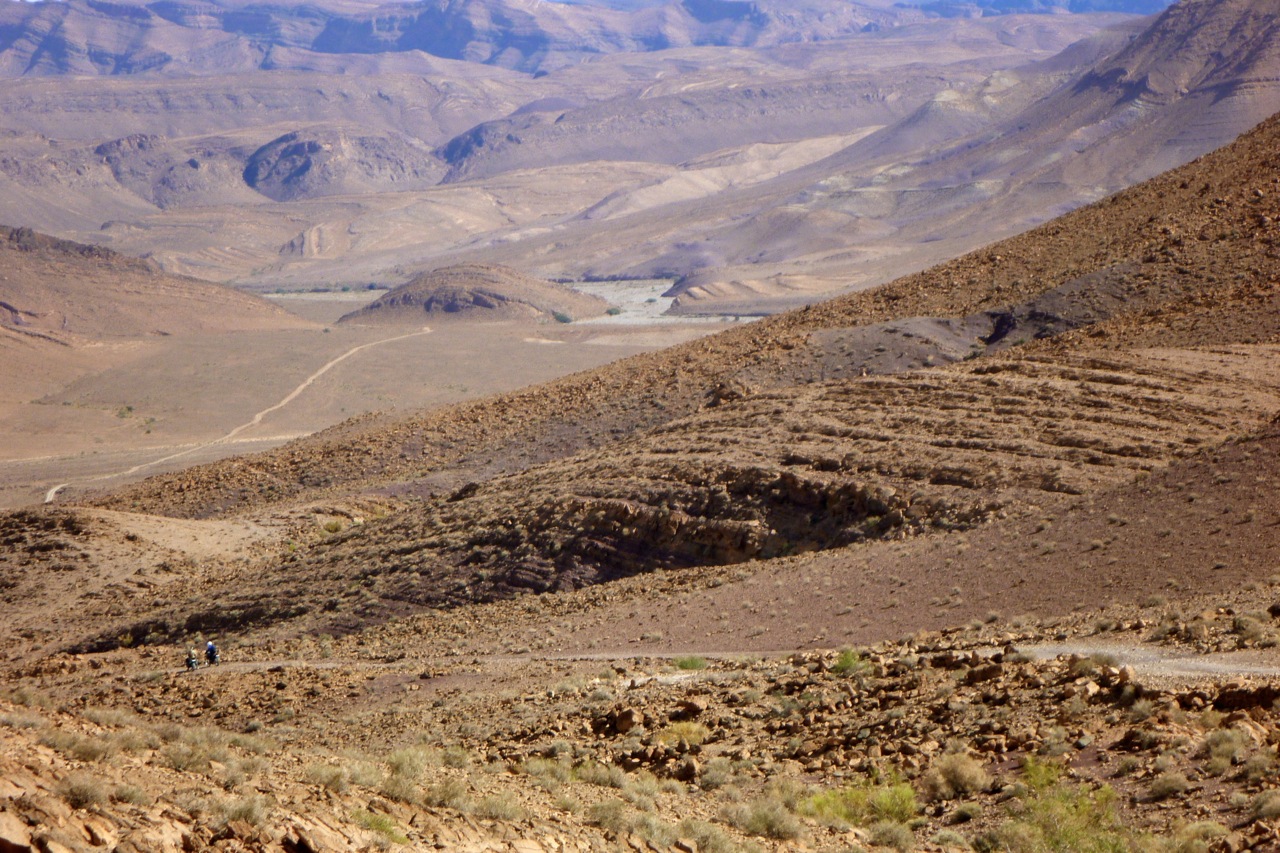
Into the ranges.


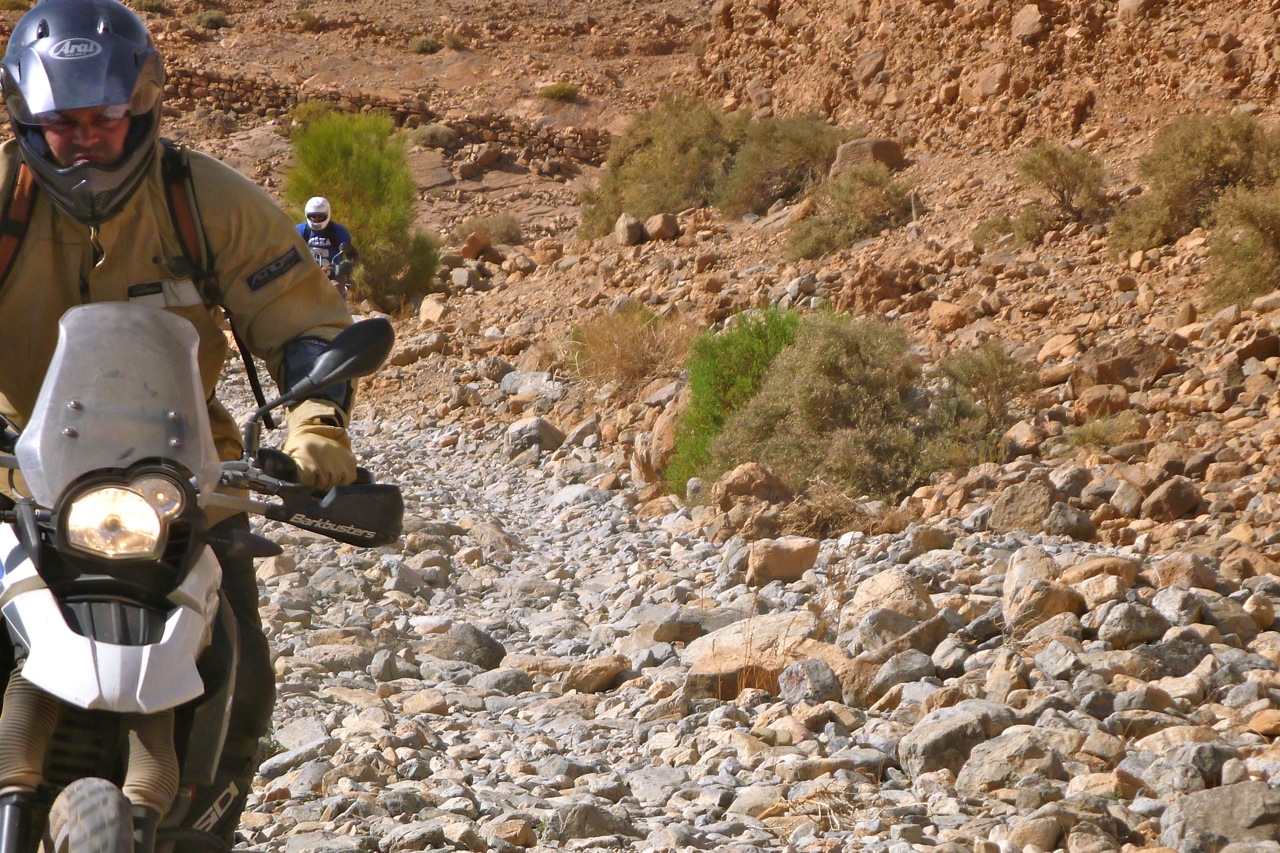
Some oueds (creeks) are hard work on the heavy 650s. So we stop to cool off and let Elisa and Mustapha catch up.


The climb begins.

Deeper

Steeper

Higher

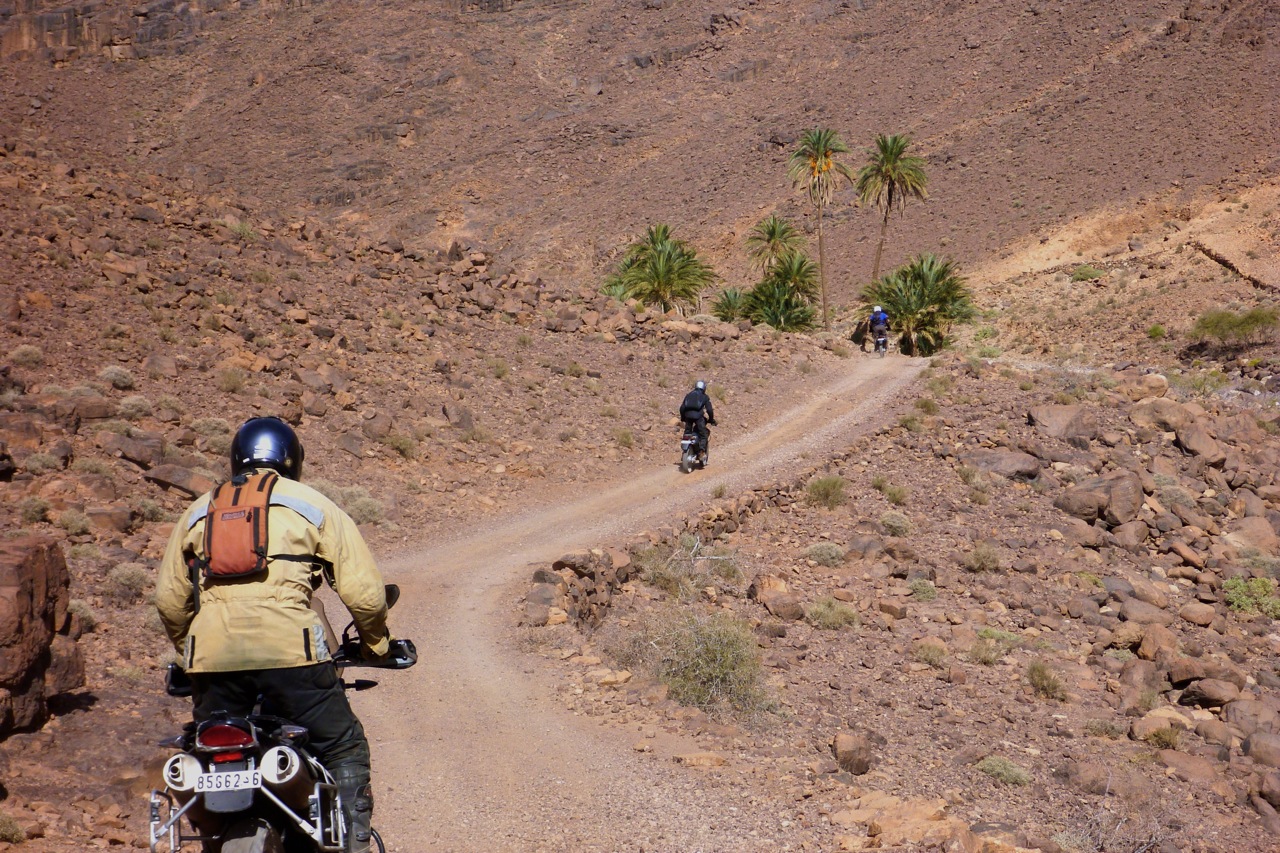
I don’t know about the others, but the occasional landslide repairs with football-sized rocks are barely rideable on the Terra. The suspension shoves the weight back at you in all directions nd you can tell that point is coming where it’s easier to fall than fight it. When I came this way in 2008 I broke a spring on my pickup. I’m up ahead and eventually pull over weak-kneed, strip off and empty my 3-pint bottle. The others catch up and Elisa hands out power bars. Andy’s Sertao is even more of a dog than the Husky and Patrick got pinned negotiating a gnarly hairpin, but is nevertheless amazed at the beating the XR can take. Rob finds his XR a breeze up here.


We carry on to an amazing view back south towards Jebel Bani, now only 80 miles away


Thankfully the track eases up and we reach the equally amazing Timouka Pass overlooking the Issil plain.
In the many tiny Berber villages below (the green clumps) women dye wool and work ancient looms to
produce the fine carpets you’ll find in the souks of Marrakech and Tangier


We drop off the pass, race across the plain to the highway and ride into Tazenacht for a late lunch, babbling about our awesome morning’s ride. Freshly-chopped Moroccan salad (a bit like Mexican salsa), omelette, chips and bread + tea. That’ll be $3 Down the road, plenty of room at the Hotel Sahara.


Night falls over Tazenacht.


While inside the infidels, some in fancy dress, gathered for the feast and then retire to their chilly suites.

Final part right here

Ten Days in Morocco ~ Husky • Sertao • XR ~ 1/3

mk13101

Husky TR650 review here
Next fly-in tour here
2upmk

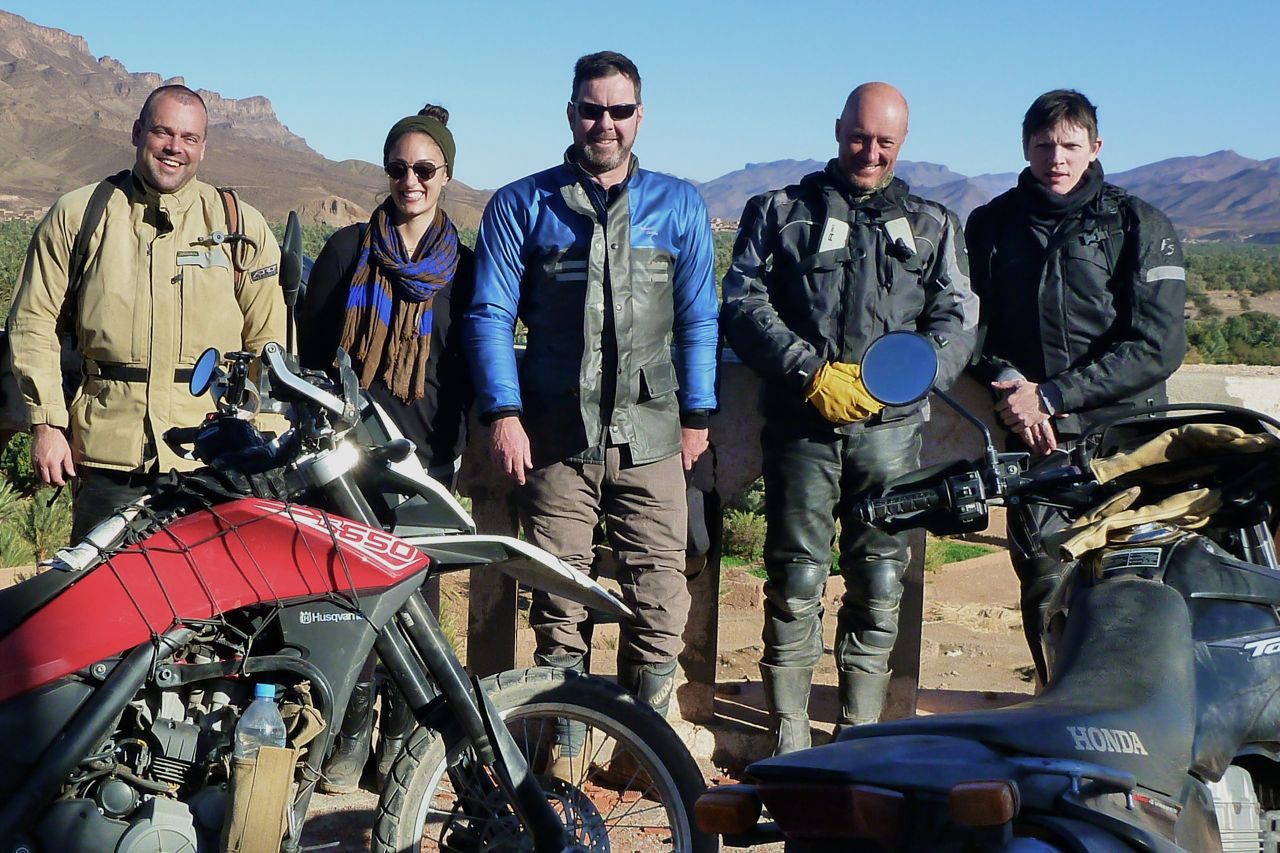
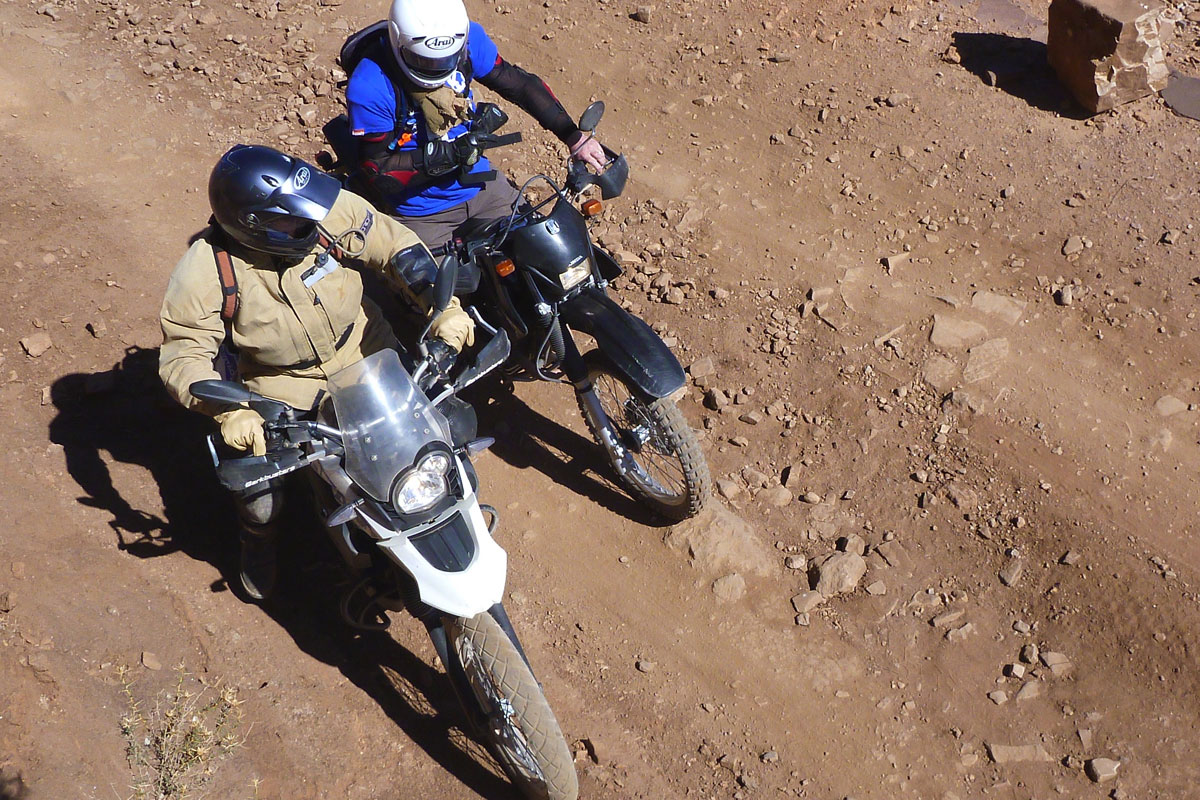
This is us: Rob UK, Patrick NYC, Andy (ex Desert Rider), Elisa NYC and me, having some sort of ministroke.
Rob and Patrick were part of a group that trekked with me in Algeria last year. With another planned moto tour having fallen through, off-road newb Patrick asked me to put together a run through Morocco. OK I said if you can find some people to cover my costs.
This he did and here we were.

mk13102

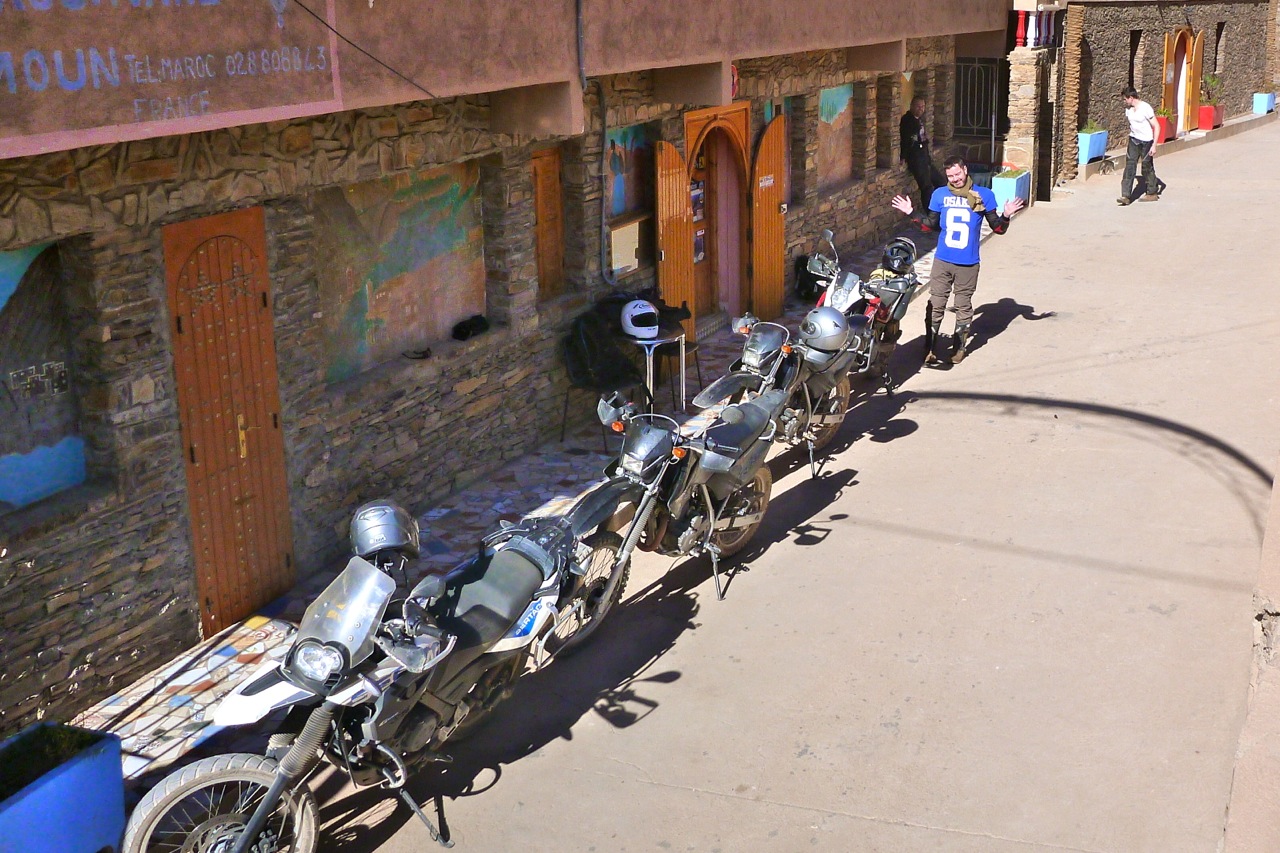
We rent bikes from Loc2Roues Marrakech (more details here).

mk13103

Andy gets a well-used Sertao with about 45,000km.

tr

I pick a sexy Terra. My review here.

mk13105

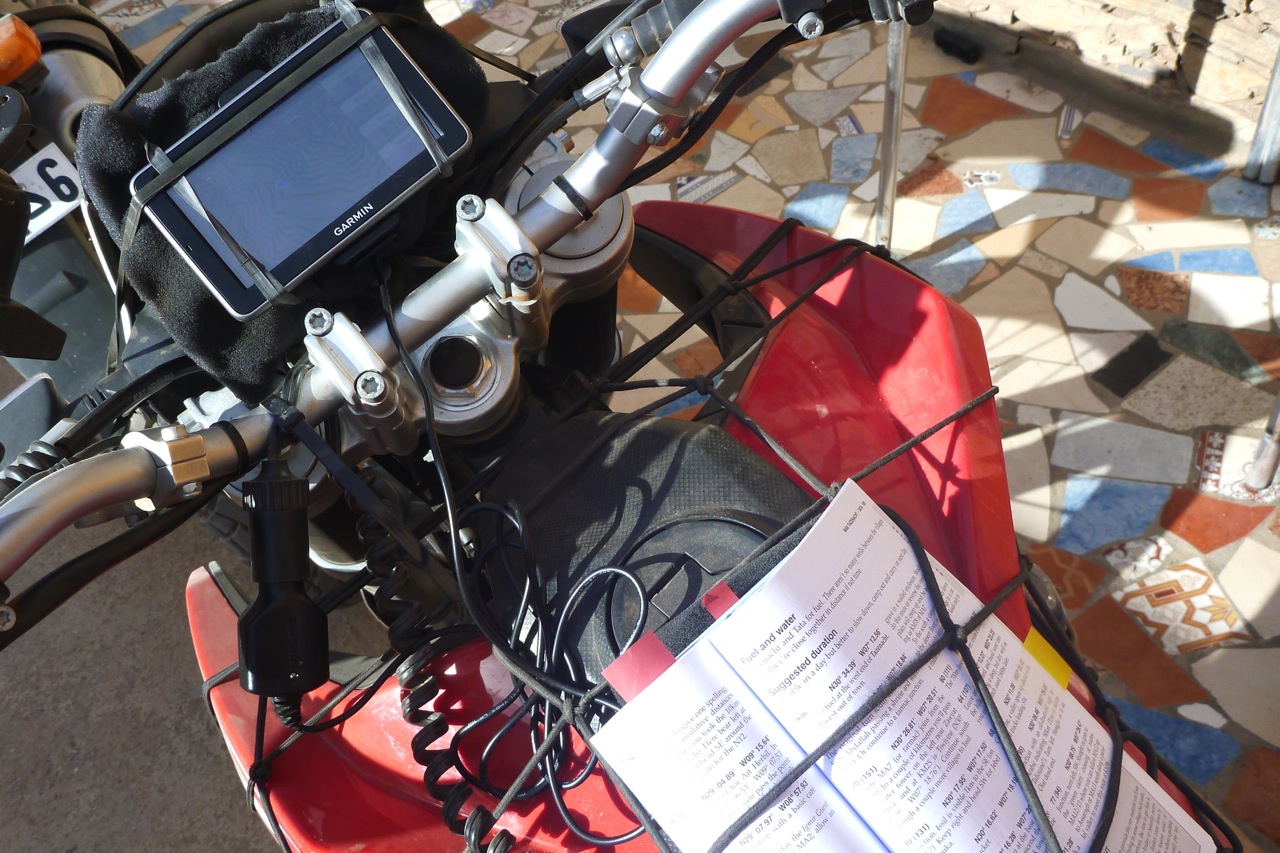
I strap a satnav over the dash, a water bottle holder to the crash bar and tuck my book under the tanknet.

mk13106

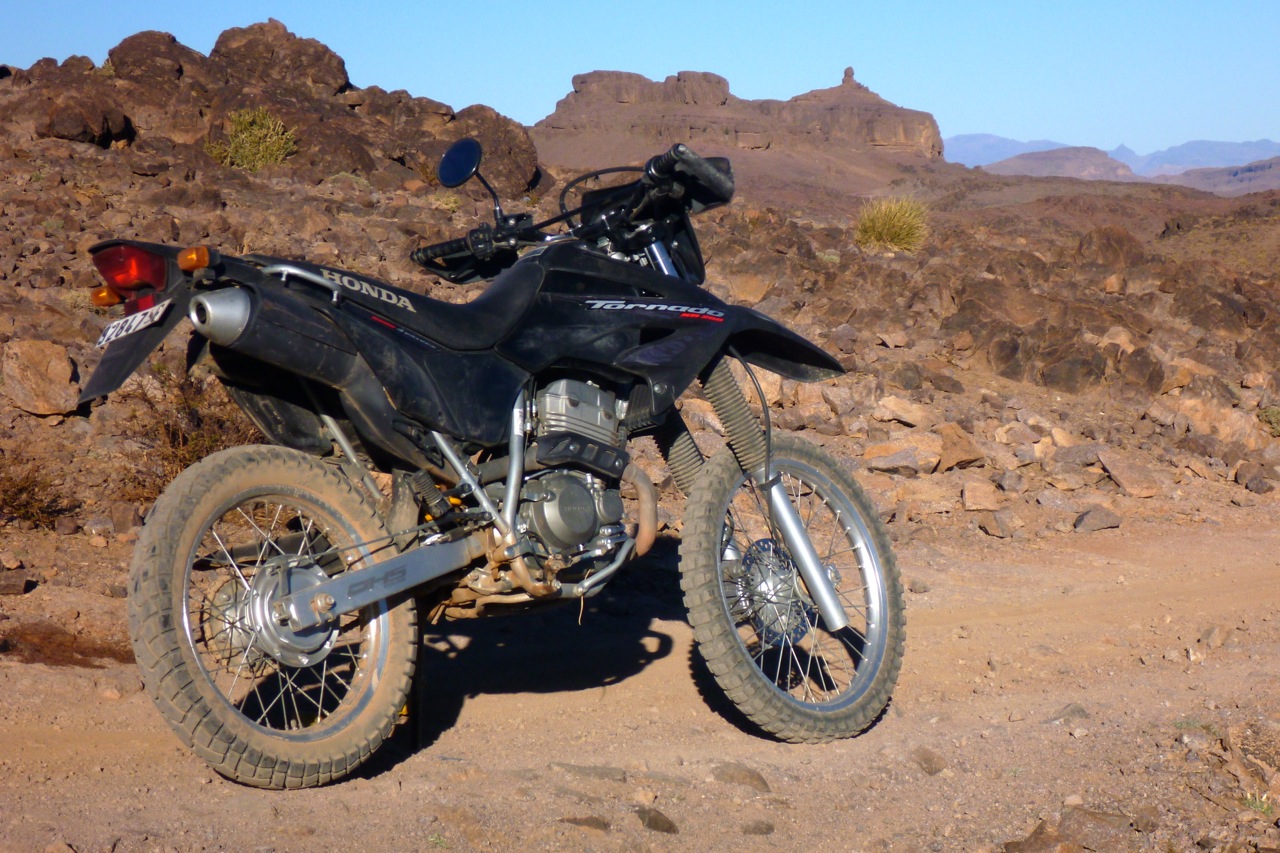
Other than Andy, I wasn’t sure of the others’ ability so recommend XR250 Tornados.

mk13107

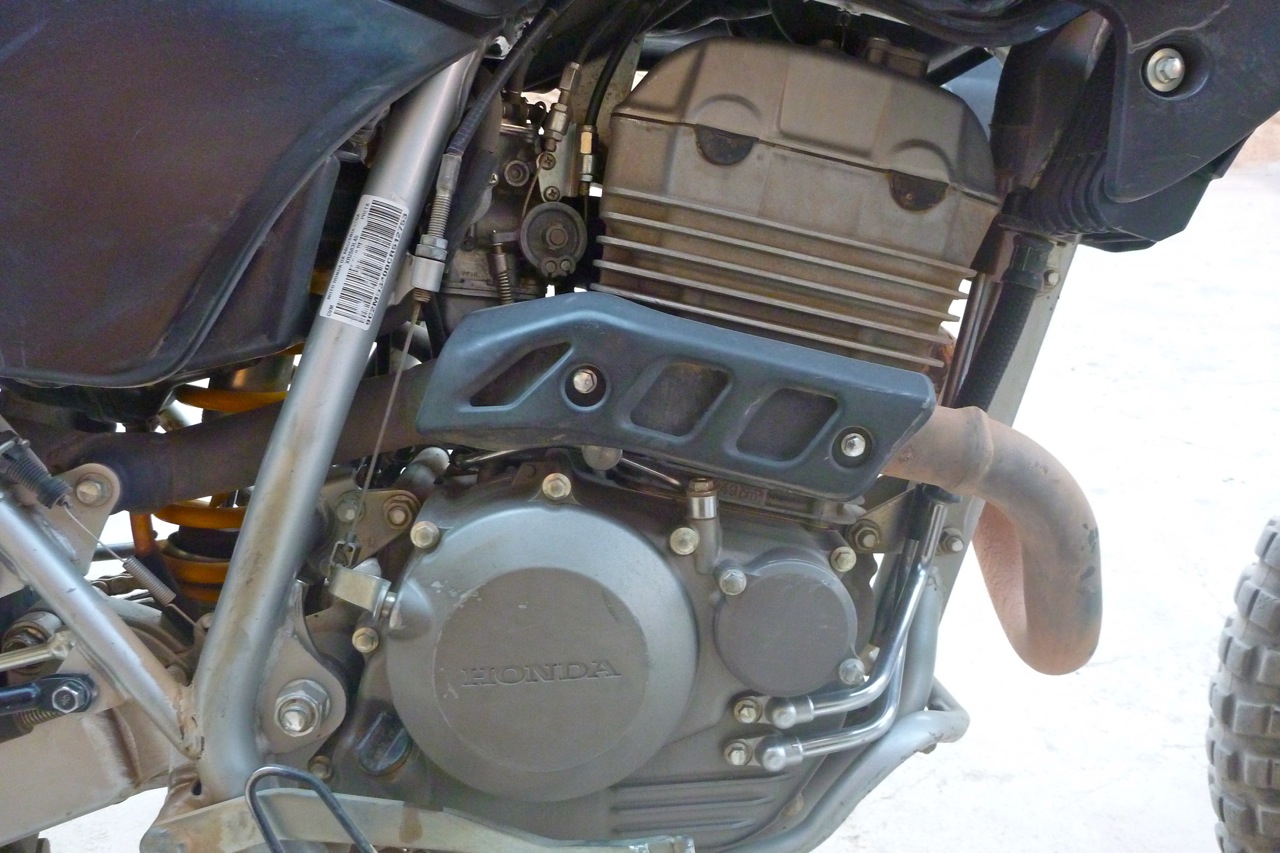
This is a great little machine: an air-cooled, four-valve, big oil cooler, 5 speed, electric start, carb-fed, drum rear dirt bike. It stacks up very well alongside the CRF250L I ran around the Southwest USA earlier this year; as economical, as good suspension, as pokey and it felt lighter, though there’s only some 6kg in it according to online stats.

mk13108

Trouble is, it’s made in Brazil (and sold in Argentina) and AFAIK is only available in countries with I presume have slack emissions regs.
None have ridden off road but Rob once ran a 996 so he’ll catch up and Patrick learned fast. Only Elisa found the learning curve of Morocco + piste a bit steep so switched to a jeep which actually served us all well as a baggage carrier.

mk13109

Before we even leave the agency, Mustapha the driver dashes off with Elisa. His silver SUV soon disappears in a sea of silver SUVs. Rob gets the guy at the servo to bring him back.

mk13110

The first day was scheduled as easy as we expected faffing around at the rental place. Just 100 clicks down the road to a lodge up in the High Atlas.

mk13111

Notice the sagging front tyre on the Husky; a slow puncture which led to overheating and a faster puncture on the rough road into the Atlas. Next morning it’s flat as, and no tools under the seat. The Sertao’s wheel wrench fits but one Torx fitting is mashed and none of mine fit.

mk13112

I nip down the road to chisel it off while the village vulcaniser irons on bits of rubber with blue goo, literally with an old electric clothes iron and a screw press. It looked impressive but also kind of crap. May work OK on a local moped but on the 650 the repair lasted 20 mins on the first piste a couple of days later.

mk13113

Anyway, on the crest of the High Atlas at Tizi n Test pass (6860’) we stop for lunch then enjoy a great ride down into the sunny southlands. Notice the ridge on the far horizon: that’s Jebel Bani about 130 miles away; the last of the Atlas mountain ranges. Beyond that, unbroken Sahara for a 1000 miles all the way to Timbuktu.

mk13114

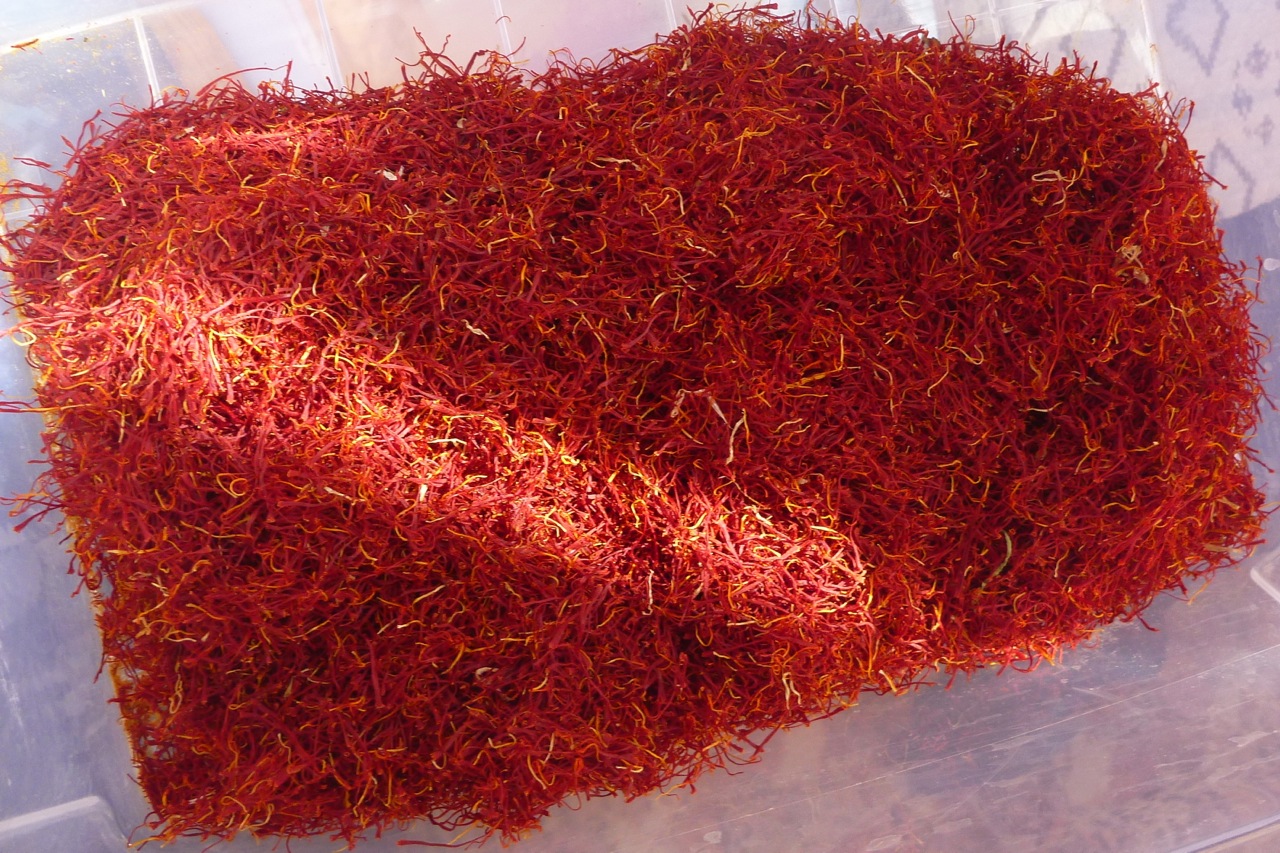
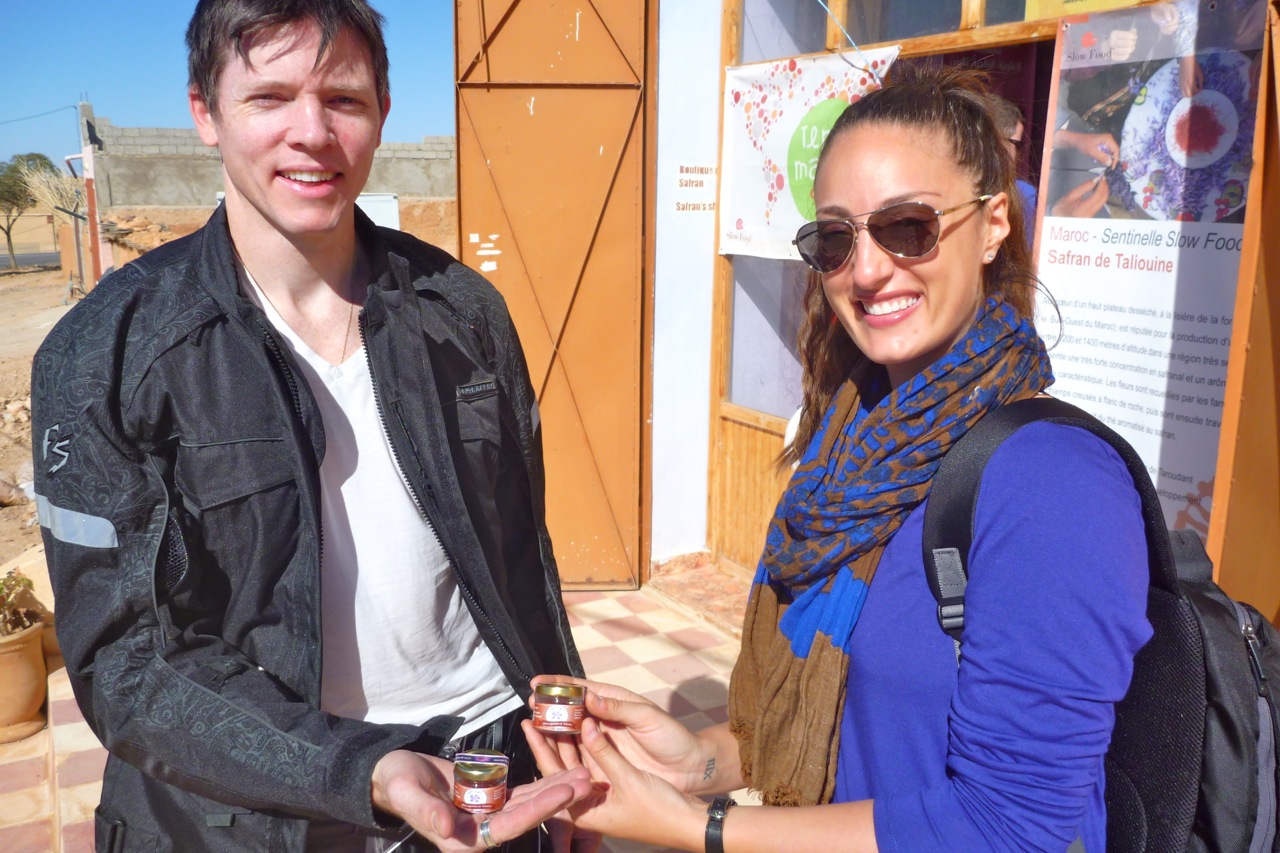
With half a day lost chiselling nuts and ironing rubber, we make an unplanned stop over in Taliouine, famous for its saffron which we’re assured is the best in the world and cures all maladies. I sprinkle some on my front tyre, also my front brake and efi which are playing up.

mk13115

As expected, the Husky is the thirstiest bike by 20%, but also the most powerful and with the best soundtrack which = a whole lot of fun in the twisty blacktop canyons of the Anti Atlas. Let me tell you, all this ‘ad-venture motorcycling’ is a lost cause, carting your junk around like a mule and camping out bush like some vagrant. Hire a jeep, check into roadside lodges at half board and enjoy Bourgeois Motorcycling!

mk13116

Patrick tries the Sertao and declares it’s the best motorcycle ever made. It’s certainly more comfy than the others, has a mellower engine than the TR and some days even used less fuel than the XRs. But when the dirt gets gnarly it’s a dog.

mk13117

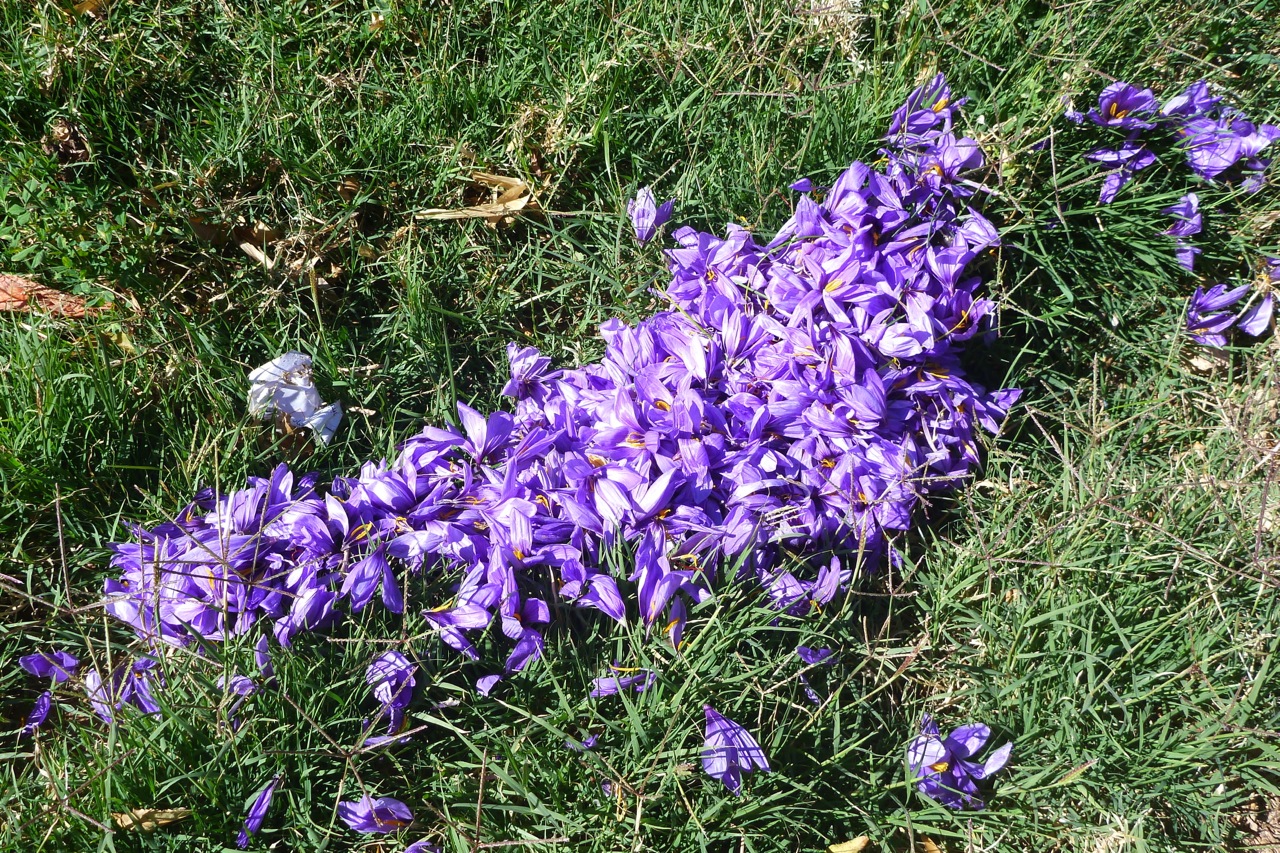
That’s several thousand dirhams worth of saffron right there.

mk13118

Carefully picked from these crocuses, or is it crocii?

mk13119

Patrick and Elisa pose with some $10 jars.

mk13120

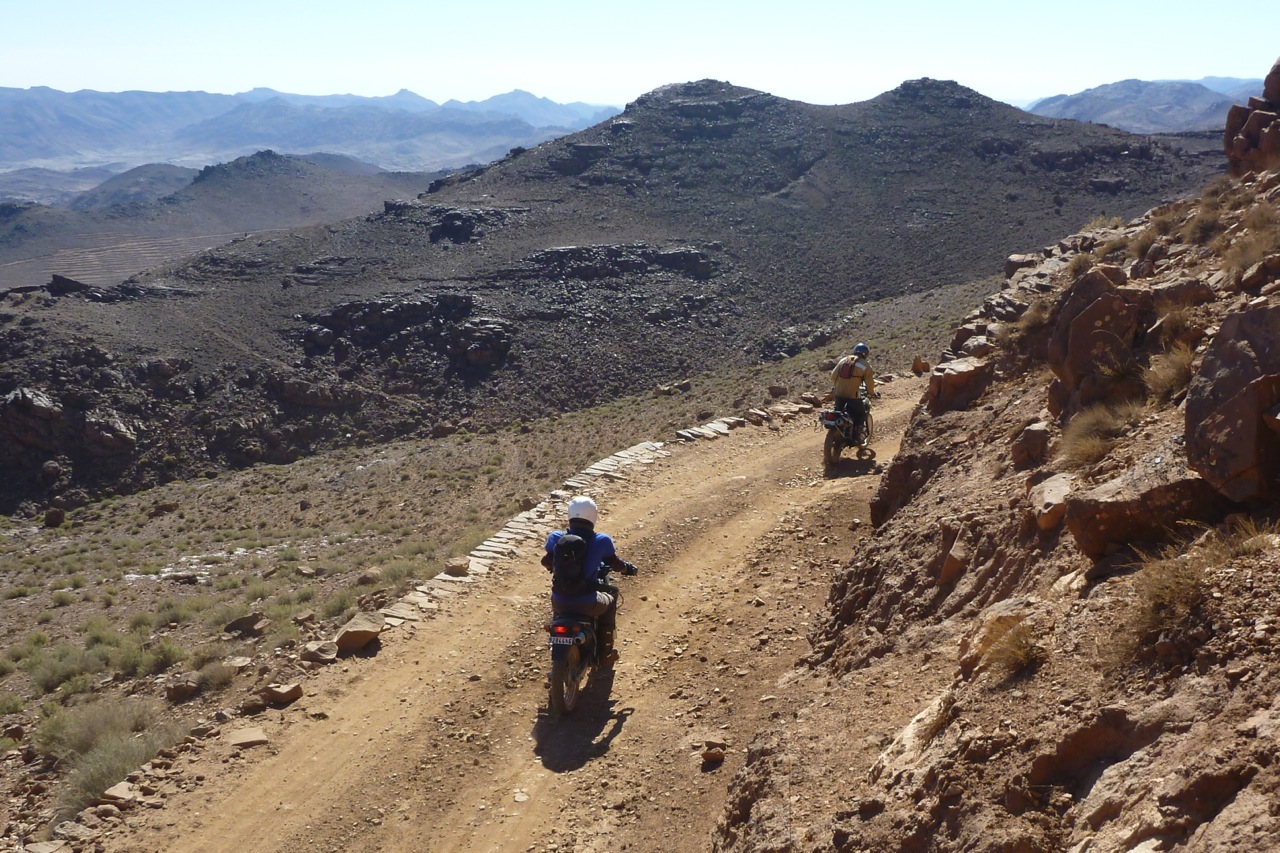
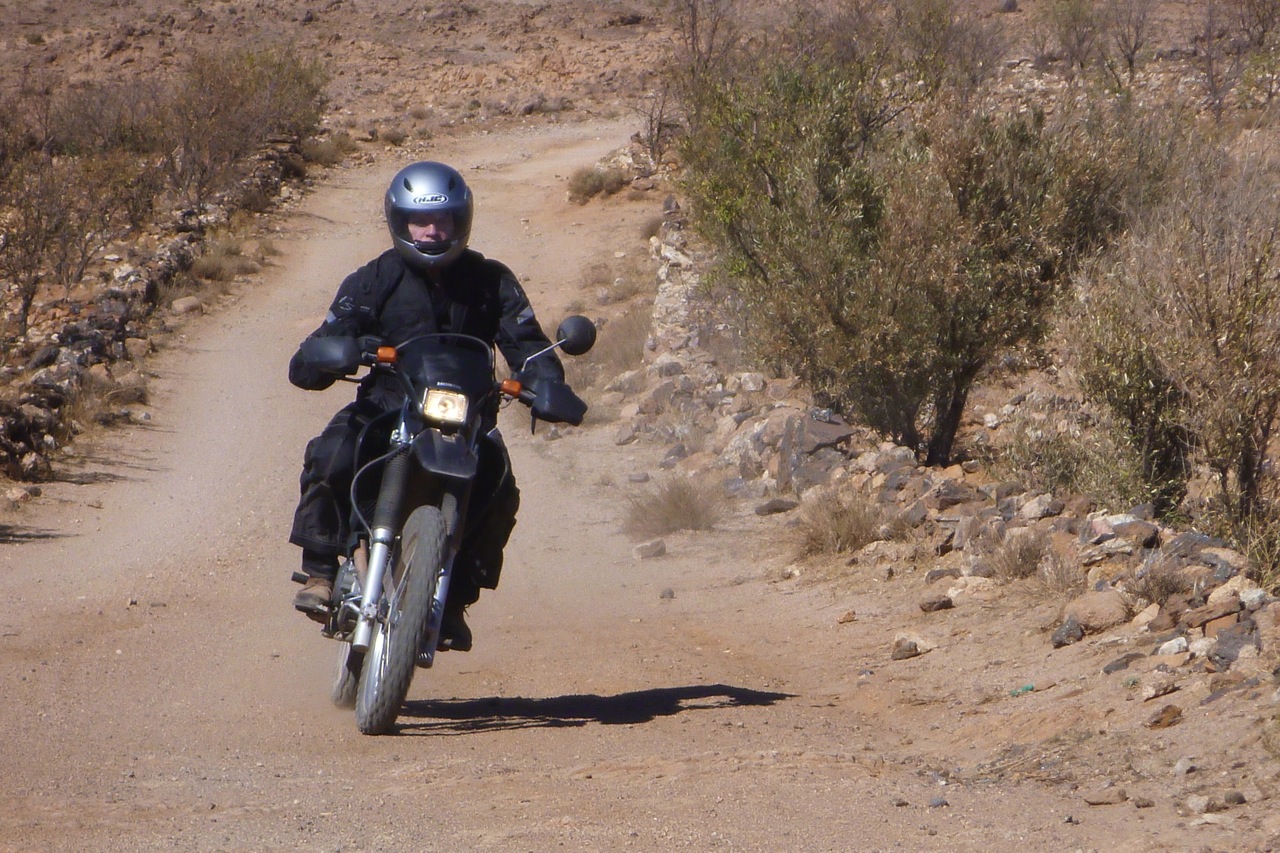
Two hundred clicks out of Marrakech we take to the piste into the Anti Atlas, the arid range south of the High Atlas which for me adds up to the best riding in Morocco. Soon the Husky front tube pops its corks so I slot our only new 21” in and hope for the best.

mk13121

Dirtnewb Patrick is getting into the swing but next time I’m going to levy a surcharge for all black outfits.

mk13122

Desert Rider Andy runs an 1190 + his old trans-Africa 640 back home so for him it’s all in a day’s work. That’s his 11-year old Darien Light that Aero made for us, still as good as new.

mk13123

Into the valley.

mk13125

Past hilltop Berber villages.

mk13126

Up ahead a dramatic descent down a tufa waterfall. Andy sets off on the Husky and we follow.

mk13127
mk13131
mk13133
mk13132

mk13136

We ride through the palmerie and arrive at our lodge where we’ll spend two nights.

mk13137Night falls across the tranquil oasis. ‘Allaaaaahu Ak-bar’ rings from the minarets.

mk13138

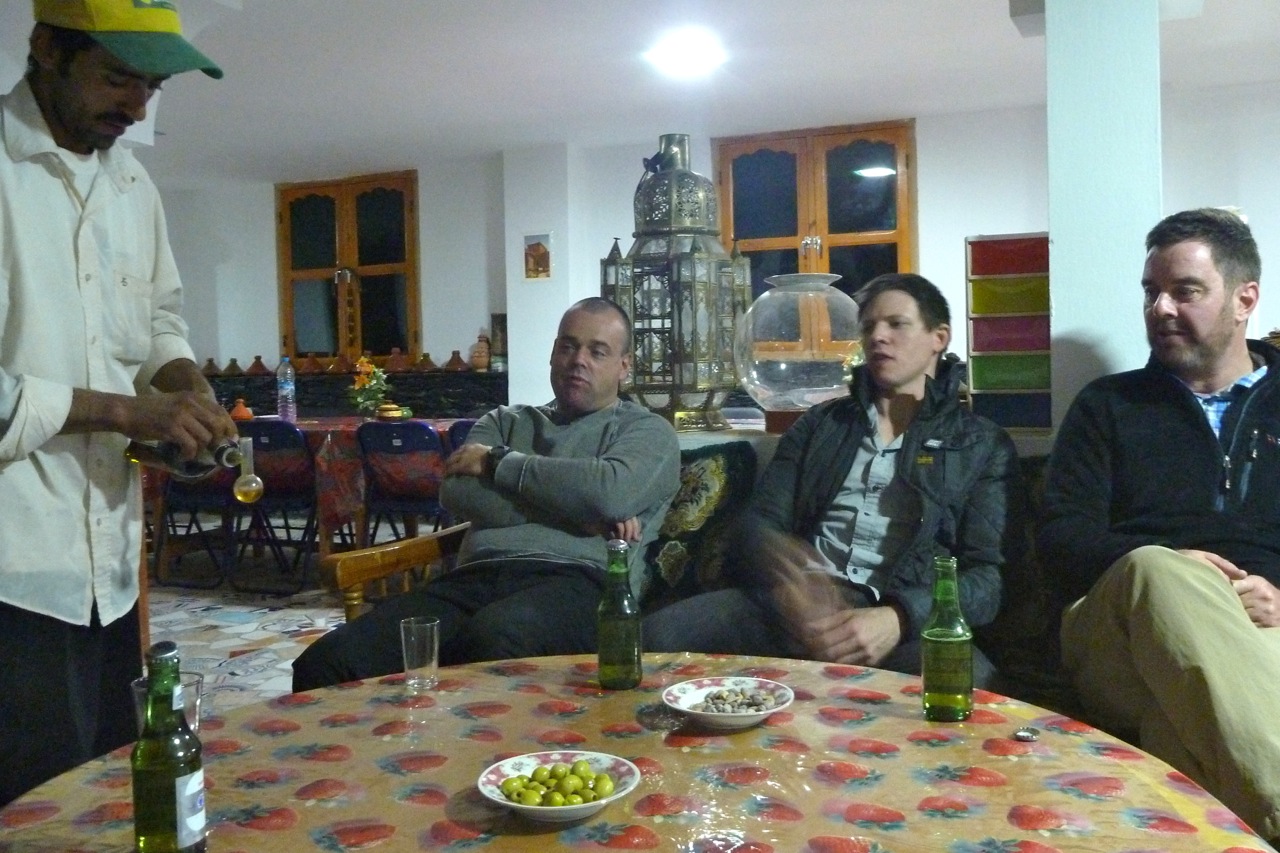
While inside the three infidels sit transfixed as the guy pours a shot of whisky.

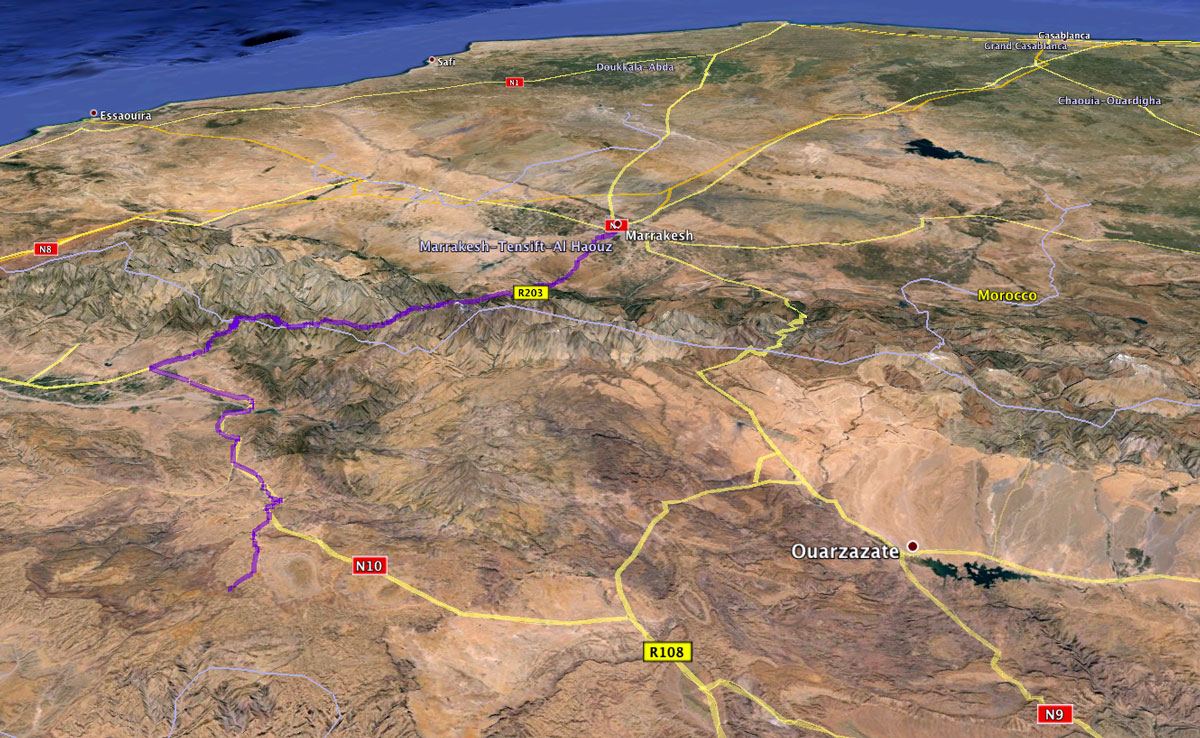
mk1ruta Our route so far.

Part Two of Three

Morocco Overland videos

ma6-7g
morocco22s

Here’s Ian Chappel’s short video as he reaches the impressive overlook at KM78 on Route MA7. You look down from the top of Jebel Timouka over the Issil Plain following a couple of hours rough riding. Good work on a hefty GS12! MA6 proved even tougher on the BMW but can also surprise you with a similarly impressive vista at KM48 if you’re heading north.

Ian’s other vids include pistes from the book and thankfully cut to the action.

We’re back in this area over the next few days with a few small XRs plus a couple of 650 singles. They’ll be a report here or on the AMWebsite. And maybe some vids too.


E is for Saharan Eclipse 2006

Part of the Sahara A to Z series
eclipse65

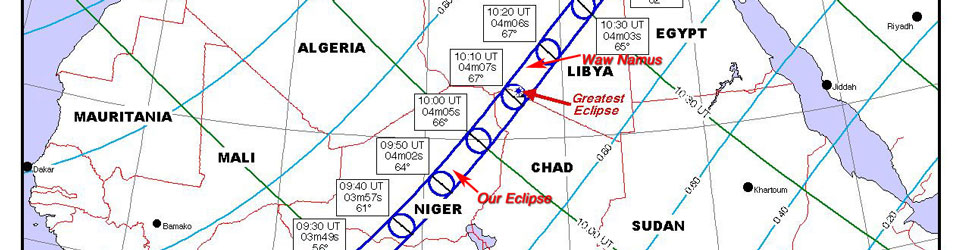
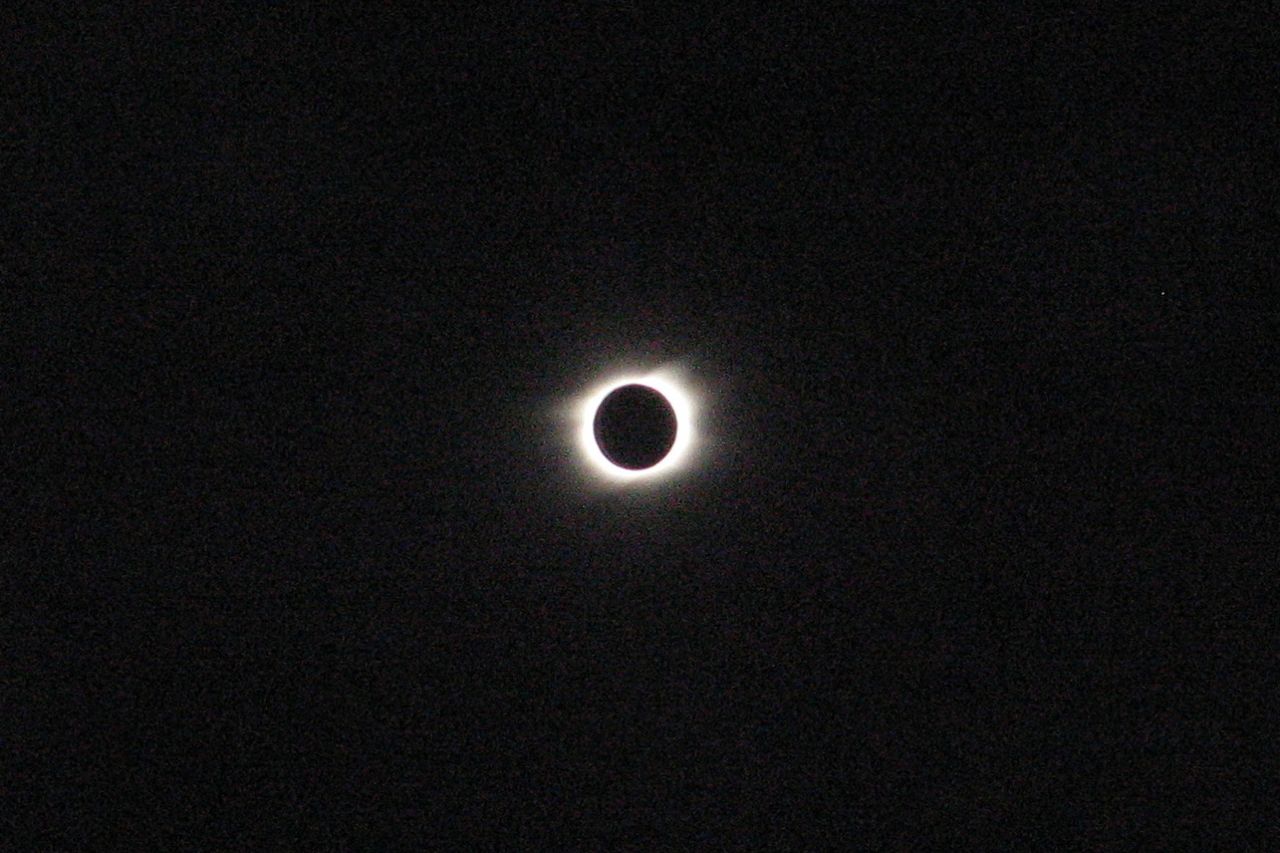
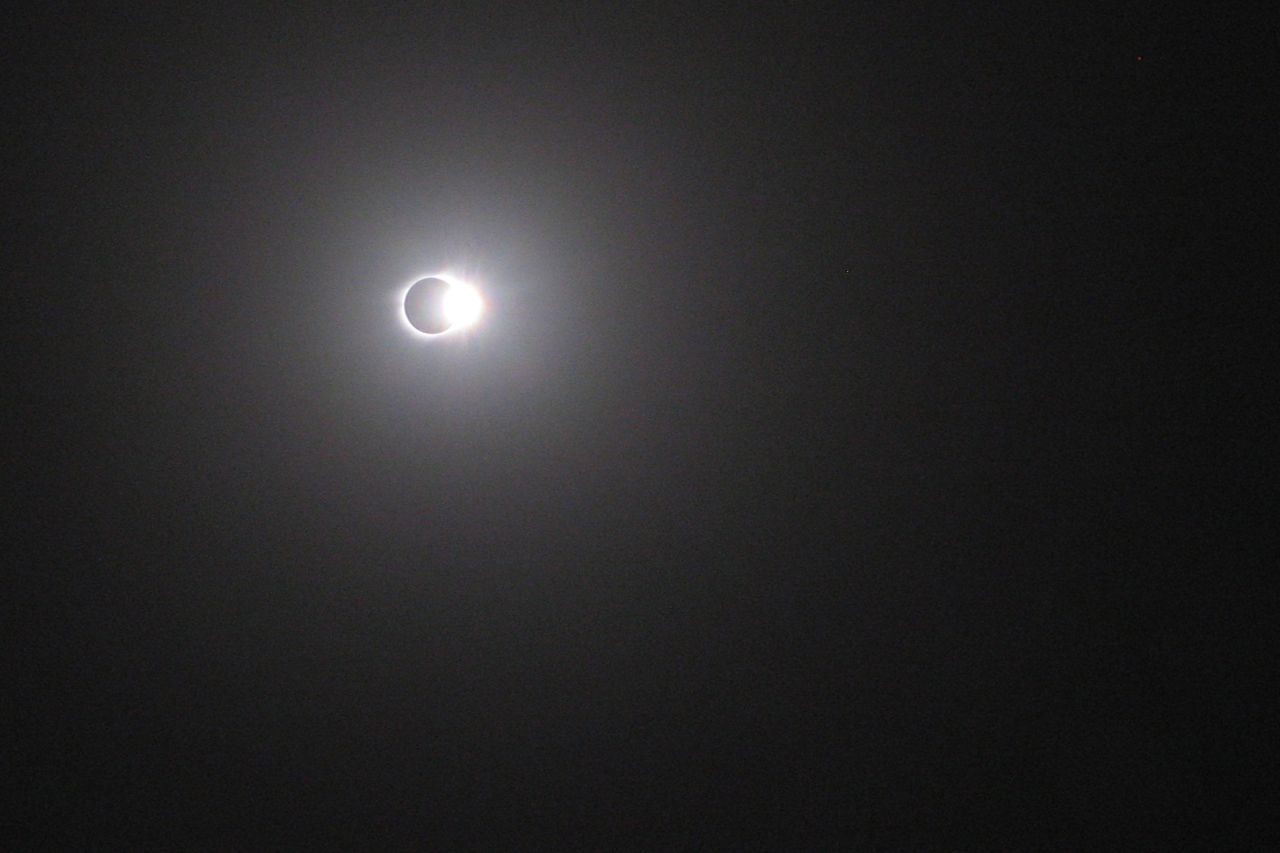
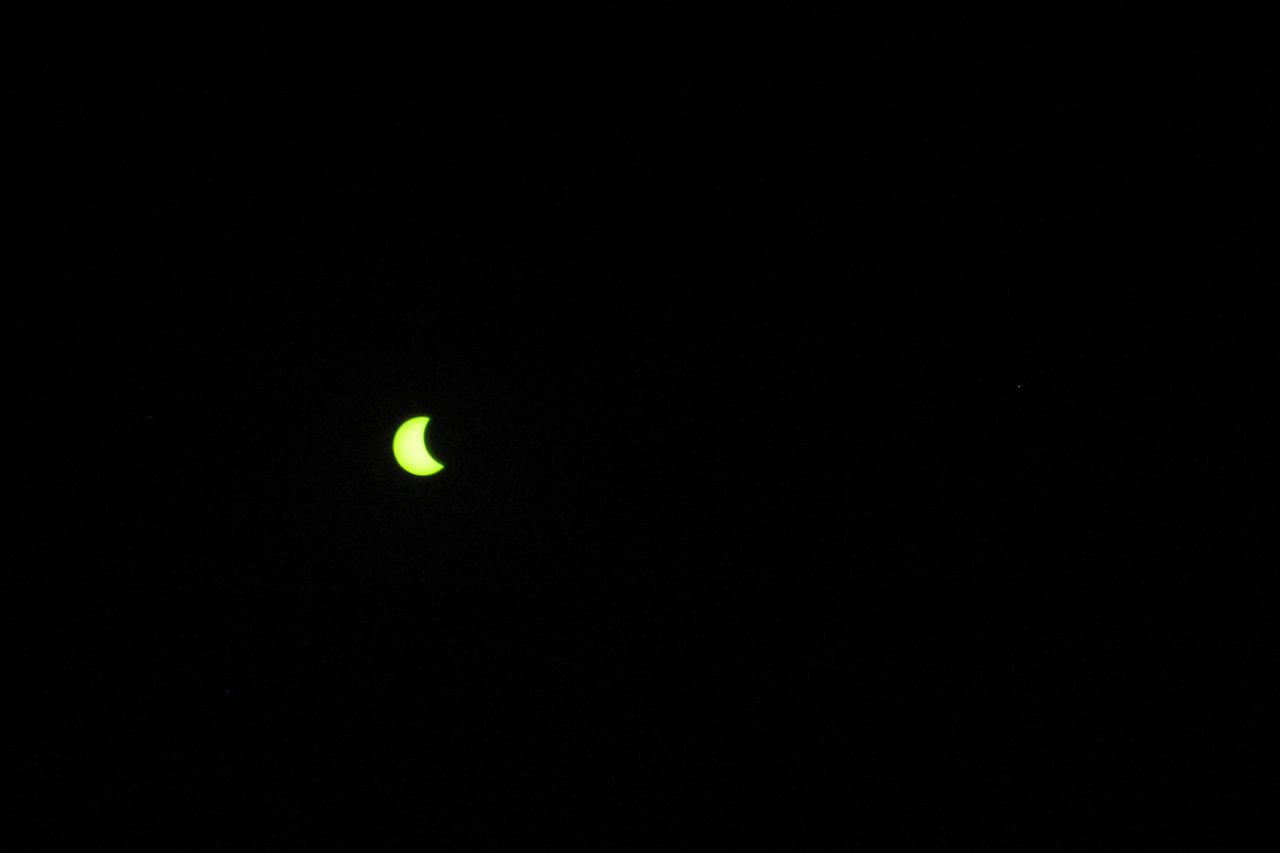
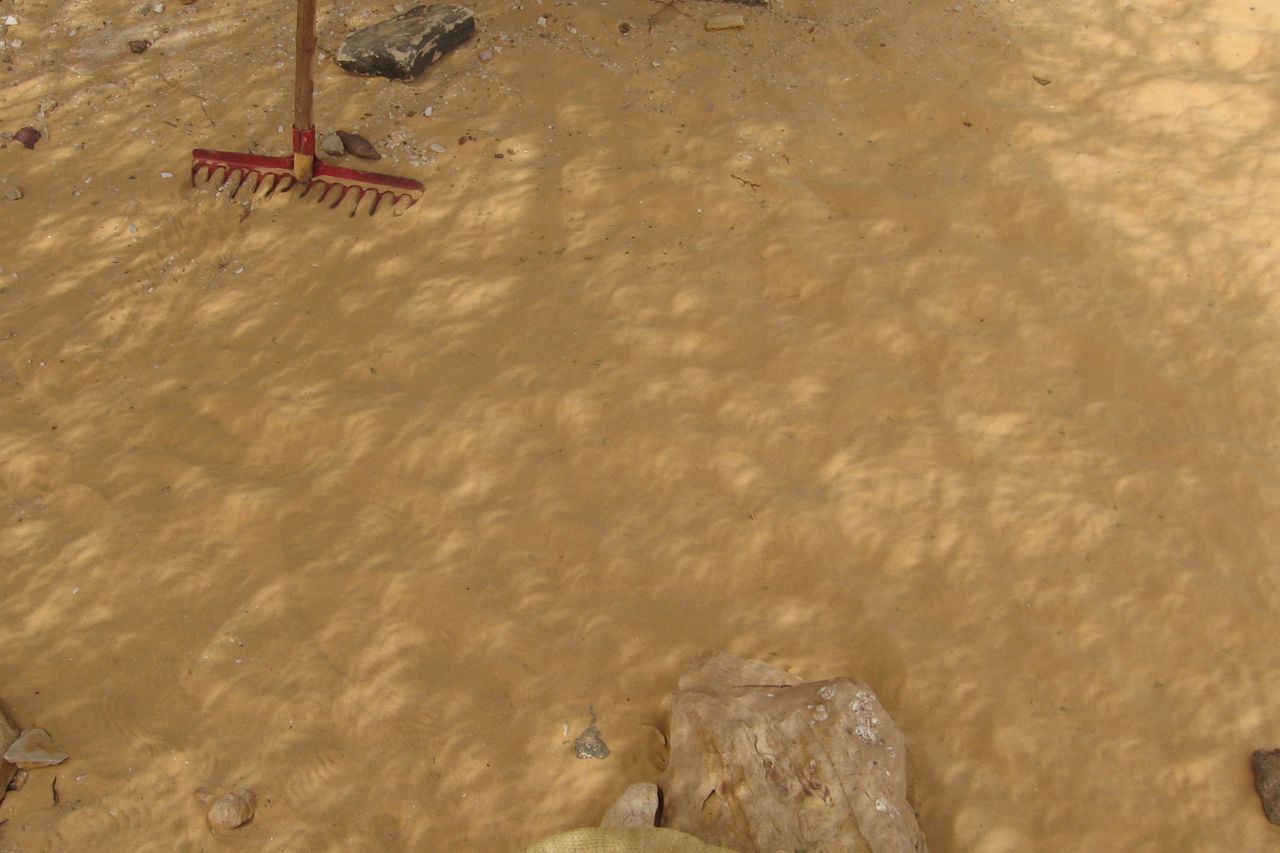
In March 2006 an eclipse sliced right across the Sahara, from Ghana to the Libyan-Egyptian border on the Med. On its way it passed close to the extinct volcano of Waw Namus in central Libya and it was clear that  everyone and his camel would be heading there. Sure enough the place turned into an Eclipse Babylon where tours ops from around the world sought to capitalise on a unique event.

eclipse-map

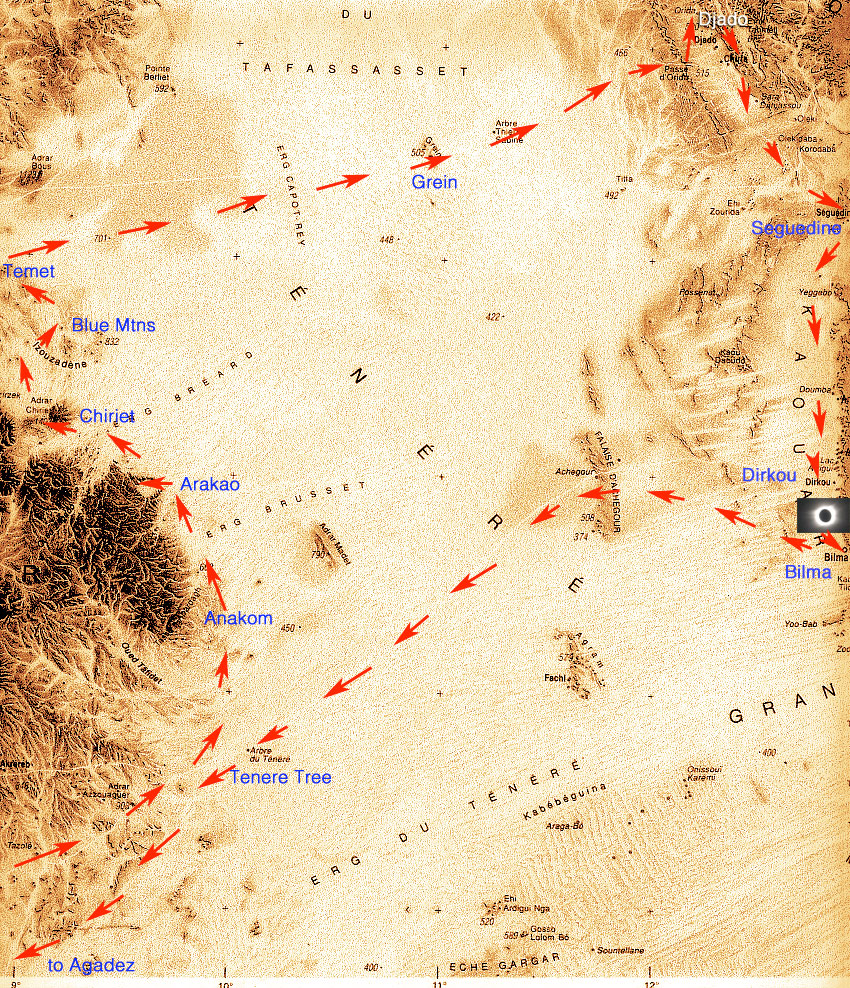
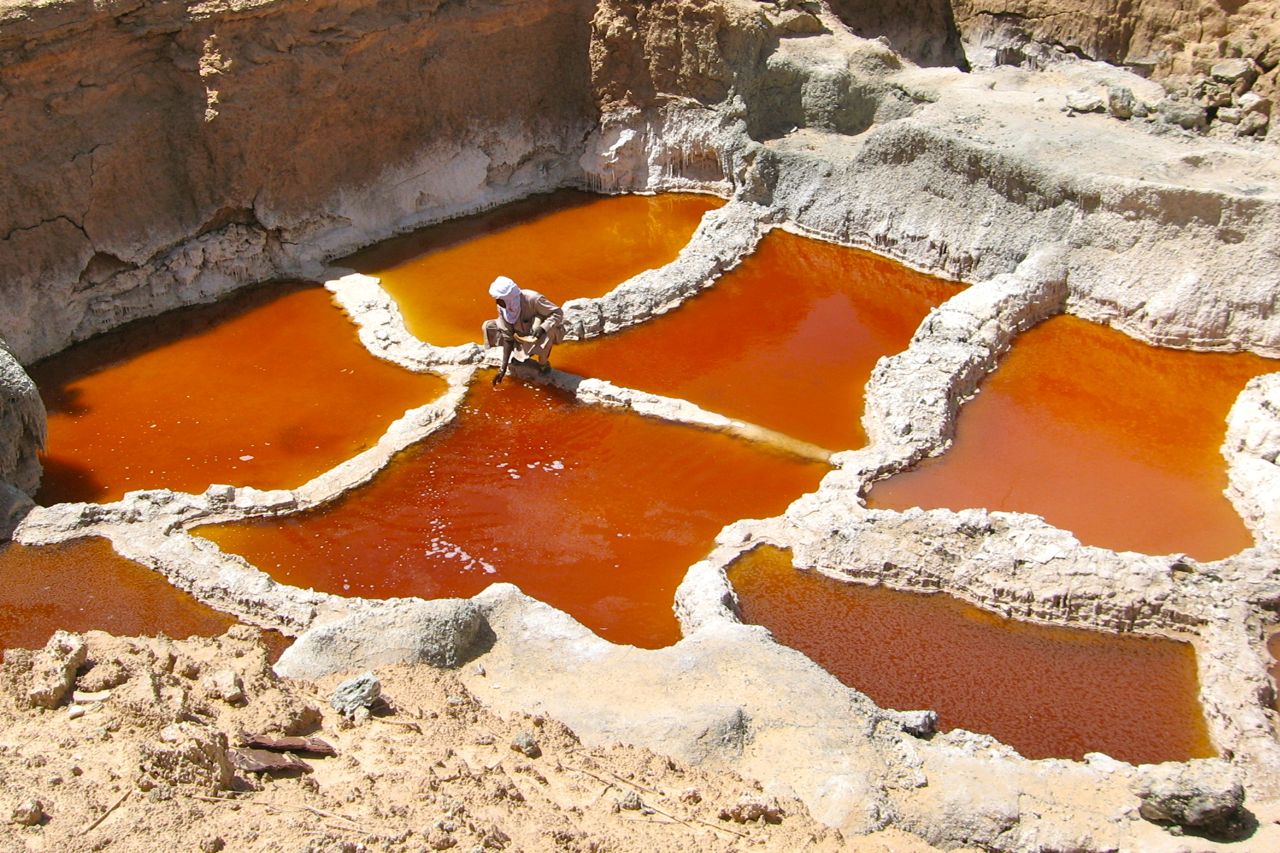
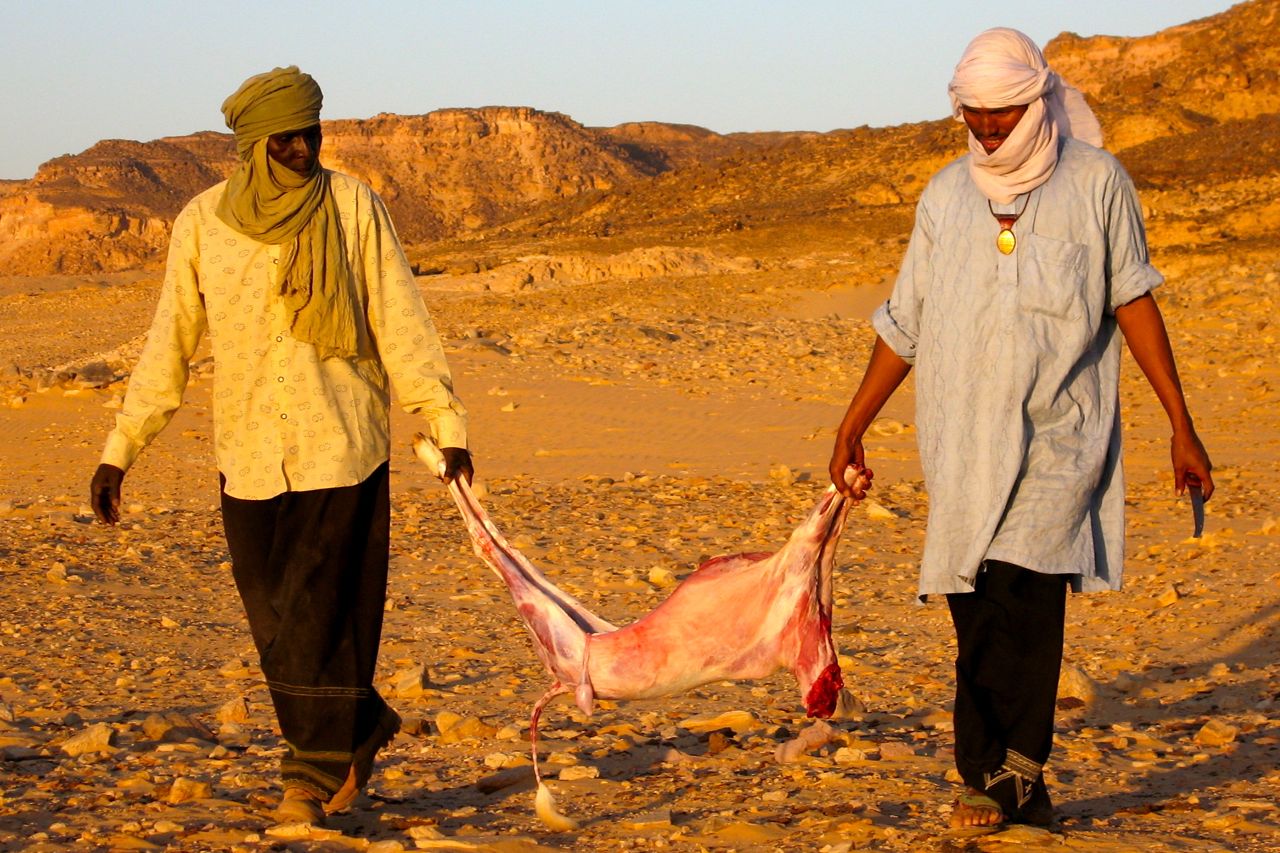
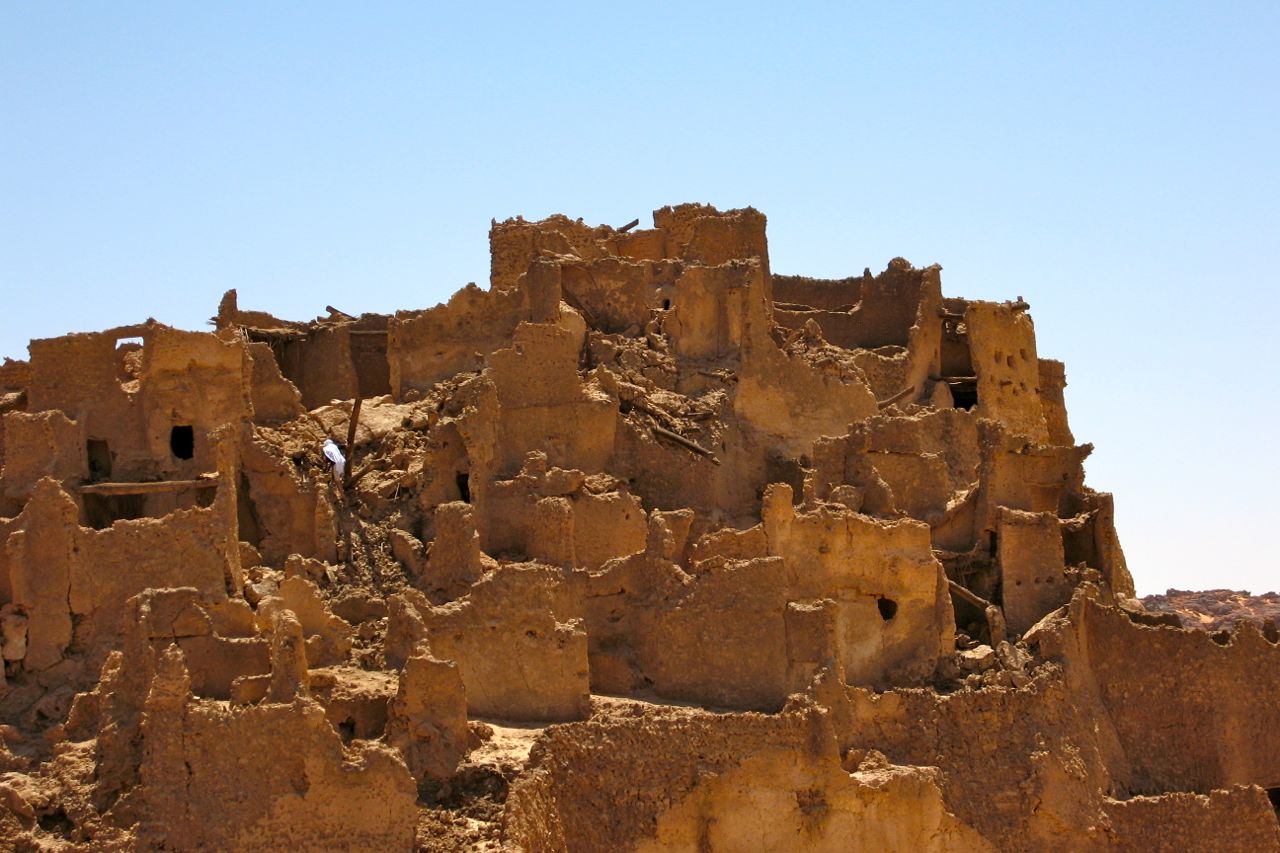
‘Clear skies or your money back’, I crowed confidentially when I pitched my tour. In my mind far better to take it to Niger, where the track of totality passed right between Dirkou and Bilma on the far side of the Tenere circuit. On the way we could take in the classic Tenere Loop (right), one of the best fortnight’s you can spend travelling in the Sahara. It includes the Aïr, Arakao, Adrar Chiriet, Temet dunes, east across the sands to the mysterious ruined citadels of Djado and Orida and the nearby salines of Seguedine and Bilma before heading back through the Bilma Erg and past the Tenere Tree to Agadez.

clipsebak

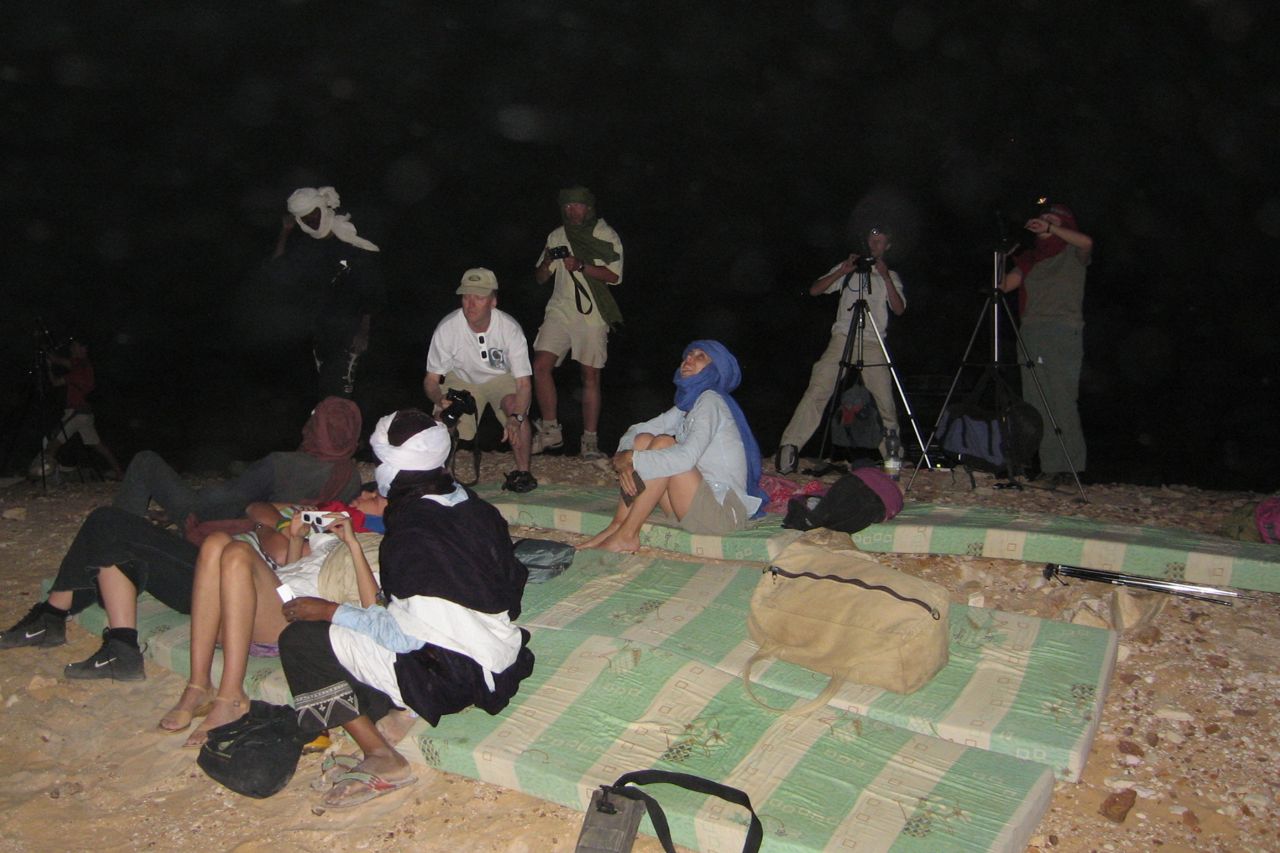
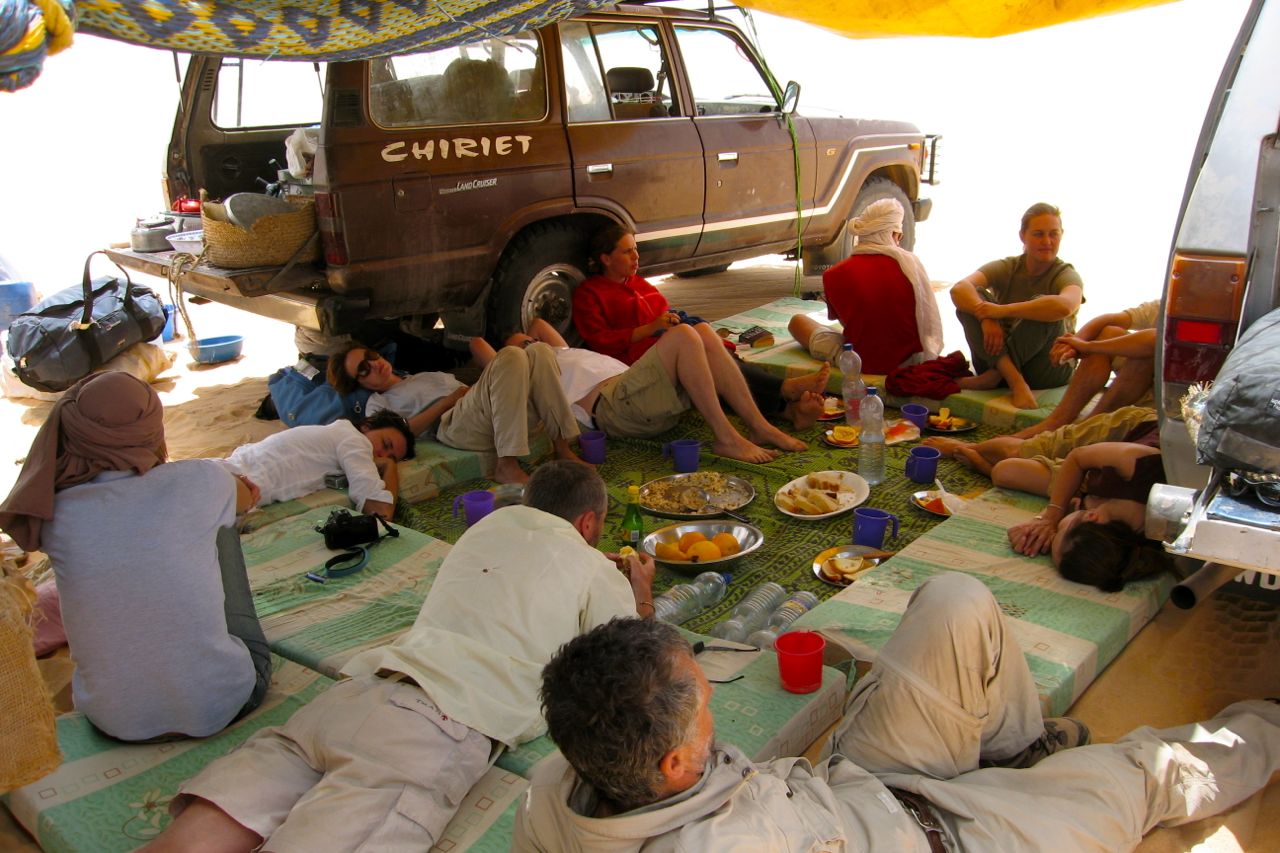
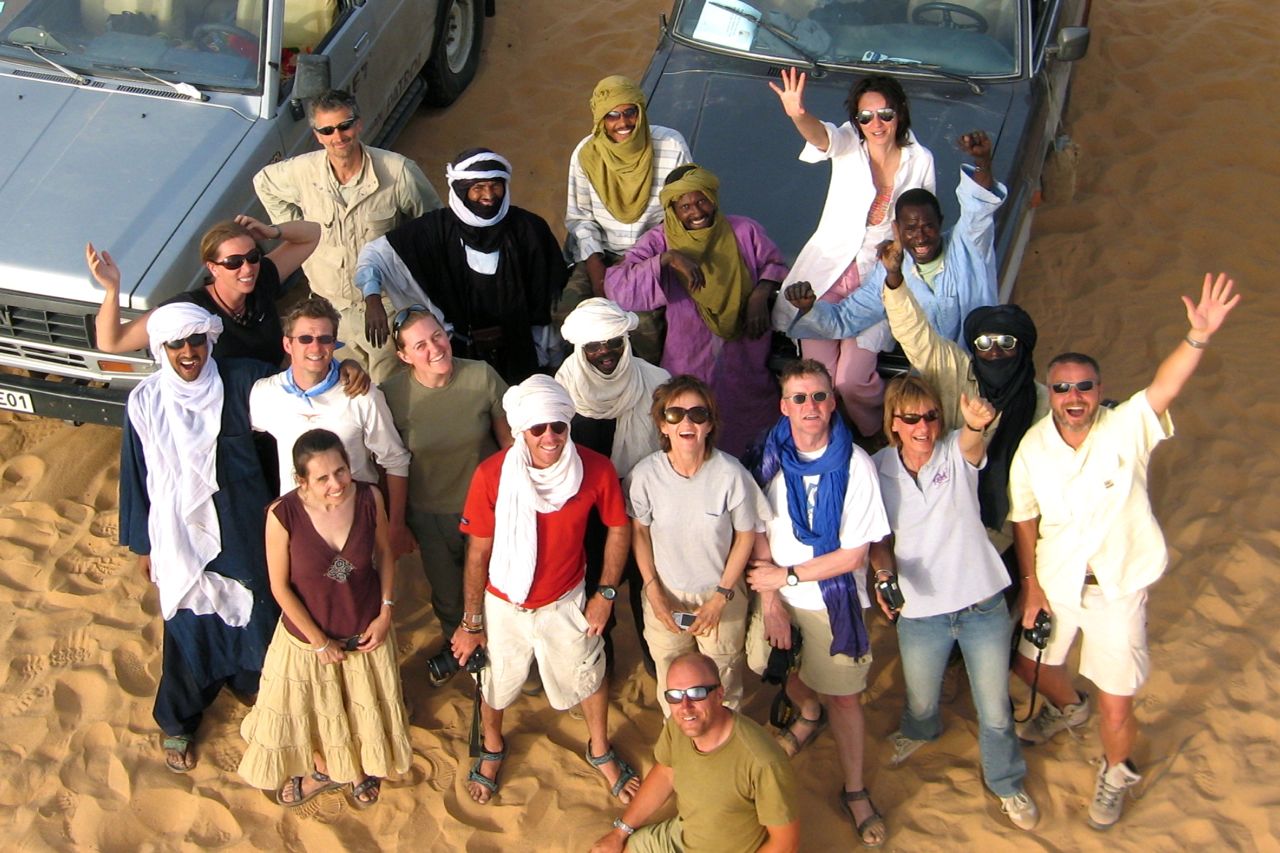
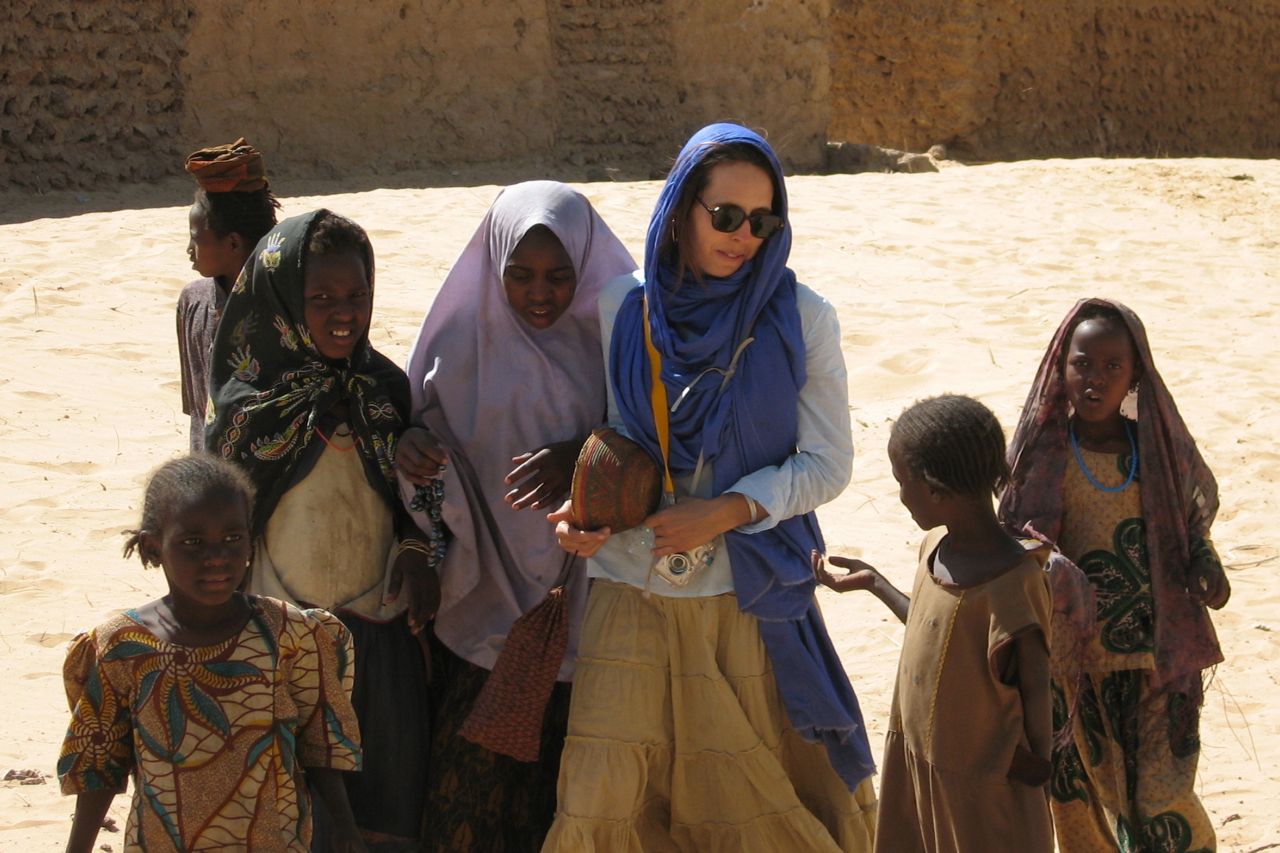
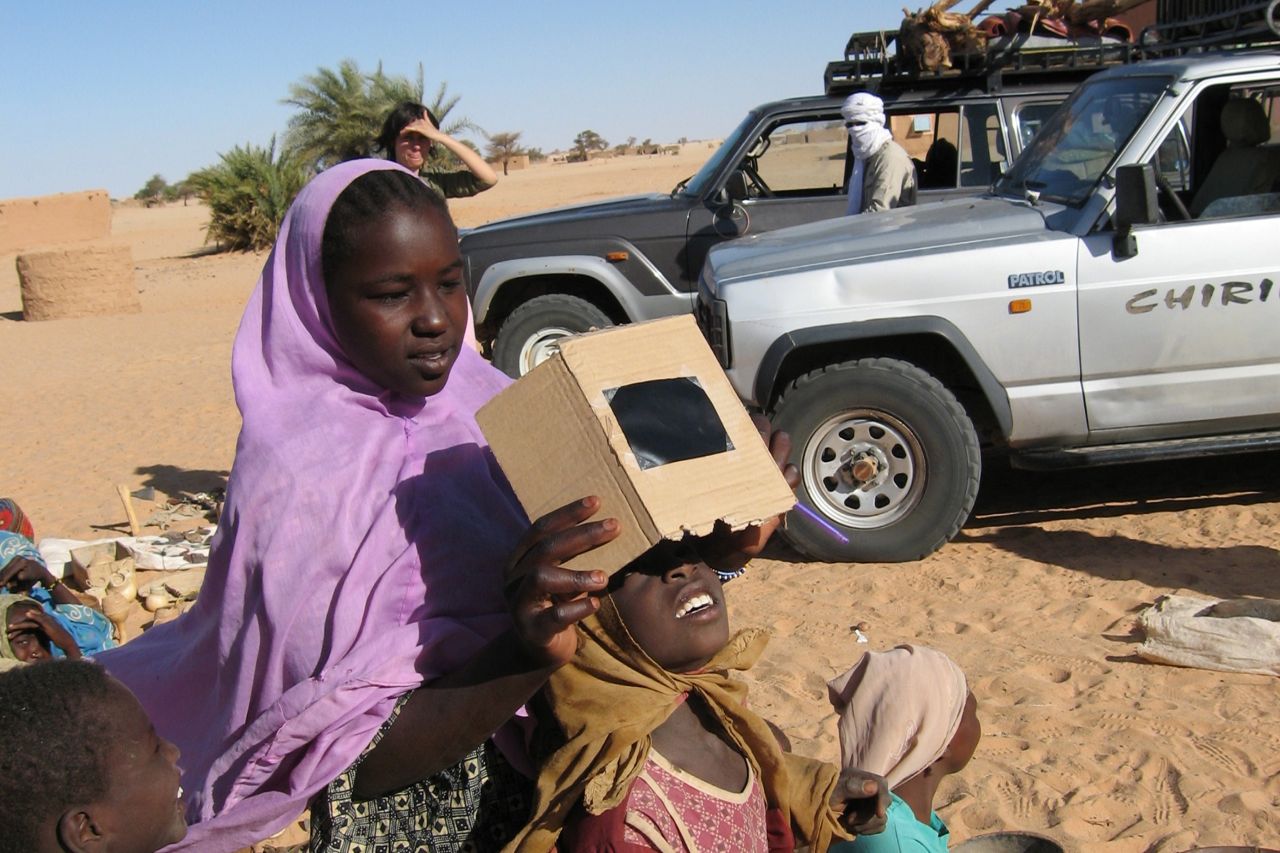
I secured ‘saharaneclipse.com’ in plenty of time and set up an enigmatic front page (left). Only those who moused over the eclipsed sun found their way to the back pages and further details. And so about eleven of us from seven countries shuffled across the tarmac of Agadez airport, paid the special ‘eclipse tax’, piled into the loaded jeeps and lit out into the Tenere to see what we could see.
Came the day I was nearly forced to eat my ‘Clear skies…’ boast but a great local crew, the international group and not least the fabulous deserts of the Aïr, Tenere and Djado made for one of my most enjoyable and trouble-free Saharan tours.