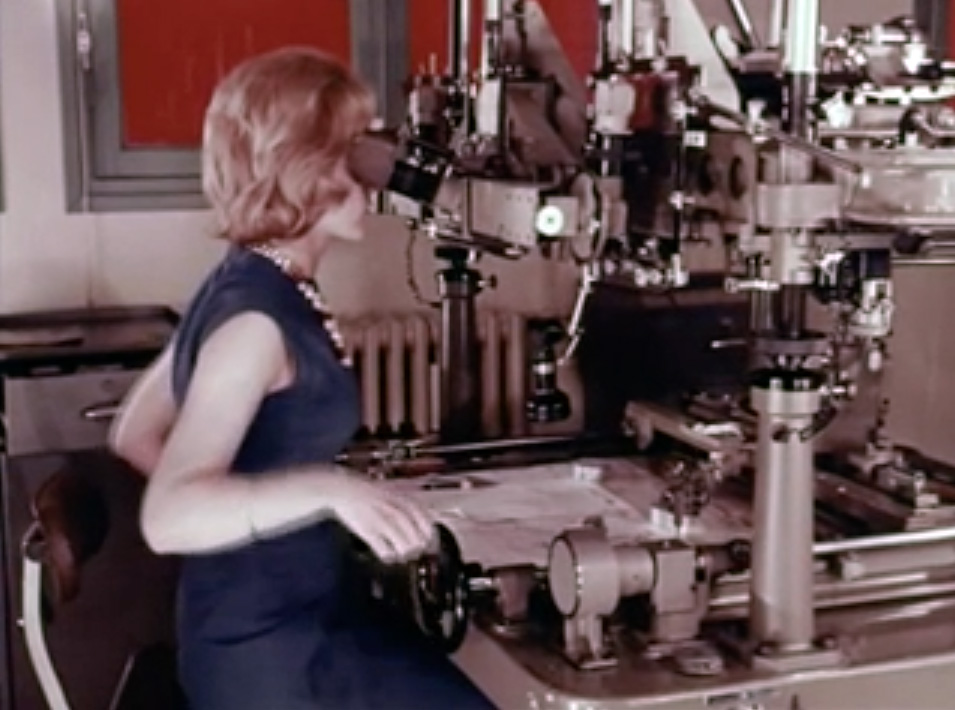
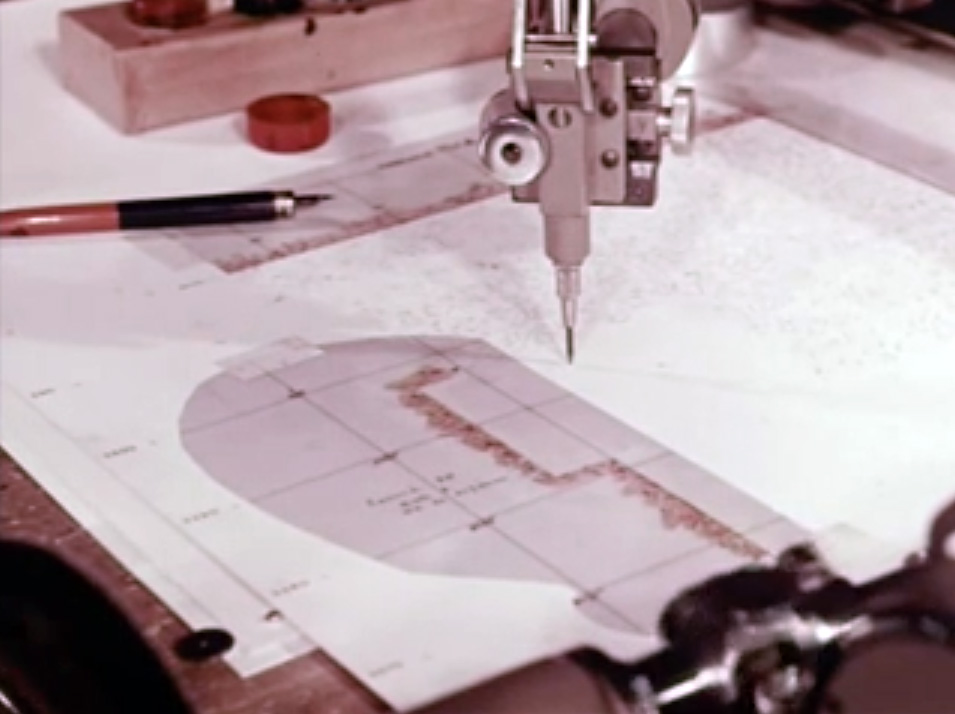
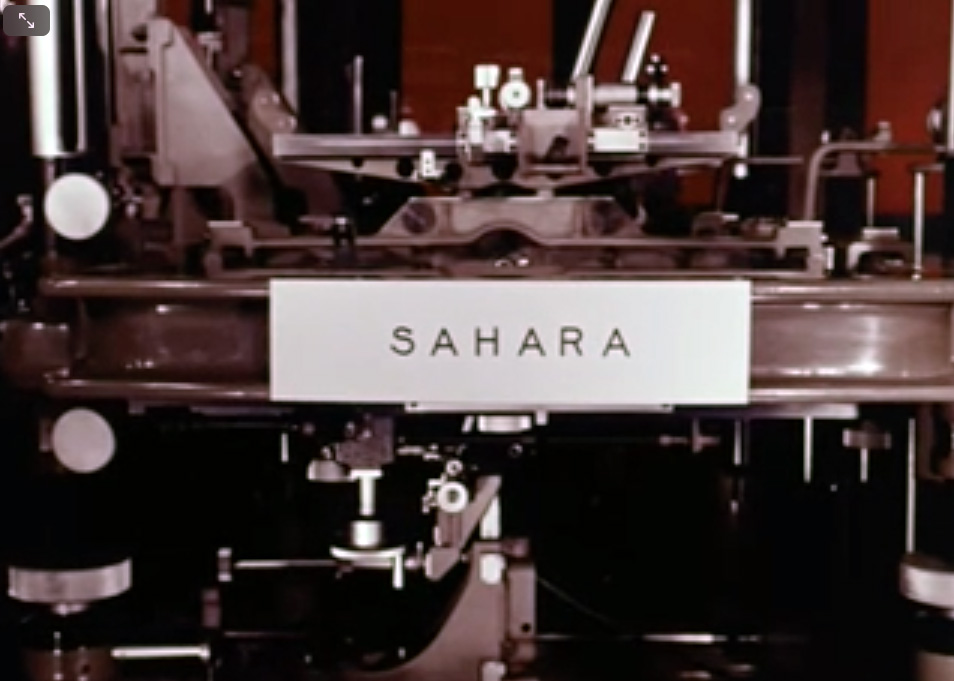
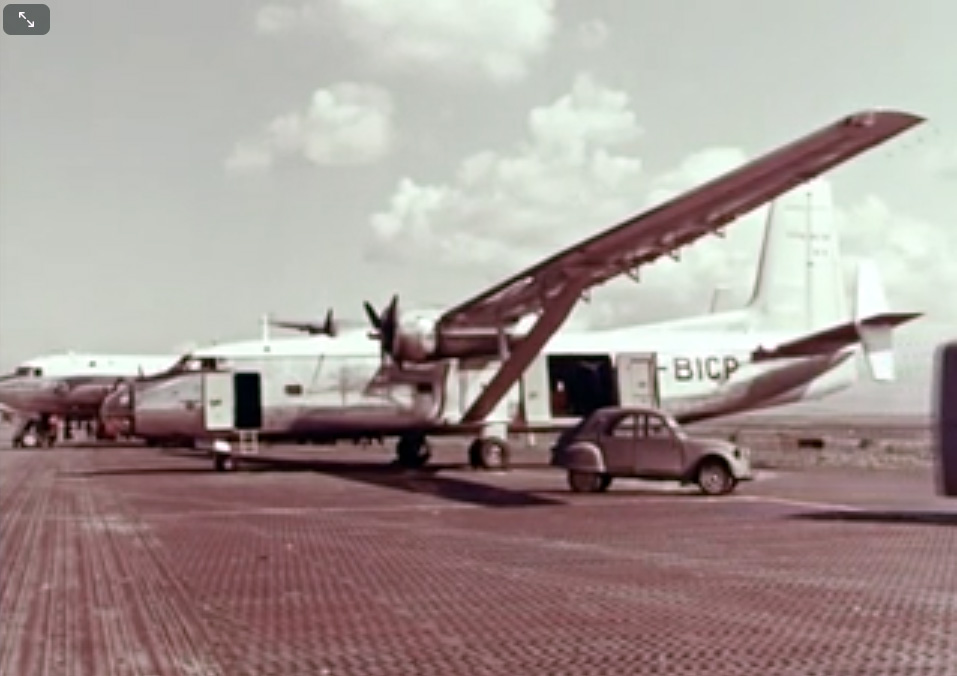
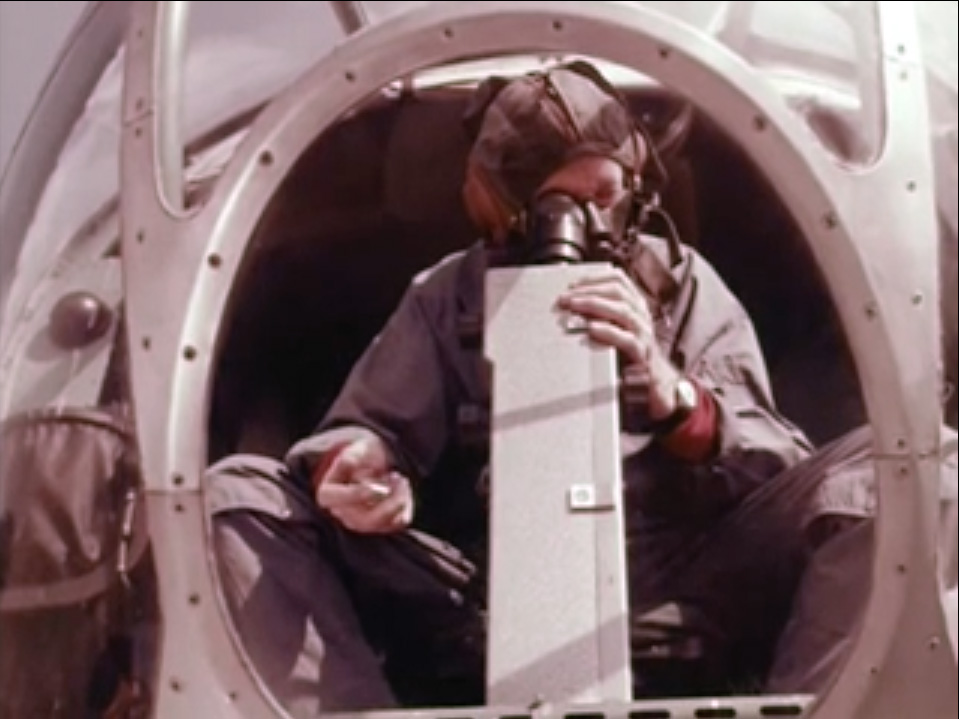
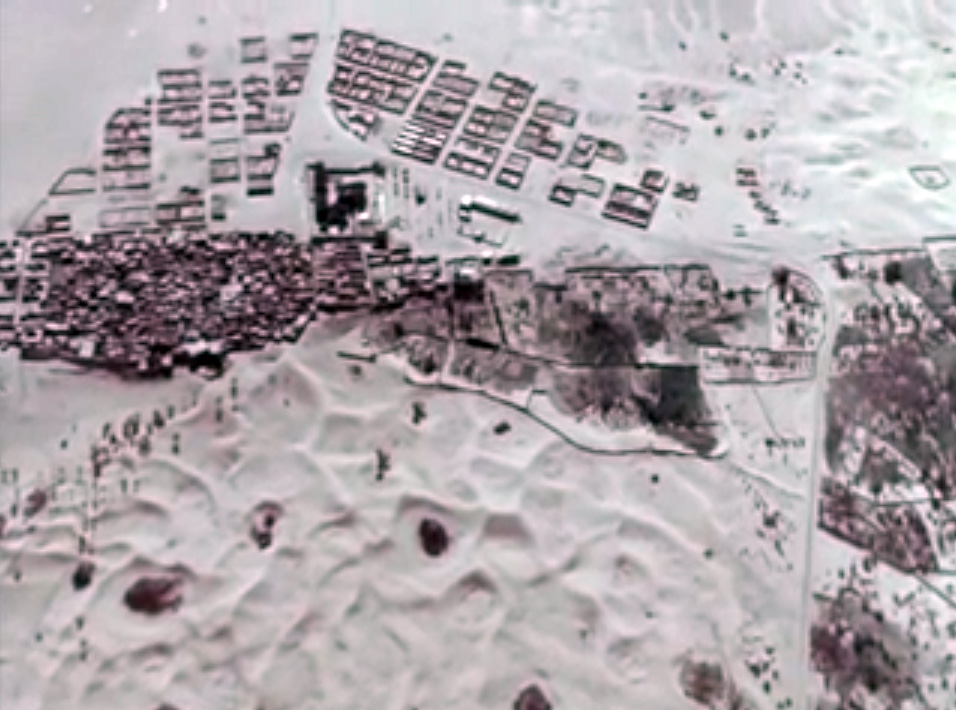
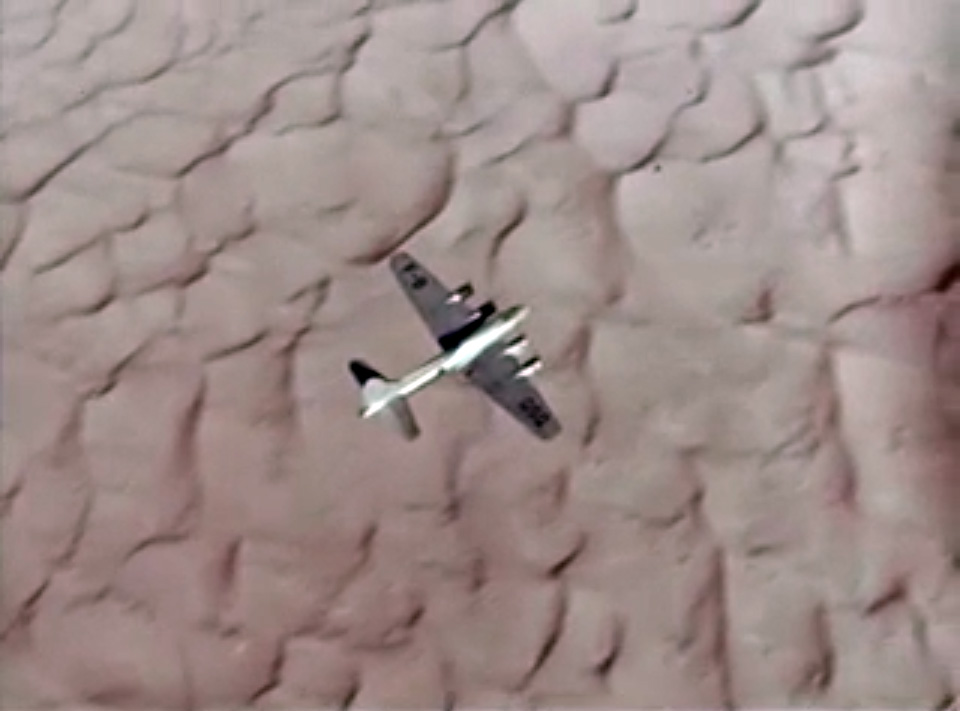
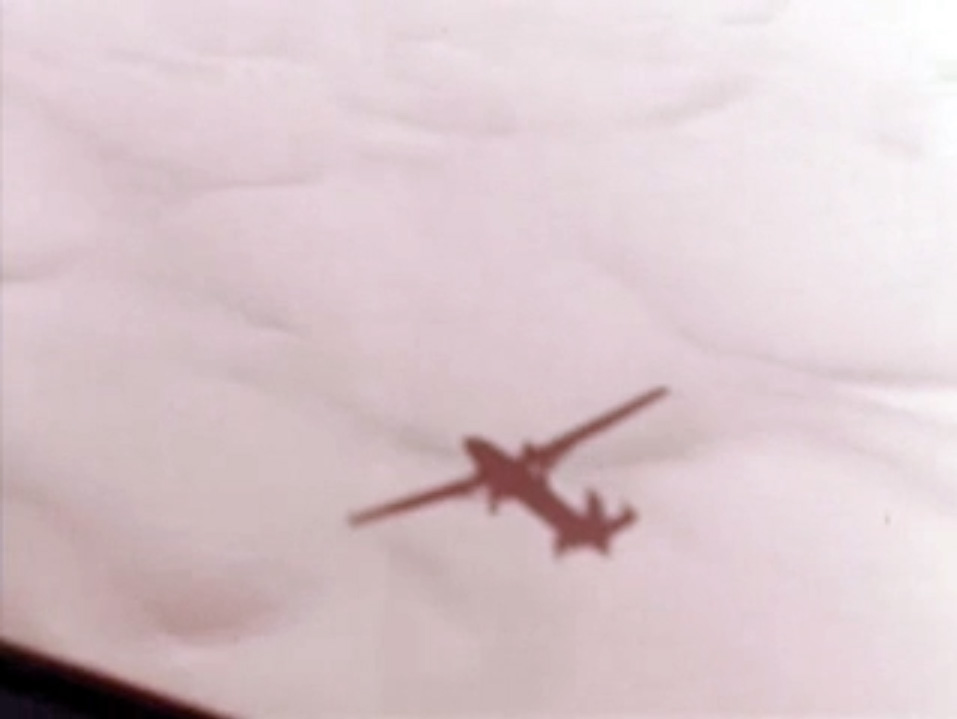
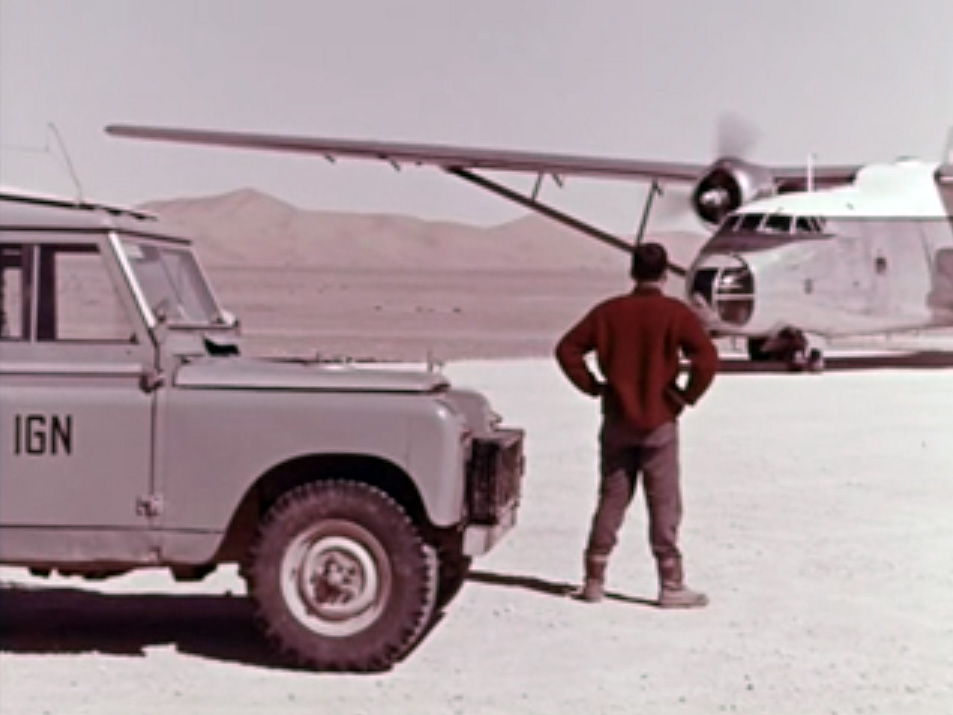
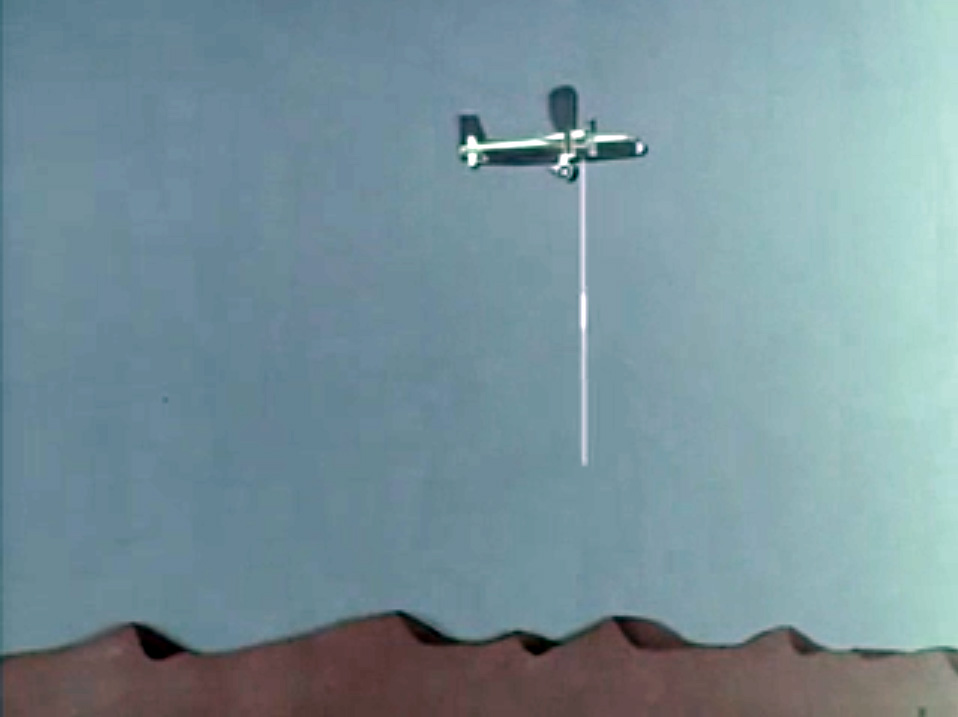
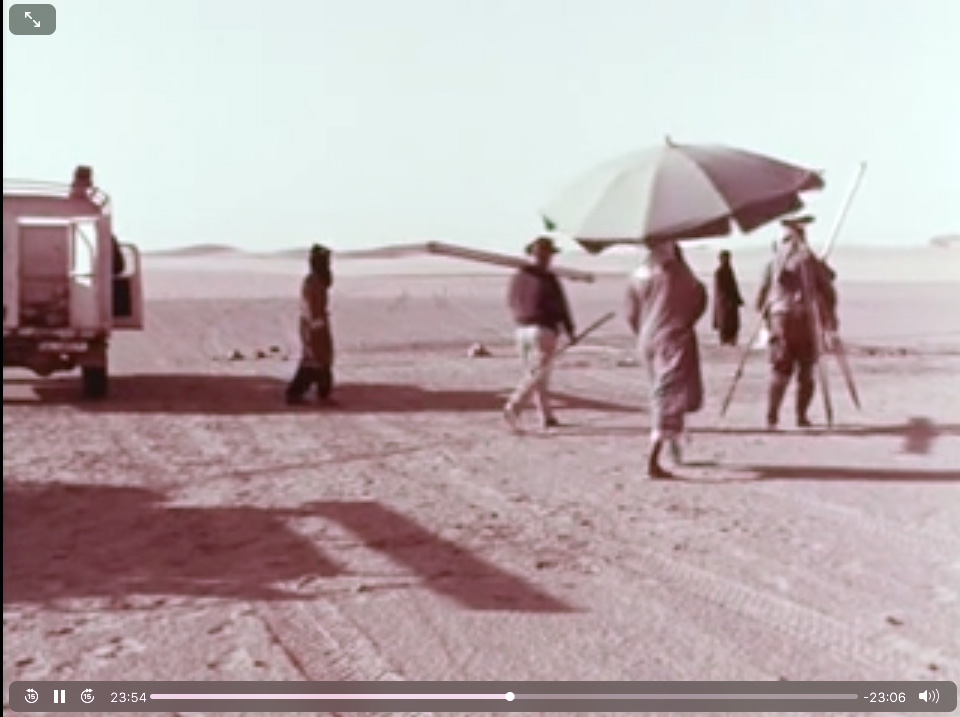
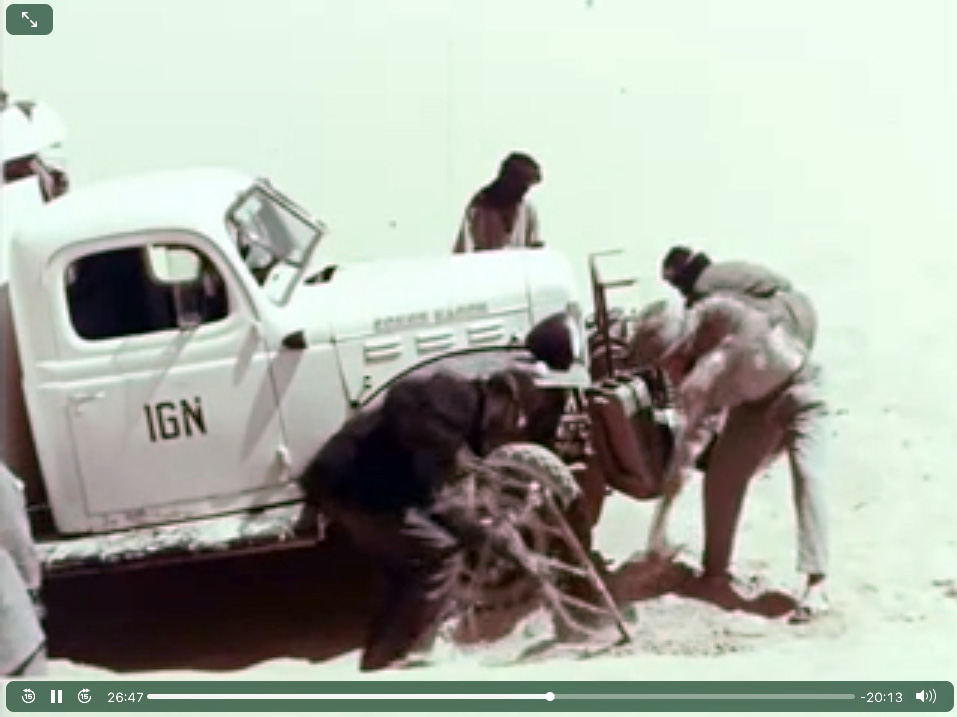
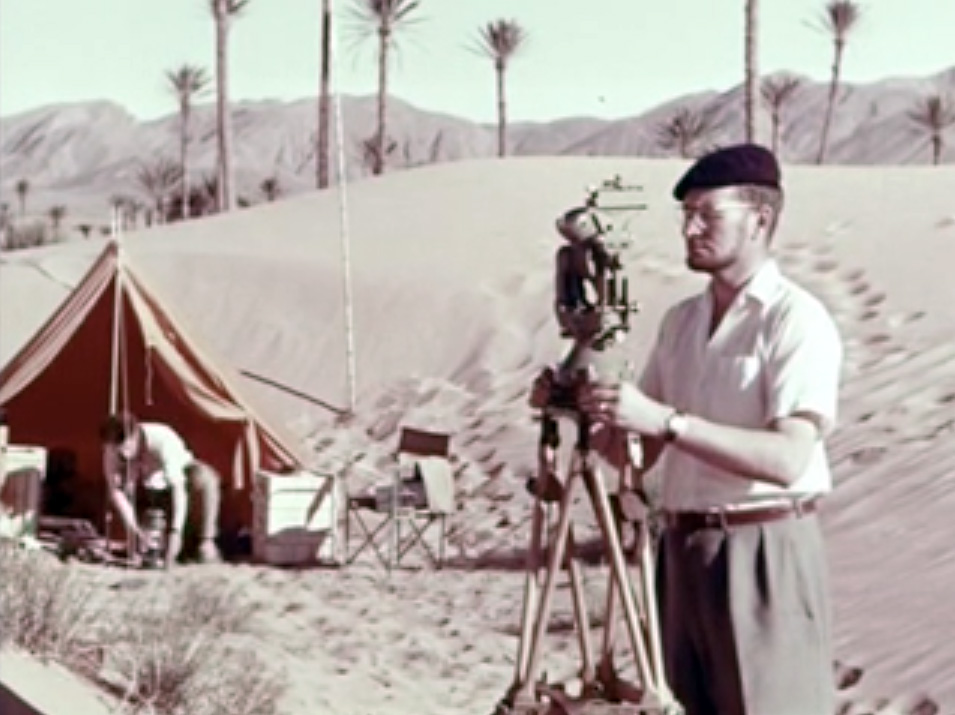
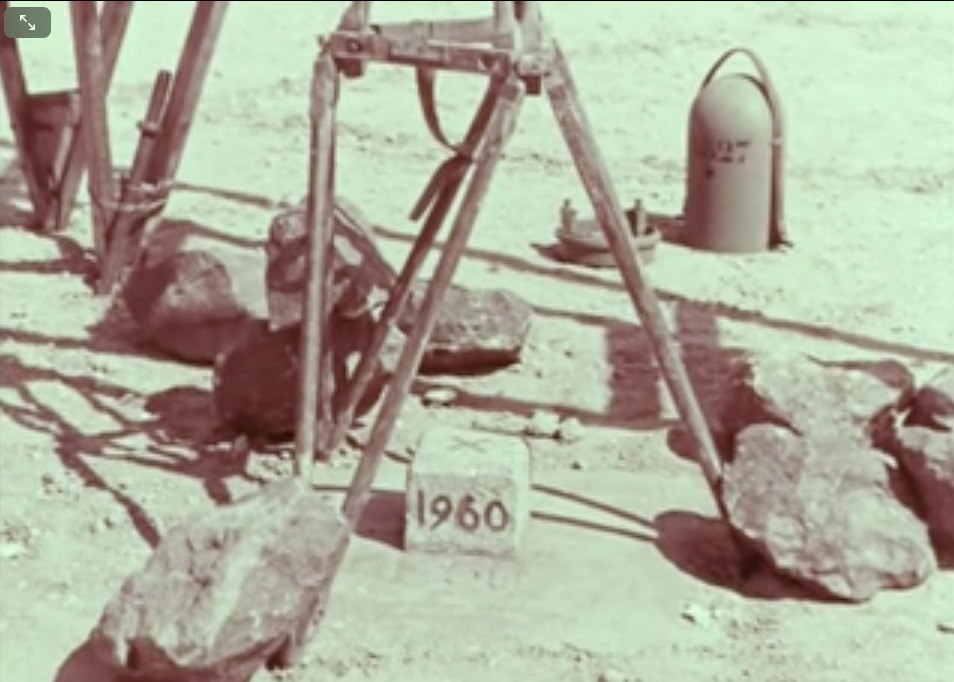
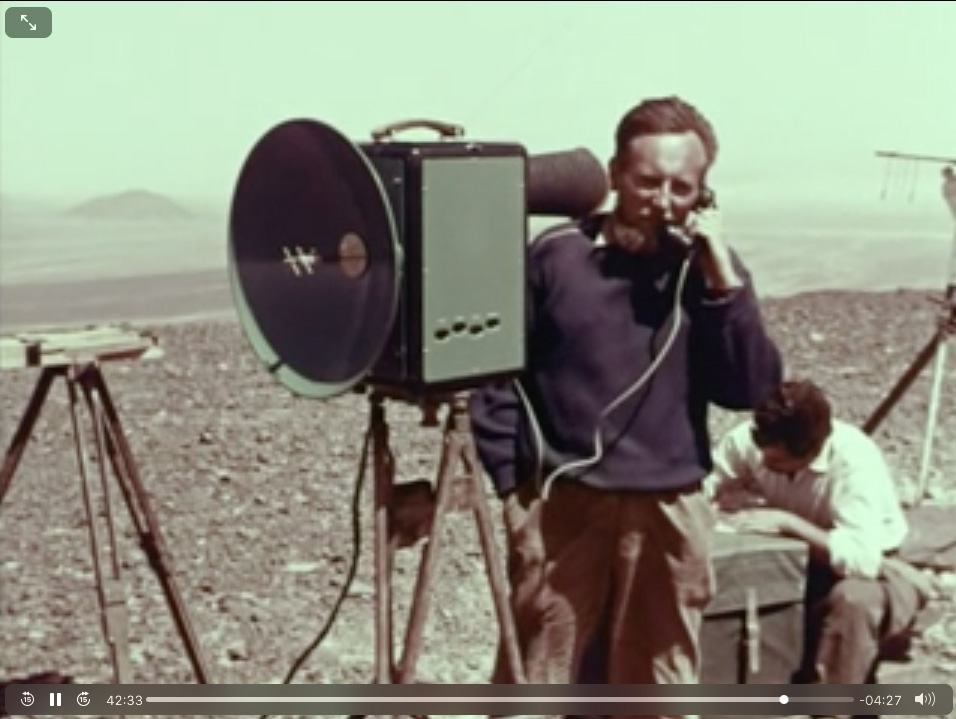
Here a fascinating 1960s vintage film (45 mins; French) on the work it took IGN to produce their brilliant 1:200,000 scale Sahara maps from thousands of aerial photos, sonar readings and laborious ground surveys. Direct link to video.
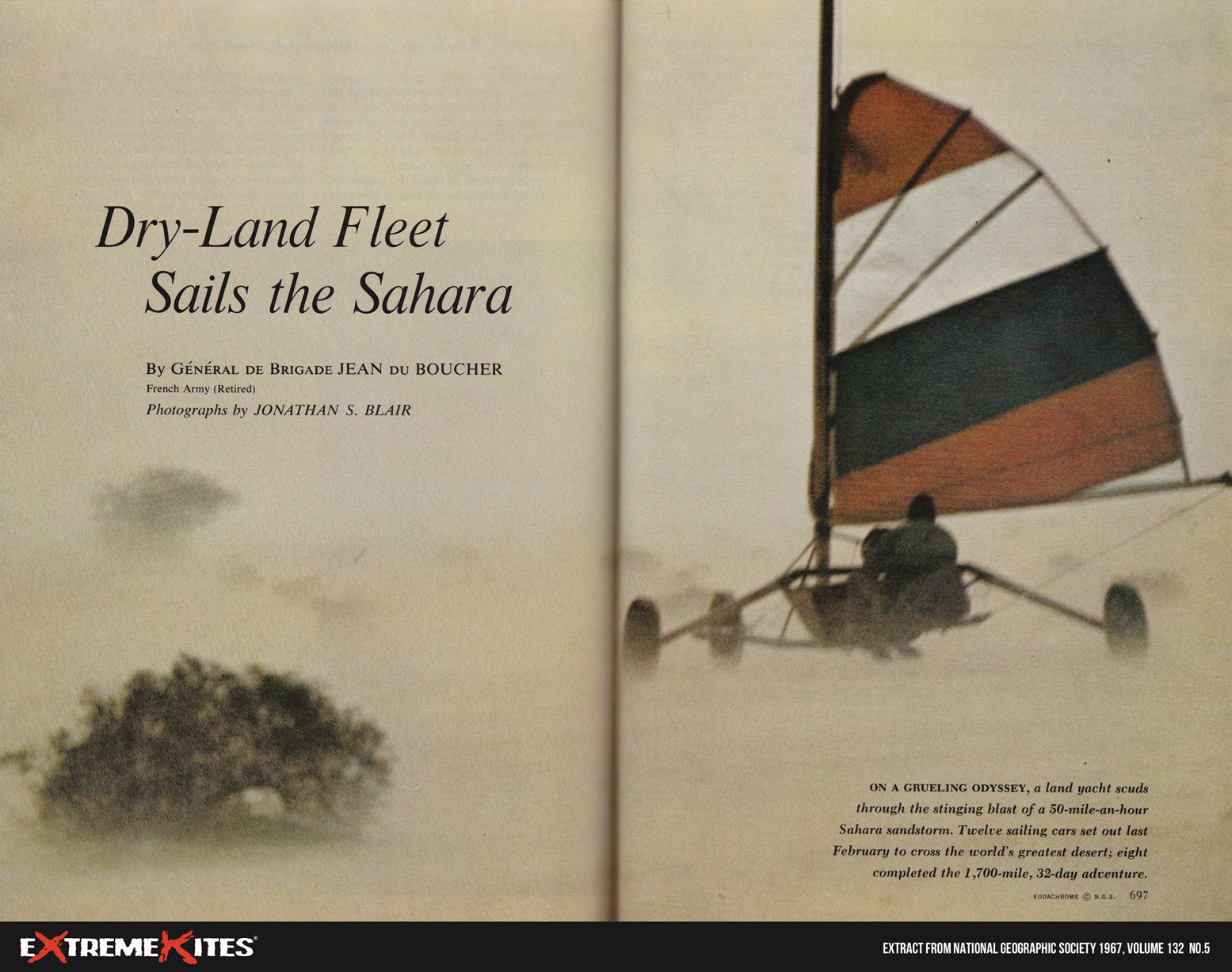
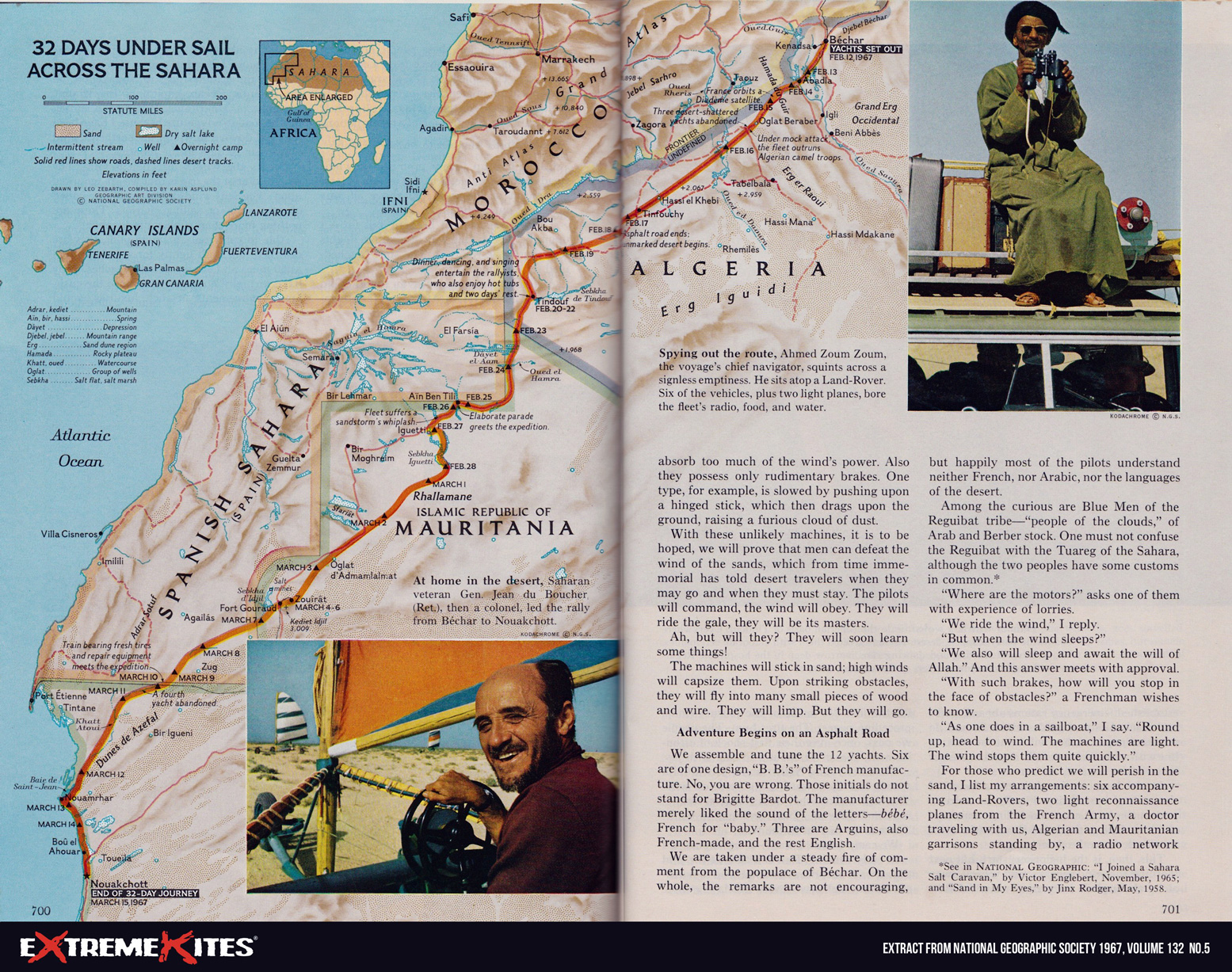
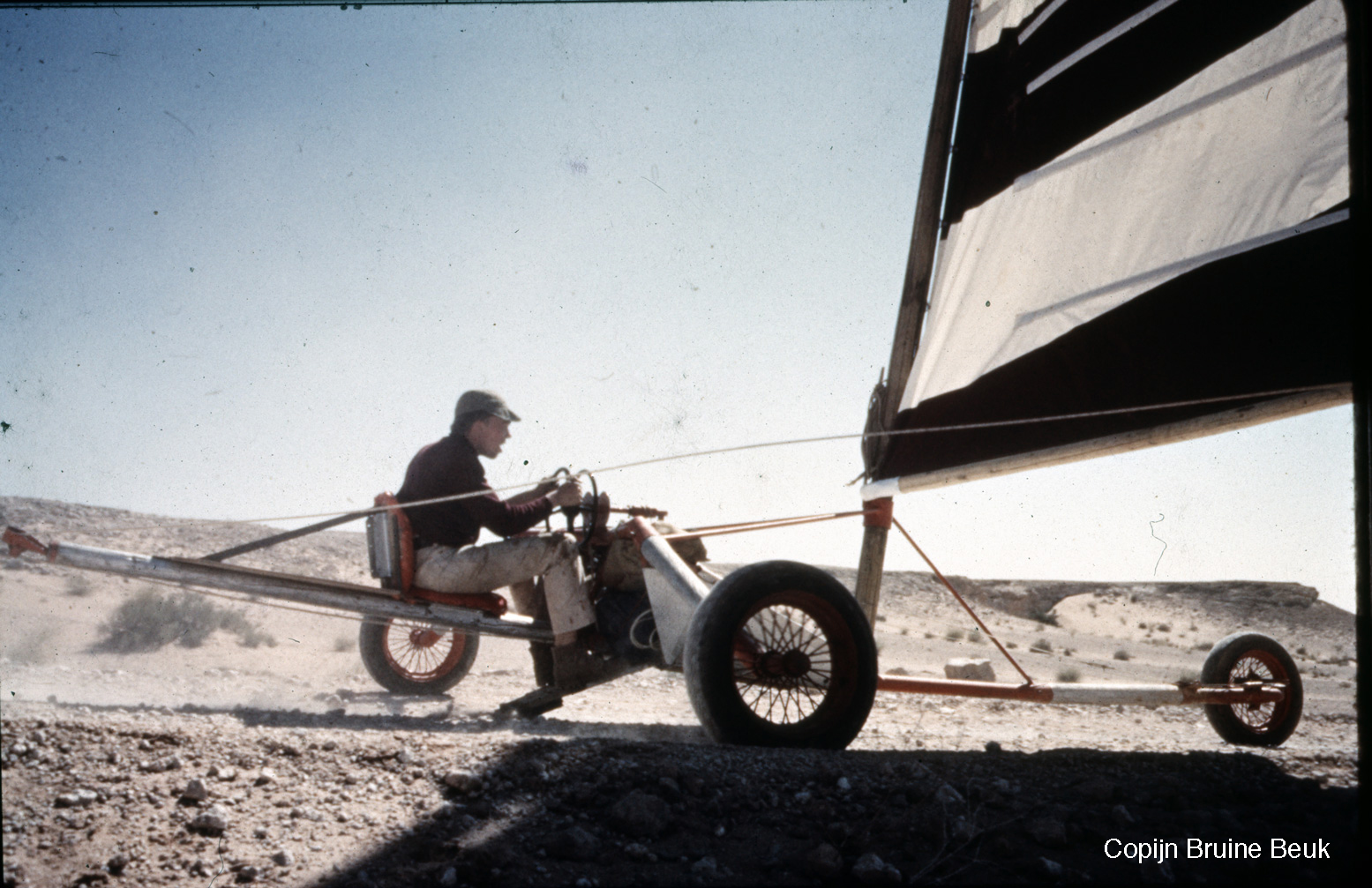
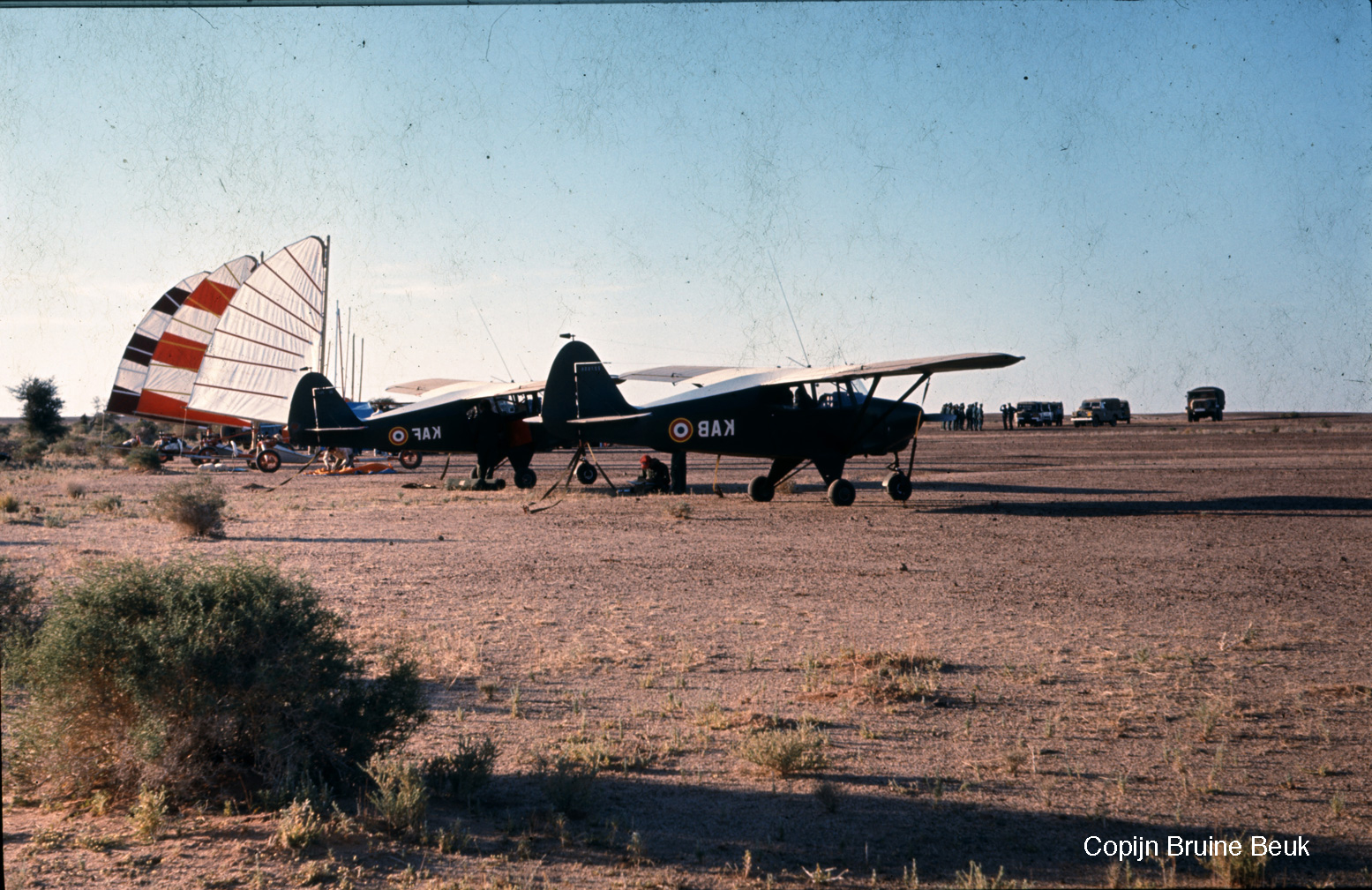
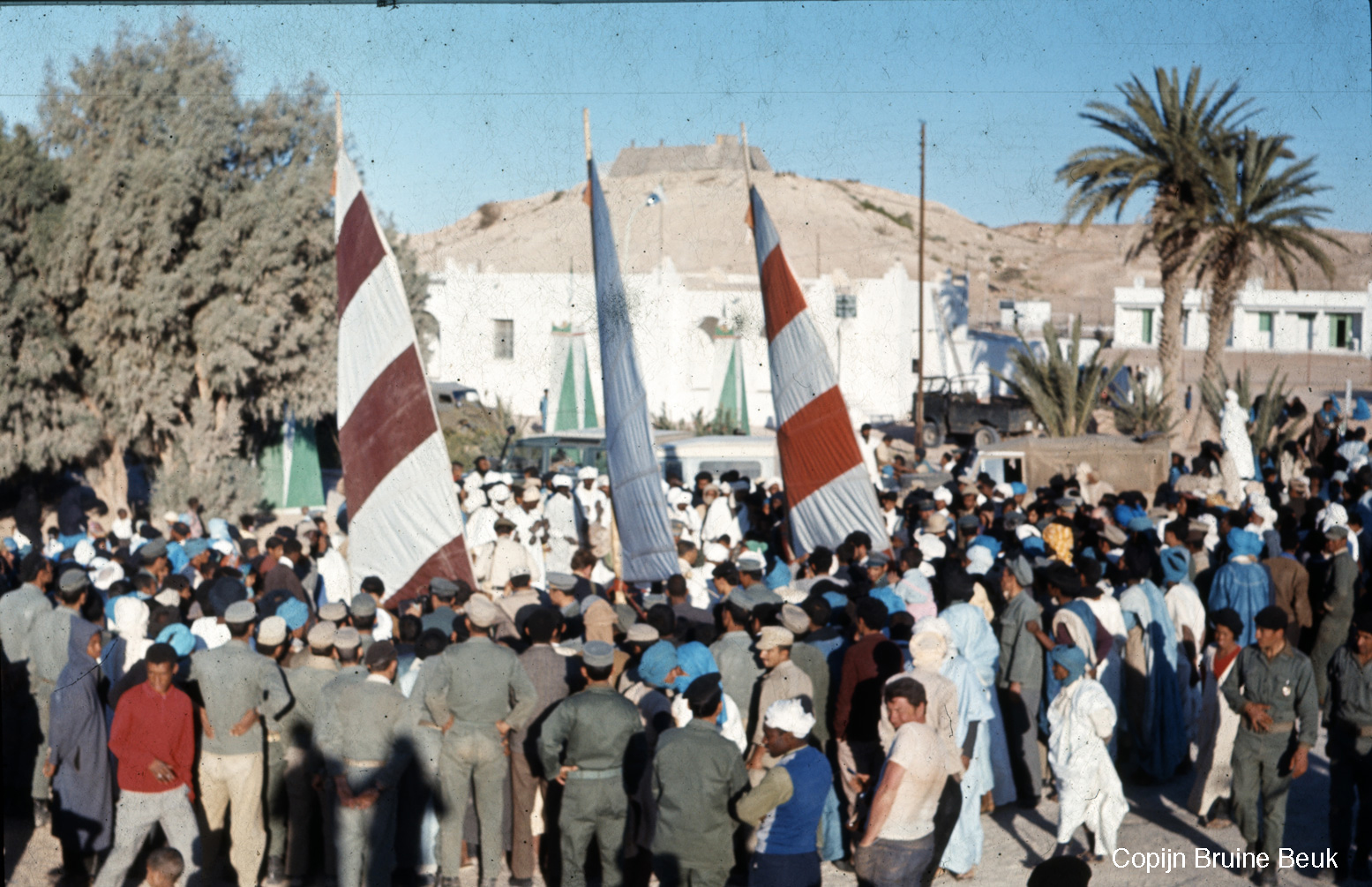
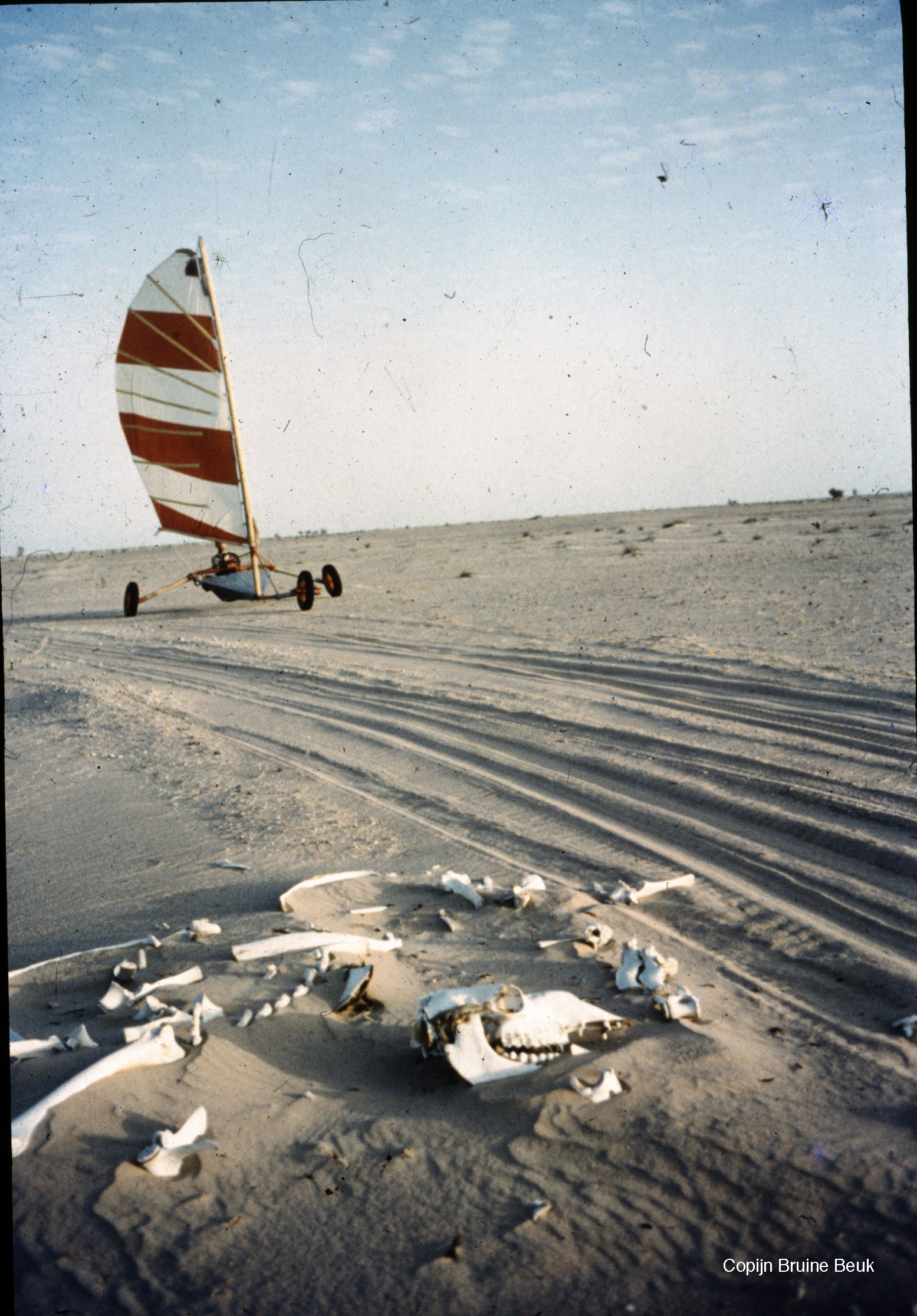
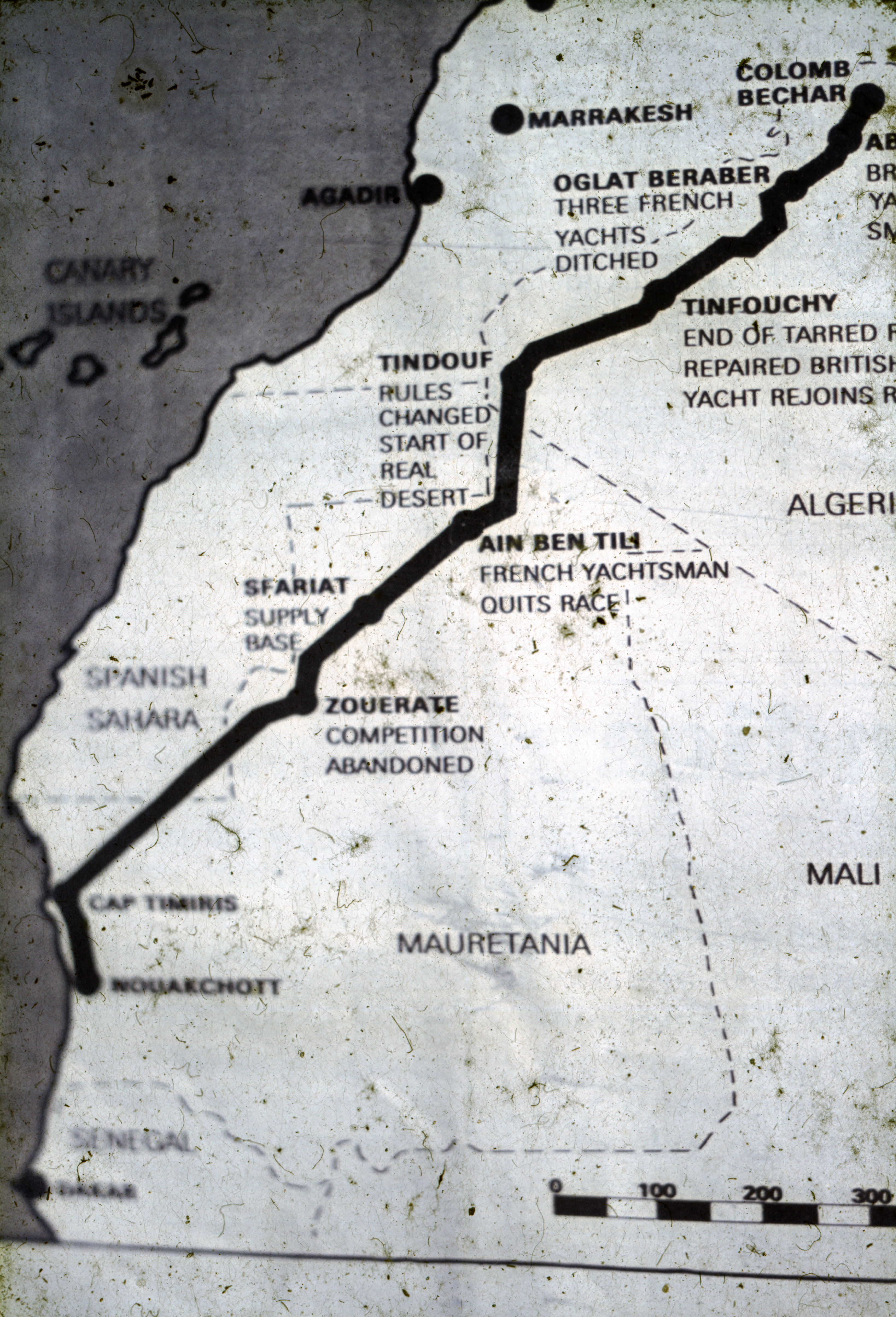
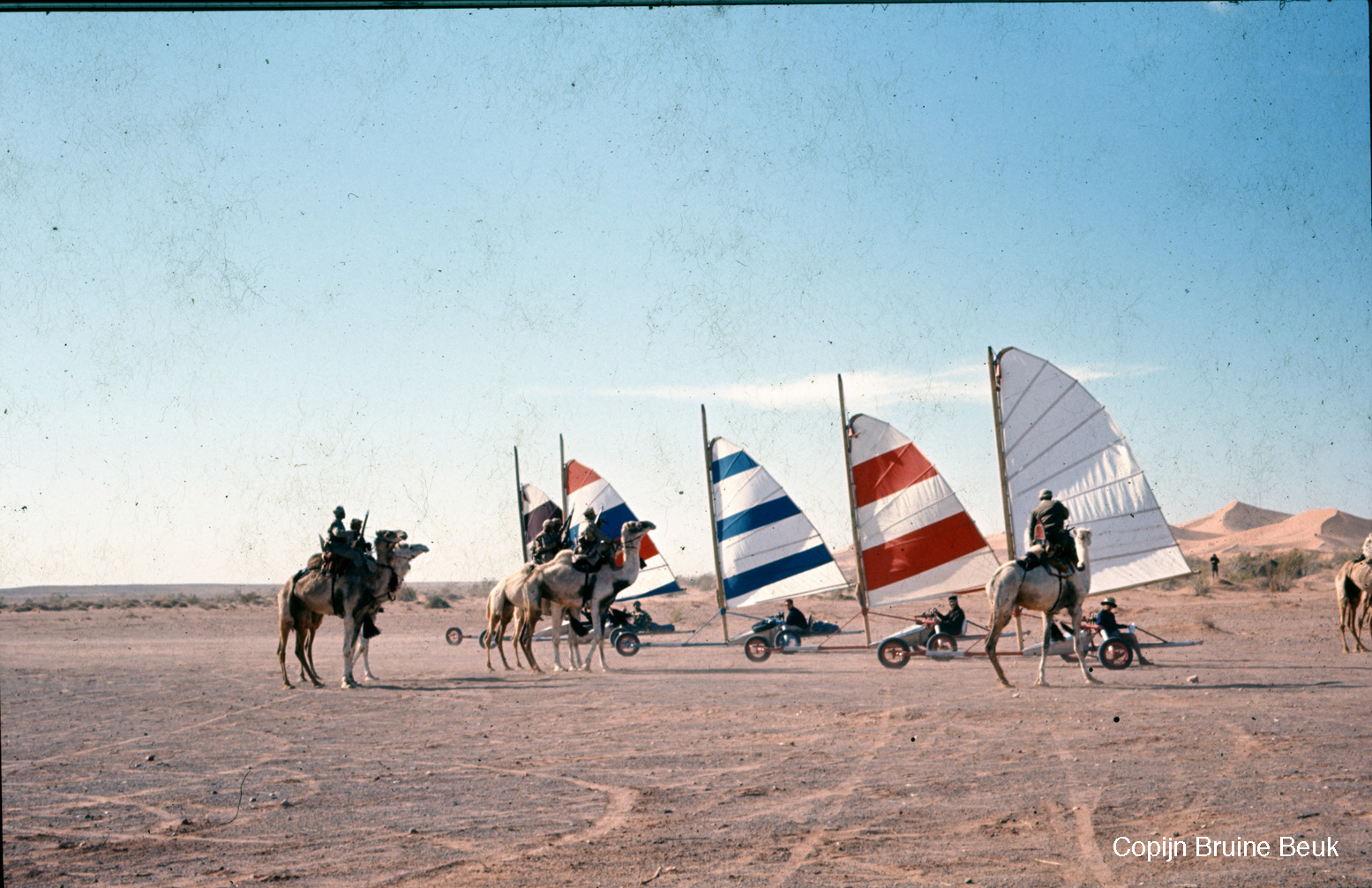
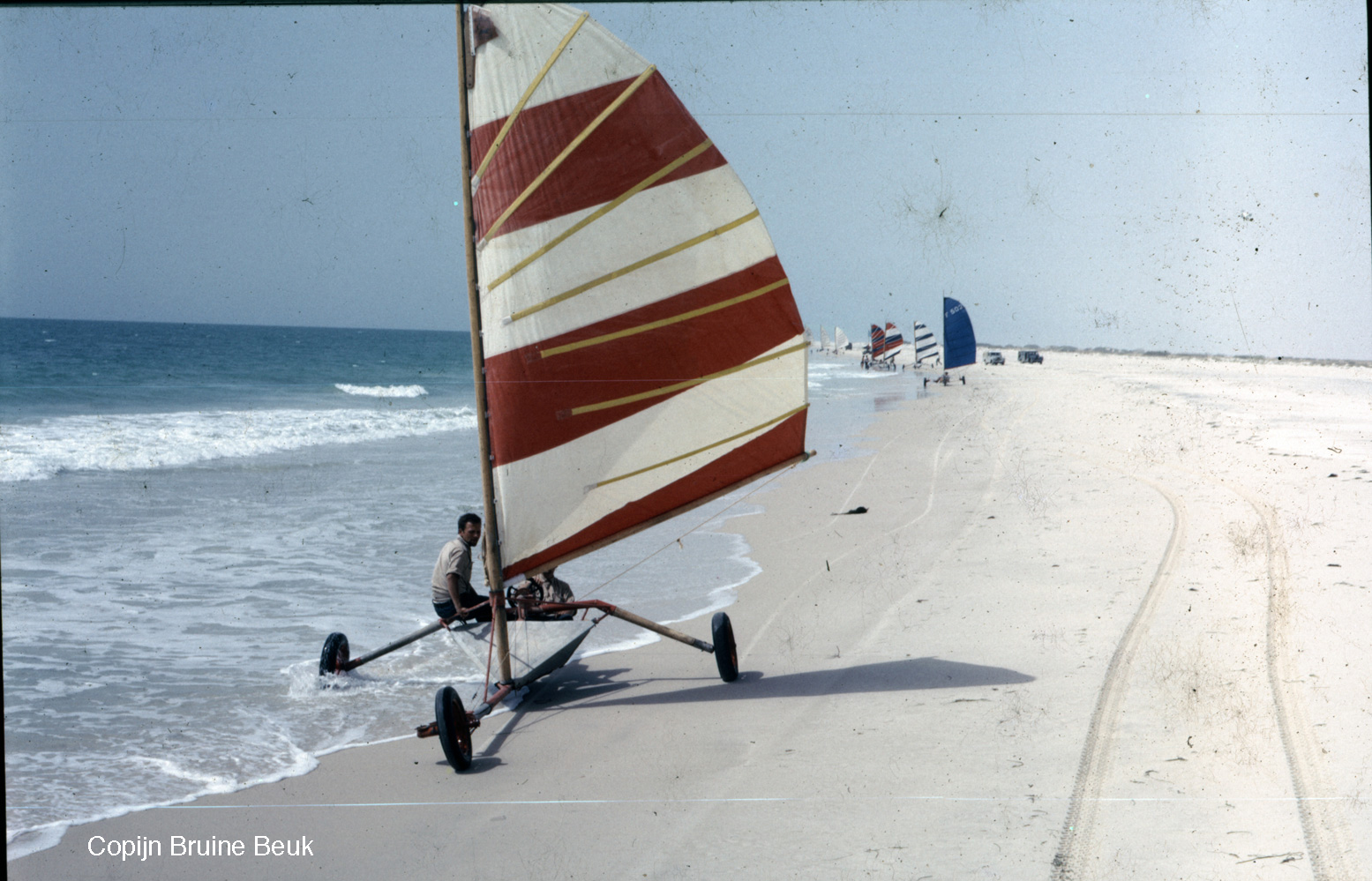
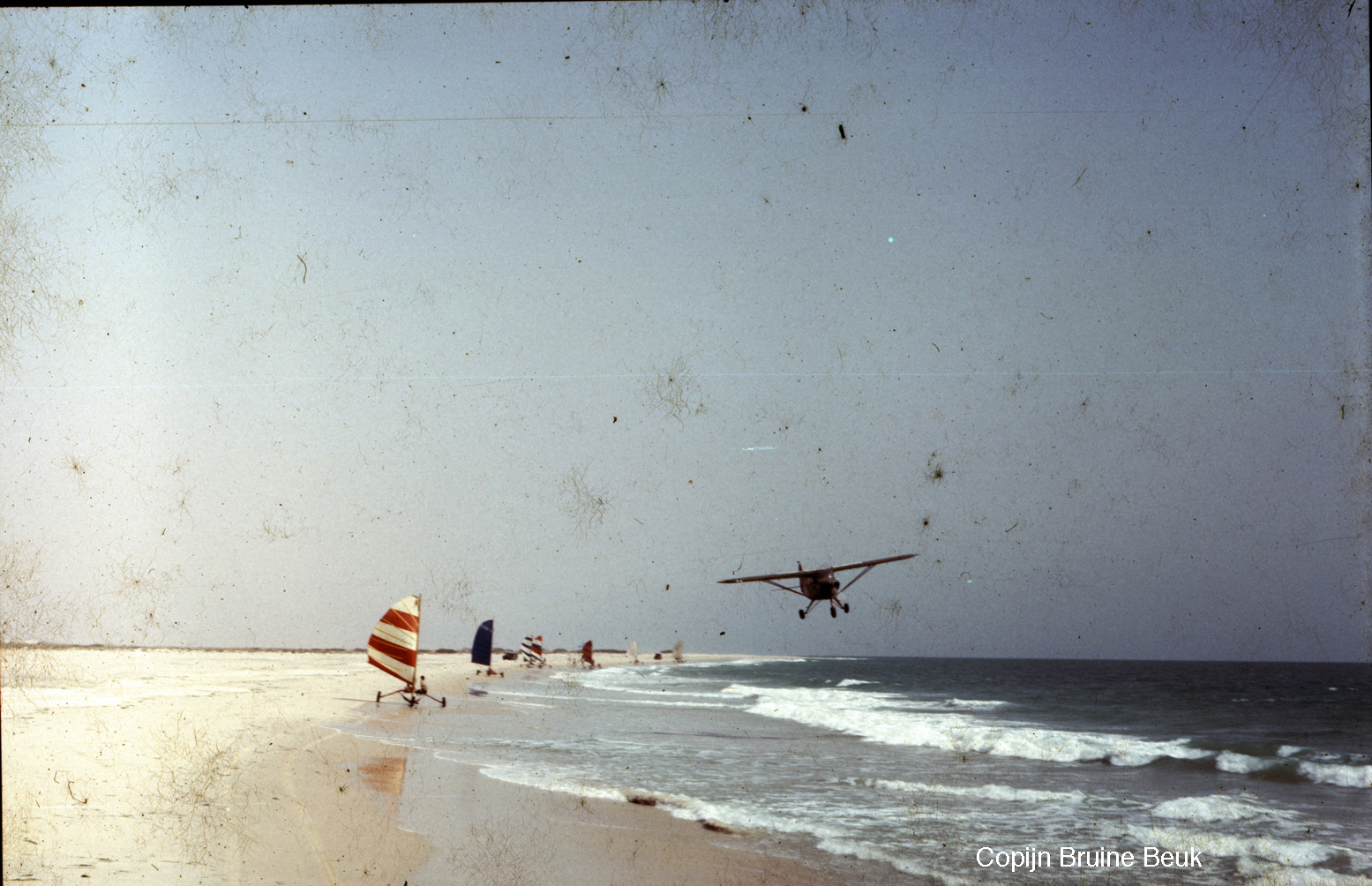
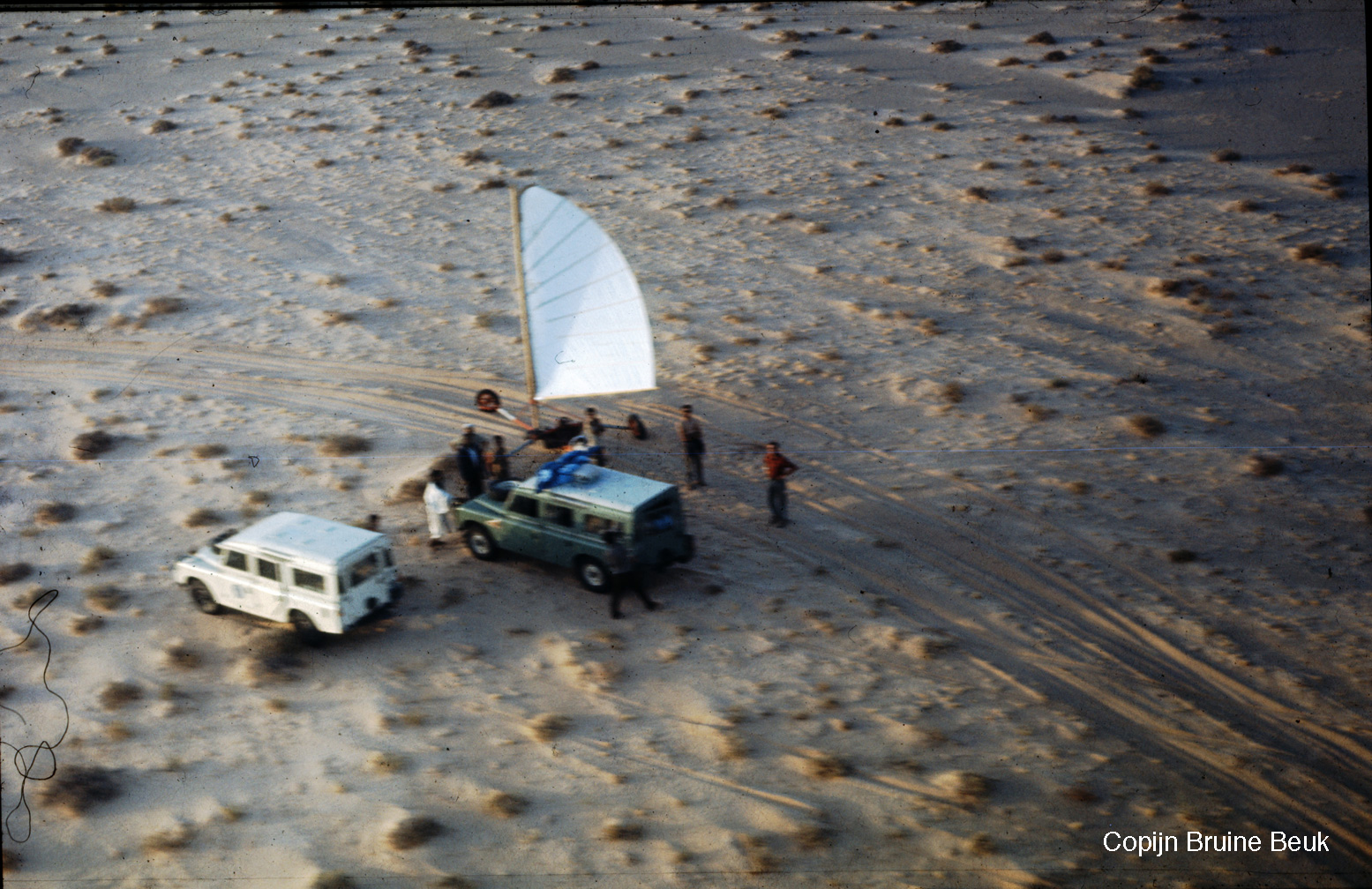
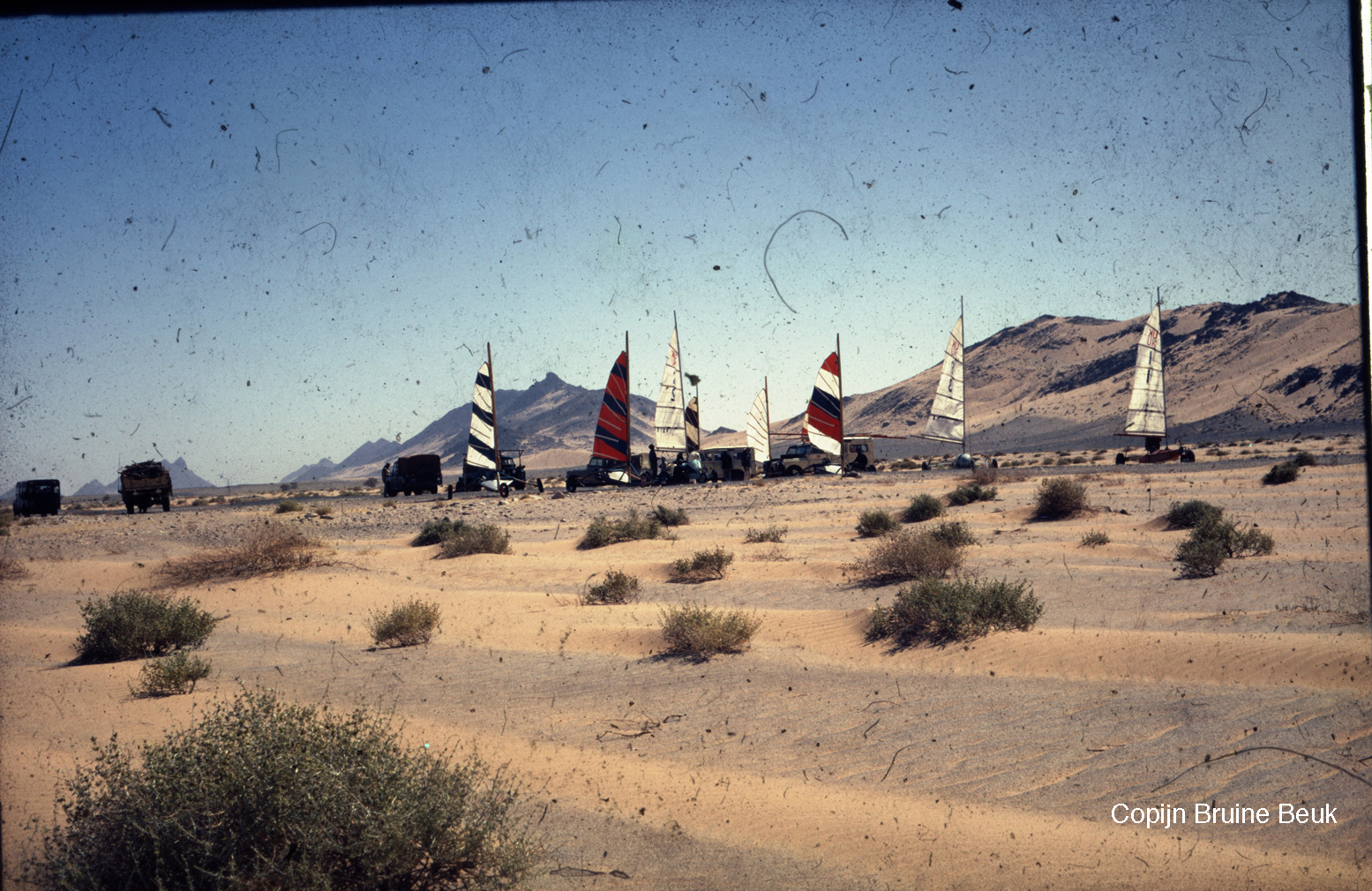
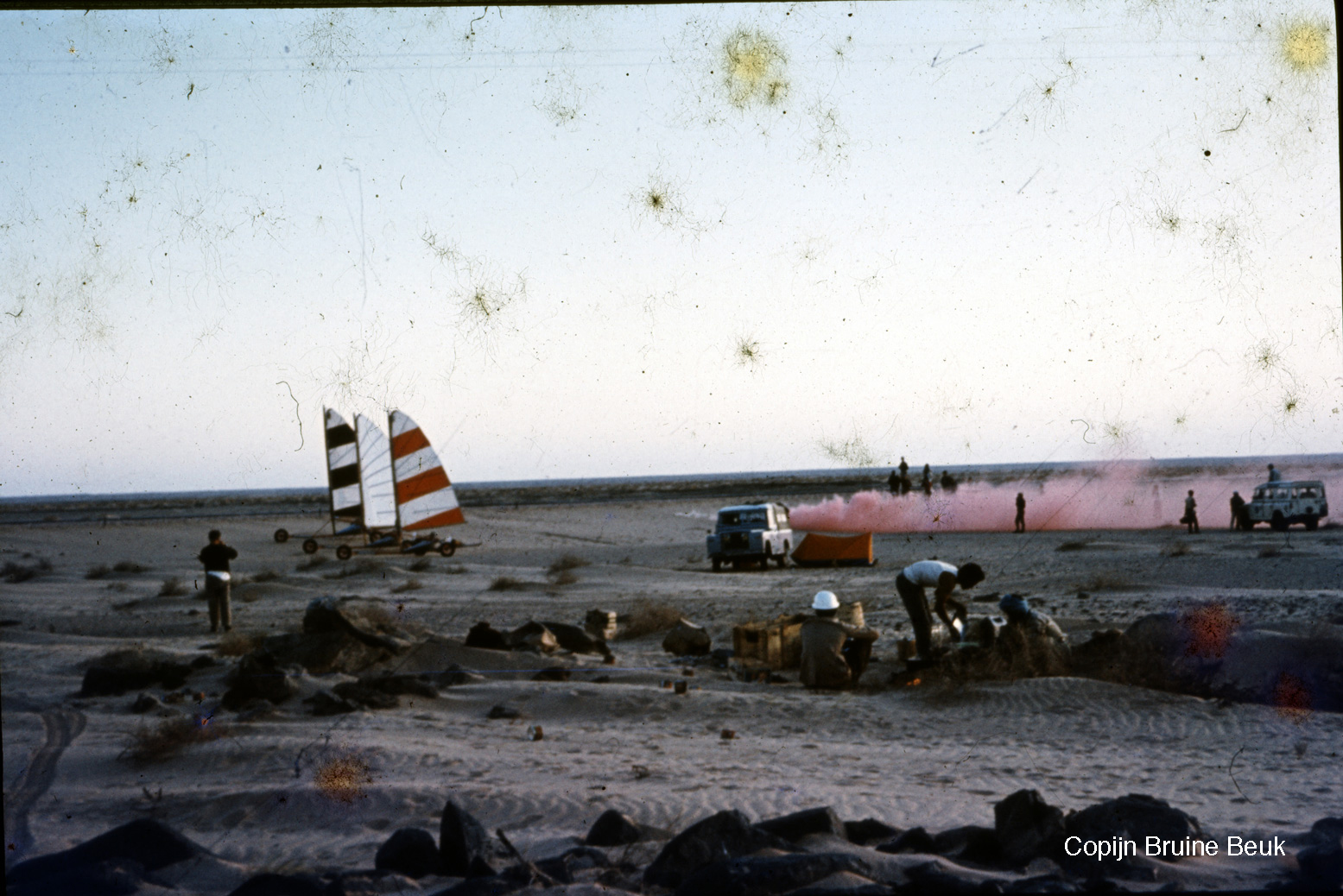
Organised by French ex-army Saharienne, Jean de Boucher, in February 1967 twelve land yachts with pilots from half-a-dozen countries set off on a 2500-km rally from Colomb Bechar (then linked by rail from Oujda on the Mediterranean) to Nouakchott on the Atlantic coast, at times following today’s recently reopened Tindouf Route via Algeria. It seems the race element of the rally was abandoned after some 2000km in Zouerat following several DNFs, but some carried on down the coast, cutting across what was then Spanish Sahara (‘PFZ’), on to the beach at Nouamghar and down the beach to Nouakchott. At this time most of Mauritania’s population still lived in the desert as nomads. The rally was supported by a couple Land-Rovers, small planes and surviving French military garrisons with which General de Boucher presumably had good connections.
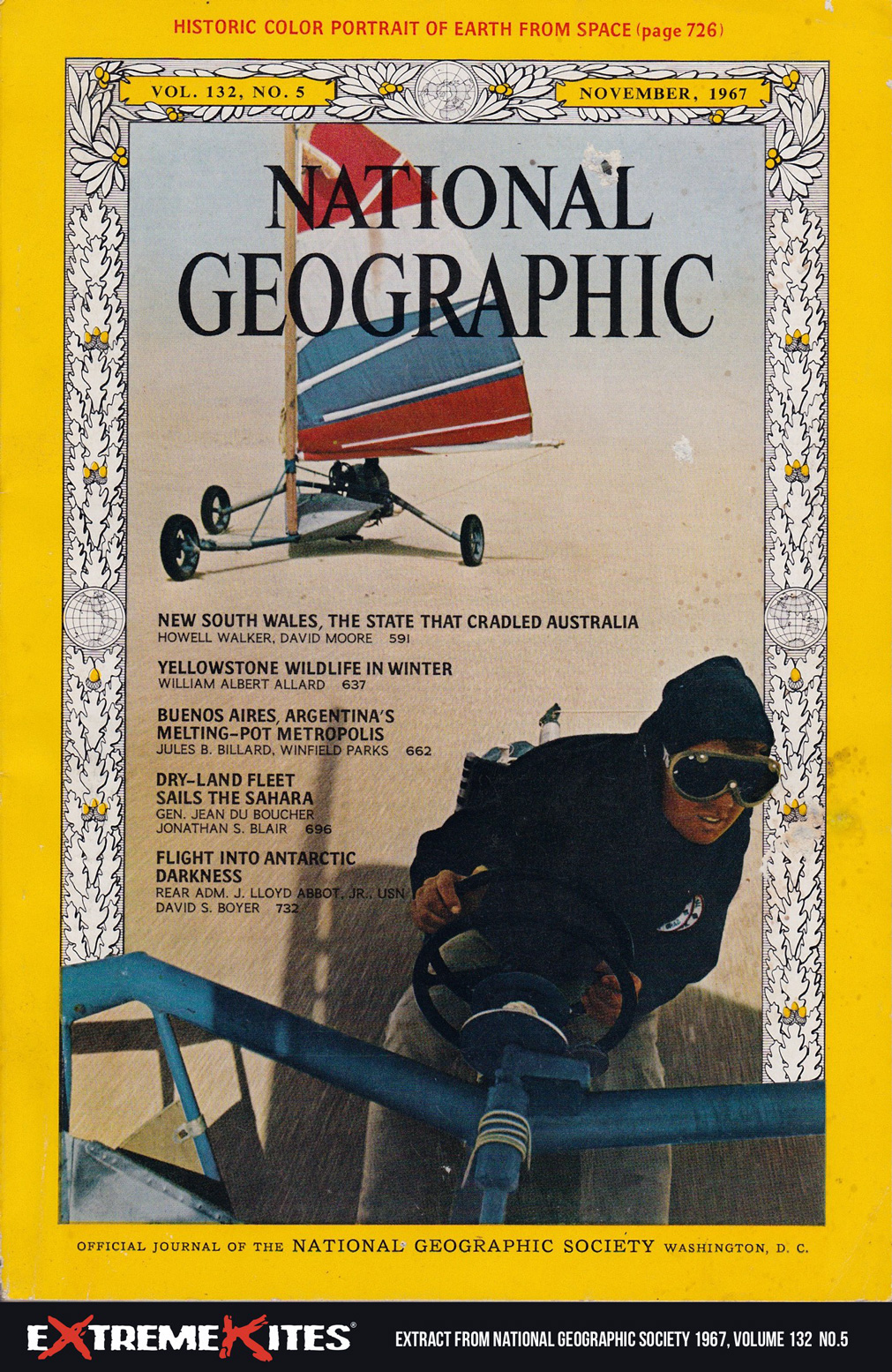
The adventure featured in the November 1967 issue of National Geographic magazine (left, right, below). A couple of images are used here; read the full 30-page article scanned on the Extreme Kites website. There are more reminiscences here by American competitor, Larry P featured on the magazine’s cover.
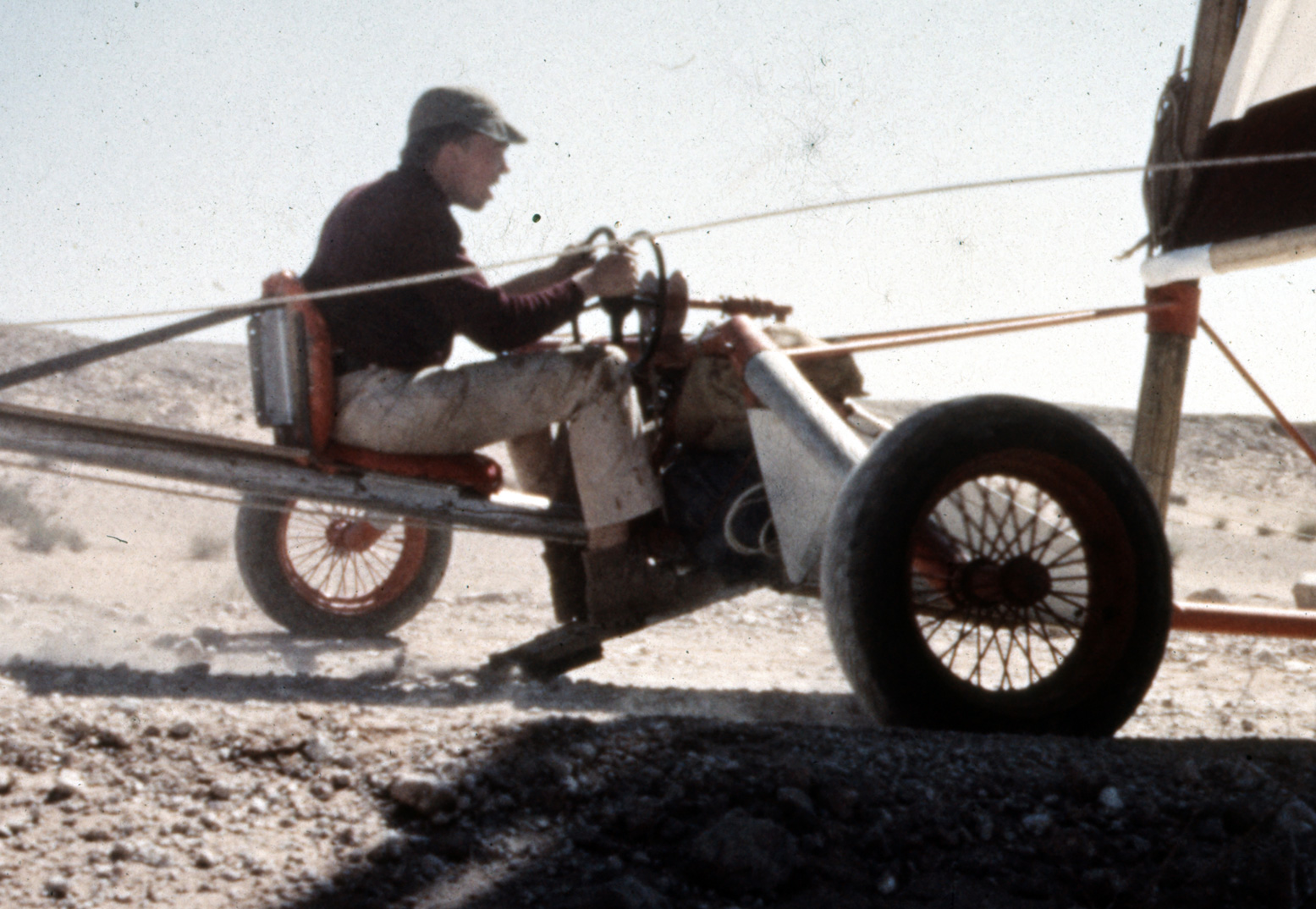
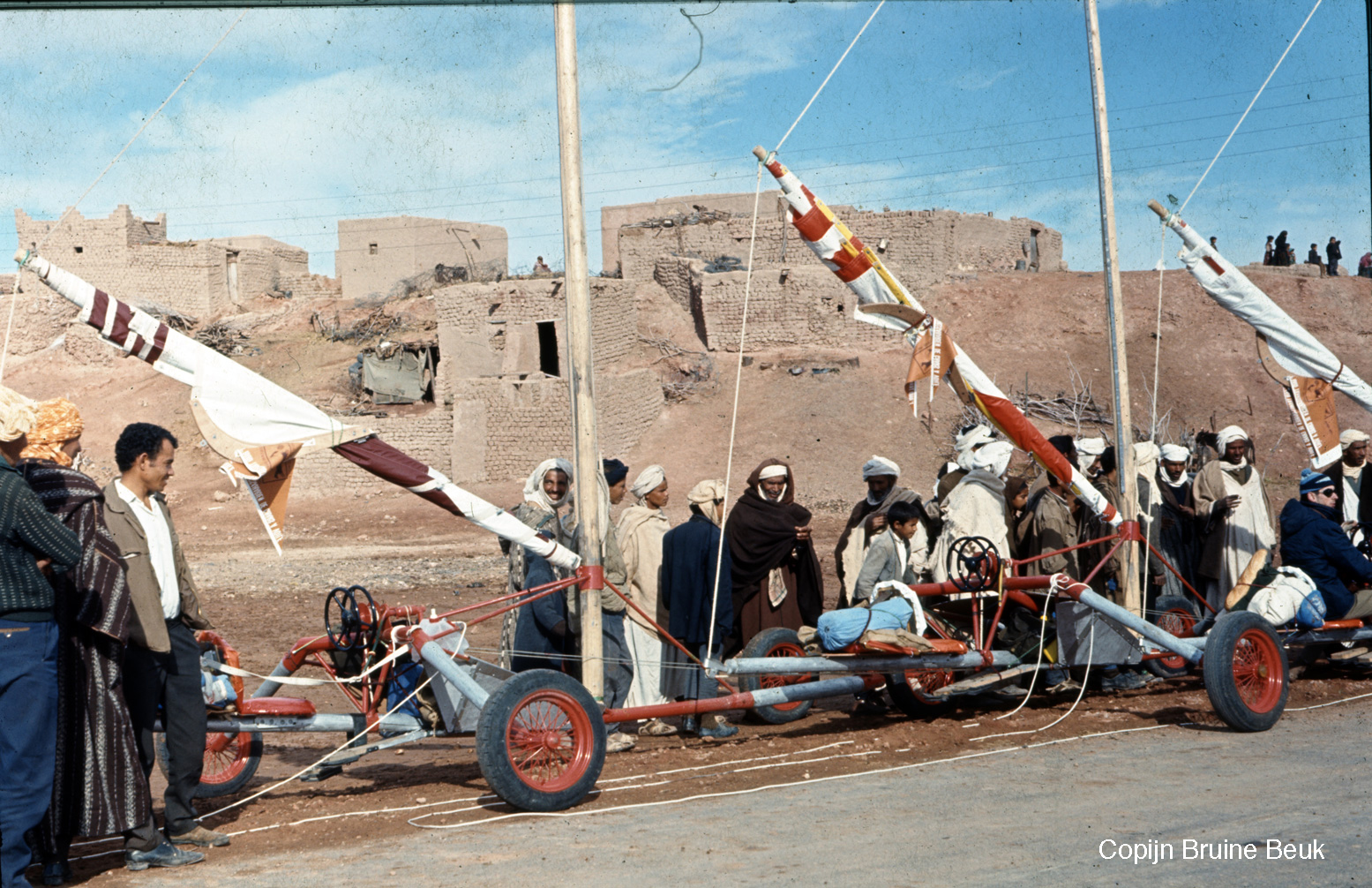
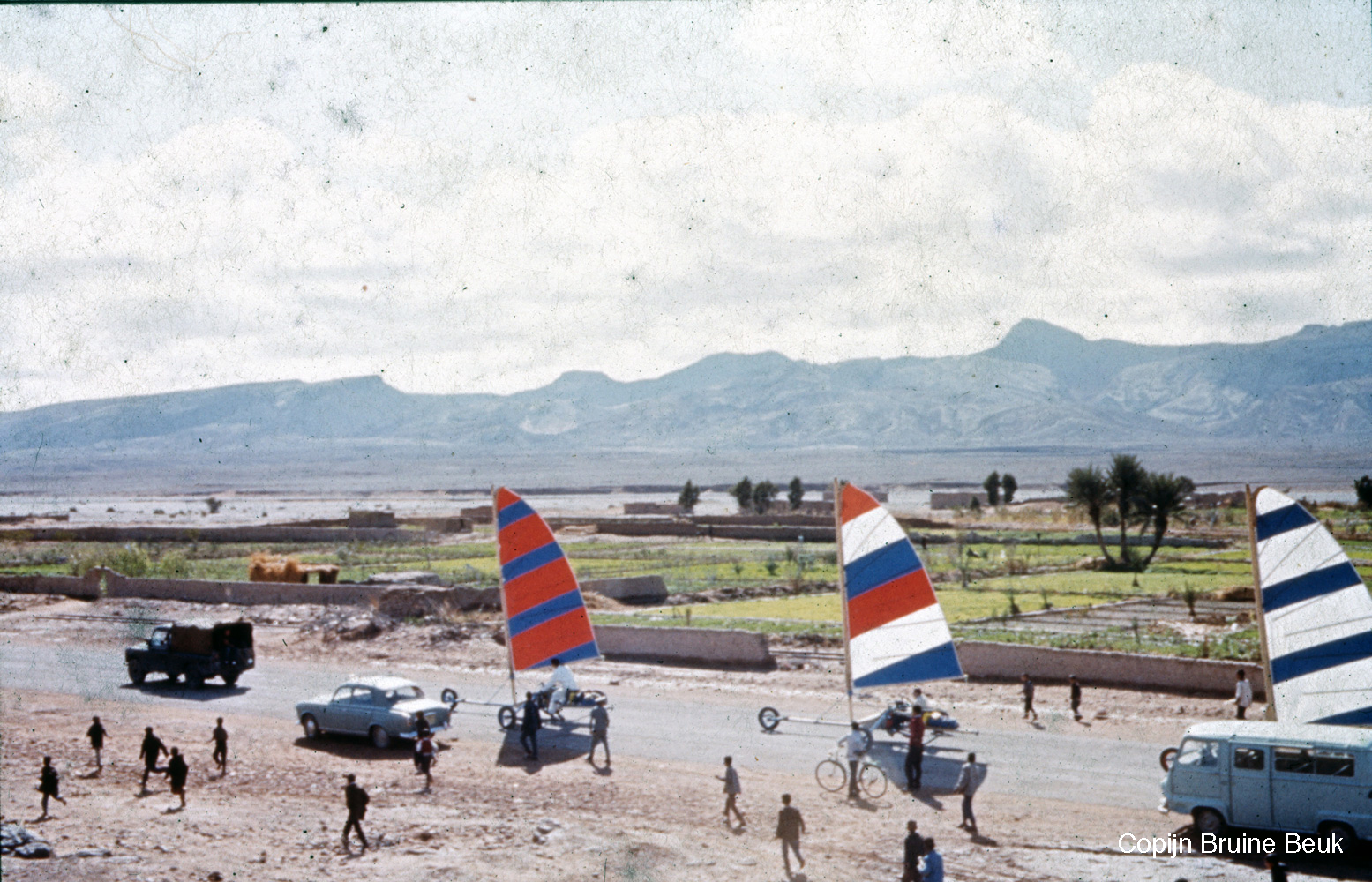
Thanks to Dutch participant, Copijn Bruine Beuk for turning me on to this little-known story and sharing his own pictures of the event (below). Besides hundreds of punctures, as the article recalls, early on Copijn had a close shave with an overhead electricity wire – luckily it wasn’t live. The same happened to a few others who ended up with snapped masts. Once it gets going, a land yacht can hit 60mph or more, but back then brakes added up to little more than a hinged footboard you pressed into the dirt (left), like pressing your feet on the ground to slow an out-of-control pushbike. So you can see why half the field DNF’d. Other hazards included side gusts blowing a land yacht over – February-March were chosen as the time of the strongest northeasterlies. Note also the twin steering wheels: one to steer the front wheel and the other to adjust the sail’s trim: pressing on the footbrake for all your worth, that’s quite a lot to think about when hurtling towards a steep oued bank or into a small dune field. Makes desert biking look positively benign!
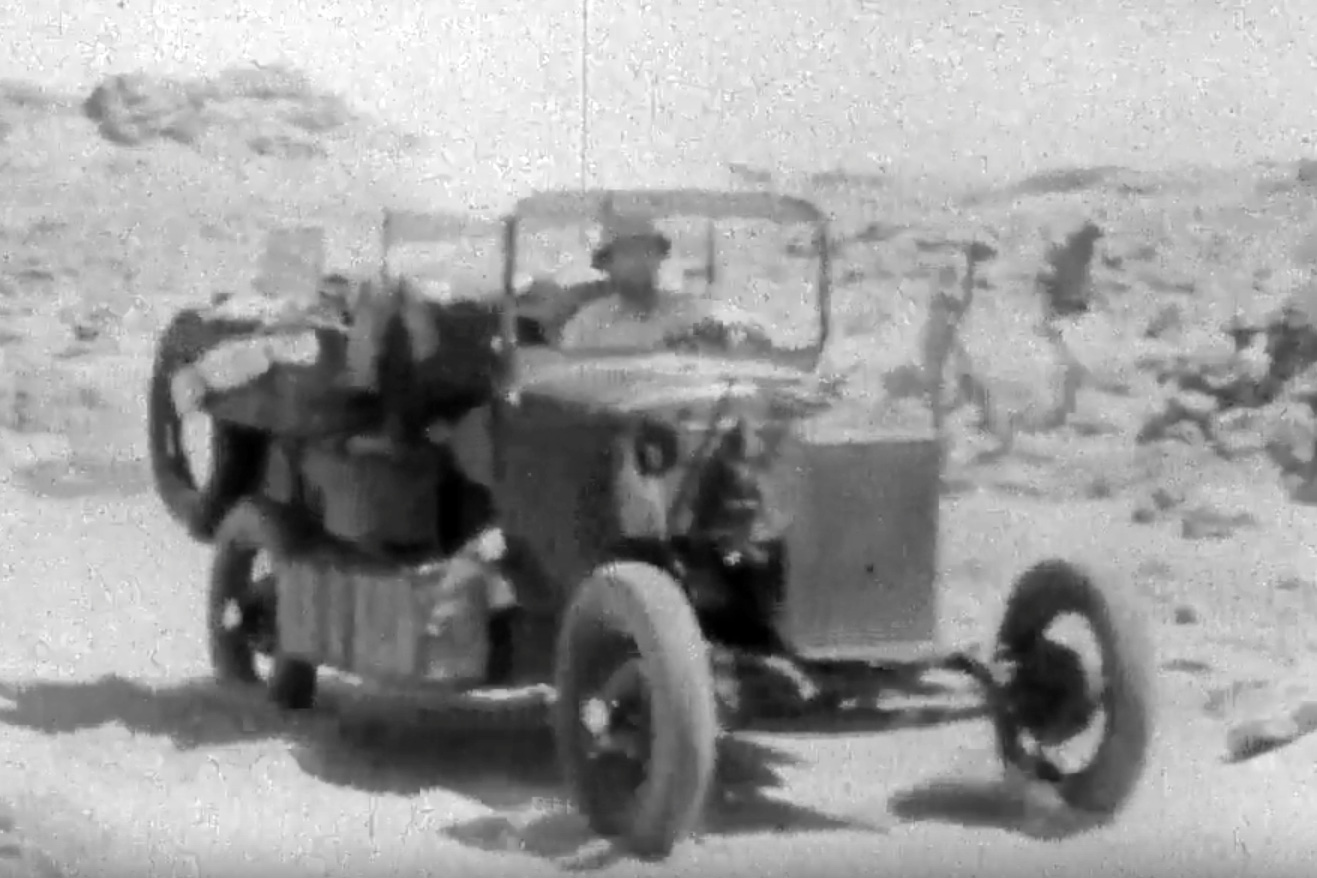
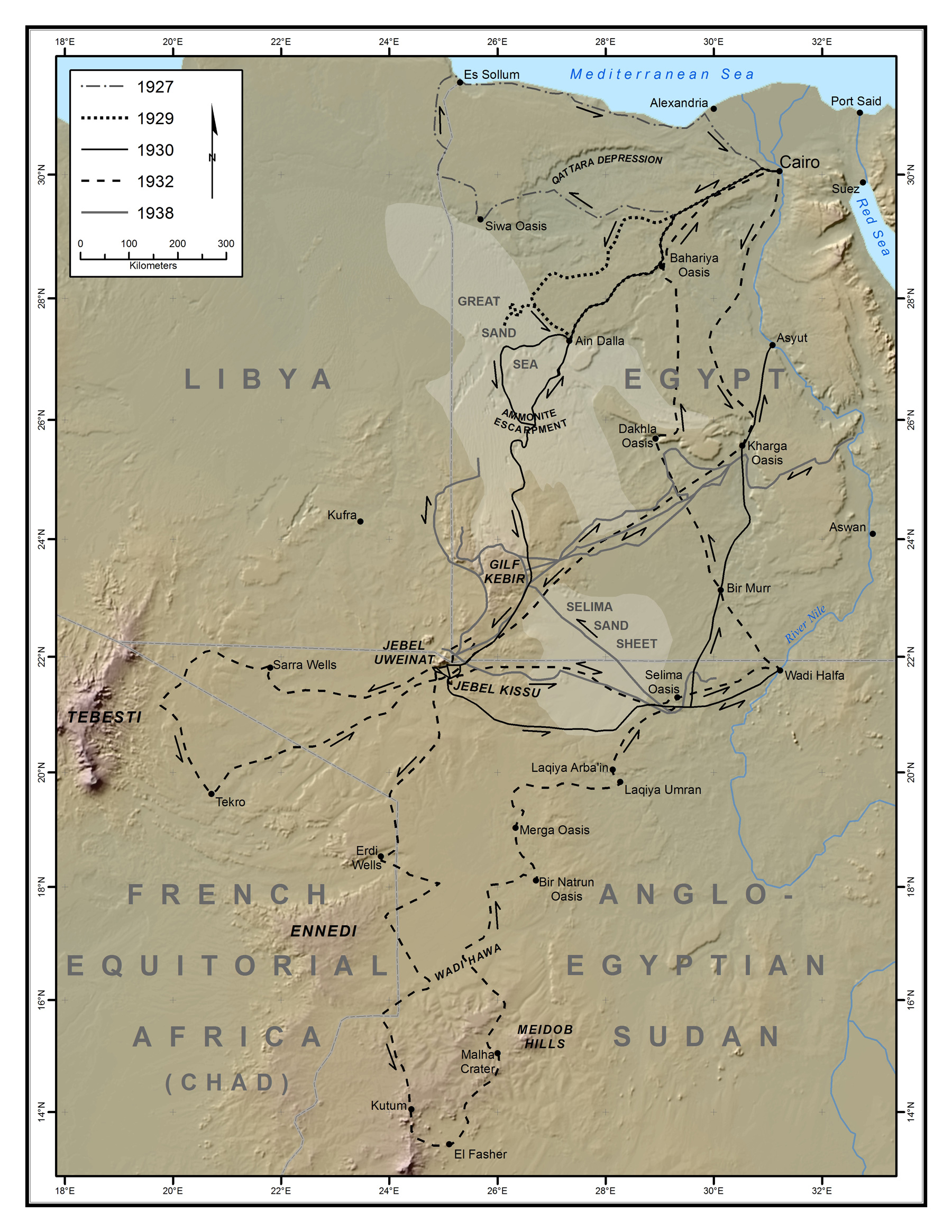
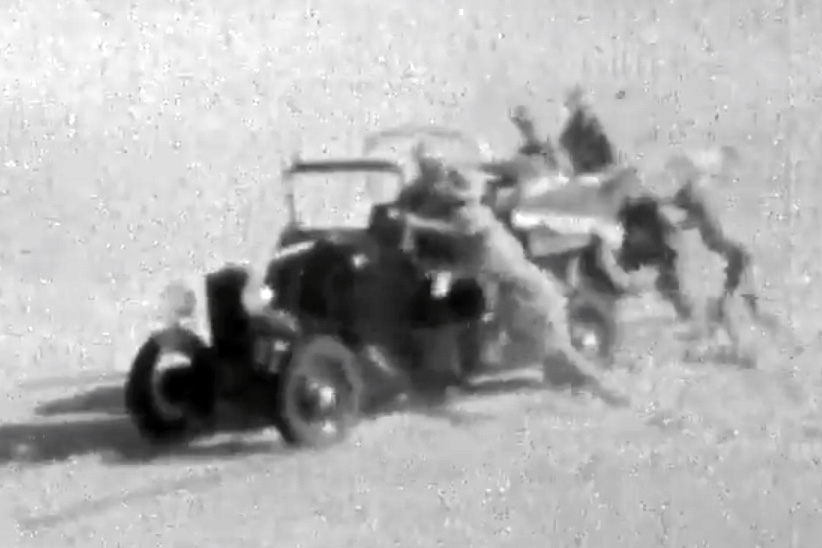
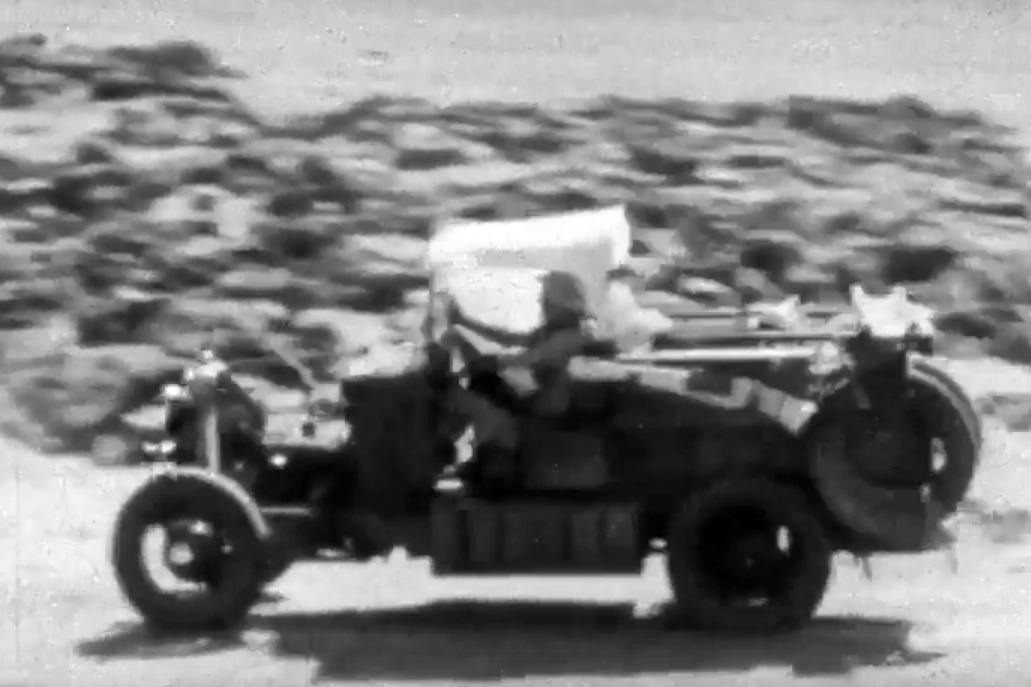
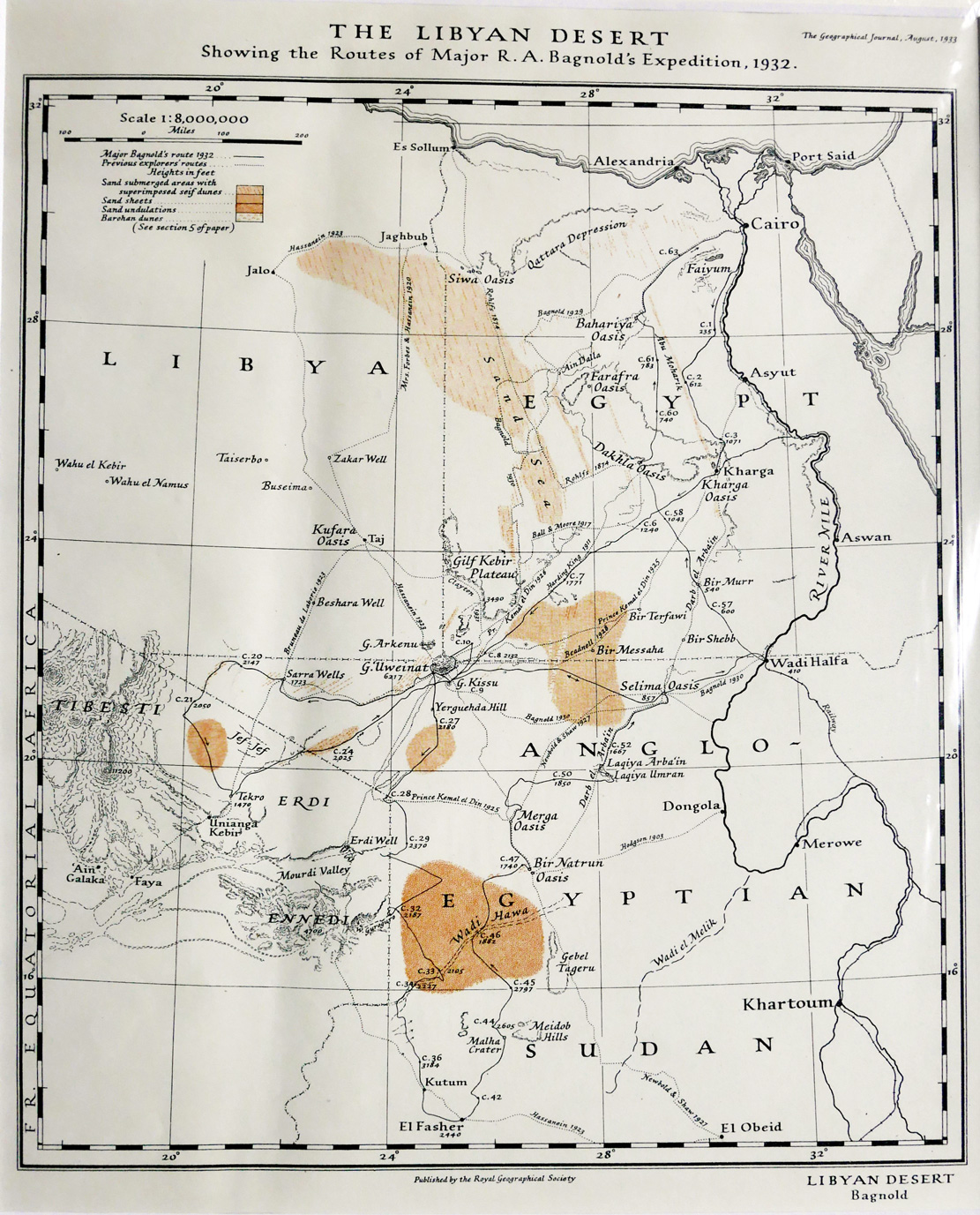
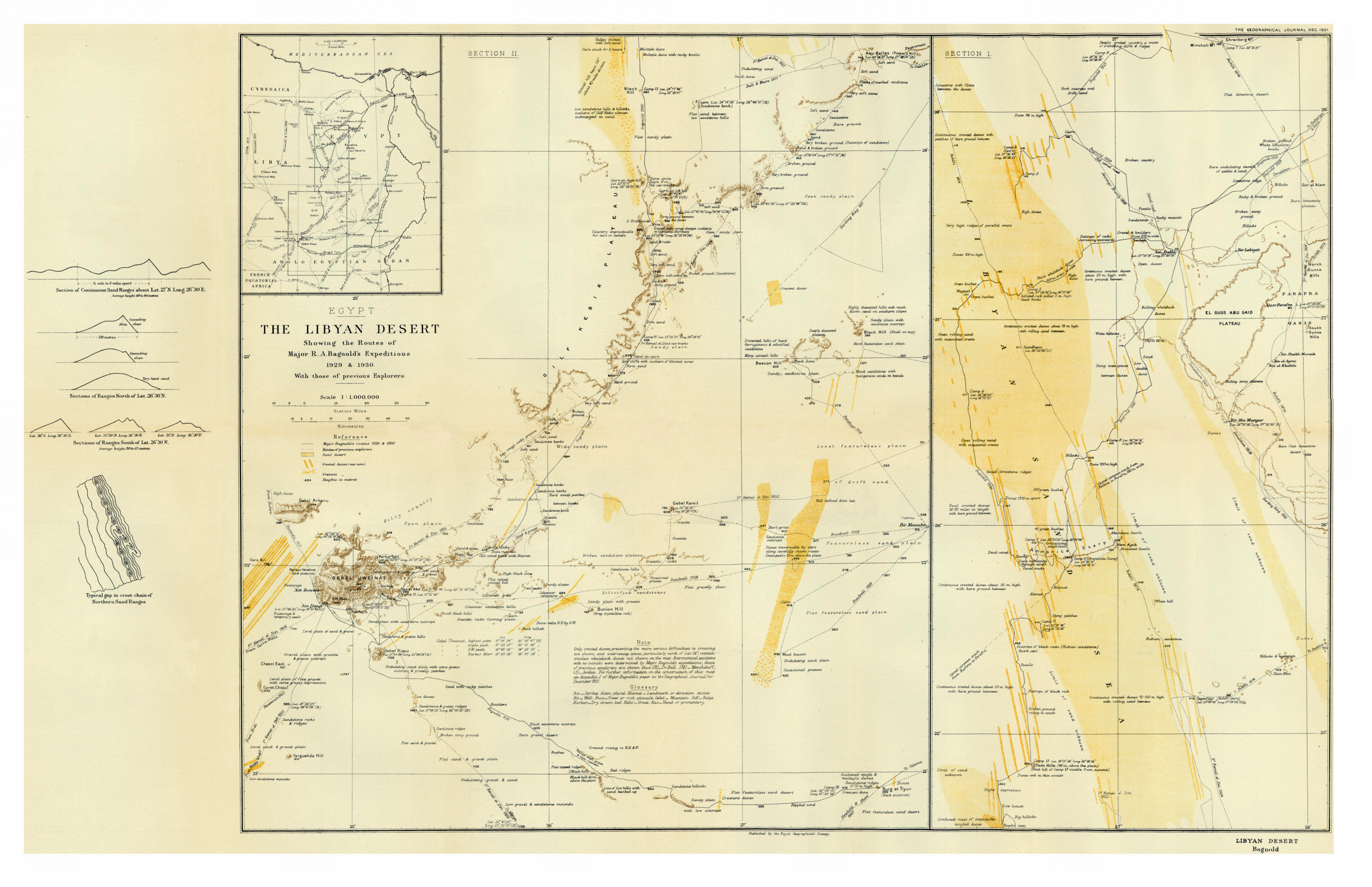
A few months ago the British Film Institute released an archive film of the early motor expeditions of Ralph Bagnold and his crew, exploring deepinto the Libyan Desert. (Click BFI if youtube below gets deleted). The map below shows all his expeditions in the 1930s, and there are more, original maps further down.
The 49-minute-long film describes the original recce in 1929 into the Great Sand Sea of the Western Desert via Ain Dalla spring. It was here that Bagnold’s group found lowering tyre pressures, as well as using sand plates and rope ladders, enabled heavy vehicles to traverse soft dunes.
A year later they set off towards Jebel Uweinat, a massif located by Ahmed Hassanein less than a decade earlier during a camel trek along Libya’s eastern borders. At Ain Dalla camels brought in extra fuel, and the cars continued to Jebel Kissu in today’s Sudan and south of Uweinat, then east for the Nile via Selima oasis.
In 1932 they based themselves again at Jebel Kissu where they refuelled from Selima, then explored the Sarra Triangle (now in Libya) as well as northeastern Chad.
Heading south to El Fasher, they passed herds of ostrich and oryx, since shot out by rifle hunters, before heading north for Merga, back to Selima and home via Wadi Halfa for a tot of rum.
The maps on the left and below show the routes of all these trips and Bagnold’s book, Libyan Sands (right) covering all these expeditions and more and is well worth reading. Reviewed here. Short bio of Ralph Bagnold.
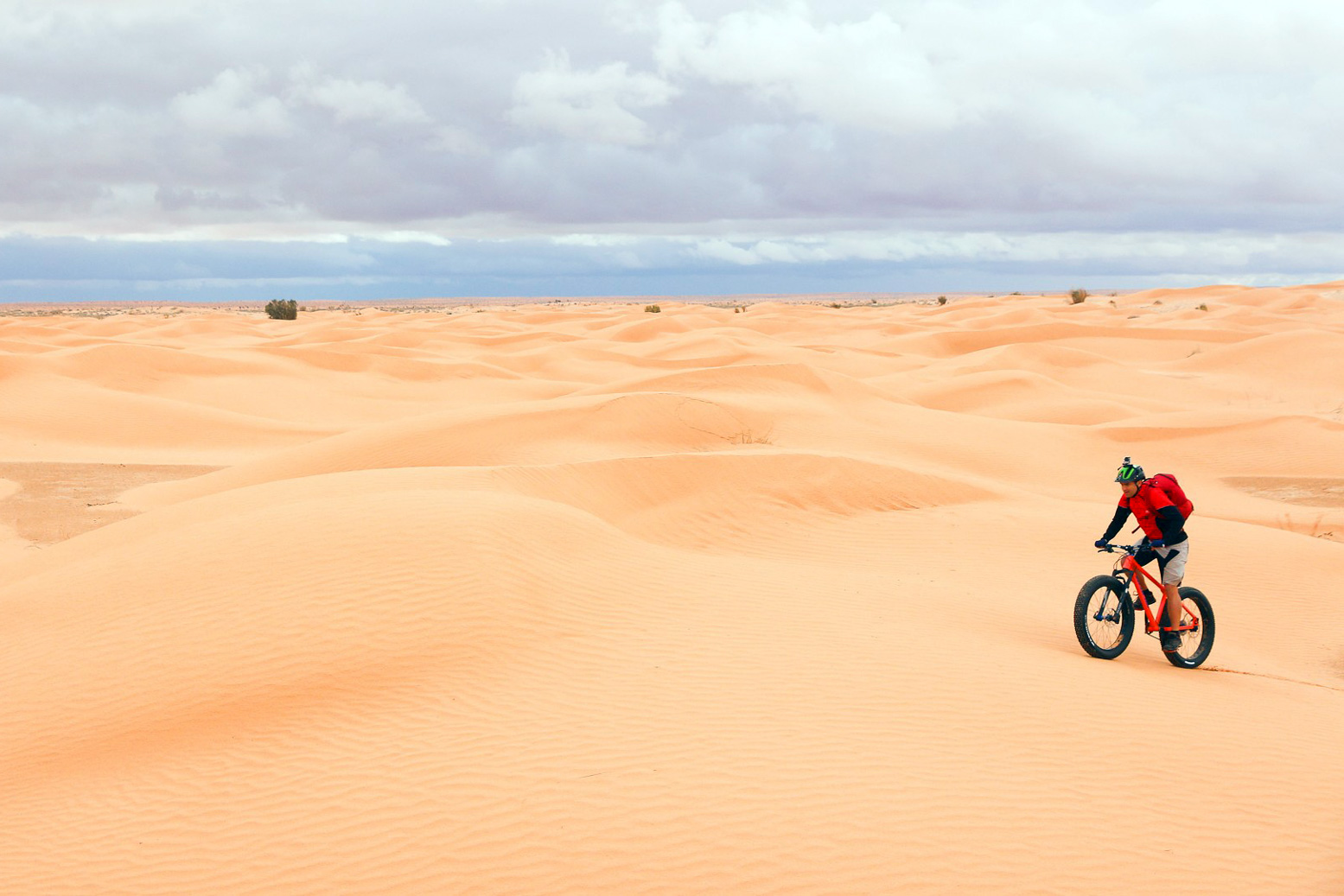
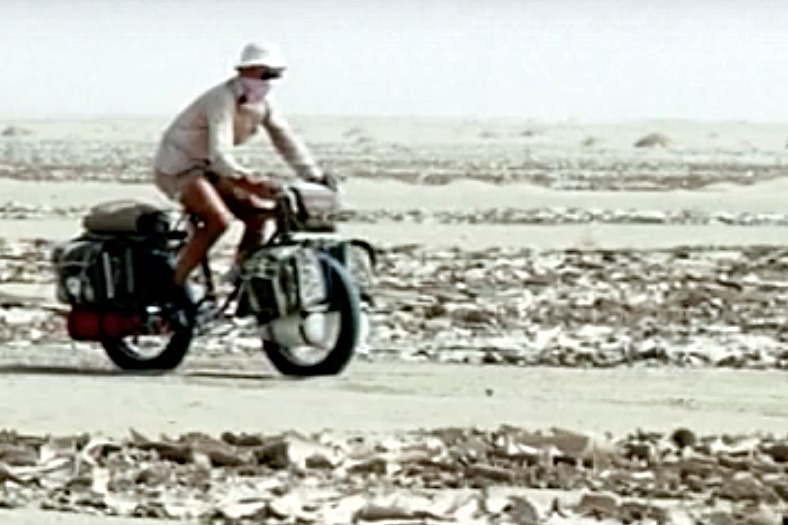
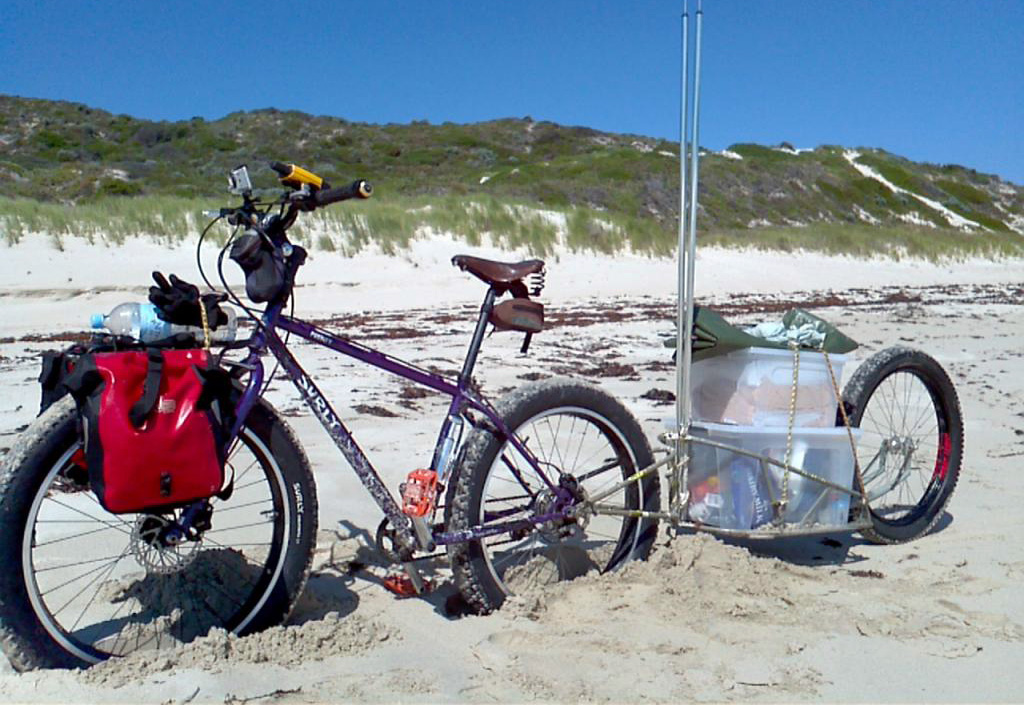
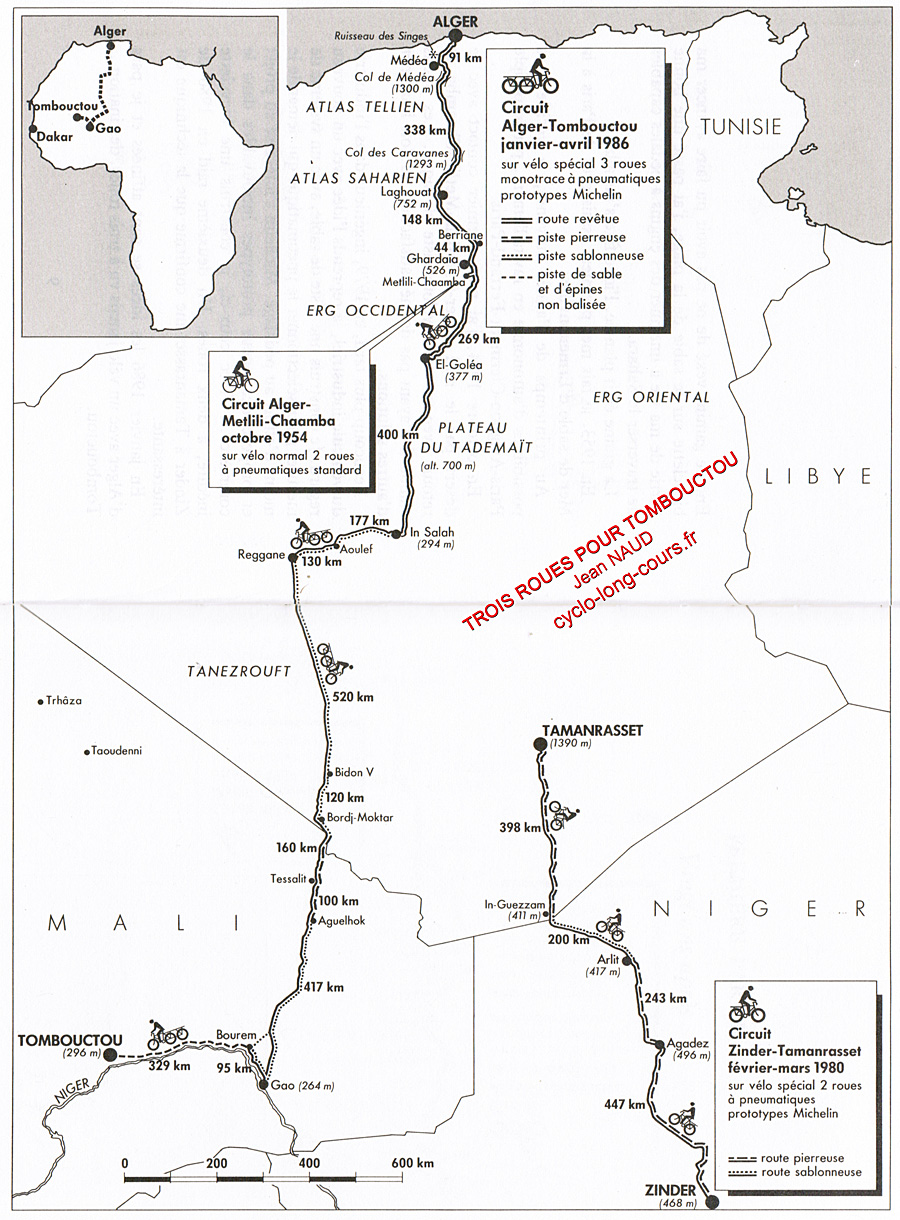
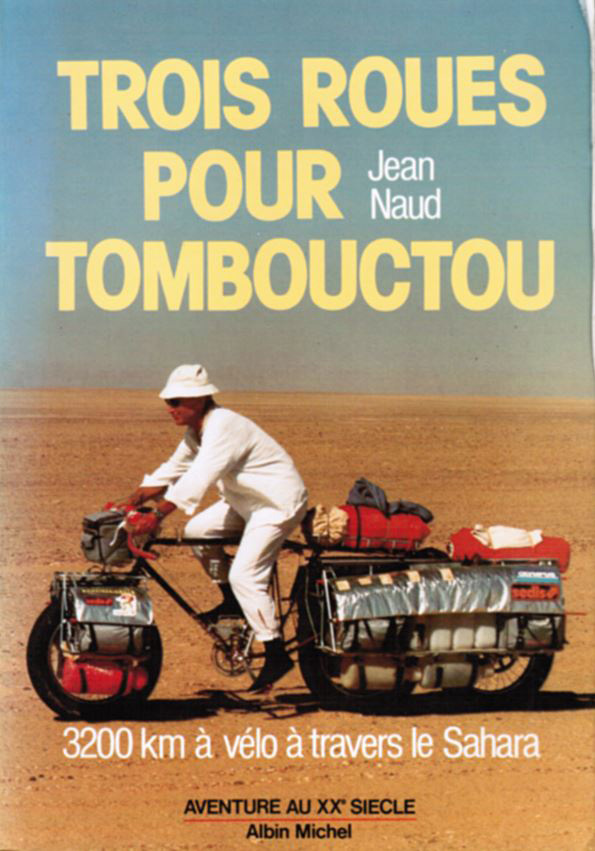
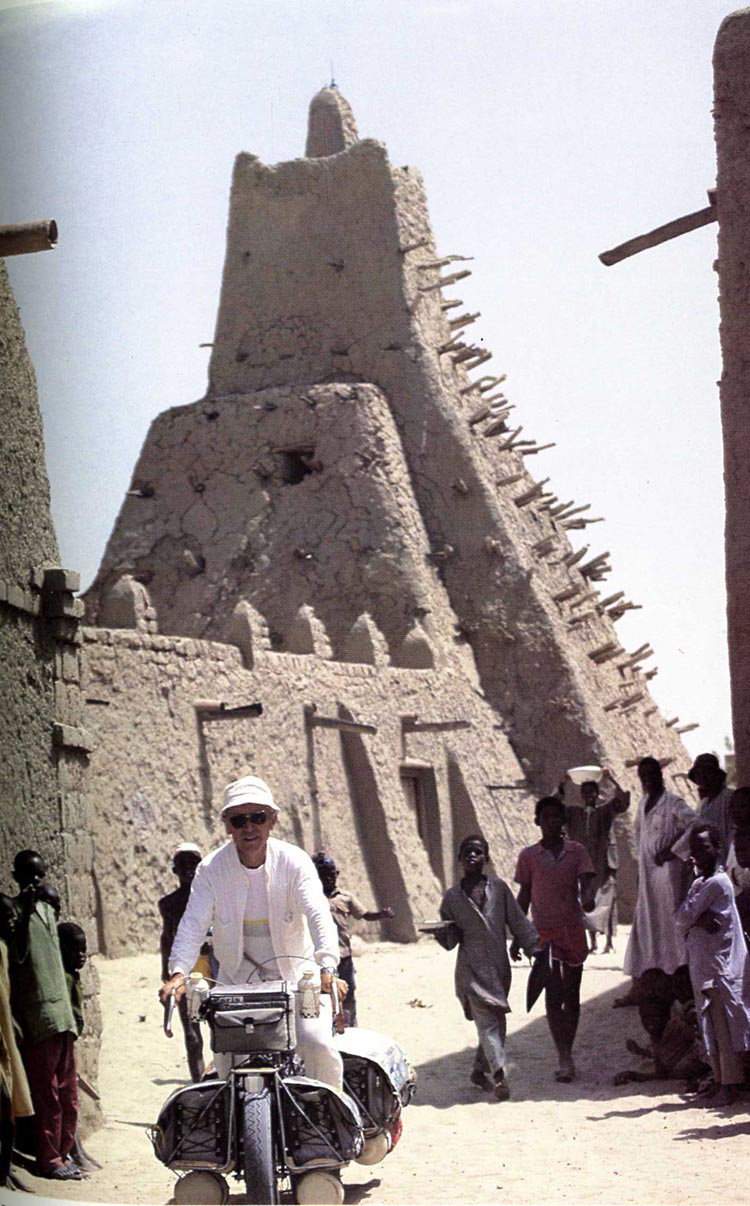
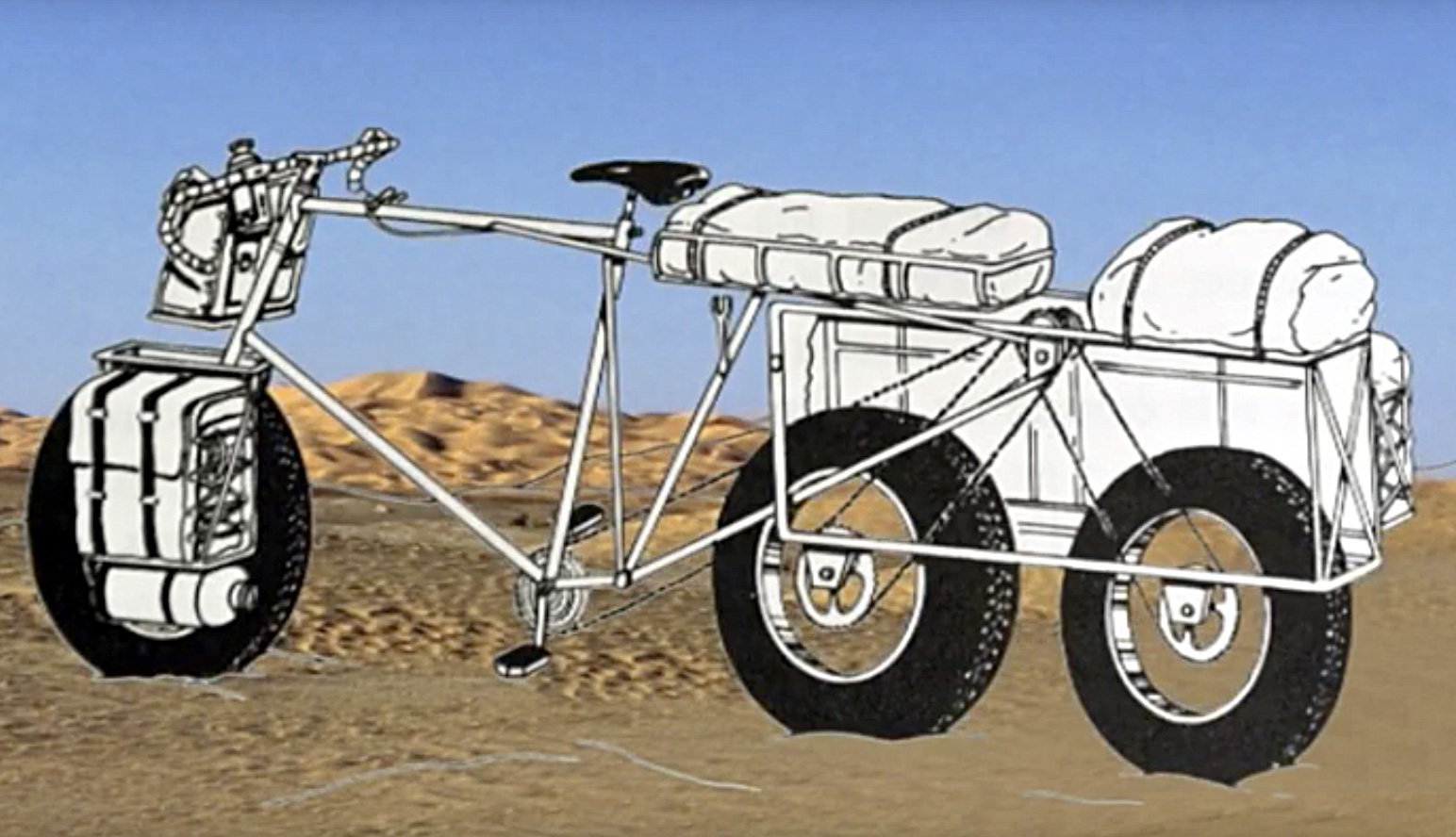
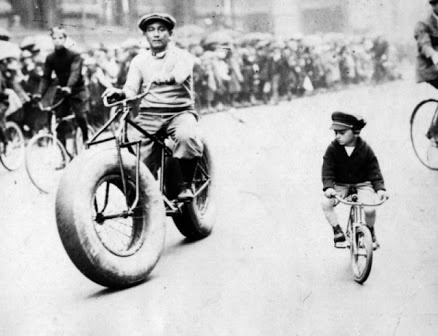
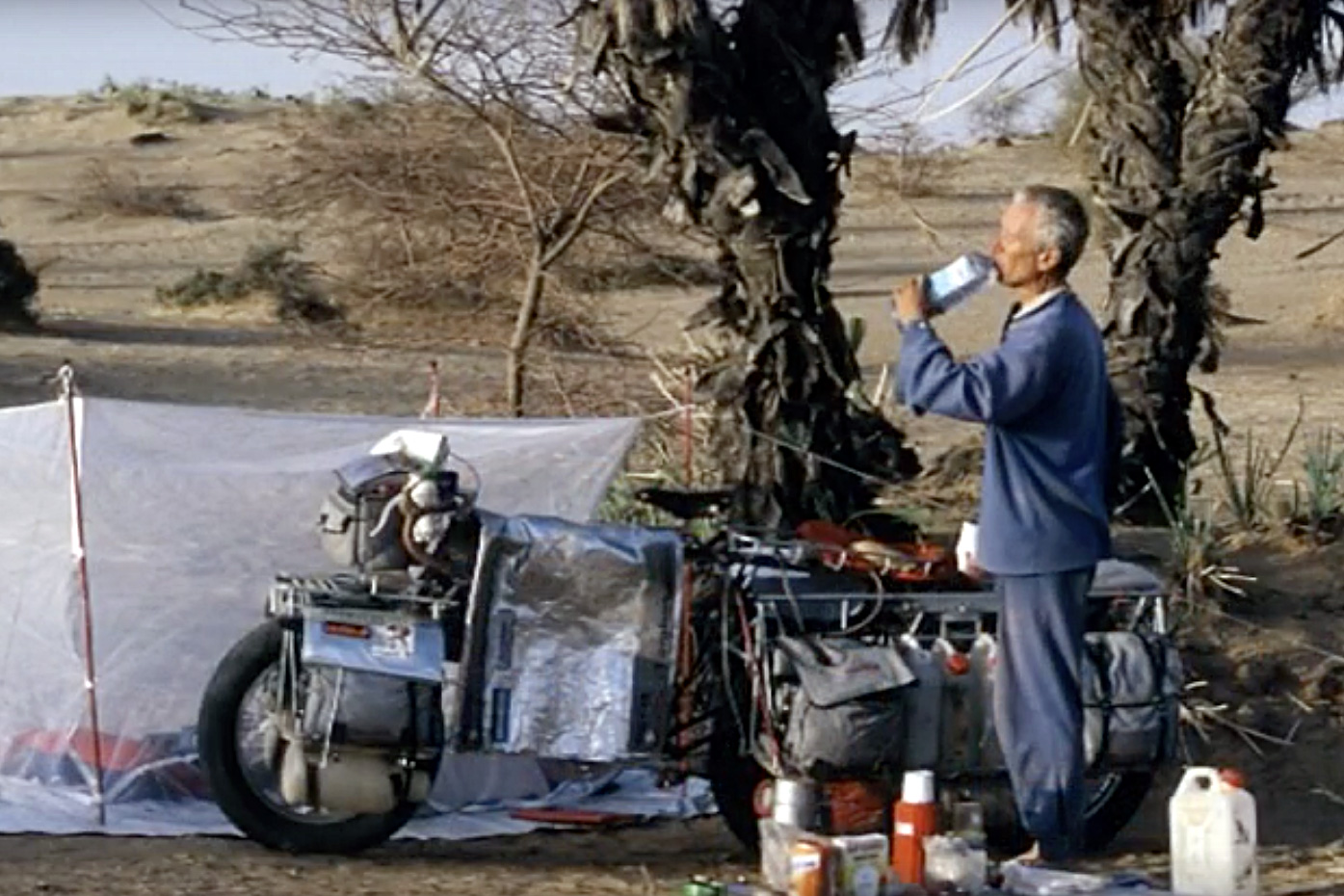
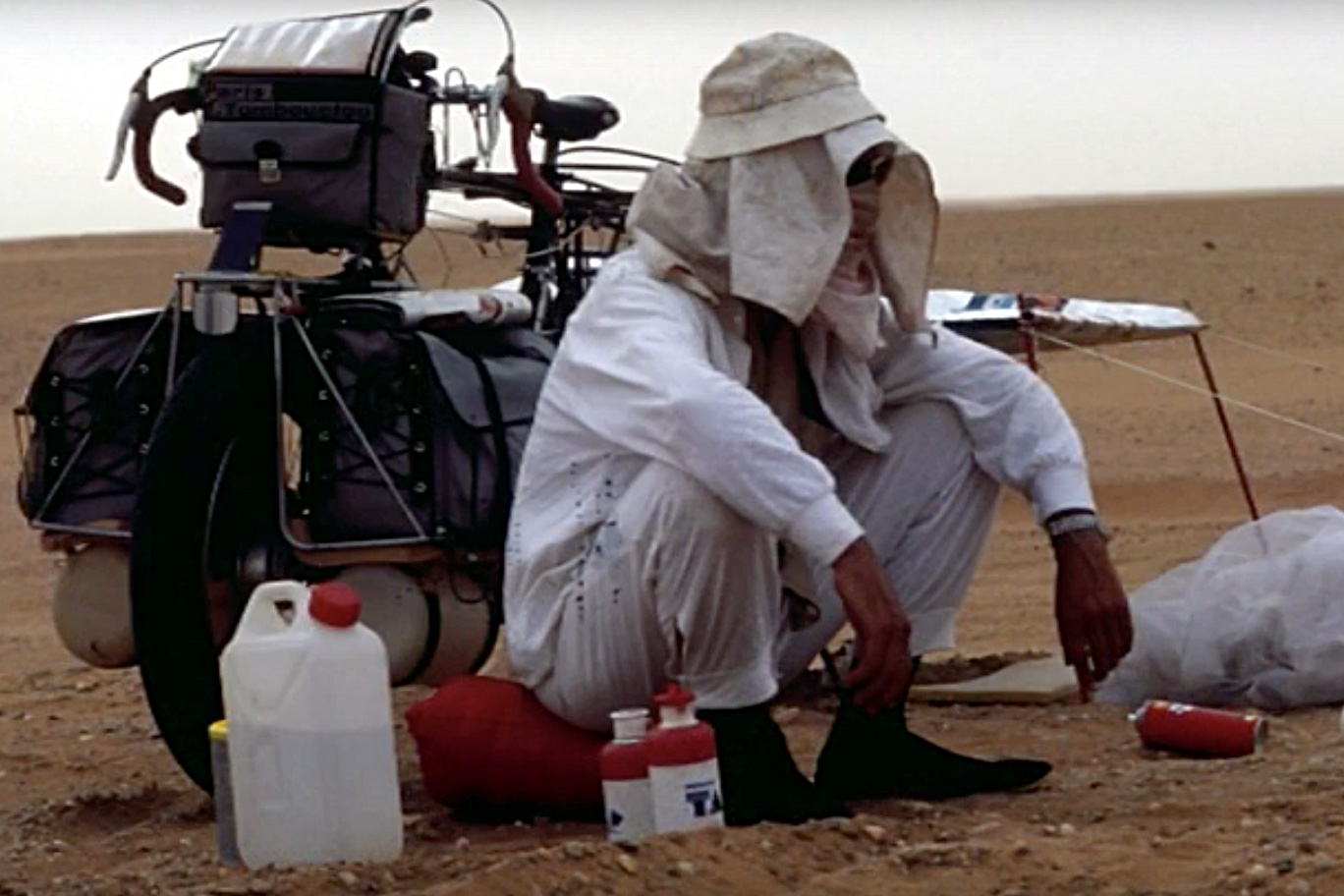
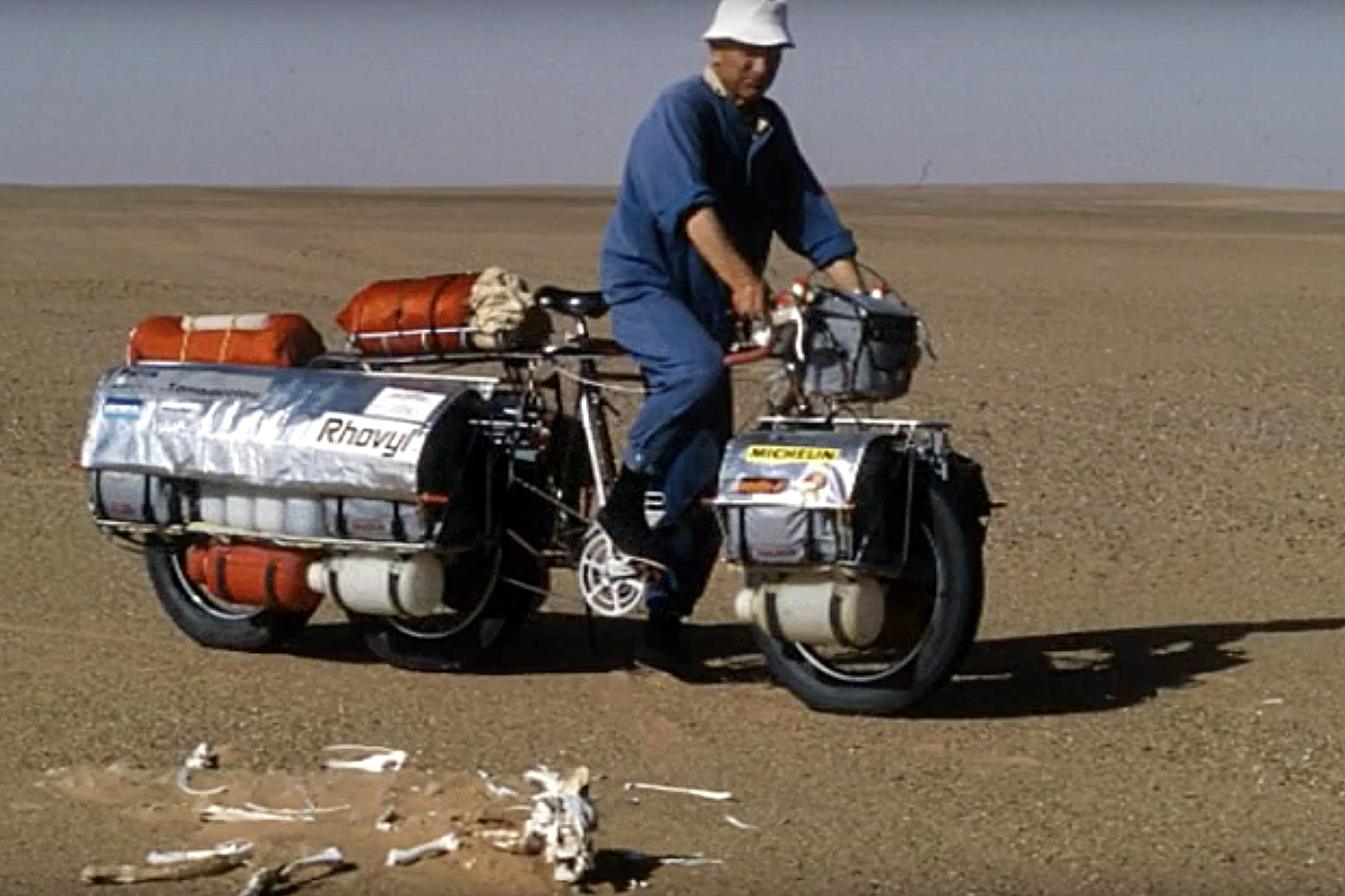
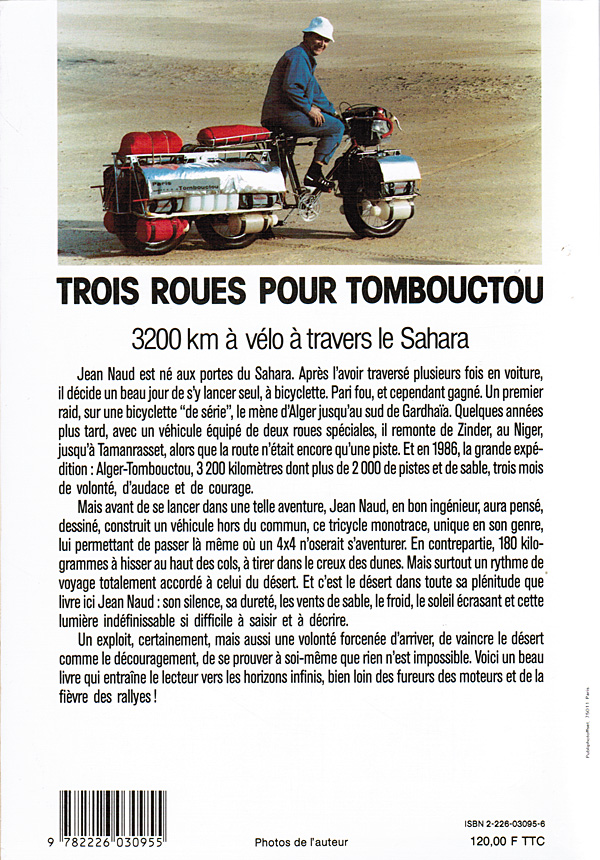
In 1986, long before the current fat-bike fashion (left), Jean Naud, a 55-year-old Frenchman set off to ride his three-wheeled bicycle 3200-km across the Sahara from Algiers to Timbuktu.
Brought up in Blida, just south of Algiers at the foot of the Atlas mountains, Jean Naud had made two previous cycle tours in the Sahara. Once, as a 23-year-old way back in 1954, from Algiers as far as Ghardaia where he was born in 1931. And another in 1980 (below) from Zinder in Niger, north via Agadez and across the Sahara to Tamanrasset – a distance of some 1300-km. This time he was riding a bike running prototype, low-pressure Michelin fat tyres. At that time this route would have been just about all piste, but he recalls passing some Brits stuck in the sand near the Algerian border in their Peugeot 404, as he cycled silently past.
Although the Sahara isn’t all a wasteland of soft sand dunes, the thin tyres of a regular bike would easily sink or damage the rims on rocks under the required loads needed for desert travel. I’ve met the odd cyclist in the Sahara. The big problem with off-highway pushbiking is the load needed to maintain autonomy, not least, water. On a conventional bike it’s barely possible without relying on passing traffic, because the tougher the terrain the greater your water consumption. Even in winter in the central Sahara, I’d guess you’d need five litres to cover about 60 kilometres on a sandy piste. And that would be a long day.
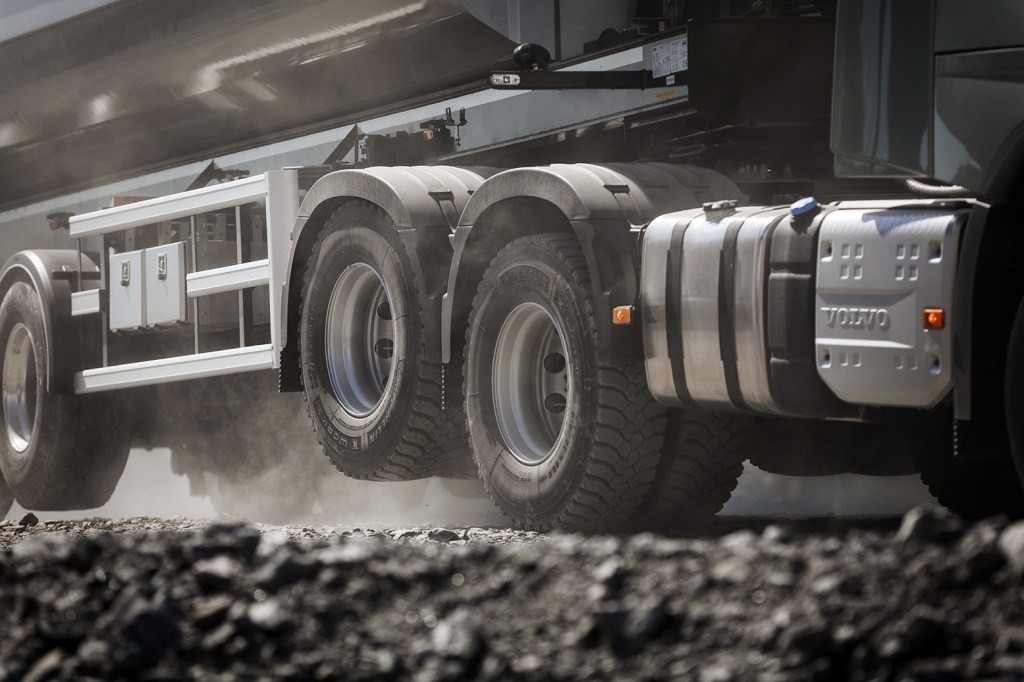
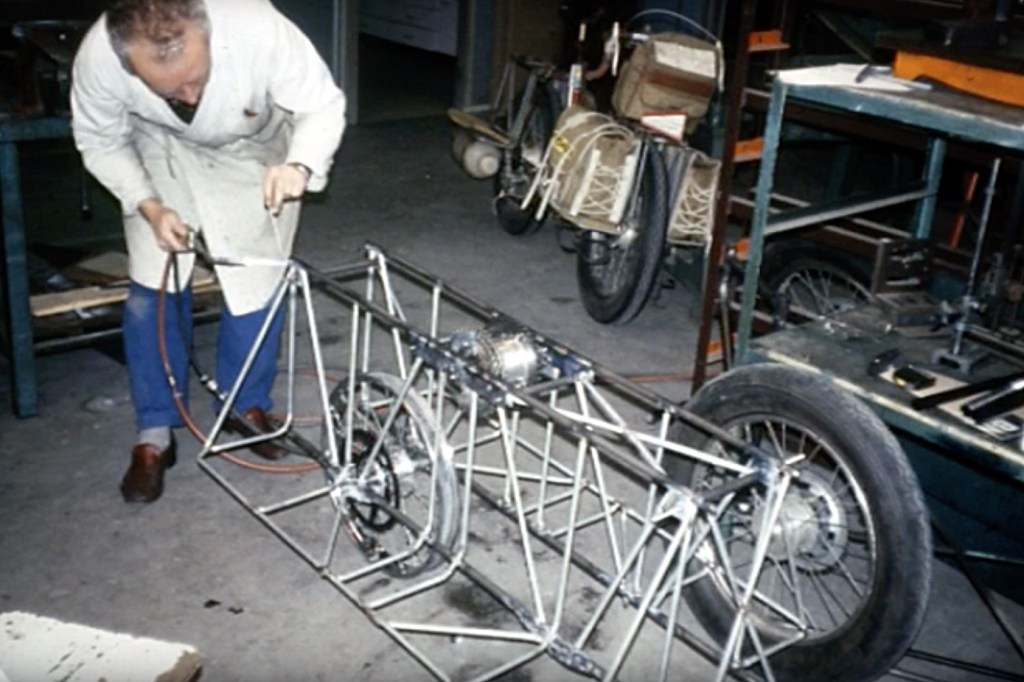
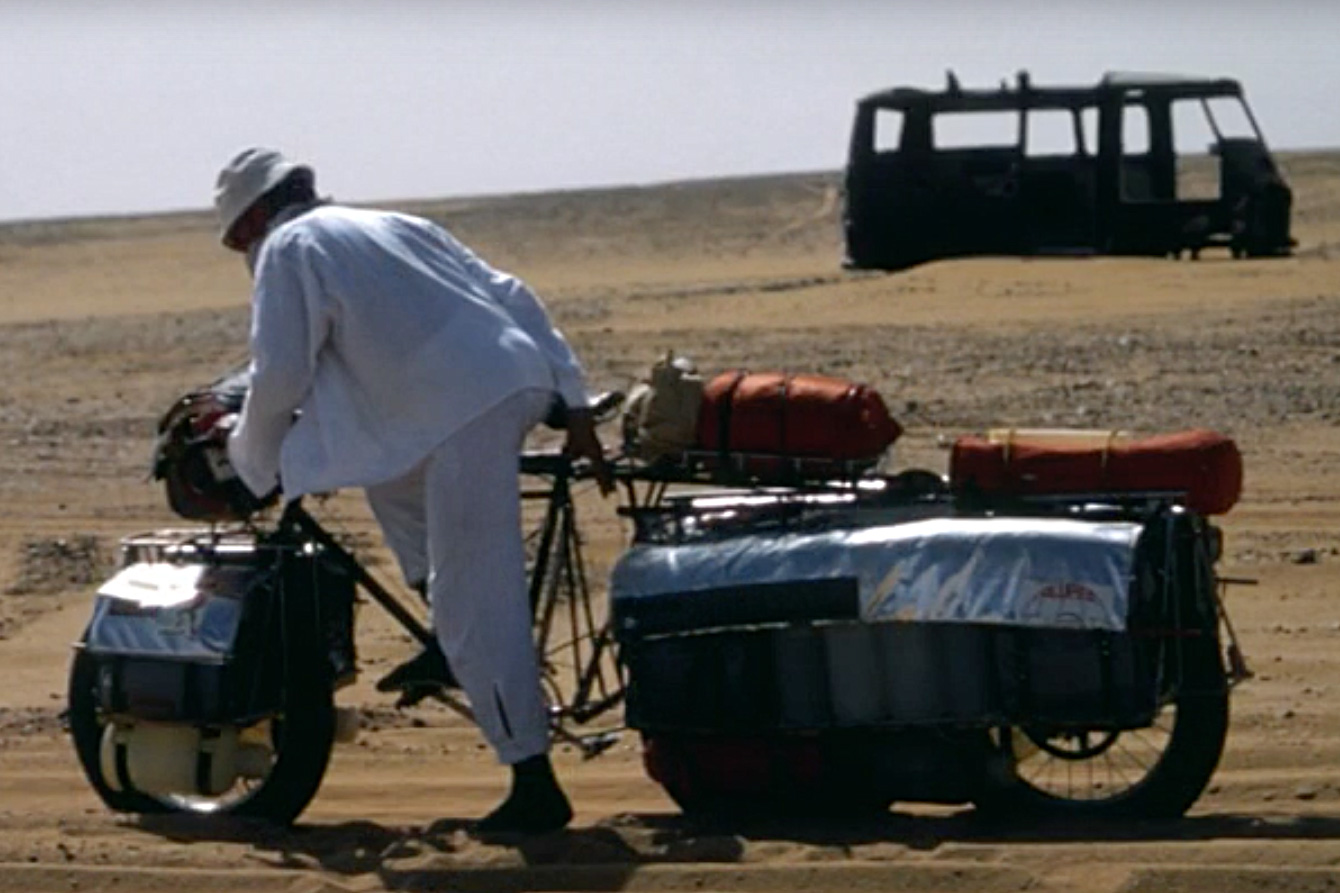
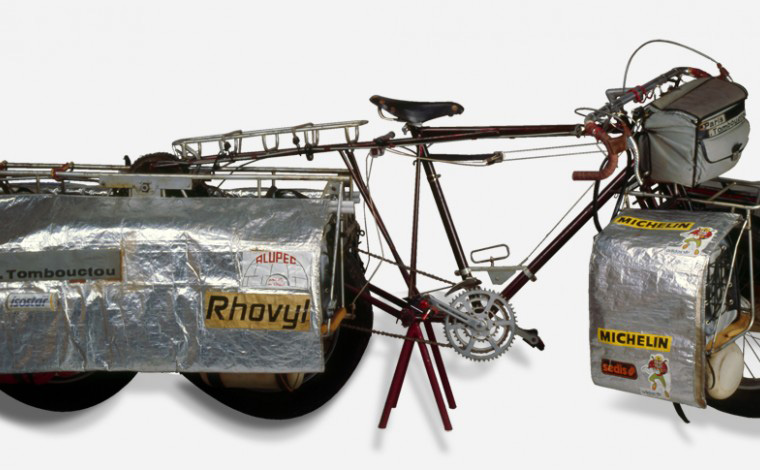
An automotive engineer, Jean Naud’s initial solution was to run fat tyres in 1980 in NIger. This time he added a second driven rear wheel to improve traction and aid flotation at pressures as low as 7psi. He then went one step further and devised a hefty hinged subframe (above) which could both raise and disengage drive from the middle wheel to reduce the drag and pedalling effort on firmer surfaces, or when running lighter loads. Mechanically, disengaging axles (as well as hubs) was commonly done on pre-electronic 4x4s in the 1980s, for the same energy-saving reasons. And today on lorries we commonly see lifting axles.
Using the modern Bob trailer on a fat bike (left) is a similar and probably more efficient solution. The added effort in towing the loaded-down third wheel, rather than powering it as Naud’s 2WD bike could have done, is negated by the weight savings and the lower centre of gravity. You get the feeling Naud was merely experimenting with novel engineering solutions, as he discusses in the video below.
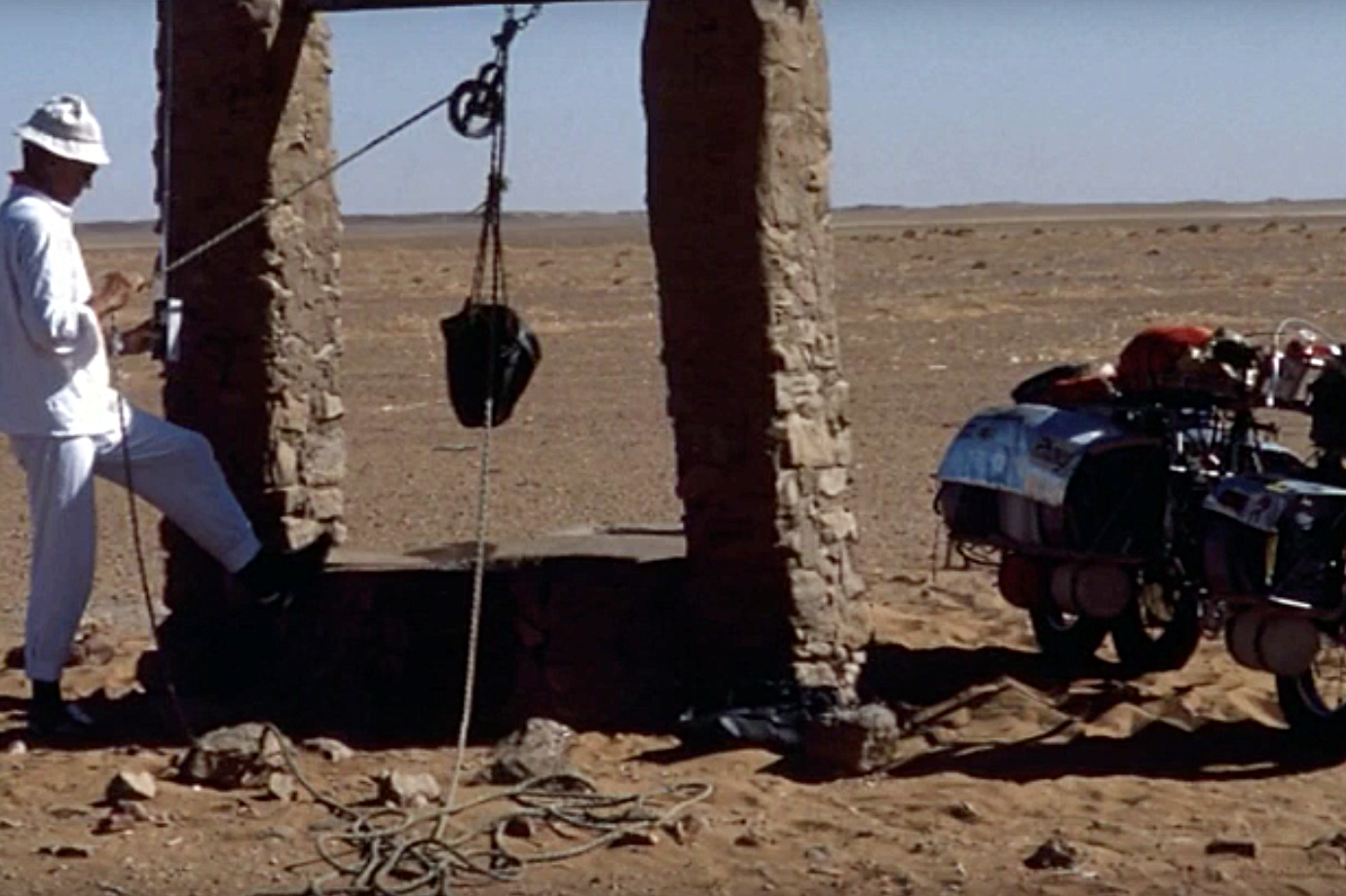
Naud’s three-wheel ride to Timbuktu (below) included at least 2000-km of piste. The route he took to the Mali border across the Tanezrouft is actually a firm gravel plain, about as easy surface to ride or drive as you get in the Sahara. Naud reckoned 20kph was easy. Beyond that, it gets progressively rougher and sandier down towards the Niger River and, having ridden it on a moto in 1989, it’s hard to believe he managed to cycle the final section west along the Niger’s north bank to Timbuktu. It’s very sandy.
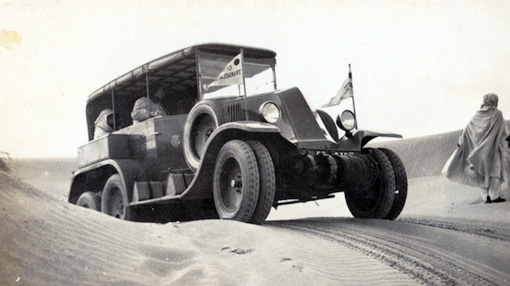
Even then, the Tanezrouft was the preferred route of the earliest Saharan motor crossings from the 1920s onwards by Citroen and Renaults (left; also using a ‘double-wheel’ idea to spread loads). The only problem in Naud’s time, was the Tanezrouft route lacked regular wells compared to the sandier but shorter Hoggar Route which Naud rode in 1980.
After visiting his childhood home in Blida, early in the trip while still unfit, it took Naud no less than eight hours to cover 14km on the climb to the 1300-m Col de Medea where the N1 tops out in the Atlas, before descending to the Saharan peneplain. Once fully loaded with 72 litres of water and another 60kg of gear, his 50-kilo monotrack three-wheeler weighed in at 180 kilos. That’s at least three times more than a modern touring bike, or five or six times heavier once fully loaded. Or, about the same as a small lightly loaded motorcycle ready for the desert. Imagine pedalling that!
Jean Naud died in 2011 aged 80. You can find his 1987 book covering all his Saharan cycling adventures, on amazon France.
His bike may still be on display at the Museum of Sport in Paris
This review was originally for Garmin’s2016 Topo North Africa v3 Light map and compared it with easily downloadedfree OSMs, Garmin’s basic global base map and other digital maps, where available. V5 was the last version in 2023 still a £20 bargain, then the priced jumped back up to £110 for the current ME&NA map which I suspect is little changed. At the current price I’d save your money
Navigating the Sahara Having used them since before the advent of GPS, I’ve got to know my Sahara paper maps well. Then, when GPS came along, I could pinpoint my position on a paper map with an accuracy that was more than adequate for desert travel. Some of these colonial-era maps such as the IGN 200s are cartographic works of art, and unlike current nav technology, in the deep Sahara topography changes at a geological pace. In other words: a paper map of the deep Sahara from 1960 may still be accurate today. Tracks may become roads and villages become towns and even cities, but the open desert itself remains relatively unchanged. Is there a benefit in having a tiny map on your GPS rather than simply a waypoint to aim for or a tracklog to follow, even if your position on the map is displayed live? That’s essential for navigating a busy city with a Nuvi, but the Sahara is more like the sea where more often what you want is…
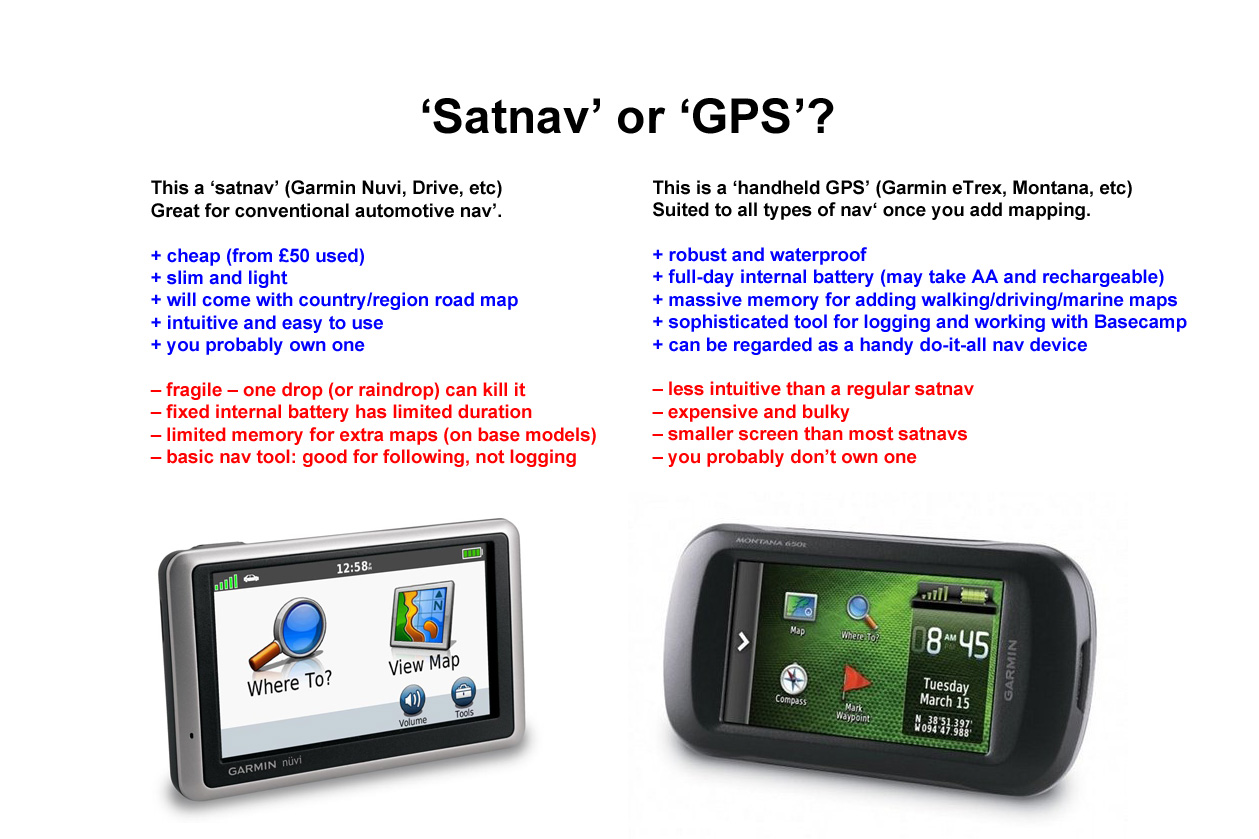
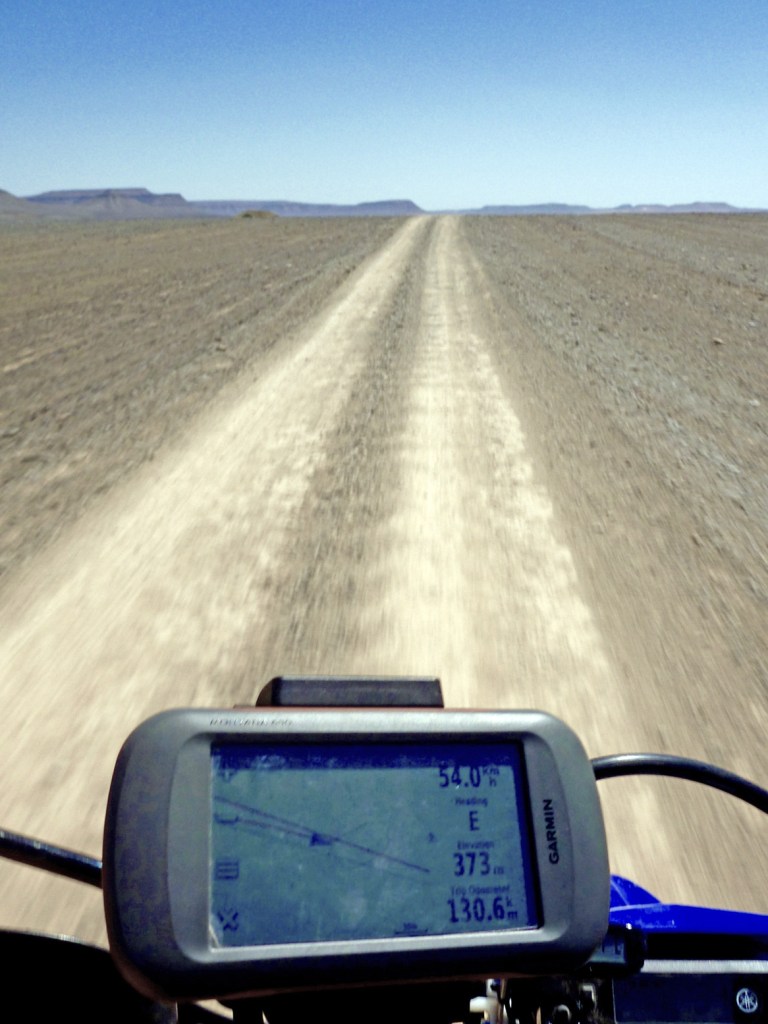
… the big picture A typical handheld device like my Garmin Montana (left) has a screen a little bigger than a playing card and which is hard to read on the move – especially on a bike. For me a ‘GPS’ (as opposed to a ‘satnav’ like a Nuvi – see below) is best at displaying simple data like how far, how fast, how high or which way, not fine topographic detail. A paper TPC map can display six square degrees over some 18 square feet – what you call ‘the big picture’. That’s what you need travelling with a vehicle in an expansive area like a desert, while at close range concentrating on negotiating the terrain.
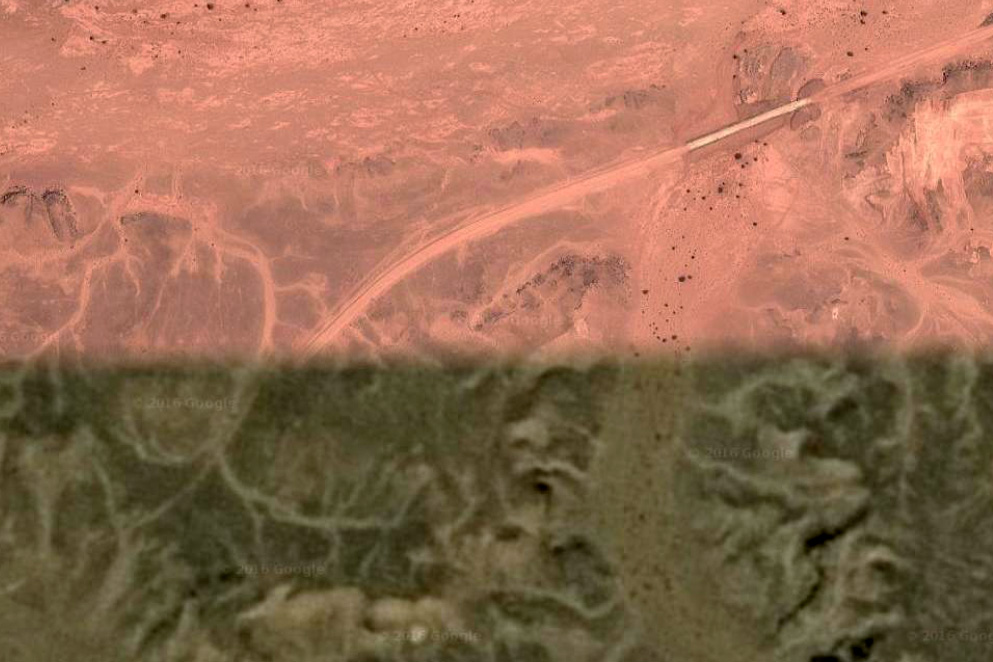
On top of excellent paper mapping (now widely digitised), we also have the wonder of Google or Bing sat imagery (Bing was often better, now Garmin have the edge) providing a clarity that varies from stunning (being able to trace car tracks) to a brown mush (both shown left). Google sat is great when planning, and now for a reasonable annual subscription, Garmin offer Birds Eye satellite imagery for the whole globe; the long-sought after ‘Google sat in your GPS’. With all these resources navigating in the Sahara couldn’t be easier.
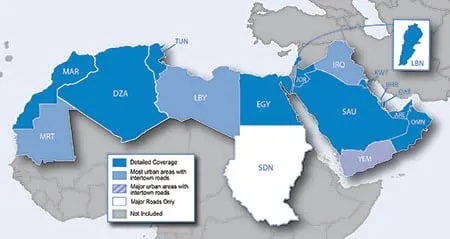
Garmin Topo North Africa v3 Light (now ME&NA, see above)
Current ME & NA coverage
Short version Even though in 2021 old Olaf from 2009 still measures up well, the similar topographic detail of the Garmin means it’s well worth £20, certainly over the plainer, but also free OSMs. In 2018, following a refurb/repair of my Montana, the v1 2016 version of this map was lost or could not be reloaded. I had to buy the v3 version for another £20. A quick scan shows that not much changed, but if it has (based on OSM user updates), it will be in Morocco – the place where most users of this map will visit.
Long version You download the Garmin Topo map directly into your device (takes about an hour) and only when your GPS device is plugged into a computer, will it display on BaseCamp. Unplug the GPS and the map disappears from BaseCamp.
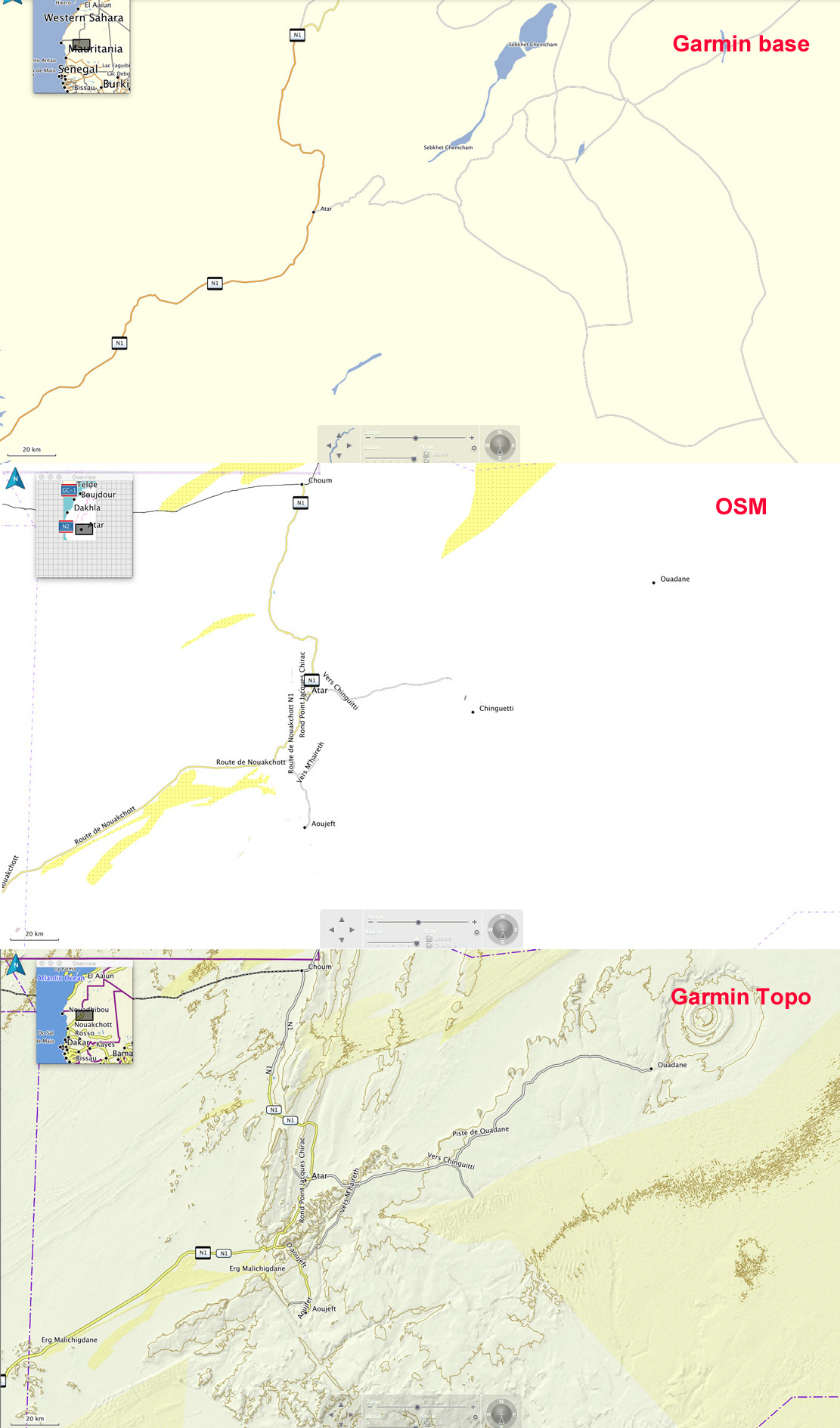
Switching BaseCamp between Olaf, OSMs and even the Garmin base map which comes free with a GPS unit, it soon becomes clear that the Garmin Topo has a level of detail and refinement that’s superior to the next best thing at the time: Olaf.
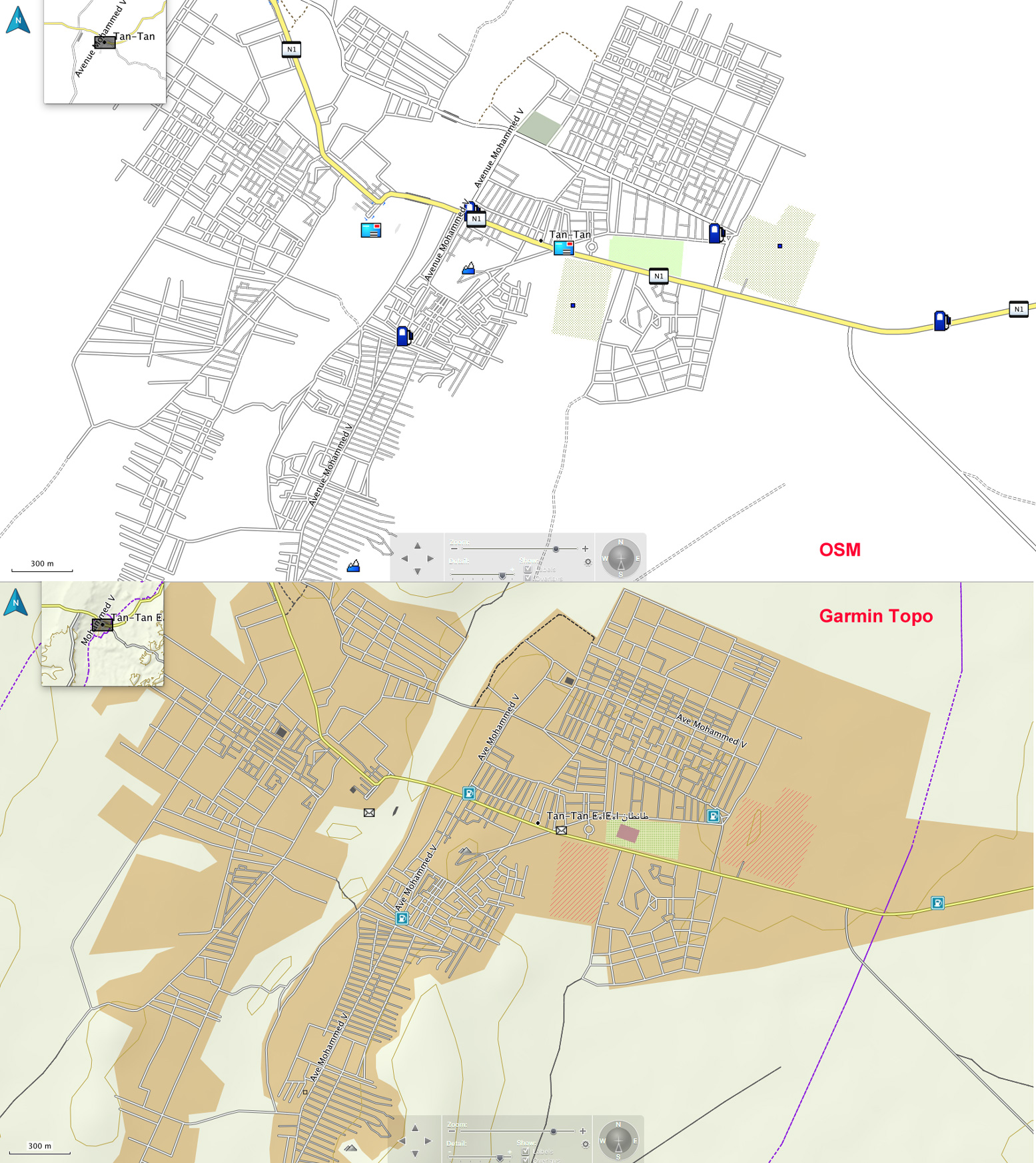
Occasionally at village level the OSM’s street-by-street detail is better, but that’s hardly vital. In towns and cities the extra shading distinguishes the Garmin from the plainer OSM, as shown for Tan Tan, left.
Tan Tan
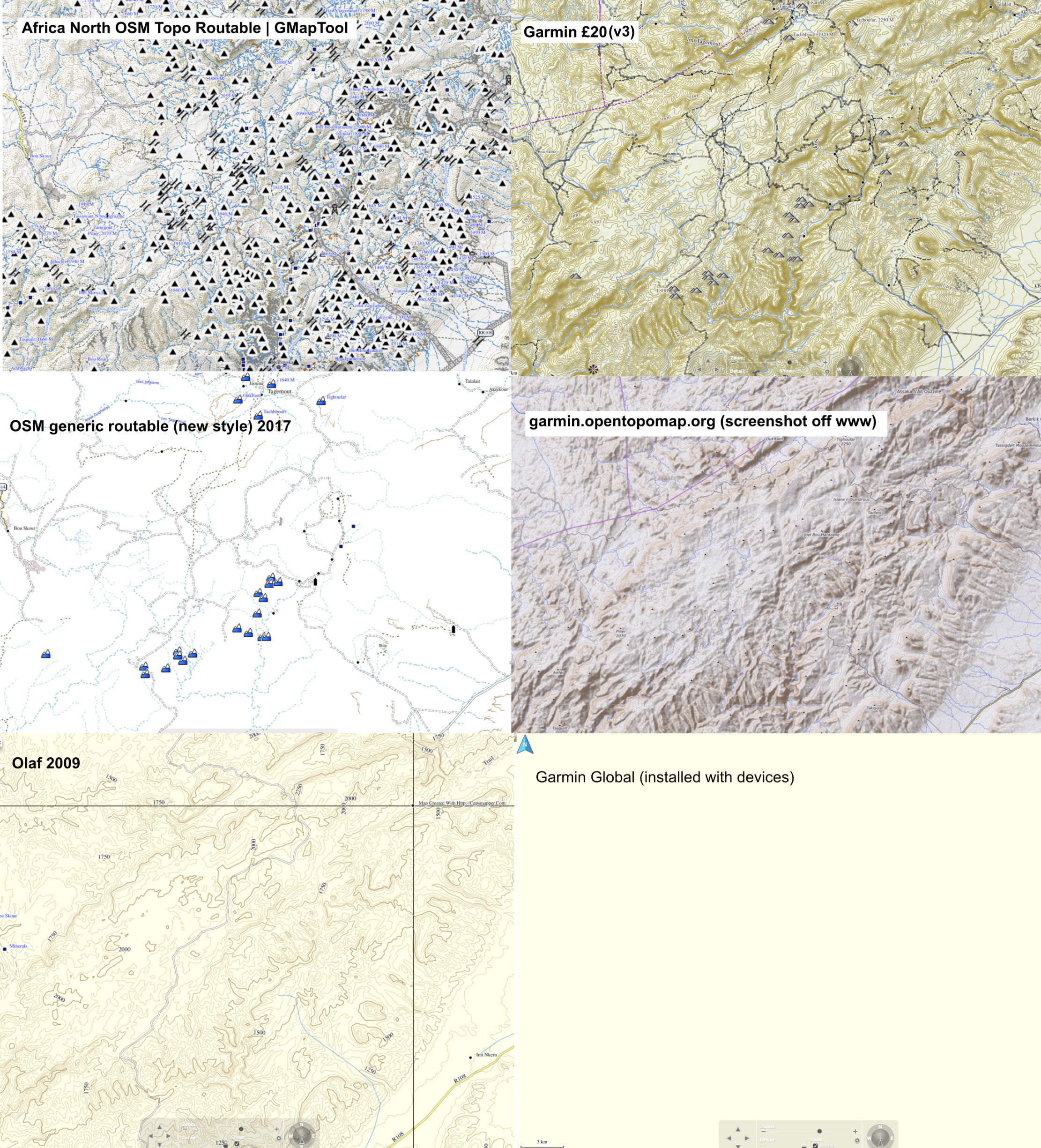
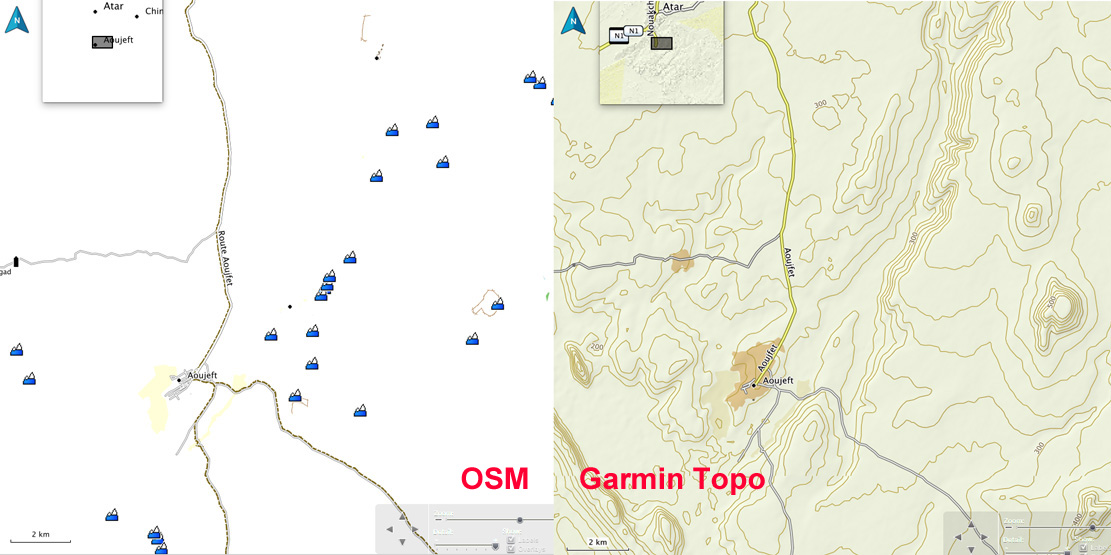
The chief difference is in the desert where the Garmin depicts relief and surface with more detail and clarity using shading, contours and colour where OSMs only use colour and Olaf only used contour lines which can be distracting. Look at the Atar region (RIM) above right – an area of escarpments, canyons and dunes – all are reasonably accurately shown on the Garmin Topo. There’s an anomaly on the Topo map on the left (bottom panel) in that the (presumably automatically recorded) elevation variation in dunes depicts them as lots of small hills (which in a way, they are), but only once they’re above a certain height. Identifying dunes with contours is not helpful nor a cartographic convention. Shade and colour is best.
Six digital maps compared 2021– screenshots of Jebel Saghro, Morocco. Garmin v3 is #2.
The piste and road detail on the Topo is pretty good: yellow for national highways, twin lines for secondary roads or piste, and a single line for a less used piste. A quick check in Morocco shows they’re all there; most of the ones I know are there in Mauritania too. In southern Algeria only a few main pistes are shown and certain ‘national highways’ are actually remote pistes never likely to be sealed. The Topo map would not be so useful here. In any country dashed lines may well be walking trails, but as far as I can see, there is no key or legend with the Topo map. Some POIs are there too – just fuel stations and post offices as shown on the Tan Tan map, above.
In places the Garmin copies OSM’s annoying habit of again, marking high points (automatically?) as mountains which is a distraction, let alone inaccurate – for example when an escarpment gets shown as a string of peaks. If you drop the detail level enough notches on BaseCamp, these peaks (left) only disappear once all the useful tracks and place names have gone too. It’s great (and a bit puzzling) that this stuff is produced for free at all by OSM supporters, but the quickest flip to sat imagery would reveal the true nature of the relief.
So does the Garmin Topo map mean I’ll stop using Google or Bing imagery in the planning, or paper maps on the piste? The former, I don’t think so; the later in Morocco yes, but elsewhere in the Sahara I’d still rely on paper maps. In places like Morocco the extent of marked pistes can be converted into accurate tracklogs, but with better surrounding detail than OSMs. And, unlike Olaf, there’s no aggro importing into a modern, touch-screen GPS. When I want to quickly verify where I am, a glance at the Garmin Topo will may be adequate.
I’ve been using the Garmin Topo map quite heavily on BaseCamp last couple of days, preparing a new edition of Morocco Overland. It’s an intuitive-reading map and I’ve found one benefit of using a Garmin map on Garmin software is that when stringing out a track with the ‘create a route’ tool, it automatically snaps onto even the thinnest track on the map just like Google maps. But the BaseCamp tool won’t do that with other installed maps like OSM or Olaf, or even the basic Garmin base map. Sometimes you have to trick the tool to go the way you want, but it makes stringing together hopefully accurate routes (as well as distances) very easy. Occasionally only Olaf will show a route you want to follow, in which case you make the route with lots of short, straight lines. No so hard.
Getting routed: As the track was clearly visible, I traced the route I’m logging above (MW7) off Google Earth the previous evening (internet required), saved and exported the kml then imported it (as a gpx) into my Montana via BaseCamp. This was pushing the outer limits of my tech ability with this sort of stuff. GPS digital maps not really needed as I had the largely accurate self-drawn tracklog on the screen to follow, while recording my own live tracklog. Years later I used this same system (pre-trace route off Google Earth) again while logging MH23. The great thing with satellite is WYS is usually WYG, whereas with maps (paper or digi) WYS can be nothing at all.
Getting routed: As the track was clearly visible, I traced the route I’m logging above (MW7) off Google Earth the previous evening (internet required), saved and exported the kml then imported it (as a gpx) into my Montana via BaseCamp. This was pushing the outer limits of my tech ability with this sort of stuff. GPS digital maps not really needed as I had the largely accurate self-drawn tracklog on the screen to follow, while recording my own live tracklog. Years later I used this same system (pre-trace route off Google Earth) again while logging MH23. The great thing with satellite is WYS is usually WYG, whereas with maps (paper or digi) WYS can be nothing at all.
In late 2008 Canadian UN special envoy Robert Fowler was kidnapped near Niamey with his assistant Louis Guay and their local Malian driver, Soumana Moukaila (left). All were held captive in northern Mali by Moktar Belmoktar’s (MBM) AQIM katiba or group. Following the lull after the mass kidnappings of 2003 in Algeria, it was a pattern that came to be repeated frequently from 2008. Excluding what’s currently going on in Nigeria, in north Mali today there ought to be nine non-African captives of six nationalities (mostly French) as well as five Africans taken from five separate abductions across the Sahara. Full list of dates, locations and outcomes here.
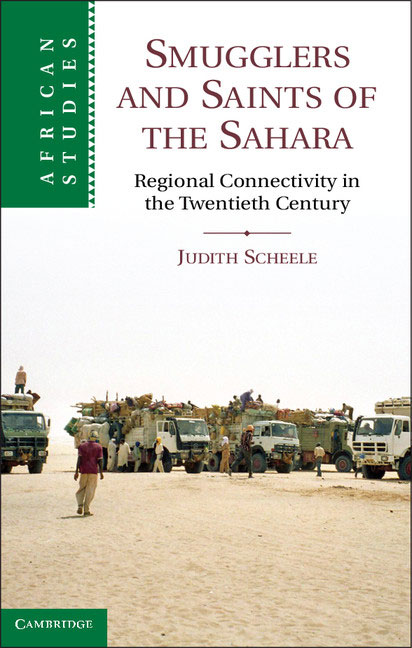
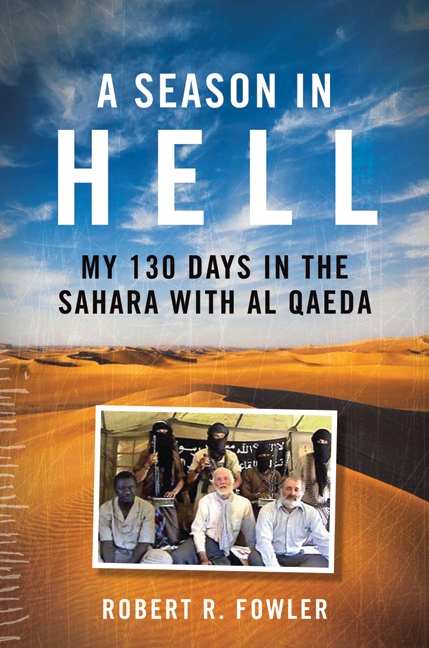
But just a year before Fowler was grabbed, Oxford-based anthropologist, Judith Scheele was travelling up and down the Tanezrouft, principally between Gao and the Touat region around Adrar in western Algeria, researching the origins and nature of the ‘connectivity’ that has long linked the two regions. Her book, Smugglers and Saints of the Sahara: Regional Connectivity in the Twentieth Century is an anthropological treatise on south Algeria and north Mali. Fowler’s book is A Season in Hell, my 130 days in the Sahara with Al Qaeda – a self-explanatory title.
Smugglers and Saints of the Sahara; Regional Connectivity in the Twentieth Century Judith Scheele Cambridge University Press, 2012 ISBN: 9781107022126; 286pp £60 – $99 From CUP catalogue: Smugglers and Saints of the Sahara describes life on and around the contemporary border between Algeria and Mali, exploring current developments in a broad historical and socioeconomic context. Basing her findings on long-term fieldwork with trading families, truckers, smugglers and scholars, Judith Scheele investigates the history of contemporary patterns of mobility from the late nineteenth century to the present. Through a careful analysis of family ties and local economic records, this book shows how long-standing mobility and interdependence have shaped not only local economies, but also notions of social hierarchy, morality and political legitimacy, creating patterns that endure today and that need to be taken into account in any empirically-grounded study of the region.
Smugglers and Saints caught my eye as it mentioned al Khalil, a frontier trading settlement that slipped out of the state control around the turn of the century to become a rough smugglers’ entrepôt right on the Algerian-Mali border and just 18km from the Algerian outpost and military base of Bordj Moktar (BBM) on which al Khalil depends. Steele writes in the introduction:
… On closer inspection, the various institutions that might turn al-Khalil into a town turn out to be optical illusions… The gendarmerie post is … empty, and here everybody knows what happened: “the government built this post, a nice building, you can see, and then they sent soldiers with guns, suwadin (‘blacks,’ that is to say people from southern Mali) who were already shaking with fear when they arrived. They lasted two days: on the second night, we stole there guns, and we never saw them again.”
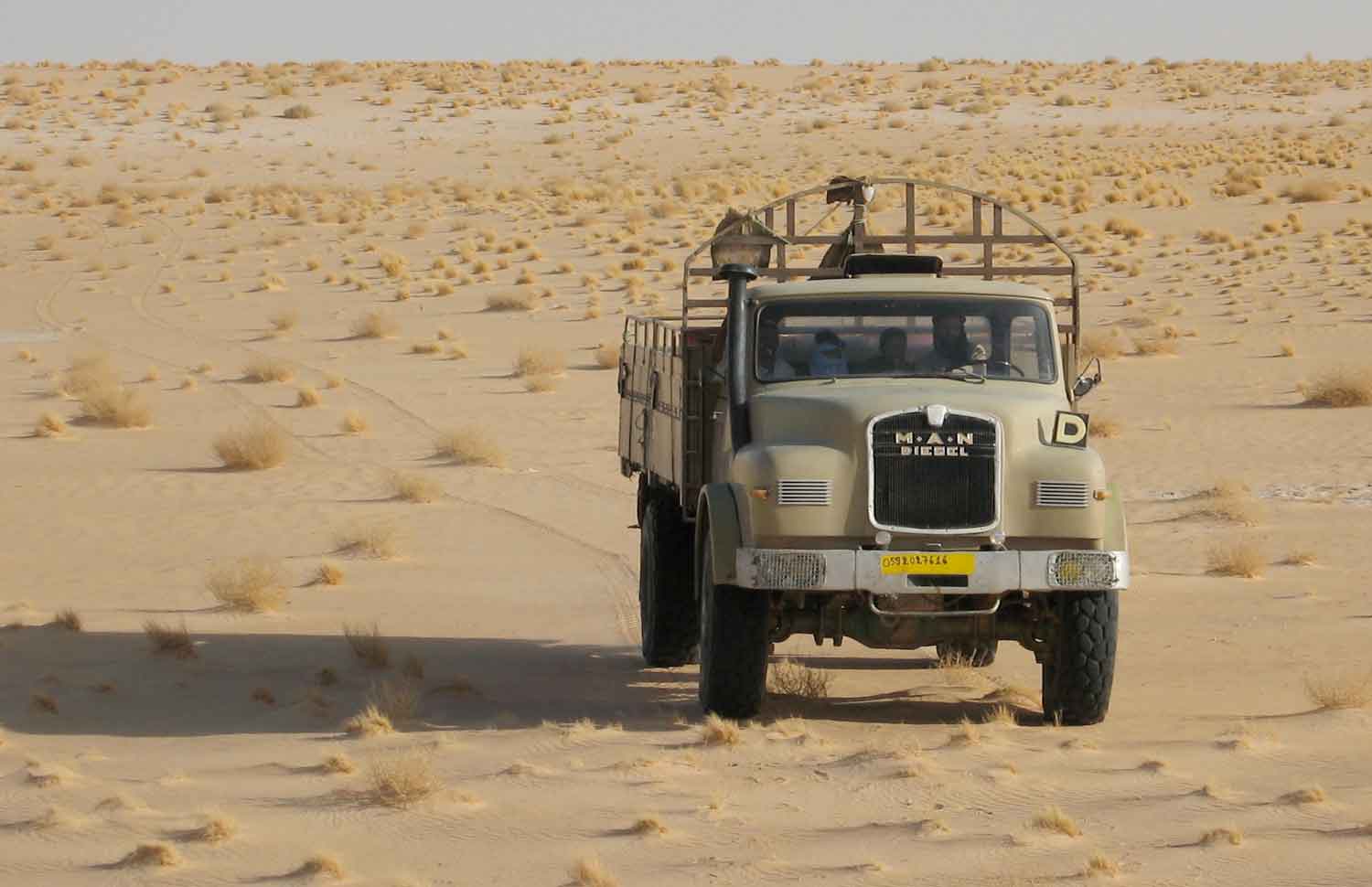
Sounds like an interesting place. I visited the outpost twice in 2006, a short while after I was told the Malian douaniers (Customs) like the gendarmes above, had been kicked out, leaving the place to its own devices. One of my visits was while passing through with a car to offload in Mali (it was actually getting reprofiled to return to Algeria as my guide’s car). I took the chance to get in with the chummy crew who were my guide’s contacts in Al Khalil; what the exact connection was I did not ask. They occupied l’Ambassade (possibly an in-joke with those that frequented it), a compound or garaj like many others in town, composed of a head-high mud-brick wall where ancient MAN or Mercedes trucks were being overloaded or refuelled. Beaten up oil drums, axles and other junk lay all around and a couple of shacks or shaded reed zeribas perched against the perimeter wall. There was no running water or electricity other than truck batteries. The toilet was like a deleted scene from a slasher movie.
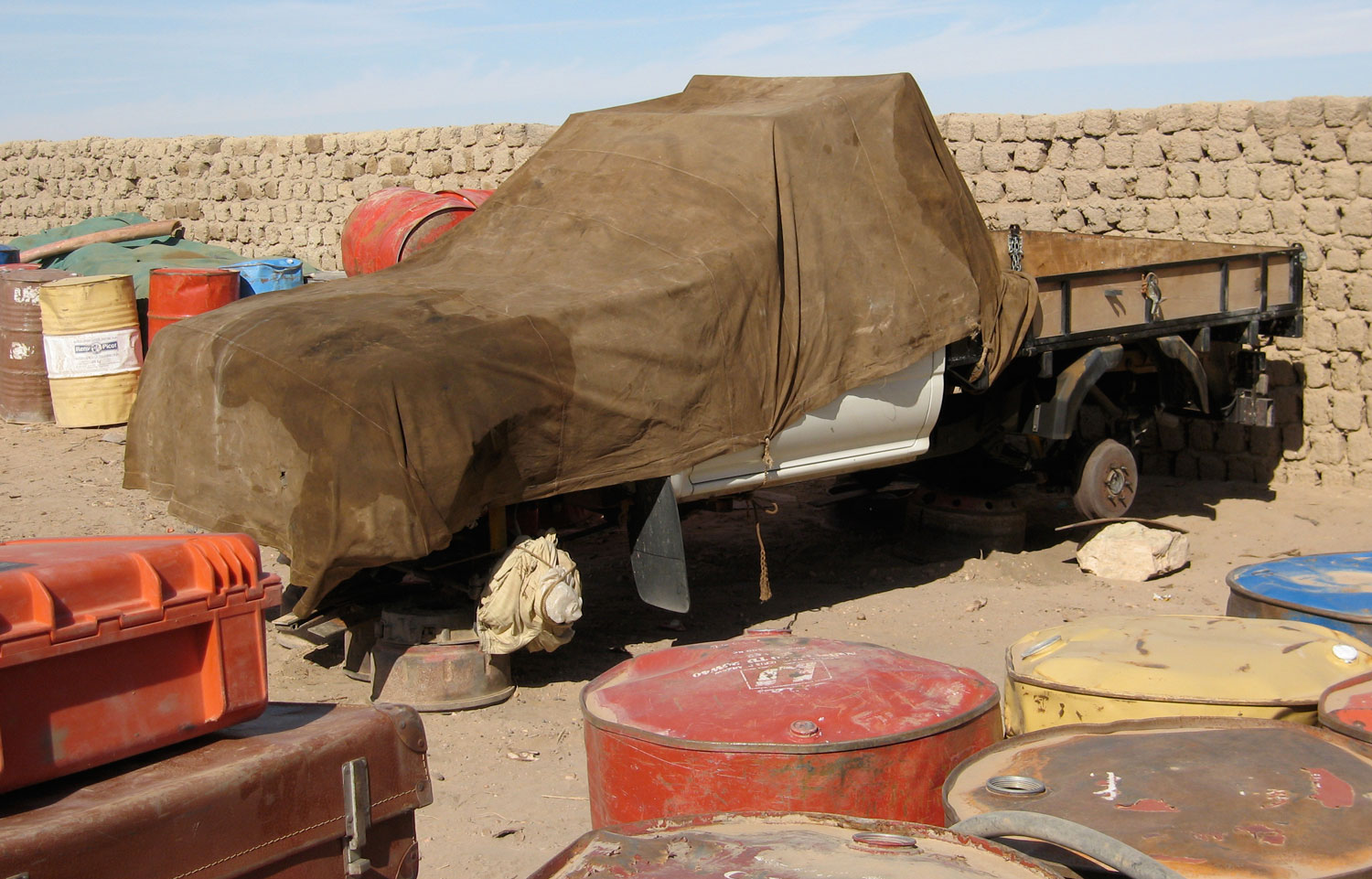
Al Khalil was by that time a stateless entity in No Man’s Land, some 100km north of the first Malian town at Tessalit where in 2006 at least the Malian army had a presence and stamped us in. The crew at the l’Ambassade weren’t like the braggarts thatJudith Scheele describes, and seemed a rather amiable bunch of possibly Berabich Arabs, a consequence one likes to think, of their avowed trade in ‘soft’ commodities between Algeria or Zouerat and their distant home town of Timbuktu. I sold some sat phones or GPSs and promised to return with solar panels and other requests, something I occasionally do to help establish a connection with guides or other local contacts. In this case my motivation was to help ease my imminent traverse of northern Mali should I get in trouble. In a way I was participating in the mutually beneficial connectivity about which Judith Scheele writes, while not going quite as far as marrying one of the ‘Ambassadors” daughters to seal a trading communion. Sure enough, two months later I was in trouble before I even got out of eastern Mauritania and was able to call in a truck via the Ambassade to recover me back to In Khalil. Last I heard my Hilux still rests under an oily tarp in the corner of the Ambassade (above right).
Enough about me. It is of course a little unfair for a ‘civilian’ like myself to judge a painstakingly researched academic work like Saints. I suspect such works follow a certain well-defined format and other rigid conventions that pass over my head. But as I’ve had dealings in Al Khalil and know south Algeria as a tourist, I gave it a go, curious to learn a little more on how the outpost survives right under the nose of BBM and where the author speculates: “… by all accounts state officials are deeply involved in all aspects of transborder business.” Not surprised to hear that at all.
Steele describes the drivers and dealers in Al Khalil as a recognisable mix of bravado and exaggeration, boasting about their contrabandeurs‘ adventures running goods along the hidden pistes while dodging patrols and ambushes from competitors. These traders claimed a distinct moral separation between ‘soft’ goods like sugar, fuel and staples, and harder items, the hardest of all being cocaine, but now might be migrants and arms. It’s fair to speculate that as much as AQIM’s occupation of northern Mali, it is the similarly recent advent of a new cocaine route to Europe, from Colombia via Guinea Bissau or Mauritania right across to the Red Sea that has upset the trading traditions she documents. No longer can a plucky young guy knock out a couple of trans-border runs for a patron to earn himself the Toyota pickup he was provided. As you’d expect with hard drugs, now much more organised mafias – in some places not far removed from state institutions – are running the show and paying flat rates for young guns in search of nothing more than adventure.
“Although al-Khalil might for all intents and purposes look like a town, it lacks in morality and is therefore locally understood to be part of the badiya… As such it remains beyond the bounds of civilisation and is described as potentially dangerous to “proper” family life and sociabilities. This is perhaps why, in their interminable boasts, Khalilis endlessly endorse “traditional” morality, as though they were trying to integrate al-Khalil within known frameworks of excellence and moral propriety: al-Khalil is decried as a place where men can be men, although everybody knows that the moral autonomy and social responsibility this implies are often illusory.
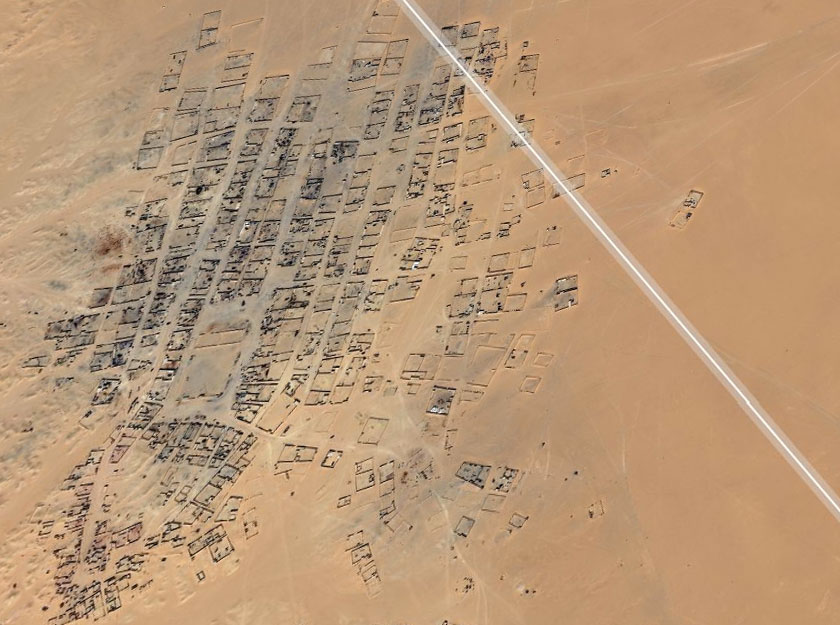
The series of traders’ compounds or garajs shown in the sat image on the left isn’t a place where a European stranger idly noses around for too long, and you get the feeling that even with her protectors, the author didn’t spend much time there, as she did in the regular settlements in Mali and Algeria. That she achieved what she did over months in this area is a testament in her ability in getting to know the right people and gain their trust. A short while after both I and Judith Scheele visited, Al Khalil became quite a dangerous place indeed and now, a few months following the French led Operation Serval, you imagine things may have turned full circle.
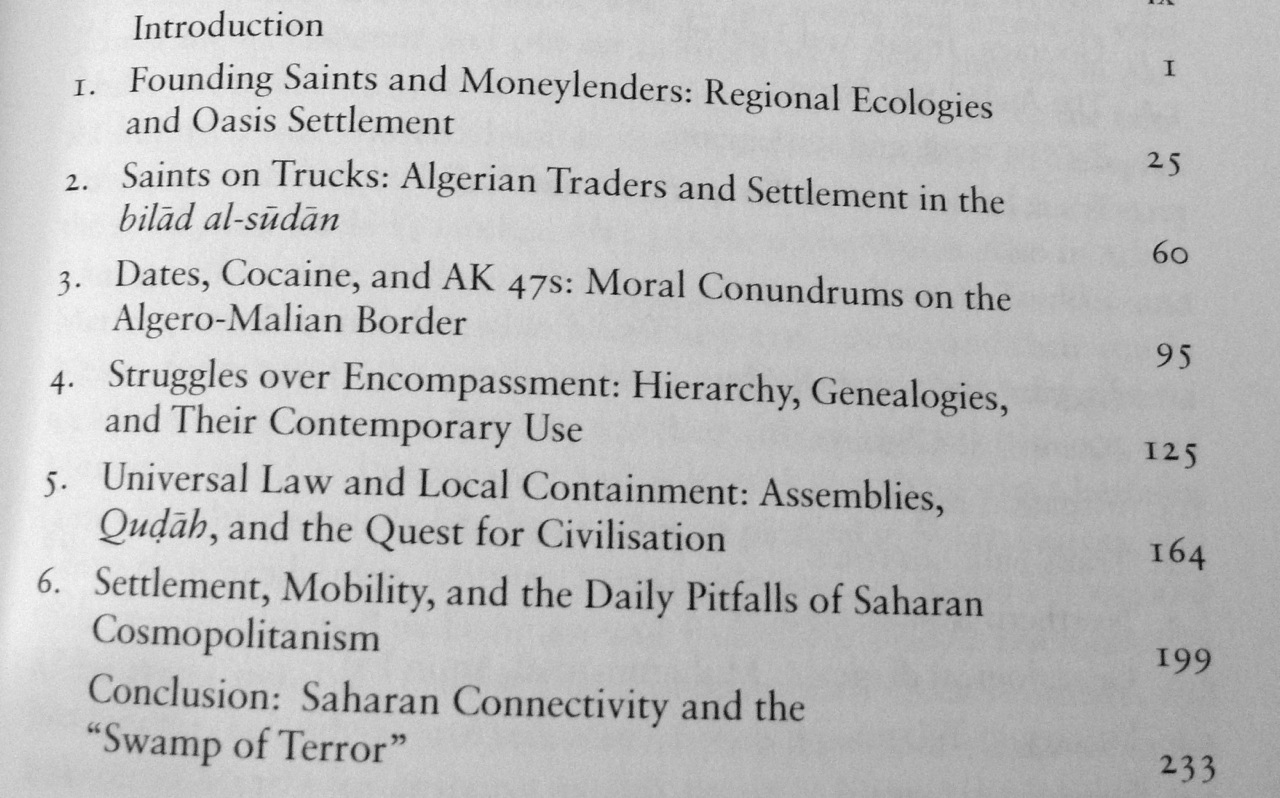
It has to be said that once beyond the lively and engaging introduction, the book gets down to business and at times becomes a bit of an effort. The chapters are listed on the right give you an idea of what to expect. Credit is due to the author’s tenacity, braveryandfluency in local languages, although part her success may have been in being perceived by the men as just a ‘harmless woman’. It gave her the best of both worlds: sisterly access to local women no male counterpart could have achieved, while at other times able to move around as a protected ‘honorary male’, as lone women travellers often find, particularly in Muslim lands.
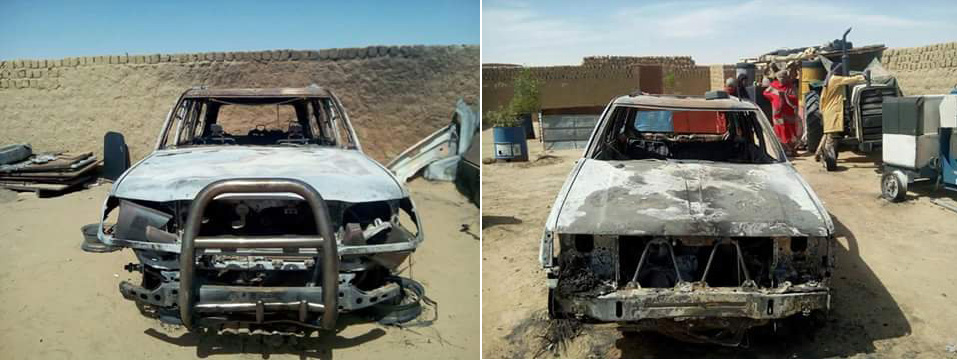
At one point her convoy is held up in southern Algeria en route to Mali until the driver explains to the brigands that he’s travelling en famille – as in ‘steady on chum, there are women present’. Travelling sans famille, on the way to rescue us in 2006, the Ambassade’s truck (left) had a similar encounter but was less fortunate.
It’s a touching example of the sort of code of honour we like to imagine exists among Saharan smugglers. They are after all merely engaged in tax-exempt trading that was disrupted or penalised when the French began their century-long project of colonising Algeria in the early 19th century. Since then, following the post-colonial era of the early 1960s, new governments settled age-old racial scores. I have long assumed that the neglect of the desert Tuareg in Mali’s Ifoghas and the Aïr in Niger was a form of payback for the bad old slave trading days. It forced places like the Ifoghas to rely heavily on subsidised goods coming down from Algeria and until very recently the Malian government still professed that the ‘Tuareg problem’ in the north was a greater threat than AQIM and associated terrorist groups.
In Saints we learn much about the demography, racial make up and historical links across the region. The Tilemsi Arabs who originated from Mauritania and include the shady mayor or Tarkint (more of him below). Or the Kunta Arabs, a sect that led by a ‘saint’, settled from an oasis in the Touat Algeria a century or two ago. Indeed it was Arab traders from there who founded Kidal, the current ‘capital’ of the Kel Ifoghas Tuareg.
“Most [pre-colonial] settlements in the Sahara are said to have been found by saints, following divine guidance… [it] is always an achievement and relates to larger projects of civilisation, generally bound up in Islamic standards of justice and order. As such it can as easily be swallowed up by moral shortcoming and internal strife as by the shifting sands and greedy raiders”
These early traders and other notables have metamorphosed into ‘saints’ possessed of baraka (blessing) or even got upgraded to sharif, noble descendants of the Prophet. It’s a form of religious aristocracy mentioned in an earlier post about Judith Scheele’s visit to Arawan around the same time. Staying with US PCVs in Mauritania in the late ’80s, I recall coming across a term ‘hassan’, with the same meaning or legitimacy as sharif.
At one point the author profiles the ‘Alkacem’ clan of Tamanrasset, a successful trading family of business-minded Chaambi Arabs who moved there from northern Algeria around Ouargla and Ghardaia. From the earliest days of the French colonisation the Chaambi worked with the administration rather than fighting it, like the Ahaggar Tuareg right up to their decisive defeat near Tam in 1911. We learn that similarly, the modern Alkacem have shrewdly developed ties with the government to their great advantage. It chimes with a meeting I had with what I took to be a patriarch of that family a couple of years ago while organising a tour. I could tell this guy was a busy hommed’affairs who these days, more than ever, surely couldn’t be making a living from his tour agency. With his shiny fleet of Hiluxes, I assumed he must have more profitable interests like property or transport, his agency being a hang over from the good years and which had been palmed off to his somewhat feckless son. The patriarch told me his family had moved down a century ago from their home oasis of Metlili Chaamba just south of Ghardaia.
These passing connections made Saints a little more digestible for me but while there must be a certain received form to academic writing that is indubitably objective and correct, the jargon doesn’t exactly leap from the page with arms outstretched. It is after all a meticulous report on the author’s fieldwork to be pored over by her peers, not an adventure travelogue.
Nevertheless, as a tourist in the region you frequently feel that you’re skimming over what’s really going on around you, especially when pre-occupied with keeping your own all-terrain show on the piste. Saints helps fill in the blanks about a Sahara where people actually live, a place beyond the string of waypoints linking fuel stations, junctions and wells. We learn a lot about the complex interconnectivity of race, skin colour and Arab assumptions of moral, intellectual and religious superiority, despite the envied lure of the licentious suwadeen. As an Arabic woman of standing, it’s all about appearances, status, how to get ahead in business while scrupulously maintaining a respectful pubic image (in short: travel for business but lock up your daughters).
Along the way Judith Scheele has amassed a bibliography on associated topics that could keep you reading for years. There are many other anthropologists out there working to unravel the secrets of the Sahara. She concludes by politely scoffing at what you suspect she views is a rather male-oriented view of today’s Sahara as a lawless “swamp of terror” to quote an American general (and to which I lazily subscribe myself). A wilderness of wily bandits and fanatical mudjihadeen that must be brought under control before it all gets out of hand. It’s an image that’s carried by the mainstream media too and the author admits that much of her research was completed before current AQIM activities hit their stride, let alone the recent fall of Gaddafi’s Libya which has further stoked the fire. Al Khalil may get pushed off the map she concludes, but it will simply pop up somewhere else because in the Sahara, like elsewhere else, life goes on.
A Season in Hell; my 130 Days in the Sahara with Al Qaeda Robert Fowler Harper Collins, 2011 ISBN: 9781443402040; 320pp CAN$ 11.99 Kindle up to 32.99 hardback From the Harper Collins website: For decades, Robert R. Fowler was a dominant force in Canadian foreign affairs. In one heart-stopping minute, all of that changed. On December 14, 2008, Fowler, acting as the UN Secretary General’s Special Envoy to Niger, was kidnapped by Al Qaeda, becoming the highest ranked UN official ever held captive. Along with his colleague Louis Guay, Fowler lived, slept and ate with his captors for nearly five months, gaining rare first-hand insight into the motivations of the world’s most feared terror group. Fowler’s capture, release and subsequent appearances have helped shed new light on foreign policy and security issues as we enter the second decade of the “War on Terror.” A Season in Hell is Fowler’s compelling story of his captivity, told in his own words, but it’s also a startlingly frank discussion about the state of a world redefined by clashing civilizations.
I may have struggled to review Saints satisfactorily, having chipped away at it over a number of weeks. That’s not an excuse I need to make with Fowler’s ASeason in Hell which I knocked back over a weekend. It doesn’t so much leap off the page as grab you by the ears and haul you back in. Here at last is what some have been waiting for since this whole threat to Sahara tourism started back in 2003*: a lucid, vivid and thoughtful account of an experience which those of us who still travel regularly in the Sahara often wonder how we’d cope with. And before the first page is turned Fowler answers that question directly with a reassuring “better than you’d assume”.
In December 2008 Fowler’s UN party was in Niger to help negotiate a settlement over the latest Tuareg rebellion in the Aïr. Their presence was not welcomed by the then Niger government who almost certainly betrayed the diplomats into the hands of AQIM, less than an hour north of Niamey, while at the same time trying to blame it on dissident Tuareg rebels, so killing two birds with one stone.
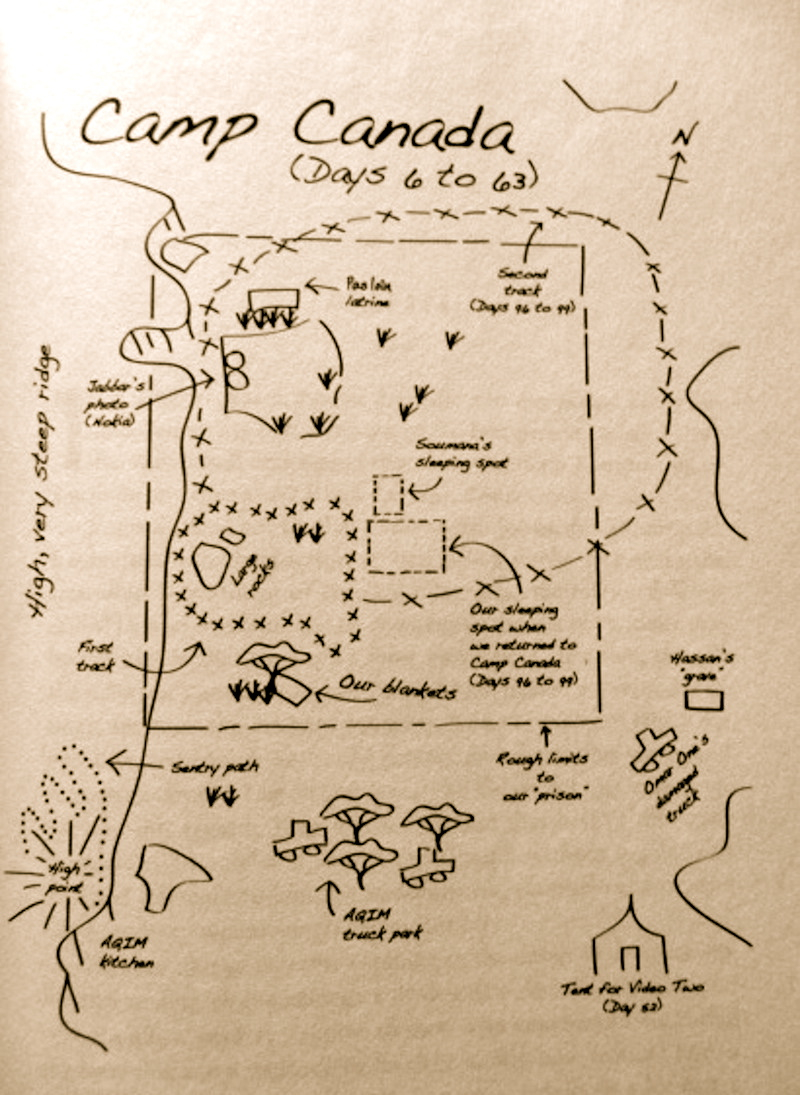
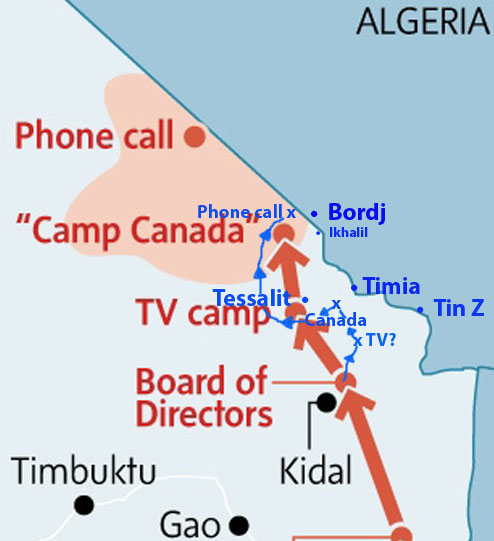
Stuffed into the back of a pickup, a breakneck flight ensues, over the border into Mali, hammering cross-country at which point Fowler – at that time in his mid sixties – injured his back and lost his glasses. Exhausted, terrified and dazed, a few days later the reality of what has befallen them becomes clear as Fowler and Louis Guay settle into life at what they called Camp Canada, somewhere in the hills northeast of Tessalit. The petrified driver Soumana was nearby but kept away from the two Canadians. The sound of what may have been French C130s coming in to land in Tessalit helps pin down their probable location.
Luckily, Fowler avoids the lazy Day 1, Day 2… diary format, instead describing events or themes over their months en brousse. Just before their abduction two Austrians had been released after eight months captivity in Mali, and so Guay at least got his head around the fact that their experience may last that long too.
One night on the flight north Guay vehemently discouraged the myopic Fowler from grabbing a pistol from the glove compartment, but once in the Camp Canada Fowler still attempted to asses his chances of escape. From the way he describes it, even without the surrounding desert, it’s clear that wherever they were camped, they were always heavily guarded by lookouts and even guarded as they slept. The threat came for other AQIM groups as well as expected rescue missions by foreign forces, plans to which they were disturbingly privy.
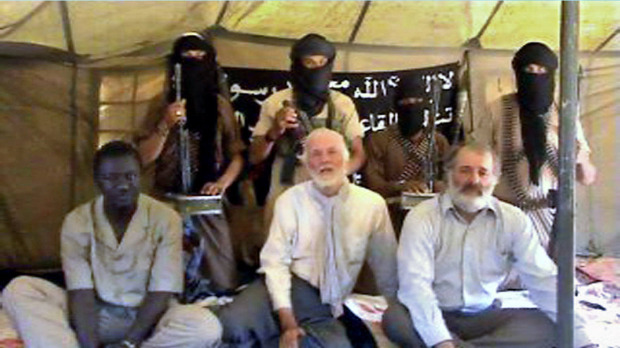
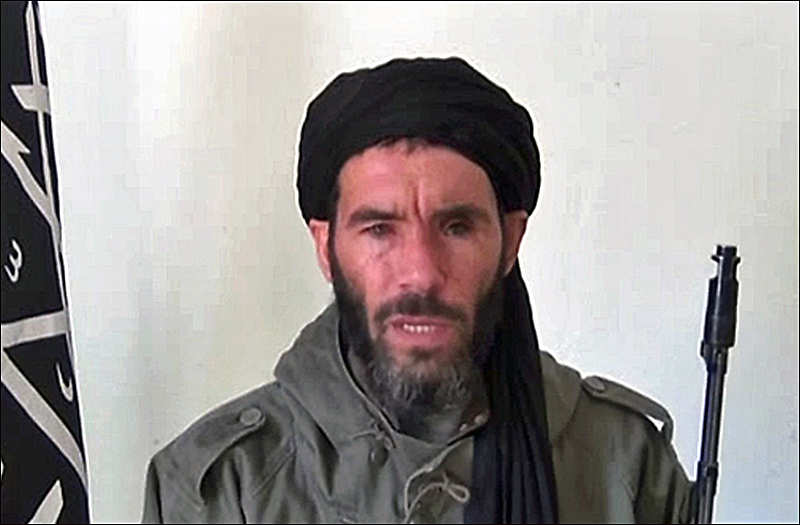
Early on the obligatory video is made, backed by masked mudj in front of the black AQIM banner, though at the time Fowler was uncertain whether they were about to film a graphic record of his own grisly execution. Fowler admits that early on suicide was a valid option and later explains “by far the most taxing [of the trials they endured] were the ravages of the psychological roller coaster that racked us back and forth between hope and despair.”
At Camp Canada the duo settle into a routine of daily walks, hauling each other away from negative thoughts (‘rabbit holes’) and even honouring the prayers of their abductors by standing up while making their own invocations. Moktar Belmoktar (MBM – or [one-eyed] ‘Jack’ in the book) makes occasional visits, a figure that clearly carried authority and respect among his men. But during MBM’s longer absences the duo have to deal with the malice, mind games and rabid contempt of their captors, including the spiteful and petty depredations of ‘the Children’ – some as young as seven.
They may well have been kidnapped from local villages, or handed over by impoverished parents and since indoctrinated, otherwise you wonder what it is that drives young men to such extreme views and a pitilessly harsh and perilous lifestyle. Aside from the commonplace domestic difficulties or some adolescent slight which apparently pushes one over the edge (a suggestion made for the recently slain Boston bomber whose promising boxing career didn’t pan out), you can’t help feeling that the chips on their shoulders and all other corners of their bodies have some legitimacy in countries where unemployment is epidemic but where the elite factions of the state constitute the apogee of self-enriching criminality.
I recall one of the guys in the MAN recovery from 2006, a young Tunisian now living the life as a desert smuggler. His insecurity, resentment and hot and cold moods lit up the desert like a flare. When he drove the truck it was as if he wanted to smash every tussock into submission. One night at a camp in north Mali he blurted out of the blue ‘Christophe, why do Europeans think all Africans are stupid?’. The others were a little embarrassed by him but I wouldn’t be at all surprised to hear that a year or two later he’d signed up with the nearest AQIM katiba.
It has at times been customary to dismiss AQIM as nothing more than criminals making money by smuggling and kidnapping, but if that’s the case then Fowler’s abductors all sustained a pretty convincing performance. Not one of the score or more who occupied Camp Canada (right) failed to try and convert the two diplomats to Islam, while at the same time ceaselessly haranguing the unfortunate driver who lived right among them. In fact it became rather a procession – as with some religions and Islam in particular, a need to be seen as doing your duty as a devout, by-the-book Muslim.
To borrow a tract from Judith Scheele: “The two mosques [in Al Khalil] were constructed with private funds, but even they can hardly be taken to represent “Khalili society.” At least one of them, people say, was built by a notorious drug dealer, to show off his wealth and perhaps even but his place in paradise, but nobody ever goes to pry there – quite simply, because nobody ever prays in al-Khalil: for al-Khalil is a place of corruption, and their prayer would wither on the tongue… it therefore remains beyond the bounds of “civilisation” and is part of the badiya (steppe, wilderness).“
Fowler is careful never to claim to speak on behalf of Guay who he nevertheless thanks deeply for helping him survive the ordeal, although you do wonder if the pairs’ fluency in French may have exacerbated their torment. Not all in the katiba spoke French but some of those who did left no doubt how dearly they’d love to kill and mutilate them, just on general jihadist principles. One, ‘Omar One’ who they got to know well had been a travelling preacher right across Africa and Europe, and was particularly skillful at relating stories from the Koran to the enthralled audience. Religious discussions between themselves dominated the abductors’ conversations.
The fact that Fowler seems to come out of the experience without lasting psychological trauma (he claims no nightmares or PTSD) makes you think that he at least had a relatively easy time of it, so perhaps the ability to communicate did help. An interviewer (worth clicking, btw) also came away with this impression after reading the book and to which Fowler replies:
RF: Sorry, if I left you that impression in the book then I didn’t write very well. It was never, not for an instant, ever relaxed. I don’t think we ever had a good time. I think I mentioned in the book that on a couple occasions Louis and I laughed about something, and then had a discussion if we should even be laughing. I mean, some of the situations were so absurd that the irony of it made us laugh. But, we were never relaxed. The 20 questions was with this fellow called Hassan, and he was among the most dangerous, difficult, and smart members of our captors. One could never be relaxed with Hassan, and let ones guard down. Even in the context of what appears to be a game, all the same stakes remained on the table.
But you wonder whether Guay – who has not written of the experience as far as I know – did not get off so lightly. For whatever reason he ended up a scapegoat, picked on for merely observing his assailants (‘what else was there to look at?’) or got persecuted for his ‘Jewish’ appearance. Both used their diplomatic nous and long experiences of working and negotiating in Africa as best they could to control this worrying situation. In a way, short of being Jean-Claude Van Damme clad in especially tight denim, you couldn’t expect two more experienced captives being put to the test. And tested they certainly were:
“Anything we believed, especially about religion but also about most anything else, they considered to be false, corrupt, and therefore not only unworthy of discussion but also intrinsically evil. Even talking about such differences was likely to incur the wrath of their vengeful and famously jealous god.”
As well as he was able, Fowler paints a vivid picture of those he got to know; some of who bristled at the duo’s transparent ploys to win favour and maybe respect, such as the aforementioned honouring of their praying. Others warmed a little and some came over to discretely discuss haram topics outside the narrow strictures of their fundamentalist dogma. There was only one thing that struck me as oddly missing from this book: obsessive discussions about food. If we on my camel treks are fantasising about the fare back home after only a week on the trail, you’d think Fowler and Guay would be crawling up the canyon sides eating plain cous-cous, pasta or rice (occasionally with meat) twice a day for months at a time. Some emotionally sensitive subjects were banned from discussion by the two in an effort to maintain morale, but you’d think the harmless pleasure in food fantasies would be quite fun.
It’s useful to be reminded that these may all be battle-hardened jihadists, but ‘extreme camping’ (as Fowler calls it) full time in the Sahara on limited resources is no picnic for them either. The captors too felt the pressure as negotiations of which the duo knew little off progressed in fits and spurts. Violent arguments broke out on the far side of the camp – for all the two knew the subject may have been ‘let’s kill them!’. For MBM who pops in and out of the drama, this is seen as a last resort or not one at all, and though he doesn’t spare the two a bitterly articulated sermon about the legitimacy of their cause, he still comes across as a principled and intelligent operator. (A whole lot more on him here -from a US ‘GWoT’ PoV). Although it’s said he fought the Russians in Afghanistan (where he lost an eye) at least a decade before this event MBM was better known on the Saharan scene as a cigarette smuggler and audacious bandit without any links to the then GSPC (later AQIM). Among some he was even glorified as a Robin Hood-like figure: ‘El Laouar – the One-Eyed my guide used to joke, with one hand covering an eye, as we crossed northern Mali in 2006 at which time MBM had been reportedly chased out of the Iforghas by Tuaregs into our path. It’s likely too that he was behind a huge convoy of ‘Marlboro’ laden pickups which passed our camp near the defile north of Amguid on New Year’s Eve, 2001. A few weeks earlier a whole lot of pickups had been stolen from oil installations nearby.
It’s still unclear how, why or when his conversion to militant Islam took place and whether his motives for jihad are genuine or more pragmatic. But that could be falling for the trap that MBM is not a ranting ABZ (see below). If he’s just building an empire he’s not had much time to enjoy it lately, and anyway has been blamed from some grisly massacres in Mauritania. He did of course recently leap to worldwide notoriety as the mastermind behind the suicidal gas plant siege at Tigantourine in Algeria last January and again in northern Niger in May 2013 – now operating under the MUJAO banner. The fact that he’s yet again seemingly escaped following the assault of the French on northern Mali while his nemesis, the paranoid and far less charismatic Abou Zeid (ABZ) met his end, does raise more suspicions about MBM’s cat-like immunity from capture or death. More of ABZ, later, but this interesting document recovered in May 2013 shows how even during the Fowler abduction MBM was a not a AQIM team player. Now MBM is clearly out of the fold but still continuing his own lethal operations.
Throughout his captivity Guay was comforted by his Christian faith, something which Fowler doesn’t profess and as a result suffered from doubts while endlessly trying to second guess possible scenarios or outcomes. There, in an anthropologist’s nutshell is a logical motivation for religious belief: it makes life’s trials more bearable. (Other explanations are possible). As to coming close to a religious experiences – again in that interview Fowler explains:
… I was almost abstractly curious to know that in those extremely fraught months I spent expecting to be executed whether I would have one of those religious epiphanies. I didn’t, and I’ve got to say I wasn’t surprised. It just clearly was not going to happen to me. I don’t regret that fact, it just is reality. Despite the enormous pressure of thinking I was going to be killed, that was not enough in my case to bring about a fundamental change in my religious outlook.
One day the troupe abandons Camp Canada and sets off west and north, ever watchful, and visiting previous camps and caches. One day a gift of goodies from the Burkinabe president Blaise Compaoré is delivered and formally distributed before the fascinated and ragged throng. It’s never explained why Compaoré took on Fowler’s case once the Canadian government’s tactics had exasperated all involved, all the more so given that some years earlier Fowler had exposed the venerable Compaoré as a profiteer from sanctions busting during the Angolan war.
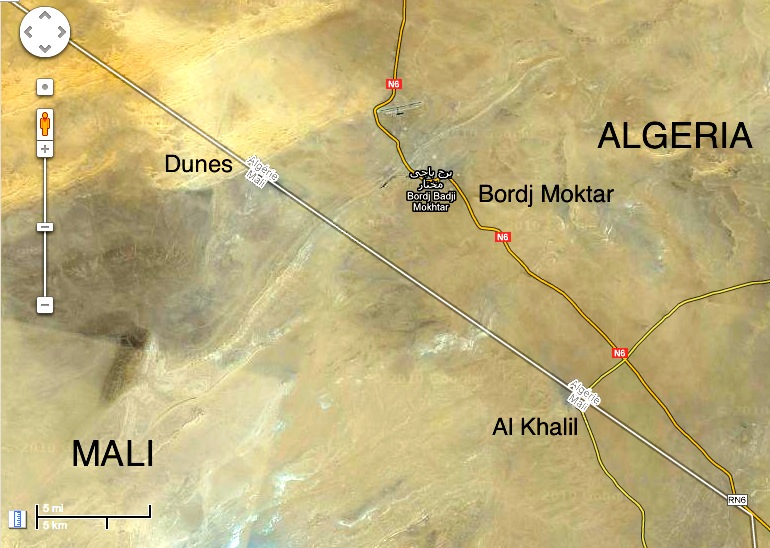
The weeks creep by and a phone call is made to Compaoré as well as to their families from a dune top within range of Bordj Moktar’s mobile signal (left). Progress is being made and the gang bundles back to Camp Canada.
Some of us on the Sahara Forum considered the map drawn for Fowler’s newspaper articles and this book to be a little inaccurate; my corrected version is on the left in blue with the dune identified below right. Getting there without being spotted necessitated a long westward arc as described in the book to make the GSM calls while still safely over the border in Mali (sat phone calls can be easily located). I know myself that the guys at the Ambassade in Al Khalil, 18km from BBM were able to use the Algerian GSM network; it was probably the very reason why Al Khalil was as close to the border as a Nevada casino.
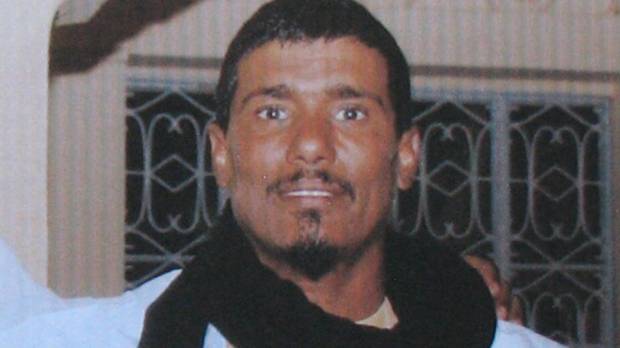
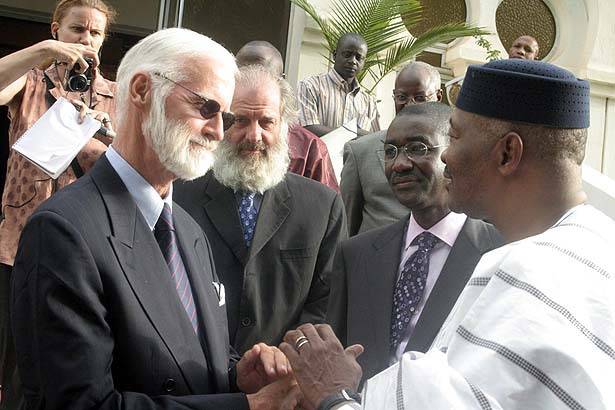
A release finally becomes a possibility and the ordeal draws to a close with the very uncertain handover to Compaoré’s envoy, accompanied by the notorious ‘mayor of Tarkint’ Baba Ould Cheick (left; actually arrested in March 2013 for drug trafficking). Like Iyad Ag Ghali before him, Cheick was thought to be up to his elbows in crooked money while readily employing himself as an intermediary for the release of other AQIM hostages, all for a handsome cut of the ransom. He can’t be the only one – surely no one out there does any of this out of the goodness of their heart and you’d think Compaoré gained less obvious but more substantial concessions from helping resolve the affair.
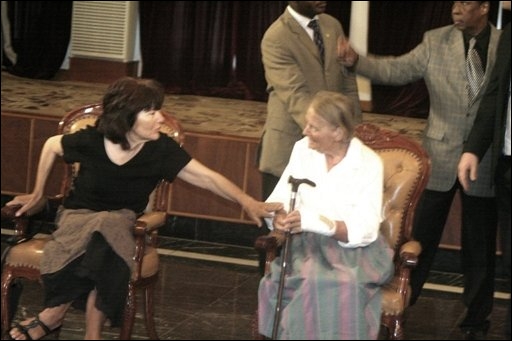
Somewhere is the desert north of Gao a grand handover rendezvous takes place. Not only are the two Canadians being ceremoniously handed over (it turned out the Malian driver had been freed a month earlier), but so too are two desperately emaciated European women, Marianne Petzold and Gabriela Greiner (right) who had been kidnapped with Greiner’s husband and a Brit, Edwin Dyer on the Mali-Niger border a month after Fowler’s party was grabbed.
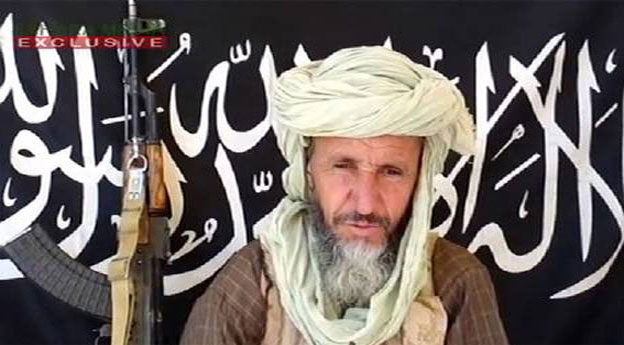
They had the deep misfortune to end up in the hands of the callous Abou Zeid (left – biography reviewed here), and whatever agreement had made for this combined release, ABZ was not buying it, possibly seeing it as a defeat. MBM seems to steadfastly overrule ABZ’s discontent and haltingly the jeeps with the four released captives shove off but barely stop moving for a day or more until they’re on safe territory in the vicinity of Gao.
As described in the book, you can’t help feeling that the stand-off between MBM and ABZ that day may have pushed ABZ into executing Edwin Dyer a couple of months later in an attempt to show he meant business. In turn, not unlike MBM’s recently organised attack on Tigantourine in Algeria in January and in May 2013 in Agadez and Arlit. Although MBM was not present their either, both have been interpreted as a show of strength following MBM’s alleged demotion among the ranks of AQIM in late 2012.
For Fowler and the other three, diplomatically staged photo calls, long-overdue ablutions and happy family reunions ensue, and the book ends with a warning that action must be taken against the scourge (as it is now), as well as an unapologetic swipe at the way the Canadian government and not least the police force (RCMP) handled the situation. The latter come across as a bunch of hicks so far out of their depth you feel like calling the RLNI.
The elephant in the room is of course the matter of a ransom. None was paid say the Canadians and you get the impression that neither Fowler nor Guay were ever filled in on how their release actually came about. Fowler explains it in appropriately vague terms:
“… there tends also to be a difference between what governments do and what they say, and this seems to me quite reasonable. There are good arguments on both sides and a wealth of unhappy experience to buttress just about every position. Every time a “principled position” is invoked, there are exceptions. Many countries adopt what are more or less pragmatic approaches while others proclaim immutable doctrine, but I know for certain that everybody has blinked at one time or another. I am also well aware that there is no way I can be objective about such issues…”.
Fowler and Guay thank Mali’s ATT (since deposed)
That will be a ‘yes’, then. Wikileaks since revealed that prisoners were released and a ransom was indeed paid (€700,000 according to this document, a figure with AQIM leaders thought was way too low. As with other Saharan ransoms, the conduit for the Canadians’ release was the then convenient and well stocked treasury of Ghadafi’s Libya, while the relevant government in denial most probably provided some kind of concessions to Libya as well as the other African counties involved, while claiming its hands were clean.
Following their release we have at times speculated that a publicity ban is put on freed hostages by their governments; perhaps a condition of the usually denied ransoms that have been paid to win their freedom. If that was the case with Robert Fowler, he ignored it. A Season in Hell illuminates in all the detail you could wish what it’s like to be the subject of events which many of use interested in Sahara travel have followed for months at a time. It might even be read as a useful manual on how to cope with a long period of captivity in the desert. However you choose to take it, it’s highly recommend as a great read.
A full list of Saharan kidnappings, which includes current captives, is here.
* In fact Rainer Bracht who we met in Tam in 2003 a couple of weeks before he was abducted, co-wrote 177 Tage Angst with his wife Petra. Part of ‘Group II who did the full six months and ended up in far northern Mali, I considered having their book translated at the time, but in 2004 was told by my German reader (a bike rider but not a Saharan) that is was not so good. Then I recently came across parts of their story archived on a German moto magazine’s website from 2004. Even reading it through Google translators helped fill in the many gaps in their baffling ordeal – not least how they got from a canyon near Illizi, right across Algeria to northern Mali as far as Taoudenni – see map on the right. You can try and start reading it all here: • Part One • Part Two • Part Three
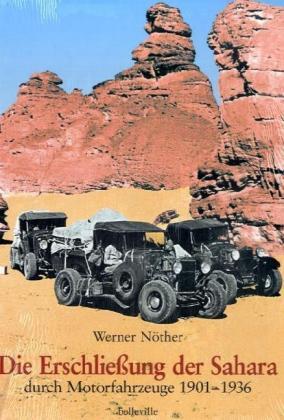
DIE ERSCHLIESUNG DER SAHARA DURCH MOTORFAHRZEUGE 1901-1936 [Opening up the Sahara by Motor Vehicle, 1901-36] Werner Nother (try amazon.de)
I would not normally review German books here, even if some of the best material may be in that language, but hardcore Saharans may be interested in this huge book, a breeze block three times the size of Sahara Overland. Werner Nother is one of a handful of German-speaking uber Saharans known to me and a registered ergoholic. Among his many Saharan achievements are mapping every last lake and paleo-lake in the Ubari Sand Sea years before they appeared on the tourist trail (his Hilux is pictured on p.82 of Sahara Overland).
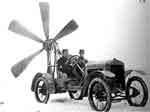
I heard it took him ten or twenty years to complete this massive book – a record of every pioneering expedition by motor car and bike trip into the Sahara in the first third of the last century. I can’t understand a word of it but the many archive photos and crystal clear maps are good enough to illustrate the advent of the automobile in the Sahara. Some of the early solutions to the problem of soft sand traction are ingenious – they cottoned on to giant caterpillar/belt drives pretty early, though the propeller cars look like they may have had pilot suction problems. And our strange friend Byron Prorok (see other reviews) is in here too.
Interestingly, one sees that all the main pistes as depicted on the Mich 741 and including the Libyan Desert were all established by the mid-30s. And yet took them another 70-odd years to finally seal the Sahara (followed by an eternity of maintenance…). The many maps also highlight places and routes that may have slipped from the contemporary Saharan radar, offering endless opportunities for historic trips ‘in the wheel tracks of’. I suspect this is a fascinating account of early motoring in the Sahara.
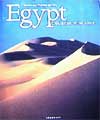
EGYPT, CIVILISATION IN THE SANDS Pauline and Phillipe de Flers (Konemann, 2000, (o/p)
Thankfully not another ‘pharaohs and fellucas’ job. The first half covers the Western Oases (Siwa, Farafra, Dakhla, etc), the second the Sand Sea, Gilf and Uweinat: the history, rock art, inter-war explorers, geology, etc, all with great photos and interesting boxed asides. This sort of book would normally be 30-40 quid, but at Stanfords was remaindered at £9.99. I should have bought them all. Scarce on the web.
Geographically authentic, fast-paced thriller set in the Hoggar, Tenere and Tassili of the central Sahara. This is Tintin for grown-ups, where laconic heroes like Burne say “what the hell…” a lot and casually swap diffs’ during sandstorms while chased by mysterious assassins. Women are usually somewhere else and “strangely attractive”. Compulsively entertaining departure lounge stuff and ten times better than Cussler’s terrible Sahara (see review). I loved it!





 Sahara Overland