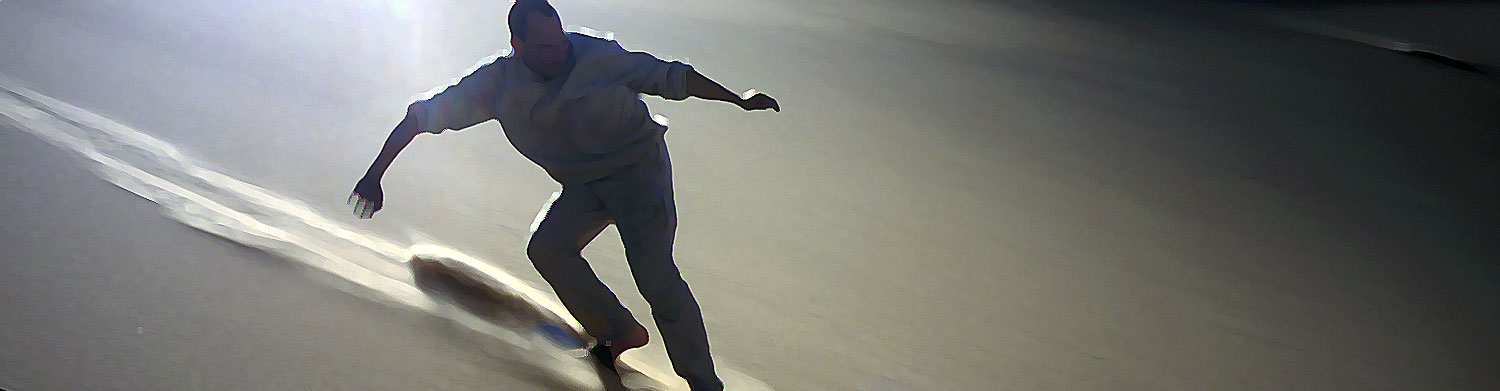
Author Archives: Chris S

M is for Marlboro piste: Libya to Agadez – 1999

 Part of the Sahara A to Z series

I met Belgian couple Luc and Catherine in Sebha last November where they were planning to cross the Ténéré to Agadez and then sell their old BJ40 Land Cruiser in Togo. Had it not been for the fortune I’d spent just getting that far myself I’d have gladly joined them. As we parted Luc and Catherine were heading up to Ghadames to meet some friends for the drive down to Ghat. Here they hoped to continue south. Five months later I got this message…

Ghat did not seem to be a good place to travel to Niger via Algeria, so we decided to return to Sebha to get more information about the conveys going to Dirkou. The advice was that we should go to Al Gatrun and wait there for the trucks going to Niger. Arriving in Al Gatrun, little more than a desert village with one filling station and a Niger consulate we soon met Mohammed Tager of the Wadi Alhikma Travel & Tourism Agency (Tel/Fax: 0735-2901). He ran a camping ground in the old Italian Fort which is very nice. Mohammed offered to organise guides for Chad ($600) or Niger ($400). This was much too expensive for us so we decided to do it our own way. We went to Tajarhi, 80km south of Gatrun to wait there for the convoys that did not come. The only traffic was Niger-bound smugglers passing through at night.

We waited patiently in Tajarhi for four days during which time we got talking with people in the village. We met some Toubous who were planning to drive to Niger with four Toyotas. They were smuggling stuff that they get almost for free from the government: rice, flour, diesel. We also saw a brand new car covered on a truck. They invited us to join them.

Like everyone else it seemed, we left one evening at 9pm. The first part of the piste was terrible, about 100 km. of very soft sand. After one hour we had only covered about 500 metres and could still see the lights of Tajarhi behind us. The others seemed unruffled and unbelievably navigated following a single star. There were no tracks.

After two hours the conditions improved so were able to keep moving. Suddenly, while we’d stopped to check the engines five military Toyotas pick ups fitted with machine guns tore out of the darkness and surrounded us. Catherine and I nervously listened to them talking over the radios and at this moment thought our trip was at an end. But after a brief talk with the others and some shaking of hands we were allowed to continue. Clearly some arrangement had been made. In fact the army knew the smugglers, because we saw one of the soldiers the day before taking money from the Toubous. The reason stopping us in the night was in my opinion to show they could find us anyway, even in the middle of the desert at night. So leaving without their permission would be impossible.

The drive to Madama unfolded exceptional landscapes and every day we met yet another overloaded truck taking Africans to Libya. It’s not a highway but there is traffic anyway We ended the next day just before Madama where we spent the night with the Toubous. In the morning we drove up to the military post and handed over our passports. At long last, after several weeks we were officially in Niger! At Madama we met up with a big Slovenian truck carrying eight tourists and we decided to continue with them as we still had another 500 km to get to Dirkou. Their truck was an old military TAM, about the size of a new Unimog, but with only 120 PS for 10 tonnes! On the way south we passed through two more military check points in Dao Timmi and Dirkou.

In Dirkou we met the famous fuel dealer Jerome the Libyan who sold us diesel in 205-litre drums. Luckily we were able to share it with the Slovenian truck as we had no room for so much fuel. Jerome is a very strange and funny man, he is about 84 years old and tells stories about the second World War during the battle with Rommel and Montgomery in Tobruk. He has lived in Dirkou since 1958. We rested two days in Dirkou during which time we checked over our vehicles and visited the very nice market.

Eventually we managed to find a guide to take us across the Ténéré to Agadez. Mohammed Toufoutou was very good but expensive, charging 1500FF for the 650km trip no matter how long it took. The Ténéré seemed to us very easy driving. We had the impression that it was very flat and only once in a while did we hit patches of soft sand. Some of the parts were so flat and featureless it was hard to keep in a straight line. The guide was incredible. We drove 250 km straight to the Arbre du Ténéré which we found a very dirty place, but anyway we saw it. On our way to Agadez we passed many Africans going north to Libya to find work, perched on the top of big 6×6 trucks overloaded to the hilt.

Very impressive were the salt caravans, some of more than 200 camels heading for Bilma via Arbre du Ténéré and Fachi: 450 km in just fifteen days. At one stage they have to cover about fifty kilometres a day through the dunes to get between the wells of Arbre du Ténéré and Fachi.

When the camels leave Tazolé (160 km east of Agadez) apparently they can become nervous. We saw many dead beasts that did not make it to the next well abandoned by the piste.

The second day, about 200 km from Agadez, the Slovenian truck’s alternator expired. Three times I had to tow-start it to get the engine running. Later when I noticed the whole roof of the BJ shaking, I realised pulling the 10-ton truck over the sand had torn away the rear chassis cross-member.

Arriving in Agadez there was a good ambience but as we were the only tourists, they all jumped on us to sell something.

Having made our repairs the Slovenians found someone to drive with them to Arlit and on to Tamanrasset. From there they planned to continue back up to El Oued and Tunisia. We were going south to Togo, so we said our goodbyes. How they did work out, I don’t know, but I knew that together we had done something special. We were very pleased with our achievement, to have crossed the Sahara and the famous Tenere from Libya to Agadez. I surely want to do it again sometime!

Luc DE WULF and Catherine THOMAS

PS. The Slovenians arrived home safely after their trip through Algeria


Gerbert Van der Aa (see Chad with Mercs) also did this route in October, 1999

Last October I travelled from Libya to Niger with my girlfriend. We had a 15 year old Nissan Patrol diesel. We bought our Niger visa in Sebha (100 dinars each). It took just half an hour. We did not take the carnet as we thought 250 dinars was too expensive. In Gatrun we stayed in the old Italian fort which is something of campsite now. Some bad stories circulate about the owner Mohamed Tahar, but I think he’s really okay. We paid 35 dinars search for the formalities. Staying at the fort was free. Mohamed Tahar offered to organise a guide for the trip to Niger, but did not bother when we said we didn’t need one.

We left Gatrun alone, two people in one car. The sandfield just after Tajarhi is easy with 0.5 bar in the tyres. We drove on the truck piste and saw about four other cars every day. We did not follow the old Marlboro-piste, but drove 20km further west. We reached Tumu in two days and then drove on to Madama, where we were met by some nervous soldiers who initially seemed to think we were Tubu rebels.

We bought insurance for 450 FF. Still alone we continued to Dao Timni, Seguedine and Dirkou.

The piste was clear. Only shortly after Madama we took a wrong branch, and probably arrived on a smugglers piste. We did not really know if the real piste was to the west or to the right. We decided to stop for the night and watch for trucks. In the night it’s much easier to see cars passing by. At the beginning of the night we saw them miles away to the west. So then we knew we had to go west in the morning. We slept well.

We arrived in Dirkou early in the morning, two nights later. We met Jerome and bought petrol with loads of sand in it. We ate something and left in the afternoon. No one told us to take a guide. If we had stayed in town longer, things may have turned out differently. We crossed the Tenere on the truck piste via Achegour. A lot of soft sand, but our Patrol did not have any problems, even without sand tyres (we had 215 R 16 Bridgestones M&S!).

Agadez was calm. We bought a carnet for 50 FF and continued south. We drove to Niamey, Gao and Bamako There we wanted to sell the car, but no one was interested. So we decided to continue to Nara, Nema and Nouackchott. Finally we sold the car in Dakar for 12.000 FF (the same price we paid in the Netherlands).

I don’t think it was dangerous to do Libya-Niger with just one car. Local truck-drivers do the same. As long as you stay on the tracks nothing can go wrong. Tuareg-rebels do not seem to be a problem anymore. Although I wonder what’s going to happen to the Paris-Dakar when they travel through the north of Niger in January 2000. I suppose some people will get robbed. The target is just too easy.

Idehan Murzuk (1998, Libya)

idehan

Ursula Steiner

We set off to cross the Idehan Murzuk from Murzuk town to a supposed fort near Tilemsin on the western edge of the sand sea, a distance of around 300km direct. Although it’s not expressly forbidden, officially the erg is off limits. Things will probably stay that way until the first tourists have to be rescued. So if heading this way keep your plans to yourself.

Our group in 1998 comprised of four cars: a Dodge RAM, a Hilux, a Discovery, a G-Wagen and a Quad, Nine people (four female and five male Saharans). Having found the tap water salty, no bottled water and little food to buy, we left Murzuk late one afternoon in mid-October, heading towards Traghan/Tmissah, but soon turned off southwest across a soft sand plain. Tyre pressures were lowered but we got stuck anyway, so we made camp.

The next day was cold and windy but we made very good progress of about 100km along a broad valley. On the days that followed we managed about a third of that distance between camps, though of course driving distance with all the zig-zaging and backtracking was at times double that. We followed fresh car tracks up and over small dunes until the Dodge got stuck on the crest of a seif and the others in a dip, due to driving too close together.
We passed dry lagoons between beautiful dune chains and from time to time had to surmount barrier dunes which blocked the valleys. There were still fresh 4×4 tracks which was comforting, but in the heat of the afternoon one car slid into a vortex or hole and it took a long time to get it out. We camped, exhausted on the beach of a dry lake. In the Neolithic era these lakes dried out into ponds and swamps ringed with beaches around which we had our camp.

Day three dawned hot; already 25°C by 8am. Now the dune chains were getting higher but the car tracks were still plentiful. We got stuck several times; hard work in this heat but the colours of the sand, orange, beige, grey were amazing! We rode up high over sparsely vegetated dunes and slithered down the slip face into another flat lagoon.

These lakes got smaller and the dunes closed in, no more broad valleys to cruise through. From the summits the chaotic dunescape looked like boiling water. We camped near a small oued with green grass, a little more tired and tense, but happy to be here. Mouse tracks covered the ground and nearby the brittle white skull of a gazelle lay half buried in the sand.

Up and down, again and again the next day. If you hesitate you get stuck on the crest – but charging over is dangerous. There is no easy way. Often in the depressions there are soft sand fields with white-greyish fesh-fesh covered with innocuous-looking sand waiting just for us… We’re now in the midst of very high dunes, no way to drive around or to turn back. Sometimes one car is already on the other side but we’re unable to follow. It’s hardest for the last car as the narrow passage over the crest gets churned up with every passing vehicle. But once over we float down the terraces of sand, silently, elevator-like. Golden sand pours away like water. It’s absolutely spectacular!

We camp in the dunes near a lagoon filled with white sand. Evidence of Stone Age occupation is everywhere to be seen, from Acheul to Aterien to Neolithic eras: 300 000-4 500 years BC! That evening the G-Wagen crew gets a bit of a fright when they realise their fuel consumption has shot through the roof.

Our fifth day in the erg was cold but we’re only 80km from the ‘fort’ at Tilemsin as the crow flies. We can’t go straight on of course, there are a lot of narrow low dunes in front of us. We decide to attack a huge dune like ants and once down the other side we find several old lorry tracks. Relieved, we follow this unexpected highway which later disappears into the side of a dune… So we climb a very soft dune, over the crest and down the other side, carefully avoiding a few more craters. Sliding into these does not bare thinking about. We even have to dig away a small dune to push our way through.

After more effort than anyone wants we finally arrive at a dry lake several kilometres long and make camp. We’ve travelled only 30 km since the morning and the cold evening brings out our sweaters. The atmosphere around the fire is a little edgy. We’re close, but not quite there yet

Day Six. Cold. Loud music for breakfast but then we have to jump start the speaker-car. We set off but after an hour must turn back, it’s impossible to go on. For one hour we wait while the quad searches the dunes for a way through. And he does a good job, leading us out of this cul-de-sac like Moses parting the Red Sea. Another lagoon with yellow, red and white sand under the blue sky – colours we never saw before. Unforgettable landscapes. Some crests, some slopes, some precipices – we’re getting used to it now.

But the last pass is the most difficult of the whole expedition. Soft, and after trying again and again softer still. There’s no room for ‘contour driving’ to get a run up but somehow, as always, and after a lot of pushing, reversing and flat-out acceleration we get through to enjoy the thrill of cascading down to the next dry lake.

The last day and the dunes get smaller, more muddled. Up and down we go, but have to turn back again. Then suddenly a valley and – STONES ! A wave of relaxation and also a little sadness passes over us as we follow the valley winding through the low dunes. Only at the last minute do we spot, very far away at the edge of a plain, the low dark line of the Messak Mellet on the horizon. We pump up the tyres and find the so-called fort (just a pile of stones) at N 24° 43,49988′ E 011° 40,15987′

It’s nice to be out of the sands at last but for the evening camp we return back into the dunes!  

Ursula Steiner

‘K’ is for KTM 450 EXC in the Algerian Sahara

by Dan Ward ~ September 2007

dandan

Riding a bike in the desert is almost the most fun a person can have, so when I saw an advert in TBM for a three week trip to the Algerian Sahara, I jumped at the chance. The trip offered a rare opportunity to travel with legendary desert rider Chris Scott, author of ‘Adventure Motorcycle Handbook’ and ‘Sahara Overland’.
Chris is a well known figure in the Sahara (which became clear when he was mobbed by a group of adoring fans during the trip, at a roadside café in Arak). He isn’t a professional tour operator, but he does occasionally take groups out into the desert to help fund his own adventures. Chris is a very easy going character who doesn’t take himself or anything else too seriously.

DRT07map

The route chosen by Chris took us in a 2600km anticlockwise loop, heading west from a pretty oasis town of Djanet in the south of Algeria, and stopping halfway at Tamanrasset to visit the Assekrem (a hermitage in the Hoggar mountains), before looping back east to Djanet (click map right). Chris’s unique experience and knowledge enabled us to explore remote and normally inaccessible regions, riding largely off-piste in the most beautiful desert I have ever seen.  Apart from Djanet and Tamanrasset we spent all of our nights camping out in the desert under the stars.

MAN-lorry-rox

Support
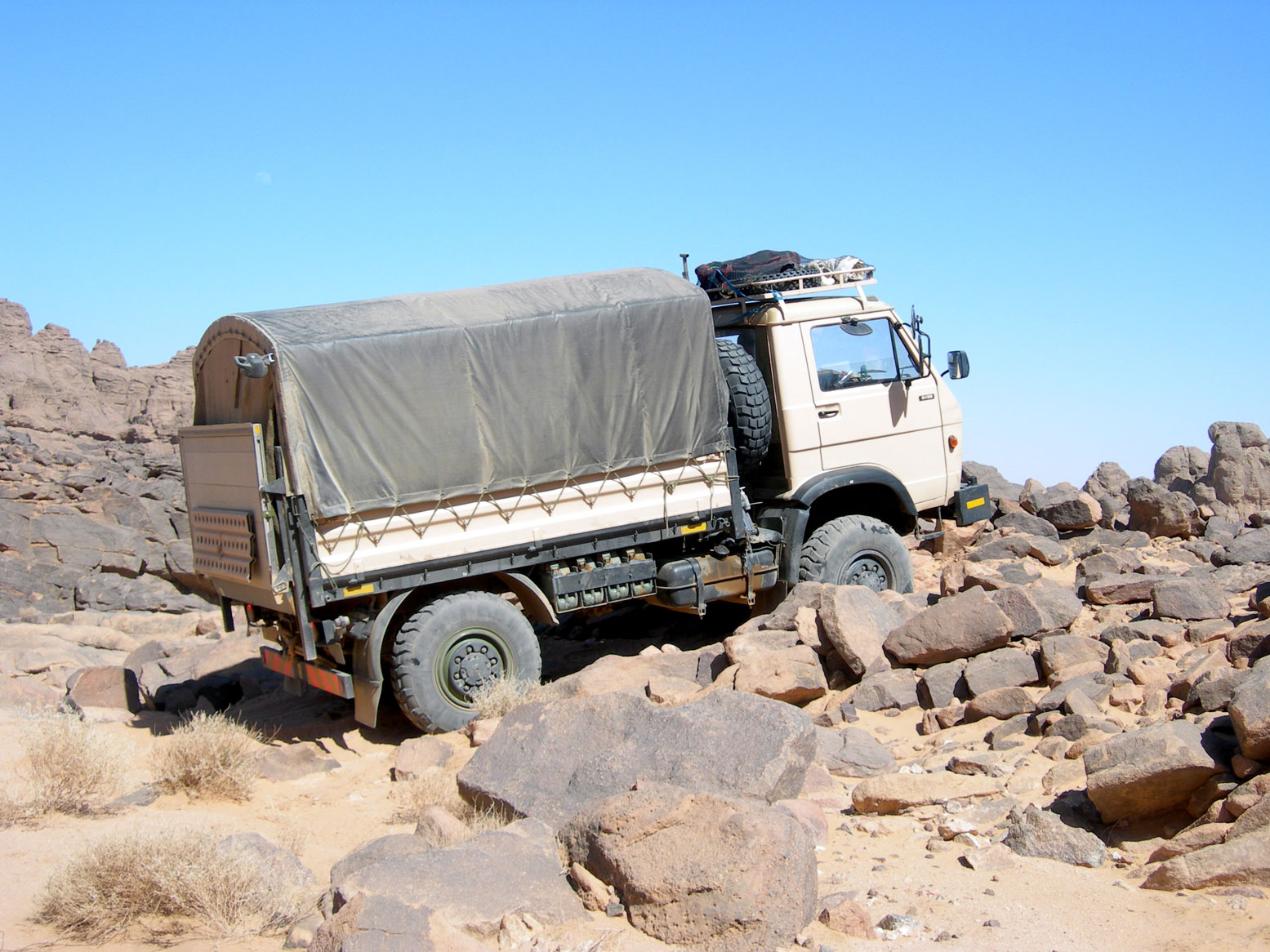
During the trip, Chris drove the MAN support lorry which carried all our food, water and fuel, and occasionally, the odd broken bike. Experienced desert rider Jon Escombe was the pace bike rider, and, since it has been obligatory in Algeria to have a local escort after the tourist kidnappings there in 2003, we were also accompanied by two entertaining local guides in a 4WD Toyota Land Cruiser.

Riders and Bikes
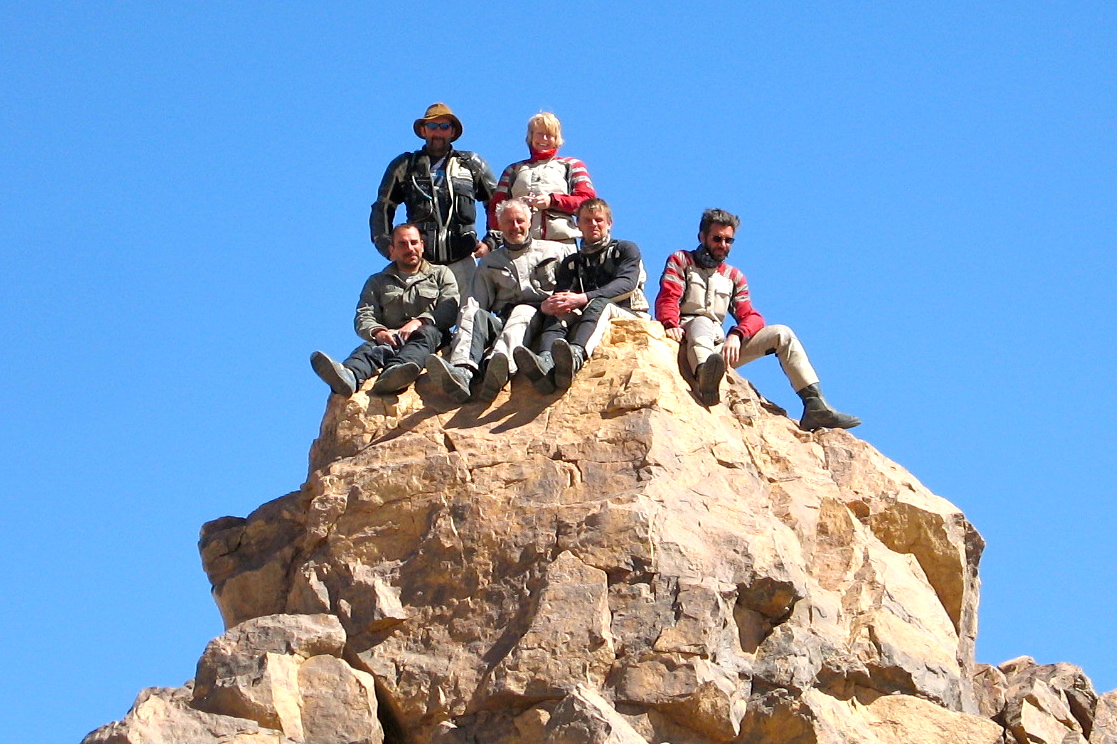
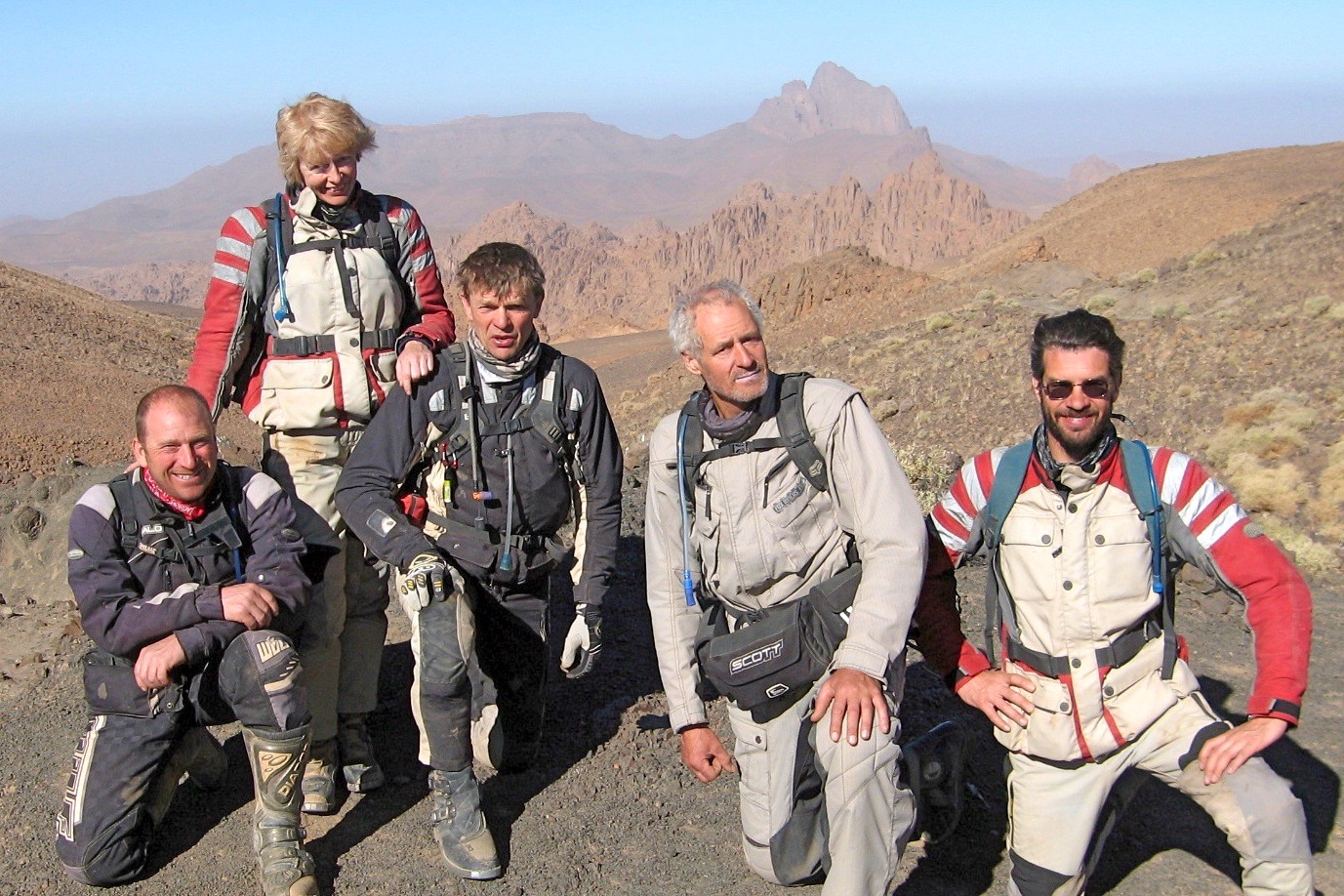
The seven riders on the trip were a very experienced group, most having previously ridden enduros or desert rallies, and all had travelled a fair bit. Oddly enough, out of seven riders – five were TRF members: Mike (who is now TBM’s ‘Mud Life Crisis’ columnist), Nick and Gerald from Cornwall, and Dave and myself from Surrey. Sean from Surrey and Ken from Scotland completed the group.

2007-riders

We each rode our own bikes on this trip. Chris drove the bikes to Djanet in the MAN and we flew out to meet them. There were two KTM 450s, one Beta 525, one Dominator and almost the complete range of Honda XRs (250, 400, 600 and a 650L  with 40l tank!).

Preparation
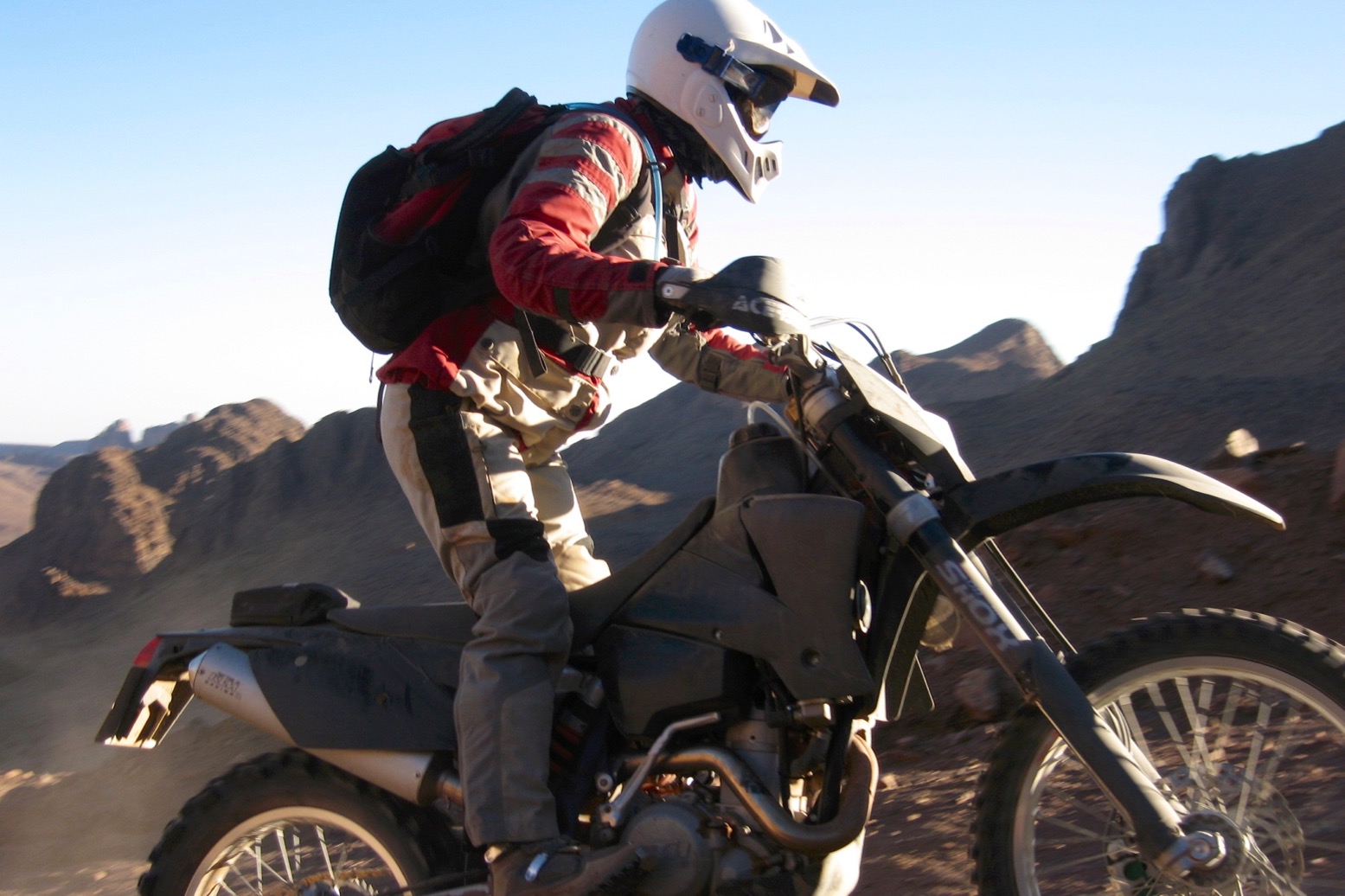
I had decided to splash out on a KTM 450EXC for this trip, as the horrors of kick-starting my recalcitrant XR250R in the desert didn’t appeal. Chris Hockey, aka Dr Shox, did a great job of lowering the KTM (as I’m just 5’6”) and set it up for my weight and the type of riding I do. (Chris sorted out my shocks and forks by POST!).

I fitted a beautiful Scott steering damper to calm the legendary KTM speed wobble, and this also had the beneficial side-effect of raising the bars to a much better position. I also fitted Michelin Desert tyres, a KTM cooling fan (essential) and a 13l Clarke fuel tank.

Bike Performance
The KTM turned out to be a great choice for the desert – its light weight, electric start, fantastic suspension and responsive ‘point and squirt’ power characteristics made riding a joy. The steering damper took the big impacts, and kept the bike on line with much less effort on my part, greatly reducing fatigue. The combination of Excel rims, heavy duty spokes and stiff Desert tyres meant that I didn’t have to worry too much about punctures or dented rims when riding at speed over the more rugged terrain, although the Deserts might sometimes have been a little too stiff for the light bike to gain enough traction in the really soft sand.

The KTM ran well on the local Algerian fuel (89 octane), and the need for bike maintenance was minimal. A daily check of oil and water, chain tension, nuts and bolts and spoke tension, plus a single air filter skin change and engine oil change was all that was needed. The chain didn’t need any adjustment. The bike didn’t use any oil, and the water needed topping up only once when the radiator boiled over (after the cooling fan became accidentally disconnected during a slight tumble.) Odd spokes and the one or two nuts which I had missed with the Loctite came loose due to the heavy pounding the bike took.

Dave’s XR400 probably had the best size, power and handling characteristics for this type of ride, but all bikes performed well, although Mike’s XR250 was nailed the whole way as his KTM 525EXC hadn’t been ready in time for the trip. Gerald’s four year old KTM 450EXC was the only bike to have any mechanical problems, although this might have been due to lack of cooling fan. The bike overheated and ran completely dry, resulting in its ultimate demise, and the end of the trip for Gerald at Tamanrasset.

Routine
During the trip, the days and nights quickly settled into a routine. Each morning, we were woken in our tents by the distant burble of the volcano kettle, signalling the imminent possibility of hot tea and breakfast.  I would then emerge from my layers of sleeping bag, bag liner, thermal clothing, rustling emergency space blanket and bike jacket. Yes, the nights were a bit cold!

After breakfast, we would pack up and ride out with Jon, meeting up with Chris and the truck at agreed waypoints for lunch and the evening camp. In the evening, Chris cooked the dinner while we rested and munched on snacks. After dinner, we would sit around the camp fire to chat and watch the stars.

Catering for nine people is a challenge in the desert. There are no shops, no refrigeration and no water, but oddly enough, Chris’ claim that the desert is a sterile environment is perfectly true. UHT milk kept very well decanted into a plastic bottle on the lorry, as did a 3kg block of cheddar. Baguettes also kept well in a black bin liner. Chris baked fresh bread for us a couple of times which was lovely (both the act and the bread), and one evening our guides went off into the desert and came back with warm camel milk – though, sadly, the taste fell somewhat short of my romantic expectations.

Riding
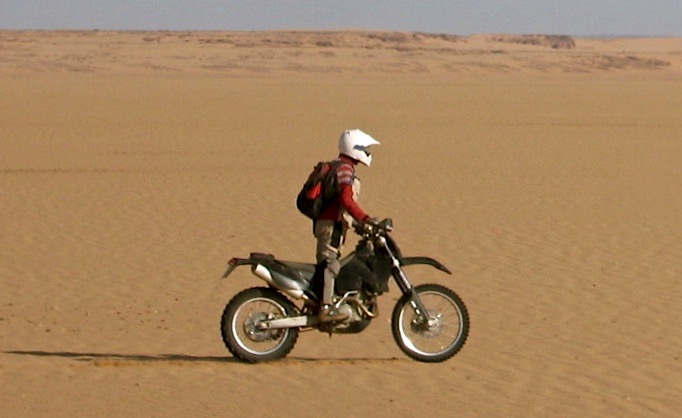
I found the trick on this trip (as any other) was to relax and try to ride with maximum technique and minimum effort. You can’t ride flat out for three weeks without becoming exhausted. The remoteness of the region and lack of possibility of any medical intervention in the event of accident means extra care is needed at all times.  The riding requires constant vigilance, constantly re-checking the foreground looking for ridges, boulders and ditches, and looking well ahead for larger obstructions like oueds or dunes which may need to be skirted, and in which the unwary can be separated from the group. The weird optical effects of the desert also mean it’s difficult to judge distances.

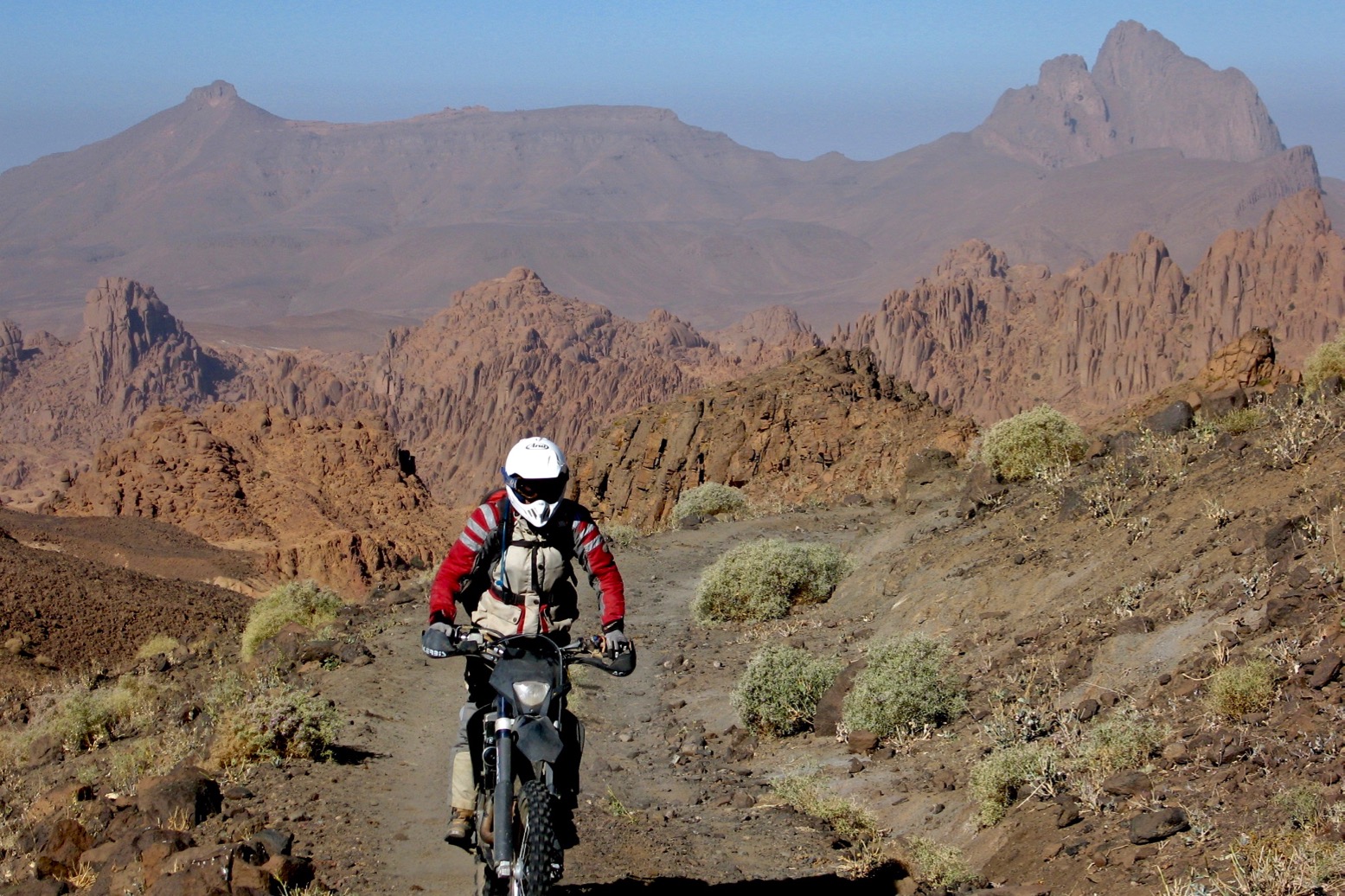
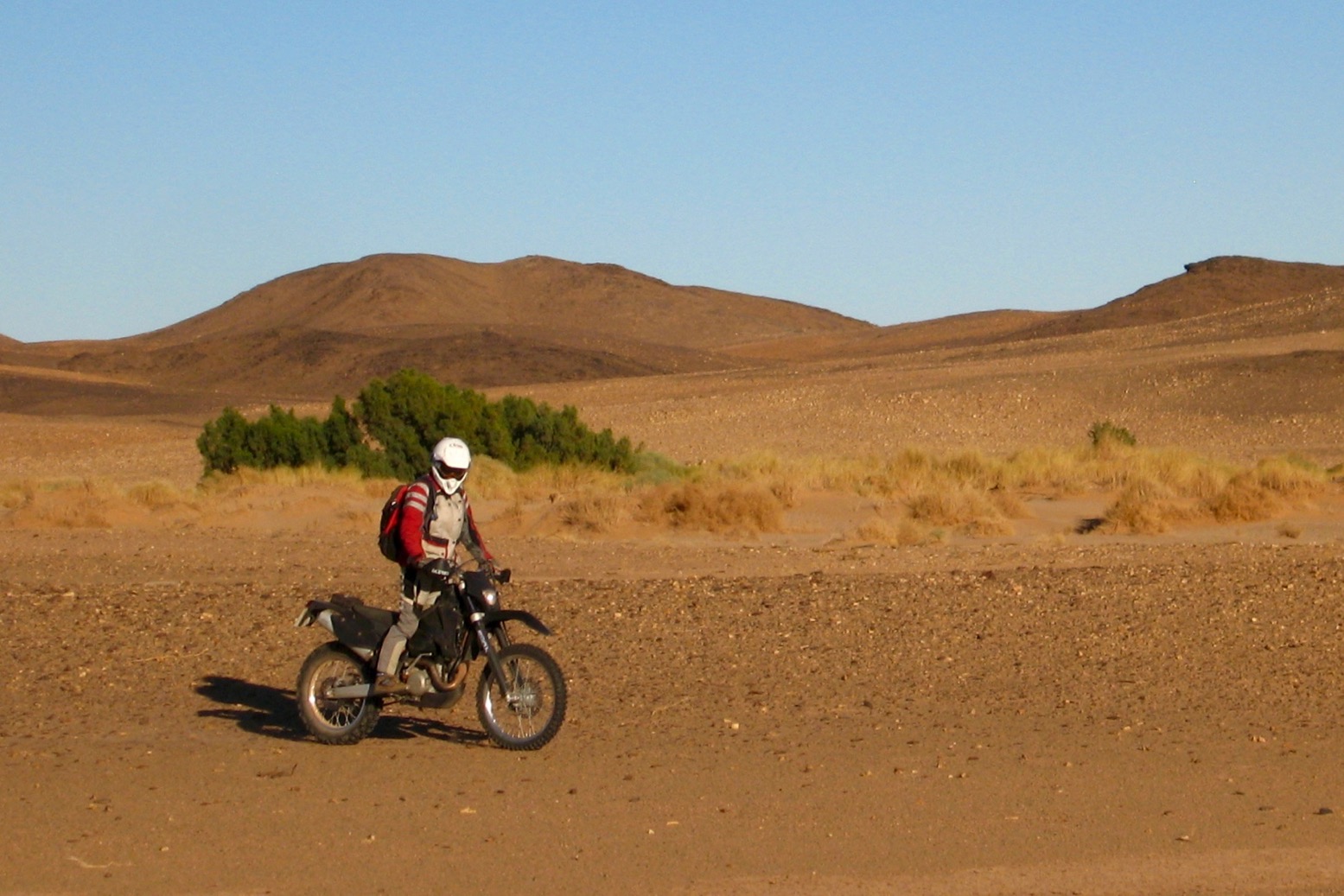
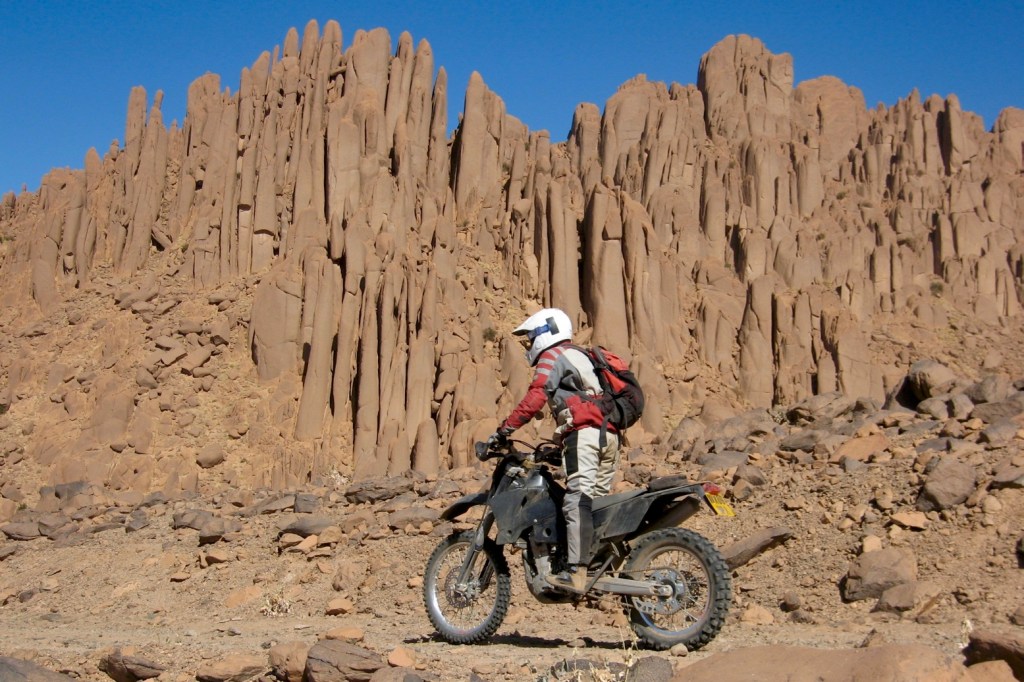
The bikes mostly travelled independently of the truck, so were able to travel off piste, which provided some great technical riding over a huge variety of terrain. There are fast, exhilarating sand plains, sometimes with unexpected flood channels and ditches which are very difficult to see. There are island outcrops of basalt and exfoliated granite in golden white sand seas, and beautiful sandstone formations and arches reminiscent of the Utah Arches national park. (Mike couldn’t resist exploring one). In between the larger outcrops and formations there are valleys of soft sandy ruts. Often there are enormous boulder fields or lava fields where the outcrops have broken down over thousands of years and become spread out in a carpet over the desert floor. The black lava fields are sometimes marked by white, narrow, twisty camel trails, formed over centuries by each passing camel shuffling its feet in the footsteps of the preceding camel to form a path through the shattered, pointy rocks.
Dune fields are the most fun, it’s incredibly exhilarating playing in the dunes, but they can be dangerous. In the really big ones, it’s easy to get disoriented with no sense of which way is up or down, just white sand in all directions, and on all dunes the crests can hide unexpected vertical drops, so it pays to stop or ride along the crest first to check the descent before going over the top.

Oueds were the particular feature of the desert that provided most entertainment for our group. Oueds are dried out river beds, containing channels, ledges and deep ditches, and boulders which have been washed down from the mountains many miles away. In between the boulders, acacia bushes have sprung up and become covered with sand, forming close-spaced soft sandy clumps and humps. These features all combine to form an interesting enduro course, where picking a line is sometimes impossible and it’s often easier just to ride straight over everything except the very deepest troughs and channels. The oueds became a familiar experience on the trip, and became known as the ‘boondocks’. Crossing the wider boondocks caused the group to scatter in all directions in a mad scramble, to emerge erratically on the other side with wild grins.

Parallel and close spaced fields of transverse sand ridges (giant sharp-edged ripples) up to five feet high were a particularly dangerous feature of the terrain. They are usually found in the areas between large rocks or dunes, and are difficult or impossible to see, especially with the sun behind or above, when there is no shadow.

We had one serious crash during the trip when Sean hit a series of the afore-mentioned sand ridges and launched his XR600 30 yards over the top, suffering a broken shoulder, other minor fractures and 2 sprained ankles. There was no possibility of being airlifted out as only the military have helicopters in Algeria, so Sean had to endure an uncomfortable couple of days being driven out of the desert in the Toyota.

Crises do bring out the best in people though. Chris showed great calmness and pragmatism, and also sensitivity, when looking after Sean after his accident. Sean was incredibly strong and stoic. Even when helpless with painful injuries, hanging half off a makeshift orthopaedic board/sand ladder in the middle of the night in the desert, he was reluctant to wake anyone up to help, and suffered in silence. The guides were also really kind looking after Sean during the following days, and even gave up their sleeping blankets.

Conclusion
I was originally slightly wary of going to Algeria in the current political climate, and, being female, I was concerned about how I would be treated. However the reality of the trip was far removed from my fears, and full of lovely surprises, including the fantastic riding, the genuine warmth and generosity of the local people who made tea for us in the desert and invited us into their homes, and the staggering beauty and purity of the landscape. Oh, and finding hedgehogs in the sand dunes was a bit of a surprise too.

I would do this trip again in a heartbeat. For me there were moments of sheer joy and exhilaration, and also a sense of personal achievement. I am really grateful to the people who made this trip possible and enjoyable. Chris’ openness and willingness to share his world with us for a short while, Jon’s capable care, and the Algerian guides’ concern, generosity and humour, and of course, my fellow riders for their company and willingness to chip in and look out for each other in true TRF fashion made the whole thing a brilliant experience I will never forget.

Of all the many bike trips I have been on, this was definitely the ultimate off road bike trip.

D is for Dust: Understanding the Saharan Climate

Part of the Sahara A to Z series
Saharan-duster

Considering its influence on global weather patterns, very little data exists about the climate of the Sahara.

saharan dust in uk

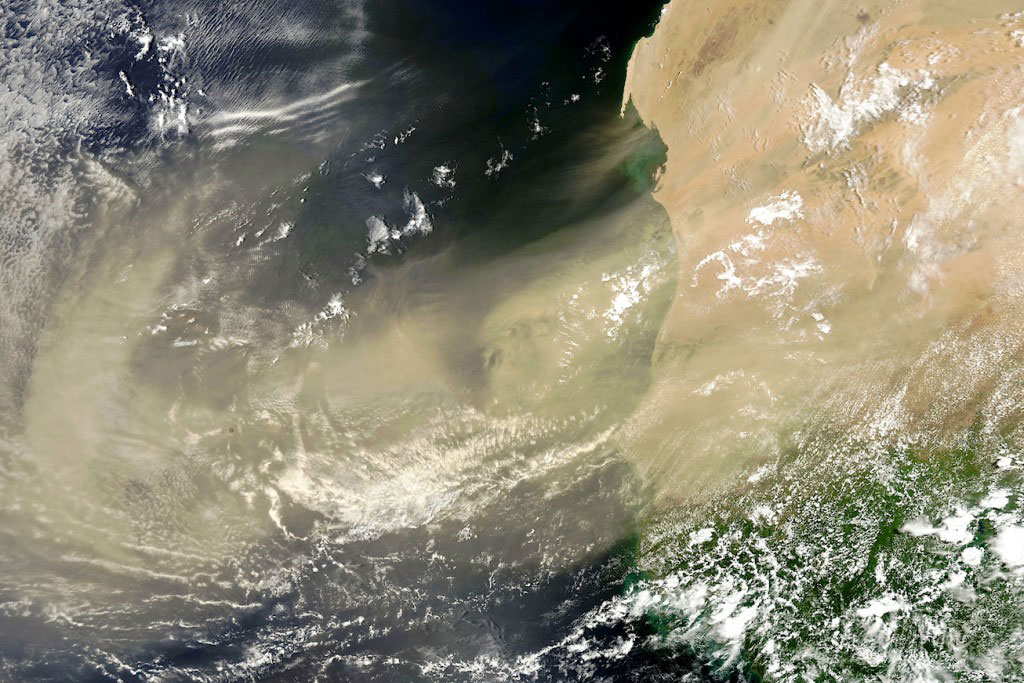
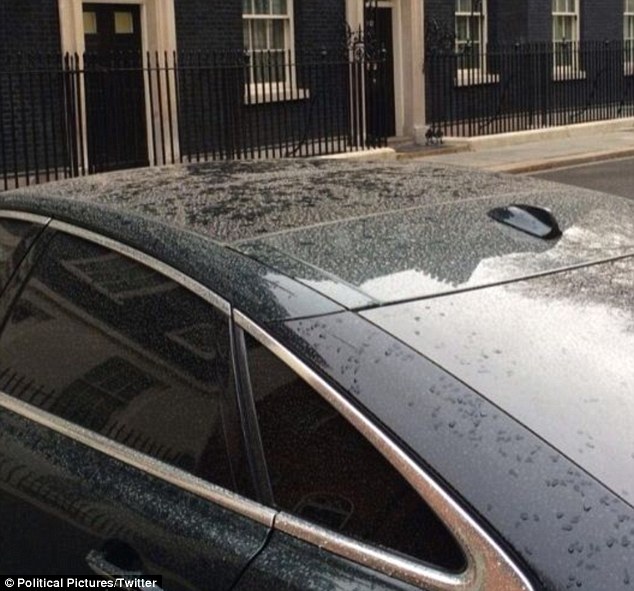
Dust plumes from summertime sand storms can reach right across the Atlantic to the Americas, having a bearing on the formation of hurricanes in the Gulf of Mexico as well as a beneficial effect on the ecology of the Caribbean and Amazon basin. In western Europe we’re familiar with occasional reports of ‘Sahara dust rain’ settling on smooth surfaces like car bodies. In March 2014 the Daily Mail reported on the outrage of Saharan dust settling on then Prime Minister Cameron’s car in Downing Street (right).

wef

bookmaproads
sahara automated weather station

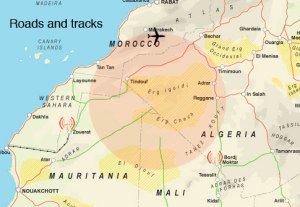
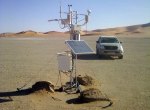
In 2011 and 2012 Project Fennec set out to expand the knowledge of this area by gathering climatic and aerosol data across the arid ‘Empty Quarter’ of the western Sahara. Covering northern Mauritania, northern Mali and western Algeria, it’s known to meteorologists as the ‘Saharan Heat Low’ (SHL) and is the world’s largest source of airborne dust. Manned weather stations were established in Zouerat, Mauritania and Bordj Moktar (‘BBM’) on the Algeria-Mali border (see map above left), while automated weather stations (AWS, above right) were planted across the 1000 miles between the two bases, in the remote Erg Chech region.

SEQroute

In 2006 we traversed the southern edge of this ‘Empty Quarter‘ between Ouadane and BBM, crossing only the infrequently travelled Timbuktu-Taoudenni piste in some 2000 km of off-piste driving. On the way we collected dust samples for what became Fennec.

ewf
wef3

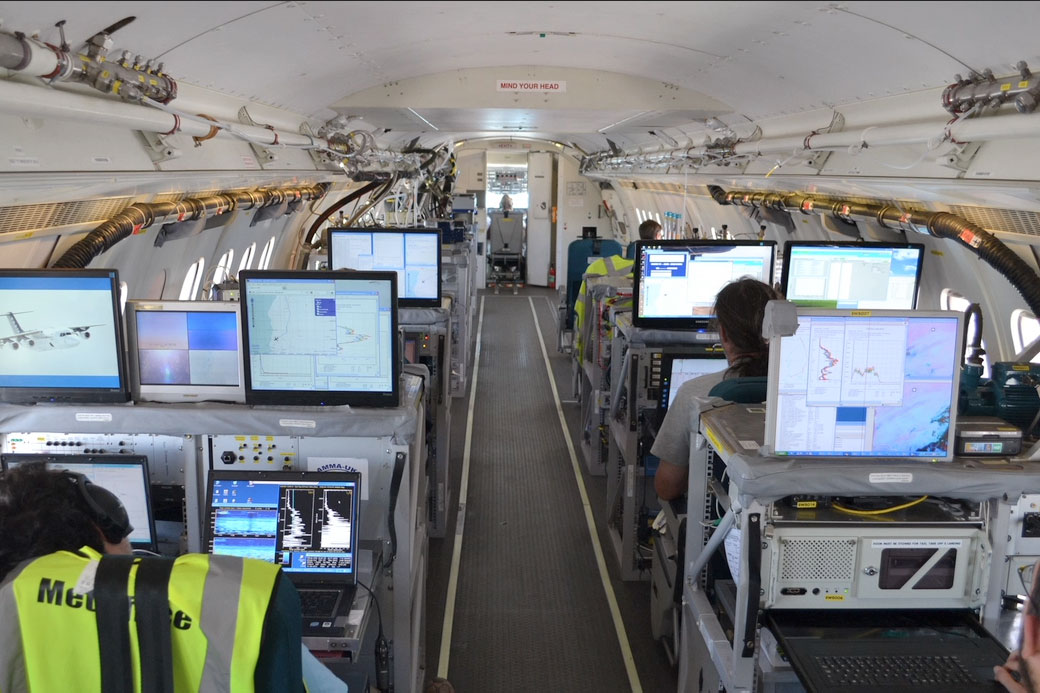
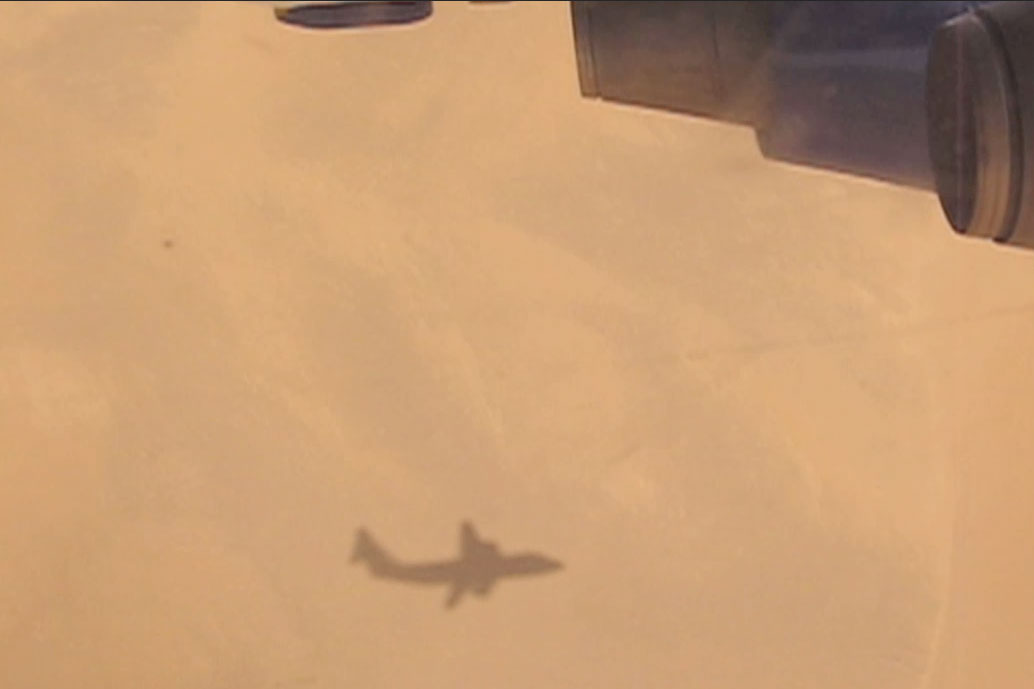
Following its 2005 Bodele dust-research expedition to Chad (BodeX), in 2012 the Fennec ground observations were backed up by a series of flights at high and low altitude across the region using aircraft crammed with recording instruments (above right).

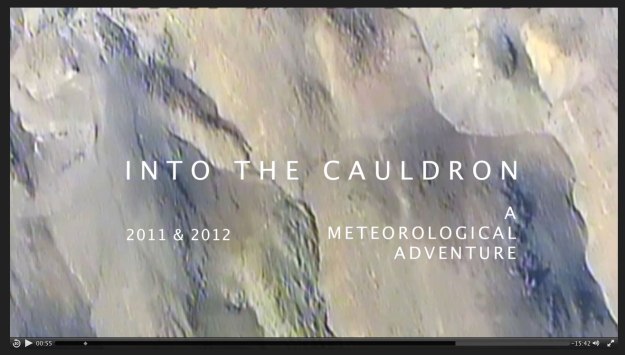
Below is a short film about the Fennec project. It’s not click and play; it has to download itself.

itc

Morocco: Getting There + Mobile phone SIMs

See also:
Documents and Port Immigration
Buying and using a Moroccan SIM card

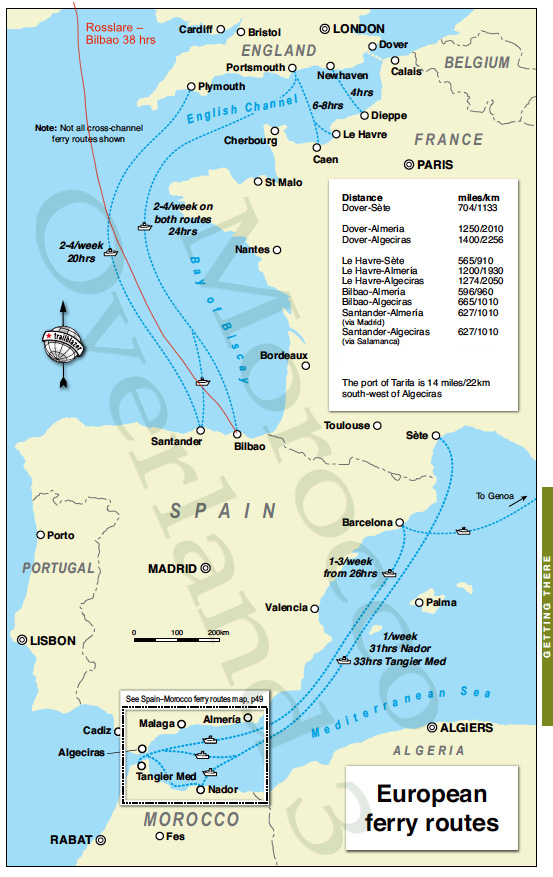
Most travellers from the UK heading to Morocco in the cooler months take ferries from Portsmouth to northern Spain: Bilbao or better still, Santander. When you add up tolls and fuel and time across France it works out the same price for less driving or riding.
The Brittany ferries on this route are well-equipped cruise ships with plenty to occupy you over ~22 hours at sea, while doing a great job of smoothing the voyage across the Bay of Biscay. Brittany also have a no-frills ferry route between Rosslare, Ireland, and Bilbao.

traspain

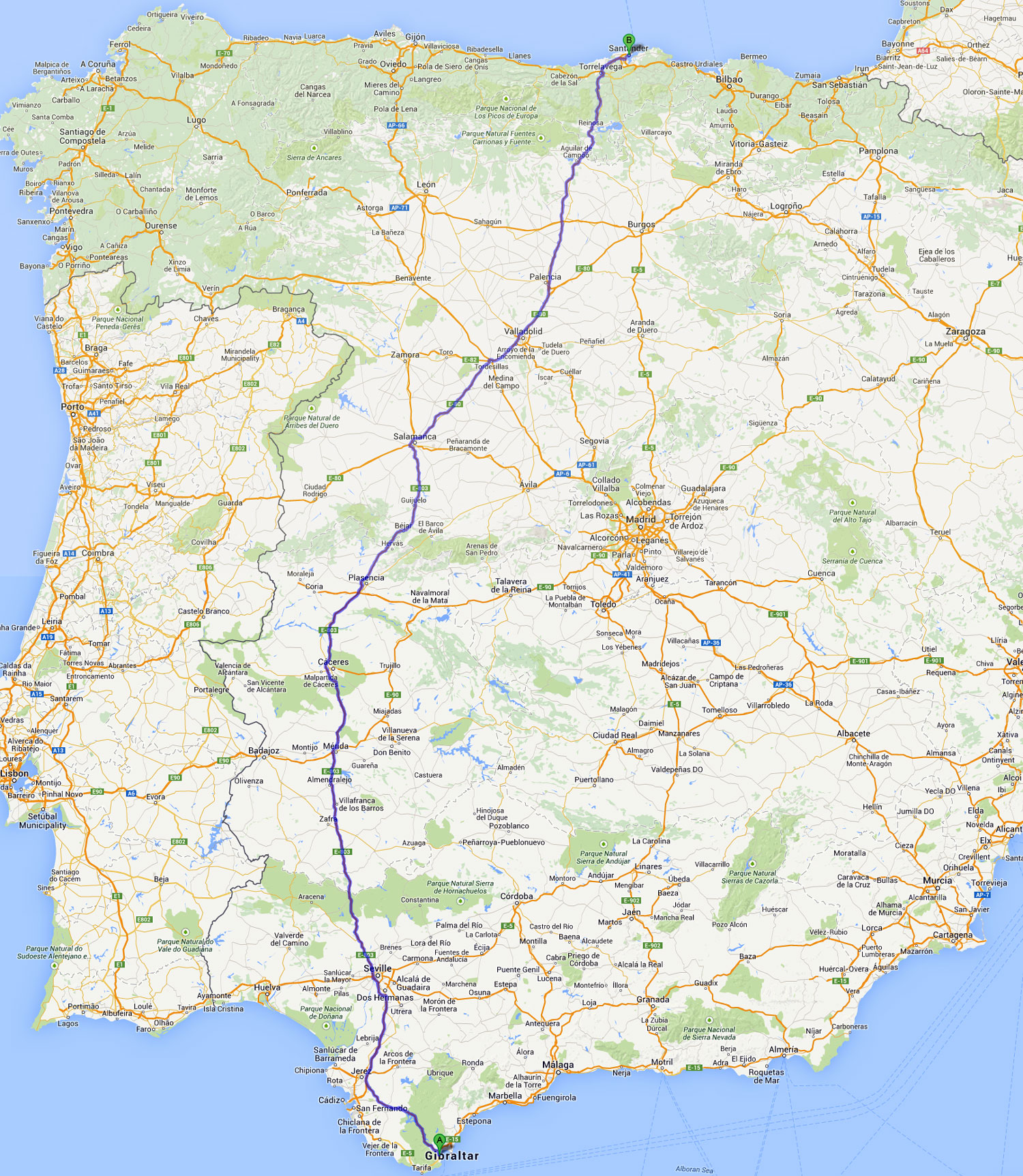
From Santander to Algeciras (the most-used port) is about 1000km, and the empty and fast network of roads west of Madrid (A67, A62, A66 and A381 – right) can get you between the two ports in one long day.

malagawear

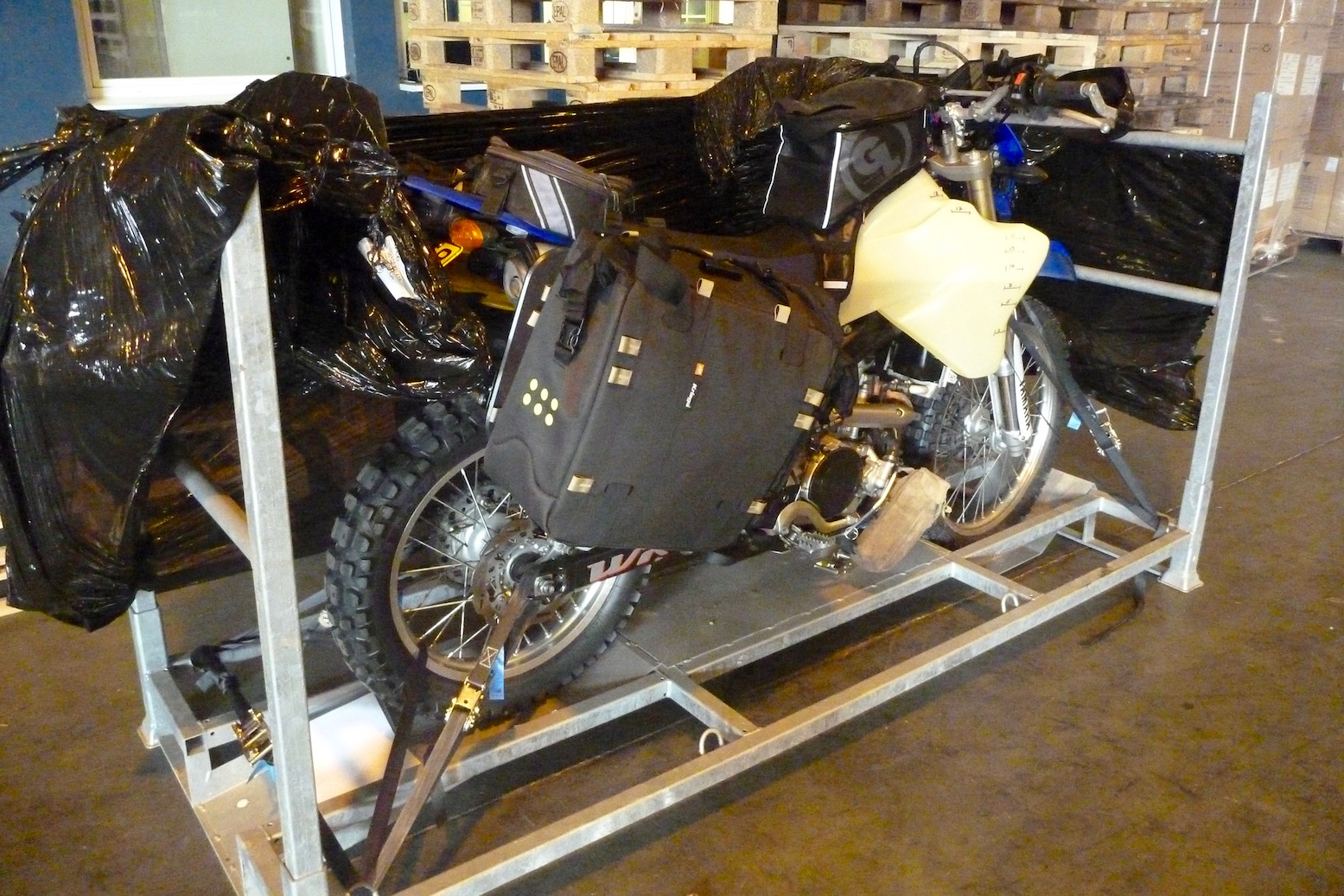
On a motorcycle, from the UK you can save at least two days each way but getting it trucked to a warehouse near Malaga. I’ve used Fly and Ride. I delivered my bike loaded up to a warehouse near Gatwick, then flew in and picked it up next to Malaga airport a week later. Post Brexit it now costs from £700 one-way. See this thread.

Toll motorways. Quick ways to get south or east.

Moroccan Ports
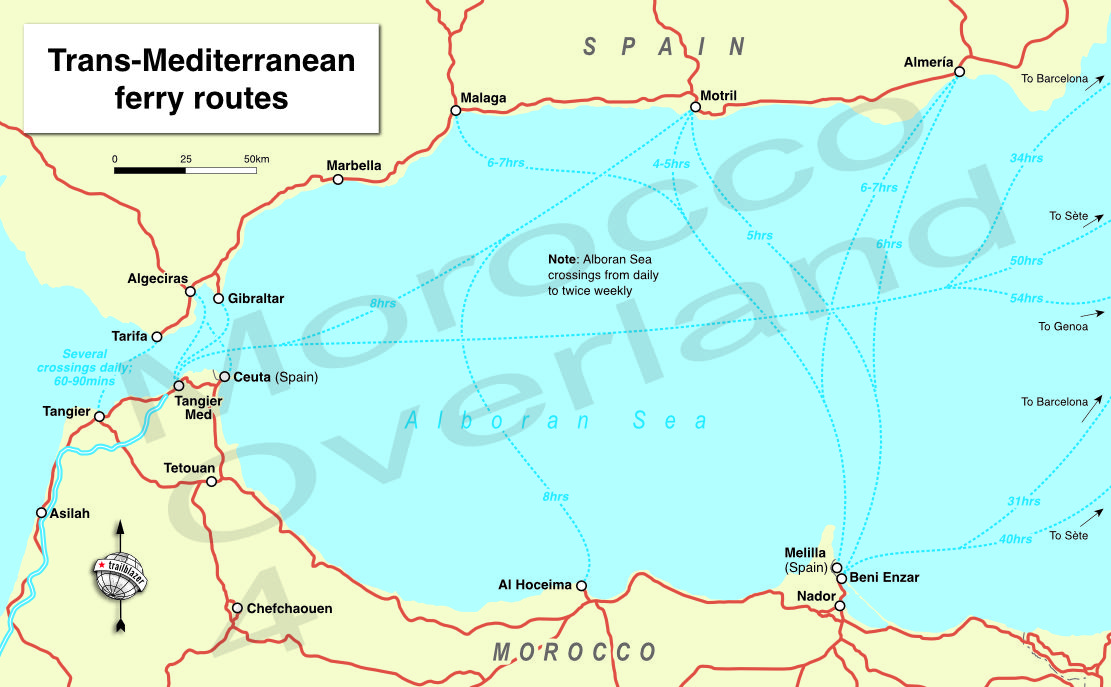
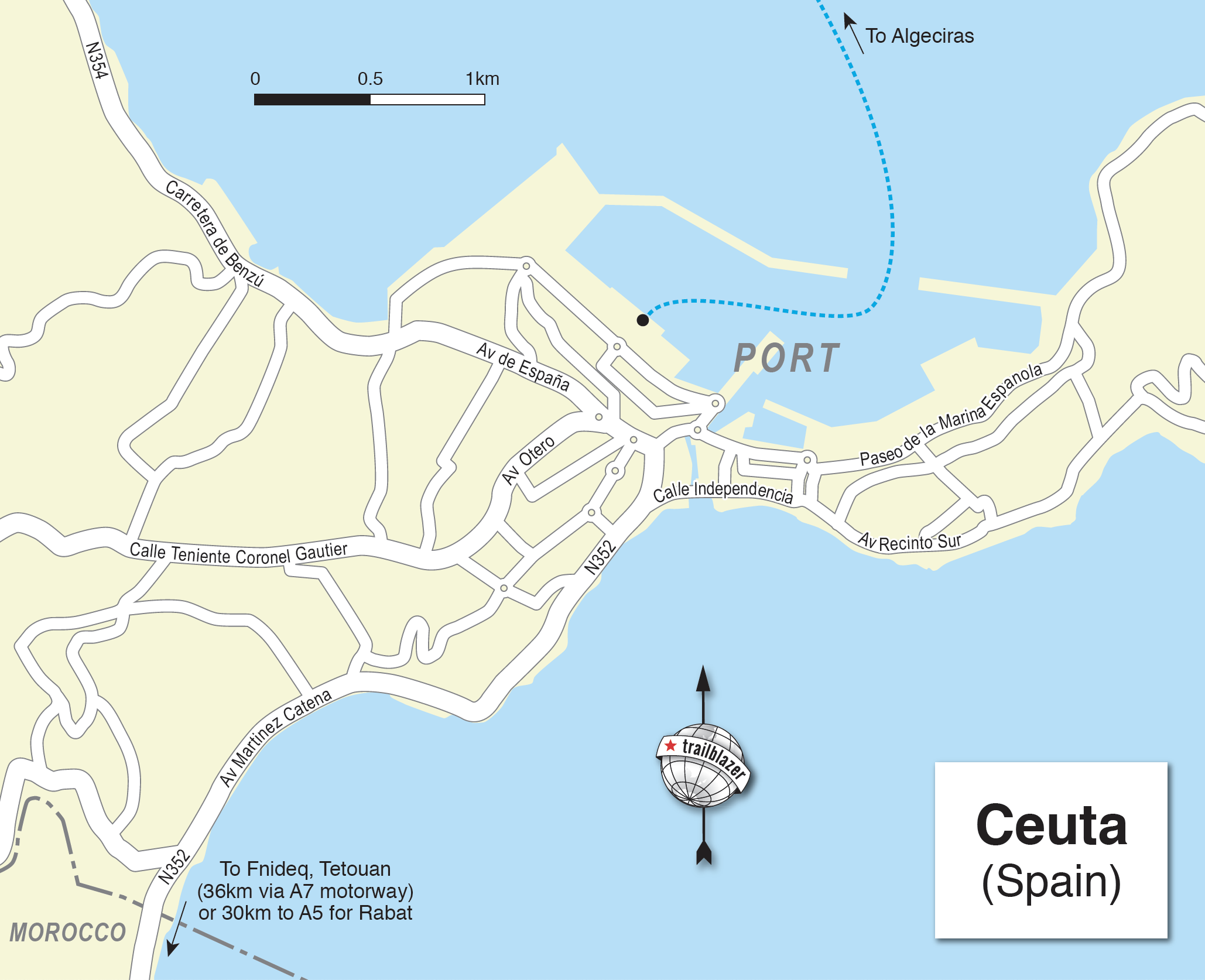
Now that Tan Med port is so easy, few go via ‘Tangier Ville‘ or the nearby Spanish enclave of Ceuta (Sp), although from Alicante, ferries to Melilla enclave (Sp) are often much cheaper than adjacent Nador. The payback can be that on the Spanish side of the land border with Morocco you’ll have annoying ‘helpers’ offering their services. They’re just looking for a tip at the end of it, but on a quiet day, you can manage without them.

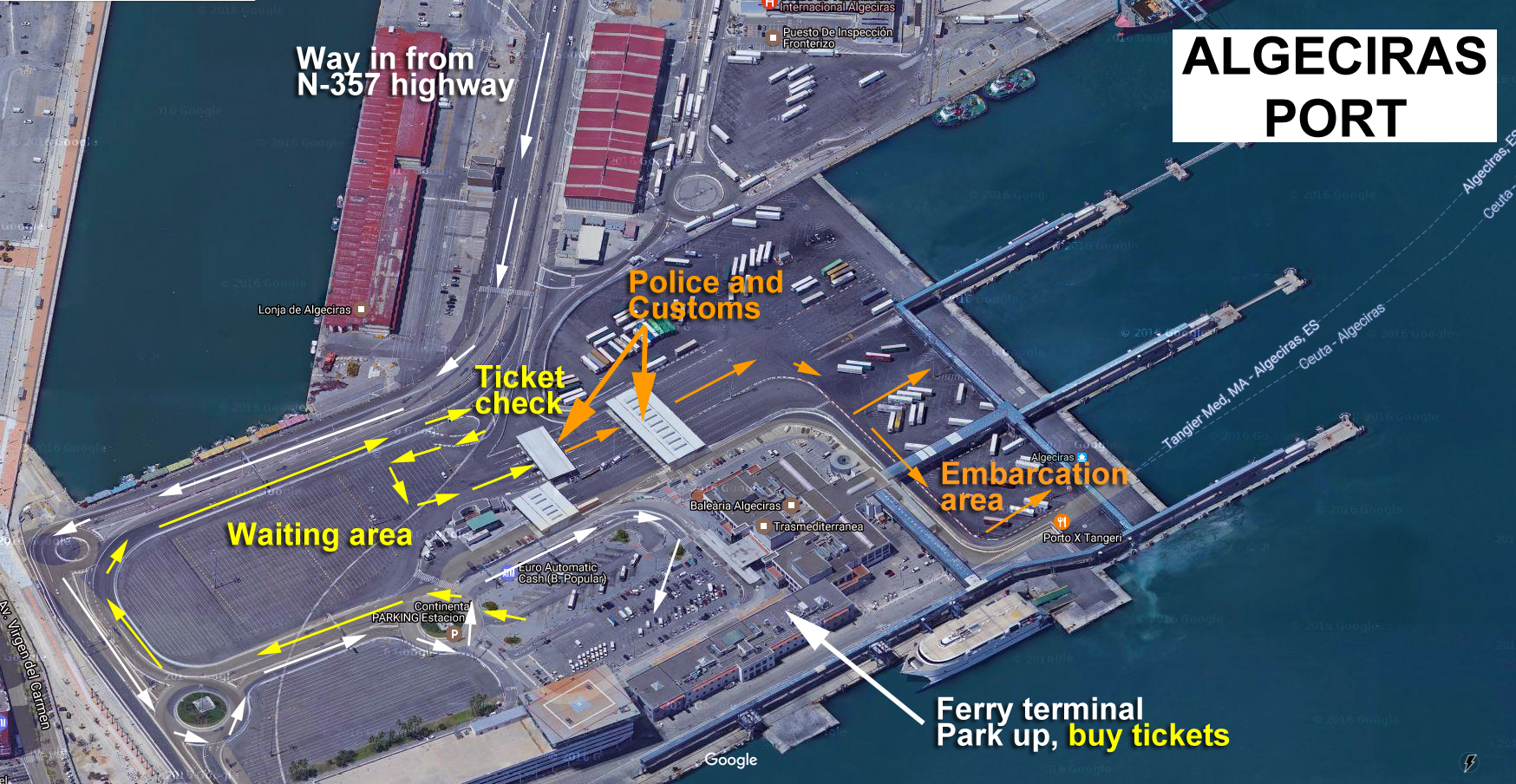
Algeciras-port
White line then to buy ticket, yellow line to waiting area, orange line to embark

Moroccan port maps

nadorins1

Morocco Maps

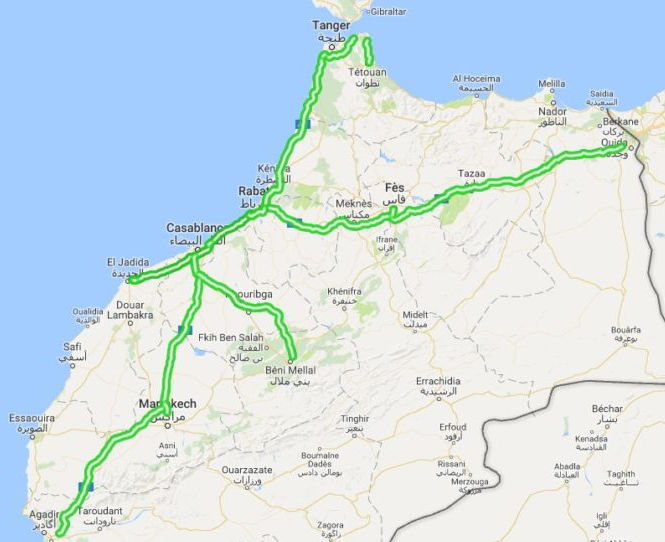
Morocco Overland Maps has moved

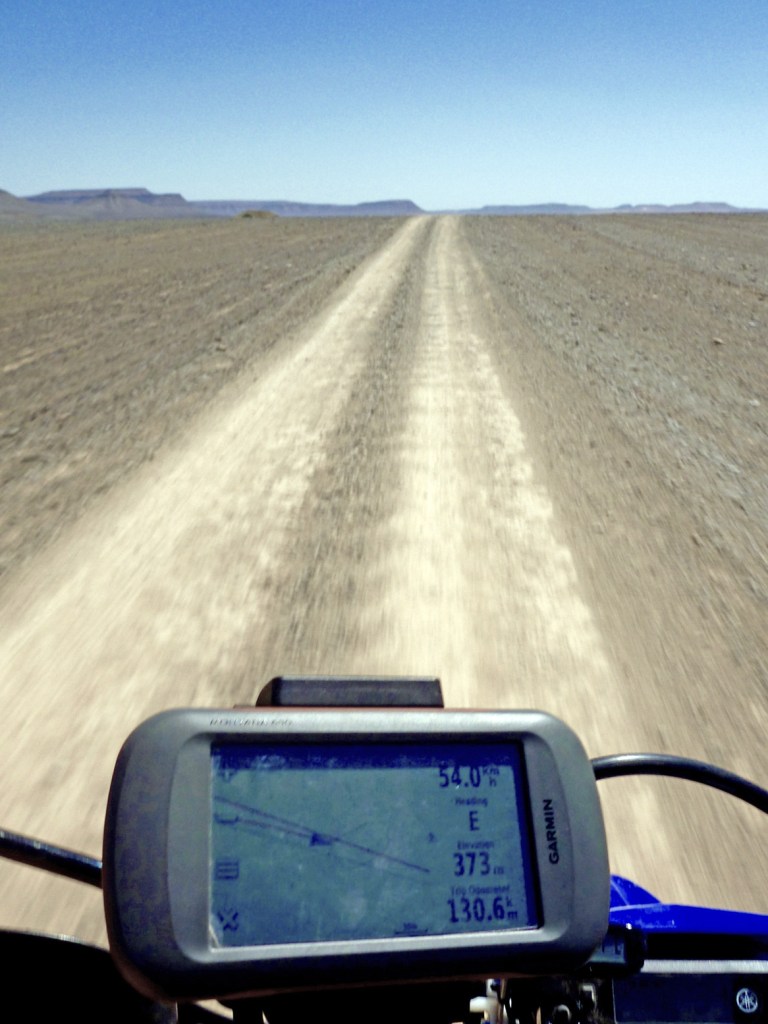
Getting routed: As the track was clearly visible, I traced the route I’m logging above (MW7) off Google Earth the previous evening (internet required), saved and exported the kml then imported it (as a gpx) into my Montana via BaseCamp. This was pushing the outer limits of my tech ability with this sort of stuff.
GPS digital maps not really needed as I had the largely accurate self-drawn tracklog on the screen to follow, while recording my own live tracklog. Years later I used this same system (pre-trace route off Google Earth) again while logging MH23. The great thing with satellite is WYS is usually WYG, whereas with maps (paper or digi) WYS can be nothing at all.

Morocco ~ Documents and port immigration

To enter Morocco with a vehicle all you need is:

  • passport (most visitors don’t need a visa and can stay for 90 days).
  • Your vehicle ownership document (‘V55’ in the UK)
  • Motor insurance covering Morocco, if you can get it. If you can’t (as with most Brits on motos) buy at the port, see below.
  • Driving License. Rarely asked for, except with rentals). Despite what some sources claim, no one in Morocco will ever ask for an International Driving Permit or even know what it is.

Immigration procedures
On ferries heading directly to Moroccan ports (ie: Tangier Med or Nadorpassport control is done aboard. Don’t get off the boat without getting stamped – they check as you come off the ramp. Once aboard, on one of the decks look for a counter with a cop, a laptop and a queue.
If you’re heading to the two Spanish enclaves (Ceuta, Melilla) you will effectively be landing in Spain and so must drive on a couple of kilometres to the actual land border with Morocco to do your stuff. Most find Tan Med easiest.

Immigration cards
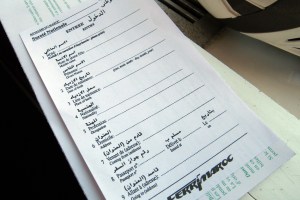
Fill out a white immigration card (right) often handed out when buying your ticket in Spain, or found at the ferry’s police or information counter, or handed out by enclave border helpers looking for a tip. The form is in French with English subtext.
Under ‘going to’ write any big Moroccan city like Fez or Marrakech; for ‘coming from’ put the European port you’ve just arrived from (Algeciras, Almeria, etc).
For an ‘address in Morocco’ any hotel or camping in any well-known town will do if you don’t actually have one.

CIN

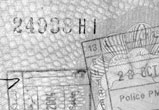
Your passport will be stamped with a date of entry and also a ‘CIN’ number (right; it may be scribbled by hand into your passport). This is an ID number that links you to a police database and you may be asked for it on other forms. It is often hard to find in your passport. If you have visited Morocco before on the same passport you do not need a new CIN; they do not expire so it helps to open the passport page with the CIN to save them looking and giving you another.

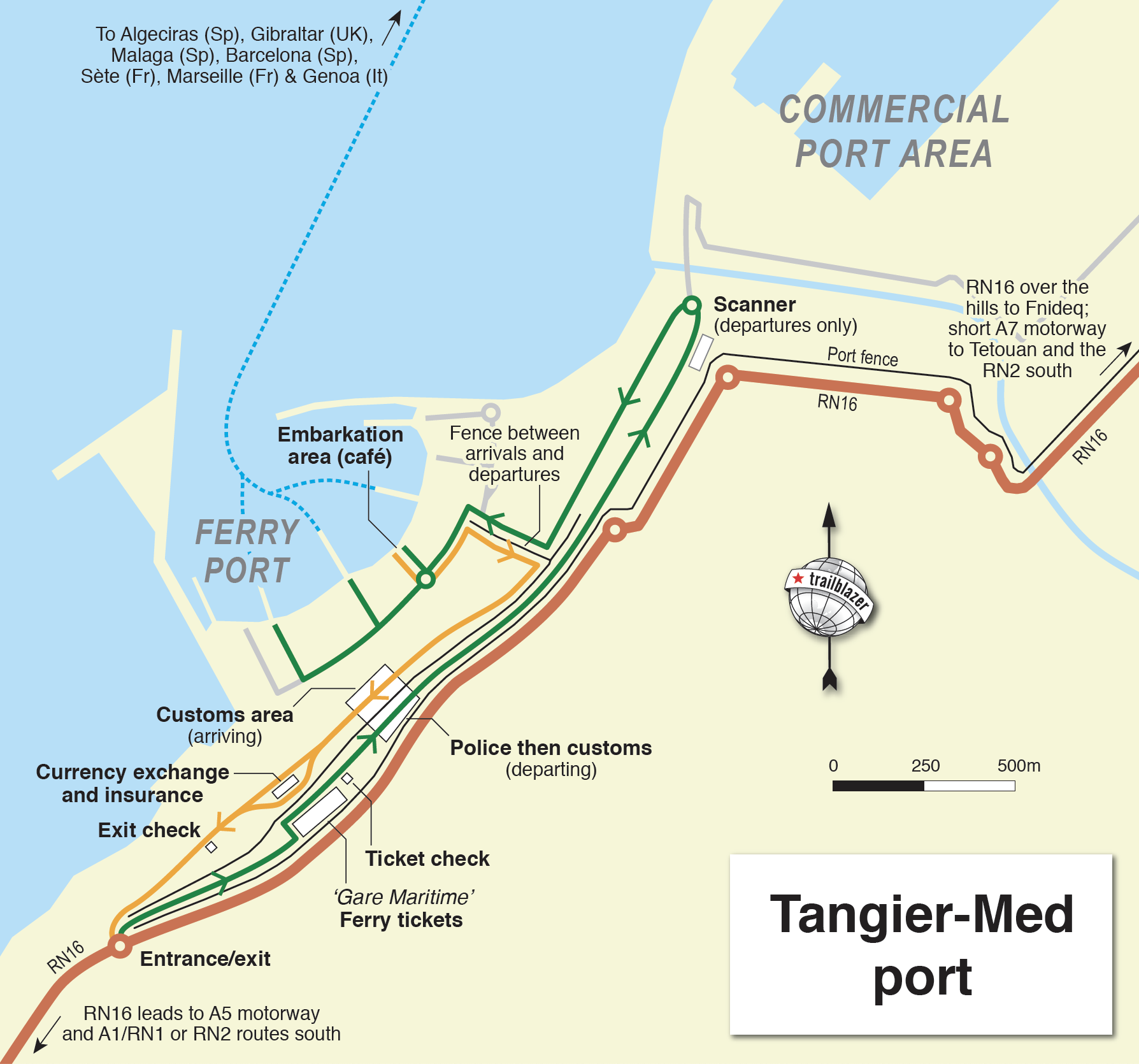
Once off the boat in Moroccan ports (e.g.: TanMed, beni Enzar/Nador) proceed to Customs (left) and hand over your vehicle ownership document and passport to a Customs guy. Wait by your vehicle. They return with your documents and a white, credit-card sized Temporary Vehicle Import Permit (TVIP) in as little as 5 minutes. They may also perform a cursory search. Don’t lose your TVIP card. You will need to show it when you leave Morocco to prove you left with your vehicle. Your TVIP will have an expiry date by which time you much leave Morocco, usually up to 6 months unless you’ve been in Morocco within the last year.

tanmedins

You may be lucky enough to have a ‘green card’ motor insurance extension for Third Party Only Morocco. Otherwise, at TanMed, just beyond the Customs is a row of cabins (left). Change some money and buy local Third Party Only insurance (assurance frontiere) at the last cabin. There is no such thing as Fire or Theft or comprehensive cover for tourists.

Car or bike the fixed cost and time periods are:
600dh for 10 days 
960dh for a month
Big vans and motorhomes pay more

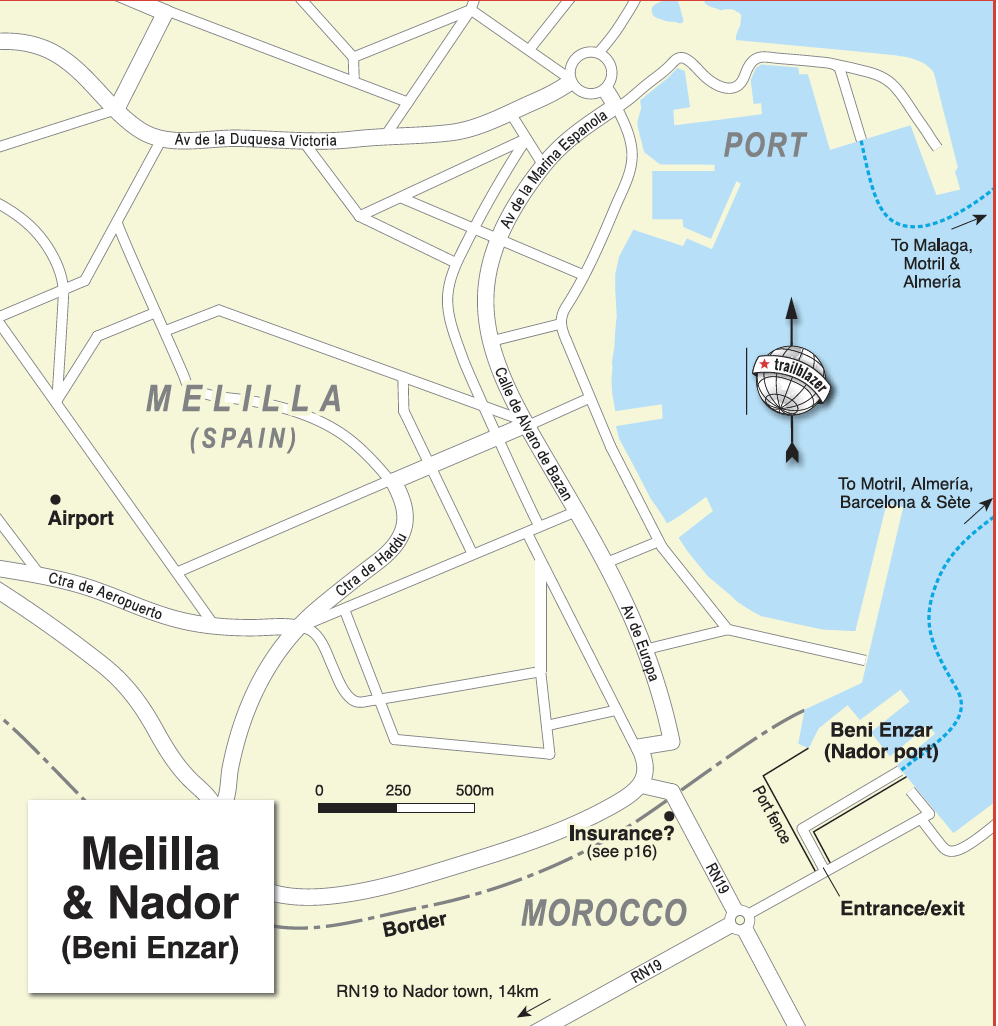
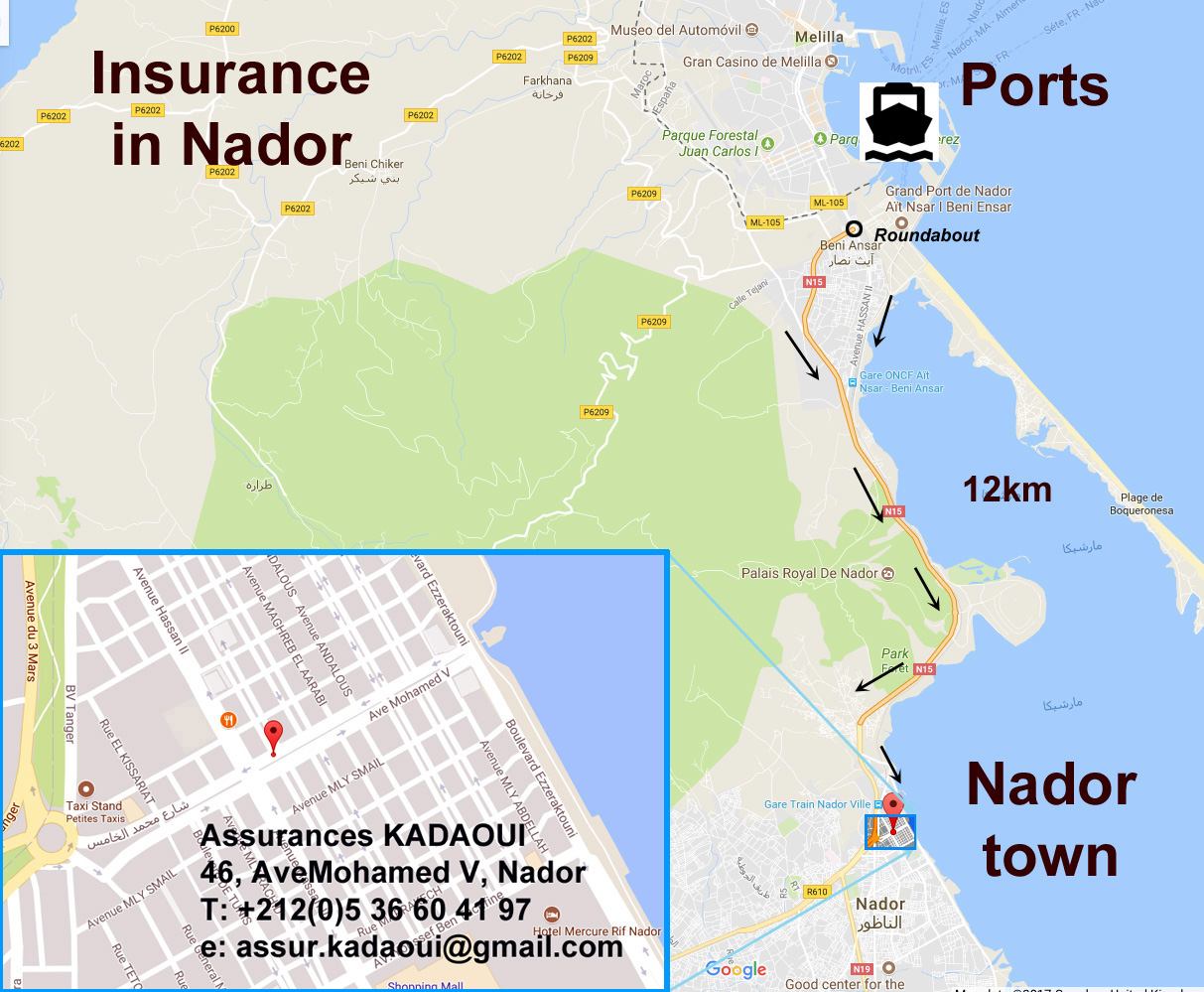
From Melilla (Sp) or Beni Enzar (Nador port, Mk), to buy insurance you need to head 12km to Nador if you need RMA Assurance Anas here (35.1796, -2.9269), behind the Hotel Ryad. They sell Assurance Frontiers (insurance for foreigners) at the usual rates. See updated map left; it’s pretty straightforward.
The only problem is ferries arrive late at Beni Enzar (Mk) which means an overnight in Nador. The overnight ferry to Melilla coming in at dawn may be better because leaving Nador without insurance you’ll struggle to get it down the road.

That’s it!

fichy

Form (fiche) for checkpoints, Western Sahara

Download this blank Word.doc template of a fiche or form (left) to fill out with your details. Hand them out to speed up passage through the many checkpoints in Western Saharan (south of Tan Tan and Assa), particularly if heading down the Atlantic Route to Mauritania.
They can also be handed over instead of your passport at hotels in ‘mainland’ northern Morocco who ask to copy down your details. Up here the checkpoints won’t require your fiche or details.
There are 4 fiches to a page. For a transit of the Atlantic Route you’ll want at least 8 fiches to get to the RIM border. And maybe as many again in Mauritania.

N is for Nemadi, dog hunters of eastern Mauritania

Part of the Sahara A to Z series

While reworking Desert Travels ahead of a small reprint, I came across this video from 2005 about an Italian expedition that set out from Bamako for Oualata north of Nema. Oualata was once as celebrated as nearby Timbuktu for being a place of Islamic learning, and the video spends a lot of time depicting the intricate bas-relief patterns for which the houses of Oualata are famous. As DT recalls, when I was there in 1989, no time was allowed to have a good look around, far less stay over.

nem1
songhai

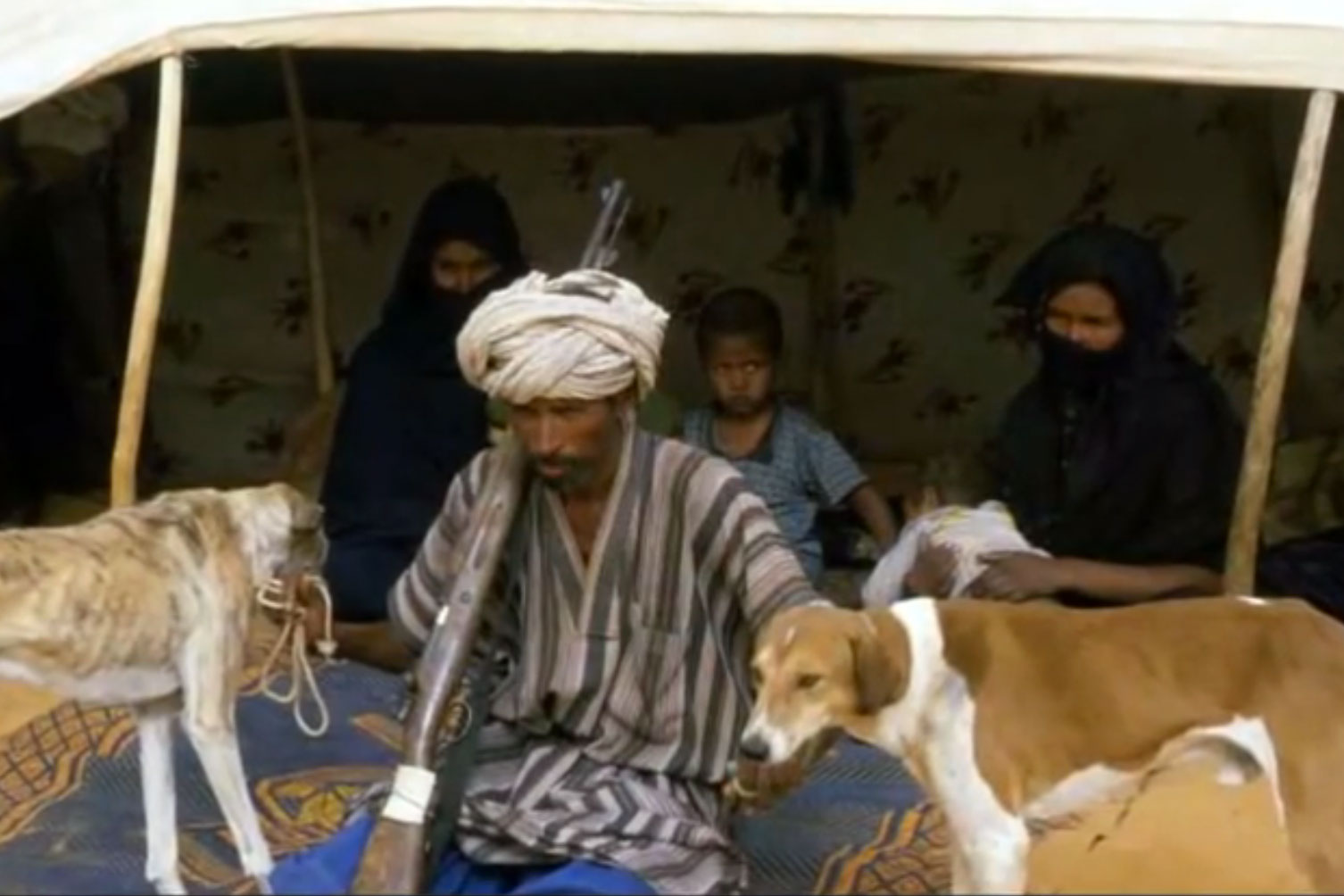
Then, amazingly to me at least, the Italians manage to track down a surviving Nemadi family, a survivor of the pariah-like tribe of dog hunters mentioned in Bruce Chatwin’s semi-fictional Songlines study of nomads. They live in what the vid calls the ‘Sarakolle’ desert. Not heard that designation before, but it seems Sarakolle also means Soninke, a tribe who live along the Malian border but who are indigenous to Africa and not Moors. Some sources attribute or connect them to the Imraguen fish catchers north of Nouamghar, also outsiders in Mauritania’s Moorish culture. Wiki makes a link for the etymology of ‘Nemadi’, something to do with Azer or dog master, but I just assumed it means ‘people from around Nema‘, like Saharawi.
As you can see, the guy doesn’t wear the usual blue robe and his tent is not a Moorish raima, but more of a bent wood humpy. His camel too has no saddle to speak of and it looks like he sits behind the hump. But other items like the three-legged tea table are also used by Moors. At no point in the vid is Nemadi man separated from his ancient rifle.

nemadi

I thought the Nemadi used to live along the Dhar Tichit beyond Oualata. There is a place call Aguelt Nemadi (Ogueilet en Nmadi) about a hundred miles NNE of Tidjikja or 300 miles NW of Oualata. That might mean ‘Nemadi waterhole’ but lost in the dunes, it looks a pretty lonesome spot on the map, perhaps a watering hole on the old caravan route between Tichit and Ouadane.

The video has no commentary, a few Italian subtitles and some great music. It looks like they set out to cross the 400km to Araouane in their Sixty-series Tojos, but something broke so they came back. The Nemadi guy appears at about 25m.

H is for Hot: Staying cool in the Sahara

Part of the occasional Sahara A to Z series
Hang around long enough and you’ll get the full set

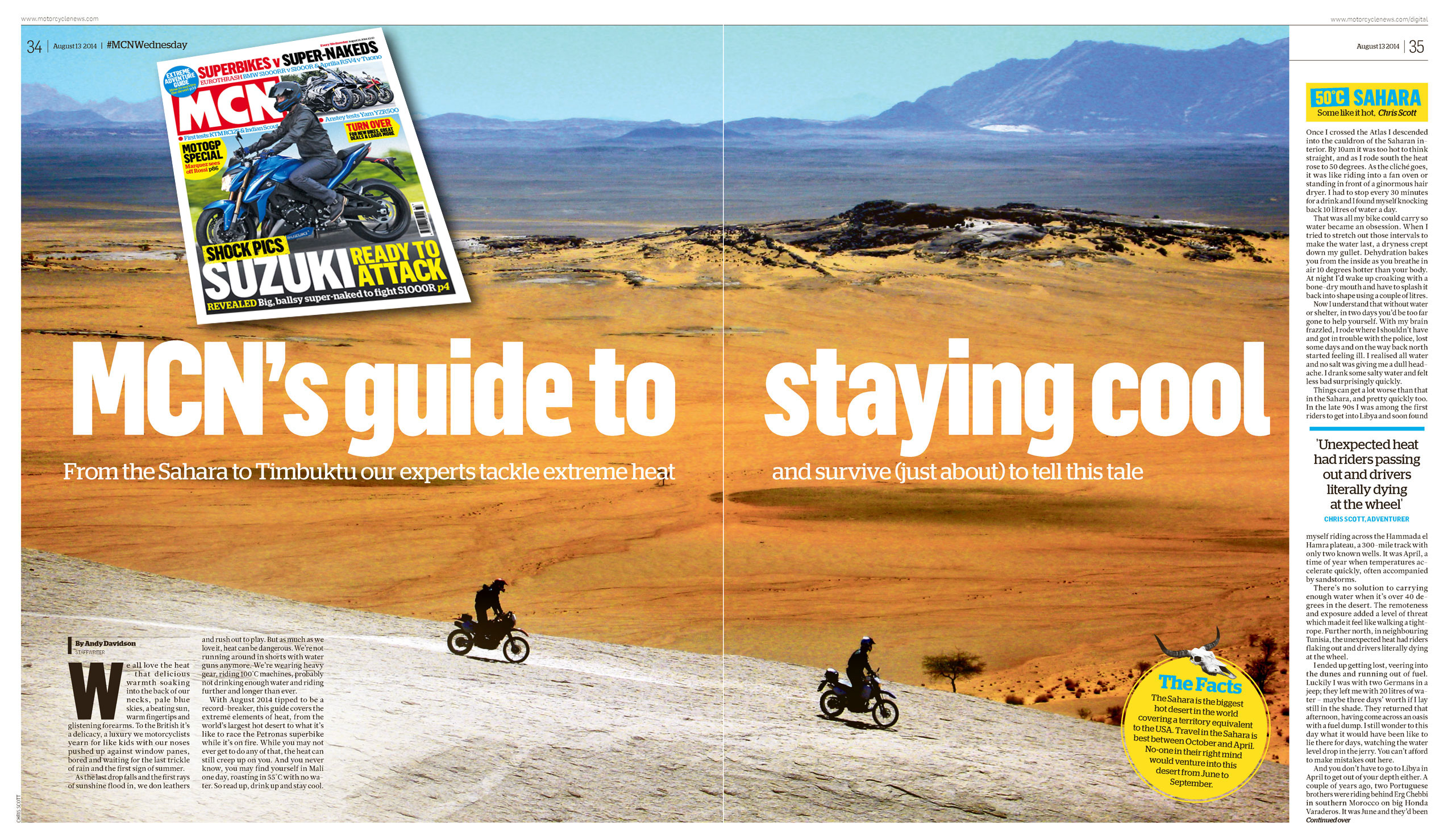
An MCN feature I contributed to about hot weather riding.
You can buy MCN digitally here.

mcnhot