
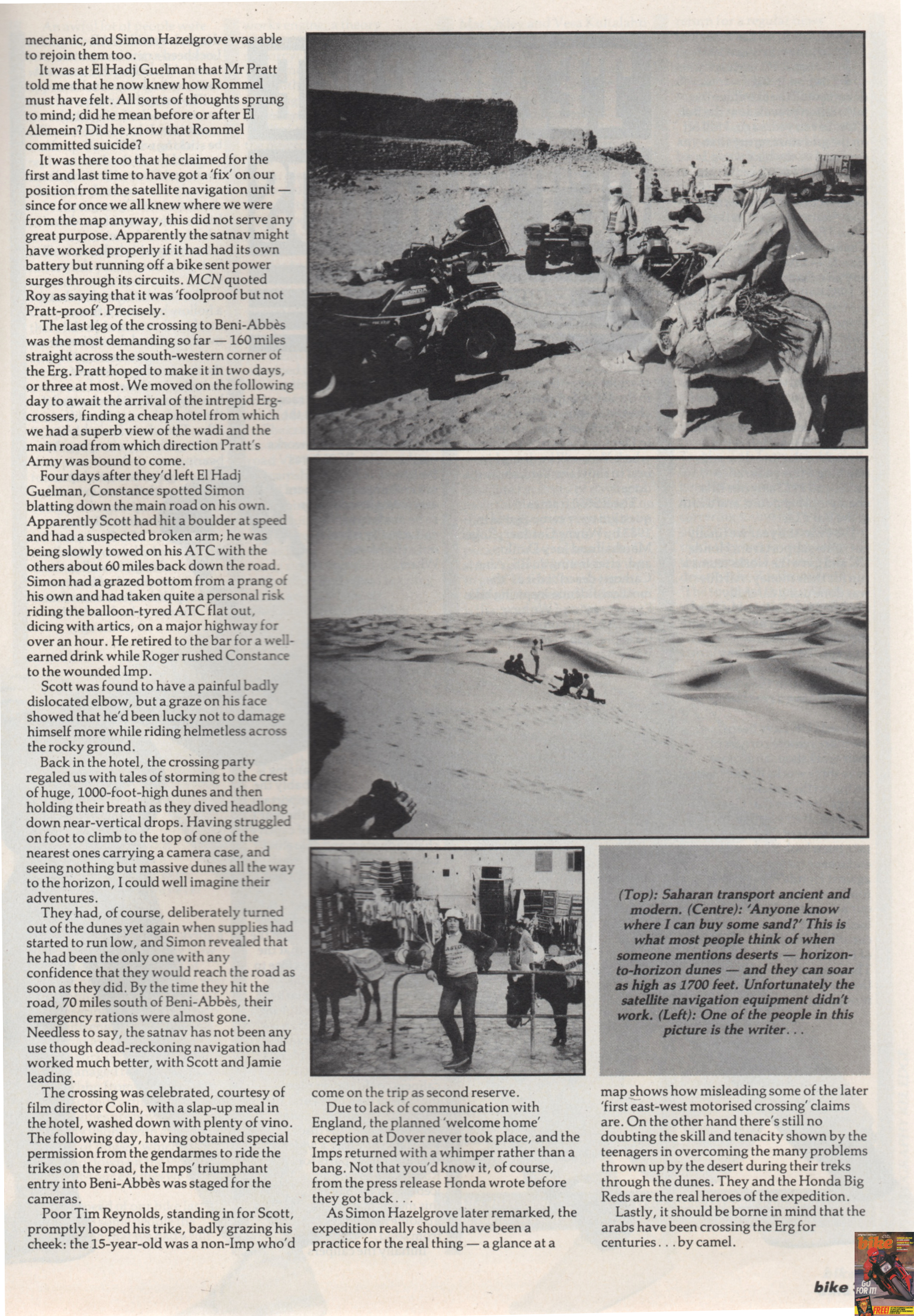
An enquiry revived memories of a 1980s Sahara ‘quad’ bike expedition across the Grand Erg Occidental in Algeria involving ‘Wheelie King’ Dave Taylor (left) and which I recalled was a bit of a cock up.
Then, a connection, Paul Blezard (below right) set me straight on the Honda 250 ATC trikes they used, plus the link to the Channel 4 doc above which features Paul as expedition translator. After watching the doc, I thought it was no more of a cock-up than my first Sahara trip or three which routinely set out with equally over-ambitious goals and inappropriate equipment. The ferryman must be paid a few times before you venture across the sand seas.
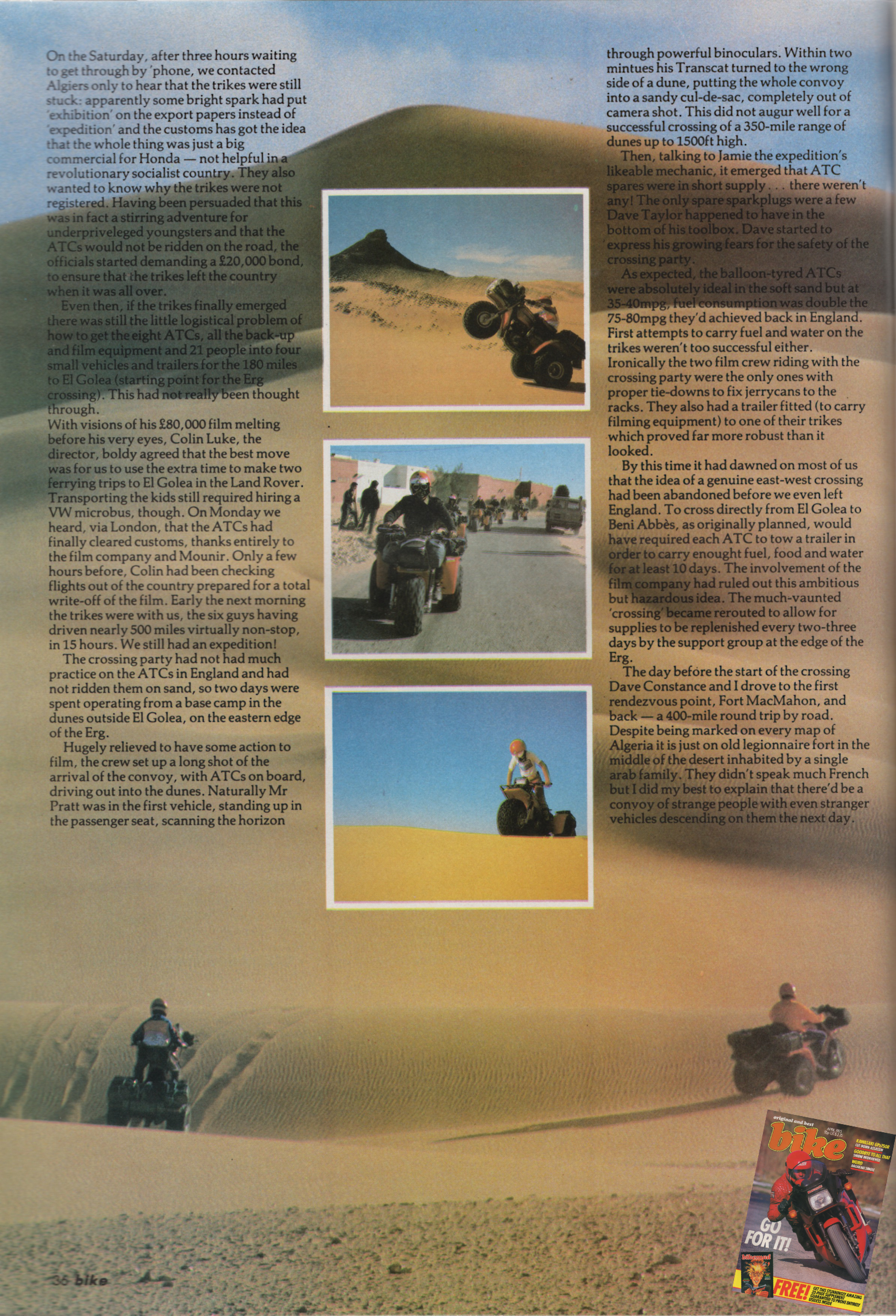
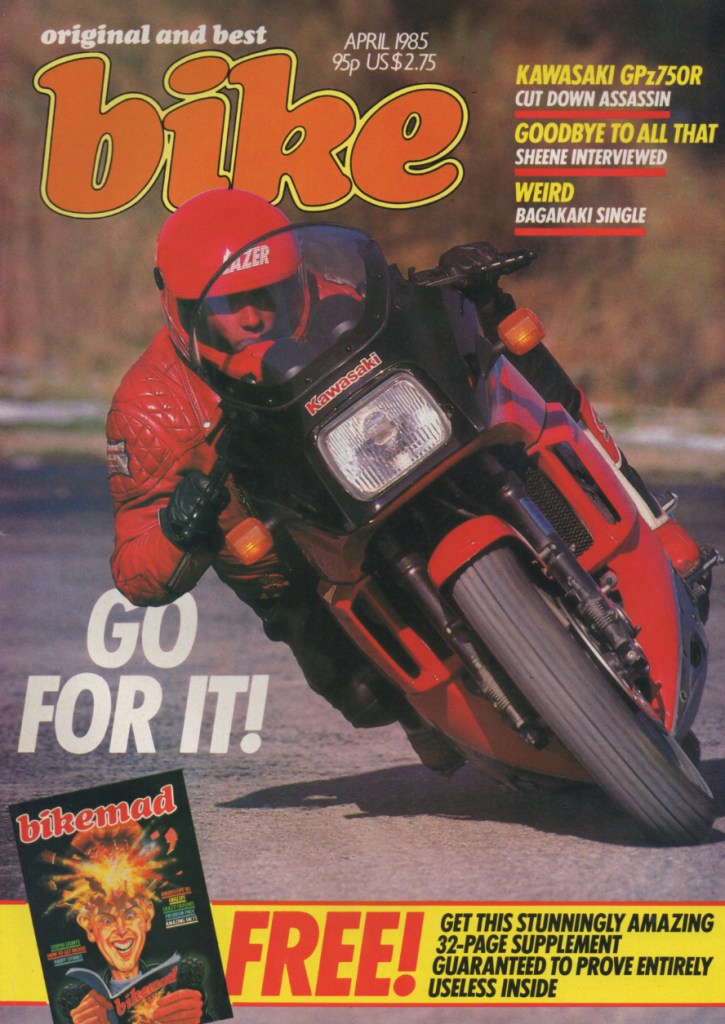
But after posting this page I read Paul’s forthright accounts published in the biking press (below; Bike 1985; more to come). Yes indeed it was a rolling calamity from start to finish, led by poor planning, preparation and logistics, followed by opportunistic thefts and irksome breakdowns leading to subterranean morale among the harried support crew. It might not have been helped by, as Blez calls him, ‘Mr Pratt’s’ leadership style. As Paul wrote for Trials & Motocross News (TMX) around Christmas 1985, just after the film aired:

To sum up, the first successful east-west crossing of the Grand Erg Occidental, as the TV film proclaimed, was only really successful in that no-one died and the trikes came out of it still running well.
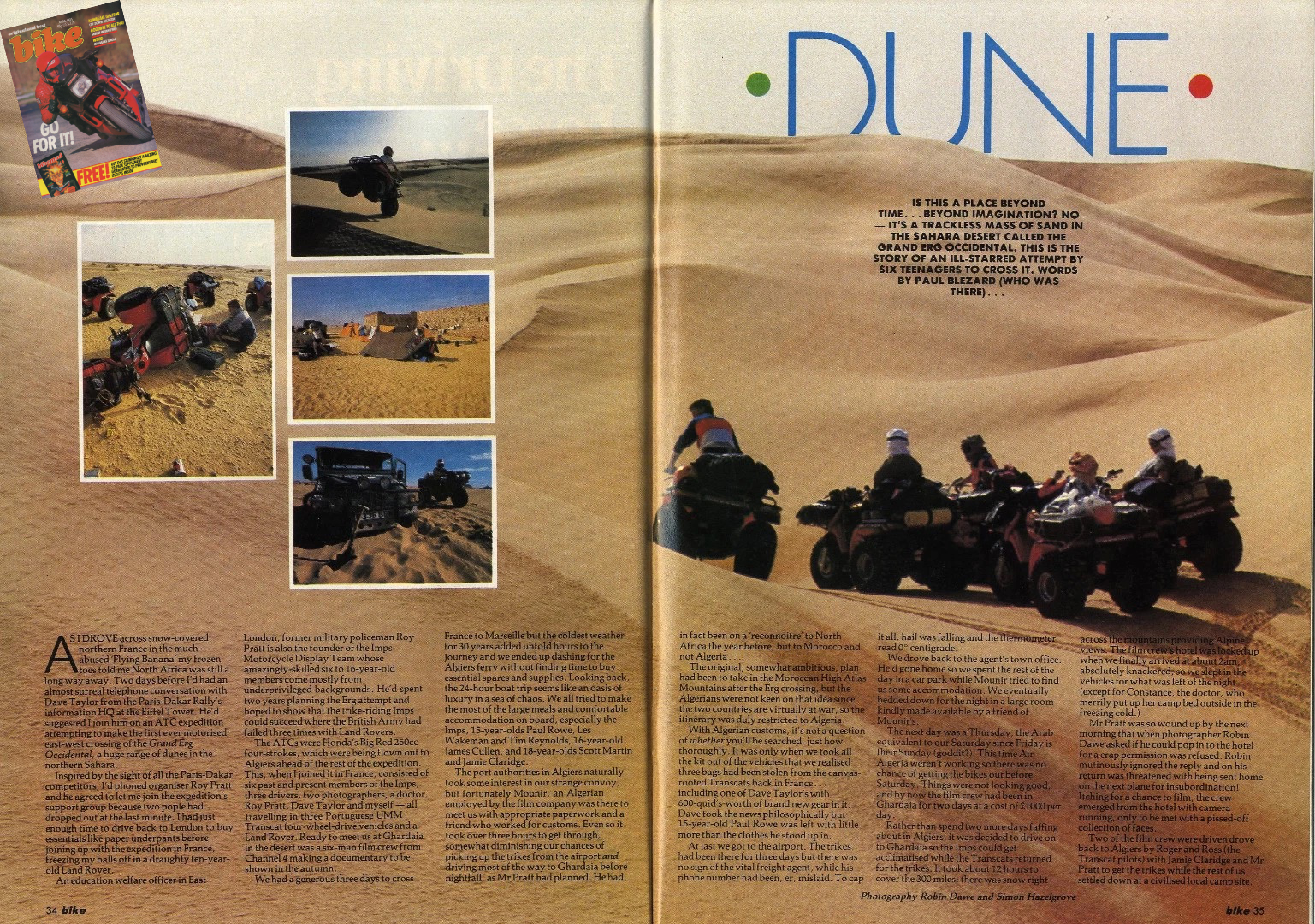

The adventure was the idea of the late Roy Pratt MBE, a former military policeman and army display rider. Now a social worker, he founded the Imps charity in 1970, a youth motorcycle display team (left), like the adult White Helmets of that time. Pratt sought to rehabilitate and inspire disadvantaged east London boys with his two-wheeled initiative.
After over 50 years, in 2025 the Imps charity closed down in accordance with Roy Pratt’s last wishes and soon after his death, aged 86. During that time well over 2000 boys from as young as six years old had been part of the Imps, learning important life skills like teamwork. bike maintenance and constructing human pyramids.

Trikes – Yikes!
An ATC trike was a motorised recreational or utility tricycle, especially popular in the 1980s North America until issues with inherent unstability saw them axed. Originally pitched as all-season, ‘snow & sand’ scoots which even children could ride, like the Reliant Robin car, trikes proved to be deceptively dangerous when too deviating sharply from a straight line, leading to countless injuries, deaths and law suits. By 1988 new sales were banned in the US (or production was voluntarily suspended) by which time better turning quads had gained a foothold – but without trapping your actual foot.

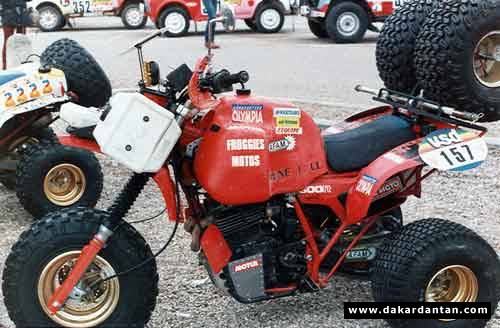
Despite being geared to only reach 45mph, the tubeless-tyred 250s used by the Imps would certainly have offered great traction in sand without a motorbike’s need for momentum to avoid getting bogged. Roy Pratt must have encountered the phenomenon at its peak and like many, assumed three wheels were safer and easier to ride than two. He was not alone: as Paul Blezard wrote, that year three riders entered Honda ATCs in the Dakar Rally (#156, #157 and #158). All were ATC dirt racing pros who’d mastered the all-or-nothing skid-steering technique mentioned in the F9 vid above to get the trikes to corner on all three wheels. One racer, Paul Bonnet, even squeezed what may have been an XR600 motor into his trike (below). None of the Dakar trikers got any further than the Algeria-Niger border which was already 2000km over just four days of flat-out riding across the desert. But then again, of the 135 bikes which entered the Dakar in ’85, only 25 made it to the Senegalese capital.
It’s unclear if Pratt had any desert experience (perhaps from the army, like Tom Sheppard?) or why he settled on leading a bunch of hand-picked former Imps to be the first to cross the width of the Grand Erg Occidental – one of several huge sand seas that fills the Algerian Sahara. There’s talk of a failed ‘Guards Regiment’ attempt on the GEO, as well as a Durham University expedition in 1982 which, among other things, proved the efficacy of trikes in on a shorter, north-south GEO crossing.
I wonder if crossing a sand sea is what a person who doesn’t know the Sahara thinks of as the ultimate desert challenge, until reality whacks them in the face like a garden rake. Like an avalanche slope, normally you avoid dunes where at all possible, or at least minimise your time there. The Dakar Rally of that era knew this, as do many visitors to Erg Chebbi in Morocco.

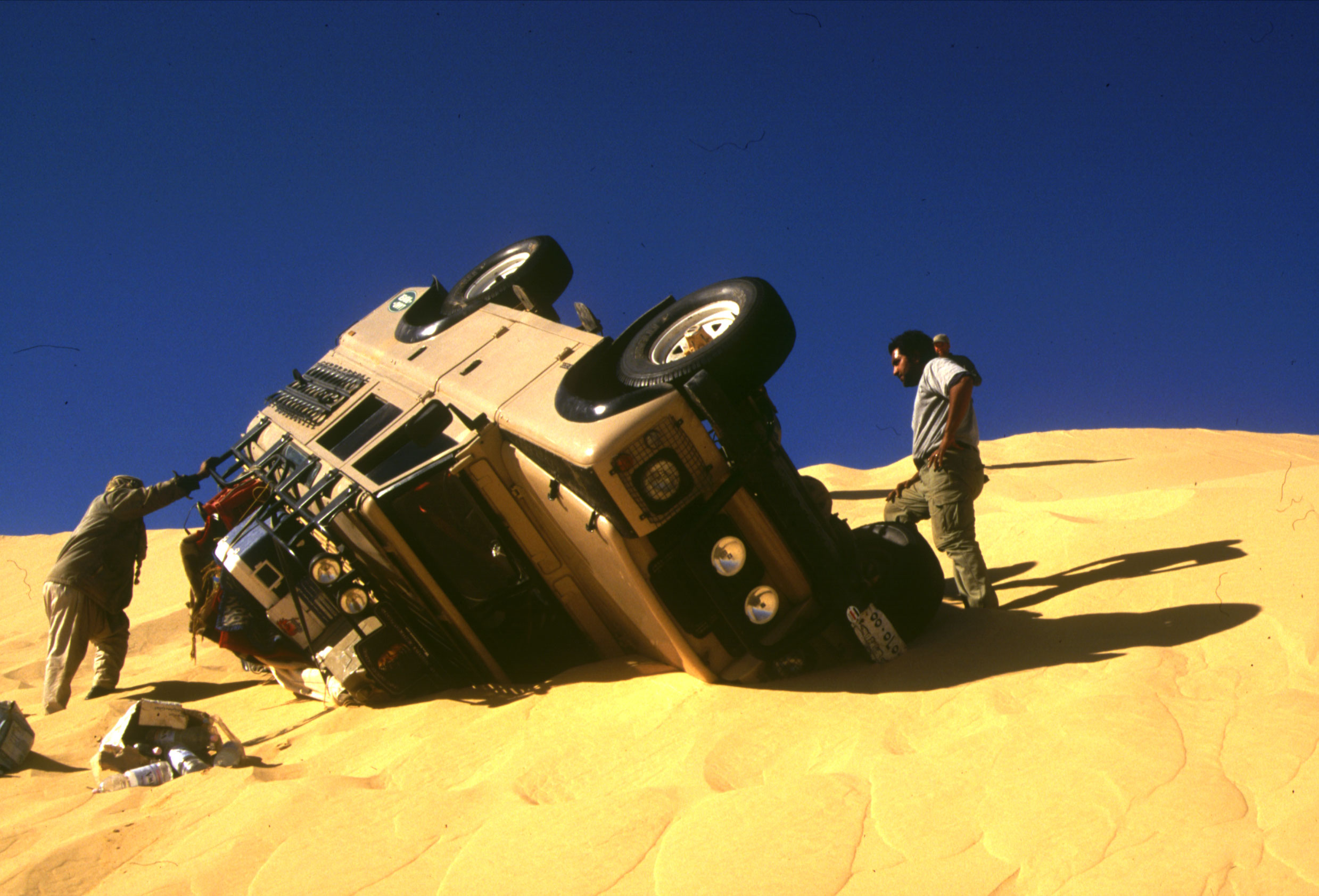
Car, bike or anything in between, dunes are where the accidents happen. The paradoxical need to maintain speed in a 4×4 to avoid getting bogged (and the laborious digging which follows), must be balanced with going slowly enough to spot and navigate over slip faces which can be invisible at certain sun angles. Once inadvertently airborne on a moto, very often it’s a tumbling machine that causes the injury. In a car it’s the impact of a nose-dive or fully somersaulting while battered by loose items. Above left: way too fast: vehicle destroyed, driver lucky to be alive. Above right: relatively harmless fall roll over descending a slip face a little too briskly and at an angle. No harm done.


The Imps’ original plan had been to plough west directly across the erg from El Golea to Beni Abbes like a fat-tyred Columbus. A distance of nearly 500km, as Paul wrote this would have required days of towing power-sapping trailers. Wisely, that plan was ditched before leaving the UK.
Apart from being a very long way, it would also have been ‘across the grain’ of the dunes’ SSW/NNE linear orientation, something that’s visible when zoomed in on sat imagery. We found that out for ourselves one morning in Egypt’s Great Sand Sea in 2000. Driving over successive dune cordons makes for extremely slow and at times risky progress (right). On that occasion we gave up and followed the inter-dune corridors south and out of the Sand Sea. It seems the Imps ended up doing the same during much of this trip.
After suffering a series of ongoing thefts, the unregistered trikes were now stuck in Algiers Customs. Early on in the doc and with group tensions and low morale already flagged up, Dave Taylor, a well known stunt rider turned motorcycle safety campaigner, presses Roy Pratt on contingency plans if things went wrong. With too much post-reality-TV cynicism, you wonder if it’s a genuine exchange or a staged conflict set up by the TV people. Reading Paul’s accounts, it was almost certainly the former – and was just the tip of the tottering iceberg.
All the support cars towed trailers for the trikes, but even an unhitched 4×4 would have struggled to reach, let alone keep up with the trikes in the dunes. So two C4 TV cameramen followed the Imps on their own ATCs, one towing a small trailer. You imagine they had a story of their own to tell at the end of it all.

The four-vehicle convoy merely followed the Timimoun road south of the erg. I’d ridden that road three years earlier until I ran out of fuel. The dunes were unseen, far to the north.
On top of everything else, we’re told radios were playing up as radios do, putting the Imp support cars even further from being able to offer assistance. Instead, there was talk of burning tyres at pre-arranged times, as well as flashing mirrors. Both were possibly set-ups for the TV because at any point all the trikes had to do was head south to the nearby road.
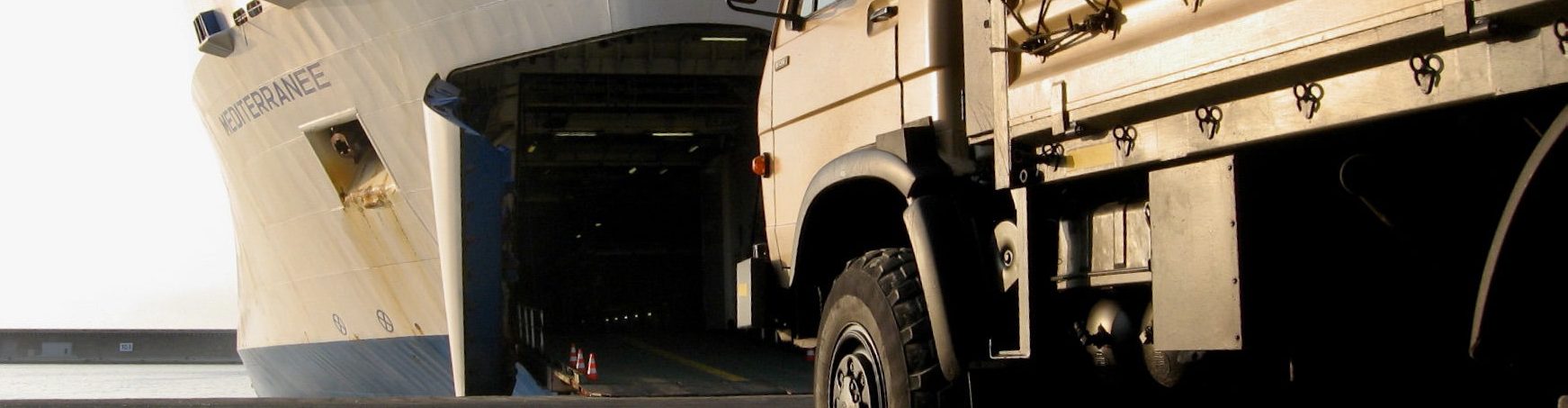
I was thrilled to see three new UMM 4x4s (below) making up the support convoy. Never seen those used in the Sahara, or indeed anywhere. A UMM was a slab-sided Portuguese built, Peugeot engined workhorse based on the 1960s French Cournil with nods to Jeeps of that era. With the Peugeot 504’s solid reputation in the desert, I’d looked into getting a UMM for my own group of two-wheeled ch’imps in 1989, but ended up with a Land Rover 101FC for a bigger payload. From what Paul wrote later, it sounds like I made the right choice. The Imps support crew also included a 1973 SWB Landie which at one point seems to have given its frazzled driver a black eye (left), but which is probably still running today.


The team had flown directly to Ghardaia and after a mooch around the market (‘ain’t no gews nowhere…’) and with the bikes released from Customs, they based themselves outside of El Golea before setting off along the erg’s southeastern perimeter towards semi-abandoned Fort Mac Mahon.
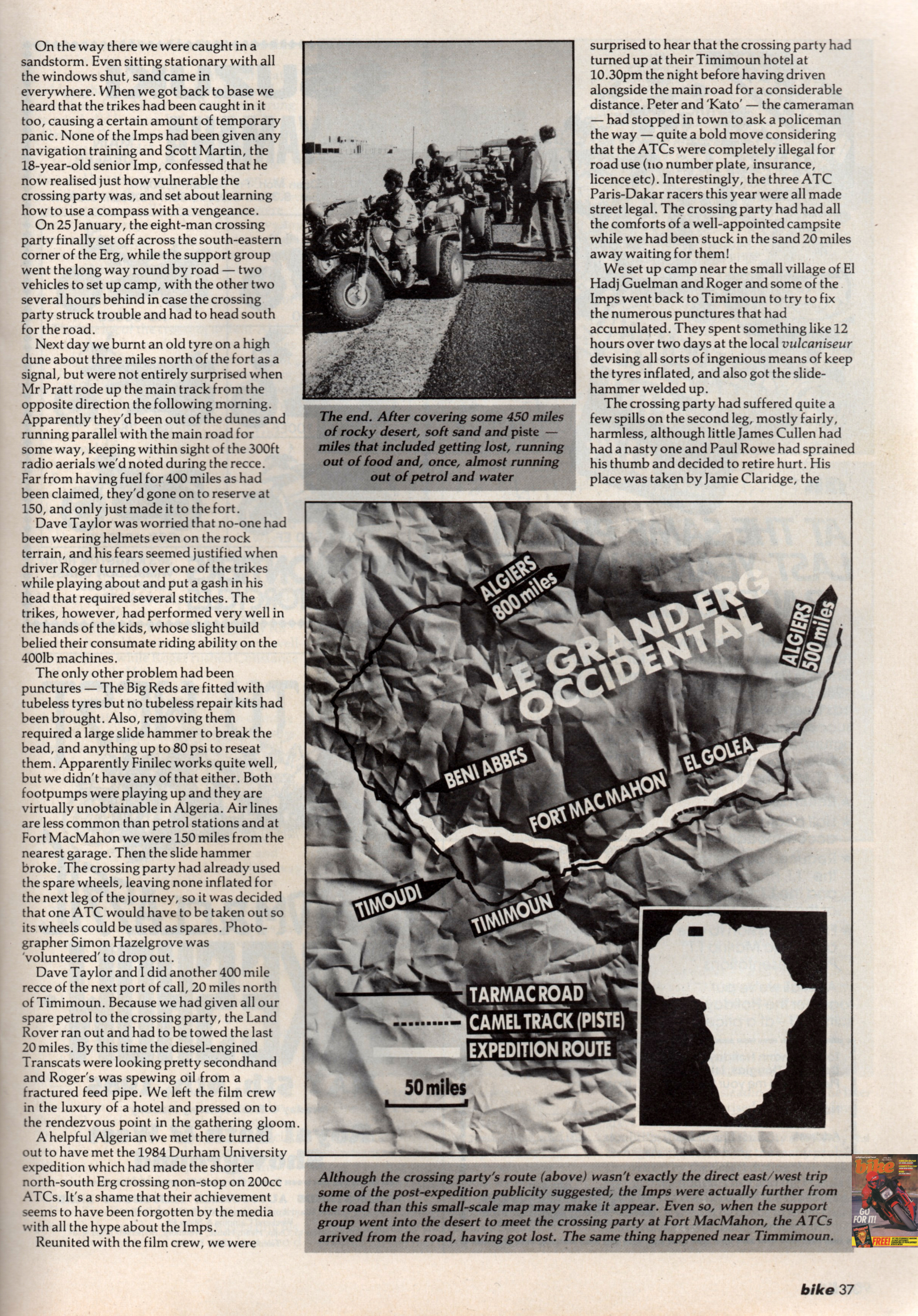
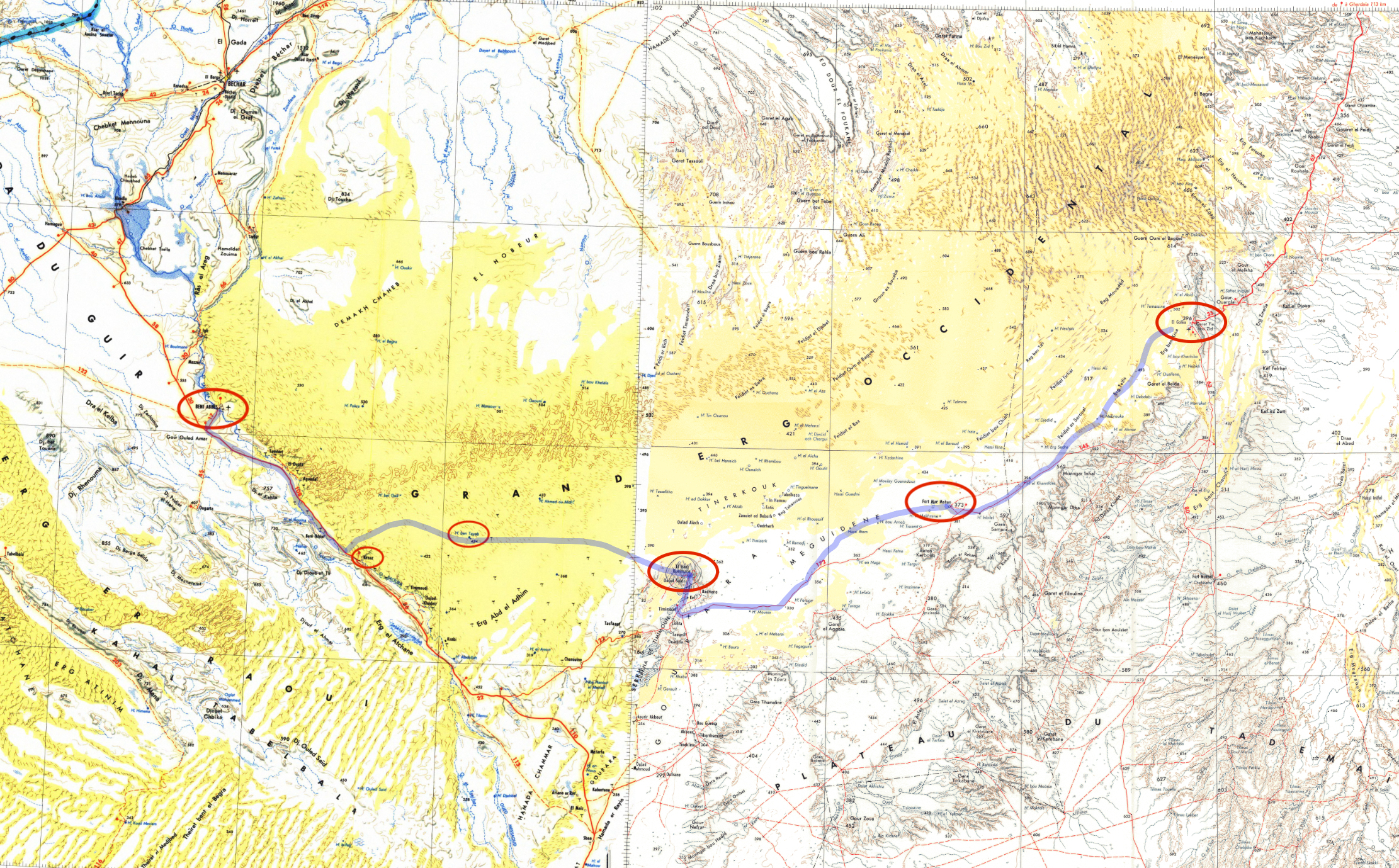
From here they continued west along the Meguidene gravel plain (see yellow map below), ending up riding alongside the road to Timimoun because the trikes were struggling but not road legal. On the way they suffered a staggering ’27 punctures’ resulting in a 16 hour day, but as Paul wrote, they’d forgotten the vital plugs which makes tubeless tyre repairs so effortless, providing you have a compressor. Desert sand soon ruins foot pumps, as I’d also found myself in ’82.

Once in Timimoun (where in ’82 I got dropped off after a creepy lift late night lift, having left my bike in the desert), the Duneriders move up to El Hadj Guelmane oasis, in the erg north of town. After two long days having punctures repaired, this was the last point where Pratt managed to get a fix out of his sat nav, as it’s claimed the trikes lacked the battery power to fire it up. I didn’t know there was land-based sat nav in 1985, unless it was an earlier version of the pre-GPS Navstar we used in 1990. Early on in the film, the antenna on Pratt’s Honda (left) resembles a Navstar unit.

Judging by the film, it seems only from El Hadj Guelmane that the trikes – we’re told without even working odometers so unable to record distance – get stuck into dune riding (above) like you’d see in today’s Dakar Rally in Saudi. They give themselves three days to cover the 250km to Beni Abbes, a very long distance to navigate hundreds of dunes without a mishap. In dunes like this the Big Reds’ 12-litre tanks would have given the 250s about a 300km range, plus another 300 from a jerry.

This whole area north of Timimoun is fascinating, dotted with small, date-producing oases and ancient fortified ksars. The Duneriders’ camp at Guelmane was just 15km from what’s become called the Ksar Draa of Timimoun (above), which looks like something from a fantasy film set.

Dead Reckoning into the Erg
Initially we’re told the Imps follow a bearing of 290° then 285° (~WNW), possibly aiming for Hassi ben Taleb. At the end of that day Pratt plays the ‘guess where you think we are’ navigation game which we also played with the Navstar in 1990 while waiting the half an hour or more for it to get a fix.
Pratt has no working sat-nav of course, but estimates ‘to the right of that highpoint, 424’, pointing to an IGN NH-30 Bechar map (left). Spot height ‘424’ on that map is just to the right of Hassi ben Taleb (on the map above). Although there’s no talk of this marked well being a destination, it’s amazing to think they might have covered the 90km of dead reckoning through the dunes and got so close. Of course they might have been anywhere in the GEO, and Taleb as a destination is just my guess.

Unless you know better dead reckoning – estimating a position from just a bearing held and distance covered – is an exceedingly sketchy way to navigate while winding through chaotic sand seas. The self-effacing Pratt credits the boys with the route finding then spells out the impossibility of accurately estimating their position after all the zig-zagging to find rideable passages.
Their key nav aid would have been knowing the N6 highway was just a couple of hours to the southwest, albeit through possibly massive dunes. These can appear daunting, but are actually easier to manage than the small dunes further north (as we found in 2002 entering the Grand Erg Oriental from El Oued; left).
Towards the end the film seeks to jack up the ante as the anxious support crew search the horizon from the Beni Abbes hotel terrace. But then we cut back to the trikes and the narrator suddenly throws in: ‘… the one safe course to follow is south, down from the dunes towards the plain and hopefully the road. After two days they’d supposedly run out of food, despite Pratt’s baffling instruction telling the support crew to wait eight days before coming to help. You wonder if Roy & the Imps could see the writing on the slip faces: this sort of riding was not sustainable. Although it’s not evident on sat imagery, the IGN map above (and which Pratt had) shows a band of even higher dunes blocking their way to Beni Abbes.
But it’s a happy ending as the riders appear right on schedule, having bailed from the Erg and headed for the road, maybe because of– or just before another accident. We’re told they hit the N6 about 80km from Beni Abbes, so just northwest of Kerzaz (below).

After recovering and refuelling my abandoned bike and getting going again in Timimoun, in 1982 I well recall stopping in amazement at Kerzaz to crawl up the monumental dune behind the town (above). Whatever lay in the erg behind there, it’s no surprise that triking it eventually ended with a suspected broken arm, one of countless tumbles suffered by the Imp trikers while riding the comically unstable three wheelers.

The film can’t disguise that in the end, by mostly tracking the erg’s southern perimeter, the Imp’s expedition was no more a triumphant crossing of the Grand Erg Oriental than the JSE ‘west-east Sahara’ crossing a decade earlier.
But more importantly, Roy Pratt (right) did succeed in delivering an adventure and hopefully a life-changing outlook for a small group of young ‘ackney teenagers which you imagine they’ll remember to this day.

Discover more from Sahara Overland
Subscribe to get the latest posts sent to your email.


Pingback: Alisdair Kennedy’s Sahara school expeditions | Sahara Overland