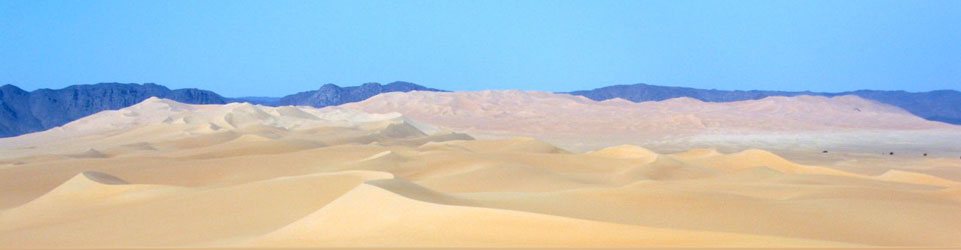
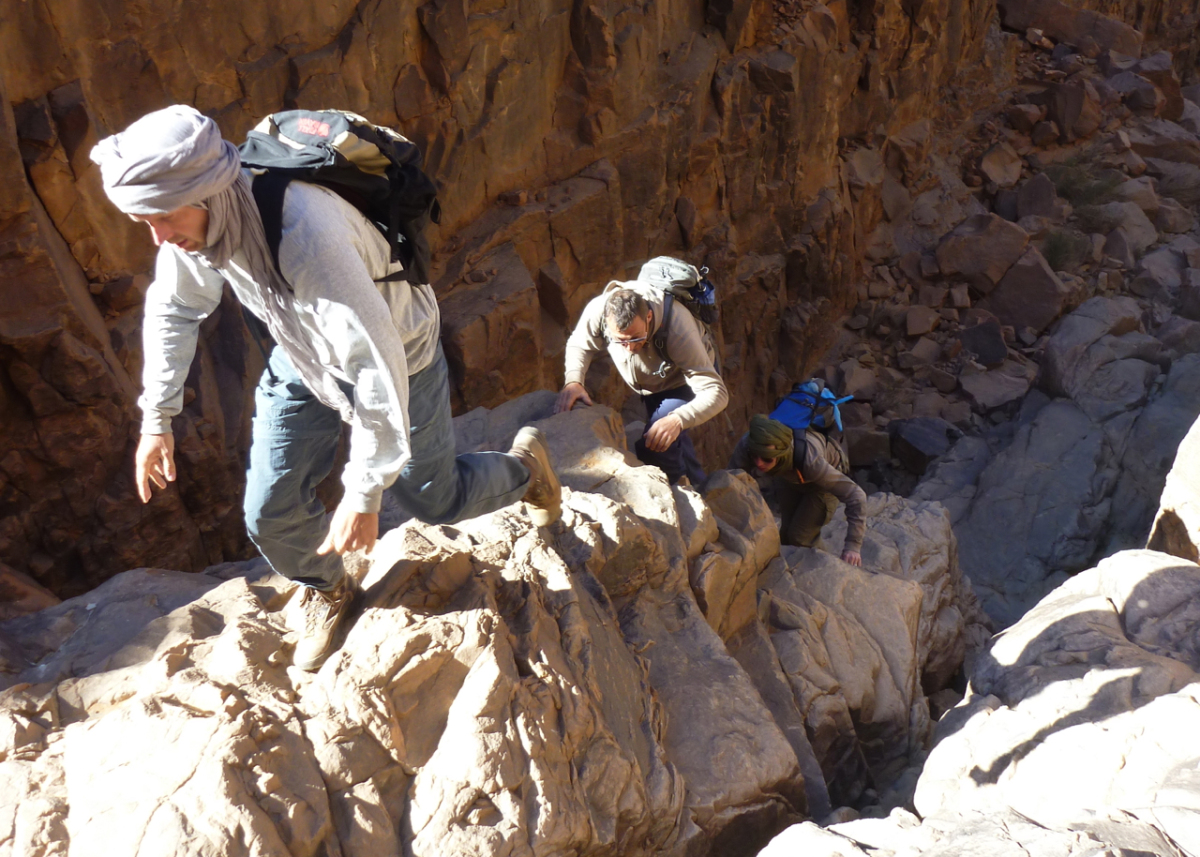
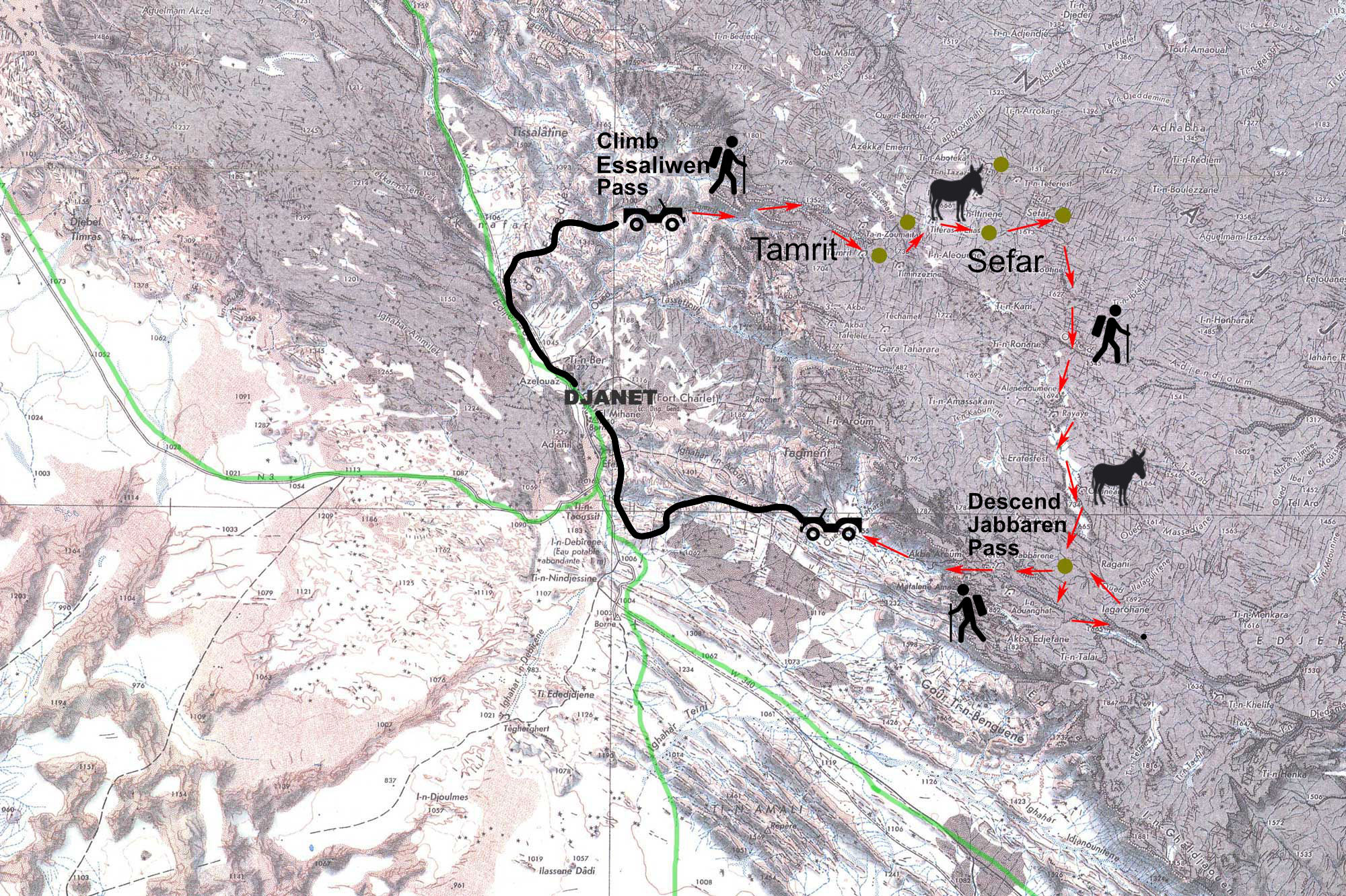
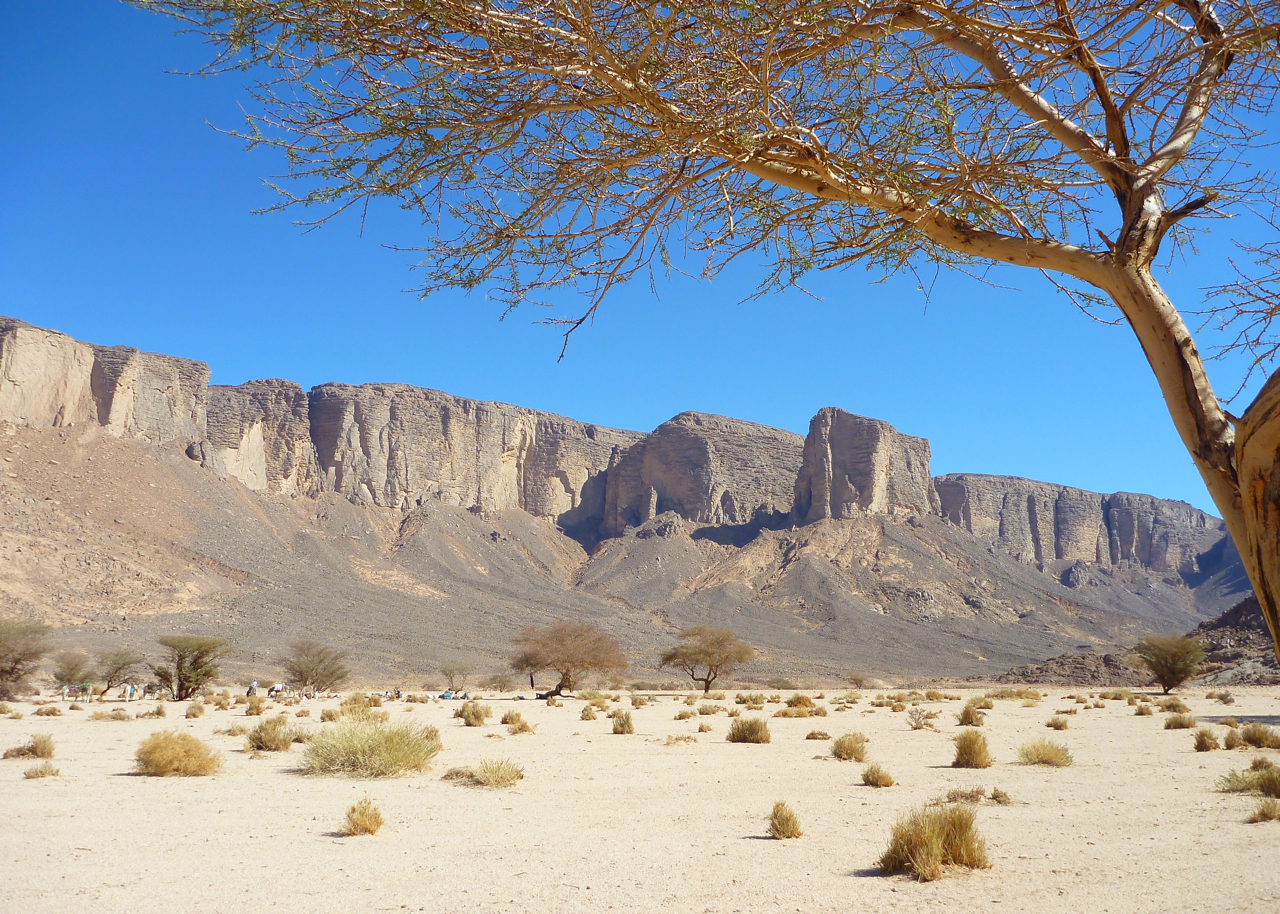
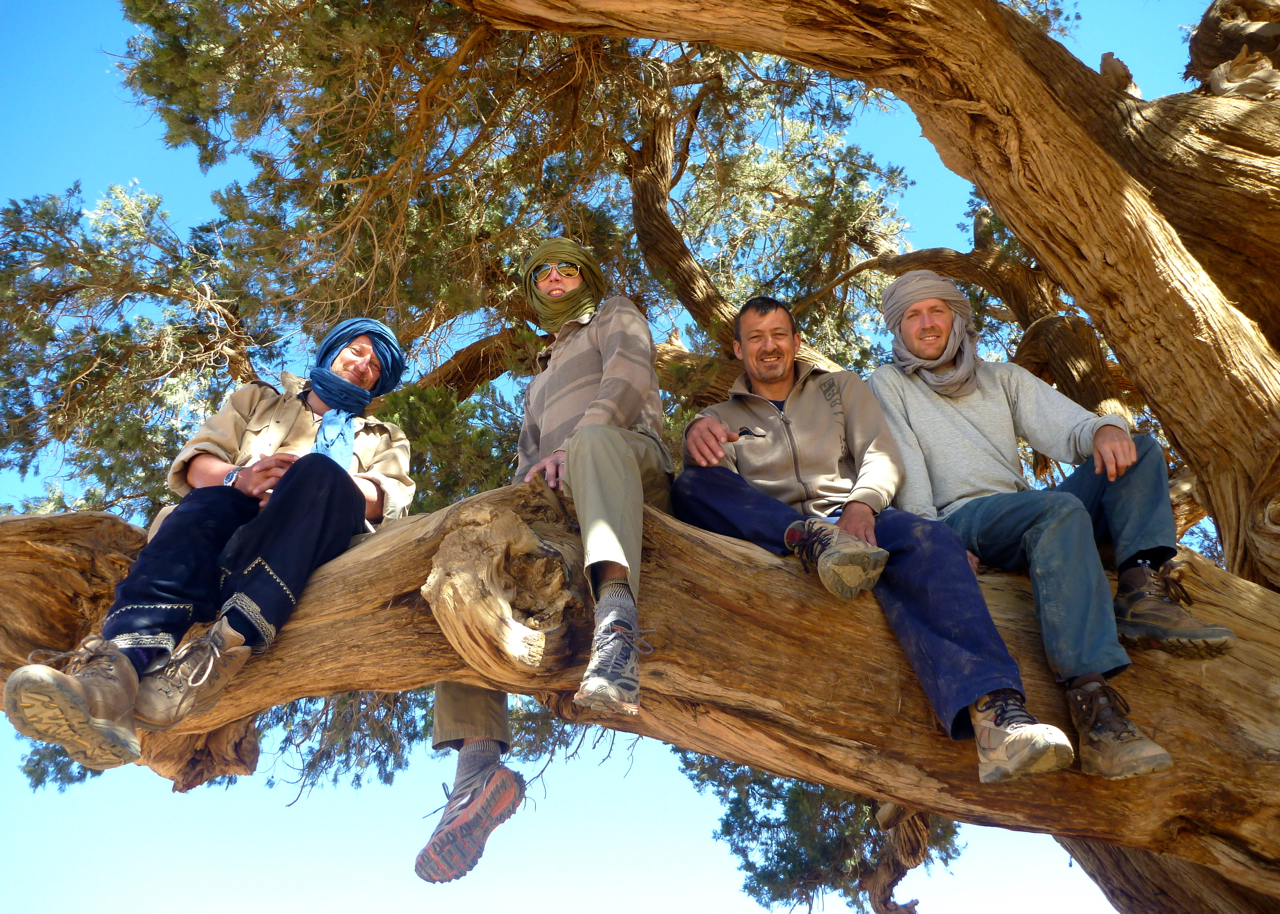
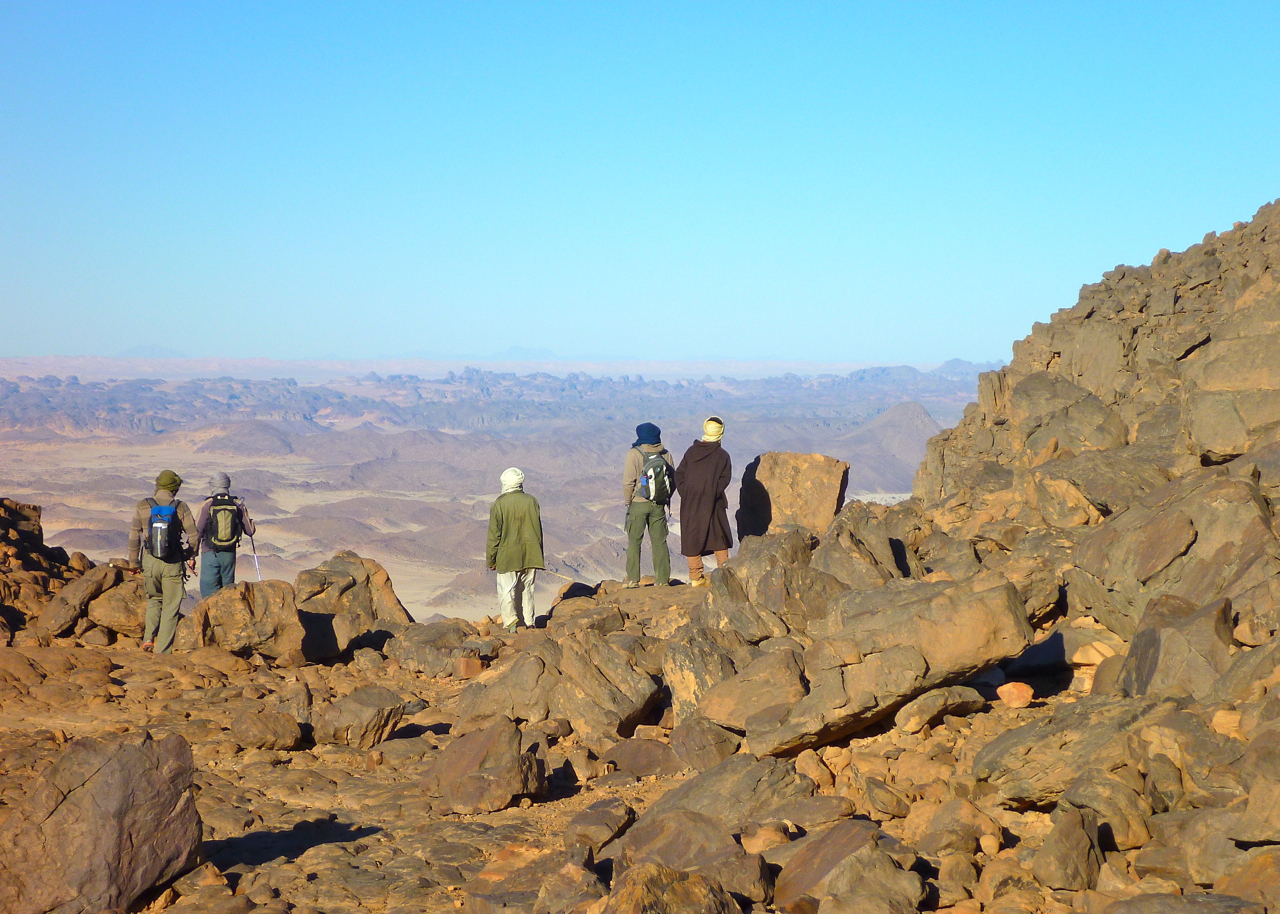
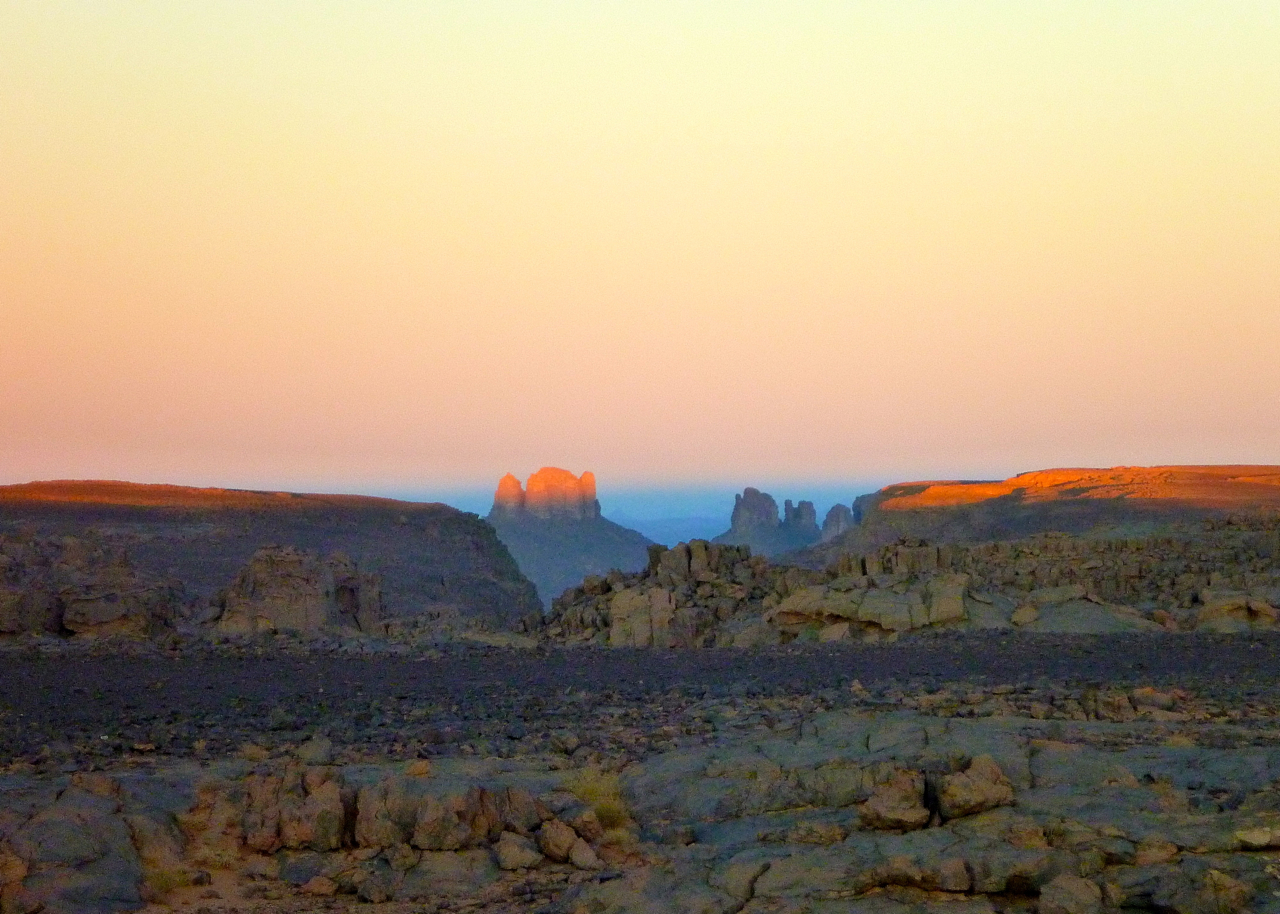
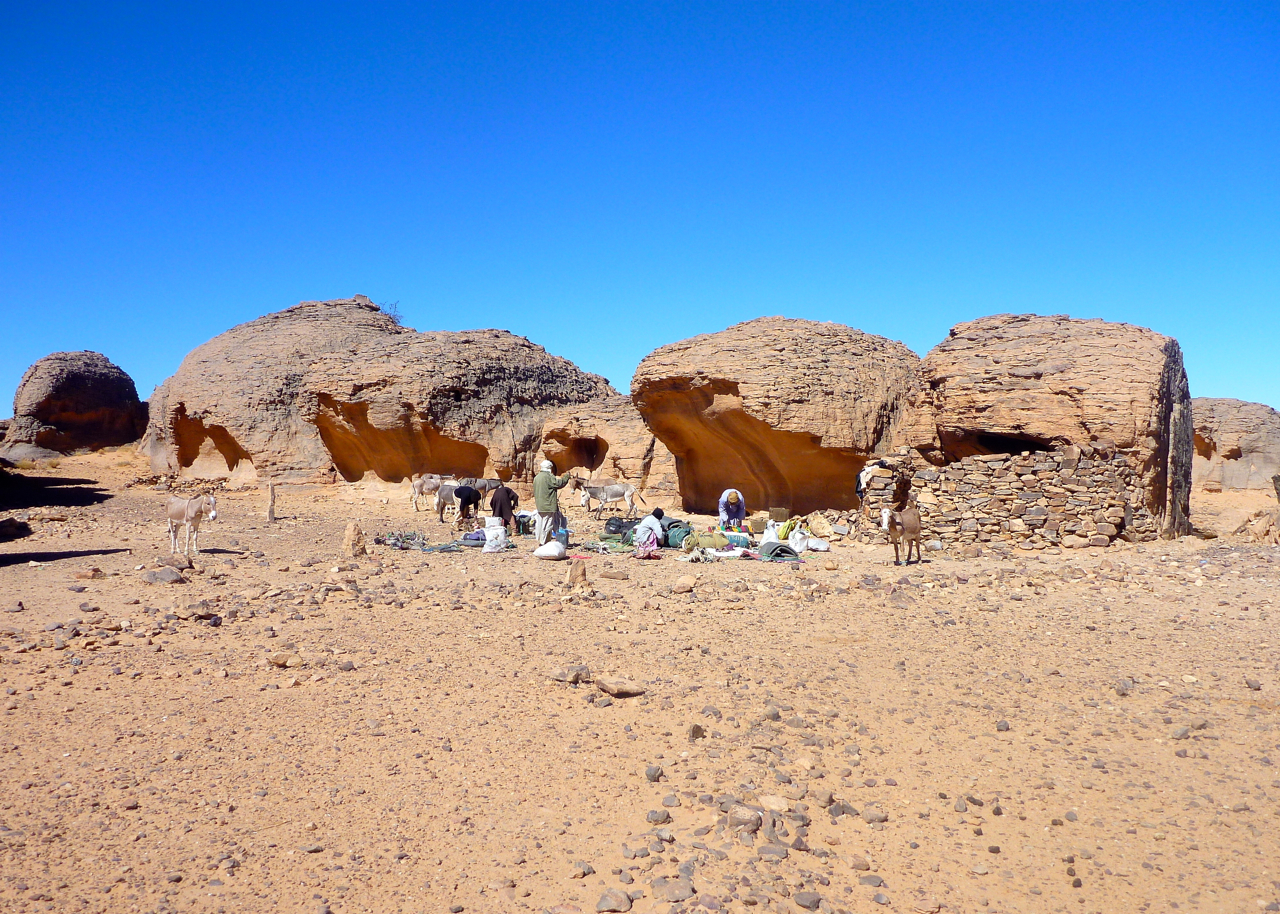
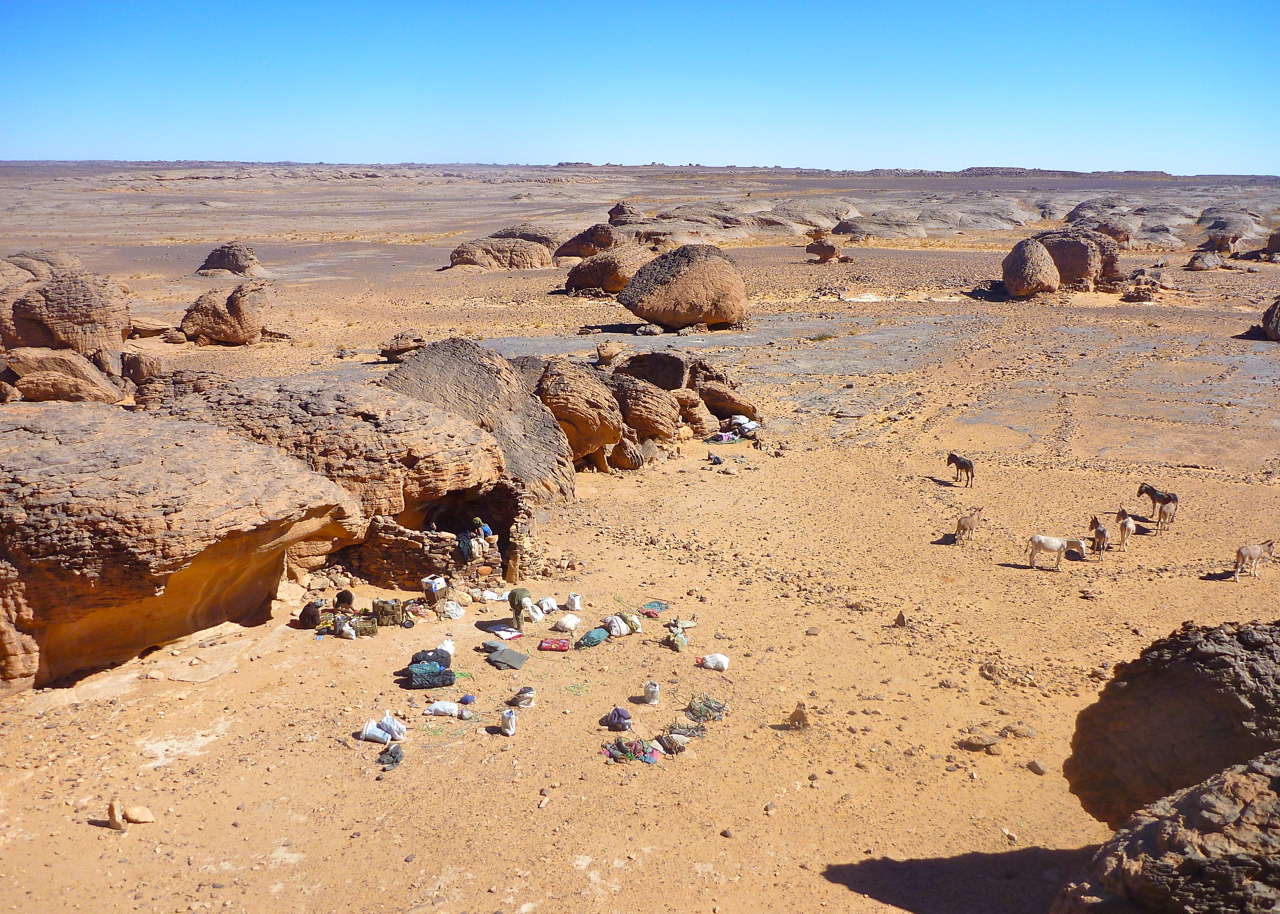
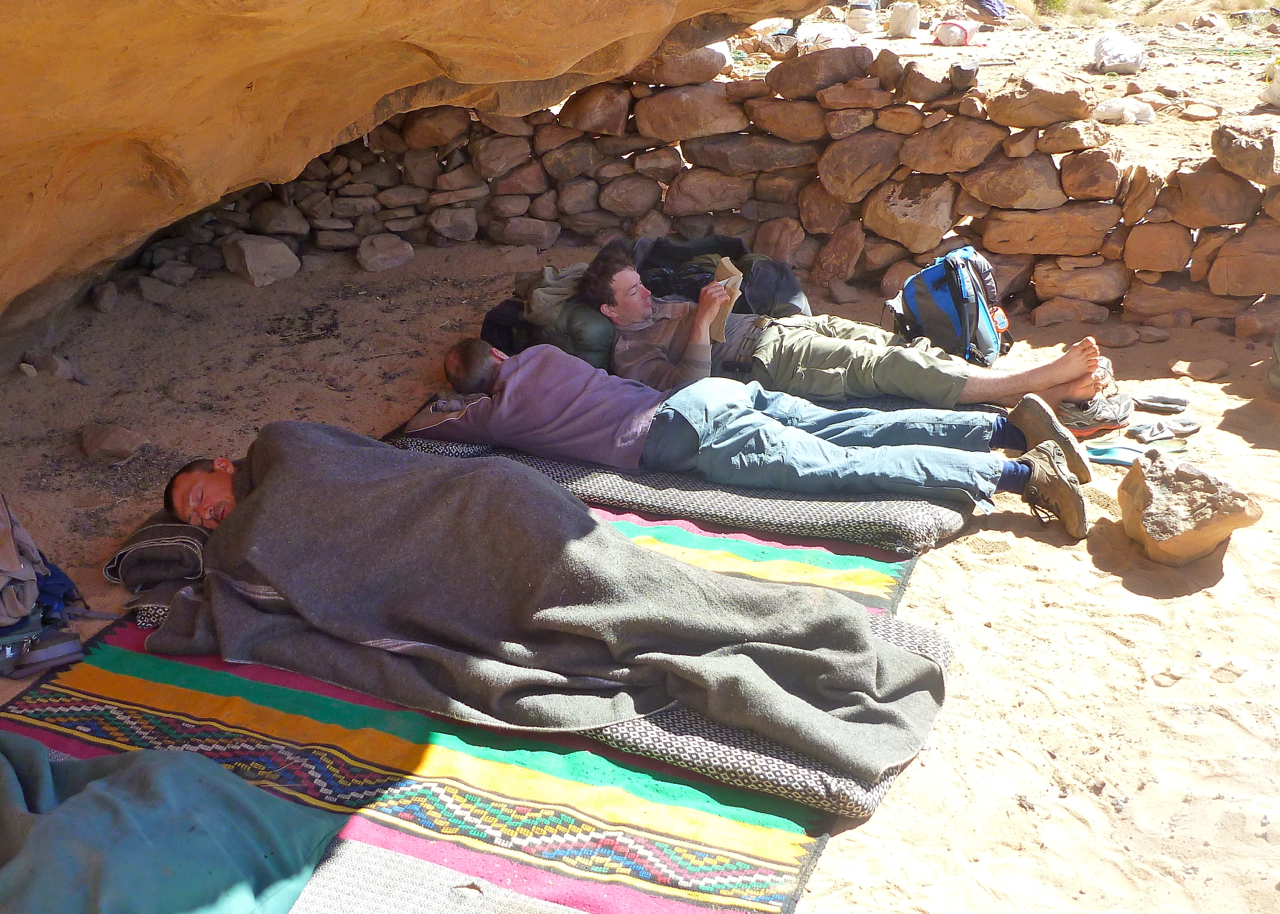
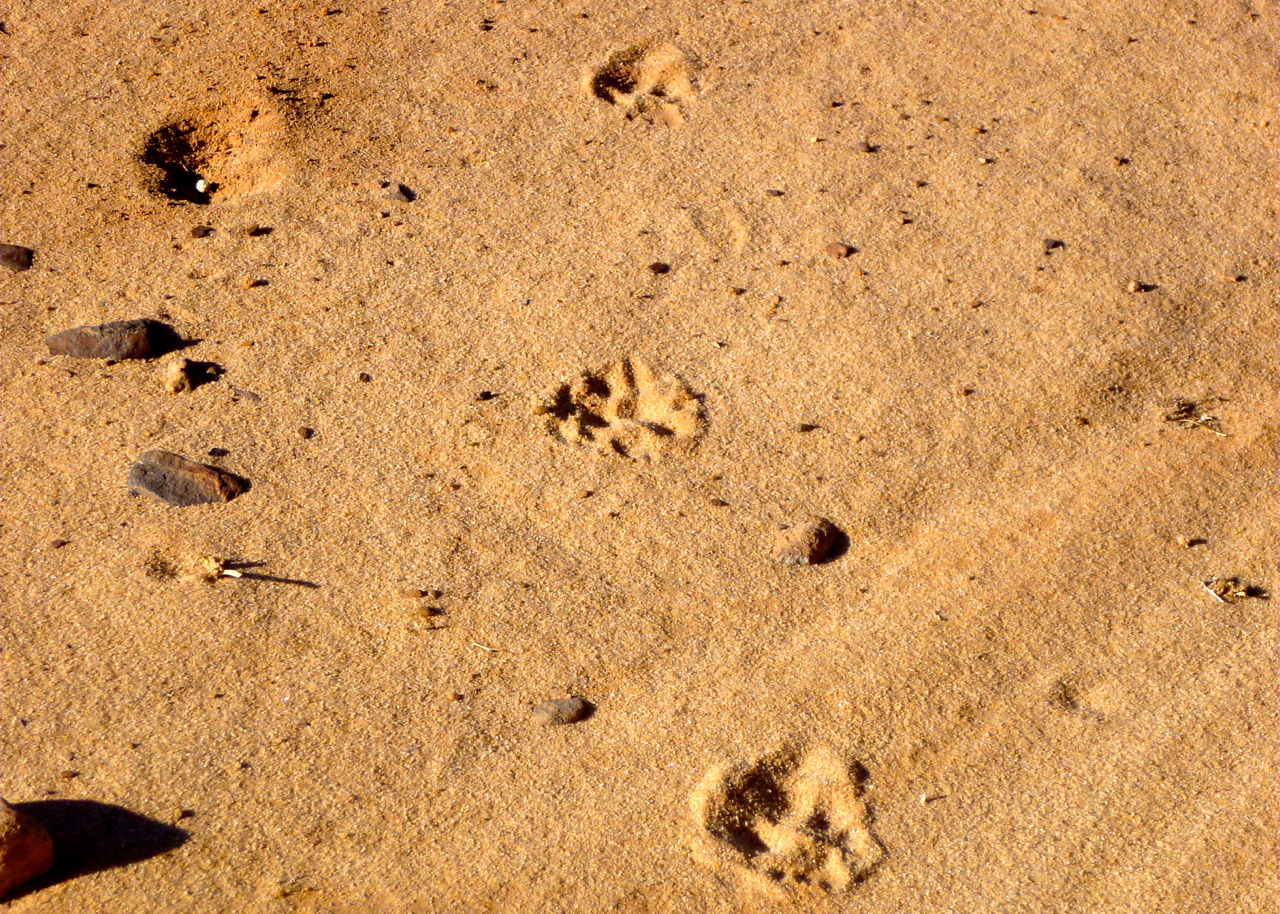
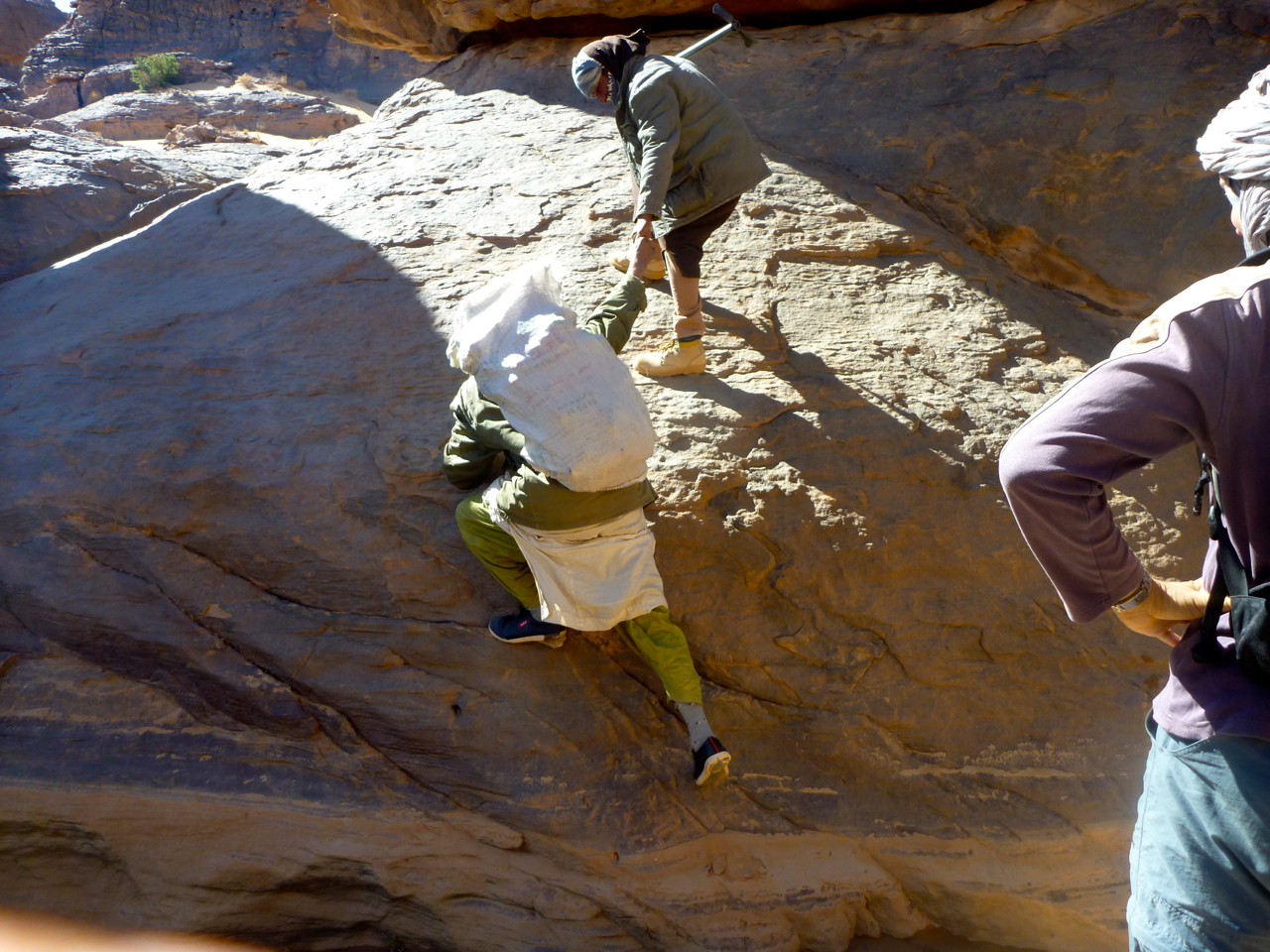
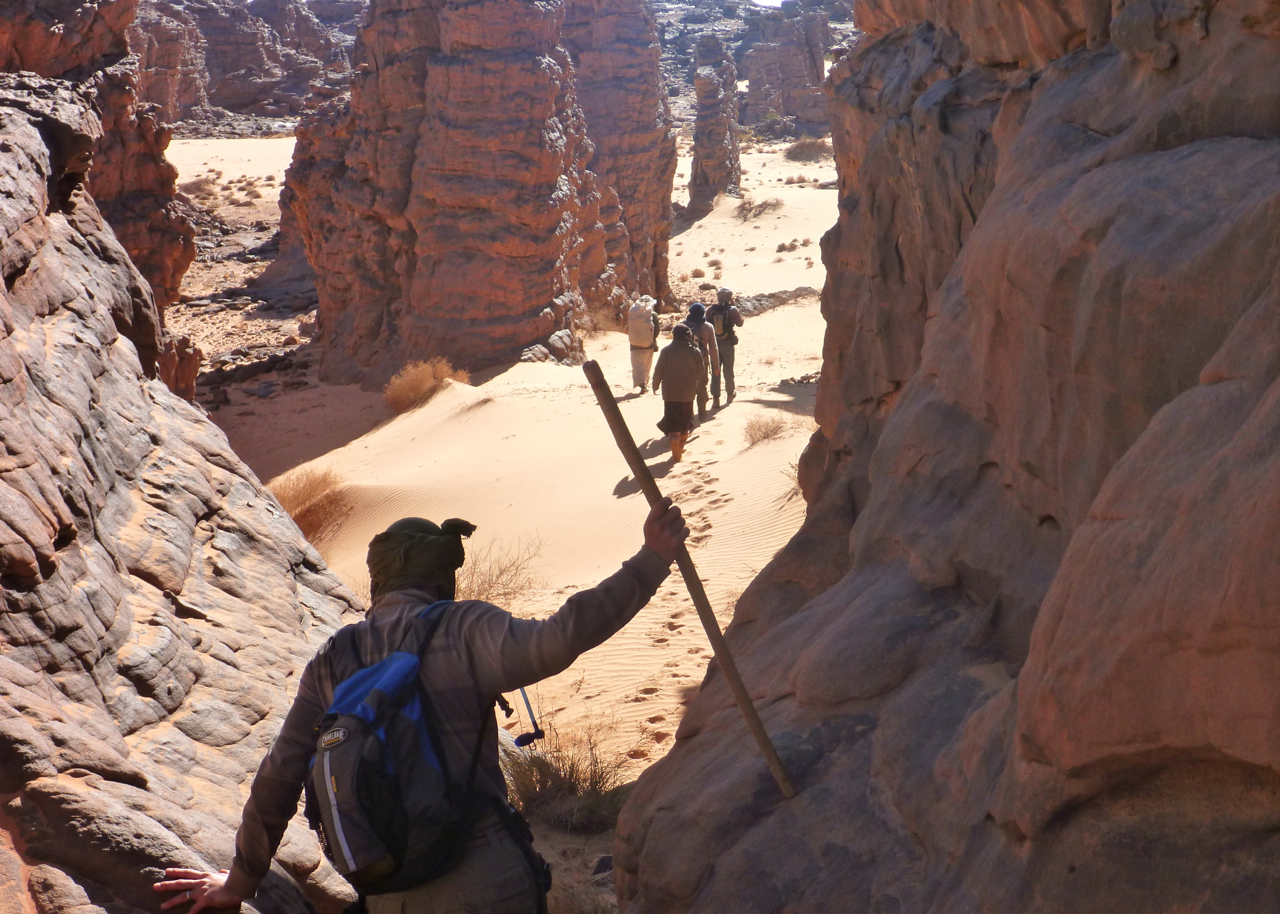
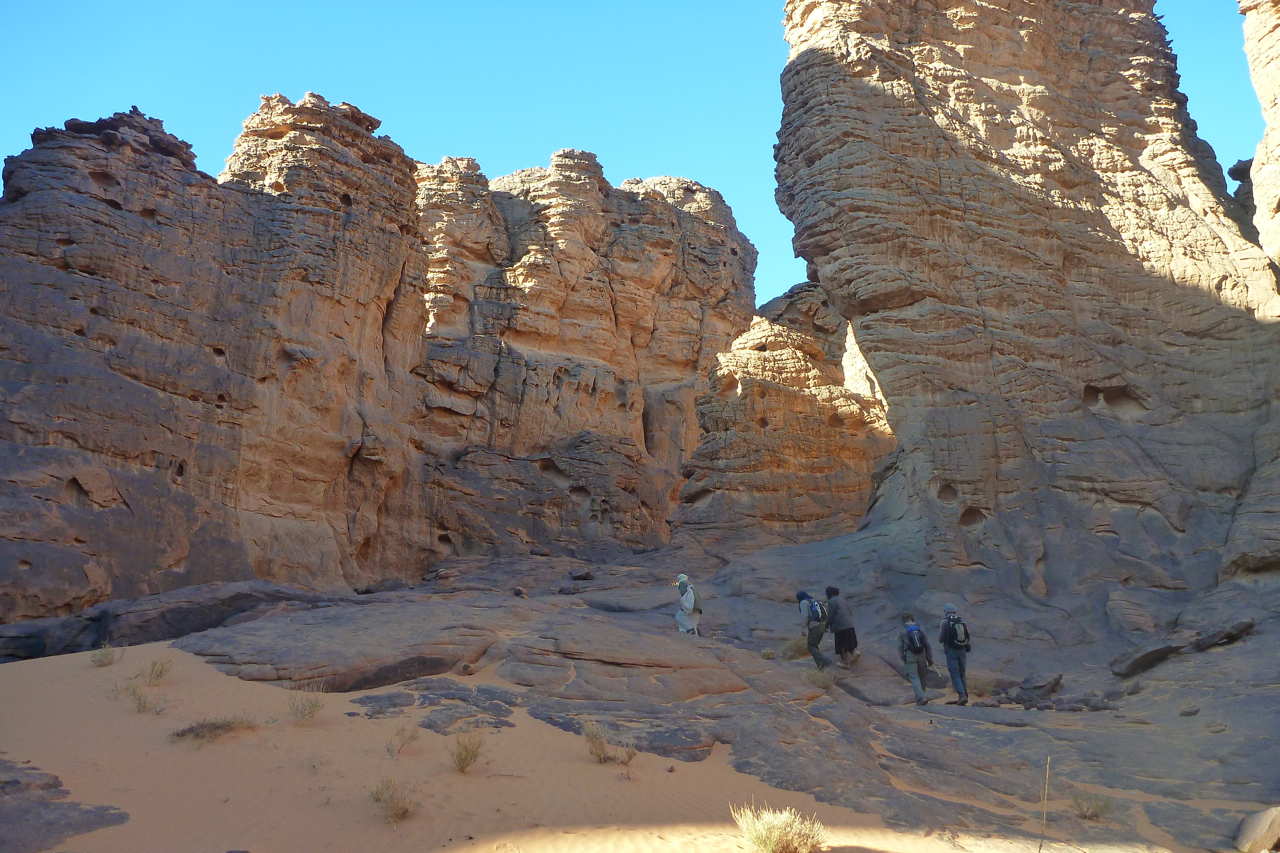
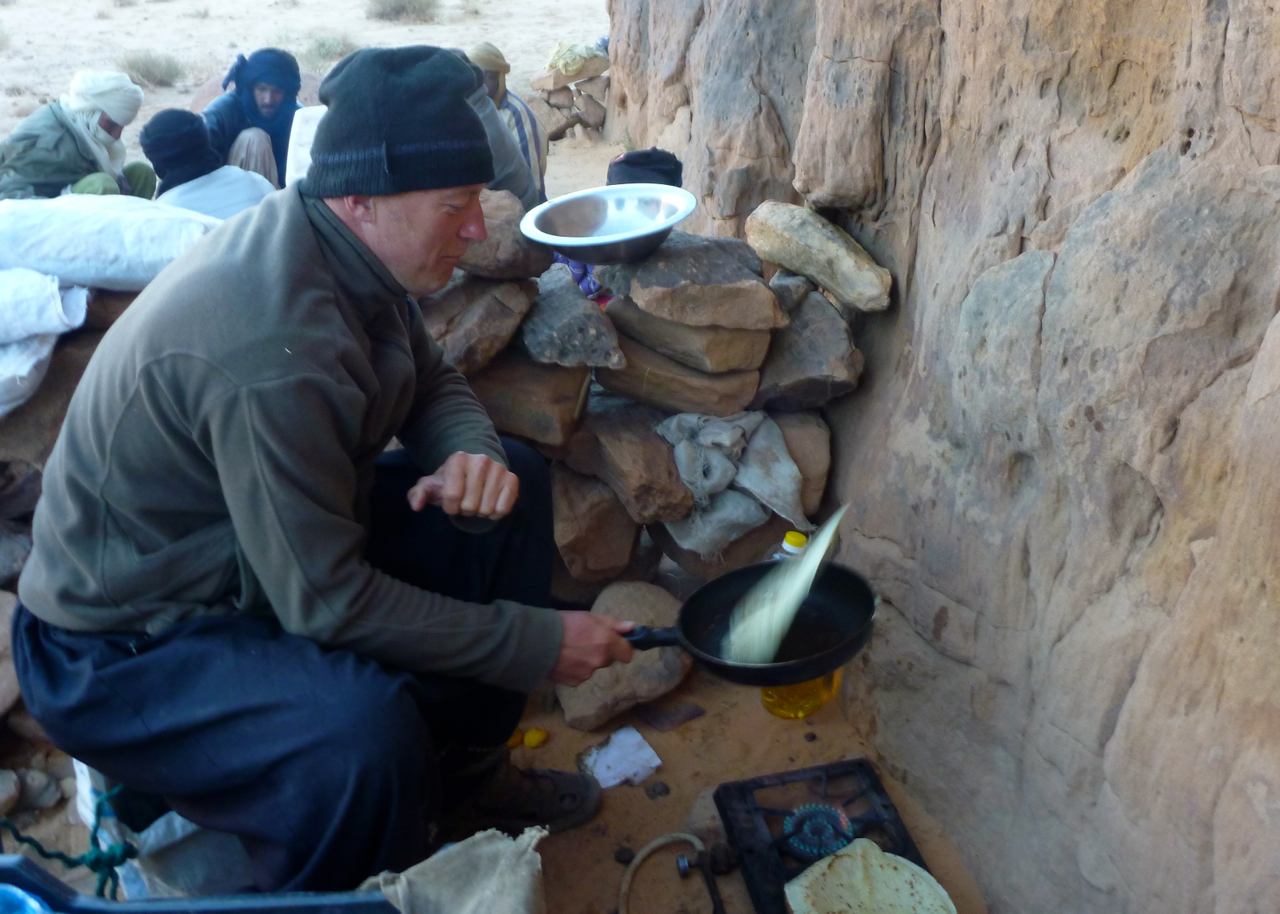
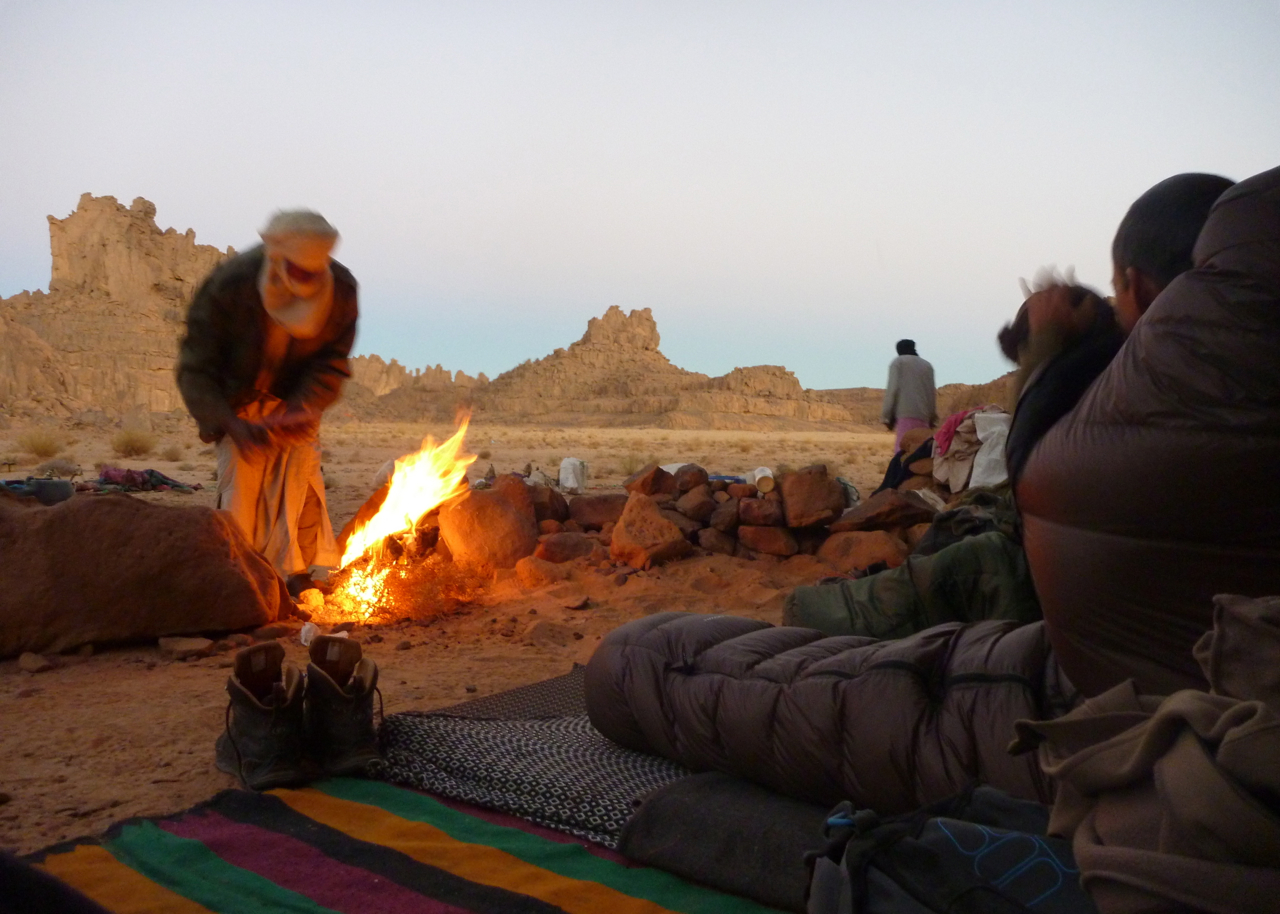
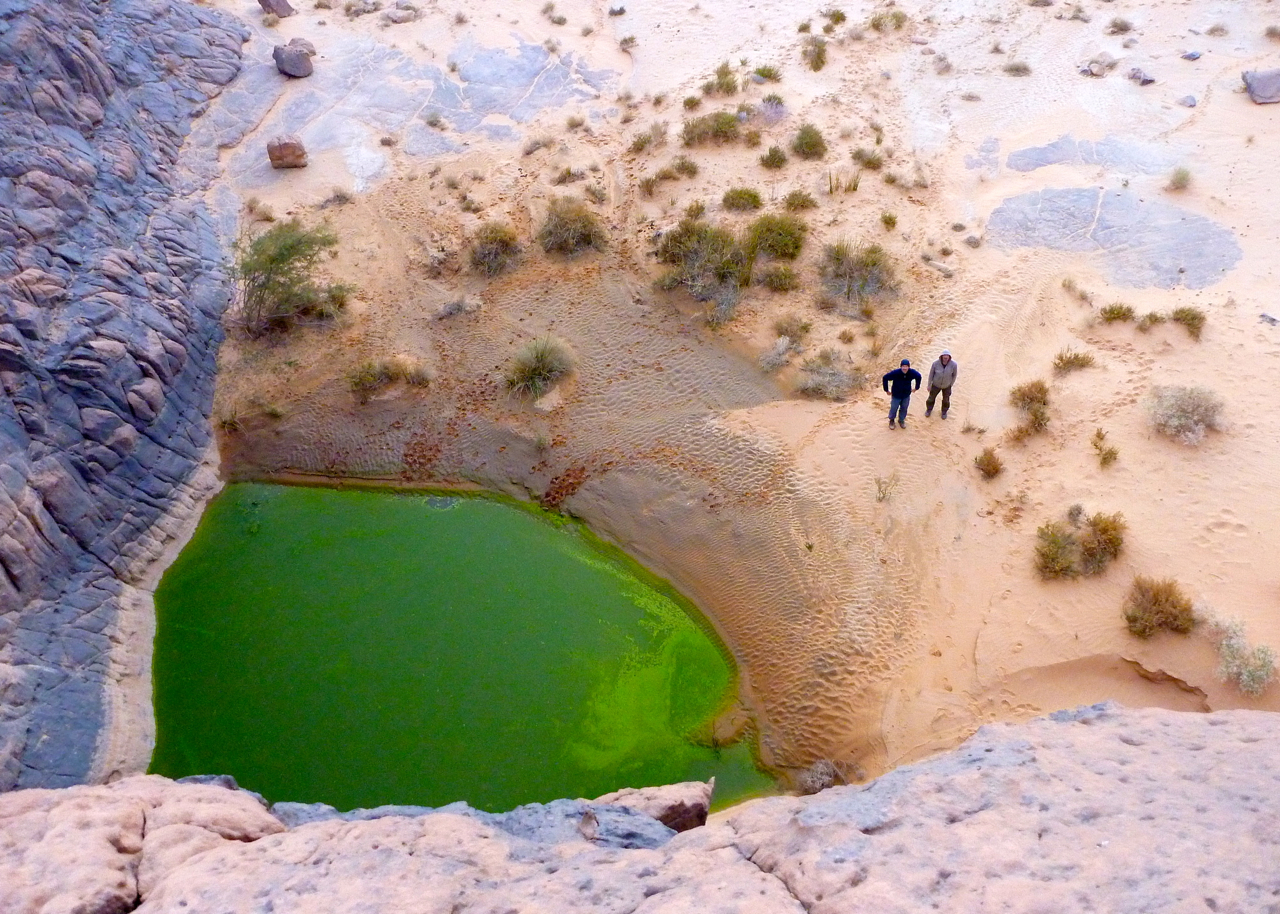
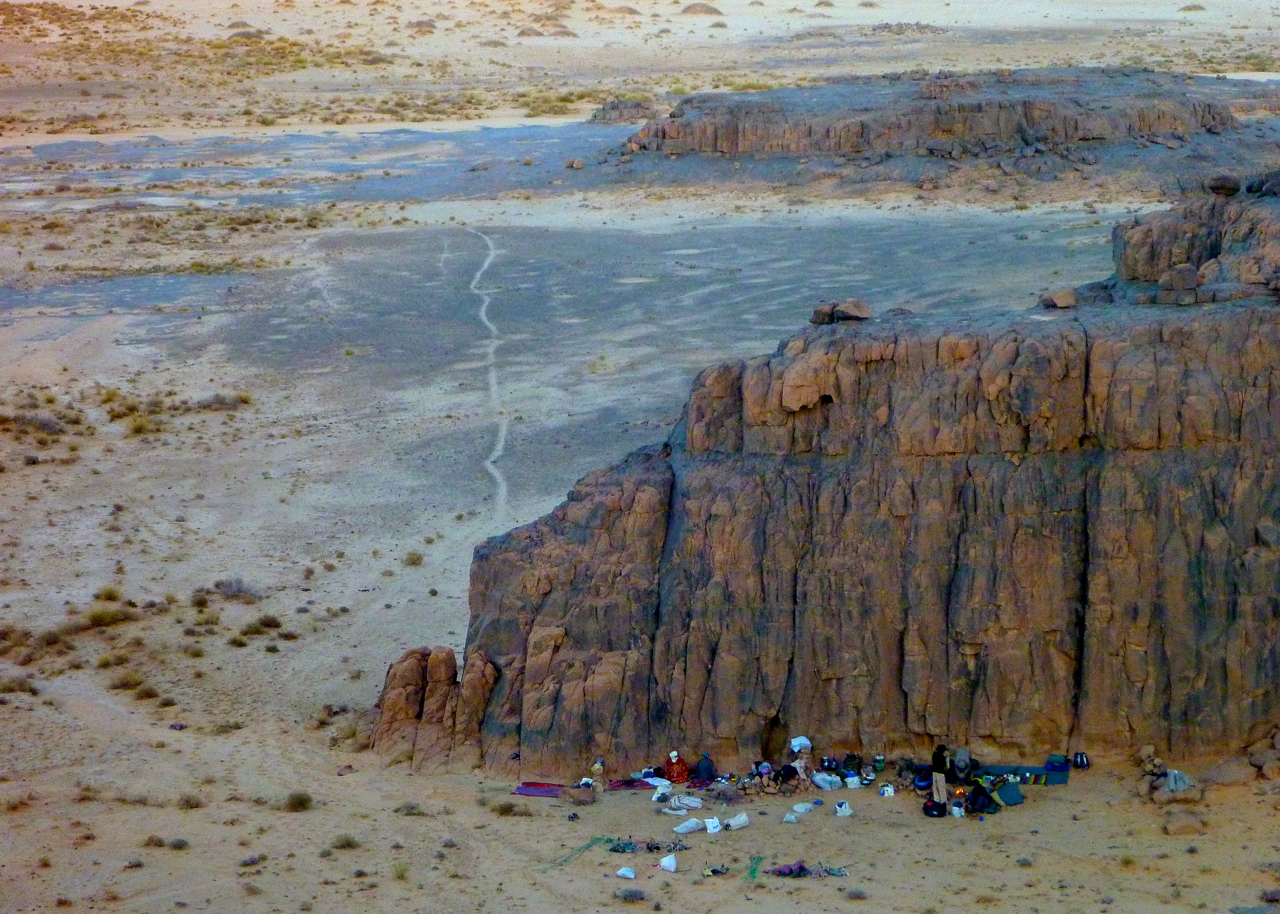
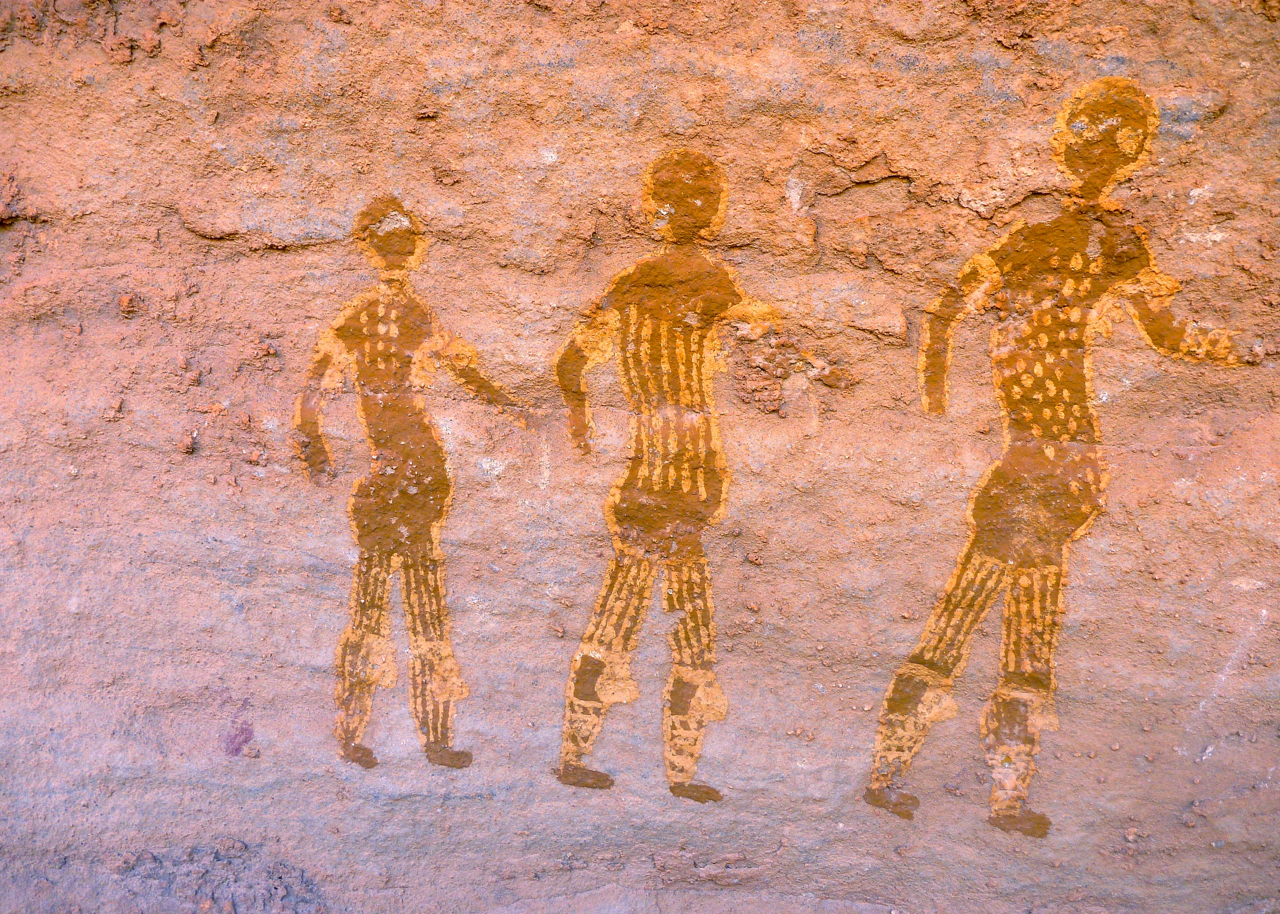
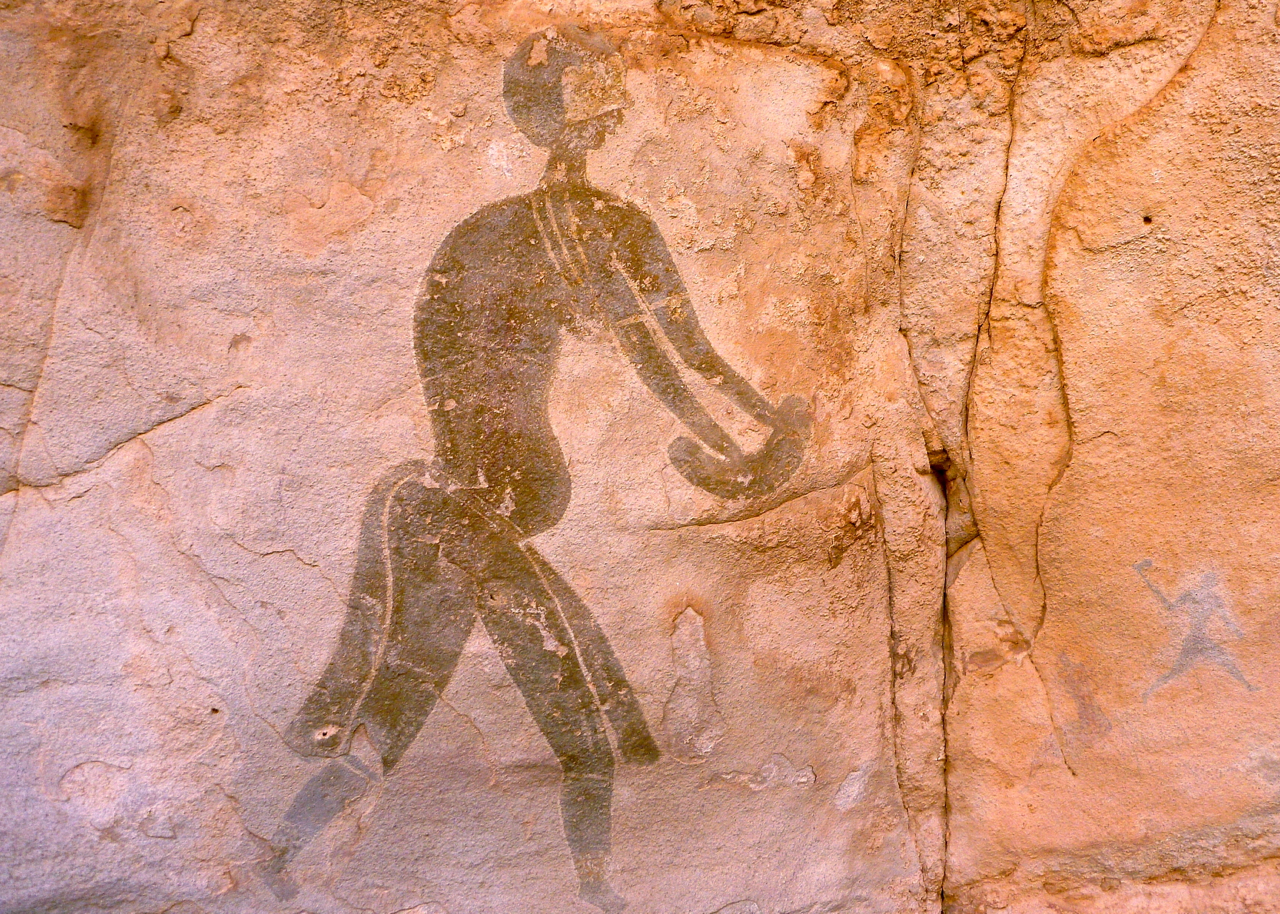
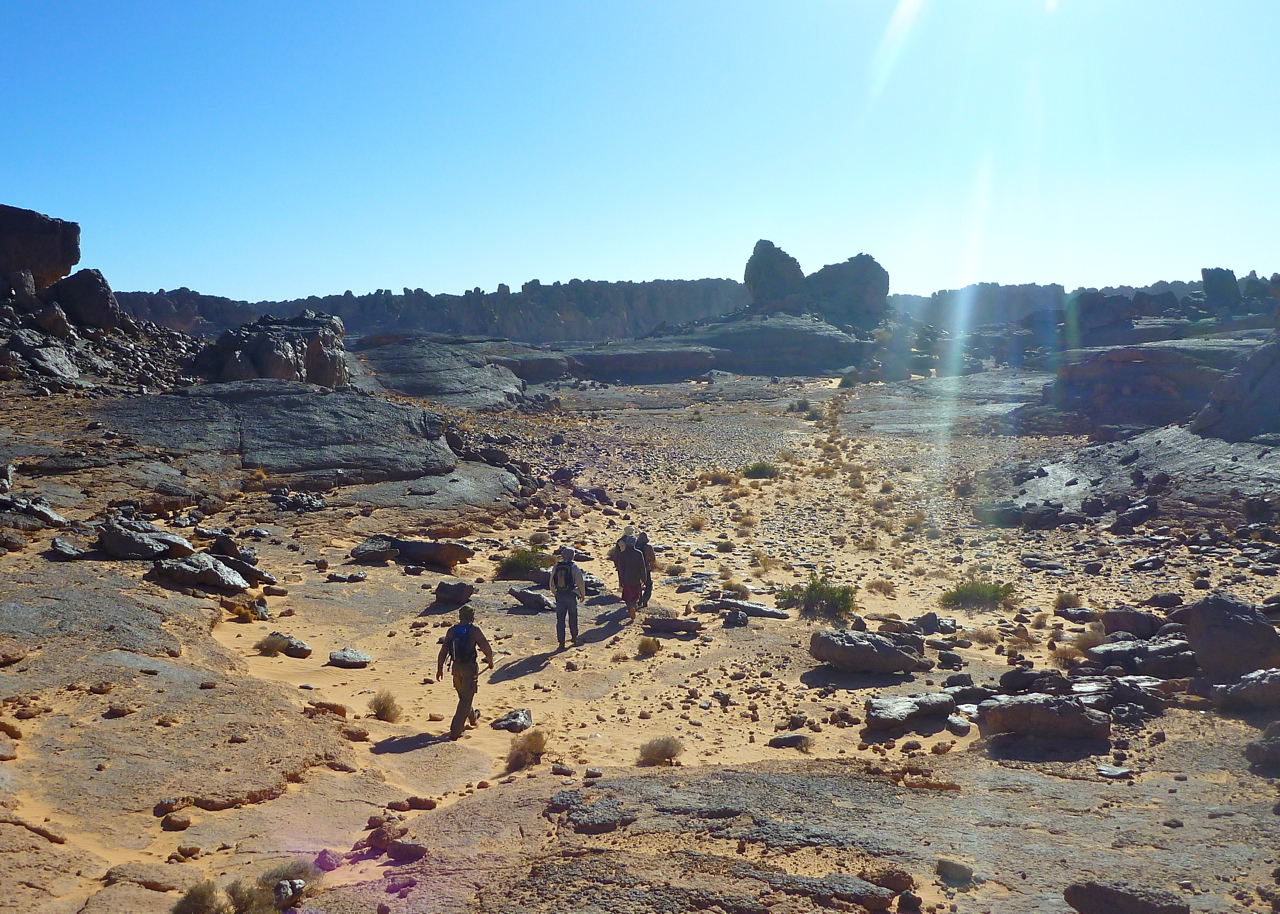
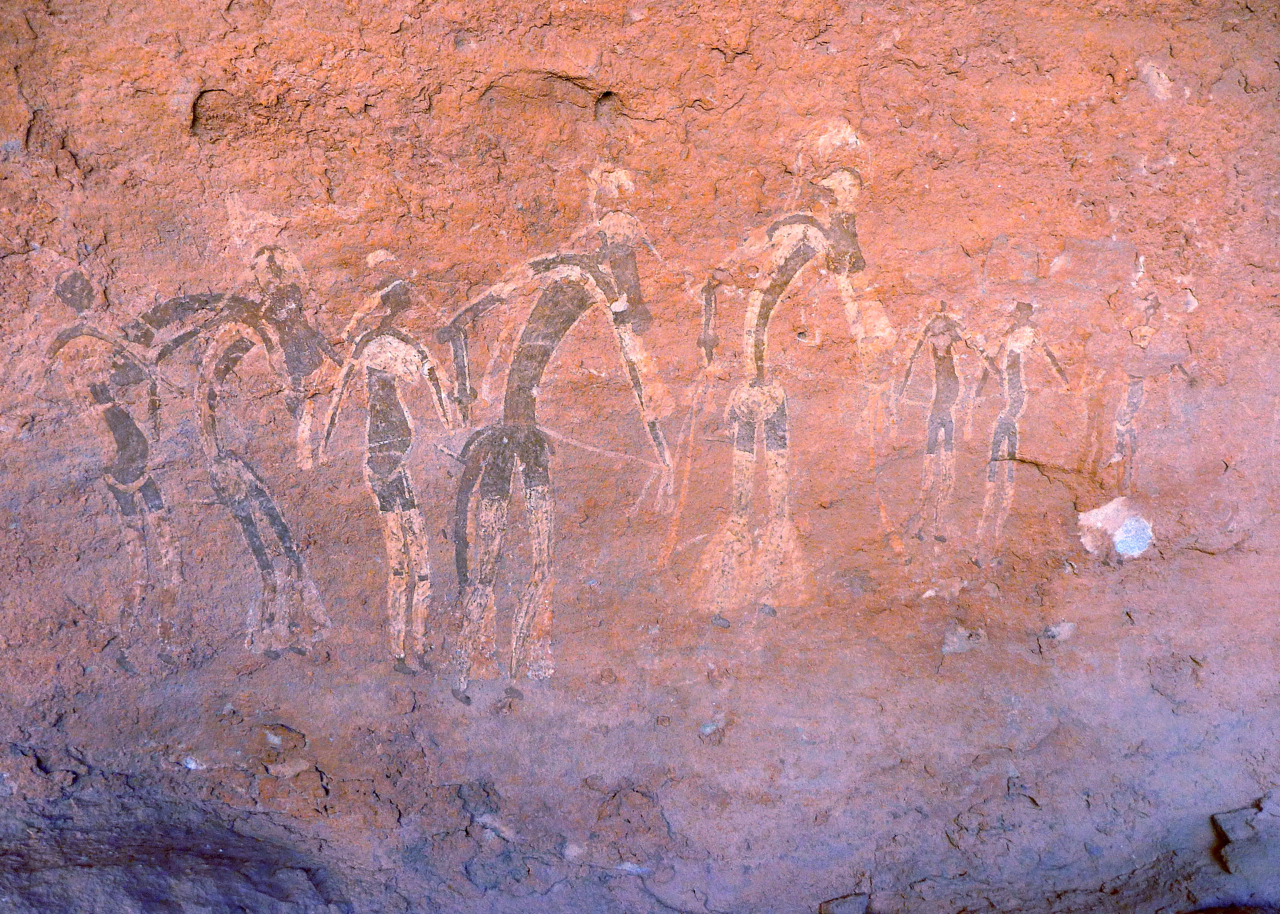
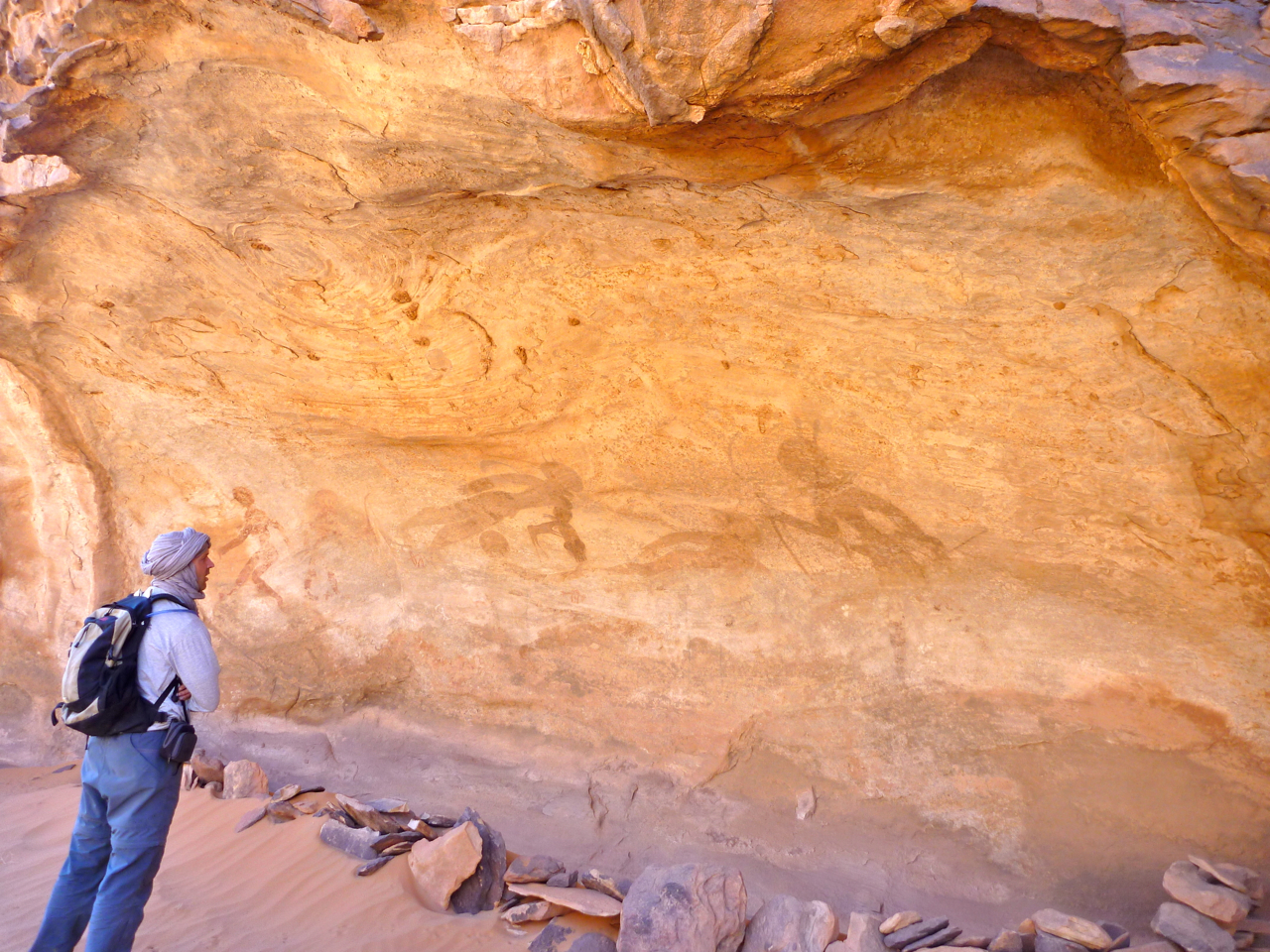
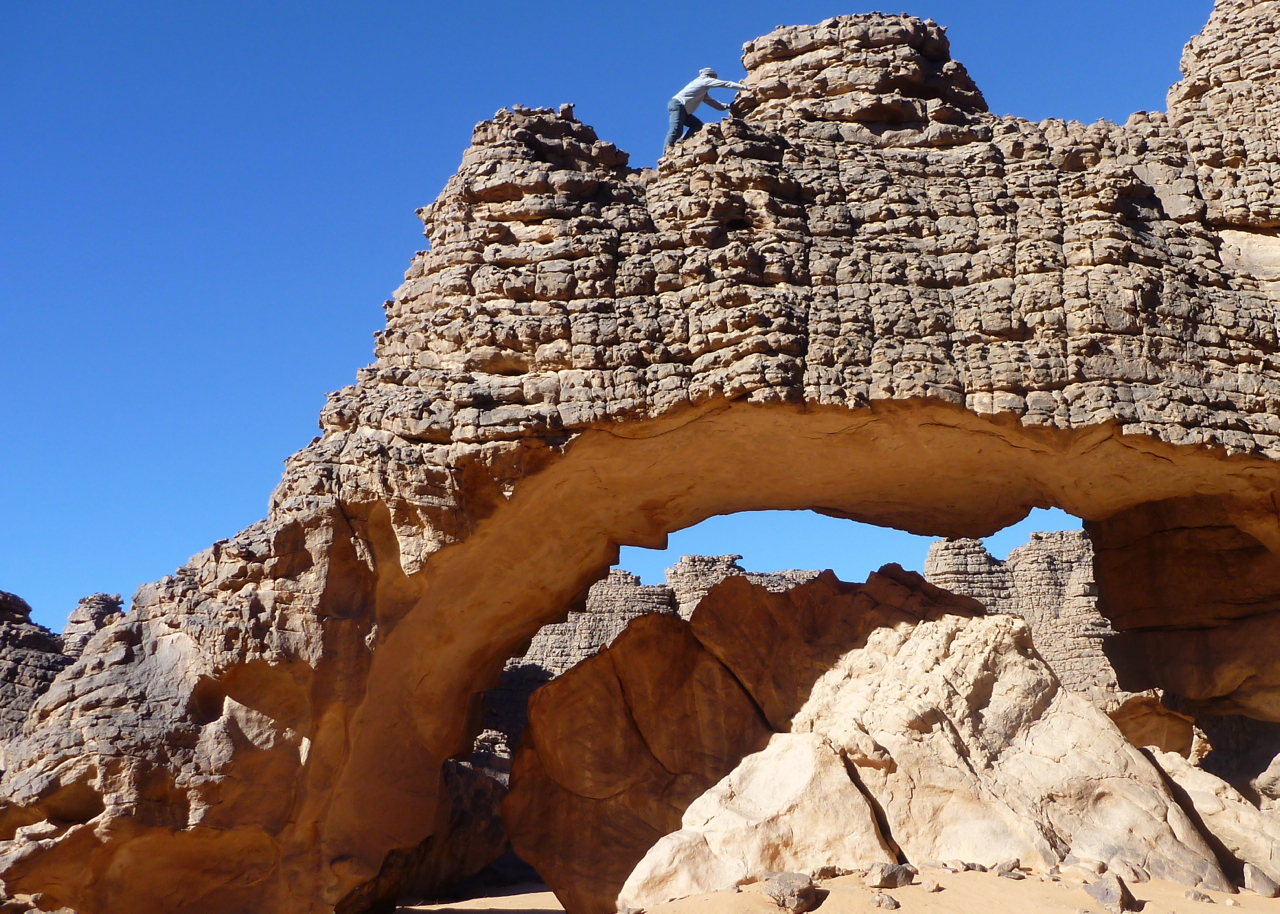
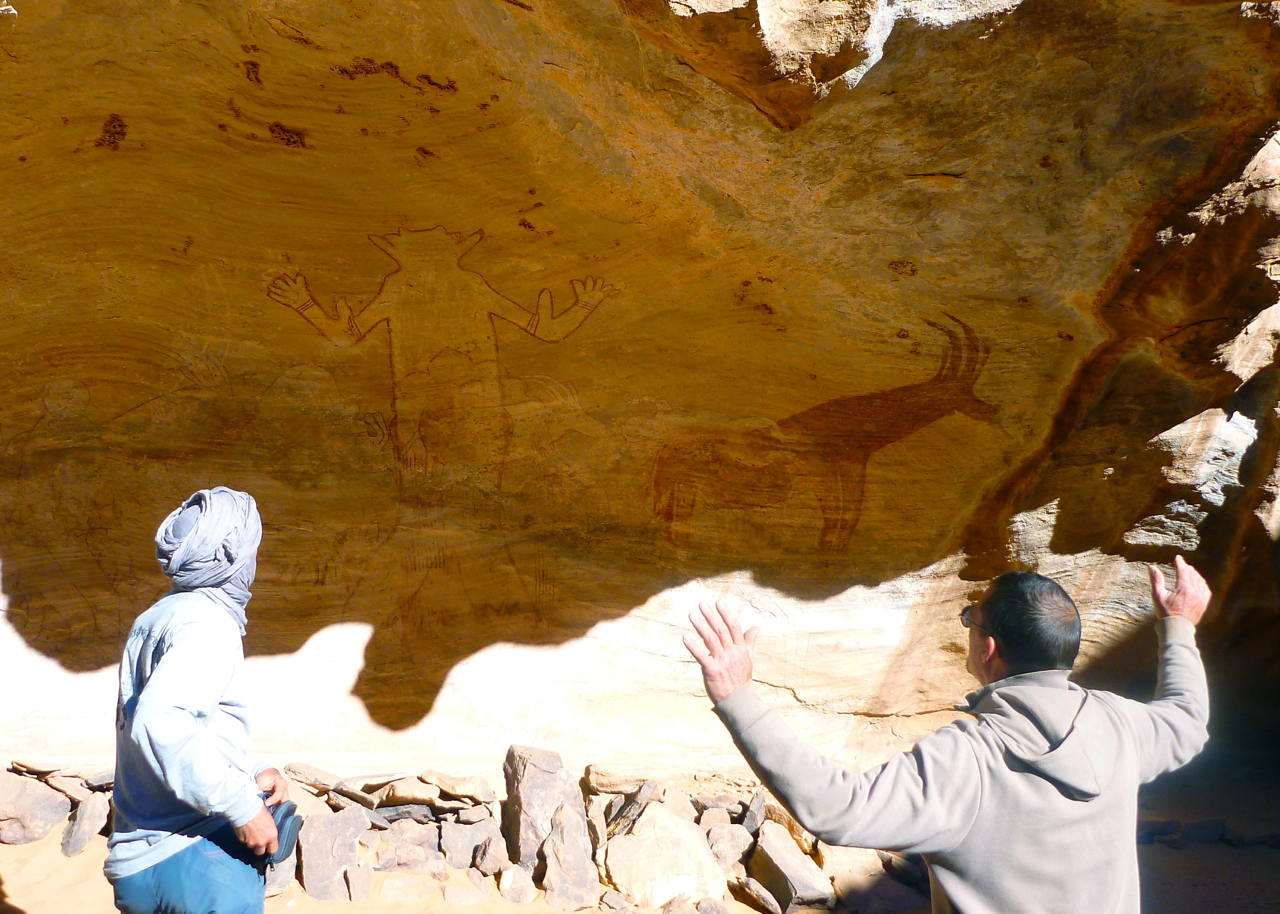
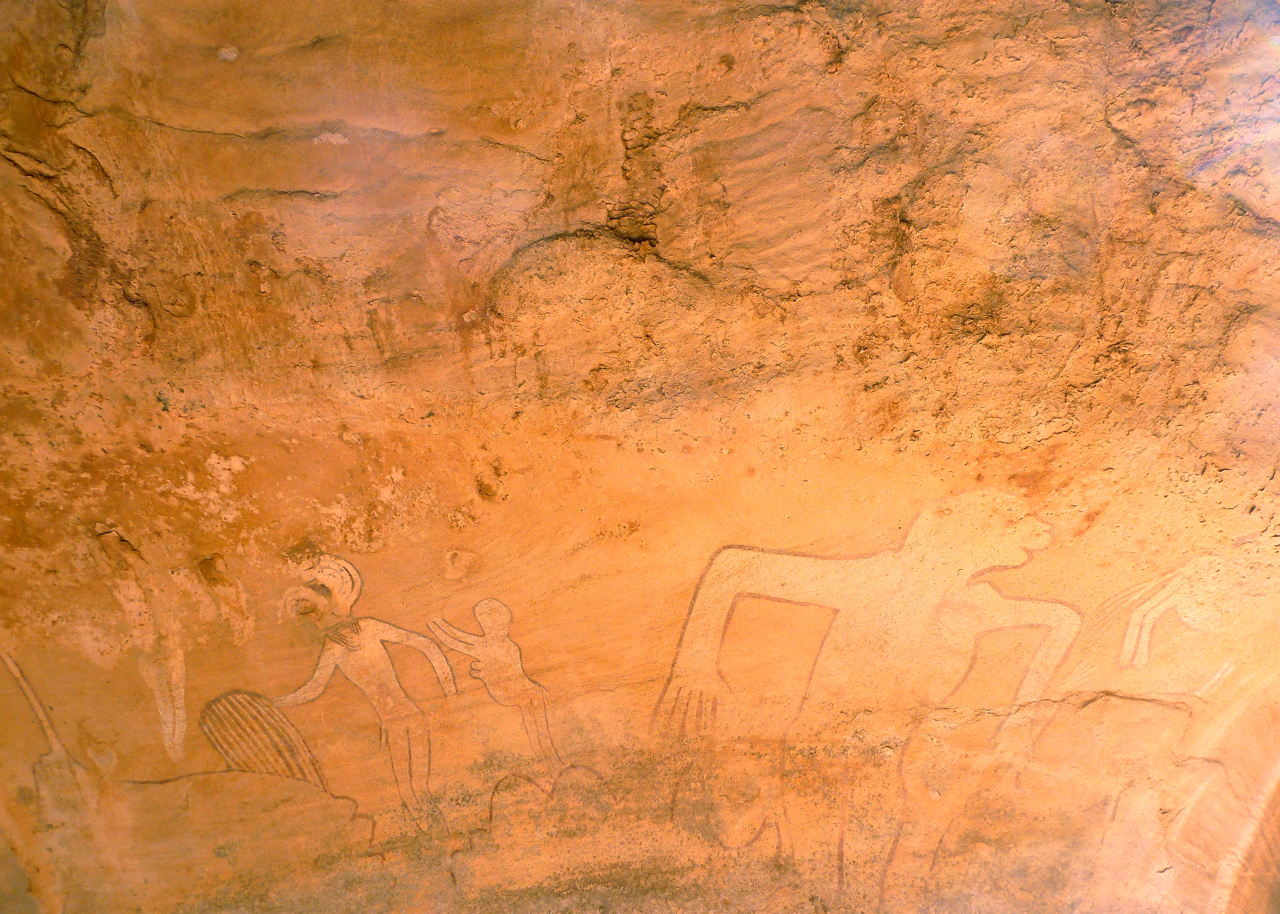
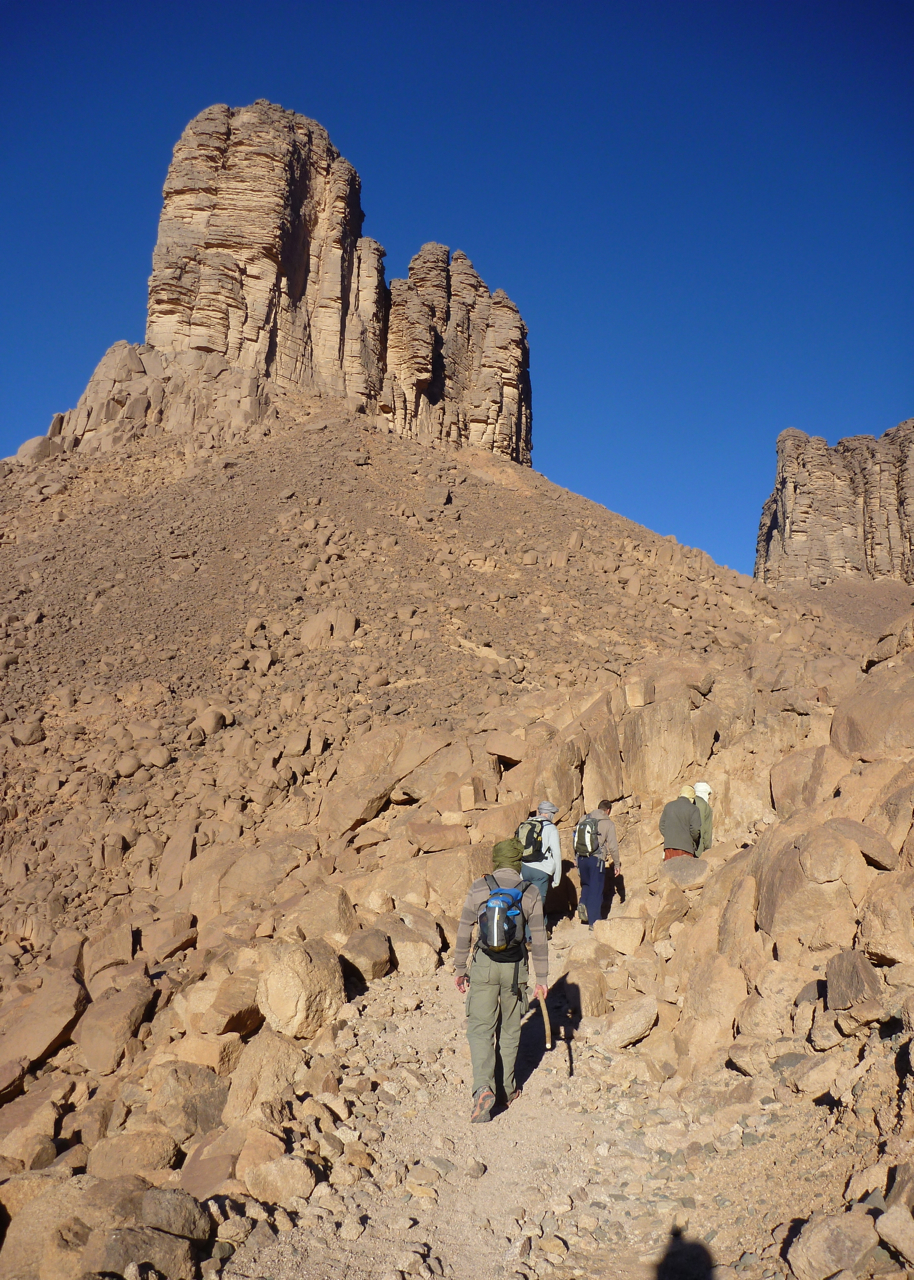
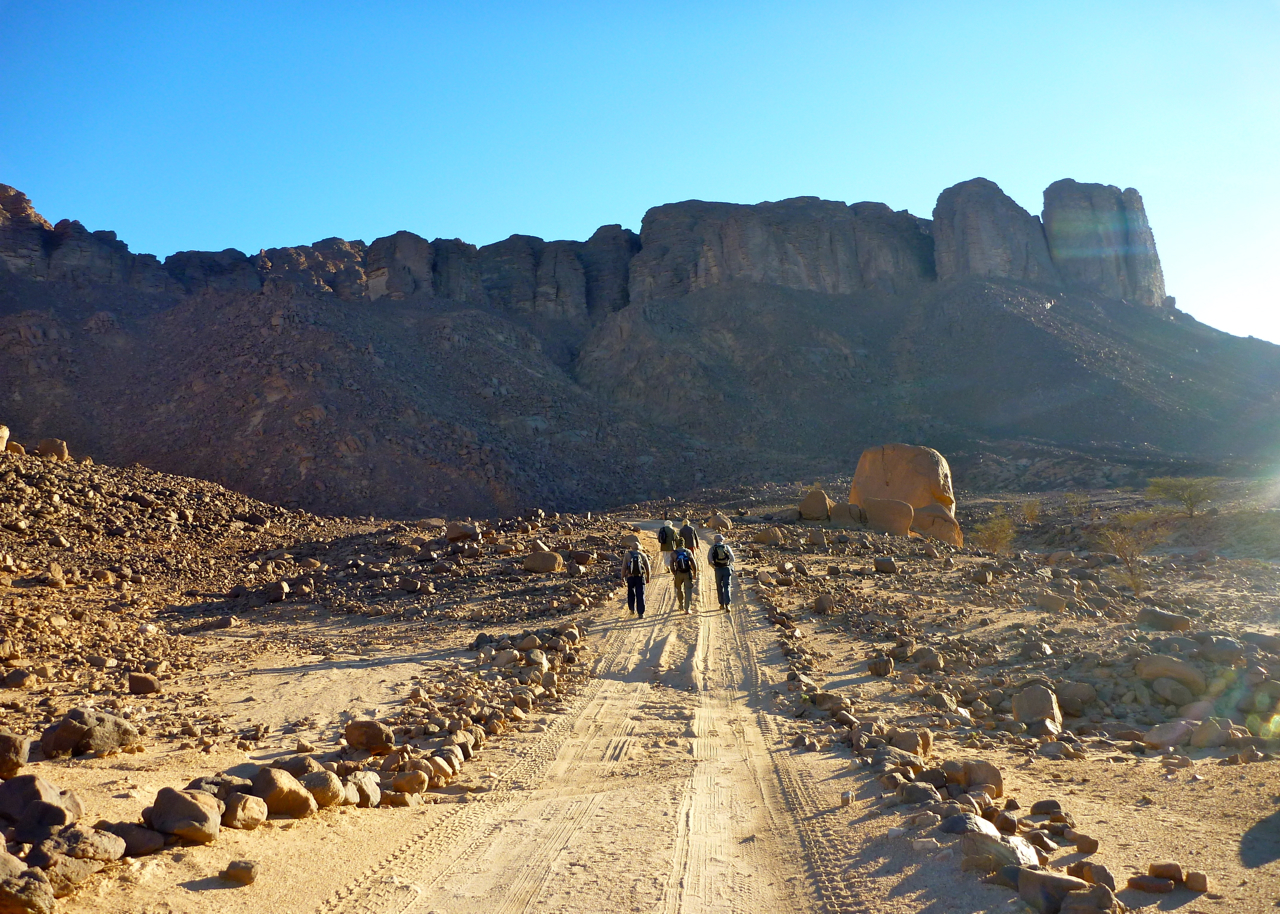
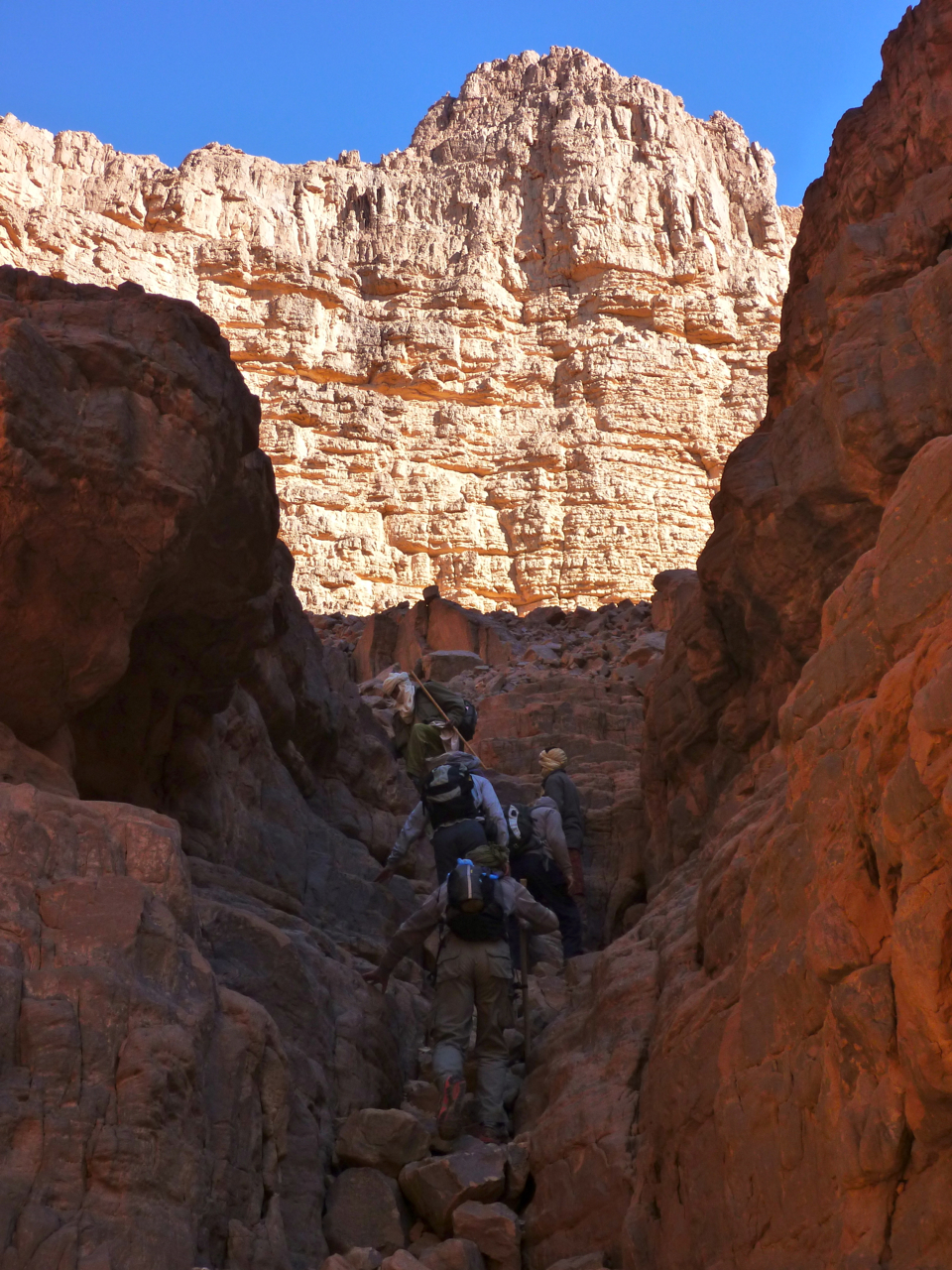
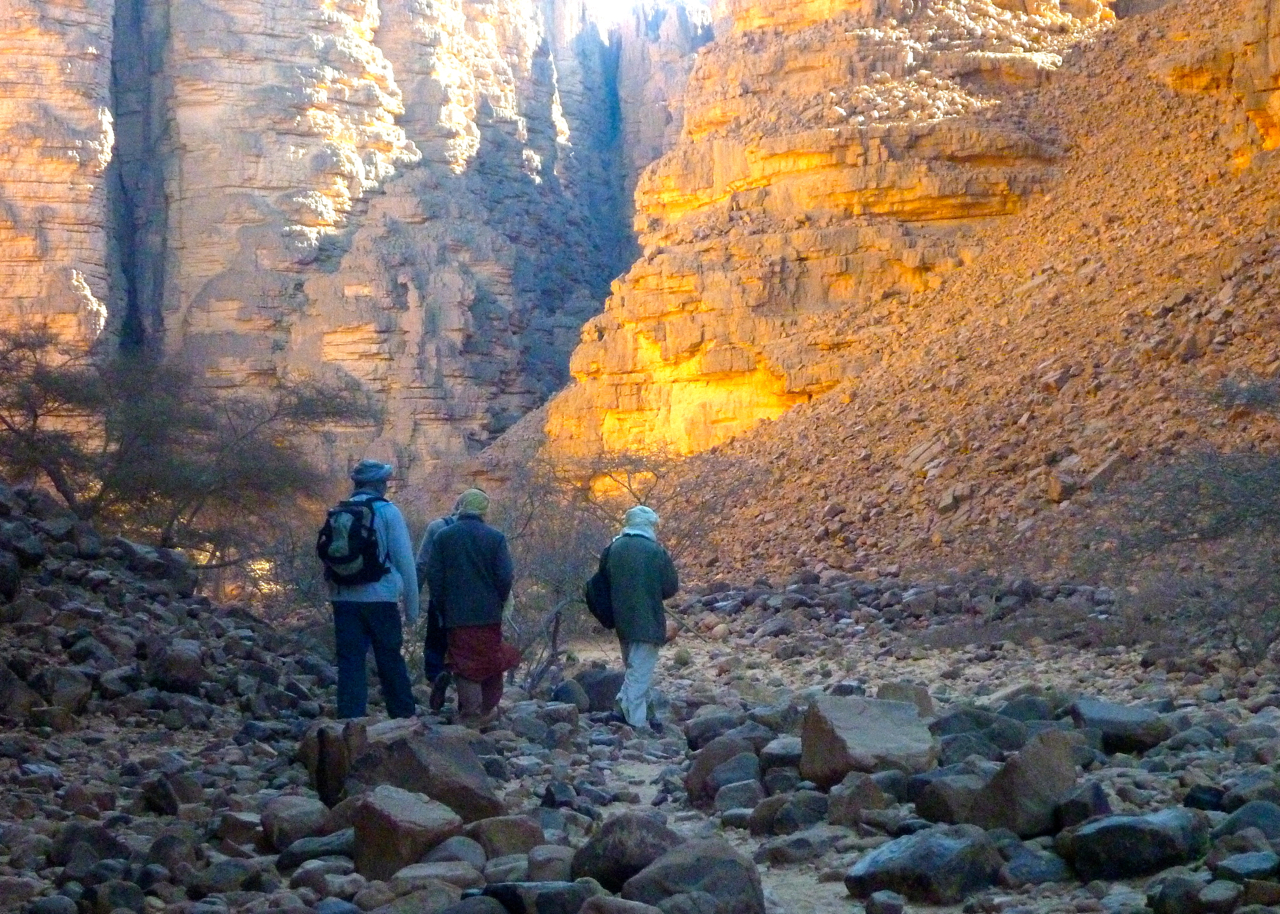
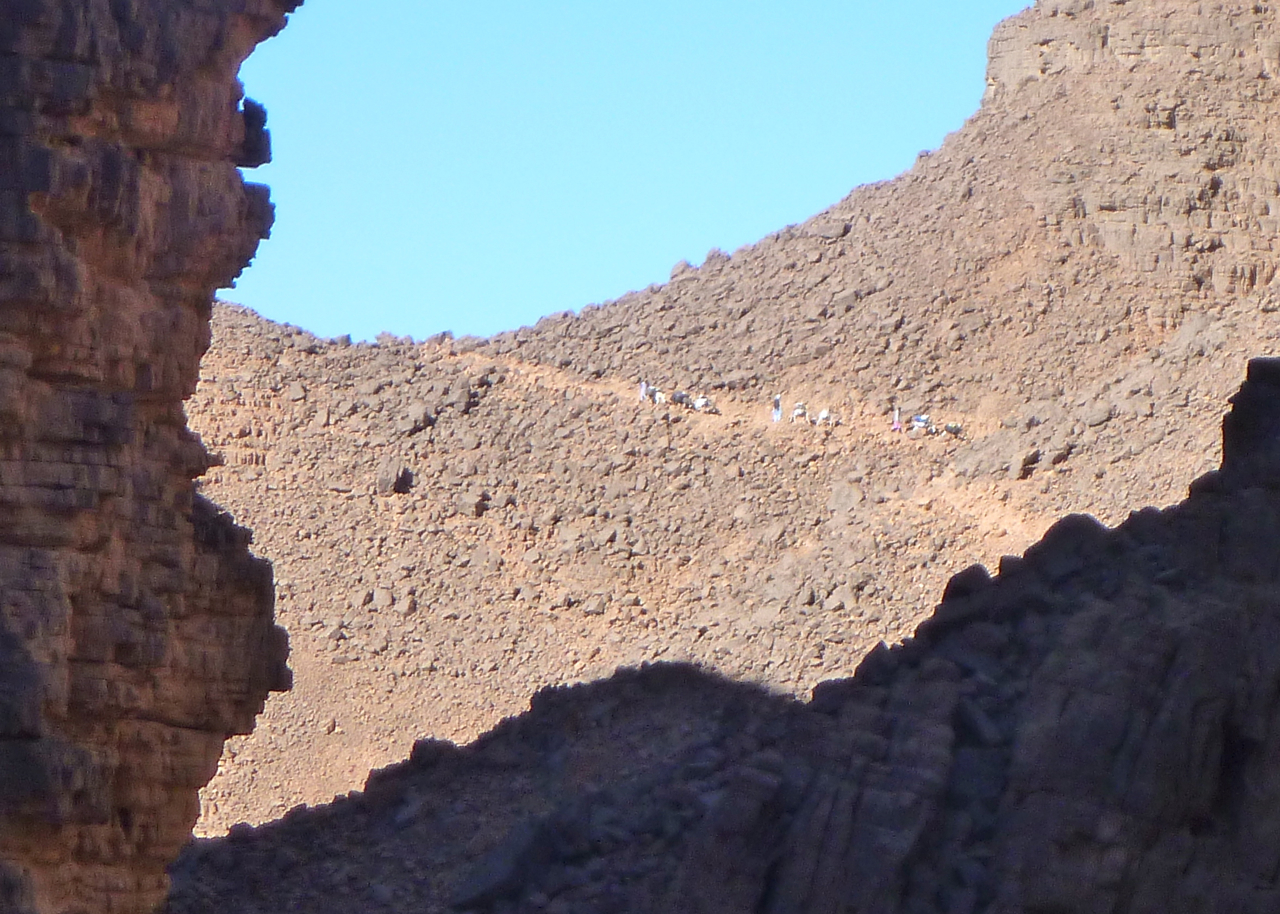
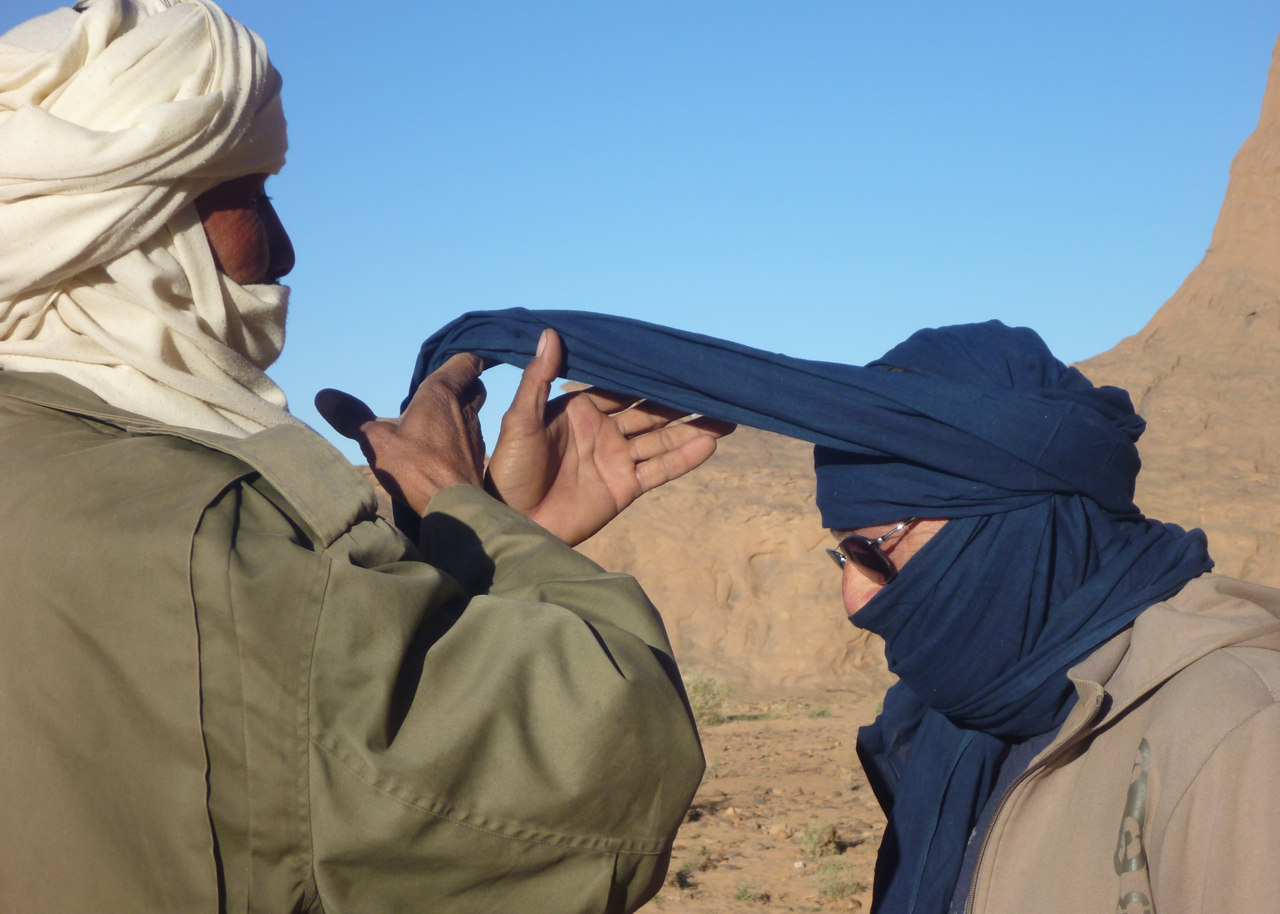
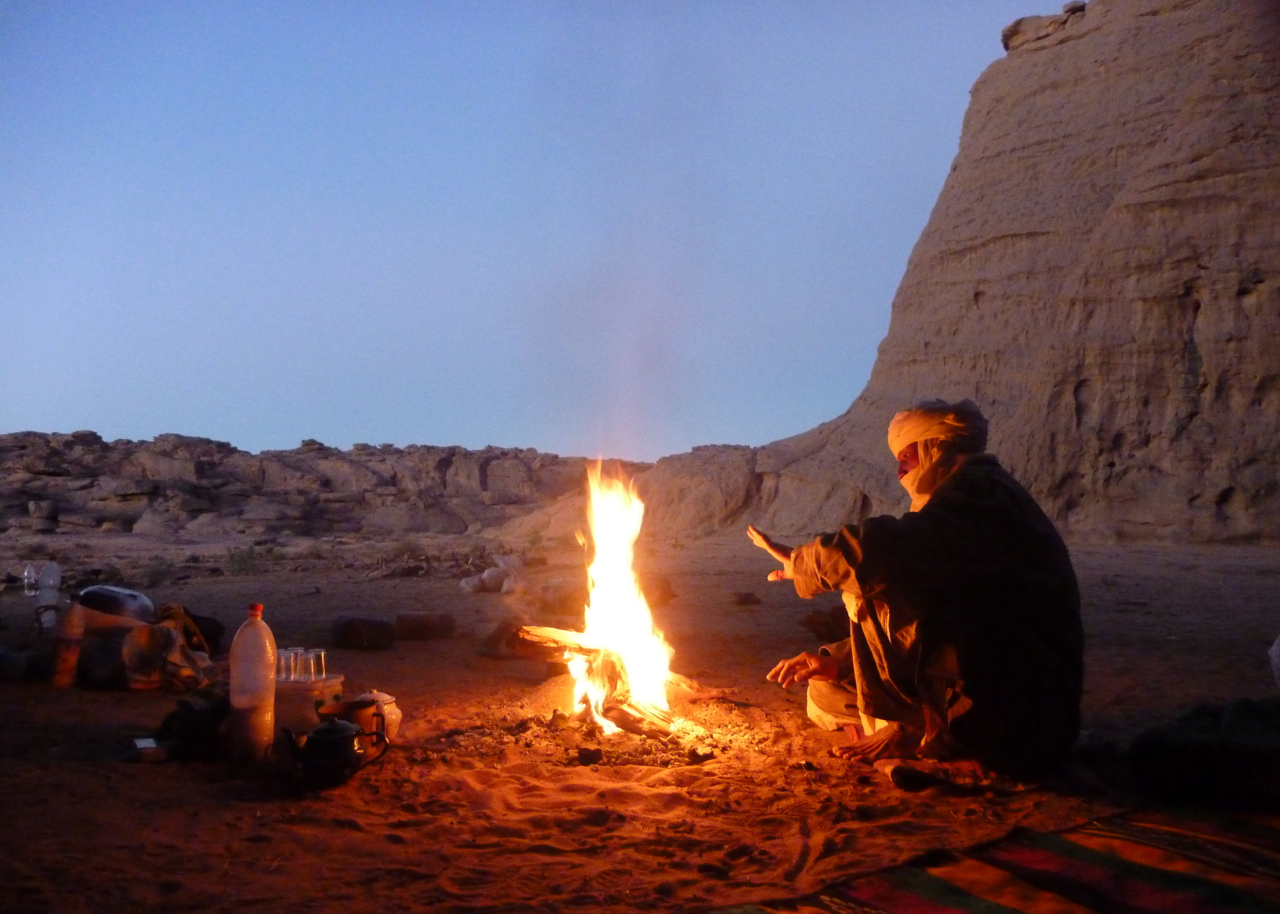
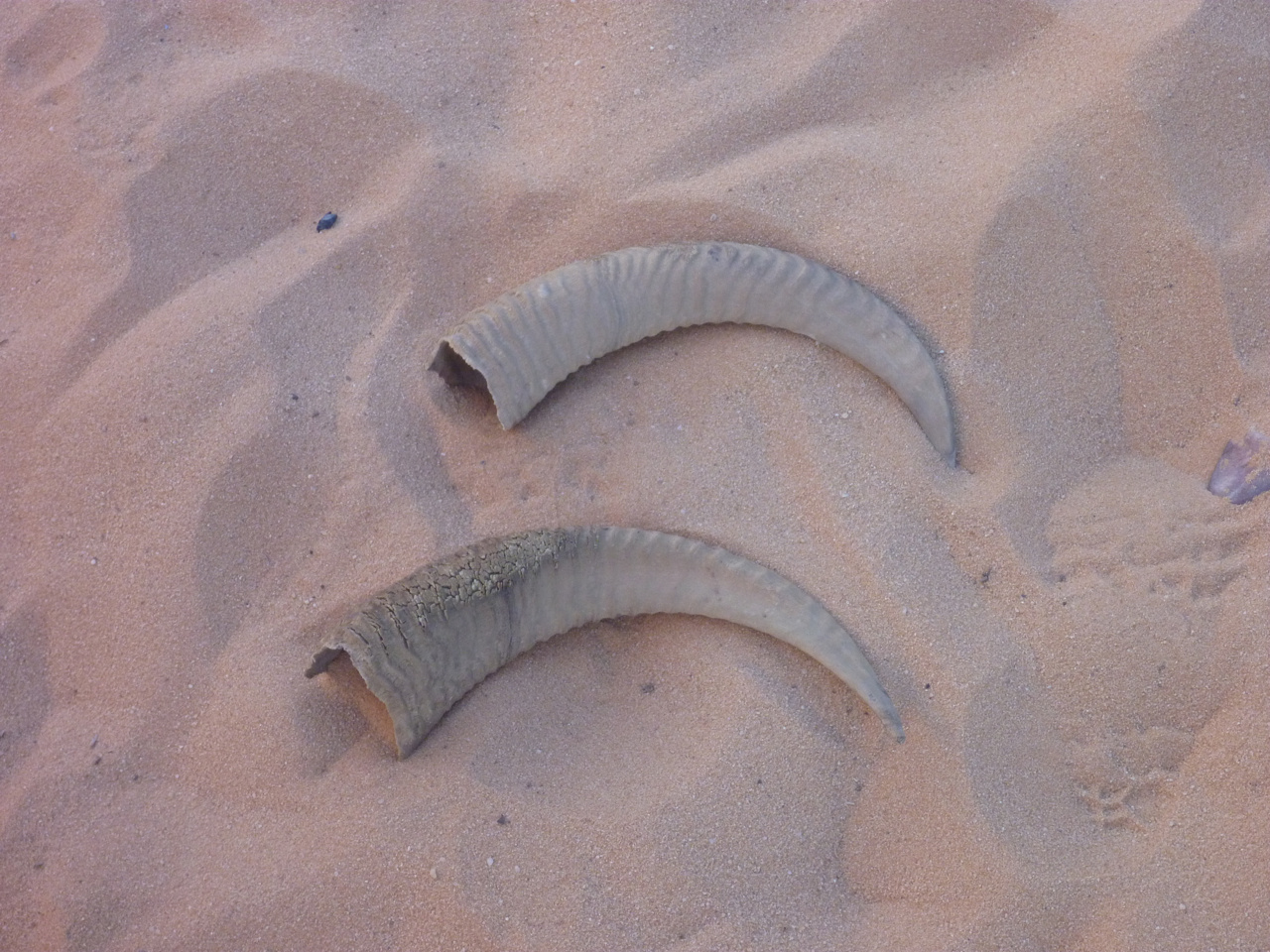
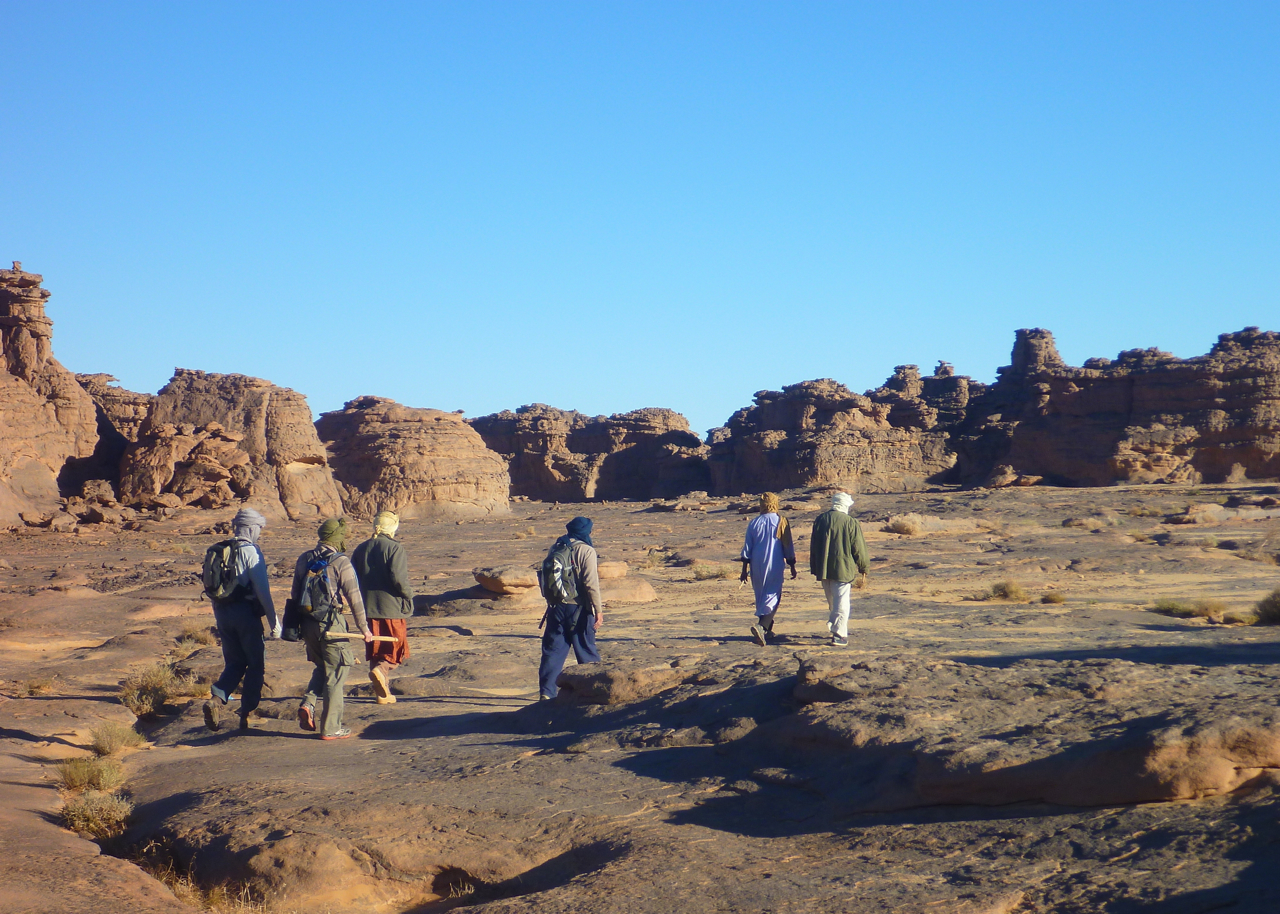
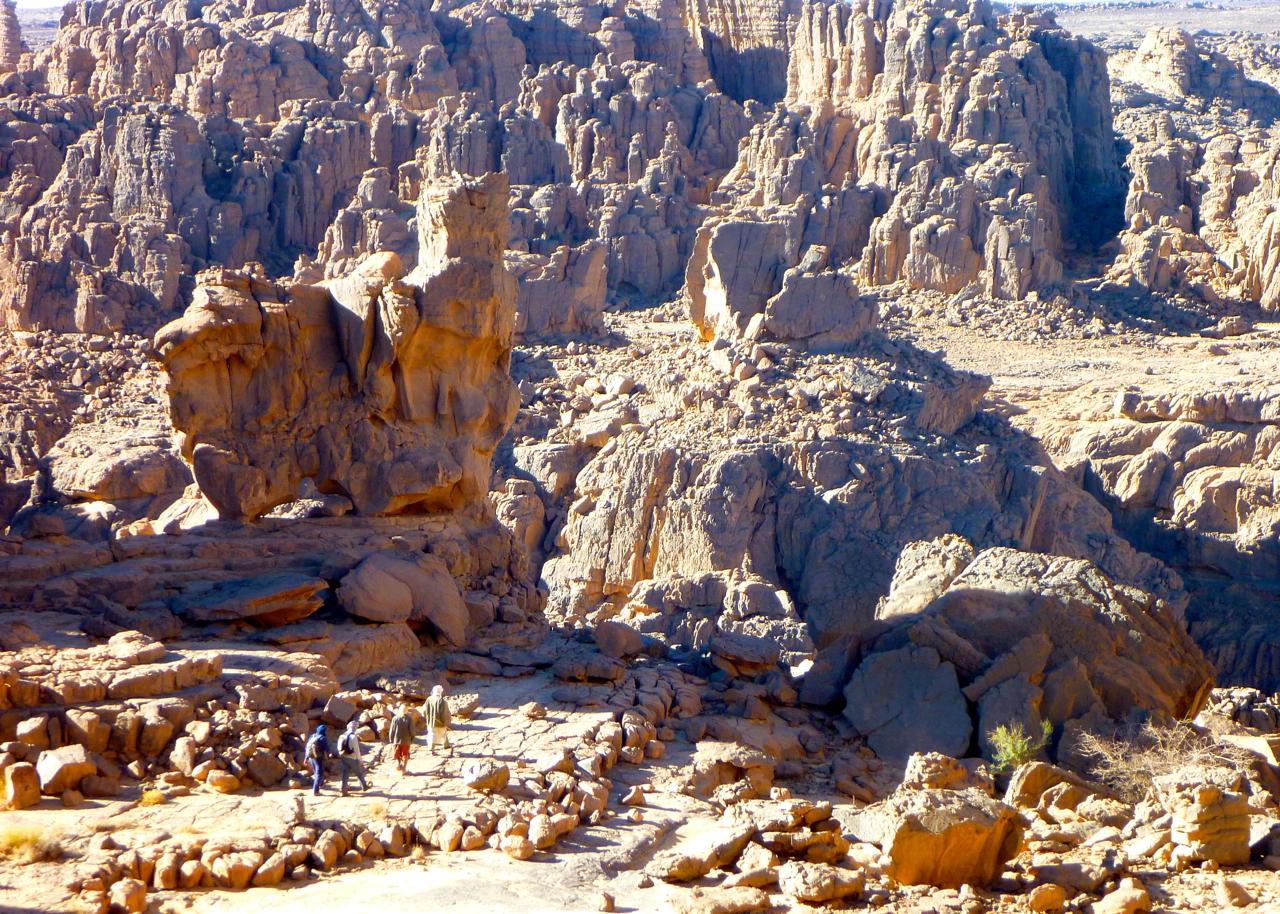
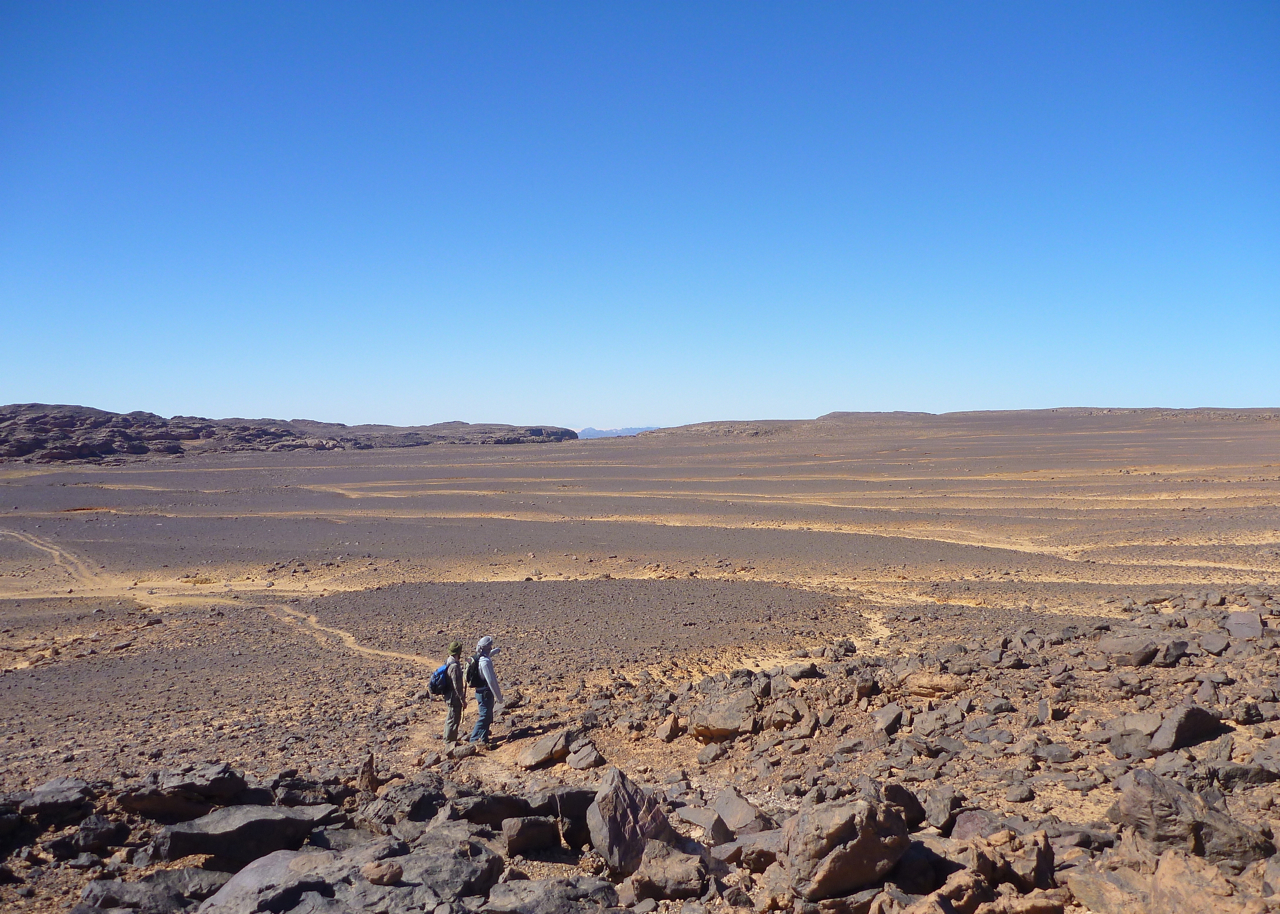
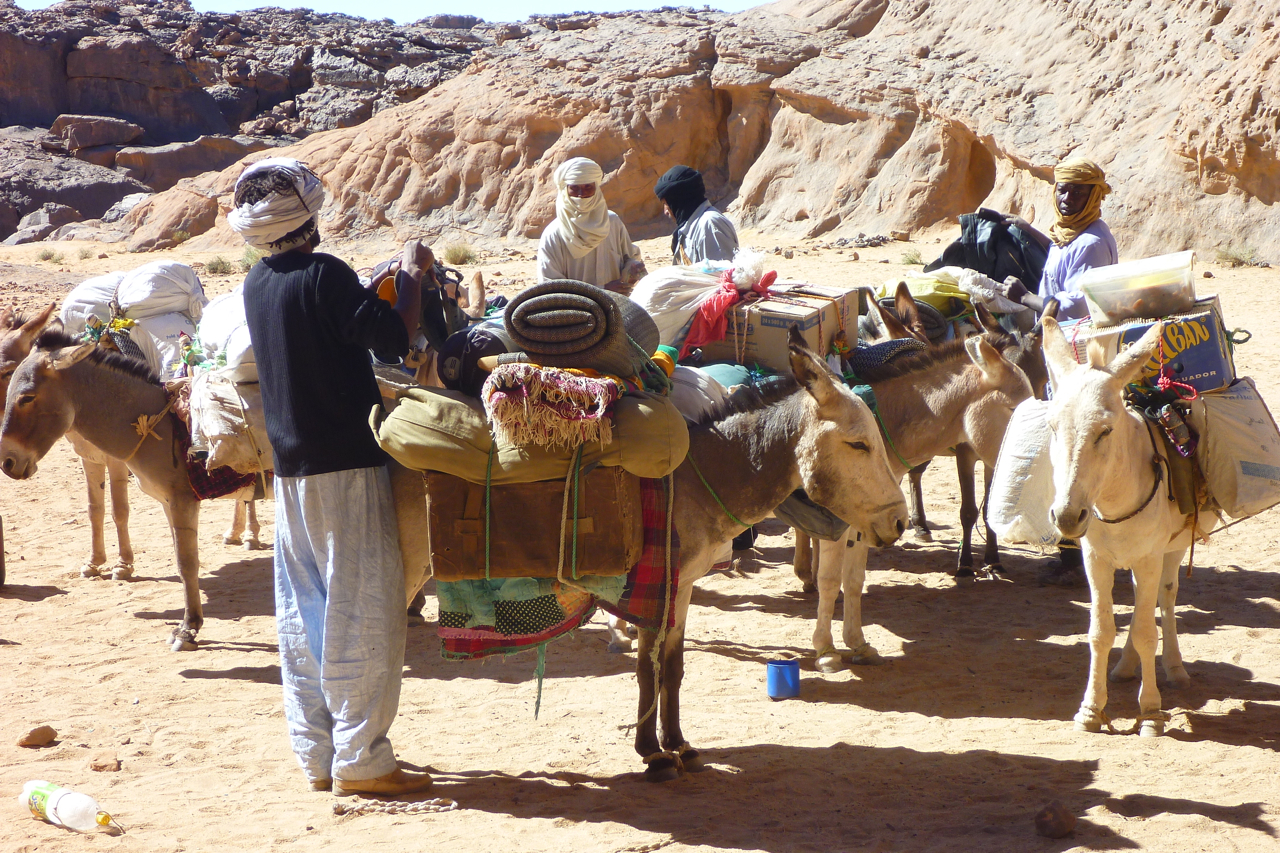
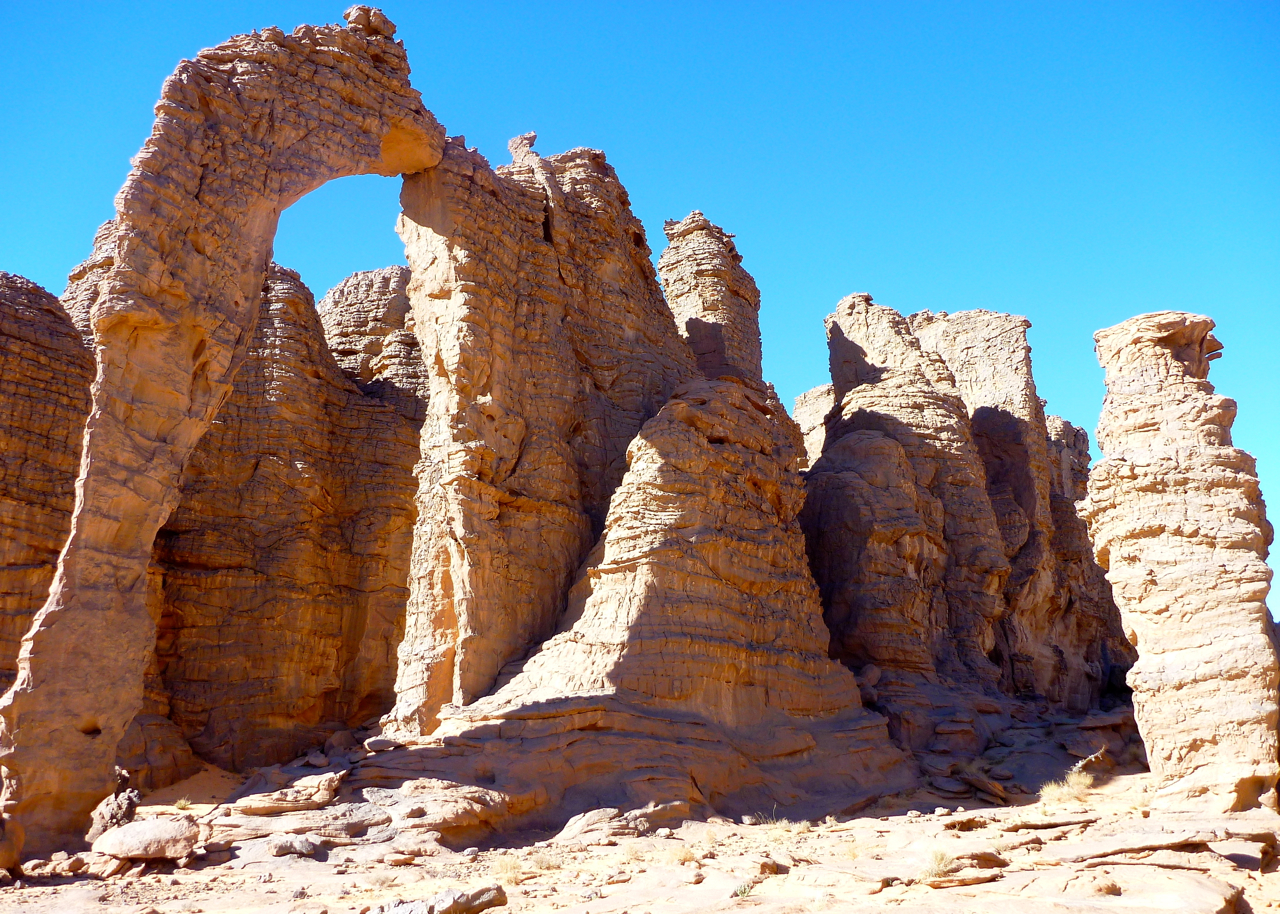
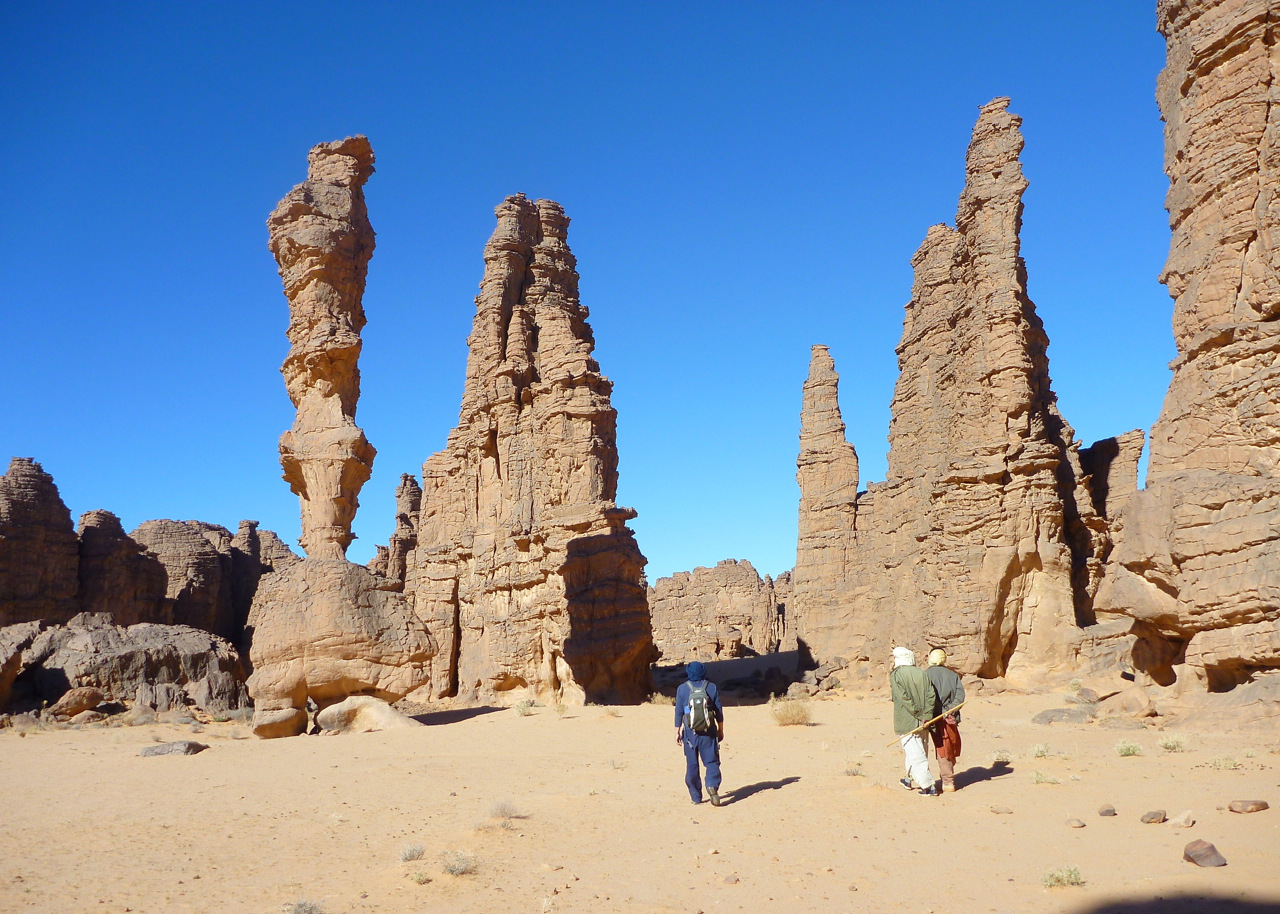
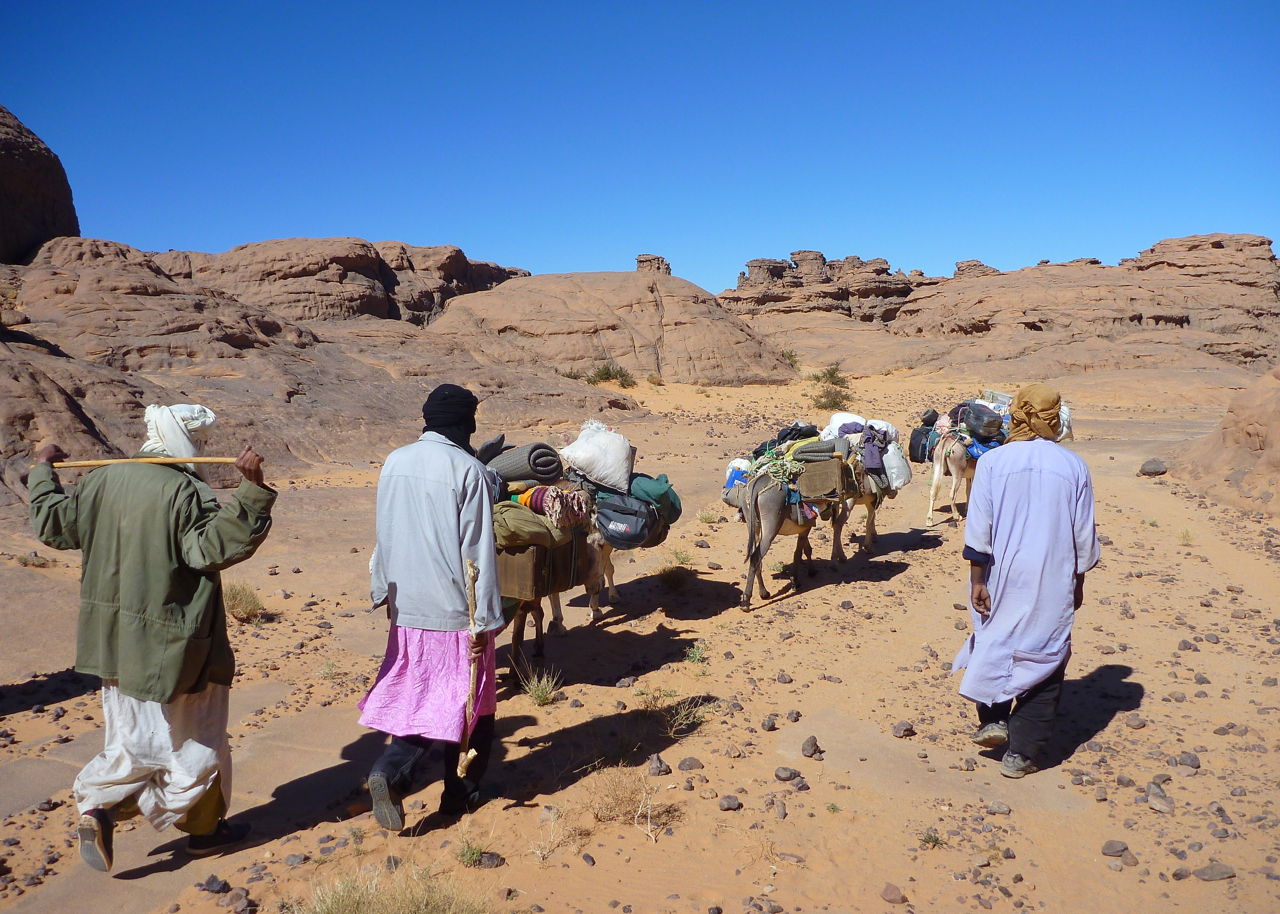
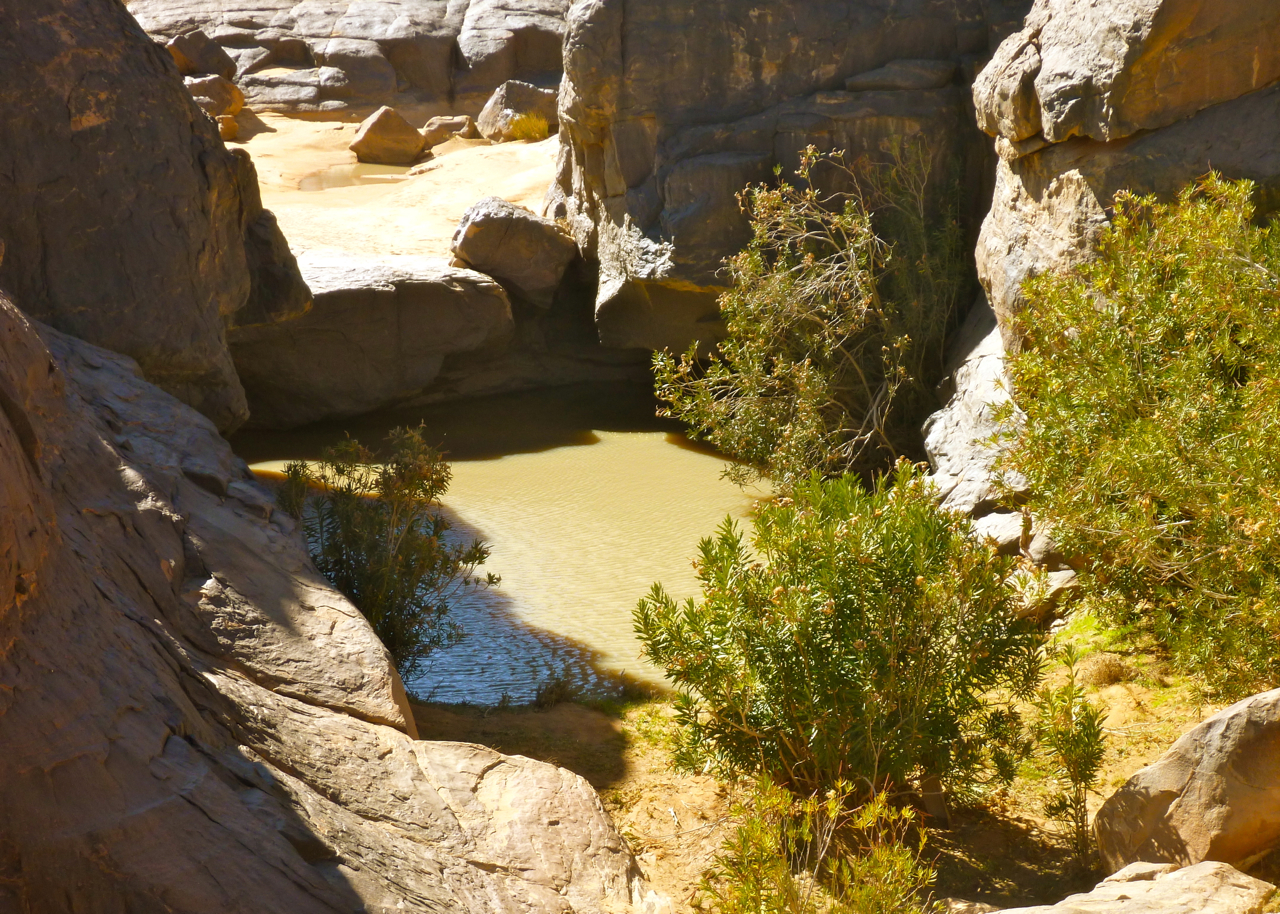
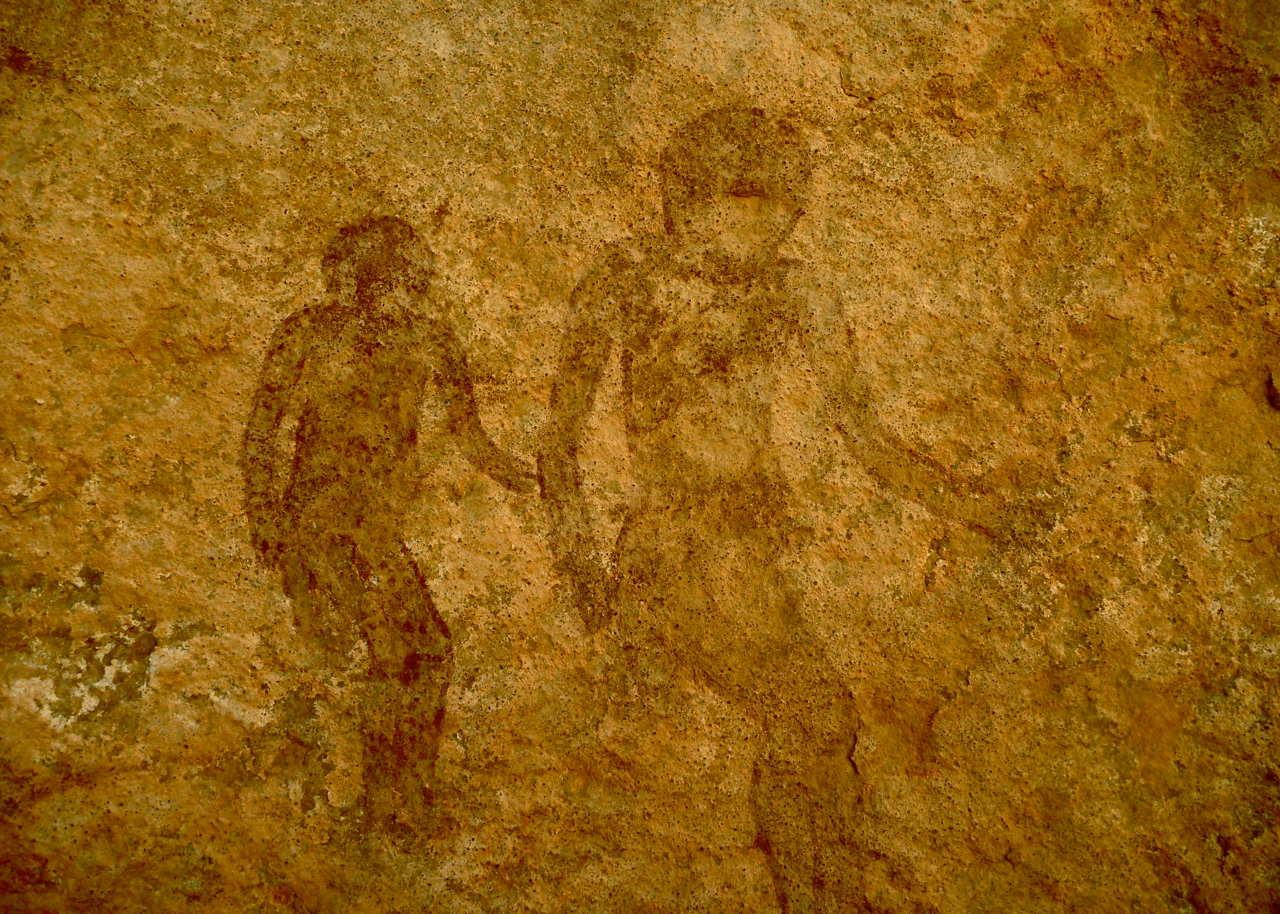
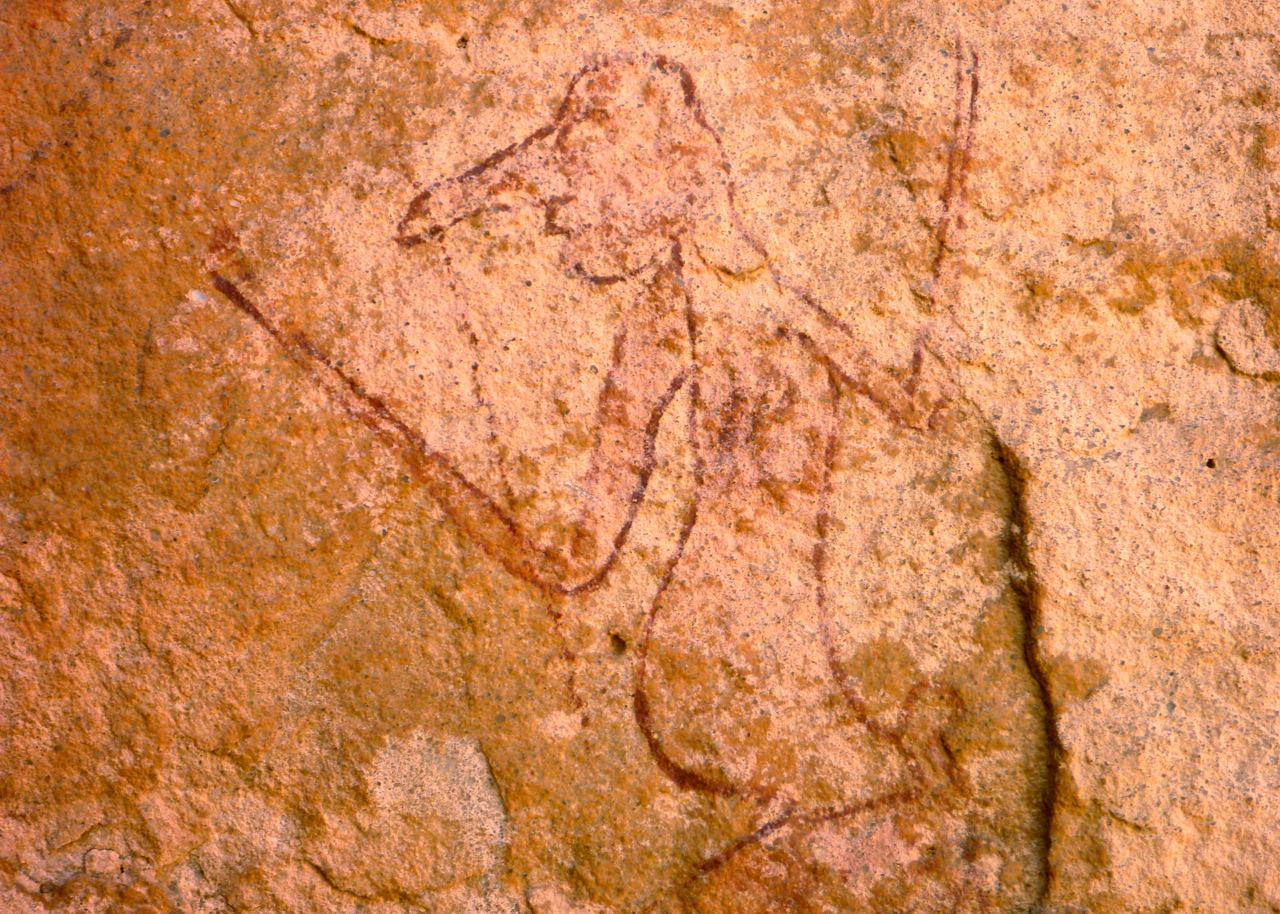
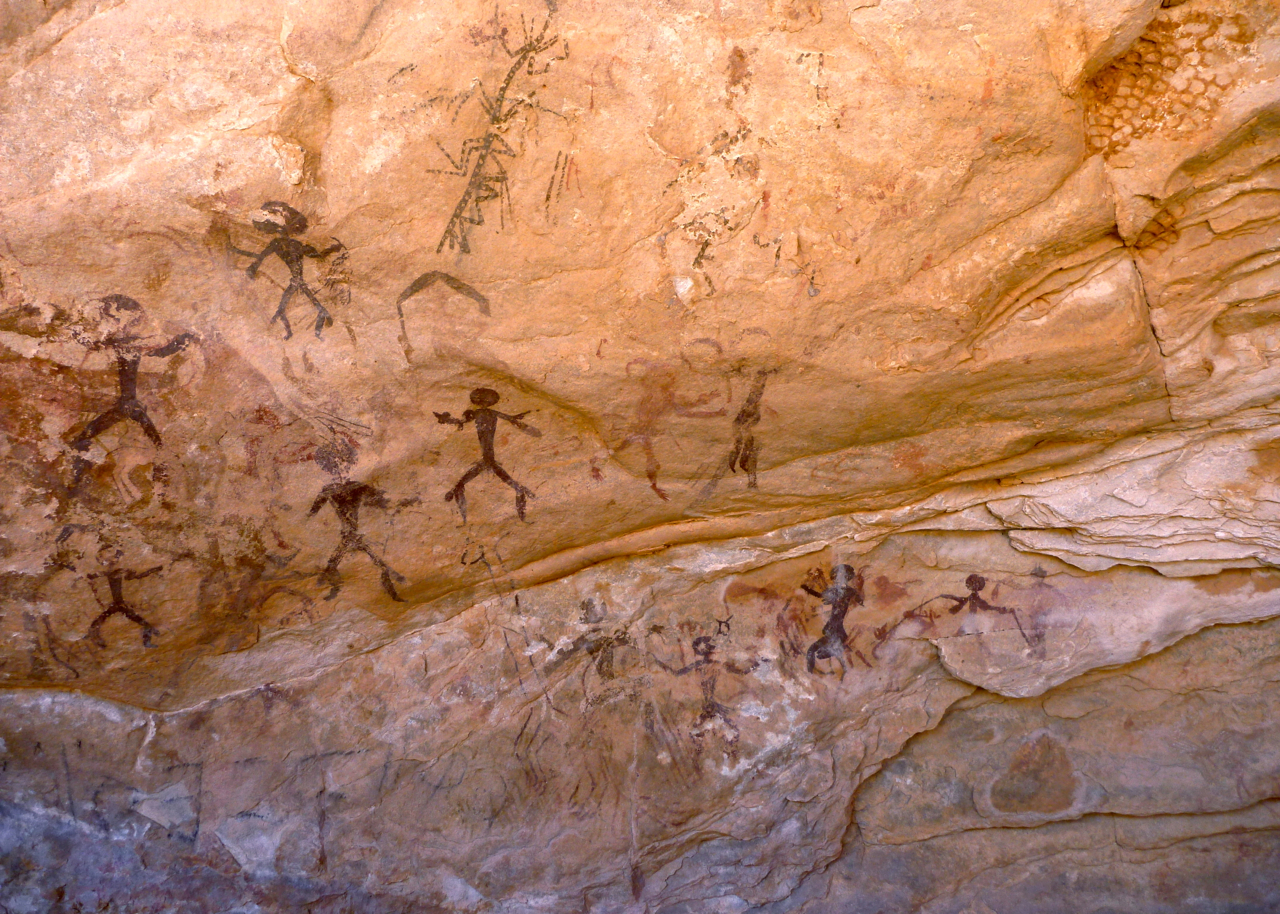
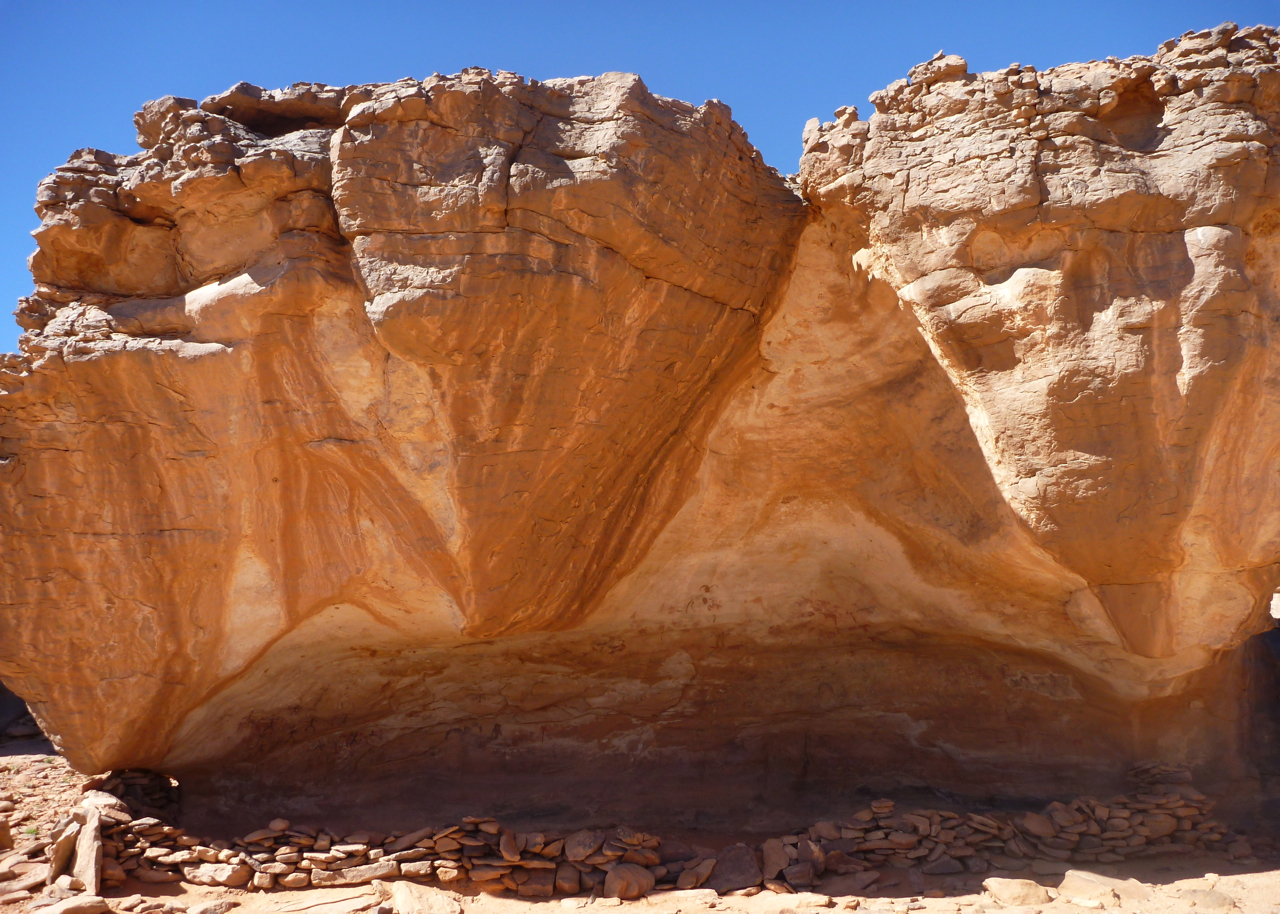
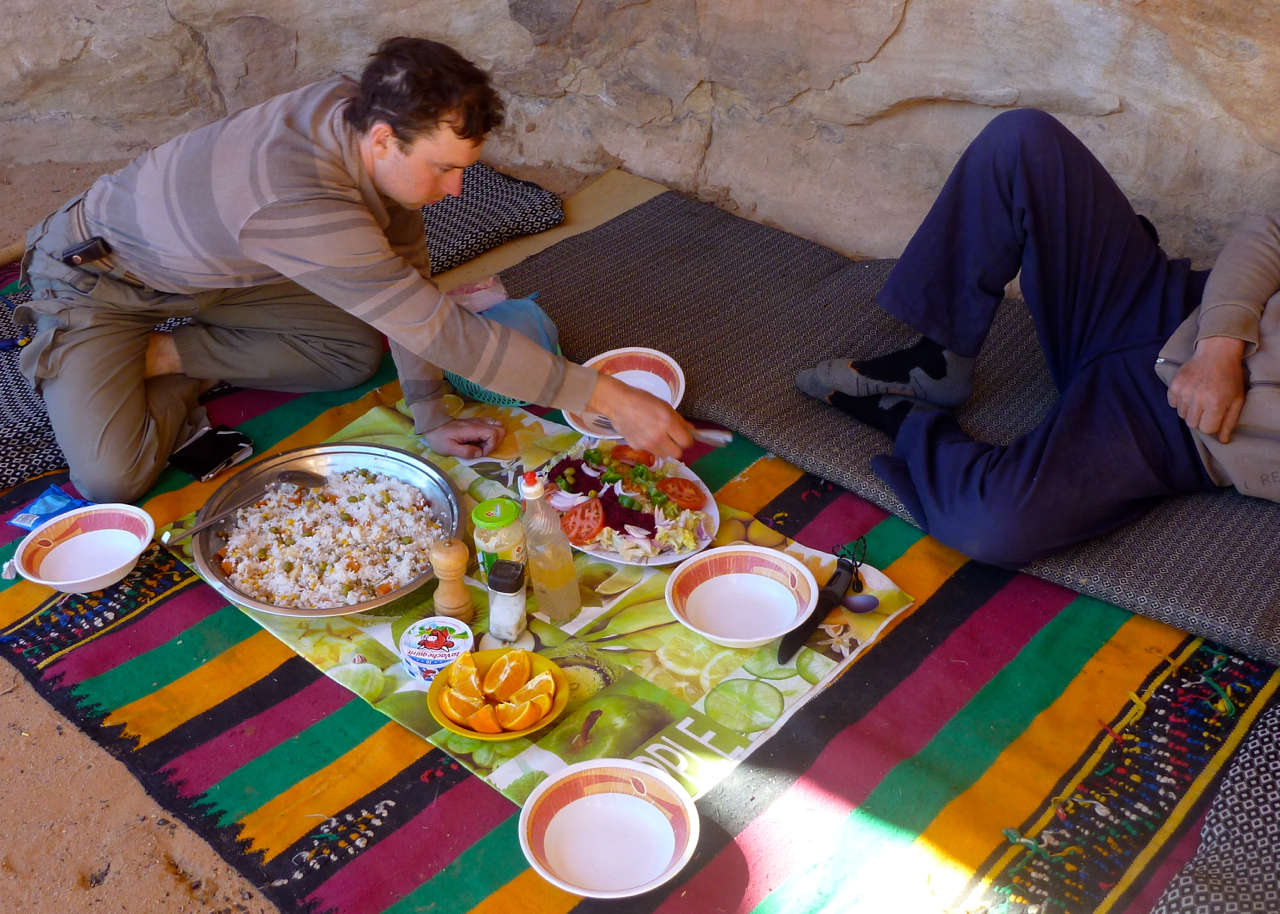
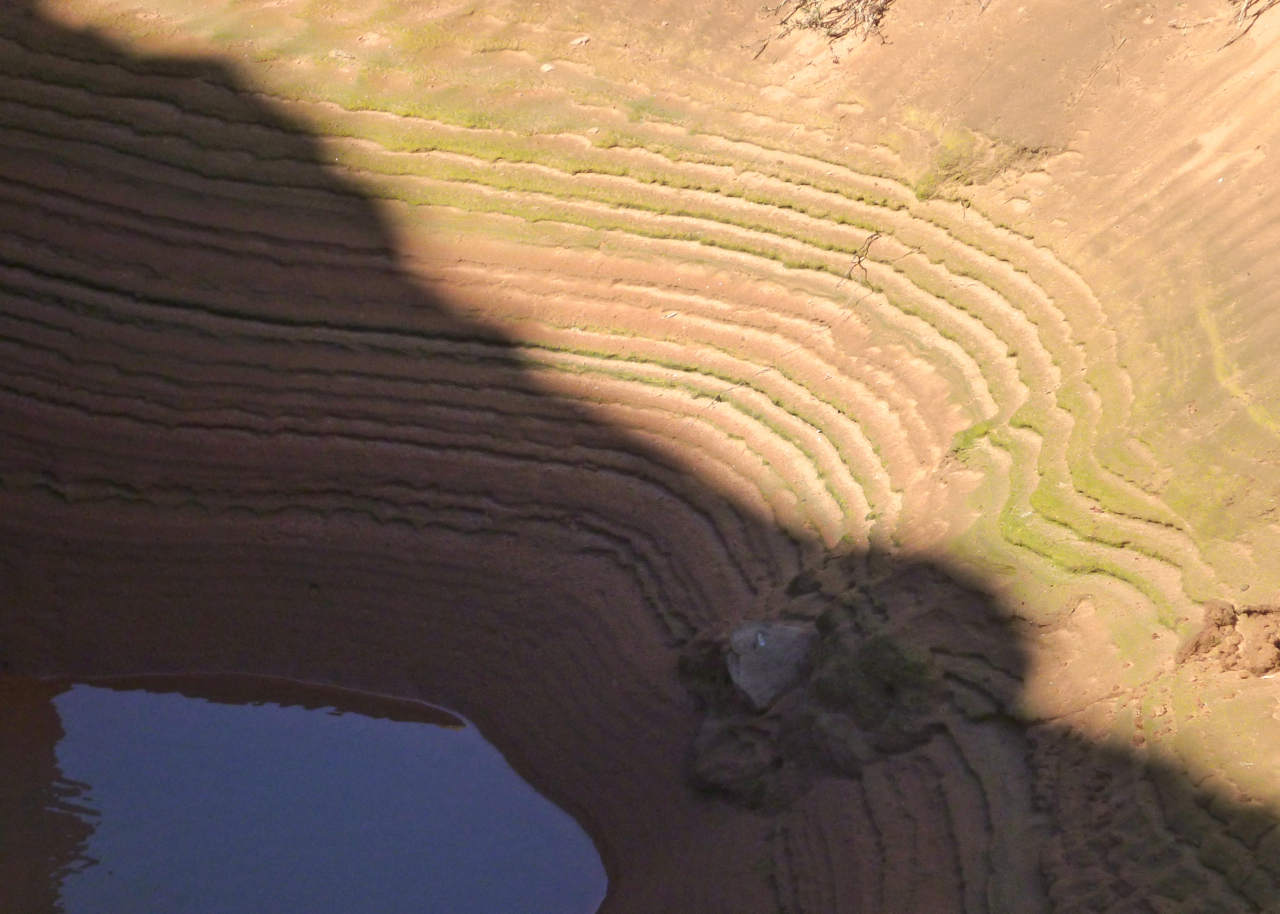
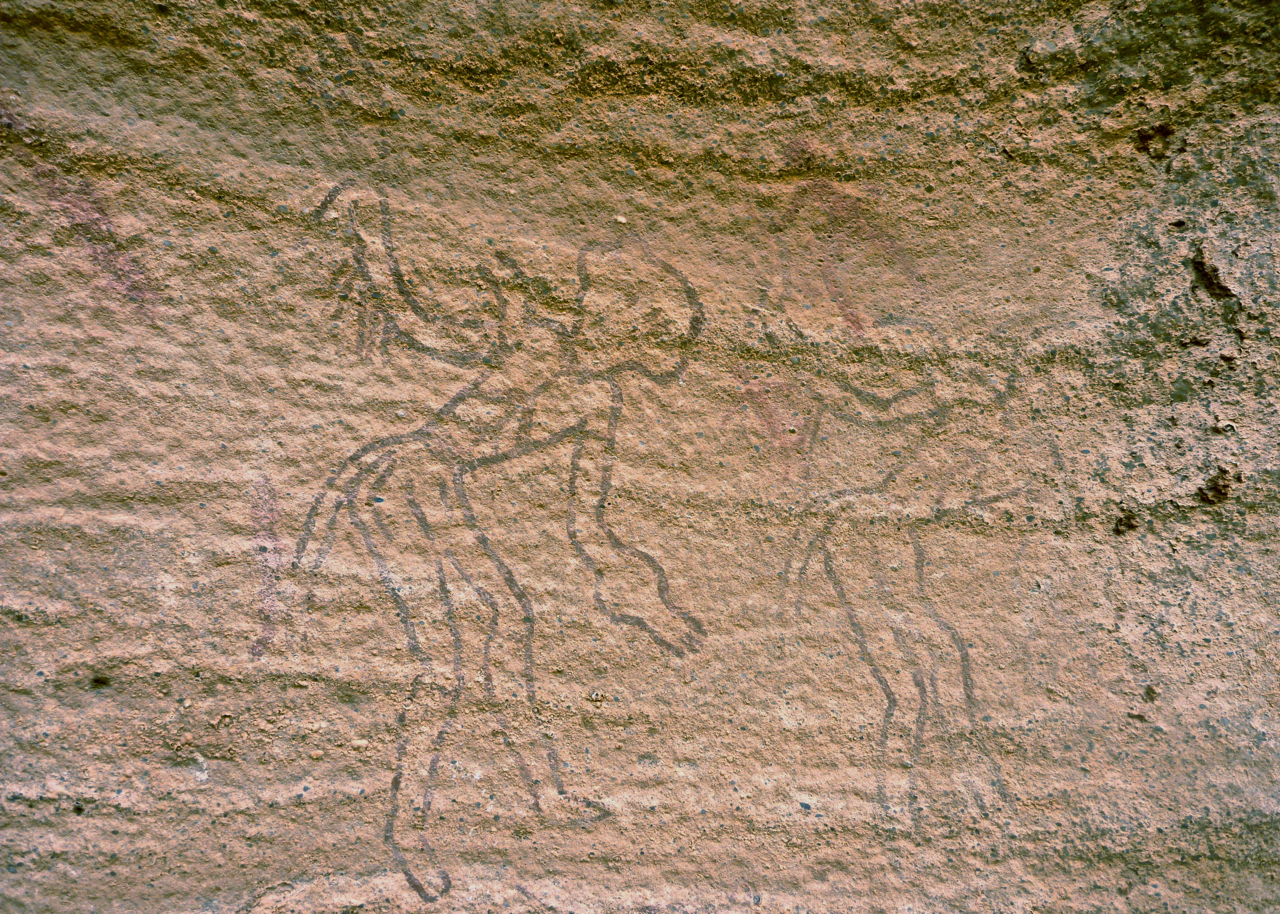
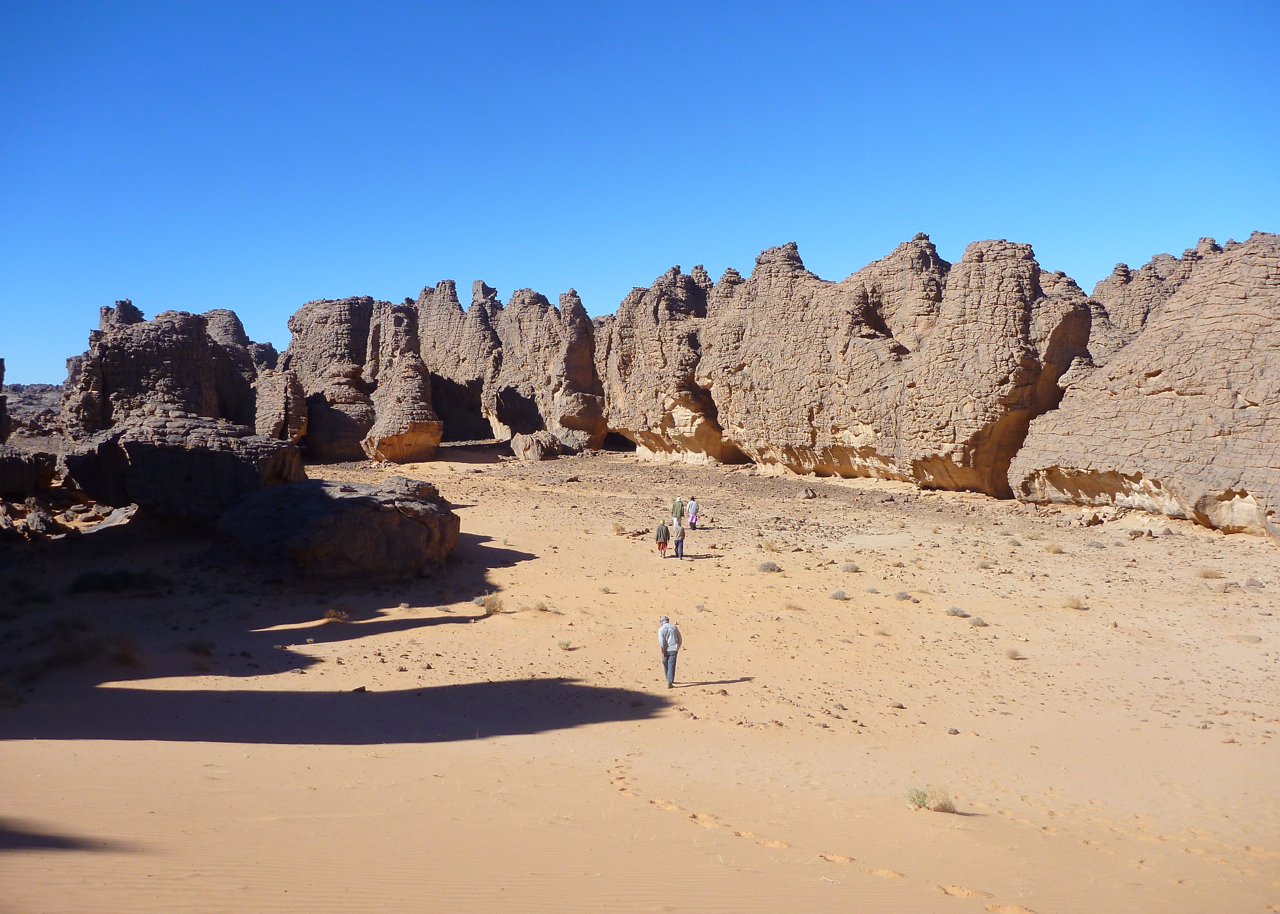
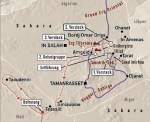
Gallery from our one-week, 60-km donkey trek on the Tassili plateau in late 2013, following our camel walk to Essendilene. We took the classic route, up the Akba Essaliwen near Djanet onto the escarpment for Tamrit, then over to amazing Sefar and down and out via Jabbaren. See map below. Loaded camels can’t manage the climb we took to the plateau (left), far less the descent at Jabbaren. So pack donkeys take a longer, less steep path ascent and, with much coaxing, down the Jabbaren trail with us.
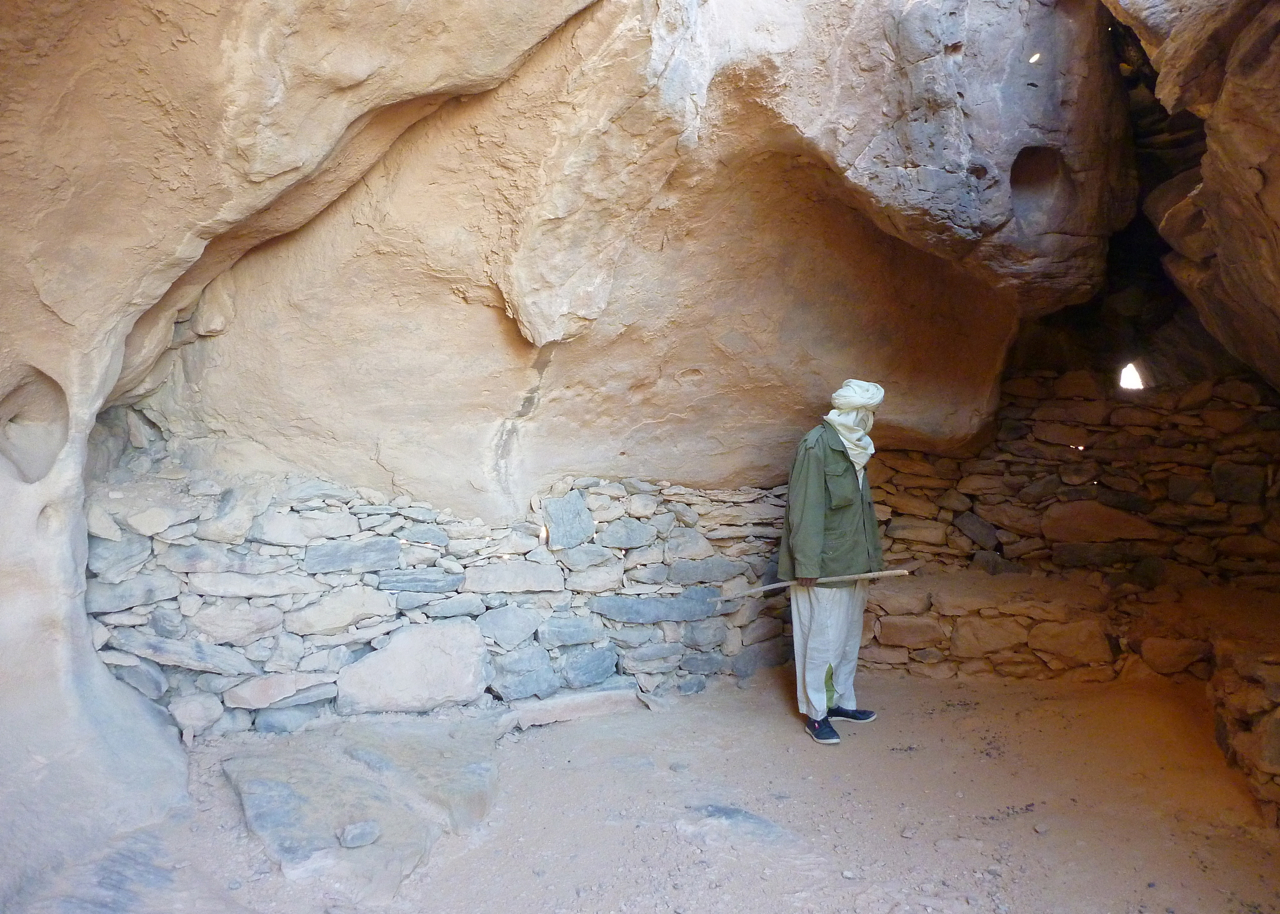
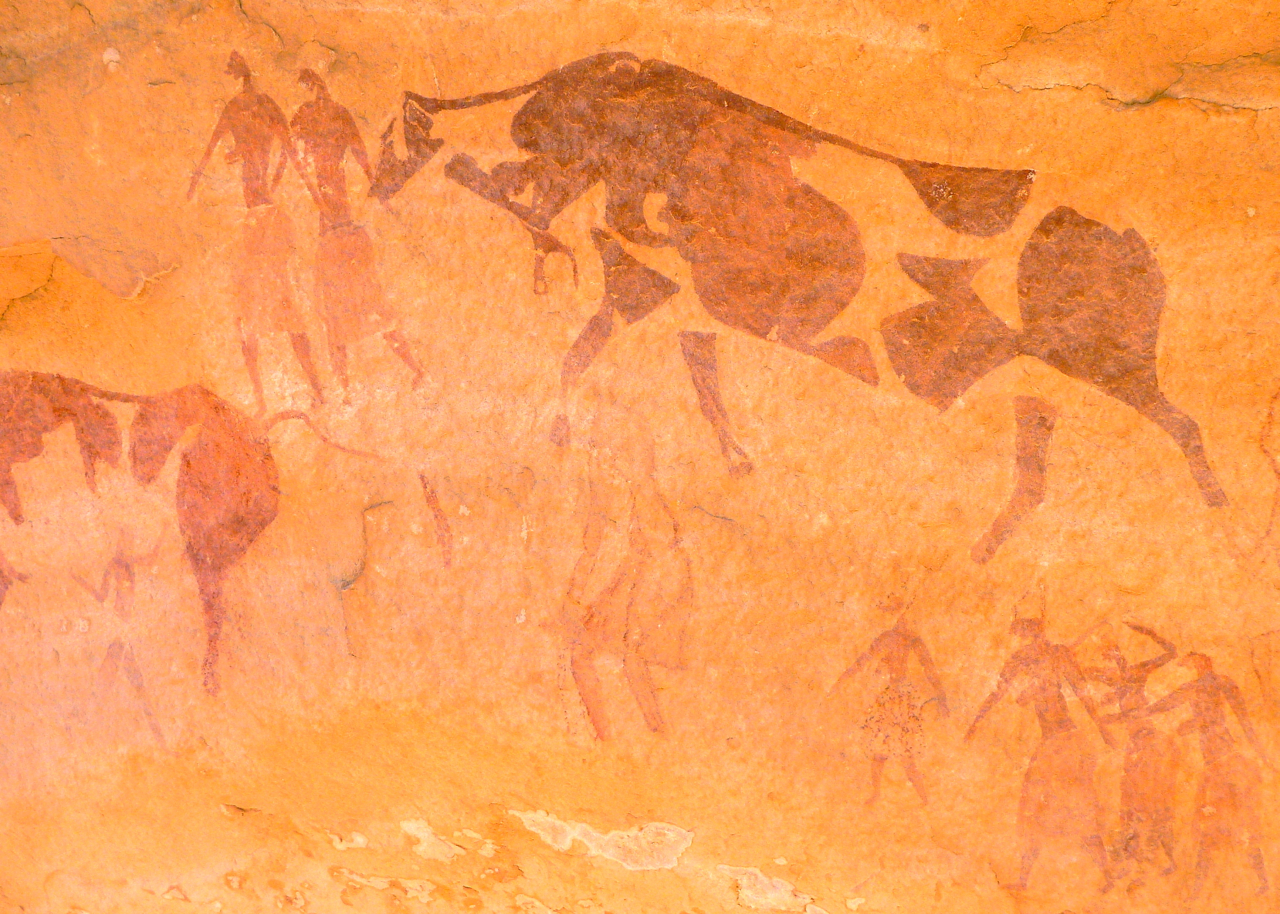
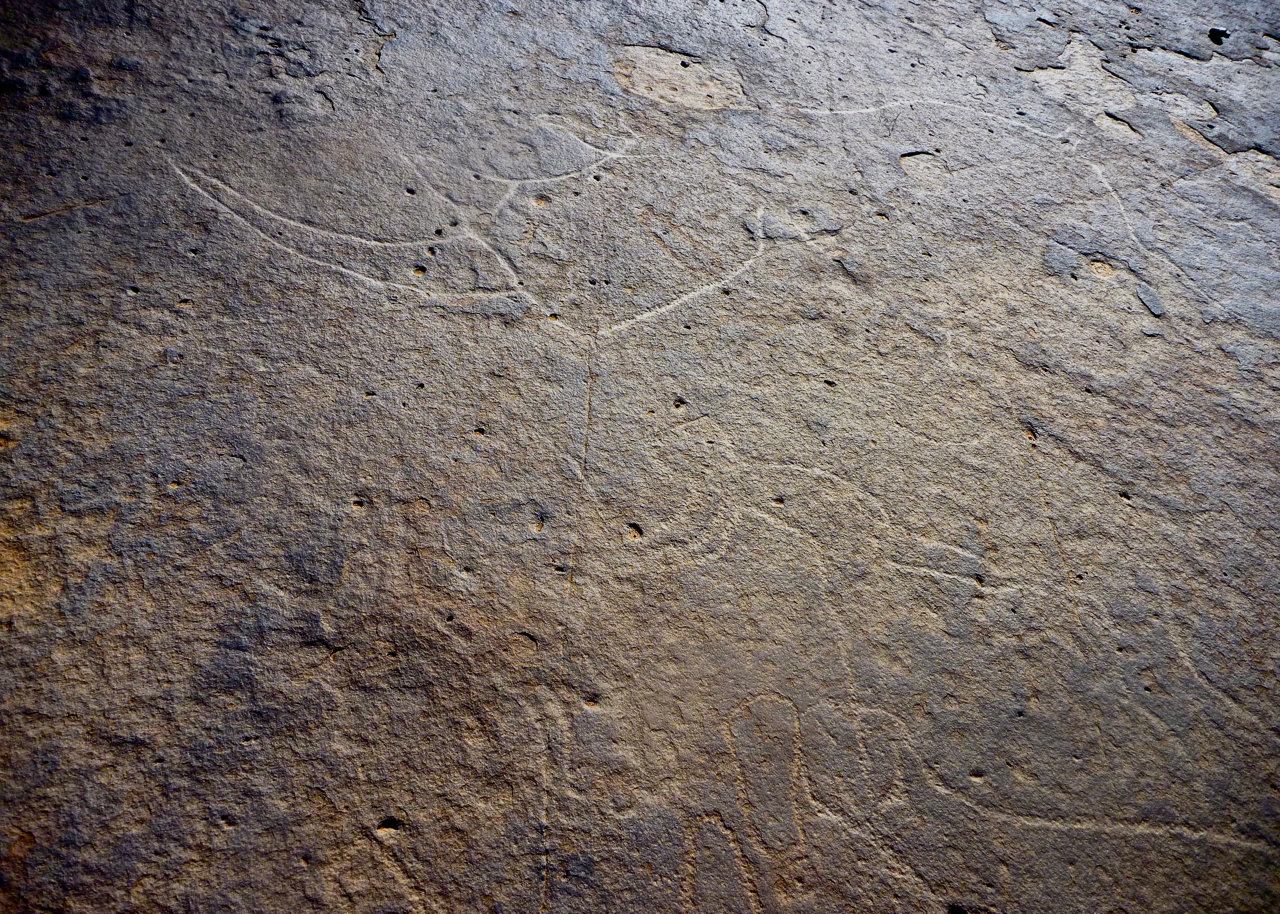
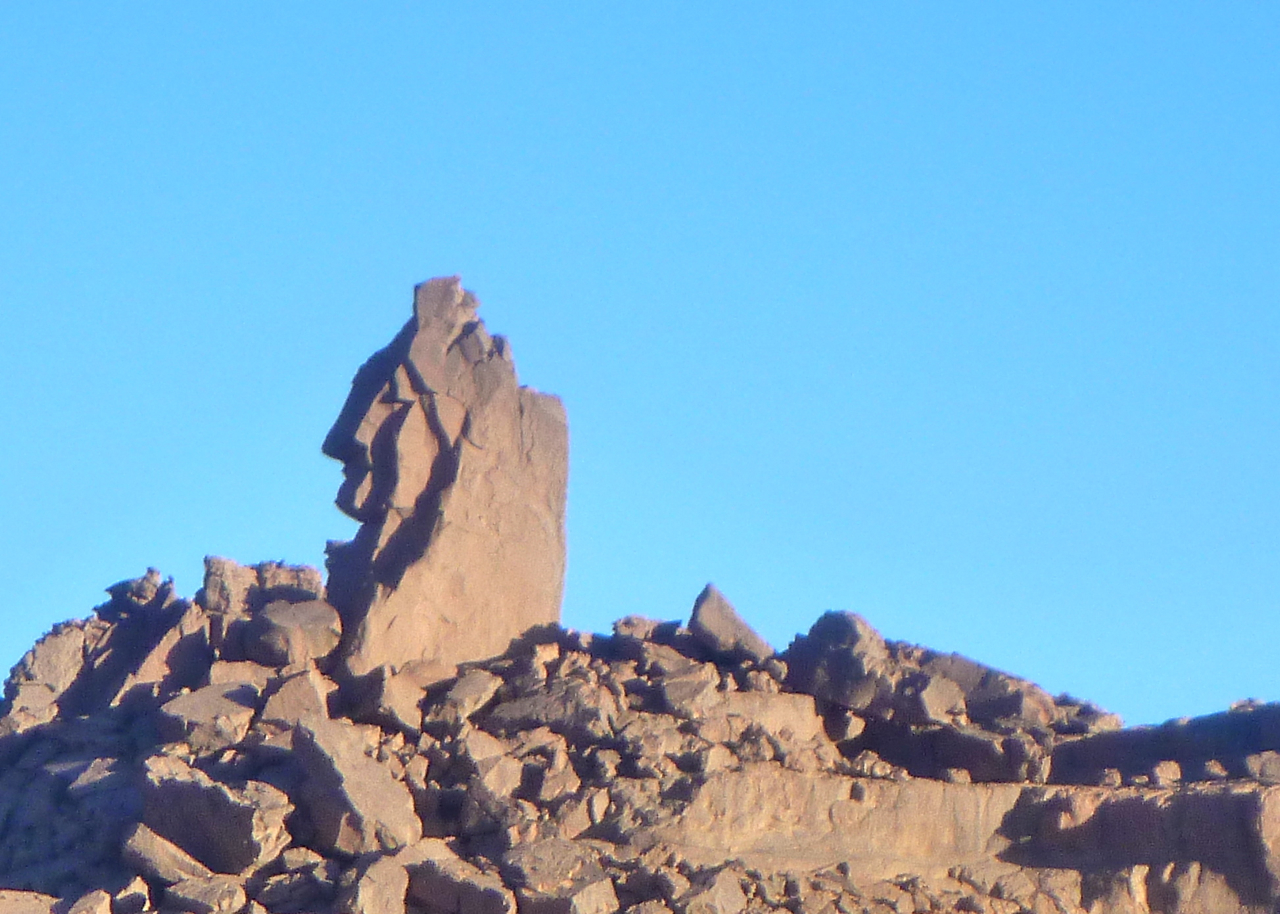
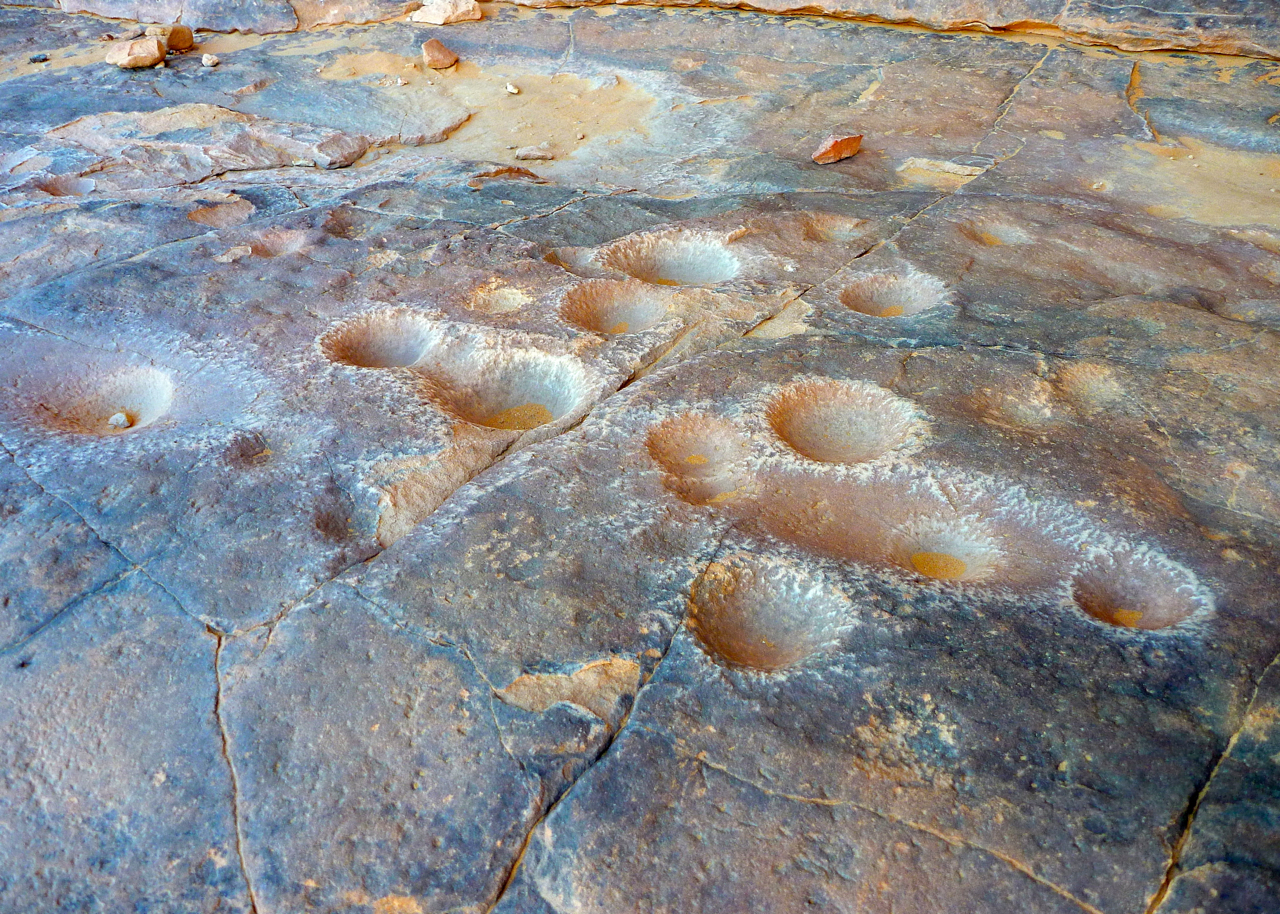
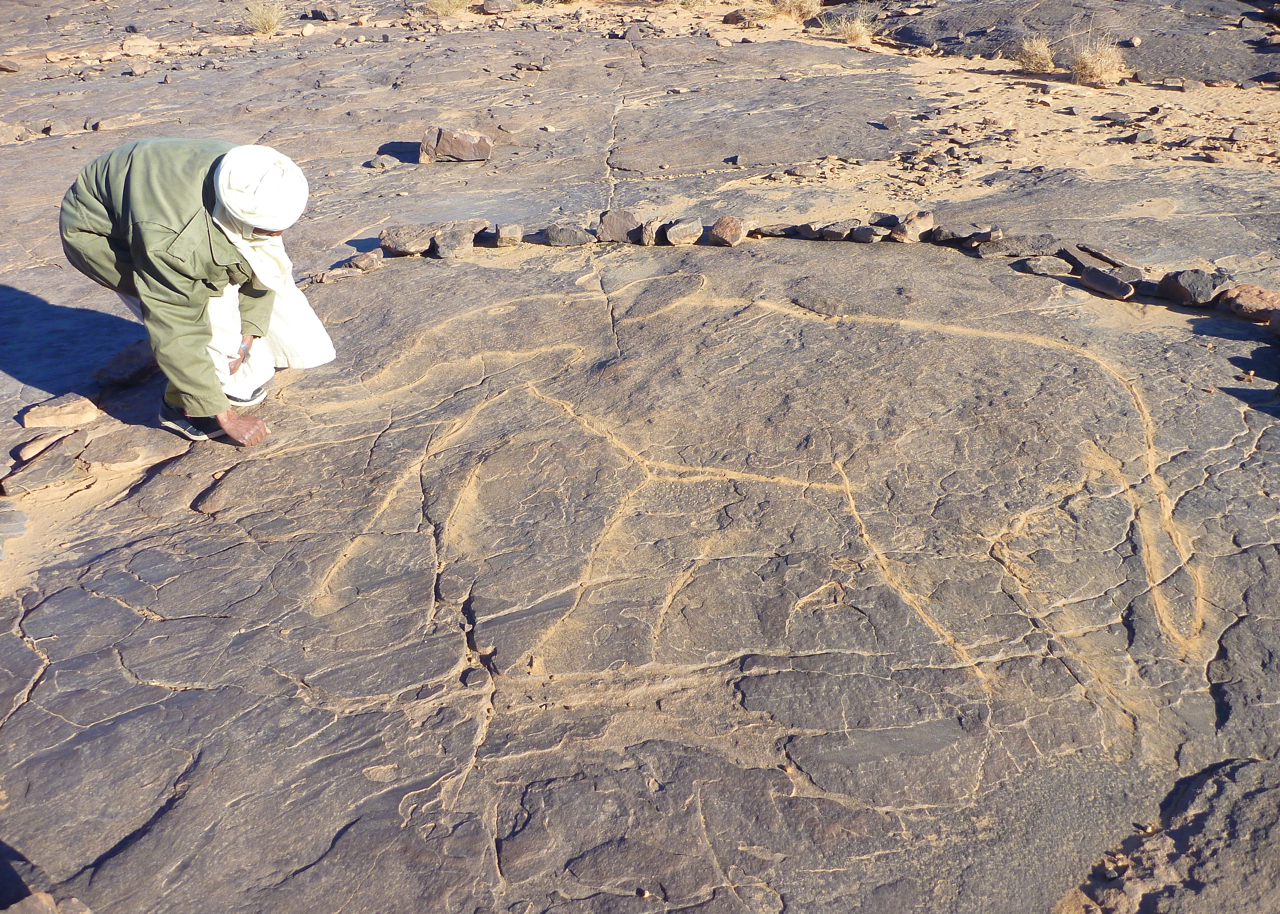
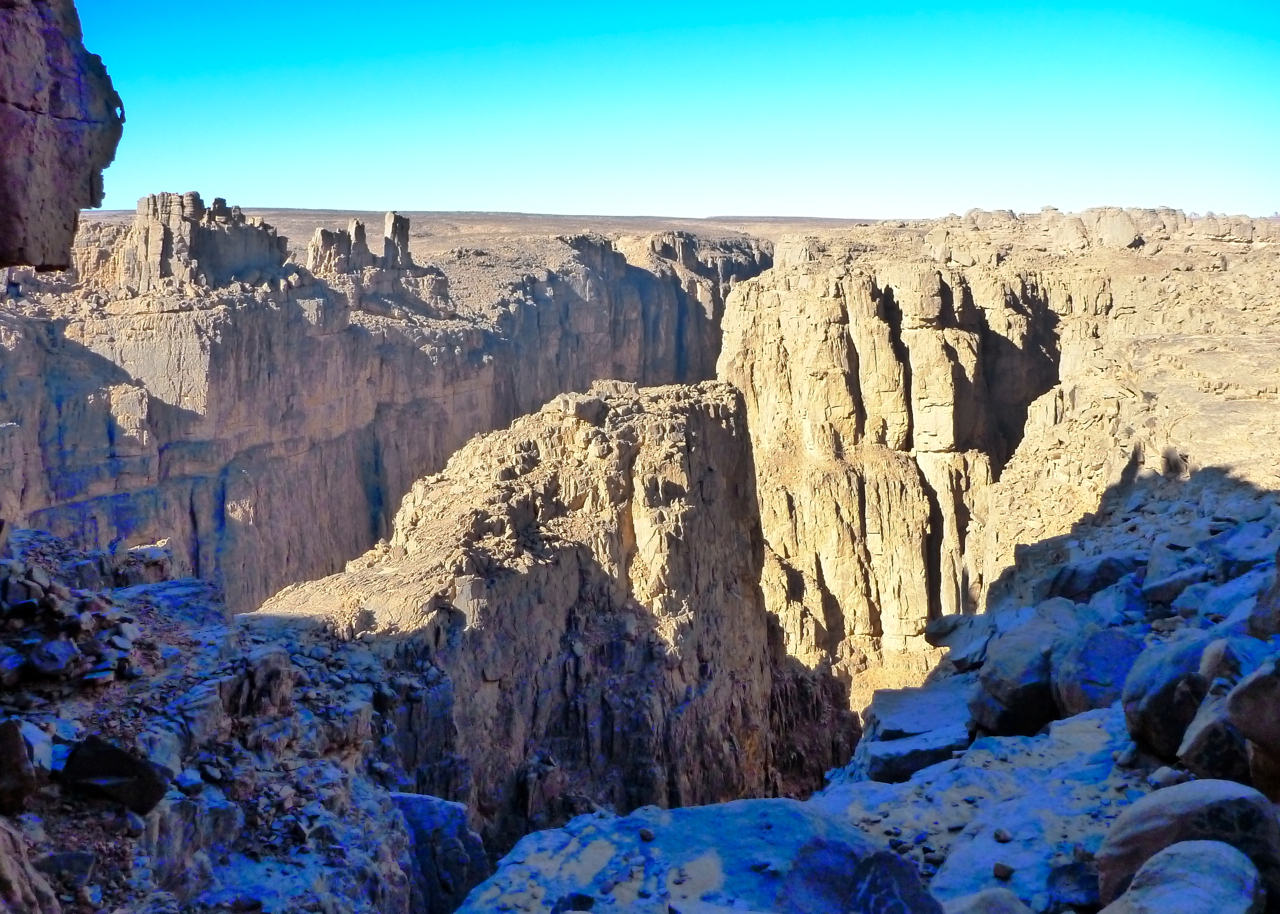
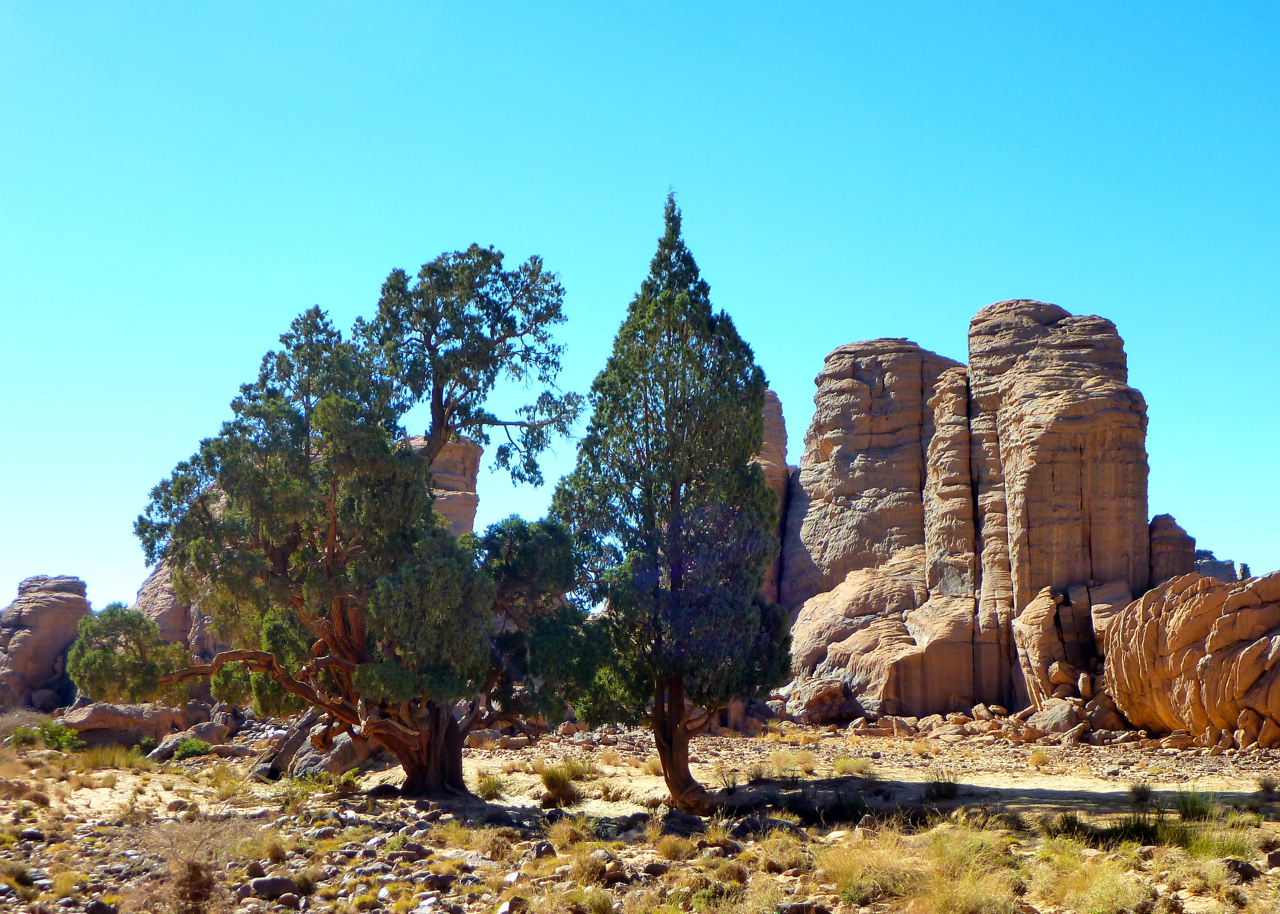
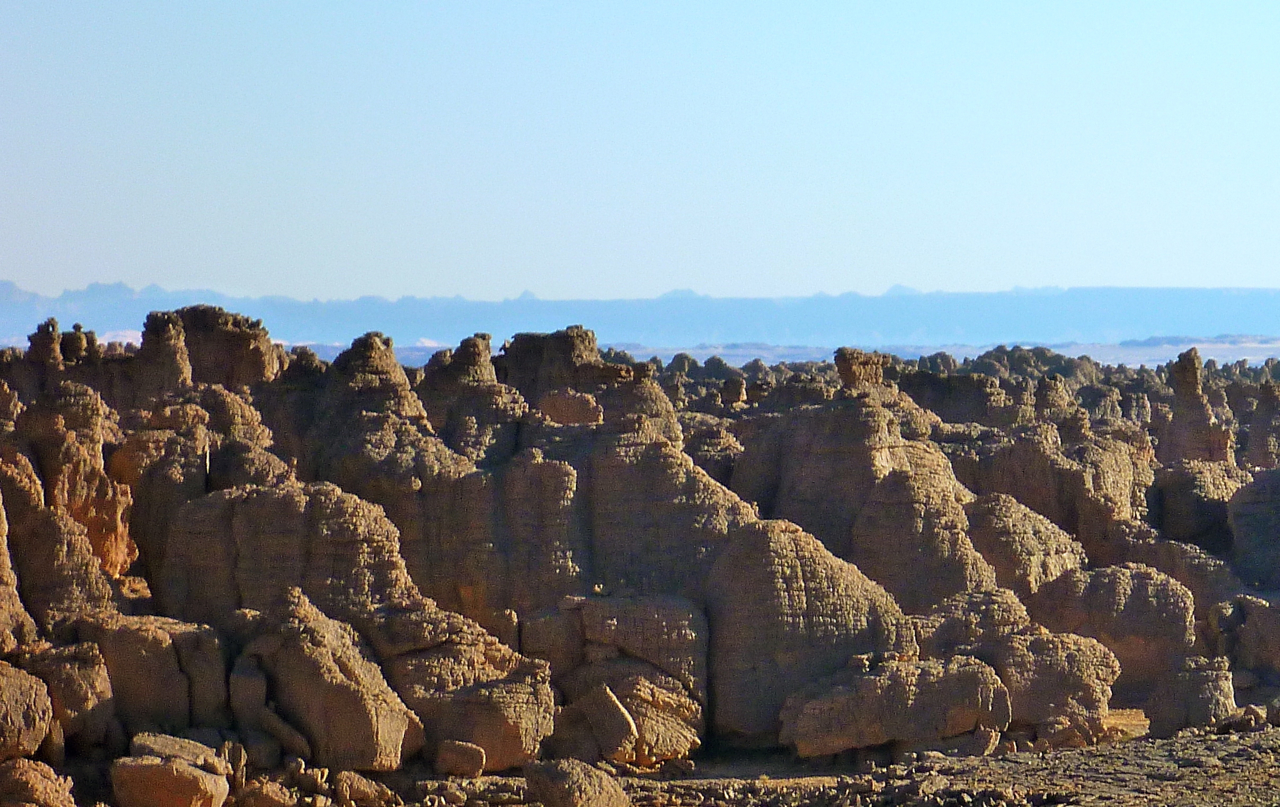
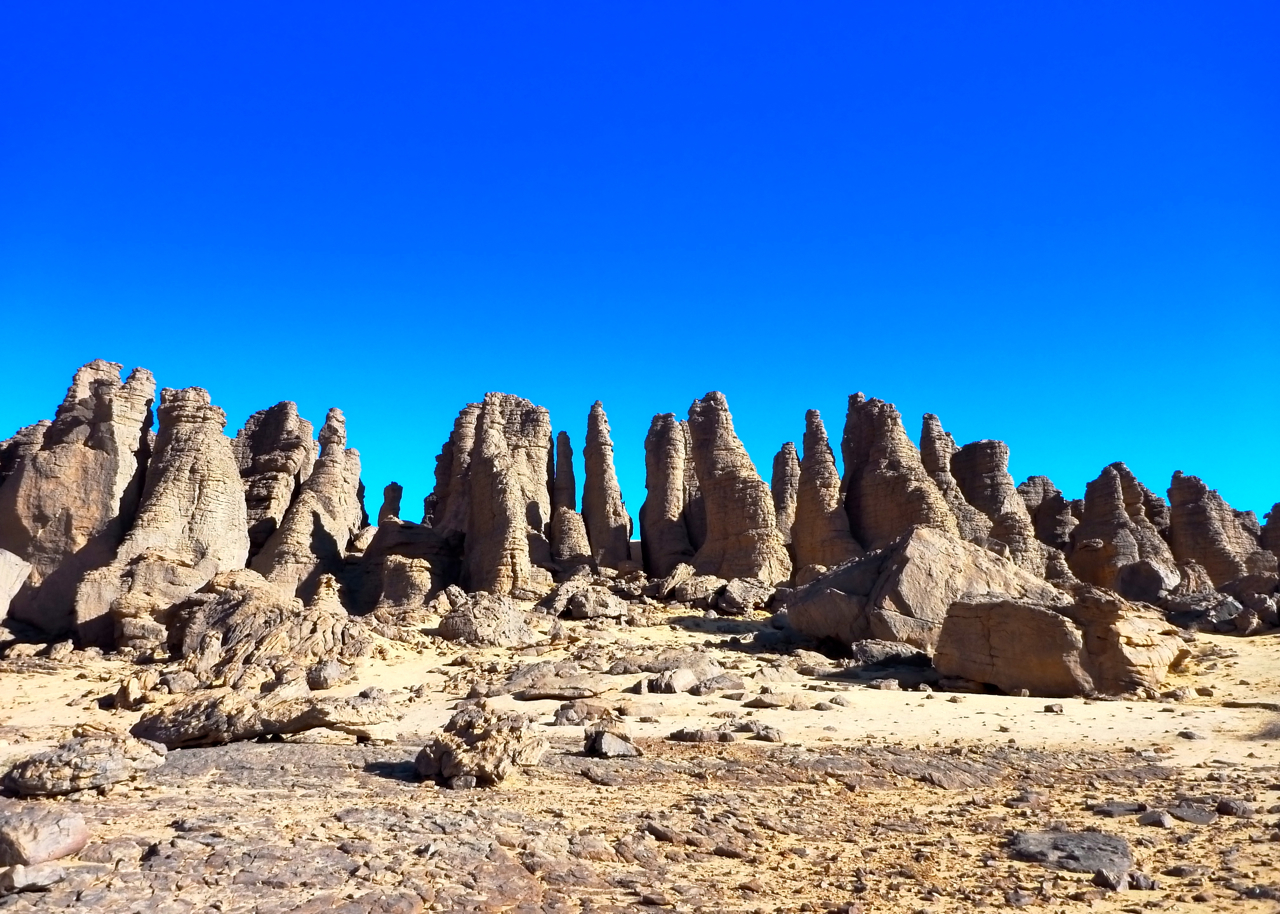
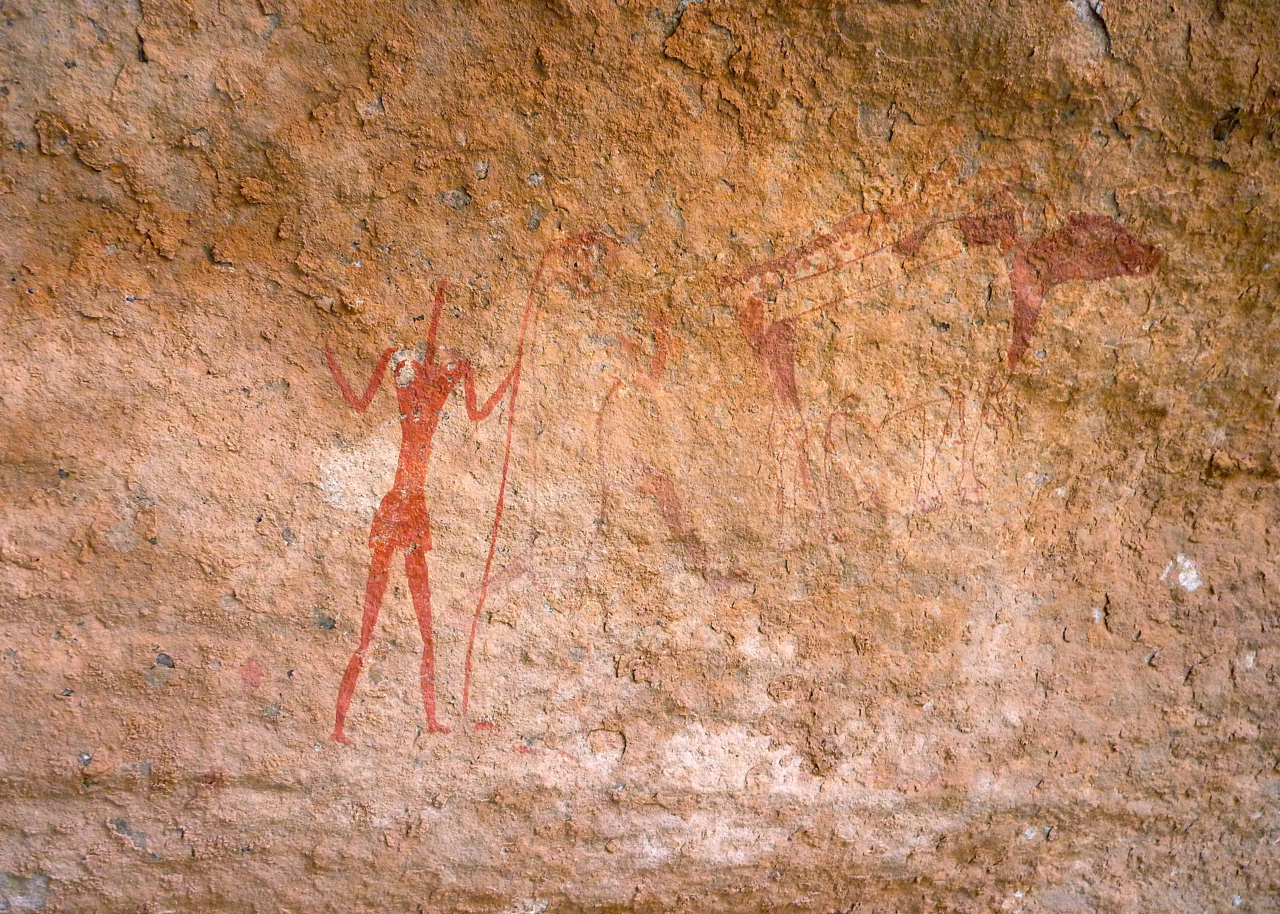
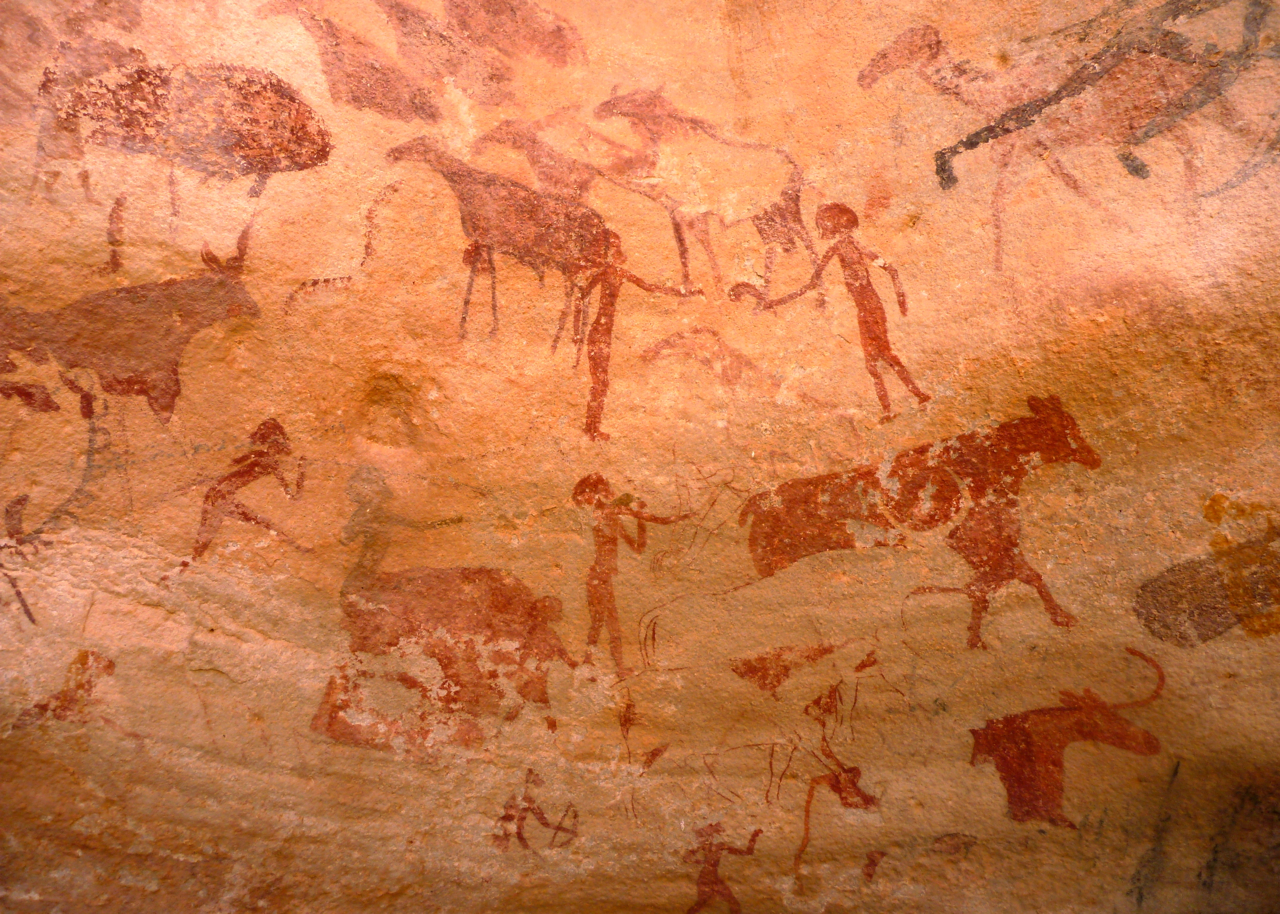
Once on top it’s a Lost World of gnared outcrops, rock art caves, weathered canyons and ancient trees where people thrived 10,000 years ago. And less than 10,000 years after my first visit to Djanet, I was thrilled to finally to tick off the famous Tassili plateau trek. Like Assekrem, it’s the another Must See in the Algerian Sahara, but I hear these days is getting like the Lake District. Not got a week for the full lap? Do a one-day up to Jabbaren and back.
Tamrit, Sefar, Jabbaren trek
As we were approaching Jabbaren before the steep descent back to the plain at the end of our trek, I heard later that my Spot tracking dropped out for those following it back home. At this time Tigantourine oil base near In Amenas was getting attacked by the Algerian army following a raid by an AQIM group led by the notorious Mokhtar Belmokhtar out of Libya. Even though 400km to the south, I presumed the Algerians temporarily blocked all satellite signals across the region. Checking in unshaven at Algiers airport a couple of days later, the bloke at the desk grinned and asked ‘you were there?’. Turns out it was nothing to smile about.
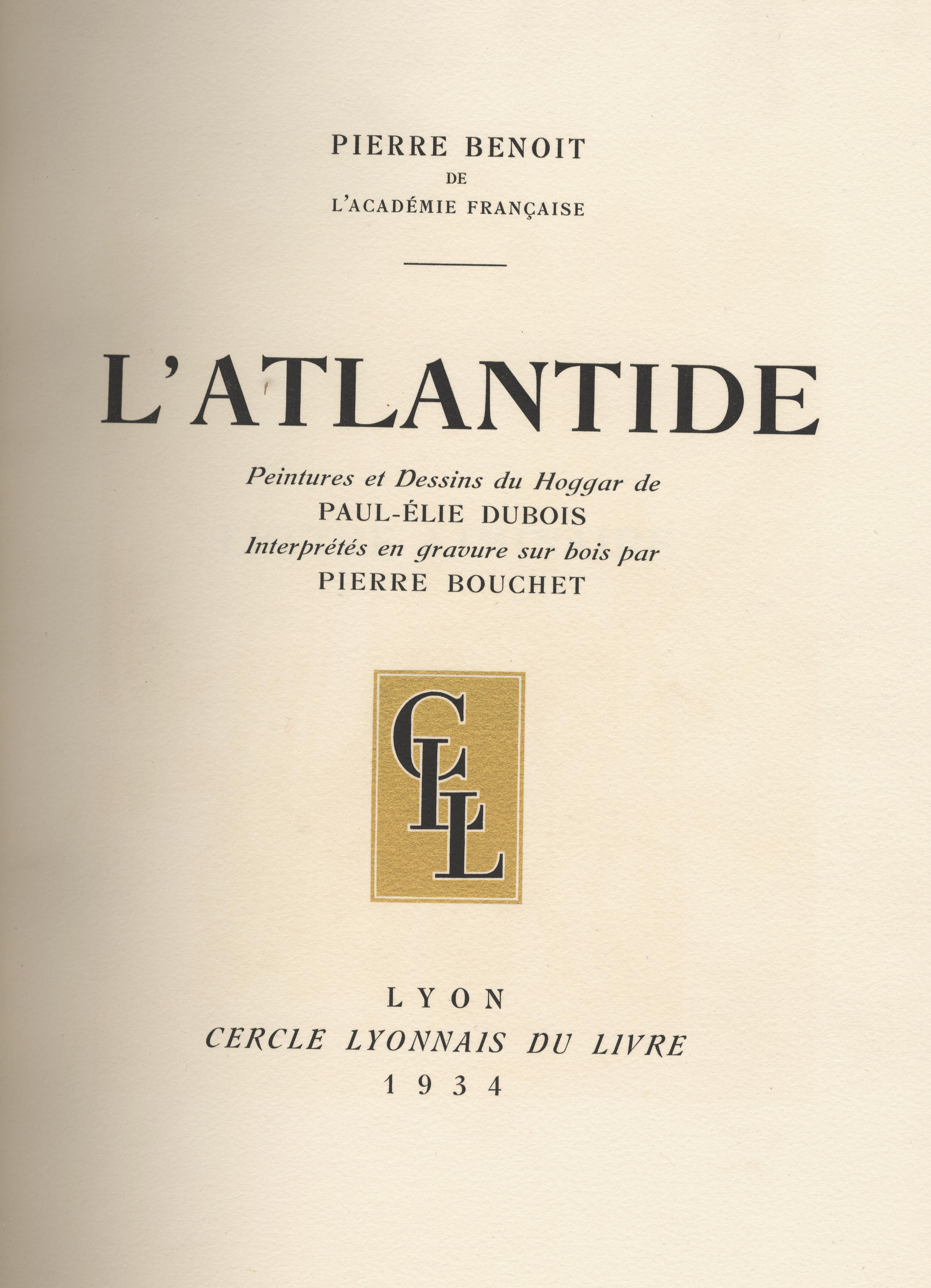
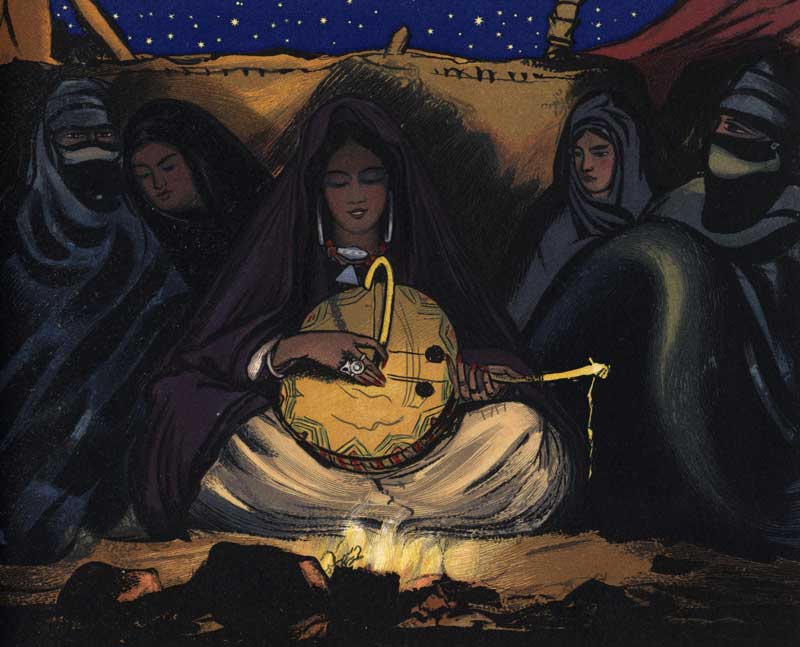
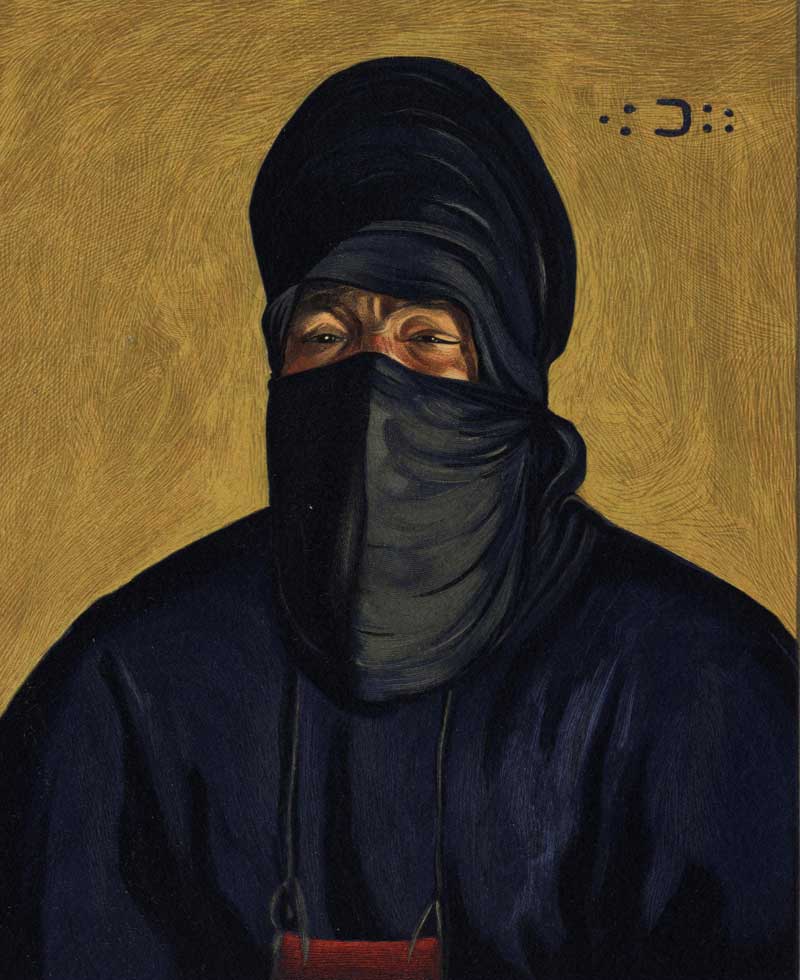
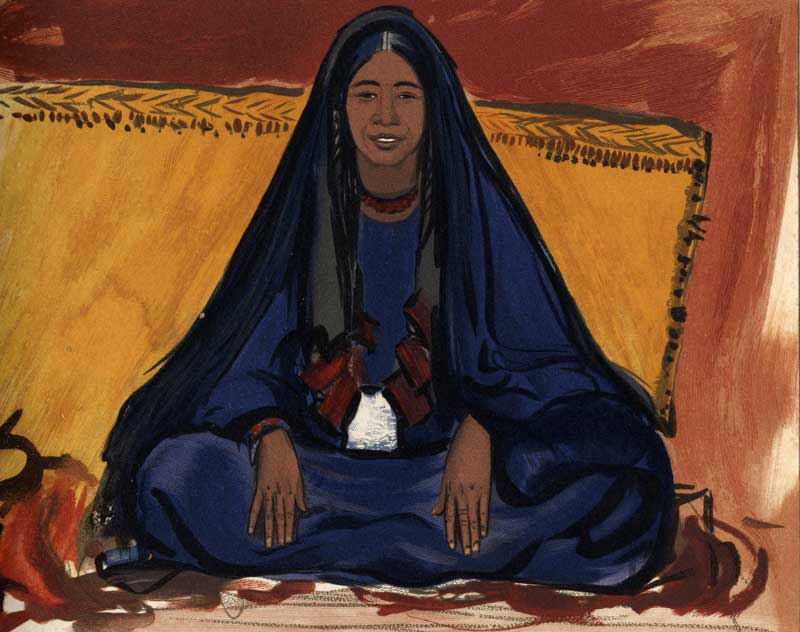
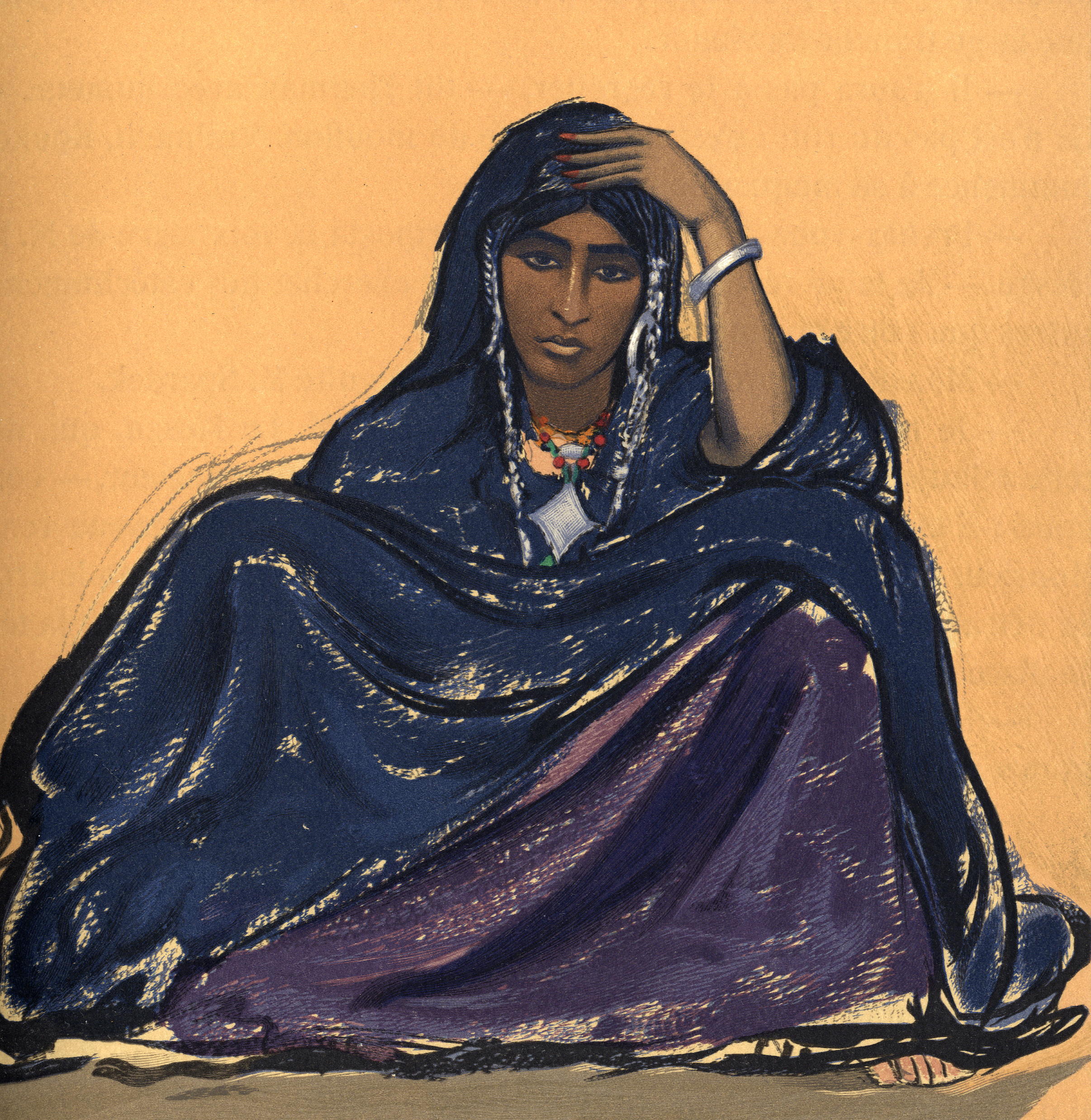
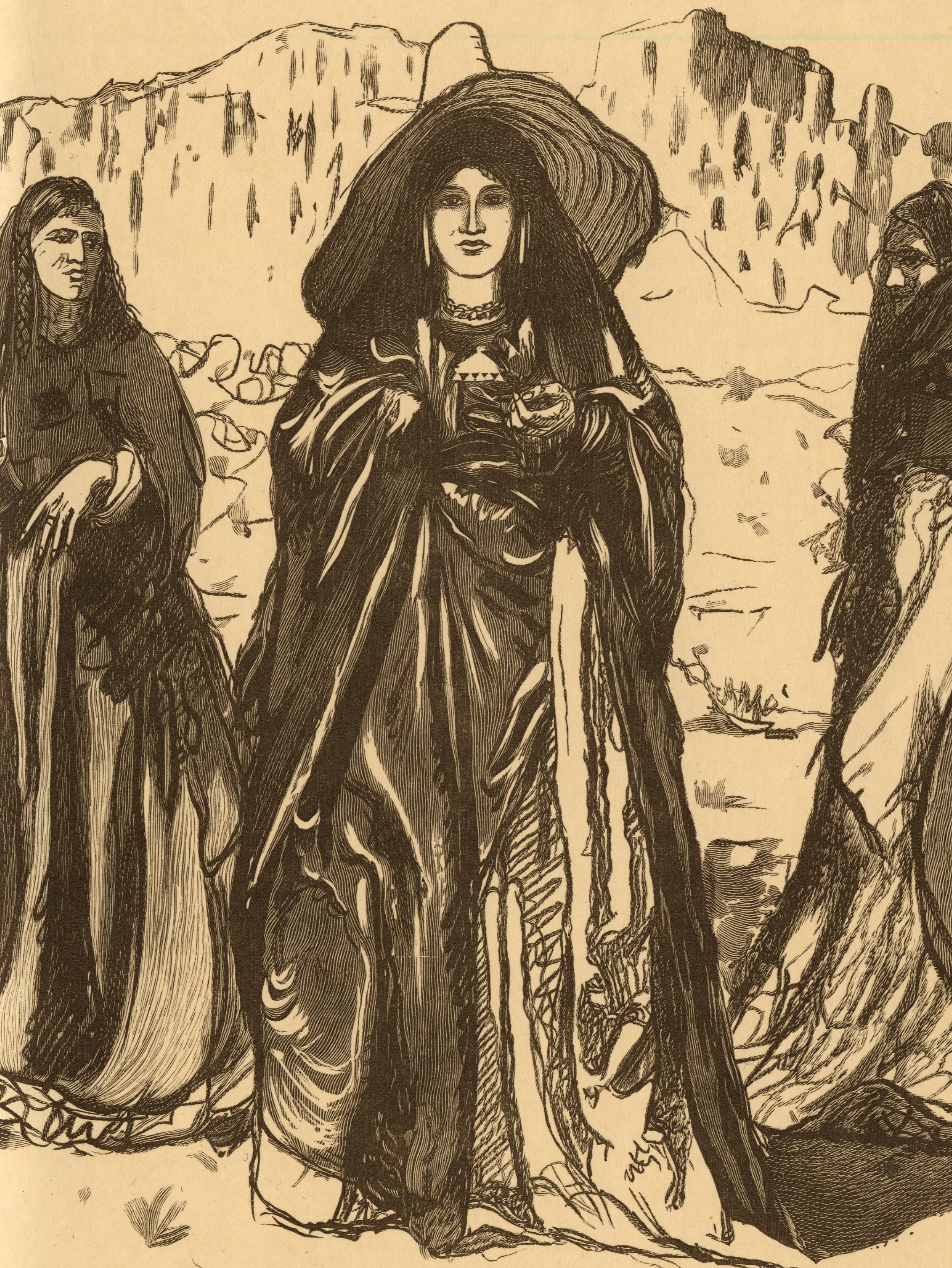
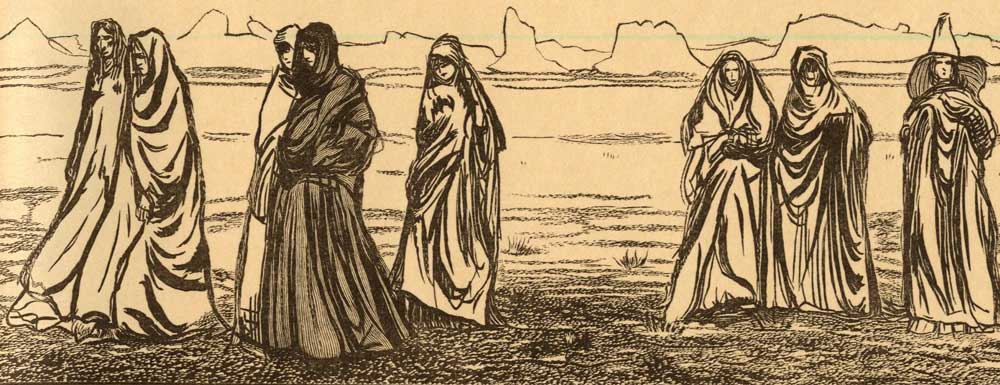
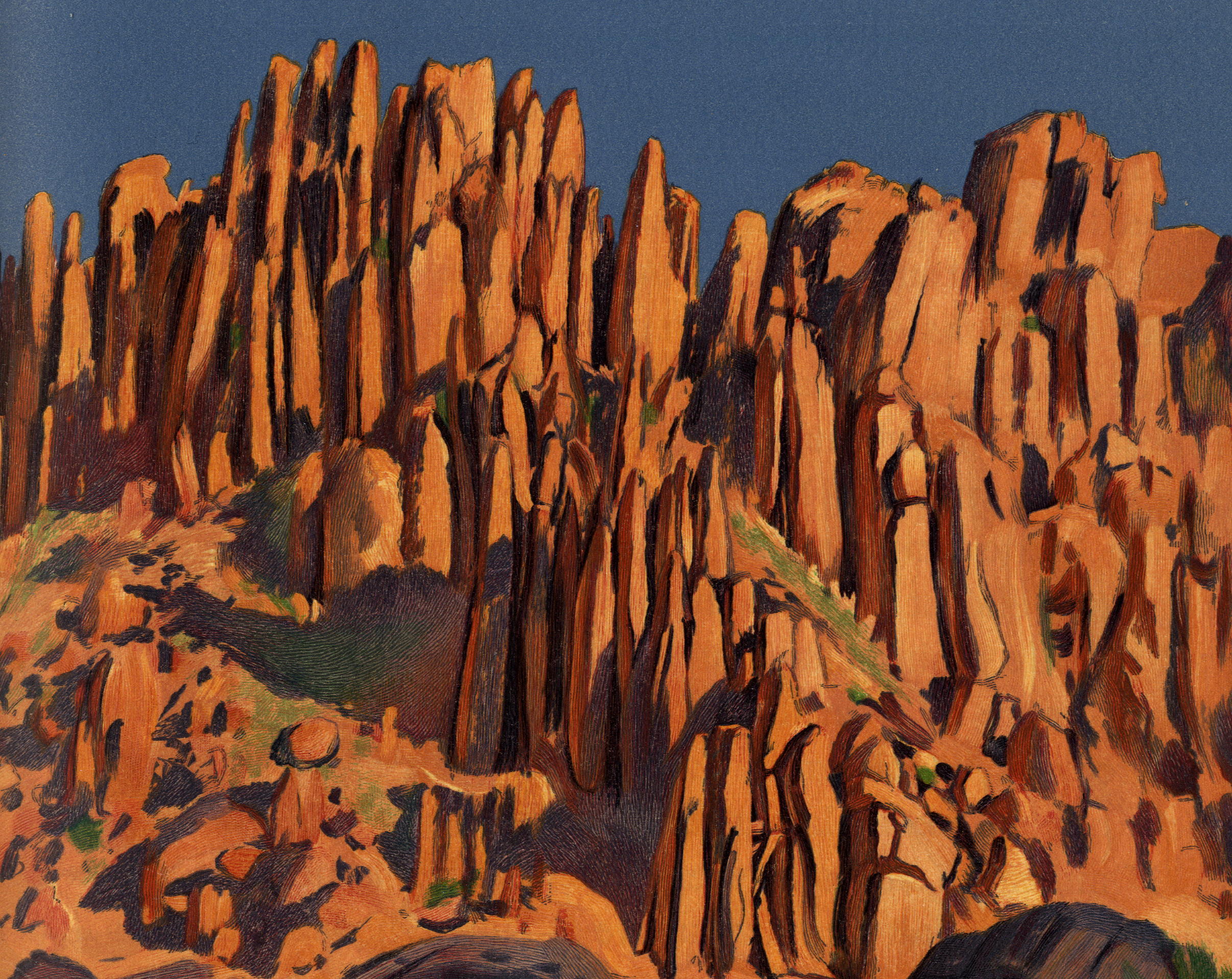
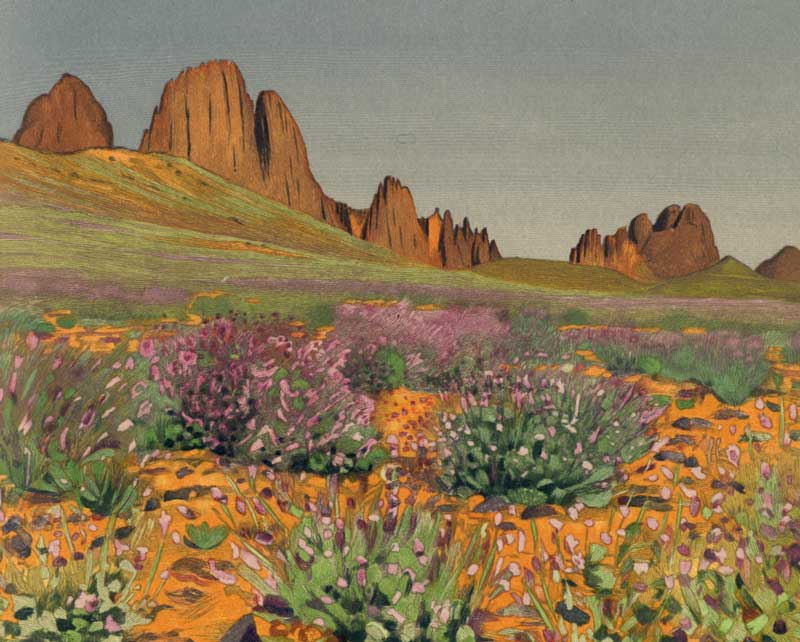
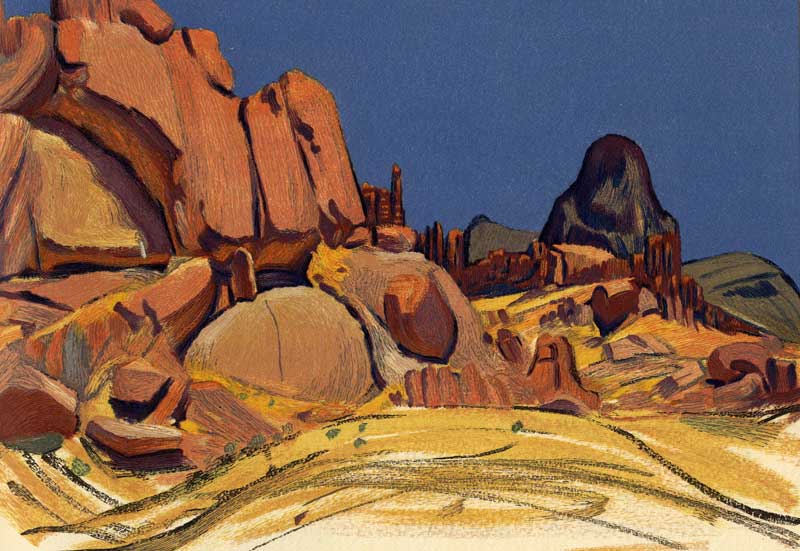
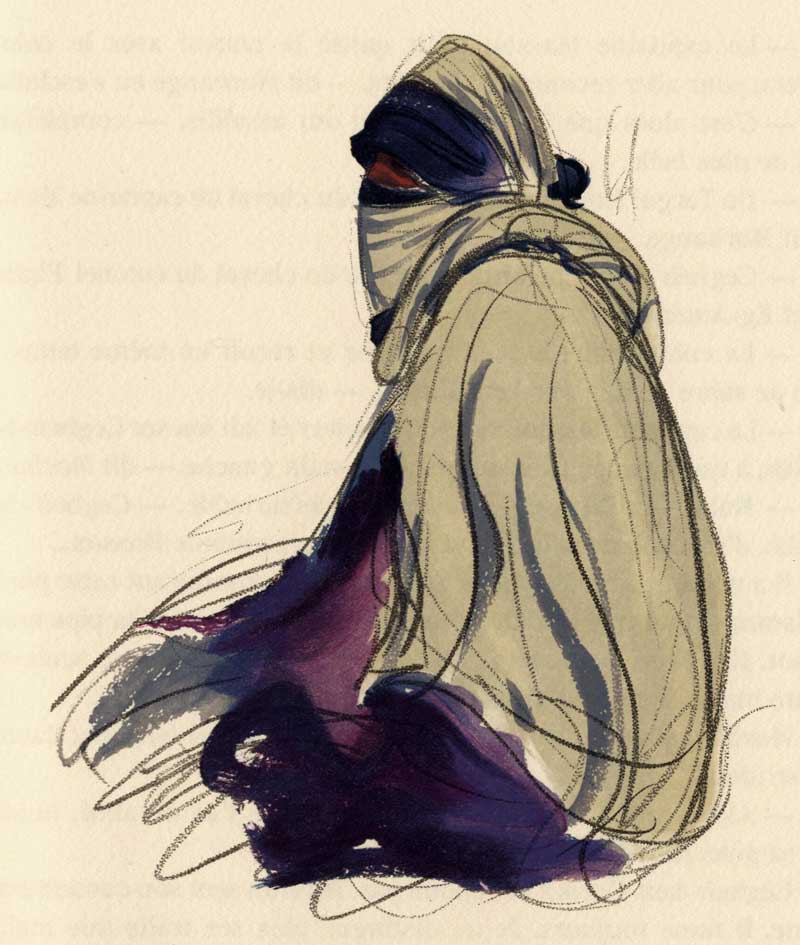
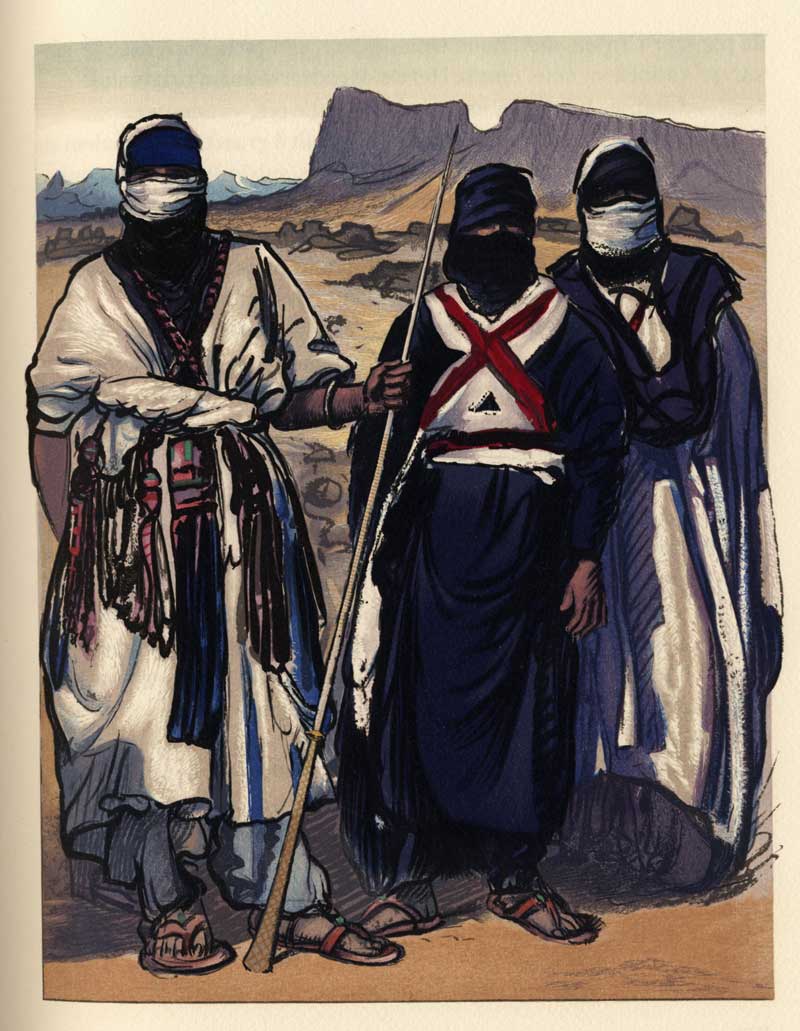
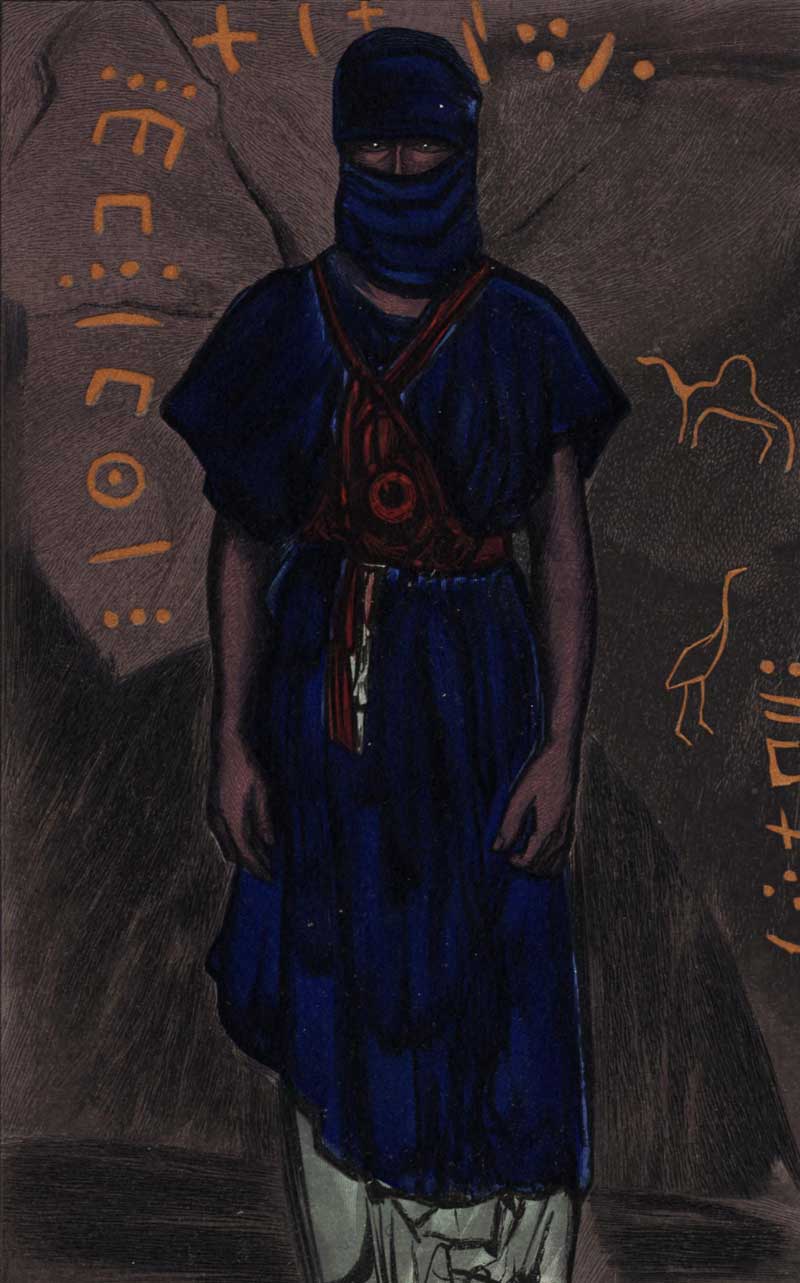
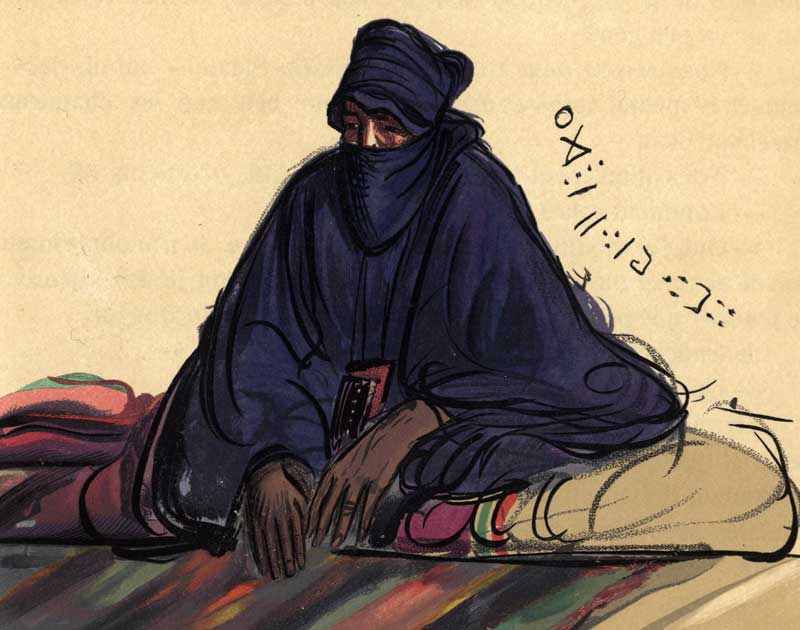
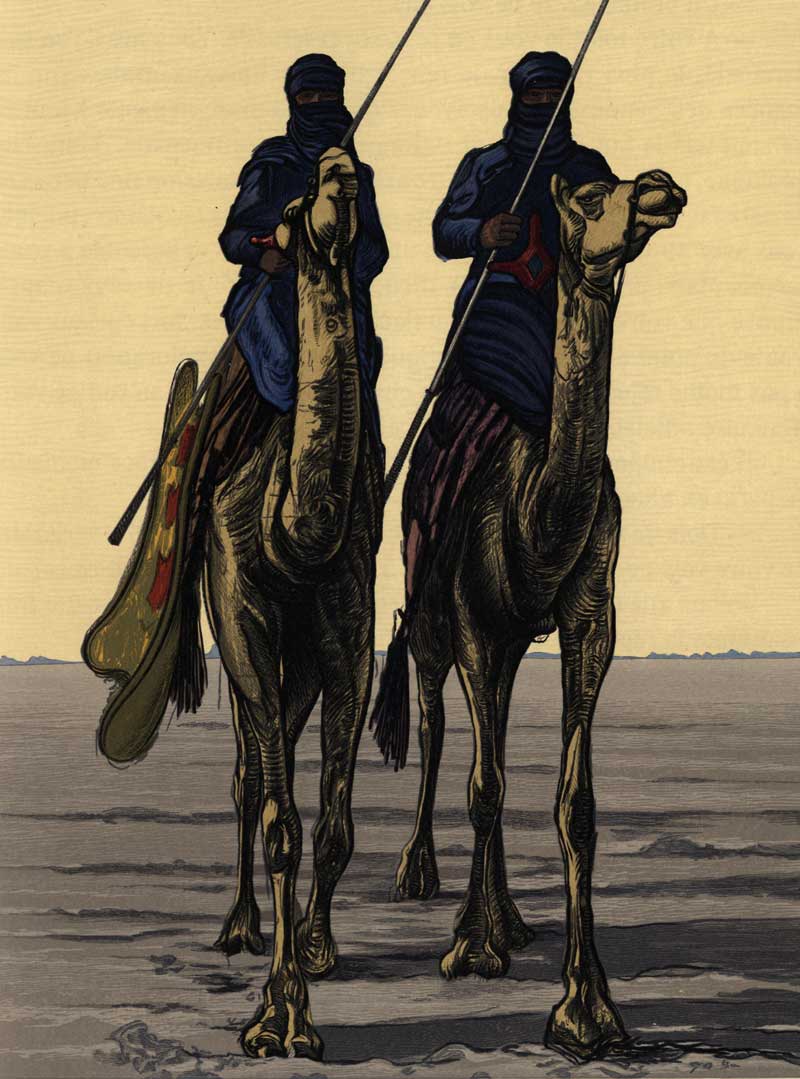
As well as illustrating Chants du Hoggar, French painter Paul Élie Dubois worked on a version of a celebrated novel of the time, L’Atlantide (Atlantis) by Pierre Benoit. It describes the vicissitudes of two French soldiers searching for lost compatriots in the Sahara and who end up in Atlantis, ruled by the beautiful Queen Antinea who seduces and then entombs her lovers. There’s more on the book and films here.
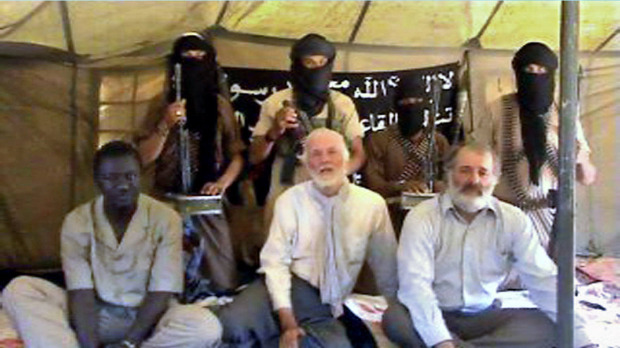
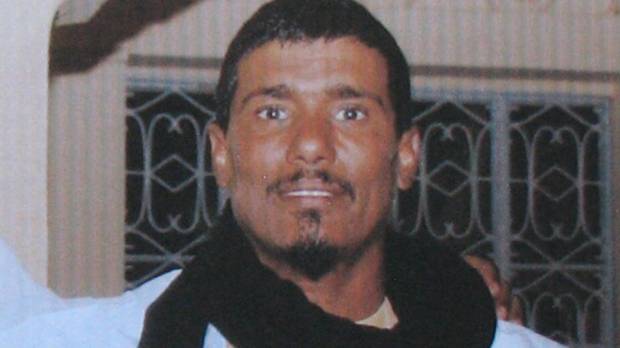
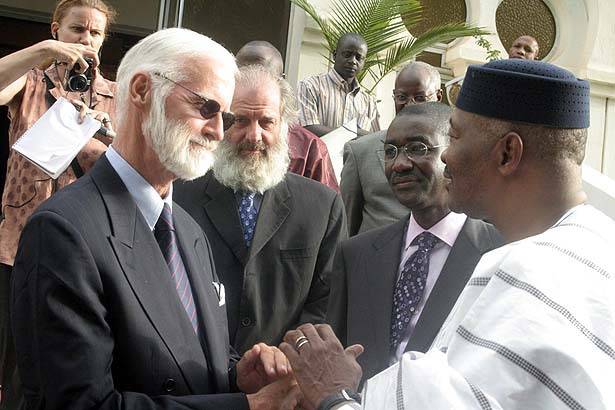
In late 2008 Canadian UN special envoy Robert Fowler was kidnapped near Niamey with his assistant Louis Guay and their local Malian driver, Soumana Moukaila (left). All were held captive in northern Mali by Moktar Belmoktar’s (MBM) AQIM katiba or group. Following the lull after the mass kidnappings of 2003 in Algeria, it was a pattern that came to be repeated frequently from 2008. Excluding what’s currently going on in Nigeria, in north Mali today there ought to be nine non-African captives of six nationalities (mostly French) as well as five Africans taken from five separate abductions across the Sahara. Full list of dates, locations and outcomes here.
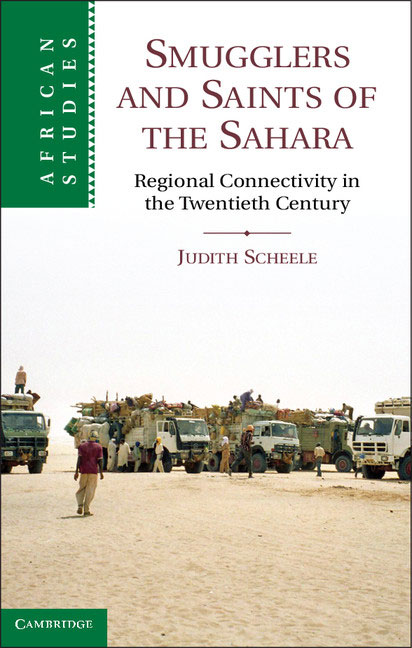
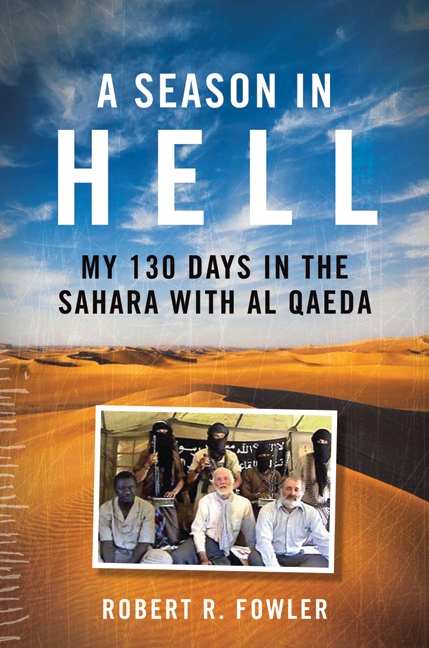
But just a year before Fowler was grabbed, Oxford-based anthropologist, Judith Scheele was travelling up and down the Tanezrouft, principally between Gao and the Touat region around Adrar in western Algeria, researching the origins and nature of the ‘connectivity’ that has long linked the two regions. Her book, Smugglers and Saints of the Sahara: Regional Connectivity in the Twentieth Century is an anthropological treatise on south Algeria and north Mali. Fowler’s book is A Season in Hell, my 130 days in the Sahara with Al Qaeda – a self-explanatory title.
Smugglers and Saints of the Sahara; Regional Connectivity in the Twentieth Century Judith Scheele Cambridge University Press, 2012 ISBN: 9781107022126; 286pp £60 – $99 From CUP catalogue: Smugglers and Saints of the Sahara describes life on and around the contemporary border between Algeria and Mali, exploring current developments in a broad historical and socioeconomic context. Basing her findings on long-term fieldwork with trading families, truckers, smugglers and scholars, Judith Scheele investigates the history of contemporary patterns of mobility from the late nineteenth century to the present. Through a careful analysis of family ties and local economic records, this book shows how long-standing mobility and interdependence have shaped not only local economies, but also notions of social hierarchy, morality and political legitimacy, creating patterns that endure today and that need to be taken into account in any empirically-grounded study of the region.
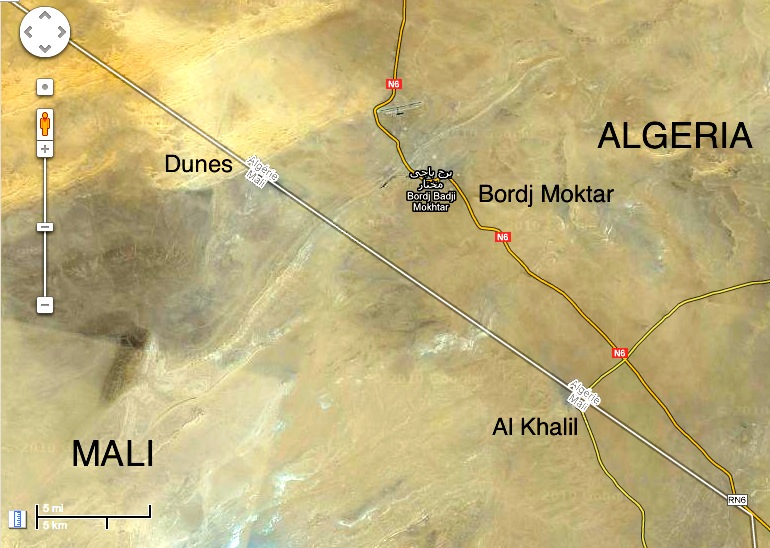
Smugglers and Saints caught my eye as it mentioned al Khalil, a frontier trading settlement that slipped out of the state control around the turn of the century to become a rough smugglers’ entrepôt right on the Algerian-Mali border and just 18km from the Algerian outpost and military base of Bordj Moktar (BBM) on which al Khalil depends. Steele writes in the introduction:
… On closer inspection, the various institutions that might turn al-Khalil into a town turn out to be optical illusions… The gendarmerie post is … empty, and here everybody knows what happened: “the government built this post, a nice building, you can see, and then they sent soldiers with guns, suwadin (‘blacks,’ that is to say people from southern Mali) who were already shaking with fear when they arrived. They lasted two days: on the second night, we stole there guns, and we never saw them again.”
Sounds like an interesting place. I visited the outpost twice in 2006, a short while after I was told the Malian douaniers (Customs) like the gendarmes above, had been kicked out, leaving the place to its own devices. One of my visits was while passing through with a car to offload in Mali (it was actually getting reprofiled to return to Algeria as my guide’s car). I took the chance to get in with the chummy crew who were my guide’s contacts in Al Khalil; what the exact connection was I did not ask. They occupied l’Ambassade (possibly an in-joke with those that frequented it), a compound or garaj like many others in town, composed of a head-high mud-brick wall where ancient MAN or Mercedes trucks were being overloaded or refuelled. Beaten up oil drums, axles and other junk lay all around and a couple of shacks or shaded reed zeribas perched against the perimeter wall. There was no running water or electricity other than truck batteries. The toilet was like a deleted scene from a slasher movie.
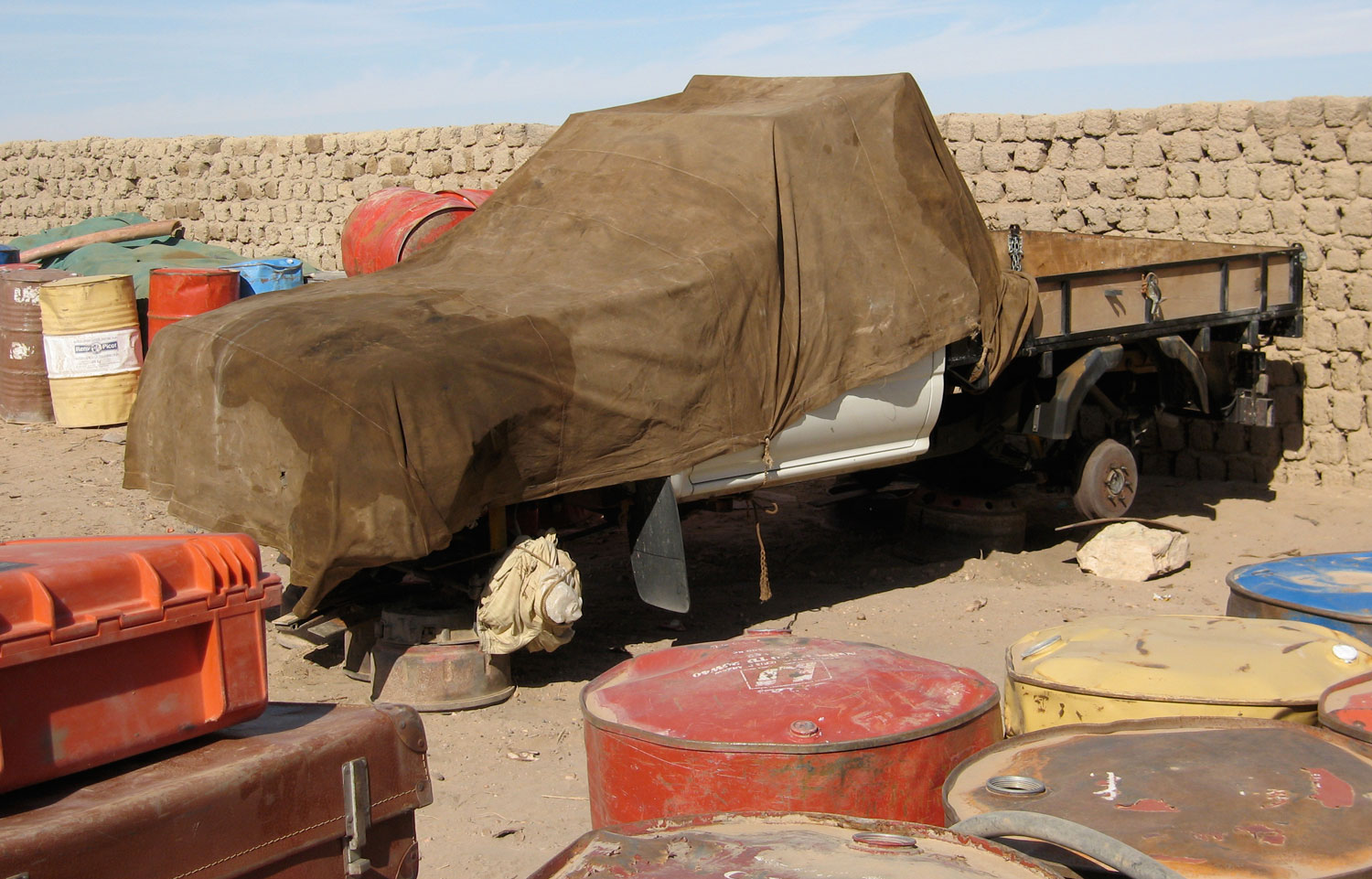
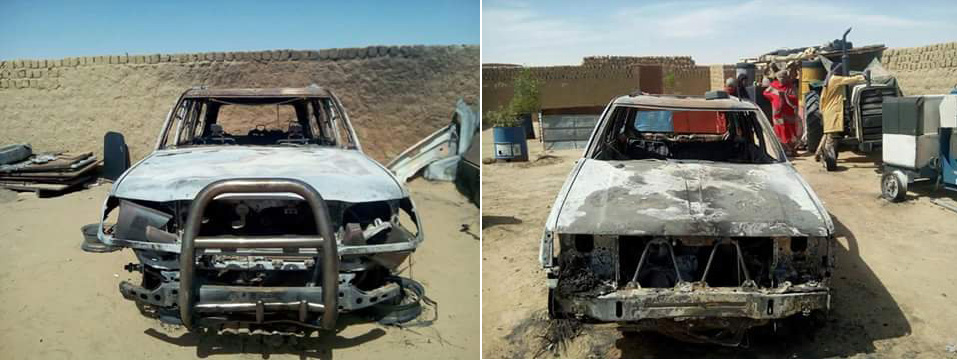
Al Khalil was by that time a stateless entity in No Man’s Land, some 100km north of the first Malian town at Tessalit where in 2006 at least the Malian army had a presence and stamped us in. The crew at the l’Ambassade weren’t like the braggarts thatJudith Scheele describes, and seemed a rather amiable bunch of possibly Berabich Arabs, a consequence one likes to think, of their avowed trade in ‘soft’ commodities between Algeria or Zouerat and their distant home town of Timbuktu. I sold some sat phones or GPSs and promised to return with solar panels and other requests, something I occasionally do to help establish a connection with guides or other local contacts. In this case my motivation was to help ease my imminent traverse of northern Mali should I get in trouble. In a way I was participating in the mutually beneficial connectivity about which Judith Scheele writes, while not going quite as far as marrying one of the ‘Ambassadors” daughters to seal a trading communion. Sure enough, two months later I was in trouble before I even got out of eastern Mauritania and was able to call in a truck via the Ambassade to recover me back to In Khalil. Last I heard my Hilux still rests under an oily tarp in the corner of the Ambassade (above right).
Enough about me. It is of course a little unfair for a ‘civilian’ like myself to judge a painstakingly researched academic work like Saints. I suspect such works follow a certain well-defined format and other rigid conventions that pass over my head. But as I’ve had dealings in Al Khalil and know south Algeria as a tourist, I gave it a go, curious to learn a little more on how the outpost survives right under the nose of BBM and where the author speculates: “… by all accounts state officials are deeply involved in all aspects of transborder business.” Not surprised to hear that at all.
Steele describes the drivers and dealers in Al Khalil as a recognisable mix of bravado and exaggeration, boasting about their contrabandeurs‘ adventures running goods along the hidden pistes while dodging patrols and ambushes from competitors. These traders claimed a distinct moral separation between ‘soft’ goods like sugar, fuel and staples, and harder items, the hardest of all being cocaine, but now might be migrants and arms. It’s fair to speculate that as much as AQIM’s occupation of northern Mali, it is the similarly recent advent of a new cocaine route to Europe, from Colombia via Guinea Bissau or Mauritania right across to the Red Sea that has upset the trading traditions she documents. No longer can a plucky young guy knock out a couple of trans-border runs for a patron to earn himself the Toyota pickup he was provided. As you’d expect with hard drugs, now much more organised mafias – in some places not far removed from state institutions – are running the show and paying flat rates for young guns in search of nothing more than adventure.
“Although al-Khalil might for all intents and purposes look like a town, it lacks in morality and is therefore locally understood to be part of the badiya… As such it remains beyond the bounds of civilisation and is described as potentially dangerous to “proper” family life and sociabilities. This is perhaps why, in their interminable boasts, Khalilis endlessly endorse “traditional” morality, as though they were trying to integrate al-Khalil within known frameworks of excellence and moral propriety: al-Khalil is decried as a place where men can be men, although everybody knows that the moral autonomy and social responsibility this implies are often illusory.
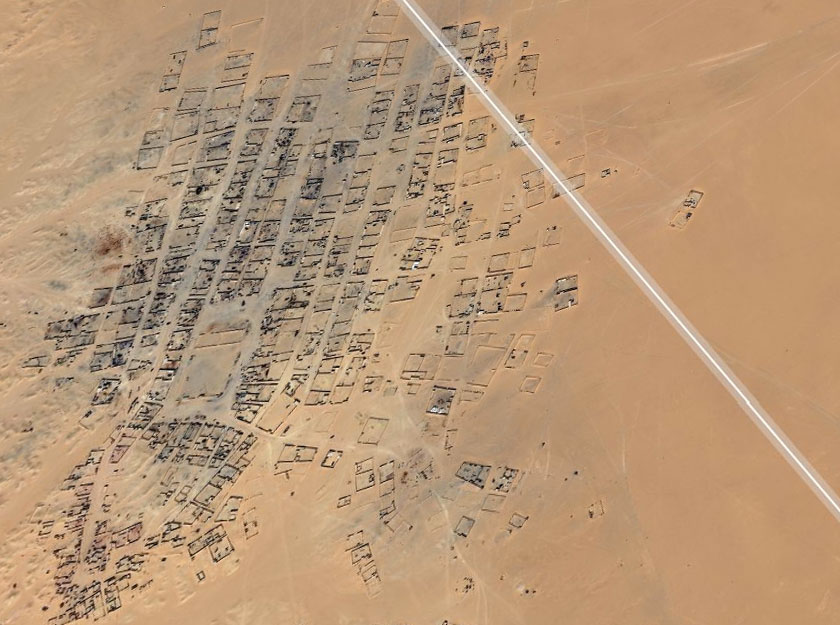
The series of traders’ compounds or garajs shown in the sat image on the left isn’t a place where a European stranger idly noses around for too long, and you get the feeling that even with her protectors, the author didn’t spend much time there, as she did in the regular settlements in Mali and Algeria. That she achieved what she did over months in this area is a testament in her ability in getting to know the right people and gain their trust. A short while after both I and Judith Scheele visited, Al Khalil became quite a dangerous place indeed and now, a few months following the French led Operation Serval, you imagine things may have turned full circle.
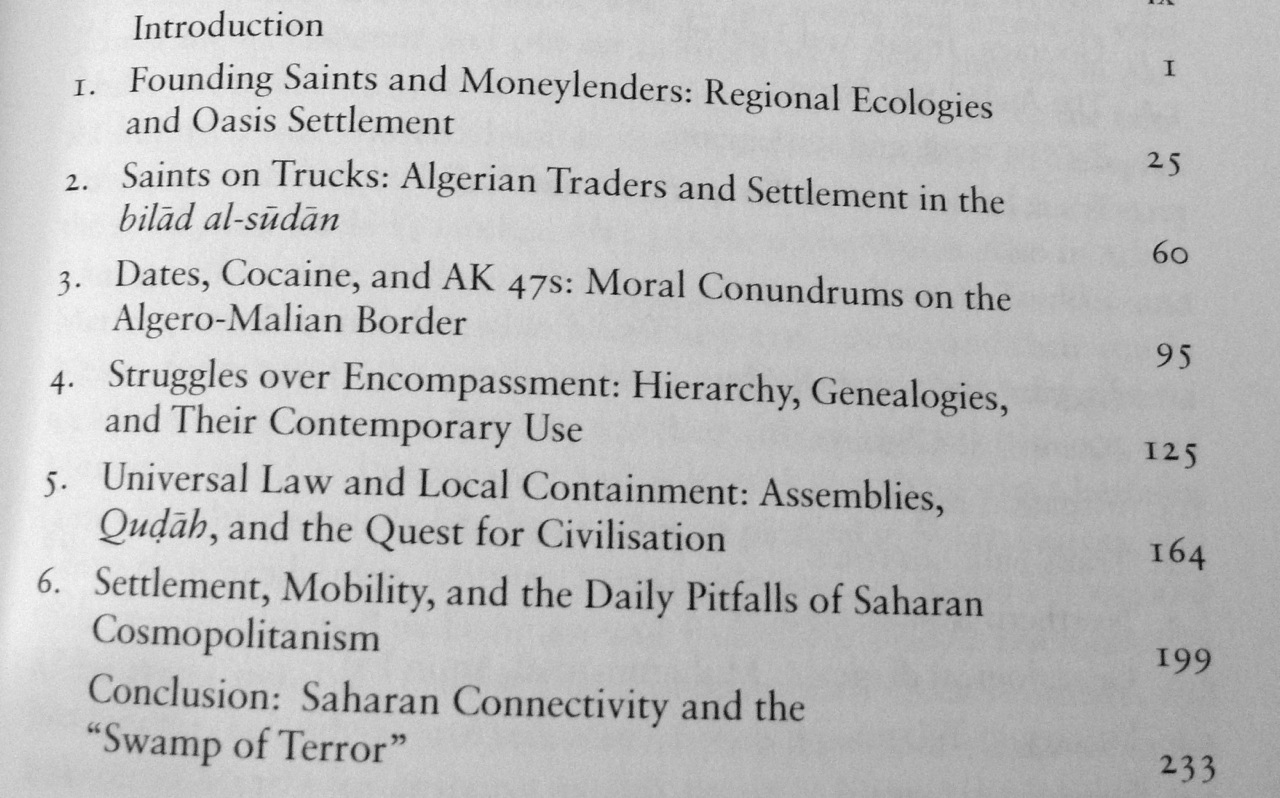
It has to be said that once beyond the lively and engaging introduction, the book gets down to business and at times becomes a bit of an effort. The chapters are listed on the right give you an idea of what to expect. Credit is due to the author’s tenacity, braveryandfluency in local languages, although part her success may have been in being perceived by the men as just a ‘harmless woman’. It gave her the best of both worlds: sisterly access to local women no male counterpart could have achieved, while at other times able to move around as a protected ‘honorary male’, as lone women travellers often find, particularly in Muslim lands.
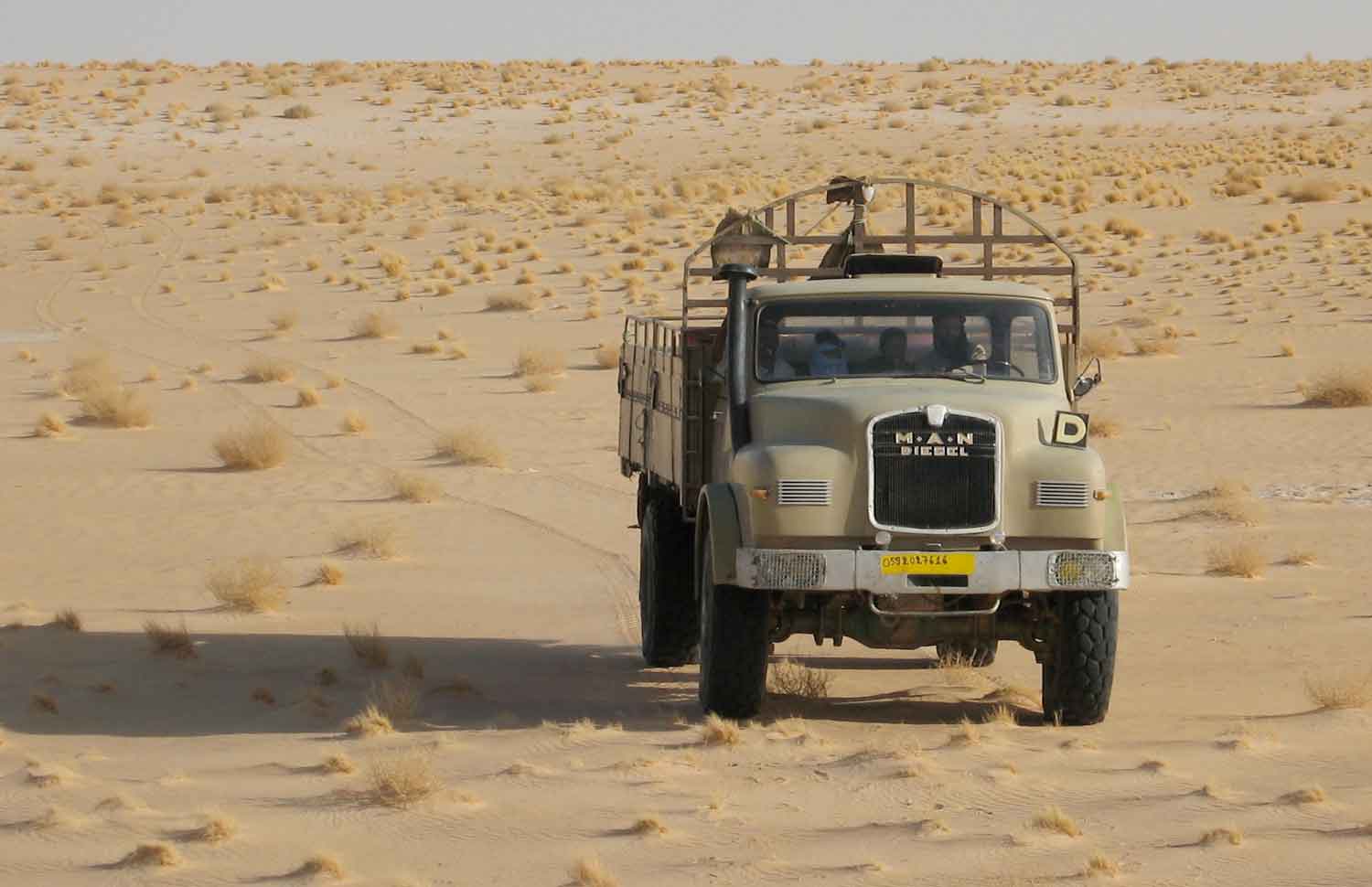
At one point her convoy is held up in southern Algeria en route to Mali until the driver explains to the brigands that he’s travelling en famille – as in ‘steady on chum, there are women present’. Travelling sans famille, on the way to rescue us in 2006, the Ambassade’s truck (left) had a similar encounter but was less fortunate.
It’s a touching example of the sort of code of honour we like to imagine exists among Saharan smugglers. They are after all merely engaged in tax-exempt trading that was disrupted or penalised when the French began their century-long project of colonising Algeria in the early 19th century. Since then, following the post-colonial era of the early 1960s, new governments settled age-old racial scores. I have long assumed that the neglect of the desert Tuareg in Mali’s Ifoghas and the Aïr in Niger was a form of payback for the bad old slave trading days. It forced places like the Ifoghas to rely heavily on subsidised goods coming down from Algeria and until very recently the Malian government still professed that the ‘Tuareg problem’ in the north was a greater threat than AQIM and associated terrorist groups.
In Saints we learn much about the demography, racial make up and historical links across the region. The Tilemsi Arabs who originated from Mauritania and include the shady mayor or Tarkint (more of him below). Or the Kunta Arabs, a sect that led by a ‘saint’, settled from an oasis in the Touat Algeria a century or two ago. Indeed it was Arab traders from there who founded Kidal, the current ‘capital’ of the Kel Ifoghas Tuareg.
“Most [pre-colonial] settlements in the Sahara are said to have been found by saints, following divine guidance… [it] is always an achievement and relates to larger projects of civilisation, generally bound up in Islamic standards of justice and order. As such it can as easily be swallowed up by moral shortcoming and internal strife as by the shifting sands and greedy raiders”
These early traders and other notables have metamorphosed into ‘saints’ possessed of baraka (blessing) or even got upgraded to sharif, noble descendants of the Prophet. It’s a form of religious aristocracy mentioned in an earlier post about Judith Scheele’s visit to Arawan around the same time. Staying with US PCVs in Mauritania in the late ’80s, I recall coming across a term ‘hassan’, with the same meaning or legitimacy as sharif.
At one point the author profiles the ‘Alkacem’ clan of Tamanrasset, a successful trading family of business-minded Chaambi Arabs who moved there from northern Algeria around Ouargla and Ghardaia. From the earliest days of the French colonisation the Chaambi worked with the administration rather than fighting it, like the Ahaggar Tuareg right up to their decisive defeat near Tam in 1911. We learn that similarly, the modern Alkacem have shrewdly developed ties with the government to their great advantage. It chimes with a meeting I had with what I took to be a patriarch of that family a couple of years ago while organising a tour. I could tell this guy was a busy hommed’affairs who these days, more than ever, surely couldn’t be making a living from his tour agency. With his shiny fleet of Hiluxes, I assumed he must have more profitable interests like property or transport, his agency being a hang over from the good years and which had been palmed off to his somewhat feckless son. The patriarch told me his family had moved down a century ago from their home oasis of Metlili Chaamba just south of Ghardaia.
These passing connections made Saints a little more digestible for me but while there must be a certain received form to academic writing that is indubitably objective and correct, the jargon doesn’t exactly leap from the page with arms outstretched. It is after all a meticulous report on the author’s fieldwork to be pored over by her peers, not an adventure travelogue.
Nevertheless, as a tourist in the region you frequently feel that you’re skimming over what’s really going on around you, especially when pre-occupied with keeping your own all-terrain show on the piste. Saints helps fill in the blanks about a Sahara where people actually live, a place beyond the string of waypoints linking fuel stations, junctions and wells. We learn a lot about the complex interconnectivity of race, skin colour and Arab assumptions of moral, intellectual and religious superiority, despite the envied lure of the licentious suwadeen. As an Arabic woman of standing, it’s all about appearances, status, how to get ahead in business while scrupulously maintaining a respectful pubic image (in short: travel for business but lock up your daughters).
Along the way Judith Scheele has amassed a bibliography on associated topics that could keep you reading for years. There are many other anthropologists out there working to unravel the secrets of the Sahara. She concludes by politely scoffing at what you suspect she views is a rather male-oriented view of today’s Sahara as a lawless “swamp of terror” to quote an American general (and to which I lazily subscribe myself). A wilderness of wily bandits and fanatical mudjihadeen that must be brought under control before it all gets out of hand. It’s an image that’s carried by the mainstream media too and the author admits that much of her research was completed before current AQIM activities hit their stride, let alone the recent fall of Gaddafi’s Libya which has further stoked the fire. Al Khalil may get pushed off the map she concludes, but it will simply pop up somewhere else because in the Sahara, like elsewhere else, life goes on.
A Season in Hell; my 130 Days in the Sahara with Al Qaeda Robert Fowler Harper Collins, 2011 ISBN: 9781443402040; 320pp CAN$ 11.99 Kindle up to 32.99 hardback From the Harper Collins website: For decades, Robert R. Fowler was a dominant force in Canadian foreign affairs. In one heart-stopping minute, all of that changed. On December 14, 2008, Fowler, acting as the UN Secretary General’s Special Envoy to Niger, was kidnapped by Al Qaeda, becoming the highest ranked UN official ever held captive. Along with his colleague Louis Guay, Fowler lived, slept and ate with his captors for nearly five months, gaining rare first-hand insight into the motivations of the world’s most feared terror group. Fowler’s capture, release and subsequent appearances have helped shed new light on foreign policy and security issues as we enter the second decade of the “War on Terror.” A Season in Hell is Fowler’s compelling story of his captivity, told in his own words, but it’s also a startlingly frank discussion about the state of a world redefined by clashing civilizations.
I may have struggled to review Saints satisfactorily, having chipped away at it over a number of weeks. That’s not an excuse I need to make with Fowler’s ASeason in Hell which I knocked back over a weekend. It doesn’t so much leap off the page as grab you by the ears and haul you back in. Here at last is what some have been waiting for since this whole threat to Sahara tourism started back in 2003*: a lucid, vivid and thoughtful account of an experience which those of us who still travel regularly in the Sahara often wonder how we’d cope with. And before the first page is turned Fowler answers that question directly with a reassuring “better than you’d assume”.
In December 2008 Fowler’s UN party was in Niger to help negotiate a settlement over the latest Tuareg rebellion in the Aïr. Their presence was not welcomed by the then Niger government who almost certainly betrayed the diplomats into the hands of AQIM, less than an hour north of Niamey, while at the same time trying to blame it on dissident Tuareg rebels, so killing two birds with one stone.
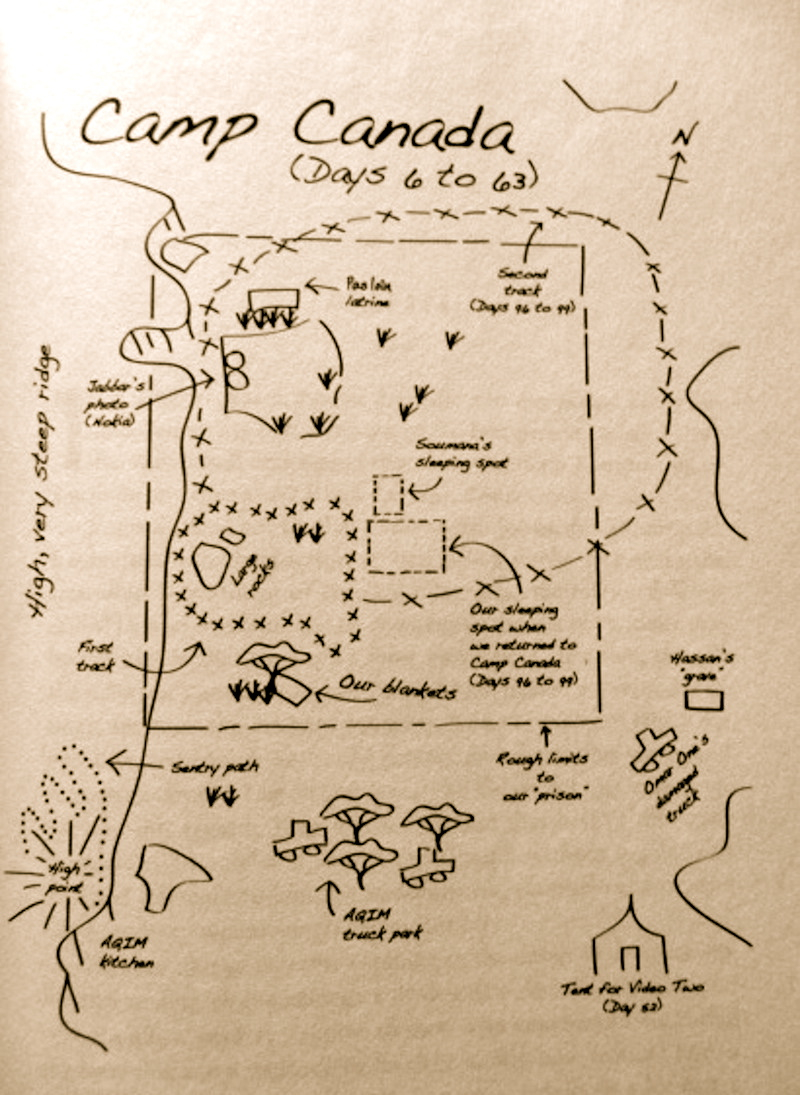
Stuffed into the back of a pickup, a breakneck flight ensues, over the border into Mali, hammering cross-country at which point Fowler – at that time in his mid sixties – injured his back and lost his glasses. Exhausted, terrified and dazed, a few days later the reality of what has befallen them becomes clear as Fowler and Louis Guay settle into life at what they called Camp Canada, somewhere in the hills northeast of Tessalit. The petrified driver Soumana was nearby but kept away from the two Canadians. The sound of what may have been French C130s coming in to land in Tessalit helps pin down their probable location.
Luckily, Fowler avoids the lazy Day 1, Day 2… diary format, instead describing events or themes over their months en brousse. Just before their abduction two Austrians had been released after eight months captivity in Mali, and so Guay at least got his head around the fact that their experience may last that long too.
One night on the flight north Guay vehemently discouraged the myopic Fowler from grabbing a pistol from the glove compartment, but once in the Camp Canada Fowler still attempted to asses his chances of escape. From the way he describes it, even without the surrounding desert, it’s clear that wherever they were camped, they were always heavily guarded by lookouts and even guarded as they slept. The threat came for other AQIM groups as well as expected rescue missions by foreign forces, plans to which they were disturbingly privy.
Early on the obligatory video is made, backed by masked mudj in front of the black AQIM banner, though at the time Fowler was uncertain whether they were about to film a graphic record of his own grisly execution. Fowler admits that early on suicide was a valid option and later explains “by far the most taxing [of the trials they endured] were the ravages of the psychological roller coaster that racked us back and forth between hope and despair.”
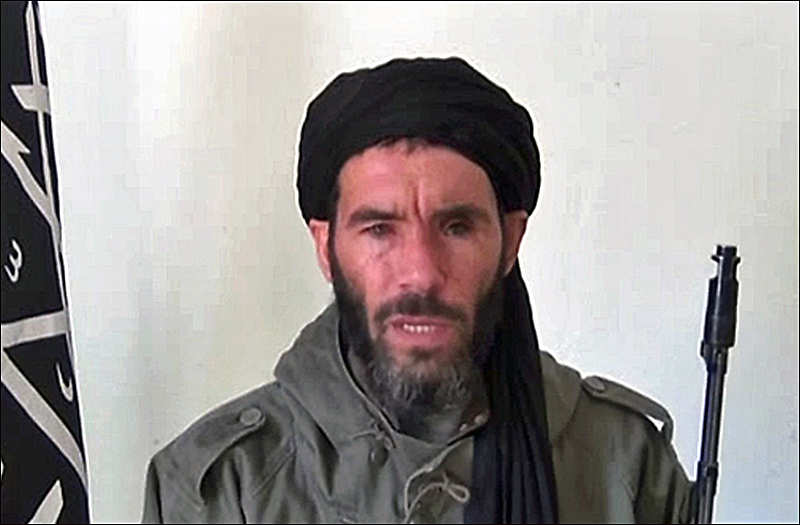
At Camp Canada the duo settle into a routine of daily walks, hauling each other away from negative thoughts (‘rabbit holes’) and even honouring the prayers of their abductors by standing up while making their own invocations. Moktar Belmoktar (MBM – or [one-eyed] ‘Jack’ in the book) makes occasional visits, a figure that clearly carried authority and respect among his men. But during MBM’s longer absences the duo have to deal with the malice, mind games and rabid contempt of their captors, including the spiteful and petty depredations of ‘the Children’ – some as young as seven.
They may well have been kidnapped from local villages, or handed over by impoverished parents and since indoctrinated, otherwise you wonder what it is that drives young men to such extreme views and a pitilessly harsh and perilous lifestyle. Aside from the commonplace domestic difficulties or some adolescent slight which apparently pushes one over the edge (a suggestion made for the recently slain Boston bomber whose promising boxing career didn’t pan out), you can’t help feeling that the chips on their shoulders and all other corners of their bodies have some legitimacy in countries where unemployment is epidemic but where the elite factions of the state constitute the apogee of self-enriching criminality.
I recall one of the guys in the MAN recovery from 2006, a young Tunisian now living the life as a desert smuggler. His insecurity, resentment and hot and cold moods lit up the desert like a flare. When he drove the truck it was as if he wanted to smash every tussock into submission. One night at a camp in north Mali he blurted out of the blue ‘Christophe, why do Europeans think all Africans are stupid?’. The others were a little embarrassed by him but I wouldn’t be at all surprised to hear that a year or two later he’d signed up with the nearest AQIM katiba.
It has at times been customary to dismiss AQIM as nothing more than criminals making money by smuggling and kidnapping, but if that’s the case then Fowler’s abductors all sustained a pretty convincing performance. Not one of the score or more who occupied Camp Canada (right) failed to try and convert the two diplomats to Islam, while at the same time ceaselessly haranguing the unfortunate driver who lived right among them. In fact it became rather a procession – as with some religions and Islam in particular, a need to be seen as doing your duty as a devout, by-the-book Muslim.
To borrow a tract from Judith Scheele: “The two mosques [in Al Khalil] were constructed with private funds, but even they can hardly be taken to represent “Khalili society.” At least one of them, people say, was built by a notorious drug dealer, to show off his wealth and perhaps even but his place in paradise, but nobody ever goes to pry there – quite simply, because nobody ever prays in al-Khalil: for al-Khalil is a place of corruption, and their prayer would wither on the tongue… it therefore remains beyond the bounds of “civilisation” and is part of the badiya (steppe, wilderness).“
Fowler is careful never to claim to speak on behalf of Guay who he nevertheless thanks deeply for helping him survive the ordeal, although you do wonder if the pairs’ fluency in French may have exacerbated their torment. Not all in the katiba spoke French but some of those who did left no doubt how dearly they’d love to kill and mutilate them, just on general jihadist principles. One, ‘Omar One’ who they got to know well had been a travelling preacher right across Africa and Europe, and was particularly skillful at relating stories from the Koran to the enthralled audience. Religious discussions between themselves dominated the abductors’ conversations.
The fact that Fowler seems to come out of the experience without lasting psychological trauma (he claims no nightmares or PTSD) makes you think that he at least had a relatively easy time of it, so perhaps the ability to communicate did help. An interviewer (worth clicking, btw) also came away with this impression after reading the book and to which Fowler replies:
RF: Sorry, if I left you that impression in the book then I didn’t write very well. It was never, not for an instant, ever relaxed. I don’t think we ever had a good time. I think I mentioned in the book that on a couple occasions Louis and I laughed about something, and then had a discussion if we should even be laughing. I mean, some of the situations were so absurd that the irony of it made us laugh. But, we were never relaxed. The 20 questions was with this fellow called Hassan, and he was among the most dangerous, difficult, and smart members of our captors. One could never be relaxed with Hassan, and let ones guard down. Even in the context of what appears to be a game, all the same stakes remained on the table.
But you wonder whether Guay – who has not written of the experience as far as I know – did not get off so lightly. For whatever reason he ended up a scapegoat, picked on for merely observing his assailants (‘what else was there to look at?’) or got persecuted for his ‘Jewish’ appearance. Both used their diplomatic nous and long experiences of working and negotiating in Africa as best they could to control this worrying situation. In a way, short of being Jean-Claude Van Damme clad in especially tight denim, you couldn’t expect two more experienced captives being put to the test. And tested they certainly were:
“Anything we believed, especially about religion but also about most anything else, they considered to be false, corrupt, and therefore not only unworthy of discussion but also intrinsically evil. Even talking about such differences was likely to incur the wrath of their vengeful and famously jealous god.”
As well as he was able, Fowler paints a vivid picture of those he got to know; some of who bristled at the duo’s transparent ploys to win favour and maybe respect, such as the aforementioned honouring of their praying. Others warmed a little and some came over to discretely discuss haram topics outside the narrow strictures of their fundamentalist dogma. There was only one thing that struck me as oddly missing from this book: obsessive discussions about food. If we on my camel treks are fantasising about the fare back home after only a week on the trail, you’d think Fowler and Guay would be crawling up the canyon sides eating plain cous-cous, pasta or rice (occasionally with meat) twice a day for months at a time. Some emotionally sensitive subjects were banned from discussion by the two in an effort to maintain morale, but you’d think the harmless pleasure in food fantasies would be quite fun.
It’s useful to be reminded that these may all be battle-hardened jihadists, but ‘extreme camping’ (as Fowler calls it) full time in the Sahara on limited resources is no picnic for them either. The captors too felt the pressure as negotiations of which the duo knew little off progressed in fits and spurts. Violent arguments broke out on the far side of the camp – for all the two knew the subject may have been ‘let’s kill them!’. For MBM who pops in and out of the drama, this is seen as a last resort or not one at all, and though he doesn’t spare the two a bitterly articulated sermon about the legitimacy of their cause, he still comes across as a principled and intelligent operator. (A whole lot more on him here -from a US ‘GWoT’ PoV). Although it’s said he fought the Russians in Afghanistan (where he lost an eye) at least a decade before this event MBM was better known on the Saharan scene as a cigarette smuggler and audacious bandit without any links to the then GSPC (later AQIM). Among some he was even glorified as a Robin Hood-like figure: ‘El Laouar – the One-Eyed my guide used to joke, with one hand covering an eye, as we crossed northern Mali in 2006 at which time MBM had been reportedly chased out of the Iforghas by Tuaregs into our path. It’s likely too that he was behind a huge convoy of ‘Marlboro’ laden pickups which passed our camp near the defile north of Amguid on New Year’s Eve, 2001. A few weeks earlier a whole lot of pickups had been stolen from oil installations nearby.
It’s still unclear how, why or when his conversion to militant Islam took place and whether his motives for jihad are genuine or more pragmatic. But that could be falling for the trap that MBM is not a ranting ABZ (see below). If he’s just building an empire he’s not had much time to enjoy it lately, and anyway has been blamed from some grisly massacres in Mauritania. He did of course recently leap to worldwide notoriety as the mastermind behind the suicidal gas plant siege at Tigantourine in Algeria last January and again in northern Niger in May 2013 – now operating under the MUJAO banner. The fact that he’s yet again seemingly escaped following the assault of the French on northern Mali while his nemesis, the paranoid and far less charismatic Abou Zeid (ABZ) met his end, does raise more suspicions about MBM’s cat-like immunity from capture or death. More of ABZ, later, but this interesting document recovered in May 2013 shows how even during the Fowler abduction MBM was a not a AQIM team player. Now MBM is clearly out of the fold but still continuing his own lethal operations.
Throughout his captivity Guay was comforted by his Christian faith, something which Fowler doesn’t profess and as a result suffered from doubts while endlessly trying to second guess possible scenarios or outcomes. There, in an anthropologist’s nutshell is a logical motivation for religious belief: it makes life’s trials more bearable. (Other explanations are possible). As to coming close to a religious experiences – again in that interview Fowler explains:
… I was almost abstractly curious to know that in those extremely fraught months I spent expecting to be executed whether I would have one of those religious epiphanies. I didn’t, and I’ve got to say I wasn’t surprised. It just clearly was not going to happen to me. I don’t regret that fact, it just is reality. Despite the enormous pressure of thinking I was going to be killed, that was not enough in my case to bring about a fundamental change in my religious outlook.
One day the troupe abandons Camp Canada and sets off west and north, ever watchful, and visiting previous camps and caches. One day a gift of goodies from the Burkinabe president Blaise Compaoré is delivered and formally distributed before the fascinated and ragged throng. It’s never explained why Compaoré took on Fowler’s case once the Canadian government’s tactics had exasperated all involved, all the more so given that some years earlier Fowler had exposed the venerable Compaoré as a profiteer from sanctions busting during the Angolan war.
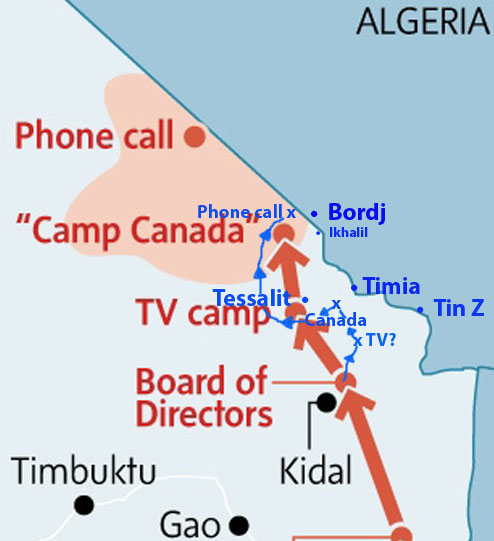
The weeks creep by and a phone call is made to Compaoré as well as to their families from a dune top within range of Bordj Moktar’s mobile signal (left). Progress is being made and the gang bundles back to Camp Canada.
Some of us on the Sahara Forum considered the map drawn for Fowler’s newspaper articles and this book to be a little inaccurate; my corrected version is on the left in blue with the dune identified below right. Getting there without being spotted necessitated a long westward arc as described in the book to make the GSM calls while still safely over the border in Mali (sat phone calls can be easily located). I know myself that the guys at the Ambassade in Al Khalil, 18km from BBM were able to use the Algerian GSM network; it was probably the very reason why Al Khalil was as close to the border as a Nevada casino.
A release finally becomes a possibility and the ordeal draws to a close with the very uncertain handover to Compaoré’s envoy, accompanied by the notorious ‘mayor of Tarkint’ Baba Ould Cheick (left; actually arrested in March 2013 for drug trafficking). Like Iyad Ag Ghali before him, Cheick was thought to be up to his elbows in crooked money while readily employing himself as an intermediary for the release of other AQIM hostages, all for a handsome cut of the ransom. He can’t be the only one – surely no one out there does any of this out of the goodness of their heart and you’d think Compaoré gained less obvious but more substantial concessions from helping resolve the affair.
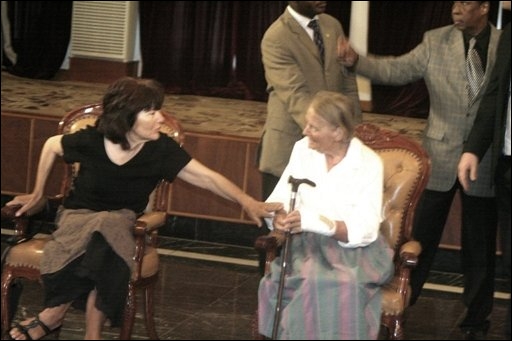
Somewhere is the desert north of Gao a grand handover rendezvous takes place. Not only are the two Canadians being ceremoniously handed over (it turned out the Malian driver had been freed a month earlier), but so too are two desperately emaciated European women, Marianne Petzold and Gabriela Greiner (right) who had been kidnapped with Greiner’s husband and a Brit, Edwin Dyer on the Mali-Niger border a month after Fowler’s party was grabbed.
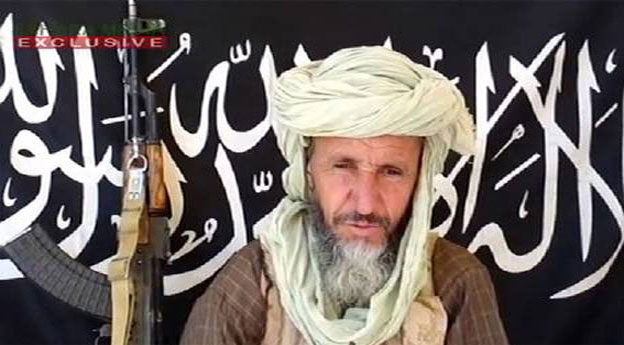
They had the deep misfortune to end up in the hands of the callous Abou Zeid (left – biography reviewed here), and whatever agreement had made for this combined release, ABZ was not buying it, possibly seeing it as a defeat. MBM seems to steadfastly overrule ABZ’s discontent and haltingly the jeeps with the four released captives shove off but barely stop moving for a day or more until they’re on safe territory in the vicinity of Gao.
As described in the book, you can’t help feeling that the stand-off between MBM and ABZ that day may have pushed ABZ into executing Edwin Dyer a couple of months later in an attempt to show he meant business. In turn, not unlike MBM’s recently organised attack on Tigantourine in Algeria in January and in May 2013 in Agadez and Arlit. Although MBM was not present their either, both have been interpreted as a show of strength following MBM’s alleged demotion among the ranks of AQIM in late 2012.
For Fowler and the other three, diplomatically staged photo calls, long-overdue ablutions and happy family reunions ensue, and the book ends with a warning that action must be taken against the scourge (as it is now), as well as an unapologetic swipe at the way the Canadian government and not least the police force (RCMP) handled the situation. The latter come across as a bunch of hicks so far out of their depth you feel like calling the RLNI.
The elephant in the room is of course the matter of a ransom. None was paid say the Canadians and you get the impression that neither Fowler nor Guay were ever filled in on how their release actually came about. Fowler explains it in appropriately vague terms:
“… there tends also to be a difference between what governments do and what they say, and this seems to me quite reasonable. There are good arguments on both sides and a wealth of unhappy experience to buttress just about every position. Every time a “principled position” is invoked, there are exceptions. Many countries adopt what are more or less pragmatic approaches while others proclaim immutable doctrine, but I know for certain that everybody has blinked at one time or another. I am also well aware that there is no way I can be objective about such issues…”.
Fowler and Guay thank Mali’s ATT (since deposed)
That will be a ‘yes’, then. Wikileaks since revealed that prisoners were released and a ransom was indeed paid (€700,000 according to this document, a figure with AQIM leaders thought was way too low. As with other Saharan ransoms, the conduit for the Canadians’ release was the then convenient and well stocked treasury of Ghadafi’s Libya, while the relevant government in denial most probably provided some kind of concessions to Libya as well as the other African counties involved, while claiming its hands were clean.
Following their release we have at times speculated that a publicity ban is put on freed hostages by their governments; perhaps a condition of the usually denied ransoms that have been paid to win their freedom. If that was the case with Robert Fowler, he ignored it. A Season in Hell illuminates in all the detail you could wish what it’s like to be the subject of events which many of use interested in Sahara travel have followed for months at a time. It might even be read as a useful manual on how to cope with a long period of captivity in the desert. However you choose to take it, it’s highly recommend as a great read.
A full list of Saharan kidnappings, which includes current captives, is here.
* In fact Rainer Bracht who we met in Tam in 2003 a couple of weeks before he was abducted, co-wrote 177 Tage Angst with his wife Petra. Part of ‘Group II who did the full six months and ended up in far northern Mali, I considered having their book translated at the time, but in 2004 was told by my German reader (a bike rider but not a Saharan) that is was not so good. Then I recently came across parts of their story archived on a German moto magazine’s website from 2004. Even reading it through Google translators helped fill in the many gaps in their baffling ordeal – not least how they got from a canyon near Illizi, right across Algeria to northern Mali as far as Taoudenni – see map on the right. You can try and start reading it all here: • Part One • Part Two • Part Three
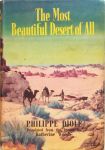
Even before I turned to camel trekking, one of my favourite Sahara books was a translation of Philippe Diole’s 1956 The Most Beautiful Desert of All(reviewed; aka: Sahara Adventure in the US).
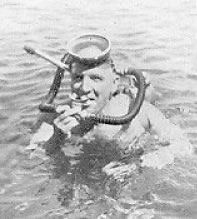
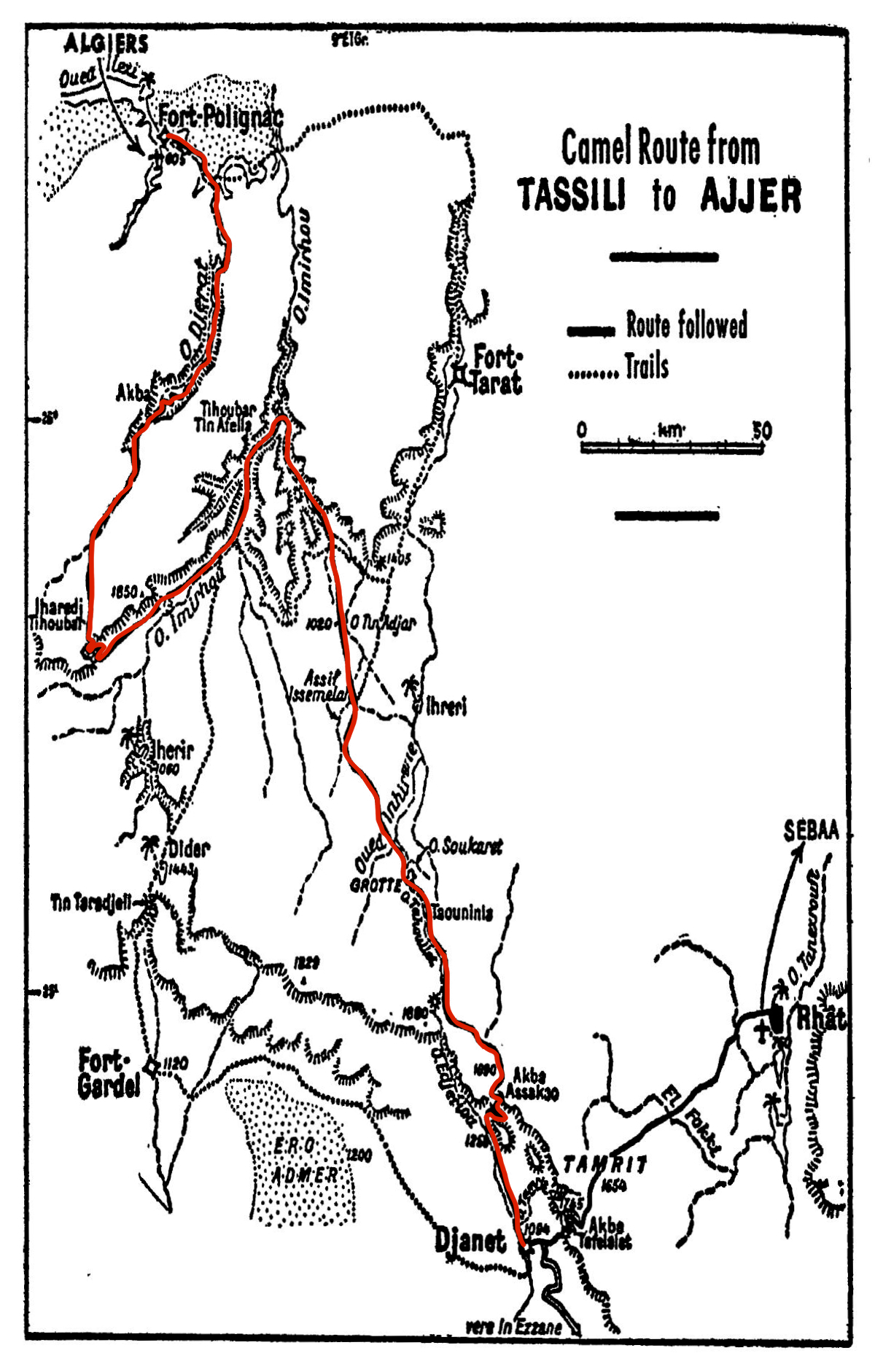
Philippe Diolé was an adventurer and author best known for his many diving books written in the infancy of scuba (Self Contained Underwater Breathing Apparatus) which had been invented by his later friend and associate, Jaques Cousteau. It’s said he was a regular crew member on Cousteau’s boat, the Calypso. Around 1953 he flew to Fort Polignac (today’s Illizi on the north edge of the Fadnoun plateau) and set off on a month-long camel trek down the Oued Djerat. In the 1930s I believe this was the first location in southern in Algeria where French administrators and others like E F Gautier and Henri Lhote became fully aware of the extent, variety and quality of prehistoric rock art which went on to be to be found right across the Tassili n Ajjer plateau, and continues to be found to this day. With his unnamed, scrawny Tuareg guide and Ali, a cook boy, from Djerat they continued south to the Tihoubar track and followed what is now a road northeast to Imirhou, before turning south again across the bare plateau towards the Assakao pass leading down the Tassili’s southern rim and into Djanet. Diolé had been told by Commandant Imbard at Fort Polignac of a rock shelter painted with fine scenes which Imbard had seen over a decade earlier.
… I am determined not to leave the locality without finding that cave. Commandant Imbart remembered having seen there a fish painted on the rock.
A few days from Djanet near Wadi Tahouilet, Diolé’s guide finally locates a rock shelter painted with fish and giraffes.
The guide has run on ahead of me into the cleft, and now bursts out of it again, with a glad cry: “Sardinal Sordinal” (To a Targui today, practically the only fish in existence are those that come in cans.). This fish, however, bears no resemblance to a sardine. It is enormous, and it is painted in a beautiful shade of dark violet. From head to tail it measures twenty-three inches. A good catch! On the back, a little behind the head, two horns are plainly visible. Beside this creature is painted a figure whose feet and arms appear to be branches covered with leaves. Even its sex is shadowed over, and its head is crowned with branches. This prehistoric grotto measures ten and a half feet in depth by eighteen in length. A bulky pendant block divides the ceiling into two separate domes. The walls are almost entirely covered with paintings, which differ in subject, style, and colour. Human silhouettes, dogs, oxen, wild sheep, scenes of the hunt and of war follow one another across these rock surfaces. Especially noteworthy are two admirable giraffes with speckled coats. In prehistoric times the giraffe was probably the ideal game animal of the Sahara: not very wild, visible from a distance, harmless, prolific [and] living in herds…
Attracted, as many of us are to places off the beaten track and obscure historic routes, I’ve long thought it might be fun to try and retrace either Diolé’s route across the plateau to Djanet or to visit the Cave of the Fishes. But even when reading the book years ago, I had a feeling this was already a little-used trail. It’s doubtful anyone’s been that way for decades. Most tours now sweep across the much more accessible and even more impressive rock art sites close to Djanet at Tamrit, Sefar and Jabbaren.
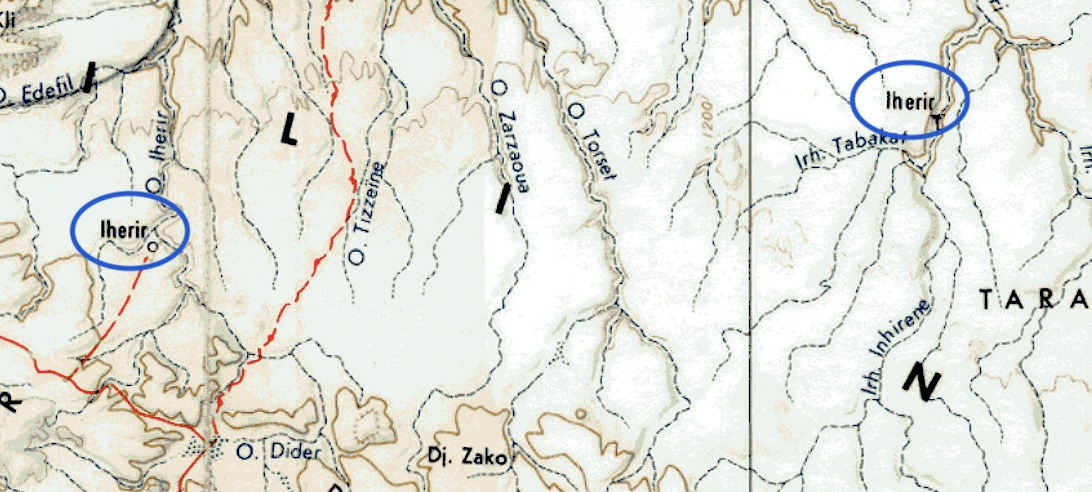
It’s a well-worn Saharan cliché, but Diolé’s route also passed close to a genuine ‘lost oasis’ that I’ve also been curious about: ‘Ihreri’ is some 80km NNW of Djanet and often mistaken with the much more visited Iherir now easily accessible off the Fadnoun road. Sacre Bleu, even the 1967 IGN 1:1m map (above) mistook the similar names and printed a second ‘Iherir’ in the east. Local guides actually call it Inhirene, like the also misnamed oued on which it is situated.
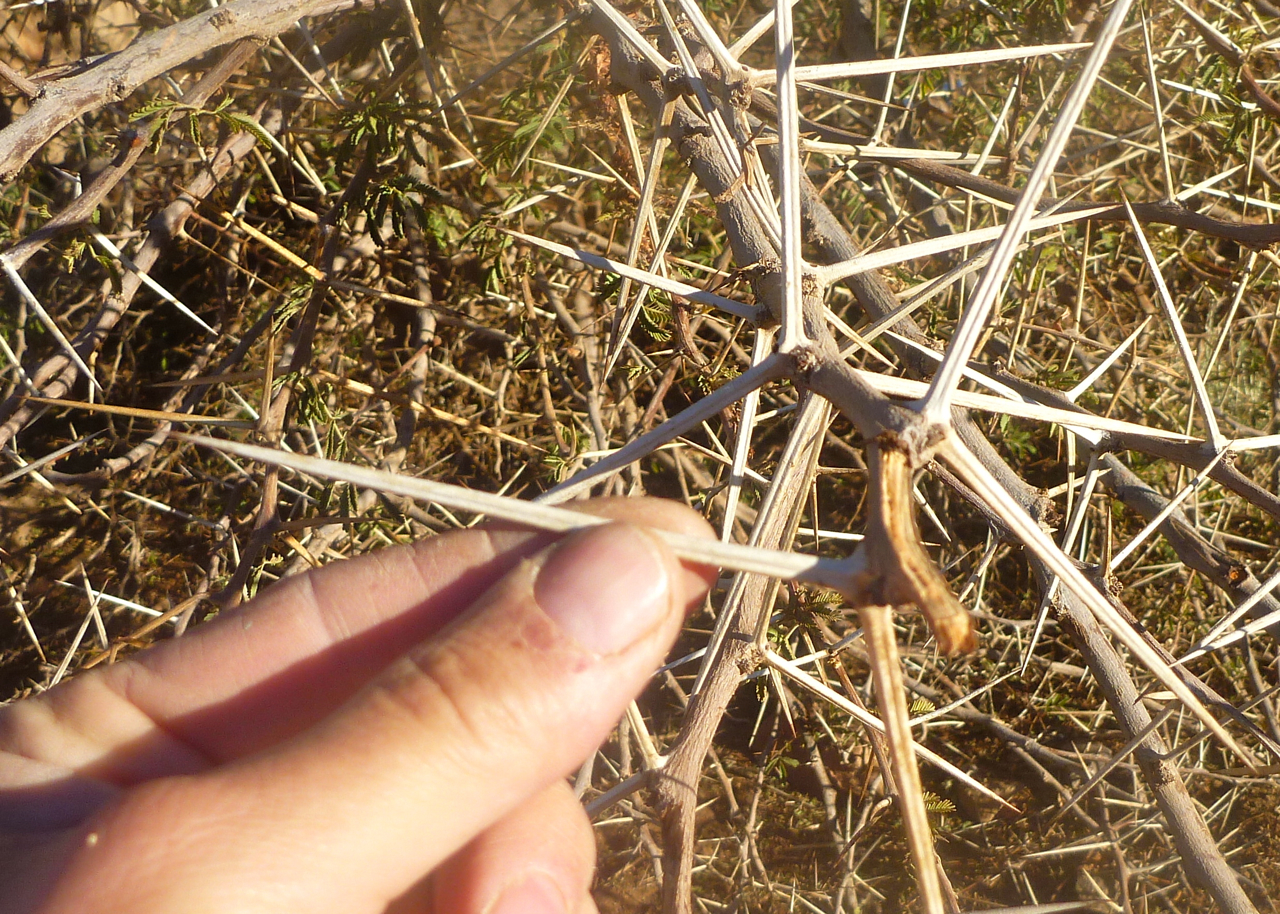
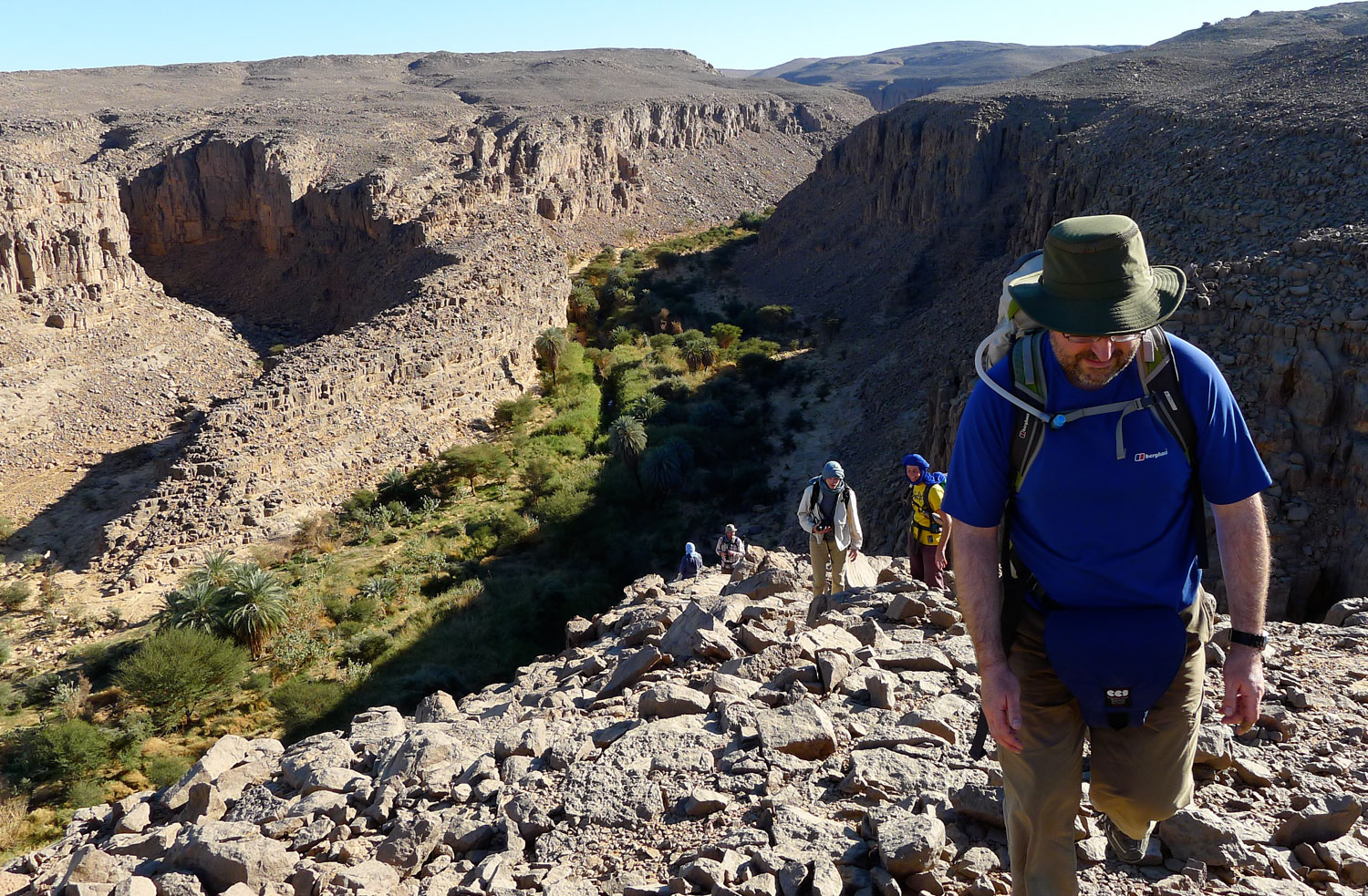
Tucked down in its small canyon, ‘Ihreri/Inhirene may well resemble the similar, semi abandoned oasis we came across on an Amguid Crater trek in 2010 (above), set in a region prolific with Stone Age megalithic tombs. The grassy patches as well as the sudden density and rustle of date palms were an unexpected sight after a week trekking across the open desert with nothing bar a thorny acacia for shade.
I’m also sure I watched a (German?) documentary in the mid-1980s about some tourists reaching a very remote oasis in the Tassili and getting a hostile reception. For some reason I think this may have been Ihreri, occupied by the grumpy vestiges of its date-cultivating denizens. Inaccessible by car, now it’s possible the only visitors come seasonally with camels to maintain or harvest the palms.
On and off I’ve tried to get the Diolé plan off the ground, being told among other things it was too hard or there was very little herbage on the plateau that year. But recently I made contact with an Algerian agency that seems keen to try something outside of their well-trodden comfort zone. Perhaps the easy ‘fly-in’ work is getting a bit repetitive these days. Venturing off the well-worn tram rails and into the unknown has its risks – uncertain herbage for the animals as well as vital water sources for all. But by first proposing a recce to establish a longer trek’s viability, in 2026 we hope to be visiting the Cave of the Fishes and the Lost Oasis of Ihreri.
Together with four friends, I recently completed a four-week tour in Chad. One car came from Belgium via the Atlantic Route and then through West Africa. A second car was rented (with the compulsory driver) for 80,000 FCFA/day (‘XAF’; €120).
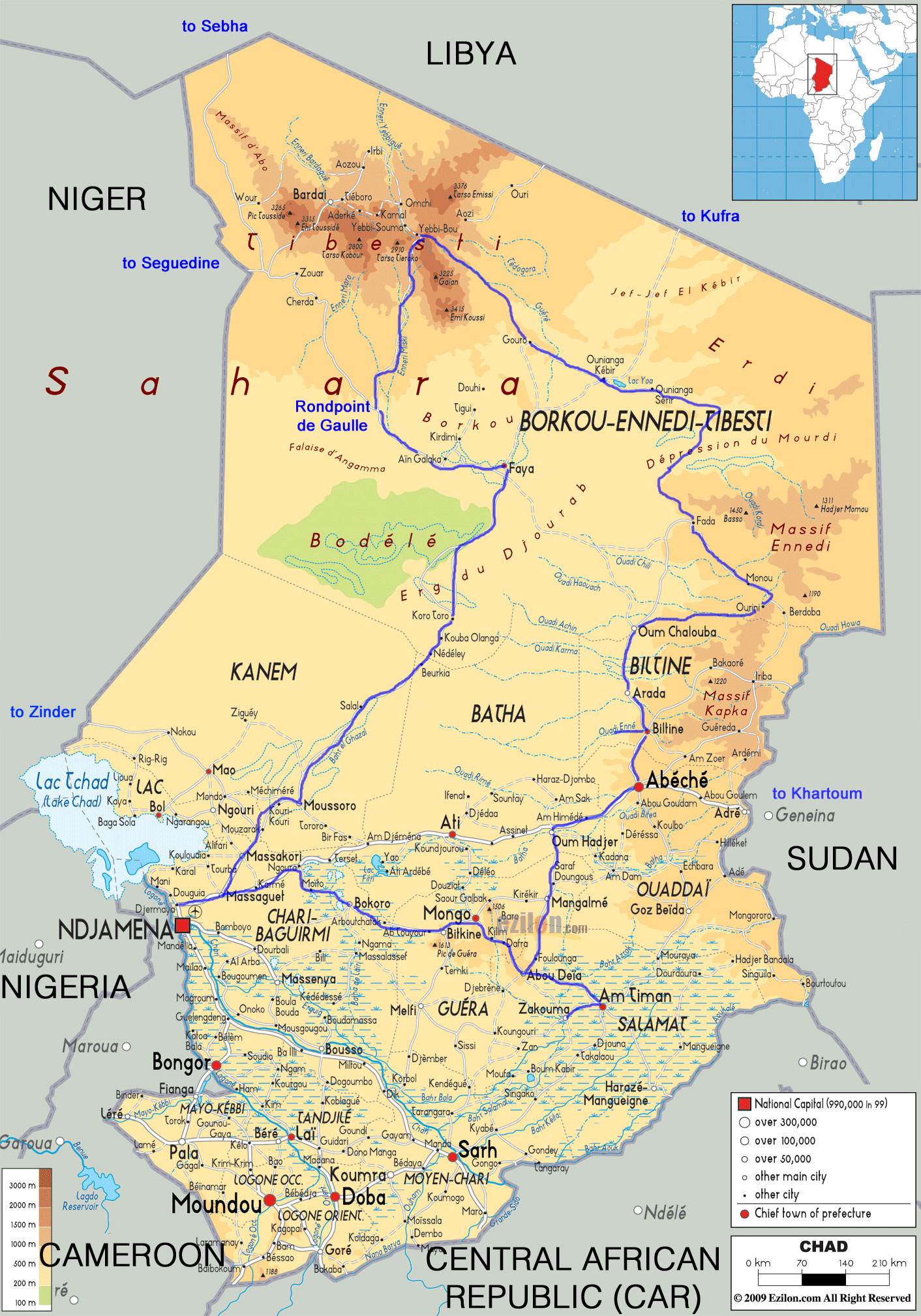
Our itinerary (see map, right) took us from Ndjamena anticlockwise down to Mongo, Zakouma NP, up to Abéché, Kalait, Ennedi, Fada, Demi, the Ounianga lakes, Gouro, Yebbi Bou in the Tibesti then Faya, Moussoro and back to Ndjamena.
Although the era of ‘mass tourism’ might be said to have arrived to northern Chad, the Authorisation de Circuler is still compulsory, as is the registration in Ndjamena (procedure still the same). However, we didn’t have a single police/gendarmerie check during the whole stay. Only the newly created Office du Tourisme Tchadien (known to everybody as ‘OTT’) checks the AdC in Fada and Ounianga. In Gouro and Yebbi Bou the Gendarmerie/Sous-préfet were vaguely interested in it too.
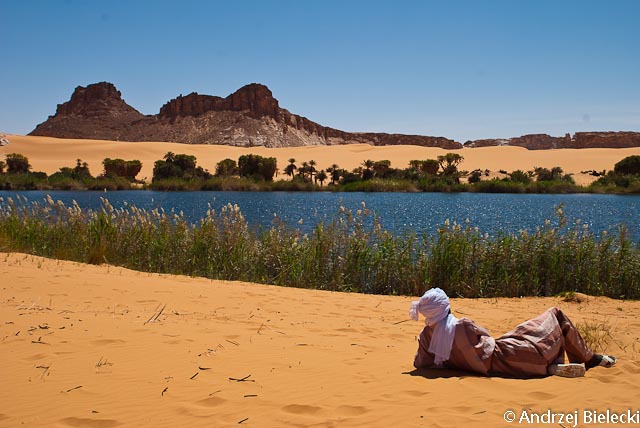
During the season the main sites around the Ounianga Lakes and in the Ennedi massif are visited on a daily basis by the tour groups of Point Afrique. Seven sites in this region now charge 5000 FCFA/person (€7.5; change from the former 50,000 FCFA per group policy) and even issue receipts. Some souvenir sellers have also have appeared. In Bachikele, near Guelta d’Archei, the chef du canton tried to charge us the old rate; we refused and left but were still, apparently, chased by young men with AK47s. We complained to OTT in Fada and the ‘délégué regional au tourisme’ admitted this was the fourth time this season this happened at Bachikele. But OTT does seem to have some kind of authority; they quickly found our guide in Fada and all of a sudden every Chadian that argues with tourists becomes very easy-going when OTT is mentioned (concrete example taken from a discussion with a guide we hired that wanted more than the agreed price…).
We took a guide from Fada to Gouro through Demi and the Ounianga lakes which is not absolutely essential but was still very useful (six days – 140,000 FCFA). The second guide (Gouro to Yebbi Bou, Meski, Rond Point de Gaulle and Faya) cost us 170,000 FCFA for five days. A guide south through the Erg du Djourab is not necessary unless there’s a sand storm; the tracks are very obvious and the balises clearly visible.
The three-day route from Ounianga Kebir to Kufra in southeast Libya sees only erratic traffic since 2011 and merchants were complaining. However, the Sebha to Faya piste through the Passe de Kourizo sees quite a few Mercedes trucks plying the route in about five days. We saw a few en route and about a dozen Libyan trucks in Faya. There is a Libyan consulate in Faya but only Tubus risk this drive (see also this).
As it probably comes from Libya, fuel is much cheaper in the north, but as before is sold only in 220-litre drums for between 75,000 and 90,000 FCFA. In the north it’s also much easier to find petrol as many cars are imported from Libya. In the Tibesti it might even be difficult to find diesel. In Ndjamena a litre costs about 550 FCFA (€0.84) in a fuel station.
Mobile coverage was widely available in the south. In northern Chad Salal, Faya, Gouro, Ounianga Kebir, Fada and Kalait had signals. The network broke down in Gouro three days before we came.
Road to Sudan From Abéché it’s possible to drive to Sudan; the border seems open. However, the Sudan embassy in Ndjamena only issues visas to residents of Chad. There’s also a consulate in Abéché but we weren’t able to check with them. There seems to be tarmac from El Geneina to Khartoum, but the trucks go in a convoy escorted by the Sudanese army every week or fortnight. I imagine one could show up in El Geneina and join the convoy or pay the army for a private escort. Abéché to Adré takes 3-4 hours. The road from Ndjamena through Mongo to Abéché is tarred almost all the way (will be finished in a few months). There are about six toll stations, each is 500 FCFA/vehicle and a receipt is issued.
AQIM Travel in the Sahara has long been disrupted by the activities of AQIM and similar groups including Boko Haram based in nearby northeastern Nigeria. And as we all know, Chadian troops are currently engaged with French and Malian forces in Operation Serval in northern Mali and there was a coup in CAR a few days ago, and you wonder if this might lead to a resumption of the normal Chadian state of affairs. Hopefully not. Our conviction was that as long as we stayed clear of border areas we would minimise the risks.
President Deby has recently decided on the creation of many new Départements, Régions and Sous-préféctures. Almost all villages in the north are now virtually sous-préféctures where the sous-préfet (usually a local elder barely speaking French) appreciates visits from the foreigners. They are the link between the State and the local tribal authorities and get new Land Cruisers, offices and even a residence. I imagine this is another way for Deby to strengthen his grip on the north. He himself originates from just south of the Ennedi and his tribe, the Zaghawa, extends as far as Bachikele and Monou. I cannot imagine that some of the revenue from tourism doesn’t flow back to high circles in Ndjaména. I therefore think there is a major interest in safeguarding security and preventing foreign infiltrations in Chad by ensuring a revenue and the preserving the power base of the President. That’s the assumption under which we travelled but only the future will tell if we were right.
Part of the occasional Sahara A to Z series
Hang around long enough and you’ll get the full set
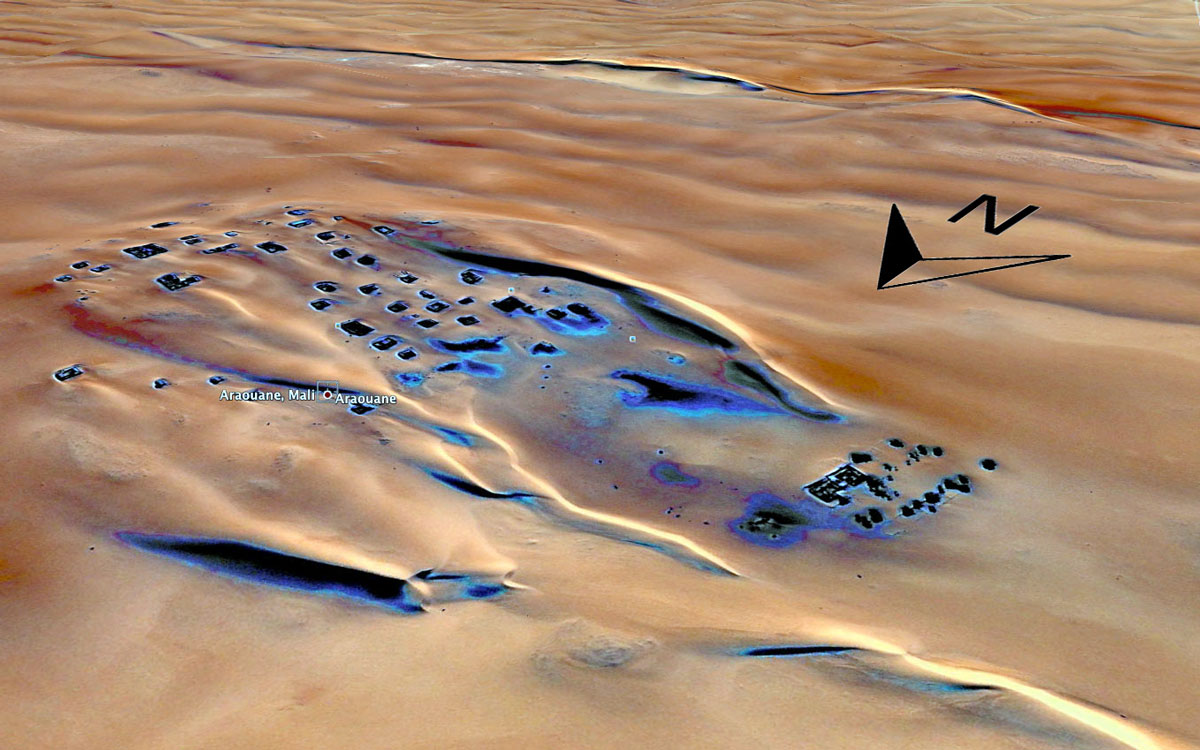
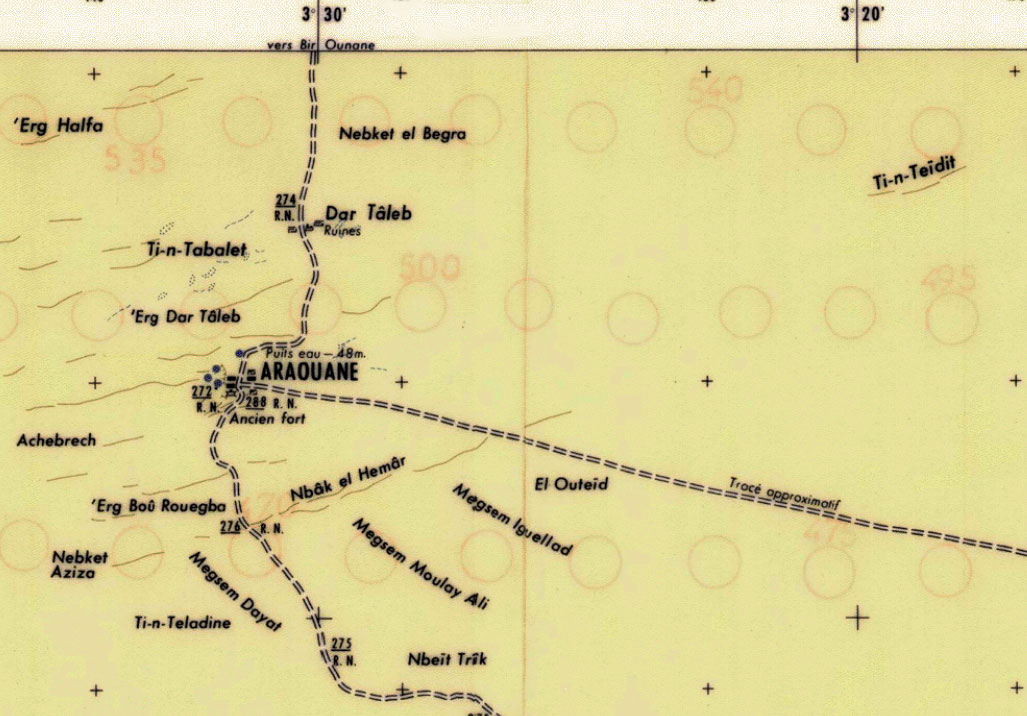
Looking at the screenshot of the Google sat image on the right (direct link), the village of Arawan some 250km north of Timbuktu seems to resemble the debris of a shipwreck adrift in a caramel swell.
I’ve never been there, though passed some 80km to the northeast during our SEQ transit to Algeria in 2006.
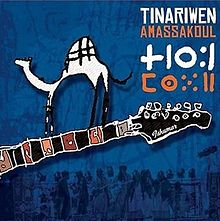
Some might recognise ‘Arawan’ as the rap track from a Tinariwen album, Amassakoul or ‘The Traveller’. As far as I can tell the lyrics match the received assumption of a once great but now near-abandoned town slowly being either swallowed up by the pitiless desert or simply changing times.
Photo Alistair Bestow
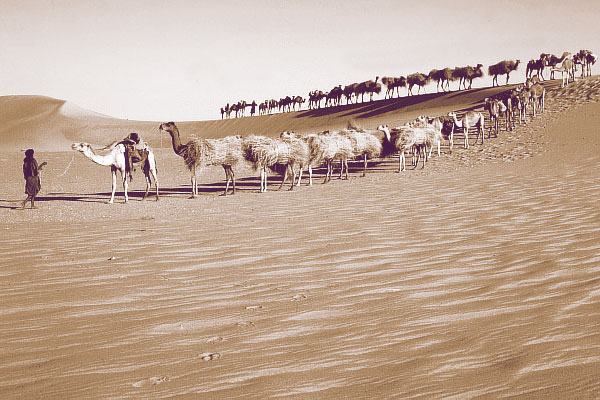
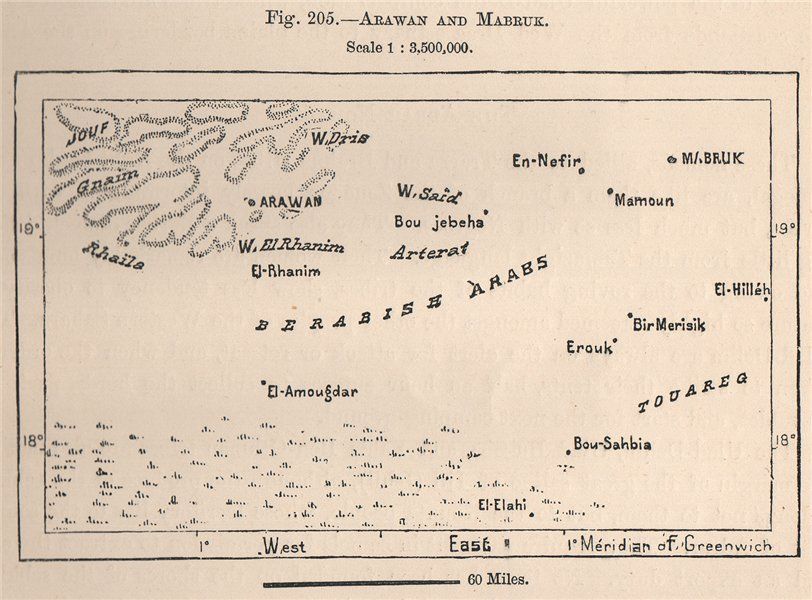
Arawan is the only permanently occupied village on the 700-km azalaï caravan route (left) to the salt mines of Taoudenni in the far northwest of Mali. Today, depending on the time of year, a couple of hundred live in Arawan, including an imam who tends to the shrine or mosque of the holy man or saint, Cheikh Sıdi Ahmed ag Ada (or Agadda; 1570-1640). It was he who refounded the settlement in the 17th century and is venerated as the ancestor of all the ahl Arawan (‘ahl’ being to Arabic as ‘kel’ is in Tamachek: ‘people of…’). The ruins of Dar Taleb (or Alphahou), just to the north of the village, have been dated back to the third century AD, making the site much older than Timbuktu.
The basis of any settlement is a reliable water source and Arawan once had scores of wells to enable the speedy watering of the passing caravans. You can only assume that nearly 500 years ago there was more pasture to sustain a livelihood than there is today. As it is, this flat expanse of northern Mali seems to be typified by enigmatic patches of grassy tussocks scattered across entirely barren sand sheets and the very occasional escarpment.
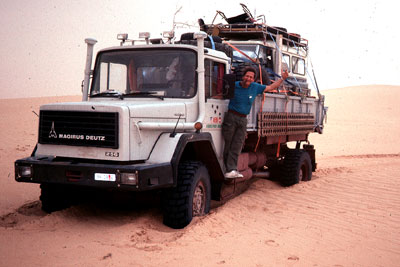
Fast forward from Sıdi Ahmed a few centuries and the Swiss American Ernst Aebi comes to Arawan. He’d made his fortune developing property in New York and had raced the Dakar. In the late 1980s he discovered the semi-derelict Arawan and decided to establish the ‘Arbres pour Araouane’ project to help revive the village.
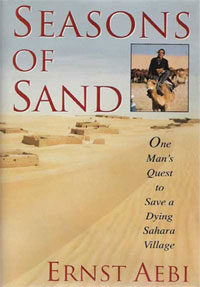
He helped build a small market garden, a tamarisk plantation and eventually even a small hotel; all typical ‘Aebian’ ventures, which owe more to his dynamism and energy than sustainable, long-term goals. Little remains of the hotel today and the garden was ransacked in the early 90s at which time he was forced to leave the region during a Tuareg rebellion and the vicious army reprisals which followed. He wrote a book, Seasons of Sand, about his time there, and later a film: ‘Barefoot in Timbuktu‘, was made about his return to Arawan, which had of course reverted to the state he’d found it in 20 years earlier.
Now over 70, Aebi (left) does sound like quite a character. Pick on any post from his blog and you’ll get the picture of the guy who is still living full life.
More recently social anthropologist Judith Scheele wrote an interesting paper about a pilgrimage of urban, well-to-do ahl Arawani from Bamako to the shrine of their ancestor, Sıdi Ahmed ag Ada. I don’t read such material by habit, but her digestible account of the complex social interplay of the long departed ahl Arawan and their timely piety set against the poverty-stricken and somewhat cynical villagers is amusingly absorbing. It turns out their trek was not just a spur of the moment adventure. At that time in 2007 oil exploration was underway in the Taoudenni basin to the north, and throughout history the ahl Arawan traditionally had a stake in the control and subsequent revenue from the salt mines. By marching into town, the dilettante ahl Arawani hoped to flag up their credentials for all to see as historically legitimate beneficiaries of the region’s resources.
Her short paper also sheds a light on the complex ethnicity of northern Mali; doubtless no less than any other region of Africa. I’d assumed it as just desert Tuareg or void, but the Tuareg homeland is specifically in the Ifoghas or ‘Adagh’ as some like to call it; northeastern Mali centred around Kidal. To the west of the Tanezrouft piste are the Tilemsi Arabs, Kounta, also Arabs and what might be called ‘Moors‘ around Timbuktu, with Songhai (indigenous West Africans) spread right through. Setting aside the thorny issue of former slaves of both Arabs and Tuareg, there are added hierarchies based on religious ancestry or legitimacy – those who called themselves sharif or descended from the Prophet. I learned about the similar status of ‘Hassans’ from American PCVs in Mauritania in the late 80s. In this way a penniless nomad in Arawan may claim to be higher up the social scale than an ahl Arawan who’s just driven up from Bamako in a flash Land Cruiser.
Gregg Butensky. Madnomad.com
Some scoff at the holy man of Arawan. It’s clear from his name that Sıdi Ahmed ag Ada was no more than a Tuareg, probably from Essouk in the Ifoghas (‘ag’ being a Tamachek equivalent of the Arabic ‘bin’). Essouk, 60km northwest of Kidal, was the site of a Tuareg music festival (above) for some years; Gregg Butensky wrote about it in my Sahara Overland book. Nearby are the pre-medieval ruins of Tadmakka excavated by Sam Nixon Nixon and on a par with the better known former entrepôts of Koumbi Saleh or Aoudaghost in southern Mauritania, or Ouadane (left) further north.
mali-nord.de
For a good impression of the region north of Arawan here’s a detailed report and gallery from 2007 by Barbara and Henner Papendieck who paid a visit to Taoudenni as part of their humanitarian work in the region (map right, click for full size). This was just before the spate of kidnappings kicked in, but even then they needed to organise an armed military escort. There are some great images of the actual mine site as well as the old prison. Below is a dramatic picture of the Sidi’s mosque in Arawan.
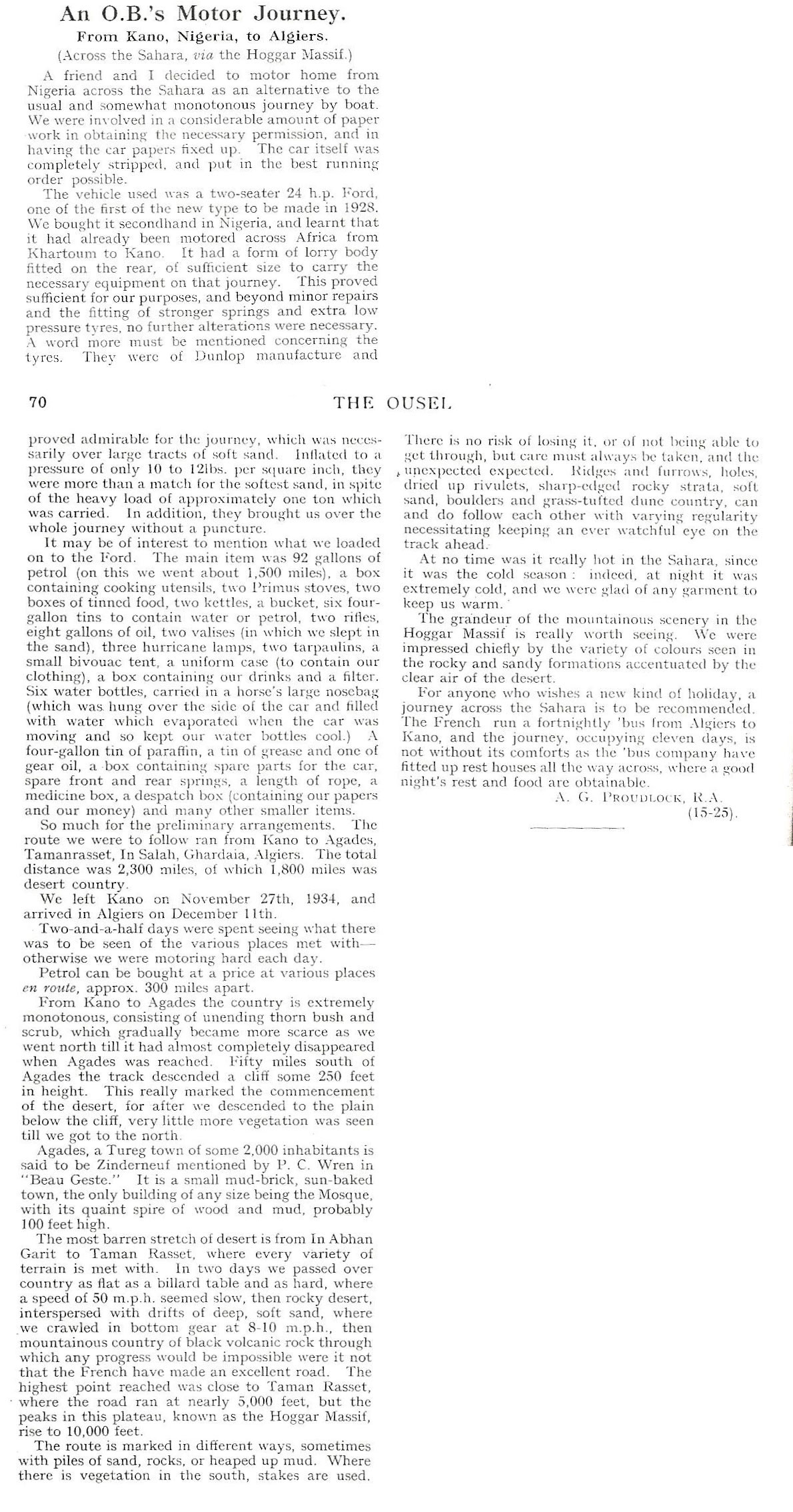
While having a clear out former trans-Sahara pilot, CP Hamp recently came across some copies of The Ousel, his old school magazine produced by Bedford School. One issue from 1934 contained a brief report of an Old Bedfordians’ trans Saharan adventure in 1934.
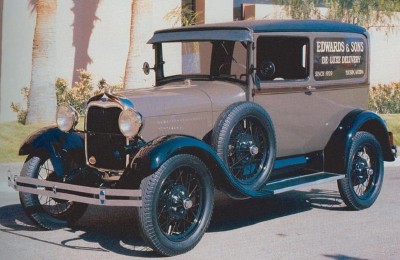
Following a spell in the army in Nigeria, the duo picked up a 1928 24-hp Model A Ford, probably like the one pictured above right and which had already been driven over to Kano from Khartoum. The ex-Bedford School duo’s off-road stage went north to Agadez and then via In Abangarit (the old piste to the west, not present day Arlit) to arrive in Algiers just two weeks later.
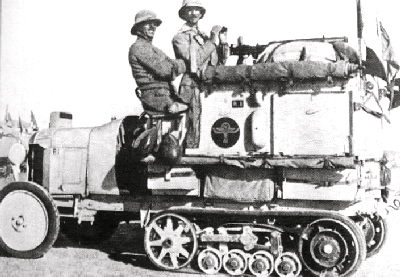
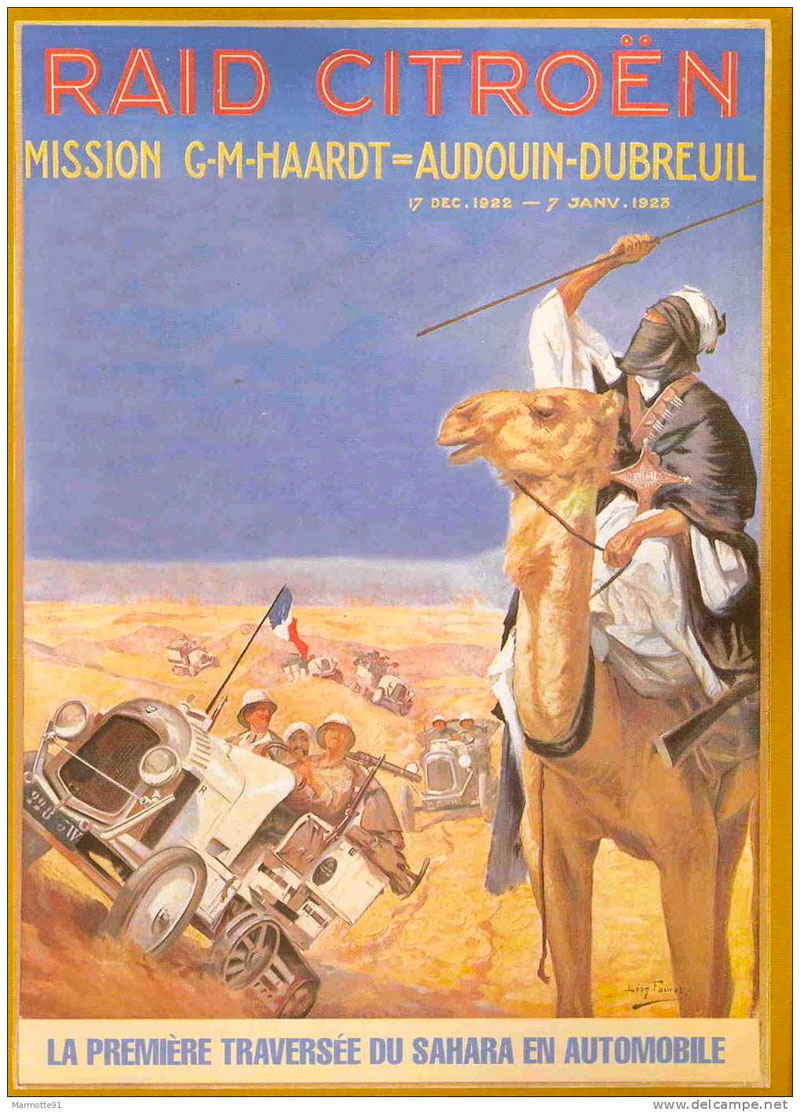
All this was barely 11 years after the first motorised crossing of the Sahara by half-track Citroën Kegresse ‘autochenilles‘ (left and right) which drove from Ouargla to Tam then southwest to Bourem on the Niger river via Tin Zaouatine and Essouk near ancient Tadmakka in the Adrar des Ifoghas, following a trans-Sahara route dating from the medieval era. You’d think this must have put the Old Bedfordians amongst the first Brits to motor across the Sahara at around the same time our man Bagnold was chasing the dastardly Almasy around the Gilf Kebir.
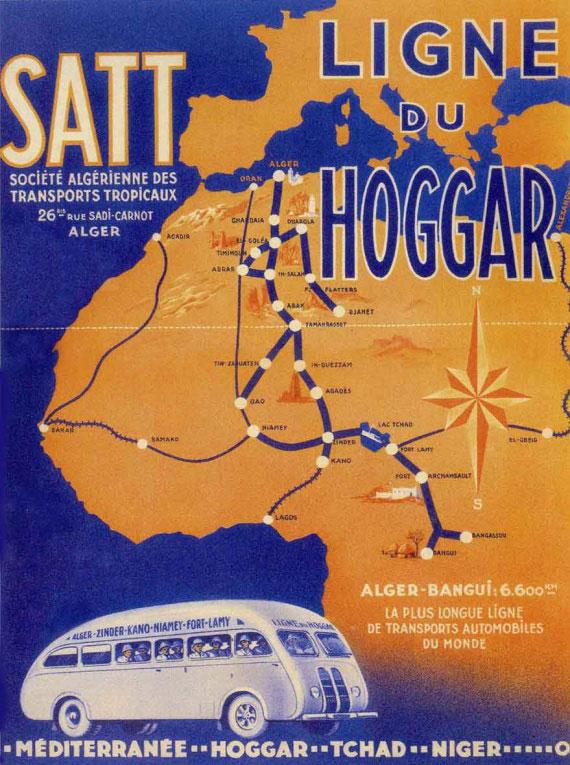
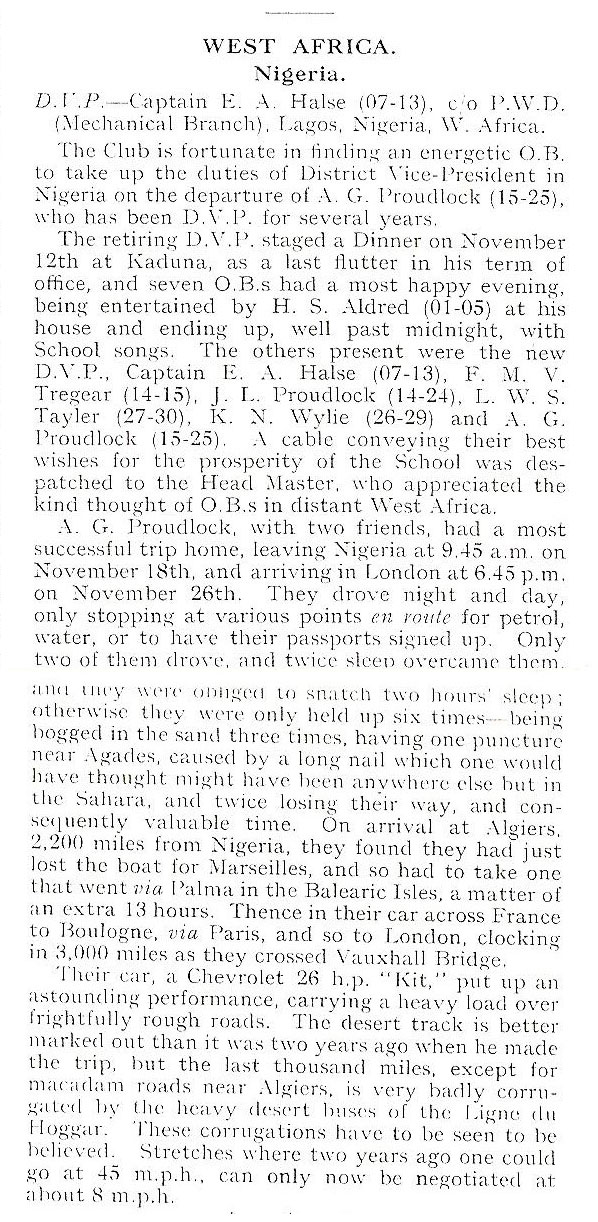
The author A G Proudlock mentions that the SATT bus service (left) did the same run in just 11 days so it seems two years later the plucky A G Proudlock decided to do it again, and this time outdo the streamlined desert bus. With a couple of chums they stuffed themselves into a 26-hp Chevrolet (possibly a 4-90 like this) and drove round the clock to incredibly clock up exactly 3000 miles between Kano, Majorca and Vauxhall Bridge astride the Thames in little more than a week!
Motoring across the Sahara during the French colonial era was quite different to recent years and was subject to much stricter regulations, but did at least come with the promise of rescue if overdue.
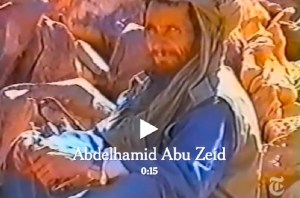
In early March 2013 AQIM confirmed that MBM rival Abu Zeid (left) was killed during the French Operation Serval in northern Mali. Full story here. Interestingly, the NYT video linked below shows the 4′ 9″ jihadist was involved in the 2003 abductions too (left). In 2015, and again in 2016, it was also reported that MBM had been killed by airstrikes in Libya. He no longer features on US wanted lists, but this article in 2017 suggests he’s still influential, while not spelling out if he’s actually alive.
In March 2013, following weeks of ostensibly effortless liberations of north Malian towns while jihadists repeatedly slipped away into the desert to fight another day, the French-led Operation Serval concluded a decisive but protracted battle in the far north. At the time the Chadian army announced the death of the notorious Abou Zeid (‘ABZ’, left) in the valley of Ametetai (or Amettetaï) somewhere inthe Adrar des Ifoghas hills. It was confirmed by DNA tests a few weeks later.
The strategic significance of this obscure valley became clear when the assault began in mid-February. A huge effort was made to defend it during which time scores of militants as well as many Chadian soldiers were killed and huge caches of arms were found. A few days after Ametetai had been ostensibly cleared there was perhaps hasty talk by the French of drawing down their troops in April, while the French defence minister deemed it safe enough to make a surprise visit to the battle site a few days later.
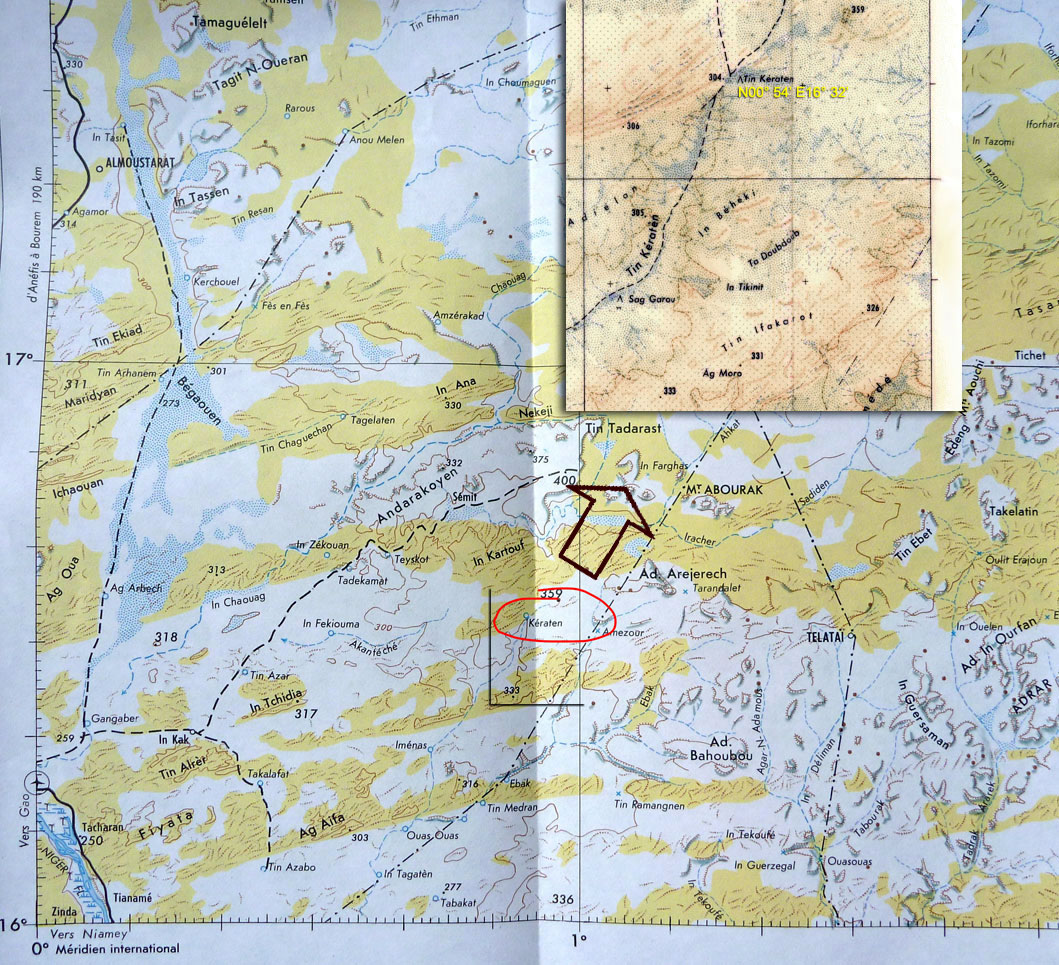
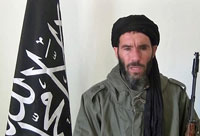
Just a day after ABZ’s death, Moktar Belmoktar (‘MBM’), supposedly ABZ’s rival and with him one of the three key jihadist ’emirs’ in north Mali at the time, was also (but incorrectly) reported killed by the Chadians. In fact the Pimpernel-like MBM had been ‘killed’ many times in the last decade or two (mostly recently in 2015 and 2016). In 2013 shot to Bin Laden-like prominence as the instigator of the suicidal attack on the Algerian gas plant at In Amenas. It’s more likely that at the time MBM (right) may have been directing AQIM operations further south, possibly in the region of Tin Keraten. Old maps label this as a well and a oued, some 100km northeast of Gao and 220km south of Kidal (see map above left). It doesn’t seem to match the terrain profile of Ametetai, but a battle was reported here a day or two later and where a fourth French soldier was killed. It’s also just as likely that before it’s all over MBM may yet again slip away into the neighbouring countries or that he was never there at all. The latest news is that following an ineffective US air strike in 2015, in November 2016 a French drone strike in southwest Libya injured MBM gravely. He has been removed from the American RFJ programme and has since lost his position in the Al-Mourabitoun group he led.
Abou Zeid
Real name Mohamed Ghadir, a small-time smuggler from Deb Deb in eastern Algeria close to the Libyan border (a book including his background reviewed here), Abou Zeid named his katiba or brigade ‘Tarek Ibn Ziyad’ after the 8th-century Moorish general who conquered Spain (‘Gibraltar’ is an anglicised version of Jebel Tarik). Following spells in prison, Abou Zeid rose up the ranks of the GSPC and became noted as a hardliner – ruling his group with ‘an iron fist’ as one former French hostage explained (her husband remains in captivity in north Mali). ABZ was said to be responsible for the execution of British-born hostage Edwin Dyer in 2009 (see link below) as well as more recent mutilations in Timbuktu in the name of Sharia laws. More on ABZ here.
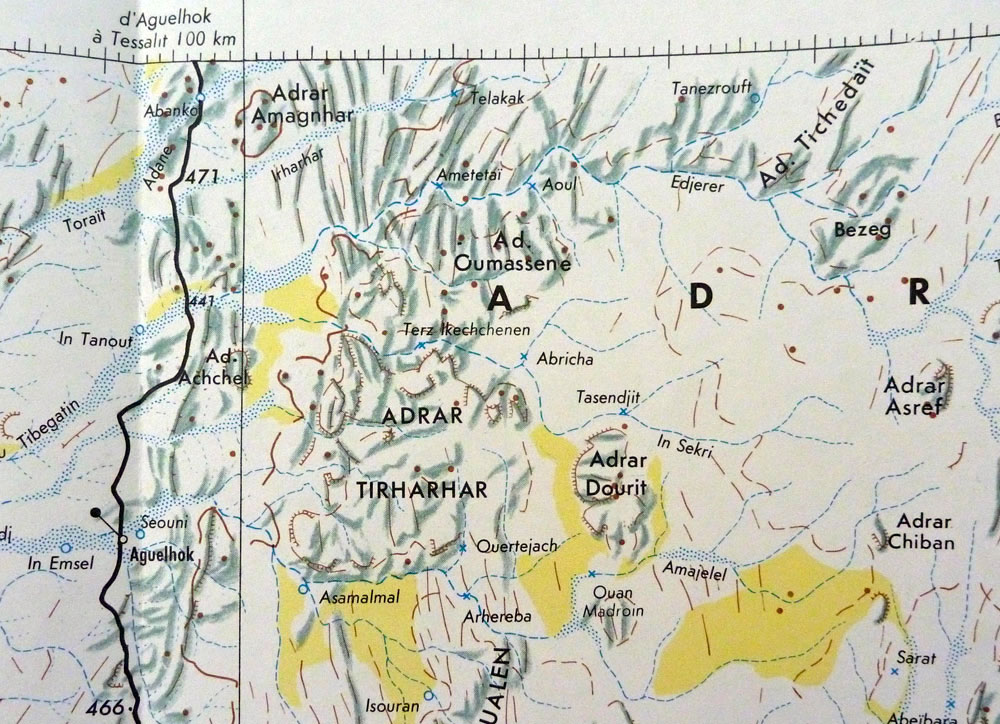
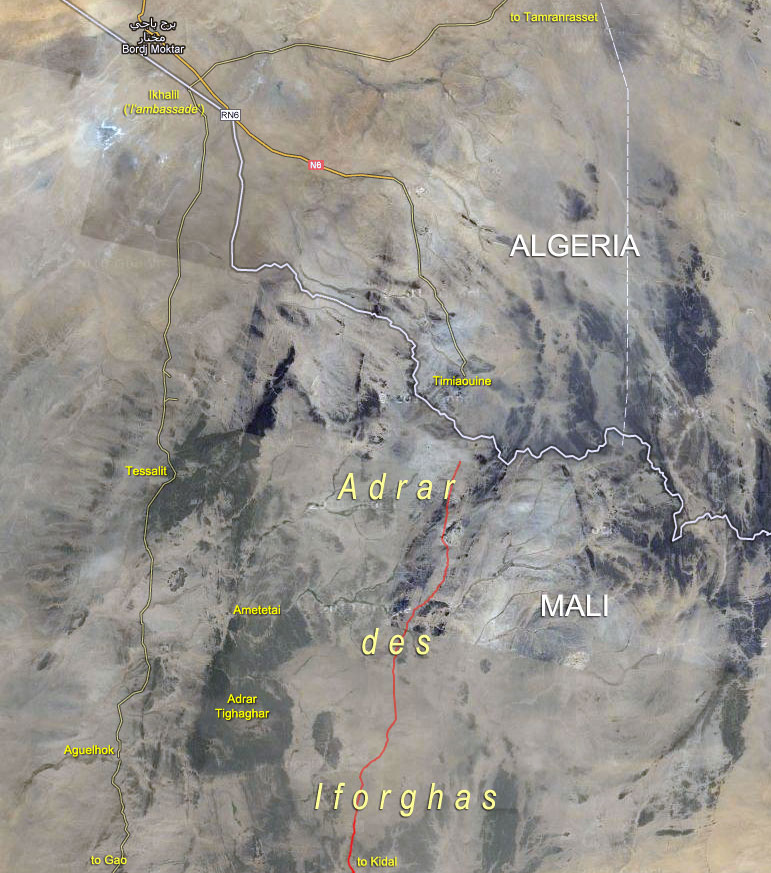
Many news reports parroted the ‘Ametetai valley’ as the location of this decisive battle which led to ABZ’s death, though none mapped it any more precisely than this BBC image. Seeing as it’s rare to get a specific location of what you presume might have been a key jihadist stronghold where some of the ten or so hostages may be kept and where ABZ’s brigade made their last stand, I tracked Ametetai down. (Some reports also mentioned air raids on ‘Etagho’ or ‘Oued? Entouwike’, as the ‘key to unlocking the bases in Adrar Tighaghar’ massif, but again, no accurate location was given and I couldn’t track them down on the usual maps.)
A well with the name ‘Ametetai’ was easily found on the IGN ‘Kidal’ NE-31 map (right), located on the northern edge of the Adrar Tighaghar hills and about 60km northeast of Aguelhok. Aguelhok is a village on the trans-Saharan Tanezrouft track which runs from Reggane, Algeria down to the Niger river and Gao (Route B1 in Sahara Overland).
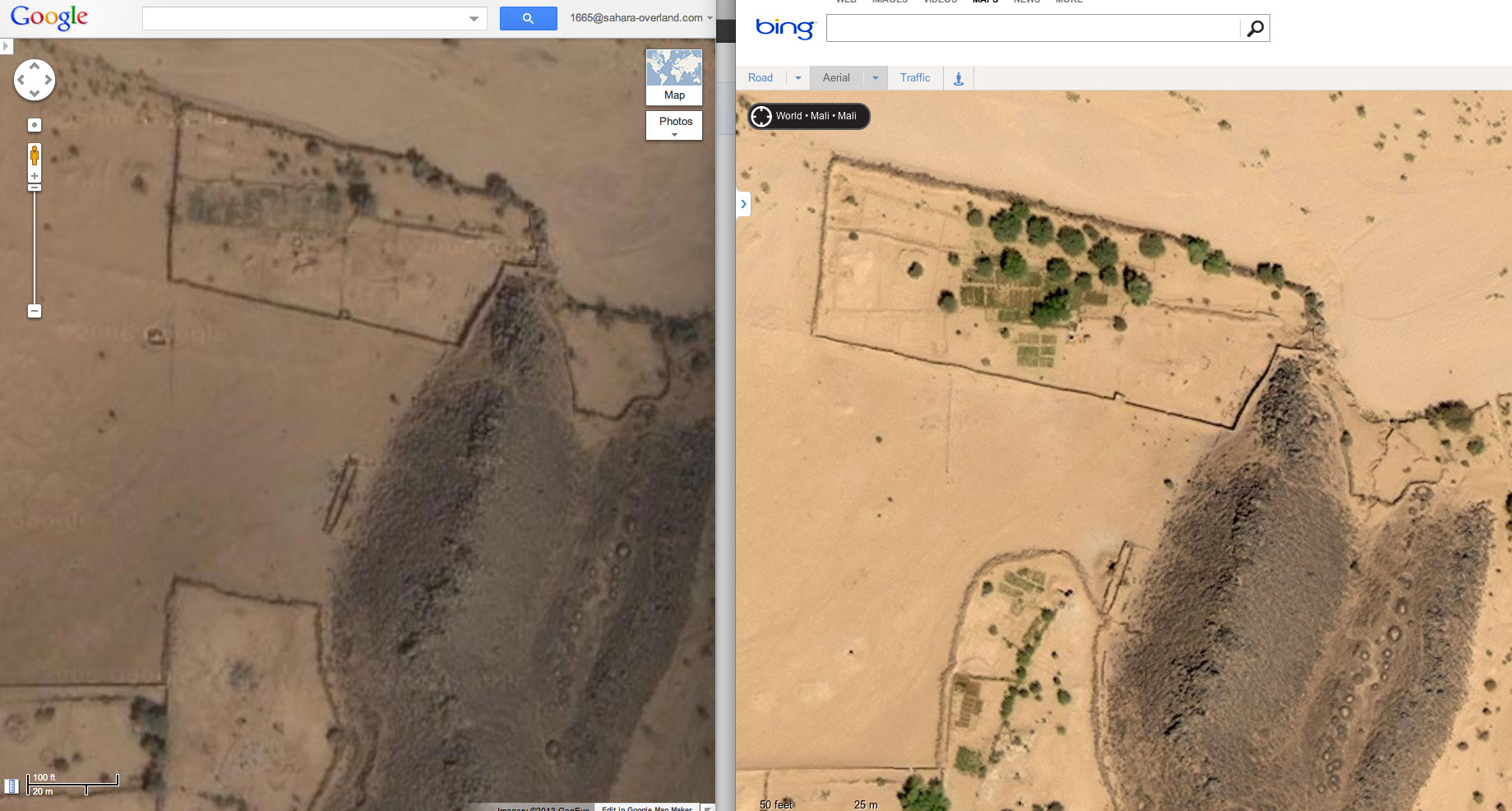
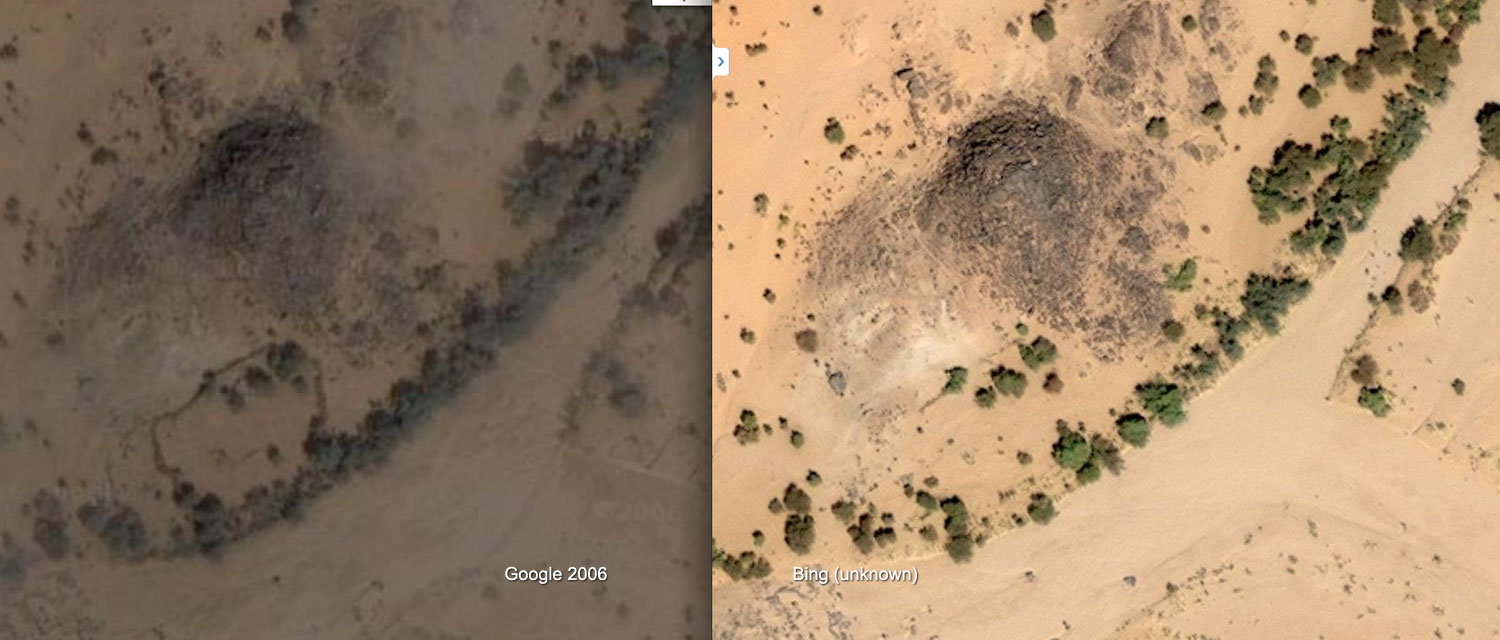
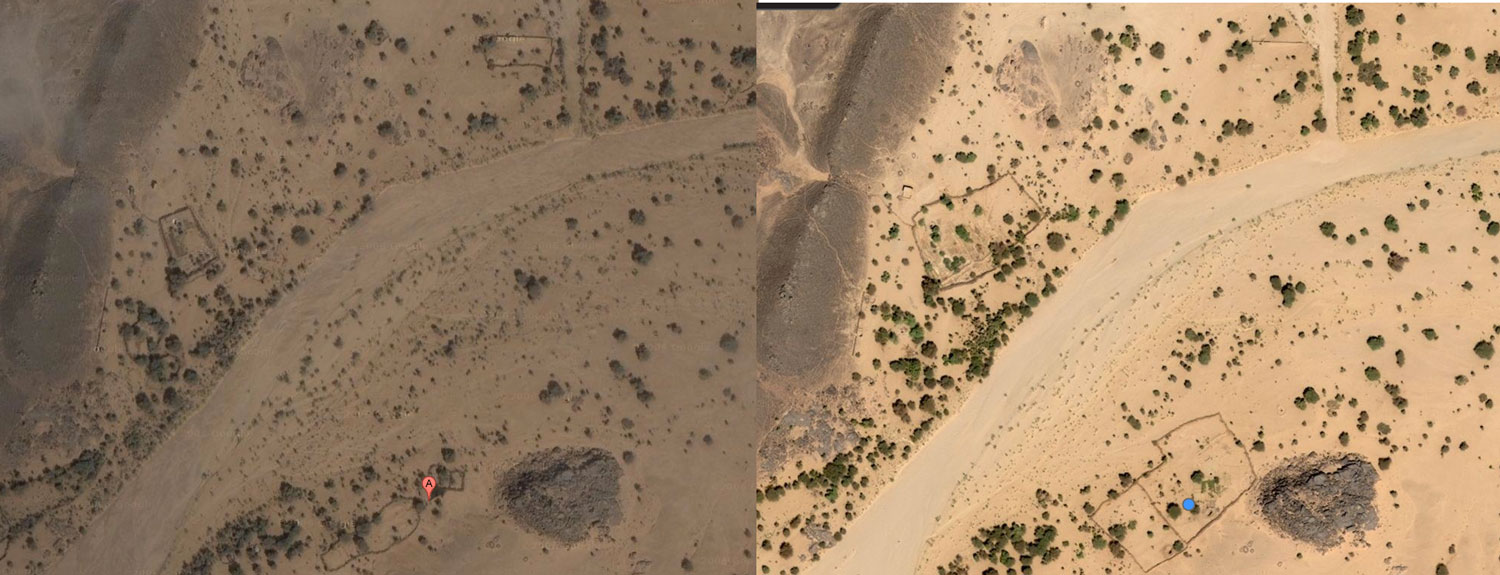
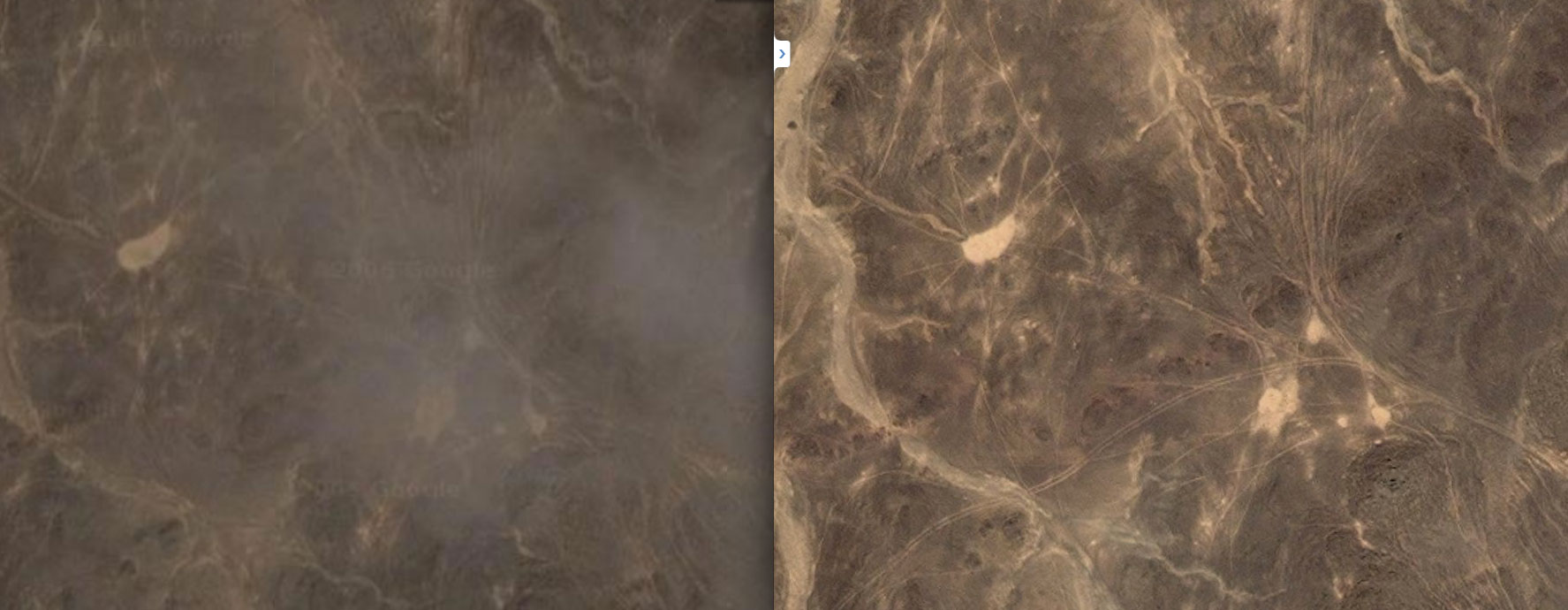
Bing vs Google imagery of Ametetai
Zoom out and around this Google maps link centred close to the site of the well as shown on the IGN map and you’ll see this ~17km2 sat image tile or quadrant (dated Jan 2006 at time of writing) is higher res than the surrounding ones. The next nearest in high res are Aguelhok and Tessalit (which we visited in 2006 laying plans for our big crossing of north Mali) so a random hi-res tile in the middle of nowhere always makes you wonder. But the Ametetai tile is also oddly spotted with unseasonal clouds for January, few of which have corresponding ground shadows which seems even more odd. Is this obstruction of ground detail significant?
For the first time comparing Google with the same area on Bing ‘aerial’ maps, it comes up as much brighter and cloud free – clearly from another occasion and time of day. On Bing there’s much more cultivation evident (see above right) as well as better developed and unusual concentrations of tracks criss-crossing the hills as below right. This suggests Bing imagery is more recent except that there are more trees which implies it’s older. In my experience trees get cut down all over the Sahara quicker than they can grow back, even by a oued.
Continuing the comparison, some walled enclosures on Google are not present on Bing (above left), while a few more on Bing have been enlarged as above right and on the left (location upstream). Perhaps the ready-made stone in old walls was taken down to expand compounds elsewhere? Finally, are the shadowless Google clouds covering up something ‘tactical’ that’s exposed on Bing Aerial? Not as far as I can tell.
You can play this ‘spot the difference’ game for a while to try and fit what is now well known to all: the ‘narco-traffiquants‘ as Chad reports derisively describe AQIM/MUHAO/Ansar Dine, had a major stronghold in the Ifoghas as has been speculated on for years. And the Ametetai valley was probably it. Here they dug caches and laid traps while successfully camouflaging their actual presence from overhead drones and presumably preparing for the assault which finally came in the form of Operation Serval. The seeming expansion of cultivation and some enclosures in a place so far from other know villages with little evidence of actual dwellings might be seen as odd.
A couple of weeks later it was reported that fighting was continuing in the ‘Hades valley… 60km from Tessalit’. This could be the next, even narrower valley to the south of Ametetai in the Tighaghar massif called ‘In Tegant’ on some maps. An unusually dense mass of tracks joins the two valleys across the stony hilltops, including the image above right.
Note: Aerial images in the region may have been updated since this article was written
What is the ‘Adrar des Ifoghas’? ‘Adrar’ usually means a region of low hills, escarpments or plateaux, but it can mean a single peak or jebel, like the Adrar Asref in the IGN map above. The Ifoghas (pronounced ‘Iforas’) is a region of low and dispersed, rubble hills spread across northeastern Mali and is also called the ‘Adagh’ by some. Separated by broad sandy plains and dissected by slender oueds, the actual ‘massifs’ barely rise a hundred metres above the surrounding 500m plain and can never be said to resemble ‘mountains’ far less a ‘near-impenetrable range’ as some reports describe. There are no distinctive peaks to speak of, nor a contiguous massif like the Hoggar in Algeria or the Tibesti in Chad, although you could say the Adrar Tighaghar is a small massif or eroded plateau within the Ifoghas.
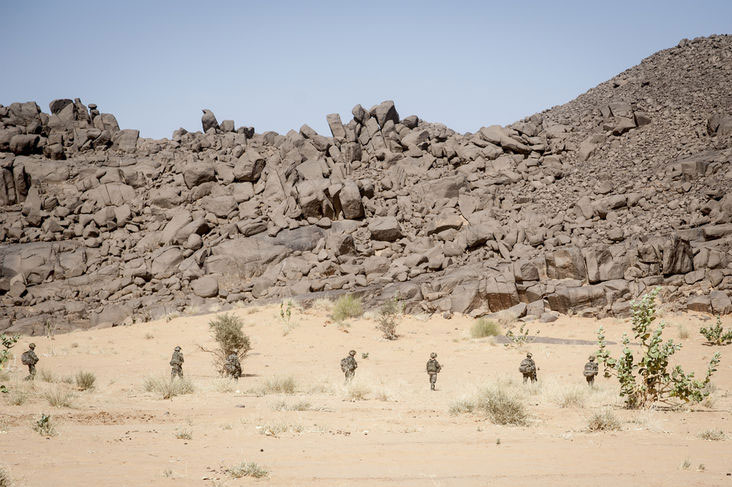
As with most low-lying Sahara hills, the composition is mostly sandstone or granite (as left), broken down by eons of weathering. In places this makes travel with anything with wheels very difficult or impossible, be it the sandy oueds which at least make natural byways, or more so on the crumbled plateaux to either side, as the Le Monde image left shows. In my experience in the Sahara, it only takes a few inches variation in the ground’s surface to reduce car speeds to jogging pace, be it sand ripples or rubble and rock ledges. Bikes manage a little better, but even on foot the effort on the sort of terrain shown above is hugely amplified. Nevertheless, for in the hills either side of the Oued Ametetai the only way in was on foot with helicopter support. (As the reports above explained, the French and Chadians did so from three sides on the final assault.) This sort of terrain is so gnarly it’s also frequently but incorrectly ascribed as ‘volcanic’ in origin, but whatever you call it, trying to across it in 40°-heat with a 40-kilo backpack while trying to dodge bullets would be hard work indeed.
However, as this blog points out, comparisons with Afghanistan’s much more rugged and allegedly betunneled Tora Bora where OBL narrowly evaded capture in 2001 are inaccurate (as is calling all the north Malian jihadists ‘Al Qaeda’). Having said that the Ifoghas’ location close to the borders of Niger and Algeria does match the Tora Bora along the Pakistani border. This must have been a factor or a welcome coincidence when the Algerian-based GSPC (later AQIM) first established itself here in the late 90s. Hostages were frequently brought down into the Ifoghas from the north or east to a place which has always been a remote outlier in Mali, with Bamako some 1200km away. You get the feeling the indigenous Kel Ifoghas Tuareg were pretty much left to themselves or neglected, depending on your point of view, while from my observations a minority of entrepreneurial Berabish Arabs (Moors) controlled a low-value smuggling commerce from places like Al Khalil (In Khalil) hard against the Algerian frontier. (That all escalated once light, compact and high-value cocaine entered the picture a few years ago).
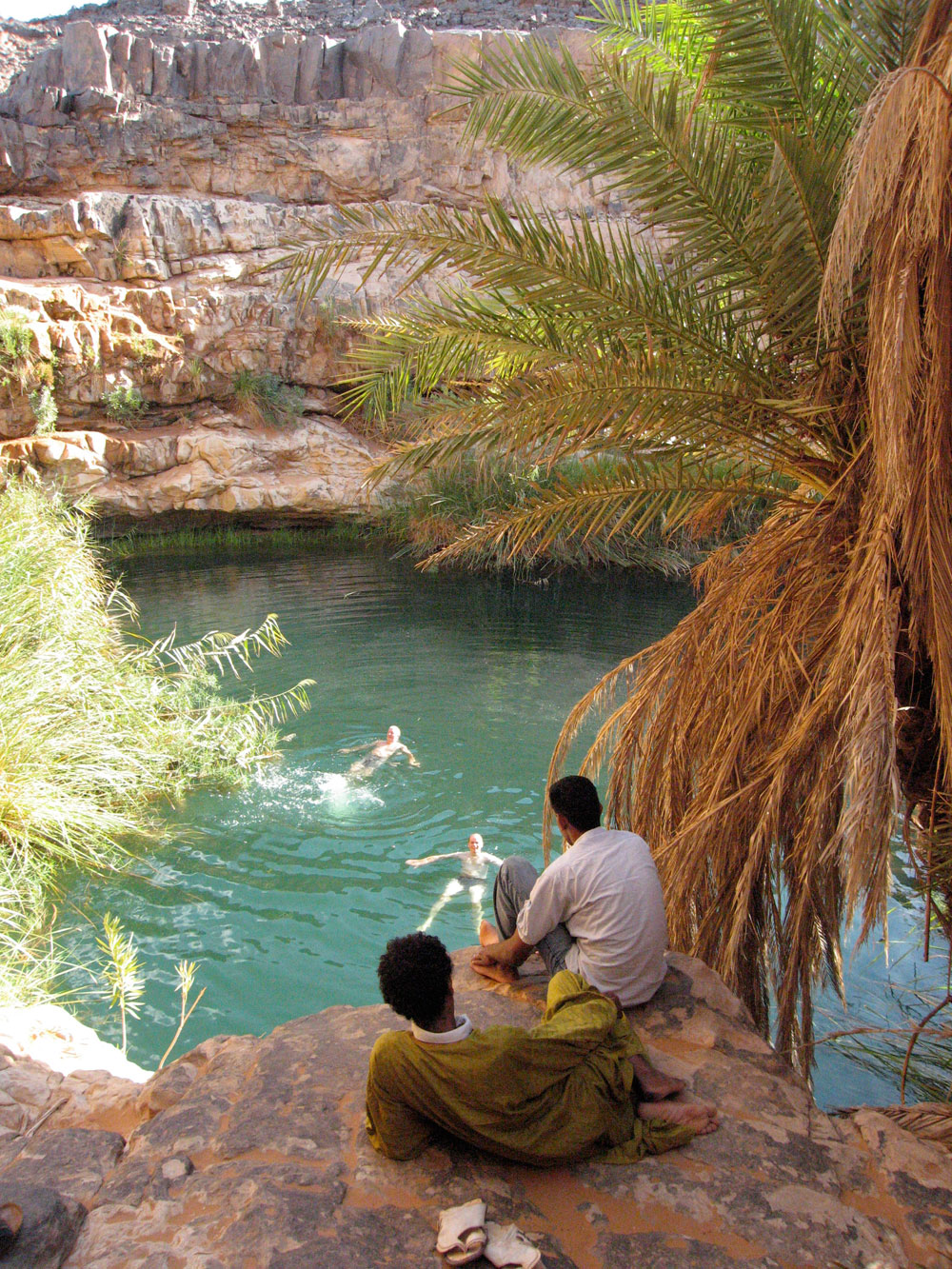
More than the sporadically rough terrain, the main thing that hampers occupation in the Ifoghas is the need for water. There are no river or lakes of course, but in this sub-tropical south side of the Sahara there are few perennial waterholes as can be relied on in southern Algeria (left), for example and which are easily spotted on sat imagery.
One benefit of the bare rocky massifs is they drive what late summer run off there is straight down into the many oueds where vegetation gets concentrated and trees can sink their roots, and where wells can more easily reach the water table. Because of this the Ifoghas hills are more suited to nomadic occupation than say, the sandy void (or ténéré in Tamashek) which fills the northwest corner of Mali. We crossed this ‘empty quarter‘ in 2006; we saw our last tree near Ouadane in Mauritania and the next as we neared Ikhalil, north of Tessalit, some 2000km later. Nor did we see another soul apart from our rescuers who met us midway. (As far as I know the remains of my Hilux – right – are still in Al Khalil).
One Chadian soldier in this Aljazeera video filmed after the Ametetai battle (see also Chad TV link top of the page) described the area as having ‘heavy tree cover’ which seems an exaggeration. Sure, there are small clusters of trees along the oueds, but more likely the sandy creek beds, huge granite boulders and low cliffs are what made hunting down the well entrenched jihadists so difficult.
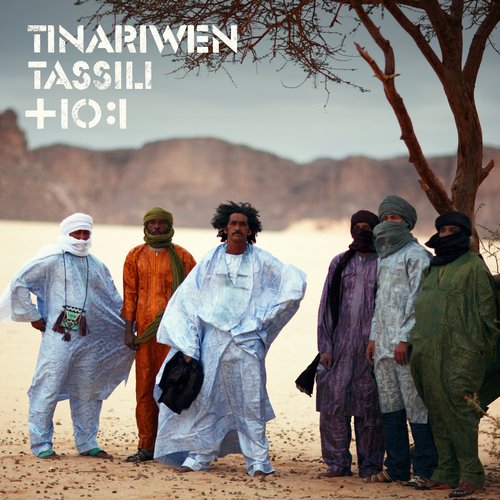
East of the Adrar Tighaghar Google depicts a well-used track (see map below) which doesn’t appear on any old maps and which leads up towards Timiaouine over the Algerian border and continues south to Kidal, about 120km southeast of Aguelhok. When I last travelled down the full length of the Tanezrouft piste in the late 80s, Kidal was the site of a political prison and off limits, but in recent years it opened up to a few intrepid tourists, visiting the Essouk music festival, nearby. The Tuareg group, Tinariwen (left) are originally from Kidal. This track would have developed in the more recent smuggling and kidnapping era as the Kidal region became busier. Doubtless many other tracks developed in the area as AQIM and later groups established themselves in this region over the last decade. With the long overdue Operation Serval, you’d hope that era may be coming to an end. So far in 2016, it doesn’t look like it.
I came across this great film on SVS’s Vimeo channel, mostly set in northeastern Chad. It’s in French but you’ll get the gist. Camels and crocs in Guelta Archei, some amazing paramotoring over Ounianga lakes and even scuba diving in one of the lakes.
It 90 mins long but cuts off at 1.11, on the way into the Mourdi Depression which is a shame. But if you try and find the complete show, watch out for torrentfrancais.com – the plug-in they recommend turns nasty. There’s another equally interesting film on SVS’s channel about Theodore Monod, also set in northern Chad.
On the same theme track down the Emir of Kano, and this one (English VO and subtitles) is about Tubu women in Niger trekking up from around Nguigmi to Bilma to exchange goats for dates. A few years ago the BBC ran a similar film in the same region about a Tubu caravan of women crossing to Termit from Agadem.














 Sahara Overland