Author Archives: Chris S

Book review: Impossible Journey ~ Michael Asher

asher

IMPOSSIBLE JOURNEY
Michael Asher (Penguin)

Asher is a modern-day Thesiger (Asher wrote Thesiger’s biography), with a similar distrust of cars and a love for the desert and its people. In 1986, accompanied by newly wed wife, Mariantonietta (who photographed their journey), they succeeded in completing Geoffrey Moorhouse’s failed attempt to cross the Sahara from Mauritania to the Nile. Unlike Moorhouse (The Fearful Void), the Ashers had worked in the desert for some years and the author was familiar with nomadic customs, selection of guides and the all-important purchase and care of camels.

Once underway they set a gruelling pace that even some of the guides found tough. The mentally disorienting ego loss and intolerable stress they experienced towards the end of their trek comes close to some of ‘The Sheltering Sky’s themes. It’s as well to remember that countless Moors and other pilgrims may have completed the same crossing over the last thousand years. As one perplexed Nigerien border official ruefully observed: “What will you westerners think of next?” That may be so but it’s still one of the best accounts of a long, long camel journey across the Sahara that wasn’t just quickie to justify a book.

Book review: Incident at Jebel Sherif ~ Kuno Gross

ijs

Incident at Jebel Sherif
In search of the First Clash of the Special Forces, 1941
Kuno Gross (2009)

History gets written by the winners, they say and so there are many books and online sources extolling the legendary exploits of the Long Range Desert Group (LRDG), especially their daring raid on Murzuk and the subsequent clash at Jebel Sherif, 150km southwest of Kufra. This new book describes the events from the Axis point of view.

It includes a detailed description of the development of the special forces on the Italian side (very interesting with rare information given) as well as the Allied/Commonwealth side (lots of background information on the LRDG) as well as the Free French forces who came up from Chad for the Murzuk raid. There is a full description of the raid and a reconstruction of the clash at Jebel Sherif with many photos and eyewitness reports.
The detailed trip description of the author to Jebel Sherif completes the full story. While associated information about the German exploration “DORA” (1942) is also included. The author lives in Libya and therefore could evaluate different details perfectly on two visits to Jebel Sherif.

This book is a comprehensive collection of all associated information to one of the most important historical incidents of the Special Forces in WWII and so is recommended to enthusiasts of the Libyan Desert and the North African campaign. Check out the website for more details and images from the book

Werner Lenz

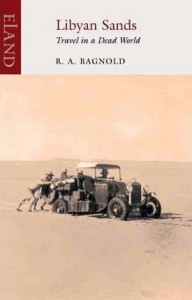
Book review: Libyan Sands ~ Ralph Bagnold

Libsand

LIBYAN SANDS
Ralph Bagnold (Eland, 2010)

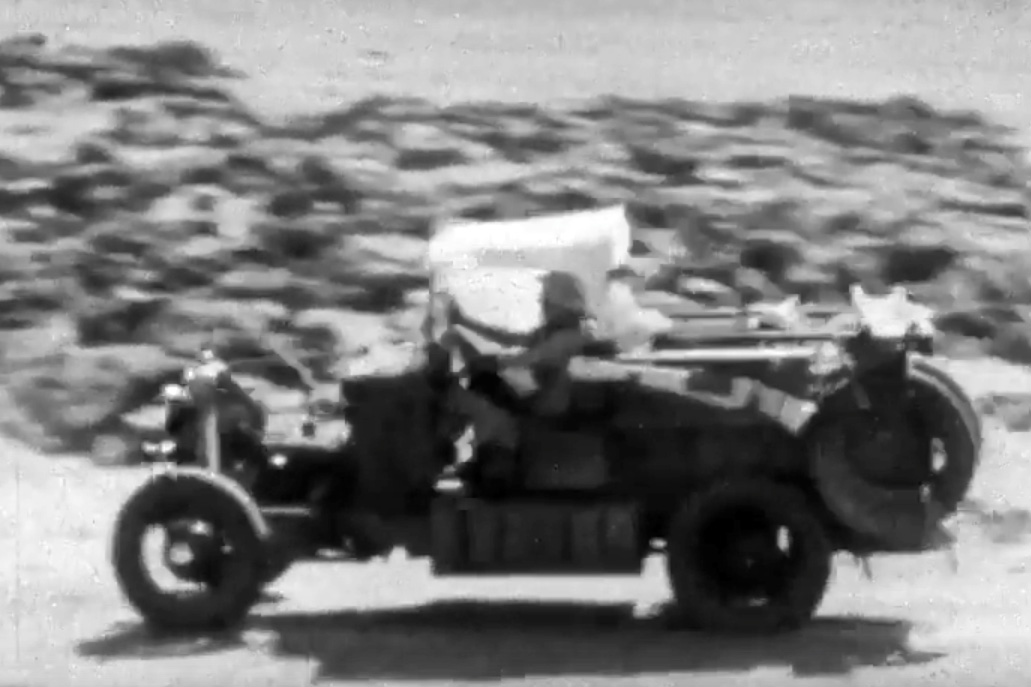
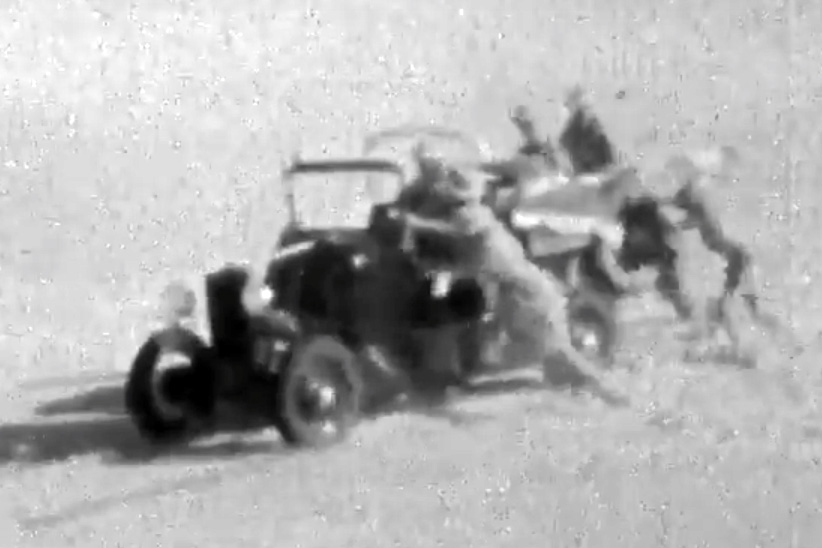
See also this archive film

bagcarr

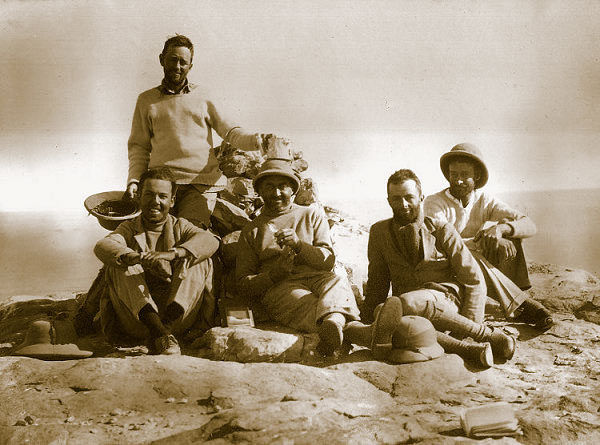
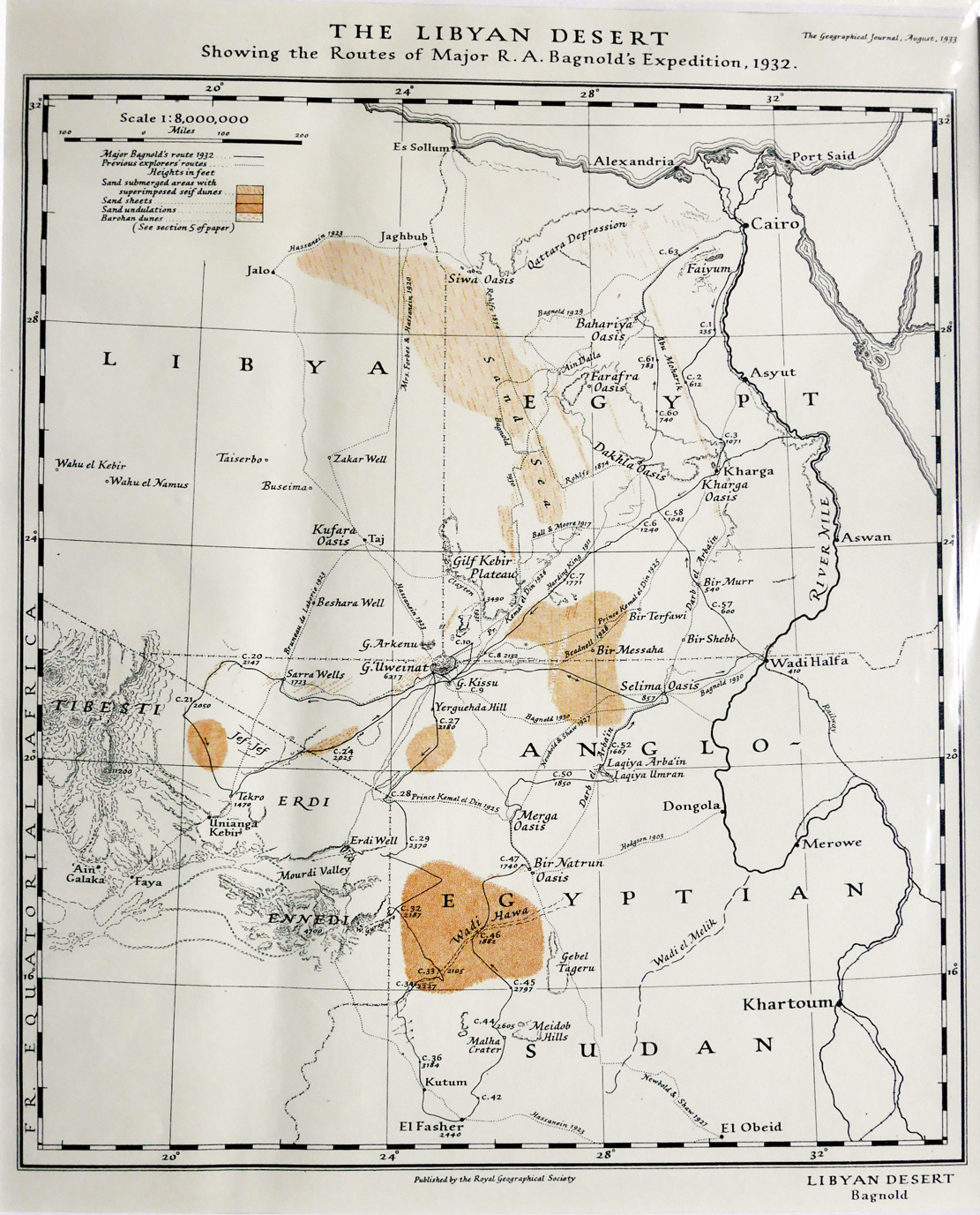
Ralph Bagnold really was quite an exceptional guy and Libyan Sands must be the best Saharan yarn written by a Brit (although he did not consider it the Sahara – see Warm Deserts, below). It describes his motor-car adventures and explorations in the Libyan Desert while stationed in Egypt in the 1920s and early 30s. Using Model T Fords loaded down at times with 150 gallons of fuel, Ralph and his chums spent every spare moment of leave exploring the Libyan Desert of Egypt and northern Sudan. His enthusiasm for (often literally) pushing the spindly, steaming Fords across uncharted ergs helped develop today’s desert driving techniques such as sand ladders and low tyre pressures.

bagcrew
baggpush

What is striking is that his passionate attraction for the desert is most contemporary, while his energy and curiosity led, among other things, to The Physics of Blown Sand, the definitive account of sand formations and features – for geology graduates only. Bagnold comes across in the much-admired mould of the self-effacing Brit hero, never complaining or boasting while enacting extraordinary feats of exploration. The book includes his potted history of the exploration of the Libyan Desert up to that time, as well as a prescient spin on the enduring Zerzura legend. An underrated classic.

sandwind

In the late 80s Sand, Wind, And War: Memoirs Of A Desert Explorer was published in the US just as the author died. It’s hard to find online at a normal price though libraries will have it. You get the feeling it would be as great a read as Libyan Sands.

ralftripsmap

Book review: Lost Oasis ~ Robert Twigger

losto

LOST OASIS; In Search of Paradise
Robert Twigger (2007)

Robert Twigger packs it all into a container and moves the family to his wife’s native Cairo where the money will go further. With previous adventures and books to his credit (his Voyageur book was great), he soon acquaints himself with the historical and geographical treasures to be found in the Libyan Desert and sets about cooking up a new project; to track down the lost oasis of Zerzura. As a motive, it may have helped hook his publishers and accounts for the corny title, but it’s really about the author’s more tangible discovery of the Sahara, and as such is much more interesting.

Our man is a candid correspondent which makes it easy to criticise him as being sometimes naive in Cairo’s shark infested streets, but this quality also draws you into the book. He tries to drum up like-minded explorers, but mostly ends up with shysters who shaft him with a smile. Averse to noisy, polluting cars and the complexities of camel handling, he builds the trolley pictured on the front cover to explore the desert independently and at a natural pace. Unsure how far that will get him, he also joins a tour led by the notorious Colonel Mestekawi (pseudonymed in the book) to the New Cave in the Gilf, a discovery Twigger seems oddly unimpressed by. During the trip he vividly describes the illicit satisfaction in finding Stone Age artefacts (their collection is outlawed on Mestekawi tours, along with other, less controversial activities). A later tour neatly segues the finding of a long sought after fossilised shark’s tooth with ‘power objects’ and a failed attempt at networking at a literary launch in London.

Following the tour, he recognises the advantage for a decent 4WD while acknowledging they can ‘get between you and the desert’. A clapped-out Toyota takes him on a weekend’s dune-bashing with some ex-pats, and later to the Djara Cave where he quickly learns the realities of desert driving.

As illuminating as his desert travels are, the mind-boggling frustrations of simply dealing with life in Cairo are more compelling. They include independently buying a flat (expect the place to be stripped down to the door frames), getting a car or even just driving solo around town when you’re not part of the pampered ex-pat elite. A couple of days there must make the peace of the Western Desert all the more rewarding.

He may not have travelled far and long into the desert with his silly trolley, but he certainly gets to the nub of the desert’s appeal. The whole thing comes across with an authenticity you can’t ascribe to all contrived travelogues. The book winds up with a checkpoint-dodging test run of the water-portaging trolley out of Dakhla. After all the frustrations and false starts, he answers his companion’s idle query about finding the elusive ‘Zerzura’: “We already have.”

Book review: The Lost Trail of the Sahara ~ R. Frison Roche

THE LOST TRAIL OF THE SAHARA
R Frison Roche, 1956 (o/p)

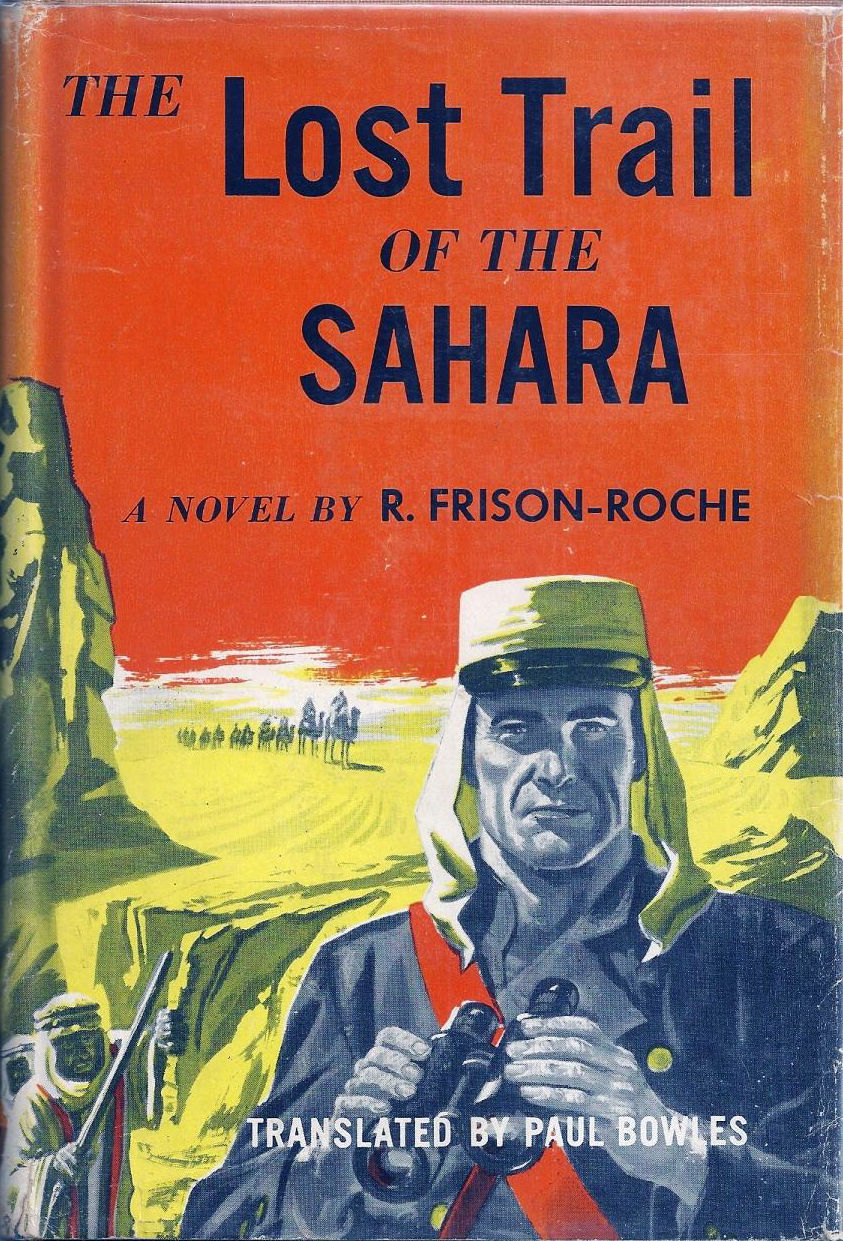
Translated by none other than Paul Bowles (see Sheltering Sky), Lost Trail is a fictional Saharan adventure by an explorer and mountain guide Frison Roche, who travelled extensively in the desert before the war. In the 1930s he led an expedition to make the first ascent of Garet El Djenoun in the Tefedest.

It tells the tale of Beaufort, a rookie soldier sent out into the Saharan summer on a long and dangerous mission to track down a renegade Tuareg, Akou, accused of murder. Beaufort is accompanied by a scientist Lignac to provide a cover story for the mission, and the band of conscripts and local guides, both Tuareg and Chaamba, who make up the caravan which reaches out from the Hoggar into the then unknown northern Tenere.

Misfortunes, both random and sinister befall the caravan, as suspicions grow that the wily Tuareg know more than they admit about the location of Akou. Predations weigh down the convoy which eventually is singlehandedly ambushed by Akou and his wicked accessory, Tmara. But, providence wins the day, the baddies are vanquished, some of the goodies are sacrificed, though the book ends rather ambiguously with the remainder of the caravan trudging ever deeper into the Tenere to see what they might find. A rather lame subplot about Lignac, slowly uncovering a lost Phoenician trade route across the Tenere (akin to the real Garamantean chariot route) gives the book its title.

Frison’s yarn has an authenticity, written by a Saharan of the desert born, a fact which, like Asher’s Sandstorm, always makes such books especially satisfying to those few who know the region. What is particularly interesting, especially for a Frenchman, is the light he casts on the Tuaregs and their long-time enemies, the Chaambi Arabs of the north. The former come across as sly and untrustworthy while the Arabs are painted in more rosey hues, possessing the traditional virtues one associates with nomads. One does wonder if Frison’s fiction was coloured by real life experiences.

Book review: Mauritanie au GPS ~ Cyril Ribas & Sylvie Beallet

moriau

MAURITANIE AU GPS
Cyril Ribas & Sylvie Beallet, Editions Takla Makane – 2001

mines

Now hard to find this, fully illustrated paperback edition of Cyril and Sylvie’s GPS route guide to Mauritania covers 10,000km of pistes. It reaches right across the country up to and beyond the Mali border to places you’ve never heard of, as well as the then obligatory Beach piste, the rail route to Choum and some interesting excursions in the Adrar south of Atar.
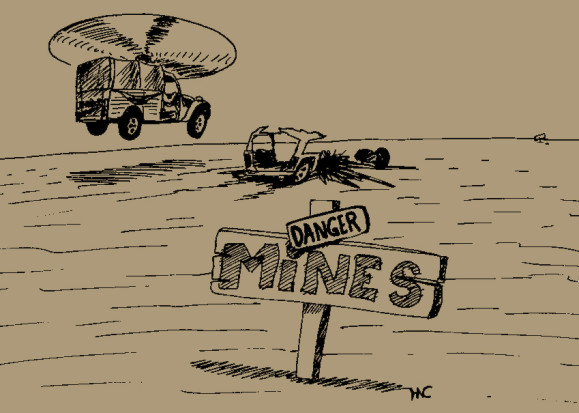
The layout of each route is similar to Sahara Overland which in my opinion is an optimal way of presenting GPS routes in a book – comprehensible even if you’re not fully conversant with French. Route maps are laid over old Soviet 1 millions which is a smart idea and there are plenty of boxed asides on Mauritanian culture and history plus some tasty colour photos. It’s pricey but nothing like it exists in any language, even now. A route guide for the truly adventurous, and all researched in fat-tyred 2CV… stick that in your 4×4 pipe and smoke it!

Book review: Men of Salt ~ Michael Benanav

menof

MEN OF SALT – Crossing the Sahara on the Caravan of White Gold
Michael Benanav ~ The Lyons Press, 2006

There are few camel trading routes in the world. One of them is in Mali, and it stretches about 750km north from Timbuktu as far as salt mines of Taoudenni. A few western travellers have made the journey in the company of the salt caravans. Michael Benanav’s book is a wonderful account of such a journey made in late 2003.

While there seems to be little shortage of slightly crazed travellers making their way to some extraordinary places, on this earth, it does not necessarily mean that the book produced is worth reading. Michael Benanav is a journalist with a flair for the descriptive, and for ensuring that his book holds the reader’s interest from beginning to end. He successfully blends some of the history of the route and the salt trade, some of his thoughts on the philosophy of travel, and provides an account of the trials, frustrations, enjoyment and the wonder of taking such a journey. He meets and travels with many people on the way – his guide, another traveller, the men who operate the caravan, the people of Arouane, the miners of Taoudenni itself and the nomadic people of the desert.

Michael Benanav makes a conscious effort to travel with the camelliers and his guide, without any concessions to his western background, in the form of GPS, satellite telephone or special food. He takes the risks to get as close as possible to the genuine experience of travelling in the same way people have for hundreds of years. The difficulties of such travel, and the rewards of doing so are reflected in his account.

The author writes -“Despite all I had seen thus far, and all I had imagined, I was unprepared for the untempered desolation of Taoudenni. It is situated on utterly lifeless desert flats; not a single leaf, or even thorn, grows from the parched, crusty dirt, which was so sharp it bit into the soles of my bare feet.”

Having travelled that way myself by camel, I can attest to the accuracy of the descriptions provided in his book of the scenery and people, which are true and evocative, without any hint of exaggeration. Whilst the description of the scenery is wonderful, it is really the interest Michael Benanav expresses in the people of this landscape that make the book such a strong account of his journey.

Benanav observes “I’d been deeply affected by my contact with the miners, not only because of their kindness, but because they’d taken this potentially hellish place and made it, if not heaven, at least human …”

The reader is introduced to people whose way of life is so different from ours. People who rely exclusively on word-of-mouth for communication. People who dance and sing after a day’s hard work in a salt mine at the end of the earth. People for whom an arranged marriage is normal. People who can navigate unaided across what appears to be featureless harsh landscape for days, and arrive at their destination as planned. All are beautifully described in this book.

Sensibly the book includes a two maps to illustrate the route and while the photographs in the book are interesting (both the colour plates, and monochrome chapter heading images), and add value to the book, the strength of the book lies in the writing.

The book is an excellent account of the author’s journey, as well as being very enjoyable to read from beginning to end.

Alistair Bestow

Book review: The Most Beautiful Desert of All ~ Philippe Diolé

See also To the Lost Oasis of Ihreri
Sahara Tours 2026

THE MOST BEAUTIFUL DESERT OF ALL (Sahara Adventure in US)
Philippe Diolé, 1956 (download free pdf)

“Are there Saharas in France?” they [Tuareg] ask me.
And when I answer, “No,” they are disappointed…
“If there is no Sahara in your country, where can a man walk on endlessly, freely, on empty earth, under a boundless sky?”

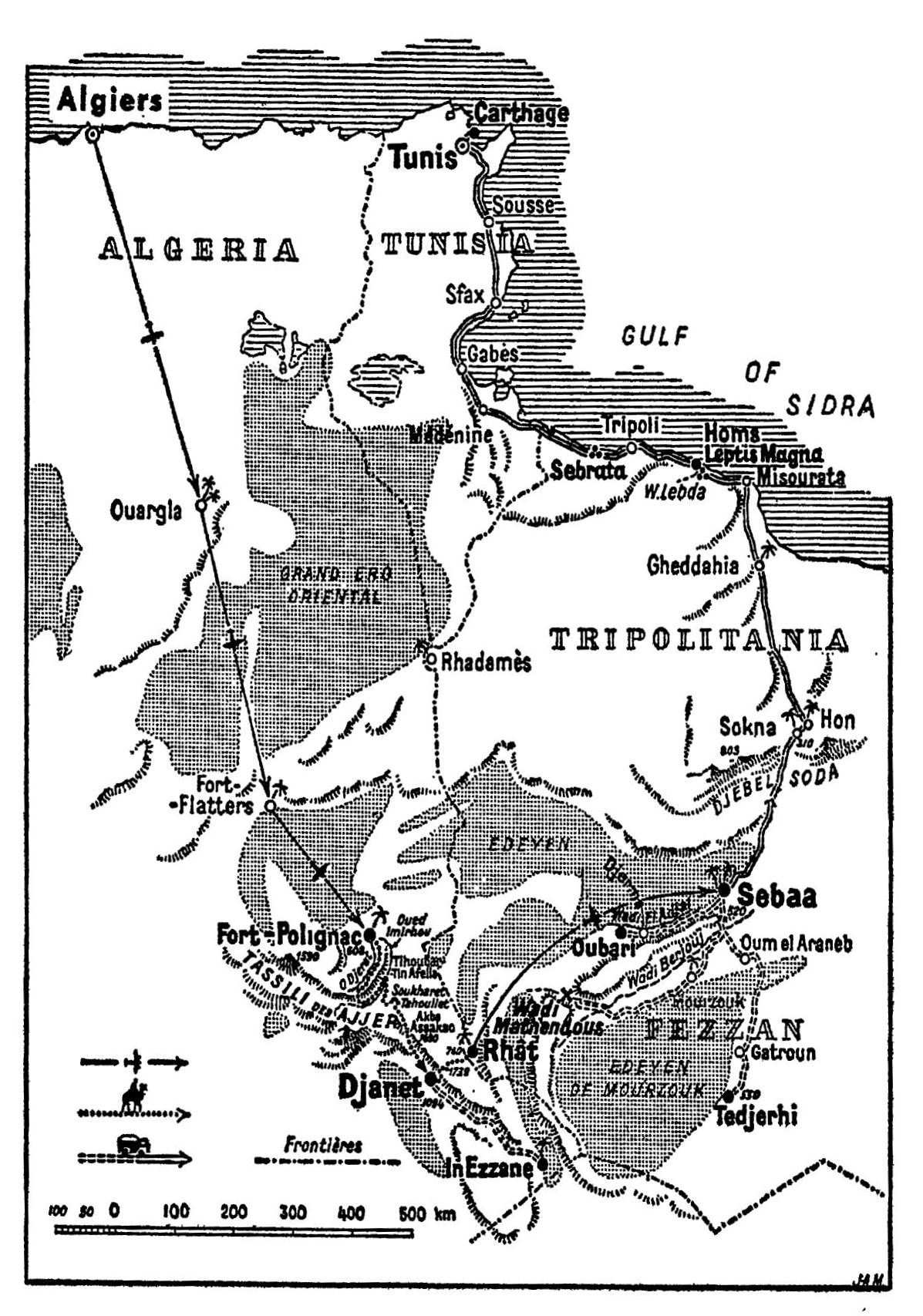
Philippe Diolé, a close friend and associate of Cousteau, made a solo camel and lorry journey to the Tassili N’Ajjer and the Fezzan in the early fifties. This was not a journey of science or exploration, it was made for sheer personal enjoyment. The book conveys this beautifully, recalling the impressions, exciting moments and deep moving personal thoughts encountered during the month-long camel trek through the Tassili (including Wadi Djerat), accompanied by a single Tuareg guide [and a cook boy, Ali]. In the second part of the book, Diolé recounts one of the earliest visits to the amazing engravings of Wadi Mathendous in Libya.

The book’s main appeal will be to those already having been to the deep desert. It is a beautiful clear distillation of the emotions experienced by true desert addicts, that many of us are aware of, but so few of us have the ability to express in words. It remains one of my all time favourite desert classics.

Andras Zboray

Book review: Mysterious Sahara ~ Byron Khun de Prorok

myzahara

MYSTERIOUS SAHARA
Byron Khun de Prorok, 2001

Byron Khun the What? I’d never heard of this guy in the annals of Saharan exploration, and a suspicion with some exaggerated and surely fabricated descriptions got me to search through my library and on the web.
Turns out he was an American with a Polish title who dedicated his early life to the exploration of ‘mysteries of the ancient world’, following an life-changing encounter with Shackleton as a youth. Prorok’s African expeditions in the 1920s and early 30s (notably ancient Carthage) became the subject of several books which Narrative Press also publish, as well as a series of popular lecture tours, films and articles back home.

Mysterious is clearly written for a market hungry for more ancient treasures following Howard Carter’s sensational discovery of Tutankamun’s tomb in 1922. It starts off by reminding us how deadly the Sahara is in any number of ways, followed by an over-the-top description of the cave-dwellers of Matmata where the hyperbole starts to froth.

Tin Hinan tomb

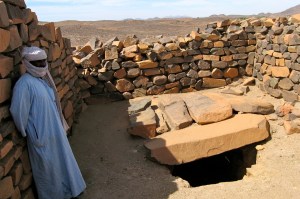
He then sets off south for the Hoggar, no mean feat in 1925 but nevertheless embellishing the landscape and events to Victorian literary levels. By chance he learns of the location of Queen Tin Hinan’s tomb (left) – the legendary ancestral mother figure of the Tuareg (that’s Tuareg, not ‘Taureg’, as is irritatingly repeated in the no less lurid back cover blurb).
What follows can only be described as the looting of an ancient and deeply significant burial site, rather than an archaeological excavation, for Prorok’s motivation errs distinctly towards gold, emeralds and glory in the Carteresque mold. (Interestingly Narrative have published a parallel account of the excavation by one Alonzo Pond, which the blurb says differs greatly from Prorok).

With Tin Hinan crated up, we’re then treated to more impressions of the gruelling desert and a fruitless rummage around Siwa whose natives appear even more degraded than Matmatan troglodytes. Several near disasters, ambushes and discoveries occur in between. Note they are always ‘near disasters…’. A deadly and very rare lizard that attacks him one night but luckily is blasted to mincemeat by a shotgun: sadly no remains for the esteemed taxidermy dept. They go off to find a legendary ‘Temple of Doom’ out in the sands, can’t find it but “we know it’s there”. But what you can’t take away is that Prorok was out there and doing it and in 1926 was indeed the first to ransack Tin Hinan’s tomb at Abalessa, even if his partner Maurice Reygasse may have been the more archaeological of the two (Reygasse went on to work with EF Gautier in the 1930s).

Strange then that Prorok (unlike his contemporary, Richard Halliburton) seems so little known despite his abundant energy for exploration, publicity and self-promotion. According to Lonely Planet: Algeria our man was no less than “…one of the most intrepid Saharan travellers of the 20th century”. He may have been more toff (in name at least) with a romantic imagination than a trained archaeologist, but his knowledge of the great European Saharan explorers’ is more than skin deep. The odd mistake is acceptable and some lurid theories are of their time, while the embellishment of adventurous exploits is nothing new of course. The mystery here is as much Prorok as the enigmatic Sahara.

Book review: People of the Veil ~ Francis Lord Rennel of Rodd

rodd

People of the Veil ~ Being an Account of the Habits, Organisation and History of the Wandering Tuareg Tribes which inhabit the Mountains of Air or Asben in the Central Sahara
Francis Lord Rennel of Rodd, 1926, o/p

rodd001

The titled Rodd was the son of a diplomat who appeared to take a gap year in 1922 to study the Tuareg of the Aïr and the Damergu region around Tanout. He came up from then British Nigeria with Angus Buchanan and another guy and travelled in the region (with a visit to Termit) for nine months, possibly motivated by an ancestor who’d travelled in the region in the nineteenth century. Like so many people, he became enamoured with the Aïr Tuareg, but what we get here is a thorough anthropological treatise in the Kel Tagelmoust, as the Tuareg call themselves (‘Tuareg’ is a derogatory Arabic description for ‘Godless’). Their customs, architecture, origins as well as the landscape around them are all detailed intimately with only occasional descriptions and insights into Rodd’s travels. The many accompanying plates ar rather drab and a small map is included.

This book would only appeal to those looking for rare English-language anthropological detail on the Tuareg (Jeremy Keenan’s republished book on the Ahaggar Tuareg is another source) or those with a close interest in exploring the Aïr mountains.