Tag Archives: Oued Djerat

To the Lost Oasis of Ihreri (one of these years)

LPB cover

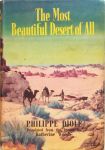
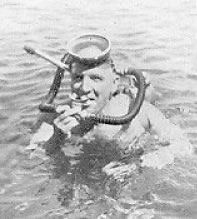
Even before I turned to camel trekking, one of my favourite Sahara books was a translation of Philippe Diole’s The Most Beautiful Desert of All (reviewed; aka: Sahara Adventure in the US).
diole

Diolé was an adventurer, author and underwater associate of Jaques Cousteau. You can watch an aged Diolé interviewed here with none other than Alain Bombard, an equally interesting character about whom I wrote this post on another blog.

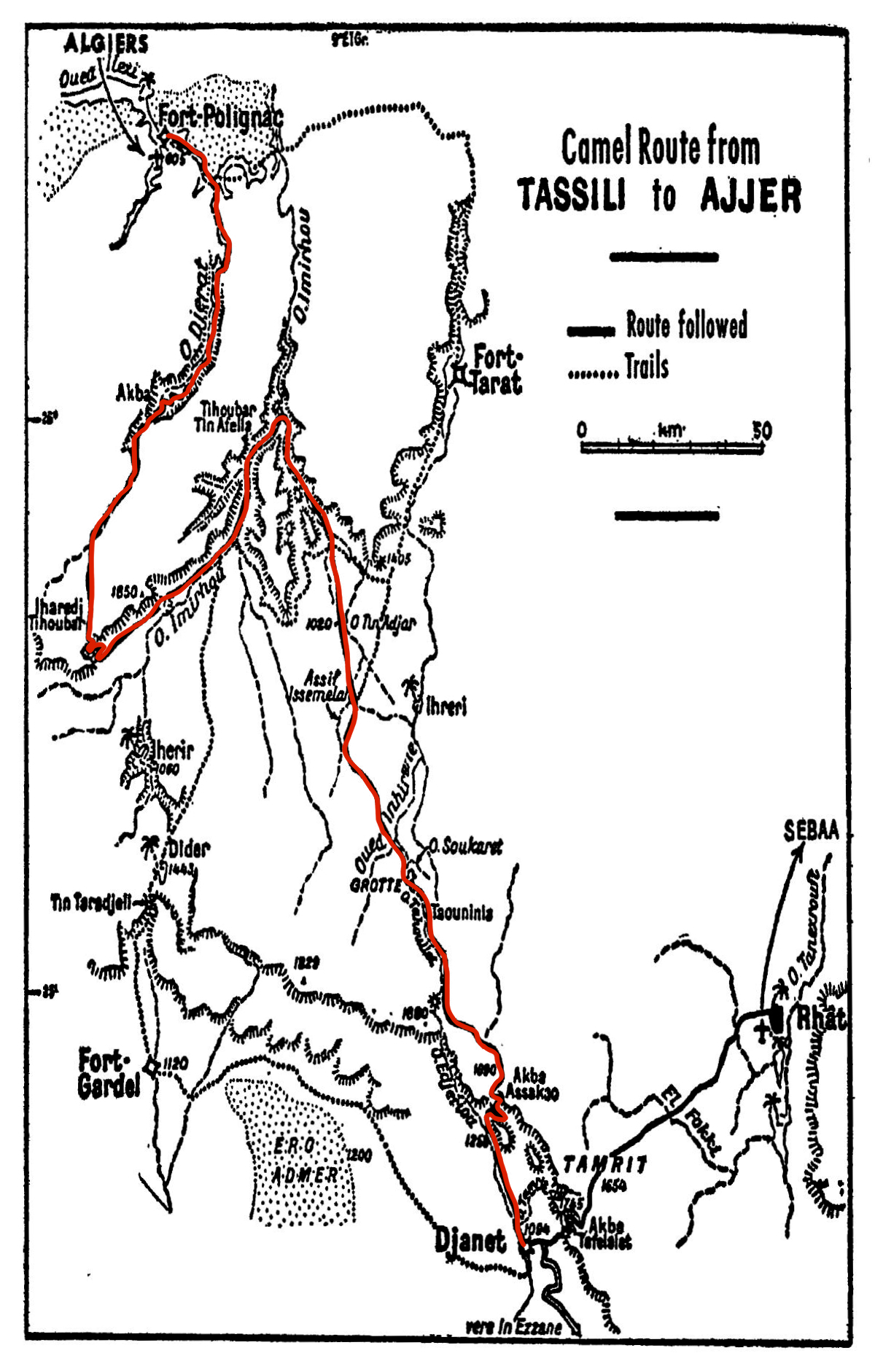
Attracted, as many of us are to places off the beaten track and obscure historic routes, I always thought it might be fun to try and retrace Diolé’s route across the plateau to Djanet, although even when reading the book 25 years ago I had a feeling it was a little-used path. Now it’s doubtful anyone’s been that way for decades.

P1020423

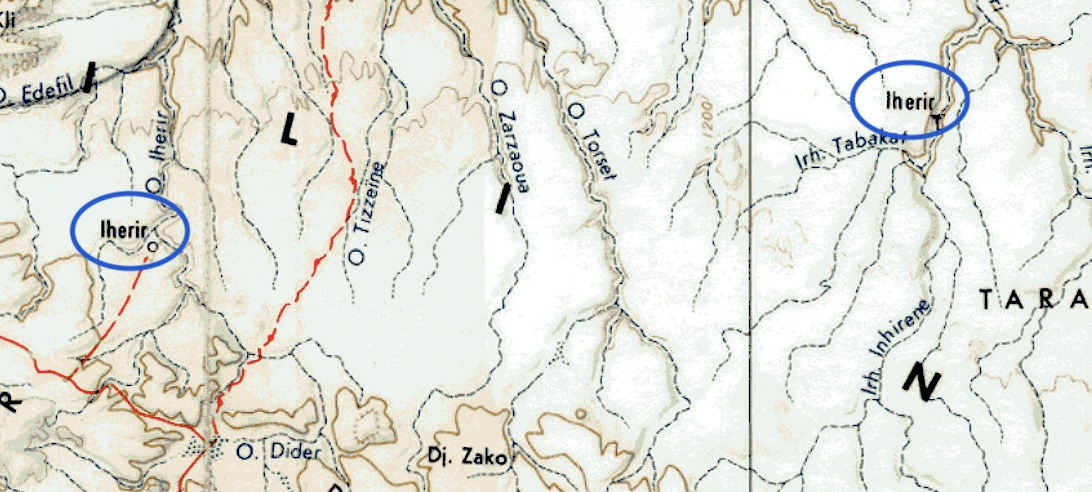
It’s a well-worn Saharan cliché, but Diolé’s route included a visit to a genuine ‘lost oasis’ that I’ve long been curious about: Ihreri, some 80km NNW of Djanet (often mistaken with the well-known but accessible Iherir on the Fadnoun).

P1020417

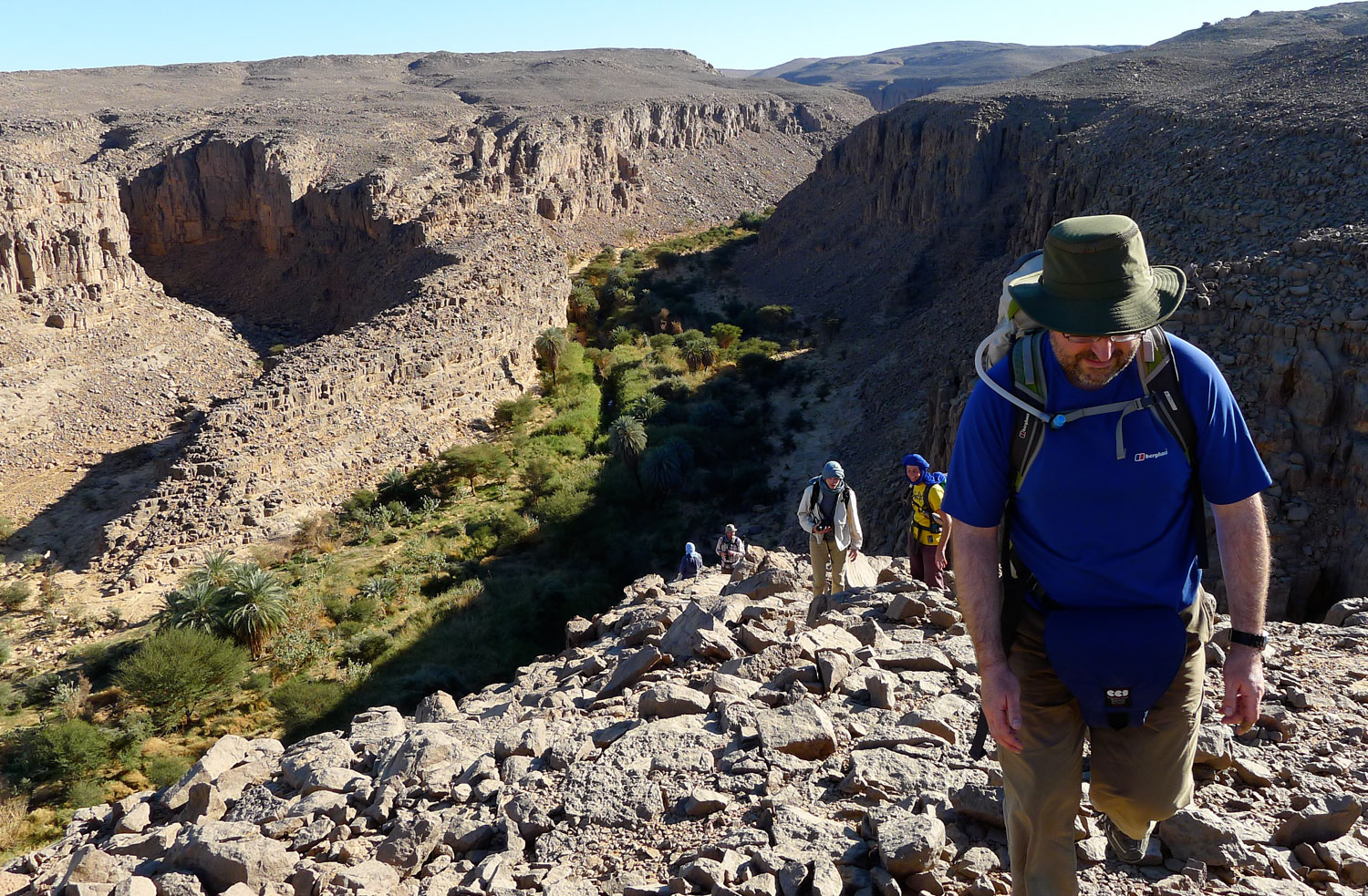
Ihreri may well resemble the similar, virtually abandoned oasis we came across on the Amguid Crater trek one time (left), set in a region prolific with Stone Age megaliths. The grassy patches as well as the sudden density and rustle of date palms were quite unexpected after a week out in the open desert with nothing bar a thorny acacia for shade. I’m also sure I watched a documentary in the mid-1980s about some people trying to get to a very remote oasis in the Tassili and getting a hostile reception. For some reason I think this may have been Ihreri, occupied by the grumpy vestiges of its date-cultivating villagers. Now, it’s unlikely anyone lives there.

tassili-1964

On and off over the years I’ve tried to get the Diolé plan off the ground but without success, being told among other things it was too hard or there was very little herbage on the plateau that year. But recently I made contact with an Algerian agency that seems keen to try something out of their well-trodden comfort zone. Perhaps the easy ‘fly-in’ work is drying up these days, but sadly the price they wanted to charge was double a normal tour so that idea has gone back into storage for another few years.

Book review: Secrets of South Sahara ~ Mark Milburn (1979)


See also:

B is for Burials

In a line: must have been a great adventure so should have been a better story…

An interest in pre-Islamic tombs of the Sahara lead me to Secrets of South Sahara (£15 on ebay), Mark Milburn’s account of a solo expedition ostensibly to the western Aïr mountains near Arlit in 1976-7 to study these monuments. I figured it would make a more digestible introduction to the subject than the many dry or technical academic studies easily found on the web which anyway tend to be localised and/or specialised.

I was familiar with the name and am sure I once read another book of his, but Secrets… seems to be the only one available. Mark Milburn was also mentioned in the Sahara Handbook (1980) as an explorer and scholar of Saharan pre-history, through in this book he never describes himself as a professional  archeologist or academic, and comes across as merely a curious and well-read enthusiast. That may be incorrect or have changed since, as even today Milburn contributes many papers to publications in Spanish, German and French on the subject, including the now defunct Sahara Journal as recently as 2011. In fact you get the feeling he may have helped found SJ and even helped fund research in the Sahara. It’s hard to be sure about any of this as there’s little about [Dr] Mark Milburn on the web. He is perhaps a man of means.

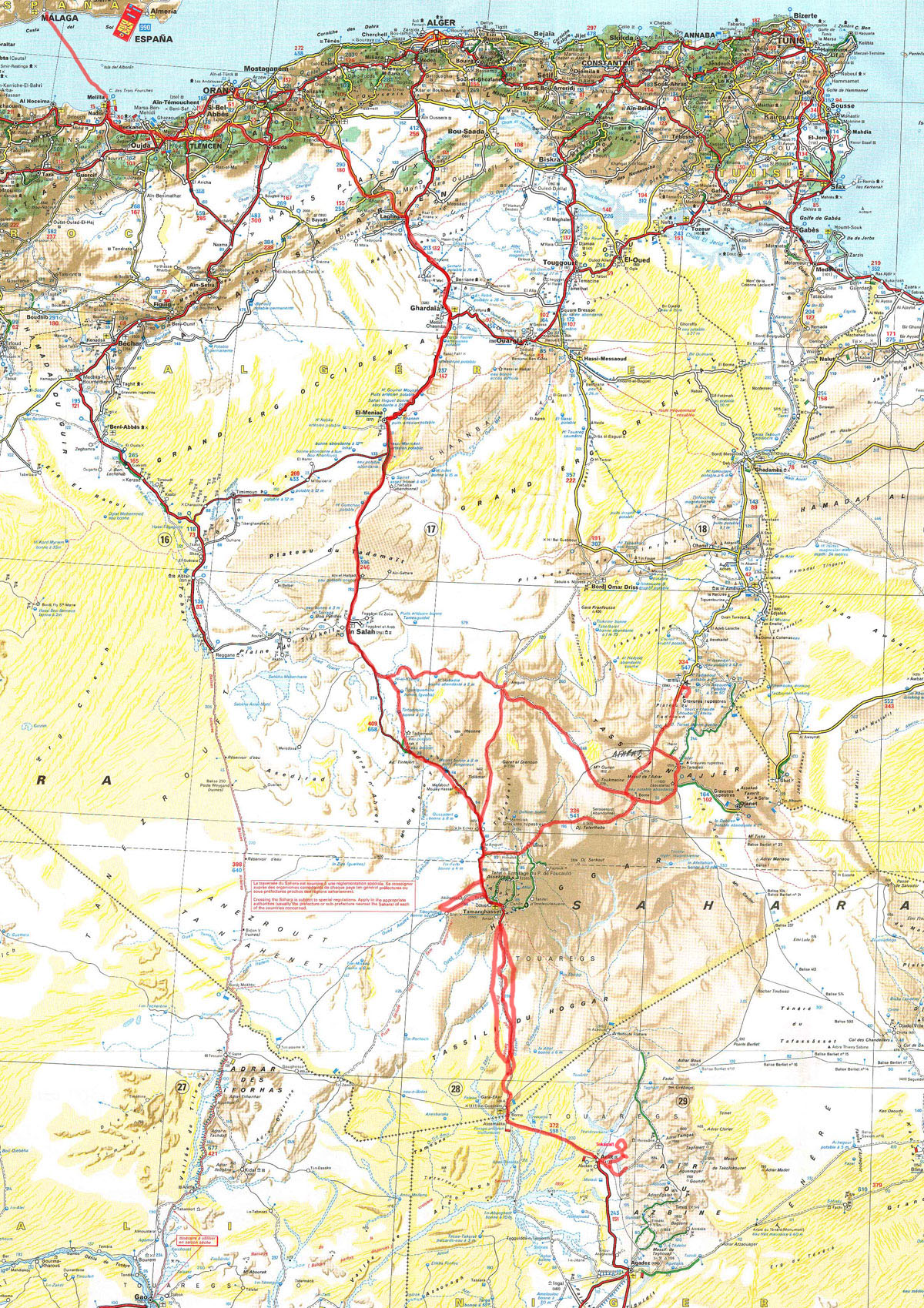
As an account of desert travel just prior to the Golden Era when things got easier for a decade or so, the book itself was rather unsatisfying and inconsistent in pace. To be fair to the author, you get the feeling it was poorly edited by the American publishers who may have had little understanding of the subject or knowledge of the area. And there is no map! – always short-sighted with a book like this, so I’ve made a rough estimation on the left, based on his account. As you can see, he covered a fair amount of ground in Algeria and Niger.

The book starts with an overdetailed account of his descent from Germany to Spain to collect his desert gear stashed there. At times it reads like a diary and you’re left thinking, who cares what you had for breakfast or what letters you’ve received and from whom, let’s get on to the south Sahara. Already, an intense dissatisfaction with his vehicle is evident, as well as the people who service it, parts availability and so on – and it recurs right up to the very last paragraphs. It’s so bad he cannot even bear to utter the identity of his despised diesel, but from the photos it’s clearly a leaky-roofed 88” Land Rover.
This scorn is perhaps more understandable when he admits that a previous expedition was curtailed when a gear lever snapped off at the base (a not-unknown flaw on Series IIIs). His was towed back (afaict), but you get the feeling that temperamentally Milburn and Land Rover should never have walked down the aisle. Anyway the mid-1970s were the ‘Leyland years’ – the subterranean nadir of British automobile manufacture when shoddily assembled ‘Monday-morning vehicles’ were made three days a week. The other two days they were on strike.

This preamble drags on into protracted to-ing and fro-ing across the Morocco-Algerian border before he finally gets allowed in, followed by much grumbling about Algerian inefficiencies and inconsistencies. The county was then in the midst of its paranoid, Soviet-backed episode which I too recall from my early travels there, a time when even photographing telegraph poles (a hobby of mine at the time) risked arrest. The Western Sahara war between Morocco and Algeria was just kicking off in late 1976 too, and there was some doubt that the Algerian border would be open at all, or that there was access to the Grand Sud.

One of 3 huge antennae tombs between Routes F4 and F7 in SW Morocco

On his travels he meets other tourists exploring the Sahara, and near In Salah teams up with a driver with similar interests. They set off east along the piste towards Amguid village to check out old tombs. The gnarly stage beyond Tin Habedra well was one of a few episodes where the author managed to evoke his majestic surroundings – elsewhere the grandeur passes un-noted. Once in Amguid, the two set about searching for tombs and paintings; MM himself treks up the escarpment for a better look over the many crescent tombs he finds below but here, as later, he admits difficulty in getting a good photo of an entire structure when alongside it at ground level. It’s something I’ve found myself; they look so much more impressive on Google Earth or from a drone (left).

From Amguid they nip down in the rain towards In Ecker where they encounter stragglers on the second Abidjan-Nice rally (precursor to the Paris-Dakar). Then a diversion west takes them out past Silet for more tomb and rock-art spotting around the twin peaks of Tioueine.

There are more shopping difficulties, intransigent clerks and tedious permit apps on the lean streets of Tam (also my impression in ’82), then it’s off to Niger. On the piste down to In Guezzam I was surprised to read of the mass of crescent tombs the keen-eyed Milburn was finding, seeing as this was a well travelled route and I’d never heard of such reports from others. Perhaps most are too focused on getting to the other side. Google sat didn’t uncover much either, apart from a collection 140km northwest of In Guezzam as well as a few more a few kilometres northwest of the border post.

In Arlit there’s more admin to unravel before stocking up and setting out with Bazo, a Targui guide, to explore a region to the northwest of town. You suspect this may be a place Henri Lhote (of Tassili frescoes fame – often cited in SoSS) had reported on in the same year, and which may have been a revised destination for Milburn once his planned visit to the Western Sahara got nixed by the impending war. Accompanied by the agreeable and sharp-eyed Bazo, all sorts of fascinating discoveries are made in this little-visited part of the Aïr; it is the core of the book.

Like others I know, Milburn seems to be driven by an urge to uncover and classify and by doing so, understand. He shows an indefatigable enthusiasm for tracking down and logging these structures while speculating modestly on their origin and meaning, hoping that some day some pros will come down and do a proper investigation (those days seem long gone).
He then shoots off back to Tam, then returns south to spend time in the Laouni region north of In Guezzam with another guy and where, surprisingly, many more ancient discoveries are made among what you presume are the outcrops of Gara Eker. Then it’s back up to Tam and alone up to In Salah where he undertakes a dash over to Illizi via Amguid with some Germans, a stage that gets covered in a page or less. In Illizi they organise a camel recce of nearby Oued Djerat, the first Saharan rock art site to be well documented by Europeans back in the 1930s, and which Lhote had written about a year earlier.
That done, MM manages to drive some 600km southwest to Hirafok in a day in his 88” because the route north of Illizi was  closed and Tin Habedra to the west via Erg Tifernine was too sketchy alone. He then zips up to the Moroccan border, delighted to be out of Algeria, and a day or two later even more thrilled to be back in Spain. These last chapters end in such a rush when you think back to the protracted start of the book, you wonder if he’d suddenly exceeded a word count or ran out of time. A few weeks after writing this I was advised by someone who knows that: ‘… [SoSS] is deliberately misleading…’ as in, presumably, protecting new locations for later study.

So overall I was disappointed by what was an uneven read from someone who even then, had much experience of the Sahara, and has acquired much more since. It would be nice to think one day Mark Milburn may retire and write ‘Memoirs of a  Saharan Tomb Grader’. Among Brits he is rare and even appears to have a lighthearted edge judging by the picture left where he suggests the direction Land Rover should have taken.

The regular grumbling about lazy Spanish, sloppy Moroccan mechanics and any number of slack-arsed or obstructive Algerians, and not least his 88″, all get in the way of what must have been a great adventure and so should have been a better story. I was surprised to be unsatisfied by Secrets of South Sahara as a travelogue, but learned enough about the enigma of pre-Islamic tombs (as well as their very profusion, once you start looking)  to make it worth reading. It just reminds you how much more there is to see of the Sahara once you slow down and look closer.

mmairmanThe book has a few so-so photos; you’d think he must have come up with better; perhaps they were saved for other publications. The few graphics of tomb layouts are much better. The cover itself is a graphic of the intriguing ‘Air man with handbag’ which the author never saw, but mentioned that Lhote had found repeated over much of the Aïr. We ourselves found one at the popular site of Anakom (left) on the east side of the Aïr.