Byron Khun the What? I’d never heard of this guy in the annals of Saharan exploration, and a suspicion with some exaggerated and surely fabricated descriptions got me to search through my library and on the web. Turns out he was an American with a Polish title who dedicated his early life to the exploration of ‘mysteries of the ancient world’, following an life-changing encounter with Shackleton as a youth. Prorok’s African expeditions in the 1920s and early 30s (notably ancient Carthage) became the subject of several books which Narrative Press also publish, as well as a series of popular lecture tours, films and articles back home.
Mysterious is clearly written for a market hungry for more ancient treasures following Howard Carter’s sensational discovery of Tutankamun’s tomb in 1922. It starts off by reminding us how deadly the Sahara is in any number of ways, followed by an over-the-top description of the cave-dwellers of Matmata where the hyperbole starts to froth.
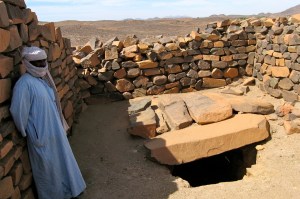
Tin Hinan tomb
He then sets off south for the Hoggar, no mean feat in 1925 but nevertheless embellishing the landscape and events to Victorian literary levels. By chance he learns of the location of Queen Tin Hinan’s tomb (left) – the legendary ancestral mother figure of the Tuareg (that’s Tuareg, not ‘Taureg’, as is irritatingly repeated in the no less lurid back cover blurb). What follows can only be described as the looting of an ancient and deeply significant burial site, rather than an archaeological excavation, for Prorok’s motivation errs distinctly towards gold, emeralds and glory in the Carteresque mold. (Interestingly Narrative have published a parallel account of the excavation by one Alonzo Pond, which the blurb says differs greatly from Prorok).
With Tin Hinan crated up, we’re then treated to more impressions of the gruelling desert and a fruitless rummage around Siwa whose natives appear even more degraded than Matmatan troglodytes. Several near disasters, ambushes and discoveries occur in between. Note they are always ‘near disasters…’. A deadly and very rare lizard that attacks him one night but luckily is blasted to mincemeat by a shotgun: sadly no remains for the esteemed taxidermy dept. They go off to find a legendary ‘Temple of Doom’ out in the sands, can’t find it but “we know it’s there”. But what you can’t take away is that Prorok was out there and doing it and in 1926 was indeed the first to ransack Tin Hinan’s tomb at Abalessa, even if his partner Maurice Reygasse may have been the more archaeological of the two (Reygasse went on to work with EF Gautier in the 1930s).
Strange then that Prorok (unlike his contemporary, Richard Halliburton) seems so little known despite his abundant energy for exploration, publicity and self-promotion. According to Lonely Planet: Algeria our man was no less than “…one of the most intrepid Saharan travellers of the 20th century”. He may have been more toff (in name at least) with a romantic imagination than a trained archaeologist, but his knowledge of the great European Saharan explorers’ is more than skin deep. The odd mistake is acceptable and some lurid theories are of their time, while the embellishment of adventurous exploits is nothing new of course. The mystery here is as much Prorok as the enigmatic Sahara.
People of the Veil ~ Being an Account of the Habits, Organisation and History of the Wandering Tuareg Tribes which inhabit the Mountains of Air or Asben in the Central Sahara Francis Lord Rennel of Rodd, 1926, o/p
The titled Rodd was the son of a diplomat who appeared to take a gap year in 1922 to study the Tuareg of the Aïr and the Damergu region around Tanout. He came up from then British Nigeria with Angus Buchanan and another guy and travelled in the region (with a visit to Termit) for nine months, possibly motivated by an ancestor who’d travelled in the region in the nineteenth century. Like so many people, he became enamoured with the Aïr Tuareg, but what we get here is a thorough anthropological treatise in the Kel Tagelmoust, as the Tuareg call themselves (‘Tuareg’ is a derogatory Arabic description for ‘Godless’). Their customs, architecture, origins as well as the landscape around them are all detailed intimately with only occasional descriptions and insights into Rodd’s travels. The many accompanying plates ar rather drab and a small map is included.
This book would only appeal to those looking for rare English-language anthropological detail on the Tuareg (Jeremy Keenan’s republished book on the Ahaggar Tuareg is another source) or those with a close interest in exploring the Aïr mountains.
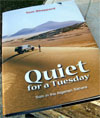
QUIET FOR A TUESDAY Tom Sheppard (Desert Winds, 2008)
Tom Sheppard is much admired, especially among a certain kind of Landrover owner, for his technical manuals on overlanding. This book is what his many fans have been waiting for, the background to acquiring that know-how over a series of desert trips spanning more than 40 years, mostly in Algeria, mostly in 4WDs and almost all alone.
‘QFAT’ is based around a 2006 trip to Algeria, a place which many widely travelled Saharans agree is ‘the fillet mignon of the Sahara’. Here the author managed – though probably for the last time as he admits later – to dodge the mandatory escort requirement which was imposed in the south following a mass kidnapping of several self-drive tourists in 2003. Inevitably he gets pulled over at one of the many checkpoints on the Trans-Sahara Highway (TSH) and the absent escort leads to questions in nearby In Salah. Here his previous visits are regarded with suspicion and his large-scale maps, carefully annotated over many years, are confiscated. No longer considered a threat, he is released.
Outraged by this setback but undeterred and still without an escort, he heads west out of town and slips into the desert unnoticed with just a country map, waypoints from earlier visits and a lifetime’s navigational skills learned the hard way. Determined, daring and above all cautious (as his Air Force background suggests), he clearly revels in the mathematical, technical and even geometric challenges while engaging in and recording this sort of travel. As described, the nightly camp regimen verges on OCD but, like solo rock climbing, driving or riding alone in the Sahara is not something you can afford to do badly if you want to do it again.
Curling out and back southeast towards the TSH, he revisits old haunts such as the diminutive Adrar Kra dune field which, one suspects from the title page, means a lot to him and may even be the basis for his Desert Winds Publishing logo. As tension builds about the trouble he may be landing himself in, he reminisces over his many previous trips in the Sahara by Land Rover and motorcycle, as well as his now prized but still fallible Mercedes G-Wagen. Although it’s sometimes hard to keep track – it’s often the same place but different time – these asides are used skillfully to string out the denouement of the main 2006 trip. An ill-timed test of a rescue beacon in Libya a few years earlier saw him banned from that country; now in Algeria in 2006 it looks like it may happen again…
At one point, recognising this could be his swansong, he acknowledges with raw candour, “… these [solo desert] trips are my life …”. You can believe it. From page to page his boyish wonder for- and deep love of the desert’s grandeur and awe – from the tiniest plant to a lens-filling vista – are evoked with passion, dry humour and some original turns of phrase. “Can the eyes gasp?” he asks. They can out here.
On several other occasions he seems to be oddly out of touch. He belittles the motives (the 2003 kidnappings) which begat the escort rule and which, as has happened elsewhere in the Sahara, sadly ended the party for independent tourism. He posits that being in his sixties and in a G-Wagen makes him a low priority target for abduction. It may just be ‘Black Flag Café’ bravado, but after six months in captivity those survivors of 2003’s kidnapping (and many more since) who matched or exceeded his age may not have seen it the same way. And those kidnappings were just the tip of the iceberg on the recent suffering the country has endured, where the ‘pouvoir’ continues to enrich itself from gas revenues before its own party ends.
Along with a plea to the right-wing broadsheets, he asks for the British embassy’s help in recovering his confiscated ‘property’, even though such detailed, colonial-era mapping is commonly restricted in many similar countries. Instead the embassy passes on a communiqué from an Algerian ministry: he ‘must be removed from the country’. He continues to insist to the reader that it’s all due to the ‘misunderstanding’ over his maps, rather than admitting it’s more likely his continued, arrogant flouting of the ‘escort’ regs. After all, the previous year he’d been led back north out of the Algerian desert by the authorities. While it’s true that the roadside implementation of the ‘escort’ rule was until recently inconsistent, as in similarly controlled places like China, down south in Algeria eventually they’ll catch you.
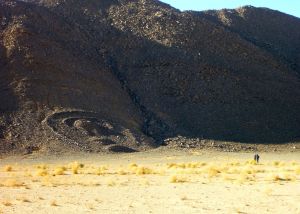
Elsewhere, the confidently asserted knowledge leads to some embarrassing schoolboy gaffes. A picture of an unusual, weathered lip of granite is mistakenly explained as being a double extrusion of lava. Earlier, after rebuffing a tour guide’s attempt to commandeer the unescorted Sheppard into his party, the author mocks him for not knowing the location or origin of a nearby arrangement of stones as being “…a huge French military insignia… So much for being guides…” he scoffs. Such insignia do exist in northern Sudan and Morocco, and clearly resemble what they are. But the adjacent photo he offers is actually a pre-Islamic ‘keyhole’ tomb (example, left), possibly several thousand years old and common all over the region. Knowing this, his following priapic quip given in the book is all the more mortifying. The idea that he actually assumes these ancient tombs to be the work of bored colonial conscripts is baffling, because elsewhere he proves to be rightly awe-struck by the vivid evidence of Saharan pre-history.
Towards the end of this book, his testament, he slams his cards on the table. Part of the motivation behind his dogged insistence in continuing to travel alone in the Algerian Sahara is blurted out with uncharacteristic coarseness: “…too many fucking people… [in this dumbed-down, ‘technophobic’ world]”. The book then winds up with a kind of manifesto – translated and presented as a formal report to the Algerian Tourist Board no less – as to how desert tourism should proceed in their country. (Short version: not as it’s done in neighbouring Morocco or Tunisia.) He presents a pertinent analysis of how tourism can wreck a place (it is the abiding paradox of tourism, after all…) but, if I understood it correctly, you can’t help thinking his proposal: no escorts, just a hefty bond deposited at the border and returned on good behaviour – comes across as blatantly self-serving and unpoliceable. It may suit responsible (and affluent) European self-drive tourists; less the few escorts, drivers, cooks and yes, even genuine guides (from whom we all learn a thing or two) who serve what little desert tourism survives in Algeria.
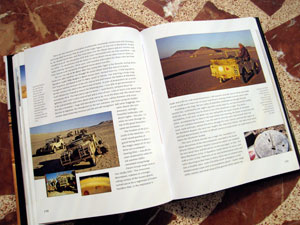
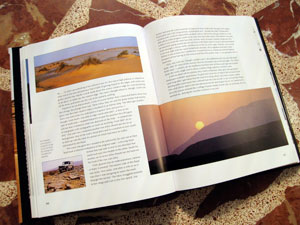
Self-publishing can often mean low production standards but, like Tom Sheppard’s other Desert Winds titles, ‘QFAT’ compares well with any ‘coffee table’ travelogue. Be in no doubt you’re getting £20 of lush paper and thoughtful design, with plentiful photos alongside the relevant body text. Some of these brilliant images (bigger would have been nice) are what readers unfamiliar with the region will most readily relate to. The apparent lack of an editor (acknowledgements list only software, technicians and machines) sometimes makes for convoluted descriptions; sentences of nearly 80 words require breathing apparatus. I’m familiar with many of the locations and journeys being described, but other reviewers and readers may also find difficulty keeping track of time and place. “Life is in the details” is the author’s frequently repeated mantra, but at times you can’t see the sand for the grains.
A desert blogger once wrote: “… the desert is a place that can only be appreciated alone. Only then do you see it for what it really is.” Alone, the wilderness experience is intensified. The frequent peaks and troughs of genuine adventure travel become moments of dizzy elation or gnawing despair. Having the strength, steady nerves and hard-won experience to deal with this acute range of clawing emotions is what sets desert travellers like Tom Sheppard apart.
‘QFAT’ is a poignant if flawed eulogy to a lifetime’s desert travel, a homage to the breathtaking Algerian Sahara. It’s not for everyone, but you get the feeling the author quite likes it that way (locations and place names are often disguised). As the man himself says: “being a perfectionist is not an instant recipe for popularity, but you’ve got to be who you are”.
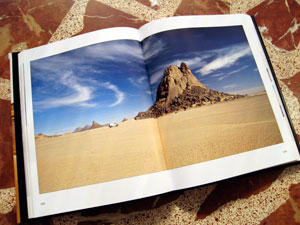
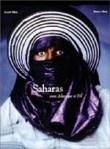
SAHARA – LAND BEYOND IMAGINATION Frans Lemmens, 2004 (28 x 28cm, 192pp)
After two decades travel in Africa, Frans Lemmens has produced a lavish photographic essay of the Sahara; a high quality, non-glossy production with a pleasing, clean design and an intelligent commentary by Martijn de Rooi which avoids the floweriness that so often accompanies these books.
As always it is the alluring dune images which most capture the imagination, be they abstract close-ups or rosey panoramas cast across sand seas. But there is just enough coverage of other desert themes to help fill picture of the Central Sahara, Morocco and the Nile, including some stunning portraits and breathtaking vistas that remind you of the Sahara’s compelling visual appeal. One regret (and a common complaint with just about every Sahara picture book) is the absence of material from the western and eastern Sahara. It would have been good to let the Moors, Tubu and the Libyan Desert get a piece of the action as these areas are no less photogenic. Maybe that can be the author’s next project but for now … Imagination is up there with the best of the Saharan picture books.
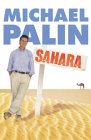
Like ‘Everest’ and ‘Yukon’, the word ‘Sahara’ is a good selling tool for Jeeps, hotels, boots, you name it. Palin’s book carries the name but, as anyone who saw the BBC series will agree, he spent little time in the desert, failed to get under its skin and instead concentrated on the less arduous and more social and photogenic aspects of West and North Africa. Fair enough, the product is MP not where he happens to be or who he’s talking to (the book, not much deeper than the TV series, is packed with pics of MP here, MP there, MP gazing winsomely).
He writes well (he got a cool million for the book alone), but for me this sort of heavily planned faux travel pretending to be a continuous journey, missing key links and with paper-thin ‘spontaneous’ encounters (e.g.: Tom Sheppard) is for undemanding Sunday evening armchairists; Saharans will be disappointed. There are plenty of truly Saharan books below and above and round the back, but of course ‘Sahara’ was in the best sellers for months. That’s show business!
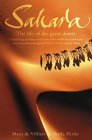
SAHARA, THE LIFE OF THE GREAT DESERT Mark de Villiers and Sheila Hirtle. Harper Collins, 2003
It is generally unavoidable to write about history while not having been there, but it is surely indefensible to attempt to describe the geography of a region with virtually no firsthand experience.The authors start off promisingly by dismissing the customary romanticism laid on the Sahara as “outsider thinking”: the “pitiless sun” being no more than the “pitiless traffic” of Fifth Avenue. Thereafter great empires of West Africa are well accounted for (lifted from a previous book of the authors?) but beyond that, and their visits to Niger and Timbuktu, they get in a complete muddle. The howlers start from page 9 when we learn that the Tanezrouft is an erg and later that In Salah is “an epicentre of the oil industry” and Leptis was dug out of the sand. The nature of the harmattan wind also happens to contradict all previous sources, Ghat is an all but abandoned Tuareg camp and – get this – the canyon of Iherir contains the Sahara’s only perennial river! This is a clanger of Saharan proportions but will hopefully bring some income to the poor village of Iherir when the whitewater brigade turn up.The problem is that the authors have been to the Sahara just a couple of times, more than most it is true but surely not enough to attempt a book such as this?
One gets the impression they fell for the enigmatic Tuareg (as you do) and thought “heck, let’s write our new book about Sahara and those shimmering courtly nomads!” Anyone who would dare take on such a task surely ought to read French and German. Perhaps this is why the authors quote repeatedly from a limited range of the usual English-language sources: Barth, Nachtigal plus Africanus and other ancients and the few Brits like Clapperton that put pen to paper. But they use these 19th century explorers as if they were as reliable as anyone and relevant today – including ancient spellings; have they not even heard of a Mich 953/741 map? Having done a lot of their groundwork fifteen years ago, Porch’s excellent ‘Conquest of the Sahara’ (see below) gets a good work out while Heseltine’s ‘From Libyan Sands to Chad’ (1955, and a great little classic) is the veritable horse’s mouth for Chad and the Tubu (so never mind about Jean Chapelle’s ‘Nomads Noirs du Sahara’ then). And last but not least is the Encyclopaedia Britannica (online version…) for all those last-minute queries. What a give away. Elsewhere the embellishment is irritating if to be expected – though you would have thought not in the “moonscape” Aïr, one of the few places in the Sahara where one suspects the authors have actually been. They certainly do not appear to have visited the desert areas of Morocco, Chad, Sudan, Algeria, Tunisia, Mauritania or even Egypt, or have nothing accurate to say about these places. But I liked the section on weather and also got a better understanding of the eminence of Old Ghana in the heyday of the trans-Sahara trading caravans.
In the end though, the authors prove that they too are outsiders – overlooking or skimming vast parts of Saharan geography like the Gilf Kebir (and not just the ‘Western Desert’), the Tassili and Akakus, the distinctive Moorish culture and the Reguibat and the ongoing Tubu rebellion. They extrapolate from maps whose context they misunderstand: we learn that “dunes cover most of Western Sahara” and long-abandoned Tagheza somehow overrules Taoudenni today as a source of salt. They miss out on contemporary political upheavals too, as if they wrote the book 20 years ago. So it is that comprehending the Tuareg rebellion in Niger, (something which has set these people back years and was one of Micheal Buckley’s better achievements in Grains of Sand) isn’t allowed to interfere with eulogies on their preternatural guiding abilities, etc; the same, tired old Tuareg schtick.
The trouble with making stuff up or guessing is that, besides making a fool of the authors, the reader does not know what else is fictitious and so the book’s value is lost. Europe is the source of the greatest works on the Sahara, either through direct historical connection or learning. The definitive work on the Great Desert will, or may already be, written in French or German. This book certainly is not it.
Alain Sebe has been photographing and privately producing high quality large format picture books on the Sahara for over 20 years, covering the Tuareg, the Tassilis, rock art, Sahara from the air, etc.
With a new publisher he has brought out more general titles at lower prices, but with no reduction in quality. Last year’s we got L’Image du Sahara an overview of 33 years desert travel and now Sahara, Atlantic to the Nile is a virtual photo journey from the Western Sahara to the Nile – and it’s in English too. It’s virtual in as much as this is another repackaging of earlier photos along a route not actually undertaken (I could be wrong here – there is a map in the back). It’s a common practise among photographers and does not undermine the result; a general Sahara picture book from the sub-Atlas Morocco to Tunisia and the Hoggar, the Tassili, Libya and Egypt.
Inside you get a fabulously rich album with text by the photographer’s son, Berny. The printing and paper are as good as it gets, with some stunning images, especially from the Moula Moula aerial collection. Algeria covers a fair slice of the book, as it should, with sections on rock art to adding to the whole Saharan panorama. We do not see the best of the amazing Gilf and Jebel Uweinat though and without Mauritania, Niger and Chad it’s still not the ultimate Sahara picture book I was hoping for. Sahara does not claim to be so and I’m sure the above three countries are in the Sebe pipeline. Then, once a general 400-page collection of those three countries is published along with the ones covered in Sahara, the ultimate Sahara coffee table book will be here.
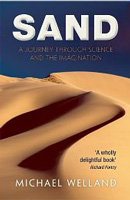
Sand – A journey through science and the imagination (US: Sand – The Never-Ending Story) Michael Welland, 2009
Bagnold’s Libyan Sands is one of the best books on desert exploration around, but I always consciously avoided taking on his better known Physics of Blown Sand, assuming it would be too hard going. So I hoped Michael Welland’s ‘Sand’ might have been an accessible compromise on the substance which any desert traveller inevitably finds fascinating.
Sadly this was not that book. Yes the author knows his science (perhaps too much of it?) and has researched the ‘imagination’ side thoroughly. He writes well too, but I suspect slack editors allowed him to pack just too much in and diverge too often (‘first book syndrome’?). And so you soon get bogged down and lacking any literary sand mats you begin to lose interest. Who else would get away with throwing in an A to Z appendix-like list of anything related to sand, like H for hourglass or C for construction.
I felt the author strayed from the topic of sand too many times to discuss general geological processes or whatever else took his interest. Even the desert landscapes chapter I ought to have devoured was surprisingly unsatisfying; he starts going on about the animals which burrow in the s….. After that I’m sorry to say I gave up and fast forwarded to the epilogue which revives the Libyan Desert Glass enigma and adds yet another personal anecdote. There are too many other good books to read, and I think the much quoted Sand, Wind and War also by Bagnold may be among them.
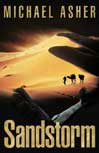
Michael Asher’s thriller is set in the Spanish Sahara of 1953 when, shortly before being garrotted, a mysterious stranger informs a grieving father in the UK that his son, Billy, survived a plane crash over the desert seven years earlier.
Both father (as well as more sinister agents) then set off in search of the boy who has since been brought up as a Reguibat warrior-hunter, because Billy holds the clues to the location of buried Nazi gold…
By p.27 you pretty much know how the yarn will pan out – maybe that’s the idea with this genre – and the final showdown in the quicksands is statistically a little far-fetched and unsatisfying. Nevertheless the journey to this point is entertaining and informative. Asher bestows the Reguibat (a Moorish tribe of Yemeni origins who make up today’s Saharawi people in Western Sahara) with many of the better qualities and customs of the Bedu of Arabia with whom the author spent many years.
Untypically, Stirling, the boy’s father is a pacifist who did time for his beliefs during WWII, while the baddies are not all scar-faced Nazis, but include other figures closer to home. The real heroes of course are the proud and honour-bound Reguibat nomads who despise our flabby and crass Western values. Like his mentor Thesiger, Asher cannot resist painting them as noble nomadic raiders wanting nothing more than peace with the despicable neighbouring tribes. At one point the Reguibat join forces with the pagan, dog-hunting Nemadi (also a real if extinct tribe, and a long way from Nema, it seems) and there is an amusing exchange tinged with truth when Muslim and pagan nomads belittle each others’ customs, language and dress.
The big themes in Sandstorm are betrayal, courage and loyalty among nomads and westerners alike – ‘honour’ in a word – and in telling its tale, Sandstorm avoids the worst cringe-making clichés of this genre (on which I’m not an expert) while opening a window on a little known people and part of the Sahara. It compares well with Desmond Bagley’s Flyaway (see review) and is much better than Cussler’s dreadful Sahara. Asher generously credits John Mercer’s Spanish Sahara (see review) for much of his information .
With its over-obvious title and gushing back cover reviews of the author’s previous book, Sandstorm looked promising. It’s the tale of Mortimer, a once lauded war correspondent now down on his luck, banging out restaurant reviews. Then one morning in a New York bar he reads an obituary to a French photo journalist, the beautiful Celeste Dumas (has there ever been a butt-ugly French photo journalist?). Flashback: Algeria 1976 and their shared adventure and fleeting romance as they broke the news of a Tuareg uprising – a story which launched Mortimer’s international career (but not their romance, to his everlasting regret). A defining event much later in the same country brings about his professional downfall.
The start offers some suspense as the lovers head south into the desert on the trail of this great scoop. We soon tick off the obligatory “water… water…” scenario in the dunes – but then the actual event which was set to explode on the world’s front pages passes by before you notice. I had to flick back, convinced that some pages were missing. From that point it was difficult to empathise with Mortimer’s dire need to wire in his groundbreaking story (the feeble ‘foreign-oil-company-funds-Tuareg-fight-for-homeland-in-return-for-oil-rights strand might have been pinched off Cussler himself). In the meantime Celeste’s uncertain feelings for Mort are hinted at, as well as her ambivalence towards their seemingly glamourous and important work. After surviving a near-drowning off the western Saharan coast, Mortimer sets his sights for fame and glory, but can’t persuade the still-traumatised Celeste to join him – she just wants to go back home to photograph lambs.
Flash forward 18 years (not 15 as the jacket on my copy said) and Pulitzer-prize winning Mort finds himself back in Algiers covering some riots, but the ‘great error of his professional life’ is another feebly shallow scenario cooked up off the cuff.
We hear that Shukman is an award-winning poet and this novel was expanded from a short story, but Sandstorm seems hampered by its ‘luvey’ literary genre; the low-brow adventure element doesn’t marry with lovelorn Mortimer’s supposed cynicism and subsequent moral failure. It’s telling of the author’s poor grasp of the region, its people and history, that in his book the newspapers describe the revolt as “the most romantic war of the half-century”. Has any 20th-century conflict ever been described so? The reasoning behind the displacement of real Algerian place names is also unclear (one assumes the action is happening around real-life Tindouf, miles from Tuareg country), and the muddling of real historical events is confusing – though maybe only to those who know of them. The location of the real Saharawi wars of the Western Sahara in the 1970s becomes a more bibliogenic Tuareg rebellion which never happened (at least not for another 15 years, and then in Niger and Mali). The desert is rendered with more purple than a bishop at a Prince gig and one has to ask, is the renaming of the real Rio de Oro as ‘Rio Camellio’ a joke – and how long did it take to cook up ‘Food International’ as an aid agency name? About as long as the ‘great error of his professional life’.
I am sorry to report that Sandstorm turns out as lame as a three-legged camellio with concussion.



 Sahara Overland