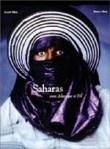
Alain Sebe has been photographing and privately producing high quality large format picture books on the Sahara for over 20 years, covering the Tuareg, the Tassilis, rock art, Sahara from the air, etc.
With a new publisher he has brought out more general titles at lower prices, but with no reduction in quality. Last year’s we got L’Image du Sahara an overview of 33 years desert travel and now Sahara, Atlantic to the Nile is a virtual photo journey from the Western Sahara to the Nile – and it’s in English too. It’s virtual in as much as this is another repackaging of earlier photos along a route not actually undertaken (I could be wrong here – there is a map in the back). It’s a common practise among photographers and does not undermine the result; a general Sahara picture book from the sub-Atlas Morocco to Tunisia and the Hoggar, the Tassili, Libya and Egypt.
Inside you get a fabulously rich album with text by the photographer’s son, Berny. The printing and paper are as good as it gets, with some stunning images, especially from the Moula Moula aerial collection. Algeria covers a fair slice of the book, as it should, with sections on rock art to adding to the whole Saharan panorama. We do not see the best of the amazing Gilf and Jebel Uweinat though and without Mauritania, Niger and Chad it’s still not the ultimate Sahara picture book I was hoping for. Sahara does not claim to be so and I’m sure the above three countries are in the Sebe pipeline. Then, once a general 400-page collection of those three countries is published along with the ones covered in Sahara, the ultimate Sahara coffee table book will be here.
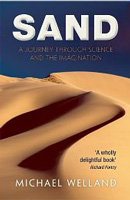
Sand – A journey through science and the imagination (US: Sand – The Never-Ending Story) Michael Welland, 2009
Bagnold’s Libyan Sands is one of the best books on desert exploration around, but I always consciously avoided taking on his better known Physics of Blown Sand, assuming it would be too hard going. So I hoped Michael Welland’s ‘Sand’ might have been an accessible compromise on the substance which any desert traveller inevitably finds fascinating.
Sadly this was not that book. Yes the author knows his science (perhaps too much of it?) and has researched the ‘imagination’ side thoroughly. He writes well too, but I suspect slack editors allowed him to pack just too much in and diverge too often (‘first book syndrome’?). And so you soon get bogged down and lacking any literary sand mats you begin to lose interest. Who else would get away with throwing in an A to Z appendix-like list of anything related to sand, like H for hourglass or C for construction.
I felt the author strayed from the topic of sand too many times to discuss general geological processes or whatever else took his interest. Even the desert landscapes chapter I ought to have devoured was surprisingly unsatisfying; he starts going on about the animals which burrow in the s….. After that I’m sorry to say I gave up and fast forwarded to the epilogue which revives the Libyan Desert Glass enigma and adds yet another personal anecdote. There are too many other good books to read, and I think the much quoted Sand, Wind and War also by Bagnold may be among them.
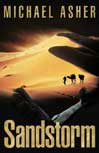
Michael Asher’s thriller is set in the Spanish Sahara of 1953 when, shortly before being garrotted, a mysterious stranger informs a grieving father in the UK that his son, Billy, survived a plane crash over the desert seven years earlier.
Both father (as well as more sinister agents) then set off in search of the boy who has since been brought up as a Reguibat warrior-hunter, because Billy holds the clues to the location of buried Nazi gold…
By p.27 you pretty much know how the yarn will pan out – maybe that’s the idea with this genre – and the final showdown in the quicksands is statistically a little far-fetched and unsatisfying. Nevertheless the journey to this point is entertaining and informative. Asher bestows the Reguibat (a Moorish tribe of Yemeni origins who make up today’s Saharawi people in Western Sahara) with many of the better qualities and customs of the Bedu of Arabia with whom the author spent many years.
Untypically, Stirling, the boy’s father is a pacifist who did time for his beliefs during WWII, while the baddies are not all scar-faced Nazis, but include other figures closer to home. The real heroes of course are the proud and honour-bound Reguibat nomads who despise our flabby and crass Western values. Like his mentor Thesiger, Asher cannot resist painting them as noble nomadic raiders wanting nothing more than peace with the despicable neighbouring tribes. At one point the Reguibat join forces with the pagan, dog-hunting Nemadi (also a real if extinct tribe, and a long way from Nema, it seems) and there is an amusing exchange tinged with truth when Muslim and pagan nomads belittle each others’ customs, language and dress.
The big themes in Sandstorm are betrayal, courage and loyalty among nomads and westerners alike – ‘honour’ in a word – and in telling its tale, Sandstorm avoids the worst cringe-making clichés of this genre (on which I’m not an expert) while opening a window on a little known people and part of the Sahara. It compares well with Desmond Bagley’s Flyaway (see review) and is much better than Cussler’s dreadful Sahara. Asher generously credits John Mercer’s Spanish Sahara (see review) for much of his information .
With its over-obvious title and gushing back cover reviews of the author’s previous book, Sandstorm looked promising. It’s the tale of Mortimer, a once lauded war correspondent now down on his luck, banging out restaurant reviews. Then one morning in a New York bar he reads an obituary to a French photo journalist, the beautiful Celeste Dumas (has there ever been a butt-ugly French photo journalist?). Flashback: Algeria 1976 and their shared adventure and fleeting romance as they broke the news of a Tuareg uprising – a story which launched Mortimer’s international career (but not their romance, to his everlasting regret). A defining event much later in the same country brings about his professional downfall.
The start offers some suspense as the lovers head south into the desert on the trail of this great scoop. We soon tick off the obligatory “water… water…” scenario in the dunes – but then the actual event which was set to explode on the world’s front pages passes by before you notice. I had to flick back, convinced that some pages were missing. From that point it was difficult to empathise with Mortimer’s dire need to wire in his groundbreaking story (the feeble ‘foreign-oil-company-funds-Tuareg-fight-for-homeland-in-return-for-oil-rights strand might have been pinched off Cussler himself). In the meantime Celeste’s uncertain feelings for Mort are hinted at, as well as her ambivalence towards their seemingly glamourous and important work. After surviving a near-drowning off the western Saharan coast, Mortimer sets his sights for fame and glory, but can’t persuade the still-traumatised Celeste to join him – she just wants to go back home to photograph lambs.
Flash forward 18 years (not 15 as the jacket on my copy said) and Pulitzer-prize winning Mort finds himself back in Algiers covering some riots, but the ‘great error of his professional life’ is another feebly shallow scenario cooked up off the cuff.
We hear that Shukman is an award-winning poet and this novel was expanded from a short story, but Sandstorm seems hampered by its ‘luvey’ literary genre; the low-brow adventure element doesn’t marry with lovelorn Mortimer’s supposed cynicism and subsequent moral failure. It’s telling of the author’s poor grasp of the region, its people and history, that in his book the newspapers describe the revolt as “the most romantic war of the half-century”. Has any 20th-century conflict ever been described so? The reasoning behind the displacement of real Algerian place names is also unclear (one assumes the action is happening around real-life Tindouf, miles from Tuareg country), and the muddling of real historical events is confusing – though maybe only to those who know of them. The location of the real Saharawi wars of the Western Sahara in the 1970s becomes a more bibliogenic Tuareg rebellion which never happened (at least not for another 15 years, and then in Niger and Mali). The desert is rendered with more purple than a bishop at a Prince gig and one has to ask, is the renaming of the real Rio de Oro as ‘Rio Camellio’ a joke – and how long did it take to cook up ‘Food International’ as an aid agency name? About as long as the ‘great error of his professional life’.
I am sorry to report that Sandstorm turns out as lame as a three-legged camellio with concussion.
THE SEARCH FOR THE TASSILI FRESCOES Henri Lhote, 1959 (o/p)
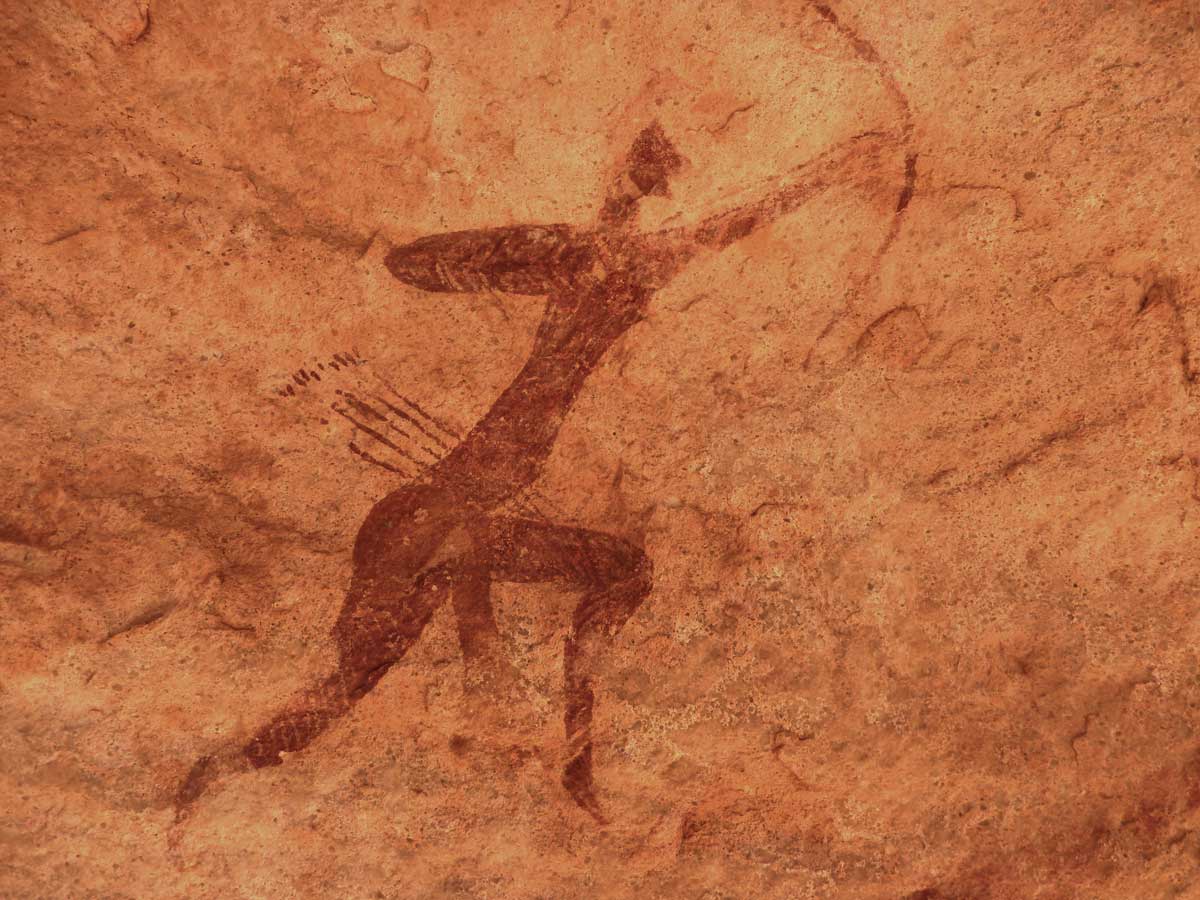
There are several picture books describing or including the rock art of the Tassili. The best known though not best admired is this one: The Search for the Tassili Frescoes published (in English) in 1959 and easily available used on the web. It was he who led an expedition to record the art for posterity as the colony of Algeria was slipping out of France’s hands. Unfortunately Lhote and those in his service adopted the practise of wetting the rock art to produce more vivid photographs – something which has accelerated fading in a few decades after surviving millennia on the plateau.
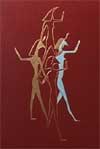
In this case he may not have known any better, though a little-known Swiss expedition recorded many of the Tassili’s sites in the late 1940s; doing a much more thorough job than the well-publicised Lhote missions. But Lhote was also accused of turning a blind eye and indeed including fakes (painted as a joke) among his recorded discoveries. The slinky quartet known as ‘The Bird Headed Goddesses of Jabbaren’ are known to be one such fake, supposedly included (but excised from later editions and indeed Jabbaren itself) to help attribute the style to ancient Egyptian influences. If anything it was probably the other way round.
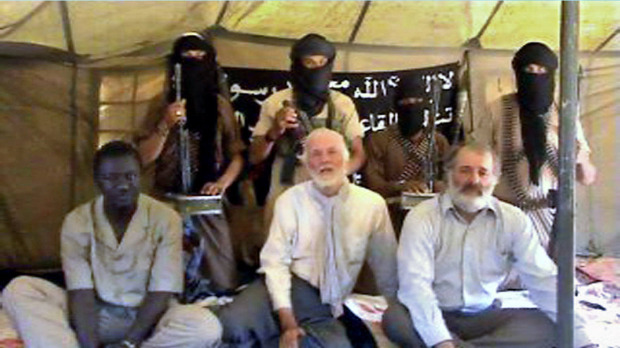
Robert Fowler’s account of his four-month captivity in northern Mali with Louis Guay in 2009 doesn’t so much leap off the page as grab you by the ears and haul you in. I read it over a weekend because here at last is a lucid, thoughtful and detailed description of an experience about which many wonder: ‘how would I cope?’. And before the first page is turned Fowler answers that question: ‘better than you’d assume’.
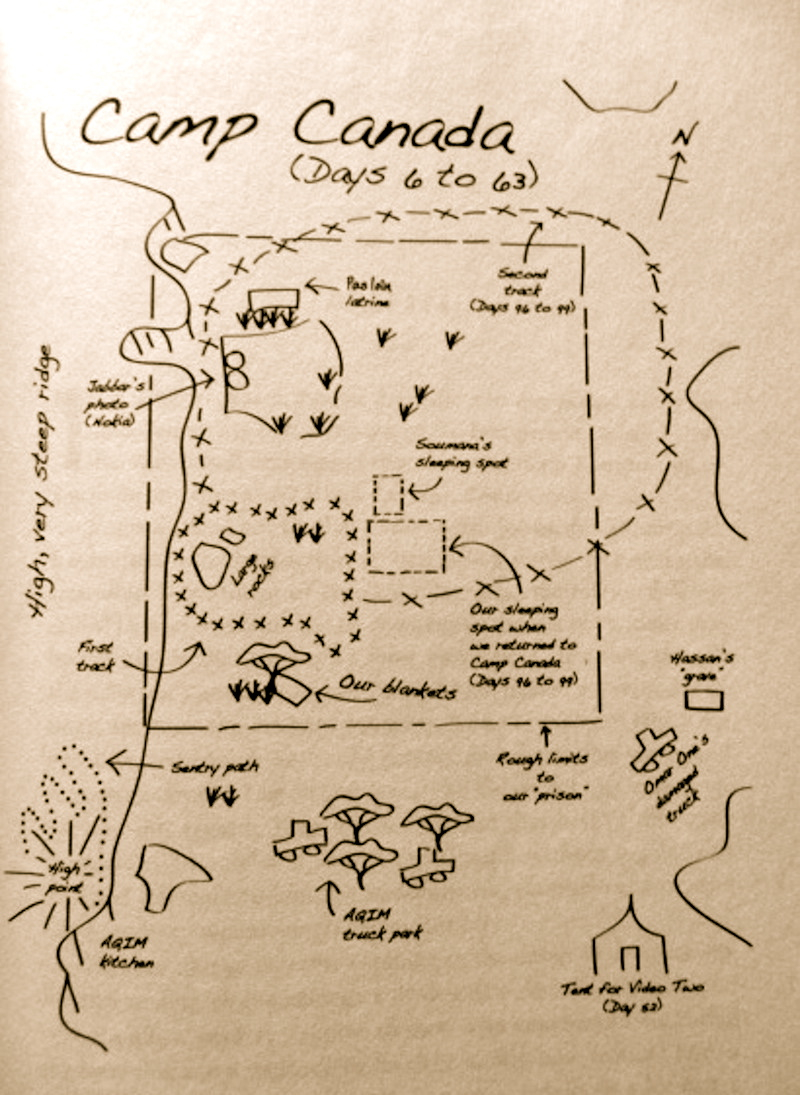
Thankfully, a lazy Day 1, Day 2… diary format is avoided. Instead, events or themes are covered over the pair’s months ‘en brousse’, while fending off the malice, provocations and mind games of their captors, as well as navigating their own inevitable mood swings. Some like to dismiss AQIM and similar groups as mere criminals enriching themselves from smuggling and kidnapping. If that’s the case then Fowler’s abductors, led by Moktar bel Moktar (‘MBM’, who went on to organise the deadly gas plant raid in Algeria in 2013) put up a convincing performance refuting that. Not one of the ragged jihadists failed to try and convert the two diplomats to Islam while at ‘Camp Canada’, and vigorous religious debates dominated the gang’s conversations, rather than which Rolex they’ll buy with their share of the loot.
Throughout this episode both Fowler and Guay were put to the test, but astutely deployed their hard-won diplomatic nous to help lessen their misery, as well as using other methods to maintain morale. One topic I thought oddly absent was any obsessive discussion over food. Some emotionally sensitive subjects were proscribed, but you’d think the harmless pleasure in food fantasies would be fun.
After months of uncertain negotiations, unexpected gifts, hurried relocations as well as calls home, somewhere in the desert the two Canadians are finally handed over to shady mediators. With them are two desperately emaciated European women, kidnapped by more brutal rivals who are deeply unsatisfied with the settlement. In a tense denouement the two AQIM leaders face each other down but MBM prevails. The jeeps speed south and diplomatically staged photo calls, long-overdue ablutions and happy family reunions ensue. The book ends with a warning that action must be taken against the scourge then oppressing northern Mali (in January 2013 the French led Operation Serval invaded the area). There’s also an unapologetic swipe at the way the RCMP handled Fowler and Guay’s abduction.
For some the elephant in the room is the matter of ransom payment – denied by the Canadian government. Fowler was kept in the dark but elucidates in appropriately equivocal terms: ‘… there tends also to be a difference between what governments do and what they say, and this seems to me quite reasonable… Many countries adopt what are more or less pragmatic approaches while others proclaim immutable doctrine, but I know for certain that everybody has blinked at one time or another…’ Wikileaks since revealed that €700,000 was paid and AQIM prisoners released, thus prolonging the scourge. The conduit for the cash was the then convenient treasury of Ghadafi’s Libya, in return for unspecified concessions.
Some speculate about publicity bans put on former Saharan hostages (nearly 100 in the last decade) by their governments; perhaps a condition for covering the usually denied ransoms. If that was the case with Robert Fowler, he ignored it. ‘A Season in Hell’ illuminates their desert captivity in vivid detail, including as far as they could gather, the motivations of the people who abducted them. It might even be read as a manual on how to cope with such an experience. However you choose to take it, it’s highly recommend.
Possibly of pensionable age but with experience with Bactrian camels as well as living in Africa and speaking Hausa, John Hare sets off to traverse the great trade route from former Borno Kanem (northern Nigeria) to Tripoli. With him are his chums: an even older Kenyan farmer, a Chinese academic and the relatively young Johnny to do the chores, plus Tubu and Tuareg cameleers and two dozen camels.
The organisation and permission for this trip goes unerringly smoothly – even the intractable Libyans are up for it and so the guides and camels turn up on time and the crew sets off reversing the camel prints of Hanns Vischer’s 1906 trek (the author’s inspiration), if not Denham, Clapperton and Oudney’s 1822 expedition. So far so good. But what should have been a stirring account of a historic trans Sahara trek plods along without enough engagement. Interminable quotes from Denham and Vischer fill the gaps, but there is barely a conversation recorded between the protagonists (a Brit upper lip was stiffly maintained, perhaps) while the local guides come across as the customary grumps.
Anticipated highlights like the Bilma Erg slip by in a couple of paragraphs while the dreary Hamada el Hamra is built up to epic proportions. One fails to get an impression of what the undoubtedly arduous three-month trek along a little-known Saharan axis was really like, even on a practical level. It all comes across as too easy and repetitive – perhaps it was, although it’s interesting to learn about the history of this trade route and why it became depopulated. It’s on this level that the book has something to offer, rather than using camels as a mode of travel in the Sahara.
A cult novel by the Tangiers literary guru based on the author’s own experiences in North Africa. Not a thoughtful gift for a nervy visitor to Morocco, but a thrilling read if you like your desert with a bit of sex, madness, infidelity and death. Bertolucci’s eponymous 1985 film turned out to be a hackneyed desert romance with dashing Tuareg princes, graceful caravans crossing golden dunes and ululating tribes women at every village. While certainly good-looking (filmed partly in the Tenere), it fails to get its teeth into the inscrutable, existential quandaries of the protagonists. Although he appeared in one of the final scenes, Paul Bowles had this to say of the film: It should never have been filmed. The ending is idiotic and the rest is pretty bad.
The track from the Police’s Synchronicity album, Tea in the Sahara, relates a morbid legend described in this book.
This astonishing yarn expands on the gruelling tale of the 1815 wreck and enslavement of the crew of the American brig Commerce mentioned in Spanish Sahara reviewed elsewhere. The ordeal the crew suffered at the hands of the barbaric Western Saharan tribes (described collectively but not so accurately as ‘Saharawi’) is truly horrendous. At that time (and indeed right up to the St Exupery era), ransoming of foreigners to European trading posts at Essaouira or St Louis was the norm, but the Commerce had the misfortune to run around Cap Boujdour midway between the two.
Pounced upon and subsequently sold on and on to other nomads for a blanket or other chattels, the miseries of the beaten, stripped and starved crew as they tramp around the desert of present day southern Western Sahara and northern Mauritania are based chiefly on the Commerce‘s Captain Riley’s own account. This book gained wide popularity following his eventual rescue and even influenced Lincoln’s anti-slavery attitudes. For weeks at a time the best drink they could manage was cupping their hands behind a urinating camel and most lost half their body weight. Some lost their minds.
You do have a feeling the author, more familiar with maritime than desert matters, embellishes a little too heartily at times, but it all helps to drive the narrative along with barely a dull moment. This is a survival story on par with Shackleton’s amazing escape from Antarctica, and right up to the very end their continued depredations leave you guessing as to the final outcome.
John Mercer visited this tightly controlled colony as power was slipping from Spain’s hands and the region’s Saharawi people faced recolonisation led primarily by Morocco, that resulted in the protracted Polisario conflict which endures today with the territory divided by the berm. All that was about to kick off as the book ends, and up to that point Mercer gives a very through account of this seeming Saharan No Man’s Land starting with geology, natural history and prehistory. The Berber history of the Almoravids who conquered most of Spain leads to the feeble (or unproductive) Portuguese and Spanish incursions of the late Middle Ages on which Spain based its colonial claim in the late nineteenth century. We also read about the activities of early traders like the Scot, Mackenzie, whose fortress-like trading counter still lies off Cape Juby an adventurer-entrepreneur who tried to buy into the rich trans-Saharan caravan trade before it got to Moroccan markets. Or the depredations suffered by Alexander Scott and James Riley, shipwrecked in the early nineteenth century, but who at least lived to tell the tale (see: Skeletons on the Sahara review).
We also get what must be the best English-language account of the tribes of that region closely related to today’s Moors; the well-known Arabised Reguibat, the Delim and other lesser clans who, when not raiding each other, preyed on shipwrecks, their victims and early explorers. Their complex allegiances, culture, customs and daily life is especially detailed, as in an account of the manoeuvres behind the French colonisation of the region. Resources was what they were after: the world’s largest source of phosphate at Bou Craa, the iron ore at Zouerate and the rich offshore fisheries.
It may be 30 years old, but its hard to think of a more thoroughly researched account (in English) that opens up the Western Sahara and its neighbouring regions – you’ll find it used on the web from around a tenner.




 Sahara Overland