
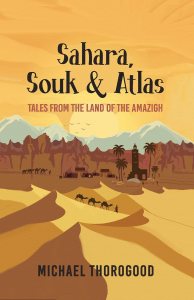
Sahara, Souk & Atlas: Tales from the Land of the Amazigh
By Michael Thorogood
In a line
Dense history but otherwise disappointing and disingenuous,
What they say
Strapped to Africa’s northern shores, Morocco is a staggering land of harsh desert, high mountains and spellbound medinas. Sahara, Souk & Atlas: [Tales from the Land of the Amazigh] recounts two journeys across this land. From spontaneous beginnings, these journeys become a passage to the heart of North Africa’s indigenous people. They know themselves as the Amazigh, ‘free people.’
For millennia, the Amazigh were the dominant force across North Africa. They were a seemingly unconquerable people, but today they are fighting for cultural recognition in the lands where their ancestors lived. This book tells their remarkable story of rebellion and resistance.
From the souks of eccentric Marrakech, to the guilds of pious Fez, enclosed are tales that dig to the roots of Moroccan society. Brace for a gripping journey through a land of diversity, from the tribal High Atlas and lawless Rif, to campfire folklore beneath the stars with desert nomads, whose way of life is on the brink.
Travelling as I do, mostly through the Amazigh lands of southern Morocco and wanting to learn more, I was hooked by the title and cool cover. For less than a couple of quid it was worth an e-punt.
More commonly known as ‘Berbers’, a term coined by the Romans (Barbary Coast is a derivation), Amazigh is what they call themselves, meaning the free people. From Siwa to the Atlantic, the Amazigh are the indigenous inhabitants of North Africa before the Arab conquest of the Maghreb in the 8th century.
Had I noticed the telling ‘this is a work of creative non-fiction…’ disclaimer, or better still, just looked at the map, I’d have clocked how superficial the author’s Moroccan travels were. To be fair, Thorogood admits he was just 20 on his first visit, and maybe a year older on the next. Both were holidays undertaken with largely unmentioned backpacking chums.
An overnight camel trek round the back of Erg Chebbi seemed an odd start. Then the penny started dropping when the group visited the leather dyeing souk in Fez, another odd place to get under the skin of the modern Amazigh condition. By the time they were larking about on a home-built raft below Ouzoud Falls – the ‘Todra Gorge’ of Morocco’s few waterfalls – pennies were spilling over me like I’d hit triple gold on a slot machine. The ‘lawless Rif’ you ask? That was a day trip to Chefchaouen.
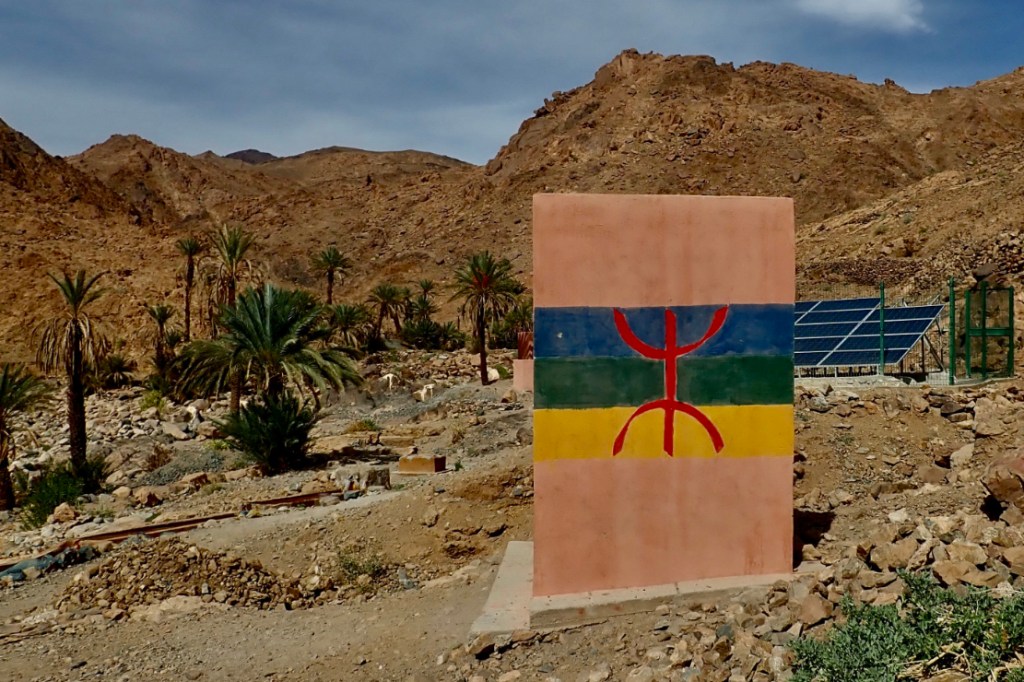
Amazigh consciousness or identity has prospered in the reign of the current King Mohamed VI, and one thing you learn is that their subjugation (banning of the Tamazigh language and so on) was introduced by his cruel and oppressive father Hassan I – part on an old Arab Alawite dynasty who established modern independent Morocco. Since Arab Spring protests of 2011 lead to limited reforms, we also learn that Amazigh identity has become more noticeable and the neo-Tifinagh alphabet more visible. You will also see the yaz (‘z’) figure of the ‘free man’ all over southern Morocco, both as furtive graffiti or bold banners, much like you see the Ⓐon a Hackney wall, ‘Oc’ in the Occitan lands of southwest France, and perhaps the fish symbol in the early Christian era. These Banksy-an icons suggest the mystique of an underground movement and underdog’s resistance to the established order. And just as with the Tuareg, some westerners are drawn to romanticise the ‘free people’.
Critically, the author was held back by barely speaking French (far less, Tamazigh) and so could only engage with the few English speakers at the tourist traps they visited. Here of course, like the tourists before them, they were spoon feed the practised Amazigh ‘of the desert born…’ schtick about the Ways of the Nomad.
These encounters added nothing other than travelogue padding (with laughably exaggerated episodes), compared to the much more detailed historical research of Amazigh dynasties from the Arab conquest onwards, which read like another book.
We read that the idea of a united Amazigh identity was always a far fetched notion, as medieval Amazigh clans and movements rose and fell: Almohadin ousted Almoravid and so on. Then a growing Arab population established its dominance from the 15th century and, like much of the Maghreb, Arabisation followed. By this time, after several centuries southern Spain’s Al Andalus had been reconquered by the Christians. All very wiki-interesting if a bit too dense for me, and possibly the subject for the author’s thesis he may have been writing at the time.
I suspect this book span off that thesis, the old idea of: heck, we had a great holiday in a foreign land, let’s make it into a book. I know it’s only blurb but claiming that ‘these journeys become a passage to the heart of North Africa’s indigenous people’ is sadly, preposterous. Sahara, Souk & Atlas is a long way from what the title claims: an anthropological study of a contemporary Moroccan underclass seeking to improve their prospects against the dominant Arab elite or Makhzen. It was not the book I was hoping to read.
 Sahara Overland